



Abstract
Although media-audience encounters are always potentially open to different interpretations, little is known about the textual mechanisms that encourage polysemy. Focusing on a story about a CEO who pledged to drastically cut his pay to increase his employees’ salaries, this study compared news reports that covered the same event but were met by different levels of polysemy in their reception. Through a combination of frame and semiotic analysis, the study pinpoints differences in content and style between news stories that were met by interpretive convergence from audiences (low polysemy) and those that were met by interpretive divergence (high polysemy). Based on these differences, a typology of three textual mechanisms is offered to explain the range of polysemy in the news: the attributes and representation of characters, the use of empiricism versus mythology in structuring conflict, and the level of closure versus uncertainty in the story’s conclusion.
Introduction
Polysemy describes the phenomenon of media texts being interpreted in multiple, and sometimes contradictory ways by their audiences. Stemming from a cultural studies tradition that highlights the interpretive agency of media audiences (e.g., Fiske, 1987; Hall, 1980; Liebes and Katz, 1990), polysemy denotes the inevitable “openness” of media texts.
Polysemy is useful for explaining the lack of consensus with which media messages are received. However, the concept’s utility in analyzing the social negotiation over meaning is circumscribed by a lack of theorization about textual mechanisms that augment or limit polysemy. We do not know why some media texts are met by divergent interpretations from their audiences while others are met by convergent interpretations. This gap is especially pronounced in relation to news, a genre that received less attention for its polysemic qualities than popular culture (though see Caragee, 2003; Jensen, 1990; and Roeh and Cohen 1992).
Addressing this gap, this paper presents a comparative semiotic analysis of news reports that covered the same event—a pledge by CEO Dan Price to pay a minimum annual salary of $70,000 to all his employees in an attempt to “combat income inequality.” Drawing on a previous study that examined audience interpretations to this story, it compares reports that were met by interpretive divergence with those that were met by convergence, in order to identify textual features that augment and restrict polysemy. Price’s initiative is a case study of Corporate Social Responsibility (henceforth, CSR), a term that spans a variety of practices employed by corporations to exhibit ethical business conduct. The ambiguities regarding CSR as a business and social practice create a fertile ground for an exploration of meaning multiplicity in the news.
Using a method I label audience-informed textual analysis, the paper pinpoints elements of content and style that distinguish between high and low-polysemy articles. Based on these observations, it offers a typology of three general mechanisms related to character, conflict, and conclusion, that augment and limit polysemy in news writing.
The semiotics of polysemic media and their audiences
The origins of research into media polysemy can be traced to literary distinctions between “readerly” and “writerly” (Barthes, 1978) or “closed” and “open” (Eco 1984) texts. Readerly/closed texts arouse uniform expected responses, whereas writerly/open texts elicit varied interpretations, targeting a reader who can grasp the text’s complex network of codes. Fiske, 1987) argued that polysemy is an attribute of commercial media because of its reliance on broad audiences. Popular texts arguably contain unresolved contradictions, creating “semiotic excess,” which audiences can exploit to modify the text’s “preferred reading” (Hall, 1980).
Polysemy is an elusive construct that dwells between the text and its audience. It is encoded into the text (intentionally or not) by its creators, but its potential is only realized when receivers decode the text in different ways. This duality is reflected in the concept’s parallel uses in media studies. Polysemy is the premise of reception studies seeking to decipher how audiences interpret the media they consume (e.g., Liebes and Katz, 1990). Polysemy is also a key concept in textual analyses that explore the semiotic complexity of media texts like sitcoms, movies, and advertisements (e.g., Fiske, 1987; Rowland and Strain, 1994; Scott, 2012) and the features that distinguish polysemic/“open” from “closed” texts (Boxman-Shabtai and Shifman 2014; Roeh and Cohen 1992)
Research is inconclusive about the polysemic potential of news. According to Hartley, 1982, the intrinsic polysemic nature of current events is reduced as much as possible in the journalistic text, contrary to literature and pop-culture which celebrate polysemy. Caragee’s (2003) analysis of news coverage of the cold war found that it promoted frames that resonated with American values and restricted the potential polysemy of the reported events. Focusing on reception, Jensen, 1990 argued that audience discourse about the content of news and the practices surrounding its consumption exhibited restricted polysemy.
On the other hand, Morley, 1980 influential study of audience decodings of the Nationwide news program captured the diversity of interpretations that audiences from various class positions articulated in their reception. Focusing on texts, Roeh and Cohen (1992) suggested that news reports could be open to multiple interpretations. They compared news reports that covered a clash between Palestinians and Israeli security forces during the first Palestinian uprising (“Intifada”) and unveiled a relationship between semiotic openness and the pursuit of journalistic objectivity. Somewhat counterintuitively, they found that the more rhetorically balanced, factual, and neutral the story, the more it was open to competing interpretations. Conversely, stories that used poetic, mythological, and stylized elements foreclosed multiple interpretations.
Research about polysemy in general, and in the news in particular, tends to focus either on the semiotics of texts or on the interpretations of their receivers, making it difficult to capture the intricate relationship between the encoded message and its decoding dynamics. This paper stemmed from a research project that utilized Decoding Convergence-Divergence (DCD) to unpack how polysemy is encoded into the news and decoded by its audiences (Boxman-Shabtai 2020). One of the principles of DCD is audience-informed textual analysis, which entails conducting a semiotic analysis of media texts only after analyzing their reception by the audience. Insight about reception fulfills two goals for the subsequent textual analysis. First, it maps the range of interpretations articulated by the audience. Second, it enables a classification of texts into high and low-polysemy categories based on their observed interpretive range rather than assumptions about their proper or probable interpretations. As the analysis in this paper will demonstrate, audience-informed textual analysis does not substitute for the semiotic exploration of polysemy in a text, but rather enriches it with evidence. The textual analysis takes a life of its own after audience analysis. It may develop interpretations beyond audience decodings, but it will do so with awareness of them.
This paper is focused on journalistic texts. However, it draws on a previous study that examined how audiences decoded them. In other words, I categorized texts as marked by high and low textual polysemy based on observed divergence and convergence in audience reactions. Before delving into the analysis, the following sections present the topic of CSR and the case study of Gravity Payments’ 70K Initiative.
Corporate Social Responsibility (CSR) and the media
In 2019, The Business Roundtable, an association of influential CEOs, issued a statement on the purpose of a corporation. The statement argued that companies should invest in employees, suppliers, customers, communities, and the environment, rather than solely to shareholders.
This shift in rhetoric came after decades of increasing economic inequality, a recession, and the emergence of social movements like Occupy Wall Street that drew public interest to the perils of crony capitalism. Corporate America responded to this climate of suspicion by stressing its commitment to CSR. The term CSR includes various models. One useful definition is a set of “practices that improve the workplace and benefit society in ways that go above and beyond what companies are legally required to do” (Vogel, 2006: p.2).
CSR aligns corporate support of social issues with brand and revenue building (Mukherjee and Banet-Weiser, 2012), a win-win situation supposedly. It enables citizens to express their values by “voting” their social preferences through what they purchase, whom they work for, and where they invest (Vogel, 2006). However, CSR has detractors. Critics from the right argue that it diverts resources away from the corporation’s core mission (Vogel, 2006). Critics from the left argue that CSR offers the chimera of ethical corporate self-interest as a substitute for public regulation (Giridharadas, 2018).
Research about media depictions of CSR is scarce. Tench, Jones, and Bowd (2007) suggested that although British journalists covered stories about CSR, they were more likely to report about irresponsibility in the corporate world. An analysis of Dove’s Real Beauty Campaign suggested that through direct appeals to social media users, the corporation harnessed users’ desire for meaningful engagement with social causes to brand loyalty (Banet-Weiser, 2012). Pairing news stories about social issues with advertisements showcasing a corporation’s CSR has been found to generate positive responses from readers about brands and social causes (Li 2020).
Journalistic coverage of CSR offers a productive context for the analysis of polysemy. CSR is an increasingly salient yet developing practice. It could trigger established interpretative frames, either critical (e.g., “crony capitalism”) or favorable (“symbols of prosperity”) towards the role of corporations in the public sphere, depending on one’s political–economic persuasion. Nevertheless, the novelty and ambiguity of CSR could potentially give rise to new meanings that transcend knee-jerk partisanship-based reactions. To better appreciate the relationship between CSR, journalists, and polysemy, this study focused on one story about CSR that was met by a broad range of reactions in the media.
“The poster child for ethical capitalism”
On 13 April 2015, Gravity Payments CEO Dan Price made an announcement to his employees that snowballed into a viral news story. Gravity Payments is a Seattle-based company that provides credit card processing services. In an event coordinated with journalists, Price informed his 120-member staff that he planned to raise the minimum salary of all employees to $70,000 per year. To offset costs, Price announced that he would cut back his $1.1 million compensation to $70,000 and reroute company profits to payroll.
Price was inspired to act when a friend who earned $50,000-a-year confided with him that she was struggling to make ends meet. Realizing that he was paying some of his employees a similar figure and wondering what compensation would allow a dignified living, he recalled a study by Kahneman and Deaton (2010), that identified an annual salary of U$75,000 as the point after which the effects of increased income cease to improve well-being. He thus resolved to implement $70,000 as a company-wide minimum salary.
This story encapsulated contemporary debates about CEO compensation and the plight of the middle class in facing rising costs of living into a simple narrative. It epitomized the win-win logic of CSR: Price defined the initiative as a moral imperative while emphasizing its expected return on investment. Price’s approach was marked by polysemic potential. Slashing his own compensation partially curtailed criticism of CSR as lip service to social justice although the resultant publicity could be perceived as a calculated reward undermining the purity of his social agenda.
Seeking to identify semiotic mechanisms that foster polysemy and lack thereof in news reporting, this paper asks How do textual features in news reports about the 70K Initiative explain patterns of audience divergence and convergence in the interpretations of the story?
Method
The central methodology used to answer this research question was a semiotic analysis of journalistic texts reporting on the announcement of the 70K Initiative. Following the principles of “Decoding Convergence-Divergence” as a framework for analyzing meaning multiplicity in the media (Boxman-Shabtai, 2020), the semiotic analysis was preceded by an analysis of the texts’ reception. This audience-informed textual analysis involved the following stages: (a) compiling a corpus of news reports, (b) analyzing how audiences decoded them, and (c) probing the texts for mechanisms that explain convergent and divergent readings.
The corpus of news stories compiled focused on a single event—Price’s announcement of the initiative. I collected reports from Media Cloud (https://mediacloud.org/), using the string “Dan Price” AND “Gravity Payments” and confining the search to the week following the initiative’s announcement. For the purpose of audience analysis, only news stories posted on the Facebook pages of news outlets were sampled. This procedure yielded a corpus of 14 items which included nine news reports about the 70K Initiative and five video interviews with Price. This paper focuses on the nine news reports, from the following outlets: Business Insider, BuzzFeed News, Huffington Post, Market Watch, The Los Angeles Times, The New York Daily News, The New York Times, and Vox.
To understand how audiences decoded the sampled news stories and to distinguish between divergent stories (those met with a broad range of interpretations, i.e., highly polysemic) and convergent stories (narrow range of interpretations, i.e., low polysemy), I first examined how the stories were received by various audiences. The following paragraphs provide a very brief description of the methods and central findings from the audience analyses. For a more detailed account see Boxman-Shabtai (2020).
Background: Audience informed classification of convergent and divergent texts
The audience analysis consisted of two studies. The first examined 5995 comments reacting to the reports on Facebook. The analysis identified, qualitatively, salient interpretive frames across comments and then assigned a numerical score for the level of competition between frames within each comment thread, using the Herfindahl–Hirschmann Index of market concentration. The second study circulated a survey to 1197 workers on Amazon’s Mechanical Turk. The questionnaire probed participants for their interpretation of the texts by gauging their sentiment towards the 70K Initiative and their perception of bias in reporting about it.
These two sites and methods were chosen in order to balance the strengths and weaknesses of different approaches to audience analysis in communication studies. Facebook comments are characterized by their associative nature; they provided a naturalistic setting with high ecological validity and were mainly analyzed inductively and qualitatively. M-Turk surveys probed decoding in a more targeted manner; they provided higher internal validity and were mainly analyzed deductively and quantitively.
Three overarching patterns emerged from a comparison between Facebook and survey data. First, on both platforms the reception of this story was positive, especially in regard to CEO Dan Price. Second, political affiliation played a significant role in patterning sentiment towards the story. In the survey, for instance, liberals were overwhelmingly supportive of the 70K Initiative and saw the reporting about it as unbiased, whereas conservatives displayed more ambivalence about the initiative and perceived reporting about it to be more biased. Third, even after controlling for the political affiliation of respondents, some articles were found to generate more divergent decodings than others. Generally, articles scoring divergent in the survey were met by divergent comment threads on Facebook
Drawing on these findings, stories from The New York Times, Market Watch, and Vox were classified as divergent and stories from Huffington Post, Business Insider, BuzzFeed News, The Los Angeles Times, and The New York Daily News as convergent. Comparative textual analysis of the reports was performed according to the procedure detailed below.
Comparative semiotic analysis of convergent and divergent texts
The semiotic analysis combined a deductive use of predefined categories from previous studies of news frames with an inductive process of “open-coding” (Strauss and Corbin, 1990), aimed at identifying patterns and concepts for further development.
Using Pan and Kosicki’s (1993) scheme of frame structures, each paragraph of the news stories was coded for its syntactical, thematic, scripted, and rhetorical elements. Concurrently, I documented questions and free-floating observations that emerged from my reading of texts, including comparisons with previous literature about polysemic mechanisms. During the inductive analysis, I observed a script shared among convergent articles that revolved around Dan Price’s heroic journey. To address this motif, I incorporated literature about mythology and storytelling (e.g., Barthes, 1978; Campbell, 1949; Kelsey, 2016; Lule, 2001) in the subsequent analysis.
The analytical process was recursive: I reviewed and coded the articles multiple times, repeatedly comparing within and across convergent and divergent groups. Through this circular process, I fine-tuned the analytical categories and unresolved questions until achieving saturation. The analysis resulted in the identification of two areas of difference between groups: content, relating to the main frames organizing the different articles, and style/structure, relating to the manner with which articles expressed content through prose.
Convergence: “A capitalist solution to a social problem”
This section focuses on the five articles that were met by relatively convergent interpretations (low polysemy) across audience studies.
Dominant frames: Price’s persona and income inequality
Convergent articles weaved an individualistic frame focused on Dan Price with a broader social frame of income inequality, thus combining what Iyengar (1990) termed episodic and thematic frames.
Dan Price’s persona was central to convergent articles. This frame was evident visually in the use of portraits of Price as leading images (see Figure 1). It was also reflected in the headlines, where he was the subject and the transfer of compensation the predicate (e.g., “CEO slashes US$1 million salary to give lowest-paid workers a raise”—Huffington Post). Price’s centrality was further apparent in the substantial space given to his voice, through direct quotes and paraphrases. Images of Dan Price in convergent articles. Top to bottom: New York Daily News, Buzzfeed News, and Business Insider.
The focus on Price’s persona involved two themes—humility and business acumen. The humility theme, highlighted further in Price’s Jesus-like appearance, revolved around his pursuit of justice and his humble nature. Describing what motivated Price to launch the initiative, convergent articles explored Price’s pain in the face of injustice: “They were walking me through the math of making 40 grand a year,” he told the Times. “That just eats at me inside. As much as I’m a capitalist, there is nothing in the market that is making me do it.” (BuzzFeed News)
Price’s humble character was further strengthened in episodes that described his lifestyle. Convergent articles suggested that Price would be able to adapt to a $70K annual salary because: “He has saved a lot of the money he has earned since starting Gravity in 2004. He said he has no plans to replace his 12-year-old Audi, which has clocked more than 140,000 miles. And his new salary will still allow him to pick up the bar tab for his friends once a month, he said.” (Huffington Post)
On the other hand, convergent articles highlighted Price’s business acumen by describing his business track record and the profitability of Gravity Payments. Framing Price as a competent businessman balanced his quixotic actions with pragmatism and credibility.
Convergent articles also set the 70K Initiative in the context of broader debates about income inequality. Some highlighted the wage gap between workers and CEOs. For example, BuzzFeed News stated that: “This move is unprecedented, as the average CEO in the United States reportedly makes over 300 times what the average worker makes.” Others focused on activism to raise the federal minimum wage to $15 an hour which originated in Gravity Payments’ hometown of Seattle. The Los Angeles Times, for instance, used this as the article’s hook, asking at the outset: “Forget $15 an hour. How about $70,000 a year?”. The New York Daily News used the colorful “war on low wages” descriptor to link Price’s announcement to nation-wide protests demanding higher wages. The issue of inequality was sometimes voiced by Price. For example: “There’s greater inequality today than there’s been since the Great Recession,” Price told The Huffington Post on Tuesday. “I’d been thinking about this stuff and just thought, ‘It’s time. I can’t go another day without doing something about this.” (The New York Daily News)
Thus, income inequality served two purposes in convergent articles: it provided context and framed the 70K Initiative as an exception to the current status-quo in corporate America and it added depth to Price’s motivations, framing him as an extraordinary CEO.
Style and structure: The hero’s journey
Slight variations were evident in the sequential structuring of convergent articles—Huffington Post presented the story chronologically, The Los Angeles Times and Business Insider used the inverted pyramid structure and BuzzFeed News used the outlet’s signature “listicle” style. Despite these differences, convergent articles were stylistically similar in constructing a hero’s journey with a sense of closure.
Journalistic storytelling, despite an ostensive aspiration for detached prose, is rife with mythological elements; the archetypical hero figure is one example (Lule, 2001). Heroes are dramatized to personify the core values and tensions in a given time and place (Kelsey, 2016). Campbell, 1949 identified 17 stages that drive the hero’s journey, from its initiation, through departure, to a return. The basic pattern follows this formula: The hero is born into humble circumstance. The hero initiates a quest or journey. The hero faces battles or trials and wins a decisive victory. The hero returns triumphant.
A reading of the convergent stories with attention to mythological elements suggests the following flow. The normal life of Dan Price, the hero, is changed when confronted with the suffering of his low-earning friends and employees; these constitute his Call for Adventure. Committed to this quest, Price Encounters a Mentor, in the form of sages Kahneman and Deaton who provide guidance—a numerical value for happiness. Price’s public announcement about the 70K Initiative represents The Belly of the Whale, the final stage in the act of departure. This stage signifies the hero’s separation from his known world, and a commitment to transformation. Cutting back his salary to $70,000—equal to the lowest-paid employees in the firm under the new initiative—represents Price’s metamorphosis into a man of the people and the Road of Trials he will endure.
Although the results of Price’s journey were still unknown, convergent articles constructed a symbolic sense of triumph. One device was the development of Gravity Payments employees as the figurative princess character, that is, the subject that is saved in the plot’s conclusion (Propp, 1968). Convergent articles emphasized employees’ salvation from economic hardship through quotes that captured their jubilance and the initiative’s projected impact on their lives. For example: “My jaw just dropped,” Phillip Akhavan, a 29-year-old merchant relations worker, told the paper. “This is going to make a difference to everyone around me.” (The New York Daily News)
Furthermore, convergent stories provided their readers with a sense of closure. News stories generally strive to treat events as complete by presenting a beginning, climax, and end (Pan and Kosicki 1993). However, journalistic closure does not necessarily correspond with the realities of the covered event, as “news stories can be brought to an end when the ‘external’ narrative has not been resolved, or kept alive long after the story’s ‘material death’" (Tenenboim-Weinblatt, 2008: p.35). News stories about Price’s announcement are an example of the former. Since it was too soon to determine the outcomes of the initiative, closure was mainly conveyed by Price or others speaking on his behalf.
Closure manifested in two levels. One suggested that the initiative would be successful for Gravity Payments. The positive impact on employees was one facet of this closure. Another was Gravity Payments’ bottom line. Convergent articles discussed the potential financial rewards of the 70K Initiative. For example, Huffington Post reported that “Price sees the pay raises as an investment. In theory, workers motivated by higher salaries will ultimately attract more business and handle clients better.” On a broader level, convergent articles suggested that the 70K Initiative would be successful in addressing the social issue of income inequality. The most powerful type of closure combined the two levels of resolution. It is epitomized in the following quote from Price which concluded several stories: “This is a capitalist solution to a social problem’, Price said. ‘I think it pays for itself, I really do.”
Thus, by relaying mythological tropes of the hero’s journey and by suggesting a sense of closure, convergent articles left the reader with the impression that Dan Price’s journey is likely to be successful.
Divergence: “Is it crazy or genius to introduce a $70,000-a-year minimum wage?”
This section discusses articles that audiences interpreted in divergent ways.
Dominant frame: Conflict
Unlike convergent stories, divergent articles kept Price’s persona at bay, as apparent in the choice of images ((Figure 2). Divergent articles were marked by a conflict frame, which revolved around the plan’s applicability and the issue of income inequality. Images in divergent articles. top to bottom: New York Times, Market Watch, and Vox.
Conflict is a common journalistic frame that emphasizes disagreement between individuals and/or groups and a discourse of winners and losers (Semetko and Valkenburg 2000). Its dominance was evident in the opening sections of divergent articles. Market Watch and The New York Times framed their headlines around conflicting perspectives: “Is it genius or crazy to introduce a $70,000-a-year minimum wage?” (Market Watch), “Praise and skepticism as one executive sets minimum wage to $70,000 a year” (New York Times).
For the most part, conflict played out above Price’s head. Market Watch and Vox relayed the same quote of Price (that none of the convergent articles used): “Is anyone else freaking out right now? I'm kind of freaking out.” The quote’s placement in the lead section, detached from paragraphs detailing opposing positions about the initiative, removed Price’s voice from the conflict. The New York Times article gave Price more agency—he got the opportunity to respond to criticism (“he dismissed the back-seat business advice as misguided”), but Price’s appearance was marginal in placement and in volume.
The overarching conflict frame revolved mainly around the initiative’s applicability. Divergent articles questioned the economic merit of the initiative and challenged the relationship between income, well-being, and productivity. For example, Market Watch cited a study that contrasted the initiative’s economic rationale, suggesting that fear of losing money is a more efficient incentive than gaining money.
Divergent articles were also skeptical of the initiative’s wider impact. Vox was most invested in this frame. Under the subtitle “what if every CEO did this?”, it considered the case of Walmart CEO Douglas McMillan ($25 million reported 2014 salary), who employs roughly one million hourly employees. If McMillan were to cut his salary to $70K, each of his employees would get an annual raise of about $25. The conclusion of this exercise: (…) the huge divergence in what Price can achieve with a pay cut and what the much-better-paid McMillan can achieve with a pay cut goes to show that the math of this kind of enterprise is heavily dependent on the size of the company.
The New York Times conveyed similar reservations about the initiative’s broader applicability, by suggesting that the plan is good for Gravity Payments but not necessarily for other firms. Market Watch argued that the initiative was dangerous for Gravity Payments and for the economy as a whole. It quoted a businessman - “this is more crazy than genius” (thus answering the provocation in the article’s title), and a busines scholar—“I would not want to live in an economy where all the CEOs were Mother Teresa.”
Finally, divergent articles framed income inequality as an unresolved position within the overarching conflict. After detailing statistics about increasing income gaps, Market Watch’s concluding paragraph described Gravity Payments as anomalous to the realities of the market. The article did not refute the argument that income inequality is a social problem but suggested that this problem is not going away: “The gap in wages is unlikely to change, Sackett says, despite the efforts by small tech companies where demand exceeds supply.” In The New York Times, the issue of income inequality, and in particular, a critique that Price made about setting chief executive pay based on what other chief executives earn, was sandwiched between opposing views, one unresolved argument among many.
Vox similarly positioned inequality, and specifically—the topic of wealth redistribution—as one side in a debate, shifting tone from one position to another with little explanation. After challenging the applicability of the initiative and its scientific premise, the article’s final paragraphs took a sharp turn. Not only did they endorse the idea of income redistribution in a corporate setting (an idea that was described earlier in the article as unrealistic for large corporations) but also, they concluded that “In a political setting, it means that taxing the rich to finance tax credits or health insurance for the poor and the working class will make for a happier country.” This conclusion had not been set up at all throughout the article.
Thus, divergent articles were underlined by discrepancies in their treatment of the inequality frame. The Times and Market Watch set up problematic facets of income inequality as arguments but neglected to address them within the conflict structure. Vox suggested solutions to income inequality that were not supported by the debate it constructed.
Structure and style: Rhetoric of empiricism and balance
In contrast to convergent articles that stylized their storytelling around the hero’s journey, divergent articles employed a prosaic style that appealed to balance and empiricism.
Divergent articles did not necessarily employ a rhetoric of neutrality. In fact, Market Watch and Vox published the most opinionated articles in the corpus. However, they made an effort to balance opposing views about the 70K Initiative by providing comparable space to critical and favorable positions. Market Watch and The New York Times created balance by zigzagging between supportive and critical segments. Vox encased a relatively lengthy critical section challenging the initiative’s applicability between a favorable introduction and conclusion.
Taking the rhetoric of facticity identified by Roeh and Cohen (1992) a step further, divergent articles employed a rhetoric of empiricism. Rather than merely reporting the facts, divergent articles emphasized empirical evidence and the scientific method as means to evaluate phenomena like the 70K Initiative. All of the divergent articles referenced research papers, statistics, and surveys. Market Watch and The New York Times quoted economists and other academics extensively. Vox was structured as an essay that conducted its own exercise in evidence-based reasoning.
The amalgamation of content (conflict) and style (rhetoric of balance and empiricism) in divergent articles presented Price as a potential “loser,” a message far removed from his personification of the hero-on-a-journey in convergent articles. In the limited depictions of Price’s character in divergent articles, he certainly came off as a “good guy.” Market Watch described Price’s initiative as a decision to “boldly go where few have gone before,” and he was acknowledged as altruistic. The many skeptics quoted in The Times article did not target Price personally, and if they did mention him, he was portrayed in a benevolent manner (“He’s young. He has a good intent, but wrong method”). Vox stated outright that “It's a wonderful story, and Price deserves the plaudits he's receiving.” On the other hand, divergent articles suggested that failure is a realistic outcome for Price’s 70K Initiative. Evidence challenging the initiative’s scientific and social applicability and sources voicing opposition to the plan’s ideology and viability suggested the initiative would be a losing strategy for Gravity Payments and/or for society as a whole.
Discussion: Polysemic mechanisms in journalistic storytelling
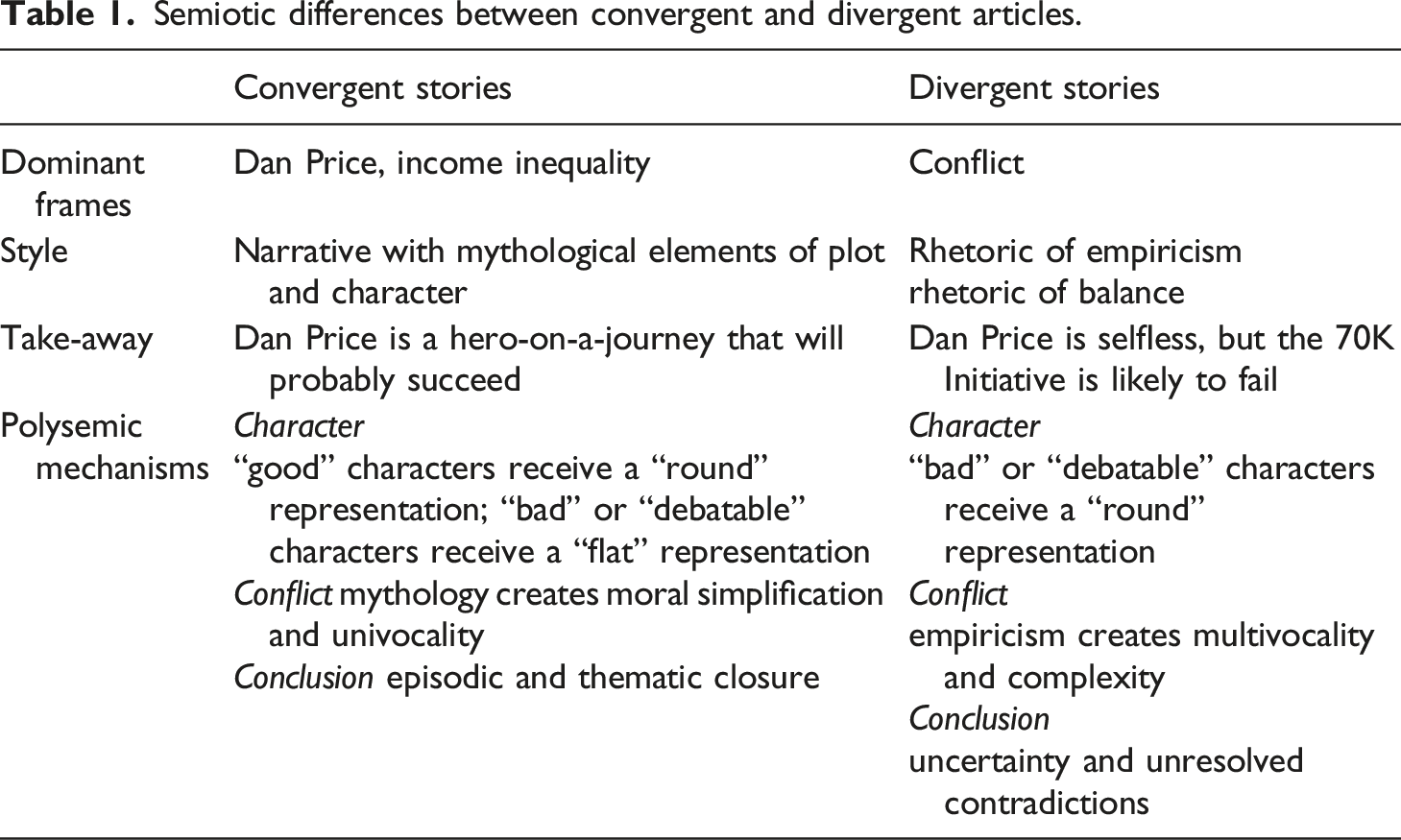
Semiotic differences between convergent and divergent articles.
Character: Attributes and representational depth
The news media often focus on individuals, as evident in personalization patterns in the coverage of politics (e.g., Balmas et al., 2014). Within this individual focus, the combination of character attributes and representational depth creates different pathways in the creation of textual openness. Characters can be roughly divided into straightforward or debatable personalities and their representation can be round or flat.
The first distinction, between straightforward and debatable personalities concerns the figure’s attributes. Dan Price gained his fame for selflessness and business savvy—unambiguously positive qualities. Most people have a mixture of “good” and “bad” attributes, and journalists may emphasize some components more than others. It is easier to reduce unknown individuals to moral binaries, whereas public figures with robust reputations tend to fall within the “debatable” category.
The second distinction, between round and flat representations, has to do with the character’s literary treatment. Round characters (often found in features and profiles) are leading protagonists; they encounter challenges and evolve throughout the plot; they are fully developed and complex. In contrast, flat characters are secondary; they do not grow substantially in the course of the narrative; they are unidimensional and lack emotional depth.
Convergent articles about the 70K Initiative emphasized Price’s positive characteristics by developing a round character. If Price started off as a good person, his journey transformed him to an even better version of himself, creating semiotic closure around his persona. Divergent articles did not dispute Price’s positive attributes, but rather treated him as a flat character, which prevented the text from being overwhelmed by his virtues. This point is evident, conversley, in the coverage of villains. Terrorists, for example, who have been conventionally treated by the press as flat and evil characters have become more commonly represented in feature articles exploring their personalities and motivations through “round” character development (Kampf 2014). One reason these practices are controversial is that they open the possibility for polysemic character representations.
By utilizing different combinations of attributes (“good,” “bad,” and “debatable”) and representations (“flat” vs “round”) journalists can shape a character’s salience in the text and the range of meanings associated with it. Characters that receive round representations play a central role in the text’s meaning. Round representations of “good” characters are not expected to be particularly polysemic, as they glorify the figures we root for. Conversely, the combination of “debatable” or “bad” personalities with round representations, especially if they suggest that questionable characters will gain the upper hand in the depicted narrative, is potentially polysemic as it defies expectations of poetic justice (Boxman-Shabtai and Shifman, 2014). Flat representations de-emphasize characters, thus granting them less significance in the text and allowing other features of the news story to shape its meaning.
Conflict: Empiricism versus mythology
Conflict was omnipresent in news articles about the 70K Initiative. Divergent articles presented conflict as a debate marked by balance and empiricism. They pitted different sources against one another, which resulted in multivocality, namely the incorporation of multiple voices and perspectives in a manner that expands a text’s meaning (e.g., Bakhtin, 1982). The rhetoric of empiricism reinforces multivocality since it emphasizes evidence (adding voices) and logical reasoning (adding complexity). However, it may pose a potential limit on a text’s multivocality, as it favors voices of elites (like academics, entrepreneurs, and opinion leaders).
Conflict was embedded in convergent stories too: The hero’s journey highlights tension between good and evil, powerful and powerless, savior and villain. However, if the balanced and empiricist stylization of conflict emphasizes complexity and multivocality, a mythological structure encourages simplification and univocality. According to Barthes, 1972, myths organize the social world by establishing “blissful clarity.” The myth “serves to flatten the complexity, the nuance, the performative contradictions of human history; it presents instead a simplistic and often univocal story” (Bell 2003: p.75).
Thus, the presentation of conflict as an empirical debate between positions bringing forth opposing sources of evidence augments polysemy through multivocality, whereas the presentation of conflict through a mythological structure limits polysemy as it simplifies reality.
Conclusion: Uncertainty versus closure
Finally, the conclusion that journalists promote in their reporting, evident in the article’s denouement and tone, influence the potential for meaning multiplicity. Divergent news stories are marked by uncertainty whereas convergent stories offer closure.
In the case of the 70K Initiative, divergent stories juxtaposed Price’s optimism about his mission to “solve income inequality” with pessimism on the social issue. They were marked by “narrative-valence discrepancy” (Boxman-Shabtai and Shifman 2014), presenting Price as likeable but conveying skepticism about his ability to pull off the initiative and change society. A careful reader of such articles might be confused about the nature of the problem, since income inequality was framed as one side in an unresolved debate. Conversely, convergent articles conveyed optimism. Despite being chronologically removed from a point of resolution, they offered readers a sense of closure. By discussing the initiative’s potential positive effects and echoing Price’s enthusiastic rhetoric, they suggested that the initiative would be successful for Gravity Payments and for society as a whole.
Although a central aspect of news framing concerns the promotion of solutions to social problems (Entman 1993), it is not always clear that they exist, especially in the early stages of an unfolding news story. A general principle that could be derived from this study’s findings is that divergent articles refrain from offering solutions, highlighting instead the contradictory facets of social problems, whereas convergent articles provide their readers an impression, through closure, that social problems could be solved.
Conclusions
This article set out to explain how polysemy is encoded in news writing. Employing a semiotic analysis, it identified differences in framing and style between news reports that evoked convergent reactions and those that triggered divergence in their reception. These differences are summarized under the following general mechanisms: character (the combination of “bad” or “debatable” attributes with round representation augments polysemy), conflict (empiricism augments polysemy, mythology limits it), and conclusion (uncertainly augments polysemy, closure limits it).
More broadly, this research provides evidence that the polysemic potential is realized by both journalistic texts and their audiences, despite the powerful codes that prioritize preferred readings in the news (Hartley, 1982). Corroborating Roeh and Cohen’s (1992) findings, the comparison between divergent and convergent texts demonstrates that the very core ideals of news production demarcate polysemy. The pursuit of journalistic norms like detachment, balance, and facticity (though interestingly not neutrality) in divergent texts created openness and multivocality whereas the appeal and esthetic of popular culture created semiotic closure in convergent texts. For journalists who continue to define their profession vis-à-vis traditional values amidst technological and cultural change (Witschge, 2012), this conclusion suggests a puzzling idea. The same values that grant journalists professional authority as practitioners undermine their semiotic authority over meaning.
Although the focus on a single news story was instrumental for this study’s comparative analysis, it limits the generalizability of its findings. In order to develop a comprehensive theory of polysemy in the news, it will be necessary to examine more case studies and to refute, corroborate, and/or fine-tune the identified textual mechanisms accordingly. Although every case study can be fruitful, the following considerations relating to audiences, media systems and content may be especially helpful in charting a way forward.
First, a crucial aspect of polysemy is the text’s audience. The audience analysis that preceded and informed the current study was based on interpretations of American news readers. In order to fully appreciate polysemy, it is necessary to consider cultural differences in decoding. Future work could utilize a comparative, audience-informed textual analysis to examine news polysemy across cultural contexts. Such an approach would likely nuance textual mechanisms identified in this paper. Considering characters, it would be worthwhile to explore the cultural specificity of “good,” “bad,” and “debatable” characteristics. For example, attributes like “hutzpa” (audacity) are polysemic in Israel but not necessarily elsewhere, whereas stupidity is by many accounts a universally negative and ridiculed attribute (Boxman-Shabtai and Shifman, 2014).
Second, selecting case studies from different media systems would help elucidate the role that platforms, institutions, and journalistic routines play in shaping the meanings multiplicity of news stories. This study focused on news reports published by mainstream media. Other types of news—for example, alternative, hyper-local, or staunchly partisan—may introduce different semiotic mechanisms. For example, new forms of journalistic storytelling based on cliffhanger installments (like the podcast hit “Serial”) may struggle to incorporate closure in their reporting, which could necessitate other mechanisms to limit polysemy.
Third, considering the content of news, an examination of stories with different ideological intensities would help delineate the contours of meaning multiplicity across social issues. One aspect to consider is the story’s level of ideological polarization. Does polysemy work differently in polarizing topics compared to stories that present ideological ambiguity? I argued that the presentation of conflict through mythological elements limits polysemy whereas the appeal to an empirical debate augments it. However, in stories that capture highly polarizing topics/characters an appeal to emotion through mythology might open an otherwise restricted and predictable interpretive sphere. Another relevant aspect is a story’s relation to the ideological status-quo. By selecting case studies that vary in their level of contrarianism, we may ask whether polysemy assumes a different form in stories that align with hegemonic values compared to those that promote a radical message.
In that vein, the significance of interpretive convergence is noteworthy. If polysemy denotes ideological fissures within a text, its absence hints at presuppositions that are not contested by journalists and audiences. Future studies will benefit from an analysis of the taken for granted in texts presenting limited polysemy. For example, convergent stories about the 70K Initiative implicitly accepted the notion that social reform could be entrusted in the hands of corporations and individuals like Price. The “capitalist solution to a social problem” catchphrase that Price propagated, and many journalists picked up, is premised on the assumption that social problems can and should be resolved within the realm of the market. Convergent articles did more than accept the ideology of CSR at face value. They used it as the premise for a moving narrative about Price’s personal quest to restore justice, thus reinforcing the neoliberal ethos of entrepreneurship and individual responsibility (Harvey, 2005) and foreclosing debates about CSR as a practice that lacks the transparency and accountability of public policy carried out by democratically elected officials (Giridharadas, 2018).
These avenues for future research illustrate not only the magnitude of work that remains in developing a full-fledged theory of polysemy but also the potential utility of such a theory. Polysemy stands at the intersection of media audiences, texts, and producers. It permeates every aspect of communication. Polysemy, as Fiske, 1987 argued, is a textual concept that mirrors society: The range of meanings found in polysemic texts echos the range of socio-cultural positions among the text’s consumers. Thus, a theory of semiotic mechanisms that augment and limit polysemy not only deepens our understanding of texts but also the various actors and power dynamics underscoring them.
Footnotes
Acknowledgments
I am indebted to Edith Boxman, Aymar Jean Christian, Wendy Griswold, Blake Hallinan, Limor Shifman, Keren Tenenboim-Weinblatt, and James Webster for their thoughtful comments on different versions of this manuscript.
Declaration of conflicting interests
The author(s) declared no potential conflicts of interest with respect to the research, authorship, and/or publication of this article.
Funding
The author(s) received no financial support for the research, authorship, and/or publication of this article.
