



Abstract
This article examines how journalists in non-permanent employment respond to their growing precarity. It is based on in-depth interviews with freelance journalists and interns who find that their working lives increasingly require entrepreneurial efforts. To work towards continuous access to journalistic work, these casually employed journalists engage in self-management and self-branding. To be able to make a living, they subsidize their income with work for clients outside of journalism that frequently offer better working conditions than news organizations but pursue narrow, strategic goals. The article develops a typology of non-journalistic work that illustrates that some non-journalistic jobs, but not others, cause these precarious news workers to defend their journalistic professional integrity. Furthermore, the study introduces Michel Foucault’s notions of the ‘entrepreneurial self’ and the ‘ethical self’ to interpret the different registers of professionalism between which journalists move today, identified as counter-, conforming and coping subjectivity. Thereby, the article uses a novel conceptual lens to make sense of resilience and change in journalistic professional identities under conditions of precarity.
Keywords
Introduction
Since the neoliberal turn characteristic of the 1980s and 1990s, employers’ and governments’ preference for flexible strategies of accumulation and regulation has eroded permanent, full-time employment (Vosko, 2006). Precarious forms of work such as self-employment, internships or combining multiple part-time jobs have been growing, and are generally defined by ‘limited social benefits and statutory entitlements, job insecurity, low wages and high risks of ill health’ (Vosko, 2006: 3). Many precarious workers today are well-educated but paste together intermittent jobs offering uncertain career progression and little pay (Standing, 2011). Precarity plays out across industries. For example, self-employed cultural workers struggle with copyright regimes increasingly favouring corporations rather than workers (Cohen, 2012), and high-tech employees internalize risk-taking formerly more expected of entrepreneurs (Neff, 2012). ‘Precarious academic labour forces’ (Busso and Rivetti, 2014: 15) teach on short-term contracts signalling that a job one is passionate about should compensate for a lack of employment security.
In the same vein, after assuming for decades that journalists work in full-time, secure employment and within traditional news organizations, journalism researchers have started to explore the increasing social and income precarity of news workers. Often, this literature uses a political economy perspective to make rising journalistic precarity understandable as a consequence of widespread conglomeration, financialization and labour flexibilization – developments which have been even more pronounced in the media industries than elsewhere (Almiron, 2010; Winseck and Jin, 2011). For example, studies have examined the lack of social security, decreasing incomes and increasing work loads of digital journalists (Cohen et al., 2014), the experiences of long-neglected groups of journalists such as freelancers (Edstrom and Ladendorf, 2012) and the often dangerous and invisible work news fixers perform for foreign correspondents (Palmer, 2019). Additionally, journalism researchers are interested in the impact of work-related stress on journalists’ health (Reinardy, 2016) as well as the diverse employment trajectories of journalists after they were laid off or took buyouts from news organizations (Cohen et al., 2019).
An emerging stream of literature on casual journalistic labour explores how news industry restructuring in journalism plays out in journalists’ professional identity constructions. For example, a study of Australian journalists (Patrick and Elks, 2015) points to professional identity as mediating perceptions of precarity: Journalists working for traditional media and holding a traditional professional identity perceive themselves as more precarious than those who define their professional self-image more generically as ‘readership-oriented’ (Patrick and Elks, 2015: 62) and work increasingly in brand journalism. A study of a news media start-up in France reveals that this fairly new form of organizing news work – founded in part to counter the demise of legacy media organizations – is not accompanied by a changing but rather by a traditional understanding of journalistic professional identity (Wagemans et al., 2016). Örnebring (2018), after a comparison of perceptions of precarity among journalists in Europe, concludes that journalists across national boundaries tend to ‘accept precarity as natural part of journalism’ (Örnebring, 2018: 109) due to journalistic professional norms they have internalized, such as individualized, rather than collective or cooperative understandings of professional autonomy. Furthermore, a study of job loss in Australian journalism shows that for some journalists, their professional identity is ‘likely to fade post-job loss’ (Sherwood and O’Donnell, 2018: 1021) while others retain this identity, even if they work outside journalism after losing news room jobs.
These studies demonstrate the ‘growing ambiguity of occupational identities’ in a context of news industry restructuring (Sherwood and O’Donnell, 2018: 1035). However, we still know little about how identity transformations play out with regards to activities not directly related to news production but critical to sustaining income and work flow, such as self-branding and non-journalistic ‘money jobs’ – especially when these supporting activities potentially enter into conflict with the public service ethos of journalism. More specifically, the study asks: How do casually employed journalists describe and re-define parameters of professional integrity, as they struggle with the consequences of precarity, including the need to work for clients outside of journalism?
The article, first, outlines the public service ethos at the core of journalistic professional identity, and puts this ethos in dialogue with the field of public relations and recent scholarly thinking on entrepreneurialism in journalism. I then lay out the theoretical framework based on Foucault’s governmentality thinking. After a presentation of the research method used, I show how the concept of governmentality underpins freelance journalists’ and interns’ narrations of non-journalistic jobs as well as their self-marketing and self-motivating strategies. I also build a typology that documents how engaging in non-journalistic jobs generates complex professional identities emerging in response to such competing professional commitments and attending ethical conundrums.
The public service ethos in journalism, corporate work and entrepreneurialism
Historically, endorsing objectivity as a hallmark of journalistic professionalism legitimized journalists’ normative role in emerging liberal democracies while simultaneously serving the business goals of early media capitalists (Hardt and Brennen, 1995; Lee, 1976). Today, critiques of objectivity and neutrality in journalism and evidence of their potential to generate inaccurate but dominant representations of the world and to perpetuate the status quo abound (Allan, 2010; Hackett and Zhao, 1998). Yet, these values are foundational to the public service function citizens and scholars still ascribe to journalism today (see McQuail, 2013; Ward, 2015). For example, McChesney and Nichols (2010) describe journalism as an institution that is a counterbalance to corporate and political power without which democracy would collapse. A number of Canadian journalism scholars agree that journalism is a significant, ‘civically relevant’ institution that ‘helps to sustain democratic life’ (Crowther et al., 2016: 4). We need journalism to help us understand ‘the complexity of what it means to be a citizen in the 21st century’ (p. 7) and recognize it as the ‘practice of indexing the present as it turns into history’ (Hanitzsch, 2011: 491). Such statements hint at an expectation that journalists’ main reference point is or should be serving a large public. Journalists widely perceive their role in society in accordance with such expectations, regardless if they consider themselves ‘populist disseminators’, ‘opportunist facilitators’, ‘critical change agents’ or ‘detached watchdogs’ (Christians, 2009; Hanitzsch, 2011).
As an anomalous profession – lacking monopoly over knowledge bases, state regulation and control over entry to the field – journalism is marked by continuous struggles over occupational jurisdiction and for professional autonomy (Schudson and Anderson, 2009). Thus, Deuze’s (2005) widely used definition of journalistic professionalism adds to the public service orientation discussed above not only timeliness but, crucially, autonomy and independence in the practice of news production. Compared to journalism as a profession, public relations has only over the past decades become a steadily growing occupational field with ever-increasing levels of professionalization, including ethics codes, and even more recently a field of academic study in its own right. It is a field keen on improving its image among publics as well as scholarly audiences (Yang and Taylor, 2013). For example, the Public Relations Society of America’s ethics code echoes similarities with journalism when it states that PR professionals serve the ‘public interest’ (Public Relations Society of America, n.d.) and contribute to ‘informed public debate’. Nonetheless, the values of independence, and fairness mentioned in the code are all explicitly invoked not to describe a relationship with the larger public – but instead a direct obligation of public relations professionals to their clients. In this ethics code, ‘independence’, for example, is interpreted as providing ‘objective counsel to those we represent’ (Public Relations Society of America, n.d.). In contrast, regardless of increasing pressures and unfavourable working conditions in newsrooms, professional autonomy defined as ‘control over journalistic content’ is still accorded by news organizations to journalists (Deuze, 2005; Willnat et al., 2013). Implying that a public service orientation remains at the core of journalistic professionalism, a group of scholars observe that: journalism (. . .) – that is, the primary sourcing, producing, and sharing of information about public affairs by independent professionals (. . .) – is fundamentally different from other kinds of communication genres (. . .). (Carlson et al., 2018: 9).
Most journalism scholars are unlikely to contest such a statement. However, a new paradigm in journalism research challenges the traditional belief that journalism as a unique form of public communication may render it incompatible with marketing, production or accumulation strategies used in other industries. Entrepreneurialism in journalism seeks to explore opportunities to renew journalism that emerge from an erosion of formerly strict boundaries between news and advertising departments or between the public service mission of journalism and its business side, validating the role of digital technologies in the process (Rafter, 2016). This includes studying how commercial and public service goals converge in crowdfunding initiatives in journalism, requiring the journalists in question to work towards both equally and at the same time (Hunter, 2016). Self-branding on social media is an entrepreneurial strategy found both among traditional journalists (Usher, 2014) and among freelancers who inspire editors in news companies to use these strategies more widely as tools to augment audience engagement (Holton, 2016). Moreover, news fixers – local workers offering translation and other services to foreign correspondents in crisis regions – are becoming more entrepreneurial by increasingly negotiating hiring processes via dedicated websites and platforms (Murrell, 2019). On the organizational level, researchers explore news companies’ experiments with agile production modelled on software companies (Deuze and Witschge, 2018), or news start-ups in journalism that receive funding from venture capitalists (Usher, 2017). In contrast, some scholars find that entrepreneurialism in journalism has the potential to exacerbate rather than address the crisis of journalism. Cohen (2015: 527) observes that adopting an ‘entrepreneurial mode’ in journalistic work, rather than resulting in news innovation, encourages ‘a market-oriented identity’ that has historically been foreign to journalists. Siapera and Papadopoulou (2016: 179) point out that value creation in entrepreneurial journalism generally means profit generation rather than quality news reporting, avoiding the fundamental question of ‘the social role and values of journalism, and the extent to which (. . .) business values are inimical to these’. This study explores this very tension between business values and the social role of journalism, using Foucault’s governmentality thinking to understand the professional identities freelance journalists and interns develop in response.
Theoretical framework
Foucault developed the governmentality concept to describe the dominant mode of governance and the resulting subjectivities in the postmodern era. In this study, the concept is used to theorize how precarious journalists conceive of their professional identities. The governmentality concept explains how, rather than using direct, coercive powers, governments of postmodern states address the problem of managing large bodies of individuals by giving them far-reaching liberties to make their own decisions (Miller, 2010). That is, individuals are guided ‘through their freedom’. In other words, states tend to: prompt them to govern themselves, to give them positive incentives to act in a certain way and understand themselves as free subjects. Governing means creating lines of force that make certain forms of behaviour more probable than others. (Bröckling et al., 2011: 13, emphasis in original)
States and institutions now use incentives that ‘aim in a complex way at steering individuals and collectives’ (Bröckling et al., 2011: 1). The concept signals the ‘double character (of power) as a practice of subjugation and a form of self-constitution’ (Bröckling et al., 2011) or, in other words, the co-evolution of statehood and subjectivity. Thus, a crucial aspect of governmentality theory is that it erases any convenient or simple way to differentiate between power and domination or disempowerment, containing a radical element of non-determinism. Foucault’s shift towards a more nuanced notion of the process of subject constitution – namely governmentality – was inspired by a neoliberal concept of the subject: what was then the brand-new theory of human capital, introduced by Chicago school economist Gary Becker. In his lectures at the Collège de France in 1979, Foucault engaged in an in-depth examination of this theory (Lorenzini, 2018). Human capital theory was the first economic theory to offer a concept of workers not as objects of employers, but subjects endowed with considerable will and decision-making power. Based on this, Foucault developed his own concept of the ‘entrepreneur of the self’. Workers that are ‘entrepreneurs of the self’ maximize the return on capital they possesses – such as skills, genetics, cultural background, etc. – in a global marketplace (Lorenzini, 2018). This particular version of self-governance and self-management, however, is not occurring naturally or arbitrarily. Rather, it is the encouraged, preferred form of subjectivity in neoliberal governance regimes. Such regimes, most prominently embodied by the rise of Ronald Reagan in the United States and Margaret Thatcher in the United Kingdom, transfer formerly collective or public responsibilities from institutions – such as the state or employers – to individual citizens and workers. This marks the transition from a Keynesian welfare state to a neoliberal state cutting universal social programmes and benefits while privatizing others, introducing punitive workfare measures, and undermining collective organizing through curbing trade union power. The active, ‘enterprising self’ is needed to deal with the fallout from this governance change where the state retreats from the provision of formerly public services such as childcare, health and education and aligns with employer interests when deregulating labour markets and employment rules (Wilson, 2018). In other words, the ‘entrepreneurial self’ emerges in response to the widespread precarity introduced by neoliberal policy regimes. It is a form of individualized management of risks previously overseen by state agencies or employers or shared collectively (Wilson, 2018).
The persistence and prevalence of the, ‘entrepreneurial self’ today suggests this subject position is not simply ‘false’ or ‘exploitative’ but has become a source of identity formation in its own right, through which actors make sense of themselves and the world around them (Davies, 2014: 10). The notion of radical freedom and decision-making power implied in this subject position resonates with many workers and citizens. As the flipside of such freedom, however, it is not surprising that researchers of ‘everyday neoliberalism’ often find people accepting individual responsibility – as ‘entrepreneurial selves’ – for structural problems such as unemployment or poverty (Braedley and Luxton, 2010). However, the ‘entrepreneurial self’, in its ability to exercise a radical freedom of choice by allocating energies, choosing activities and investing resources according to the highest expected return – already contains a tendency that can be part of its own demise as a purely instrumental means to an end (Dilts, 2011). Foucault thought its logic through to the end, taking human capital theory much further than economists such as Gary Becker had ever intended. Towards the end of his life, in The care of the self (1988) Foucault turned to possibilities for an ethical subjectivity under neoliberalism. The emphasis here is on what Foucault calls ‘technologies of the self’, namely strategies that individuals employ to perform work on themselves. The focus moves to the self-conscious, self-reflexive use of those ‘technologies’, rather than purely entrepreneurial actions designed to generate a return on investment. These technologies, as Foucault elaborates, permit ‘individuals to effect by their own means or with the help of others a certain number of operations on their own bodies and souls, thoughts, conduct, and way of being, so as to transform themselves in order to attain a certain state of happiness, purity, wisdom, perfection or immortality’ (Foucault, 1988: 18).
In sum, the subject positions assumed by an individual are not arbitrary but incited and invited by the state, culture or society, with neither individual nor structural forces holding necessarily or permanently an upper hand in the process (Dilts, 2011). Domination of the self by external forces or imposition of a certain subjectivity, such as the ‘entrepreneurial self’ can never be complete because the self is able to act upon and re-form itself, due to its ability for self-reflection and self-care. Subjectivities in neoliberalism might be incited to be ‘enterprising’ but they can recognize, through their ability for self-reflection, the environment or regime that conditions them, ‘thinking self-consciously about the production of that regime of truth’ (Dilts, 2011: 145). This is key to envisioning an ethical self and actions that are alternatives to those an entrepreneurial self would take. Self-interest turns into self-development by refusing the investment logic driving all aspects of life and work under neoliberalism.
Method
The research presented here is part of an ongoing research project on journalists in non-standard employment in Canada and Germany. The findings discussed in this article are based on 25 semi-structured, in-depth interviews with freelance journalists and interns in both countries (10 interns and 15 freelancers). The interviews were conducted in person and face-to-face with participants in Canada and Germany, and lasted between 60 and 120 minutes. The gender composition of the sample is fairly balanced, with 14 female and 11 male journalists. The youngest participants were in their 20s and the oldest in their 60s. For the purpose of this article, I neglect the cross-country comparison that is part of the larger project, as entrepreneurial strategies and non-journalistic jobs were equally present among research participants in both countries. Furthermore, both the aspiring journalists (interns) and those with years of work experience in journalism (freelancers) in my sample used such strategies. As a result, the study at hand offers perspectives of journalists starting their career as well as in mid- and late-career situations. The interns in the study had completed two or more internships of at least 4 weeks each – most lasted longer – or were in the process of doing so. As for the freelancers, the participants worked for multiple employers, including clients outside of journalism, and without an open-ended employment contract or the benefits that permanent employees enjoy.
The freelance journalists and interns contacted the researcher after reading invitations to research participation posted or distributed by unions, professional associations and journalism programmes at postsecondary institutions in Germany and Canada. Therefore, participation in the study is based on self-selection. In qualitative and exploratory research such as this, self-selection of participants – while it still needs to be acknowledged as a possible source for bias – is not only common but often central in pursuing its main objective, namely obtaining rich accounts of individual lived experience rather than representative results (see, e.g. Robinson, 2014).
To capture the interns’ and freelancers’ subjective experiences of the relationship between precarity and professional identity, I let my participants take their discourse in any direction they found necessary, guided only by a few specific questions. I asked which non-media organizations they work for, if any, the reasons for engaging in this work, and I inquired about the relationship of these non-journalistic jobs to their journalistic work (in terms of clients served, income and topics covered)? Second, I asked which unpaid and less visible types of labour related to freelancing, such as networking, self-branding or advertising one’s services, play a role in the lives of these casually employed journalists? The interview data was coded manually. During the analysis, different themes emerged, which are discussed in detail below.
Findings
In this section, I use Michel Foucault’s concept of governmentality to interpret the different subject positions (i.e. professional identities) journalists take on in contemporary journalism – in response to precarious working conditions that potentially jeopardize their professional integrity. The participants’ accounts of journalistic labour range between the two poles of Foucault’s ‘entrepreneurial self’ and ‘ethical self’. The former subjectivity, encouraged in neoliberal regimes, tends to align with entrepreneurialism in journalism and the latter tends to contradict or question it.
The entrepreneurial self
Some of the strategies articulated by the freelance journalists and interns fall within the notion of the entrepreneurial self as it appears in Foucault’s account of human capital theory. This implies thinking of oneself as an entrepreneur or investor, and is exemplified in several freelance journalists who describe how they divide up their professional persona into acquisition, marketing, controlling and production departments, running these at changing capacities as required by work flow, or speak of acting as their own lawyers, tax advisors and accountants. This indicates that they indeed take on responsibilities formerly more commonly assumed by employers, or distributed across several workers in news organizations. Performing the work of these multiple job descriptions, which entails paid as well as unpaid work, is not enjoyable but perceived as necessary to succeed by freelance journalists.
Additionally, some develop their professional services as a brand to increase visibility among potential and actual clients. For example, they print their name on pens they give out to clients or pay personal visits to editors at news organizations to introduce themselves. Networking and relationship building with decision-makers in the media rank high on the list of activities among interns and freelancers. These are activities which are unpaid but planned and executed carefully by my research participants – during events such as casual after-work get-togethers with colleagues or bosses, workshops, media-related conferences or media award ceremonies. The goal of networking is to tilt chronic uncertainty in their favour, by building and cultivating relationships that might result in future journalistic work and income.
As part of policing their own efficiency as entrepreneurs, the freelance journalists I talked to try to consciously control their emotional states, such as fear of not finding enough work or not being able to afford health care. They write post-it notes to themselves in order to cheer themselves up, monitor internet browsing that is not work-related, and work with weekly or monthly income targets in mind that they need to reach in order to become or remain financially sustainable. Efforts to acquire journalistic assignments are intensified or relaxed accordingly.
The ethical self
Thus far, we have discussed activities for which the research participants largely adopt the logic of an entrepreneurial self or pure business identity. However, the participants’ subjectivities are, to a greater or lesser extent, at the same time composed of elements that are portrayed as being part of an ‘ethical self’. Following Foucault, the latter finds expression as careful self-reflection on one’s position and practices within a given environment, as well as recognition of the preferred mode of self-governance – namely the entrepreneurial self – implied by a given regime. This particular regime is a media environment in which news labour is casualized and precarious, shifting what were formerly employer responsibilities to freelancers and interns (such as buffering legal risks or securing the quality of reporting, etc.). Self-care in this sense is ultimately the capacity for critique of neoliberal regimes.
Thus, the research participants adopt ideas and actions that do not squarely fit into or even resist an entrepreneurial logic. For example, not all, but most participants have to overcome inner resistance to engage in networking and self-marketing, with some participants noting that advertising, including self-advertising, is traditionally perceived as antithetical to a journalistic professional identity. Going even further, for some, the institution of journalism under neoliberalism is becoming untenable as a source of income and as the realization of a particular professional ethos. Insisting on a subjectivity that sees itself as more than a mini-investor, as more than ‘a machine producing an income’ (Dilts, 2011: 145), some of the journalists use the subject position of an ethical self to frame why they are leaving or consider leaving journalism. For them, this means abandoning an industry and occupation that requires too much self-promotion and constant hustling, contradicting their understanding of a journalistic ethos.
After many internships, unsuccessful applications for permanent jobs, or trying to make a living through freelancing, some of the prospective journalists in my sample had decided on or were considering alternative career paths. Such paths include those that do not neatly align with an entrepreneurial ethos based on narrow return-on-investment thinking and retain a connection to the journalistic norms of independence and public service, such as pursuing a doctoral degree in the humanities or founding a social enterprise dedicated to media education. Other participants, at the beginning of their job search in journalism, acknowledge that work in advertising, public relations or copy writing is easier to find and better paid, and will be likely be chosen for these reasons in case a job in journalism cannot be found.
Of the freelance journalists interviewed with many years of experience in journalism, none had decided to leave journalism, despite its precarity, but many vocalized this as possibility, should working conditions further deteriorate. What keeps many of them from leaving journalism is their enjoyment derived from news work, based on types and degrees of autonomy and independence rarely found in other types of work. Demonstrating the ability for self-reflection that defines an ethical self, some frame their decision to keep working as a journalist and retaining the related autonomy as consciously surrendering luxuries such as buying new clothing, going out with friends, or owning a house – perceived as mainstream definitions of success and rewards for more entrepreneurial types of careers.
Non-journalistic jobs and journalistic integrity
One strategy to keep doing journalistic work in the current environment is to subsidize it with other jobs or assignments, which my research participants did to varying degrees. Journalistic professionalism is perceived to be either in tension with or to peacefully coexist with work that is not performed for media organizations but other clients. More precisely, the journalists and interns I interviewed engage in non-journalistic work that can be divided into four categories of which only one leads to clashes with a journalistic professional identity (Table 1).
Typology of non-journalistic labour.
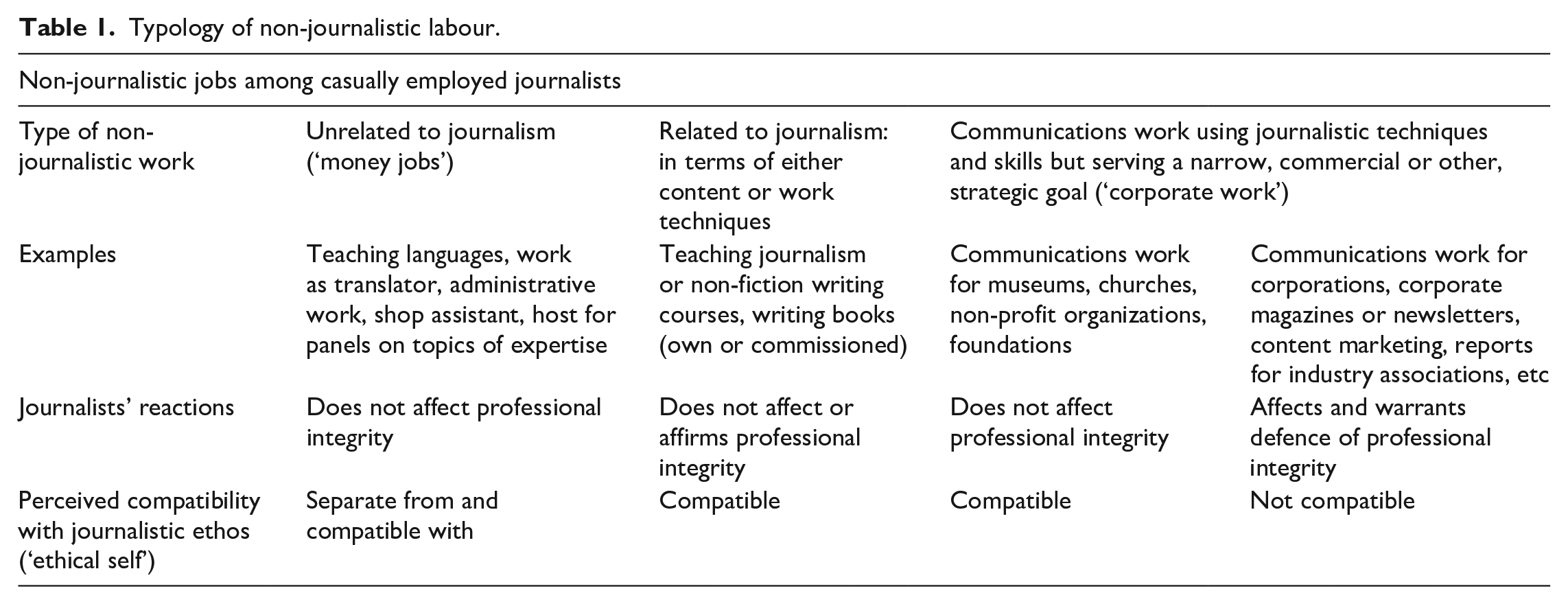
First of all, some journalists hold what they call ‘money jobs’ – such as positions as secretaries, translators or sales assistants in retail – that make up for the fact that internships or freelance journalistic work often do not pay at all or not enough to make a living. Second, some of my research participants work regularly or irregularly as teachers in postsecondary education, teaching writing or journalism courses. Some have held full-time teaching positions in the past. Also, several freelance journalists are writing their own books, sometimes debt-financed or cross-financed by other activities. Others are regularly commissioned book projects, as authors or as ghostwriters. These two broad categories of jobs – either clearly dissimilar to journalism and unrelated to doing journalistic work, such as administrative jobs, or similar to it in terms of work techniques or content, such as teaching journalism or book writing – do not cause my research participants to question or defend their journalistic integrity. The same goes for communications work performed for organizations that serves non-profit or somewhat public causes such as work for foundations, churches, government agencies or museums.
This relaxed attitude towards additional jobs in journalism changes when journalists perform work that my research participants term ‘corporate work’. They indicate that such work has an ethos dissimilar to journalism – serving narrow corporate rather than public goals – and, at the same time, requires the use of journalistic skills, techniques and genres. Work falling into this category is the creation of public relations and advertising materials, corporate magazines, newsletters or tweets, reports written for a corporation’s clients, customers or employees, texts for tourist guides or travel catalogues, articles for trade magazines or reports for industry associations. When it comes to these types of work, the interns and freelancers tend to fiercely defend their journalistic integrity, showing the ethical self up in arms against the entrepreneurial self.
There are three professional identities embraced in this situation where journalists remain in journalism as an occupation, despite the many struggles involved in such a decision, but also perform non-journalistic work (Table 2). Only one participant explicitly frames journalism as nothing more and nothing less than a regular business service, comparing it to services provided by notary publics or home renovation companies. I term this a conforming identity or business identity, largely in tune with the stance of the entrepreneur or investor of the self. This journalist does different types of corporate communications work and does not discuss or perceive any conflict with his journalistic work. For his journalism, he switches topics as required by the market. For example, he wrote about technological developments in the past, and now about oil and gas. The participant invests his skills and energies in issues that are more likely to offer regular work and decent compensation, thus promising a return on investment.
Typology of professional identities among casually employed journalists.
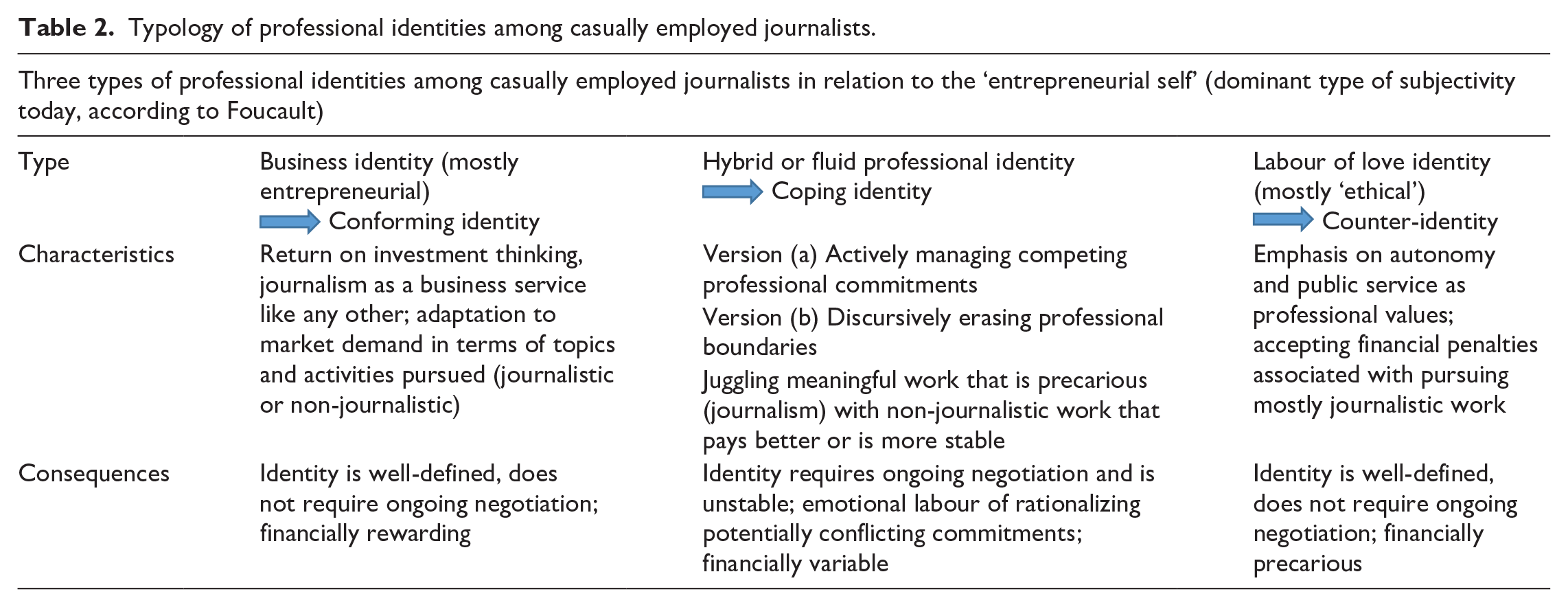
At the other end of the spectrum, I situate an identity that accepts low pay and precarity in journalism as the price there is to pay for doing meaningful work that allows for a large degree of autonomy over content created as a public service. These journalists in my sample do very little ‘corporate work’ as it takes time away from doing journalism and is perceived to be in opposition to a journalistic ethos. These journalists struggle the most financially. I term this a ‘labour of love identity’ or counter-identity, resisting the entrepreneurial incitation to see one’s work as nothing more than a business, and accepting the associated consequences, including increased precarity.
Third, some journalists remain in journalism for now, despite needing to subsidize it through other work. This results in juggling journalistic and non-journalistic jobs as the price there is to pay for continuing to do journalism. I term this a coping identity. This hybrid form of journalistic identity was the most common type of identity found among my research participants. The non-journalistic work of these journalists includes public relations and similar lines of work that are perceived to contradict a journalistic ethos but are more lucrative and often pay by the hour, which makes income more predictable than in journalism. In one version of this identity, in order to protect journalistic integrity, journalists use strategies such as geographic or weekly separation between the two realms of work to erect boundaries and mark two different professional commitments – of which journalism is framed as the clearly preferred one. In another version of this coping identity, rather than acknowledge, some journalists are eager to erase the boundaries between ‘corporate work’ and journalism in order to protect their journalistic integrity. They work in both realms extensively if less and less in journalism due to a lack of assignments and low pay. They construct journalistic professional identity by emphasizing that they use the very same journalistic skills and values to prepare texts for ‘corporate’ clients that they use to write articles for magazines. Some freelance journalists foreground that working with corporate clients often entails generous budgets and fairer modes of payment, namely by the hour which includes time to interview, research and write a piece rather than pay only for the finished product as in journalism. Working for corporate clients, from the experience of many research participants, often also entails more respect and appreciation for assignments than is experienced when working for news organizations.
This line of argument by my research participants implies that the journalistic ethos – rather than being compromised by corporate work – is being extended into the corporate realm. Thinking through this logic, one could interpret these journalists as even more radically embracing an ethical self than other journalists, as they imply infusing corporate communications with journalistic values such as accuracy, independence and public service.
Alternatively, this group of journalists, embracing a coping identity, can be interpreted as representing an expansion of the entrepreneurial self in journalism. More and more non-journalistic work is necessary to subsidize their journalism, as they try to uphold their journalistic integrity. The stories of my research participants indicate that corporate clients, while paying them better, often eventually tailor and revise the texts ordered, according to their particular financial or symbolic goals. Also, conflicts arise when doing ‘corporate work’ for a corporation that one later has to cover as a journalist. Journalists embracing a coping identity by heavily combining journalistic and non-journalistic work are more likely than the other participants to explicitly to call themselves ‘writer’ rather than ‘journalist’, indicating that their adherence to a traditional journalistic identity is rather weak or more receptive to modification. At the same time, one participant underlined that she does not consider herself a ‘copy writer’ (a term perceived as indicating purely commercial writing) which she clearly saw as a professional definition inferior to both ‘writer’ and ‘journalist’.
Discussion
This study has demonstrated how news workers such as freelancers and interns struggle to uphold the public service ethos at the core of journalistic professionalism under conditions of precarity. While these journalistic workers often earn more income from and spend much of their time on non-journalistic work, journalists are deeply wedded to this ethos, which they articulate particularly forcefully when demarcating their journalism from entrepreneurial activities such as ‘corporate work’ or self-branding.
Applying Foucault’s governmentality thinking to constructions of journalistic professional identities under conditions of precarity generates important insights. To begin, ethical and enterprising components of the journalistic professional identities examined are shown to be not mutually exclusive but to appear simultaneously. The entrepreneurial effort to allocate micro-investments of time, energy or material resources wherever one expects the highest return is obvious among my research participants, especially when it comes to activities such as networking, self-branding and figuring out income targets. However, they articulate that thinking of themselves as entrepreneurs, while necessary, often conflicts with their professional journalistic identity. The governmentality lens thus, secondly, identifies entrepreneurialism as inimical to the journalistic ethos and aligns the research results with existing scholarship that is critical of entrepreneurial journalism as a new paradigm thought to address the crisis of journalism (Cohen, 2015; Siapera and Papadopoulou, 2016). Third, Foucault’s reference to present-day neoliberalism and its preferred and discouraged subject positions contextualizes and politicizes the contradictions experienced by casually employed journalists today. While the coping and the counter identities discussed above entail freelance journalists and interns self-reflexively recognizing and resisting behaviours in tune with the neoliberalism’s encouraged subjectivity (the entrepreneurial self), the associated financial and emotional burdens are considerable. Evoking the larger shift in politico-economic governance implied in governmentality helps us make sense of the ‘precarity penalties’ (Cohen, 2016) in journalistic work today, associated with holding on to an ethical self, or a traditional journalistic identity, based on public service. In this way, governmentality thinking moves beyond descriptive, occupational-level approaches to studying experiences of part-time journalists today who also work in public relations or related domains, such as the concept of ‘inter-role conflicts’ (Viererbl and Koch, 2021).
Furthermore, the journalists researched experience a devaluation of their journalistic work (by news organizations) on the one hand and a validation of their journalistic skills on the other (by non-journalistic clients). For the aspiring journalists in the sample, higher pay and fairer payment models make public relations and similar work more attractive than journalism. Thus, some young journalists are tempted to leave journalism, reluctantly but pragmatically giving the entrepreneurial self the upper hand. Other aspiring journalists, conversely, consider pursuing professional paths perceived as equally public service-oriented but requiring less hustling and self-promotion than journalism, such as founding a social enterprise related to media. Most participants display a coping identity, balancing better-paid non-journalistic work they dislike and low-paid journalism they enjoy and find purposeful. For example, there is a tendency for non-profit organizations as well as churches, government agencies and museums to hire journalists to produce custom content of high calibre, informed by journalistic skill and ethos. The journalists in this study perceive as acceptable these kinds of assignments as there seems to be no blatant contradiction with a traditional journalistic professionalism. In contrast, avid efforts to defend journalistic integrity appear among interviewees who work regularly both in journalism and in public relations or other forms of ‘corporate communications work’. Some journalists describe how they consciously separate their journalistic from public relations work, including geographic or weekly alternation of jobs. Others imply that, for them, working in both realms is unproblematic as they use their journalistic skills and values equally in both. Thus, for journalists working in non-standard employment situations and especially those working partially outside journalism, professional identity requires ongoing negotiation rather than being a stable reference point. This work of ‘ethical boundary setting’ (Ladendorf, 2013), as this study demonstrates, is an ongoing experience for casualized news workers. They have to juggle simultaneously but separate mentally journalistic and non-journalistic jobs and construct an individualized, de-institutionalized journalism ethics rationalizing the presence of both types of work in one’s professional life.
In sum, the research participants’ stories about non-journalistic assignments foreground the tenacity of traditional journalistic identity, understood as combining autonomy over content, effort at truth-telling and the idea of public service (Deuze, 2005; Schudson and Anderson, 2009). At the same time, as individual entrepreneurialism is necessary to deal with precarity under neoliberalism, traditional professional identity in journalism becomes fragile and hybridized: freelance journalists have to put on different non-journalistic hats in order to subsidize their journalistic work, and increasingly have to engage in self-branding to promote their journalism. Finally, an affective attachment to journalistic professionalism, as found among the participants, is a major benefit to media organizations who can keep payment and security low for contingently employed journalists while never running out of a reserve army of workers (Cohen, 2016). Thus, journalistic professionalism plays a complex and contradictory role today, inspiring journalists to reinforce and protect public service ideals while simultaneously entrenching precarious working conditions.
Contributions to the literature and future research
This study has analysed ‘the circumstances in which journalists attempt to turn themselves into professional people’ (Schudson and Anderson, 2009: 90), focussing specifically on casually employed journalists struggling to protect their occupational legitimacy and integrity. As such, it adds to existing research that explores professional identities in journalism under conditions of precarity. For example, as they are unable to make ends meet from journalistic work only, journalists take on non-journalistic jobs. Some teach journalism (Lahav, 2008), which reaffirms rather than challenges their professional identity. Others work in public relations, which leads to role conflicts (Fröhlich et al., 2013), reflecting public as well as scholarly assumptions that ‘the trustworthiness or ethos of a journalist is seen as compromised if s/he does information work, PR or – even worse – work in advertising’ (Ladendorf, 2013: 83). Moreover, this study nuances existing categories of professional identity, adding to Mathisen’s (2017) distinction between ‘idealists’ and ‘entrepreneurs’ a coping identity that contains elements of both entrepreneurialism and idealism. The current study also confirms research (Sherwood and O’Donnell, 2018) on laid-off journalists forced to look for careers in public relations and related realms, which shows a shift from news organizations as primary definers of professional identity to journalistic practices and values applied to other forms of content, assigned by clients outside the media industries. Furthermore, notions of traditional professional identity based on an ‘ethical self’ are indeed used as a resource to cope with change in the profession, as shown by Witschge and Nygren (2009) and Grubenmann and Meckel (2017). However, such changes, including the precaritization of journalistic employment, in turn also modify and render definitions of professional identity more fluid.
Finally, as shown in this study, while journalism’s public service ethos is abandoned by media organizations and made the responsibility of individual, casualized news workers, it is captured and enlisted by a new set of organizations that offer it a new institutional ‘home’, co-opting – rather than attacking or eliminating – journalistic professional norms. Thus, the study provides further evidence of the ongoing privatization of the public service ethos in journalism today and its simultaneous corporatization. There is an increasing appreciation that ethically minded public relations or similar work created by journalists can serve broad public goals such as progressive social or environmental change (Gurleyen and Hackett, 2016). But what about work for profit-oriented corporations? As the latest effort in product marketing, corporations have begun to develop their own, professionally staffed news rooms that seek to employ journalists, in order to imbue with journalistic credibility their content marketing or native advertising (Serazio, 2020, 2021). The phenomenon of multiple job-holding and precarity-induced career diversification in journalism opens up unconventional but urgent questions that future research should pursue. If journalists move fully or partially into corporate realms, could this improve corporate communications, infusing content narrowly embracing corporate interests with an edge of public service orientation? While research pursuing such questions has only just begun, the current study as well as Serazio’s (2020, 2021) examination of news workers who have transitioned into brand journalism invite us to be cautiously pessimistic in this regard.
Footnotes
Funding
The author received no financial support for the research, authorship, and/or publication of this article.
