



Abstract
After the financial crisis, journalism scholarship has extensively pointed out how the journalistic debate on economic policy has been dominated by a strong emphasis on austerity and a limited range of elite sources. Building on 19 semi-structured interviews with Finnish political and economic journalists, this article examines how journalists themselves evaluate the pluralism of the economic policy debate. This article shows how journalists covering economic policy are critical when evaluating the level of pluralism in economic journalism, referring to a narrow range of expert sources and a widely shared economic policy consensus. These findings testify to the ability of ‘primary definers’ to set the boundaries of ‘legitimate controversy’ in economic journalism. Also, the interviews show how ruptures in economic policy, such as the COVID-19 pandemic and the resulting vast amount of monetary and fiscal stimulus, create space for more pluralism in economic journalism.
Keywords
Introduction
In the aftermath of the financial crisis of 2008 and the ensuing European economic crisis, media scholarship has criticized journalism for a lack of pluralism and one-sided coverage of the economic reality. Scholars have pointed out how journalism has been dominated by a narrow range of elite sources and an emphasis on austerity (Basu, 2018; Doudaki et al., 2019; Mylonas, 2012; Tracy, 2012).
In the existing literature, the lack of pluralism and politico-ideological diversity is attributed to the close-knit relationship between professional journalists and their sources, the absence of academic experts from the debate and the prevailing consensus on the necessity of deficit reduction, which has rendered anti-austerity views unrealistic or marginal (Berry, 2019; Phelan, 2014; Rodríguez, 2020; Wren-Lewis, 2018). The scholarly consensus regarding economic policy coverage is that journalism has framed deficit reduction and market-friendly solutions as the responsible way to deal with the economic predicament (Basu, 2019; Berry, 2016; Kay and Salter, 2014).
The existing scholarship, however, leaves room for analyses on the dynamics of the economic policy debate and the reasons driving austerity consensus in professional journalism. This is not to suggest that scholars have not made important contributions. Berry (2019) – through content and audience analysis as well as interviews with British journalists – argues that myriad factors must be taken into account. These factors include the lack of dissenting voices within political parties as well as advertising incentives that have made it difficult for journalism to challenge market imperatives. In a similar vein, Knowles et al. (2017) argue that financial journalism has faced commercial and ideological pressure, which has hampered journalists’ ability to question prevailing ideas.
This article further explores the relationship between economic journalism and pluralism by building on 19 semi-structured interviews with Finnish journalists covering economics and politics. This article argues that the criticisms offered by journalists are aligned with the scholarly critiques of journalism, as journalists point out how most authoritative sources limit the range of the economic policy debate. Therefore, the results testify to the ability of ‘primary definers’ (Hall et al., 1978: 53–77) to control the ‘sphere of legitimate controversy’ (Hallin, 1984) in economic news.
This article is organized as follows. The article examines the concept of pluralism as well as the meaning of pluralism for economic journalism. It discusses the existing literature on economic journalism in the aftermath of the financial crisis and defines the concepts ‘primary definers’ and ‘legitimate controversy’. After presenting the data and method as well as discussing the results, the article reflects on the implications of the analysis. The results of the article support previous findings that the most authoritative sources are able to influence the limits of controversy in economic reporting (Berry, 2019; Rodríguez, 2020; Schifferes and Knowles, 2018). Although the interviewed journalists are aware of the dominant position of primary definers, it is difficult for journalists to challenge consensual ideas and contribute to more pluralistic economic policy coverage. This is due to the significant institutional position of the primary definers, which makes them elemental sources of information and insight for professional journalists (Manning, 2001). This article thus supports the thesis that professional journalism, despite its adherence to pluralism, often offers pluralism within narrow limits (Glasser et al., 2009; Karppinen, 2018). However, the interviews also indicate that recent developments in global economic policy – such as the vast amount of monetary stimulus by central banks amid the COVID-19 pandemic and economic turmoil – may serve to open up the journalistic debate on economic policy.
Pluralism in economic journalism
The idea that journalistic output should be pluralistic stems from the democratic roles of journalism. In serving as the public watchdog of the powerful and providing a setting for a multi-voiced democratic debate, journalism should represent a wide range of ideas and give voice to different societal actors in a balanced fashion (Christians et al., 2009; Schudson, 2008; Strömbäck, 2005).
Pluralism is, however, a slippery concept with different meanings, ranging from the diversity of media ownership to the plurality of people represented by journalism (Karppinen, 2018). Maeseele and Raeijmaekers (2017) argue that pluralism should not be analysed solely in terms of the diversity of sources or people represented in the media, but also in terms of the ideological pluralism of journalistic content. Certainly, it is important for professional journalism to represent the views of experts and political leaders in a balanced fashion and build settings for inclusive civic deliberation, but journalism should also foster an ‘agonistic’ (Mouffe, 2013) debate between fundamentally differing worldviews to support a pluralistic democracy (Raeijmaekers and Maeseele, 2015). Pluralistic journalism should politicize economic issues, meaning that journalism should subject economics and economic policy-making to democratic debate instead of solidifying certain ideas as natural or being beyond political contestation (Harjuniemi, 2020; Phelan, 2014).
Critical journalism scholarship has done a thorough job of uncovering how professional journalism often falls short when it comes to providing the public with a pluralistic viewpoint on economic issues. Instead, journalism tends to support a liberal market consensus. Philo et al. (1995) argue that during the economic turmoil of the 1970s, the BBC’s coverage of industrial action aligned itself with the assumptions of the British government and presented unions and their demands as erratic and irresponsible. Economic journalism has promoted the idea that responsible economic policy-making should reflect market and investor concerns (Durham, 2007; Jacobsson, 2016; Mårtenson, 2000). Journalism often treats ideas that challenge the established norm as dangerous or populist (Kantola, 2007; Mylonas, 2014). Especially in the years following the financial crash of 2008 and the European economic crisis, scholars have lamented the lack of pluralism in journalistic coverage of the economy, as journalism has underscored the necessity of austerity and liberal market reforms (Doudaki, 2015; Ojala and Harjuniemi, 2016).
What is driving this well-established lack of pluralism in economic journalism? Berry (2013, 2019) has analysed how economic journalism in the UK dealt with the financial crisis, paying attention to such myriad factors as the dominance of City of London expert sources as well as commonsensical wisdom on the importance of deficit reduction among journalists and political decision-makers. Journalists covering economics and the world of finance need to turn to market analysts, officials and politicians for source material, but the views of such actors often end up dominating economic and financial journalism (Basu, 2018; Davis, 2018; Manning, 2013; Rodríguez, 2020; Starkman, 2015; Tambini, 2010). This is certainly understandable, as professional journalism relies on the insights of people and institutions considered most authoritative and competent (Berkowitz, 2008; Sigal, 1986).
Primary definers and the sphere of legitimate controversy
This article further examines the lack of pluralism in economic journalism with the help of the concept ‘primary definers’. The concept derives from the canonical work of Hall et al. (1978), who – amid the unravelling of the Keynesian consensus in British society and the rise of Thatcherism – explored the nexus between journalism and the reproduction of ideas and social values. When analysing the ideological role of journalism, they argued, one should not succumb to crude class reductionism but explore how the professional norms and practices of journalism contribute to the dominance of ruling ideas (Hall et al., 1978: 58–59; see also Chadwick et al., 2020). Journalism often ends up reproducing a view of the world aligned more with the ideas of the elite, but this is not solely due to the fact that the media and other ‘means of mental production’ (Marx and Engels, 2001: 92) are mostly privately owned enterprises that simply reflect underlying material relationships.
Aiming to paint a more nuanced picture of the relationship between journalism and the reproduction of social values, Hall et al. (1978: 57) argued that to manufacture news stories and to cope with the ‘internal pressures of news production’, journalists are dependent on sources and authorities that are considered legitimate and trustworthy (Manning, 2001). Journalism, in order to adhere to the demands of neutrality and objectivity, must rely on sources ‘accredited’ (Hall et al., 1978: 58) as authoritative and insightful. These sources include, for example, politicians, employers and trade union leaders, who are accredited as vital sources because of their institutional status as democratically elected decision-makers or as spokespeople for various societal interest groups. Moreover, professional journalism is reliant on the ‘the expert’ and the ability of the expert to pursuit knowledge in a ‘disinterested’ (Hall et al., 1978: 58) fashion. The public legitimacy of journalism is built on the promise to represent a truthful view of the world and to regulate the boundaries between fact and opinion (Schudson, 2001; Zelizer, 2004). Journalists therefore need experts to produce nonpartisan information and insights (Albæk 2011; Chadwick et al., 2020: 5).
In economic journalism, experts and other key institutional actors, such as representatives of research institutions, banks, ministries or central banks, are often used as authoritative sources, commentators and analysts (Basu, 2018; Berry, 2019; Chadwick et al., 2020; Harjuniemi and Ampuja, 2019; Walsh, 2020). Such authoritative actors are, in the analysis of Hall et al. (1978: 58) the ‘primary definers’ of news, as they are given privileged access to the media to establish a ‘primary interpretation’ of the topic in question. In journalism practice, these primary definers are believed to possess information that is ‘more accurate’ and ‘more specialised’ than what the vast majority of people could possibly possess (Hall et al., 1978: 58).
Importantly, professional journalistic dynamics ensure that journalism does not simplistically transmit the ideology of a ruling class. It is standard practice that in the name of balance, journalists pit such political adversaries as left-wing politicians and right-wing politicians or employer and employee representatives against each other. However, the privileged and authoritative position of such primary definers renders a narrow elite interpretation of the world as an objective social reality.
Journalists do aim to present the public with a wide range of competing views from politicians and other sources. Nevertheless, ideas not backed by institutional authority or expertise are often rendered illegitimate or simply unworthy of further investigation (Raeijmaekers and Maeseele, 2017). The range of critical political reporting is therefore dependent on the degree of consensus within the political establishment (Bennett, 1990). In terms of economic policy, established thought has, since the 1970s, gradually coalesced around a set of ‘neoliberal’ ideas, emphasizing, for example, financial and industrial deregulation and the need to curb inflation through budgetary discipline (Cahill and Konings, 2017; Harvey, 2005). Scholars have pointed out that such ideas are often portrayed as commonsensical in journalism, too (Basu, 2018; Phelan, 2014), and that voices that demand, for example, more redistribution policies are dismissed as supporting unrealistic or old-fashioned ideas in public discourse (Grisold and Theine, 2020).
One can illustrate the dynamics between dominant ideas and pluralist public debate by examining how consensual public issues become controversial journalistic topics. In his classic work, Hallin (1984: 22), examining how professional US journalism became increasingly hostile to the Vietnam War, argued that anti-war voices gradually made their way ‘from the political fringes of the society into its mainstream’. As established politicians and institutions started to adopt an oppositional stance to the war, it became necessary and accepted for journalists to air critical viewpoints as well. As the parameters of established opinion shifted, questions surrounding the war moved into what Hallin (1984: 21) called the ‘sphere of legitimate controversy’, where journalists routinely put conflicting viewpoints and ideas out into the public realm. The war moved from the ‘sphere of consensus’ – wherein lie social issues that journalists do not deem controversial – into the sphere of legitimate controversy where ‘objective journalism reigns supreme’ (Hallin, 1984: 21) and conflicting opinions are covered in a balanced fashion. In terms of the pluralism of the war coverage, the sphere of consensus thus contracted while the sphere of legitimate controversy expanded as the crisis fractured elite opinion.
Journalism scholarship has used Hallin’s framework to analyse the parameters of economic policy debate and found empirical evidence for the thesis that journalists do not feel compelled to present dissenting views on consensual issues. Economic questions regarding, for example, globalization and the importance of deficit reduction have tended to remain in the sphere of consensus (Harjuniemi and Ampuja, 2019; Lounasmeri, 2017).
This article employs Hallin’s framework, together with the concept of ‘primary definers’, to analyse how professional Finnish journalists examine the pluralism of the Finnish economic policy debate and how fractures in elite opinion as well economic crises and fluctuations in economic policy-making affect the boundaries of legitimate controversy. One should be aware of the limitations and criticisms of the ‘primary definer’ framework. It has been argued that the model overestimates the cohesiveness of powerful institutions and disregards the effects that intra-elite competition can have on public discourse (Miller, 1993). Moreover, the framework neglects the ability of journalism to cover issues independently of powerful definers and overlooks the myriad communicative strategies that more marginal groups can deploy to affect media coverage (see Manning, 2001: 15–17; Schlesinger, 1990). Still, the concept provides a useful tool to analyse the interaction between journalism practice and the sources accredited as most authoritative and competent (Manning, 2001: 17–18).
Data and method
This article is based on 19 semi-structured interviews with Finnish journalists covering economics and politics. The author conducted the interviews in January–June 2020. This means that some of the interviews took place during the first wave of the COVID-19 pandemic. The interviews were part of a research project that examined a wide range of issues regarding economic journalism (Harjuniemi, 2020b). The research project analysed, for example, how Finnish economic and political journalists evaluate the competence of various economic policy experts, the most important functions of economic journalism, how journalists evaluate the pluralism of the economic policy debate and how social media has affected economic journalism and journalist–source relations. A questionnaire survey was also conducted as part of the project. This article, however, builds solely upon the interviews conducted as part of the project.
The author recruited the interviewed journalists partly via the questionnaire survey sent to professional associations representing Finnish economic and political journalists. Moreover, the author contacted some journalists directly, and a few journalists were recruited by asking the interviewees to name colleagues who deal with economic policy issues.
The Finnish journalistic milieu is characterized as embodying a ‘democratic-corporatist’ model (Hallin and Mancini, 2004), referring to the strong position of the national public broadcasting company Yle, a high degree of journalistic independence as well as a robust commitment to journalism ethics. Thus, the Finnish journalistic milieu makes for an interesting case study when analysing the interplay between professional journalism practice and the plurality of economic news. Accordingly, the vast majority of the journalists interviewed in the study represent mainstream nonpartisan journalistic news outlets (Table 1). Such outlets put out much of the journalistic content through which economic policy is debated in the public sphere. In the text, the 19 interviewed journalists will be referred to anonymously as Journalist1–Journalist19.
Sample of journalists.
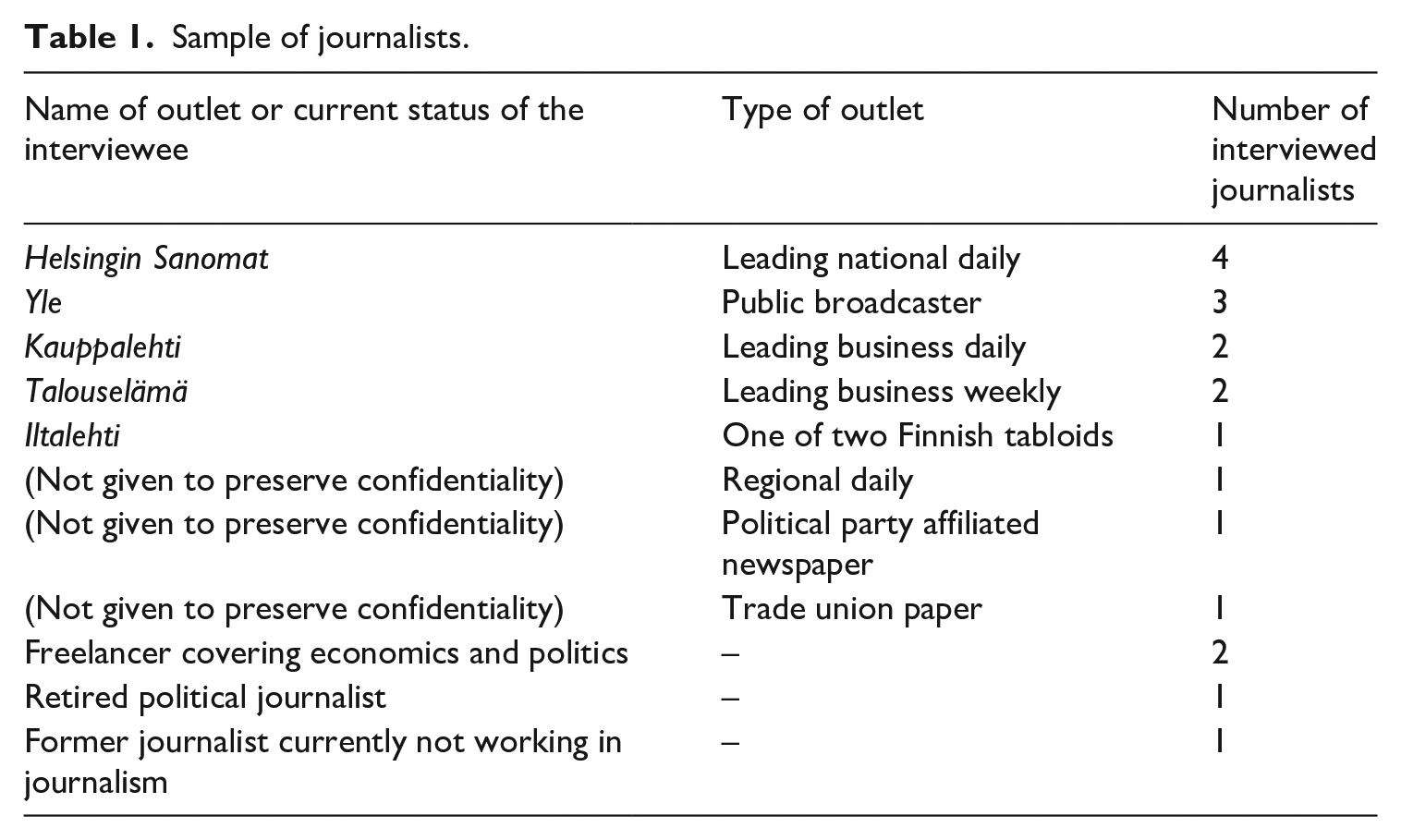
The interviews were semi-structured and guided by pre-determined questions examining the themes of the research project. However, it was possible during the interviews to deviate from the question set to ask clarifying and follow-up questions regarding topics and issues that came up during the interviews. Although pluralism was not the sole theme of the interviews, many of the themes and questions dealt directly with the pluralism of economic journalism and public debate. The interviewees were asked to reflect on the importance of pluralism for economic journalism and whether they think that Finnish public debate on economic issues is currently pluralistic enough. Also, the interviewees were asked to reflect on whether they believe that some perspectives are lacking in the economic policy debate and whether they think that some actors or ideas are too prominent in the public realm.
Most of the journalists were interviewed face-to-face either at their workplaces or in nearby cafés. Due to the pandemic, a few interviews were conducted online. On average, the interviews lasted for about an hour, ranging from 30 minutes to an hour and a half. The interviews were then transcribed by the author and analysed and coded using ATLAS.ti data analysis software. The assigned thematic codes were partly pre-determined in accordance with the themes of the research project, but some of the codes stemmed from issues and themes brought up by the journalists during the interviews.
Results
The article now presents the results of the analysis. The results section is structured as follows. First, it makes the general argument that Finnish journalists are critical when evaluating the level of pluralism in the Finnish economic policy debate. Second, it makes the argument that the primary definers of Finnish economic journalism are able to set the limits of the economic policy debate, effectively narrowing pluralism and constructing the boundaries of legitimate controversy in economic journalism. Finally, it makes the argument that such ruptures in global economic economy as the COVID-19 pandemic or the significant monetary and fiscal stimulus measures orchestrated after the financial crisis may work to disrupt the economic policy consensus among primary definers and enlarge the sphere of legitimate controversy in economic journalism.
Journalists lament the lack of pluralism in the Finnish economic policy debate
Like many journalism scholars, journalists covering economics and politics are critical when examining the level of pluralism in the economic policy debate. Many of the interviewed journalists pointed out how the Finnish debate often lacks competing perspectives and how only a small group of expert sources shape the dominant perspective in economic journalism. The interviewees stated that journalists routinely use established and well-known economists, representing, for example, banks and economic research institutions, as commentators and analysts.
An experienced journalist, now working as a freelancer, argued that journalists naturally strive for pluralism. However, she noted that the problem is that the viewpoints and sources tend to remain the same. The interviewee further argued that the number of ‘legitimate sources’ (Journalist18) is rather small, as journalists routinely reach out to the same group of experts. Another journalist, working for the leading Finnish daily paper Helsingin Sanomat, similarly argued that in Finland, the number of ‘interviewees and experts’ (Journalist17) is limited, making it difficult to find fresh commentators and viewpoints. She critically pointed out that economists working for private banks are used quite often, even for issues that have nothing to do with the core business of the bank. Another journalist observed that a small ‘all-star group of experts’ (Journalist12) are routinely used as authoritative commentators ‘when one needs to reach people who do not routinely follow economic issues’. She then mentioned that this group includes, for example, the Finnish economist Bengt Holmström, who won the Nobel Prize in economics in 2016.
The narrow range of authoritative and legitimate sources fuels a lack of pluralism in economic journalism. One interviewee stated that journalism often addresses economic issues as if they were somehow apolitical or beyond human control (see Phelan, 2014). He noted that newsroom practices often fuel such coverage, echoing what Hall et al. (1978: 57) had to say about the demands of daily news production. According to the interviewee, the economic forecasts from the Finnish Ministry of Finance routinely make their way into the editorial agenda, and there seldom is sufficient time or resources to think of alternative journalistic viewpoints.
In newsrooms, it is easy to support that idea (of the economy existing outside politics) on a discursive level. The wheels of the economy just keep turning, and there are different seasons, just like in nature. [It would be important] to open up the fact that in the end, it is about alternatives and issues that we, as human beings, can have an effect on. (Journalist16)
In a similar fashion, an experienced journalist working for the daily business daily Kauppalehti commented that the public debate on economic policy-making lacks pluralism. She stated that the debate is dominated by a certain ‘mainstream’ (Journalist9) perspective and that ‘opposing views’ tend to be side-lined. Another journalist argued that the problem is that people or views going against the dominant narrative might seem implausible in the public realm. The interviewee further argued that when the right-wing coalition government of Prime Minister Juha Sipilä came to power in 2015, it became commonsensical to think that public spending must be curbed. Due to the prevailing consensus, it was difficult for opposing arguments to break into the public realm.
If there is a person in a news story saying, wait a minute, there may be some alternatives [to austerity], you begin to wonder if the person is lacking in credibility compared to the dominant narrative. And [you wonder] if it affects the credibility of the whole story as well. (Journalist12)
Primary definers construct consensus in the economic policy debate
The fact that journalists critically evaluate the level of pluralism gives testimony to the ability of authoritative primary definers to set the boundaries of dispute in economic journalism. Many journalists noted that such major economic policy institutions as the Ministry of Finance or the Bank of Finland (the Finnish central bank) are treated as respected authorities within journalistic circles. These institutions have historically been central in determining the parameters of Finnish economic policy, where fiscal discipline and international competitiveness have been important (Harjuniemi and Ampuja, 2019). One of the interviewed journalists noted that Finland is a nation characterized by a ‘respect for authority’ (Journalist1).
If the Ministry of Finance or the Bank of Finland says something, it will get repeated. And of course, we must do that, but in terms of taking a more analytical stance, that’s where we don’t always succeed. (Journalist1)
Another journalist expressed the belief that Finnish journalists have internalized the Ministry of Finance’s view on the importance of fiscal discipline. The upside of such thinking, he argued, is that the importance of balancing the books is understood not only among journalists but also by the public, which has adopted a ‘realistic’ attitude towards public spending.
On the other hand, you can ask whether the debate on economic policy is too one-sided if the Ministry of Finance’s view plays a dominant part in it? (Journalist4)
The views expressed in the interviews demonstrate how authoritative institutions have the ability to regulate the boundaries of the debate on economic policy. After the financial crisis, the Bank of Finland published its calculations regarding the problems of Finnish national competitiveness, effectively consolidating a consensus on the necessity to curb excessive wage growth. One newspaper journalist expressed the view that the Bank of Finland should have been subjected to more public scrutiny.
Think about the Bank of Finland, for example, when Lauri Kajanoja [an official working for the bank] calculated the deficit of Finnish competitiveness, it was accepted everywhere. I think that the Bank of Finland should have been challenged more. (Journalist6)
Indeed, due to the position of authoritative primary definers, it might be difficult for alternative viewpoints and dissenting experts to break into the public realm, with such dissenters seeming illegitimate (Lounasmeri, 2017: 1307) or lacking the ‘objectivity’ and ‘authority’ (Hall et al., 1978: 58) of established expertise. One of the interviewed journalists argued that pluralism is ‘a double-edged sword’ (Journalist8). While it is important for journalists to strive for a plurality of perspectives, media outlets should not give room to voices and actors that are completely ‘illegitimate’, she stated. She argued that this could possibly feed into the problematic phenomenon of ‘false-balance’, where fringe experts are pitted against established expertise in the name of balance and pluralism.
When contemplating the status of certain experts, one interviewee argued that in the eyes of journalists, some experts might seem overtly political, which might make it difficult for a journalist to treat them as credible experts. As an example, he mentioned an expert who is thought of as being ‘left wing’ by the journalist’s colleagues (Journalist16). It might be unwise or unprofessional to reach out to such experts, as it is thought that their view of the world is distorted by an ideological bias. Such notions testify to the ability of the most authoritative voices to define the limits of ‘realistic’ (Phelan, 2014: 98–100) economic policy options. Another reporter reminisced about how difficult it had been during the 1990s – when Finland was debating joining the European Union and the common currency – for experts critical of the EU to be heard. She remembered that in the eyes of some of her colleagues, a certain expert was not a ‘suitable’ interviewee.
He had views that deviated from the mainstream, and that must have been the reason. Back then, I thought that he was a bit too left wing, perhaps very critical of the European union. (Journalist7)
The interviewed journalists are well aware of the plurality problems stemming from the dominant position of primary definers. However, at the same time many journalists noted that it is important to listen to established institutions and experts. Due to the very ‘institutional power and position’ (Hall et al., 1978: 58) of the primary definers, it is crucial for professional journalists to follow their agenda. The interviewed journalists noted that, for example, they are dependent on the Ministry of Finance for data regarding the current situation with the Finnish economy. Moreover, the ministry is in charge of preparing the annual budget for public spending. Importantly, politicians listen to such authorities with great care, making them paramount agenda setters for journalists as well. Although journalists are often critical of the position of authorities, the interviewees stated that is essential to report the views of such primary definers. When asked about the public role of the Ministry of Finance, one newspaper journalist noted that the ministry has a great deal of power, making it understandable that the ministry has such a strong public role, too.
I don’t know if the ministry has too strong a role, because it has a lot power, and that’s how it should be. Of course, we should have politicians that are able to challenge the ministry. In its economic forecasts, the line of the ministry is rather, I do not know if it is neoliberal, but they emphasize fiscal discipline. It is not a very Keynesian line. That is the starting position, and if politicians want to do something else, they should be able to justify that. (Journalist19)
Ruptures in elite opinion affect the sphere of legitimate controversy
So far, the analysis has suggested that the primary definers often used by professional journalists are able to regulate the boundaries of legitimate disputes in economic policy debates and suppress pluralism. In Finland, the consensus around the importance of fiscal discipline and international competitiveness has penetrated the political establishment, consolidating a cross-party consensus (Kantola and Kananen, 2013). The consensus among primary definers has contributed to a lack of pluralism in the public debate on economic policy (Harjuniemi and Ampuja, 2019; Lounasmeri, 2017).
However, the interviews suggest the recent shifts in global economic policy are impacting the boundaries of the economic policy debate. Consensual economic policy issues, such as the importance of fiscal discipline, are moving from the sphere of consensus into the sphere of legitimate controversy, where conflicting viewpoints can be legitimately uttered and the level of pluralism increases (see Hallin, 1984).
Multiple factors have fed into the fracturing of elite thought. Since the financial crisis, the global economy has suffered from a prolonged period of feeble growth, which has seen authorities such as central bankers calling for more fiscal stimulus (Harjuniemi, 2020). The fact that the International Monetary Fund has begun to call some of the fundamentals of the neoliberal policy programme into question (Ostry et al., 2016) signals a change of course in economic policy. Moreover, the COVID-19 pandemic has forced governments to stimulate national economies to prevent mass unemployment and any further deepening of the social crisis. Public deficits have ballooned. However, markets have not forced governments into austerity, as central banks have effectively become lenders of last resort, financing national public deficits and securing low interest rates (De Grauwe, 2013).
The interviewed journalists stated that such ruptures in economic policy present a challenge to the standard Finnish view. A journalist working for a regional Finnish newspaper argued that since the financial crisis and European economic crisis, it has become more common for politicians to deviate from the traditional Finnish line. Journalists have become more comfortable with new ideas, too, he noted.
Recently, I have noticed that many economic journalists, or journalists with a background in economic journalism, have been very sympathetic to deficit spending and even helicopter money [the idea that the central bank should deposit money directly into people’s bank accounts], and so forth. The very same people would not have been so sympathetic to such ideas 15 years ago. (Journalist2)
The journalists also commented on the fact that economic policy has entered uncharted territory as levels of public debt have risen substantially while interest rates have remained low and there is no market pressure to engage in austerity. One newspaper journalist argued that this goes against traditional thinking. In orthodox thought, authorities would have viewed such high levels of public debt as catastrophic for Finnish public finances. Now, however, ‘the markets seem to think that everything is fine’ (Journalist6).
This raises the question, what should one make of all this? Even the experts do not seem to know where we are heading. (Journalist6)
Another journalist similarly contemplated the possibility of a paradigm shift. He said that traditionally, Finns have supported budgetary discipline and treated the EU rules on public debt and deficits with respect. That, however, will no longer be so easy, as governments, no doubt, will need to rely on accumulating public debt in the near future as well.
As economic journalists, should we, for example, continue to hold on to the disciplined line, or do we think that the situation is very peculiar and that we should take a completely new outlook on things? (Journalist4)
In a similar way, another interviewee observed that ‘we seem to be on the brink of a rupture’ (Journalist1). The journalist stated that the development has been fuelled not only by the COVID-19 pandemic but also by the climate crisis and the call by the influential business newspaper Financial Times to ‘reset’ capitalism and restrain economic inequality (Financial Times, 2019).
Indeed, these findings indicate that the sphere of legitimate controversy is expanding as authorities react to shifts in economic policy. Consensual matters are becoming matters of dispute as policy-makers and experts confront novel economic circumstances. One reporter summarized these circumstances by saying that after the financial crisis, high levels of public debt have become the new normal.
We are never going to get rid of all this debt. Maybe there is a way to live with it. (Journalist3)
Crises have the potential to increase the pluralism of economic journalism as the sphere of controversy increases (Lounasmeri, 2017). However, it is paramount to note that in the aftermath of the financial crisis and after a brief period of Keynesian stimulus, journalists framed the 2010 pivot to austerity as necessary to curb public debt (Basu, 2019; Berry, 2019; Tracy, 2012). Indeed, established policy ideas have significant public staying power and may well again reassert themselves should primary definers move back to a pre-crisis consensus and no alternative policy ideas emerge within the strata of authoritative institutions and experts (Harjuniemi and Ampuja, 2019; Rodríguez, 2020).
Conclusion and discussion
This article has argued that the journalistic austerity consensus identified by multiple scholars after the financial crisis is partly due to the ability of authoritative primary definers to establish the sphere of legitimate controversy. The starting point for this article was the well-established fact that post-financial crisis economic journalism has been lacking in ideological pluralism. There have been no significant alternatives to budgetary discipline and liberal market reforms in the public realm, despite the normative claims by media scholars and journalists that journalism should support a liberal democracy by representing a pluralistic view of the social world. In the existing literature, journalism scholars have attributed this lack of pluralism to the dominance of elite sources and the unwillingness of decision-makers to present alternatives to fiscal austerity (Basu, 2019; Berry, 2019; Rodríguez, 2020).
To further examine the nexus between professional journalism practice and the pluralism of economic journalism, this article drew from 19 semi-structured interviews with Finnish political and economic journalists. From a theoretical standpoint, the article built on two concepts used to analyse the relationship between journalism practice and the reproduction of social consensus. Hall et al. (1978) introduced the concept of ‘primary definers’ to show how journalists disseminate elite ideas and galvanize consensual thought. They have argued that such primary definers as political leaders and experts are given privileged access to the media. In journalism practice, primary definers are accredited as institutional political forces representing the people or, alternatively, as experts capable of producing and circulating dispassionate knowledge. Journalism depends on such authorities and logics to function in accordance with the norms of the profession, which is why journalism often ends up rendering the worldview of such experts as objective social reality.
Moreover, Hallin’s (1984) idea about the ‘sphere of legitimate controversy’ was used to highlight how societal crises and ruptures in elite opinion affect the boundaries of policy debate. In his seminal analysis, Hallin illustrated how anti-war sentiment travelled from the fringes of American society into mainstream political circles, enlarging the sphere of legitimate controversy regarding the Vietnam War. As the elite consensus on the war evaporated, the ‘sphere of consensus’ decreased while the sphere of legitimate controversy increased, making it legitimate and even mandatory for professional journalists to balance opposing views and play by the rules of objectivity.
Critics have pointed out that the primary definer model is a simplistic rendering of the source–journalist relationship because it overlooks the effects of intra-elite competition and the strategies that non-mainstream societal actors deploy to impact media debate (Miller 1993; Schlesinger, 1990). However, the results of the article testify to the ability of authoritative primary definers to regulate the boundaries of dispute regarding economic policy. Many of the interviewed journalists discussed the level of pluralism in economic journalism in a highly critical manner. The interviewed journalists noted that a narrow range of experts have a dominant role in the debate.
The article supports prior findings that the range of public debate on economic policy reflects the prevailing elite consensus (Rodríguez, 2020). Such institutions as the Ministry of Finance or the Bank of Finland are, due to their institutional status, able to establish the ‘primary interpretation’ (Hall et al., 1978: 58) regarding Finnish economic policy. The interviewed journalists expressed the belief that such authorities are given ample space in the public realm and that they have a powerful role in defining conventional economic thought. Therefore, journalists might treat experts or other actors who deviate from established orthodoxy as illegitimate or ideologically biased (Lounasmeri, 2017: 1307). The critiques offered by many of the interviewed journalists thus resemble the scholarly critiques of professional journalism. Scholars have argued that professional journalism – for which it is important remain politically neutral or above the fray of partisan struggles – often renders political ideas as marginal or unrealistic should they be considered beyond the pale (Maeseele and Raeijmaekers, 2017; Phelan, 2014). This article supports claims that journalism often only offers a narrow version of pluralism that does not challenge the status quo (Glasser et al., 2009; Karppinen, 2018).
While aware of the anti-pluralistic effects of primary definers, the interviewed journalists argued that it is still necessary for journalists to give ample space to primary definers. Journalists are often dependent on the data and information provided by such institutions as the Finnish Ministry of Finance. Due to the major role of primary definers in policy-making processes, it would quite simply be unprofessional for journalists to ignore them. Such dynamics are illustrative of the logics previously analysed by Hall et al. (1978: 58), who found that primary definers are prominent due to their very institutional status (see also Manning, 2001: 15). These logics ensure that professional journalists, although critical of established authority, must rely on primary definers for accredited views and information, further strengthening the public authority of such definers.
However, the article found evidence in support of the thesis that ruptures in economic policy-making and established economic thinking can increase the level of pluralism in economic journalism and broaden the sphere of legitimate controversy. Together with the disruptions caused by the COVID-19 pandemic, the extensive monetary and fiscal stimulus measures have put many of the pillars of established economic thought to the test, as interest rates have remained low despite high levels of public debt. Whereas European policy-makers turned to austerity to combat public debt during the euro crisis in 2010 (Blyth, 2015), a decade later there is increasing pressure to use fiscal policy to support economic growth and to finance the investments needed to combat climate change (Harjuniemi, 2020).
Many journalists interviewed for this study stated that the parameters of economic policy are in a state of flux. The journalists noted that in Finland, it has been perceived as commonsensical to adopt a fiscally conservative stance on economic policy. However, this consensus might be unravelling as interest rates remain quite low despite soaring public deficits. The interviewed journalists wondered aloud whether many of the central tenets of economic orthodoxy must be rethought due to these new circumstances. As the consensus unravels and fresh policy ideas move into the mainstream of economic thought, space for pluralism and legitimate controversy increases. This provides journalists with leeway to address economic policy issues in a more pluralist manner. Of course, the long-term effects of such disruptions as well as the scope of any ‘paradigm shift’ (Kuhn, ([1962] 2012)) in economics are unclear.
Naturally, myriad factors affect the level of pluralism in economic journalism. As newsrooms are increasingly affected by economic difficulties, journalists must work with fewer resources (Usher, 2017). Moreover, the analysis provided in this article did not differentiate between general journalistic outlets and the more specialist economic press, which is often able to offer economic analyses that are more ‘technical’ in nature (Arrese and Vara, 2015: 157). Differences between various journalistic cultures and media systems must be taken into account, too. Finnish journalists have traditionally remained above the political fray, whereas, for example, British journalism has historically tended to be more partisan (Ahva et al., 2017; Hampton, 2008). Scholars further analysing the nature of economic journalism and its primary definers must be aware of such differences.
Footnotes
Acknowledgements
The author would like to thank the two anonymous reviewers for their supportive and constructive comments.
Funding
The author(s) disclosed receipt of the following financial support for the research, authorship, and/or publication of this article: This work was supported by Helsingin Sanomain säätiö (Helsingin Sanomat Foundation) and Palkansaajasäätiö.
