



Abstract
This article presents an analysis of risk perception among chain newspaper CEOs in Scandinavia. Based on in-depth, semi-structured interviews, the analysis finds that risk is perceived in relation to public trust, corporate expansion and contentious government regulation. We discuss these themes in relation to their uncertainty, and the potential gains and losses that accompany them. The aim of the study is to sharpen the distinction between risks, uncertainties and threats as they are mobilized in research on the news industries, contributing to the research on strategic media management at the firm level. The contribution of the study is furthermore to demonstrate how CEOs’ risk perception can be seen as boundary work performed at the corporate level.
Introduction
Journalism is faced with perpetual uncertainty (Sparrow, 1999). A set of complex and interrelated ‘crises’ relating to journalism’s financial future and public standing (Curran, 2019; Nielsen, 2016; Waisbord, 2019) pose organizational, economic and professional challenges for the news industries. Emerging issues such as capture (Nechushtai, 2018), programmatic and social media marketing (Braun and Eklund, 2019) and post-industrial production modes (Deuze and Witschge, 2018), signal the extent to which news organizations operate within increasingly volatile environments. For CEOs in the news industries, the short-term future poses questions about how to sustain income (e.g. Chyi and Tenenboim, 2019), trust (c.f. Fink, 2019) and relevance to the general public (c.f. Simons et al., 2017). How media organizations respond to these uncertainties depends on the knowledges, resources and logics of the field (Lowrey and Gade, 2011). Managing such risks thus involves strategies to ensure organizational survival. The research question we ask in this article is therefore: As the room for action open to news organizations is framed by constant and rapid changes, how do CEOs perceive risk within this landscape? What issues are considered as risks, and how do risks differ from threats and uncertainties?
We ask this question to further our understanding of how journalism’s institutional boundaries are maintained and negotiated (c.f. Carlson, 2015) at the level where organizational strategies are formed. CEOs are in a particularly public position as responsible both for the quality of the journalistic product, and for the financial performance of the firm. Moreover, news corporation CEOs hold key positions for the future of journalism, making decisions that affect audiences’ news access (Benson, 2019), pursuing innovations that induce mimicry in competing firms (Barland, 2020), acquiring companies that reduces ownership diversity in the overall landscape (Sjøvaag et al., 2020) and making statements that influence policy-making (Sjøvaag and Krumsvik, 2018). What news CEOs perceive as the biggest risks facing journalism in the near future will therefore have an impact on the development of news media markets. As Scandinavian news markets are considered digitally innovative (c.f. Newman et al., 2019), developments here should inform further analyses of corporate news markets beyond Democratic Corporatist media systems (Syvertsen et al., 2014), particularly as newspaper chains in the Scandinavian countries have been comparatively successful in digitizing their operations through proactive paywall strategies (Olsen et al., 2019). Moreover, Scandinavian business and innovation strategies in the news industries have been found to be highly comparable to other contexts, including the U.S. (Lehtisaari et al., 2018) and Europe (Larrondo et al., 2016).
The contribution of this study is to untangle the distinction between threats, uncertainties and risks in news organizations’ response to current and emerging challenges (c.f. Ekberg, 2020), to further our understanding of how boundary work is performed at the firm level. As risk resides in how to respond to threats (to act or not act), responses constitute boundary work, embedded in the enduring conflict between profit maximization and journalism’s democratic function. The mobilization of management perspectives on risk thus serves to broaden the institutional framework of journalism theory, demonstrating how industry considerations are embedded in institutional, boundary protecting behaviour.
Literature review
When applied to the media industries, risk is associated with management and corporate strategy (e.g. Chalaby; Hardy, 2014), often defined as ‘the potential loss or gain from a decision’ (Lacy and Sohn, 2011: 160). Chalaby (2018) identifies seven types of risks to the media industries. These range from catastrophic, financial, regulatory, technological and commercial risks to risks involving intellectual property rights and value-chain related risks. The risks facing media industries thus involve financial aspects such as recessions, loss of income streams and shifting audience demands; competitive issues such as the rise of substitutes or news aggregators; inefficient, slow or reactive regulation; as well as theft, piracy and hacking. Noam (2019) also distinguishes between overall market risk, industry-specific risk and firm-specific risk. The different types of risks can be mitigated, according to Chalaby (2018), through concerted action such as pursuing policy lobbying, engaging with technological development and acquiring firms that compete within the value chain. Measures assumed to reduce risk in the media industries thus include effective management, vertical expansion, diversification, alliances, joint ventures and long-term contracts to control resources (Hoskins et al., 2004; Küng, 2017; Lowrey and Gade, 2011; Noam, 2019; Picard, 2011). Brand value (McDowell, 2011) or reputation (von Rimscha, 2011) is also assumed to guide risk mitigation, because while business models, technology and organizational structures can be readily replicated by rivals (McDowell, 2011), intangibles are harder to copy.
Closely associated with risks are concepts such as threats, opportunities, uncertainty and complexity. Such management terminology is often used interchangeably in journalism scholarship, largely without operationalization or definition. This is perhaps because these are fluid concepts that sometimes can be both positive with potential gains, and negative with potential losses (Ekberg, 2020). Risks, threats and uncertainties are all terms that imply certain contexts, events or developments that require decision-making that is dependent on knowledge, where outcomes are uncertain. But while they are interrelated, they are not the same. In the management literature, threats are predominantly associated with a lack of control (Ekberg, 2020), or specific issues related to competition (McDowell, 2011). While threats entail knowable aspects, risks are created by uncertainty: ‘a condition in which the risks of activities and choices cannot be estimated or are not identified’ (Picard, 2011: 264). Uncertainty is thus related to possible outcomes (Langlois and Everett, 1992) that are often shaped by environmental changes (Wilczek, 2019), that require knowledge and information to be managed effectively (Picard, 2011). Uncertainty is often separated into external and internal uncertainty (Lowrey and Woo, 2010), where external uncertainty depends on factors beyond actors’ control, while internal uncertainty is created by the actions of lower-level actors within the organization (Wilczek, 2019). Moreover, external, or market-level risks, cannot be readily reduced, whereas firm-specific risks can be managed through diversification and efficiency measures (Noam, 2019).
Picard (2004: 72) outlines the following relationship (see Figure 1): Uncertainty is that which produces risk, while potential gains and losses are outcomes of decision-making (Lacy and Sohn, 2011).
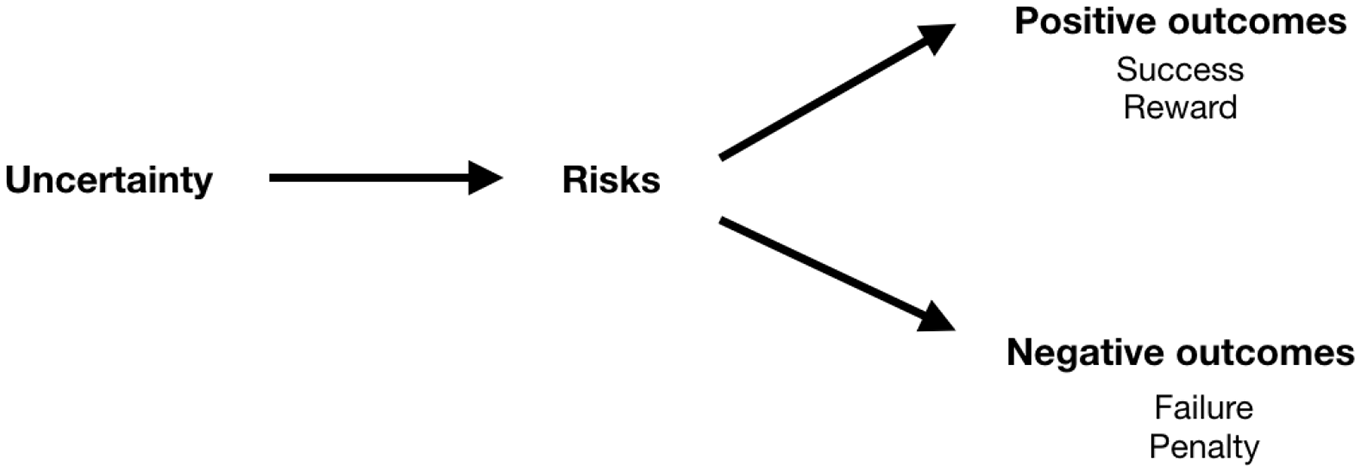
Replica of Picard’s (2004) model of the relationships among uncertainty, risk and outcomes.
It is important to note, however, that much of the literature (e.g. Chalaby, 2018; Doyle, 2013; Noam, 2019) largely mobilizes risk in discussions of the creative industries, rather than the news industries. Creative industries such as film, music and games bear higher risks because of the uncertainty associated with predicting audience tastes, and therefore assume more risk in pursuing costly projects that may fail. In the journalism literature, research on the impact of technological and economic changes generally refer to risk mainly in the context of losing out on innovation opportunities (e.g. Sjøvaag and Krumsvik, 2018), and risks to the journalistic institution posed by economically motivated business decisions (e.g. Anderson et al., 2015). Risk as perceived within newspaper management is in fact rarely treated in the research. Instead, uncertainty (Lowrey, 2011; Wilczek, 2019), and threats (Buozis et al., 2018; Walh-Jorgensen et al., 2016) are more readily employed. However, as uncertainty is what produces risk (Picard, 2004) and risk management is what determines outcomes (losses or gains), understanding CEOs’ risk perception is integral to understand how journalism patrols the borders of the institution (Carlson, 2015) during times of high uncertainty. While threats are knowable aspects, risks, on the other hand, influence strategies and actions, and thus, altered situations (based on success or failure) that in turn can induce mimicry across the industry, changing the conditions for journalism.
As ownership, management and organizational structures have an impact on journalism (Croteau and Hoynes, 2001; Edge, 2019; Hardy, 2014), how managers perceive and deal with risk also affects professional practices, routines and production. Because risk is something that large, resourceful organizations can more readily assume in technological innovations (Krumsvik et al., 2013; Villi et al., 2020), avoiding risk can be dangerous (Picard, 2011), as other firms could be awarded for assuming risk and thus gain competitive advantage, reducing the competitiveness of risk-averse companies. Risk therefore also contains opportunities (Franklin, 2016). How those opportunities are seized depends on the knowledge that reduces the uncertainty of outcomes from making decisions in risky landscapes.
Theoretical framework
Institutional members engage in boundary work to ‘enlarge the material and symbolic resources’ (Gieryn, 1983: 782) of their profession, to expand its authority and to defend its autonomy. Members mobilize a range of values and norms to promote such authority. Journalists and editors often invoke the function of the press in democracy in this boundary work, its critical oversight of power and its independence in performing these roles on behalf of the citizenry. Within the study of journalism as an institution, boundary maintaining actions and narratives have primarily been accessed through journalists and editors’ (e.g. Brookes, 2020; Carlson, 2016; Wolfgang, 2018) or managers’ perceptions (Belair-Gagnon and Holton, 2018; Scott et al., 2019), and are often related to journalistic practices (Carlson and Berkowitz, 2014; Revers, 2014; Singer, 2020) or technology (Liu and Berkowitz, 2020; Maares and Hanusch, 2020). Few studies have, however, used interviews with CEOs to understand how boundary work features in institutional maintenance considering overall challenges to the industry. As the many ‘crises’ facing journalism entail struggles over its boundaries (c.f. Carlson, 2015), CEOs play important roles in maintaining professional jurisdiction, not only through managerial action, but also in their public communication, strategic planning and policy lobbying. When CEOs defend cut-backs or lay-offs publicly, speak at industry events about the democratic role of the press or when they attack Google and Facebook for disrupting journalism’s income model, they perform boundary work on behalf of journalism as an institution. As their strategic communication contributes to the crisis narrative, their risk identification helps to define the institutional boundaries, signal the scope of possible actions and separate between insiders and outsiders.
Analysing how CEOs talk about risk thus provides an entry point to locating industry perspectives in Carlson’s (2015: 10) matrix of the forms of boundary work in journalism. The matrix outlines the various actors and actions involved in boundary work, including three types of work – expansion, expulsion and protection of autonomy and three areas where boundary work occurs – participants, practices and professionalisms. Boundary work thus involves expanding journalism’s jurisdiction to new forms of practice; expelling deviant forms, values and practices of journalism; and keeping the boundaries of participation and practice intact. This work takes place at the level of actors, practices and the profession. Business management does not enter this framework except at the level of professional protection of autonomy, where separation of business and editorial management is highlighted as an example of defending against non-professional outsiders. Management beyond the role of the editor is thus not considered as part of the institution that engages in boundary work. Moreover, business management is, according to this model, something that should actively be maintained outside of professional borders.
What we seek to understand with these interviews, however, is how boundary maintenance can be extended to the corporate level. CEOs are arguably in a position where they are expected to both protect the business side of the organization (its income and thus sustainability), and the institutional level – patrolling borders to protect the credibility of the institution. As Lowrey has argued (2011), decision-making in news organizations is shaped by contradictory logics sourced in the logic of the stable institutional field and fluid and weakly tied networks offering new knowledge. Decisions here are, however, more risky, as past experience provides less guidance on their likely outcome (Hoskins et al., 2004), given the volatility of their technological and economic landscapes. To that end, business decisions are potentially boundary maintaining actions. Media companies are faced with the bounded rationality that limits their information and decision space, and a dependency on the behaviour of other institutions that shape decision-making within institutional boundaries (c.f. Lowrey and Gade, 2011). The landscapes of uncertainty under which these CEOs move, and their perceptions of risk within that landscape, thus shape institutional boundary work at an industry level. By assuming CEOs as agents of boundary maintenance bound by institutional behaviour, we thus expand the range and properties under which boundary work is performed.
Data and method
As the population of newspaper CEOs in Scandinavia is sparse, and CEOs are ‘elite’ sources, obtaining access is generally difficult (c.f. Kvale and Brinkmann, 2009). The population from which our sample is drawn consists of 6 newspaper corporations in Denmark, 7 in Norway, and 13 in Sweden. We define a newspaper chain as a group of newspapers with the same owner controlling more than three titles. Informants were recruited via email, either directly or through communications officers. Of the CEOs contacted, two from Denmark, two from Norway and one from Sweden responded positively. Due to different corporate communication cultures in the three countries, the purposive sampling was strategic (according to access). We started our sampling procedure with the largest corporations, moving down the list as requests for interviews were denied or left unanswered. The Danish informants turned out to be the most receptive to interview requests. Therefore, we sampled representatives of large, dominant corporations from Denmark (owning more than 40 newspapers). Norwegian CEOs were less receptive, so we sourced representatives of small operations (owning less than 10 papers) from Norway. Swedish CEOs were harder to reach, as corporations’ websites did not list email addresses. While we tried to recruit Swedish CEOs through personal contacts, we only managed to reach one positive informant. While this presents a weakness in the sample, the Swedish informant is representative of mid-sized corporations (the fifth largest among Sweden’s 13 corporations). In the end, the five informants represent 21 percent of newspaper chain CEOs in Scandinavia, 33 percent of CEOs in Denmark and Norway and 8 percent in Sweden.
In terms of the type of population from which the strategic sample is drawn, our sample is heterogeneous and representative of the types of newspaper chains operating in the Scandinavian region, as well as their welfare state basis and management logic (Kammer, 2016). The sample also represents the two most common forms of ownership in the region, from privately owned companies in Norway to foundation owned companies in Denmark and Sweden. The rationale behind this heterogeneous sampling was to look for similar and common perceptions of risk along different market characteristics, an assumption that was based on comprehensive ‘crisis narratives’ concerning news corporations’ financial and journalistic futures (e.g. Curran, 2019; Nielsen, 2016; Waisbord, 2019). CEOs were chosen as they hold both key insight and influential positions in terms of industry reaction to financial and journalistic crisis dimensions, allowing for strong opinions, personal experiences as well as general and professional perspectives that can reveal relational patterns reflecting industry trends and concerns (c.f. Thurman, 2018).
In Denmark, we interviewed the CEOs of the two largest newspaper chains in the country – Stig Ørskov, CEO of JP/Politikens Hus and Jesper Rosener, CEO of Jysk Fynske Medier. JP/Politikens Hus is Denmark’s largest media house, owned by a foundation, Jyllandspostens Fond, with four leading national newspapers and a consolidated chain of local papers. Jysk Fynske Medier is a privately owned company with 13 daily newspapers, 56 weeklies and four radio stations covering the regions of Fyn and Jutland. In Sweden, we interviewed CEO of Hall Media, Mats Tidstrand. Hall Media is owned by the Hamrén foundation and has 17 local newspapers published in the regions of Småland and Västergötland. In Norway we interviewed the CEOs of two of the smallest newspaper chains in the country, Ivar Rusdal, CEO of Nordsjø Media and Nils Kristian Gauslaa, CEO of Agderposten Medier. At the time of the interviews, both chains were privately owned, regional companies that have since been incorporated with larger, national chains. Nordsjø Media’s nine local newspapers were incorporated with the foundation owned Amedia in February 2019. Agderposten Media’s six local titles were incorporated with the publicly traded Polaris Media (holding 51% of the company) 1 January 2020.
In order to ascertain the perceptions of CEOs we opted for in-depth, semi-structured interviews. This method is particularly suited to gain access to stakeholders’ opinions, perspectives and understandings (Kvale and Brinkmann, 2009). The value of analysing perceptions is that risk means different things to different people, and as such, that risk perception is contextual. Risk perception and management is not merely ‘rational’ or objective – it is dependent on the knowledge horizon in which risk occurs (Boholm, 2003). As strategies are formed on the basis of institutional and organizational values and norms, perceptions matter, at least to the extent that CEOs are in a position to affect decision-making within risk assessment scenarios.
The interviews were conducted in person, primarily on site at the company headquarters. The interviews all took place during 2019, and lasted between 1 and 1.5 hours. Particularly when the sample is small, the depth of the interview can make up for breath (Rakow, 2011). The interview guide consisted of nine questions focusing on long and short-term risks, future unknowns, decision-making within risky environments and the difference between editorial and business risks. The interviews were recorded, transcribed and translated before being analysed following Braun and Clarke’s (2006) thematic analysis procedure. Thematic analysis was chosen because ‘issues’ are at the base of risk management. Issues are developments that affect the ability of companies to reach their goals, and that are perceived to have an impact on the organization, constituting either an opportunity or a threat (Ekberg, 2020). Thematic analysis is thus driven by the research question, chosen for the analytical flexibility it provides and the straightforwardness of the approach, suited to our sample, which was limited to the extent that no software was needed. Coding was therefore done by hand. First, each interview was transcribed by a research assistant. Both authors checked the transcripts according to the recordings. Then, the authors independently coded each document (one per interview), colour-coding issues and themes before transferring findings to a separate document for further analysis, noting context in the process. We then moved corresponding statements into sections, noting patterns between issues and themes. Finally, as three main themes emerged, they were labelled as public trust, corporate expansion and regulation. Specific issues were compiled separately, to allow for an analysis of differences as well as similarities.
Findings and analysis
The thematic analysis reveals three common themes across the interviews: corporate expansion, contentious government regulation and public trust. All three themes are discussed in response to questions about risk. Risks constitute how to act in response to threats (to expand or not, to lobby government or not), the outcome of which can either lead to success or failure. Outcomes are in turn related to what extent they serve to strengthen or weaken the public’s trust. Boundary work is performed at this level, as CEOs emphasize journalism’s democratic function as their main aim. Risks thus reside at the firm-level, associated with action, while industry- or market-related issues identified as risks in the literature (e.g. Chalaby, 2018; Noam, 2019), are more correctly categorized as uncertainties, according to Picard’s (2004) model, while threats are knowable events or issues that induce action.
Uncertainties
At the overall market level, declining advertising income and the future sustainability of audience markets, and in particular, the future of the printed newspaper product, are highlighted as general uncertainties. For the larger companies, from where to draw future income is the main concern, for smaller companies, pure survival. Fast-moving changes make future predictions difficult, even two years is seen as too distant to plan. The threat that Google and Facebook pose to the future sustainability of journalism’s two-sided income model thus leads to industry-wide uncertainties. The national jurisdictions that support Scandinavian media regulatory systems (Syvertsen et al., 2014) are, moreover, challenged by the global nature of Google and Facebook’s market reach.
Regulating the activities of global tech giants is seen as a policy challenge because they are perceived as having unfair advantages in the advertising markets – they do not pay taxes, nor do they pay for the production of the content they distribute. Jesper Rosener, CEO of Jysk Fynske Medier, says: There is a truly unfair competition going on. They do not contribute to society in any way, no taxes, hardly any jobs. This is not reasonable. Furthermore, and this is the worst part as far as we are concerned, they are using our news as they see fit without paying anything. Competition is fine, but unfair competition is not. (. . .) I think you will hear this from all media executives in Scandinavia.
To this, the CEO of Agderposten Medier, Nils Kristian Gauslaa adds, ‘It’s doubly wrong. Someone has to finance our societies, that’s the first thing, and market conditions should be structurally similar’. Failure to update regulations thus creates uncertainties at the market level. This not only concerns the introduction of new regulation (imposing taxes on Google and Facebook), but outdated ownership rules also affects CEOs’ decision space. Stig Ørskov’s company, JP/Politikens Hus, is currently barred from further growth in Denmark, because regulators define control over advertising markets too narrowly, in his opinion.
It’s an awkward decision. They claim we would get too much concentration in the advertising market, because we define the advertising market as advertising within daily news. This is awkward, because we compete with other platforms, in particular Facebook and Google.
Regulatory issues, particularly concerning the taxation of global tech giants and limitations on ownership power, thus have market-wide implications that threaten CEOs decision-making space. Risk mitigation strategies are about expansion, diversification, alliances and value-chain control to attain economies of scale. As uncertainty rises without regulation following suit, scaling up becomes a risky prospect. Performing boundary work at the industry level, CEOs emphasize overall societal contribution, contrasting the role of news corporations over Google and Facebook, within the context of fair competition and the role of government regulation. Uncertainty is tied to journalism’s economic sustainability, the threat to which is knowable: declining advertising revenue caused by Google and Facebook.
Threats
The competition from Google and Facebook is in and of itself conceptualized as a threat, and a serious one at that. Ørskov, CEO of JP/Politikens Hus claims that these services are ‘impossible’ to compete with, because the range and depth of the type of personal data they can collect is beyond the realistic scope of any news outlet. The threat is two-fold. First, they contribute to lowering the price of advertising, and second, they have all but obliterated the notion of advertising as content by moving in on newspapers’ ad markets. Says Ørskov, Ads in local media are essential – ads understood as a kind of content – they have been crucial to local and regional outlets. That is one of the fundamental elements of the overall development. (. . .) And Google in particular is very good at addressing local needs.
Informants concede that these services have come to stay, and that news media will have to figure out ways to co-exist with them. CEO of Norsjø Media, Ivar Rusdal, says: As long as the terms of competition are so unreasonable that we pay taxes and they don’t, there is an elementary unfairness that makes things difficult. But we, or any other local newspaper, can’t do anything but focus on doing our own jobs well. The storm will rage regardless.
Hence, by effectively lowering prices, Google and Facebook represent a threat to society as a whole, because they challenge the sustainability of privately owned media. Taxing these companies would generate income that could be used to support national media that otherwise face extinction, the argument goes. Furthermore, they represent a threat to news organizations by presenting decision-makers with the risks associated with how to face the new market realities. One option is to focus on revenue from the reader markets and forfeit the substantial extent to which advertising has traditionally subsidized news consumption. The other is to invest in digital advertising solutions in order to keep up with Google and Facebook. In this context, CEO of Hall Media, Mads Tidstrand, identifies digital sale skills as a central problem for local news ventures: We should have made the switch to digital faster. Google and Facebook are excellent here. So we should have been more proactive in shifting to digital. We have print advertising competency, but we should have seen more clearly [where new skills were needed].
Deciding what to do about the competition from Google and Facebook constitutes risk within this scenario. Failing to act quickly, as Tidstrand remarks, has led to negative outcomes in the form of failure to secure digital competencies. As Ørskov points out, this has induced penalty in local markets. CEOs here perform boundary work on behalf of journalism’s two-sided market model, where newspapers – especially local ones – have provided non-substitutable products linking advertisers with audiences in local markets (Rosse, 1980), a platform function increasingly overtaken by global competitors. Threats thus produce risk because income losses require action, the outcomes of which are uncertain.
Risks
As the news business migrates from print to digital platforms, newspapers increasingly find that they have to invest in technology and skills in order to monetize online news. These skills and technologies can be centralized and shared within an organization, allowing them to profit from economies of scale. Organizations thus seek to expand in order to justify investments. To this, Rosener remarks, ‘If you cannot afford to invest in the digital world, you will never achieve success in the digital world’.
Expansion is inherently risky, as it involves investments for potential future gains. The informants are quite united in their assessment of the general necessity and inevitability of expansion, consolidation and ownership concentration, but they differ somewhat in their approach. Ørskov of JP/Politikens Hus is eager to expand, lamenting advertising market regulations that limit his possibilities in the Danish market: Yes. We have to grow. I’m certain. Dead certain. We must locate new content revenues, new content sales, in order to gain the strength to remain financially independent. We have to invest. (. . .) This is the challenge I spend the most time pondering.
Rosener, on the other hand, claims that his company harbours no ambitions to grow for the sake of growing.
When asked why we do not acquire [this or that publisher], we don’t do that because we see that they fulfil their publishing commitments just as well as we could. We have no desire to own [for the sake of owning]. We wish to own in order to utilize synergies. And we can utilize synergies in our business at the moment, we are big enough to harness sufficient synergies for future investments.
Nor is Gauslaa, CEO of Agderposten Medier, eager to expand by buying up nearby local independent competitors. First of all, he notes, because if these competitors were willing to sell, they would not seek his ownership, they would rather pursue larger companies. And second, he does not want to, out of respect for ownership diversity. Instead, Gauslaa gains scale advantages from offering them services through a ‘partner model’ – in particular consolidated advertising services, customer relations, printing and graphics and distribution. ‘We are just big enough to have the resources, money and people we need to manage. But we need more volume’, says Gauslaa.
Mats Tidstrand, CEO of Hall Media, relates a similar concern. To him, the crucial question is to sustain adequate size. This does not necessarily mean expansion. As his company faces a downturn in advertising revenue (15%–20% in 2019), he says they ‘must adjust the size of the company to compensate for these losses’. ‘We must become smaller and sharper’. Instead, he mentions portfolio expansion over corporate expansion, venturing into other areas such as business-to-business to find new markets. To that end, corporate expansion is not only about buying new companies, but finding new areas of profit. In choosing how to act to mitigate risks to the firm, expansion is not the only option. Diversification, partnerships and cost control carries less risk for smaller companies. Large entities like JP/Politikens Hus can, however, afford to pursue both avenues, expanding their holdings while also engaging in business-to-business ventures. Large companies may find more room for action in risky environments, thus having an advantage over smaller ventures. While small companies may pursue more diversified pathways, size will always remain one of their risk-mitigating strategic options.
While the CEOs interviewed have different approaches to how to mitigate firm-specific risks, they all agree that credibility is the one thing they cannot afford to risk. Informants point to national surveys suggesting that people do not trust journalists or legacy media to the same extent as they used to. Rosener, CEO of Jysk Fynske Medier, says: ‘We take very seriously the fact that we are losing people’s trust. Journalists are no longer as trustworthy as they should be. This is particularly in relation to social media’. CEO of JP/Politikens Hus, Ørskov, declares that trust is crucial: ‘It is the most crucial factor overall. And it is the one I am most concerned about – whether we are able to create that trust’. To mitigate the risk of losing credibility, Ørskov proposes increasing transparency in reporting: Transparency is crucial. One must be transparent in the processes, how content is produced: what criteria are applied? And one has to be open about mistakes, acknowledge mistakes and explain why they occurred.
Protecting editorial autonomy at all costs is promoted by the informants as a crucial component in preventing further decline in perceived trustworthiness. When discussing the decision to sell Nordsjø Media to Amedia, CEO Rusdal, says: The central thing is audience trust and local identity. And that supports, at least for me, a very strong position to defend in all circumstances editorial independence, because that’s the product.
Loss of credibility, trust and legitimacy is understood as a risk because there are obvious gains from wagering them. Exaggerating to maximize clicks could yield short-term financial rewards, but at the expense of credibility. Cutting corners and reporting less diligently will be cheaper, but the institution runs the risk of becoming less trustworthy. Infringing on editorial autonomy can be tempting in order to please advertisers or power-structures, but it comes at the possible expense of institutional or brand legitimacy. CEOs thus express boundary work by linking legitimacy, trust and editorial independence with financial soundness as hallmarks of the journalistic institution. While this risk may reside at the level of the overall industry, the mitigation of said risk resides at the firm level, where CEOs perform boundary work on behalf of their own journalistic brand.
Risk perception
Based on the analysis, we present the following table (Table 1) outlining the factors involved in these CEOs’ risk perceptions, risks being located at the level of the firm, influencing decisions that are shaped by the uncertainties of the market created by industry-wide threats, the response to which is dependent on information, foresight and prior knowledge. The interviews reveal three common themes associated with risk – corporate expansion, contentious government regulations and public trust. The different issues related to these themes reflect firm-specific risks that influence CEOs’ decision-making, such as company size, national/local identity and public/private ownership forms.
Firm level risk perceptions and the potential outcomes of responses to threats identified.
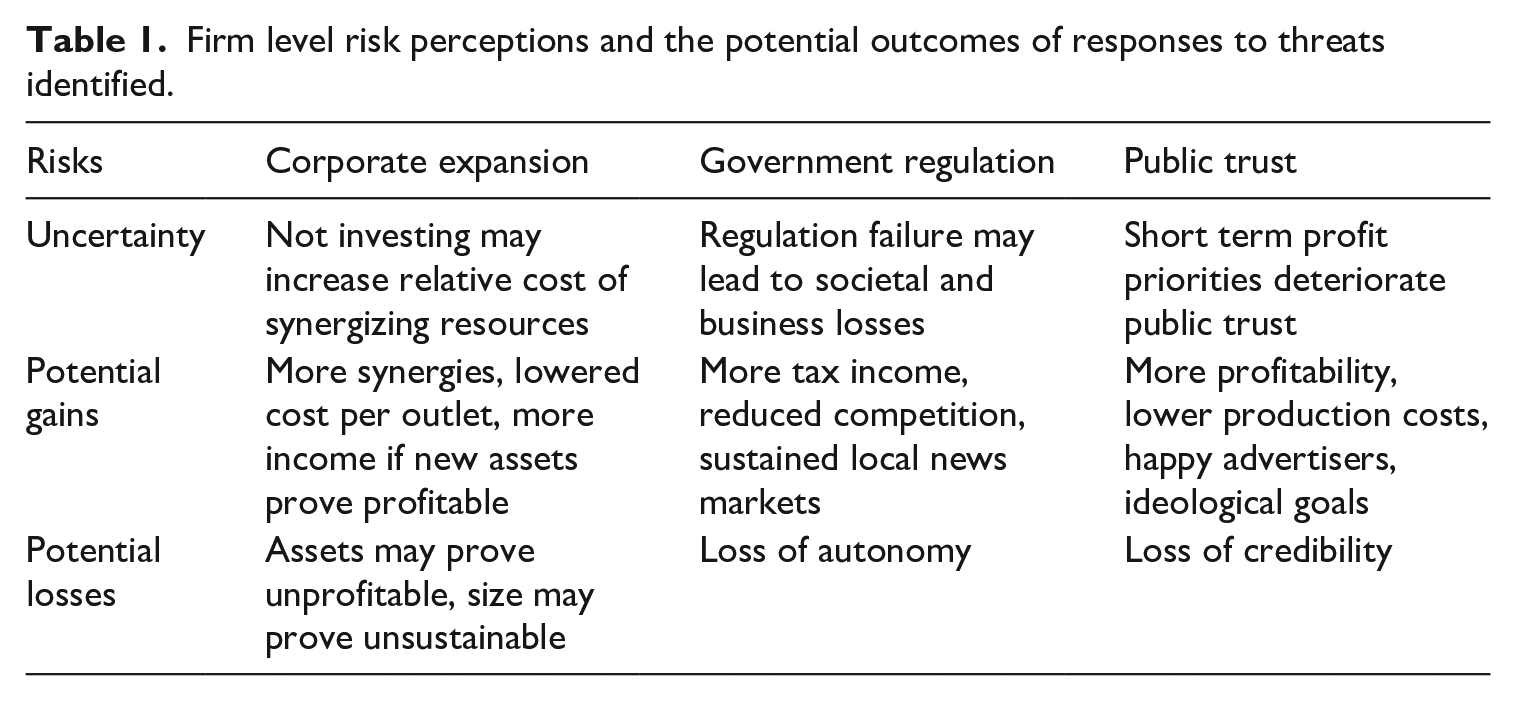
Table 1 thus outlines the risks, their uncertainty bases and potential outcomes from assuming action. The analysis furthermore enables an expansion on Picard’s initial model (Figure 2), identifying the relationship between risks, threats and uncertainties, demonstrating the boundary maintaining properties of risk mitigation. Threats are conceptualized by our informants as competition, primarily from Google and Facebook, which fosters market-level uncertainties, creating firm-level risks (whether and how to act), the outcomes of which can be either positive or negative. Boundary work resides with risk perception and mitigation, as actions constitute measures with boundary maintaining properties.
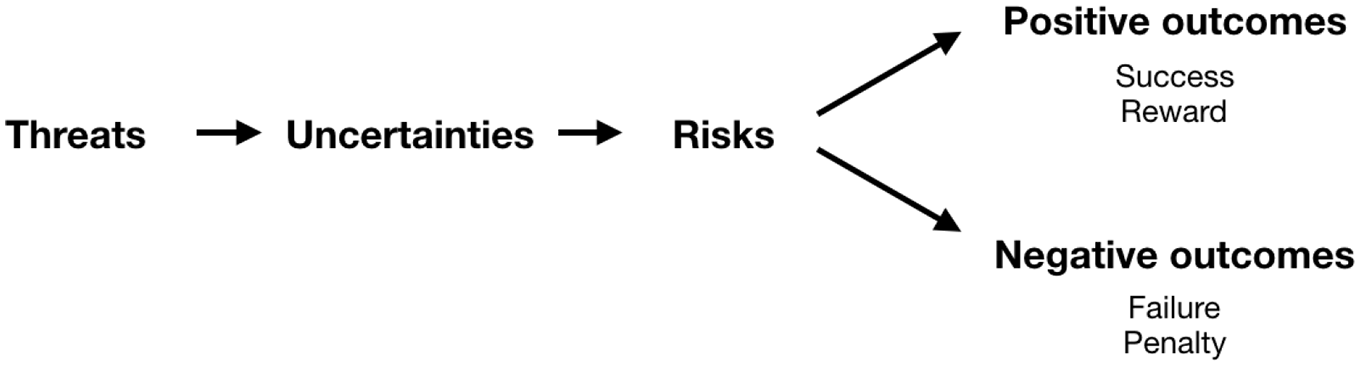
Revised model of the relationship between threats, uncertainty and risks.
It is important to note that the revised model reflects the relationship as described by our informants, and would require further testing to attain universality. The relationship between threats and uncertainties is by no means necessarily a directional one, nor is it necessarily a causal one, moving from threats to uncertainties. However, as uncertainties in this context is tied to action or inaction to mitigate the risk of a given threat, threats are seen to precede uncertainties. In our model, we move from the market level (knowable threats from Google and Facebook), to the industry level (where these threats lead to uncertainties), creating firm-level risks. As uncertainties are related to possible outcomes (the risk residing in what to do about threats), threats precede action or decisions to act in this model. In the following, we discuss these findings in light their theoretical contribution to boundary work in the context of journalism as an institution.
Discussion
As the informants were asked open-ended questions, and thus not instructed to interpret risks in any particular way, it is not entirely obvious how to separate risks from uncertainties and threats as they appear in the data. Indeed, in management literature, the models typically mobilized to illustrate their relationship frequently substitute one for the other in cause/effect illustrations. Their relationship is thus not easily established. From the review of media industries literature, it was, however, possible to make operational distinctions between risks, threats and uncertainties. Once these operationalizations were established, Picard’s model (2004) could be applied to the thematic analysis.
In the media management literature, scholars have tied uncertainty to environmental changes (Wilczek, 2019), associated with isomorphism, inertia and commercialization (Lowrey, 2011; Lowrey and Woo, 2010). Threats have been associated with competition (McDowell, 2011), as well as a general lack of control (Ekberg, 2020), while risks have been more specifically linked with (technological) innovation (Hoskins et al., 2004; Krumsvik et al., 2013). Risk mitigation strategies have been found to be largely sourced at the level of economies of scale and scope (Küng, 2017; Noam, 2019). Our study shows that uncertainties can indeed be seen as tied to overall, industry or environmental changes. The study also shows that threats can be seen as competition. The conditions shaped by competition create uncertainty. Hence, in line with Picard (2004), risks do entail decisions that can grant success or failure. However, because risks are tied to action, our study also demonstrates that journalism scholarship should consider risk perception as part of the conditions that shape institutional boundary maintenance beyond the newsroom, and in particular in relation to external stakeholders such as policymakers, the tech industry and the general public. While CEOs do not enact journalism per se, they perform visible acts of boundary maintenance that serve to mitigate financial and professional risks. How much of this boundary is shaped by CEOs’ risk perception is not within the scope of this analysis to answer. However, when they use their positions to associate what they see as contentious regulation and unfair competition with declining levels of trust in journalism, they position these risks within the boundaries of the field, performing boundary maintaining actions.
How CEOs mitigate risk depends not only on how they evaluate uncertainty, threats and opportunities within the business landscape, it also depends on how they manage the intangible assets of their own brand, and to what extent their actions are geared towards protecting the journalistic institution. The CEOs interviewed for this study all engage in boundary maintenance when they, arguably, perform strategic communication in their engagement with us, the interviewers. To that end, these CEOs clearly mobilize meta-journalistic discourses, expressing values that are sourced within the normative bounds of the journalistic institution. They know very well where these boundaries are and they stay well within them. They refer to their main asset as trust, to their main function as sustaining democracy, and their primary role as protecting the editorial function of the business. To that end, the CEOs reflect the kind of boundary work often found at the level of journalists and news managers (c.f. Singer, 2020; Wolfgang, 2018). While the CEOs emphasize that the best way to secure the journalistic institution is to stay financially sound, this should not be seen as external to the kind of boundary work that Carlson (2015) describes. The CEOs engage in both expansion, expulsion and protection of autonomy when they discuss the various practices, forms and values they can expel or expand to ensure the future of their companies. How CEOs perceive risk thus contributes to define institutional borders. Their discussion of contentious regulation contributes to expand the responsibility for the welfare of media industries to the media policy level; their identification of Google and Facebook as outsiders contributes to expel actors beyond the traditional business model, and their emphasis on financial viability is linked to autonomy protection. Threats are thus knowable realities that can be mobilized to patrol institutional borders, defining institutional problems. Uncertainties serve as invitations to support the institution, while risks, being firm-specific, entail possibilities to explain and defend corporate actions. Even though these CEOs make business decisions to mitigate risks that involve corporate take-overs, policy lobbying and diversification, the risk they seek to mitigate is the decline of trust, and hence the role of journalism in society. Risk mitigating actions, discourses and communication strategies are thus boundary maintaining actions, as perceptions of risks are shaped and acted upon within the institutional context (Boholm, 2003; Lowrey and Gade, 2011).
Distinguishing risks from threats and uncertainties in the news industries thus demonstrates the importance of knowledge, or how the bounded rationality within which decisions are made (Lowrey and Gade, 2011), shapes the boundary work that journalistic professionals engage in. Risk perception is part of the institutional framework that signals journalism’s jurisdiction – perceived here as its democratic function and the public trusts on which this function rests. The biggest risks facing journalism in the near future thus reside with the strategies CEOs assume in balancing the need for financial sustainability on the one hand, and journalistic credibility and brand trust on the other. Distinguishing between risks, threats and uncertainties thus enables a more accurate identification of risk that in turn require action, and to ascertain how those actions potentially impact journalism and its boundaries. The contribution of this study furthermore lies with how it advances our understanding of how boundary work is performed at the firm level. As the study shows, CEOs, existing within the bounded rationality of the profession, contribute to this boundary work through their risk perception and mitigation, expanding the scope of actors and the types of work engaged in boundary maintenance.
Conclusions
Our study shows that uncertainties can indeed be seen as tied to overall, industry or environmental changes. The study also shows that threats can be seen as competition. Threats and uncertainties are thus the conditions that make decisions risky. Risk is tied to action or inaction, the consequences of which constitute boundary work at the corporate level. The CEOs engage in both expansion, expulsion and protection of autonomy when they mobilize the various practices, forms and values they can expel or expand to ensure the future of their companies. Meta-discourses around corporate, organizational and financial survival is part of the material and symbolic resources that CEOs mobilize when addressing future uncertainties. The significance of this insight is twofold: first, it expands the scope of actors and actions involved in Carlson’s (2015) boundary work matrix, and second, it enables a clearer identification of risks and their potential impacts on journalism. Understanding risk as action or inaction and their potential outcomes thus adds to our understanding of boundary maintenance at the corporate level, expanding the institutional space where boundary work is performed.
Limitations and suggestions for further research
There are inherent weaknesses with this analysis. For one thing, the number of informants – while representing a significant share of Scandinavian news corporation CEOs – is limited. The study is also limited in the context of time. By asking open-ended questions about risks, informants are possibly more inclined to use current trajectories as the basis for identifying possible risks, potentially ignoring eventual negative outcomes of assuming action. Given the situational context of the interviews, projecting action as well as normative values is also of possible strategic interest to the informants, who must be considered both expert, versed and strategic in their communication with communication researchers. Hence, the interview design likely affects the results, which must be accounted for in conclusions, not assuming universality. The limited scope of the study, restricted to Denmark, Norway and Sweden, also means conclusions must be seen in light of this context. Future research should consider probing deeper into the decision-making processes of news managers, to better ascertain not only the relationship between threats, uncertainty and risk, but also the link between risk perception and decision-making in relation to possible positive and negative outcomes, and how perceptions and decisions manifest as boundary work in actual practice, beyond the interview situation. Future research should thus also consider analysing risk mitigating actions (or inactions) and their outcomes, to determine what kinds of risk incur action and which do not.
Footnotes
Declaration of conflicting interests
The author(s) declared no potential conflicts of interest with respect to the research, authorship, and/or publication of this article.
Funding
The author(s) disclosed receipt of the following financial support for the research, authorship, and/or publication of this article: This work was supported by the Ander Foundation, Anne-Marie och Gustav Anders Stiftelse för mediaforskning.
Risk perception in newspaper chains
Threats, uncertainties and corporate boundary work.
