




Abstract
Baghdad, Christchurch or Paris: Over the last years, many cities were the location of extremist attacks – but only some incidents were covered as “terrorism”. Journalists selectively attach the label to particular acts of political violence. This study analyses how characteristics of attacks and their perpetrators influence whether news media portray incidents as terrorism. Based on attacks between 2012 and 2018 (N = 86,668) and their coverage in the German press (N = 5411), the study finds that highly lethal incidents in Western countries are more likely to be called terrorism. Moreover, news more often portrays violence by Islamist extremists as terrorism than attacks by right- or left-wing extremists. Small or inconsistent effects emerge when comparing violence by lone actors to those by groups and domestic to international terrorism. The study illustrates that news is highly selective in which acts of political violence are presented as terrorism, which may foster stereotypes and prevent policy responses towards different forms of extremism.
When Islamist extremists 1 attacked citizens in Paris in 2015, media outlets were quick to condemn these acts as terrorism. When a white supremacist targeted a church in Charleston, however, news was more hesitant to use the term (de Veen and Thomas, 2020). Consequently, journalists (Fisher, 2017) and researchers (Betus et al., 2020; Ghazi-Tehrani and Kearns, 2020) have started to question whether news is too selective, even biased in which attacks are called terrorism – and which are not.
How news media portray political violence has consequences. Journalists often associate Islam with terrorism (Dixon and Williams, 2015; Matthes et al., 2020), which may foster Islamophobia (Von Sikorski et al., 2021). Violence by left- or right-wing extremists, however, is largely ignored (Mitnik et al., 2020). What news presents as terrorism reflects ‘which groups society is willing to protect, and what kind of violence it is willing to tolerate’ (Fisher, 2017: no page) – or counteract. Given that terrorism is a highly politicized term (Schmid, 2011), its use has policy implications. In crises, journalists rely on governmental sources. Politicians can capitalize on this and convey their interpretation of violence through the news, for example to legitimize war against actors they call terrorists (Ahmad, 2020).
This study analyses how incident and perpetrator characteristics influence whether news portrays political violence as terrorism. It combines a manual content analysis of N = 5411 articles in five German newspapers and magazines with data from terrorism studies. The study illustrates systematic differences in how political violence is covered: News predominantly presents lethal attacks in Western countries by Islamist extremists as terrorism.
This study advances research in three ways: From a theoretical perspective, it illustrates how Social Identity Theory may not only serve to understand stereotypic coverage of Islam (Matthes et al., 2020) and related media effects (Schmuck et al., 2021; Von Sikorski et al., 2017, 2021) but also journalistic use of the pejorative label ‘terrorism’. The paper also addresses two empirical gaps: Research on journalistic labelling of different attacks is largely absent, at least apart from case studies including few incidents (de Veen and Thomas, 2020; Elmasry and el-Nawawy, 2020). 2 By comparing N = 86,668 attacks and their coverage, this study delivers a more comprehensive picture of why journalists may decide to portray political violence as terrorism. Furthermore, it extends scholarly knowledge on the influence of perpetrator characteristics. Despite an uptick in white supremacist violence (Cai and Landon, 2019) and journalists being criticized for their hesitance to call related incidents terrorism (de Veen and Thomas, 2020), most studies either ignore the role of perpetrator characteristics or only focus on how violence by Islamist extremists is covered (Sui et al., 2017). To better understand whether journalists emphasize the threat posed by some types of perpetrators while ignoring others, this study analyses a broader range of perpetrator characteristics than has been done in previous studies.
Defining political violence and terrorism
Political violence, that is, violence by state and non-state actors to influence governance, includes war, military coups – and terrorism (Kalyvas, 2019). The Global Terrorism Database (GTD), one of the most extensive databases on terrorist attacks, defines terrorism as ‘the threatened or actual use of illegal force and violence by a non-state actor to attain a political, economic, religious, or social goal through fear, coercion, or intimidation.’ (Start, 2019: 10) Similar to most definitions, the GTD understands terrorism as the (threatened) use of violence for political ends (Weinberg et al., 2004). However, scholars disagree about a variety of other aspects when conceptualizing terrorism (Nacos, 2016; Schmid, 2011), some of which also pertain to the GTD’s definition. For instance, there is an ongoing debate about whether states can perpetrate terrorism, with the GTD excluding state terrorism. Additionally, scholars emphasize that terrorism targets civilians or non-combatants (Weinberg et al., 2004), while the GTD also includes violence against other targets.
Overall, more than hundred definitions of terrorism exist, often in addition to governmental conceptualizations (Beck and Miner, 2013; Schmid, 2011). While the GTD’s conceptualization therefore serves as one example for how terrorism can be defined, a consensus definition has yet to be agreed upon.
A critical perspective on defining terrorism
Importantly, critical terrorism studies has challenged the assumption that a consensus definition is possible as definitions of terrorism are ‘influenced by cultural, social, and political factors’ (McCann and Pimley, 2020: 807). 3 In particular, national contexts influence how institutions conceptualize terrorism. For example, Western governments do not necessarily designate those actors as terrorists that have the highest track record of violence against their citizens. Rather, geopolitical interests and contexts, for example Islam and Islamist extremism being perceived as particularly incompatible with Western societies, influence national perceptions of and responses to terrorism (Beck and Miner, 2013; Meier, 2020). Consequently, scholars stress that we should question whether terrorism can be defined objectively at all. Jackson (2007: 247) argues that terrorism is not something we can measure, but a pejorative label used to convey ‘political judgement about the legitimacy of actors and their actions.’ If acts are called terrorism, this carries an implicit evaluation concerning their presumed illegitimacy which allows for law enforcement to justify countermeasures. Thus, governments may not only define terrorism in line with prevailing cultural, social and political sentiments, for example by more often designating Islamist extremists as terrorists. They also strategically use the term to condemn specific forms of political violence and advance political agendas. However, politicians are not the only ones contributing to the construction of the terrorist threat – so do news media (Nacos, 2016; Rothenberger, 2021).
How news media define terrorism
Before summarizing important patterns in coverage of political violence, the paper underlines how national identities, including those of journalists, influence perceptions of violence and, thus, coverage.
National identities and coverage of political violence
The concept of national identities describes ‘a subjective or internalized sense of belonging to the nation’ (Huddy and Khatib, 2007: 65), that is, the belief in shared values in a country in difference to those not part of it. According to Huddy and Khatib (2007), the concept is understood best through the lenses of Social Identity Theory (SIT). According to SIT, ‘part of an individual’s self-concept [. . .] derives from his knowledge of his membership of a social group (or groups) together with the emotional significance attached to that membership.’ (Tajfel, 1974: 69) Following Tajfel and Turner (2004), individuals consider themselves as being part of in-groups (‘us’) in difference to out-groups (‘them’) which leads to in- and out-group bias. In-group members are perceived more positively and individuals act in line with their interests while out-group members are perceived negatively.
Importantly, in- and out-group bias is partly activated under threat, including terrorist attacks (Van Hauwaert and Huber, 2020). Threats make perceived belonging to an in-group, for example one’s nation, and differences to out-groups, for example perpetrators of violence or those assumed to agree with them, more salient. Thus, SIT plays an important role in understanding coverage of political violence and its effects (Matthes et al., 2020; Schmuck et al., 2021; Von Sikorski et al., 2017, 2021). Nossek (2004: 344) argues that in- and out-group thinking is decisive for how journalists cover political violence as ‘professional norms become subordinate to the national identity of the reporting correspondent.’ National identities influence coverage as journalists feel compelled to take a clear stance on the illegitimacy of violence by condemning acts as terrorism, especially if in-group members, for example domestic audiences, are targeted. Oftentimes, journalists are part of the in-group and may feel threatened themselves, which affects reporting (Abubakar, 2020). Journalists also interpret violence in line with prevailing sentiments (Nossek, 2004). For instance, journalists downplay violence by the in-group, for example, domestic citizens, and exaggerate threats by the out-group, for example, foreigners (Fishman and Marvin, 2003). As journalists rely on governmental information during crises, politicians can more easily access the news flow and further reinforce in- and out-group bias through calls for unification by the nation or condemnation of out-groups (Ahmad, 2020). In conclusion, journalistic use of the term terrorism may be an indicator of in- and out-group bias: Journalists suggest for acts of violence and their perpetrators to be illegitimate, often due to an increased salience of journalists’ national identities during attacks.
The influence of incident and perpetrator characteristics
Coverage of political violence, including terrorism, is highly selective: Most attacks are either never reported on or only mentioned briefly, while few incidents dominate the headlines (Chermak and Gruenewald, 2006). News is also selective in how political violence is described. Journalists can indicate the legitimacy of violence by using labels carrying negative (‘terrorists’) or positive (‘freedom fighters’) sentiments (Rothenberger and Hase, 2021). Editorial departments often recommend for journalists to avoid the term terrorism due to its pejorative meaning. However, journalists feel compelled to rely on it as recipients expects them to or governmental sources use the term (Abubakar, 2020). Importantly, studies indicate systematic differences in which attacks are called terrorism (Betus et al., 2020; Ghazi-Tehrani and Kearns, 2020). Two aspects influence selective coverage, although their impact has mostly been analysed concerning the volume of coverage, not its content (Mitnik et al., 2020): incident and perpetrator characteristics.
Incident characteristics describe event-related aspects, including the location, lethality or victims of violence. Attacks in proximate countries are covered more frequently, especially if they are lethal (Sui et al., 2017). Studies also indicate that the type of victim influences coverage (Chermak and Gruenewald, 2006; Mitnik et al., 2020). Most studies analysing the role of incident characteristics have relied on news values theory (Galtung and Ruge, 1965) to show that the proximity of incidents or negativity in the form of fatalities as important news values increase the newsworthiness of incidents and, thus, coverage.
However, journalists also draw on perpetrator characteristics, that is, information on individuals or groups behind attacks, to understand whether violence is perpetrated by in- or out-group members and who is likely being targeted, often based on SIT. In particular, lone actor terrorism has received more attention recently (Cai and Landon, 2019; Fisher, 2017). While there is conceptual ambiguity about the term (Kenyon et al., 2021), lone actor terrorism is often defined as attacks by individual(s) instead of terrorist groups. 4 Additionally, domestic terrorism as violence by domestic citizens on domestic soil (Berkebile, 2017) 5 is covered differently than international terrorism. Studies indicate that domestic terrorism is covered more frequently (Chermak and Gruenewald, 2006; Mitnik et al., 2020), presumably because in-group members are involved as perpetrators, victims or both. Studies also indicate for perpetrators’ ideology to play a role. Attacks by self-identified Muslims (Kearns et al., 2019) and, partly, Islamist extremist groups (Sui et al., 2017) are covered more as Muslims are considered an out-group in many Western societies. While most studies analyse how incident and perpetrator characteristics influence the volume of coverage, their impact on the labelling of political violence has largely been neglected. Thus, the paper now introduces the hypotheses and research questions of this study.
Location of attacks
Turning to incident characteristics, attacks in countries that are geographically or culturally close may be covered differently. Proximity is an important news value that influences how much attacks are covered (Sui et al., 2017). If political violence is ‘too far removed to be of concern to [. . .] news consumers’ (Chermak and Gruenewald, 2006: 439), it may be ignored. Proximity may also influence labelling. Following SIT, attacks on Western countries are considered a bigger threat for in-group members: If Western journalists and their audiences can identify with victims, for example domestic citizens or citizens in other Western countries presumably sharing similar values, this may activate in- and out-group thinking (Schmuck et al., 2021). Attacks in Western countries may be perceived as an attack on ‘us’ and lead to condemnation of violence as being illegitimate, that is, terrorism. Journalists themselves report that (personal) affectedness motivates them to report on violence as terrorism (Abubakar, 2020). In line with this, Matthes et al. (2020) show that more proximate attacks lead to stronger in- and out-group bias in the news, specifically negative portrayals of out-groups. Similarly, Ismail and Mishra (2019) illustrate that US coverage of two very similar attacks in Beirut and Paris was far more emotional when describing the latter, presumably because journalists perceived victims to be more similar. For the US, Elmasry and el-Nawawy (2020: 13) demonstrate that journalists more often portrayed attacks in Western countries as terrorism than similar incidents in Maiduguri and Ankara, ‘despite the fact that all [. . .] easily meet textbook definitions of terrorism’. Thus, if journalists identify with victims, they may be more likely to condemn violence as terrorism.
H1: Attacks in Western Europe or North America are more likely to be portrayed as terrorism than attacks elsewhere.
Lethality of attacks
Lethal attacks are covered more frequently (Kearns et al., 2019; Sui et al., 2017) as lethality is an indicator of negativity which, as a news value, increases the newsworthiness of violence. Lethal attacks may not only be more newsworthy, but also activate in- and out-group bias. According to terror management theory, mortality salience as individual awareness about death fosters in- and out-group thinking (Burke et al., 2010). As Cuillier (2012) shows, this effect also pertains to journalists as it leads to out-group bias in their coverage. Mortality salience may be induced by deadly attacks across the globe, independent of who is affected: Matthes et al. (2020: 2418) demonstrate that out-group bias towards Muslims in the news increases with the lethality of attacks as ‘deaths [. . .] lead to more mortality salience, which fosters intergroup bias.’ Similarly, Ghazi-Tehrani and Kearns (2020) illustrate that US news outlets are more likely to cover an incident as terrorism the more deaths it caused. Nagar (2010) shows that groups which perpetrate lethal attacks are more often portrayed as terrorists in the news, independent of where their attacks occurred. Thus, lethal attacks across the globe may increase in- and out-group bias through mortality salience and, correspondingly, influence how violence is portrayed.
H2: The higher the number of fatalities, the more likely an attack is to be portrayed as terrorism.
Victim of attacks
Some scholars stress that political violence should only be called terrorism when targeting non-combatant targets (Weinberg et al., 2004). Attacks on civilians or tourists may be perceived as more gruesome, thus more in line with the assumed illegitimacy of terrorism. As already mentioned, Schmuck et al. (2021) show that the more news audiences identify with the victims of attacks, the more emotional their reactions to coverage and, thus, in- and out-group bias – an effect that may extend to journalists. Studies analysing whether attacks on civilians receive more coverage do not find consistent associations (Chermak and Gruenewald, 2006; Mitnik et al., 2020); however, almost none have analysed how the type of victim influences labelling. Ghazi-Tehrani and Kearns (2020) illustrate that attacks on some targets, for example, law enforcement or the government, are less likely to be covered with references to terrorism than those on other targets – but their comparison category of ‘other targets’ is not limited to civilians. Thus, it is unclear whether targeting civilians and tourists as victims audiences and journalists can more easily identify with influences labelling.
RQ1: Are attacks on citizens, public places or tourists more likely to be portrayed as terrorism than attacks on other targets?
Lone actors versus groups
Turning to perpetrator characteristics, the threat of lone actor terrorism has been a frequent object of discussions (Cai and Landon, 2019; Fisher, 2017). Underlining the salience of the issue, Schmuck et al. (2018) finds that if German recipients are presented with news about attacks where the perpetrator has not been identified, around 40% assumed lone actors to be responsible (see similarly Schmuck et al., 2021). However, lone actor terrorism – here defined as violence by individuals instead of groups – may be considered less threatening: If attacks are perpetrated by formal organizations, recipients are more likely to perceive them as terrorism (Huff and Kertzer, 2018). D’Orazio and Salehyan (2018: 1022) underline that ‘a “lone wolf” attacker may be dismissed as a single, isolated threat, while ties to a larger organization imply that others hold similar, extreme beliefs’ which may be seen as a bigger threat for the in-group. Consequently, Betus et al. (2020) find that attacks by formal groups are more likely to be covered with references to terrorism. Otherwise, they are portrayed as acts by perpetrators with mental illnesses (see similarly Ghazi-Tehrani and Kearns, 2020).
H3: Attacks by groups are more likely to be portrayed as terrorism than attacks by individuals.
Domestic vs international terrorism
Domestic terrorism as violence by domestic citizens on domestic soil is covered more frequently (Chermak and Gruenewald, 2006; Mitnik et al., 2020). Still, citizens more strongly associate international perpetrators with terrorism (Huff and Kertzer, 2018), presumably because they have less difficulties imagining foreigners as terrorists than their fellow citizens. We also know that journalists downplay violence by domestic citizens (Fishman and Marvin, 2003). Overall, attacks by domestic citizens on domestic soil as acts of domestic terrorism are often depicted as isolated incidents caused by individuals with mental problems. In contrast, international perpetrators attacking one’s nation are portrayed as angry extremists who may attack again soon, thus posing a bigger threat (Crenshaw, 2014). These differences may be due to racial bias, for instance journalists being hesitant to connect white perpetrators assumed to be Western citizens to terrorism (Ghazi-Tehrani and Kearns, 2020).
H4: International terrorism is more likely to be portrayed as terrorism than domestic terrorism.
Ideology of perpetrators
Political violence can be motivated by an array of ideologies, including religious, nationalist/ethnic, left-wing and right-wing extremism. In recent years, news has largely focused on one ideology: Islamist extremism. Journalists are more likely to cover attacks by self-identified Muslims (Kearns et al., 2019) and, partly, Islamist extremist groups (Sui et al., 2017). Journalists often portray Muslims as an out-group by associating Islam with terrorism (Dixon and Williams, 2015; Matthes et al., 2020) and depicting violence by perpetrators who self-identify as Muslims as terrorism (Betus et al., 2020; de Veen and Thomas, 2020), as expected due to out-group bias. However, we know less about how other forms of extremism such as right-wing or left-wing extremism are covered, especially in comparison to Islamist extremism. Mitnik et al. (2020) find that US news reports more often on violence by Islamist extremists than on attacks by, for example, left-wing extremists. This indicates that journalists more often ignore violence by perpetrators motivated by other ideologies. Similarly, Nagar (2010) finds that news more often associates Islamist groups with terrorism than ethnic/nationalist groups or left-wing extremists.
H5: Attacks by Islamist extremists are more likely to be portrayed as terrorism than attacks by unknown perpetrators, perpetrators with unclear motives, or perpetrators following other ideologies.
However, news does not necessarily cover every attack by Islamist extremists. Instead, it focuses on incidents in Western countries. For example, the November 2015 attacks in Paris by the so-called Islamic State were covered extensively while lethal attacks in Beirut just a day prior received far less attention (Ismail and Mishra, 2019). Schmuck et al. (2018, 2021) demonstrate that if German recipients are presented with attacks where the perpetrator is unidentified, they more often assume the perpetrator to be an Islamist extremist if they can identify with victims. In conclusion, both journalists and recipients perceive Islamist extremism as a threat mainly directed towards Western citizens. 6
H6: The effect of Islamist extremism on the portrayal of attacks as terrorism is stronger if attacks occur in Western Europe or North America.
Method
Setting the scene: Terrorism in Germany
Between 2012 and 2018, Germany suffered 177 terrorist attacks leading to a total of 29 fatalities. Prominent incidents included Islamist extremists attacking a Christmas market in Berlin or the right-wing Freital Group targeting refugees. However, attacks and fatalities were considerably higher in the United States, the United Kingdom or France (Start, 2019). Previous studies on the labelling of violence focused almost exclusively on the US (Betus et al., 2020; Elmasry and el-Nawawy, 2020; Ghazi-Tehrani and Kearns, 2020). Given that the country was more affected, we might find stronger in- and out-group bias in US news, and thus, findings ‘may not translate cross-nationally’ (Betus et al., 2020: 16). In addition, previous studies mostly considered attacks in the US (Betus et al., 2020; Ghazi-Tehrani and Kearns, 2020) – but recent years have been characterized by an uptick of violence across the globe (Start, 2019). By focusing on Germany, we can therefore learn how previous findings translate to countries less affected by terrorism and attacks outside the US.
Dependent variable: Media coverage
In this study, the unit of analysis is every attack in the GTD. The dependent variable indicates whether an attack was covered as terrorism (0 = No, 1 = Yes). All attacks listed by the GTD between 2012 and 2018 were retrieved (N = 86,668). The observation period is limited to these years as the GTD only included information until 2018 at the time of data collection and its methodology changed from 2012 on. The GTD employs an inclusive definition of terrorism: It includes cases suspected to be crime or lacking a clear motive (Start, 2019). Thus, it is unlikely that news reports on attacks not listed here. 7 However, readers should note that by relying on the GTD, the study cannot measure coverage of state terrorism.
Online and offline coverage from five German newspapers and magazines was sampled, namely Der Spiegel, Focus, Süddeutsche Zeitung, Die Welt and Die Zeit and their online counterparts Spiegel.de, Focus.de, Sueddeutsche.de, Welt.de and Zeit.de. These outlets are highly popular. Moreover, they include left- and right-leaning views. However, please note that Die Welt represents the only conservative outlet in the sample.
Using the database Factiva and the search term ‘atleast2 terror*’, articles including the word ‘terrorism’ or related terms at least twice were retrieved as a first step. The term ‘terror’ had to occur more than once to assure that articles primarily discussed terrorism. Articles describing terrorist attacks, its victims or its perpetrators were retrieved. According to this second step of the manual content analysis, N = 5411 articles were identified as relevant (α = .87). Conservative outlets, here Die Welt, more frequently wrote about terrorism: 32.9% of articles were published by the conservative outlet while 67.1% were published by the four remaining central/liberal outlets (see Supplementary Material, Element A1).
Next, the study analysed which attacks in the GTD were mentioned in these articles. Importantly, an attack was only coded as mentioned if journalists called the incident a terrorist attack or described its perpetrators as terrorists, that is, clearly portrayed it as terrorism. According to this third step of the content analysis, N = 2028 attacks were mentioned by the German press (percent agreement = .84). For details on the coding process, please see the Supplementary Material (Element A1).
Independent variables: Incident and perpetrator characteristics
Incident characteristics
Based on the GTD, the dichotomous variable Western Europe/North America indicates whether an attack occurred in Western Europe/North America (H1). 8 Fatalities (log) describes the number of fatalities for each attack (H2). To account for skewness, the log of the original values was taken. Civilian/tourist target specifies whether attacks targeted individuals, the public in general, public places or tourists (RQ1).
Perpetrator characteristics
To measure perpetrator characteristics, the names of perpetrators behind all attacks were retrieved from the GTD. Group association describes whether an attack is associated with individual(s) or group(s) (0 = Individual, 1 = Group, H3). In the GTD, attacks are listed as being perpetrated by individuals, for example, ‘Jihadi-inspired extremists’ or formal organizations, for example, ‘Al-Qaida’, which was used to construct this variable. Domestic terrorism describes whether the perpetrator of an attack is a German group perpetrating an attack in Germany (0 = International Terrorism, 1 = Domestic Terrorism, H4). Importantly, this information could only be coded for groups: While we know that the ‘Freital Group’ is a German organization, the nationality of individuals, for example, ‘Jihadi-inspired extremists’, is unclear. Ideology describes the ideology of perpetrators independent of the specific attack (H5, H6). Perpetrators were coded as following nationalist/ethnic, left-wing, right-wing, religious (non-Islamist), religious (Islamist) and other/mixed goals, for example issue-specific terrorism. In some cases, the ideology of perpetrators was not known or perpetrators were not known. For databases used to create Domestic terrorism and Ideology, please see the Supplementary Material (Element A2).
Controls
Based on the GTD, four controls were included: Extended describes whether an incident lasted several days, which makes coverage more likely. Yearly trend describes the year an attack took place to account for an increase in coverage over time. Series describes whether incidents were part of a series of attacks. Doubt describes whether there is doubt that an act constitutes terrorism, for example if it is suspected to be an act of crime.
Multivariate analysis
The binary dependent variable, whether news covered an attack as terrorism, was regressed on controls, incident and perpetrator characteristics using logistic regression with robust standard errors. The regression was run in blocks of controls and incident characteristics (Model 1) and perpetrator characteristics (Model 2a–d). As the inclusion of Group association and Domestic terrorism led to smaller samples, these models are presented separately (Model 2a; 2b). The effect of Ideology with Islamist extremism as the baseline (Model 2c) and the interaction between only one type of Ideology, Islamist extremism, and Western Europe/North America (Model 2d) are also estimated separately. For robustness tests, including outlet-specific differences and clustering by perpetrators, please see the Supplementary Material (Element A3–5).
Results
Descriptive results
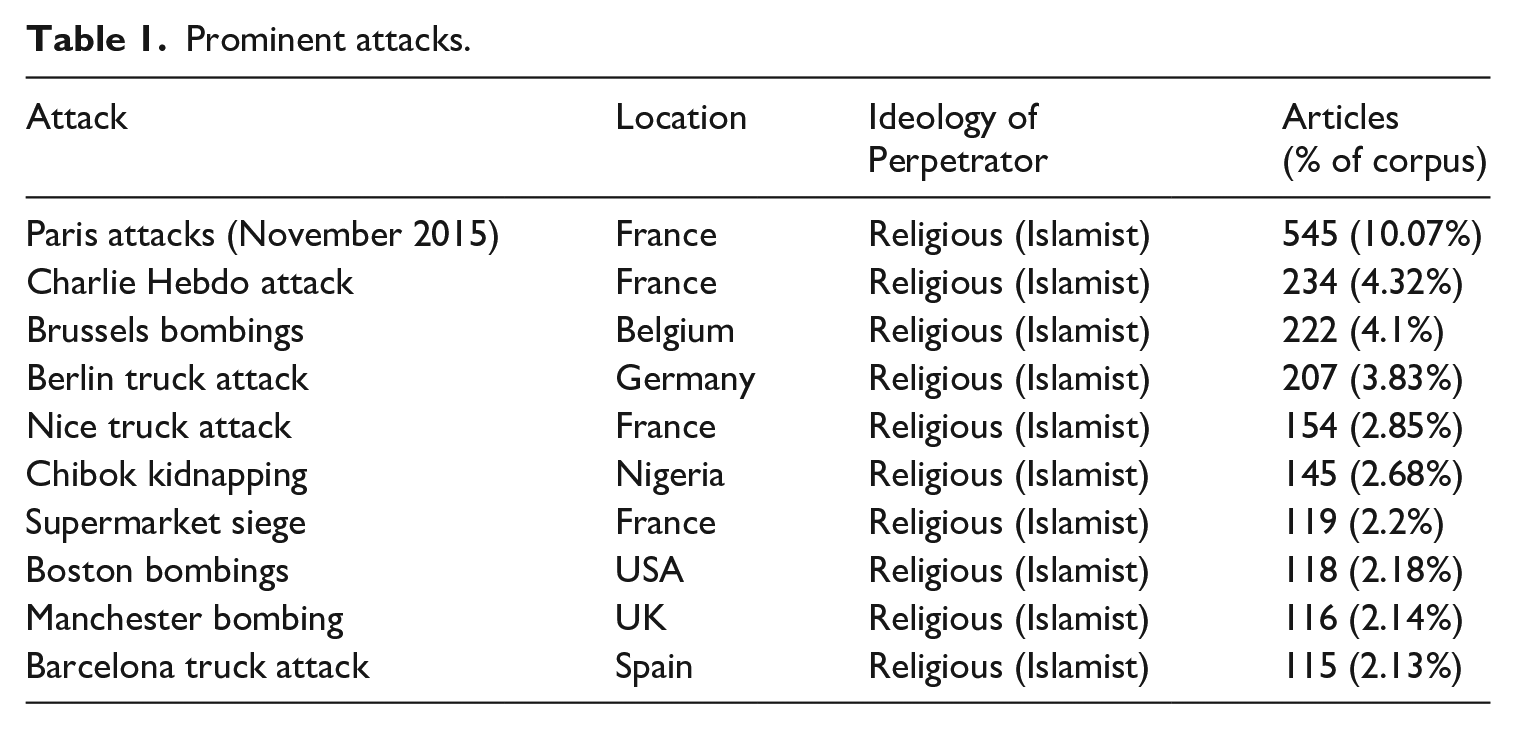
Between 2012 and 2018, German news outlets covered a minority of attacks: 2028 incidents or 2.34% of all attacks that occurred globally were reported on as terrorism. Table 1 lists the ten most prominent attacks. Few incidents dominate coverage, above all the attacks in Paris in November 2015 which were mentioned in 545 articles or 10.07% of coverage. Most prominent attacks took place in Western countries and were perpetrated by Islamist extremists: the Charlie Hebdo attacks (4.32%), the siege of a kosher supermarket in France (2.2%), the bombings in Brussels (4.1%), the Boston marathon (2.18%), the attack on a concert in Manchester (2.14%) or incidents with trucks in Berlin (3.83%), Nice (2.85%) and Barcelona (2.13%). Only one attack outside of Western countries was covered comparably often: Boko Haram’s abduction of schoolgirls in Nigeria (2.68%), which received attention via the #bringbackourgirls-campaign.
Prominent attacks.
To further illustrate the exclusive focus on Western countries, Figure 1 visualizes how many attacks that occurred in a given country were covered. For example, 23.16% of all attacks in Germany were covered as terrorism but only 2.7% of those in Iraq, the country that suffered most from terrorism throughout the observation period.
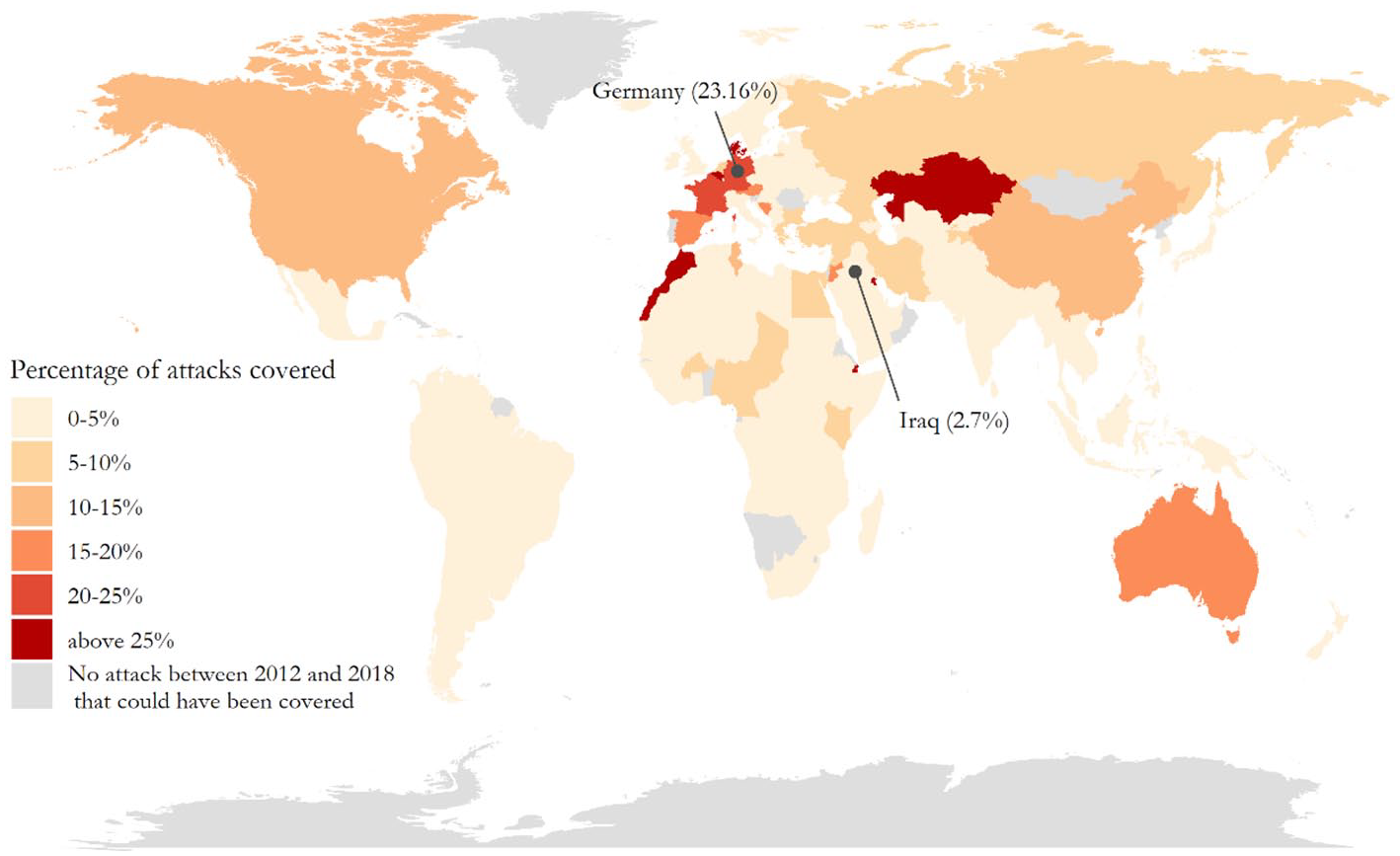
Coverage by region.
Table 2 illustrates how many attacks by different perpetrators occurred and how often they were covered. It underlines that journalists focused on Islamist extremism. However, the sheer frequency of attacks by Islamist extremists might partly explain this selectivity. For example, 1593 attacks by Islamist extremists were reported on compared to 36 attacks by right-wing extremists. By doing so, however, news still reported on 5.81% of all attacks by Islamist extremists and 8.82% of those by right-wing extremists.
Coverage by ideology.
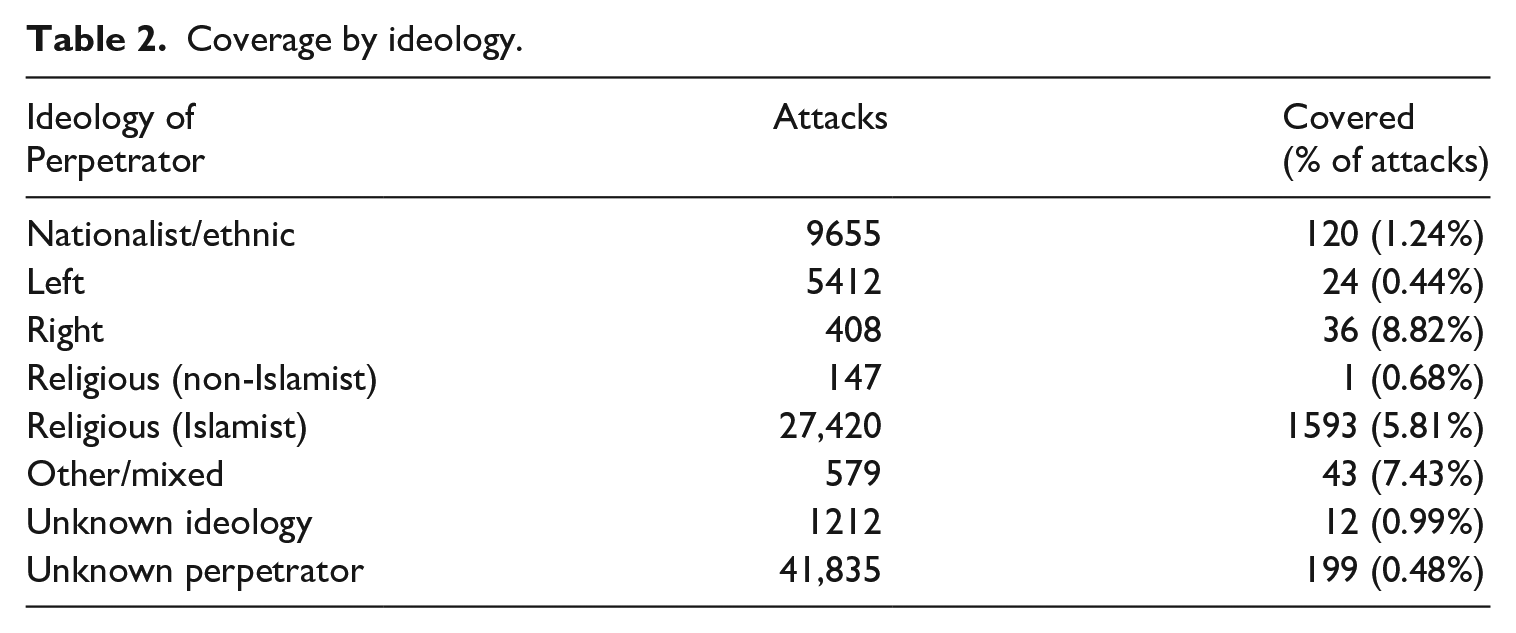
Still, it is notable how much more consistently journalists used the term terrorism when describing violence by Islamist extremists. For example, when lone actors associated with Islamist extremism attacked civilians in San Bernardino in 2015, all outlets portrayed the incident as terrorism. However, when a right-wing extremist attacked a church in Charleston, outlets mostly covered the incident as an act of racism and often avoided the term terrorism.
Multivariate results
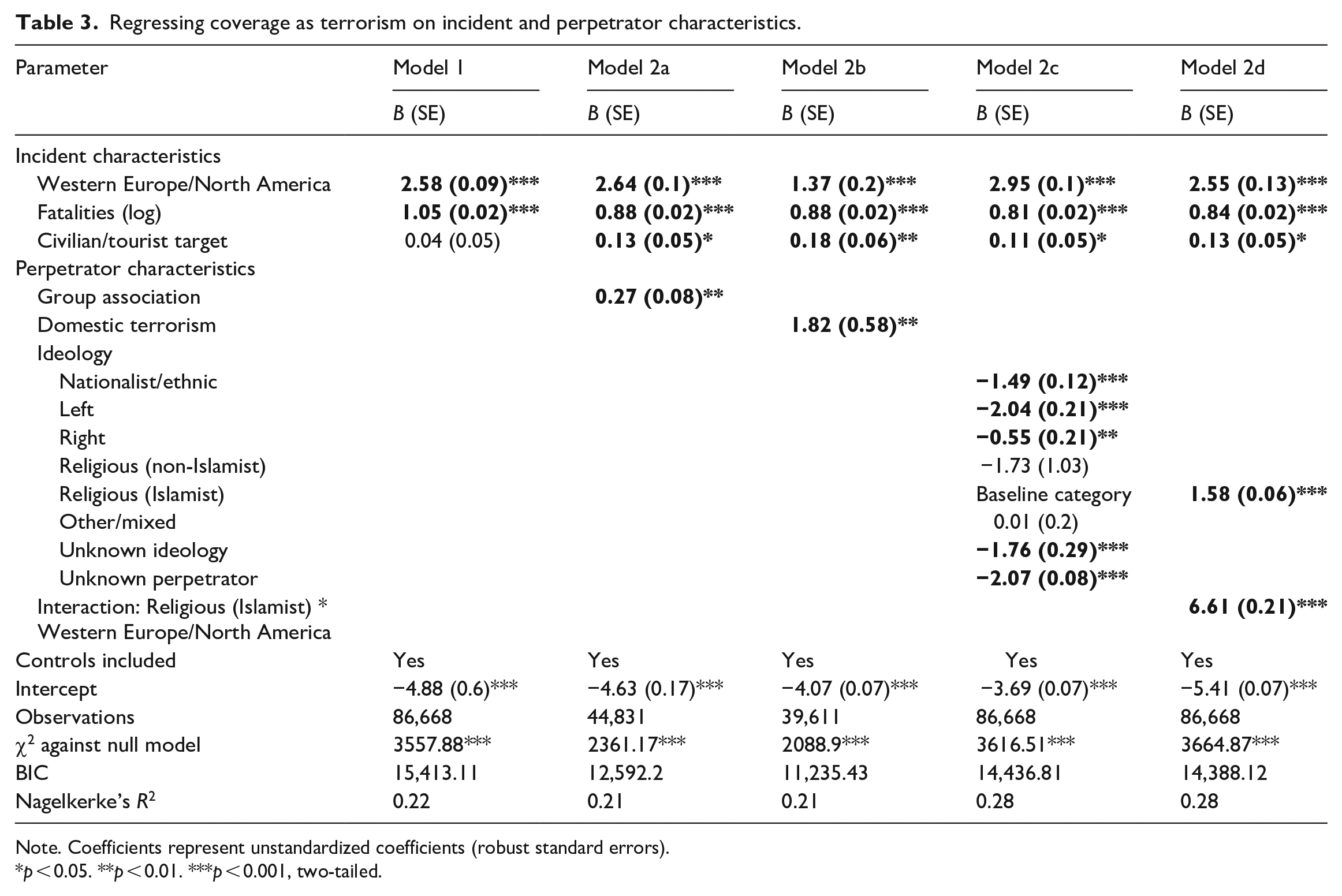
Table 3 displays the logistic regression models. Incident characteristics were included across models; for interpretation, Model 2c as the model with the highest amount of explained variance but exclusion of the interaction term is used. H1 proposed an association between the location of an attack and its depiction as terrorism. The odds of an attack being portrayed as terrorism increase by a factor of 19.08 if it occurs in Western Europe or North America (B = 2.95, p < .001). Results indicate strong support for H1. According to H2, lethal attacks are more likely to be portrayed as terrorism. The positive association between the logged number of fatalities and news deciding to cover an incident as terrorism support H2 (B = 0.81, p < .001). Related to RQ1, the odds of an attack being covered as terrorism increase by a factor of 1.11 if civilians, tourists, or public places are targeted (B = 0.11, p < .05). This effect is comparably small and not robust (see Supplementary Material, Element A3–A5). Thus, the type of victim does not consistently or substantially influence labelling.
Regressing coverage as terrorism on incident and perpetrator characteristics.
Note. Coefficients represent unstandardized coefficients (robust standard errors).
p < 0.05. **p < 0.01. ***p < 0.001, two-tailed.
Turning to H3 and perpetrator characteristics, Model 2a illustrates that attacks by groups are more likely to be covered as terrorism than those by individuals. However, the difference is small: The odds of an attack being covered as terrorism rise by a factor of 1.31 if the attack is perpetrated by a group (B = 0.27, p < .01). In addition, the effect is only partly homogenous and consistent (see Supplementary Material, Element A3). Support for H3 is limited. According to H4, domestic terrorism as attacks by domestic groups on domestic ground is less likely to be portrayed as terrorism. Model 2b indicates a consistent effect opposite to what was expected: The odds of an attack being covered as terrorism rise by a factor of 6.18 for domestic terrorism (B = 1.82, p < .01). H4 is not supported. H5 proposed that attacks by Islamist extremists were more likely to be covered as terrorism. According to Model 2c, attacks by Islamist extremists are more likely to be portrayed as terrorism than attacks by nationalist/ethnic (B = –1.49, p < .001), left-wing (B = –2.04, p < .001), or right-wing extremists (B = –.55, p < .01) 9 or attacks where the ideology of the perpetrator is unknown (B = –1.76, p < .001) or the perpetrator is unknown (B = –2.07, p < .001). However, there is no consistent difference compared to religious, non-Islamist extremists (B = –1.73, p = .09) or perpetrators following other/issue-specific ideologies (B = 0.01, p = .97). H5 is partly supported.
Related to H6, Model 2d displays the effect of attacks being perpetrated by Islamist extremists conditional on the location of the incident. The interaction effect (B = 6.61, p < .001) is visualized in Figure 2: While attacks by Islamist extremists are more likely to be portrayed as terrorism, this effect is by far stronger for Western countries. H6 is supported.
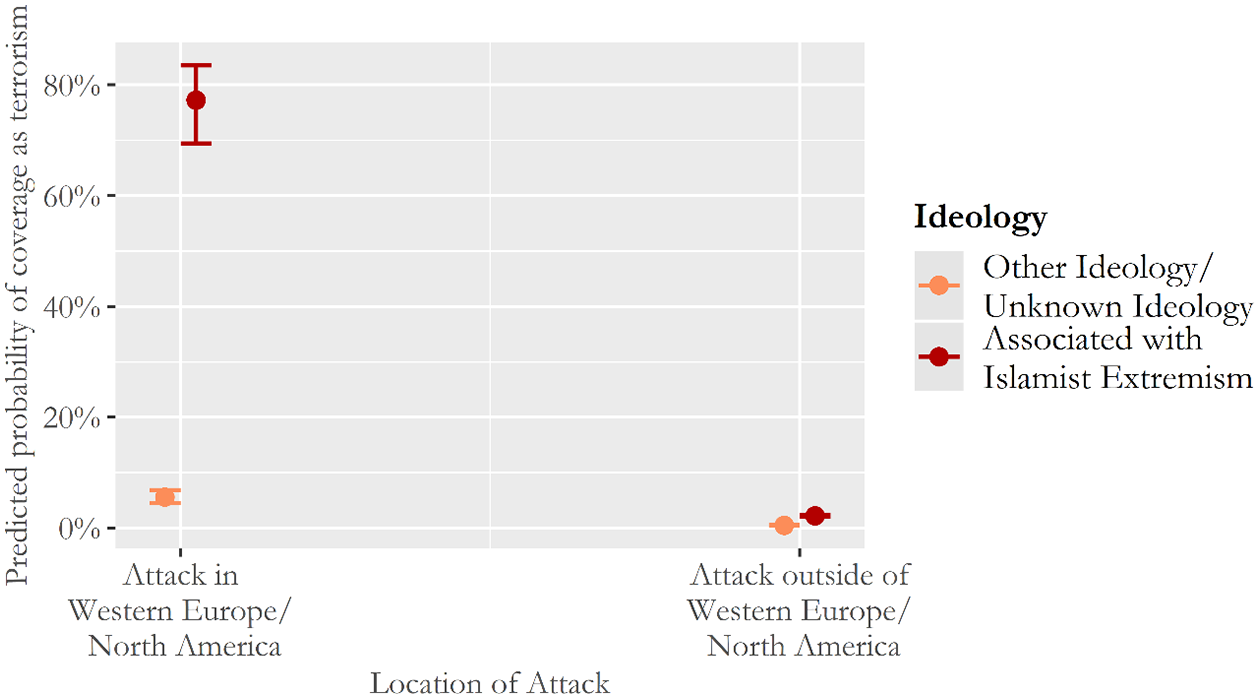
Interaction between ideology and location.
Discussion
Journalists influence how societies perceive and respond to political violence. Based on the coverage of attacks in the German press, this study illustrates that news is selective, even biased in which attacks are reported on as terrorism. In particular, journalists almost exclusively present lethal attacks in Western countries by Islamist extremists as terrorism. At the same time, they hesitate to use the term for violence by left- or right-wing extremists.
How news media define terrorism: Western targets, Islamist perpetrators
News media are more likely to cover attacks in Western countries as terrorism (H1), especially those that are lethal (H2). However, whether attacks target citizens or tourists does not have a substantial effect (RQ1). This is mostly in line with previous research showing proximity and lethality to be associated with media attention to political violence (Kearns et al., 2019; Sui et al., 2017) and the portrayal of incidents as terrorism (Betus et al., 2020; Ghazi-Tehrani and Kearns, 2020). As the use of violence is a constitutive element of how many define terrorism (Schmid, 2011; Weinberg et al., 2004), it comes as little surprise that violent acts are more often called terrorism. However, that news focuses on in-group related targets, that is, Western countries, underlines that national contexts impact which incidents are considered terrorism. May it be that attacks further away are considered too irrelevant to be covered by journalists or that they are covered, but as war or insurgencies: Through highly selective coverage, journalists portray terrorism as a threat mostly affecting Western citizens. In contrast, coverage is not reflective of violence elsewhere, for example the Middle East.
Journalists also consider information on perpetrators to interpret political violence. Attacks by groups were more likely to be portrayed as terrorism than those by lone actors (H3) similar to previous studies (Betus et al., 2020; Ghazi-Tehrani and Kearns, 2020). However, this effect is small, partly inconsistent and the concept of lone actor terrorism more complex than could be measured here (Kenyon et al., 2021), which is why readers should interpret these findings with a grain of salt. Domestic terrorism, here attacks by domestic groups on domestic soil, is also more likely to be depicted as terrorism than international terrorism (H4). This indicates that violence by in-group members is not downplayed in contrast to what was expected based on previous studies (Crenshaw, 2014; Fishman and Marvin, 2003). Also, attacks by Islamist extremists are more likely to be called terrorism than attacks by perpetrators following other forms of extremism or attacks where motives were unclear. In particular, violence by left-wing extremists or nationalist/ethnic extremists is far less likely to be covered with references to terrorism than attacks by Islamist extremists. Differences in coverage of right-wing extremism and Islamist extremism indicate a similar effect that is, however, less pronounced. To some extent, a focus on ideology-driven violence is understandable: Most definitions of terrorism stress ideological motives (Weinberg et al., 2004). If news cannot construct meaning around violence, incidents might not be portrayed as terrorism but instead as crime or acts of war. However, findings support a troublesome development indicated by previous studies (Betus et al., 2020; Dixon and Williams, 2015; Matthes et al., 2020): News exaggerates the threat of Islamist extremism by mostly linking terrorism and Islam. Extending previous studies, results indicate that, at the same time, the threat of right-wing, left-wing or ethnic/nationalist extremism is largely ignored, as such violence is rarely depicted or not depicted as terrorism. This selectivity is only partly explained by the fact that violence by Islamist extremists was far more prevalent in the observation period than, for example, attacks by right- or left-wing extremists.
Overall, this study extends scholarship on coverage of political violence. It illustrates that SIT may not only explain out-group bias towards Islam in news coverage (Matthes et al., 2020) and related media effects (Von Sikorski et al., 2017; Schmuck et al., 2021), but also how journalists use the term terrorism. As an indicator of in- and out-group bias in the news, journalists portray violence as terrorism to condemn specific incidents and its perpetrators. This is often the case when journalists’ national identities become more salient, for example when in-group members are threatened by out-group members. Thus, journalists consider information about the incident and its perpetrators to make sense of violence. This study therefore extends previous research which either ignored perpetrator characteristics or mainly analysed how violence by Islamist extremists is reported on. Results of this study indicate pronounced differences related to how journalists cover various extremist ideologies, domestic terrorism and lone actor terrorism.
Implications: Why is selective coverage of political violence a problem?
Readers should keep in mind that ‘there is no absolute definition of terrorism for journalists to reference, nor are they obligated to select and consistently apply a specific definition.’ (Betus et al., 2020: 1–2) Certainly, there is no ‘right’ way of covering political violence – its mere existence poses an ethical dilemma (Abubakar, 2020). Terrorists capitalize on the fact that journalists are expected to alert readers of current events and, thus, attacks will become news (Nacos, 2016). However, selective coverage of political violence may have unintended consequences as news is a ‘powerful tool for priming how individuals think and behave in response to a terror attack’ (Schmuck et al., 2021: 4). Apart from distorted risk perceptions of the likeliness of terrorism in Western countries (Mitnik et al., 2020), selective or stereotypical coverage can lead to fear and Islamophobia (Von Sikorski et al., 2017, 2021). In fact, many citizens simply assume that perpetrators of attacks are Islamist extremists (Schmuck et al., 2021). Thus, journalists’ selective use of the term terrorism may bias public perceptions of risks and lead to hostile attitudes towards Islam.
Focusing on some forms of extremism may also lead to a lack of policy responses to others. Mitnik et al. (2020) argue that, to some extent, counterterrorism responses are based on which forms of extremism receive attention. If news does not underline that right- or left-wing extremism also poses a threat, there is no pressure on governments to provide the resources necessary to combat them.
When using the term terrorism, journalists often adapt the language of politicians (Abubakar, 2020). Thus, journalists may allow for governments to pursue political agendas through the news, for example to legitimize war (Ahmad, 2020). Hence, journalists should carefully reflect when to portray acts as terrorism and when to prefer more neutral descriptions to serve as a source of information rather than as a tool of politicians.
Limitations and the road ahead
Results should be interpreted in light of several limitations. The GTD suffers from common pitfalls in terrorism studies such as the exclusion of state terrorism. Also, operationalizations of domestic and lone actor terrorism may not grasp the theoretical complexity of these concepts (Berkebile, 2017; Kenyon et al., 2021). Journalists may not have been aware of all information in the GTD at the time of reporting. While it is likely that once an attack occurred, it was immediately clear who was attacked where, information on the perpetrator may have only emerged over time. Additionally, the dependent variable measured which acts are reported on as terrorism in contrast to those covered as war or crime and those not covered at all. As such, it is also a measure of news attention. Findings might partly be explained by news value theory as newsworthy events are covered more, here with references to terrorism. However, if news associates terrorism more with, for example, Islamist extremists, it does not really matter whether attacks are covered with a different label or not at all. The audience will still be more likely to connect Islam to terrorism. Lastly, given that coverage changed after 9/11 (Mitnik et al., 2020), it may change again, for example due to the Christchurch shooting in 2019, which sparked discussions about the threat of white supremacist violence (Cai and Landon, 2019). Future studies should analyse changes over time, for example whether Christchurch changed coverage.
Notwithstanding these limitations, this study illustrates that cultural, social and political sentiments in a given country influence coverage of political violence. It underlines the decisive role of journalists’ national identities that foster in- and out-group bias in coverage, including how the term terrorism is used. It also shows that news portrays terrorism in way that fuels fear of Islam while neglecting left- or right-wing extremism.
Supplemental Material
sj-pdf-1-jou-10.1177_14648849211017003 – Supplemental material for What is terrorism (according to the news)? How the German press selectively labels political violence as “terrorism”
Supplemental material, sj-pdf-1-jou-10.1177_14648849211017003 for What is terrorism (according to the news)? How the German press selectively labels political violence as “terrorism” by Valerie Hase in Journalism
Footnotes
Acknowledgements
The author would like to thank to the three reviewers whose remarks substantially improved this paper, Mirjam Baumann and Lukas Tribelhorn for their support throughout the coding process as well as Mike Schäfer, Katherine M. Engelke and Pero Dosenovic for their comments on earlier drafts.
Declaration of conflicting interests
The author declares that there is no conflict of interest.
Funding
The author(s) received no financial support for the research, authorship, and/or publication of this article.

Supplemental material
Supplemental material for this article is available online.
Notes
Author biography
References
Supplementary Material
Please find the following supplemental material available below.
For Open Access articles published under a Creative Commons License, all supplemental material carries the same license as the article it is associated with.
For non-Open Access articles published, all supplemental material carries a non-exclusive license, and permission requests for re-use of supplemental material or any part of supplemental material shall be sent directly to the copyright owner as specified in the copyright notice associated with the article.
