




Abstract
The news media in general, and newspapers in particular, are supposed to provide a forum for public debate. These expectations of news media take on a heightened relevance in the case of wicked problems precisely because of the irreducible complexity, the inherent tensions, and the multiplicity of stakeholders and conflicting interests involved in such issues. Both their material complexity and lack of consensus make wicked problems difficult to address. This study uses British newspaper coverage of the H5N1 avian influenza outbreak (2003–2008) to determine if under near ideal conditions, newspaper coverage in the UK is compatible with the expectation that newspapers provide a forum that supports constructive societal debate of a complex, wicked problem. We chose to work with avian influenza because it was extensively covered, evidence rich, and not captive to clear partisan constructions. Our frame analysis examined 254 relevant newspaper articles published in seven national circulation outlets between 2003 and 2008. Newspaper coverage did reflect multiple problem definitions and causal interpretations of avian influenza, which is consistent with the expectation that the media inform and open up public debate. Coverage did not, however, link avian flu to other related issues, engage in systemic contestation or problematise structure. Finally, we found that, despite heterogeneous problem definitions, there was near consensus on a single technical solution. This coverage does not appear to support the open, constructive and informed public debate whose promise justifies the privileges given to news media.
Keywords
Introduction
The latest animal health crisis to arise after avian flu claimed its first human life in Thailand forms part of a pattern that has gone along with industrialisation and mass transportation of livestock The Guardian, 24/01/2004 The disease will be a devastating blow to many of the estimated 2m families involved in Thailand’s poultry industry, until now the world’s fourth-largest chicken exporter Financial Times, 26/01/2004 I blame greedy supermarkets for unwittingly causing avian flu by putting pressure on Asian poultry farmers to produce the cheapest birds, at the same time destroying the UK poultry industry, where hygiene, animal welfare and EU standards have always been paramount The Times, 18/10/2005 Politicians may also need to protect the interests of wild birds, if avian flu hysteria mounts. There have already been ill-informed calls in Asia and eastern Europe for culls of migratory birds Financial Times, 24/02/2006
The nature and diversity of coverage given to Avian influenza by British newspapers suggest that it, like other infectious diseases at the human-animal interface including the current coronavirus pandemic, is best recognised as a wicked problem (Connolly, 2017). Problems qualify as wicked when they are credibly subject to diverse and incompatible problem definitions and causal interpretations (Rittel and Webber, 1973). These diverging problem definitions come with their own stakeholders, effects thereon (Constance et al., 2018; Gordon et al., 2016) and suites of (un)intended consequences. Both their material complexity and dissensus make wicked problems difficult to address, as any proposed solution will meet opposition from those who recognise the problem differently, and any enacted solution will likely produce material effects that were not anticipated. Waltner-Toews (2017) suggests scholarly and public spaces for constructive, high-quality deliberation to support exploration of alternative interpretations, debate, articulation of possible outcomes, and tracing possible trade-offs.
The news media in general, and newspapers in particular, are tasked with providing a forum for public debate (Norris, 2000; Schudson, 2003, 2008), a function that justifies the protections afforded journalists. Studies from normative (Christians et al., 2010) and sociological perspectives (Schudson, 2008) speak to the role of news media in providing a forum for public discussions. These scholars emphasise the effect of news media’s support of public debate when topics are contested in producing social empathy (Schudson, 2008). While empirical evidence suggests that news media have not always met these normative expectations (Curran, 2005; Curran and Seaton, 2002; Fenton, 2010b; Freedman, 2014; Schudson, 2005), they remain benchmarks of good journalism (Vos and Wolfgang, 2018) and, if nothing else, valuably serve as standards against which to assess current practices (Fenton, 2010a).
The expectations that news media support informed public debate are yet more relevant when confronting wicked problems precisely because of their irreducible complexity, inherent tensions, diverse stakeholders and conflicting interests. News media shape political controversy over intractable or wicked problems (McCallum and Waller, 2013). Public debates about wicked problems, such as avian flu, should enable readers to understand how diverse stakeholders interpret the problem and see how the diversity of solutions proposed may affect stakeholders; enabling readers to detect, and therefore acknowledge, trade-offs and tensions they did not initially recognise. In order to support debate, the fora provided in news media must accommodate diverse evidence on different temporal and spatial scales as advanced by multiple stakeholders, so that values and relations of power can be seen and addressed (Waltner-Toews, 2017).
Given an understanding of power as context-shaping (Hay, 1997), and evidence that newspapers remain agenda-setters (Djerf-Pierre and Shehata, 2017; Harcup and O’Neill, 2017), how these debates play out in, with, and through newspapers shapes the space of possibilities in ways that may shape response to wicked problems. For example, if a problem is consistently represented to be specific and isolated, debate will tend towards specific and often technical solutions, constraining public debate to a single or a very limited set of courses of action (Stirling, 2008). While perhaps fit for tame problems, failure to report wicked problems’ complexities may harm as this inappropriately constrains societal understanding and response. Coverage fit for wicked problems opens up and enriches public debate by revealing the indeterminacies and contingencies, asking alternative questions, including marginalised perspectives, considering (un)known uncertainties (Stirling, 2008: 280–281); and supports assessment of the different interpretations and new possibilities, in ways sensitive to issues of values and relations of power (Waltner-Toews, 2017).
This study uses the coverage of British newspapers of the outbreak of the highly pathogenic H5N1 strand of avian influenza between 2003 and 2008 that appeared in newspaper articles discussing issues in chicken meat production to assess the extent to which coverage by the very newspapers that ground our expectations of media in mature democracies of a core dimension of a complex and well reported event adequately supports appropriate public debate (Waltner-Toews, 2017). Our primary interest was in testing the extent to which media speakers’ coverage of avian flu opened up (as expected for a wicked problem) or closed down (as appropriate for a technical problem) public debate. We tackled this question through a two-stage framing analysis of 254 newspaper articles published in seven national circulation outlets between 2003 and 2008.
Background
Avian flu as a wicked problem
In many ways, the “formulation of a wicked problem is the problem” (Rittel and Webber, 1973: 161). “Wicked problems arise in situations that can be defined from a variety of apparently incompatible perspectives. Since there is no definitive problem formulation, and scientific uncertainties confound all formulations, they cannot be resolved in any definitive manner. Solving one part of a wicked problem may exacerbate other parts” (Waltner-Toews, 2017: 3). So, for example, while industrial agriculture may feed an increasing population, it also requires massive habitat conversion and biodiversity losses, as well as pollution due to animal waste and increased use of agricultural biochemical inputs, all of which have been linked to increases in emerging infectious diseases for human and non-human animals (Rohrl et al., 2019).
Every wicked problem is also a symptom of another problem (Rittel and Webber, 1973). To illustrate, avian influenza is an animal health problem caused by waterfowl migration. Stepping back a level, like other emerging infectious diseases, avian influenza is a symptom of “wicked problems embedded in complex social-ecological feedbacks, characterised by changing inequalities of social and economic power, well-intentioned ecological destruction, repression of eco-social diversity in the name of better healthcare, colonial attitudes an paternalistic environmental management” (Waltner-Toews, 2017: 4). These two interpretations suggest very different models that support diverging solution paths; illustrating how “The choice of explanation determines the nature of the problem’s resolution” (Rittel and Webber, 1973: 166).
Wicked problems are also characterised by entanglement. In the case of avian flu, there are complex interlinkages – which were known and reported in the publicly accessible scientific literature at the time – between ecological processes, like wild bird migration, environmental disruption and climate change, industrial poultry farms, and agricultural practices (Canavan, 2019). Avian influenza thus illustrates the geophysical, social, ethical and health impacts of climate and environmental change, as well as the interconnections of environment, wildlife, and human activities (Canavan, 2019). Understanding of these interlinkages is complicated by interactions that are neither linear nor unidirectional. For example, while livestock production is recognised as one of the major causes of the world’s most pressing environmental problems and as an important driver of biodiversity loss and climate change (Almiron and Zoppeddu, 2015; Lahsen, 2017; Waltner-Toews, 2017), climate change can in turn directly and indirectly affect pathogen distribution, reproduction rates, and transmission media (Khan et al., 2019). Loss of biodiversity has also been linked to increases in infections (Rohrl et al., 2019), an effect that is further exacerbated by the emergence of antibiotic-resistant bacteria due to drug overuse in industrialised agriculture (Rohrl et al., 2019; Waltner-Toews, 2017).
Framing
For our study, to frame is to “select some aspects of a perceived reality and make them more salient in a communicating text, in such a way as to promote a particular problem definition, causal interpretation, moral evaluation, and/or treatment recommendation for the item described” (Entman, 1993: 52). In order to recognise framing of the issue as well as stakeholder identities, we incorporated the framing of identities (Dewulf et al., 2009) as victims suffering the consequences of this problem, villains responsible for causing the problem, and the problem-solvers who should fix things.
Our operationalisation of framing permitted us to reliably describe the themes and identities that news media used to organise their contributions to public debates (Bennett and Pfetsch, 2018), and to test their practice against the requirements imposed by wicked problems. Through our use of framing analysis, we hoped to capture if the information needed to understand the problem depended upon the idea for solving it, and if the choice of explanation of the problem also determines the nature of the problem’s resolution (Rittel and Webber, 1973). Entman’s (1993) conceptualisation of framing speaks to the multiple framings and interpretations that can arise in debate of wicked problems. The functions he identifies for a frame provided us with guidelines for transparent and reliable description of media behaviour.
Expectations
We have created, tested and operationalised a framework that describes the behaviour of media in creating a space for public debate of the wicked problem of avian influenza (Waltner-Toews, 2017).
Since wicked problems are characterised by entanglements, we expected newspaper coverage to mention other related issues. We expected coverage to ‘connect the dots’, to report patterns at broader levels, to put findings into context, to establish connections across cases. Since wicked problems require consideration from concrete to systemic analytic levels, we expected newspaper coverage to at least mention these levels. Since wicked problems have systemic roots (Waltner-Toews, 2017), and since many stakeholders argue that news media are vital in holding power to account (Christians et al., 2010; Fenton, 2010a; Schudson, 2003), we expected coverage to contain some systemic contestation, for example, by identifying systemic causes of avian influenza like contemporary food production systems (Canavan, 2019; Gilbert et al., 2017; Rowe et al., 2008; Waltner-Toews, 2017) or speciesist ideologies that deny moral consideration of nonhuman interests (Almiron, 2017; Khazaal and Almiron, 2016), etc. Moreover, there was at the time rich discussion of complex entanglements in the scientific literature about avian influenza (Canavan, 2019; Connolly, 2017; Waltner-Toews, 2017) as well as literature suggesting links between these emerging zoonoses and global food production systems (Rohrl et al., 2019), climate change (Khan et al., 2019), the oppression and exploitation of nonhuman animals (Almiron et al., 2018; Almiron and Zoppeddu, 2015; Khazaal and Almiron, 2016), and the structural inequalities upon which industrial (animal) production relies (Waltner-Toews, 2017), amongst other structural phenomena. Since there was at the time of the outbreak evidence of the UK press reporting on warnings about avian influenza and the potential for a pandemic from scientists and experts (Nerlich and Halliday, 2007), we expected newspaper coverage to make links across issues and to broader issues, laying the ground for systemic contestation.
Finally, if newspapers indeed “provide a forum of debate in which people can identify problems, propose solutions, and reach a consensus” (Curran, 2005: 129), we expected framing of a tame problem to converge or close down over time (Stirling, 2008) around the consensual solution. Conversely, since avian flu was a wicked problem, characterised by both low consensus and inherent complexity, we expected newspaper coverage to support opening of public debate (Stirling, 2008) to accommodate alternative and contending narratives that acknowledge trade-offs and continual tensions (Waltner-Toews, 2017).
While we found backing in the literature for the expectations we set, we did not find any useful discussion of standards. Therefore, we propose an operationalisation of an ideal that is frequently referenced both in scholarly and professional contexts, in ways that have symbolic and material effects. As such, we have chosen just to report the raw findings from our census of relevant articles in one section in a manner that permits readers to render their own assessments, if any, and then to discuss the implications that we see of those findings separately.
Materials and methods
Data collection and curation
The 254 newspaper articles used for this study are drawn from a larger dataset consisting of 766 newspaper articles on chicken meat production. We designed, piloted and refined a search string to retrieve relevant articles about chicken meat production from seven high circulation, national newspapers 1 in the United Kingdom that were published between 1985 and 2016 (Garnier et al., 2020). For this study, we focused on a subset of data comprised by those articles published between 2003 and 2008 that covered the resurgence of the highly pathogenic H5N1 strand of avian influenza first detected in the UK in 2006 (de Krom and Mol, 2010). This outbreak produced an explosion of articles (Nerlich and Halliday, 2007) that was reflected in our data; avian influenza was the single most extensively covered issue, resulting in over a third of all articles included (more details are provided in the supplemental material). Since our goal was to examine the extent to which news media supports the sort of public debate required by wicked problems, we examined media speakers separately as we anticipated that they were more likely to be sensitive to the expectation of supporting public debate than might be stakeholders who were more likely to use a newspaper to advocate a position. Table 1 summarises the speakers included in the Media Speaker category.
Media speaker categorisation.
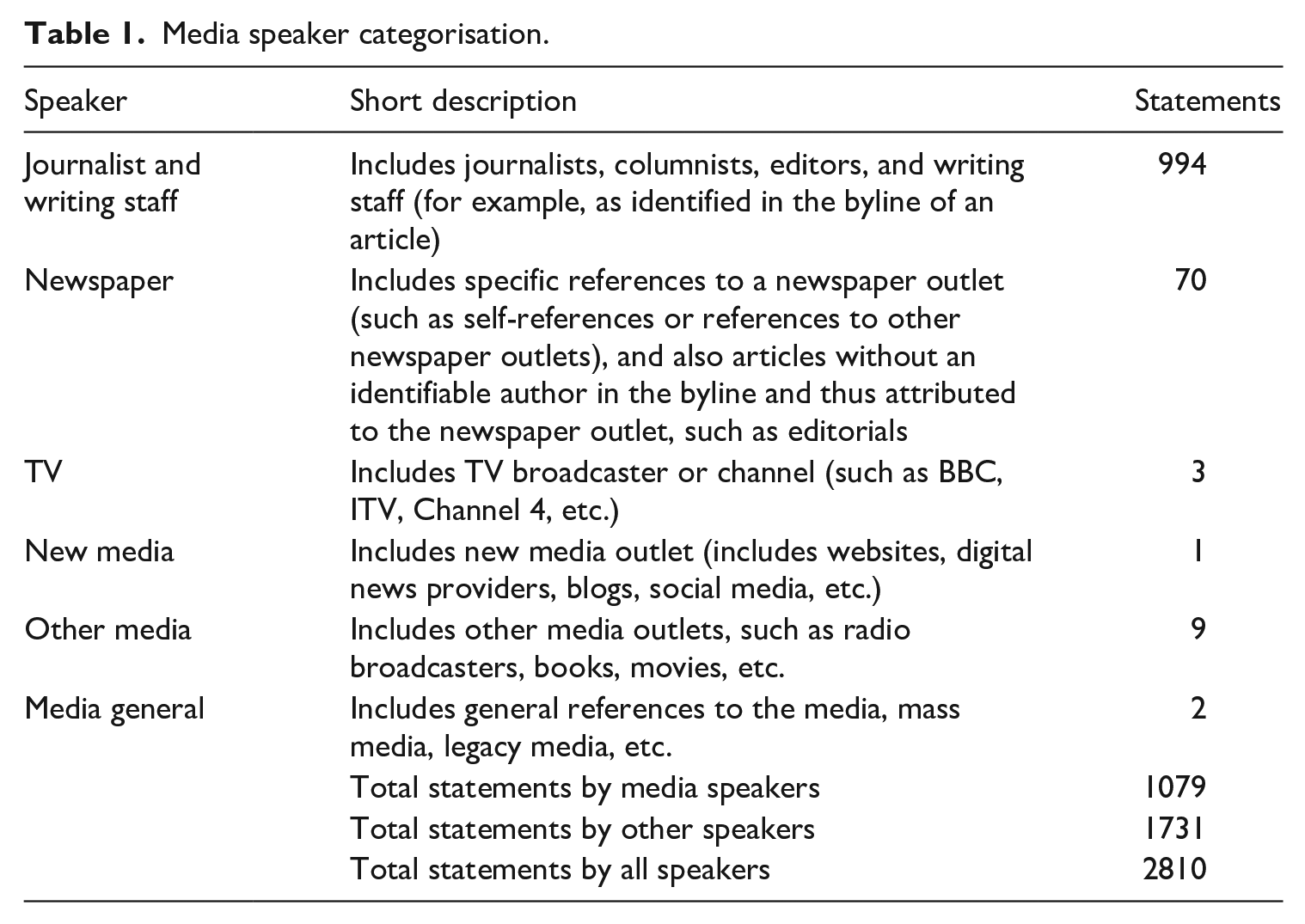
For the purpose of this study, all other actor categories that are not considered media speakers have been collapsed here into the single category of ‘other speakers’. This includes speakers from all levels of the production chain, retailers, governmental authorities, inter- and supranational organisms, civil society, etc. (a more detailed overview of the categorisation of speakers is included in the supplemental material).
Framing analysis
We used Entman’s four functions of frames as a theory-informed coding structure that allowed us to identify those framing elements in news texts: problem, cause, solution, and judgement. In addition, we coded for the identity of stakeholders: victim, villain, and problem solver. Together, these framing elements allowed us to describe how a topic is framed and constructed as an issue, and how these issues then become the main thematic categories around which public debate is organised.
We used statements as the main unit for analysis, understood as a continuous utterance by the same speaker(s). We examined 2810 statements by means of a two-stage framing analysis: first, a theory-driven inductive stage of a randomly selected subset of our data, followed by a second and deductive stage. For the first stage, we identified the issues that were being problematised. Using the four aforementioned functions of a frame as a guide, we identified the specific framing elements that fulfilled each function in the text via in vivo coding in Atlas.ti. Through an iterative process of increasing abstraction, we constructed broader categories for each of the framing elements. These broader categories then formed the basis for a coding scheme, which presents the set of nine framing element variables and their respective values and codes. This inductively developed coding scheme was subjected to several rounds of piloting and refining with three separate independent coders to improve reliability, resulting in a detailed coding scheme for deductive use in the second stage of our analysis.
The coding handbook we used consisted of 326 individual codes or values across nine framing element variables (issue, problem definition, victim, cause, villain, solution, action for solution, solver, and moral judgement), plus variables to characterise the speaker, quotation and article. This coding handbook supported analysis at several levels of aggregation. The analytic categories used for this publication are an aggregation that speaks to the theoretical framework that underpins this study. (More details about the methodological design can be found in the supplemental material and in Garnier et al. (2020)).
In our second stage, we used the inductively developed coding scheme to support deductive content analysis of the full dataset. Using Atlas.ti, two independent coders systematically applied the codes set out in the coding handbook to the newspaper articles (in random order). The results from this content analysis were translated into frequency counts for the applied codes, as well as co-occurrence frequency counts between codes, using Atlas.ti. These frequency counts were then exported to Excel for further quantitative analyses. A more detailed discussion of the methods used, including inter-coder reliability reporting, can be found in Garnier et al. (2020) and in forthcoming publications.
Operationalisation of expectations
This section presents each expectation and its operationalisation.
Connecting the dots: the percentage of the statements that mention avian influenza that also mention another issue related to chicken meat production, out of the total frequency of mentions of avian flu as an issue. From all the specific issued mentioned in the news texts, we constructed a list of sixteen categories, which besides avian influenza, include adulteration of chicken meat, alternative agriculture, animal welfare, antibiotics, cheap chicken, chicken meat production industry, consumption, economics, foodborne illness, global trade, information, policy and regulation, work and employment, food preparation, religious slaughter, and others (the supplemental material provides further detail and examples of how these issues were problematised).
Systemic contestation: the extent to which statements include systemic references for four of the framing elements included in the coding scheme – Cause, Villain, Solution, and Action for Solution. Systemic references refer to explicit mention of systemic elements. For example, in the case of systemic cause identification, this includes references to the system (food production system, animal husbandry system, capitalist system, etc.), as well as references to systemic dynamics such as commodification, globalisation, industrialisation, intensification or factory farming in general (details for the other relevant variables are included in the supplemental material).
Structural problematisation: the extent to which statements that identify that a systemic cause of avian influenza is also relevant in causing a different problem. Given previous evidence of a lack of systemic contestation in coverage of chicken meat production more generally (Garnier et al., 2020), we decided to include a lower-level test of structural problematisation, which consists of references to the chicken meat production industry and its practices as causing avian flu and at least one other issue. In this case, there is no explicit mention of systemic causes, but we take the broiler industry as a structural reference.
Opening debate: the extent to which there is a diversity of framing elements used at all stages and across time.
In this study we report by outlet, which was coded at the level of the article. This allowed us to aggregate and analyse the statements by media speakers from each newspaper outlet, as that is often cited as predicting behaviour. Where relevant, findings for all other non-media speakers provide context and a point of comparison to assess whether media speakers were indeed more likely than other stakeholders to frame avian influenza in a manner consistent with the opening up of the public debate required for discussions of wicked problems.
Results
Expectation 1: Connecting the dots
Table 2 summarises the frequency counts for statements with mentions of avian influenza as an issue, as well as frequency counts for mentions of avian influenza together with at least one other issue, both for all the speakers included in our dataset and only for media speakers, in each of the different outlets included. Only a small proportion (~5%) of the total mentions of avian flu also mention other issues related to chicken meat production, across all the outlets included.
Frequency counts of statements mentioning avian flu, and avian flu together with at least one other issue, by speaker in each outlet.
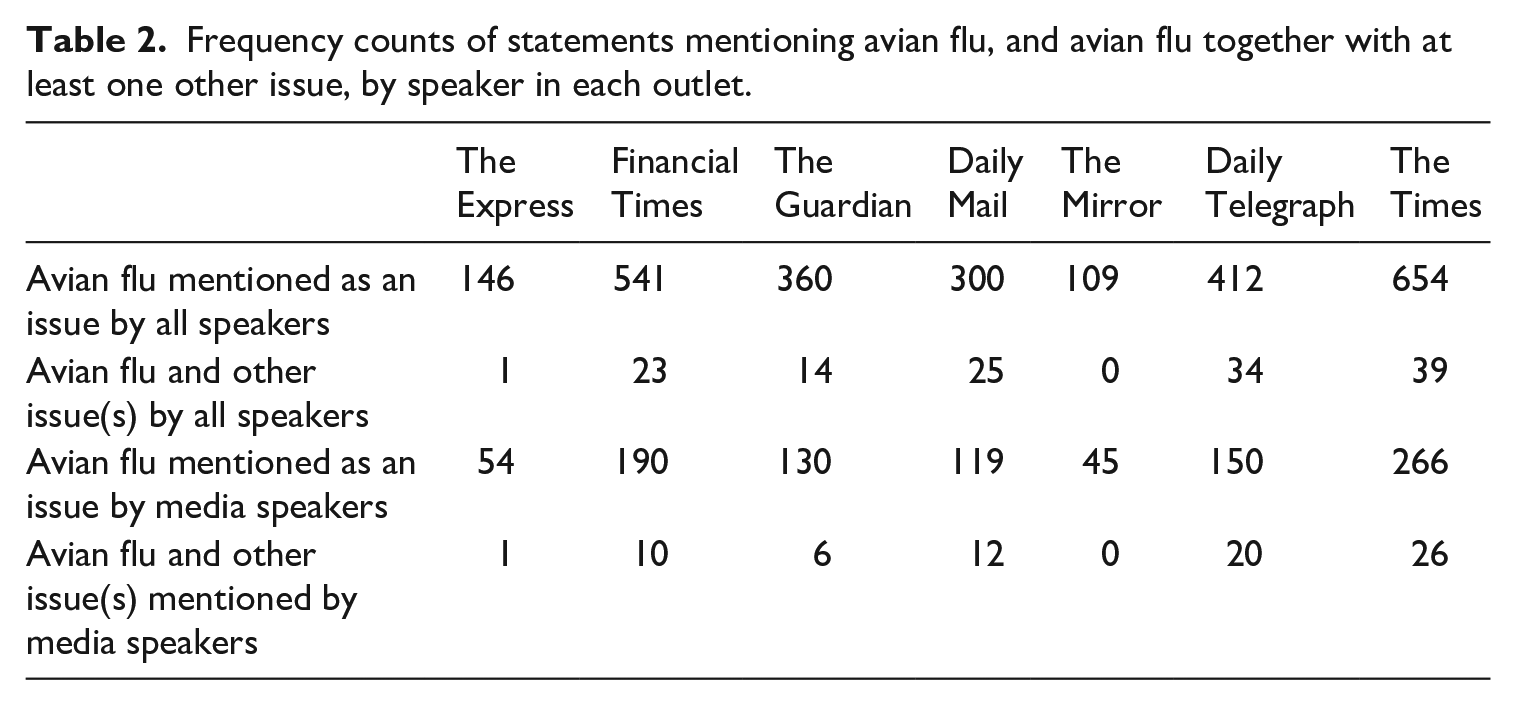
Limiting our data to media speakers, statements that mention avian flu together with another issue make up a small proportion (~8%) of mentions. Though the exact proportion varies across outlets, the total number of statements that mention both avian flu and least one other issue represents only a small proportion of the total number of statements that problematise avian influenza, varying from none of the 45 statements about avian flu by media speakers from the Mirror also mentioning at least one other issue, to 20 of the 150 statements (13.3%) in the case of media speakers from The Telegraph. While media speakers did mention avian flu together with another issue more frequently than all other speakers taken together – suggesting that they did make more connections between avian influenza and other issues than non-media speakers – these frequencies remain a very small proportion of the overall mentions of avian influenza.
Figure 1 presents the frequency distribution of the number of issues mentioned per article in each outlet. Looking at the frequency counts at the level of articles as unit of analysis, and based on most articles containing at least one and usually more statements, we would reasonably expect to find more frequent mentions of avian flu together with other issues. However, even at this broader level of analysis, over 62% of all the articles only mention one issue: avian influenza. Figure 1 shows differences across outlets in this regard. As for the tabloids, one and none of the articles from the Express and the Mirror mentioned more than one issue, respectively. By contrast, eighteen of the articles from The Telegraph mentioned one issue, sixteen mentioned two issues, five articles mentioned three issues, and one even mentioned six different issues related to chicken meat production (the supplemental material includes co-occurrence frequencies and coefficients across issues by media and non-media speakers, as well as specific examples).
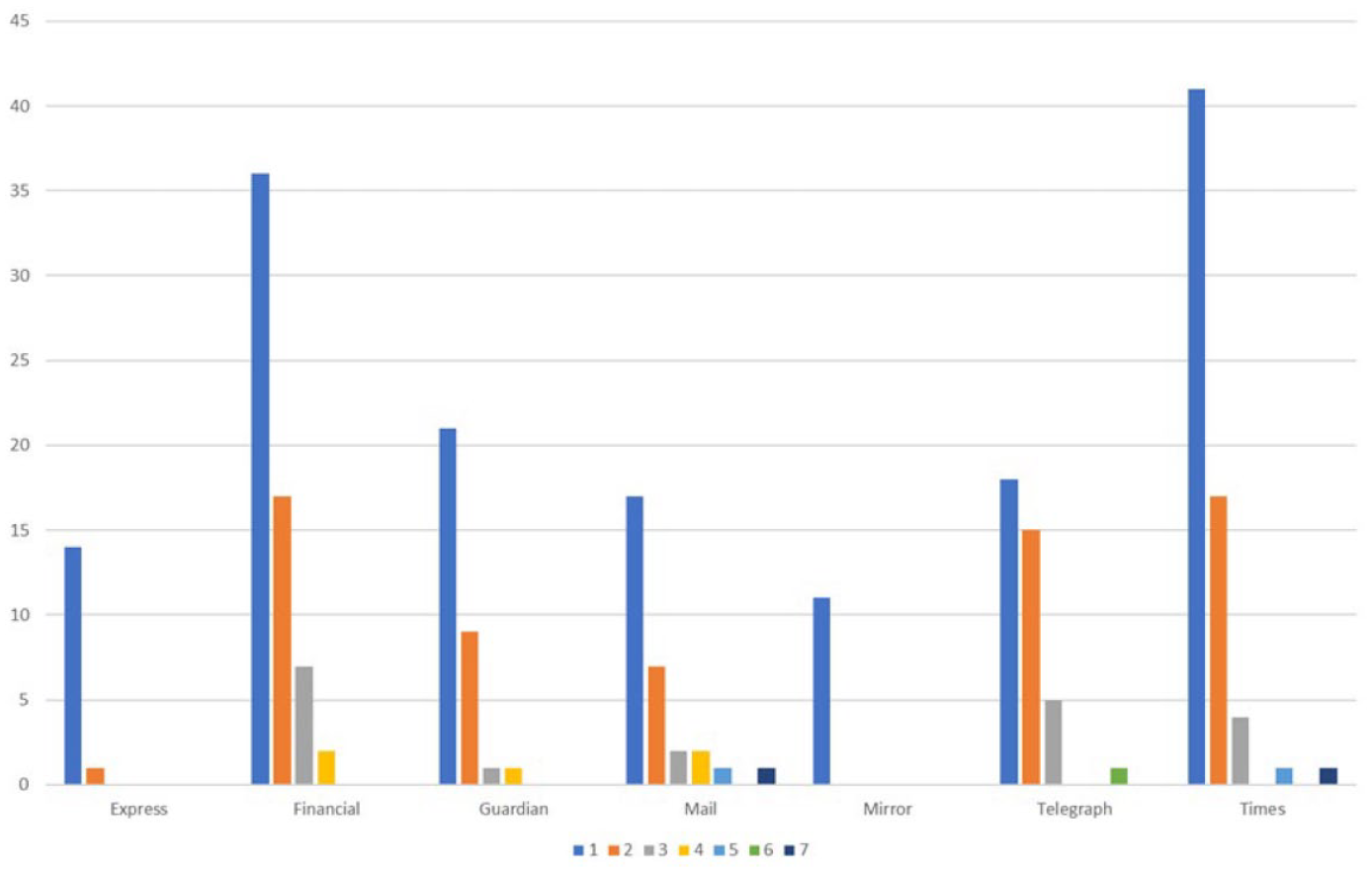
Frequency distribution of number of issues mentioned in an article, per outlet.
Taken together, however, these results do not support the expectation of coverage that consistently established links across issues, connecting the issue of avian influenza to other issues related to chicken meat production. Though they suggest that media speakers did mention avian flu together with another issue slightly more often than the rest of the speakers, mentions of avian flu with at least one more issue represent only a small proportion of the total number of statements that problematise avian flu. While we do not expect every statement by a media speaker to make these connections, if indeed news media were often making links between avian influenza and other chicken meat production related issues, this would have been reflected in frequent mentions of these issues together in the same statement, and consequently in a higher proportion of statements about avian influenza also mentioning other issues related to broiler production. These results are thus not consistent with coverage or indeed journalism that is making links across issues and connecting the dots.
Expectation 2: Systemic contestation
Table 3 summarises the co-occurrence of statements that mention avian flu with a systemic reference as cause, villain, solution or action necessary to bring forth the solution, and contextualises these frequency counts within the overall number of statements mentioning avian influenza as an issue. Surprisingly, only a very small proportion of the statements problematising avian flu also mention other systemic elements. Only one of the 541 statements about avian influenza in the Financial Times mentions a systemic action (an overhaul of traditional agriculture) as necessary to bring about the solution to avian flu. Similarly, only one of the 654 statements about avian flu in The Times mentions the factory farming system as the villain responsible for causing avian flu (these and other examples are included in the supplemental material). These are the only two instances that mention a systemic villain or a systemic action necessary to solve the problem of avian influenza. Two out of 541 statements in the Financial Times and three out of 360 statements in The Guardian mention systemic solutions for the issue of avian flu. Systemic causes for avian flu were only slightly more frequent in our dataset. These range from none of 54 statements in the Express mentioning systemic causes for avian influenza – or any other systemic reference, for that matter – to thirteen out of 360 statements in The Guardian mentioning systemic causes for avian flu.
Co-occurrence frequency counts of mentions of avian flu as an issue with systemic references in four framing elements, by outlet (all speakers).
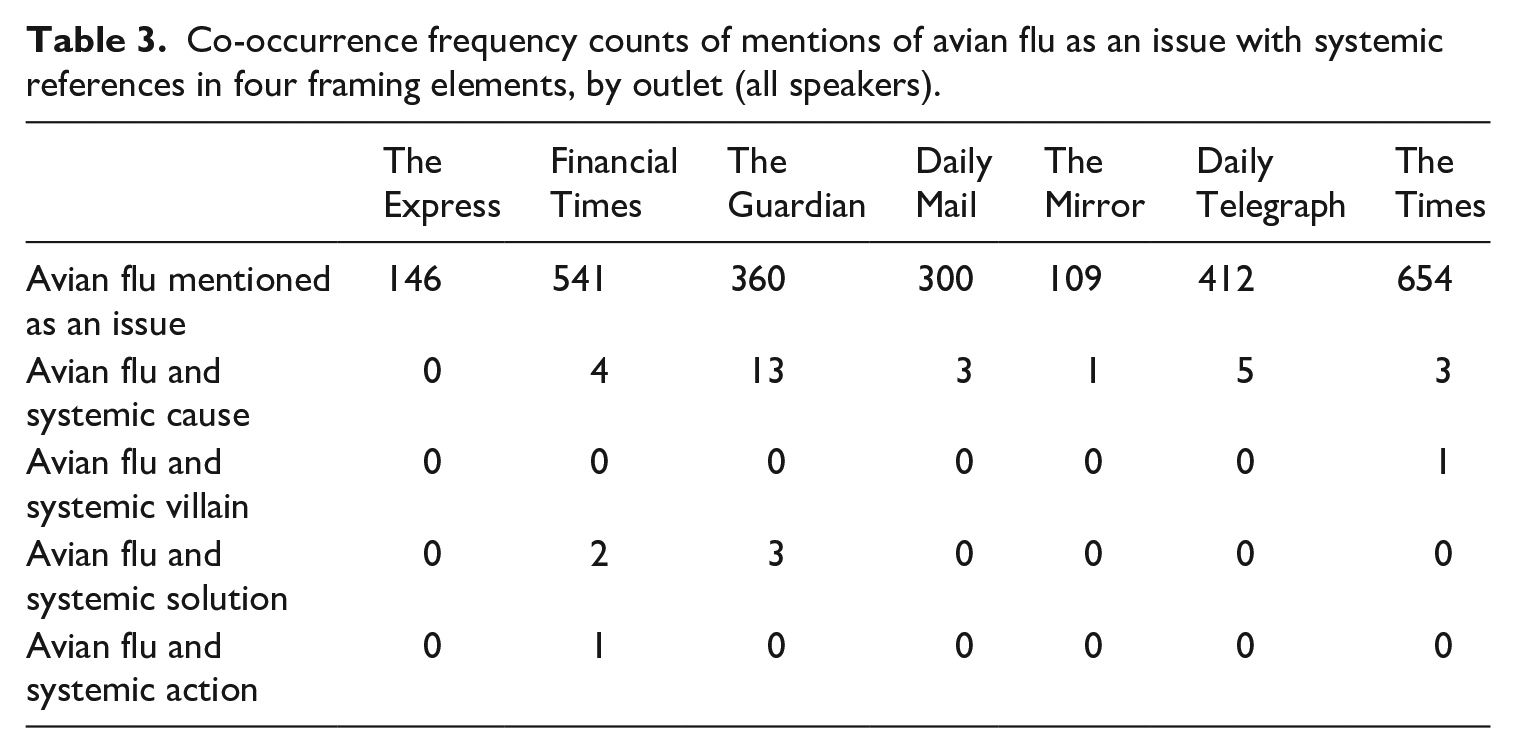
Table 4 is even more striking. It shows only the mentions of avian flu by media speakers in each of these seven outlets. None of the statements in which media speakers problematise avian influenza mention either systemic villains, systemic solutions or systemic actions to bring about the solution. Moreover, none of the statements about avian influenza by media speakers from the Express and the Mirror contain any systemic reference at all. The highest proportion of systemic causes for avian flu mentioned by media speakers was found in The Guardian, where eight out of 130 statements about avian flu also mentioned systemic causes, representing 4% of the total number of statements about avian flu by media speakers in that outlet.
Co-occurrence frequency counts of mentions by media speakers of avian flu as an issue with systemic references in four framing elements, by outlet.
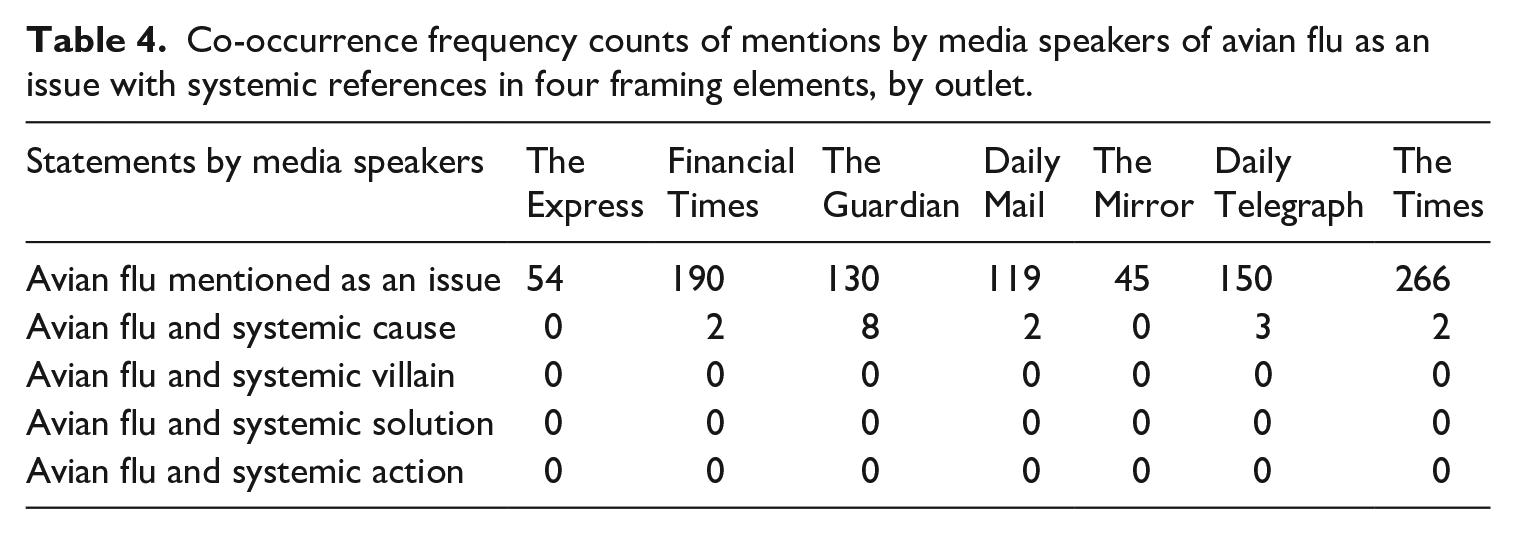
These results do not appear to be compatible with the expectation of systemic contestation. Though there were differences across outlets, statements mentioning avian influenza together with reference to systemic values were rare across the board. Taken together, statements with systemic references make up 1% of the total mentions of avian flu, and 2% of the mentions of avian flu by media speakers. The picture that emerges when looking only at the statements made by media speakers is even more striking, as none of the seven outlets included mentions any systemic references for three of the four framing element variables that include them. These results do not provide support for the expectation of coverage that highlights the systemic and broader structural elements related to this issue in a way that supports systemic contestation. Contrary to our expectations, evidence of systemic contestation by media speakers is even less frequent than for the totality of speakers included in our dataset.
Expectation 3: Structural problematisation
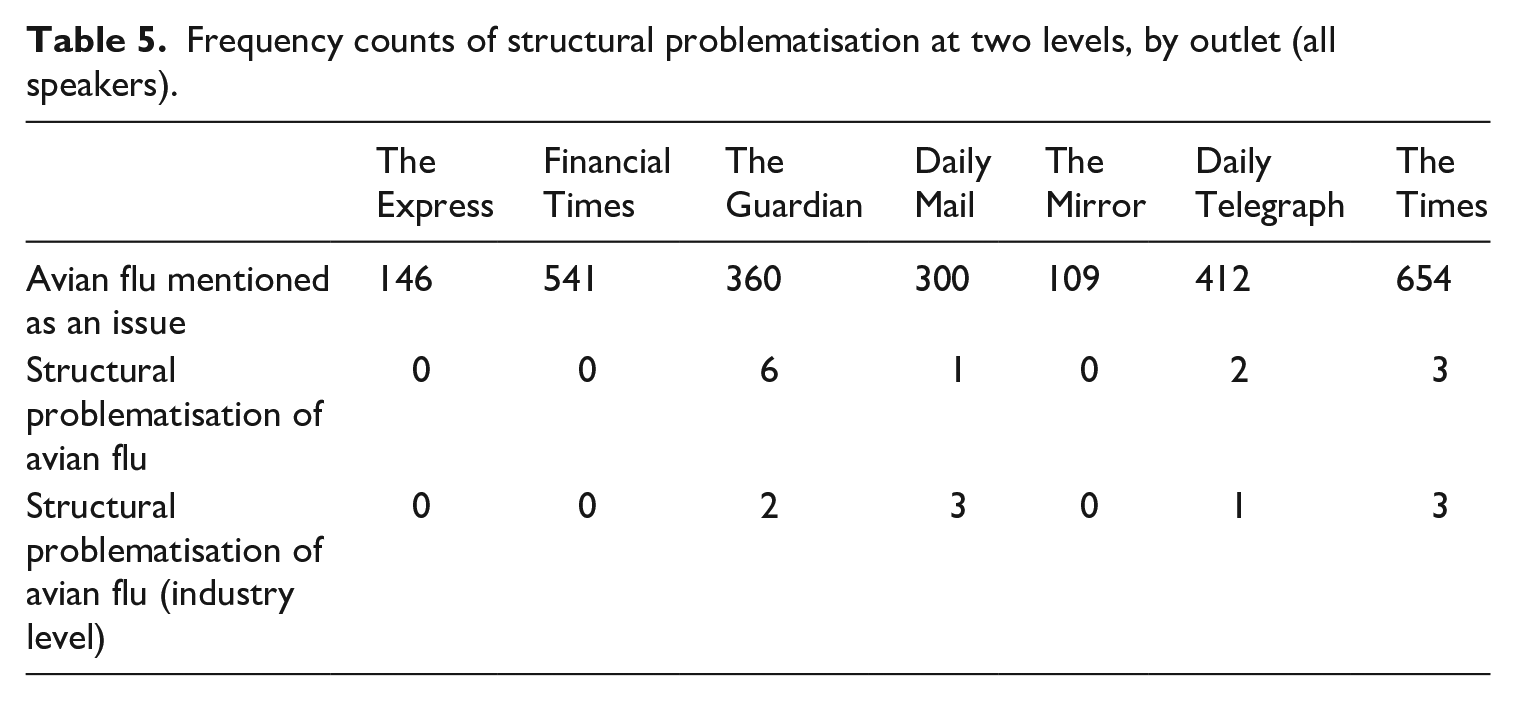
Tables 5 and 6 present the results for structural problematisation for all speakers and for media speakers, respectively. A small proportion of mentions of avian flu fit our operationalisation of structural problematisation as identification of a systemic cause for more than one issue.
Frequency counts of structural problematisation at two levels, by outlet (all speakers).
Frequency counts of structural problematisation by media speakers at two levels, by outlet.
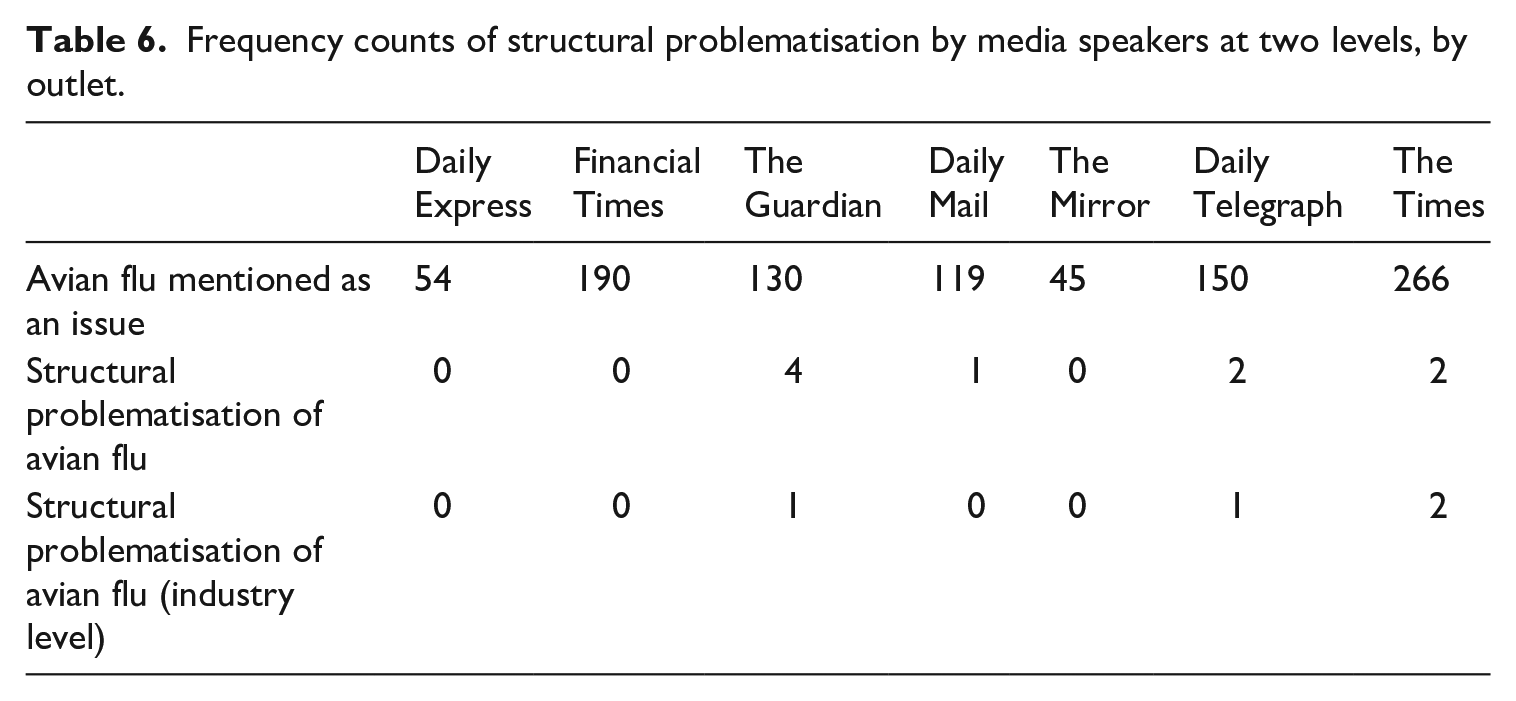
As shown in Table 5, three of the outlets included did not have a single statement that identifies a systemic cause for more than one issue, even at the more limited level of the industry as a structural cause. The highest proportion was found in The Guardian, where 6 out of 360 statements problematising avian influenza also mention at least one other issue and a systemic cause. Table 6 presents the results for structural problematisation of avian flu by the media speakers of each outlet. Though instances of structural problematisation also vary across outlets, they represent only a small proportion of the total mentions of avian influenza by media speakers.
Taken together, instances of structural problematisation of avian flu make up less than 0.5% of the statements that problematise avian influenza, and less than 1% of the statements by media speakers problematising avian flu. Looking at a lower level of structural problematisation, statements that identify the industry as a structural cause of at least one other issue besides avian flu represent around 0.4% of all statements problematising avian influenza, both for media speakers and for all speakers together. Instances of structural problematisation at either level represent only a small proportion of the statements problematising avian flu both for all speakers and only for media speakers and across outlets. These findings are not compatible with the expectation of structural problematisation, either at the systemic level or at the more limited level of the industry as a structural cause.
Expectation 4: Coverage that supports an opening up of the public debate
Figures 2 and 3 present the frequency counts of problem definitions and solutions endorsed respectively for the issue of avian flu by media speakers in each outlet and per year. Figure 2 shows how avian flu was defined as problematic in different terms, with the most frequent problematisations being as a human health problem, animal health problem, and economic problem. Figure 2 also shows that these problematisations varied not only across outlets, but also over time within each outlet; however, it is clear from the graphs that these problematisations do not tend to close down over time towards a single preferred problem definition for avian flu. Conversely, Figure 3 illustrates that one solution was endorsed by media speakers 90% of the time throughout the entire period under study and across all outlets: biosecurity. Equivalent figures for other framing elements show similar patterns to that of problem definition in Figure 2. Each of these, with the exception of the dominance of biosecurity as a solution, are compatible with the expectation of coverage that supports an opening up of the public debate. The findings regarding the solutions endorsed for avian influenza are instead compatible with a closing down of the public debate.
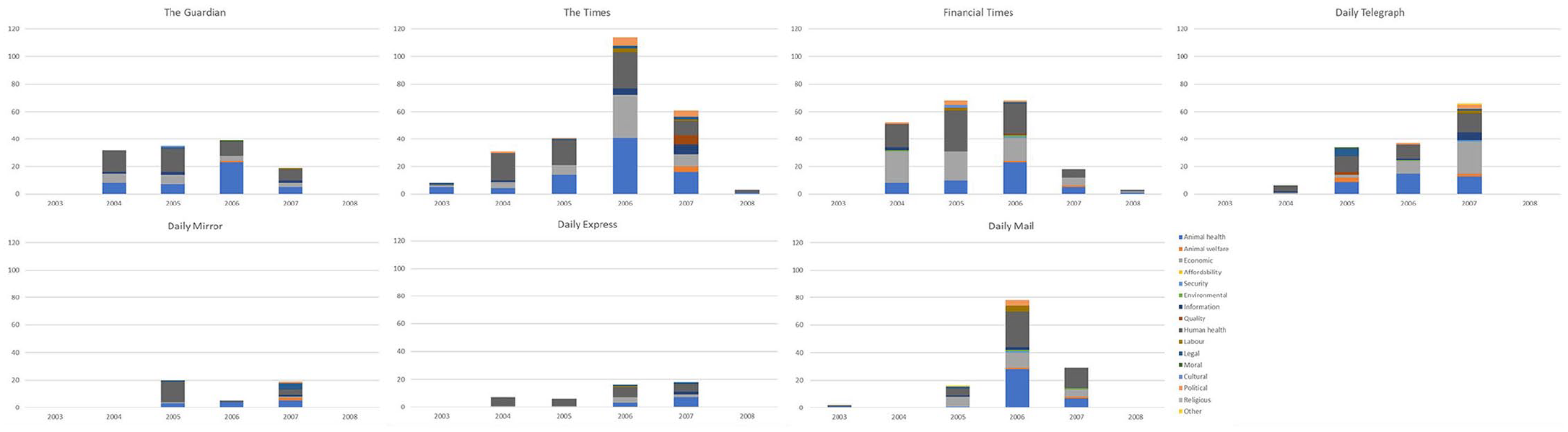
Yearly frequency counts of problem definition for avian flu mentioned by media speakers in each outlet.
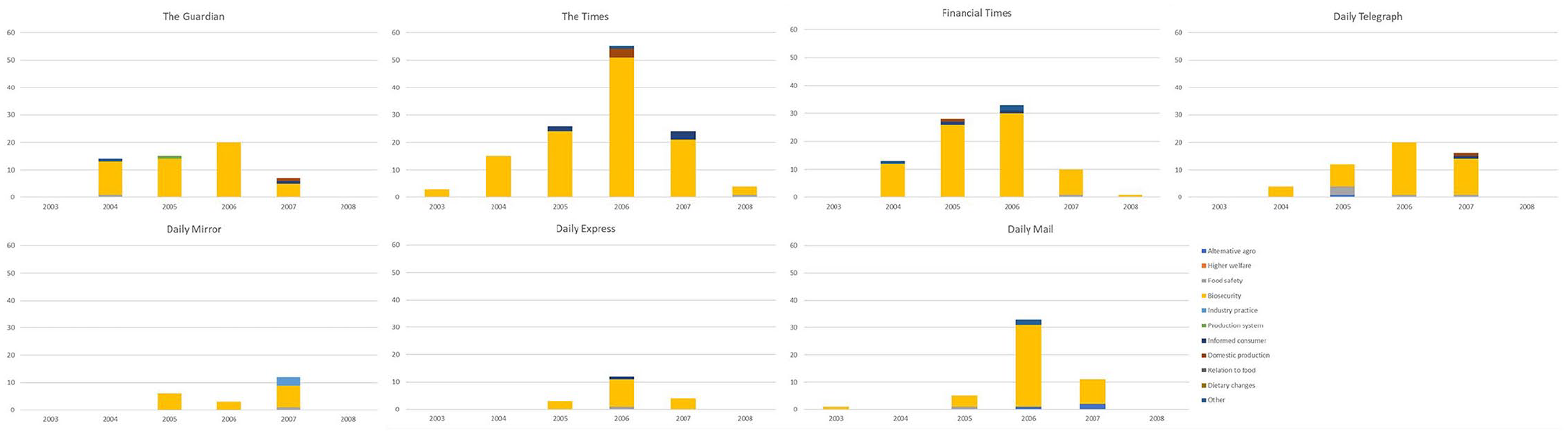
Yearly frequency counts of solutions endorsed for avian flu mentioned by media speakers in each outlet.
Figure 4 presents, for each of the eight framing elements included in our coding scheme, the number of different values mentioned more than once by media speakers from each outlet per year, illustrating diversity in the framing of avian flu by media speakers across outlets and over time. If coverage of avian flu had indeed privileged a preferred framing of this issue, then we would expect to find fewer different types of problem definitions over time. Conversely, if coverage increased in complexity and opened up to new possibilities and interpretations, as we would expect for a wicked problem, then we would expect to find more different types of victims or villains over time, for instance. The graphs included in Figure 4 are not compatible with expectations of coverage that converges around the consensual framing of avian flu by media speakers in the outlets included. On the contrary, most of the graphs for the different framing elements show variation in the number of different problem definitions, causes identified, victims, problem solvers, etc., mentioned by media speakers in their coverage of the avian flu outbreak. For most of these framing elements, and for media speakers in most outlets, there are more different framing elements mentioned at the end than at the beginning of the outbreak (Figure 5), a result consistent with an expectation of coverage that supports an opening up of the public debate. Against these findings, the clear predominance of biosecurity as the solution most frequently endorsed by media speakers for avian flu presents a stark contrast. These findings are not consistent with our expectation that newspapers will open up public debate and the contrast between open description and closed solution appears, given our model, to be incoherent.
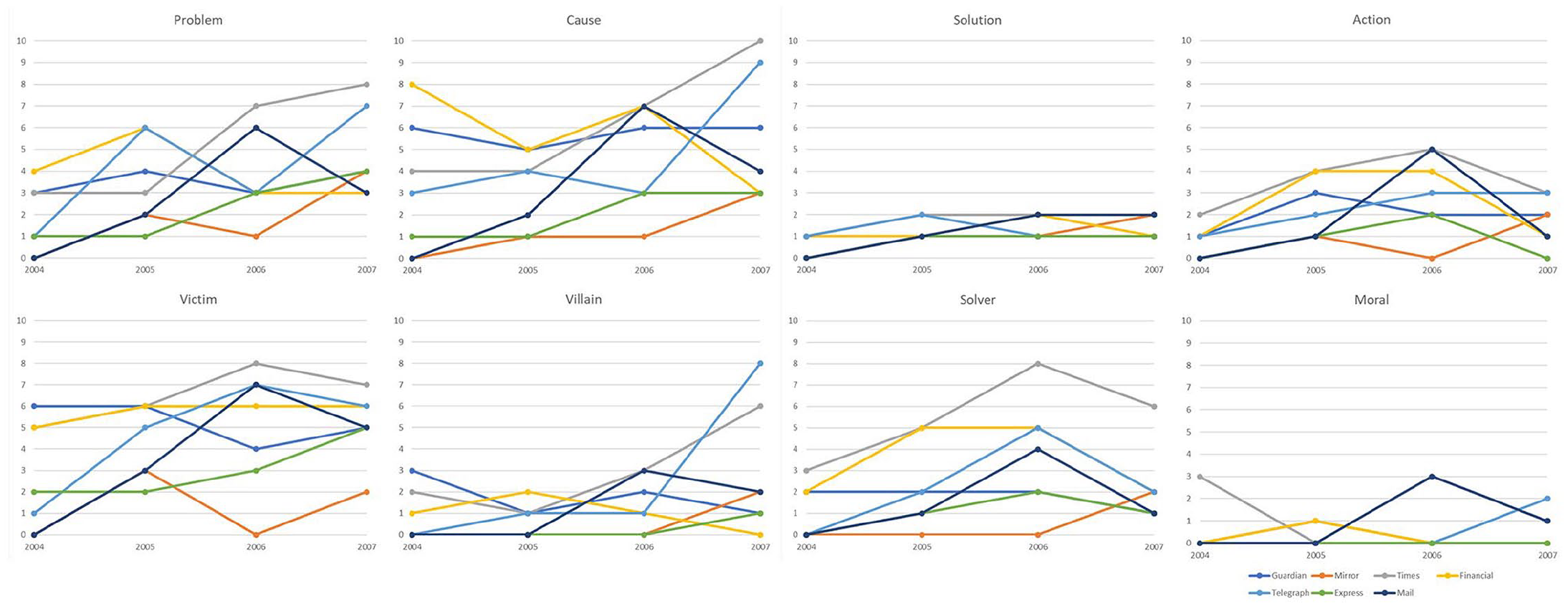
Number of different values mentioned more than once by media speakers in each outlet, per year.
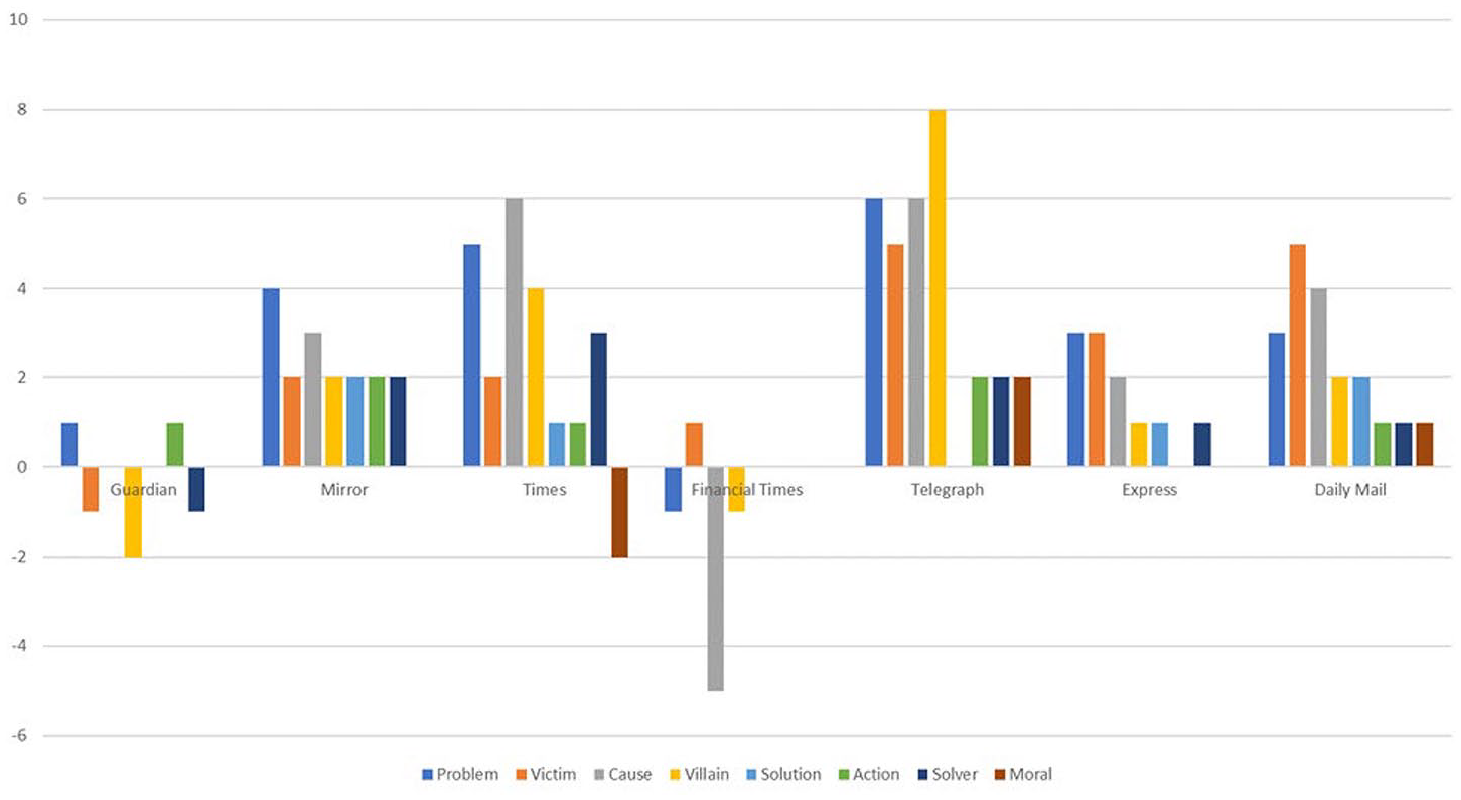
Variation in the number of different values mentioned more than once by media speakers in each outlet between the first and last years of the avian flu outbreak.
Discussion: Newspaper coverage about avian flu as a wicked problem and implications for our understanding of the democratic role of newspapers as forum for public debate
The conclusions that can be drawn from these results are of course circumscribed to the subset of articles that constitute the primary data for this study. These findings may be somewhat limited because these articles were drawn from a larger dataset of articles about chicken meat production. This dataset is thus by no means exhaustive, as articles that covered avian influenza exclusively from a human health perspective, for example, would not have come up in our search. It is possible that such articles do make links to other issues, thus exhibiting the kinds of connections, systemic contestation and structural problematisation that were rare in our dataset. However, research on the framing of avian influenza as a potential human pandemic has found that newspaper coverage of bird flu tends to be dominated by episodic framing, which presents single, specific event-driven cases related to a given issue, usually without providing much context, and thus impeding recognition of the interconnections between issues (Choi and McKeever, 2019; Dudo et al., 2007), which is consistent with our results. The stark findings in a dataset that should capture at least one of those connections – namely, that between avian influenza and issues related to chicken meat production –, together with available evidence of the dominance of episodic framing in coverage of avian influenza, leads us to expect that application of this methodology to a broader dataset would produce similar results, though future research should put this expectation to empirical test.
Our results do not support the expectation of newspaper coverage that mentions avian influenza together with other related issues in a manner that supports their linking and highlights their mutual entanglement. Our disappointment with this finding is sharpened by complete lack of reference to then current scientific discussion that made structural connections. While it would be unreasonable to expect that every article mentioned such entanglements and complex interlinkages – after all, wicked problems are subject to multiple and conflicting interpretations –, we did expect to find that newspaper coverage reflected the connections discussed in the scientific literature available at the time, at least to some extent. Our results are not compatible with the expectation of coverage that shows how avian influenza, like other emerging infectious diseases, is entangled in complex spatial and temporal webs, in which relations change over time (Waltner-Toews, 2017). Our data, further, do not support the expectation that newspaper coverage will highlight the links between industrialised mass animal production and global distribution of cheap animal protein and the emergence of such zoonotic diseases (Waltner-Toews, 2017), or the complex interlinkages between industrial poultry production, broader environmental problems such as climate change, and zoonotic infectious diseases (Almiron and Zoppeddu, 2015; Canavan, 2019; Gilbert et al., 2017; Khan et al., 2019; Waltner-Toews, 2017). Without such interlinkages highlighted in newspaper coverage, it is easy readers form partial, more simplistic understandings of the issue, which would in turn encourage solutions that have negative consequences in other domains (Van Asselt et al., 2018, 2019).
We did not find support for the expectation that newspaper coverage would address the systemic and broader structural elements related to avian influenza in a manner that supports systemic contestation. These findings are not compatible with newspaper coverage that links the accelerated rate of outbreaks of emerging infectious diseases like avian influenza to deeper, systemic problems (Waltner-Toews, 2017). Such findings raise serious questions regarding the extent to which newspapers can indeed foster the kinds of public debate that allow us to examine and address the systemic and structural dimensions of wicked problems such as avian flu, as discussed in the scientific literature (Canavan, 2019; Gilbert et al., 2017; Leibler et al., 2009; Rohrl et al., 2019; Van Asselt et al., 2018, 2019; Waltner-Toews, 2017).
The infrequent instance of structural problematisation that we found follows logically from the general lack of connections across avian flu and other issues related to broiler production and the lack of systemic references found in our dataset, but is particularly disappointing given the availability of scientific literature on precisely this topic that was available at the time (Canavan, 2019; Gilbert et al., 2017; Leibler et al., 2009; Rohrl et al., 2019; Van Asselt et al., 2018, 2019; Waltner-Toews, 2017). They are also surprising given research on public perception of the avian influenza outbreak at the Bernard Matthews plant during in February 2007, suggesting that the public was indeed making such links between industry practices and avian influenza, amongst other public health concerns (Rowe et al., 2008).
While newspaper coverage did reflect multiple problem definitions and causal interpretations of avian influenza, which is consistent with an opening up of the public debate, this was not coupled with connections to other related issues, systemic contestation or structural problematisation and, where present, this heterogeneity did not suggest an equal diversity of solution paths. The predominance of biosecurity effectively closes down debate by highlighting a single solution (Stirling, 2008). These results lend further empirical evidence to the argument by Nerlich and Halliday (2007) that the framing of avian influenza in newspapers in early 2005 might have had the effect of obscuring the availability of options for controlling its development and spread.
Our findings are compatible with Garnier et al. (2020), who argue that the episodic nature of newspaper coverage, narrow framing and problematisation of specific aspects related to chicken meat production in relative isolation and in the absence of either structural problematisation or systemic references, effectively results in a diffusion of the public debate. Our evidence, even at the level of outlet and when controlling for the identity of the speaker, supports the argument that newspapers do not deliver the kind of coverage necessary to tackle the kinds of multidimensional, systemic, and complex problems we face (Garnier et al., 2020).
Our findings are not compatible with the expectation that newspapers provide a civic forum for a constructive, pluralistic public debate (Norris, 2000) in ways sensitive to questions of values and relations of power (Waltner-Toews, 2017). More specifically, the lack of systemic contestation and structural problematisation in coverage of avian influenza appears incompatible with an understanding of avian influenza as a wicked problem as discussed by Waltner-Toews (2017). Our findings, in a case deliberately selected to be favourable to journalists, lend evidence to those critics who argue that news media fail to hold power, and especially corporate power, to account (Curran, 2005; Curran and Seaton, 2002; Fenton, 2018; Freedman, 2014). In this sense, our findings appear consistent with studies that argue that mainstream public discourses – and news media discourses in particular – often tend to reinforce the power of animal production industries and the continued emphasis on meat production, thus perpetuating its enacted violences (Almiron and Zoppeddu, 2015; Broad, 2016; Freeman, 2009; Lahsen, 2017).
Wicked problems like avian flu require the creation of public spaces for managing constructive, high-quality conflicts that allow us to collectively articulate and debate such issues under conditions of scientific and political uncertainties, articulate possible outcomes and their differential effects on human and non-human stakeholders, characterise and address trade-offs, negotiate potential outcomes, and identify the structures for implementing the required changes (Waltner-Toews 2017). We do not find that newspapers in general, that specific outlets, or that media speakers provide these spaces even under deliberately selected favourable conditions. On the contrary, the findings discussed here raise serious questions regarding the role of newspapers as a forum for public debate, and the ability of news journalism to inform, facilitate (Christians et al., 2010; Fenton, 2010a; Schudson, 2003, 2008) and open up (Stirling, 2008) such debate in ways conducive to address the inherent complexity presented by wicked problems. Recalling our understanding of power as context-shaping (Hay, 1997), newspaper coverage about avian influenza effectively shapes the space of possibilities in ways that do not appear to be consistent with nor conducive to an open, constructive and informed public debate that allows for the exploration, not just of the many possible interpretations of avian flu as a wicked problem in all its complexity, but also of how different solutions stemming from such interpretations might have differential effects on human and non-human stakeholders.
This article reports on a study for which we have created, tested and operationalised a framework able to describe the performance of news media in creating a space adequate to support such a public debate, and we have used the avian influenza outbreak between 2003 and 2008 to test our framework. Given that many contemporary problems are increasingly characterised as wicked problems that confront societal and policy actors and institutional regimes, from climate change and loss of biodiversity to migration and terrorism (Termeer et al., 2019), and given the potential context-shaping power of news media as a forum for the public debate of these and other wicked problems, as we have argued here, it seems relevant to put this framework to a broader test. Future research should therefore apply this methodology to debates about other contemporary wicked problems and in other media outlets, including new and social media.
Further research should also investigate if and how journalistic practices and the material conditions that underpin such practices (Fenton, 2013; Freedman, 2014) might be curtailing journalists’ ability to deliver the kinds of coverage that is expected and required to address such complex phenomena and the inherent scientific, scholarly, cultural, political and economic conflicts they imply (Waltner-Toews, 2017). The stark gap between our empirical findings and the expectations derived from media scholarship that informed our efforts lend strength to the argument that we must reassess these expectations (Vos and Wolfgang, 2018) or standards against which to assess current practices (Fenton, 2010a). Further research should also re-examine the assumptions that underpin such expectations, and the conditions under which it would be reasonable to expect news media to deliver on such expectations regarding their role in democratic public debate, particularly relevant in the discussion of such wicked problems.
Supplemental Material
sj-docx-1-jou-10.1177_1464884920977781 – Supplemental material for Something wicked this way comes: How well did UK newspapers support the public debate of Avian Influenza as a wicked problem?
Supplemental material, sj-docx-1-jou-10.1177_1464884920977781 for Something wicked this way comes: How well did UK newspapers support the public debate of Avian Influenza as a wicked problem? by Marie Garnier, Peter A Tamás, Margit van Wessel and Severine van Bommel in Journalism
Footnotes
Acknowledgements
The authors thank the reviewers for their insightful comments and constructive feedback, which greatly improved the article.
Declaration of conflicting interests
The author(s) declared no potential conflicts of interest with respect to the research, authorship, and/or publication of this article.
Funding
The author(s) received no financial support for the research, authorship, and/or publication of this article.

Supplemental material
Supplemental material for this article is available online.
Notes
Author biographies
References
Supplementary Material
Please find the following supplemental material available below.
For Open Access articles published under a Creative Commons License, all supplemental material carries the same license as the article it is associated with.
For non-Open Access articles published, all supplemental material carries a non-exclusive license, and permission requests for re-use of supplemental material or any part of supplemental material shall be sent directly to the copyright owner as specified in the copyright notice associated with the article.
