




Abstract
Like many fields of communication research, journalism scholarship draws on theories from other disciplines and mostly applies social theories to make sense of journalistic practices. One theory that has gained immense popularity in recent years is Pierre Bourdieu’s field theory. However, while there are now numerous studies using his concepts, we have little comprehensive understanding of how scholarship applies them. To this end, this study conducts a systematic analysis of 249 articles, using content analysis, textual analysis and citation analysis to examine how field theory is adopted and adapted, as well as who has interpretative authority in shaping Bourdieusian thought in journalism research. The findings suggest a selective in-depth use of field theory and that the appropriation of some concepts is still ambiguous. Moreover, it highlights once more the dominance of Western scholarship in the academic field.
As a relatively new but increasingly popular academic field, journalism studies is often accused of lacking in-depth theoretical approaches and relying mostly on descriptive studies. However, recent evidence suggests the field – while still ‘heterogeneous, multidimensional, and full of competing ideas’ (Löffelholz, 2008: 15) – has undergone different stages of epistemic logic and is now dominated by a pragmatist-participatory approach to theory (Ahva and Steensen, 2019). Theoretical awareness is more pronounced, particularly in relation to integrative social theories (Steensen and Ahva, 2015), which promise more nuanced opportunities to take account of journalism in transition across macro, meso and micro-levels of journalism (Löffelholz, 2008).
Of particular interest to journalism scholars across the globe has been the concept of field theory, developed by French sociologist Pierre Bourdieu. While he had already published a wide array of studies since the 1960s and was steadily imported to Anglophone academic fields since the 1980s (Sapiro, 2020; Wacquant, 1993), Bourdieu mainly came to the attention of international journalism scholars following his televised lecture Sur la télévision (On Television) in 1996. In it, he described the French journalistic field and its relationship with the economic and political fields, and the field of power. The lecture was translated into English soon afterwards (Bourdieu, 1998a), and, even though it was largely polemic rather than based on empirical findings, it defines the starting point for the adaptation of Bourdieusian field theory into international journalism scholarship.
In fact, since the early 1990s, field theory has become a key theoretical approach for journalism scholars, starting first with French scholarship (Bourdieu, 1994; Champagne, 2000), followed by English publications (Benson, 1999; Marlière, 1998) and later spurred on through Benson and Neveu’s (2005) seminal edited volume. Field theory has been employed to investigate the differentiation of the journalistic field, its constraints, and technologically-induced change, as well as its social structures and power relations. It also offers an important contribution to comparative and historical contextualisation. However, the growing use of Bourdieusian thought in journalism studies has been widespread but inconsistent, and we have no reliable, empirical overview of how it has influenced scholarship, or where there might still be gaps in research. This is important, as it might help us to understand interpretative authority in journalism studies; that is, the power relations that shape the reading, adoption and adaptation of new theories.
This study reports the results of a systematic analysis of field theory use in 249 English-language articles about journalism, published in peer-reviewed journals between 1998 and 2018. We investigate the depth of theoretical discussion and appropriation of Bourdieu’s concepts, as well as the theoretical contribution to understanding journalism, and where this discussion takes place. By critically examining and synthesising the different approaches to field theory, we aim to contribute to a more structured approach to engaging with, adopting, as well as adapting Bourdieu’s work in journalism studies.
Background
Conceptual change in any academic field occurs through the tension between academic traditions and innovation, where new theory is accepted based on its improvements in accuracy, consistency, scope, simplicity and fruitfulness to solve new problems (Kuhn, 1977). However, in academic fields with ‘theoretical anarchy’ (Ahva and Steensen, 2019: 50) and competing ideas (Löffelholz, 2008) like journalism scholarship, theory choice is not simply based on these five values but on more individual parameters, for example, on academic socialisation such as epistemological perspective or personal preferences (Bourdieu, 2004; Kuhn, 1977; Lamont, 1987). These need not be conscious but are part of the academic struggle itself. As such, the reputation of both the person who employs a concept, as well as the one verifying the choice can shape whether and how it will be used further (Bourdieu, 2004: 57). In other words, we can observe an extension of what Merton (1973) calls the Matthew effect, where academic work is more likely to be cited and thus built upon if the authors are of higher renown. Moreover, citation analyses show citation counts do not necessarily reflect ‘research relevance, quality and impact’ (Lindgren, 2011: 8) but also author-dependent reasons, such as citing scholars that are regarded as ‘authoritative’. Other reasons such as demonstrating familiarity with important literature and journals, appealing to reviewers or availability of literature are also relevant.
Journalism scholarship is slowly becoming aware of these power dynamics that shape knowledge production and questions over ‘who has authority to speak in the field’ (Hanusch and Vos, 2020: 322). While studies have found a dominance of US and UK scholars for some time (Cushion, 2008) prompting calls for de-westernising journalism studies (cf. Wassermann and de Beer, 2009), not much has changed. A recent study examining comparative journalism studies found that authorship in key international journals is still predominantly Western, with researchers from Europe and the US making up the vast majority of authors. This is reinforced through citation practices, with mostly Western scholarship being cited (Hanusch and Vos, 2020). The tendency to perceive journalism through a Western prism and ‘the continuous search for theoretical innovation’ (Ahva and Steensen, 2019: 50) might have implications for the depth in which theories are adopted and adapted. In particular, it relates to who has interpretative authority – the power to shape the dominant reading of theories and concepts in journalism studies. Applying these ideas to the growth of Bourdieusian thought thus serves as an illustrative case that can enable us to better understand interpretative authority in journalism scholarship and how (new) theories are appropriated.
Bourdieusian thought
Bourdieu’s work aims to bridge the dichotomy between structural functionalism and social phenomenology by analysing society on both the structural and individual level through the interplay of various concepts, while remaining open enough to considering spontaneous change (Bourdieu, 1993, 1977; Bourdieu and Waquant, 1992). At the same time, field theory has been criticised for its structural determinism, particularly regarding the concept of habitus (Wacquant, 1993). Such critiques might also be rooted in publishing practices, as English translations of Bourdieu’s works appeared delayed and non-chronologically, leading to a fragmented reception of his theory into Anglophone social sciences (Wacquant, 1993), as well as the international academic space (Sapiro, 2020).
Field theory comprises several concepts, with field, forms of capital, habitus and doxa the most commonly-known ones. Fields allow us to spatially map actors’ social positions and the relative power dynamics between them and are structured by possession of forms of capital (Bourdieu, 1993). These enable agency and comprise different material and immaterial resources – economic, cultural, social and symbolic capital (see Bourdieu, 1986). The concept of habitus connects the individual level (agency) and the societal level (structure), by capturing internalised beliefs and dispositions that individuals acquire through their socialisation and accumulated capital. The relations between habitus and position within a field shape agency while, at the same time, actors lean more towards positions that best mirror their dispositions. Thus, oversimplifying, those in more powerful positions are equipped with a different habitus from those that occupy dominated positions in the field and define the nomos, which distinguishes a field from others and legitimises it. This prompts a constant struggle over capital and positioning, structured by the dichotomies of new versus old and autonomy versus heteronomy, which indicates the degree to which a field is self-sufficient or reliant on outside logics. Field theory assumes that actors are willing to compete in these struggles because they believe it is worth it (illusio) and at the same time, they do not question the rules (doxa) that organise it within the field (Bourdieu, 1990).
As his theoretical thinking evolved over time, Bourdieu refused to provide neat definitions of his concepts (Bourdieu and Wacquant, 1992). This might explain, for instance, the many definitions of journalistic capital that journalism scholars conceptualised over the past 20 years. Journalism research appropriates field theory for its usefulness to investigate the microcosm of journalistic practice within the broader macrocosm of social power dynamics (Benson, 2006), as well as the stratification of journalistic role perceptions (Hovden, 2012). The forms of capital have been employed to explain differences in journalistic content (Benson, 2006), or the emerging importance of audience engagement (Tandoc, 2015). Moreover, concepts such as doxa have been used to explain journalistic routines (Schultz, 2007). Overall, Bourdieusian thought has been applied in a wide range of ways and to date there has been no comprehensive analysis of how it might have influenced journalism scholarship, or where there might still be gaps. To map and uncover the reproduction of power structures in the academic field, it is necessary to conduct systematic reviews of how theories, concepts, or methodological approaches are employed, or whether competing interpretations exist, and who may hold interpretative authority.
We therefore developed the following research questions:
Method
This study investigates the use of Bourdieusian thought in journalism research over the past 20 years through a systematic literature review, employing a design that includes a content analysis, a textual analysis and a bibliometric citation analysis. Even though traditional literature reviews should be as comprehensive as possible, they will always be subjective and selective to some extent (Hanusch and Vos, 2020). Systematic literature reviews in contrast, strengthen our understanding of knowledge production by increasing the scope and being replicable (Mallett et al., 2012). While systematic analyses of theories, concepts or methods are relatively common in communication research (Griffin et al., 2018), they are somewhat rare in journalism studies. The few studies that systematically explore theoretical frameworks find that journalism scholarship is mostly characterised by sociological thought, but also employs theories from political science, technology and the humanities in the ‘broader sense than when applied in their original fields’ (Ausserhofer et al., 2020: 960; see also Löffelholz and Rothenberger, 2011; Steensen and Ahva, 2015).
By employing multiple databases and peer-reviewed journals, defined inclusion and exclusion criteria, as well as a guided reading approach through content analysis and open coding, systematic literature reviews minimise the implicit research bias (Mallett et al., 2012). Our unit of analysis constitutes all articles about journalism published in major English-language peer-reviewed journals. We acknowledge that this approach may exclude important books – most notably Benson and Neveu’s (2005) edited collection. Nor does it include works written in other languages, which may be relevant (e.g. Meyen, 2009). However, as we aim to examine the power structure in international journalism scholarship, we focus on what is currently the key symbolic capital in academia – journals and their corresponding citation indexes. Moreover, a focus on journal articles allows for greater comparability, as a monograph would leave more space for thorough exploration of a field theory of journalism.
Content analysis
For a systematic and comprehensive overview, we analysed all relevant articles through a quantitative content analysis. To identify these, we used keyword searches in the Communication and Mass Media Complete (CMMC) database as well as in Taylor and Francis and Sage journals. 1 This search included a large variety of journals, allowing us to analyse power dynamics between journals with high symbolic capital (listed in the Social Science Citation Index, SSCI) and lower symbolic capital. We included all articles published between January 1, 1998 and December 31, 2018. Our searches joined the terms ‘field theory’ or ‘Bourdieu’ with ‘journalis*’ or ‘media’ in various combinations in the subject term, abstract, keywords and whole text. This search resulted in a total of 423 articles, which were downloaded and scrutinised for relevance. We examined whether articles focussed on Bourdieusian field theory, rather than social-psychological approaches linked to Kurt Lewin, interorganisational institutionalism associated with Walter Powell, or those that simply used the term ‘field’. Moreover, articles were only included if they touched on topics of journalism research in the wider sense, that is, they focussed on journalistic routines, journalistic content, media work or audience engagement with news. In the end, 249 articles with these parameters were included in the content analysis. They were published in 74 different journals, of which 82% were SSCI-ranked; a third of these articles were published in Journalism, Journalism Studies and Digital Journalism (see online appendix).
Subsequently, two coders examined each of the 249 articles, with the codebook including 11 pre-defined categories and 19 sub-categories, as well as some open categories for inductive coding. Manifest categories comprised year and journal of publication, authors and authors’ affiliations, while more latent categories examined the main research object (Krippendorff’s α = .939) and methods used (α = .927). Moreover, the codebook adapted categories from previous systematic analyses of journalism studies (e.g. Hanusch and Vos, 2020; Löffelholz and Rothenberger, 2011), for example, whether the study was a single case study or comparative research (α = 1), or whether the comparative research was conducted in more than one country (α = 1). We also examined the dominant disciplinary perspective referenced in the abstract, based on Steensen and Ahva’s (2015) conceptualisation of nine disciplines (political science, sociology, history, language, cultural analysis, economy, philosophy, law; α = .785). Categories investigating the use of Bourdieusian thought explicitly included whether only field theory was mentioned in abstract and keywords, whether it was mentioned along with another theory, or not at all (α = .86 for abstracts and α = 1 for keywords). Moreover, the use of the concepts field, forms of capital, habitus, doxa, illusio and nomos was examined with a nominal scale including four values: ‘no use of concept’, ‘concept is mentioned once’, ‘concept is named more than once, but not explained/applied’ and ‘concept is explained and applied’. As an open-ended category, coders had the option to code two more concepts of Bourdieusian thought if they were dominant in the investigated articles. Concepts mentioned included heteronomy/autonomy, or symbolic violence. For these categories, inter-coder reliability reached α = 1 throughout.
Textual analysis
Of the 249 articles, 180 explained and applied at least one Bourdieusian concept (field, forms of capital, habitus, doxa and illusio). These 180 articles were examined via qualitative textual analysis. First, each article was imported to MaxQDA, and paragraphs mentioning the different concepts were auto-coded. Next, these passages were read thoroughly and in a second and third reading paraphrased, as well as summarised separately, following the model of a thematic profile matrix (Kuckartz, 2014). The matrix provided an overview of how each of the 180 articles explained and applied each of the concepts, which was especially useful for more varying applications of concepts, such as the forms of capital. Lastly, using this matrix, the different applications and definitions were synthesised for a more thorough understanding of how specific concepts were employed.
Citation analysis
In addition to content and textual analysis, a citation analysis was conducted to investigate the citation patterns of articles that engage with Bourdieu. All meta-data of the 249 articles included in the content analysis were downloaded from the Web of Science database. Where data was not available, certain meta-data was collected manually: authors’ names, article title, journal name, keywords, references, date of publication and DOI. We then used the software CitNetExplorer (Van Eck and Waltman, 2014) to create a citation network of individual publications, where each node represents a publication, edges refer to the relation between publications and are always directed at the older publication, and citation scores are based on how often publications are referred to by others within the network. This allowed us to detect which of Bourdieu’s publications are cited most often, which are cited within the same publication, and whether publications by other scholars are cited alongside Bourdieu’s books and articles. Moreover, CitNetExplorer allows clustering of groups of publications that are strongly connected with each other in terms of citation relations, as well as a closer examination of specific parts of a network (Van Eck and Waltman, 2014).
Results
Applying Bourdieusian thought
To address our first research question, which asked how Bourdieusian thought is adopted and adapted in journalism scholarship, we first address the results of both the content and textual analysis. Looking at the dates of publication (Figure 1), we find increasing popularity of Bourdieusian thought over the past ten years, with only single-digit counts in the years between 1998 and 2008, and a sudden surge from 2009 onwards. 2
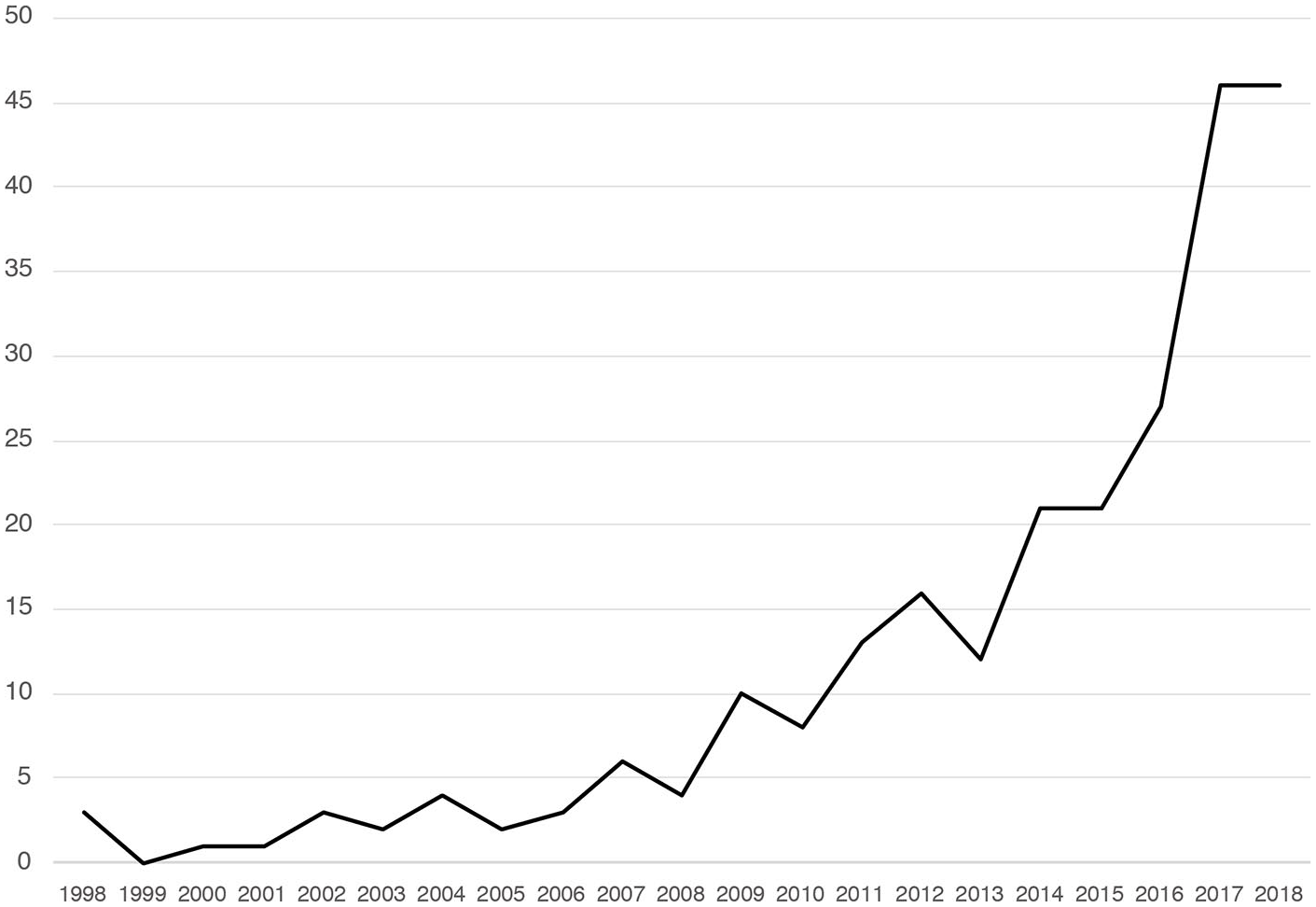
Use of Bourdieusian thought over time (number of articles per year).
These developments coincided with the broader institutionalisation of international journalism scholarship, evidenced through the establishment of specific journals such as Journalism and Journalism Studies (in 2000), Journalism Practice (in 2007) and Digital Journalism (in 2013), as well as the founding of the Journalism Studies Division of the International Communications Association (ICA) in 2004. Therefore, while Figure 1 may in part reflect changing publishing practices and is thus tied to a general increase in research output across the field (Steensen and Ahva, 2015), use of field theory and its accompanying concepts has steadily grown up to 46 publications in 2017 and 2018 each, almost doubling in number from 2016. However, as Table 1 shows, field theory is rarely used on its own, with about one-third of all articles naming only field theory in their abstracts and keywords.
Selected findings from the quantitative analysis.
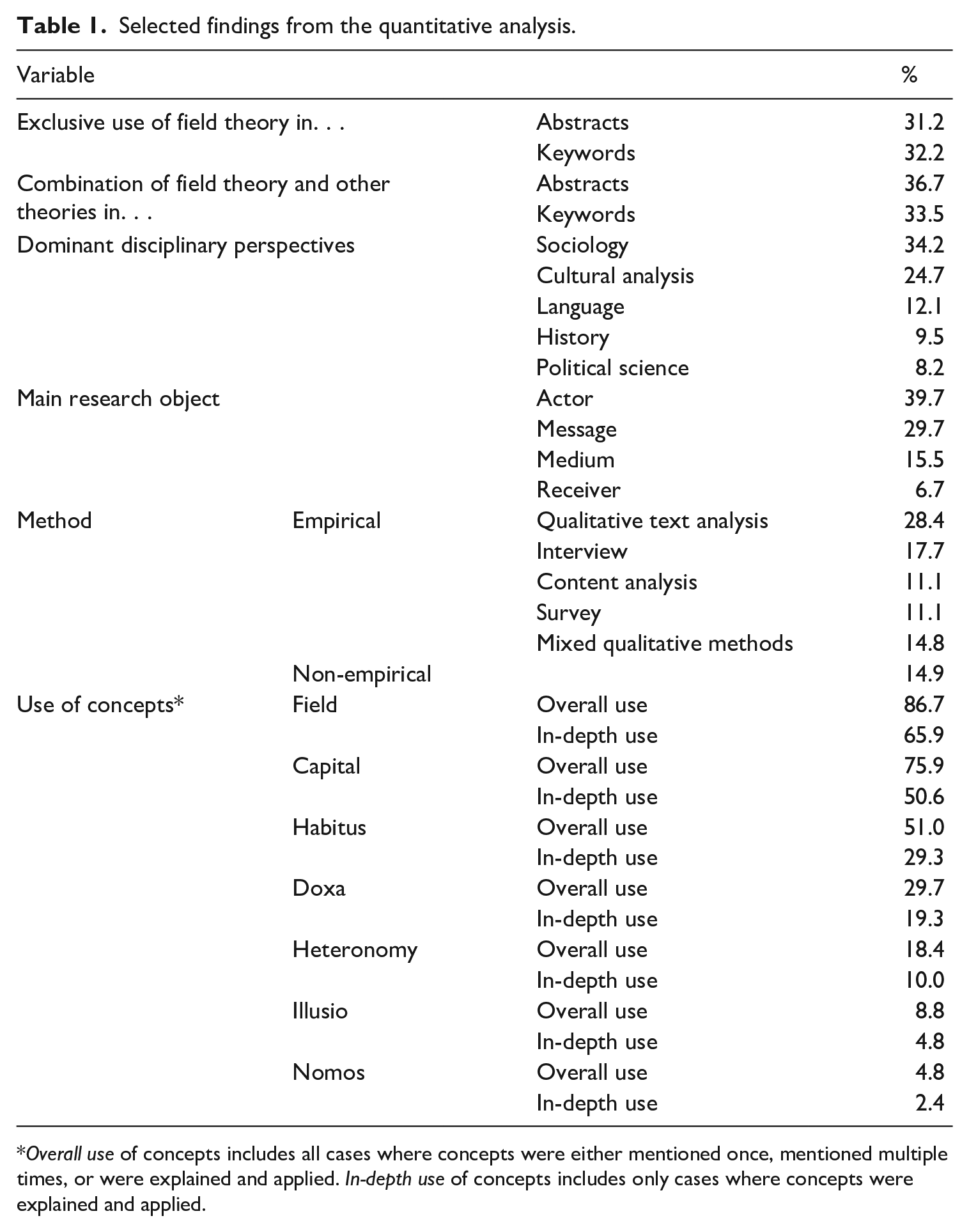
Overall use of concepts includes all cases where concepts were either mentioned once, mentioned multiple times, or were explained and applied. In-depth use of concepts includes only cases where concepts were explained and applied.
Instead, Bourdieu’s concepts are often used along other theories and concepts in abstracts (37%) and keywords (33%). Here we find, similar to results from Steensen and Ahva (2015), most prominently the boundary concept, professionalism, media systems theory, role theory, gatekeeping theory, the public sphere and the concept of news values. Over time, we observe a pronounced change in the exclusive use of field theory in abstracts and keywords between the early period of 1998–2008, and 2009–2018. While in the early period, the vast majority of articles had mentioned field theory in combination with other approaches in abstracts (61%) and keywords (75%), these numbers dropped by more than half in the second decade. In contrast, we see a strong rise in the use of field theory as the only conceptual approach in abstracts (from 16% to 32%) and keywords (from 6% to 34%). The most dominant disciplinary perspective in abstracts is sociological thought, which is followed by cultural analysis, reflecting the main focus of Bourdieusian thought.
The studies focus predominantly on social actors and employ qualitative methods. As Table 1 shows, the main research objects in four out of ten studies were social actors, that is, they take active part in producing a message, while nearly one-third examined media content, followed by media outlets (15%), and audiences (8%). In terms of methods, we found a majority (54%) employed qualitative approaches, while 18% used quantitative methods, 13% a mix of quantitative and qualitative methods, and 15% were not empirical. Among the empirical studies, roughly one-third employed qualitative textual analysis, another one-sixth used interviews, and around one in ten applied content analysis or surveys. Only very few (2%) studies employed correspondence analysis, which was Bourdieu’s core statistical method to map actors’ positions within a field. While six of ten articles included single case studies, 17% took a comparative approach across countries. This is 6% more compared to journalism scholarship more broadly (Löffelholz and Rothenberger, 2011; Mellado, 2012), and might be an indicator of a response to Bourdieu’s call for the global level to be considered in research (Bourdieu, 1998a: 41).
When it comes to the use of Bourdieusian concepts in journalism research, we find that one-fourth of all articles did not engage with any concept in-depth, while 55% explained and applied at least one or two concepts. Table 1 shows that almost nine out of ten articles used the concept of field, closely followed by the different forms of capital. Only half of all articles referred to habitus, and one-third to the concept of doxa. This is echoed in their in-depth use, where again the majority of articles frequently applied and explained the concept of field, followed by the forms of capital, habitus and doxa. Other concepts were rarely referred to, for instance illusio, nomos or heteronomy. When they were mentioned, they were also explained and applied in half of the cases. A closer look into which concepts are more often applied together reveals, surprisingly, that a third used the concept of field by itself (Table 2).
Combination of concepts used in-depth.
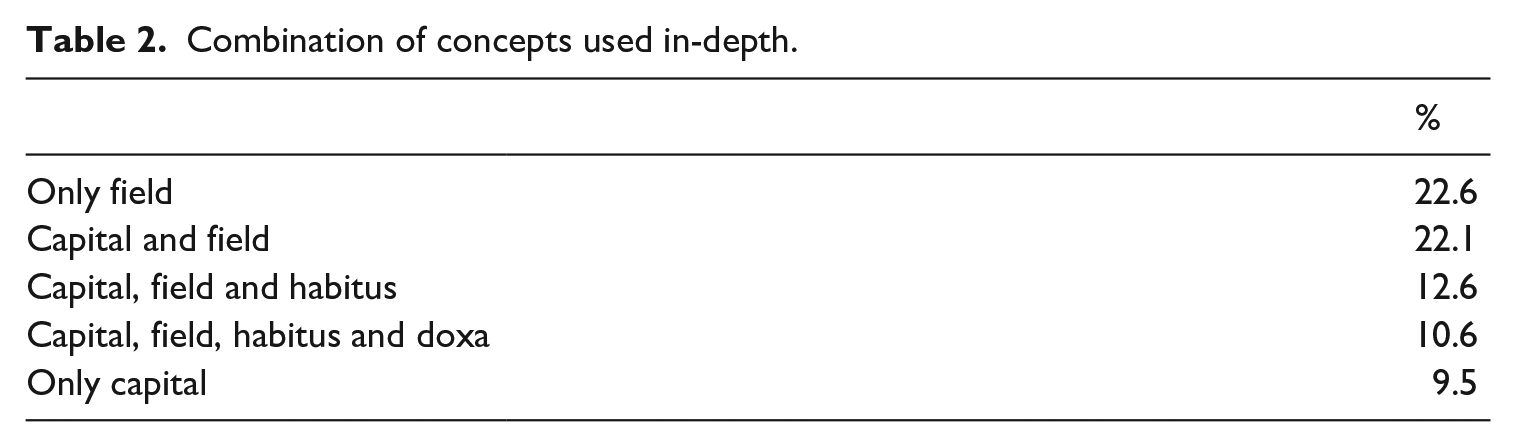
When concepts were applied together, the most dominant combination included the concepts of field and forms of capital, followed by the combination of field, forms of capital and habitus, and field, forms of capital, habitus and doxa.
While this analysis of the broad patterns shows extensive use of Bourdieusian thought, it indicates that Bourdieu’s analytical tools are not yet fully put to use in journalism scholarship. This is particularly apparent in the results of the textual analysis. The concept of field was the most dominantly used in-depth; it was explained and applied rather homogenously across the board as a meso-level hierarchical social space of power relations and competition over resources. Moreover, much of the field’s definition focuses on the opposition between an economic, or heteronomous, and a symbolic, or autonomous, pole – which speaks to general discourses around the tensions of journalism as a symbolic or an economic good. Thus, the journalistic field is located within the field of cultural production, with varying degrees of heteronomy depending on the context of the relevant national field. In general, scholarship describes it as being influenced by external forces, such as the economic or political field, which reiterates how Bourdieu thought of the journalistic field in On Television (1998a). Only few studies, however, concern themselves with discussing its nomos, which is the fundamental criterion of functioning, defining who is worthy of being a member of the field (Hovden, 2012). While journalistic nomos is equalled with traditional journalistic norms (Hanitzsch, 2011), it might also be reflected in meta-journalistic discourse on what is deemed ‘good’ journalism and ‘good’ journalistic practice (Eldridge, 2017); thus, it is an ideal and subject to contestation and change.
Since Bourdieu never conducted an empirical analysis of the journalistic field, his descriptions of the capitals at stake within it are limited to economic and cultural capital (Bourdieu, 1998a). Hence, the forms of capital appear to be more open to debate in the studies we examined. Economic and cultural capital were the most frequently referenced forms of capital, in particular in terms of their opposition, structuring the journalistic field along the economic (heteronomous) and cultural (autonomous) poles. However, it is here where the first ambiguity lies, as around one-quarter of studies that defined this opposition of capitals referred to it as being between symbolic (or journalistic) and economic capital. Economic capital was defined across the board as money or other assets that can easily be transformed into money. The operationalisation of cultural and symbolic capital, however, overlapped and was inconsistent. Symbolic capital was widely defined as recognition, prestige, and consecration of valued practices, while cultural capital was mostly operationalised as knowledge, educational credentials, technical expertise, and verbal abilities, but also as clever, intellectual work, as well as exceptional knowledge and skill. These could therefore count as prestigious qualities within a field of knowledge production. What is more, most studies named either two or three forms of capital. Studies which focussed more on social actors than the position-taking of organisations acknowledged that agents need all forms of capital to compete within the field. This also includes social capital, which was sometimes discussed in combination with symbolic capital, especially when the latter referred to recognition and (social) prestige. Social capital within the journalistic field was moreover often defined as the social network of informants, but has recently been conceptualised as the social network of other (powerful) members of the field to advance one’s position (Jian and Liu, 2018).
Of the 113 articles that engaged with forms of capital in-depth, only 21 articles specifically referred to journalistic capital, and it is here we can observe differing and somewhat contradicting conceptualisations. Not an original Bourdieusian concept, journalistic capital was either directly translated as symbolic capital, closely linked to symbolic forms of capital, a specific cultural capital, or as an overall capital volume of cultural, social, economic and symbolic capitals viewed valuable within the field. These include education and class-based knowledge, social networks and reputation. Sometimes, economic capital is not included in this overall capital but is conceptualised as opposition to combined journalistic capital (Meyen and Riesmeyer, 2012). As field-specific symbolic capital, journalistic capital is connected to peer recognition, respect from colleagues and a favourable position within journalism. In that regard, it can occur in material form, such as awards, as well as in immaterial form through praise and better assignments (Willig, 2013). Moreover, others defined journalistic capital as the provision of long-standing journalistic norms and ideals such as objectivity, autonomy, or gatekeeping (Hovden, 2012). As such, it has been conceptualised as linked to journalism’s normative roles and offers a stratification of the journalistic field along the appreciation of different values (Vos and Wolfgang, 2018).
While the analysis of habitus is essential, the concept is not often applied in journalism scholarship. This might be due to its complexity and supposed determinism, as habitus is both an outcome of the societal structure, as well as a contributor to it (Wacquant, 1993). The studies that did apply habitus defined it as an embodied history of particular dispositions and internalisation of specific rules and practices, both accumulated through inhabiting specific positions within the social space, as well as having access to specific forms of capital. It was often referenced as having a ‘feel for the game’ (Bourdieu and Wacquant, 1992: 128), suggesting habitus favours those who are able to occupy positions in familiar social spaces. Journalistic habitus as secondary layer of professional socialisation is often operationalised as either practice- or role-dependent. Thus, scholars defined journalistic habitus as genre-specific practice, for instance an editor habitus, correspondent habitus, or commentator habitus (Schultz, 2007; Willig, 2013), or as dependent on role perceptions, such as a watchdog habitus, or objective reporter habitus. Meyen and Riesmeyer (2012) offer the most detailed operationalisation of the two layers of habitus, consisting of habitus as opus operatum, that is, socio-demographic socialisation and the current living situation, and habitus as modus operandi, that is, the daily journalistic tasks, aims, ethical principles as well as ideas of the audience and media effects as a whole.
The concepts of doxa and illusio were less frequently applied explicitly. However, doxa was often referred to as ‘rules of the game’ and thus more frequently integrated in our sample. These rules were characterised by their ‘uncontested truth’ as ‘natural’ and evident experiences of the social world. While doxa was primarily used to explain norms and other professional beliefs, such as what constitutes a ‘good’ story, some studies also investigated its ability to function as discipline for the dominated members of the field (Prandner, 2013), or the contest over different forms of doxa and thus the possibility of change within fields (Vos et al., 2012). Illusio, on the other hand, was mostly used by scholars socialised in Europe and defined as an investment, a ‘necessary belief’ (Willig, 2013: 374), or ‘strong feeling’ for the journalistic mission (Hovden, 2012: 67). This concept was often discussed along the results of journalistic decision-making as an explanation for journalists’ field-conforming behaviour. As such, illusio is defined as a force of preservation of the power relations within the journalistic field (Vos et al., 2012).
Power relations in scholarship
To address our second research question, which explores interpretative authority that shapes Bourdieusian thought in journalism scholarship, we examined the locations where scholarship was produced and citation networks. The results suggest that Bourdieusian thought is predominantly adopted and adapted by researchers located in Europe and North America. More than eight out of ten authors were affiliated with Western countries, with US affiliations at the top: 27% of all authors worked at US universities at the time of publication (Table 3).
Geography of authorship – top five countries.
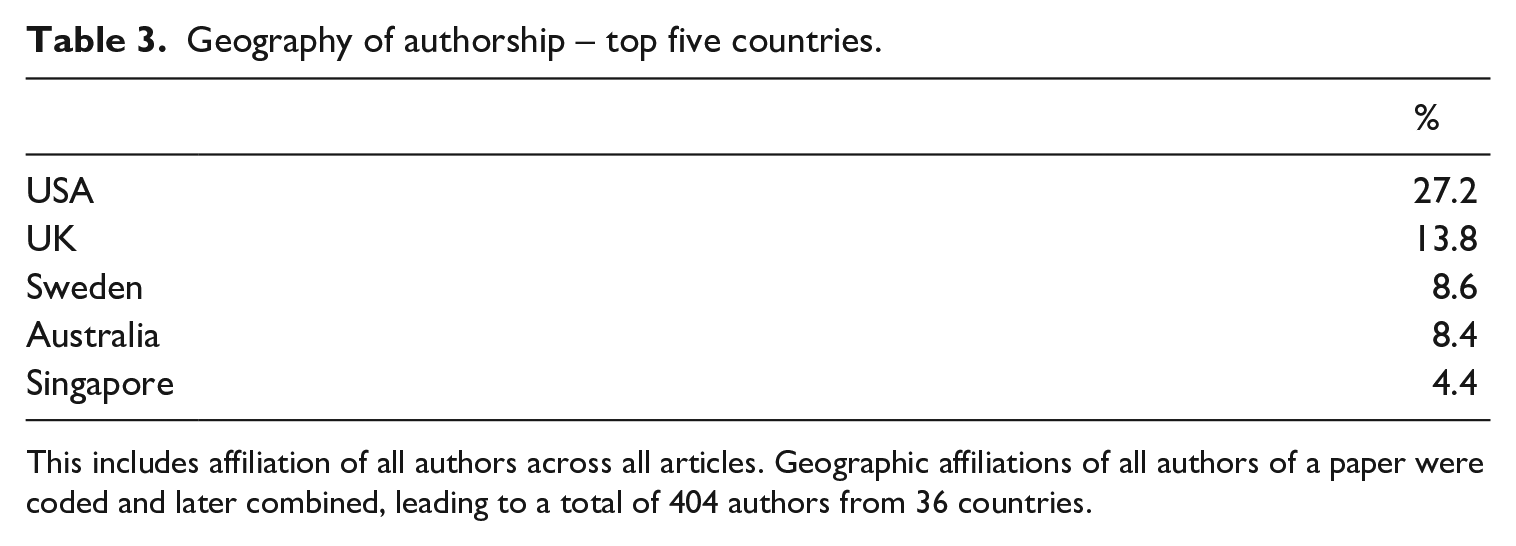
This includes affiliation of all authors across all articles. Geographic affiliations of all authors of a paper were coded and later combined, leading to a total of 404 authors from 36 countries.
While our sample contains work from scholars across the globe, including many contributions from Asian countries, this finding is reflective of the broader field of journalism studies. Previous studies have shown that 84–94% of authors publishing in international journals are affiliated with Western institutions, and 37–48% with US institutions (Cushion, 2008; Hanusch and Vos, 2020; Wassermann and de Beer, 2009). Moreover, the citation analysis shows that apart from Bourdieu’s works, the most frequently cited publications stem from universities in the US and UK.
In terms of citations, our analysis of the 249 articles using CitNetExplorer resulted in a citation network that included 293 publications and 1390 citation links. The threshold for references to be included in this network was set at ten, which means a publication had to be cited by at least ten articles in our sample. Table 4 shows all the cited publications by Bourdieu in this network and the five most referenced publications by other authors.
Citation and citation score of Bourdieu’s work and top five other authors in the citation network.
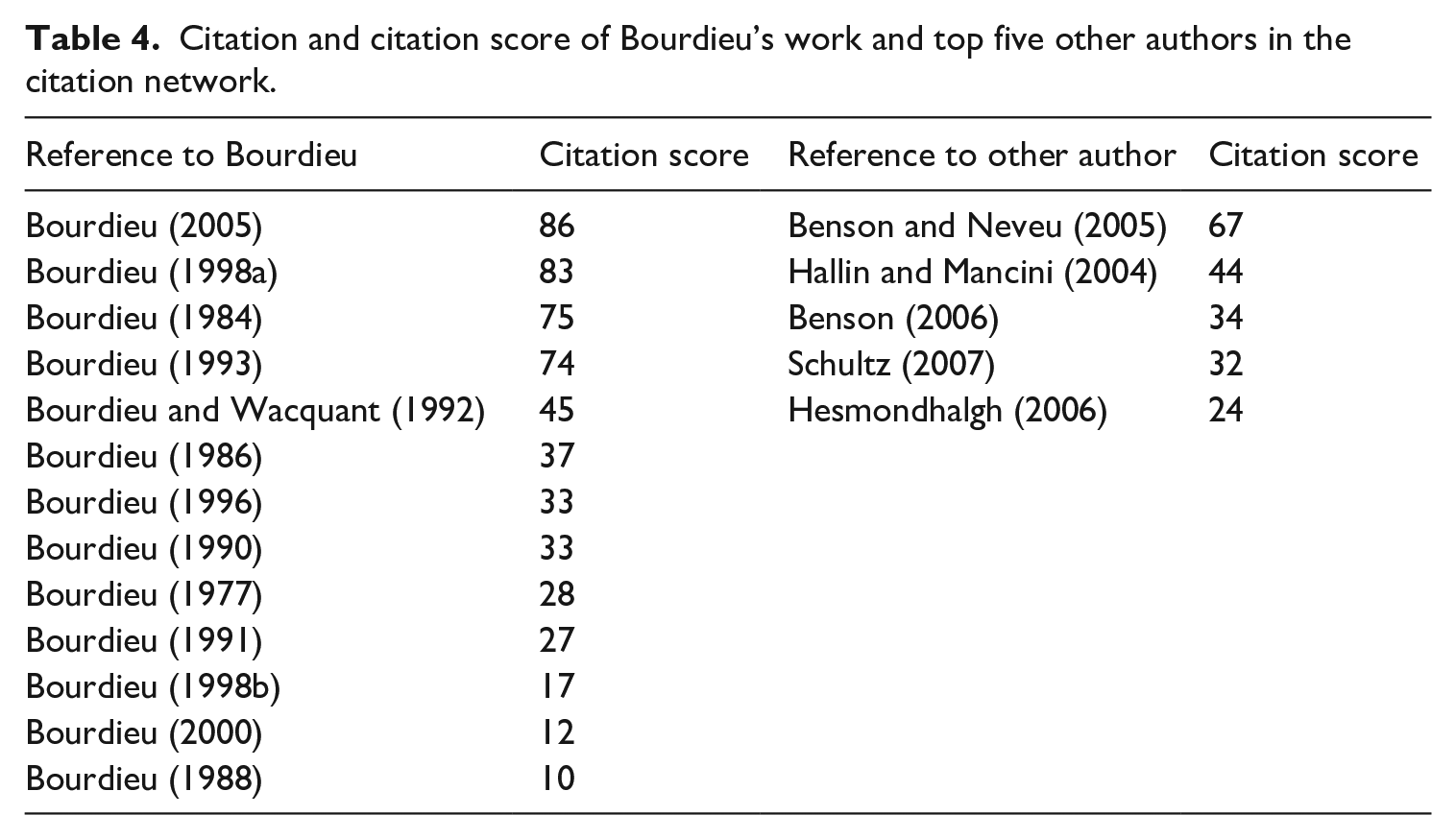
The four most-referenced works were written by Bourdieu, leading with the two publications that explicitly focussed on the journalistic field: his posthumous chapter The Political Field, the Social Science Field, and the Journalistic Field (2005), as well as On Television (1998a), followed by Distinction (1984) and The Field of Cultural Production (1993). This reflects, on the one hand, what Benson and Neveu (2005: x) consider Bourdieu’s ‘major works of sociology of culture’, but on the other ignores work on the reproduction of power relations within fields of knowledge production, such as Homo Academicus (1988), which is cited only ten times in our sample. This reiterates previous findings of a fragmented reading of Bourdieu’s works in the Anglophone academic field (Sapiro, 2020; Wacquant, 1993).
The most-cited publications from other authors include Benson and Neveu’s (2005) edited collection. Other references are studies published in the 2000s, which adopted Bourdieusian thought to the journalistic field (Benson, 2006; Schultz, 2007) and large-scale media production (Hesmondhalgh, 2006). These three articles discuss specific Bourdieusian concepts in detail and to some extent adapt them to their object of research, which could explain their relatively high citation scores within this citation network, as they offer a new perspective on field theory for journalism scholars. For instance, Benson (2006) discusses in detail how the forms of capital can be operationalised for the journalistic field. While he refers to Duval’s (2005) measurements of economic and symbolic or cultural capital, Benson is later referenced by many focusing on these forms of capital in the journalistic field. Schultz’s (2007) ethnographic analysis of journalistic work focuses on the journalistic ‘gut feeling’ for a good story, which she conceptualised as journalistic doxa to explain which news values are undisputable and which are dependent on context. Moreover, she offered a conceptualisation of field-specific cultural capital, namely journalistic capital, as discussed in the textual analysis. Another frequently referenced source is Hallin and Mancini’s (2004) Comparative Media Systems, confirming the indication in the content analysis presented earlier that Bourdieusian thought is often present in comparative research.
When the citation network is further clustered, we obtain two groups of publications. The larger one of 226 publications combines, among others, most of Bourdieu’s works, as well as the edited book by Benson and Neveu (2005), and articles by Benson (2006) and Schultz (2007). Another smaller group of 47 publications includes Bourdieu’s Distinction (1984) and his chapter on the forms of capital (1986). Figures 2 and 3 show these clusters.
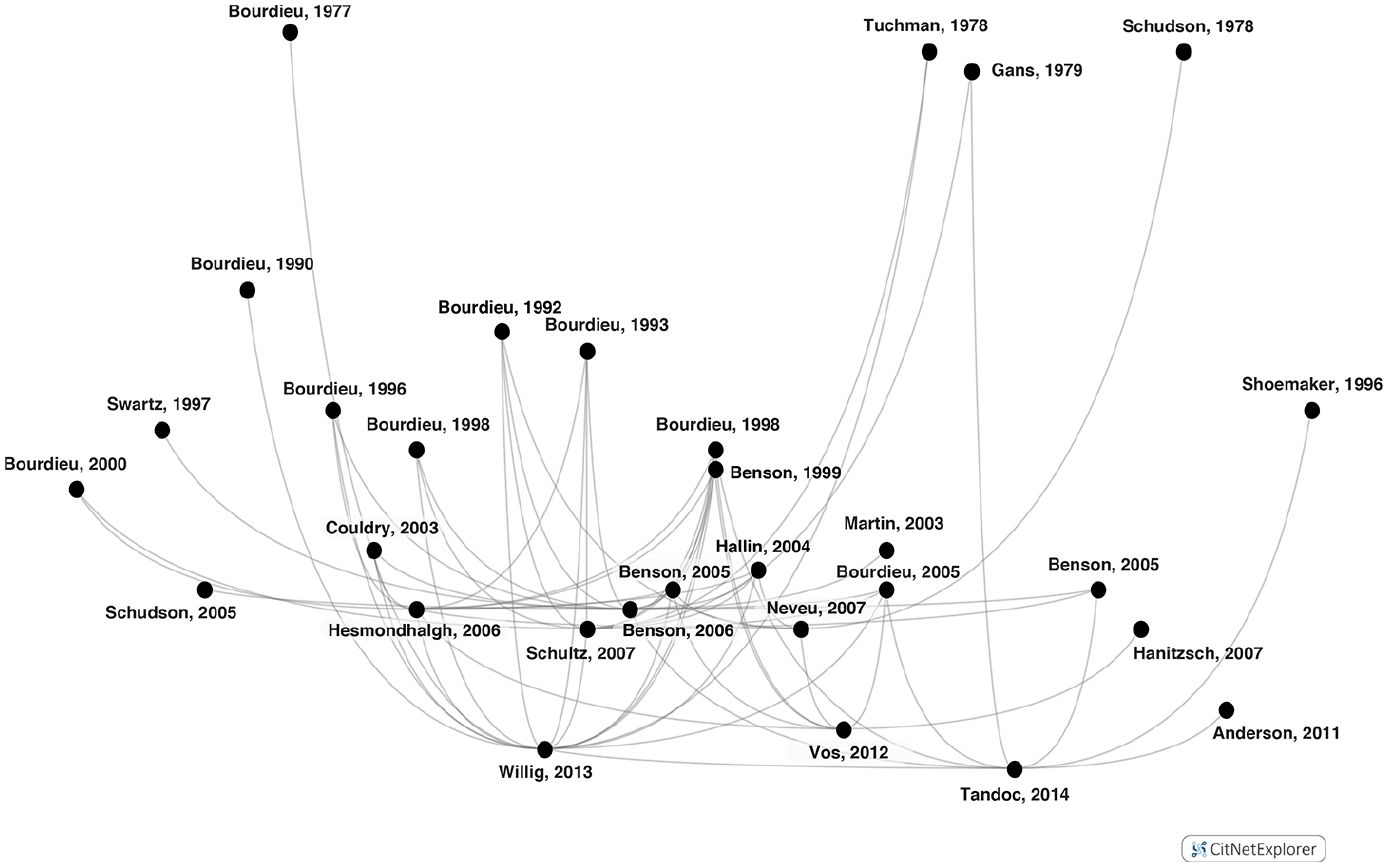
Large cluster of citation network, containing 226 publications.
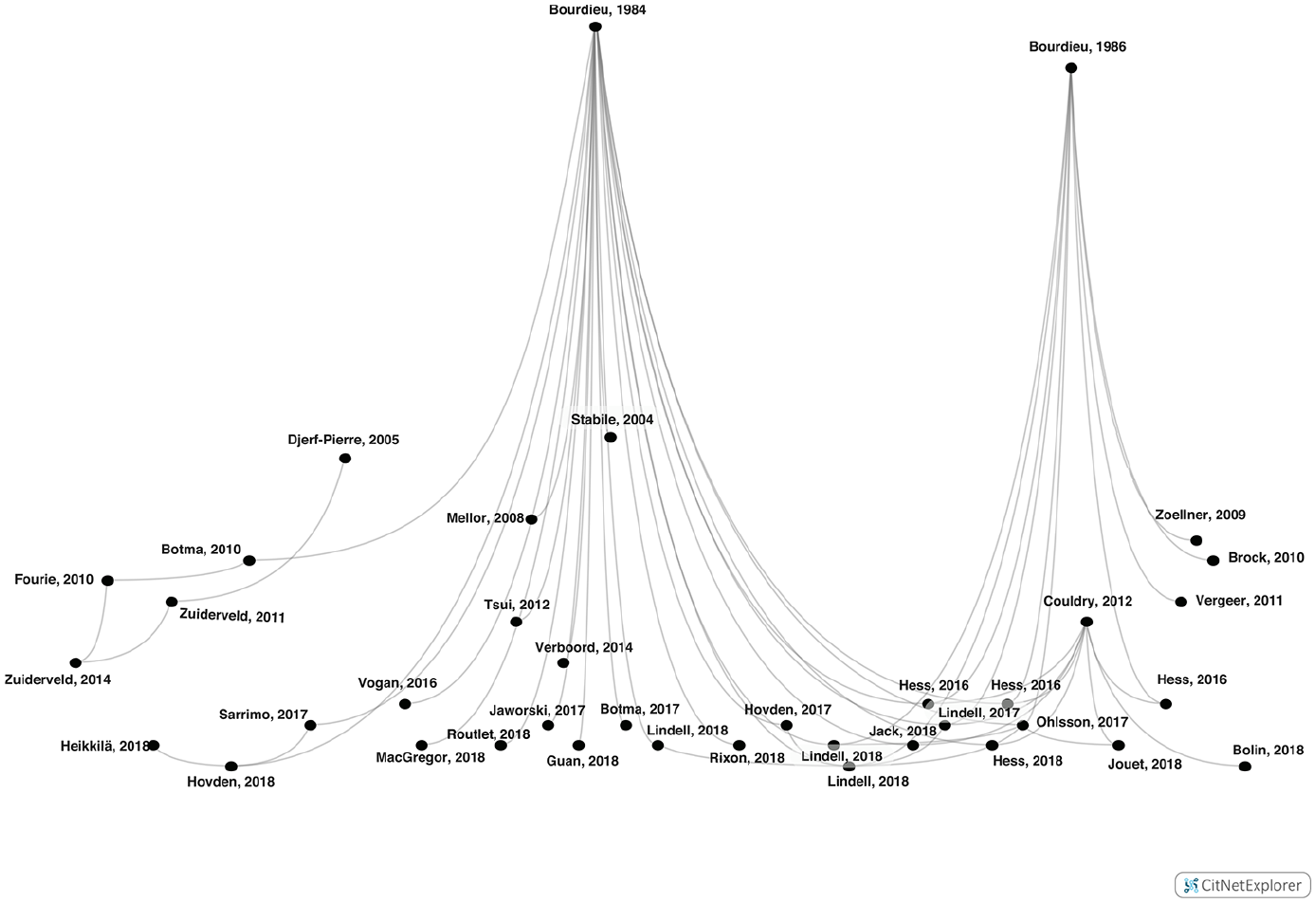
Small cluster of citation network, containing 47 publications.
While the larger network mostly consists of a wide variety of publications that refer to Bourdieu’s works, the smaller network shows a dominance of articles written by scholars socialised in Europe, predominantly Scandinavia. Moreover, we can distinguish a cluster within this network of articles with affiliations in Africa (on the left side of Figure 3), either by author or topic. Interestingly, while the smaller network derives only from Bourdieu’s work, the larger network (Figure 2) is much denser and to some extent messier. Here, Bourdieusian thought is also connected with the classical US works of sociological journalism research (e.g. Shoemaker and Reese, 1996; Tuchman, 1978), and shows a slight dominance of Anglo-American scholarship. These clusters suggest that Bourdieu’s works are generally employed together and combined with US scholarship, except when it comes to the specific stratification of society along the different forms of capital, which is discussed more in Distinction (1986).
Conclusion
Bourdieusian thought is increasingly popular in journalism scholarship and has been employed to investigate different aspects of journalistic work, such as the stratification of the journalistic field and occupational roles (Hovden, 2012), journalistic routines (Schultz, 2007), as well as the shift in journalistic norms (Vos et al., 2012), the relevance of resources to successfully pursue a career (Jian and Liu, 2018), technological change (Tandoc, 2015), and the boundaries of the journalistic field (Eldridge, 2017).
However, while Bourdieu offers an entire plate of conceptual tools to analyse the journalistic field and changes within it, the most frequently applied concepts are the field and forms of capital. While forms of capital are useful to map variations in journalism both along broader traditions and genres, as well as between organisations and agents, the concept and its analytical power to research journalism has not yet been streamlined in journalism scholarship. In Bourdieusian terms, one could argue the discursive construction of what constitutes journalistic capital – or what is valued most in the journalistic field – is still very much in flux. Of the 113 articles that engage with the forms of capital, only 21 studies conceptualise journalistic capital, and even these vary greatly in their definition and the emphasis they put on journalistic capital vis-à-vis other forms of capital. Similarly, in studies that do not employ journalistic capital, the definition and application of cultural and symbolic capital is not consistent across the field. This might be due to the strong reliance on Bourdieu’s work on literary production, and less consideration of his discussion of forms of capital in general, as well as in other fields of knowledge production (Bourdieu, 1988).
Interestingly, other Bourdieusian concepts that could explain journalistic behaviour and practice, are not used as extensively. This appears surprising, especially as many studies focus on actors as their main research objects, and thus their dispositions and their adherence to the rules of the field might well explain their actions. This negligence could be due to the fact that Bourdieu does not discuss habitus, doxa and illusio in much depth in his works on journalism (1998a, 2005), as well as that some of these, notably the habitus concept, are perceived as too deterministic from Anglophone translations (Wacquant, 1993). Moreover, the fragmented reading of Bourdieu could explain why only few studies employed multiple correspondence analysis to map the journalistic field, and correspondingly, investigate homologies between the production and reception of news. In light of the audience turn in journalism studies, social position of actors and audiences, as well as Bourdieu’s writings on language and symbolic power could help explain news content and its reception.
At the same time, our study highlights that theoretical engagement and application of Bourdieusian thought in journalism scholarship is predominantly Western, with scholars associated with US and European institutions contributing to a large extent to how we use field theory and other concepts when studying the journalistic field. This affects which aspects are considered as contributing to what is deemed valuable in the journalistic field and, moreover, how broadly these concepts will apply in non-Western contexts. Instead of largely referring to only Western literature, future research employing field theory should thus also engage with the existing application of Bourdieu’s work from non-western scholars to make a stronger theoretical contribution to the development of Bourdieusian thought in journalism scholarship. Moreover, similar to Lamont’s (1987) description of how Derrida’s work was diffused in US comparative literature departments in the 1970s, Bourdieusian thought offered a broad theoretical paradigm to the emerging field of international journalism studies that focussed very much on practice (Ahva and Steensen, 2019). Given the paucity of research on similarly influential thinkers in journalism studies, future studies may wish to empirically explore to what extent scholars such as Habermas, Latour or Foucault have been appropriated to international journalism scholarship, further contextualising our findings.
Of course, systematic reviews of literature do not come without their limitations. One lies in the sample itself, as we only examined journal articles, which arguably offer limited space to discuss theory in detail, or to triangulate findings. However, many empirical studies in our sample show theoretical depth, proving that one can in fact offer a comprehensive theoretical contribution. Lastly, no one ‘owns’ Bourdieusian thought; therefore, our analysis, while it is extensive, cannot evaluate the legitimacy of its appropriation but only highlight possible gaps to be addressed in future studies.
Supplemental Material
sj-pdf-1-jou-10.1177_1464884920959552 – Supplemental material for Interpretations of the journalistic field: A systematic analysis of how journalism scholarship appropriates Bourdieusian thought
Supplemental material, sj-pdf-1-jou-10.1177_1464884920959552 for Interpretations of the journalistic field: A systematic analysis of how journalism scholarship appropriates Bourdieusian thought by Phoebe Maares and Folker Hanusch in Journalism
Supplemental Material
sj-pdf-2-jou-10.1177_1464884920959552 – Supplemental material for Interpretations of the journalistic field: A systematic analysis of how journalism scholarship appropriates Bourdieusian thought
Supplemental material, sj-pdf-2-jou-10.1177_1464884920959552 for Interpretations of the journalistic field: A systematic analysis of how journalism scholarship appropriates Bourdieusian thought by Phoebe Maares and Folker Hanusch in Journalism
Footnotes
Acknowledgements
The authors would like to thank Steve Reding for his support with pre-processing the data necessary for the citation analysis, as well as Michael Marbacher for his help. Moreover, the authors would like to thank the two anonymous reviewers for their constructive comments on the manuscript.
Funding
The author(s) received no financial support for the research, authorship, and/or publication of this article.

Supplemental material
Supplemental material for this article is available online.
Notes
References
Supplementary Material
Please find the following supplemental material available below.
For Open Access articles published under a Creative Commons License, all supplemental material carries the same license as the article it is associated with.
For non-Open Access articles published, all supplemental material carries a non-exclusive license, and permission requests for re-use of supplemental material or any part of supplemental material shall be sent directly to the copyright owner as specified in the copyright notice associated with the article.
