




Abstract
A growing amount of scholarship on lifestyle journalism and role conceptions has shown its relevance in the context of consumption cultures and societal changes. However, the existing literature has tended to focus on countries with relatively prosperous economies, neglecting to explore those with greater socio-economic inequality. Likewise, scholarship has offered some insight into what audiences expect of political journalists, but we know little about expectations of lifestyle journalism. Exploring role conceptions and expectations in socio-economically unequal societies gives rise to the question: How may social class shape these? To examine this, our study draws on 22 in-depth interviews with lifestyle journalists and three focus groups with audiences from different class backgrounds in South Africa. Findings suggest that lifestyle journalists’ awareness of class disparity and the country’s history of racial segregation and oppression shapes their roles in three ways. First, journalists expressed strong support for roles typically associated with political journalism, albeit interconnected with lifestyle roles. Second, journalists acted as ‘responsible’ cultural intermediaries, mediating the worlds of luxury and inequality. Third, journalists expressed a strong role orientation toward providing aspiration, as did audience expectations, indicating a level of congruence. Applying a Bourdieusian framework, we argue that lifestyle journalism allows audiences who live under ‘conditions of scarcity’ and who have been conceptualized as having a ‘taste of necessity’, to perform a ‘taste of aspiration’. We suggest a need to reconceptualize scholarship’s approach to studying journalistic roles by moving beyond a politics-lifestyle binary, and to more closely examine the role of aspiration in lifestyle journalism.
Keywords
Introduction
Journalism research has tended to prioritize political journalism as playing the only role in democracy and citizenship, at the expense of considering the societal contribution of softer forms of journalism. However, the development of consumption cultures globally and societal shifts seen particularly in Western countries toward individualization, de-traditionalization, and value change, have led scholars to explore other types of journalism, such as lifestyle journalism more deeply (Hanusch and Hanitzsch, 2013).
Much like journalism scholarship’s North American and European bias, literature on lifestyle journalism has typically focused on consumption cultures in Minority World Countries, 1 such as Australia, Denmark, Germany, and the USA (e.g. Fürsich, 2012; Hanusch and Hanitzsch, 2013; Kristensen and From, 2012; McGaurr, 2012). Less attention has been paid to Majority World Countries and those with greater socio-economic divisions, despite evidence of lifestyle journalism’s importance (Vodanovic, 2019; Wasserman, 2010). Additionally, lifestyle journalism literature has focused on production and content, and less on audience expectations and perceptions (Hanusch, 2019), although these affect how journalists understand their roles (Donsbach, 2008).
To address these gaps, this article explores lifestyle journalists and audiences in South Africa, where inequality is high and the media target specific economic, language, and racial groups (Schieferdecker, 2017). Drawing on interviews with 22 lifestyle journalists and focus groups with 25 audience members from diverse socio-economic backgrounds, we focus on these actors’ role conceptions and expectations, respectively.
The importance of lifestyle: Social class, aspiration, and consumption
Lifestyle journalism’s rise in popularity has been attributed to major societal shifts, which occurred as a consequence of modernization and a flourishing consumer culture allowing audiences to craft out specific lifestyles (Hanusch and Hanitzsch, 2013). However, to understand the significance of lifestyle journalism, we need to understand the social significance of ‘lifestyle’, or the ‘stylization of life’ as a reflection of social class and ‘taste’ (Bourdieu, 1984: 5–6).
Social class and ‘taste’
Lifestyle as a reflection of social class is captured in the concept of ‘taste’, famously developed by Bourdieu (1984) in his study of social distinction and forms of capital. Lifestyle can be understood as ‘patterns of action that differentiate people’ (Chaney, 1996: 4) or a ‘distinctive style of life of specific groups’ (Featherstone, 1987: 55). These distinctive tastes are a reflection of a person’s ‘habitus’ or system of ‘cultivated dispositions’ – conditioned, internalized preferences and perceptions of distinctive, cultural practices and goods – that are structured by and structure class divisions within the social space (Bourdieu, 1984: 170). A person’s relative position within the class structure is determined by access to cultural, economic, and social capital (Bourdieu, 1986). Overall capital volume positions a person into broad class groups, while capital composition distinguishes their volume of specific forms of capital within a class group, placing them into class fractions (Bourdieu, 1984).
Class fractions distinguish themselves through oppositional and distinct ‘tastes’ or dispositions for cultural practices and consumption styles (Bourdieu, 1984: 184). This implies that ‘people who share positions are likely to share dispositions’ (Lindell, 2018: 3031), whether this refers to taste in fashion (Blumer, 1969; Simmel, 1957), political behavior (Verba et al., 1997) or news consumption (Lindell and Sartoretto, 2018). While the concept of lifestyle or ‘lebenstile’ is broader than lifestyle journalism, its major genres – fashion, beauty, food, home, technology – provide an orientation for how people manage their lives, perform their lifestyles, and articulate their identity (Hanusch and Hanitzsch, 2013).
Found in this orientation, performance, and articulation of everyday life are traces of a person’s ‘taste’ – a ‘symbolic struggle’ among groups ‘for the exclusive appropriation of the distinctive signs’ which make distinction appear ‘natural’ (Bourdieu, 1984: 250). However, nothing about distinction is ‘natural’, but requires participating in a ‘game’ or the ‘illusio’ that maintains the belief in the absolute value of legitimate culture (Bourdieu, 1984: 250). Distinction is preserved through ‘structures of opposition’, a relational power struggle between, for example, the ‘taste of necessity’ associated with practices and goods perceived as ‘vulgar’ and exemplified by those with low cultural and economic capital volume who resign to fulfilling basic, practical or functional needs; and the ‘taste of luxury’ associated with ‘rarity’ and inaccessibility, freedom and distance or dissociation from necessity and urgency, belonging to those with higher volumes of capital (Bourdieu, 1984: 175–177). Within lifestyle journalism this might present in the opposition between the symbolic power associated with couture versus high-street fashion, or Michelin star cuisine versus fast-food. This symbolic struggle reproduces and legitimizes the hierarchy between what is perceived as authentic or legitimate culture and that which has been imitated and popularized (Bourdieu, 1984: 250). In their study of ‘distressed neighborhoods’ in Cologne, Germany, Blasius and Friedrichs (2008) found that working-class groups cannot sufficiently convert cultural capital (education) into economic capital (income) and vice versa, to increase overall capital volume. They confirm the argument that the working-class have a ‘taste of necessity’ – ‘condemning “simple,” “modest” people to “simple,” modest’ tastes’ (Bourdieu, 1984: 379).
For our study, this suggests that lifestyle journalism will speak differently to classed audiences. One argument would be that the elite consume lifestyle journalism for pure pleasure, the economic middle classes to find aspiration (and imitation), and the working classes to feel excluded. In turn, journalists will reflect this stratification in their roles and how they relate to audiences.
Aspiration and the consumption of culture: Symbolic and material goods
Early aspirational observations were made by Simmel (1957) and Blumer (1969) who argued that fashion signifies class inclusion and exclusion. Like other class-distinguishing insignia, it reinvents itself to allow elite groups to distance themselves from lower-class groups who aspire to identify with it (Simmel, 1957). Once adopted and popularized by the masses, goods previously unique become ‘taken-for-granted’ and stripped of their distinction, prompting the privileged classes to quickly relegate these with ‘new, rarer and more distinctive goods’ (Bourdieu, 1984: 247).
There has been significant scholarship on the concept of aspiration also within social psychology, which suggests that aspiration reflects individuals’ innate motivation toward psychological growth and fulfilment of basic needs (Ryan and Deci, 2000). While ontologically different, we see value in engaging in some theoretical eclecticism, in the hopes of opening new analytical questions and perspectives (Karppinen et al., 2008), for example, how the consumption of lifestyle journalism for aspiration may factor into audiences’ psychological needs and motivations.
Extrinsic aspiration and conspicuous consumption
Aspiration can be extrinsic and intrinsic. Extrinsic aspirational goals seek external validation and include financial accomplishment, social recognition, and attractive appeal (Kasser and Ryan, 1996). People of low socio-economic status, susceptibility to normative pressure (keeping up with others), and a need to regain agency within personal domains, can turn to materialism as a ‘coping response’ (Chang and Arkin, 2002: 393).
That extrinsic aspiration is driven by external validation suggests its connection to conspicuous consumption, a concept coined by Thorstein Veblen ([1899] 2017) who argued that social status shapes consumption practices (Trigg, 2001). Conspicuous consumption entails ‘the purchase of goods that do not exhibit additional utility or functionality but offer status and reveal socio-economic position’ (Currid-Halkett et al., 2019: 84). Bourdieu (1984: 31) refers to this as a form of ‘naïve exhibitionism (. . .) which seeks distinction in the crude display of ill-mastered luxury’ by fractions with economic capital who seek exclusivity through material possession and the appropriation and commodification of objectified cultural goods (e.g. expensive art). In other words, goods become tools to visually position oneself within an aspirational class. While the culturally privileged are seen as the ‘distinguished possessors’ of symbolic power and an unconscious ‘sense of distinction’ for legitimate culture, the nouveau riche (so-called ‘new money’) are perceived as the ‘pretentious pretenders’ who aspire to possess distinction through the ‘illusory form of bluff or imitation’ (Bourdieu, 1984: 251–252). That is, they buy their way into performing belonging to legitimate culture. This performative aspect of class echoes Goffman’s (1959) theatrical metaphor that in social interactions people control their behavior and appearance to achieve a desired impression. To give a convicting ‘performance’ the nouveau riche ‘constantly overshoots the mark for fear of falling short’ in anticipation of ‘being by seeming’ (Bourdieu, 1984: 253).
Intrinsic aspiration and inconspicuous consumption
Intrinsic aspirational goals carry inherent value and include community closeness, health, and self-growth (Kasser and Ryan, 1996), and relate to ‘inconspicuous consumption’ – an understated form of status-making through ‘subtle, luxury goods and services that are not overtly materialistic but that also act as social signifiers’ (Currid-Halkett et al., 2019: 85). Contrary to the crude display of material goods, inconspicuous consumption reflects Bourdieu’s (1984: 227) discussion of symbolic goods; consumption and appreciation for pure pleasure (art as art, not commodity). In other words, while the nouveau riche is seen to overdo it, the cultural elite performs ‘ostentatious discretion, sobriety and understatement, a refusal of everything which is “showy,” “flashy,” and pretentious’ (Bourdieu, 1984: 249).
Consumption is a vital part of how people construct and perform their identity: ‘I am = what I have and what I consume’ (Fromm, 1976: 15). The literature thus suggests that social class shapes an individual’s ‘habitus’ – their dispositions and taste for specific cultural goods, aspirational goals and consumption practices. We relate these discussions to how social class shapes audiences’ expectations of lifestyle journalism and its producers, and lifestyle journalists’ role conceptions and perceptions of audiences.
Journalists as cultural intermediaries: Class and role conceptions in lifestyle journalism
Journalism is a field of cultural production, and journalists act as cultural intermediaries between the public and culture, consumption and production (Bourdieu, 1984; Hovden, 2008). They have the professional legitimacy to be taste instigators, shapers, and manipulators in the economy of cultural wants and needs, match-making consumers’ tastes to goods (Smith Maguire, 2014).
As cultural intermediaries, journalists are the cultural bourgeois, and the journalistic field is often composed of those with inherited capital and origins in the social elite (Hovden, 2008). An internally classed space, the journalistic field reproduces the ‘silent orchestration of habitus’ where journalism education and recruitment perpetuate the (self-)selection of journalists whose habitus pre-disposes them to and corresponds with the dominant vision of the profession (Hovden, 2008: 103; see also Hovden, 2012). Once in the field, new members develop a ‘journalistic habitus’ – a tacit understanding or ‘feel for the [journalistic] game’ that shapes their work practices and ideals (Willig, 2012: 378) and reproduces class distinctions (Grabe, 1996). Habitus (e.g. gender) also affects journalists’ preference for genre specialization and journalistic ideals (Hovden, 2008).
While journalistic roles have been studied in-depth, the focus has been on political journalism (Hanitzsch and Vos, 2018), with journalism’s relationship with everyday life receiving attention only recently. Scholarship has shown lifestyle journalists seek to entertain, inspire, offer life orientation and exemplars of desired lifestyles, be a service provider (advice, product review) (Fürsich, 2012; Hanusch, 2019; Hanusch and Hanitzsch, 2013), friend and mood manager, as well as marketer; roles that speak to the interrelated domains of consumption, identity, and emotion (Hanitzsch and Vos, 2018). However, lifestyle journalists also seek to advocate by monitoring and scrutinizing lifestyle industries, roles found in political journalism (Hanusch, 2019). While limited, this literature begins to suggest overlap between political and lifestyle role conceptions, blurring distinctions between the fields.
Audience expectations
Social class also shapes how journalists perceive their audiences and which audiences they speak to, reinforcing their fragmentation (Lindell, 2018). Journalists from privileged classes perceive audiences as a ‘distant mass’ and approach them with detachment and ‘cynicism’, while those from lower classes tend to feel compassion (Hovden, 2008: 95). This opposition, Hovden (2008: 95) argues, reflects Bourdieu’s (1984) distinction between pure taste, exemplified by the privileged class’ ‘neutralizing and distanced relation to works of art’, and the working class’ barbaric taste ‘characterized by empathy and the lack of distance to the depicted people and their suffering’. These dynamics arguably also affect audiences’ expectations of journalists.
Compared to role conceptions, audience expectations are under-explored although they are said to shape roles (Biddle, 1979). Past studies of political journalists’ roles and audiences’ expectations have found both congruence and incongruence (Loosen et al., 2020; Schmid and Loosen, 2015; Tandoc and Duffy, 2016; Tsfati et al., 2006; Vos et al., 2019) but have rarely focused on Majority World Countries (Frere, 2014) or accounted for class (Heider et al., 2005). Lindell and Sartoretto (2018) found that in Sweden and Brazil social class shaped young people’s news consumption preferences and perceptions of its value, and they used these to ‘draw cultural and moral boundaries’ that reinforce established class hierarchies. Higher capital audiences are ‘avid consumers of cultural goods’, while working-class audiences resist ‘the normative news order’ and further ‘exclude themselves from “legitimate” culture’ (Lindell and Sartoretto, 2018: 2057–2058). Similar distinctions were found in the United States, where television and newspaper consumption separates audiences with lower and higher volumes of capital, respectively (Friedland et al., 2007).
Audiences of lifestyle journalism have been neglected, and studies of lifestyle journalists’ role conceptions confined to countries with more equal wealth distribution. To examine these in the context of wider socio-economic divisions, South Africa presents a unique social space.
The South African context
For almost five decades, South Africa was governed by apartheid, a nationalist regime and ‘ideology of racial hierarchy’ (Schieferdecker, 2017: 130) that segregated and oppressed people of colour. Since the 1994 democratic elections, the government has launched affirmative action policies. Consequently, a ‘consumer identity’ has emerged which allows people ‘to express their identities by means of conspicuous consumption rather than through the old identity categories inherited from apartheid’ (Wasserman, 2010: 34). Recent entrants to the Black middle class are more likely to engage in visible consumption to signal membership (Burger et al., 2015). Historically, class stratification was expressed through consumption (Alexander et al., 2013) of items such as cell phones, cars, and fashion (Mbembé et al., 2004).
The concept of class is particularly intricate in South Africa where the population is divided into 10 Living Standard Measures (LSMs) 2 – a marketing tool that identifies audiences based on ownership capital. Differences between socio-economic (occupation) and socio-cultural (cultural capital, status) factors, and one’s raw income may not reflect classic class markers (Seeking and Nattrass, 2015). South Africa’s middle-class is a ‘fluid’ and ‘arbitrarily defined’ space (Melber, 2017: 146) where boundaries are constantly confirmed and contested by those who discursively adopt or reject the middle-class label (de Coninck, 2018). It consists of ‘established’ middle-class fractions (higher salaried professionals), and ‘vulnerable’ groups who identify more closely with the working class and feel insecure about sustaining membership (Burger et al., 2015). Socio-economic inequality (poverty, obstacles accessing education, and employment) is found at the intersection of class and race (Seeking, 2008).
These dynamics are somewhat reflected in South Africa’s media. South African journalists negotiate traditional-liberal and developmental journalistic values which emphasize African cultural identities and the national interest (Kanyegirire, 2006). Journalists experience racism in newsrooms (Ndlovu, 2015) and media institutions rely on various strategies to negate these experiences (Durrheim et al., 2005). The media landscape targets specific economic, language and racial groups, and class and race mediate whether audiences access international or local media (Schieferdecker, 2017). Tabloids speak primarily to a Black working-class audience that has been neglected by the mainstream press (Steenveld and Strelitz, 2010) and has ‘remained on the margins of the post-apartheid mediated public sphere’ (Wasserman, 2008: 788). While magazines target the ‘aspirations of the new Black elite’, tabloids reflect ‘this aspirational culture’ to a lower socio-economic market (Wasserman, 2010: 35).
This brief overview demonstrates South Africa as a valuable case study for lifestyle journalists’ roles and audience expectations in a country with a complex socio-political history and economic inequality.
Based on the above literature review, the following research questions were developed:
RQ1. How do lifestyle journalists understand their role in socio-economically unequal societies?
RQ2. How does awareness of socio-economic fragmentation across audiences shape journalists’ role conceptions?
RQ3. How does socio-economic inequality shape audiences’ expectations and perceptions of lifestyle journalism?
Methodology
This study used interviews and focus groups with participants with diverse capital volumes/compositions, measured with a questionnaire used in other studies on class and news consumption (Lindell, 2018; Lindell and Sartoretto, 2018). We captured economic capital through participants’ employment, income, house and car ownership; cultural capital through participants’ education, parents’ education and occupation, number of books at home, and frequency attending ‘legitimate’ culture (e.g. museums, theatre); social capital via group/community membership. For some of our journalists and many of our audiences, social capital was characterized by participation in religious, political, and charity groups. While Bourdieu’s social capital means belonging to social networks with those affluent in capital volume and who can elevate others in the social space, participation in community-level associations more accurately reflects Putnam’s (2000) definition of social capital in the political sense. Here ‘associational networks facilitate the underlying conditions of interpersonal trust, tolerance, and cooperation’ by promoting connection among members (Norris, 2002: 3). To measure symbolic capital, we asked only the journalists whether they have received journalism awards or been on a selection committee, the presence of which increases journalistic legitimacy and capital (Hovden, 2008; Willig, 2012).
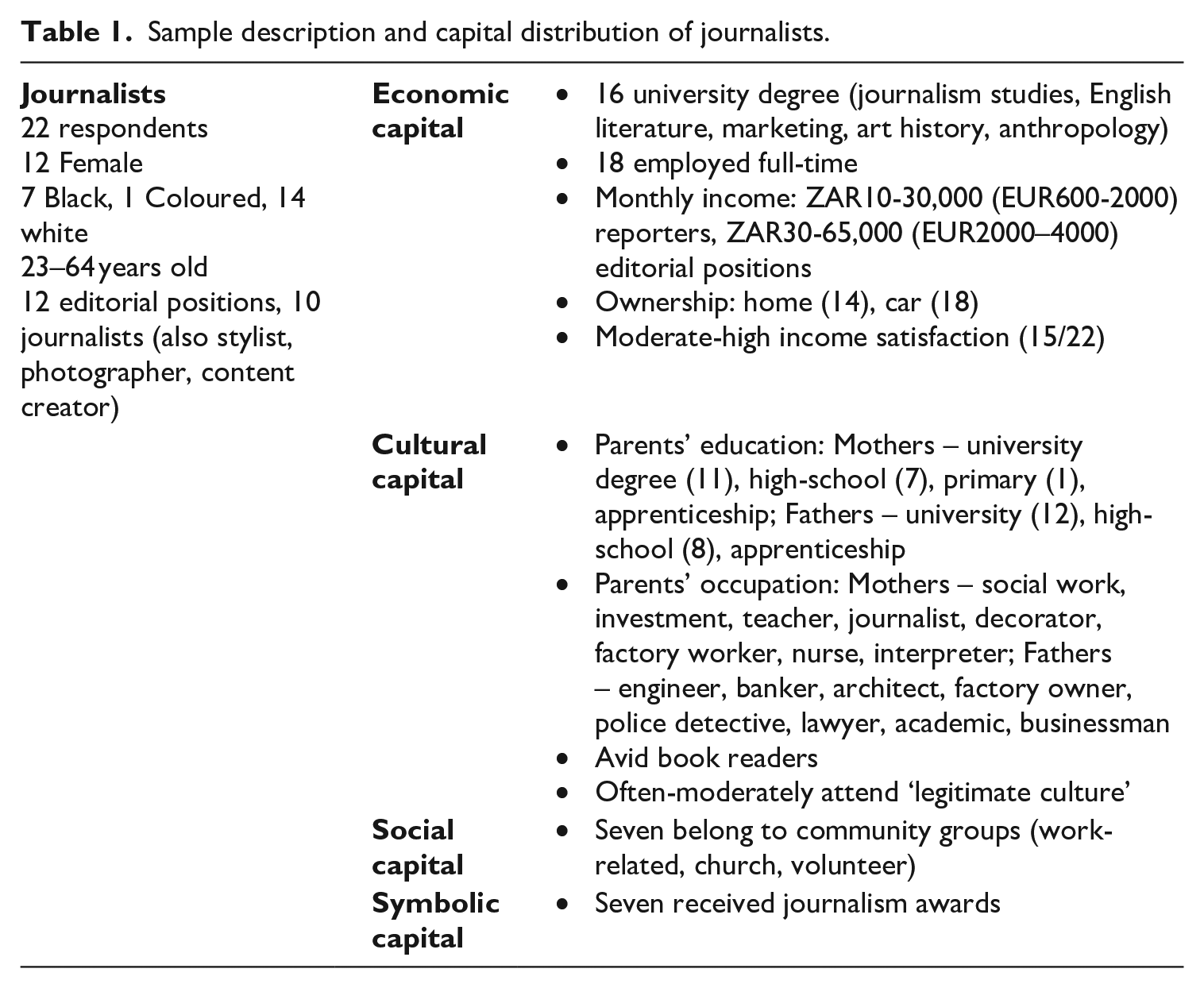
A total of 22 lifestyle journalists and editors working for diverse magazines and newspapers, including one blogger, were contacted via email, LinkedIn, and Twitter, and interviewed in person or over the phone (one via WhatsApp text messages), July to October 2018. Journalists had moderate economic capital (editors had high), moderate-high cultural capital, low-moderate social capital, and low-moderate symbolic capital, making them the cultural middle-class and the editors also the economic elite (for sample description see Table 1). Semi-structured interviews allow for detailed exploration with enough flexibility for inductive and deductive approaches to analysis (Kvale, 1996). Journalist were asked how they understand their journalistic purpose, how they imagine their audiences and their expectations, and how this shapes their roles. In the findings, journalists have been assigned pseudonyms.
Sample description and capital distribution of journalists.
Audience expectations were explored through three focus groups with a total of 25 participants with different volumes/compositions of capital (for sample description see Table 2). Focus groups permit exploring themes in group dynamics where patterns of consensus and dissent offer a rich and multifaceted understanding of a subject (Kitzinger, 1995). Inspired by Morley’s (1980) study of audiences we sampled homogenous focus groups. A strength-in-numbers approach and shared identification (class belonging) among individuals increases their confidence and level of comfort with one another (Lunt and Livingstone, 1996). We employ Blasius and Friedrichs’ (2008) approach of neighborhoods as a unit of class identification, meaning, focus group participants were drawn from social spaces and suburbs populated by specific class groups.
Sample description and capital distribution of audiences.
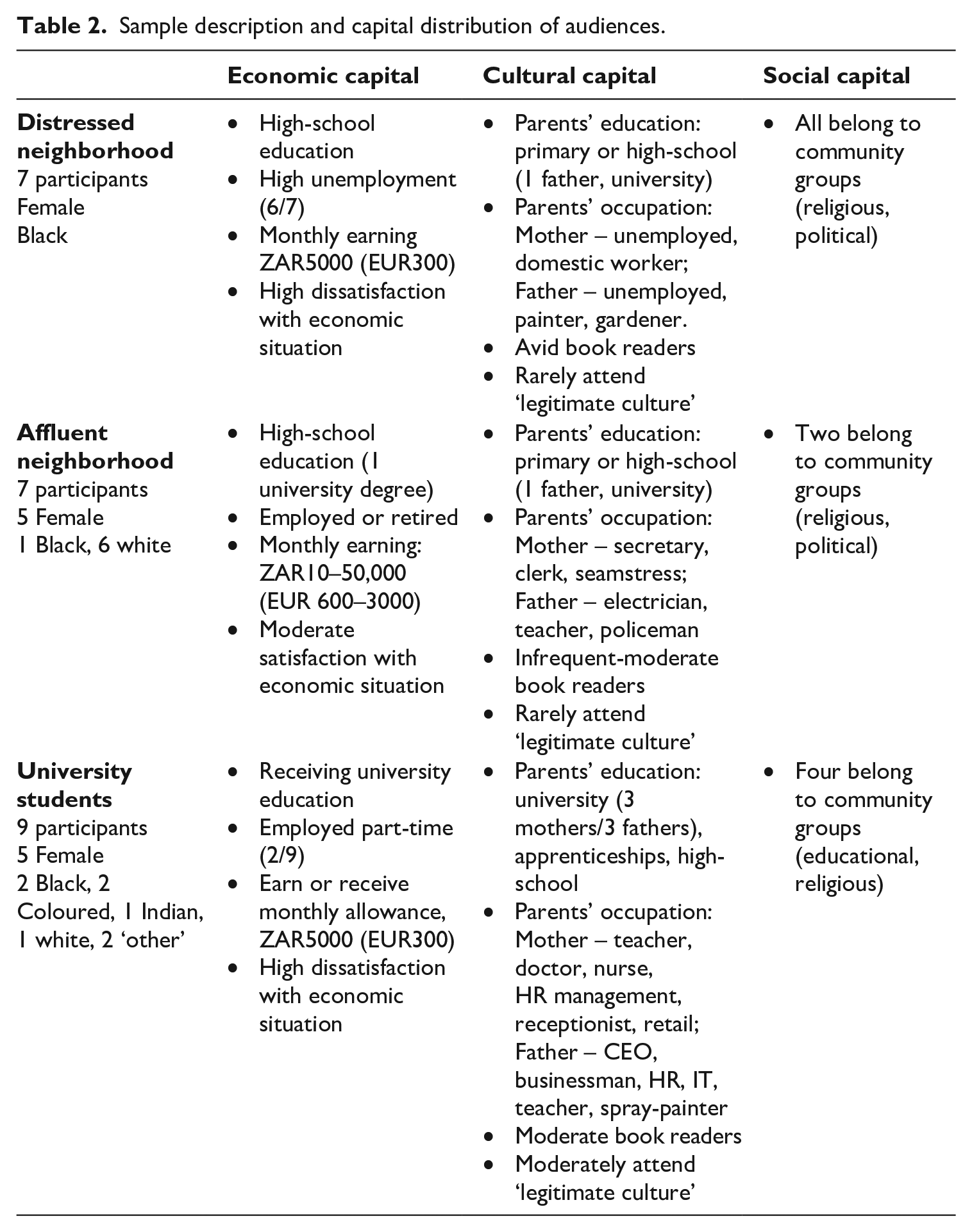
The first focus group came from a township (‘distressed neighborhood’) and was sampled through a woman who lives in the township and is employed as a domestic worker by a friend. Members of this group had low economic capital, low to moderate cultural capital, and high social capital. The second group was recruited by contacting ‘elite’ social clubs and associations in affluent neighborhood, and had high economic capital, low cultural capital, and low to moderate social capital. The third group consisted of university students and was mobilized through two local university colleagues in their seminars. Members had moderate economic capital, moderate cultural capital, moderate social capital. All participants were given a supermarket voucher valued at ZAR150 (EUR10) for participating. Audiences were asked to discuss how they imagine lifestyle journalists and their purpose in society, and what they expect from them and the content they produce. In the findings, focus groups are cited as ‘distressed’, ‘affluent’, and ‘university’. Data was analyzed in MAXQDA using principles of ‘informed grounded theory’ (Thornberg, 2012: 243), with open and axial coding to arrive at major concepts, while engaging with existing literature.
Results and discussion
The lifestyle journalists we interviewed named a range of roles identified by previous research (see, for example, Hanitzsch and Vos, 2018; Hanusch and Hanitzsch, 2013), however, our analysis also revealed two important differences: First, they expressed strong support for traditionally political journalism roles to a greater degree than in existing scholarship, and; second, we identified a role ‘to provide aspiration’, which has previously received less attention in scholarship. Importantly, the aspirational role also featured strongly among audience expectations.
The political in lifestyle journalism
In relation to our respondents’ stronger focus on political roles, we particularly identified roles in Hanitzsch and Vos’ (2018) advocative-radical and developmental-educative dimensions. One recurring theme was a need to celebrate and acknowledge Black culture, by promoting a ‘strong Black narrative’ and telling ‘authentic African stories’ (Thembile). This role challenges stereotypical narratives of Black culture as defined by the traditionally white-dominated media. Respondents also wanted to celebrate local and national identity through stories on innovation and design, by bringing ‘international attention to the country’ (Clive), ‘getting African designers out there’ (Khanyisile), and encouraging audiences to ‘champion local flavors’ and food (Kassy). There was also a desire to empower women by helping ‘dismantle the patriarchy’ (Heidi), making ‘South African women feel proud and safe’ (Sara), addressing the ‘socio-political connotations of fashion’ (Chloe), ‘disrupt beauty standards’ and raising ‘awareness around (. . .) Black transgender women’ (Heidi). As mediators, journalists hoped to bridge class differences, by creating a ‘sense that women, no matter where they are from are dealing with the same stuff’ (Sara). Journalists also sought to educate people by raising their awareness of ‘the sustainability of chocolate’ (Kassy) and the ‘drought in the cape’ (Maria).
South Africa’s context as an emerging democracy confronting societal challenges may explain the strong presence of political roles. In a country where overcoming racial tensions and economic inequality is on the agenda, it makes sense that lifestyle journalists also express developmental journalism values (Kanyegirire, 2006) in seeking to empower marginalized groups. Above all, these results point to an integration of journalism’s otherwise oppositional relationship with political and everyday life and the need to rethink it in future scholarship on journalistic roles. Rather than seeing the two as separate, as suggested in past theorizations (Hanitzsch and Vos, 2018), it appears they are intricately interwoven – the personal is political and vice versa.
Lifestyle journalists as cultural intermediaries: Negotiating roles amidst class inequality
Our journalists also identified several lifestyle roles found in other countries (Hanitzsch and Vos, 2018; Hanusch and Hanitzsch, 2013), but their interpretations reflected the local context. For example, as a guide and a mood-manager, journalists exposed audiences to beautiful content that allows them to escape the volatility of the outside world. As a friend, or even a therapist, journalists wanted to offer ‘psychological and emotional’ support in relation to ‘violence against women’ (Sara). As a service provider they offered audiences tips and ‘advice on how to spend their money’ (Rekopile).
Journalists were very aware of social class divisions among their audiences, which particularly highlights their position as cultural intermediaries (Hovden, 2008). Said one respondent: ‘I understand that in South Africa, my audiences will have less disposable income’ (Clive), because they live in ‘a very stratified space’ (Kabelo). This gave some journalists a ‘feeling of disjointedness’ (Clive) and ‘disconnect’ (Chloe), making cultural mediation all the more complex and fragmented.
Conscious of social class stratification, as a mindful marketer, journalists and editors had conflicting orientations. On the one hand, this role involved marketing and branding by ‘showing pieces of furniture that we want to get them to buy’ (Julia), treating content as profit-generator, offering audiences value for money, and considering advertisers needs: ‘We are compelled by sales to feature them otherwise they are going to cut their massive ad-spend with us’ (Patrick). Here journalists aim to expose the economic middle class and elite to opportunities for conspicuous consumption (Currid-Halkett et al., 2019) and the acquisition of material goods (Bourdieu, 1984). Journalists shape and match their audiences’ taste with goods (Smith Maguire, 2014). On the other hand, journalists were weary of promoting conspicuous consumption and encouraged mindful consumerism. Said one respondent: ‘People will overspend on technology as long as people can see it and they can use it as a social status symbol (. . .) and we are trying to discourage that kind of practice’ (Gary). Another added they wouldn’t promote the ‘debt is good’ message: ‘I don’t want to be selling people shit they don’t need’ (Rachel). Moderating conspicuous consumption reveals journalists’ position as ‘responsible’ cultural intermediaries (Hovden, 2008), concerned with both manipulating and discouraging the economy of cultural wants and needs (Smith Maguire, 2014). Journalists also seemed weary of promoting extrinsic aspiration and conspicuous consumption (Currid-Halkett et al., 2019) for their potentially negative effect on people’s wellbeing (Kasser and Ryan, 1996). This is particularly prevalent in societies with high levels of uncertainty (Chang and Arkin, 2002), such as South Africa, where poverty and unemployment are high, and recent entrants to the middle-class may feel particularly vulnerable (Burger et al., 2015). This tension between the pressure to promote and discourage aspirational consumption in a socio-economically volatile society, led journalists to feel a sense of role dissonance. Their dilemma also suggests that on the one hand, driven by commercial imperatives journalists have bought into the ‘illusio’ of exposing audiences with a ‘taste of luxury’ to goods that allow them to perform legitimate culture, but on the other hand they also actively challenge the ‘game’ by discouraging such consumption (Bourdieu, 1984).
Providing aspiration
In an important divergence from journalists in more prosperous economies, our respondents identified a role which has thus far received much less attention in scholarship. Journalists overwhelmingly spoke of the need to provide aspiration through stories and consumer goods that audiences could aspire toward. While this role is similar to ‘providing audiences with exemplars of desired lifestyles’ (Hanusch and Hanitzsch, 2013), it was explicitly connected to journalists’ awareness of social class distinctions among audiences, and was among the most dominant role conceptions: ‘You need to be able to always have aspirational audiences’ (James). Another respondent said: ‘Magazines are all about selling the dream, so it’s kind of how we differentiate the different markets’ (Khanyisile).
Journalists’ function as cultural intermediaries across the class spectrum became most evident in this role. Confirming our assumptions, journalists targeted inspiration and aspiration to specific class groups. Inspiration was about ‘provid[ing] affluent South Africans with ideas to go away for the weekend or for holiday’ (Justin), while aspiration was targeted at people ‘who aren’t necessarily rich (. . .) not in the luxury market, but (. . .) are working and they still have things that they want to acquire, but they are not kind of low LSM where they can’t afford certain things’ (Thembile). Inspiration was for the elite with sufficient capital volume to consume for pure pleasure rather than crude display (Bourdieu, 1984). Aspiration was targeted at the emerging and established economic middle-class (Burger et al., 2015) or the ‘nouveau riche’ with relative economic capital to expend on performing their lifestyle tastes (Bourdieu, 1984). However, ‘people from fully disadvantaged backgrounds whose key purpose is to put food on the table’ (Sibongile), meaning, the working class who have a ‘taste of necessity’ (Bourdieu, 1984) were not targeted.
Further, journalists sought to provide aspiration in two ways: (1) through consumerism and gradations of affordability which relates to lifestyle journalism’s domains of consumption and identity and (2) through psychological and emotional motivation and hope, which relates to the domain of emotion (Hanitzsch and Vos, 2018). However, both reflect Bourdieu’s sociology of social class and social psychology’s approach to aspiration as the pursuit of psychological growth (Ryan and Deci, 2000). They are interconnected – consumption, identity and emotion feed into each other – but can be delineated.
Aspiration through consumption was about ‘gear-porn’ and ‘showing products that are really aspirational, but out of most people’s reach’ (Gary). Respondents said South Africans had a ‘dreaming mentality (. . .) we are spending on shoes that we can’t afford’ (Kassy) and spoke of ‘people in the townships who probably have a better phone than I have (. . .) things like that allow them the visual status’ (Rick). An editor problematized this phenomenon: ‘Everybody aspires to a level of dignity and recognition in society (. . .) I think South Africans in general are struggling to maintain their sense of dignity and self-respect for that matter, and often these physical things are a manifestation of that’ (Gary). Aspiration here serves as a bridge between consumption and identity (Hanitzsch and Vos, 2018). Extrinsic aspirational goals that seek external validation (Kasser and Ryan, 1996) fulfilled through conspicuous consumption allows individuals to perform a desired identity (Goffman, 1959) and visually position themselves within a desired social class (Bourdieu, 1984). It also implies that working classes are more likely to engage in conspicuous consumption or materialism as a way of regaining control (Chang and Arkin, 2002). Aware of gradations of affordability, journalists expose audiences to luxury goods, affordable to some and aspirational to others. To the ‘nouveau riche’ they extend goods that allow them to ‘fake the quality in the sense that the wallpaper is still as beautiful but it’s only 500 Rand a meter’ (Rachel) and thus encourage this fraction to engage in ‘naïve exhibitionism’ (Bourdieu, 1984: 31) through the ‘illusory form of bluff or imitation’ (Bourdieu, 1984: 251).
Aspiration through motivation and hope involved allowing audiences ‘to see people like them who have achieved stuff, people who come from the same kind of neighborhoods they come from, the same kind of circumstances they come from, and have accomplished or reached certain stages of their life’s journey and their work journey’ (Kabelo). Here, the focus is placed on the psychological and emotional domain of lifestyle journalism (Hanitzsch and Vos, 2018) which relates to intrinsic aspirational goals such as self-growth (Kasser and Ryan, 1996). Aspiration was about projecting a hopeful, desirable future, however, again onto the middle-class fractions and not those with a ‘taste of necessity’ (Bourdieu, 1984). Another journalist said, ‘they [working-class audiences] might get inspired because everyone I’ve ever written about started from the bottom, but their bottom isn’t the same bottom as the fully disadvantaged group’ (Sibongile). This comment highlights South Africa’s nuanced class structure (Seeking and Nattrass, 2015), where the working-class spectrum ranges from the ‘fluid’ middle-class (Melber, 2017) including recent entrants (Burger et al., 2015), to those who have almost no economic capital (‘the fully disadvantaged’). So too, aspiration has a racial dimension. One respondent said their magazine was ‘definitely not aimed at a Black readership, because the view is always that the Black readership aspires to be like the white upper class’ (Patrick). In South Africa, the media target race and class groups strategically (Schieferdecker, 2017) thus reproducing class distinctions (Grabe, 1996).
The above discussion highlights two things. First, the capital composition and volume of our lifestyle journalists and editors confirms they are a cultural (and economic) middle class, and have a critical function as ‘responsible’ and somewhat conflicted cultural intermediaries (Hovden, 2008). Second, mediating the worlds of luxury and inequality suggests journalists, although elites, relate to disadvantaged audiences with compassion and empathy, and privileged audiences as a ‘distant mass’ to have pure pleasure imparted on (Hovden, 2008; see also Bourdieu, 1984). This divide is particularly evident in their orientation toward political roles, but also roles such as the mindful marketer and providing aspiration.
Audience expectations of lifestyle journalists
Our audiences’ expectations reflected several of the journalists’ role conceptions, namely, to be a service provider, offer escapism, and education. Providing a service and escapism was discussed by audiences across the social class spectrum, although reflecting somewhat classed dispositions. For example, middle and upper classes wanted recipes and advice on ‘how to revamp your kitchen’ (‘affluent’), while the working classes wanted ‘relationship advice’ and financial advice on ‘how to plan, how to budget’ (‘distressed’). Upper-class audiences found escape in ‘crosswords’, and gossip about the royal family (‘affluent’), while working-class audiences sought out updates on ‘what’s going to happen in soapies’ and the horoscope (‘distressed’). However, only working-class audiences expected ‘education’ in wanting to learn about issues of rape, mental health, and HIV/Aids. One participant said: ‘How do I deal with my sister when my sister comes back home and says “I’ve been raped” (. . .) how does a person come and say, “my daughter, my child, I’m HIV positive,” how do I talk, how do I deal with that person?’ (‘distressed’).
Reflecting past research on how class shapes news consumption (Lindell, 2018; Lindell and Sartoretto, 2018), the working-class audiences in this study consumed lifestyle content from print tabloid and local community newspapers, primarily because these are the cheapest or free, respectively. Middle- and upper-class audiences accessed lifestyle content in broadsheet newspapers (print and online) as well as social media platforms such as Twitter and YouTube – news sources that are more expensive and require internet access. While magazines speak to the ‘aspirations of the new Black elite’ (Wasserman, 2010: 35), tabloids do that for working-class audiences, generally neglected by the mainstream press (Steenveld and Strelitz, 2010; Wasserman, 2008). However, even the higher-class groups in our study remarked that magazines were unaffordable and rarely purchased them.
Congruent with journalists’ aspirational role, among the most-discussed audience expectation was aspiration. Audiences sought out aspiration in the form of both consumption and hope, but with two key differences. While aspiration through consumption spoke to audiences across the class spectrum, aspiration through motivation and hope spoke to working-class audiences. Importantly, aspiration through consumption spoke to working-class audiences, although this group is neglected by journalists.
Aspiration through consumption was about seeking ideas on ‘decorating your home’ and fashion (‘distressed’), or ‘find the trending stuff’ (‘affluent’). However, this form of aspiration highlighted gradations of affordability (Alexander et al., 2013) and fulfilling aspirational goals by ‘imitating’ (Bourdieu, 1984) a lifestyle through more affordable products. Such aspirational behaviour and thinking were evident not only among the ‘nouveau riche’ (Bourdieu, 1984) but audiences across the socio-economic spectrum, albeit exercised differently. Working-class groups talked about replicating more expensive styles by shopping at budget stores, factories, or sewing their own clothes, while more affluent groups talked about shopping at more affordable brand stores. Said one participant: ‘You look at the price tag and, well, it’s out of my price range, but maybe I can go to Mr. Price and get the knockoff’ (‘affluent’). However, reflecting the journalists’ mindful marketer role, audiences also had an uneasy relationship with extrinsic aspiration and conspicuous consumption. Audiences said such content ‘can give you a goal or direction’ (‘university’), but also ‘they put up people’s expectations of what they can buy’ (‘affluent’) and ‘you need to be cautious about that’ (‘university’) or you ‘run out of money’ (‘distressed’). While lifestyle journalism could be a motivator, it also invited discretion. Important to stress is that working-class audiences also rejected the appeal of extrinsic aspiration stressing the intrinsic importance of community and making the best out of what they had (Kasser and Ryan, 1996). They relativized its value, thus in some way ‘refusing what they are refused’ (Bourdieu, 1984: 471).
Consumption through motivation and hope spoke only to working-class audiences and was about seeking ‘true-life stories’ (‘distressed’) that exposed them to people who had achieved something, and could offer hope. While journalists targeted such content at the aspirational middle-class, this form of aspiration spoke to working-class audiences, and allowed them to recognize themselves in other people’s struggles and potential future successes. This hopefulness was best captured in their repetition of the words ‘one day. . .’, signifying their anticipation of a better future.
While we assumed aspiration would exist among economic middle-class audiences, in particular the so-called ‘nouveau riche’ (Bourdieu, 1984), it was evident across all class groups, including the working class. We discuss the implications of this and our other findings in the concluding section.
Conclusion
Exploring journalists’ role conceptions and audiences’ expectations in a country with greater socio-economic inequality has highlighted key contributions but also avenues for future research.
First, our study challenges existing conceptualizations of political and lifestyle journalism as binaries. Although we focused on a particular cultural, political, and socio-economic context, we show journalism’s relationship with political life and everyday life cannot be separated as neatly as past theorizations may have suggested (Hanitzsch and Vos, 2018). Beyond merely politicizing lifestyle journalism, scholarship needs to reconceptualize established ways of thinking about journalism and everyday life, thus expanding our understanding of journalism.
Second, we contribute to existing studies in showing that lifestyle journalists’ classed dispositions and awareness of socio-economic inequality in society, shape their distinct role conceptions and function as ‘responsible’ cultural intermediaries (Hovden, 2008). This is most evident in journalists’ role of being a mindful marketer of lifestyles and the role to provide aspiration, where journalists experience role dissonance (Biddle, 1979) in mediating two opposing worlds – luxury and inequality. Evident in their orientation to political roles and responsible marketing, journalists also appear divided, approaching their ‘suffering’ audiences with compassion, and privileged ones with detachment (Hovden, 2008; see also Bourdieu, 1984). Future studies could examine more closely these conflicting role orientations and oppositional approaches to audiences, in diverse contexts.
Third, we reveal that although working-class audiences are not targeted by lifestyle journalists, they engage in aspirational thinking, along with audiences in other class groups. What differed was the economic capital available to expend on performing the desired lifestyle. Contrary to the argument that working-class audiences who live under ‘conditions of scarcity’ have merely a ‘taste of necessity’ (Blasius and Friedrichs, 2008; Bourdieu, 1984), they demonstrate a ‘taste of aspiration’ with relative choice over how they enact it with limited economic capital. In other words, although their ‘conditions of existence’ (Bourdieu, 1984: 170) reflect those of necessity, their taste of aspiration sees them engage in creative ways of anticipating ‘being by seeming’ (Bourdieu, 1984: 253). By engaging in some theoretical eclecticism through social psychology scholarship (Kasser and Ryan, 1996), our study also raises new questions about how lifestyle journalism may be a positive (or negative) tool for audiences to seek out psychological growth through aspirational goals. It is crucial for future scholarship to examine more explicitly working-class audiences’ perceptions and expectations of lifestyle journalism. More broadly, studies could explore the role of aspiration in relation to social class, among journalists and audiences in other societies.
Finally, we show that employing focus groups to study audience expectations yields unexpected expectations that cannot be captured in as nuanced a way when relying on survey measures of existing journalistic role conceptions research (Loosen et al., 2020; Schmid and Loosen, 2015; Tandoc and Duffy, 2016; Tsfati et al., 2006; Vos et al., 2019). While such studies assess direct levels of congruence between expectations and role conceptions, they may also inadvertently limit the opportunity for expectations to emerge freely. Thus, future research exploring role conception–expectation (in)congruence should more readily rely on qualitative methodological approaches.
Our study has several limitations. Role conceptions only record how journalists discursively construct their societal roles, which may not reflect in actual content (Mellado and Van Dalen, 2017), something future studies could examine within lifestyle journalism. Considering that working-class audiences consume lifestyle journalism from community media and tabloids (Wasserman, 2010), future studies could focus more explicitly on journalists from these news media. Finally, we relied on three focus groups to capture broad social class groups in a country with a nuanced class structure. Accounting for how social class intersects with other modes of oppression/power (e.g. race) is also limited.
Footnotes
Acknowledgements
The authors would like to thank Herman Wasserman and colleagues at the University of Cape Town, and William Bird and colleagues at Media Monitoring Africa, Johannesburg, South Africa, for their assistance during fieldwork. Thank you also to Henrik Bødker for his valuable comments on a presentation of this study.
Funding
The author(s) disclosed receipt of the following financial support for the research, authorship, and/or publication of this article: This research was supported by funding from the Kurzfristige wissenschaftliche Auslandstipendien (KWA), Förderungsstipendien, and the Department of Communication at the University of Vienna.
