




Abstract
Transparency is seen as a panacea for a major problem facing journalism and journalists today, that is, the loss of trust and credibility. However, the scholarly literature has focused primarily on normative considerations, without providing much empirical data that could confirm what are widely assumed to be the positive effects of transparency. In this paper, I argue, first, that editorial texts, in their various manifestations, are the most potent of the various established means of displaying transparency for opening up the production of news item. However, I then draw on my linguistic, process-focused research on quoting and highlight challenges this process creates for the use of editorial texts in the pursuit of transparency. It turns out that conveying the essentials of decision-making that occurs during newswriting requires profound understanding and awareness of the interplay between modalities, co-texts and contexts of language use. Finally, implementing the norm of transparency has allegedly led to the transformation of a well-intentioned goal into an institutional myth, leading journalists – constrained, for example, by the mechanism of impression management – to disclose only socially acceptable practices. Therefore, I conclude by arguing for transdisciplinary research in which scholars research ‘on, for and with’ (Perrin, 2018) other stakeholders in order to bring about a fundamental change in the culture of transparency in journalism.
Introduction
Traditionally, the mass media have been in a powerful position to support public negotiation on socially relevant topics. However, just as the audience’s illusions about the mass media’s objectivity and impartiality have recently crumbled – and both concepts were rightly challenged in journalism studies long ago (e.g. Durham, 1998; Gauthier, 1993) – so too trust in these established players has declined (Edelman, 2019). Many journalism scholars as well as practitioners have argued that breaking this cycle and restoring a trusting relationship between the news media and their audience depends to a great extent on transparency about journalistic processes (e.g. Allen, 2008; Deuze, 2005; Fengler and Speck, 2019; Karlsson, 2010, 2011; Philips, 2010; Zamith, 2019).
Transparency has been suggested as the new ethical norm, ‘the new objectivity’ (Weinberger, 2009), which should be embraced in journalists’ daily work and implemented on the level of news items. It is included in numerous journalistic guidelines (Accountable Journalism, 2019; EthicNet, 2018), and the media industry has introduced features that inform the audience about producers and production and call on the audience to join in the discussion. Journalism scholars have then identified these transparency features as the means of manifesting transparency (Heikkilä et al., 2012; Karlsson, 2010, 2011; Meier and Reimer, 2011).
The rise of claims for transparency in journalism reflects the larger societal development of opening up institutions in the hope that this will encourage trust in them (e.g. Berger and Owetschkin, 2019). However, even if transparency has made businesses, public institutions and governments more trustworthy, the causality seems not to be so clear in the field of journalism: empirical studies, still small in number, have provided little (Chen et al., 2019; Curry and Stroud, 2019; Karlsson, Clerwall and Nord, 2014, 2017; Meier and Reimer, 2011) or no (Koliska, 2015; Roberts, 2007) support for this normative assumption, and the impact can even be the opposite (e.g. Smolkin, 2006), for example if the practices that are unveiled do not meet audience expectations (Manninen, 2020). In addition, the pressure for journalists to explain their work might overburden the journalist and, at the same time, bombard the audience with so much information that the essential will no longer stand out from the irrelevant (Allen, 2008; Vos and Craft, 2017).
Why does transparency not seem to work as expected? First of all, one must not rush to draw too far-reaching or definite conclusions, as it is methodologically difficult to verify the increase in trust: the pessimistic results might just reflect the fact that there are other circumstances that also have a major impact on people’s trust in journalism, rather than transparency having no significance. With this reservation in mind, Koliska’s comprehensive study (2015) presents some thought-provoking findings. To begin with, the audience members participating in the study stated quite unanimously that transparent news items (i.e. items that explain their production, including mistakes and possible biases) are trustworthy and that they would trust such items more than news items that are not transparent (Koliska, 2015: 242). However, when the same participants were shown news items that contained a range of transparency features, they had difficulty recognising them, nor could they distinguish between news items with different levels of transparency disclosure. It was clear that participants could not recognise the intended meanings of these varied transparency features as their trust perception, as already mentioned, neither increased nor decreased across different transparency conditions. (Koliska, 2015: 227–237)
All this tempts me to argue provocatively that the established transparency features, which I will introduce in the next section, seem almost like ‘rituals 1 of transparency’ (Karlsson, 2010: 535). By this I mean that they ‘signal audiences that journalists and news outlets embrace the new norm of transparency’ (Koliska, 2015: 202) by making the news item appear to be transparent without having to reveal much about the inner workings of their news organisation. Many of the journalists that Koliska interviewed considered transparency to be just ‘a promotional tool’ to draw in and engage the audience. In short, the transparency features in fact give little away as to how news items are produced and who makes them.
In this paper, I will both confirm this conclusion and further problematise the mismatch between the normative assumption and empirical reality. In order to do so, I first critically examine the established range of transparency features and argue that editorial texts are the most effective and most practical way of opening up and explaining journalistic work. Then, by taking quoting as the focus of my analysis, I highlight the challenges that even this seemingly simple process creates for the pursuit of transparency. Finally, the implementation of the norm of transparency has allegedly led to the transformation of a well-intentioned goal into an institutional myth, encouraging journalists to disclose only socially acceptable practices. Therefore, I will conclude by arguing for transdisciplinary research that could trigger a fundamental change in the culture of transparency in journalism.
Editorial texts: The most potent transparency feature
As mentioned above, the research on transparency has identified and labelled some elements present in today’s journalism as transparency features. These features have been classified in several ways.
Karlsson (2010) differentiated between disclosure transparency and participatory transparency, referring to the features that allow audiences to see the production process and to participate in it, respectively. Meier and Reimer (2011) set the dividing line differently, distinguishing between information background, such as sources, and the explaining of editorial decisions, and labelled them news item transparency and editorial transparency. Heikkilä et al. (2012: 43) emphasised that journalists should also reveal more about themselves, and proposed the categories actor transparency and production transparency, the former referring to ‘practices of media organisations providing contextual information about their ownership and ethical codes, as well as about the journalists producing the news stories.’ Similarly, Koliska (2015) divided transparency features into two groups, naming them production transparency and producer transparency.
Combining these categorisations, Table 1 introduces the aims and realisation of the established array of transparency features. The features are grouped according to their aim, whether it is to establish transparency in producer, production, or through participation.
The established range of transparency features.
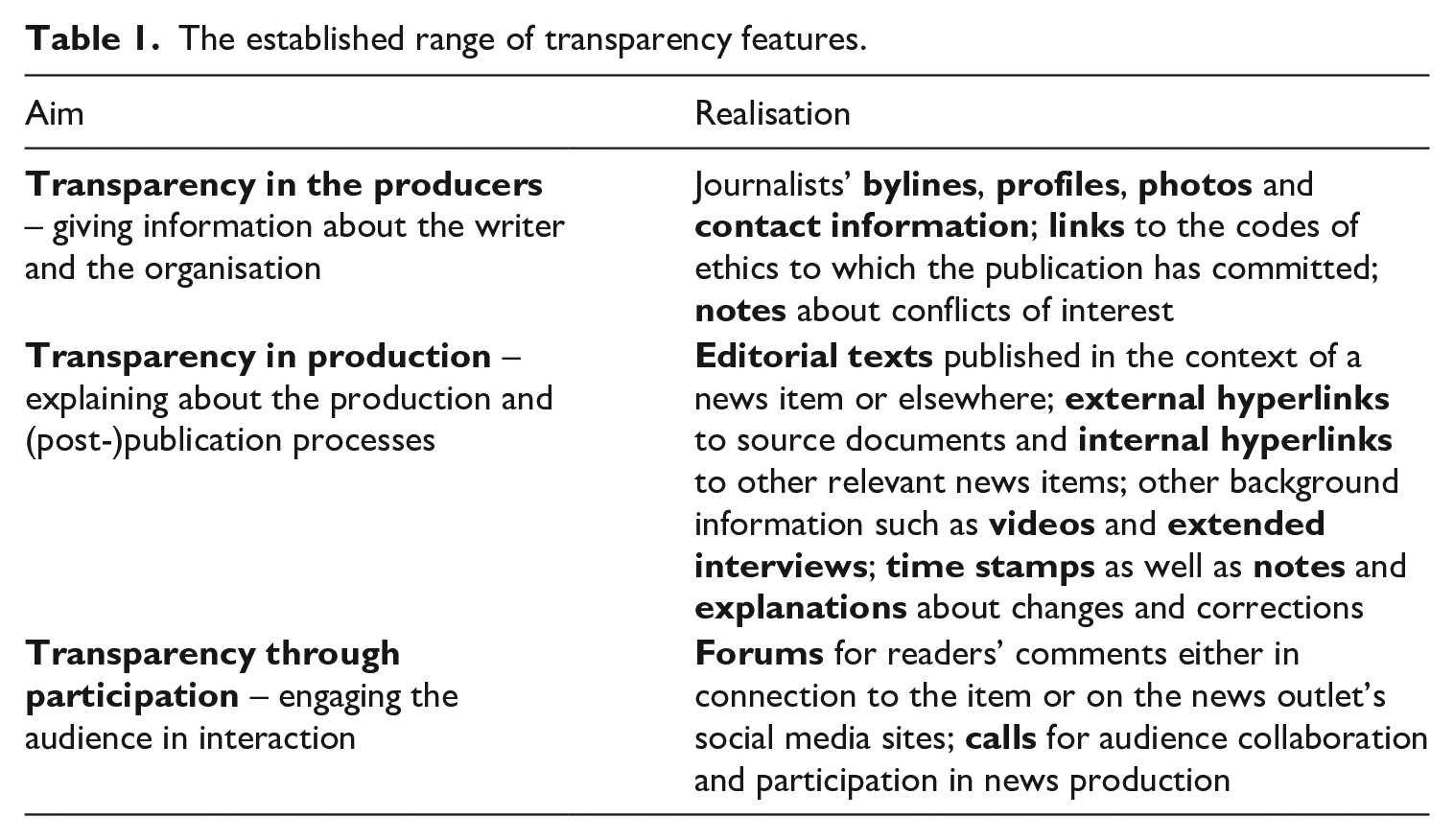
According to Koliska (2015), most of these features seem, actually, not to serve to enhance transparency. I will support this claim by raising three possible points in answer to the question, to what extent do these transparency features really help the audience understand news production processes? First, with regard to bios and notes about conflict of interest, let alone other producer-related features: these are mere trivialities. If one finds out, for example, that a journalist is in favour of a particular party or is interested in certain subjects, does that mean that this journalist is – possibly, or necessarily – biased in his or her reporting on this party or these subjects, or should one instead consider him or her to be an expert on these issues?
Second, discussion forums might provide the audience with information about journalistic production processes only when, and if, the journalists participate in the discussion. This rarely happens on a large scale, especially because of the uncivil and abusive nature of the commenting (e.g. Binns, 2012; Coe et al., 2014. However, see Wright et al., 2020). The audience’s comments only make it clear that there are other perspectives on the subject in the news; while they might be eye-opening and thought-provoking, they say nothing about the production process. Broader audience participation, on the other hand, for example, by inviting readers or viewers to collaborate and publish their contribution (which Koliska [2015] found totally non-existent in his large data), clashes with a fundamental principle of journalism, manifested in numerous ethical guidelines: that the power to make journalistic decisions must under no circumstances be surrendered to any party outside the editorial office.
Third, hyperlinks to source material, for example original text documents or uploaded videos and transcripts of interviews conducted, might allow the audience to check the facts and evaluate how the journalists have interpreted their sources. In practice, however, this can only be done – and has only been done – on a one-off basis: as a systematic procedure it would be far too laborious and technically demanding, and it would come into conflict with protecting one’s sources, for example, and the fact that everything said in an interview may not be publishable. Hyperlinks to previously published news items might provide the audience with material for contextualising the news coverage and with further reading; it will not give them any information about the production process.
Based on these critical considerations, I argue that the transparency features discussed above offer the audience barely any relevant information that would enable them to properly assess and evaluate, and thereby understand, journalistic production. In this light, it is also understandable that the members of the audience in Koliska’s study (2015) did not consider that these features increased transparency.
When all is said and done, editorial texts seem to be the most potent means among the vast array of established transparency features that can open up and explain journalistic decision-making. This can be done in different ways, of which I present two examples below. They are drawn from the Finnish newspaper Helsingin Sanomat (HS), the largest subscription newspaper in the Nordic countries.
In December 2017, Helsingin Sanomat featured an article on the Defence Force’s Intelligence Research Centre. The fact that the article was based on the leaking of classified documents sparked a heated debate that reverberated all the way to the Minister of Defence and the President, and later that day the paper published a column written by the editor that justified the publication of the article. ‘The most important task of the media is to monitor and control the activities of the authorities. HS is responsible for supplying its readers with sufficient truthful information about what is happening in society,’ the editor wrote. However, the storm grew stronger: in addition to the government, Helsingin Sanomat received much criticism from its readers. The following day, the editor-in-chief published an ‘Open letter to readers’ under the headline, ‘Article on the Intelligence Research Centre should have been better explained to readers’. The column and letter opened up the newspaper’s editorial decision-making and also admitted that the process should have been more transparent.
With the growing importance and increasing potential of social media, some platforms, especially Twitter, have been harnessed for editorial-like purposes. In January 2019, Jussi Pullinen, one of the news editors of Helsingin Sanomat, published a series of 18 tweets in real time when an online article dealing with the Finnish government’s behaviour towards asylum seekers was written, published and updated during that 1 day. The tweets explained what initiated the process; what was identified as the most newsworthy issue and therefore made into the headline, and why the headline was later changed; what sources the journalists used, and whom they contacted for an interview, with or without success; how the pictures were selected and why the main picture was later changed; and how the process was organised from the editor’s point of view, bearing in mind that other ongoing news events, lunch breaks, fixed newsroom meetings and urgent emails also had to be taken into account and dealt with.
In an interview about what prompted this series of behind-the-scenes tweets, Pullinen (2019, personal communication) referred to the concept of trust capital among the public and expressed some reservations about transparency.
If we tell people more about the decisions we make in our everyday work, then if there is a mistake or a crisis it is easier to handle as we can build on this ‘foundation’, However, such openness also involves risks: There are always things going on or there is information that the editorial office cannot disclose due, for example, to protecting one’s sources. Nothing like this happened during this series of tweets, but it could have done, and if it had and if it had then come to light later, the chain would have appeared to be deliberately skewed. So, the limits of openness should be stated, as things that cannot be made public are happening all the time.
In the research literature, editorial texts are most commonly presented as being in the format of a column. However, social media has a growing potential and can at best disclose the production process and create interaction between journalists and audience.
Quoting: A seemingly clear and simple phenomenon
In the previous section, editorial texts, especially editorial columns, were found to be the most promising of the current strategies for promoting transparency in journalism. However, since such columns are very limited in length, they cannot really handle more than one distinct sub-process or phenomenon at a time. In this section, I identify quotes and the process of making them, quoting, as one such distinctive and clearly definable phenomenon.
Quotes and quoting, among other sub-processes of newswriting, appear to be a necessary part of today’s news items. There are also two other factors that make them well suited as tools for my analysis. On the one hand, quotes in written journalism are easily identifiable by their formal markings (and the same is true on audio-visual platforms, too), and on the other hand, they are widely believed to be exact reproductions of original spoken utterances. The guidance given to journalists supports this latter belief: in guidebooks (e.g. Brooks et al., 2002; Goldstein, 2009) as well as in ethical guidelines (e.g. Accountable Journalism, 2019; EthicNet, 2018), the quote is mostly defined – if defined at all – as being as verbatim a rendering as possible of an original utterance. Even if the linguistic form of the utterance needs slight modifications, its meaning must remain the same. (These concepts are anything but simple, but in these guidebooks and guidelines they are regularly left unexplored.)
The guidance sounds clear and simple and, as such, describable in a shortish editorial column. However, recent production-oriented research on journalistic quoting in a written format (e.g. Havumetsä, 2020; Kuo, 2007; Matsushita, 2016, in press; Nylund, 2006; Satoh, 2001), to which my series of studies (Haapanen, 2011, 2016, 2017a, 2017b, 2017c, 2018, 2020; Haapanen and Perrin, 2019) makes a not inconsiderable contribution, has revealed that the relationship between original interview discourse 2 and the published quoted discourse is by no means so simple and simplistic. To begin with, there is no absolute correspondence between sound waves in the air and graphemes on paper or on screen, and several features of oral communication, such as prosody, do not have any apparent equivalence in writing – if any at all. This, however, only explains some of the modifications that quoted utterances undergo between being heard and being seen in print. Other modifications, which range from minor revisions to substantial alterations in terms of both linguistic form and situational meaning, can be explained by co-textual and contextual aspects that inevitably affect the quoting. I will elaborate on these observations in the next section and argue that it is hard for editorial texts to explain even a seemingly simple process like quoting.
Examining quoting from three perspectives
In this section, I will explain what journalists do when they are quoting from the point of view of language use. More specifically, I will focus on the process from three nested perspectives: modality, co-text, and context of language use. Based on the complexity they reveal, I will then problematise the idea that editorial texts can explain this process in an appropriate way.
In the first subsection, the focus is on quoting as the conversion of spoken utterances into written quotes. I will show that, due to the nature of the oral and written modalities, journalist have to make compromises over quotes. The second subsection then shows that even if the quote is reproduced as nearly word-for-word as possible, the change of text environment, the fact that the quoted discourse is extracted from its original co-text and positioned in a new co-text, inevitably affects the meaning of the quoted utterance. In the last subsection, I will identify the key phases of newswriting as four sub-processes of quoting. In this way, I can explore the process of newswriting quite thoroughly and show that discourse that is selected to be quoted is subject to modifications that reflect the publisher’s values and goals, the target audience’s interests as well as the journalist’s personal preferences.
The three perspectives are illustrated with case studies from my data. The parts of the corpora that I exploit here contain original journalistic interviews as well as the published articles and/or journalists’ retrospective verbalisations of the trains of thought they had while quoting (stimulated recall). All the data has been collected from Finnish newspapers between 2015 and 2018. The material was originally in Finnish but has been translated into English by the author. (For details about the data used in the first two subsections, see Haapanen, 2017a, and in the third subsection, see Haapanen, 2020. Some parts of the analyses have been reproduced from these publications without explicit cross-references.)
Modality: How spoken utterances are converted into written form
Converting spoken utterances into written quotes cannot be done mechanically but demands continuous problem-solving in the attempt to find the best possible way of doing it each and every time. This stems on the one hand from the above-mentioned fundamental incompatibility between the physical form of oral and written modalities, and on the other hand from the fact that the production of the oral modality differs from that of the written one, as explained below.
In oral language use, planning and speaking occur more or less simultaneously, and what is once said cannot be erased. These characteristics easily lead to disfluencies such as re-starts, self-repair and expletives. To some extent, these features can be reproduced in writing. This holds true especially of languages such as Finnish, where there is a direct one-to-one relationship between spelling and sound and where special pronunciation can be precisely reproduced in writing. However, while features such as self-repair are common and pass unnoticed in spoken interaction, in written formats they would be much more prominent and distinctive. In other words, hearers and readers – especially lay-people who are not used to seeing spoken language in written form – get a very different impression with strictly verbatim quoting (i.e. when exactly the same wording is produced in both the spoken and written contexts).
The first case study is an interview that a journalist conducted with the President of the Finnish Supreme Court and the article based on it. The excerpt below is from the transcript 3 of an interview. In this excerpt, Example 1, the president is explaining how Finland is a constitutional state.
Example 1: Transcript of an interview
the basic (0.5) structures of the rule of law are are (3.0) ha-have (1.0) stabilised and and taken root in a way that we (3.0) umm (0.5) we don’t have the kind of (0.5) like (0.5) serious serious (2.0) err structural err or functional (0.4) problems >that doesn’t mean that we don’t have problems but< but I mean in this this these basic matters the the basis of the rule of law is pretty well well established and and it’s (3.0) it’s also kind of wide (1.0) widely accepted
Based on this excerpt, the journalist formulated the following quote (Example 2):
Example 2: A quote based on the interview
‘The basic structures of the rule of law are well established and generally agreed to by all political movements’, she says.
To begin with, the fragmented shape of the interview answer (Example 1) reflects its spoken origin, but for the quote (Example 2) this has been cleaned up, so to speak. In other words, one could say that during the quoting process, pauses, word repetitions (this this) and hesitations (ha-have, umm, err) have been omitted and unfinished utterances completed (the basic [0.5] structures of the rule of law are are [3.0] ha-have [1.0] stabilised and and → The basic structures of the rule of law are well established and) so that the written quote follows the conventions of standard written language. Regardless of these formal modifications, however, we can see that the core meaning of the original utterance has been reproduced – although such an evaluation is fairly subjective.
In everyday contexts, individual languages are often treated as monoliths. In other words, we speak of the Finnish language – not languages – without making separate reference to the oral and written modalities. Such an understanding of language cannot fail to affect media literacy. What I mean by this is that one can imagine some advanced means of manifesting transparency, for example, by providing the audience with an audio or video recording about the course of an interview. Such means would allow the audience to compare utterances and quotes and make sure the quotes are verbatim. However, without educated awareness of the differences between oral and written language use, this could easily lead to misinterpretations. For example, paradoxically, it is not uncommon to achieve better results in terms of verbatimness by not quoting verbatim: while self-corrections, word repetitions and similar features in speech do not attract much attention or interfere with spoken communication, as exact as possible a transcript of the same stretches of oral discourse could give a false impression of the speaker, for example, by raising questions about his/her insecurity and poor delivery (Haapanen, 2017c. Cf. Matsushita, in press).
While the audience might be generally unaware of the differences between oral and written modalities, it is unlikely that a close examination of these differences is part of the training or expertise of many journalists, either. Furthermore, journalists craft numerous quotes every day, and when a practice becomes routine it can in the long run make journalists inattentive to what they actually do. ‘I was kind of stunned myself when I realised that these [quotes] have been edited this much’, one of the informants in the research told me in her retrospective verbalisation, when we were comparing the transcript of the journalistic interview she had conducted and the quotes in the article she had written.
Both unawareness of the subtle differences between modalities and the autopilot-like work routines – although they streamline work and help journalists to meet deadlines – could make it difficult for journalists to open up their work practices to their audience.
Co-text: How quoted discourse is embedded in a new text environment
News articles are not protocols of the course of the oral interviews on which they are based, but dramaturgically independent text entities. They follow so-called mass media logic (Altheide and Snow, 1979) to maintain readers’ interest by, for example, simplifying and polarising real-world phenomena. In order to achieve this, the journalist must cut and compress into a relatively short format a longish interview that might drift from one topic to another, by picking out only the most relevant issues and (re)organising them in a persuasive order. In short, pieces of information and stretches of discourse are often positioned in a new co-text, that is, the immediate text that precedes and follows them.
In terms of quoting, journalists often either choose or need to position the interviewees’ utterances in a different co-text from the one in which they were originally produced. This can change the meaning of the quoted discourse: as any single stretch of discourse receives its situated meaning in relation to its surrounding text (see, e.g. Linell, 1998), so also quotes, both their propositional meaning (i.e. their literal meaning) and their illocutionary force (i.e. the speaker’s intention or the act the speaker is performing), are always interpreted against their co-text (and naturally also in their broader contexts). The second data case, below, illustrates the issue of change of co-text.
In the spring of 2015, an alleged (and later substantiated) gang rape occurred in Helsinki, the capital of Finland. A prominent Finnish newspaper quoted a police officer in its online news article as follows:
Example 3: A quote attributed to a police officer
‘The woman was not severely injured physically in this incident.’
The quote was surrounded by a somewhat neutral co-text; in other words, the text preceding and following the quote did not strongly steer the interpretation of the quote in any particular direction.
The journalist who had interviewed the police officer and co-written the article told me, when I was carrying out my research, that the quoted utterance was a verbatim reproduction of the answer to his question, ‘Was the victim severely injured?’ The journalist also said that his intention was to quote this utterance in the article without bias; he told me that ‘I perceived the answer to be neutral, and did not try to make any interpretation of the answer’. However, because the answer was presented in the news item without the preceding question, the journalist’s initiating and interrogative role was obscured. This change of co-text, in turn, blurred the original situated meaning of this re-contextualised stretch of discourse and meant there was a danger of its being misunderstood – which in fact is what happened.
This inflammatory news article provoked hundreds of comments from readers. In many of them, the person who was commenting seized on this very quote and interpreted it – genuinely, or deliberately provocatively – as showing that the police officer understated the probable psychological injury suffered by the victim and thus diminished rape as a crime. Very few of the commentators challenged how the discussion between the police officer and the journalist had actually emerged in the interview – a fact that clearly evidences the media audience’s unawareness of industry-wide, often tacit, conventions, here the convention that I have called monologisation.
During monologisation, an interactive turn exchange between a journalist and an interviewee is simplified for the resulting article. This simplification mainly takes the form of obscuring the role of the journalist in the original spoken discourse. As a result, the quote appears to be unprompted, continuous utterance by the interviewee. As we saw above, this might have decisive consequences for the interpretation of the quote. (Haapanen, 2017b. For a similar phenomenon in television journalism, see Ekström, 2001; Kroon Lundell and Ekström, 2010.)
The question posed to the police officer – regardless of its simplicity – was anything but easy to answer. Let us speculate for a moment. What could the police officer really have replied to the question ‘Was the victim severely injured’? A negative answer – ‘No, she was not severely injured’ – was misleading because it neglected the possibility of psychological injury. On the other hand, neither would a positive answer have worked, because the policeman was not aware of any ‘severe’ injuries at this early stage of the criminal investigation. In this light, the police officer seemed to be doing his best in his comment on the issue, which he had not introduced himself but gave in answer to the question he was asked. Probably the journalist should have been more careful when formulating his question and/or re-co(n)textualising the answer in the article. However, this is easier said than done in a breaking news situation where no one yet has a clear overview of what has happened.
In terms of transparency, tacit conventions such as monologisation are tricky. To begin with, from the journalists’ point of view, these conventions are named and described as distinct entities only in the research literature, not in journalism textbooks or guidelines. Then, even if a journalist were to name and open up the basic principles of a phenomenon in one way or another, the audience could not know how this particular convention affected any particular news item and the details about it. For example, it is a basic feature of monologisation that the journalist’s questions are not presented in a news item, but a quote without a question preceding it in a news item does not necessarily mean that a question has been omitted; the quoted statement may not have been presented in answer to a question in the first place, but as the result of some other kind of interaction. By looking at the ready-made news item alone, this cannot be deduced.
Context: How the publisher’s goals and writer’s preferences are met
This section addresses the contextual resources that guide the process of quoting. In practice, the key question is how journalists conduct the ‘dynamic transfer-and-transformation’ (Linell, 1998: 154) of a stretch of discourse from the original context into the target one. (The notion of recontextualisation in linguistics, see Linell, 1998.) The original context is often an oral, one-to-one interview which has an explicit purpose – most obviously, to gather information for an article − as well as a fixed structure and pre-determined participant roles. The target context is a written text that needs to respect the publisher’s values and goals, the target audience’s interests, as well as the journalist’s personal preferences.
As already mentioned, I have identified the key phases in the process of newswriting – from the selection of a topic through to the surface realisation of a news item – as four sub-processes of quoting (Haapanen, 2020). This means that journalists
(1) decide on a topical issue to be addressed,
(2) identify groups of people who are linked to this issue,
(3) pick some people as representatives of these societal groups, and
(4) verbalise these people’s points of view, often by means of quoting, inter alia.
These sub-processes of quoting appear to be a prerequisite for the publication of today’s journalistic news items. In other words, a ‘proper’ piece of journalistic newswriting cannot merely name a topical issue and introduce competing societal groups, but it must explicitly identify some key representatives and embed a selection of their statements in the text.
Applying this holistic understanding of quoting to the third case study, which deals with the presidential election held in Finland in 2018, allows us to see how thoroughly various contextual resources affect the process of newswriting and the decision-making it involves.
Before presidential elections, candidates are the subject of numerous requests for an interview, and that was the case also before the 2018 presidential election. Not every candidate had time for every journalist. To overcome the inflexibility of the schedule of one of the candidates, three journalists working for the same media company but for different publications came up with the idea of conducting a joint interview with the candidate. Then, based on this 50-minute interview, each of the journalists would write their individual news item. The main topic of each of these three parallel articles was naturally the same, the candidate, but the sub-topics varied.
First of all, the journalists selected different sub-topics because they were writing for different publications and they each anticipated what their target audience would want to read. In other words, the publisher’s purpose and values and the interests of the audience affected the newswriting.
A retrospective verbalisation was conducted with one of these journalists, and he told the researcher (me) that he left out one prominent sub-topic because it was ‘a big issue and there wasn’t enough space for it, and it has already been discussed in another article’. This indicates that both the pre-determined parameters of the news item in the making and the earlier news coverage of the news outlet affected the newswriting. In addition, the journalist usually built his storylines by linking all the sub-topics together textually; here, he decided to disregard one sub-topic because he could not find ‘a good, smooth way to work it in with the others’. His personal writing preferences therefore also affected the newswriting.
When preparing for the interview, the journalist had learnt that this candidate had been inconsistent when talking about Twitter bots. The journalist wanted to point out this inconsistency in his article but, at the same time, he ‘wanted to seem to remain neutral and objective’. These are ideals of the industry by which journalists are often thought and required to act. The journalist therefore personalised some other people from the background material as representatives of opponents, who then presented their critical points of view as direct quotes in the article. Apart from the candidate, people in this societal group of opponents were the only people who were quoted in this article. They got their voice heard because their opinions happened to fit into the pre-outlined story the journalist wanted to tell his readers.
To sum up, the analysis revealed a number of contextual resources that affect newswriting: the ideals of the industry; the publisher’s values and purpose; the audience’s interests; the outlet’s earlier news coverage; the pre-determined parameters of the article; the journalist’s outline for the item; and his/her personal writing preferences. These contextual resources are often interrelated, and they are translated into grassroots journalistic decisions in a non-transparent way. For example, the publisher’s values are behind and influence all the editorial work; there is no need to discuss them daily – they are in the air that is breathed in the editorial office, so to speak. And while these values may sound simple when listed in an editorial stylebook, translating them into the practical processes of newswriting requires situational considerations which are affected by each journalist’s personal preferences – which, in turn, must be applied in such a way that they do not conflict with the publisher’s values.
Furthermore, the role of chance in the process of production should not be overlooked. At the very beginning of the production process, the limited availability of the candidate whom all the journalists wanted to interview was seen as most unfortunate. However, instead of letting it stand in their way, the journalist and his colleagues managed to overcome the difficulty by organising a joint interview. As research on the role of serendipity and creativity in journalism has pointed out, these aspects play a part throughout the cycle of journalistic production (e.g. Malmelin and Virta, 2019).
In the previous subsections, the focus was on the processes that stem from changes of modality and co-text when quoting. In this section, the broader analysis of quoting has revealed the network of contextual resources and shown that there are many choices to be made, seasoned with serendipity and creativity, when journalists engage in selecting, prioritising, constructing and mediating newsworthy circumstances. In the next section, this subtle interplay is discussed in relation to the legitimation of journalists’ professional role.
Discussion and conclusion: Towards change in the culture of transparency
The notion of transparency entered the journalism literature some two decades ago and has since been the subject of intense debate. Transparency is seen as a panacea for a major problem facing journalism and journalists today, that is, the loss of trust and credibility. In this paper, I have first argued that editorial texts are the most potent of the various established means of displaying transparency that are available for opening up production. I have then demonstrated that even quoting, which can be seen as a relatively simple process from the normative point of view, is too complex to be fully explained in the established types of editorial texts such as columns or tweets.
All-inclusiveness, however, would barely be an appropriate or feasible objective, and a partial explanation of the production process can also be valuable for the audience. The key, I would say, is that the audience should be exposed to the essential decisions that have taken place during each individual newswriting session and thus be convinced that there are acceptable and trustworthy reasons for the decision-making. As shown by my fine-grained analyses, whose added value is related to the linking of the dominance of product-bound text analysis in linguistics and interview-only methods in social sciences, conveying these essentials requires profound understanding and awareness of the subtle interplay between the surface activities of language use and the layered contexts of individuals, organisations, and societies. In the face of this complexity, it is no wonder that journalists themselves have sometimes called the process of news production ‘messy’ (Koliska, 2015; Smolkin, 2006) and ‘untidy’ (Wasserman, 2006) and therefore have been keen to leave it in its present obscurity.
Koliska argues (2015: Section 8.3) that the institutionalisation of transparency by the implementation of the norm of transparency has transformed a well-intentioned goal into an institutional myth. In pursuit of this idealisation of journalistic work, which is often disconnected from real practices, journalists and news organisations only want to disclose practices that are socially acceptable. In other words, transparency has become an increasingly important aspect of journalism that authenticates a claimed professional role, and revealing the real practices might threaten this legitimacy. Among other mechanisms, for example impression management (Goffman, 1959) would discourage journalists from telling their audience that they combined utterances from two or more different places in an interview in order to produce one single quote (Haapanen, 2017a: 23); that they reformulated their interviewees’ unshaped and meandering chit-chat into concise, unambiguous quotes (Haapanen, 2016: Section 4.5); or that on one occasion they had asked an interviewee, ‘Was it a hard situation to accept?’, received the answer ‘Yes’, and then written a direct quote in which the interviewee says, ‘It was hard to accept‘ (Haapanen, 2017b: 9–12).
Koliska goes on to suggest that the transparency of institutional processes might increase with a change in social discourse about what is considered acceptable or ideal behaviour for journalists.
Shifting the social discourse around transparency, journalism may need to start from the bottom up instead of through prescribed ethical norms that aim to foster a “culture of transparency.” I suggest that a “culture of transparency” must be established between journalists and their community to reaffirm and renegotiate particular views of the world through constant interactions and engagement in order to change social expectations and educate about the journalistic process. (Koliska, 2015: 269)
One way of achieving this could be live journalism (Eveleth, 2015). Since 2016, Helsingin Sanomat has produced events called Musta Laatikko (‘Black Box’), which have mostly been sold out. During each show, 8–10 staff writers and photographers get up onto a theatre stage and present edited and rehearsed speeches about previously untold pieces of journalism (which will later be published in the newspaper). In their speeches, they also throw light on the production process.
There is an ongoing, pioneering research project that brings together journalism scholars and staff members in order to explore the dynamics of Musta Laatikko. Their preliminary results seem to be promising. In an audience survey, firstly, the experience of listening to a live speech was described as much more powerful than consuming other kinds of journalistic material. Secondly, the shows have made people interested in topics that they previously considered to be of little interest or relevance to them. Thirdly and most importantly in terms of this paper, the audience has been delighted by how the show increases the transparency of journalism – although how they understood the concept of transparency when responding to the survey has still not been examined.
The format of Musta Laatikko itself will probably remain relatively exclusive and small-scale. However, the researchers are investigating the scalability of the insights of live journalism: how the editing process of live journalism and its transparency-boosting audience-centric logic can be applied to other forms of journalistic content production.
This paper has demonstrated that a focus on quoting (as central to most journalism and news production) is a good starting point for a discussion of the complexity of transparency. To conclude, I argue that the restoration of trust in journalism could benefit from transdisciplinary research in which scholars study ‘on, for and with’ (Perrin, 2018) other stakeholders in order to trigger a fundamental change in the culture of transparency in journalism. This would mean that everyone’s expectations were taken into account from the very beginning of the research project, including an audience position (and, in democracies, a media policy making position) in which transparency is expected and demanded from journalism. In practical terms, working co-operatively, while scholars rethink the concepts of transparency beyond normative presuppositions and continue investigating under what circumstances transparency could enhance trust, practitioners innovate and adopt new means of communicating the production process to the audience who, in turn, evaluate the outcome with a critical eye, arguing that establishing transparency is what legitimates public funding of journalism, a so-called public service.
Footnotes
Funding
The author received no financial support for the research, authorship, and/or publication of this article.
