




Abstract
A spate of terrorist attacks in the Muslim-majority world and the non-Muslim-majority West has sparked debates about an alleged double standard in Western news coverage of terrorism victims, with critics alleging Western news outlets are less concerned with Muslim victims than non-Muslim victims. This content analysis comparatively examined American newspaper framing of two terror attacks occurring in the non-Muslim West with three attacks occurring in the Muslim-majority world. Findings show American papers covered attacks in non-Muslim-majority societies prominently and framed them as acts of terrorism, and covered attacks in Muslim-majority societies scantily and framed them as internal conflicts.
A recent spate of terrorist attacks in the Muslim-majority world and the non-Muslim-majority West has sparked debates about alleged double standards in Western news coverage of victims, with some critics arguing that Western news outlets are less concerned with Muslim victims of tragedy than non-Muslim victims. For instance, informal analyses by Barnard (2016), Moghul (2016), and Johnson (2016) all contended that Western news media have allotted more attention to Western victims of terrorism than Muslim victims.
Although research has not examined this phenomenon specifically, scholars have looked at news attention to victims in the context of both race and geography. Studies have generally found that Western news outlets pay more attention to white, Western victims of natural and humanitarian disasters than brown, black, and non-Western victims (see Adams, 1986; Fair, 1993; Hanusch, 2008, 2012; Hawkins, 2002; Joye, 2009, 2010; Moeller, 1999; Simon, 1997; Van Belle, 2000), and that outlets also highlight white, Western casualties of war and conflict more than non-white victims (see Griffin and Lee, 1995; Herman and Chomsky, 1988; Youssef, 2009).
Some American journalists, however, have argued that allegations of double standards in terrorism coverage, in particular, are unfair and overly simplistic. For instance, Phillips (2015) posited that there is not a double standard per se, but that Western news reporting of terrorism simply follows traditional news values formulas. Specifically, Phillips argued that Western news outlets cover terrorist attacks occurring in Western countries more prominently because they are rare, unusual, and unexpected. Wrong (2014) offered up a similar defense of Western journalism, but her argument centered primarily on conflict reporting in Africa.
This study builds on the aforementioned research and, more specifically, on a study by el-Nawawy and Elmasry (2017) that examined The Washington Post coverage of five prominent terrorist attacks occurring in 2015 and 2016 against Muslim and non-Muslim victims, respectively. Like the study by el-Nawawy and Elmasry (2017), this research examines American newspaper coverage of attacks carried out in Paris, France (November 2015); Ankara, Turkey (October 2015 and March 2016); Maiduguri, Nigeria (January 2016); and Brussels, Belgium (March 2016). While the study by el-Nawawy and Elmasry (2017) was carried out qualitatively and on a single newspaper, however, the current research employs a quantitative content analysis of 10 elite American newspapers.
As the subsequent literature review will make clear, previous studies into the broad areas of research mentioned above have tended to focus on either humanitarian disasters or wars and have generally relied on small samples and qualitative techniques which do not produce statistically generalizable results. Although prior quantitative research on terrorism coverage has been carried out, it has focused on terrorism perpetrators, rather than victims, and has not gone beyond simple measures of news topic prominence. The current study is unique, then, not only because it employs a quantitative approach and a coding scheme that goes beyond news topic prominence, but also because it examines a broad sample of elite, agenda-setting American newspapers and focuses on coverage of diverse victims of Muslim-perpetrated terrorism. As a subsequent section of this article will explain, four of the five attacks under study were carried out, at least partly, by Muslim groups who claim an Islamic identity, while one of the attacks – the March 2016 Ankara attack – was committed by a secular group (the Kurdistan Freedom Falcons or TAK) whose members are nominally Muslim Kurds (Brandon, 2006). This article’s comparative focus on victims of Muslim-perpetrated terror is important because it is precisely this issue that is at the heart of many current debates.
This article, then, begins forth from the premises that it is important to systematically quantify apparent disparities in elite American newspaper coverage of global terrorism victims, and also to go beyond notions of prominence to consider other aspects of victim humanization. The study’s focus on attacks taking place in predominantly white, black, Muslim, non-Muslim, Western, and non-Western societies, respectively, allows it to simultaneously consider the impact of race, religion, and geography on American news coverage patterns. Importantly, all five selected attacks were carried out by Muslims, a fact which helps naturally control for a possible confounding variable – the religious identity of the attacker(s). The study’s basic purpose is to determine how 10 elite, geographically dispersed American dailies framed Muslim victims of terrorism in Ankara, black, Muslim victims of terror in Maiduguri, and predominantly white, non-Muslim victims of terrorism in Paris and Brussels.
Background on studied terrorist attacks
This study examines American newspaper framing of five terror attacks that took place in four cities – Ankara, Turkey; Paris, France; Maiduguri, Nigeria; and Brussels, Belgium – within the span of 6 months near the end of 2015 and beginning of 2016. While attacks in Ankara and Maiduguri targeted mainly Muslim victims, attacks in Paris and Brussels were perpetrated against mostly non-Muslims. All five attacks were carried out by Muslims.
The Ankara attacks occurred on 10 October 2015 and 13 March 2016, respectively. In the October attack, two men detonated bombs outside the Ankara central railway station during a pro-Kurdish People’s Democratic Party (HDP) peace rally. The attack killed more than 95 people and injured approximately 250 (Melvin, 2015). While no party claimed responsibility, the Turkish government blamed the Islamic State of Iraq and the Levant (ISIL) and Kurdish militants affiliated with the secular Kurdistan Workers’ Party (PKK; ‘Peace rally bombing’, 2015). The Turkish state considers the PKK to be a terrorist organization, and both sides have been involved in violent confrontation since the 1980s (Yeginsu and Arango, 2015). The March 13, 2016 attack occurred when car bombs were detonated in Güvenpark, a central transport and commerce area in Ankara. Thirty-seven people were killed and 125 injured. The Kurdistan Freedom Falcons (TAK), which has links to the PKK, issued a statement claiming responsibility for the attack (Letsch, 2016). Although the TAK’s membership base comprises Kurds who are nominally Muslim, the group’s ideology is secular (Brandon, 2006).
The Maiduguri, Nigeria attack took place on January 30, 2016, when militants belonging to the extremist group Boko Haram released gunfire, detonated bombs and set fire to the Nigerian village of Dalori, just northeast of Maiduguri. About 90 people were killed (Isuwa and Searcey, 2016). Boko Haram joined the so-called Islamic State of West Africa and has been launching attacks in northeastern Nigeria since 2009 (‘Boko Haram blamed for deadly attack on Nigeria village’, 2016).
The Paris, France attack occurred on November 13, 2015, when eight ISIL members carried out six coordinated attacks in the northern and central parts of Paris, France, killing about 130 people and injuring about 400. The attacks hit a major stadium, a concert hall, several restaurants, and bars (Walt, 2015). The Brussels, Belgium attack was carried out on March 22, 2016 by five ISIL-affiliated men who carried out multiple, coordinated attacks. More than 30 people were killed (‘Brussels explosions’, 2016; Rankin and Henley, 2016).
Literature review
To date, no studies have employed quantitative techniques to compare American coverage of Muslim and non-Muslim victims of Muslim-perpetrated terrorism. However, a good deal of research has been devoted to related areas – coverage of conflict and war (including conflicts in Muslim countries), and reporting of natural and humanitarian disasters, including in Muslim countries.
Western media coverage of victims of conflict and war
A series of studies have evaluated Western, particularly Anglo-American, media framing of violent conflicts. General findings point to marginalized and stereotypical coverage patterns in Western reporting of conflicts taking place in non-Western, predominantly Muslim, and black or brown countries. Research also suggests that victims of these conflicts are often dehumanized and othered by Western media. Although these studies employ qualitative methods and do not focus primarily on terrorism, their focus on Western reportage of Muslim victims of violence makes them relevant to the current research.
A pair of relatively recent studies by Patrick (2016) and Gruley and Duvall (2012) analyzed Western news coverage of violent conflicts in Africa, with results pointing to both a general neglect of the issues and stereotypical reporting patterns. Patrick’s (2016) analysis of American and British newspaper coverage of the Bosnian conflict (1992–1995) and Rwandan genocide (1994) showed that reportage of Rwanda was both comparatively scant and grounded in stereotypes about Africa. Gruley and Duvall’s (2012) examination of The New York Times and The Washington Post coverage of the war in Darfur, Sudan suggested that coverage lacked contextual background on the origins of the conflict, and highlighted ‘the stereotype of tribal conflict in Africa’ (p. 38).
Several other qualitative studies have assessed news coverage of conflicts and violence involving Muslims, including wars in Muslim-majority countries (see Griffin and Lee, 1995; Steuter and Wills, 2009; Yang, 2008; Youssef, 2009). Collectively, this research lends insights into how Western news outlets talk about Muslim and non-Muslim victims and perpetrators of war violence.
A study of the framing of the wars in Afghanistan and Iraq by Canadian newspapers found that coverage tended to dehumanize Muslim victims and characterize them ‘as animals, insects and diseases’ (Steuter and Wills, 2009: 9). Analyses by Yang (2008), Griffin and Lee (1995), and Youssef (2009), meanwhile, focused on 2003 Iraq War coverage in American newspapers. Yang’s (2008) research suggested that The New York Times and The Washington Post framing of the war was conflict-driven, revolving around issues such as weapons of mass destruction and daily combat. The studies by Griffin and Lee (1995) and Youssef (2009) both posited that American newspapers tended to neglect Iraqi casualties of war.
Other recent research has focused on acts of terrorism carried out by Muslims in the West (Kearns et al., 2018; Powell, 2011, 2018). Although studies by Powell (2011, 2018) and Kearns et al. (2018) focused on perpetrators, rather than victims, of terrorism, they offer insights relevant to the current research, in particular because they use comparative approaches and seem to provide evidence of alleged double standards in American reporting.
Powell’s research comparatively examined American news coverage of terrorist attacks carried out by Muslim and non-Muslims. Results suggested that American news outlets discursively linked Muslim perpetrators with Islam, fanaticism, evil, and global terrorist networks, while discursively constructing non-Muslim perpetrators as mentally ill, irrational, and products of America’s gun problem. A study by Kearns et al. (2018) provides perhaps the most robust quantitative evidence of a double standard in American news treatment of Muslim and non-Muslim violent perpetrators. The research found that American news outlets allotted significantly more coverage to terror attacks committed by Muslims than attacks carried out by non-Muslims.
Western media coverage of victims of humanitarian disaster
A number of studies have focused on natural and humanitarian disasters, with most studies suggesting that Western news tends to allocate insufficient focus to death and tragedy in the Global South, something which scholars argue devalues non-Western human life. For example, a number of studies have found that, in the context of disaster news, American media privilege American and other Western lives, while ignoring or downplaying deaths in the Global South. Although these studies do not focus on terrorism or violent conflict, they are relevant to the current research because they seem to point to a double standard in news treatment of different kinds of victims.
Moeller (1999) argued that ‘compassion fatigue’ among American news consumers and a series of structural constraints on news organizations have led to a systematic decrease in foreign news in general, and news about foreign disasters and suffering in particular. Moeller (1999) cited an apparent American journalism truism: ‘one dead fireman in Brooklyn is worth five English bobbies, who are worth 50 Arabs, who are worth 500 Africans’ (p. 22). Hawkins (2002) affirmed this, arguing that, ‘if anything, it is an understatement’ (p. 230).
One of the earliest empirical assessments of this phenomenon was carried out by Adams (1986), who analyzed American broadcast news coverage of earthquakes in six countries. The study found that earthquakes occurring in geographically and culturally distant locations received scant American news attention, despite very large casualty figures. Meanwhile, results showed that Western European earthquakes were covered prominently.
Studies by Van Belle (2000), Simon (1997), Joye (2009, 2010), and CARMA (2006) provide further support for the thesis that Western news media tend to privilege Western lives over others. Van Belle’s (2000) analysis concluded that foreign disasters geographically distant from the United States are generally ignored by American news media, while Simon (1997) found that geographically distant earthquakes received less prominent coverage in American media than earthquakes in countries closer to the United States. Joye’s (2009) study suggests that disaster sufferers in the United States and Australia were privileged on Western broadcast channels, while victims in Indonesia and Pakistan were marginalized. Another study by Joye (2010) suggested that Western news coverage of the 2003 SARS outbreak lacked empathy, identification and compassion; presented information in an ‘us’ versus ‘them’ dichotomy; and helped ‘reproduce a Euro-American centered world order’ (p. 586). Meanwhile, a CARMA (2006) study examined American media portrayals of six geographically diverse disasters. Hurricane Katrina, the only studied disaster taking place in the United States, received ‘by far the highest volume of coverage’ (p. 11).
Other research suggests that non-Western victims of crises are given fair attention by Western news media, but covered stereotypically. For example, Singer et al. (1991) found that while disasters occurring in the United States are given ‘disproportionate attention in the U.S. press’ (p. 48), disasters in other parts of the world, including the Global South, are also covered prominently, particularly when casualty figures are high. Campbell (2012) posited, however, that Western images of African famine are stereotypical and sensational, working to exoticize Africans.
Framing theory
Framing is a theoretical approach for deciphering meanings, interpretations, connotations, and implications in a text. Framing is ‘the process of culling a few elements of perceived reality and assembling a narrative that highlights connections among them to promote a particular interpretation’ (Entman, 2007: 164).
Frames that are adopted and projected through news media can increase the prominence of certain events in ways that may impact audience perceptions and interpretations (Entman, 1993, 2007). Frames can be helpful in simplifying complex information and events (Entman, 1993). Frames make information ‘accessible to lay audiences because they play to existing cognitive schemas’ (Scheufele and Tewksbury, 2007: 12). Frames can be categorized as ‘issue-specific’ frames, which tend to focus on the particularities of certain topics, or ‘generic’ frames, which deal with broad, wide-ranging contexts (De Vreese, 2005: 55).
A news frame usually has distinguishable, identifiable, observable, and recognizable elements or framing devices, such as headlines, phrases, images, keywords, sourcing, leads, and metaphors (De Vreese, 2005). The ‘lexical choices of words or labels’ can impact audience interpretations (Pan and Kosicki, 1993: 62).
The effects of news framing can vary depending on the nature of the events being framed and the receivers’ knowledge level regarding these events (Scheufele and Tewksbury, 2007). A frame’s effectiveness is also determined by how persuasive it is and whether it faces competing or alternative frames (Chong and Druckman, 2007). The success of any news frame in affecting audience evaluation ‘increases . . . when it comes from a credible source, resonates with consensus values, and does not contradict strongly held prior beliefs’ (Chong and Druckman, 2007: 104). The prominence of frames is enhanced when they are associated with popular cultural symbols. Creating mental associations ‘is a product of the interaction of texts and receivers’ (Entman, 1993: 53).
Several factors play a critical role in how journalists frame news stories, including ‘social norms and values, organizational pressures and constraints, pressures of interest groups, journalistic routines, and ideological or political orientations of journalists’ (Scheufele, 1999: 109). All of these factors affect the ‘decision frame’ or ‘the decision-maker’s conception of the acts, outcomes, and contingencies associated with a particular [framing] choice’ (Tversky and Kahneman, 2013: 453).
Researchers of media discourse can determine news frames inductively by generating them from media content, or deductively by constructing them prior to the analysis (De Vreese, 2005).
Hypotheses and research questions
Several hypotheses and research questions seek to formally compare American newspaper coverage of the Paris and Brussels attacks with coverage of the Ankara and Maiduguri attacks.
Based on prior literature indicating that Western victims receive more Western news attention than non-Western victims, the first hypothesis predicts that the Paris and Brussels attacks will generate more news coverage than the Ankara and Maiduguri attacks.
This hypothesis is parsed out with four sub-hypotheses, which predict that the Paris and Brussels attacks will generate more articles, longer reports, more prominently placed stories, and more photographs than the Ankara and Maiduguri attacks.
Based on prior research suggesting that violent attacks can be framed as either acts of terrorism or internal conflicts (Norris et al., 2003; Jorndrup, 2016; Lewis and Reese, 2009), the second hypothesis predicts that the Paris and Brussels attacks will be more likely to be framed as acts of terrorism than the Ankara and Maiduguri attacks, which the hypothesis predicts will be more likely to be framed as internal conflicts.
The third and fourth hypotheses are grounded in past literature suggesting that Western news is more likely to humanize and highlight Western victims. These hypotheses predict that news reports will include more personal details about victims of the Paris and Brussels attacks than victims of the Ankara and Maiduguri attacks, and that reports will more often quote victims, family members, and civilian eyewitnesses of the Paris and Brussels attacks.
Three research questions address how often the religious identity of attackers (Islam) was mentioned in news reports, the extent to which news articles linked attacks with the US-led war on terrorism, and how likely reports were to quote US officials.
Method
This study used content analysis to examine how elite American newspapers framed Muslim and non-Muslim terrorism victims. Content analysis is a quantitative research technique that enables researchers to systematically examine large quantities of content.
Following el-Nawawy and Elmasry (2017), five terrorist attacks – three that targeted primarily Muslim victims, and two which targeted primarily non-Muslim victims – were selected for analysis. All five attacks met textbook definitions of terrorism and were carried out by Muslim perpetrators within a 6-month span in late 2015 and early 2016. The selected attacks were the 10 October 2015 Ankara, Turkey, attack perpetrated by ISIL; the 13 November 2015 attack in Paris, France, carried out by ISIL-affiliated youth; the 30 January 2016 attack in Maiduguri, Nigeria, committed by Boko Haram; the 13 March 2016 attack in Ankara, Turkey, carried out by the Kurdistan Freedom Hawks (TAK); and the 22 March 2016 attack in Brussels, Belgium, perpetrated by ISIL.
Ten prominent American daily newspapers were selected for analysis based on circulation figures and geographic distribution. The website Statista (2018) was used to generate circulation figures. The original plan was to select the 10 highest circulating American daily papers. However, this strategy would not have yielded meaningful geographic diversity, especially because several of the top-circulating papers are based in New York. Some papers, then, were eliminated, and high-circulating papers representing other geographic regions – the Midwest, the South, and the Pacific Northwest – were selected. The 10 papers selected for study were The Chicago Tribune, The Cleveland Plain-Dealer, The Denver Post, The Houston Chronicle, The Minneapolis Star-Tribune, The Los Angeles Times, The New York Times, the USA Today, The Wall Street Journal, and The Washington Post. These widely circulated, geographically dispersed newspapers likely contribute to shaping public opinion on a variety of issues, including matters concerning Islam, Muslims, and terrorism.
For all 10 studied newspapers, we aimed to select the 5 days/editions published immediately after each of the five attacks. This would have yielded a total of 250 issues (10 × 5 × 5 = 250), but the USA Today does not publish Saturday and Sunday editions, a fact that dictated that we were not always able to find five consecutive days of coverage following attacks. Ultimately, then, we searched through 19 editions of the USA Today, and 25 issues of each of the other nine studied newspapers, for a total of 244 editions searched. Our strategy involved looking through the main news section of all newspaper issues to search for news and opinion articles about the attacks. This yielded a total of 713 articles. This total included 400 articles on the Paris attack, 241 articles on the Brussels attack, 37 articles on the first Ankara attack, 25 articles on the second Ankara attack, and 10 articles on the Maiduguri attack. An undergraduate research assistant used the Library of Congress’ newspaper archives to retrieve and collect all studied newspaper editions. The overwhelming majority of coded articles (297, 89.2%) were news articles, while just 36 (10.8%) were editorials.
We coded all found articles on both of the Ankara attacks and the Maiduguri attack. To keep the study manageable, we used systematic random sampling to select Paris and Brussels articles for final analysis. For Paris, we selected every third article, and for Brussels, we selected every other article. The final coded sample, then, included a total of 333 articles – 139 for Paris, 122 for Brussels, 37 for the first Ankara attack, 25 for the second Ankara attack, and 10 for the Maiduguri attack.
The coding scheme sought to measure prominence, humanization, dominant frame, links to the West, and sourcing. Several items measured prominence, including article placement, article length (in words), and number of photographs. Framing was dichotomously coded as either ‘terrorism’ or ‘internal conflict’. Coders were instructed to code as ‘terrorism’ any article that described the covered attack as an act of wanton aggression without apparent justification, and as ‘internal conflict’ any article that primarily discussed a political conflict that may have motivated attackers. Humanization was measured by counting the number of personal details – name, age, occupation, charitable/volunteer/community work, relationship status, nationality, and number of children – mentioned about victims. The coding scheme also assessed the extent to which attacks were linked to other attacks carried out in the West, and the total number of quotes allotted to US government officials, and victims, family members, friends, or civilian eyewitnesses. The coding scheme did not account specifically for newswire material – which is often reproduced in daily papers across the United States – because duplicated newswire material still broadly represents American news discourse.
Two graduate students served as coders. Training on the coding scheme was carried out over a period of several weeks in the spring of 2018. Intercoder reliability testing was carried out on a total of 12% of the sample (N = 39). Scott’s pi was calculated for all nominal level variables. For ratio level variables, Krippendorf’s alpha was calculated. All reliability calculations were completed with ReCal, an online tool developed by Freelon (2010). Reliability figures ranged from very good to perfect. Scott’s pi figures for nominal level variables ranged from .85 to 1.0, and Krippendorf’s alpha figures for ratio level variables ranged from .91 to 1.0.
Results
The first hypothesis predicted that terrorist attacks occurring in the non-Muslim, Western societies of Paris and Brussels would receive more prominent news coverage in the 10 studied American newspapers than attacks taking place in the Muslim-majority societies of Ankara and Maiduguri. This hypothesis included four sub-hypotheses, which predicted that the Paris and Brussels attacks would generate more news articles, be longer and placed more prominently, and include more photographs than attacks in Ankara and Maiduguri. Results suggest strong support for all four sub-hypotheses.
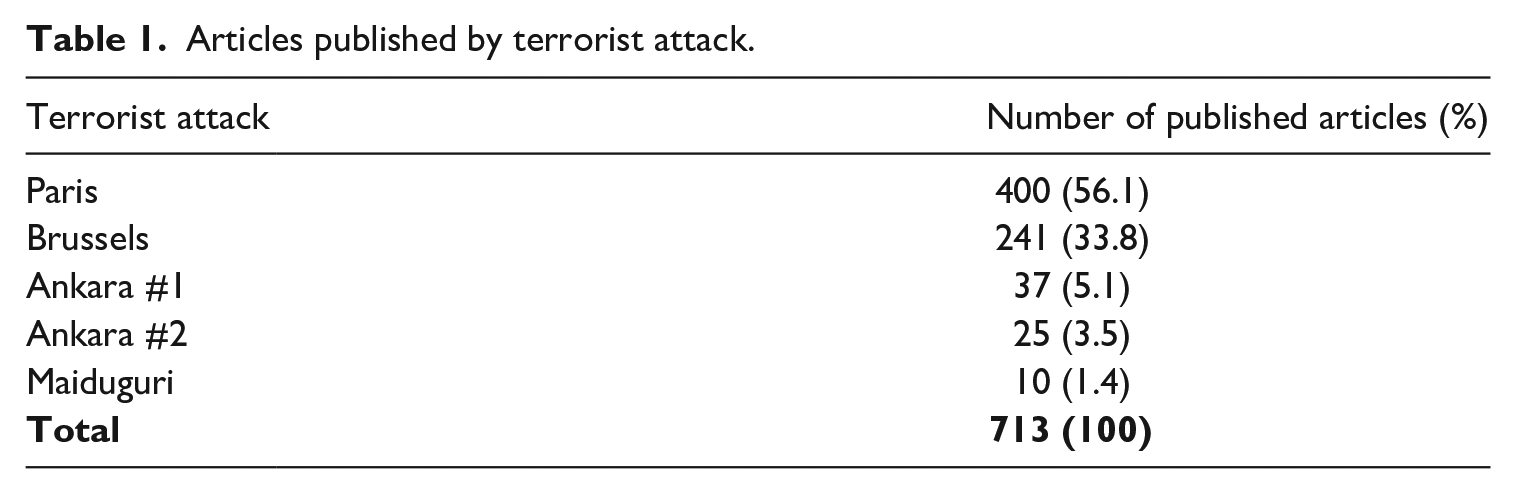
In all, the 10 studied newspapers published 713 articles about the examined attacks in the 5 days of coverage following the events. The overwhelming majority of these articles were written about the Paris (N = 400) and Brussels (N = 241) attacks. Only 72 articles were published about the three events occurring in Muslim-majority societies. Of these, the first Ankara attack generated the most articles (N = 37), followed by the second Ankara attack (N = 25), and the Maiduguri attack (N = 10). H1a was supported. These results are displayed in Table 1.
Articles published by terrorist attack.
H1b was also supported. Articles about the Paris and Brussels attacks were longer than articles covering attacks in Ankara and Maiduguri. On average, articles about Paris and Brussels featured more words (M = 749.10, SD = 367.57) than articles about Muslim-majority societies (M = 454.00, SD = 312.77). An independent samples t-test showed these differences to be statistically significant at the .05 level (t(331) = 6.2, p < .001). These results are displayed in Table 2.
Article word count by terrorist attack type.
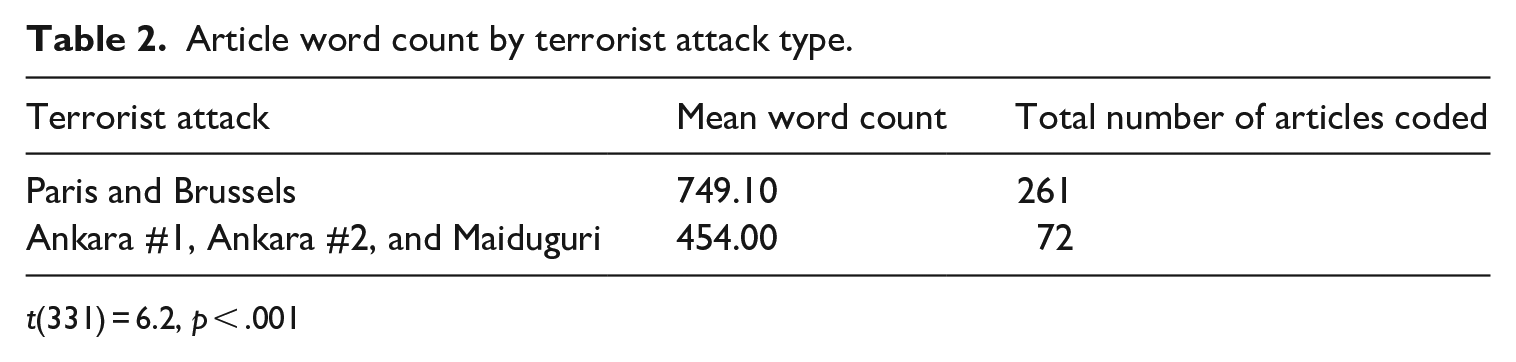
t(331) = 6.2, p < .001
H1c was also supported. Articles about the Paris and Brussels attacks were significantly more likely to appear on the front-page of newspapers than articles about the Ankara and Maiduguri attacks. In all, 35 percent of Paris and Brussels articles appeared on the front-page, compared with just 14 percent of Ankara and Maiduguri articles. A chi-square test showed these differences to be statistically significant at the .05 level ((χ2 (df = 1, N = 333) = 12.1, p < .001). These results are displayed in Table 3.
Article placement.
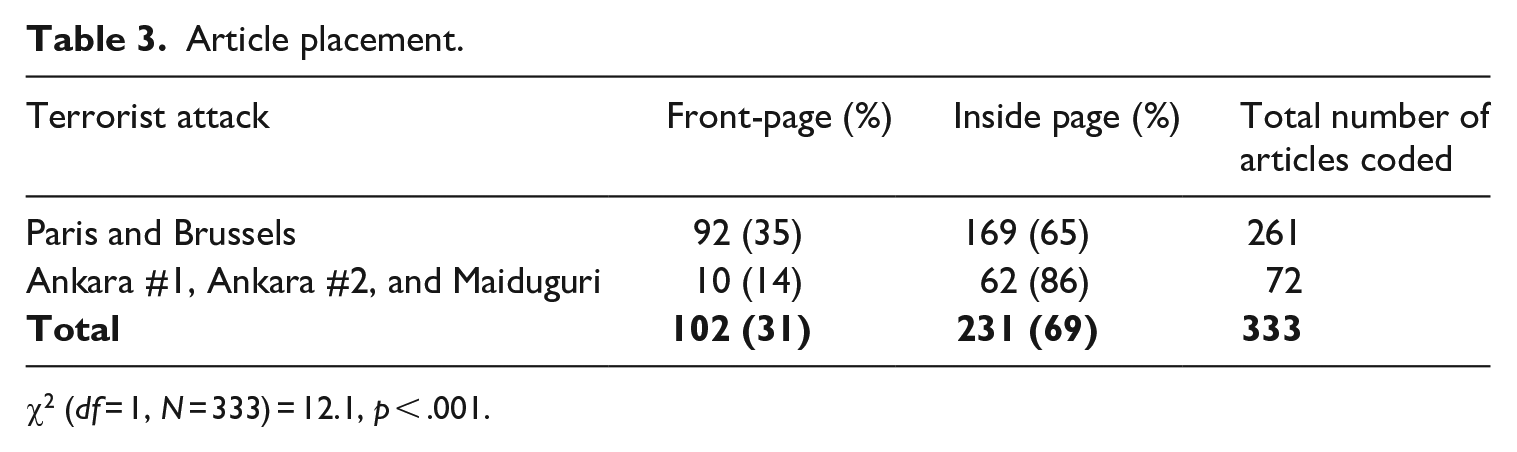
χ2 (df = 1, N = 333) = 12.1, p < .001.
On average, articles about attacks in Paris and Brussels included more accompanying photographs (M = 1.10, SD = 1.18) than articles about Ankara and Maiduguri (M = .81, SD = .78). An independent samples t-test showed these differences to be statistically significant (t(331) = 2.02, p = .044). H1d was thus supported. Table 4 displays these results.
Photos per article.
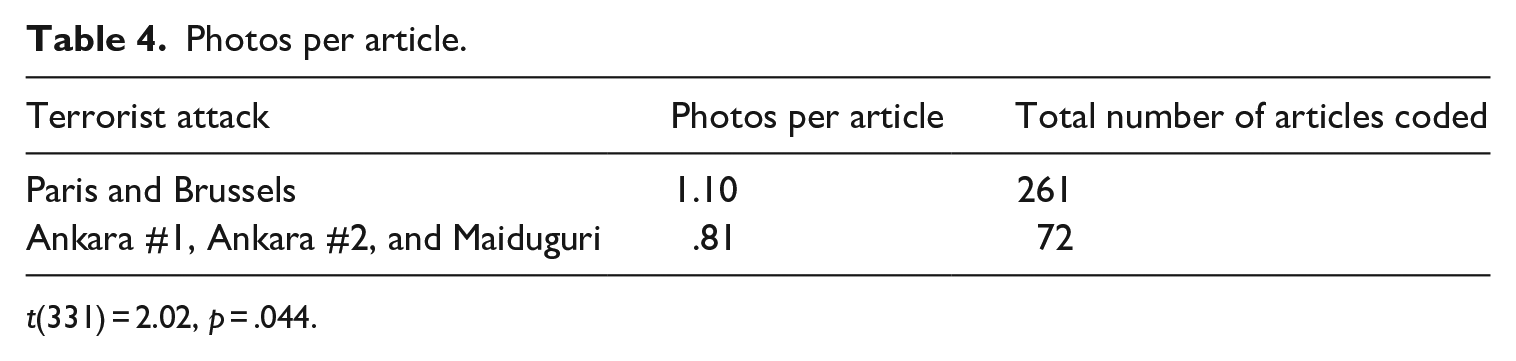
t(331) = 2.02, p = .044.
The second hypothesis predicted that studied American newspapers would be more likely to frame the Paris and Brussels attacks as acts of terrorism, and the Ankara and Maiduguri attacks as the products of internal conflicts. Results displayed in Table 5 show that examined papers almost exclusively framed the Paris and Brussels attacks as acts of terrorism (99.6%), while relying most heavily on an internal conflict frame in coverage of the Ankara and Maiduguri attacks (56.9%). A chi-square test revealed these differences to be statistically significant at the .05 level (χ2 (df = 1, N = 333) = 163.8, p < .001). H2 was supported.
Dominant frame.
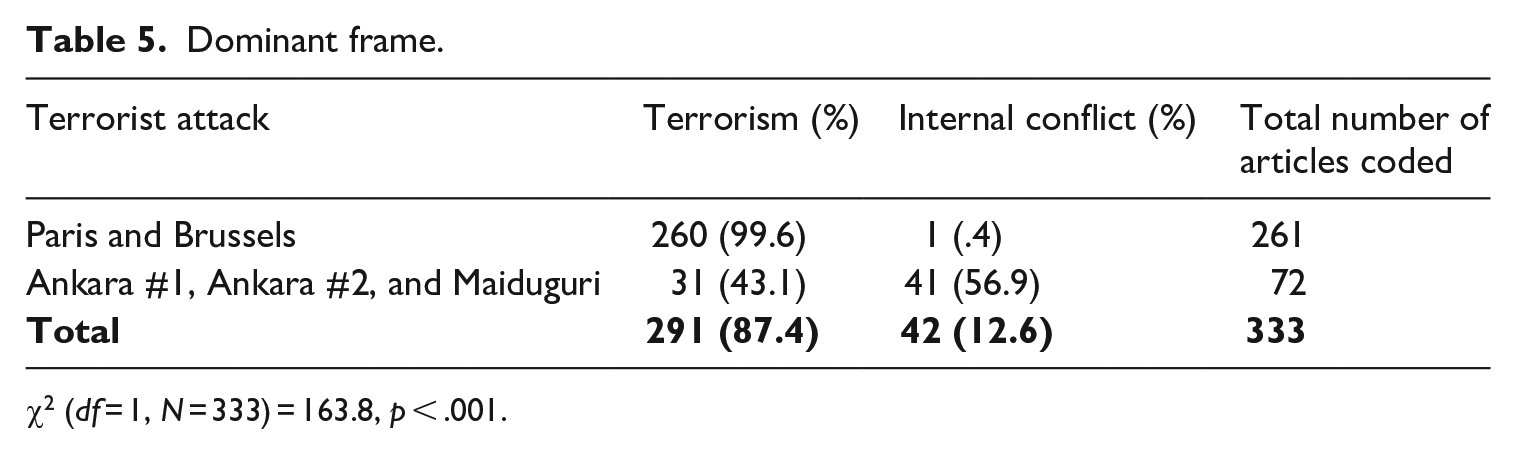
χ2 (df = 1, N = 333) = 163.8, p < .001.
Hypothesis 3 predicted that terrorism victims in Paris and Brussels would be humanized through personal details more than terrorism victims in Ankara and Maiduguri. On average, articles about attacks in Paris and Brussels included more personal details about victims (M = 2.26, SD = 7.96) than articles about attacks in Ankara and Maiduguri (M = .25, SD = .84). An independent samples t-test showed these differences to be statistically significant at the .05 level (t(331) = 2.14, p = .033). These results are shown in Table 6. H3 was supported.
Personal details about victims per article.
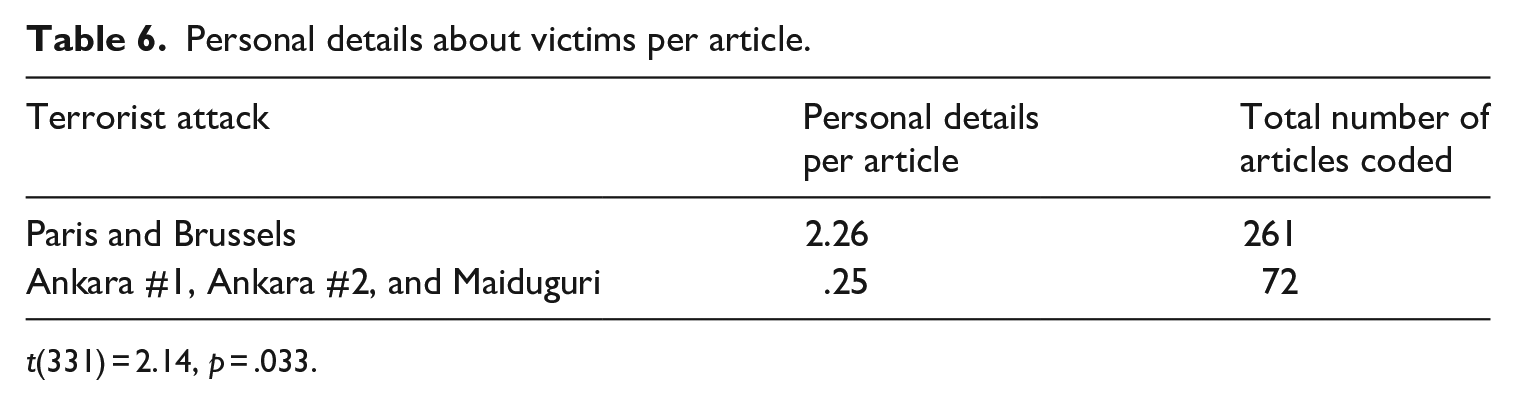
t(331) = 2.14, p = .033.
Hypothesis 4 predicted that articles about attacks in Paris and Brussels would be more likely to feature quotes from victims, family members, or civilian eyewitnesses than articles about attacks in Ankara and Maiduguri. As shown in Table 7, results indicate that articles about attacks in Paris and Brussels did, on average, generate more quotes (M = .99, SD = 2.96) than articles about Ankara and Maiduguri (M = .60, SD = 1.15). These differences were not statistically significant, however (t(331) = 1.10, p = .273). H4 was thus not supported.
Quotes from victims, family members, and civilian eyewitnesses.
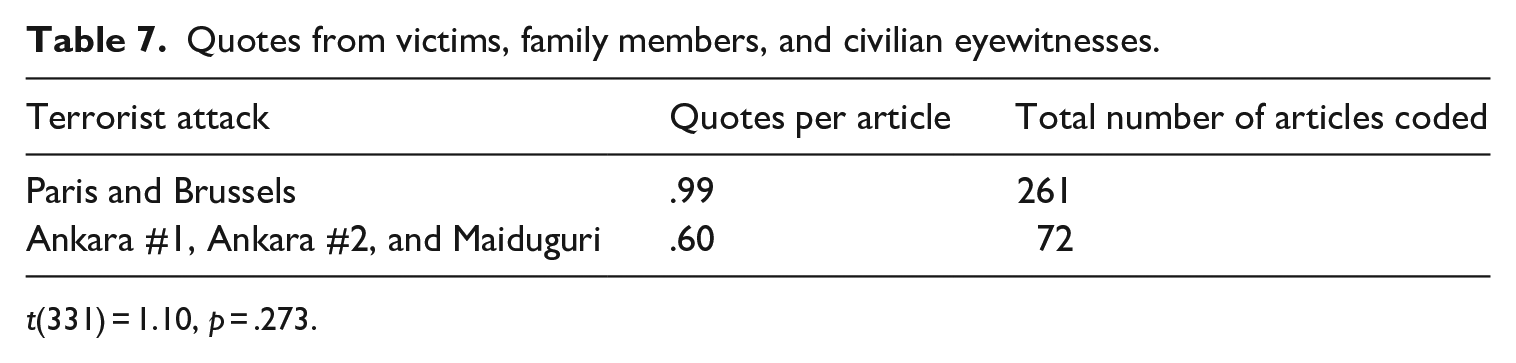
t(331) = 1.10, p = .273.
This study also presented three research questions about associations with Islam and the United States.
The first research question asked whether perpetrators of attacks occurring in Paris and Brussels would be more likely to be associated with the religion of Islam than the perpetrators of the Ankara and Maiduguri attacks. The religious identity of attackers was more likely to be mentioned in articles covering Paris and Brussels (84.7%) than in articles covering the Ankara and Maiduguri attacks (69.4%). A chi-square test revealed statistically significant differences (χ2 (df = 1, N = 333) = 8.64, p = .003).
The second research question asked whether newspaper articles about attacks in Paris and Brussels would be more likely to link these attacked cities to the US-led war on terror than articles addressing attacks in Ankara and Maiduguri. The Paris and Brussels attacks were more likely (48.3%) to mention the global war on terror than the Ankara and Maiduguri attacks (18.1%). These differences were statistically significant (χ2 (df = 1, N = 333) = 21.19, p < .001).
The third research question asked whether US officials would be quoted more in articles addressing attacks in Paris and Brussels than in articles addressing attacks in Ankara and Maiduguri. US officials were more likely to be quoted in articles covering Paris and Brussels (52.5%) than articles covering Ankara and Maiduguri (26.4%). A chi-square test showed these differences to be statistically significant at the .05 level (χ2 (df = 1, N = 333) = 15.44, p < .001).
Discussion
This study sought to determine to what extent differences in the religious, racial, and geographic identities of terrorism victims affect how 10 elite American newspapers report on them. Although this study builds on previous research in the broad area of media framing of global news events, it may be the first to include a comparative analysis of coverage of terrorism victims from a broad range of major American papers.
Findings from the content analysis point to clear differences in how the studied American dailies covered attacks that targeted primarily non-Muslim victims, on one hand, and primarily Muslim victims, on the other hand. American newspapers covered attacks in Paris and Brussels very prominently and framed them almost exclusively as acts of terrorism. Meanwhile, two attacks in Ankara and a single attack in Maiduguri were scantily covered despite high casualty figures. These attacks were also framed mostly as internal conflicts, despite the fact that all three attacks easily meet textbook definitions of terrorism. Importantly, the examined newspapers were also more likely to personalize Paris and Brussels victims than they were Ankara and Maiduguri victims. Furthermore, the Islamic identity of the perpetrators was more pronounced in articles dealing with Paris and Brussels than in articles about Ankara and Maiduguri. Also, attacks in Paris and Brussels were more likely to be linked to the US-led war on terrorism and feature quotes from US officials.
What is surprising about the results presented here, perhaps, is the scope of marginalization and neglect of victims in non-Western, Muslim-majority societies, including one black African society. Three major attacks in Ankara and Maiduguri generated just 72 articles in 10 major newspapers in 5 days of coverage. The two attacks in Paris and Brussels generated about nine times this many articles (N = 641). Articles about Paris and Brussels were also more likely to appear on the front-page of newspapers and were significantly larger and included more photographs, on average, than articles about Ankara and Maiduguri.
Although the five attacks studied here were characterized by different political contexts, all five fit neatly within the textbook definition of terrorism – targeting civilians for political reasons (Ganor, 2007) – and all produced significant casualties. In fact, the first Ankara attack produced three times the number of deaths as the Brussels attack, yet Brussels generated more than six times as many articles (N = 241) as the first Ankara attack (N = 37). The Maiduguri attack – which victimized black African Muslims – was the least covered event, despite a comparatively high death toll.
The framing differences uncovered here might point to important ideological constraints on US news coverage of terrorism. It may be that aspects of American journalism are constrained by ideological stereotypes both precluding the possibility that Muslims can be victims of terrorism and consistently associating Muslim countries with internal conflict (even when the contextual circumstances do not warrant such an association). The ideological underpinnings of US news coverage of the war on terror should be the subject of further scholarly research.
This study did not examine effects and cannot make any definitive statements about how readers might interpret sampled news articles. It is fair to consider, though, how American readers might understand stories about these attacks and the people they victimized given how they were covered. It is possible that readers may come away with the impression that societies like Ankara and Maiduguri are simply mired in prolonged conflict, and that the attacks represented battles in a war rather than acts of terrorism against civilian populations. Moreover, and perhaps more importantly given the paucity of coverage, it may be that many American newspaper readers would simply not be made sufficiently aware of the Ankara and Maiduguri attacks.
If this coverage represents a type of stable pattern, the long-term result may be the consistent impression that Western non-Muslim societies (like Paris and Brussels) are the only, or primary, victims of global terrorism. Also, given the attention allotted to the Paris and Brussels attacks, and also the focus on personalization, American readers may come to sympathize more with victims of these attacks. The patterns are in line, then, with what previous research has argued – namely, that Western reportage tends to feed the notion that Muslims are a menacing threat against a victimized, non-Muslim, white, Christian West (see Powell, 2011).
These differences also ‘[provide] evidence indicating that only stories involving a white or ex-colonial angle are taken seriously by media outlets in the developed world’ (Franks, 2012: 207). Apparently, the extent of Anglo-American media coverage of a given terrorist attack is not determined by the number of fatalities or casualties, but rather by the media outlets’ religious and cultural affinities with the victims. This coverage tends to challenge the principles of ‘common humanity’ and the ‘equality of victimhood’ (Patrick, 2016: 151).
As mentioned in the ‘Introduction’ section, some writers have defended western reporting of foreign conflict. For example, the aforementioned article by Wrong (2014) argued that Western journalists do a good job contextualizing foreign conflict, and that academic arguments against Western journalistic practice seem unrealistic. Specifically, Wrong argued that academic instructions to journalists in foreign conflict zones are ‘easier to say than do’. She also posited that current Western reporting of foreign conflict – particularly in Africa – provides sufficient nuance and context to inform news audiences, who, she said, are more intelligent than news scholars tend to believe. Wrong’s defenses are arguably problematic, in the specific context of Africa and also if applied to broader global levels. First, academic instructions to provide greater context, proportionate coverage, and more realistic descriptors, are not unrealistic. Rather, they are in line with Western journalistic principles of fairness, balance, and context. Second, Wrong’s argument that foreign reporting provides adequate nuance and context is not substantiated by evidence and seems to belie available data, including that which is cited in the literature review of this paper. Finally, Wrong’s specific claim that American news audiences are well informed about African and other global issues seems to contradict empirical data. For example, a recent survey by National Geographic’s Council on Foreign Relations found that college-aged Americans were largely uninformed about basic matters of global affairs (National Geographic Council on Foreign Relations, 2016).
el-Nawawy and Elmasry (2017) documented Phillips’ (2015) defense of American news coverage of terrorist atrocities. Phillips’ The Washington Post editorial contended that terrorist attacks occurring in major European cities generate more American news interest not because there is a double standard at play, but, rather, because attacks in those societies are rare and unusual. But, as el-Nawawy and Elmasry (2017) note, Turkey and France rank similarly on the Global Terrorism Index (Institute of Economics and Peace, 2016), so this argument does not seem to explain why an attack in Paris would generate so many more articles, front-page articles, and photographs than an attack in Ankara. Phillips also argued that major European cities share cultural similarities with the United States, something which influences American journalists to pay more attention to attacks in those cities. But, here, Phillips essentially makes the double standard argument for those against whom he is ostensibly debating. The argument that scholars (see Adams, 1986; Fair, 1993; Hanusch, 2008, 2012; Hawkins, 2002; Joye, 2009, 2010; Moeller, 1999; Simon, 1997; Van Belle, 2000) have made is that it is inappropriate to privilege Western victims simply because they look and talk like ‘us’.
Victim racial and religious identities are not necessarily the only factors at play in the coverage disparities described here. Another contributing explanation for these coverage discrepancies lies in Wallerstein’s world systems theory, which suggests ‘a power hierarchy between core [mostly Western countries] and periphery [mostly Global South countries] in which powerful and wealthy “core” societies [have the upper hand over] weak and poor “peripheral” societies’ (Chase-Dunn and Grimes, 1995: 389). Between the core and peripheral countries lie the semi-peripheral countries, which share characteristics of both the core and the periphery (Chase-Dunn and Grimes, 1995). The core countries’ political and economic superiority over peripheral and semi-peripheral countries affects global information and news flows. News media in the core countries often play a hegemonic role that allows them to make decisions on ‘who to include and exclude from the international communication network’ (Himelboim, 2010: 387).
Our findings showed that victims of attacks in France and Belgium – two core countries – were prioritized by the American newspapers under study, especially when compared with their counterparts Turkey (a semi-periphery country) and Nigeria (a periphery country). The patterns of coverage that this study revealed point to ‘the usual practices of . . . U.S. media . . . [which] often fail to cover . . . [periphery and semi-periphery] countries adequately, if there is coverage at all’ (Chang et al., 2009: 151). Our findings indicate that a country’s place ‘in the world system . . . determines its overall newsworthiness’ (Golan, 2008: 54).
World systems theory should not, however, be seen as the only explanation for the coverage patterns described here, or as a substitute for the importance of religious and racial identity markers. It is likely that the fact that the primary victims of the Ankara and Maiduguri attacks were Muslims affected how American papers approached those attacks. And it is equally likely – perhaps more likely – that the fact that the Maiduguri victims were both Muslim and black contributed to the dearth of articles generated by that event. In short, it is possible that the racial and religious identities of victims and a country’s position in the world systems framework can affect Western coverage tendencies.
Future research should look at other terror attacks and attempt to further parse out the influence of race, religion, and a country’s position in the world systems framework on American and other Western news coverage patterns.
Footnotes
Funding
The author(s) received no financial support for the research, authorship, and/or publication of this article.
