




Abstract
Politics in Austria is still a male business. Even though in 2017, women occupied 34 percent of the seats in Austria’s Nationalrat, female MPs are still underrepresented. Moreover, previous studies have shown that women receive substantially less media coverage than men do and this, for instance, disadvantages female politicians to male politicians in election campaigns. Our study seeks to contribute to this debate by adding a longitudinal perspective and substantially underpinning it with empirical data. We use quantitative content analysis to examine whether the election coverage of female politicians in Austrian news media has changed between 2008 and 2017. Our findings show low visibility of female politicians in Austrian campaign coverage that is even decreasing over time; furthermore, the political role a female politician occupies plays a crucial role for her media visibility.
Introduction
In the context of today’s media-centered campaigns (Norris, 2000), politicians with higher media coverage are more visible to voters (Kahn, 1994; Lühiste and Banducci, 2016). It is therefore essential for all politicians to be equally represented in the media and to be portrayed in an accurate way (Council of Europe, 2017: 5), because the amount and type of campaign coverage can influence voters’ perceptions of politicians (Lühiste and Banducci, 2016). Hence, gender equality in campaign coverage is a matter of fairness (Atkeson and Krebs, 2008; Council of Europe, 2017). Nevertheless, previous studies have shown that female politicians receive substantially less media coverage than male politicians do (e.g. Armstrong and Gao, 2011; Hooghe et al., 2015; Kahn, 1994; Lühiste and Banducci, 2016; Rußmann and Höller, 2012; Shor et al., 2015). Our study aims to contribute to this debate by examining the subject over time and substantially underpinning it with empirical data.
The underrepresentation of women in campaign coverage is undoubtedly part of a consistent power struggle (Celis and Lovenduski, 2018). Therefore, national parliaments in Western democracies as well as the European Parliament have adopted voluntary or mandatory quota systems (Celis and Lovenduski, 2018; Council of Europe, 2017). As a result, the general visibility of female politicians has increased, albeit rather slowly. In the European Parliament, 29.6 percent of members were women in 1999. By 2008, this number had risen to 31.2 percent and just under a decade later, in 2017, 37.3 percent of Members of European Parliament (MEPs) were women (European Commission, 2009; European Parliament, 2017). However, the question arises as to what extent the media still disadvantages female politicians compared to male politicians in election campaigns. The media can break, but also foster existing stereotypes such as the marginalization and trivialization of female politicians (Wolf, 2008).
The literature review in the next section provides an overview of previous research in this field. To understand how female politicians’ underrepresentation in campaign coverage has changed over time, we are focusing on the Austrian national elections in 2008, 2013, and 2017. Even though there is a growing awareness of issues of gender equality among political scientists as well as communication and media scientists, to our knowledge only two relevant studies have been carried out so far. Shor et al. (2015) took a longitudinal approach in order to compare changes over time by focusing on the underrepresentation of women in printed news, and Hooghe et al. (2015) examined the allotted speaking time to members of parliament (MP) from 2003 to 2011 in the two main television news broadcasts in the Dutch-speaking region of Belgium. For this study, we analyzed 11,441 newspaper articles in 6 major newspapers and 503 television news programs on 2 major television channels during the 4 weeks prior to Election Day in each election year.
Austria is a representative democracy. The country has a multi-party political system structure; its electoral system is based on the principle of proportional representation, and it has a consensus-based political culture. The National Council (Nationalrat) has 183 members, who are directly elected by universal suffrage for a 5-year term of office unless snap elections are called as in 2008 and 2017. Over the past 10 years, the number of female politicians in the Austrian Parliament (Nationalrat) has increased from 27.32 percent in 2008, to 33.33 percent in 2013, and 34.43 percent in 2017 (Demokratiezentrum, 2015; Parlamentsdirektion, 2018). This is the highest proportion of female MPs ever recorded in Austria, however, it is still far from equal (re)presentation as women constitute approximately 51 percent of the Austrian population. The increasing number of female politicians is to some extent owed to the adoption of gender quotas by Austrian political parties. For instance, to increase the proportion of women in politics, the current party statute of the Social Democratic Party of Austria (SPÖ) states that when electing officials and compiling lists of candidates, it is important to ensure that no less than 40 percent of women and no less than 40 percent of men are represented. The Greens – The Green Alternative has a self-imposed quota of 50 percent women for all top positions of the party and for the 2017 national election, the Austrian People’s Party (ÖVP) introduced the 50/50 principle of alternation, the so-called ‘Reißverschlussprinzip’ (‘zipper principle’). The national government has been shown to vary considerably in its gender balance over the examination period; before the 2008 election, there were 8 male and 6 female ministers, in 2013, 7 men and 6 women were in government, while in 2017, only 3 women governed together with 11 men.
Regarding the media system, Austria is counted among the democratic corporatist media systems (Hallin and Mancini, 2004), characterized by high newspaper circulation, an early emergence of mass-circulation press, and strong public service broadcasting.
Following the presentation of the results, this article concludes with a discussion of the principal findings.
Female actors in campaign coverage
Previous studies have shown that the media generally focuses on four aspects when differentiating between male and female politicians in campaign coverage: volume of coverage (visibility), politicians’ issues, politicians’ traits, and politicians’ viability (Atkeson and Krebs, 2008; Kahn, 1994). We consider the first two aspects in our study – the visibility of female politicians in campaign coverage and the issues in relation to which the media features them – as these two aspects can be evaluated throughout all campaign media coverage that features politicians.
Many studies have confirmed the low visibility of female politicians in campaign coverage across various types of media, elections, and countries (see for example, Armstrong and Gao, 2011 across online platforms; Banwart et al., 2003, for US Senate and state governorship campaigns; Hooghe et al., 2015, for television news broadcasts in Belgium; Humprecht and Esser, 2017, for political digital news; Semetko and Boomgaarden, 2007, for Germany; Wolf, 2008, for main evening news on TV around the world). For instance, by analyzing newspaper coverage in 47 statewide campaigns in the United States, Kahn (1994) shows that in both senatorial and gubernatorial races, female politicians receive less coverage than their male counterparts do. The lack of press attention is a ‘potential roadblock[s] for women candidates because citizens are unlikely to vote for candidates with whom they are unfamiliar’ (Kahn, 1994: 171). Agenda-setting theory and research over the past five decades has shown that the volume of media attention influences voters’ perceptions of politicians. The low coverage of women in US newspapers has barely changed over time and a longitudinal comparison of newspaper-wide female coverage from 1983 to 2008 by Shor et al. (2015) found that almost all newspaper coverage focuses on a relatively small number of individuals, the majority of whom are men. The few Austrian-based studies on first-order as well as second-order elections also show a particularly small amount of campaign coverage of female politicians. Rußmann and Höller (2012), who analyzed newspaper and TV news coverage in the 2008 Austrian national election campaign, emphasized that only 15 percent of all main actors in news coverage were women. Austria (together with Spain) also showed a greater gender bias in coverage in newspapers and broadcasts during the 2009 European Parliamentary Elections than the other EU member states (Lühiste and Banducci, 2016). Even though around 40 percent of all candidates were women, they only received approximately 5 percent of the media coverage; ‘at least part of the gender bias in candidate coverage appears to be the media’s own creation’ (Lühiste and Banducci, 2016: 27).
Overall, past research shows that female politicians are marginalized in the media; they are less present in newspaper and TV news coverage than their male counterparts are. Moreover, in Austria, there is still a dominance of men in top positions across various political, economic, and social categories (see, for example, Seebacher and Wieser, 2018) and as Shor et al. (2015) noted, this external factor influences ‘the difference between the rate of female and male names in today’s newspaper’ (p. 976). As an analogy to the ‘glass ceiling’, Shor et al. (2015: 964) refer to a ‘paper ceiling’ in printed news coverage characterized by women being underrepresented in political news coverage. Thus, the first hypothesis predicts the following:
H1: Male politicians are likely to have greater visibility than female politicians in Austrian election coverage over time.
However, there was an increase in female politicians in Austria over the period of investigation (Demokratiezentrum, 2015). In the legislative period from 2006 to 2008, women occupied 31.15 percent of the seats in parliament. In the following legislative period up to 2013, the representation of women in parliament dropped slightly to 27.32 percent, but increased again to 33.33 percent in the legislative period up to 2017 – the second highest proportion of women in parliament since 1918 (33.88% in the legislation period from 2002 to 2006; Parlamentsdirektion, 2018). We suggest that the increase may be largely due to the influence of parties self-imposed quotas. Moreover, there is a slight increase at the top of economic and social realms in Austria over the past 10 years. For instance, despite being at a very low level, the representation of women among CEOs of Austria’s Top-200-companies (based on revenue) has almost doubled over the past 10 years, from 4.6 percent in 2008 to 8.6 percent in 2018 (Seebacher and Wieser, 2018). According to Shor et al. (2015), such external factors positively influence female politicians media coverage. Lühiste and Banducci (2016) report similar findings by highlighting that female politicians benefit from an overall gender equality in society by receiving greater media coverage during election campaigns. Therefore, we hypothesize,
H2: The greater share of female politicians in economic, political, and media realms over the past 10 years has led to greater visibility of female politicians in campaign coverage.
The media employ certain stereotypes about male and female politicians. Numerous studies show that female politicians receive less attention regarding political issues than male politicians do (Kahn, 1994). There is a tendency of campaign coverage of women to focus on ‘soft’ issues such as culture, health care, education, and family, whereas men tend to lean more toward ‘hard’ issues such as economics, finance, foreign affairs, and defense (Atkeson and Krebs, 2008; Greene and Lühiste, 2018; Herrnson et al., 2003; Rußmann and Höller, 2012; Wolf, 2008). This can influence the voter’s perception on female politicians’ suitability for office. Moreover, female politicians tend to receive more non-policy and personal coverage (Atkeson and Krebs, 2008) and are more likely than are male ‘to have their gender, children, and marital status mentioned’ (Banwart et al., 2003: 670; see also Semetko and Boomgaarden, 2007). Pantti (2007) argues that while male politicians are being perceived as politicians, their female counterparts are being perceived as women and mothers. Hence, female politicians are perceived as less competent and capable of doing the job of a politician. Greene and Lühiste’s (2018) description of ‘soft’ issues as ‘compassion issues’ characterizes this perception of female politicians as weaker and downplays and devalues their political role and achievements. Even though female politicians can increase their chances of electoral success when they consciously focus on ‘female’ issues in the election campaign (Herrnson et al., 2003), male politicians still dominate these ‘soft’ news items. In addition, ‘hard’ news occupies the larger place in policy reporting (Gallagher, 2005). Thus, we hypothesize,
H3: Female politicians are less frequently covered on ‘hard news’ issues compared to male politicians.
Again, we assume a change over time. First, over many decades, women were not represented as ministers in the Austrian government and if so, they held a ministerial office covering soft or compassion issues such as ‘family and social affairs’. However, since the mid-2000s, not only has the number of female ministers increased (apart from the last government period), they have also occupied ‘elite’ or ‘hard’ ministries such as ‘finance’, ‘justice’, or ‘interior’ (Bundeskanzleramt, 2019). Second, gender imbalances in socio-economic participation has decreased over the past 10 years as, for example, shown by the increase of female CEOs in Austria’s Top-200-companies (Seebacher and Wieser, 2018). Economic participation is an external factor, which is crucial in determining media coverage (Shor et al., 2015). Third, the coverage of women is influenced by decision-making powers within the medium itself. Shor et al. (2015) found that ‘[w]omen do receive greater coverage in newspaper sections led by female newspaper section editors, as well as in newspapers whose editorial boards have higher female representation’ (p. 962; for similar findings see Lühiste and Banducci, 2016). Editors have a say in whose voices are heard and how (Wahl-Jorgensen, 2002). For instance, a female editor led the newspaper Der Standard from 2007 to 2017, the Kleine Zeitung employed a woman as second editor in 2012 and in the same year, a women became television director of the Austrian Broadcasting Corporation, ORF – three of the media outlets under investigation in this study. Based on these external and internal factors that influence the media coverage, we hypothesize,
H4: The greater share of women in economic, political, and media realms over the past 10 years has led to greater coverage of female politicians on ‘hard’ issues.
When analyzing female politicians’ representation in campaign coverage of six newspapers and two TV news programs, the question arises as to whether these media outlets cover female politicians differently in their campaign coverage and what changes have occurred over the past 10 years? Austria is a so-called newspaper-centric society (Norris, 2000), meaning that newspapers are the main source of information in Austria. Thus, we have included two quality newspapers, Der Standard and Die Presse; two mid-market newspapers, Kurier and Kleine Zeitung; as well as two tabloid papers, the Kronen Zeitung and Österreich, in the empirical study. Television is the key electronic medium in Austria (Plasser and Lengauer, 2009), therefore, we have included reports of two TV news programs in the empirical study: Zeit im Bild 1 (ZIB 1; ORF), a public broadcasting program with approximately 1 million viewers, and ATV aktuell (ATV), a private TV station with around 50,000 viewers. Both have the highest viewer count within public and private broadcasting.
Balance is one of the primary journalistic norms for good quality in Austria (see for example, Kaltenbrunner et al., 2018). Balance means presenting a variety of sources as well as different viewpoints and opinions on a story (Bennett, 1996). Hence, balance also refers to gender equality in campaign coverage. To ensure a high quality of reporting the journalistic norm of balance is part of the self-imposed guidelines of Austrian quality newspapers and the public broadcaster ORF. For instance, the journalistic norm of balance is stipulated in the Federal Act on Austrian Broadcasting, the ‘ORF Act – To establish and periodically revise the criteria for ensuring balance and consideration of the diversity of interests of listeners and viewers’ (ORF Gesetz, 2019). However, tabloid media follow journalistic norms such as balance to a lesser extent in their news coverage (Kaltenbrunner et al., 2018). For instance, the Private Radio Act (Privatradiogesetz, 2019) refers to the journalist norm of diversity of opinions, but not to the journalist norm of balance. Very often, a few frequently covered politicians or those who are presumed to occupy the most powerful positions (e.g. Bennett, 1996) dominate the news. These theoretical considerations have led to our last hypothesis:
H5: Tabloid media are less likely to report on female politicians than quality media.
Data and method
Data
The data for this study were collected through a quantitative content analysis of newspaper articles and TV news reports during the last 4 weeks of the 2008, 2013, and 2017 Austrian national elections, the so-called hot phase of the campaign (2008: 30 August to 27 September; 2013: 1 September to 28 September; 2017: 17 September to 14 October). Reports were selected if they contained the word or word stem ‘wahl’ (election). Our overall dataset includes 11,944 reports from the 6 daily newspapers with the widest readership in Austria, the Kronen Zeitung (Krone), Österreich, Kurier, Kleine Zeitung, Der Standard (Standard), and Die Presse (Presse), as well as from 2 TV news programs, Zeit im Bild 1 (ZiB 1) (ORF) and ATV aktuell (ATV). Table 1 shows the distribution of reports across media outlets and years.
Media coverage across media outlets in the 2008, 2013, and 2017 elections (N = 11,994; newspaper articles and TV news reports).
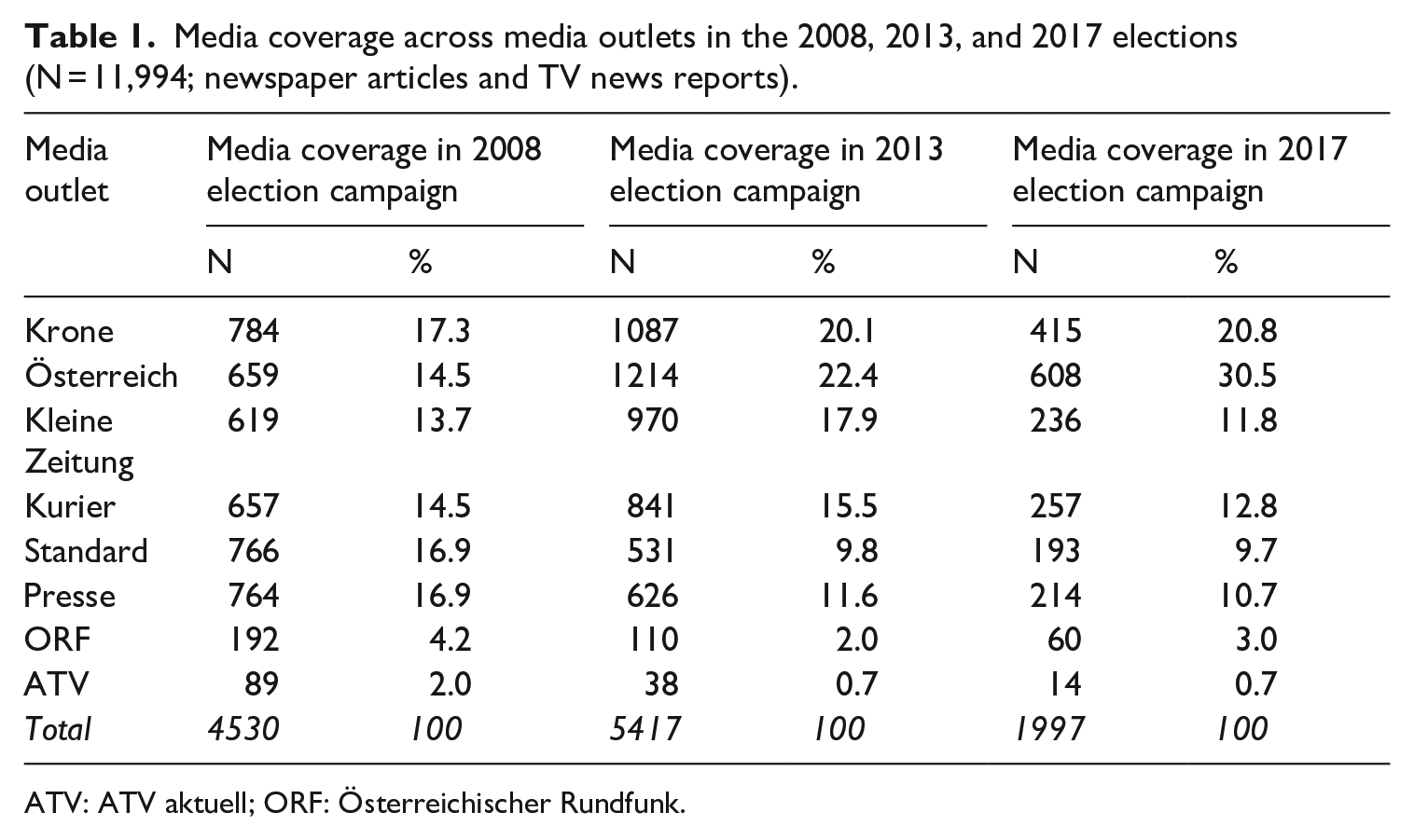
ATV: ATV aktuell; ORF: Österreichischer Rundfunk.
Coding procedure and measures
We conducted content analyses. The unit of analysis is the single newspaper article or single TV news report. The main variables are the main actor and the main issue and both are characterized by their prominence in the article. We record the direct content-related network of relationship between the main topic (the main focus) of the report (What is the story about?) and the related main actors (Who is involved in connection with the main topic?). Therefore, in a first step, we identify what the report is about in its core, and at the same time, the main actors involved (both individual and collective) are recorded.
Formal criteria
For each report, we recorded the date, the media outlet it was published in, the newspaper section for newspaper articles and the word count.
Main issue
The main issue is the first content-related aspect appearing in the article, which is discussed in the broadest sense. Issues were classified into 38 issue categories of which 3 are polity issues 1 that deal with structural circumstances in the political process, 6 are political issues 2 that include relationships between political actors and issues related to the election campaign, and 29 are policy issues. 3 The policy issues we further categorized as hard issues and soft issues. There are no undisputed definitions of hard and soft issues (Reinemann et al., 2011). However, as we focus on the issues themselves rather than on the type of news report, we follow the definition of Curran et al. (2010): Issues with high political relevance and low emotional value are defined as hard issues, such as military and disaster relief, and soft issues are those issues that deal more with individual circumstances such as culture, and kindergarten and schools.
Main actor
As the main issue, the main actor is characterized by its prominence in the article: Actors qualify as main actors if they are mentioned in direct relation to the main topic and mentioned at least twice by name or with synonyms. For this analysis, we only included actors who are active politicians (non-political main actors are displayed in Table 2). These include the president and members of the cabinet as well as candidates from all parties running for parliament. Due to different coding approaches in the three periods of investigation (the 2008 research team coded five main actors, the 2013 team coded only one individual actor, and the 2017 team coded two main actors), we limited the analysis to the first actor mentioned and coded.
Coverage of main actors in Austrian campaign coverage in 2008, 2013, and 2017.
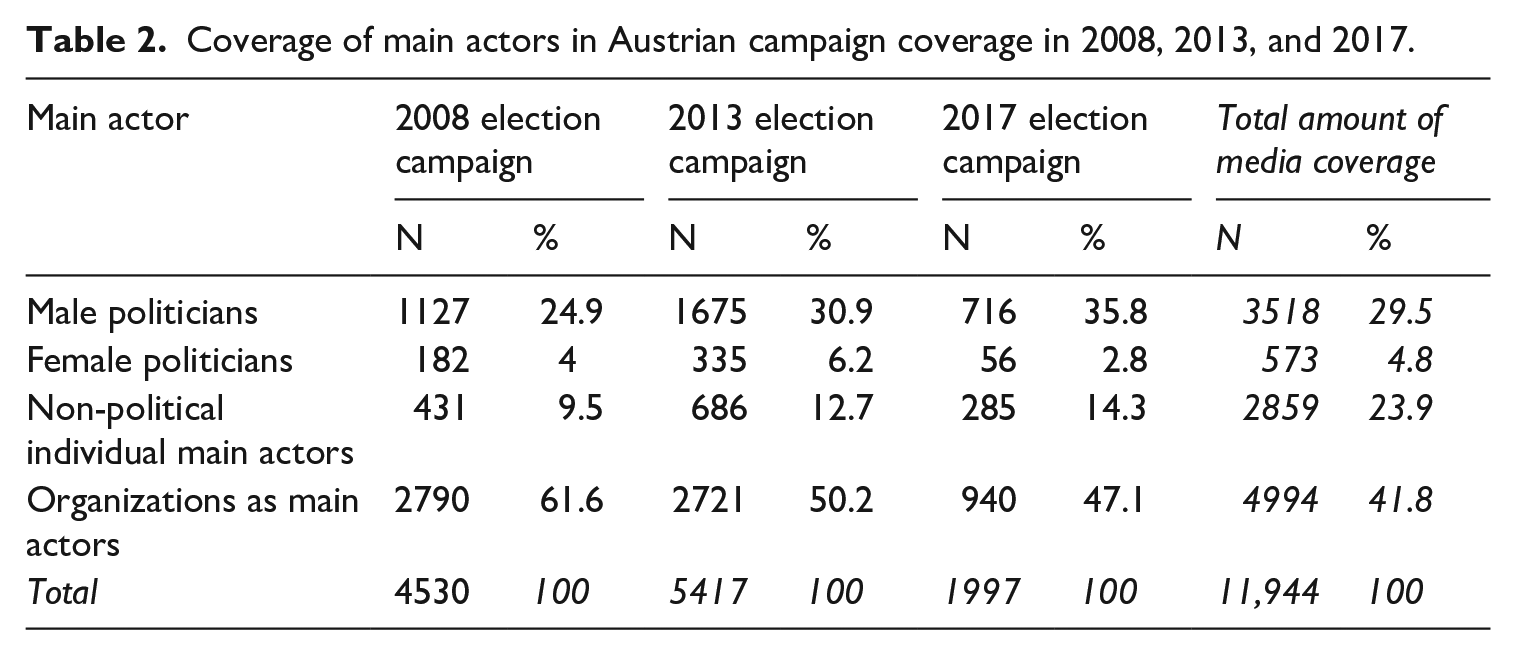
The coding processes for the 2008 and 2013 data took place within AUTNES, the Austrian National Election Study, and for the 2017 data in a project at the University of Innsbruck. A total of 6 to 10 coders conducted the coding and intercoder reliability scores were calculated using Holsti’s coefficient of reliability (2008, 2013) and Krippendorff’s Alpha (2013, 2017). Overall, intercoder percentage agreement for each of the items falls within the acceptable range. The coefficients for main actor are 0.81 (Holsti) in 2008, 0.87 (Holsti) and 0.81 (Krippendorff’s α) in 2013, and 0.76 (Krippendorff’s α) in 2017. The coefficients for main issue are 0.75 (Holsti) in 2008, 0.76 (Holsti) and 0.78 (Krippendorff’s α) in 2013, and 0.74 (Krippendorff’s α) in 2017.
Results: Underrepresented female politicians in Austrian campaign coverage
Visibility of female politicians in campaign coverage
The aim of this study is to understand how female politicians’ underrepresentation in campaign coverage has changed over the past 10 years. The results reveal that in 34 percent of all media reports (4091 reports), an individual politician was coded as main actor. The percentage of media coverage featuring individual actors has increased over the period of investigation from 38.4 percent in 2008 to 52.9 percent in 2017, which is an indicator for the increasing personalization of political media coverage (McAllister, 2007).
However, the overall increase in the percentage of media coverage with individual actors from 2008 to 2017 comes with an increase of media coverage featuring male politicians. The data in Table 2 show that in total 29.5 percent of the media coverage featured a male politician as main actor, compared to only 4.8 percent female politicians.
Over the past 10 years, the visibility of female politicians has decreased in Austrian campaign coverage. In 2008, 4 percent of the newspaper articles and TV news reports featured female politicians as main actor, and although this percentage increased to 6 percent in the 2013 Austrian elections, in the last election campaign in 2017 only 2.8 percent of the analyzed newspaper articles and TV news reports carried a female politician as main actor. Not surprisingly, female politicians are almost invisible in campaign coverage – in the following we will show how and why.
Following the general claim that the underrepresentation of women in campaign coverage is part of a consistent power struggle (Celis and Lovenduski, 2018) and based on the analyzed data, we observed that the political position influences the visibility of female politicians. Again, in only 14 percent of the analyzed newspaper articles and TV news reports that featured a politician as main actor across all three campaigns, was this main actor a woman (573 of 4091). Table 3 shows the roles in which female politicians become visible across all 573 media reports with female politicians as main actors. The data in Table 3 show that there seems to be two guarantees for female politicians to be visible in the media in election times: to be a member of the cabinet and to be the party’s top candidate.
Roles of women in campaign coverage featuring female politicians.
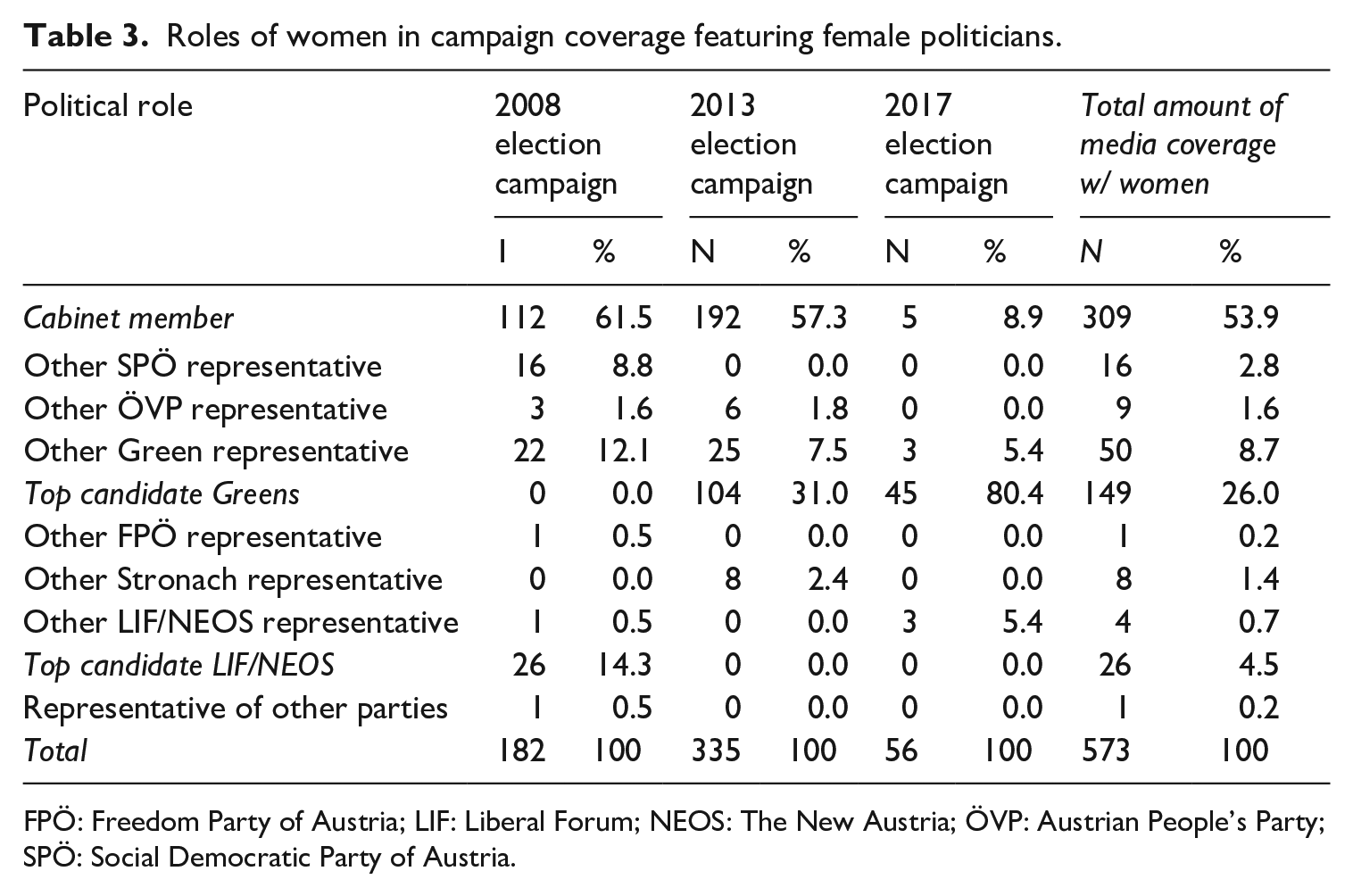
FPÖ: Freedom Party of Austria; LIF: Liberal Forum; NEOS: The New Austria; ÖVP: Austrian People’s Party; SPÖ: Social Democratic Party of Austria.
The media coverage of the 2008 and 2013 elections shows a high percentage of newspaper articles and TV news reports featuring women in the cabinet; in both election campaigns, 6 of 14 ministers were women. During the 2008 election, the federal minister for the interior, Maria Fekter, was the most visible female actor. In the 2013 election campaign, her successor Johanna Mikl-Leitner was the most visible female actor. Having such a ‘hard’ ministry occupied by a woman seemed to make her a prominent actor in the media. On the contrary, in the 2017 campaign coverage only the federal minister of women and health, Pamela Rendi-Wagner, was featured as main actor, but in no more than five media reports. She was the only female cabinet member who re-ran for office, therefore, the percentage of female cabinet ministers in the news is considerably lower than in previous years.
Table 3 also illustrates that female politicians have a higher chance of being visible in the media when running as top candidate. In 2008, the top candidate of the Liberal Forum (LIF) Heide Schmidt accounted for 14 percent of the media coverage on female politicians, although her party only gained 1.6 percent of the votes. In 2013, 31 percent of the coverage featuring female politicians as the main actor included the top candidate of The Greens Eva Glawischnig. Despite the fact that the 2017 election resulted in disaster for The Greens – the party did not reach the 5 percent threshold to enter parliament – the party’s top candidate Ulrike Lunacek was featured as main actor in 80 percent of the media reports that included a female politician as main actor in that year.
The analysis reveals that being a Green Party politician makes it more likely for female politicians to be present in the media. Across all 3 elections, women associated with the Greens (either as top candidates or as other representatives) were featured in 35 percent of the media reports with female politicians as main actors, second only to female cabinet members (54%). Longer than any other party, the Greens have established a 50:50 quota on their candidate lists; this practice seems to support female politicians’ visibility in the media. In addition, they were the only party to have contended two of the three elections with females as their top candidates and top candidates are, of course, of greater interest to the media.
Issues and gender
To evaluate the claim that female politicians are being reduced to ‘soft’ issues in campaign coverage, we examined the issues (with respect to the main actor’s gender) most discussed in the campaign coverage of the 2008, 2013, and 2017 Austrian elections. Figure 1 illustrates all issues that were identified as main issues in at least 50 newspaper articles and TV news reports (13 of 38 issues). Male politicians as main actors dominated the coverage regardless of the issue; in fact, not a single issue occurs more often with a female than with a male politician as main actor. The three most discussed issues throughout the three campaigns were politics issues dealing with campaign and election circumstances and male politicians dominated all of those. Women appeared more often in articles and TV news reports with policy issues and dominated those issues that are typically soft issues, and therefore, more likely to be connected to female actors such as culture and education (kindergarten and schools).
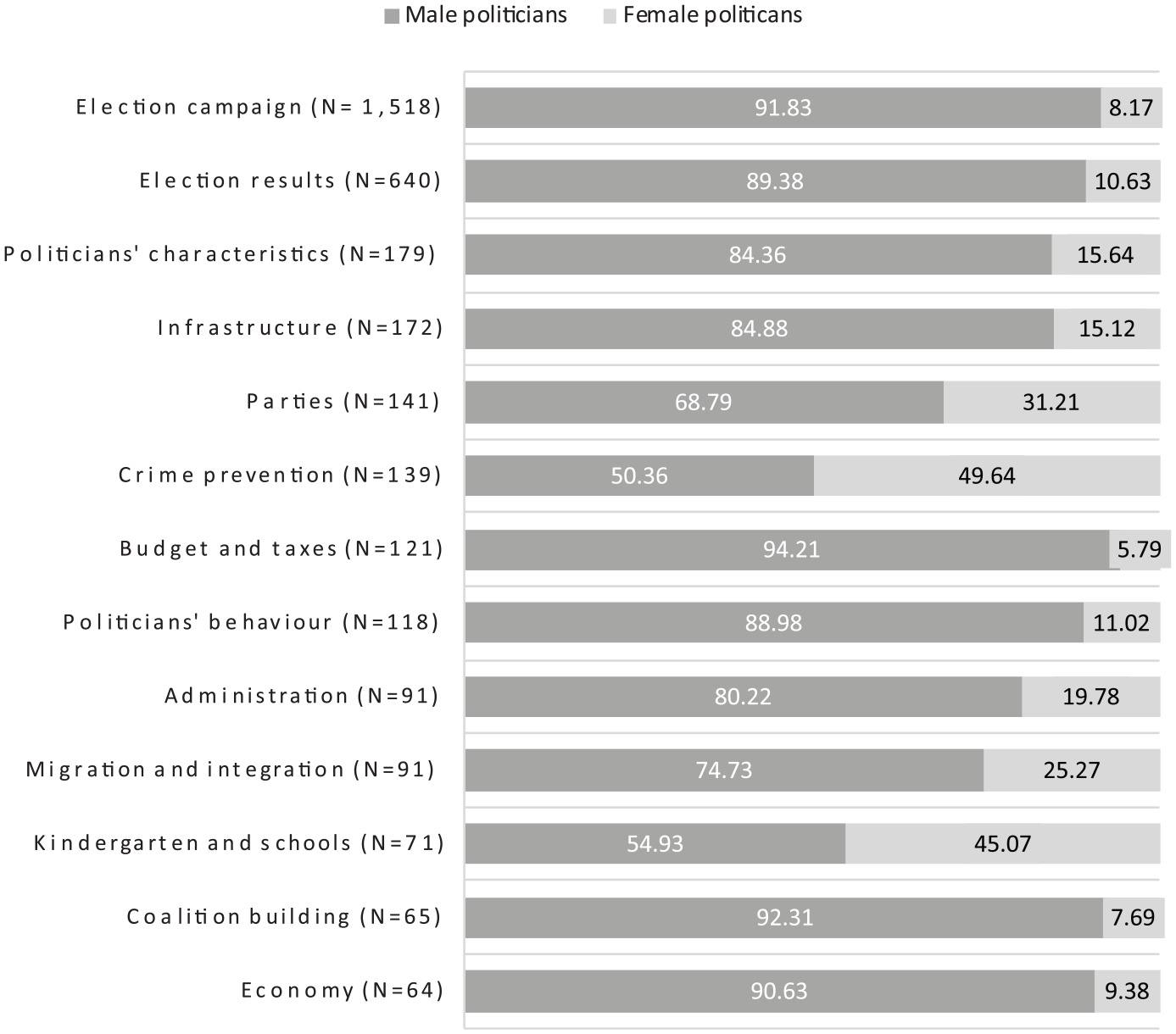
Most discussed issues by gender of politician as main actor.
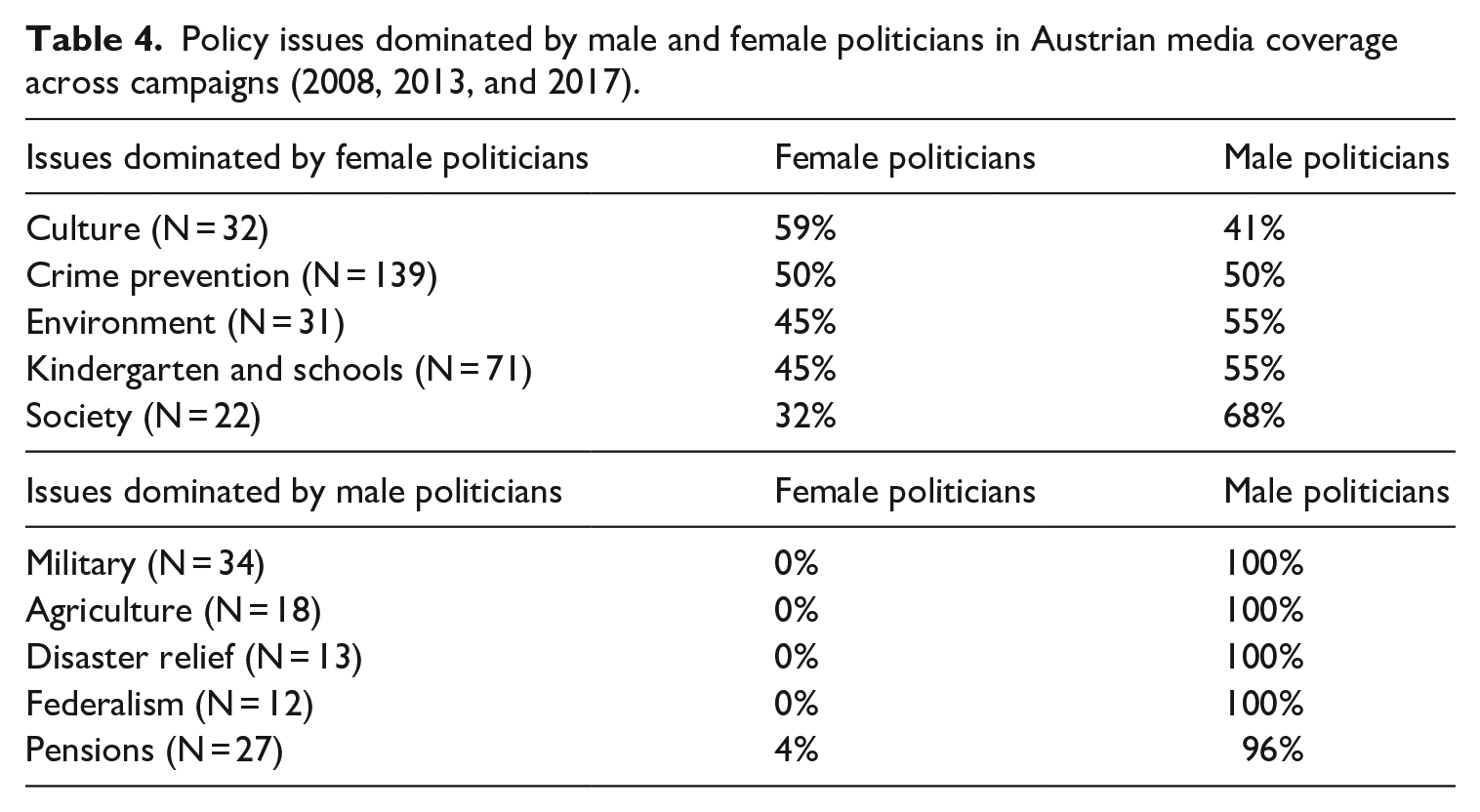
Considering the top 5 issues for female as well as male politicians, Table 4 shows that male and female politicians (as main actors) were primarily featured with policy issues in all three campaigns (see also Supplemental Table B). However, female politicians only dominated the campaign coverage of 1 issue; 59 percent of the articles and TV news reports on culture feature a woman as main actor. Culture is a ‘soft’ issue. Two more issues with which female politicians were featured most often can be considered as ‘soft’ issues: kindergarten and schools as well as society. Crime prevention is the only hard issue that women and men are featured with equally often; in 2008 and 2013, the ministry of interior was occupied by a female minister. On the other hand, the five issues with which male politicians were featured most often are ‘hard’ issues. Female politicians were never presented as main actor with four of these issues – military, agriculture, disaster relief, and federalism, and only a single article on pensions features a female politician as main actor. None of these issues were ever included in a woman minister’s portfolio (for a list of all male and female ministers see Supplemental).
Policy issues dominated by male and female politicians in Austrian media coverage across campaigns (2008, 2013, and 2017).
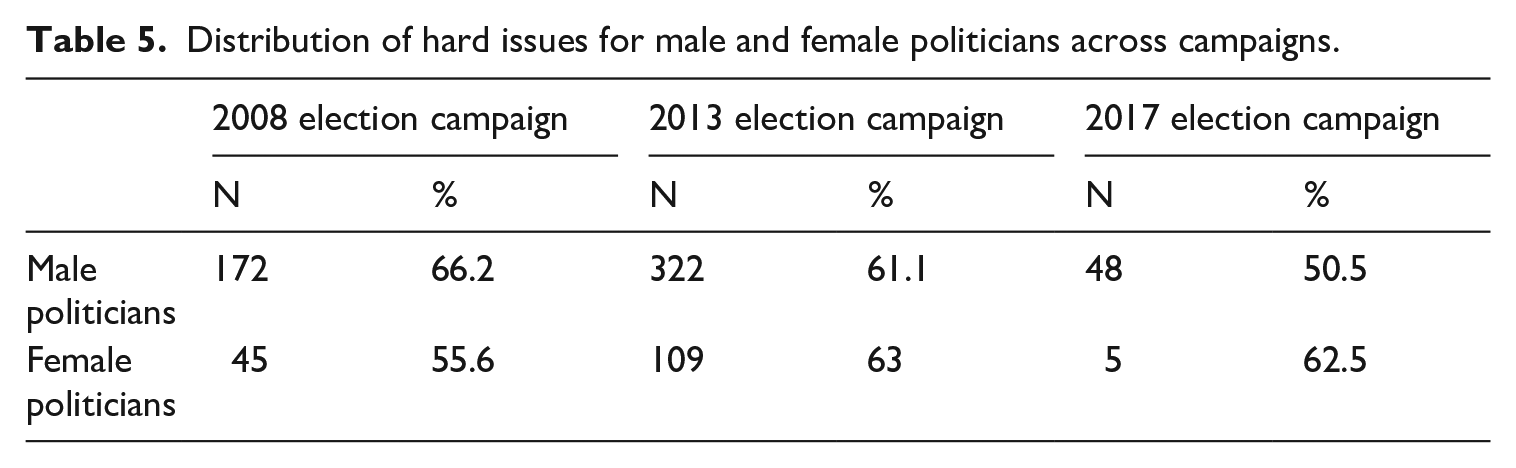
Following these findings, we took a closer look at the type of policy issues male and female politicians were featured with and examined whether women’s ownership of hard issues had increased over the past 10 years (see Table 5). We had to neglect the figures for 2017 as the number of observations is too small, but the 2008 and 2013 figures show that the share of hard issues in articles with female politicians as main actors increased from 2008 to 2013. In fact, the share of hard issues was almost the same in 2013 for male and female politicians. Again, we have to remember the roles the most visible female politicians were occupying. In 2013, Johanna Mikl-Leitner was the minister for the interior, and therefore, connected to hard issues by office, and Eva Glawischnig as the Green’s top candidate had to be prepared for a broad range of issues from soft to hard. Leading up to the 2017 elections, however, only three cabinet members were women, and they were responsible for soft issues, and only the Green Party, which did not make it into parliament, was led by a female candidate. Therefore, only five articles in total covered hard issues with females as main actors.
Distribution of hard issues for male and female politicians across campaigns.
Once a woman holds a cabinet position, however, the respective issue is much more likely to be associated with a female actor in the news. Table 6 shows a logistic regression model with the gender of the main actor as a dependent variable and hard issues as well as female minister as explanatory variables, controlling for media type and the election year. First, we confirm the earlier finding that female main actors occur less frequently in articles with ‘hard’ issues. Second, we show that having a female minister in power in the respective issue area strongly increases the probability of a female main actor in the article (for more detail, see Supplemental Figure A). We reaffirm our earlier findings that female politicians in power lead to a higher visibility in the media.
Female politicians’ coverage with hard issues.
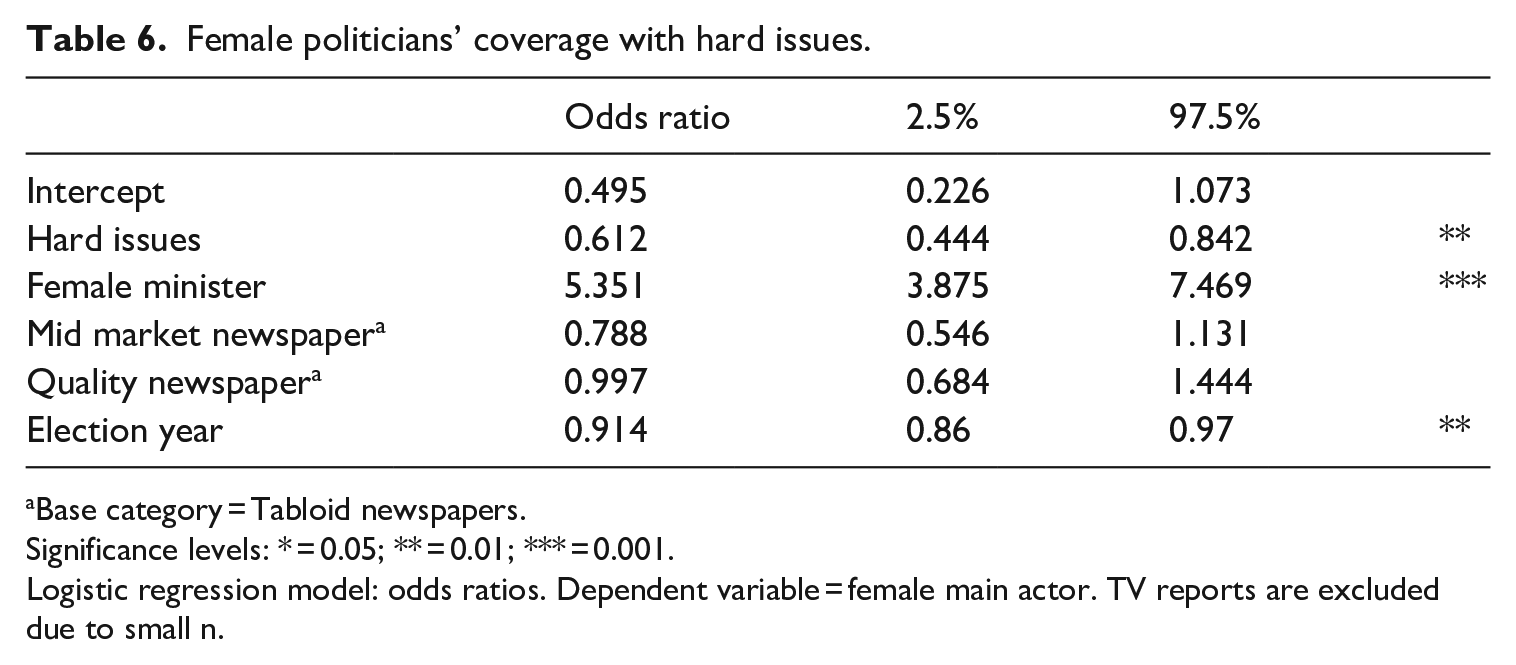
Base category = Tabloid newspapers.
Significance levels: * = 0.05; ** = 0.01; *** = 0.001.
Logistic regression model: odds ratios. Dependent variable = female main actor. TV reports are excluded due to small n.
Female politicians across media outlets: Similarities and differences
When analyzing female politicians’ representation in campaign coverage across different media outlets, similarities and differences between the various media outlets are of interest. The data in Table 7 reveal the share of media reports featuring female politicians across media outlets for all three elections. While slight changes between elections occur across all media outlets, they are not statistically significant. There is neither a specific tendency for a single medium, for newspapers or TV, nor quality and tabloid media.
Distribution of female politicians (as main actors) across media outlets and across campaigns.
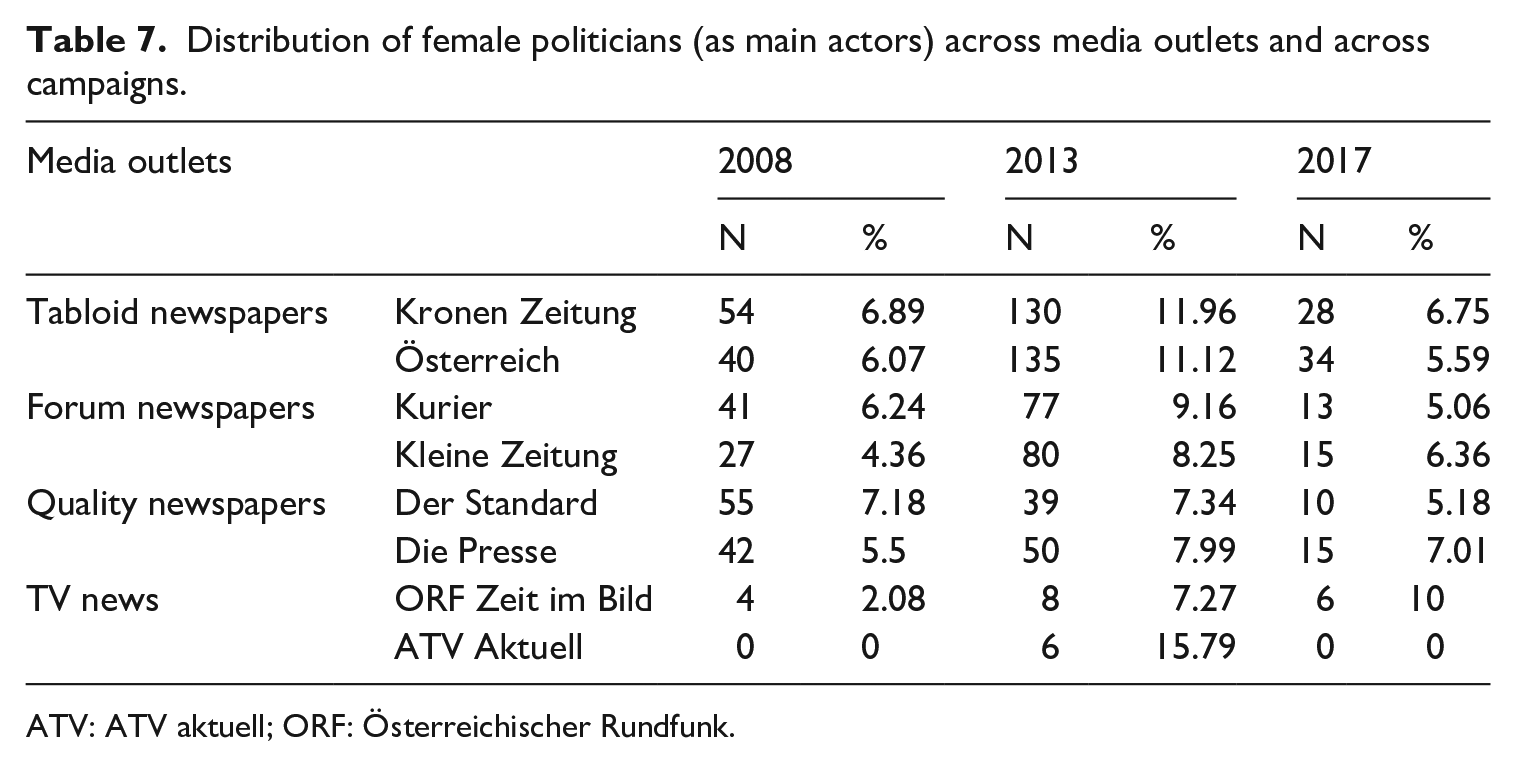
ATV: ATV aktuell; ORF: Österreichischer Rundfunk.
Concerning quality and tabloid media, we hypothesized that tabloid media is less likely to report on female politicians. The logistic regression model displayed in Table 8 shows that we have to reject our fifth hypothesis. With television news as the base category, we can see that media types do not differ significantly from each other. Changing the base category returns similar results. Reporting on female politicians is not correlated to the media type; in fact, when looking at the percentage of female politicians mentioned in each of the media outlets, the tabloid Kronen Zeitung shows the highest figure, with 17 percent of the politicians mentioned being female.
Logistic regression model: Media types, odds ratios.
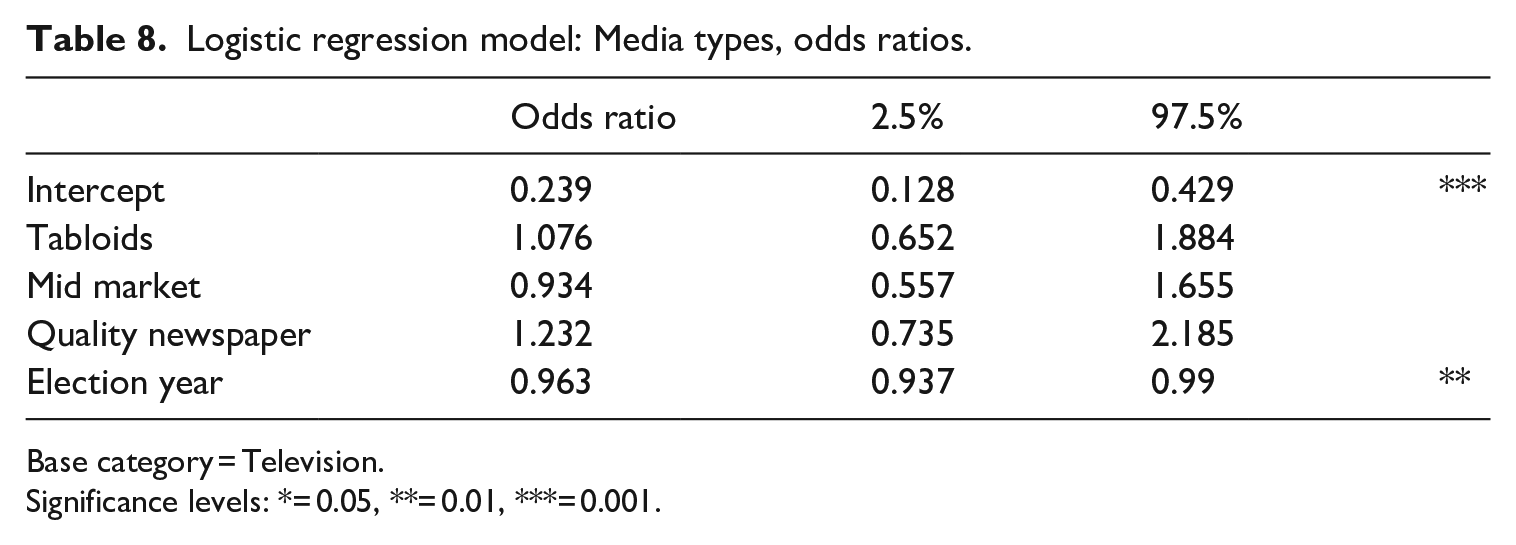
Base category = Television.
Significance levels: *= 0.05, **= 0.01, ***= 0.001.
Discussion and conclusion
Following previous research in the field, this study argued that male politicians are likely to have greater visibility than female politicians in Austrian election coverage over time (H1). Confirming H1, female politicians are almost invisible in campaign coverage in Austria over the past 10 years – and hence, we assume female politicians were also underrepresented in politics before that time. Unlike H2 predicted, the increasing share of female politicians in politics over the past 10 years did not translate to a greater visibility of female politicians in campaign coverage. In 2017, fewer female politicians were the main actor in newspaper articles and TV news reports than in the campaign coverage of the two previous elections. This is congruent with the findings of Hooghe et al. (2015), who concluded that female MPs receive significantly less speaking time in television news broadcasts in Belgium than their male colleagues and this does not change over time. By analogy to the ‘paper ceiling’ as described by Shor et al. (2015: 964), we can talk of a ‘media ceiling’ characterized by women being underrepresented in political news coverage across different media outlets. In addition, the findings reveal an increasing personalization of political media coverage over time of which male politicians benefited.
According to our findings, female politicians can increase their visibility in the media only when they are either a member of the cabinet or the party’s top candidate. Only those who have powerful positions get the coverage. Similarly, Hooghe et al. (2015) found that holding an elite position was a strong predictor for female politicians to receive speaking time in television news, but even then, ‘they receive less time in the news than men. The observed difference therefore will not simply disappear when female MPs acquire elite positions’ (p. 407). Women in top positions are still an exception in Austrian politics Indeed only in September 2018 Pamela Rendi-Wagner became the party leader of the Social Democrats; the first woman in the party’s 130-year long history. The Austrian People’s Party and the Freedom Party of Austria have never had a female party leader or contested an election with a female top candidate. Female top candidates led only seven party campaigns since 1945, five of them by the Greens and two by the Liberal Forum. These two more progressive parties, however, are also considerably smaller, making it even more difficult for the top candidate to become prominent in media coverage.
Consistent with H3, female politicians were less frequently featured on ‘hard’ issues news compared to male politicians in the analyzed campaigns – even though the minister of the interior, responsible for the police system, was a woman in two of the three analyzed election campaigns. Across all campaigns, female politicians only dominated the campaign coverage of a single ‘soft’ issue: culture. Even over time, as predicted by H4, the findings only show a slight increase of female politicians on ‘hard’ issues between the 2008 and 2013 elections. In the 2013 election, the share of hard issues was almost the same for male and female politicians. Again, the connection of female politicians to ‘hard’ issues seems to be a question of the role the political actor occupies – being responsible for a ‘hard’ ministry or being the top candidate translates into coverage on hard issues regardless of gender; however, women rarely occupy these positions. This can influence the voter’s perception of female politicians’ suitability for office and their likelihood of being elected.
Politicians in power receive media coverage – whether they are men or women. This struggle for visibility, however, is more crucial for women than for men. Female politicians who are not in the first row – ministers or top candidates – are not covered; in policy areas where a woman is in power, the probability of coverage increases drastically. In this context, the general trend of personalization and of an increasing focus on leading figures in campaign coverage contributes to even lower visibility of women in media reports. Despite an increase of female politicians in politics, the findings show that the power struggle is still ongoing. The findings on gender-biased inequalities and exclusion demonstrate how the media discourse fails to approximate the requirements of gender equality and inclusion. The media play a crucial role in the perception of politics, in general, and in particular, in the run-up to the elections, because they provide voters with essential information regarding different political alternatives. The media are among the most important institutions influencing citizens’ gender role attitudes, hence, the media are involved as actors in the process of gender equality and inclusion. They should serve as a critical forum, provide a balanced representation of male and female politicians, and reflect the different perspectives (see also Humprecht and Esser, 2017), because an ‘equal and fair participation of women and men in political debate is fundamental for democracy’ (Council of Europe, 2017: 5). Unlike H5 predicted, our findings show that a more balanced coverage of male and female politicians cannot be found even in quality media. Instead of playing a significant part in pointing citizens toward these inequalities in politics, the media marginalize female politicians – especially when the political elites nominate fewer and fewer women for prominent positions, as was the case in 2017. This goes for all media outlets; the findings show no specific tendency for a single medium.
The consequence of the low visibility of female politicians in the media is that voters are less familiar with them than with their male counterparts. The consequence of female politicians primarily being featured in relation to ‘soft’ issues is that voters perceive them as weaker than they perceive male politicians. Male politicians are always featured with regard to ‘hard’ issues – the important political issues. When it comes to deciding who should fill a political position, men have a better chance of winning votes, because of the stereotyped media portrayals. Consequently, the indicator gender should not be underestimated in election campaigns (see also Banwart et al., 2003; Hooghe et al., 2015: 408; Semetko and Boomgaarden, 2007) also emphasize that ‘a lack of media attention for female politicians may stimulate beliefs that the democratic system is not open to everyone’. Political parties as well as the media have to adapt to ‘new social realities’ (Hooghe et al., 2015: 408), which are displayed in women – albeit slowly – gaining more power in socio-economic, media, and political realms. Parties should promote women to more prominent positions, such as on the lists of candidates, if they want to allow them more media presence. The media as outlined in the previous paragraph is not following the journalistic norm of a balanced coverage of male and female politicians. However, balance is emphasized by the Council of Europe (2017) and for quality media through self-imposed guidelines as well as the Federal Act on Austrian Broadcasting, the ORF Act. Especially in a free press system, journalists should be aware of their responsibility to report in a way that reflects political realities, because voters need to be able to make an ‘informed, rational choice’ (Atkeson and Krebs, 2008: 249). Only then will norms be more than an aspiration. Studies on agenda setting over the past 40 years have shown that voters rely on the media for information on politics, and hence, the media influences voting behavior (Iyengar and Kinder, 1987).
This article provides the first insights into media coverage of female politicians in Austria. It would be beneficial to compare these results with data from other countries, taking into account different candidate selection processes or media laws. Austria is a small country and newspapers have a strong position in the Austrian media market. Furthermore, it would be insightful to contrast these results with the parties’ own communication through press releases; for instance, is overlooking female politicians a media phenomenon, or do the parties themselves primarily focus on their male candidates? Finally, our findings over time raise the question of how the media generally treats women – not only politicians – in campaign coverage, such as female experts and women in the streets. With the increasing adoption of voluntary or mandatory quota systems in politics, economics, education (universities), and so on, this is an important question for future research, because the media as a mirror of society can support or oppose societal changes.
Supplemental Material
H-R-coverage_appendix2 – Supplemental material for Those who have the power get the coverage – Female politicians in campaign coverage in Austria over time
Supplemental material, H-R-coverage_appendix2 for Those who have the power get the coverage – Female politicians in campaign coverage in Austria over time by Lore Hayek and Uta Russmann in Journalism
Footnotes
Funding
The author(s) disclosed receipt of the following financial support for the research, authorship, and/or publication of this article: This research was partly carried out under the auspices of the Austrian National Election Study (AUTNES), a National Research Network (NFN) sponsored by the Austrian Research Fund (FWF) (S10905-G11).

Supplemental material
Supplemental material for this article is available online.
Notes
Author biographies
References
Supplementary Material
Please find the following supplemental material available below.
For Open Access articles published under a Creative Commons License, all supplemental material carries the same license as the article it is associated with.
For non-Open Access articles published, all supplemental material carries a non-exclusive license, and permission requests for re-use of supplemental material or any part of supplemental material shall be sent directly to the copyright owner as specified in the copyright notice associated with the article.
