




Abstract
The aim of this study is to map and scrutinize developments within Swedish cultural journalism, with a particular focus on transformations in genres, text types and thematic repertoires. Drawing on a constructed week sample from press, television and radio during four decades (1985, 1995, 2005, 2015), we address three aspects of ‘the crisis discourse’ of cultural journalism: (1) the potential decline in cultural coverage due to economic cutbacks and downsized cultural desks; (2) cultural journalism’s perceived ‘quality crisis’ connected to transformations of thematic repertoires; and (3) the alleged decline of cultural expertise related to changes in cultural journalism’s generic structures. The study makes a unique contribution to cultural journalism scholarship by identifying media-specific differences and complementary relationships between media forms, building on media ecology and genre theory. In contrast to the crisis discourse, results show that cultural journalism has expanded significantly through popularization and thematic and generic diversification, but the transformations are different in press, radio and television due to differing role positions in the larger media ecosystem. In addition, some parts of the cultural journalism media ecology appear to be endangered.
Keywords
Introduction
Due to the considerable changes taking place in the media landscape in the last decade, the notion of a crisis in journalism has repeatedly resurfaced in the public debate and scholarly discussion. Jay Blumler (2010) has referred to two aspects of journalism’s crisis: an economic crisis, referring to changes in newspapers’ advertiser-supported business model, and a ‘civic adequacy’ crisis, or what is in essence journalistic quality. As Blumler points out, while the civic adequacy crisis of journalism is not new, it has accelerated after the digitalization and fragmentation of the media market. The crisis of journalism is also connected to an ongoing debate among journalists and scholars about a crisis in the subfield of cultural journalism, although the sources and motivations are different (Jaakkola, 2017: 51). An example of this debate spread from Denmark and Norway to Sweden in the autumn–winter of 2017, when a series of news industry-sponsored studies of the ‘decline of criticism’ were published (e.g. Edenborg, 2018; Undheim Larsson, 2017). The studies pointed to a sharp decline of the review genre in many important newspapers across the region. This is a paradox, given that international scholarly research on the same phenomenon points mainly to stability for the review genre, alongside a significant expansion of cultural journalism over time (cf. Heikkilä et al., 2017; Kristensen, 2010). In Sweden, however, longitudinal studies have been scarce, and there are few studies exploring developments over time beyond comparative case studies or practitioner interviews (Lund, 2005; Riegert and Widholm, 2019; Sarrimo, 2017). Sweden is an interesting case to examine, not only because of this research gap but also because Swedish cultural journalism has proved to be relatively unique in its stronger focus on political and international issues compared to its Nordic neighbours (Riegert et al., 2015; Roosvall and Widholm, 2018). Furthermore, the prevalent press bias in both industry studies and international cultural journalism scholarship calls for studies that include a broader spectrum of media, not least in Sweden, where public service television and radio are key institutions for cultural coverage in the public sphere (Hellman et al., 2017b; Riegert and Roosvall, 2017). News media environments can be likened to ecological systems, where a potential crisis for one species could be lethal for other species as well, while yet others could instead start to flourish. According to such a view applied to journalism, all parts of a journalistic environment are connected and interdependent (Scolari, 2013). Cultural journalism has been described as a ‘delicate plant’ in the broader Swedish media environment (Sommelius, 2014), emphasizing both its importance and vulnerability in times of economic crisis. An important backdrop to this vulnerability is the accelerating media convergence, which makes it problematic to restrict the study of cultural journalism to newspapers only.
Departing from the scholarly discussion about the crisis of cultural journalism, the aim of this article is to map and scrutinize content developments in Swedish cultural journalism from a media ecology perspective with a particular focus on transformations in thematic repertoires and genres. The study addresses three aspects of the crisis discourse. First, the decline in cultural coverage as a result of economic cutbacks and downsized cultural desks, especially in the press. Second, cultural journalism’s ‘quality crisis’ as reflected in transformations of its thematic repertoire. Third, we address the decline of professional expertise as reflected in the way cultural journalism’s generic boundaries and text types have changed.
The term ‘quality crisis’ refers here to two distinctive interpretations of cultural journalism’s thematic development primarily among practitioners (Riegert et al., 2015). On the one hand, there are those who are worried that commercialization and popularization impoverishes cultural journalism and that more narrow and non-commercially viable cultural areas may be increasingly excluded. Others point instead to how a popularized and more inclusive cultural journalism can reach more readers and thereby be more democratic. These interpretations of thematic quality are not necessarily in conflict, but they underscore different aspects of cultural journalism’s contribution to the cultural public sphere (cf. Jaakkola, 2015c; Kammer, 2015).
Drawing on a constructed week sample in each of the years 1985, 1995, 2005 and 2015, we thus ask if the amount and length of Swedish cultural items have changed; to what extent the thematic repertoires and text types/genres of cultural journalism have changed; and whether there are noticeable differences and changing relationships between different media over time in the ecosystem of cultural journalism.
In what follows, we begin by reviewing three analytical prisms through which the crisis of cultural journalism has been discussed in previous research followed by a section on media ecology. Subsequently, we detail our sample and the content analysis. The article ends with a discussion.
Downsized but expanded – Cultural journalism’s economic crisis
The crisis in journalism’s business model is often seen as the result of global structural changes such as the loss of print advertisers to the Internet, technological and regulatory changes allowing competition from global online players and the fragmentation of audiences, who are now interactive multiplatform consumers. The prevalence of this ‘master narrative’ is confirmed by a six-country study that found that, despite varying profit and job losses, and differing state intervention in European countries, all seemed to accept the US paradigm: innovation and new business models would solve the problem (Brüggemann et al., 2016). In the meantime, newspapers have cut losses by conglomeration, becoming multiplatform ‘media houses’, streamlining jobs and shrinking news desks. Many cultural desks have lost their prized editorial economy, as central managerial control has increased (Hellman et al., 2017a; Sarrimo, 2017). The new generation of cultural journalists are more oriented towards journalism and less educated in the arts and humanities than the cultural critics of previous generations (Hovden et al., 2017; Hovden and Knapskog, 2015). Cultural journalists are also more likely to be tasked with producing multiplatform journalism than previously.
Up until 2010, longitudinal studies of the European and Nordic press, demonstrate an overall increase in the quantity of space to culture. This was true of both the number of pages devoted to culture and other measures of editorial cultural content from the 1960s until 2010 (Heikkilä et al., 2017; Kristensen and From, 2011). Regarding reviews, however, Jaakkola (2015a) shows a proportional rise and then a decline in reviews in the Finnish press between 1978 and 2008. Other studies did not find a decline in the space of reviews (Kristensen and From, 2011; Reus and Harden, 2015). Heikkilä et al. (2017) studied the cultural pages of elite newspapers in five European countries from the 1960s to 2010. They came to the conclusion that ‘no evidence can be found for the crisis of cultural journalism if one bases that on a decrease in the amount of space devoted to culture’ (p. 13). They do, however, point out a general increase in illustrated articles, as well as a greater commercial orientation.
These findings are in contrast to interview-based studies of Nordic cultural practitioners (Riegert et al., 2015; Sarrimo, 2017), which point to economically driven structural changes that cultural editors find alarming. One possible reason for this difference could be that most of these longitudinal studies do not cover the period after 2010. A second reason is that the interview-based accounts and public debate of the economically driven changes tend to mix economic aspects with thematic changes in cultural journalism and with the professional identity crisis prompted by organizational changes to the cultural desks.
Thematic transformations in cultural journalism
Cultural and arts journalism have been defined in three ways by different researchers. Some scholars concentrate on ‘arts journalism’, which is a subset of cultural journalism, whereas others look at content produced by specific cultural desks, or by journalists that describe themselves or define their product as cultural journalism. A third definition includes journalism about culture, whether it is labelled culture journalism or not (Riegert et al., 2018). In this study, we use the second definition, that is, the content produced by the cultural desks of the press and public service radio and television.
Despite varying definitions, studies across Europe and the Nordic countries find a similar trend: an increasingly broadened conception of arts and culture in the press. The changes have been traced to the early 1990s, when newspaper formats allowed for more thematic sections and supplements. This was also a period of deregulation of media markets, which led to an increased international flow of media and cultural products, and more cultural advertising, which increased the size of the cultural sections of newspapers (Szántó et al., 2004). At the same time, the public demonstrated increasing curiosity for popular culture products, in what many authors refer to as the increasing cultural omnivorousness of the Western middle classes (see Jaakkola, 2015b). Janssen et al. (2011) connect this to the democratization of higher education, increased social mobility, the impact of minority voices and identity politics (on taste) and processes of individualization, all of which undermine previous cultural taste hierarchies.
Longitudinal studies of cultural and arts journalism show an increase in the number of aesthetic areas covered – not simply through including more kinds of popular culture like thrillers, television series or popular music, but new cultural areas also appear, such as gaming and media industry reporting (Kristensen, 2010; Schmutz et al., 2010). In this expanded mix of aesthetic areas, some have lost ground, notably classical music and theatre, whereas film and popular music have increased in both Nordic and European countries (Larsen, 2008; Verboord and Janssen, 2015). In a comparative study of cultural journalism in six European countries, Purhonen et al. (2017) found that the inclusion of popular culture between 1960 and 2010 in Sweden’s daily Dagens Nyheter was mainly confined to music, film and television. In this context, it is interesting that Dagens Nyheter was found to have an earlier and stronger increase in popular music than comparable papers in other European countries. Janssen et al. (2011) also found differences between countries regarding the general shift to popular cultural themes in their study of elite newspapers in the United States, France, Germany and the Netherlands between 1955 and 2005. The Dutch and, particularly the German press, retained more focus on ‘high’ culture, but the traditionally important film and fashion industries in France necessitate contextual sensitivity when defining them as popular culture. In sum, this research points to similar general trends across Europe regarding thematic shifts, but that caution should be exercised to avoid generalizing across national borders regarding cultural journalism.
Genre transformations and professional boundaries
Cultural journalists have long considered themselves to be outliers in mainstream media organizations. They are, as Forde (2003) puts it: ‘journalists with a difference’. Nordic studies designate cultural journalism as a hybrid field characterized by a ‘dual professionalism’ with journalists working either within the ‘aesthetic paradigm’ or within the ‘journalistic paradigm’ (Hellman and Jaakkola, 2012). Studies have shown a gradual expansion of the journalistic paradigm over time, due to tighter organizational control over the cultural departments and a professionalization of the workforce (Hellman et al., 2017a; Sarrimo, 2017: 788). Hellman and Jaakkola (2012) describe the journalistic paradigm as one that refers to democracy, uses fact-based communication about the arts, and employs an immediacy-based approach to culture. This is contrasted to the aesthetic paradigm, which promotes quality in the arts, bases arguments on field expertise and emotional experience and employs a primarily retrospective approach to culture. Thus, the journalistic paradigm is an adaption of journalistic values such as objectivity, immediacy and ethics to the cultural field, whereas the aesthetic paradigm cherishes historically established ‘specialized’ values of cultural journalism, such as subjectivity, commitment (to arts and culture) and pedagogicality (educating the audience) (Jaakkola, 2015a). The differences between the two paradigms are moreover manifested in distinctive genres and writing styles. Cultural news, interviews and reportages, for example, are key genres of the journalistic paradigm, whereas the aesthetic paradigm most often is bound to cultural criticism and the review genre.
Scholars have pointed to a diversification of genres in cultural journalism over time, but genre categories differ between studies and national contexts. Jaakkola (2015a) documents the numeric dominance of the news genre in Finnish cultural journalism and a rise in personal features, commentaries, and specific formats which do not fit into traditional generic categories. In their study of French, German, Dutch and US arts journalism from 1955 to 2005, Verboord and Janssen (2015: 841) point to an increase in ‘background articles’ and interviews at the expense of reviews. Similarly, Hellman et al. (2017a) report an increase in portrait interviews and cultural reportage in Finnish cultural journalism, whereas Kristensen (2010: 84–85) finds an increase in both ‘preview articles’ and ‘in-depth genres’ between 1970 and 2008.
Despite a considerable research interest in genre development in cultural journalism, there is no common agreement as to how certain genres are to be conceptualized or theorized. In relation to the crisis of journalism, it appears for instance in discussions of the blurring of genres, in prognostications of the death of certain genres as well as in studies of the birth of new genres (Kristensen, 2010; Kristensen and From, 2012). In genre theory, genres are sometimes described as pre-textual rather than textual; for example they draw on a network of conventions that are recognizable for both producers and consumers who know already when they encounter a text what types of readings should ideally be evoked (Fiske, 1987). Such pre-textual features are manifested via style signals, which means they are defined by structural conventions rather than by specific perspectives of texts. An important function of a genre is also that it is bound to social actions that come with certain communicative goals and is connected to certain rhetorical situations (Berge and Ledin, 2001). The interview genre for instance carries certain style signals, connected to the Q&A structure, which makes it different from genres where the individual voice plays a more marginal role (Fairclough, 1995). The review genre is likewise characterized by evaluative and classificatory conventions and goals that distinguishes it from other subjective genres such as editorials, columns, or essays (see Riegert and Roosvall, 2017).
In this study, we acknowledge genre as a theoretical and a practical concept and apply a critical view on genre concepts used by the news media. We argue that a simple use of established practitioner terms may hide the genre-blurring and development that we are interested in. Thus, we draw on the concept of ‘text type’ as developed in genre theory as a way of identifying broader transformations in the generic consistency of cultural journalism (Werlich, 1976). Text types are closely related to genres in that they are identified by stylistic aspects of texts. They are, however, not defined by their communicative goal in the same sense and do not need to appear in a certain rhetorical situation. This is pertinent here, as we recognize that the goals and rhetorical situations of cultural journalism may change in the ‘new media ecology’ (Deuze, 2008, see below). Werlich (1976) distinguishes between descriptive, narrative, expository, argumentative and instructive text types. These categories encompass much of the types of change that journalism scholars are discussing regarding genre development, for example descriptive versus argumentative, and makes the study relevant also for the journalistic field more broadly.
We consider also thematic specificities of cultural journalism. A study exploring political and cultural opinion articles in Sweden and Denmark revealed significant differences between texts published in cultural sections compared to editorial and debate pages of newspapers, despite both being ‘argumentative’ text types in Werlich’s terminology (Kristensen and Roosvall, 2017). This points to the importance of studying genre development in a subfield such as cultural journalism, since the overarching subject discussed – culture – seems to have an impact on genre- and text-type characteristics. In fact, some genre definitions emphasize themes and subjects as crucial for understanding and pinpointing genres (Bakhtin, 1999: 121; Gardiner, 1992). Our study encompasses both text type and theme dimensions (see ‘Methodology’ section), even though we focus more on text types when we discuss generic developments.
In the analysis, we discuss these generic developments from a media ecology perspective. Ecology studies examine the relationship between a group of living things and its environment. In the same way that specific combinations of plants and animals make up natural ecosystems, media ecosystems are made up of different media forms, formats and genres, as well as different types of media actors and journalists (Scolari, 2013). In this study we approach cultural journalism as a specific media ecosystem where press, radio and television may play different roles, and this may also vary over the years due to media structural changes. An ecosystem perspective can provide insights into the balance between different media forms with regard to what Scolari (2006) calls evolution and interface. Evolution concerns issues of media/genre/text type extinction, survival and coevolution. Interface, in turn, focuses on interactions regarding media (such as radio, television and newspapers), subjects and the social. 1 In this article we do not consider interfaces between media and readers/users, but interface as ‘a place where media interact with each other and co-evolve’ (Scolari, 2006: 216), as inter- and intra-media interfaces, for example how the evolution of media/genre/text type extinction, survival and coevolution appear when diverse media are related to each other and when a certain section of one medium – such as cultural journalism – is considered. While we do not focus on digital media forms, we examine a period when journalism has become more fluid, that is, the larger ‘new media ecology’ (Deuze, 2008) can be assumed to have an impact on (and be impacted by) what is happening in the subfield of cultural journalism, for instance, regarding the success of cultural debate articles in the digital era (Riegert et al., 2015).
Methodology
The study is based on a content analysis of cultural journalism in press, radio and television during 4 years: 1985, 1995, 2005 and 2015. In 1985, the Swedish media landscape was marked by the broadcasting monopoly held by the public service broadcasters Sveriges Radio (SR) and Sveriges Television (SVT), while the printed press had a large readership and a thriving economy. The years that followed are characterized by technological, political and economic upheavals that have had distinctive consequences for the Swedish media ecosystem. Broadcasting market deregulation introduced commercial radio and television in the 1990s. The years after the new millennium brought shrinking newspaper revenues, media concentration, convergence and digitalization. Severe economic pressures appearing in the media landscape of 2015 consisting of social media and multiplatform media resulted in the downsizing of staff and streamlining of content in the press (cf. Weibull et al., 2018). These pressures have been less evident in the public service broadcasting organizations, which instead faced pressure to reach audiences in an increasingly competitive environment online.
While SVT and SR have a mandate to cover a broad range of cultural circuits, locally, nationally and globally during the studied years, they have had complementary roles to the opinion-driven critical press, due to their wider national reach and impact, and state regulation. Both broadcasters distinguish between programmes that ‘monitor, reflect and scrutinize’ the cultural public sphere and their own ‘expressive’ cultural production, like drama or live event broadcasting (Sveriges Radio, 2016; Sveriges Television, 2016). Only programmes in the former are included in the sample as cultural journalism, that is, cultural news (which includes reviews and opinion), cultural magazine shows and cultural documentaries. This means that less of the broadcasters’ total cultural output is considered here than in the press however important it was to ensure comparability between media. Although genres such as reviews, news and reportages are similar in all media, the press has a wider palette of genres. Broadcasting also tends towards genre hybridization, as exemplified by the way that reviews take the form of interviews in cultural television news. These differences are alleviated by the use of text types in a cross-media comparison.
Three criteria guided our selection of newspapers: (1) size of readership and influence on the national public debate; (2) newspaper type (a mix of tabloids and morning newspapers with both national and local distribution) and (3) ideological diversity. The selected newspapers include the largest Swedish tabloid, which has national distribution and a left-leaning editorial page (Aftonbladet); two Stockholm-based morning newspapers with a liberal (Dagens Nyheter) and conservative (Svenska Dagbladet) orientation, where the first is considered the most influential newspaper in the nation; and two morning newspapers with a liberal orientation based outside of the capital area – one in Gothenburg (Göteborgs-posten) and one in Helsingborg (Helsingborgs dagblad). The liberal/conservative bias in the sample reflects a larger ideological imbalance on the newspaper market in Sweden (Weibull et al., 2018).
Data were gathered as a constructed week sample from each year and media (N = 2768). Due to the scarcity of material broadcast during 1985 and 1995 in radio and television, we chose to include an additional week for these 2 years in order to enable valid comparisons over time. Results are weighted with regard to amount and length for these years. We used the print editions of the newspapers. The television and radio material were identified through archived programme schedules of two television channels (SVT1 and SVT2) and one radio channel (P1). The unit of analysis was individual articles in the press and thematic programme sequences in radio and television. Programme sequences are the equivalent of ‘articles’ in the press, and they constitute distinctive thematic building blocks of cultural programmes in both television and radio. Typical examples of such sequences are individual reviews, news stories, interviews or reportages, but they can also appear as ‘thematic turns’, clearly articulated by talk show hosts in their conversation with other cultural journalists or invited guests. In order to provide valid comparisons between press, radio and television, we draw conclusions mainly on the basis of changes in the frequency of published/broadcast items rather than on item length.
Variables and operationalization
The study seeks to disentangle the crisis of Swedish cultural journalism with regard to the amount of cultural journalism produced, developments of the thematic repertoire and changing uses of text types. Amount was coded in terms of the number of published items during each year and media. The length of television and radio items was coded in terms of duration in seconds. For the press, length was coded using an ordinal variable assigned the following six values: More than one page, one page, half a page, quarter of a page, eighth of a page and less. This is an established measurement of length that has been used in other longitudinal studies of cultural journalism both in Sweden and elsewhere (e.g. Heikkilä et al., 2017). Press articles were also coded nominally for the prevalence of images and illustrations. The share of visual material for each item was registered on the basis of the following categorization: (images constitute) the entire article space, half of the article space, a quarter of the article space or less.
The thematic repertoire was coded using 11 nominal categories such as performing arts, visual arts, popular music and so on. Text types, at last, is connected to cultural journalism’s generic consistency. We coded 19 different genres, from telegrams, news and reportages to culturally specific genres such as reviews and essays. The genres were then clustered into four different text types: descriptive, interpretive/critical, dialogical and narrative text types. Descriptive text types consist of journalistic genres such as news, telegrams, lists, surveys and so on. Interpretative/critical text types constitute the core of the aesthetic paradigm of cultural journalism. This includes cultural criticism expressed through subjective genres such as debate, reviews, essays, analyses, cartoons and columns. Dialogical text types are especially important in television and radio, where the content often takes the form of a dialogue between journalists/critics and invited guests/cultural practitioners. Dialogical text types also include interviews, and it is thereby closer to the journalistic paradigm than to the aesthetic. Narrative text types at last, consist of reportage, cultural documentaries, obituaries and other similar items, which could, for example, be about the cultural scene in Brazil or summarize the history and life of a cultural personality and his or her contribution to the cultural domain. While the reportage is a widely used genre also in journalism, it does not necessarily lean on objectivity or factual reporting. Similar to the documentary, the reportage sets the story or ’narrative’ in focus through detailed sceneries and portrayal of people’s lived experiences. Two research assistants did the coding. After the coding was finalized, an intercoder reliability test (percentage agreement) was conducted based on 50 randomly selected items from each media (150 in total or 5.4% of the full sample). The test showed satisfactory levels of agreement for all variables: genre (0.83), theme (0.80), article length (0.90), airtime length (0.90), and image prevalence (0.98).
Results
Let us start by addressing changes regarding amount and size. What traces of a crisis in cultural journalism can be found when looking solely at the quantity of material produced? The first and most obvious answer is that the there are few such signs. Table 1 below displays four different measures for the development of the content produced by the two public service broadcasters, SR and SVT (results for newspapers are presented separately since specific types of measurements are needed for printed texts). The most striking result is that cultural journalism has expanded significantly in both media, both in absolute terms and in terms of total airtime. From 1985 to 2015, the ‘airtime growth’ is 77 per cent in SR and as much as 90 per cent in SVT. The airtime has grown consistently over time in radio, whereas the year 2005 stands out as the strongest year for cultural journalism in television. While the airtime has grown steadily over the years, the length of the items produced has on the contrary declined in both SVT and SR. This decline becomes substantial in 2005. The development towards shorter items is more clearly accentuated in radio than in television. In 1985, the mean length of a radio item was 10.8 minutes, and the considerably shorter items of both 2005 (7.9) and 2015 (6.1) should be seen in light of a changing media environment where speed, immediacy, news and other shorter formats have been increasingly prioritized. The shortening of item length at SVT has been more gradual and evidently less drastic than at SR.
Swedish cultural journalism in public service organizations 1985–2015.
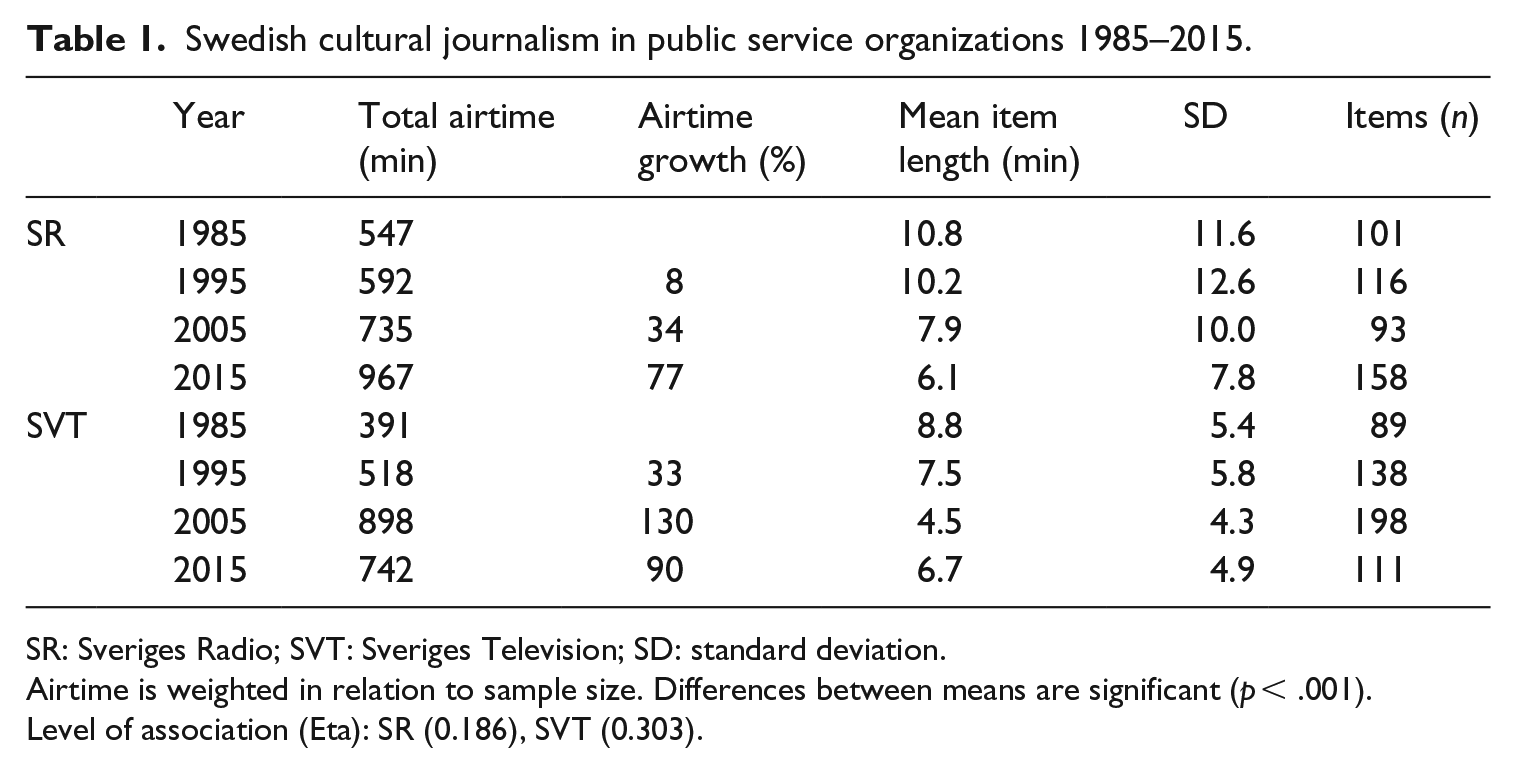
SR: Sveriges Radio; SVT: Sveriges Television; SD: standard deviation.
Airtime is weighted in relation to sample size. Differences between means are significant (p < .001).
Level of association (Eta): SR (0.186), SVT (0.303).
A similar development as in the PSBs can be seen in the Swedish newspapers, with a steady increase in the number of articles produced by the cultural desks. The growth of articles (not in table) between 1985 and 2015 was 76 per cent, with a clear peak in 2005 when the increase was as much as 93 per cent (582 published articles in 2005). In 2005, the press had undergone conversion from broadsheet to tabloid format with less space available for each page. However, the relative length of cultural articles does not seem to have been affected dramatically by these changes (Table 2). The number of articles which were half a page or more clearly increased significantly during the two latter periods, constituting 20 per cent in 2005 and 23 per cent in 2015. The corresponding numbers for 1985 and 1995 were 3 and 9 per cent, respectively. Short articles, covering less than a quarter of a page, have been produced during all studied years, and we see no clear signs of dramatic decreases in length outside the format change.
Length of articles and prevalence of images in press (%).
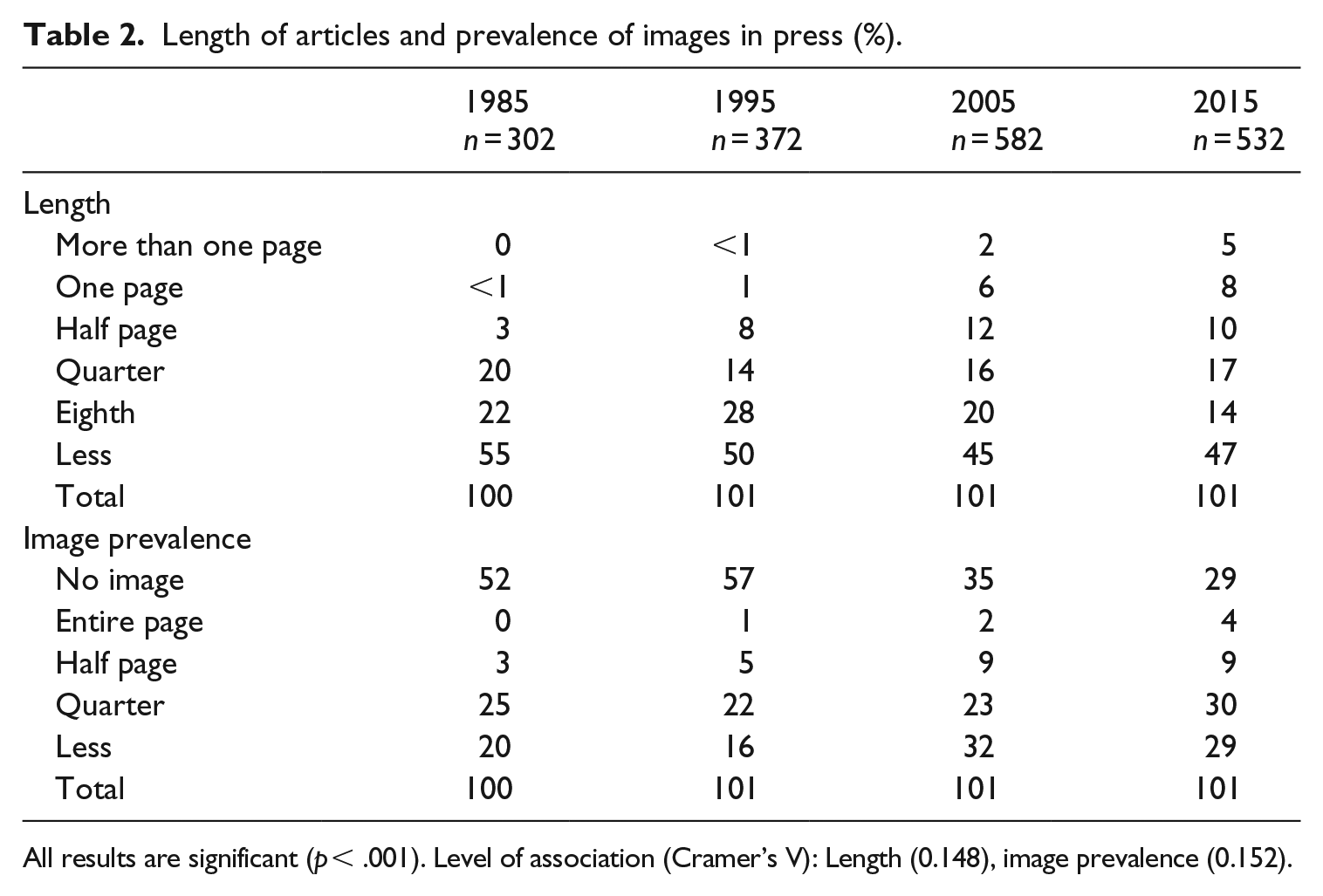
All results are significant (p < .001). Level of association (Cramer’s V): Length (0.148), image prevalence (0.152).
There are however other structural differences that some may consider more critical to the quality of cultural journalism. There has been a prominent increase in the use of images. About 48 per cent of the articles in 1985 included visuals compared to 71 per cent in 2015. Images are moreover not only more common but play a more prevalent role. In 13 percent of the articles of 2015, for example, visual materials constituted half of the item space or more. The corresponding number for 1985 is 3 per cent. Thus, it is not the relative length of the cultural items that have changed in the press but the degree to which items include visual elements.
Thematic repertoires
Results displayed in Table 3 below show three important changes regarding thematic repertoires. At first glance, the distribution seems to have been remarkably stable over time. There is no dramatic decline in coverage of classical areas such as performing arts or visual arts. The number of articles devoted to ‘new’ cultural areas such as lifestyle, fashion or computer games is moreover very limited. There are, however, noticeable changes in some areas in the Swedish coverage. The hallmark of cultural criticism, literature, has gone down from 30 to 20 per cent. Similarly, classical music has gone down from 7 per cent in 1985 and 1995 to 1 per cent in 2015. A steady expansion of coverage devoted to popular music is also noticeable, echoing results from previous press studies in other countries. Yet the most striking result is the differences between media types. The decline of literature coverage is primarily an effect of transformations in radio and the press. The PSB radio stands out the most; in 1985, literature constituted nearly half the cultural desk’s entire production (45%). Thirty years later, literature is rather a cultural theme among others, constituting only 11 per cent. In 2015, the new cultural grand theme in radio is instead film/TV/radio, mirroring a changing status for popular culture, especially movies and television series. One reason music has a comparatively minor role in SR is that we focus on P1, which is a talk channel. Several other channels are devoted exclusively to playing classical and pop music, but these fall outside of our definition of cultural journalism. As noted in a study of the global dimensions of cultural journalism (Roosvall and Widholm, 2018), SR’s cultural desk is unique in that it has foregrounded the societal dimensions of culture fairly consistently over time, which is evident also in the results of this study (societal issues vary between 15 and 39 per cent).
The thematic repertoires of cultural journalism over time (%).
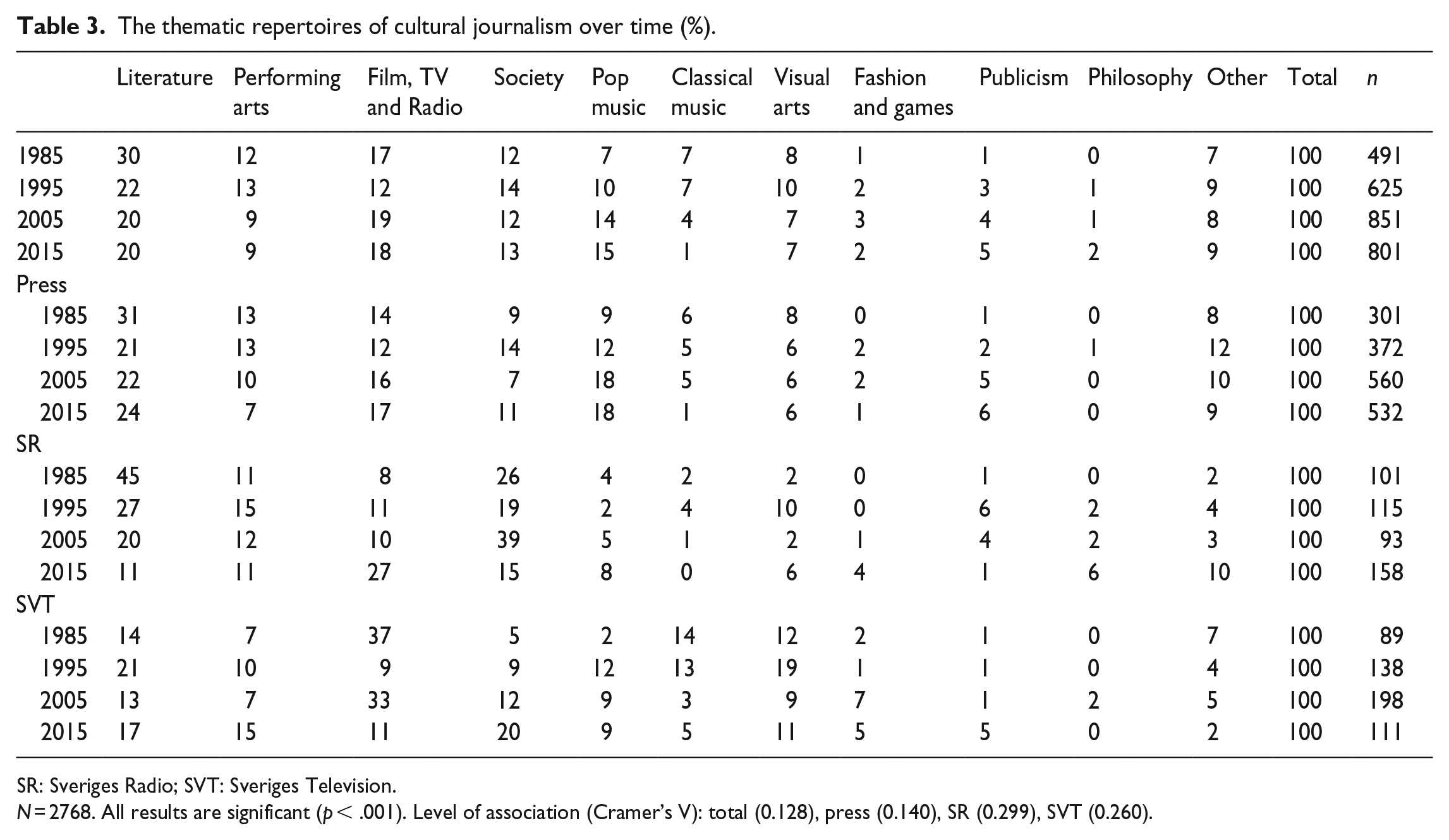
SR: Sveriges Radio; SVT: Sveriges Television.
N = 2768. All results are significant (p < .001). Level of association (Cramer’s V): total (0.128), press (0.140), SR (0.299), SVT (0.260).
Thematic variations over time are clearly visible in the output of SVT, which emphasized film and television greatly in 1985, especially through the influential magazine programme ‘Filmkrönikan’ (the Film Chronicle) and in movie reviews presented in the cultural news bulletins which were particularly common in 2005. SVT was also leaning more towards high-brow culture in the 1980s and 1990s than in the 2000s, which can be seen in the stronger status of classical music.
It is important to note that variations in percentage shares of various cultural themes do not necessarily represent a decline in absolute numbers. The decrease in the percentage share of literature for example is in fact an increase in absolute terms when it comes to the press, but not for SR. Likewise, a weak relative increase in coverage relating to publicism, fashion and games in SVT represents a more noteworthy upsurge in absolute terms due to the expansion of items produced. Our results should therefore first and foremost be understood as changes in the balance and status of different areas in the cultural media ecosystem.
Generic transformations
As previously noted, we use the concept of ‘text types’ as a way of identifying broader generic transformations. There has been a sharp decline in critical and interpretative text types in both radio and the press (Table 4), paralleled by an increase in descriptive text types. The development towards a greater share of descriptive content is evident in all media, and in SVT’s case, it can be related to the introduction of daily cultural news bulletins in 2001. These are clear signs of changes in the balance between the aesthetic and the journalistic paradigms in favour of the latter. The emphasis is no longer exclusively on explicit evaluation, interpretation, analysis and a subjective voice but also on objective or more neutral accounts such as reporting on cultural events, media industry changes and journalistic scrutiny of cultural institutions.
The text types of cultural journalism (%) (N = 2660).
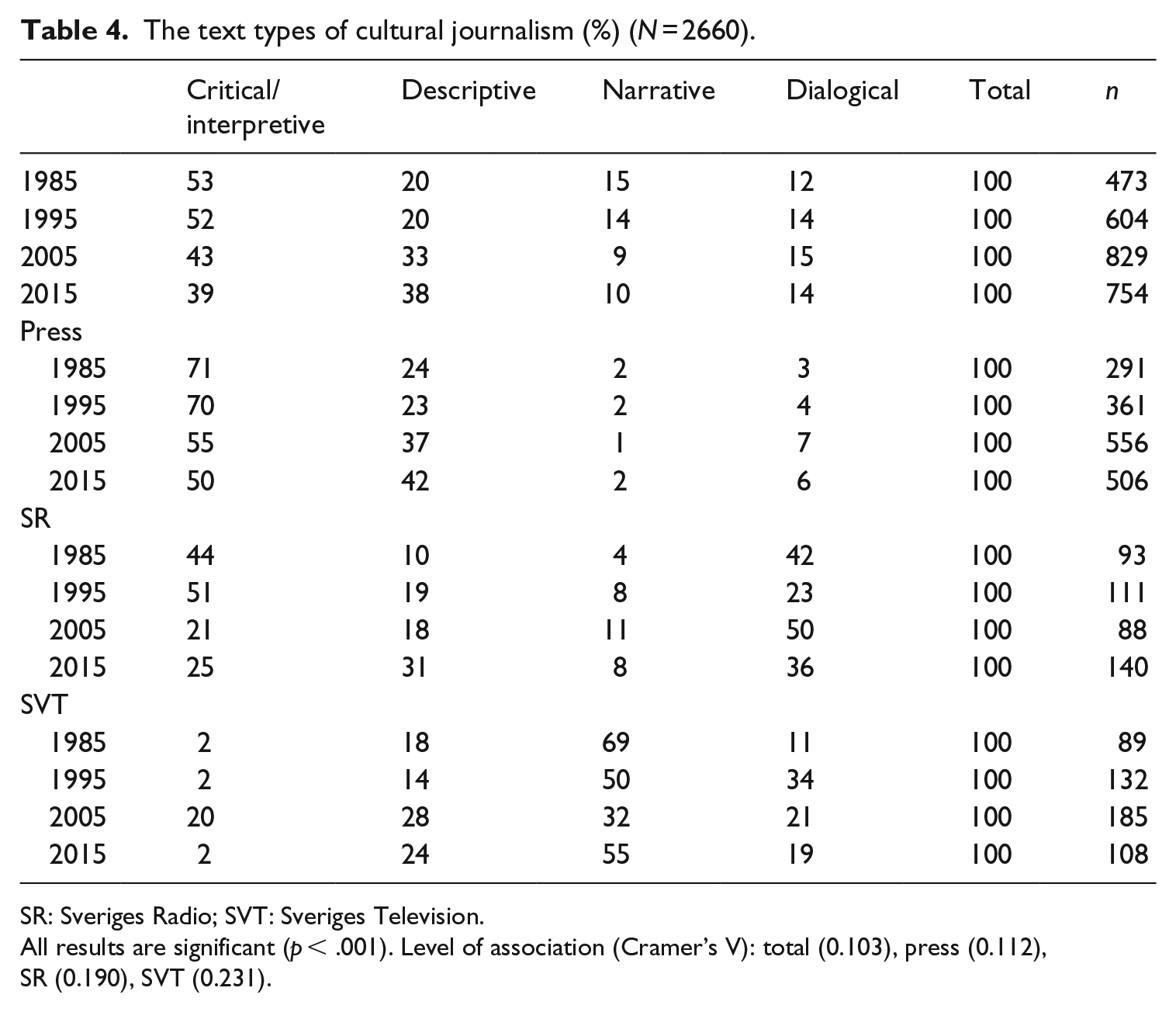
SR: Sveriges Radio; SVT: Sveriges Television.
All results are significant (p < .001). Level of association (Cramer’s V): total (0.103), press (0.112), SR (0.190), SVT (0.231).
It is worth reiterating that a decrease in the overall share of various forms of criticism does not represent a decrease in absolute terms. The number of reviews (not in table), for example, increases significantly in both radio and the press from 1985 to 2015 (yet with a minor decrease in the press after 2005 due to very high levels that year). SVT is somewhat of an anomaly here for 2005. Unlike its press and radio competitors, SVT had less of its material in the form of explicit reviews, prioritizing narrative text types (reportage or documentaries) and, to a lesser extent, dialogical (e.g. talk shows) text types before the 2000s. The dialogical text type is also stronger in radio, which prompts the observation that this is not only media related but is also connected to the classical idea of public service as a democratic arena, where debates are aired rather than certain arguments driven, as in the case with the press, where critical/interpretative text types are stronger in all the years (Hellman et al., 2017b; Riegert et al., 2015).
Conclusion
This study reveals that in contrast to the crisis of journalism discourse, Swedish cultural journalism is thriving both in terms of quantity and scope. Total numbers have gone up, and especially popular cultural themes and descriptive text types have increased, echoing results from previous studies of cultural journalism in the press of other Nordic and European countries. However, this study contributes to existing scholarship not only by identifying similar content developments but also by underlining distinctive media-specific differences and complementary relationships between media forms in the broader media ecology of cultural journalism. Our results show that scholars as well as practitioners need to pay more attention to time when diagnosing problems in cultural journalism. One example is the relationship between SVT and SR. Although cultural journalism has expanded considerably from 1985 and onwards, there is in fact an airtime decline between 2005 and 2015 in SVT. This decline is however paralleled by a continuing airtime growth of cultural journalism in SR. The press also shows a decline in the number of published articles between 2005 and 2015, but this is foremost an effect of shrinking space devoted to culture in one of the newspapers, Svenska Dagbladet. Thus, from a time perspective of 30 years, there is no doubt that cultural journalism is thriving, but the picture looks different depending on media and points of comparison one uses. For the press, where economic competition is fierce, the pressures have not led to a dramatic decrease in the number of articles, despite the significant reduction of staff at most cultural desks. This applies to the field of journalism more generally, where fewer people now produce more content on multiple platforms (Deuze, 2008). A central tendency, however, is that articles consist to a larger degree of images, which means that there is not necessarily more written text, even if the content is defined as cultural journalism.
Media specificity and complementarity are important also when it comes to the thematic and generic consistency of cultural journalism. Historically, the press has had a stronger focus on promoting ideas through debate and criticism, while SVT has been more concerned with the visual, emotional and ‘experiential’ aspects of culture. SR has had a position in between SVT and the press, with a strong tradition of cultural criticism, but not in the political and opinionated forms that characterize the press (Riegert and Roosvall, 2017). These different positions in the cultural media ecology are clearly mirrored during the years examined, although the differences are less distinctive as cultural journalism across the entire subfield becomes increasingly descriptive. Our focus on text types has helped to make radio, television and press material comparable with regard to generic consistency. SVT stands out through a lower share of critical/interpretative text types and a higher share of narrative text types, which is related to the central role of longer documentary and reportage genres there. SR on the other hand, leans extensively on dialogical text types, since such genres are central in talk radio and for fulfilling the public service ideal of mirroring and arraying cultural debate (Riegert and Roosvall, 2017).
The fact that critical/interpretive text types have decreased in terms of share indicates that the aesthetic paradigm is losing ground within the cultural journalism ecosystem, even though it does not really shrink in terms of numbers. Thus, what we see are mainly relative changes in the balance between the subparts of an expanding cultural media ecosystem. The overall tendency is more descriptive content, indicating a stronger status of news-related genres. However, the relationship between narrative and dialogical text types on the one hand, and the journalistic/aesthetic paradigms on the other, needs to be studied further, preferably through qualitative methods. Both narrative and dialogical text types involve critical and interpretative dimensions, but could be expressed through other genre conventions than those commonly associated with the aesthetic paradigm.
Finally, are there signs of a thematic crisis in cultural journalism? There is a relative decrease of some previously prominent themes in cultural journalism, most notably literature and classical music, and more so in the cultural journalism of SR than in other media. However, equating literature and classical music with quality would not be a valid quality indicator. It is especially film and television coverage that has replaced literature in SR, but more prominent are also popular music and philosophy themes. SVT displays a different development in that the share of literature has increased while film and television has decreased. Thematic changes are in that sense not pervasive, but media specific, as seen also in the much higher status of popular music in the press than in radio and television. Building on the totality of the results, we conclude that in one crucial sense cultural journalism’s ability to contribute to civic adequacy has not declined. Like Kammer (2015) has noted, popularization and diversification can be seen as a form of democratization because it makes cultural journalism more inclusive and accessible. The way cultural journalism in television and radio gradually expands in the interface (Scolari, 2006) with the press further emphasizes accessibility, since cultural journalism in public service media is available to all citizens. A few delicate plants may at the same time wither while others thrive; classical music becomes an endangered species in the music subpart of the ecosystem where popular music now takes up most of the space. Generally, the two different types of music switch places in a conspicuous coevolution of themes over the years. Is this a sign of crisis? A vital part of cultural journalism’s democratic contribution is to provide coverage not only of what would economically survive on its own but also to cater to niche cultural audiences through diverse coverage, including ‘narrower’ forms of cultural production. Because the development of cultural journalism points in two different directions concerning inclusiveness/accessibility and diversity, we cannot conclude that there is a democratic crisis connected to cultural journalism. We do note, however, that since parts of the ecosystem are endangered, there is a risk of such a crisis materializing, even though the field of cultural journalism is becoming larger and more inclusive.
Footnotes
Funding
The author(s) disclosed receipt of the following financial support for the research, authorship, and/or publication of this article: This study was supported by the Swedish Research Council, Project number (2015-01091).
