




Abstract
This article reviews scientific research on narrative journalism, aiming to (1) demystify the nature of narrative journalism by specifying its core characteristics, resulting in a sustainable definition of the genre; (2) characterize the current state of the scientific field; and (3) identify gaps in our knowledge about narrative journalism. A systematic search of the scientific literature between 1998 and 2017 resulted in a set of 103 journal articles about narrative journalism. Their analysis reveals that the scientific field is dominated by essayistic and qualitative studies on printed forms of narrative journalism, with a focus on the history and style of narrative journalism, whereas systematic research on the function and impact of the genre is scarce. A framework is presented that synthesizes the hitherto isolated strands of research on narrative journalism and offers anchors for an empirical turn in narrative journalism studies.
Keywords
The genre of narrative journalism has received much scholarly attention over the past years, both with respect to its promises and its pitfalls. 1 Views on the promises of narrative journalism stress its supposed positive influence on audience engagement and appreciation, an asset of increasing importance in light of the current crisis in journalism that is characterized by declining newspaper circulation (e.g. Shim, 2014) and public distrust in the news media (e.g. Lewis, 2019). While such considerations have led researchers to view storytelling as the future of journalism (e.g. Groot Kormelink and Costera Meijer, 2015), narrative journalism also remains the subject of enduring debates about the tensions it creates between ethics and aesthetics, fact and fiction, and objectivity and subjectivity. These tensions may ultimately deceit the audience, as they lead to the bending and stretching of journalism’s boundaries (e.g. Frank, 1999). Shifting boundaries have implications for the traditional role distribution between journalist and audience members in terms of reliability and responsibility: audience members can rely to a lesser degree on journalists’ intentions and trustworthiness and need to take on the responsibility themselves to assess the relation between reality and narrative depictions of that reality (Van Krieken and Sanders, 2017). These considerations make knowledge about the critical reception of narrative journalism by the audience of essential importance in understanding the genre’s potential pitfalls.
However, little is known about actual audience responses to narrative journalism and its true engaging impact (Van Krieken, 2019). An important reason for this knowledge gap is the lack of a clear and generally accepted definition of the genre (Roberts and Giles, 2014). A variety of definitions has been proposed, resulting in a broad palette of concepts associated with the genre but without generating a consistent view of which of these concepts define the genre’s essence and distinguish it from other genres. Moreover, definitions tend to stress the supposed function and effects of narrative journalism, such as its ability to make ‘a deeper connection with its readers’ (Ricketson, 1997: 82, as cited in Joseph, 2010: 84). From an empirical point of view, a problem with definitions of this type is that they do not offer an objective measure to distinguish narrative journalism from non-narrative forms of journalism. This makes it not only difficult to grasp the nature of narrative journalism but also to generate generally valid hypotheses about the relation between the characteristics and effects of narrative journalism, and to empirically test the genre’s promises and pitfalls. This study therefore aims to advance research in this direction by systematically reviewing the existing literature on narrative journalism so as to demystify the essence of the genre.
Summarizing, the aim of this review study is three-fold: (1) clarify the nature of narrative journalism as a genre by specifying its core characteristics so as to formulate a clear and sustainable definition that facilitates further empirical investigations; (2) provide a comprehensible overview of studies on narrative journalism in order to characterize the current state of the scientific field; and (3) identify gaps in our knowledge about narrative journalism and formulate essential directions for future research.
Method
The Web of Science database was searched for articles about narrative journalism by using the search string (narrat* OR litera* OR storytelling) 2 AND (journalis* OR news OR nonfiction). The parameters were set to include only sources with any of these combinations in their title that were published between 1998 and 2017. Next, the archives of key journalism journals (Journalism, Journalism Studies, Journalism Practice, Literary Journalism Studies, and Journalism & Mass Communication Quarterly) were searched for publications with the term ‘narrative’, ‘literary’, and/or ‘storytelling’ occurring in the title or abstract. Terms related to journalism and news were not used in the search because articles appearing in these journals are by definition about journalism and their titles do therefore not always include such terms. These searches resulted in an initial set of 382 publications.
Results that could not be classified as a research article (e.g. book reviews, conference abstracts, and editorial notes) were excluded from the data set. Articles that were not published in a scientific journal and non-English articles were also excluded. Subsequently, the remaining 253 articles were read to assess their relevance for the purposes of this study. Articles that were found not to concern journalism, narrative, or the combination of journalism and narrative were excluded from the data set. For example, some studies used literary and journalistic works as source materials to describe a historical period or discussed the life of authors working as journalists as well as novelists. Such articles were excluded because they did not examine any type of combination between narrative or literature on one hand and journalism on the other. Finally, articles about narratives about journalism, journalism about literature, and the representation of journalism in works of literary fiction were also excluded. The final data set consisted of 179 publications, published in 66 different scientific journals.
Phase 1 of the analysis
First, all 179 articles were read with the purpose of determining how narrative in the context of journalism was understood or conceptualized, yielding a typology of three categories: (1) narrative as a synonym of news item (n = 62); 3 (2) narrative as a synonym of metanarrative (n = 14); and (3) narrative as a specific form of journalism (n = 103). 4
Studies treating the news narrative as a synonym of news item echo Bell’s (1991) conception of news reports as inherently narrative. Any kind of a single news item (text, image, map, video, tweet, etc.) is viewed as a ‘narrative’, irrespective of its stylistic or structural features. These items need not have narrative qualities or features; analyses typically focus on what is represented in the news items and what is not. Examples are studies examining the representation of news sources (e.g. in terms of racial or gender diversity; see e.g. Ross, 2007) or the use of frames (e.g. framing an issue as individual, regional or national issue; see e.g. Stoddart and Smith, 2016).
Studies considering the news narrative as a synonym of metanarrative treat narrative as a merely conceptual, abstract artifact that is both created and evoked by the repeated use of certain frames in news products. A metanarrative is not a tangible product in itself but a concept shared by groups of individuals (typically groups with a shared culture, nationality, or political orientation) that, although it may be subject to modification, endures over time. Studies adopting this conceptualization of narrative typically examine how news coverage of a specific theme or issue either relies on a certain metanarrative for interpretation and sensemaking, or contributes to the creation, endurance, or salience of a certain metanarrative. The metanarrative is also referred to as grand (Robinson, 2017), public (Herrmann, 2017), national (Handley and Rutigliano, 2012), social (Durham, 1998), or collective narrative (Kontos and Sidiropoulou, 2012).
Studies in which the news narrative is considered a news product displaying specific stylistic and/or structural narrative features and/or in which narrative journalism is considered a journalistic movement with specific aims and practices or a genre with specific formal characteristics, constitute the final category, in which narrative journalism is seen as a distinctive subgenre. Narratives are in these studies distinguished from non-narrative journalistic products, and the genre of narrative journalism is typically considered as a genre of which the origin, practice, function, and/or impact contrast with other genres.
Since the aim of this study is to review scientific literature on the genre of narrative journalism, the studies in this final category will be the focus of the second phase of the analysis. The majority were published in Literary Journalism Studies (44), Journalism (19) and Journalism Studies (7). Figure 1 shows the number of articles about narrative journalism per year. Between 1998 and 2008, only 10 articles were published about the genre of narrative journalism. The remaining 93 articles were published between 2009 and 2017, which indicates that this field of research has only recently emerged. The launch of Literary Journalism Studies in 2009, a journal specializing in research on narrative forms of journalism, seems to have lent an important impetus to this development.
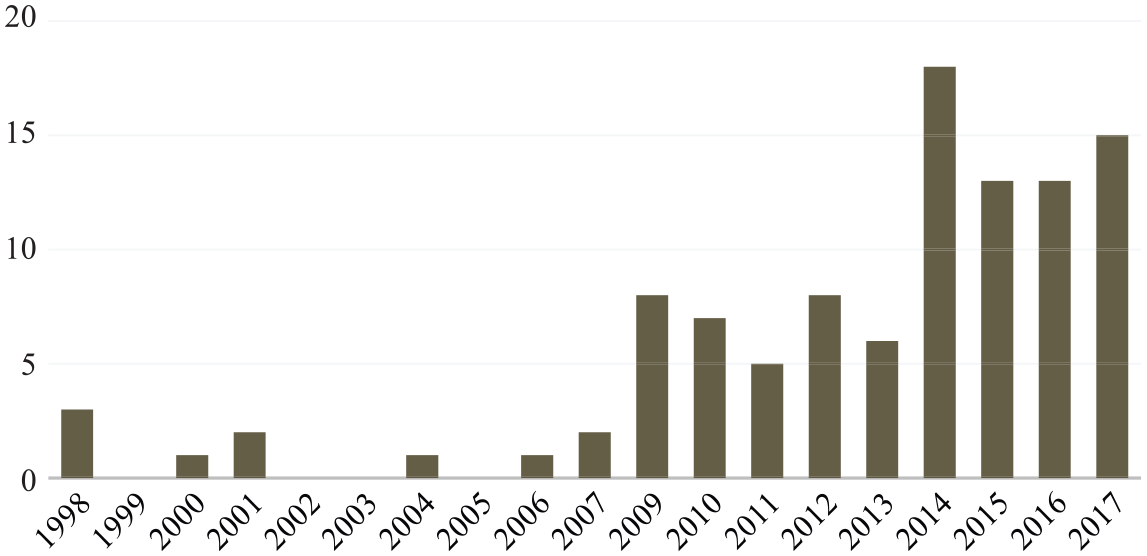
Number of published articles about the genre of narrative journalism per year.
Phase 2 of the analysis
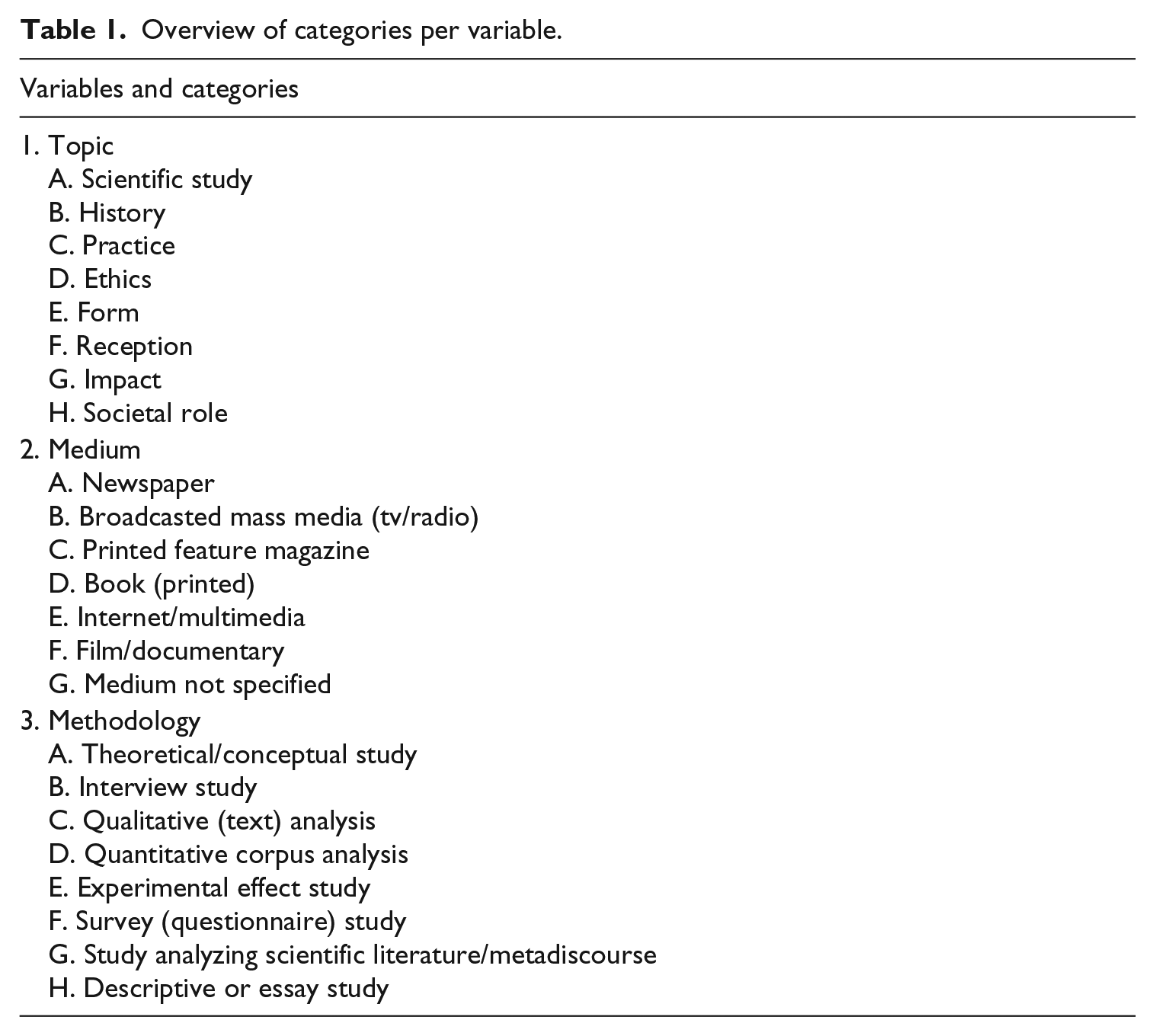
Second, the 103 articles that treat narrative journalism as a journalistic subgenre were analyzed on a number of variables: the article’s topic, main medium of interest, and its methodological approach (see Table 1 for an overview; please refer to the Appendix 1 for definitions of the topic categories). For each variable, a single article could receive a maximum of three codes.
Overview of categories per variable.
Results
General findings
Figure 2 shows the percentages of articles about narrative journalism focusing on the various distinguished topics, methods, and media, respectively. This figure shows, first, that research on narrative journalism is dominated by studies focusing on stylistic form and history, whereas relatively few studies focus on the effects, reception, and societal role of narrative journalism or the scientific treatment of the genre. Second, it shows that the main focus of research on narrative journalism is on textual forms: books, newspapers, and magazines. Relatively few studies have addressed narrative journalism in online media or multimedia, broadcasted mass media (tv/radio), or films or documentaries. Finally, Figure 2 shows that a large percentage of the studies used essayistic and descriptive methods, that is, non-empirical, argumentative studies which may include examples to illustrate arguments but of which the central aim is not to provide a systematic approach to narrative journalistic work. 5 Furthermore, analytical studies tended to employ qualitative methodologies rather than quantitative. Relatively few articles reported experimental studies, interview studies, theoretical contributions, analysis of scientific or other metadiscourse discourse on narrative journalism, or a survey.
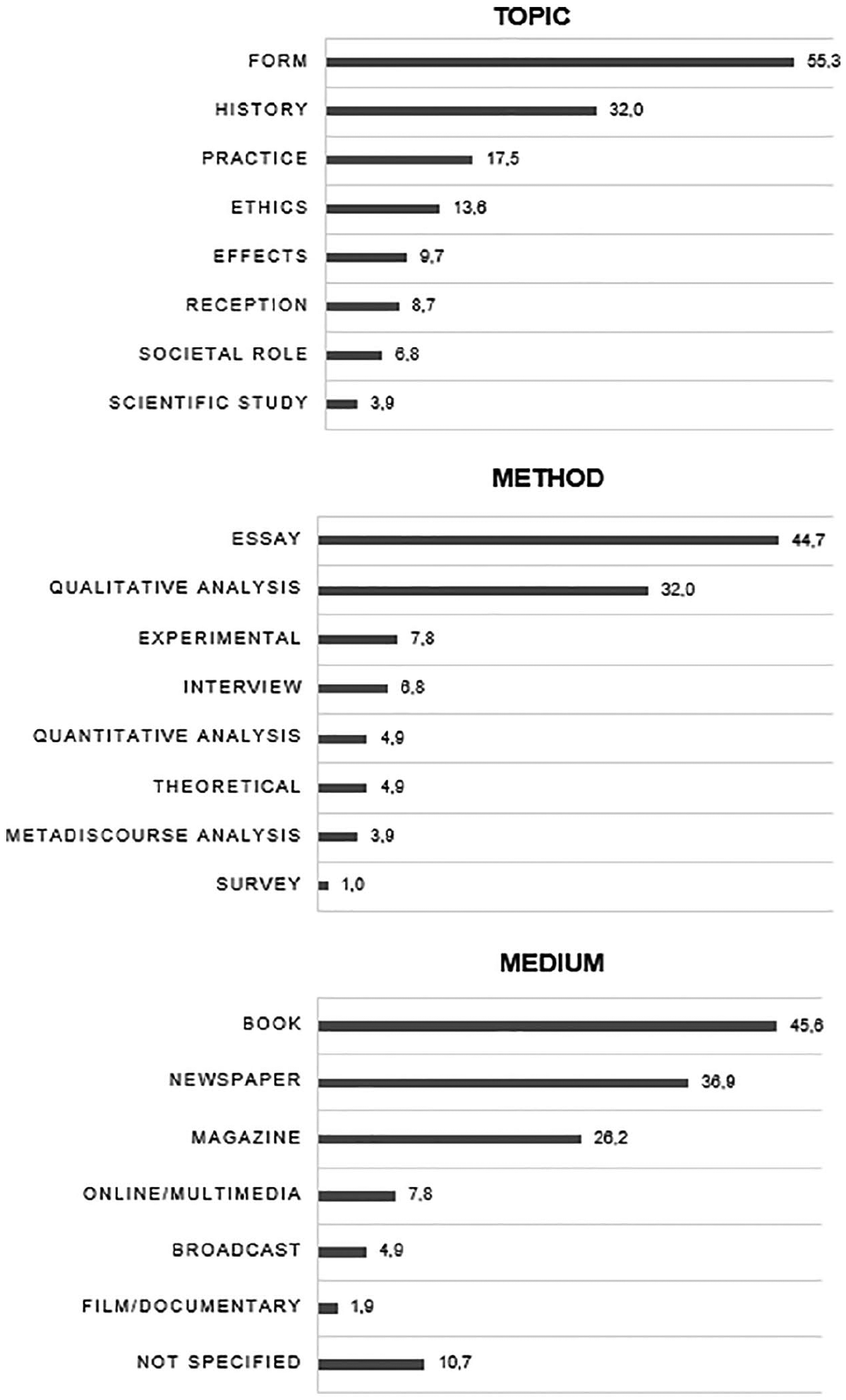
Percentages of articles focusing on the various topics, research methodologies, and media (n = 103; percentages do not add up to 100 because a single article may focus on more than one topic, method, and/or medium).
In the following, the research on narrative journalism will be reviewed in order of the various topics dealt with within the literature: scientific study, history, practice, ethics, form, reception, impact, and, finally, societal role. For each topic, key findings and exemplary studies will be discussed.
Scientific study of narrative journalism
Research on the scientific study of narrative journalism includes attempts to advance the field by identifying issues in need of critical examination (Sims, 2009) and establishing connections with adjacent research fields (Gillespie, 2012; Landa, 2010). Sims (2009) argues that the field could benefit from cross-cultural and diachronic approaches in its aim to gain a comprehensive understanding of the genre’s artistic merit and societal function. Such an understanding might further be advanced through interdisciplinary collaboration between narrative journalism scholars and ethnographic researchers, as Gillespie (2012) argues. However, this strand of research appears to be rather isolated; few attempts have been made to respond to the calls made in these studies, with most studies moving in different and divergent directions, as will be discussed in the following.
History of narrative journalism
Various studies on the history of narrative journalism have aimed to trace the genre’s origins. Fitzgerald (2017) argues that the roots of American literary journalism are to be found in the nineteenth-century literary movement of sentimentalism. While the second half of the nineteenth century marked a transfer from sentimentalism to realism in literature, a group of female writers held on to the personalized, emotional writing style in their journalistic work, thus creating a hybrid style that can be seen as a precursor of the style of literary journalism (Fitzgerald, 2017). Similarly, Bech-Karlsen (2013) traces the origins of literary journalism in Norway back to the second half of the nineteenth century, in which several influential reporters mixed journalistic elements with fictional elements in crafting travel reportages. Other studies have focused on the origins and development of literary journalism in Australia (Joseph, 2010; McDonald, 2014) and Spain (Díaz Noci, 2017).
Most studies on the history and origins of narrative journalism focus on the nineteenth and twentieth century. A notable exception is a study by Marsh (2010) which traces roots of narrative journalism in Greek drama and mythology. This study argues that the presently known genre has emerged out of a chain of historical displacement, starting with the displacement from Greek oral myths to Greek tragedies. While the roots of contemporary narrative journalism may thus lie in ancient times, there appears to be consensus among scholars that narrative journalism started to develop into an independent genre in the nineteenth century.
Practice of narrative journalism
In the United States, the development of narrative journalism reached its peak in the second half of the twentieth century, when social and institutional circumstances were optimal for practitioners of what would later become known as New Journalism. This practice, often seen as the prototype of narrative journalism, flourished as a movement in the 1960s and 1970s, ‘apocalyptic’ times of social and political unrest which created a desire among journalists to ‘free themselves from the narrowness of objectivist journalism’ (Cuartero Naranjo, 2017: 23). A progressive newsroom culture created space for this liberation and, by extension, for the New Journalism to develop into a thriving and influential genre (Schmidt, 2017). Studies on Australian and Slovene narrative journalism, by contrast, signal that in these countries, institutional contexts offer limited opportunities for literary journalists to publish their stories in newspapers (Joseph, 2010; Merljak Zdovc, 2009). Similarly, González (2012) shows how the political system in Cuba has been hindering the practice of narrative journalists for years with a ban on the use of stylistic techniques intended to prevent journalists from covering Cuba’s social reality in an interpretative way.
Another strand of research on the practice of narrative journalism focuses on the methods applied by journalists; in particular, immersion journalism (Gillespie, 2015; Roberts, 2015) and undercover journalism (McDonald, 2014). Roberts (2015), for example, describes how journalists Dorothy Day and Meridel le Sueur depicted deprivileged communities during the Great Depression by immersing themselves in these communities, which in the case of Day meant living in poverty among the homeless for nearly 50 years. Immersion enabled Day and Le Sueur to write in a participant-observer voice that is almost impossible to achieve in non-narrative forms of journalism (Roberts, 2015).
Ethics of narrative journalism
Research on ethical aspects of narrative journalism includes studies on the practice as well as the form of narrative journalism. An example of practical ethics research is Edwards’s (2017) article on narrative journalistic writing that safeguards the privacy of bystanders, such as a character’s relatives. Another example is Wheelwright’s (2014) article on narrative journalistic writing about intelligence history, a field in which sources are commonly unreliable. Crafting stories based on potentially false source materials in an ethical way requires journalists to scrupulously examine the materials on hidden subjectivities and to confront the materials with as many as possible alternative sources in order to arrive at a truthful interpretation (Wheelwright, 2014).
Studies of formal ethics research have focused, among others, on speech and thought reports (Joseph, 2016; Mitchell, 2014) and first-person narration (Tulloch, 2014). These studies pay specific attention to the ethical responsibilities of narrative journalists toward the audience. Tulloch (2014) posits that the ethical risk of writing first-person journalistic narratives concerns a possible deceit of readers such that the ‘I’ is perceived as a witness or observer rather than a narrator reflecting on personal experience. Transparency about which status applies to the first-person narrator should reduce this risk of misguidance. Likewise, transparency should reduce the risk of violating readers’ assumptions about the truthfulness of speech and thought reports (Mitchell, 2014).
Stylistics of narrative journalism
Research on the stylistic form of narrative journalism was found to be divided into theoretical studies presenting typologies or conceptual models of narrative journalism and qualitative and quantitative analytical studies on the stylistic characteristics of narrative journalism. The number of theoretical studies appeared to be rather limited (5), particularly in comparison with the number of analytical studies (more than 35). Remarkably, none of the analytical studies explicitly adopts a specific typological or conceptual framework as developed in one of the theoretical articles.
Stylistics: Theory
Aare’s (2016) theoretical framework utilizes the concepts of voice and point of view as analytical categories based on which works of narrative journalism can be positioned on a spectrum running from subjective to objective journalism. A similar spectrum is proposed by Roberts and Giles (2014), which classifies works of narrative journalism as one of two forms: Ethnographic Realism, characterized by an omniscient narrator and narrative techniques associated with social realism, or Cultural Phenomenology, characterized by reflection, exploration, and personalization. Works of Ethnographic Realism lean toward the objective end of the spectrum, whereas works of Cultural Phenomenology lean toward the subject end (Roberts and Giles, 2014).
Stylistics: Qualitative analysis
The general concept of subjectivity is mentioned in several of the qualitative analytical studies, particularly regarding the subjectivity of the journalist in the roles of writer, narrator, and character. Joseph (2016), for example, shows how Helen Garner positions herself in her journalistic stories as a ‘dramatized’ narrator, a technique through which she essentially comes to fulfill the role of character in her own stories. The resulting sense of what Joseph (2016) refers to as ‘intersubjectivity’ is the object of recurring critique on Garner’s work, for it jeopardizes the journalistic promises of truth, reliability, and impartiality. Similarly, in analyzing the narratives of British author Robert Fisk and Dutch author Arnon Grunberg, Harbers and Broersma (2014) argue that these journalists’ expression of their own subjectivity results in stories that, while compelling, challenge notions of objectivity and factuality. This account of subjectivity as at once engaging the audience and endangering journalism’s claim to truth is a recurring notion in analytical research on narrative journalism (e.g. Soares, 2009; Thérenty, 2016; Willman, 2017).
A noteworthy finding is that several analytical studies on the form of narrative journalism focus on the work of a single writer or a single work. Examples are studies on the work of Rebecca Solnit (O’Donnell, 2015), Margaret Simons (Joseph, 2015), and Ted Conover (Walters, 2017); and Johnny Steinberg’s book The Number (Rennie, 2014), Arturo Perez-Reverte’s book Territorio Comanche (Sellin, 2013), and Quijano de Manila’s reportage The House on Zapote Street and its adaptation to the film Kisapmata (Arriola, 2010). Results of these studies signal a great diversity in the characteristics of journalistic narratives, which underscores the need for quantitative analyses to identify shared stylistic features and lay bare the core characteristics of narrative journalism.
Stylistics: Quantitative analysis
Only a few studies have adopted a quantitative approach in analyzing the stylistic characteristics of narrative journalism. Jacobson et al. (2016) analyzed a corpus of 50 multimedia stories on narrative techniques and found that techniques of scene descriptions, dramatic tension, characterization, and dialogue were expressed not only in text but also in other media, such as videos, animations, audio fragments, and photo slideshows, and were particularly arrived at in combinations of these media formats.
In a much larger corpus study, of 5000 Australian newspaper articles, Johnston and Graham (2012) compared the number of articles written in a narrative style versus an inverted pyramid style. Their results showed that the percentage of narrative articles has decreased from 16 percent in 2007 to 11 percent in 2009, which appears to contradict claims about the increasing popularity of narrative journalism (e.g. Hartsock, 2007). The percentage of articles combining narrative characteristics with inverted pyramid characteristics has increased, but these hybrid articles accounted for only a small percentage of all news articles. Taken together, the results of this study point toward a marginal status of narrative journalism in Australian newspapers.
Finally, a corpus study on Dutch newspaper articles examined changes within the narrative genre over a period of 150 years (Van Krieken and Sanders, 2016). This study focused on the use of quotations and their function in a collection of 300 crime narratives. The results revealed that the dominant function of quotations shifted over time from dramatization and enlivenment (until the 1960s) to legitimization of the narrative reconstructions of reality (from the 1960s onwards). These findings illustrate how the genre of narrative journalism has been evolving over time in order to adapt to changing journalistic standards of factuality and trustworthiness.
Reception of narrative journalism
Studies on the critical reception of narrative journalism have focused on how the genre is perceived by journalists and journalism lecturers (Van Krieken and Sanders, 2017), book critics (Wilson, 2017), and academic scholars (Groot Kormelink and Costera Meijer, 2015; Hartsock, 1998). These studies typically depart from observations of ambivalence and controversy in attitudes toward the genre, or in the reception of specific works, and aim to uncover the reasons behind the intensity of recurring debates about truthfulness, neutrality, and objectivity. Such debates are considered practices of boundary work in which the limits of journalism are negotiated. Fakazis (2006), for example, analyzed news coverage and court documents about a 1980s libel suit against journalist Janet Malcom, who allegedly fabricated direct quotes in a New Yorker profile story. She argues that the ways in which journalism is represented in these sources served either to defend or challenge the traditional boundary between subjective storytelling on one hand and objective reporting on the other. A similar form of boundary work was found in a study examining how practitioners and lecturers of narrative journalism both view and promote the genre (Van Krieken and Sanders, 2017). In the view of these journalists and lecturers, the boundary between subjectivity and objectivity was found to be fluid, irrelevant, or even nonexistent. Note that while research on the critical reception of narrative journalism has provided insights into both the nature and function of debates about the genre, the view of audience members has remained unexplored.
Impact of narrative journalism
Only few studies have tested the supposed positive impact of narrative journalism on the audience by experimentally comparing a narrative news item with a non-narrative news item. In the majority of these studies, the main variable between the narrative item and the non-narrative item was a structural difference between chronological structure and inverted pyramid structure (Emde et al., 2016; Kleemans et al., 2018; Shen et al., 2014; Van Krieken et al., 2015). Additional variables included the difference between the inclusion versus exclusion of personal experiences (Emde et al., 2016) and the inclusion of quoted and paraphrased characters versus characters who are not quoted at all but only described (Kleemans et al., 2018). Common measures were the audience’s involvement or engagement with the narrative, their empathy for the persons portrayed in the narrative, and their comprehension of the narrative.
Findings indicate that journalistic narratives have a stronger engaging effect on audience members than non-narratives, both in terms of feeling ‘present’ at the described scenes and in terms of identifying and empathizing with the story characters (Kim et al., 2012; Oliver et al., 2012; Shen et al., 2014; Van Krieken et al., 2015). Narrative articles were also found to outperform non-narrative articles as stimulating audience’s comprehension, retention, and recognition of the information provided (for print journalism: Kleemans et al., 2018; for television journalism: Machill et al., 2007). Finally, newspaper narratives were found to exert a stronger influence on readers’ attitudes and behavioral intentions than non-narrative articles, which signals the persuasive potential of narrative journalism (Kim et al., 2012; Oliver et al., 2012; Shen et al., 2014).
Although these studies show differences between journalistic narratives and non-narratives in their impact on the audience, much remains to be discovered about the precise causes of these differences. Various studies manipulated multiple narrative characteristics in one experiment and measured multiple outcomes. Shen et al. (2014), for example, varied both the order (inverted pyramid in the non-narrative text versus chronological order in the narrative text) and the content (statistical information in the non-narrative text versus personal information in the narrative text) of news texts, while measuring the impact of these texts on readers’ ‘transportation’ into the story world, empathy, immediate as well as delayed issue attitudes, cognitive responses, and perceived credibility. Relevant questions arising from studies like this are which narrative characteristics are responsible for which reported differences in audience responses. Note, in addition, that experimental studies are at best loosely connected to analytical studies on the stylistic characteristics of news narratives. Narrative characteristics and techniques that received much attention in analytical studies, such as voice and setting, were not found to have been systematically tested on their impact.
Societal role of narrative journalism
Research on the societal role of narrative journalism focuses on the ways in which narrative journalism mediates the relation between the audience and society. Using a narrative template with recognizable characters is seen as a powerful means to (a) increase the audience’s understanding of society in all its complexities and (b) enhance the audience’s sense of being part of that society. It appears from these studies that topics about minority groups and social, cultural, or racial injustice lend themselves particularly well to be covered in a narrative style that renders critical voices. Forde (2014), for example, shows how the narrative journalistic book The Fire Next Time, published in 1963, changed the beliefs of many Americans about racial injustice and its detrimental impact on civil society. Likewise, in a study on long-form television dramas at the intersection of news and narrative, Baym (2017) argues that these ‘public affairs narratives’ have the potential to engage the audience in exploring socio-political realities and to spark public conversations about critical societal situations. Such narratives resemble metanarratives in their function as vehicles of sensemaking and may outperform traditional journalism in establishing meaningful connections between politics and audience members by performing rather than informing, that is: ‘by constructing complicated, at times holistic, social worlds, populated by richly conceptualized characters who face true, if scripted, social, political, and economic challenges’ (Baym, 2017: 47–48). A somewhat similar process has been described by Cowling (2016) in her study on narrative journalism in South Africa. Analyzing stories published in Drum, a popular black readership magazine, she argues that the use of narrative techniques contributed to the construction of black identity in the first years of apartheid by providing readers with ‘an attitude to take, an identity to occupy, a language they could use to describe their world’ (Cowling, 2016: 26).
Conclusion and research agenda
The first aim of this review study was to clarify the nature of narrative journalism. The fuzziness surrounding the genre was found to be partly explained by the different uses of the label ‘narrative’ in journalism studies: narrative as a synonym of news item, narrative as a synonym of metanarrative, and narrative as a product of the genre of narrative journalism. We make a case for use of the label exclusively in this third meaning, that is, to refer to journalistic products that display storytelling techniques to report upon real-world events and situations. More particularly, mutual understanding could benefit from defining narrative journalism as a genre that employs the narrative storytelling techniques of voice, point of view, character, setting, plot, and/or chronology to report on reality through a subjective filter. This filter can be either a character or the journalist. Such a definition, grounded in the findings of the review, would be both narrow enough to distinguish narrative journalism from other, non-narrative journalistic genres, and broad enough to account for the highly diverse manifestations of the genre. It also offers clear anchors for the design of empirical studies and, as such, can stimulate and facilitate research testing contentions about the promises and pitfalls of the genre.
The second and third aim of this study were to characterize the current state of narrative journalism studies and to formulate directions for future research. Narrative journalism studies has only recently begun to develop into an independent scientific field, which might explain the dominance of studies on printed forms of narrative journalism – books, newspapers, magazines – and the imbalance in both the topics and methods of studies. Whereas the history and form of narrative journalism have been studied extensively, its hypothesized effects on and the supposed reception by the audience, as well as its presumed societal role, have received much less attention. This imbalance is related to a conceptual imbalance, with none of the analytical studies employing a particular typological or conceptual framework as developed in one of the theoretical articles, and to a methodological imbalance, with relatively few studies having systematically connected conceptual models to quantitative (corpus, experimental, or survey) methodologies. In particular, there appears to be a mismatch between the rich variety of techniques studied in analytical research, such as voice and plot, and the narrow focus in experimental studies, which mostly examined the effects of chronological event ordering. These findings signal that research on narrative journalism is both theoretically and empirically underdeveloped, which hampers its maturation and scientific advancements in our understanding of the genre and underrepresents the perspective of users.
The general conclusion, then, is that although 20 years of research on narrative journalism has produced many valuable insights into various aspects of the genre, most notably its history and its form, the main challenge for the future is to synthesize the scattered field by establishing connections between the distinctive methods and topics of interest. Such connections can offer a crucial impetus to, as well as a solid ground for, an empirical turn in narrative journalism studies. This turn is essential if we are to expand our knowledge about the impact of narrative journalism on the audience and to move debates about the genre’s promises and pitfalls forward by injecting evidence-based input. To advance research in this direction, we present a framework (Figure 3) that establishes relations between various hitherto rather isolated strands of research on narrative journalism.
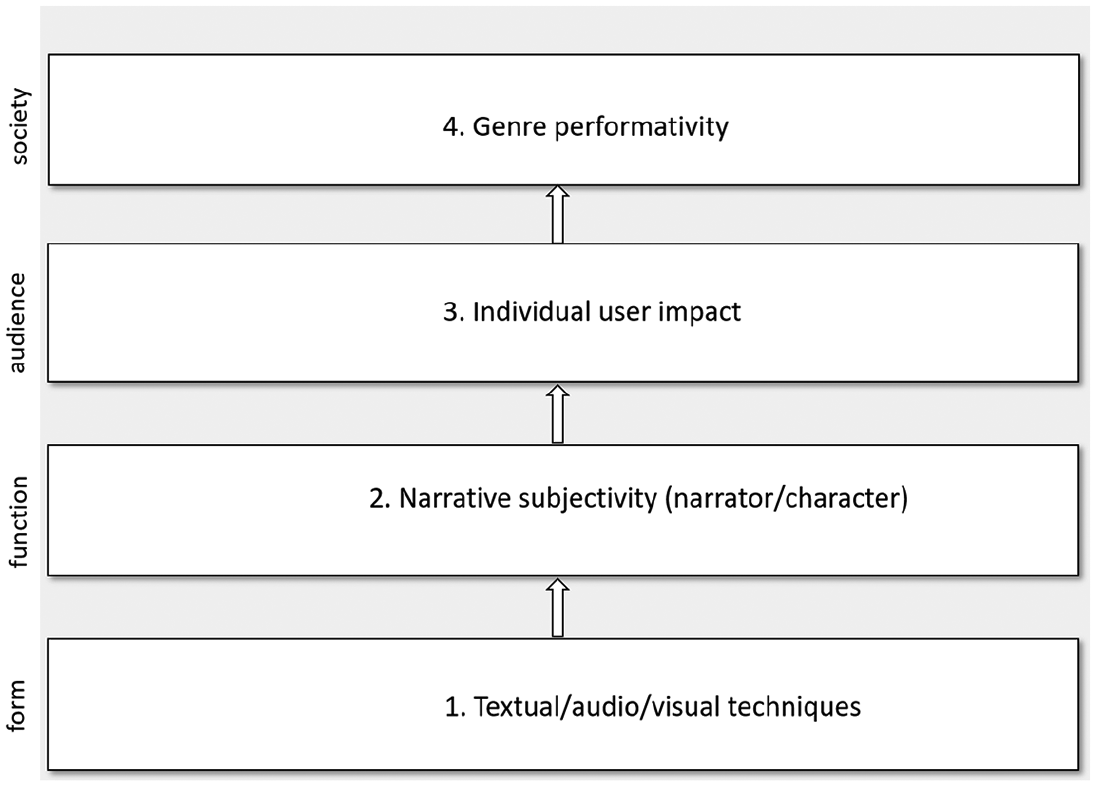
Framework of the relations between form, function, audience impact, and societal impact of narrative journalism.
Figure 3 shows that narrative techniques (level 1) impact the individual user (level 3) by regulating the expression of both the character’s and the journalistic narrator’s subjectivity (level 2). In line with previous theoretical studies (Aare, 2016; Roberts and Giles, 2014), we posit that works of narrative journalism can be positioned on a spectrum ranging from little to very subjective. The framework proposes that the type and degree of subjectivity is determined by the specific use of narrative techniques: voice, point of view, character, setting, plot, and/or chronology. For example, point-of-view writing may be established by the use of linguistic markers that give expression to the subjective mind of a news character (Van Krieken et al., 2017), such as expressions of perception (to see, to hear) and cognition (to think, to realize). Point-of-view writing thus increases the degree of character subjectivity, and the number of linguistic viewpoint markers is expected to be positively related to this degree. By contrast, journalists’ use of a first-person voice instead of a third-person voice increases the degree of narrator subjectivity. Systematic variation of these techniques in experimental studies could test these expectations and establish causal relations between the use of narrative techniques and the audience’s perceived sense of character and narrator subjectivity.
Although subjectivity was found to be a recurring concept in studies on narrative journalism, the status of the concept, being neither a technique in itself nor an effect in audience members, has remained rather vague. Our framework proposes that degree of subjectivity is not an intuitive category but rather the functional mechanism explaining the impact of narrative techniques on the audience. In assessing the impact of narrative journalism’s functional subjectivity and its relation to the genre’s promises and pitfalls, it is useful to distinguish between different types of impact: first, individual users’ cognitive reactions (understanding and comprehension) and affective reactions (empathy and emotions) to a specific journalistic narrative (level 3); second, their appreciation as well as understanding of the genre (level 3); and, finally, their performative sensemaking of narratives in the public sphere (level 4). The need for empirical studies testing these types of impact is particularly profound in expediting the quest to determine the true promise of narrative journalism to rejuvenate journalism in its engaging function, as well as its potential drawbacks. Measuring the impact of narrative journalism on groups of individual readers might ultimately clarify the societal function of narrative journalism, as is seen in the chain of relations as depicted in Figure 3, for individual experiences elicited by narratives may extend to a collective experience, thus stimulating its performative role.
The relations depicted in the framework are media-independent, implying that manipulations of narrative techniques can be applied to both textual narratives and broadcasted and multimedia narratives, as well as films and documentaries (Sanders and Van Krieken, 2018; Van Krieken, 2018). Studies covering this range of media are important to further widen the scope of narrative journalism studies. This may benefit not only journalism research but also journalism education, for it has been argued that recent trends toward a renewed narrative journalism call for ‘significant changes in both the training of journalists and the nature of the media used for the diffusion of this renewed style of reporting’ (Neveu, 2014: 533). This training can be informed and designed by the findings of research into the forms and effects of narrative techniques in different media. Moreover, the framework allows for the possibility to systematically examine narrative techniques in cross-cultural as well as diachronic investigations of narrative journalism, both of which directions remain in need for further exploration (cf. Sims, 2009). With this framework, we thus aim to move both the educational and the scientific field of narrative journalism to the next level by setting an agenda for theoretically founded, empirically conducted examinations of the relation between the form, function, and impact of narrative journalism across time, media, and cultures.
Note, finally, that this review was limited to articles in which narrative forms of journalism are explicitly referred to as ‘narrative’ or ‘literary’ journalism. However, narrative forms of journalism are sometimes referred to with alternative labels, such as ‘creative nonfiction’ or ‘literary reportage’ (see Joseph, 2010; Roiland, 2015). The use of a specific label also appears to be culture sensitive. In Poland, for example, ‘literary reportage’ is a commonly used label to refer to narrative forms of journalism (Wiktorowska, 2018), whereas the label of ‘feature writing’ is common in Slovenia (Merljak Zdovc, 2009). Moreover, research on narrative journalistic forms in non-English cultures may use non-English labels (see the collection in Bak and Reynolds, 2011). Findings of this review study may not be representative for research employing these and other alternative labels. Future systematic reviews including these labels in their literature search are important to further advance our understanding of how narrative forms of journalism are studied across the globe and to provide an inclusive view on what we do and do not yet know about the genre and its diverse manifestations across cultures.
Footnotes
Appendix 1
Acknowledgements
The authors would like to thank Adriënne Ummels BA for her assistance with the coding of the articles.
Funding
The author(s) disclosed receipt of the following financial support for the research, authorship, and/or publication of this article: This research was supported by an Innovational Research Incentives Scheme VENI grant from the Netherlands Organization for Scientific Research (NWO; project number 275-89-038) awarded to K.v.K.
