




Abstract
Although narrative journalism has a long history in the Netherlands, it is in recent years being promoted as a ‘new’ genre. This study examines the motives underlying this promotional tactic. To that end, we analyze how narrative journalism is framed in (1) public expressions of the initiatives aimed at professionalization of the genre and (2) interviews with journalists and lecturers in journalism programs. Results indicate that in public discourse on narrative journalism, the genre is framed as moving, essential, and as high quality journalism. These frames indicate that the current promotion of narrative journalism as ‘new’ can be seen as a strategy that journalists apply to withstand the pressures they are facing in the competition with new media. These frames are deepened in the interviews with lecturers and practitioners, who frame narrative journalism as a dangerous game, a paradigm shift, and as the Holy Grail. These frames indicate that narrative journalism is regarded as the highest achievable goal for journalists, but that its practice comes with dangers and risks: it tempts journalists to abandon the traditional principles of objectivity and factuality, which can ultimately cause journalism to lose its credibility and authority. We discuss these findings in terms of boundary work and reflect on implications for narrative journalism’s societal function.
Introduction
The professional interest in narrative journalism has expanded notably over the past years (Ray, 2013). An often mentioned reason for the increased popularity of journalistic storytelling is the ongoing decline in newspaper circulation (Hartsock, 2007; Shim, 2014). Shim (2014), for instance, argues that ‘the rise of narrative journalism should be understood in the perspective of the hierarchical relationship between the journalistic paradigm and market ideology’ and that ‘narrative journalism has been propagated to rejuvenate the declining paper business in the contemporary media market’ (pp. 79, 90). This contemporary media market, characterized by the 24-hour access to news through online media, forces journalism to undergo far-reaching transitions in which existing boundaries dissolve (McNair, 2009). For newspapers in particular, simply providing news is no longer sufficient to compete with the plethora of new media. Narrative journalism is seen as an important promise for the future of print journalism for its capacity to cross traditional boundaries and fulfill additional, distinctive functions (e.g. Joseph, 2010; Merljak Zdovc, 2009; Neveu, 2014).
A crucial characteristic in this respect is the ascribed power of news narratives to attract and maintain readers because narrative is the dominant mode of communication in social life (e.g. Boyd, 2009; Gottschall, 2012; Niles, 2010). We should be able to effortlessly relate to news narratives because they resemble the stories we encounter on a daily basis from childhood on, ranging from bedtime stories to soap operas and from movies to popular songs. The use of narratives in journalism is, in other words, ‘culturally resonant’ for the audience (Berkowitz, 2005: 608). In addition, narrative journalism is said to ‘transform its readers into travelers in the backstage of the social world’ (Neveu, 2014: 538), allowing them to virtually experience otherwise distant events from up close (Peelo, 2006). Compared to traditional journalism, narrative journalism, thus, actively engages its readers.
This engaging function is then explanatory for and essential to narrative journalism’s supposed ability to increase the audience’s understanding of events which disrupt the functioning of society, such as high-impact criminal acts (Peelo, 2006). News narratives are culturally resonant in that they ‘offer models which help us understand reality, other people and ourselves’ (Ekström, 2000: 474). In this line of reasoning, Bird and Dardenne (2009) argue that news narratives are able to assign meaning to complex situations and Singer (2010) states that news narratives ‘help readers understand what they already know took place’ (p. 94). Compared to traditional journalism, narrative journalism, thus, has the capacity to provide a meaningful context to news events and situations. By engaging readers and providing a richer context to news events, narrative journalism might be a valuable addition to traditional journalism and increase its overall salience.
This study focuses on the practice of narrative journalism in the Netherlands. Since the end of the 20th century, Dutch journalists are increasingly interested in exploring the possibilities of narrative techniques (Mak, 1998). This explicit interest has continued to grow, resulting in recent attempts to develop narrative journalism into a full-fledged, flourishing genre. The aim of this study is to examine how this professionalization process is framed in various initiatives promoting the genre and, drawing on interviews with active proponents of narrative journalism, the motivations for and consequences of this pursuit.
Research on narrative journalism
There are various strands of research on narrative journalism. One strand of research is concerned with the forms and functions of narrative journalism. Textual analyses typically focus on the use and form of storytelling techniques in news texts, such as anecdotal leads, point-of-view writing, and emotive appeals (Berning, 2011; Wahl-Jorgensen, 2013a, 2013b; Van Krieken, Sanders and Hoeken, 2015; Van Krieken, Sanders and Hoeken, 2016). Experimental studies typically focus on the effects of such techniques on the audience’s engagement with news texts (Oliver et al., 2012; Shen et al., 2014; Van Krieken, Hoeken and Sanders, 2015). A consistent finding across these studies is that the use of narrative techniques in news texts positively influences readers’ involvement.
A more culturally based strand of research focuses on news narratives as myths and how these myths help us understand reality in all its complexity. Theoretical accounts of the function of narratives – both fictional and non-fictional – in social life are fundamental to this type of research. The activity of sharing stories is supposed to be a deeply rooted and universal phenomenon enabling humankind to entertain one another, establish group identities, and learn how to act and react in unexpected or dangerous situations (e.g. Boyd, 2009; Niles, 2010). The ubiquity of narratives in social life can often be traced down to essential and highly recognizable narrative patterns that can also be recognized in news narratives: elements of fairy tales or folk stories are not uncommon (e.g. Machill et al., 2007). Folk stories typically narrate on a hero in pursuit of the goal of helping a person in need, while an opponent throws a spanner in the works (Propp, 1958). This structure can be readily applied and adjusted to many kinds of situations and many kinds of audiences.
Elaborating on this analysis, Lule (2001) argues that news narratives often portray the news actors in such a way that they fit one of the following mythical archetypes: The Victim, The Scapegoat, The Hero, The Good Mother, or The Trickster. Various studies have shown that journalistic narratives indeed revolve around these and other archetypes, thereby providing cognitive shortcuts to myths that are deeply rooted in our culture (e.g. Berkowitz, 2005, 2010; Sternadori, 2014). Such abstractions help us understand reality by providing simplified accounts of highly complex news events; that what seems incomprehensible is being placed in prototypical story frames we are familiar with. In doing so, news narratives engage us personally and help us to re-establish our understanding of society (Peelo, 2006).
Despite its well-documented capacity to engage readers, narrative journalism remains a hybrid genre. A multitude of labels, which are often used interchangeably, denote highly divergent journalistic texts, including narrative journalism, literary journalism, literary non-fiction, creative non-fiction, factual fiction, and artistic non-fiction. Literary journalism is one of the most frequently used labels and may refer to any production at the intersection of literature and journalism, as varied as historical books, first person newspaper narratives and columns, celebrity portraits, biographies, feature stories, and reportages (e.g. Greenberg and Wheelwright, 2014; Joseph, 2016).
The term narrative journalism appears to be primarily associated with newspaper journalism; for instance, most articles of a special issue of Nieman Reports on narrative journalism focused on storytelling practices in newspapers (ed. Ludtke, 2000). Not all news articles can be classified as narrative journalism, but it is important to observe, and this was most notably done by Bell (1991), that newspaper articles are in essence stories structured around the same basic elements that have been found to make up oral stories (Labov and Waletzky, 1967). In this article, we focus on professional conceptions of narrative journalism and in doing so, we distinguish the genre of narrative journalism from fiction, narrative history, and hard news reporting. The difference between narrative journalism and fiction lies in their relation to truth and reality. Narrative journalism applies the style and techniques of fiction to non-fiction (Kramer, 1995), but unlike fiction, narrative journalism ‘makes a truth claim to reflecting phenomenal experience’ (Hartsock, 1999: 432). The difference between narrative journalism and narrative history lies in the topicality of the issues of interest. Narrative journalism deals with events and situations of the present rather than the past (Kramer, 1995) and is therefore to be distinguished from the genre of narrative history, in which historical events and people are – most often in book form – portrayed in a story format (see Lepore, 2002). Finally, the difference between narrative journalism and hard news reporting lies in the type of questions addressed as well as the style in which answers are provided. Unlike hard news reporting, which addresses the ‘who’, ‘what’, ‘where’, and ‘when’ questions in a neutral way with reference to official sources, narrative journalism provides context to these bare facts by addressing the ‘how’ and ‘why’ questions (Uko, 2007). These questions are typically answered by describing news events through the eyes and minds of real persons involved in the events, who become characters with whom readers can empathize and identify.
We now zoom in on conceptualizations of narrative journalism in specific professional journalistic cultures. Recent research has examined professional conceptions of narrative journalism in Australia and Slovenia. Joseph (2010) interviewed six leading Australian narrative journalists on their understanding of the genre. The interview data revealed that Australian journalists do not actively debate or talk about the genre but just practice it. Similarly, in a study on Slovene narrative journalism, Merljak Zdovc (2009) concludes that the publication of journalistic stories ‘continues to be the result of the enthusiasm of individual journalists and editors who follow the trends in journalistic writing on their own, and not of systematic attempts of newspapers to provide readers with quality writing’ (p. 328). These studies, thus, signal the marginal status of narrative journalism in Australia and Slovenia and advocate a larger role for the genre as it might help newspapers to attract readers in an increasingly competitive media landscape. This study focuses on narrative journalism in the Netherlands, a country with a rich and well-documented history in journalism.
Narrative journalism in the Netherlands
Several studies have shown that the use of storytelling techniques is by no means a recent invention in Dutch journalism. A study on Dutch pre-cursors of newspapers – so-called pamphlets – published between 1600 and 1900 showed many narrative techniques in these texts, such as vivid descriptions and dialogues (Dingemanse and De Graaf, 2011). A corpus analysis of Dutch newspaper articles published between 1850 and 1939 furthermore showed that the majority of these articles were written in a narrative structure rather than the traditional news text structure of the inverted pyramid which reveals the most important (often most recent) news event first (Van Krieken and Sanders, 2016b). In another study, the narrative technique of point-of-view writing was examined in a large corpus of Dutch newspaper articles published between 1860 and 2009 (Van Krieken and Sanders, 2016a). The results indicated that this technique was already employed by journalists in the 19th century. In addition, the use of speech and thought reports as a dramatizing technique, mainly by directly quoting news sources, was frequent across the entire period. These studies thus demonstrate that Dutch print journalism is, at least partly, inherently narrative.
Yet, only in recent years has narrative journalism started to gain serious attention of Dutch professional journalists as a genre in itself (Mak, 1998; Smit, 2012). From the new millennium on, courses on narrative journalism entered the curricula of Dutch journalism schools and initiatives were developed to promote the genre among journalists and editors. Some of these initiatives explicitly aim to professionalize narrative journalism and increase its salience.
This raises the question as to why narrative journalism is being conceptualized and promoted as a ‘new’ genre, while storytelling formats in themselves are in fact deeply rooted in Dutch journalism. What, then, is new in the eyes of journalists, how is this new type of journalism established, and what is its function or aim? We address these questions by examining conceptions of narrative journalism in (1) public expressions of the initiatives aimed at its professionalization as well as educational text books and (2) interviews with journalists and lecturers in journalism programs. Public expressions about narrative journalism can be seen as forms of ‘metajournalistic discourse’, that is, ‘a field of discourse that continually constructs meaning around journalism and its larger social place’ (Carlson, 2015: 2). It is in this field that journalists establish definitions and boundaries and legitimize their practices. An examination of the metajournalistic discourse on narrative journalism can thus provide more insight into the promotion and positioning of Dutch narrative journalism. The consequences of the current process of professionalization are further examined through interviews with journalists and lecturers who are actively involved in this process.
To examine how narrative journalism is discussed in the public discourse and interviews, we will conduct a framing analysis. In communication research, framing refers to the presentation and definition of issues through processes of exclusion, emphasis, and selection (Gitlin, 1980). Specifically, framing means selecting ‘some aspects of a perceived reality and make them more salient in a communicating text, in such way as to promote a particular problem definition, causal interpretation, moral evaluation and/or treatment recommendation for the item described’ (Entman, 1993: 52). Framing, in this sense, can be seen as a rhetorical act to persuade others into thinking about an issue from a particular point of view (Kuypers, 2009). A framing analysis of public discourse and interviews about narrative journalism should, thus, provide insight into professional conceptions of narrative journalism, the motives underlying the current process of professionalization, and how these motives are articulated in order to establish and promote the genre.
Study
The study was divided into two parts. The first part examined how narrative journalism is framed in various public expressions about the genre. The second part examined how narrative journalism is framed in interviews with journalists and lecturers engaged in promotion of the genre.
Public expressions
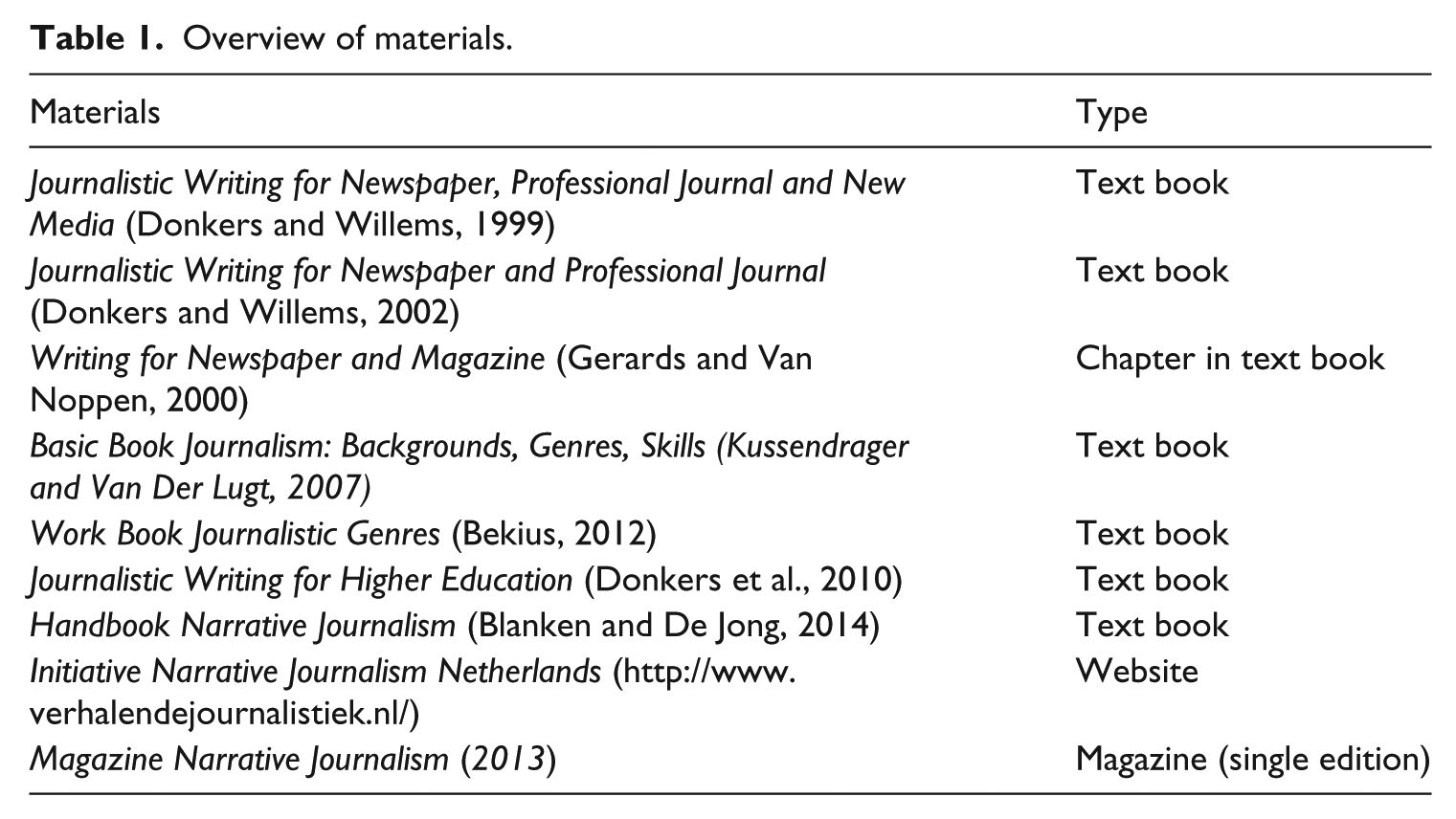
A web and library search for journalism text books published between 1995 and 2015 was conducted. Only books with an educational goal were included and only if their emphasis was on journalistic writing and genres rather than, for instance, on the history of journalism. The search resulted in seven relevant text books.
Also included in the materials were a website and magazine published by the Initiative Narrative Journalism Netherlands. This initiative was founded in 2010 and has been actively promoting narrative journalism ever since. The website consists of blog posts on narrative journalism by journalists and researchers, tips and tricks for aspiring narrative journalists, and interviews with established narrative journalists from the Netherlands and abroad. Table 1 provides an overview of the materials used to examine public expressions about narrative journalism.
Overview of materials.
Interviews
Materials and participants
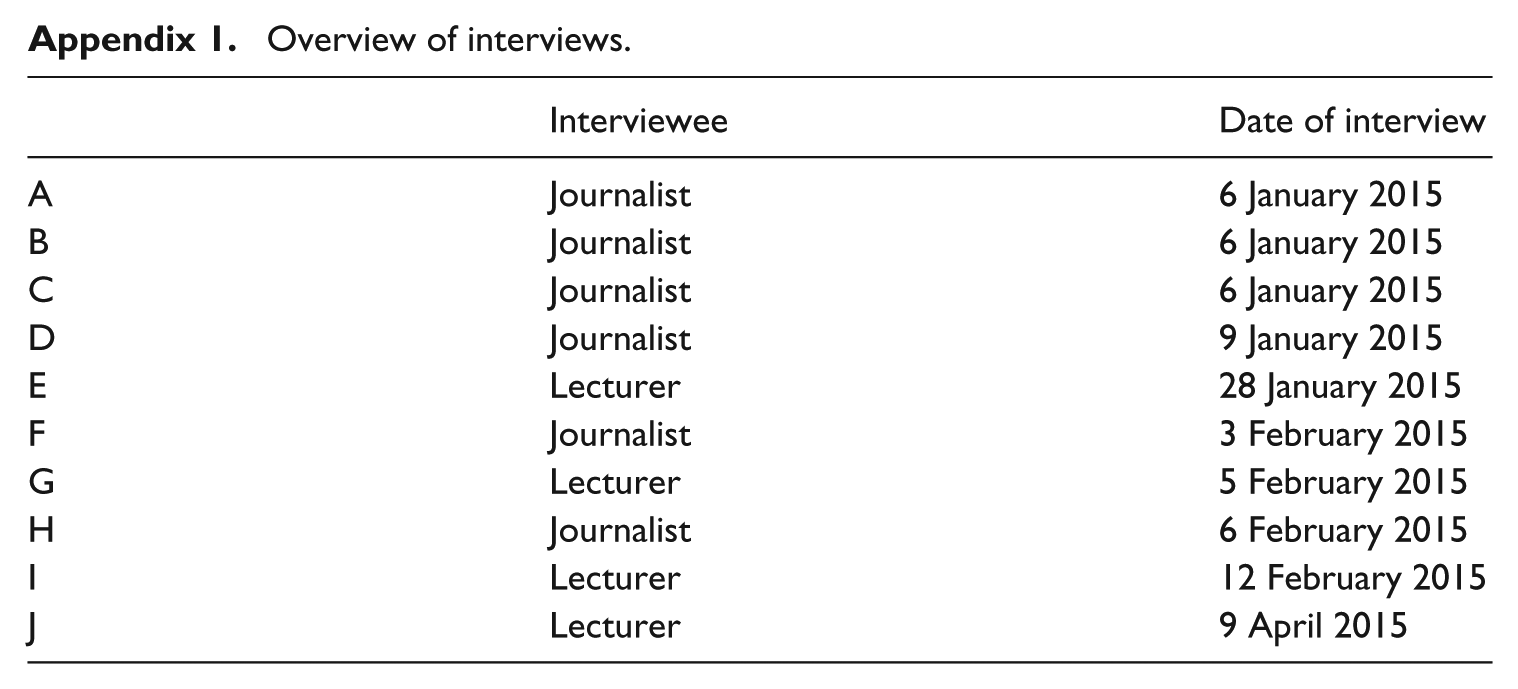
Data for the second part of the study were collected through 10 in-depth face-to-face interviews with proponents of narrative journalism in the Netherlands (see Appendix 1 for an overview of the interviews). Six of the interviewees were active journalists specialized in narrative forms of print journalism. Four of them were founders and/or active members of the Initiative Narrative Journalism Netherlands; one of them was one of the authors of the Handbook Narrative Journalism. The other four interviewees were teaching narrative journalism in journalism programs at various Dutch colleges. Two of them were also authors of narrative non-fiction books. All interviewees actively promoted the use of storytelling techniques in journalism by organizing conferences and workshops on narrative journalism, teaching narrative journalism, and/or producing various forms of narrative journalism.
Procedure
An active interview approach (Holstein and Gubrium, 1995) was adopted to allow interviewees to talk about narrative journalism in their own words. In this approach, the interview is seen as a two-way process of meaning construction in which both interviewer and interviewee play an active role. Instead of asking a list of questions, the interviewer’s tasks involve ‘encouraging subjective relevancies, prompting interpretative possibilities, facilitating narrative linkages, suggesting alternative perspectives, and appreciating diverse horizons of meaning’ (Holstein and Gubrium, 1995: 78). The interviewees were encouraged to talk freely about their conceptions of narrative journalism and their experiences with producing or teaching narrative journalism. Questions were asked about their views on the potential, stylistic form, functions, and presupposed effects of journalistic narratives in comparison with more traditional forms of journalism. In addition, the interviewees were encouraged to reflect on the similarities and differences between narrative journalism and traditional journalism. In accordance with the active interviewing approach (Holstein and Gubrium, 1995), the interviewees were confronted with statements made in earlier interviews to provide them with the opportunity to compare their views with the views of others.
The interviews were held at quiet public places, the interviewee’s work environment, or the interviewee’s home. The interviewees were informed about the aims of the interview before the interview started. The interviews, which took approximately an hour, were recorded with permission of the interviewees and later transcribed literally.
Analysis
A framing analysis was conducted to examine the public expressions and interviews about narrative journalism. The analysis of the public expressions was guided by a close examination of language use, since metaphors, analogies, and figures of speech function as indicators of a frame (Van Gorp, 2007). These linguistic expressions have in common that they require an interpretation of concept X (here: narrative journalism) in terms of concept Y, that is, they evoke concept Y and all its attributes as a frame within which to view and understand concept X.
With respect to the interview data, we first identified, in line with Deuze (2005) and Borger et al. (2013), the different topics addressed in the interviewees’ talk. In this stage, the transcripts were read integrally several times in order to isolate the parts in which interviewees discussed the genre of narrative journalism and related aspects. Relevant parts were labeled and grouped into topics in the software program Dedoose. For instance, all parts in which interviewees talked about the function of narrative journalism were labeled as ‘Function’ and all parts in which they talked about the genre in terms of objectivity and subjectivity were labeled as ‘Objectivity/subjectivity’.
Similar to our analysis of the public expressions, we subsequently analyzed how the various topics were framed by closely examining language use. In this more intensive stage of the analysis, we established framing relationships between content and form of the interviewees’ talk by focusing on metaphors, analogies, and recurring figures of speech. After identifying a given frame, we returned to the transcripts to validate the salience of that frame by searching for additional frame-indications and possible counter-indications. This process was repeated several times in order to arrive at an exhaustive set of relevant frames in which the genre of narrative journalism was discussed.
Results
Frames in public discourse
First, an analysis of the educational text books revealed that narrative journalism is almost nowhere distinguished as a separate genre; most limit their discussion of journalistic genres to news reports, news articles, interviews, reportages, background articles, opinion articles, and book reviews (Bekius, 2012; Donkers and Willems, 1999, 2002; Gerards and Van Noppen, 2000; Kussendrager and Van Der Lugt, 2007). In one text book, the genre of the reportage is understood to be somewhat similar to that of the narrative. This book describes the reportage as a genre at the interface of journalism and literature, in which literary techniques are used to evoke emotions (Donkers et al., 2010). Those techniques include the use of details, scenic descriptions, dialogues, metaphors, and concrete words. Techniques which are central in most definitions of narrative journalism, such as character development and point-of-view writing, are not discussed. Tellingly, the authors of this text book discourage journalism students to practice the genre of the reportage if they lack stylistic qualities.
By contrast, the Handbook Narrative Journalism focuses exclusively on the genre of narrative journalism. In the following, we focus on this handbook and the website and magazine of the Initiative Narrative Journalism Netherlands, since these are the public expressions in which narrative journalism is explicitly addressed and where relevant frames were found. The analysis of these materials revealed that narrative journalism is discussed in three different frames. We will discuss each frame below:
#1 Narrative journalism is Moving
First, narrative journalism is framed as a genre that moves readers. Narrative journalism is in this frame seen as being capable to ‘surprise, move, shock, or outrage’ the audience because it ‘reveals the essence of the human condition’ (Magazine: 27). This frame implies that narrative journalism discloses social reality more thoroughly than traditional journalism; it brings to the surface what remains hidden in traditional journalism.
As such, narrative journalism also involves readers more actively. A statement on the website of the Initiative Narrative Journalism Netherlands, for instance, reads as follows: ‘Stories endure. A story – with characters, tension, a deeper meaning – not only informs but also let people co-experience’. In addition, the Magazine writes, Those articles and books in which journalists have been able to pour their research and insights in a narrative form, using literary techniques and all, not only prompt an immersive reading experience; they are also very effective. They make an indelible impression. (p. 27)
These literary techniques include the use of scenes, characters, action, plot, details, and perspective. The Handbook Narrative Journalism (pp. 129/137) writes that perspective ‘is possibly the most powerful story instrument’ and compares it to castor oil (Dutch: ‘miracle oil’) when it comes to involving readers because it allows them to ‘smell, see, hear, and taste the same as the character’. Castor oil is used to produce grease and to keep food from rotting. Thus, the use of literary techniques such as perspective is framed not only as a means to engage the audience but also as a strategy to preserve journalism and to keep its motor running. This brings us to the second frame:
#2 Narrative journalism is Essential (to revitalize newspapers)
Second, narrative journalism is framed as a necessity to attract readers and revitalize newspapers: ‘stories are indispensable’ and ‘narrative journalism is essential’ (Magazine: 16/27). This need for narrative journalism is explicitly linked to the emergence of online media in the mid-1990s, which has caused a dramatic decrease in Dutch newspaper circulation. It is seen as ‘the journalist’s task to make journalistic products more attractive’ by crafting good stories (Website). Similarly, the Handbook Narrative Journalism (p. 31) reassures journalists that ‘you have to write vivaciously if you do want to be read’.
Alongside investigative journalism, narrative journalism is even seen as ‘the most important form of journalism, now that the news itself is being delivered via the Internet’ (Magazine: 27). This importance follows from the audience’s need for a better understanding of the news. The abundance of fast, short, free online news items ‘irrevocably creates a need for stories showing “what it all means”’ (Handbook: 30). This frame implies that there is a new market for narrative journalism and that not writing and publishing narratives is not an option if newspapers want to survive in the digital age.
#3 Narrative journalism is High Quality journalism
Third, narrative journalism is framed as high quality journalism: ‘narrative journalism provides existing media with a quality incentive’ (Magazine: 25). This claim is supported by references to American journalism, where the genre has been successful in leading media for many years: ‘[…] there is a great need for well told true stories. If we look at the United States, we can see that this quality improvement works’ (Magazine: 25). The quality of narrative journalism is further underscored by references to important journalism prizes which have, in recent years, been awarded to narrative texts, all written by journalists who believe that ‘popularity and quality do not necessarily contradict one another’ (Handbook: 31).
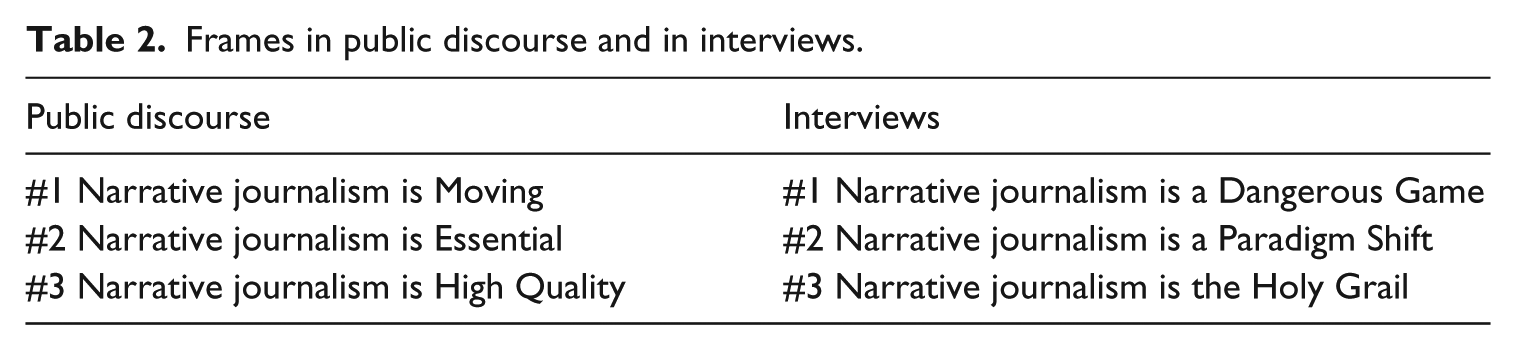
In short, the analysis of public expressions shows that the genre of narrative journalism is being framed as (1) moving, (2) essential, and as (3) journalism of higher quality. The following section discusses how narrative journalism is framed in the interviews with journalists and lecturers in journalism programs.
Frames in interviews
Results of the interview data revealed that narrative journalism is discussed in three distinctive frames which correspond to, as well as deepen, the frames found in the public expressions. An overview is shown in Table 2 below.
Frames in public discourse and in interviews.
#1 Narrative journalism is a Dangerous Game
First, narrative journalism is framed as a dangerous game. This frame appears to be an extension of the ‘narrative journalism is moving’ frame: because narrative journalism should engage readers, narrative journalism is conceived of as a gambling game with ‘temptations’, ‘dangers’, and ‘risks’ involved as well as wins and losses (A, D, F, H). 1 As one interviewee articulates it: ‘There is a lot to win, but yes, there is a lot to lose’ (H). The dangers and risks of the narrative game lie in the temptation to sacrifice a narrative’s truthfulness for the sake of readers’ involvement. Specifically, using storytelling techniques may increase ‘the danger to get carried away by the story structure and to twist the facts a bit’ (A) and ‘the temptation […] to take the truth a bit more lightly – but that I consider as a sliding scale, where does it stop?’ (D).
The temptations in the game of narrative journalism are not to be taken lightly: journalists are tempted to cross ‘the boundary to too much fiction, that is the danger’ (F); and in doing so, ‘you are getting somewhat in an atmosphere of a novel almost, you’ll be tempted of course, because it’s so big and it feels so good’ (F). Likewise, interviewees compare journalists who use storytelling techniques to children playing with ‘dangerous toys’, ‘a set of knives’, and even with ‘a barrel of gasoline’ (H), implying that narrative journalism may cause harm or could even be explosive: it may harm the journalist as well as journalism itself. In playing the narrative game, journalism’s credibility, authority, and function are at stake. To ensure that the narrative journalism game does not reach the exploding stage, journalists should ‘read the manual’ and ‘play by the rules’ (H). This brings us to the second frame:
#2 Narrative journalism is a Paradigm Shift
Second, professionalization of narrative journalism is framed as a paradigm shift in which the ideal of objectivity gets abandoned. This frame appears to be an extension of the ‘narrative journalism is essential’ frame: because narrative journalism is essential to revitalize journalism, it permits or presupposes a rethinking of the traditional objectivity and factuality paradigm.
In the first place, the abandoning of objectivity is legitimized by the claim that objectivity simply does not exist and that all journalism is in fact inherently subjective: ‘The discussion about objectivity goes way back and and I don’t mean to throw it all overboard, you should use it but in another way’ (E). The objectivity ideal gets readily substituted by different ideals: ‘[…] we are going to abandon the notion of objectivity, because that does not exist […] and instead there is the notion of plausibility, credibility, trustworthiness, truthfulness …’ (E).
The paradigm shift also involves the notions of fact and fiction. Although most interviewees feel that journalism should be strictly factual and that ‘facts are sacred’ (H), the notions of fact and fiction are found to be ‘slippery’ (J). In this view, defining the boundaries of narrative journalism becomes highly problematic. Interviewees talk about the flexibility (‘there are no fixed boundaries’ (J)) and even the absence of the genre’s boundaries (‘the boundaries of literary non-fiction have nowhere been defined’ (G)). In order to resolve this issue, conceptions of what is allowed and what is not are seen as ‘less relevant’ (D) or ‘outdated’: ‘[…] so the journalistic ideology, about what truth is and such, that I find really outdated and sometimes very primitive’ (E).
For some of the interviewed lecturers, but not for the journalists, the absence of clear boundaries allows for ‘more freedom’ (I) in terms of how to represent reality: ‘[…] what is true and what is untrue and how do you deal with composing sources – there are no rules either. I am not against composite sources or fabricated quotes at all’. (E). Stylistic and aesthetical considerations may come to dominate over traditional norms of truthfulness and factuality, although narrative journalism is still to be distinguished from fiction: So then I read a story representing the reality as it could have happened. But I know that, before you know it, you end up in the wrong camp. […] You have to be careful with that, but I am a bit aesthetic, I like to see it pretty. (I)
By consequence, this new paradigm requires readers to be ‘mature’ (B). They decide what to read in the newspaper and if they choose to read news narratives, that decision implies agreement with the somewhat blurred line between fact and fiction. It is the readers’ responsibility to understand that not everything they read in the newspapers mirrors reality. In the words of one of the interviewees: ‘It is not up to me to educate the reader’ (B). And another, ‘As a reader you don’t think: oh everything that is told there is true. […] A certain level of literacy, media literacy it is called nowadays, may be presupposed’ (E). Over time, readers come to understand that narrative productions are a mix of fact and fiction: ‘that you look for signals where you can tell oh this is made up or something, by a transition or whatever. So yes, of course, over time that is changing’ (E).
#3 Narrative journalism is the Holy Grail
Third, narrative journalism is framed as a form of art. This frame appears to be an extension of the ‘narrative journalism is high quality journalism’ frame: because narrative journalism is high quality journalism, it is also ‘the highest’ achievable for journalists. In this frame, narrative journalism is compared to the top, heaven or ‘the Holy Grail’: ‘Yes, I really consider it the top of journalism’ (G); ‘It is the higher form of journalism which, yes, if you can do that, you are in the Valhalla of journalism’ (A); ‘[…] Haha, yes, the Holy Grail’ (B).
The effects that narrative journalism as art can achieve are compared to those of music, visual art, and literature: ‘A reportage with the power of a literary story, that causes the reader to sit upright because he thinks: oh God, and this is all true’ (H). It thus appears that professionalization of narrative journalism also affects journalists’ professional identity: they become artists rather than reporters.
This frame implies that the quality of a journalistic narrative is determined by the talent and practice of its creator: ‘If you learn to play the piano you must also walk along those keys, again and again, and one day you find yourself playing Tchaikovski’ (G). Successes may be met with failures, although, ‘There are nice paintings but there are also very cheap paintings’ (I). News narratives may not always excel in quality, but the narrative productions which do excel should be valued and treasured as true art and as showcases of what narrative journalism is capable of.
Conclusion
Although narrative journalism as a journalistic phenomenon is not new in the Netherlands, it has in recent years been propagated as a ‘new’ genre. This study shows that this new focus can be conceived of as a strategy to withstand the pressures journalism is facing in the competition with online news. In metajournalistic discourse on narrative journalism, the genre is conceptualized as an essential enterprise, using involving techniques to deliver an attractive and high quality product. These findings clearly show how this public field of discourse is used to establish narrative journalism as a meaningful and legitimate genre (cf. Carlson, 2015).
However, as became clear from the interviews, the supposed strengths of narrative journalism come with some risky downsides. The use of literary techniques is seen as a precarious affair; it attracts readers but it may also tempt journalists to alter the truth. This is dangerous in the sense that aesthetic considerations may come to dominate over traditional principles of objectivity and factuality, which may ultimately cause journalism to lose its credibility and authority. Note that in itself, this frame has all the characteristics of a folk tale. By framing narrative journalism as an obligatory task, using a magic trick that enchants the audience en route to the Holy Grail, meanwhile averting the dangerous abyss of subjective fiction underway, the journalist may feel reinforced in the battle against the abundance of new media.
The framing of narrative journalism as a dangerous game is notable for several reasons. First, a game is a contest involving some sort of rivalry. Use of this frame, thus, signals an attempt to dissociate narrative journalism from other forms of journalism rather than an attempt to integrate the genre into mainstream journalism – which could be an alternative and recommendable strategy, if narrativization indeed does raise quality. Second, a game involves a set of rules. Interviewees, when using this game-frame, showed their awareness of the importance of the rule to stay away from fiction. However, the game-frame is in this view somewhat contradictory to the framing of narrative journalism as a paradigm shift: a paradigm shift frame acknowledges that rules concerning objectivity and factuality are either unclear – and therefore irrelevant – or that they should be adjusted to fit narrative journalism – instead of the other way around.
Does this mean that narrative journalists are ready to depart from journalistic norms altogether? The traditional rule in journalism, rooted in the New Journalism movement of the late 19th century (Broersma, 2007), pertains to the objectivity norm according to which journalists should provide news in a factual and neutral manner without adding values, emotions, or comments to it (Schudson, 2001). Despite many critical evaluations of this norm, journalism’s claim to objectivity remains a central one in journalism practice as well as public discourse (Broersma, 2010; Post, 2015). Interviewees in this study take an alternative stance by claiming that objectivity is no longer very relevant, or does even not exist, and that the objectivity rule does therefore not apply to the game of narrative journalism.
This finding resonates with the results of a study by Andén-Papadopoulos and Pantti (2013) on journalists’ use of citizen-created photographs and videos, a routine which challenges the traditional professional values of accuracy and objectivity. Their study showed how journalists defend this routine by ‘renegotiating the conventional model of objectivity in favor of the model of transparency’ and how they ‘explicitly question the importance of objectivity in the context of crisis reporting, pitting it against the norm of truth-telling, non-elite sourcing and the public serve commitment of journalism’ (Andén-Papadopoulos and Pantti, 2013: 971–972). In the case of Dutch narrative journalism, the objectivity norm is renegotiated in favor of less rigid norms of plausibility and credibility.
The renegotiation of objectivity can be viewed as a form of boundary work, a process of ‘demarcating, defending, expanding and contesting the limits of legitimate journalism in order to consolidate and protect authority’ (Fakazis, 2006: 6; see also Lewis, 2012). Interviewees in our study not only contest the boundaries of narrative journalism but also question the relevance of these boundaries by emphasizing their flexibility and reflecting on their haziness. Interesting in this respect is the finding that for some of the interviewed lecturers, this flexibility even allows for the inclusion of fictional elements in journalistic writing, such as composite sources and fabricated quotes. Note that only lecturers consider narrative journalism as a genre in which the use of such fictional elements is legitimate, which might be explained by the presumption that lecturers have a more reflective view on the notions of fact and fiction compared to journalists. Part of the lecturers’ professional task involves the transmission of values and norms to students, requiring their ability to think beyond commonplaces and adopt conventional as well as unconventional views – if only for the sake of fruitful classroom discussions. A complementary explanation could be that lecturers and professional journalists alike regard narrative journalism as a space to include fictional elements, but that in the context of this study, only lecturers felt free to express such views because they are not actively writing for newspapers. Future explorations of these two explanations could contribute to a clearer understanding of the limits and legitimacy of narrative journalism and examine how and why the boundary work in this area might differ across the various actors involved.
The relevance of future research in this direction derives from the paradox that in narrative journalism, fiction – be it fictionalizing techniques or fictional elements – is used to serve non-fiction. The framing of this practice as a dangerous game involves a renewed understanding of journalistic professionalism with implications for the role distribution between journalist and reader: the narrative journalist is a child playing with storytelling techniques, while the reader is an adult who is able to assess the playful conception of reality. This marks a sharp contrast with the traditional relationship between journalist and reader in which journalists function as watchdogs alerting the public about official misconducts and other problems occurring in society (Strömbäck, 2005). In this relationship, readers rely on the journalist’s trustworthiness in order to become informed citizens and participate in democratic processes (Strömbäck, 2005). The newly proposed relationship appears to offer less room for this kind of reliance, which could raise the anxious question as to how narrative journalism lives up to journalism’s societal function. A possible answer is that news narratives contribute in a slightly altered way to society, in terms of sense-making and ‘quality of life’. Their value could be shifting toward the range of meanings and valuable experiences these stories bring about (Costera Meijer, 2013). Journalism can only fulfill its democratic function if its products are consumed by the audience, and the audience has a need for understanding and sense, delivered by gripping stories (Peelo, 2006).
From this perspective, the narrative formats that are used so frequently in journalism contribute to democracy precisely because they attract readers: they stage news actors as prototypical characters whom readers can relate to (Lule, 2001) and display storytelling techniques that draw readers close to the news events (Peelo, 2006). This idea also corresponds to research indicating that Dutch journalism is and always has been functioning on narrative grounds (Van Krieken and Sanders, 2016a, 2016b; Dingemanse and De Graaf, 2011). Hence, there is no evident reason to assume that the current promotion of narrative journalism would endanger the interdependent relation between journalism and democracy. And the story of narrative journalism gives narrative journalists a sense of greater quality of life, as well.
Footnotes
Appendix
Overview of interviews.
| Interviewee | Date of interview | |
|---|---|---|
| A | Journalist | 6 January 2015 |
| B | Journalist | 6 January 2015 |
| C | Journalist | 6 January 2015 |
| D | Journalist | 9 January 2015 |
| E | Lecturer | 28 January 2015 |
| F | Journalist | 3 February 2015 |
| G | Lecturer | 5 February 2015 |
| H | Journalist | 6 February 2015 |
| I | Lecturer | 12 February 2015 |
| J | Lecturer | 9 April 2015 |
Acknowledgements
The authors would like to thank Radboud Honours Academy student Fabiënne Stoffels for her assistance with the data collection, and Hans Hoeken for his thoughtful comments on an earlier version of this article.
Funding
The author(s) received no financial support for the research, authorship, and/or publication of this article.