




Abstract
Opinion polls form an important part of modern election coverage but might also shape amount and tone of other subsequent coverage about political parties. We propose to use and elaborate on Patterson’s generic storylines to help account for different findings in prior research, by pointing to the importance of race context. A manual content analysis (N = 3755) of the 2013 German Bundestag election campaign is used to empirically test our framework, using a multilevel model that separates effects of 36 polls on coverage of five different parties in 11 different outlets. Results show that the amount of party coverage for the front runner party increased after drops in its ratings, and the challenger party received more negative coverage after increases in its poll ratings. Media coverage did not follow a bandwagon trend but played an independent and counteracting role within the election campaign.
Keywords
Opinion polls are a central aspect of modern democratic campaigns, and media widely use them for their campaign coverage (Brettschneider, 2008). Much research has looked at the various effects of polls on voting and turnout (Hardmeier, 2008). There is growing evidence of a bandwagon effect of favorable poll reporting resulting in an extra boost for the front runner candidate/party as voters are drawn to the likely winner (Van Der Meer et al., 2016). The enthusiasm of the crowds gives a party momentum and induces a positive spiral since favorable poll ratings shed a more positive light on a party and further increase support for it (Stolwijk et al., 2017). Most studies investigate the effect of polls on voters (see Hardmeier, 2008), but much less attention is given to their effect on news selection and coverage, in terms of the amount and tone of a party’s media portrayal (Green-Pedersen et al., 2017). This despite of the strong theoretical role ascribed to the media’s coverage of parties in creating the bandwagon effect (Bartels, 1988; Patterson, 1993): it is through the media that polls reach voters, and media can play an important role in the story told about a party, a story that might shed a favorable or unfavorable light upon it. This article will explore whether that story told in the media follows poll trends or not.
This article takes a closer look at how polls help shape the media agenda. Do polls influence subsequent party coverage apart from the poll coverage itself, that is, do polls help shape the story that journalists tell about parties in an election campaign? Here, party coverage will refer to the amount of any sort of (positive/neutral/negative) mentioning of a party or its politicians in the media that does not refer to poll results. Rosenstiel (2005) argues that polls create a context for journalists to explain and organize other news. Exposure to such other news coverage, in turn, might have effects on vote intentions, separate from those of poll coverage (e.g. Geers and Bos, 2017). Together, poll ratings, poll coverage, and other news coverage (influenced by these poll ratings) may create a media environment conducive to a much stronger (or weaker) bandwagon effect, than is captured by studies that examine one of these factors in isolation (Henshel et al., 1987). They might combine into an amplified bandwagon effect, with positive polls leading to positive media coverage of such polls, and more frequent and more positive media coverage of other news in relation to this party. These factors might work together to influence voters in increasing their support for this ‘winning’ party. Studies show that journalists are interested in opinion polls and use them in determining newsworthiness (Weaver, 2008; Wichmann and Brettschneider, 2009). To investigate whether this translates into news selection patterns, and whether media coverage supports an amplified bandwagon effect, this study explores how media coverage of parties responds over time to changes in the poll ratings of these parties.
The literature on the influence of polls on party coverage is still limited. Previous studies have mostly looked at US presidential campaigns and primaries, but there are also studies on multiparty systems such as the Netherlands and Germany (Box-Steffensmeier et al., 2009; Christenson and Smidt, 2012; Jandura and Petersen, 2009; Vliegenthart and Van Aelst, 2010). These studies tend to build their hypotheses on a bandwagon thesis in news selection. Overall, their results confirm this theory: more positive poll ratings appear to contribute to more, and more favorable, party coverage. However, there are many exceptions. Both Christenson and Smidt (2012) and Vliegenthart and Van Aelst (2010) report inter-party/candidate differences, which do not fit the bandwagon theory. Likewise, Bartels (1988), Patterson (1993), and Sides and Vavreck (2014) find that the effect of poll ratings on party coverage has more to do with the position of a party in the horse race, than whether a particular poll rises or falls with respect to the previous poll. For example, emerging candidates are treated differently than steady front runners. We argue that such differences might be (partly) explained by differences in campaign dynamics. Different storylines, like, for example, those of a rising or trailing party, are likely to be more or less applicable to different campaigns depending on whether such poll trends actually occur or not (Patterson, 1993).
In this study, the influence of such context variations will be explored by examining an example of a different election campaign context: The 2013 campaign for the German Bundestag elections. This was a campaign with relatively stable polls in combination with one party (CDU) having, and maintaining, a solid lead over the other parties in the polls. The campaign was stable as no party gained or lost more than 5 percent of the vote between its lowest and highest predicted poll ratings during the campaign, and the front runner party and the main challenger party did not switch places at any point. This limits the applicability of two of Patterson’s (1993) storylines (that of a party gaining and of a party losing ground during the campaign), which are most likely to foster bandwagon-type coverage. Although such poll dynamics are not uncommon, such campaigns have been studied far less frequently (see Bartels, 1987, for a typology of campaigns). Consequently, the 2013 German case offers an opportunity to get a better idea of the role of the race context for how media coverage of a party responds to changes in poll ratings. In this article, race context will refer to the type of poll patterns that occurred during the campaign. For example, a race context can contain little poll volatility or much, for one party or many, indicate a clear winners or losers or a balanced field, and so on. Patterson’s (1993) framework will be extended by proposing a typology of how party coverage may respond to changing poll ratings under a race context with little poll volatility.
The study considers poll ratings published for all five main parties in the period between 6th August and 21th September, 2013. A content analysis measures the daily amount and (positive/neutral/negative) tone of coverage of each of these parties in the main TV news broadcasts, national newspapers and is the first to also include coverage on newspaper websites in this regard. A multilevel model with each outlet’s party coverage nested under the specific combination of outlet and party and the particular poll publication is used to compare coverage before and after each poll with changes in ratings. Results show that the influence of changing poll ratings on party coverage indeed appears to be race context dependent. Media coverage is found to ‘magnify’ small poll changes for larger parties and respond to them in a ‘counteracting’ fashion: the observed pattern did not correspond to bandwagon-supporting news selection of increasing poll ratings leading to more (positive) coverage. The front runner (CDU) gets more coverage after decreases rather than increases in its poll ratings, while its trailing challenger (SPD) receives additional negative, rather than positive, coverage when it rises in the polls. The findings thus challenge the amplified bandwagon effect suggested in some earlier studies.
Theory
Polls and the media
Surveys show that journalists are interested in polls and often use them in their work (Weaver, 2008; Wichmann and Brettschneider, 2009). Journalist’ self-reports indicate that polls have a moderate influence on their news selection. That media take polls into account when selecting news is also consistent with Bennett’s (1990) indexing hypothesis. The higher a party’s standing in the polls the more powerful and authoritative it becomes and thus the more worthy it is of coverage. Differences have been noted for the effects of polls on the coverage of different candidates or parties in different elections in different countries (Box-Steffensmeier et al., 2009; Sides and Vavreck, 2014; Vliegenthart and Van Aelst, 2010). This article will build on Patterson’s (1993) storyline perspective to suggest how race context might help to account for some of these differences. Therefore, Patterson’s perspective will be examined here first, and then related to its impact on the relation between polls and party coverage for different race contexts.
Patterson (1993) argues that media will create a storyline out of poll results, in order to turn them into a continuous stream of news. This storyline might make some parties more newsworthy than others. In his study of US primary election coverage, Patterson (1993) listed four generic stories that can be applied depending on the position of a candidate within the horse race: gaining ground, losing ground, trailing, or leading. Those candidates who are gaining ground get the most favorable coverage. However, this phase of positive portrayal can be short-lived: as soon as the candidate’s gains are stabilizing or even falling again, the press reverts to its more usual, negative, style of coverage. The opposite of a gaining candidate is a candidate who is losing ground. When a candidate drops in the polls, the press starts to investigate the causes for this drop, yielding a corresponding negative tone of coverage. A third story is that of a trailing candidate, or ‘likely loser’, whose ratings are low and stable. This candidate is least likely to get good coverage. In fact, this candidate is least likely to get any coverage at all. There are a few variations within the likely loser coverage category though: weak contenders get little coverage, a candidate with ascribed potential might be awarded the status of ‘underdog’ and even get favorable coverage, and a few losing candidates get a host of negative attention. The fourth generic story, that of a stable leading, front runner candidate, yields reasonably positive coverage, but not as positive as a gaining candidate, as media tend to focus on the maneuvers of this front runner candidate to maintain his or her lead.
Following this perspective, we might suppose that the influence of polls on party coverage is dependent on which poll trends occur. Campaigns differ in this respect: some witness repeated cycles of candidates gaining and losing ground (e.g. Sides and Vavreck, 2014), while others only have a single rising star (e.g. Jandura and Petersen, 2009). A different case, not usually studied, would be a campaign with little poll volatility whatsoever. Such a campaign does not offer obvious, exciting poll gains or losses for journalists to report on and thereby provides an interesting test of the effect of race context. Below, we introduce a typology of different media responses to deal with campaigns with little poll volatility, describing three theoretically plausible effects on party coverage: poll magnification, counteracting, and ignorance.
Stable polls and party coverage: A typology
Logically, journalists can respond to poll results in their coverage in three different ways: they can follow poll changes, counter them, or ignore them. There is support in the literature for each of these three, quite different, possible reactions of media when it comes to campaigns with little poll volatility.
Magnification
Even though strong upward or downward poll trends did not occur in the 2013 German federal election, the media still might be tempted to rely on the generic (bandwagon) storylines of gaining and losing ground. These stories are the most prolific from the viewpoint of the media as each new twist can be presented as news. In general, changing ratings are continuously newsworthy, make the horse race more exciting, and create the need for additional explanatory stories. To keep these storylines, the media could grasp any short-term change and report on it as if it were the beginning of a strong rising or falling trend. Therefore, the type of media response in which small changes in poll ratings positively affect party coverage is labeled ‘magnification’ here. Indeed, studies find that journalists frequently interpret poll changes that fall within the sampling error as if they were substantial and meaningful (Bhatti and Pedersen, 2016; Brettschneider, 2008; Patterson, 2005). Extrapolating on these findings yields the expectation that party coverage increases with rising polls and becomes more positive in tone. This response would be in line with the bandwagon narrative of the generic gaining ground or losing ground storylines.
Counteracting
A related response would be to counter any poll change. This response type resembles the magnification type in that ‘meaningless’ changes in polls are interpreted as meaningful, but it differs in the kind of interpretation given. Technically, ‘counteracting’ would refer to any reaction in party coverage to changes in poll ratings that is at odds with the bandwagon narrative in which positive poll changes lead to more (positive) party coverage.
Journalists in democratic corporatist countries like Germany are known for their interventionist interpretation of journalistic autonomy (Donsbach and Patterson, 2004; Schudson and Anderson, 2009; Weischenberg et al., 2006). As argued above, polls provide journalists with the scientific authority to challenge the views provided by (some) parties. If a party is falling in the polls, then apparently their voters disagree with its recent actions or policy proposals. When polls lack a continuing storyline of a gaining or losing candidate, an alternative must be found to achieve the norm of journalistic independence. The most direct way to do so would be to counter current political trends. In its purest form, this would lead to an underdog-type effect in which party coverage becomes more positive when poll ratings drop (cf. Ceci and Kain, 1982). Alternatively, the counteracting response type could also reflect the effect of campaigning by parties or other actors. For example, campaign teams who witness dropping poll ratings of their party might be afraid that these polls might induce more negative party coverage and increase their efforts to prevent this from happening by seeking media attention and spinning stories (see Mutz, 1998).
Ignorance
In contrast, a third possible response could be for the media to ignore small poll changes. The literature on news values would suggest that rather stable poll ratings would not make it in the news at all because they lack the key attribute of novelty/surprise (Helfer and van Aelst, 2016; Van Santen et al., 2015). Both Searles et al. (2016) and Matthews et al. (2012) find that stable polls themselves are less likely to be reported and are reported in shorter articles with less interpretation than volatile polls. If stable polls are not newsworthy, how can they be part of a storyline and why would small variations in polls affect consecutive party coverage? In this case, no response in party coverage would be expected after small poll changes.
These three different response types pose quite opposite expectations. The literature offers little guidance as to whether one of them might dominate the other. They could also cancel each other out, or perhaps, one might apply to one party, while the other to another party. The lack of poll volatility applies to all five major parties competing in this election, so the effects on media coverage might be similar as well. However, Patterson’s (1993) storylines did not treat all parties with stable polls similarly: a leading party is covered quite differently from a trailing one. Stable poll ratings might be considered positive for a leading party and negative for a trailing party as election day comes closer, and it becomes less likely that the gap between them will be closed. So although the focus here is on poll changes, still Patterson’s argument how party coverage is dependent on its position in the horse race remains important. To explore how and which of the different theoretical perspectives outlined in the typology can help explain party coverage for a specific party or across parties in the 2013 German Bundestag election, therefore, a research question rather than a hypothesis is formulated:
RQ1. How does party coverage change in relation to changes in party poll ratings over time?
If race context is indeed party dependent, we would expect different effects for different parties, with polls of a leading party being interpreted in a more positive light than those of a trailing party.
Method
The aim of the analysis is to examine the effect of poll ratings on party coverage during those last crucial 6 weeks of the campaign. During that period, a variety of polls are released. Poll ratings are themselves an object of contestation as different polling firms compete for attention. Different pollsters use different methods and consequently vary in systematic ways in their estimations (see Online Appendix A). Previous research have roughly applied two methods to determine day-to-day poll ratings. One approach restricts itself to using only one polling source, usually in the form of a rolling cross-sectional survey (e.g. Box-Steffensmeier et al., 2009). A second approach tries to combine ratings from different polling firms into a continuous measure. To do so, they use the rating published for a certain day when available, regardless of source (e.g. Jandura and Petersen, 2009). Both approaches have their drawbacks. In the first approach, polls by other polling firms are ignored. In the second approach, daily variations could be the result of differences in polling method (see Rosenstiel, 2005; Wlezien, 2003). In addition, in Germany, as well as in many other countries, there are established ties between some of the polling firms and some of the media outlets (Holtz-Bacha, 2012; Searles et al., 2016). Such ties could lead to differences between the influences of certain firms’ ratings on party coverage in different outlets (see Searles et al., 2016).
The design of the present study aims to address these issues by a more precise model specification. In order to capture the polling information available to journalists more fully, polls from multiple polling agencies will be used in the current study and related to coverage in multiple outlets. We compare each poll for each party to its predecessor by the same agency. These differences are then related to the coverage of the parties in question following this poll, for each outlet, while controlling for the coverage preceding it. This results in 36 (polls) * 11 (outlets) * 5 (parties) = 1980 such comparisons, which form the cases in our dataset (for a similar approach, see Bos et al., 2011; Walgrave et al., 2006). 1 In this way, differences in polling methodology are accounted for since the focus is on change within the predictions of a single polling firm. By using data from all seven main polling agencies in relation to each of the eleven media outlets, the multifaceted information environment and possible links between polling firms and media outlets are explicitly accounted for. A multilevel model is used to account for the various interdependencies in this party, outlet, and poll publication–grouped dataset. By including outlet as one of the levels, the potential partisanship of individual outlets is controlled for, as is any specific affiliation between a certain polling firm and an individual outlet.
Media content analysis
Sample
The content analysis (N = 3755 articles/TV news items) includes all campaign related text articles on the front page of the main German national newspapers (Frankfurter Allgemeine Zeitung; Die Welt; BILD-Zeitung; Süddeutsche Zeitung), on the main and politics tabs of newspaper websites (www.bild.de; www.spiegel.de; www.faz.net), and all items of the main TV news broadcasts (Tagesschau, ARD (20:00 hours); Heute, ZDF (19:00 hours); RTL News, RTL (18:45 hours); SAT.1 Nachrichten, SAT.1 (19:55/20:00 hours)) from 2nd August to 21th September, 2013. 2 Coding was done by five native German-speaking coders in October and November 2013, after having received a 2-week coder training. Although our sample of newspapers is slightly right-leaning, by including coverage from a range of outlets, this study goes beyond most previous studies that focused exclusively on a single outlet (e.g. Box-Steffensmeier et al., 2009) and can therefore be more certain that any effect found is not specific to the outlet studied.
Variables
Independent variable: Change in poll ratings
Poll ratings are expressed in percentages of the total expected vote and thus theoretically range between 0 and 1 (i.e. between 0% and 100% of the vote), so 0.01 represents 1 percent of the vote. 3 The absolute poll ratings used were coded for the day they were released. The change in poll ratings represents the increase/decrease in the poll rating of a party as reported in the current poll with respect to the previous poll published by that same polling firm (M = –0.00; SD = 0.01; range = [–0.03, 0.02]). 4 This range shows that any individual changes between two consecutive polls tend to be small (i.e. between 0% and 3% up or down). This is not surprising since new polls are released within short-time intervals during the campaign period. Polls are collected from seven polling agencies and drawn from www.wahlrecht.de. Polls are included if they are published after 9th August and before 20th September. In this way, there is enough content data left to estimate party coverage preceding each poll, and there is at least one day of coverage left after the poll, but before the election to estimate the effects of poll changes on party coverage. 5
Dependent variables
Amount of party coverage is denoted by the number of articles/items mentioning this party per outlet per day (M = 0.86; SD = 0.80; range = [0, 5]; see Online Appendix D on intercoder reliability). So, on average, each outlet typically published slightly under one article/item mentioning each of the five parties per day on their front page, main tab, or politics tab. 6 The coverage on the day of publication of the poll in question itself is excluded from analysis. If the timing of the publication of a poll is driven by campaign events, the coverage on these days might be atypical. By omitting these days from the analyses, any spurious correlation between poll ratings and coverage due to a campaign event is avoided. 7
Tone of party coverage refers to whether the coverage related to this party or its politicians was explicitly described positive (+1), neutral/balanced (0), or negative (–1; see Online Appendix D on intercoder reliability). To arrive at the measures of tone of party coverage suitable for the analysis in this article, these tone ratings were first averaged per party per article, if multiple actors related to the same party co-occurred in the same article. From these article–party tone ratings, three variables were computed, each aggregated and averaged per day over each period between the publications of two polls by the same polling firm: the number of positive articles per party in an outlet per day (M = 0.07; SD = 0.16; range = [0, 1.33]), the number of neutral articles per party in an outlet per day (M = 0.63; SD = 0.59; range = [0; 3.67]), and the number of negative articles per party in an outlet per day (M = 0.16; SD = 0.22; range = [0; 1.5]).
Controls
Poll list
A categorical variable indicates for each case to which poll list (= list of poll ratings per party published by a polling firm) it refers. Each category refers to one instance (n = 36) in which one of the polling agencies publishes poll ratings for each of the parties (i.e. CDU/CSU, SPD, FDP, Grüne, Linke). For example, the poll results of Allensbach for CDU, SPD, Grüne, Linke, and SPD published on the 18 September are each coded ‘poll list = 1’, the Allensbach poll results for those parties published 4 September are each coded ‘poll list = 2’, and so on.
Time trend
It can be expected that coverage increases toward election day. To control for such possible time trends in the data, each poll list publication is coded for the number of days from the start of the dataset (2nd August) to its publication date, this variable thus increases toward election day. Separate time trends are estimated for the front runner (CDU), challenger (SPD), and small parties (FDP, Grüne, Linke).
TV debate
German federal campaigns only have one TV debate between the two main party leaders, as this debate generates massive publicity two dummies are used, one for before the debate and one for after. These dummies only refer to CDU and SPD, as the other parties did not take part in the debate and descriptive analysis showed the debate had little effect on their coverage (not shown).
Amount of campaign coverage
In addition to the debate, there might be other periods in the campaign which might trigger more coverage of all parties, as a general control for such events a measure is included summing the total number of articles/items referring to the election campaign, which might or might not refer to one or more of the parties, on average per day over the period between each two consecutive polls for the same polling firm. Again two versions of this measure are included, one referring to the period preceding the poll list and one to the period following it.
Lag length
One consequence of the data structure is that the number of days between two consecutive poll lists by the same firm might vary (range = [2, 19], M = 7.06), as the effects of polls on coverage might dissipate or escalate over time and differences in lag length might affect the findings; to control for this possibility, two measures are included counting the lag length in number of days in the period preceding and following the poll list (see Online Appendix B for an example of the model equation used).
Results
To test whether there is any change in party coverage following poll changes, and whether this differs across parties, a series of models has been run. Results show that the general effect of changes in poll rating on total amount of party coverage, across parties, outlets, and polls, is not significant (see Online Appendices for full results and model specification). When polls of a party went up, the amount of its coverage did not change significantly (in line with the ignorance response), but results also show that this is partly because the amount of positive coverage decreases while the amount of negative coverage increases (in line with the counteracting response).
To evaluate whether the pattern is indeed similar across parties as implied by this analysis, or whether the main leading party (CDU) and trailing party (SPD) are treated differently from the rest, another set of models is run. Table 1 shows the results of comparing the effects of changes in ratings for front runner CDU, challenger SPD, and the other parties on total amount of party coverage, positive coverage, negative coverage, and neutral coverage (see Online Appendices B and C for more information on the model specification). The first row of Table 1 shows the effect for front runner CDU, the second for challenger SPD, and the third for the smaller parties (FDP, Grüne, Linke). 8 The first point to notice is that the coefficients for front runner CDU are quite different from those of the other parties, and often opposite in sign. In addition, the coefficients for the front runner are the only ones to be significantly different from zero, while there are marginal significant effects for the challenger on amount of total coverage and negative coverage. For the front runner, the effects of polls contradict a bandwagon effect in news selection, that is, when CDU poll ratings go up the amount of their total, positive and negative coverage goes down. However, although the CDU had a solid lead over the other parties throughout the campaign, the changes in polls for CDU were on average negative (M = –0.2%). Consequently, the more likely interpretation of the CDU results is that when its ratings go down, its coverage increases. 9 The effect is modest: for each percent drop in the polls, coverage of the front runner grew on average with 0.09 (β = –8.61) articles/items. As the range of average party coverage per outlet per day is between 0 and 5 (prominent) articles/items, this is an effect amounting to 1.7 percent of the range for each percentage point increase or decrease. In other words, the front runner was covered in an additional 0.09 articles/items per day on average in each of the eleven outlets during the period until the next poll by the same polling firm. So, if that period lasts 5 days, this amounts to an additional coverage of 5 * 11 * 0.09 ≈ 5 articles/items across this time period across all outlets for each percent that the CDU drops in the polls. Note that there are no effects on neutral coverage, so effects refer to articles/items in which journalists give some (positive or negative) qualification to the CDU. This implies that such party references are interpretative rather than merely descriptive in nature. These results appear to align best with the counteracting-type media response described above. More specifically, they correspond to Patterson’s (1993) leading party generic storyline. Still, the increase in coverage after a decrease in poll ratings is not generally positive coverage, as would be expected for the underdog version of a counteracting-type effect, but negative coverage increases at an about equal rate as well. The estimates for the CDU time trend are likewise in line with the leading party storyline. They show that coverage of CDU becomes more positive and less negative as election day comes closer. 10
Results of multilevel model explaining next amount of total, positive, negative, and neutral coverage specified for CDU versus SPD versus other parties.
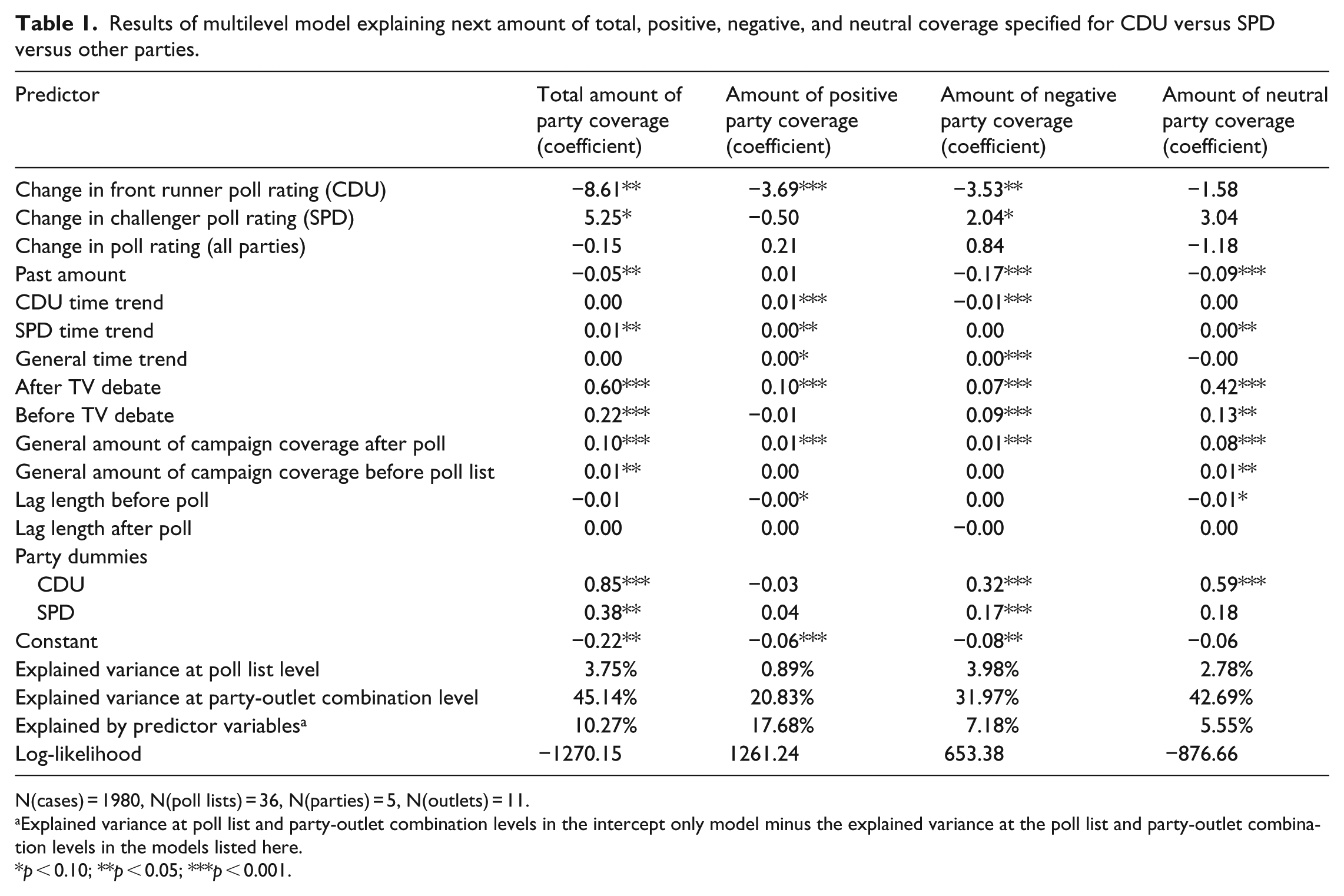
N(cases) = 1980, N(poll lists) = 36, N(parties) = 5, N(outlets) = 11.
Explained variance at poll list and party-outlet combination levels in the intercept only model minus the explained variance at the poll list and party-outlet combination levels in the models listed here.
p < 0.10; **p < 0.05; ***p < 0.001.
The effects for challenger party coverage are quite different. In line with Patterson’s generic trailing party storyline, the challenger (SPD) in general received less coverage than front runner CDU (β = 0.38 vs β = 0.85), and the effects of polls on its coverage were likewise smaller. The two marginally significant positive effects on total coverage (β = 5.25/1.0% of its range) and negative coverage (β = 2.04/1.3% of its range) again, broadly, appear to support the counteracting-type media response. Apparently, increasing poll ratings did make the challenger more likely to be covered, but this increased coverage was mostly negative. Again the results do not fit neatly in any one type of media response within the typology outlined above. The positive effect of total SPD coverage with changes in poll ratings seems to support the magnification type and resembles a bandwagon response in news selection. However, the negative tone of this coverage rather supports the counteracting-type response. The time trend for SPD shows that its coverage increased toward election day and that this increase was mostly due to positive coverage. 11 The results for the smaller parties (FDP, Linke, and Grüne) are not significant and support the typology’s ignorance media response category.
Discussion
This study aimed to clarify some of the disparate findings on the effects of polls on party coverage found in previous studies, by evaluating the effect of race context. Building on Patterson’s (1993) storylines, it was argued that certain patterns of polls need to be present in a campaign in order to construct a story. Accordingly, different campaigns lend themselves to different stories. In terms of race context, the German 2013 federal election campaign provides an interesting case since it witnessed little poll volatility. Instead of ignoring the poll changes that occurred, or follow them in their coverage, results support a counteracting-type response, both across parties and when looking at individual party effects. Overall (marginally) increasing polls were followed by a decreased amount of positive coverage and an increased amount of negative coverage. Party coverage did react to (marginal) changes in the ratings of the front runner and challenger party, but not in the bandwagon direction.
In line with a leading party storyline, negative ratings for the front runner (CDU) are found to be more newsworthy than positive ratings, replicating a similar finding by Vliegenthart and Van Aelst (2010). The additional coverage for the front runner was both positive and negative in tone. In line with a trailing party storyline, the effect found for poll increases on amount of coverage for the main challenger party (SPD) is positive, but the tone of this additional coverage was mostly negative. In addition, the SPD time trend showed that the amount of positive coverage it received increased toward election day. This might reflect a difference between majoritarian and proportional election systems, such as Germany. 12 Finishing second did not mean the SPD lost the election altogether, in fact they ended up in government. The SPD was a challenger party that trailed the leading party but remained relevant throughout the election campaign period. In majoritarian elections, such as the US primaries described by Sides and Vavreck (2014), it makes more sense to declare a candidate a loser if she is unlikely to win.
The effect of poll changes on media coverage for smaller parties (FDP, Grüne, Linke) was non-significant and thus corresponded to the ignorance type response: Their poll changes were ignored in building the party coverage agenda. Patterson (1993) argued that smaller parties matter little to the horse race and tend to be ignored in general. The small effect sizes of the front runner (CDU) and challenger party (SPD) of changing ratings on coverage may likewise be indications of the ignorance type response, though the effect size was in line with some previous studies of more volatile campaigns (e.g. Vliegenthart and Van Aelst, 2010). Ignoring smaller parties is less obvious in a proportional system such as Germany, where they might make or break a future coalition. Future studies might analyze additional newspaper sections and TV broadcasts, where there might be additional attention for these parties (cf. Holtz-Bacha, 2012).
This study has focused on the influence of polls on party coverage, but other research points out that the relationship might also go the other way as well (Box-Steffensmeier et al., 2009; Geers and Bos, 2017; Green-Pedersen et al., 2017). Additional and positive coverage following the, in general, slowly increasing poll ratings for the main challenger party (SPD) could have amplified the increase in its poll ratings, however, the results presented here suggest that that coverage would mostly have been negative instead.
Maybe the lack of magnification or bandwagon-type party coverage is to be expected in a country which is found to have relatively small degrees of horse race framing in its election coverage (Holtz-Bacha, 2012). However, Jandura and Petersen (2009) did observe a positive spiral of more positive poll ratings inducing more (positive) media coverage in the German 2002 Bundestag campaign. Many factors could have contributed to the counteracting effect found here, but the stable lead of the front runner in combination with the large and consistent gap with the challenger appear as a plausible explanation. In 2002, the gap between the two parties was much smaller and the challenger party (SPD) received a strong boom in positive coverage at the start of the campaign. 13 Rising SPD polls nicely fitted the storyline of a successful party gaining ground. Indeed, the SPD soon was a credible opponent to the front running party (CDU) and overtook it in the polls around 2 weeks before the election. The much larger gap between the two parties in 2013, in combination with the low poll volatility, made such a scenario unlikely for the 2013 election and thus warranted a different media response. Alternatively, the CDU campaign team might have learned from their failure in 2002 and successfully prevented a press narrative like that from happening.
What this stresses is the importance of considering the specific race context of an election campaign as a whole as well as the difference between parties. A different pattern is found in the same country, with the same journalistic culture and electoral and media systems, but with different race dynamics. In addition, these two campaigns illustrate the finding from various studies that the effects of polls on party coverage and vice versa tend to be limited in scope (Green-Pedersen et al., 2017; Vliegenthart and Van Aelst, 2010). These effects are generally not sufficient to create a dynamic out of nothing. For the larger part, the influence of polls on party coverage depends on whether interesting poll trends occur in a campaign: journalists need to work with what they get – and their subsequent party coverage is influenced by and actively reacts to those trends in predictable and systematic ways.
The counteractive relation between polls and coverage found for the front runner party is also found in a Dutch and Belgian context (Vliegenthart and Van Aelst, 2010), which suggests that it is not specific for a German context. The close link between polling firms and media outlets is likewise present in many other countries, as is the willingness of journalists to play a rather active role and put their own opinion forward, which suggests that the findings might be generalizable to other campaigns with little poll volatility (Brettschneider, 2008; Köcher, 1986). Larger analyses including more parties, elections, and outlets can also explore party differences with party-level variables, such as government versus opposition or left–right orientation, and outlet differences, like ownership or left–right readership.
Compared to earlier studies, this study has used a more precise model to investigate the effects of changes of polls on party coverage and accounts for differences between polling firms, outlets, and parties. It also examined a different kind of campaign: one with overall stable poll ratings. In lieu of exact theoretical expectations for such a case, a three category typology of media responses was proposed. Findings support a counteracting-type response as party coverage in the 2013 German campaign reacted even to marginal changes in poll ratings and, in line with the storyline perspective, in different ways for different parties. Party coverage in this democratic corporatist state did not mindlessly follow a bandwagon but took a rather active role in the election campaign itself.
Supplemental Material
MLpaper_journalism_26mei2019_online – Supplemental material for All in the game: Effects of opinion polls on party coverage in the 2013 German election campaign
Supplemental material, MLpaper_journalism_26mei2019_online for All in the game: Effects of opinion polls on party coverage in the 2013 German election campaign by Sjoerd B Stolwijk and Andreas RT Schuck in Journalism
Footnotes
Funding
The author(s) disclosed receipt of the following financial support for the research, authorship, and/or publication of this article: Nederlandse Organisatie voor Wetenschappelijk Onderzoek (022.003.037, 451.11.011).
Supplemental material
Supplemental material for this article is available online.
Notes

Author biographies
References
Supplementary Material
Please find the following supplemental material available below.
For Open Access articles published under a Creative Commons License, all supplemental material carries the same license as the article it is associated with.
For non-Open Access articles published, all supplemental material carries a non-exclusive license, and permission requests for re-use of supplemental material or any part of supplemental material shall be sent directly to the copyright owner as specified in the copyright notice associated with the article.
