




Abstract
Journalists play an important role in the formation of public opinion and can therefore be regarded as influential actors in conflict resolution. In Colombia, where the peace process remains a highly debated issue, the media are assumed to fuel polarization instead of dialogue. Indeed, deep societal divisions have been unveiled during last year’s plebiscite. In this environment, the concept of Peace Journalism has gained popularity among journalists, as it may promote a more nuanced debate. Against this backdrop, this study explores the role perceptions of Colombian journalists and their compatibility with the premises of Peace Journalism. To provide in-depth insights into journalists’ role conceptions, 16 semi-structured interviews with Colombian journalists were conducted. The results indicate that journalists hold a very active stance and want to influence and engage the public with their work, closely identifying with the role of the public mobilizer.
The Colombian peace process, aiming to end a conflict that has shaken the country for over 50 years, is facing one setback after the other. The slow implementation of the accord that the government signed with the Revolutionary Armed Forces of Colombia (Fuerzas Armadas Revolucionarias de Colombia, FARC) is affecting the ongoing peace negotiations with today’s biggest active guerrilla group, the National Liberation Army (Ejército de Liberación Nacional, ELN), as mistrust is increasing further. Because various armed groups are moving into the vacuum that the demobilization of the FARC created, violence surges in parts of the country (El Espectador, 2018; Semana, 2018). Meanwhile, Colombia remains polarized concerning the question of how to move forward – for example, with regards to transitional justice (Restrepo and Ramírez, 2016).
The media play a paramount role in the formation of public opinion regarding peace building processes. In the Colombian context, the coverage of the conflict has been criticized for fuelling polarization instead of fostering peace (e.g. García-Marrugo, 2013). Although journalists are assumed to play a key role in the framing of peace and conflict, little is known about how Colombian journalists themselves experience their role in peace building. The way journalists perceive their role has been shown to have a substantial impact on their production of media content (e.g. Bartholomé et al., 2015). Against this backdrop, in-depth qualitative interviews with Colombian journalists were conducted to better understand journalistic role perceptions in the midst of the Colombian peace process.
The Colombian conflict involves many different actors, fighting over influence and access to resources. In the absence of state control in many rural regions, right-wing armed groups have been formed to counter the resistance of the left-wing guerrilla. In addition, criminal groups, primarily interested in illicit trade, play a central role in the conflict. The state itself spurred the violence further, for example, in the scandal of the ‘falsos positivos’. In this setting, civilians were killed and presented as fallen guerrilla to fake war victories (Verdad Abierta, 2015). In the course of the conflict, 7.3 million people were internally displaced and around 220.000 lost their lives (Felter and Renwick, 2017; UNHCR, 2017). The peace process, started under president Juan Manuel Santos, has mainly been about the treaty with the FARC, the country’s largest guerrilla group.
On 7 August 2018, Iván Duque from the right-wing party Centro Democrático was elected as the new president. During the election campaign, Duque called for changes to the peace accord, which critics fear might threaten the already unstable process. Yet, it remains to be seen how these changes can contribute to his promise to fight the polarization of the country (Manetto, 2018). Meanwhile, public opinion about the peace process continues to be surrounded by a fierce debate (Universidad de los Andes, 2018). These developments have created a sensitive work environment for journalists. In addition, especially journalists living in rural areas are affected by the conflict, and consequentially face serious security threats (FLIP, 2018). Furthermore, the working atmosphere is influenced, confined and convoluted by the interests and agendas of media organizations. Prominent media organizations, such as the two main TV stations Caracol and RCN or the newspapers El Tiempo and El Espectador, communicate strong views on the peace process. In this context of organizational constraints, it is important to understand how journalists interpret and negotiate their role in covering the Colombian peace negotiations.
One approach that received attention in Colombia is the concept of Peace Journalism, which can be distinguished from dominant ways of news reporting in its focus on backgrounds and the context and causes of conflict. Peace journalism focuses less on societal elites (Lynch and McGoldrick, 2012). However, this proposed style of reporting has been criticized for crossing the line to advocacy and opposes the notion of objective journalism – which also touches upon recent developments and accusations of ‘fake news’ (Van Aelst et al., 2017). In addition, critics highlight that the concept of peace journalism is not compatible with journalistic working practices that emphasize conflict as a key news value (e.g. Bartholomé et al., 2015).
In this setting, the results of this study confirm and extend the principles of Peace Journalism. However, none of the interviewed journalists evaluated the work of the national media in positive terms. Their opinions of the local media were more positive. However, at the local level, the topic of self-censorship is a highly relevant one due to security concerns (FLIP, 2018). The findings of this research provide insights into the perception of journalistic agency in the context of Peace Journalism. By demonstrating how journalists renegotiate their role in the face of conflict, this study contributes to our understanding of the influence of journalists on the framing of heated societal debates.
Journalistic role perceptions
Journalistic roles describe what obligations and responsibilities journalists ascribe to their own job and how they see their relationship with the public, as well as with politics and businesses (Donsbach, 2008; Van Dalen et al., 2012). Four role conceptions suggested by Cassidy (2005) can be used to describe the most central roles of journalists. These are as follows: the disseminator, the interpreter, the adversary and the public mobilizer. The disseminator sees his or her role as simply distributing information quickly, while avoiding unverifiable facts. The interpreter sees as a prior task to investigate claims of officials, to analyse complicated matters and to talk about national policy. The adversarial scrutinizes the actions of public officials as well as of other influential actors. In this study, the interpreter and the adversarial will be incorporated into one role conception, namely the watchdog, as conceptualized by Skovsgaard et al. (2013). The public mobilizer emphasizes that giving voice to everyone is the primary aim of journalism. In addition, journalism should include ordinary people in public debates, should propose possible solutions for urgent problems, and should set the agenda (Cassidy, 2005).
An additional category is useful for the present analysis: the advocate. Aiming to ‘value judgments according to political, social, or moral standards’ (Donsbach and Klett, 1993) this role perception taps into the extent to which journalists think they should go in actively promoting peace. It is often seen as a counterpart to the notion of impartiality. Yet, it potentially frees journalists from a bias towards elite sources and a ‘he said, she said’ style of reporting. It is thus in favour of a more analytical approach to socio-political reality (Donsbach and Klett, 1993; Entman, 1989).
Against this backdrop, the four categories that will be used as a starting point for this discussion are as follows: the disseminator, the watchdog, the public mobilizer and the advocate. Based on the conceptualizations of these various role perceptions, we introduce the first central research question: To what extent and how are journalists negotiating different roles between being a mere disseminator of information, an alert watchdog, an involving public mobilizer or an active advocate? (RQ1).
Interpretative journalism and role conceptions in peace journalism
Over the last decades, a rise of a more interpretative style has been noticed in journalist practices in many countries (Esser and Umbricht, 2014; Patterson, 1996; Salgado and Strömbäck, 2011). However, as pointed out by Salgado and Strömbäck (2011), the definition of this term, including practical and theoretical conceptions, remains highly debated. As common ground, the majority of studies identify that interpretative journalism moves beyond the hard facts and descriptive nature of journalism. This style of journalism entails that news coverage is driven by the theme decided upon by the journalists or editors. Patterson (1996) has even argued that journalists select a theme prior to covering the facts. In any case, interpretative journalism entails an emphasis on the meaning of news events, beyond describing the ‘Who, What, Where and When’. (Salgado and Strömbäck, 2011: 149).
Interpretative journalism counters the hard news paradigm and the idea of objectivity. Its active stance gives the journalist more control over a story and changes his or her relationship with the source, as the journalistic role is not seen as only repeating what has been said, but also providing contextual details and historical relevance (Salgado and Strömbäck, 2011). Hence, a journalist takes a greater responsibility regarding the content of the story and presents a broader picture.
A critique on this strand of journalism is that the focus on the ‘why’ behind a story makes the news all too dependent on the journalists’ view. Patterson (1996) claims that interpretative journalism asks too much by requiring journalists always stay on top of the motives and agenda of politicians. Moreover, he is critical of the role of journalists as they are subject to economic pressures and are in many cases not held accountable themselves. Such a view that media should provide a more unfiltered version of what sources say, is countered by supporters of interpretative journalism. They suggest that there is a need for contextualized, analytical information (Salgado and Strömbäck, 2011). Furthermore, it is argued that neutral reporting is impossible, as a journalist is already subjective when choosing topics, interviewees and narratives.
Leaving aside the normative implications of interpretative journalism, an important reason for its development was that newspapers could not keep up with the fast pace of television and later, online news. As Patterson (1996) notes in the US media industry development, this resulted into a transition to the larger provision of context and background details. In this study, the perspective of Colombian journalists regarding the hard news paradigm versus a more interpretative style of journalism is relevant as it influences the stance they have on their role in the conflict. Journalists who favour more interpretative forms of reporting are likely to embrace an active role (Weaver and McCombs, 1980). This is further confirmed by empirical evidence from Bartholomé et al. (2015), who show that in conflict framing, journalists hold role conceptions that oppose the mere dissemination of information.
Peace Journalism in particular calls for a more active role of journalists in building peace. Importantly, peace journalism is rooted in interpretative routines (Fong, 2009). This type of journalism explores contexts and causes of conflicts and promotes the transparent representation of all stakeholders, not only of the elites. Also, it focuses on creative ideas for conflict resolution and the exposure of lies (Galtung, 2003; Lynch and McGoldrick, 2012). War journalism, in contrast, focuses on violence, elites and the question of victory, whereas peace journalism wants to present more nuances of any confrontation (Lynch and McGoldrick, 2012).
In Colombia, Peace Journalism has attracted a considerable level of attention. It has been praised by the government, researchers, and journalists themselves. One of the first initiatives in this direction was Medios para la Paz (MPP), meaning ‘media for peace’, launched by journalists in 1998 (Barajas, 2016). Today, there is a relatively high number of media projects focusing on peace building, such as Colombia2020 (2017) by El Espectador, ¡Pacifista! (2017), by Vice Colombia, La Silla Vacia (2017) or Verdad Abierta (2017) by the think tank Fundación Ideas para la Paz (FIP) and the magazine Semana.
Peace Journalism is regarded as a desirable way of dealing with a conflict, but can be rather impracticable in many cases. An example is the practice of mainstream journalism to highlight elite voices and conflict, with the aim of making a story more newsworthy and increasing the audience’s interest (Harcupp and O’Neill, 2016). In this sense, Peace Journalism ‘fails to take into account the dynamics of news production’ (Barajas, 2016). Moreover, a fundamental question regards the way a journalist’s role in conflict situations is perceived. Hanitzsch argues that a journalists’ role is not to solve the world’s conflicts. Also, he highlights that journalism is a product of the society around it and is therefore not suited to solve its conflicts (Barajas, 2016; Hanitzsch, 2004).
A second paramount point of critique is that in a conflict situation, the need for reporting atrocities should not be neglected. In this sense, Peace Journalism is said to be too soft, overly positive and even naïve (Barajas, 2016). Without doubt, journalists have a duty to hold actors accountable and point towards wrongdoings. Barajas questions the strategy of the Colombian government to actively promote the concept of Peace Journalism and suggests it might be a tactic to silence journalists from scrutinizing the ongoing conflict. However, we believe that the mere concept of Peace Journalism has to be seen separate from Santos’ government’s usage of it, because Peace Journalism does not promote the dissolution of discourses that involve violence. Its aim is to look deeper, contextualize, look for solutions and to not simply reproduce the official narrative of the elites (e.g. Keeble et al., 2010; Pilger, 2010). Furthermore, Peace Journalism is a way to reflect on the consequences that reporting might have on the audience. In this way, it is helpful in sensible situations, where the population’s perception of conflict and its most central causes are critical in the process towards piece (e.g. García-Marrugo, 2013). Contrary to Barajas’ understanding of the concept, it is not about publicly announcing that a journalist’s work follows the examples of Peace Journalism, but rather about a self-reflection of newsrooms.
Against the background of the challenging context of interpretative peace journalism, the final research question of this paper is: To what extent and how do journalists perceive challenges and barriers in the execution of their journalistic role perceptions? (RQ2).
Method
Data collection
A total of 16 semi-structured interviews were conducted, of which four took place via Skype and 12 in person in Bogotá and Medellín. Contact with the interviewees was established by purposive as well as snowball sampling (Marshall, 1996). Specifically, this strategy entailed looking for journalists from diverse backgrounds and standpoints to acquire a diverse range of perspectives. Journalists from TV, radio, newspapers and digital projects of different generations and professional backgrounds were included in the search. Consequently, diversity regarding personal and professional experiences with the conflict was achieved. They were purposefully selected by looking for authors of articles from outlets that supported or opposed the peace negotiations in Havana, as well as through the contacts of friends and acquaintances. Subsequently, some interviewees provided further contacts. As can be seen in Table 1, most of the journalists were interviewed live in Bogotá, where the majority of bigger media outlets are based. However, five of the interviewees started their journalistic careers in other regions of Colombia. Nine journalists explicitly said to have been directly affected by the conflict.
Description of participants and interview context.
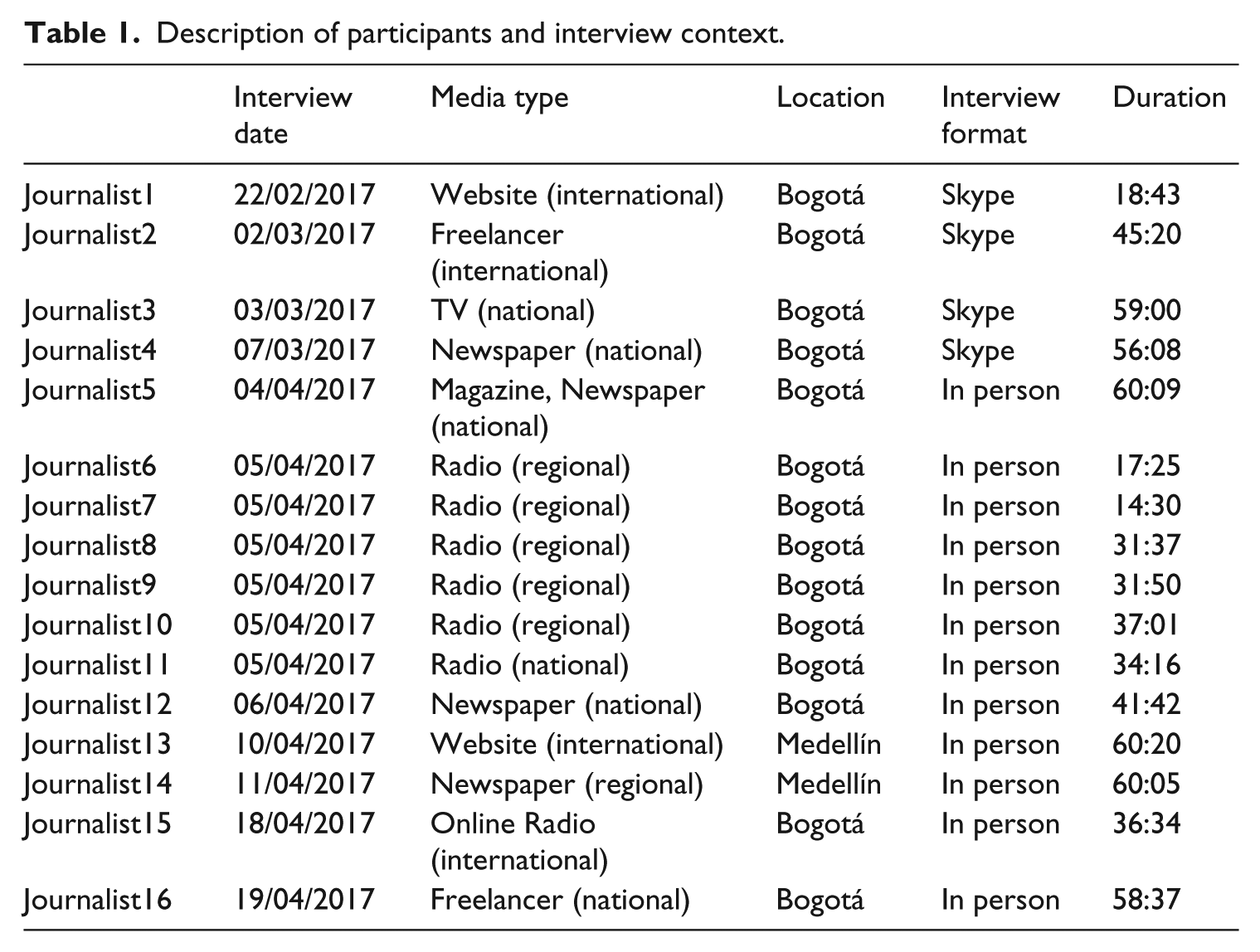
The interview format was semi-structured (see Appendix 1 for interview guide). Most questions were unstandardized and open. This technique was chosen to give interviewees the possibility to include topics they personally regarded as important and to leave room for follow-ups (David and Sutton, 2011).
A theoretically guided approach ensured maximum efficiency and effectiveness of the interviews (Braun and Clarke, 2006). This approach allowed us to create relatively similar interview situations by asking journalists the same set of questions. However, in an inductive manner, the mostly open and explorative interview questions were modified when the interviewee had already talked about an issue before the relevant question came up or when a follow-up seemed fruitful (e.g. Braun and Clarke, 2006).
The interview questions became more specific throughout the interview. The rationale behind this approach was to first get a feeling for which themes were considered important by the journalists and to get a broader picture of their opinion. The more specific questions later aimed at avoiding jumping to false conclusions about what had been said before and to get a better feeling for the journalists’ view (David and Sutton, 2011). In the end, the interviewees were asked to explicitly select one, or multiple, of the pre-developed role models to check if the conclusions were coherent with the journalists’ own view. This can be seen as a form of a member check (Birt et al., 2016).
Data analysis
The data were recorded and fully transcribed and organized with the programme NVivo, which proved to be a helpful tool to gain a well-organized and in-depth insight into the data and develop a framework of codes (see Appendix 1 Table 2 for coding details).
The gathered data were coded following the approach of thematic analysis, as described by Braun and Clarke (2006), which provides a widely used framework to identify and analyse patterns, also called themes, across a collection of data items. This means that we looked for central topics in each interview, developed a codebook, applied them to the texts and searched for patterns. In this way, following the principles of Grounded Theory, theories were ‘developed from empirical material’. (Flick, 2014). Codes were formulated while going through the data, clustered together and thereby reduced more and more. The most dominant ones are described in the results section. Specifically, the open codes were structured around specific role perceptions as main dimensions. After the process of constant comparison between dimensions and their indicators, codes were refined and developed into more general themes. The indicators were compared both within and between role perceptions. Within role conceptions, we also structured the themes around the dimensions of challenges and opportunities. Next, opinions on these topics, as well as their related role conceptions were related back to theory and analysed driven by the research questions.
Results
In between four role models
The journalists interviewed for this study, with the exception of Journalist 1, all held a very active role conception. That said, even Journalist 1 saw the role of the media as important in shaping the public debate but underlined the importance of detachment. ‘We have a very big power in our hands which is the power to construct and transform’, Journalist 1 said. The norm of objectivity was rejected by all journalists. They said – even though to varying degrees, as can be seen from the discussion below – that their own experience would be reflected in their work. Again, the only exception was Journalist 1, who believed in the possibility of objective reporting.
Disseminator
This role conception is the least active one of the four conceptualized categories. However, journalists mentioning this role conception did not see it as opposed to taking an active stance but referred to it in terms of the obligation of spreading the truth and sticking close to the facts. This was especially highlighted with regards to the high share of misinformation and the biased media environment: ‘The protagonists are the stakeholders of the conflict, in this case the government, the armed groups, and – most importantly – the people. They are the ones who need to be visible, not the journalists’, Journalist 8 said. In addition, bridging information gaps was an important topic, as, for example, emphasized by Journalist 13, who said most of the victims he meets were victims of paramilitary groups, while his audience blames the FARC for everything.
Journalist 4, who described himself as a supporter of the peace process, told a story in which he had interviewed someone who criticized parts of the peace deal and wanted to include this into a news piece. His editor immediately changed the angle of the story saying that as a newspaper supporting the peace process, they couldn’t publish criticism on it. The journalist himself felt like it would have been the right choice to disseminate what had been said, instead of sticking to the editorial line of supporting the deal. Criticism of this role conception was articulated the light of underlining the necessity to contextualize and not only disseminate information without thorough verification, by, for example, Journalist 15.
Watchdog
The category of the watchdog was in most cases brought up in the context of calling out omissions of the state and the spread of misinformation by all sides. Thereby it involved strong investigative duties for journalists. At the same time, this role was associated with putting journalists at risk, when, for example, covering corruption. Journalist 4, 10, 12 and 16 opposed this category, with the argument that watching the elites would not be enough and instead emphasized the importance of the role of journalists to give a voice to the civil society. Furthermore, they stressed that in the context of war, it was not possible to stay detached as a watchdog but that active participation in the public debate was necessary.
Advocate
‘We have tried to be very objective in our work and this is not working. We lose and we are becoming each day more distant from the people’, said Journalist 16. This journalist stressed that, in the middle of a war, it was simply impossible not to get involved. At this point, it was recurrently highlighted that they as journalists were also Colombians, who have had their own experiences with the conflict and their own interests about how to move forward. In this sense, as mentioned before, the notion of objectivity was rejected in favour of pursuing an advocative role.
Another way of looking at it was the question of how much activism was needed to get the audience to listen. As Journalist 13 said, ‘I sometime take an activist role. But for play. You know? Because I believe that if I take more of an activist role, more people will listen to me’. All the interviewees, who talked about themselves as advocates, supported the peace process and were in favour of pushing for reconciliation. But also those journalists, who did not think about themselves as advocates mentioned the great responsibility of Colombian media in shaping the public opinion and finding possible ways to move forward.
At several points, this conception overlapped with arguments for being a public mobilizer. As Journalist 12 phrased it, give voice to all the movements, organizations, of all types and all political stances that have been suffering in the conflict but have resisted and have a story to tell. Not only as a memorial of the conflict but as proposals for the construction of peace.
Public mobilizer
This category was most dominant in journalists’ interpretations. Giving a voice to everyone as opposed to only focusing on the elites was seen as a primary task by many of the interviewees. At the same time, the failure to do so was one of their main critiques of the national media sphere. Thereby, telling the stories of ordinary people and shedding light on what was going on in society were the main reasons for the journalists to choose this category. For 12 of them, the mobilization of people to participate in shaping the country’s future was defined as a goal. As Journalist 12 said, ‘We have been trying to involve the audience more with several opinion columnists–military persons, activists, guerrillas–for them to nourish all visions’. This aim was even mentioned if the Public Mobilizer was not chosen as a category, as in the case of Journalist 4. For him, the inclusion of the whole society was especially important because of his definition of the Colombian conflict as social, instead of political.
A challenging climate to go forward
In light of RQ2, several major challenges regarding the role of the media in the conflict can be identified, as they play an important role in shaping public opinion. The challenges that were mentioned most frequently in the interviews are the polarization of the country, the inaccurate framing of the government – in the sense that the peace deal was used synonymous with peace – and the difficulties surrounding the implementation of the peace accord.
One of the most significant commonalities was the concern about the poor performance of the country’s national media outlets in terms of independent reporting as well as regarding the mediated reality of the conflict. Therefore, failures of the media will be a prevailing theme throughout the following analysis. In this context, the concept of Peace Journalism has been mentioned recurrently and highlighted for its potential to improve the journalistic praxis in Colombia.
Polarization
In Colombia’s polarized debate about moving forward, two highly opinionated camps oppose each other: One in favour of the peace accord with the guerrilla and one against it. Interviewees criticized that media outlets were driving this societal split further. There is little space for nuances and therefore little space for constructive discussions. As Journalist 13 said, Rather than putting that on the political agenda, which would be a duty as a journalist, they put it on the public agenda. So, Santos has a fight with Uribe. And now the country is divided into Santistas and Uribstas. You know what I mean. While, … I wasn’t born a Santista. Or an Uribista.
This is further intensified through the dynamics of social media, as it was mentioned by several interviewees. Due to the possibility to filter opposing opinions, social networks create bubbles in societies, in which people tend to only consume media content that confirms their views. Journalist 13 spoke about campaigns of misinformation in conservative circles, such as the high salary for ex-combatants and the difficulty to dismantle such allegations, while being filtered out of these communications on, for example, Twitter.
Furthermore, the questions of transitional justice, reconciliation and impunity are causing much disagreement. Explaining the complexity of these emotional issues to the audience has been mentioned as a major difficulty and main failure of the Colombian media. As Journalist 8 said, Nobody explains anything. […] This is how people become polarized and confused. They see a media outlet and notice that it is the view of the government, or another one that is presenting a leftist view. And people don’t know any more whom to believe.
Without exception, the journalists spoke of the necessity for a change in the status-quo of conflict reporting.
Journalists 5, 12, 14, 15 and 16 explicitly talked about the potential that the concept of Peace Journalism could have for such a transformation, especially its focus on the civil society instead of on the elites, which was described as major advantage. Platforms such as ¡Pacifista! and Colombia2020 were brought up as best practice models. However, their digital character, distribution strategy via Social Media and active stance as supporters of the peace process limit their readership – especially when compared to the impact of the TV stations Caracol and RCN. Journalist 16 said, ‘The problem with Colombia2020, El Espectador, is that it is mainly digital and many people in Colombia still don’t have access to the Internet. […] So they are amazing but most of their stories don’t reach anyone’.
Inaccurate framing by the government
A barrier that many journalists brought up was the strong push by the government for a ‘speech of peace’, as Journalist 16 formulated it. And Journalist 14 said, ‘Santos tells the world that there is peace in Colombia but there is no peace because the FARC is not the only armed actor. […] The peace doesn’t exist’. This refers to the government’s practice to try to convey to the world that Colombia left its troubles in the past. This includes the need to set the deal with the FARC equal to bringing peace to the country (Restrepo and Ramírez, 2016), while turning a blind eye on the big remaining challenges. An example is the intensifying conflict between the two guerrilla groups ELN and the Popular Liberation Army (Ejército Popular de Liberación, EPL) in Catatumbo, close to the Venezuelan border (El Espectador, 2018).
Moreover, the role of the FARC is often over-emphasized. ‘The reality of Colombia’s conflict is that the FARC is a victimizer of only maybe 34% of the total number of victims. But all the attention is on the FARC. FARC. FARC’, said Journalist 13. This is especially true for the international picture of the conflict. Within Colombia, considerable coverage on the role of other armed actors also exists. However, political and economic elites have an interest in keeping reports about current violence in the country down, several interviewees remarked. ‘If you see more details, you will see the carpet. And you will see that they use these beautiful words to hide an impunity agreement for everybody’, Journalist 15 said.
Concerning RQ2, it can be concluded that the above mentioned perceived spread of misinformation from all parties plays an important role, as it poses a big challenge for journalists to report truthfully – a goal that all interviewees underlined.
Implementation of the peace accord
In this context of polarization and misinformation, the successful implementation of the accord as well as further steps into the direction of reconciliation and stability are difficult. All 16 journalists consistently pointed out that the real challenge for the country lies in this phase. ‘Colombia is a hurt country, psychologically and physically. There are a lot of scars’, Journalist 3 said.
Hence, the disputed nature of the agreements concerning transitional justice is not surprising. Not all members of society support the peace accord as introduced in Colombia. In the beginning of October 2016, the Colombian electorate rejected the accord in a plebiscite. However, the government interpreted the negative outcome as a demand to renegotiate and decrease concessions made to the FARC and finally pushed the revised accord through without consulting the population again (Brodzinsky, 2016). For many ‘No’ supporters, these revisions were not far-reaching enough. ‘Changes were not profound. They started to implement it against the will of the people’, Journalist 14 said. Most of the other interviewees were much more positive about the deal, as Journalist 2: ‘It is one of the most complete peace agreements internationally that I have ever seen. […] Maybe the process is not perfect but we should be striving for it’. At the same time, it is crucial that over 60 percent of Colombians did not vote (El Tiempo, 2016) and that the voter turnout was especially low in areas most affected by the conflict.
Among citizens who voted, considerable differences could be noted, depending on the region. In the most affected regions, voters tended to approve the peace process (El Mundo, 2016).
Another uncertainty is posed by the vacuum that has been created through the demobilization of the FARC, especially in terms of access to the country’s natural resources. At the moment, one of the fiercest competition takes place in the field of goldmining, especially regarding illicit trade, where goldmining has already overtaken the profit derived from cocaine (Alsema, 2016). Furthermore, there has been a stark increase of killings of social leaders by different armed groups in rural regions (Semana, 2018). Journalist 4 said about the current instabilities: ‘And what if these motherfuckers [paramilitaries] still don’t like it to have a leftist party in politics in Colombia. Are they going to kill them like before?’
Important for this so-called post-conflict time is also, as, for example, Journalist 11 said, that the society as a whole, including the media, learns how to speak and think in peaceful terms. With regards to the media sector, the potential of the concept of Peace Journalism was highlighted by some interviewees. But such a change of mentality takes time, Journalist 11 said. Journalist 5, who aims at being thought-provoking with her columns, talked about the necessity to stop and think and change common newsroom practices. For her, the main challenge is to not give up in this process: ‘I am a distance runner, marathons. And you have to have resistance. In war as in peace. You have to be willing to run for a long time. And that is very hard. People like things fast. That’s like the Narco culture. But peace processes are very slow’.
Discussion
Situated in a context confronted with the severe consequences of conflict, this study aimed to provide in-depth insights into the role perceptions of Colombian journalists in the country’s conflict. RQ1 aimed to investigate to what extent and in what ways Colombian journalists identify with various role models foregrounded in research (e.g. Cassidy, 2005). The role of the public mobilizer was favoured by many. There was a strong tendency of perceiving the duty of journalists as giving voice to the civil society and telling the stories of citizens, instead of providing a stage for the elite. This corresponds with Cassidy’s (2005) definition of the term as giving a voice to everyone, including ordinary people in public debates, proposing possible solutions for problems and actively setting the agenda. In the light of Colombia’s high level of polarization, this was seen as an important counter-strategy to involve the whole society into finding a way forward. All journalists, even though to varying degrees, shared this active approach to the role of journalists to bring about change in society. This attitude links well with the concept of Peace Journalism, as will be discussed below.
At the same time, the most important duty mentioned was to contextualize and analyse, which is connected to all the described role perceptions. This goes hand in hand with the perceived importance of interpretative journalism in Colombia that was confirmed by the majority of interviewees. Also, it is in line with the global shift of journalism to strengthen its focus on the ‘why’ question (e.g. Patterson, 1996; Salgado and Strömbäck, 2011). However, the increase of interpretation in news was also problematized. It was seen as a failure of the media when mentioned in the sense that journalists take sides and refuse to show the whole picture of a story. At this point, Hanitzsch’s (2004) argument that journalists are a product of society is important, especially with regard to the Colombian context of concentrated media ownership structure and security concerns. Furthermore, according to Patterson (1996), they are subject to economic and political pressure, while the public cannot hold journalists accountable.
Journalists had a strong sense of providing a public service by telling the lesser told stories and enabling people to engage in the public debate. The central tendency points towards the role perception to mobilize the audience by providing information and context. Journalists called for self-reflection, which is an explicit aim of Peace Journalism. Within Peace Journalism, journalists are prescribed the role to contribute to peaceful conflict transformation. Therefore, they have to be aware of their central role and responsibility in society. The journalist operates in a sensitive area, where caution is urgently needed and open self-reflection crucial (Mitra, 2016). Within Peace Journalism, this self-reflection should ideally happen in a way that is comprehensible for the audience (Lynch and McGoldrich, 2005; Mitra, 2016). Indeed, the results of this study indicate that journalists see a need for change and search for ways forward.
In today’s world of an endless stream of information, journalists are required to connect the dots and provide context (Patterson, 1996). This development is fostered through social media (Gandour, 2016), posing an opportunity and a challenge for journalists at the same time. While social media offers possibilities in peace building, as they have the potential to foster communication beyond social divides (Howard, 2015), its actual dynamics can further social division, as people tend to look for news that confirm their views (Gandour, 2016). This played a substantial role in the 2016 plebiscite. Especially the ‘No’ campaign mobilized strongly via digital platforms (Roddel, 2016). Furthermore, they provided a stage for political actors to spread messages themselves, bypassing the media (Gandour, 2016). Regarding RQ2, this was seen as very problematic in the light of the high amount of misinformation in the Colombian discourse, as it is hard for journalists to counter inaccurate statements (Engesser et al., 2017).
Against this backdrop, it can be concluded that that the concept of Peace Journalism is indeed compatible with the role perception of Colombian journalists. The main features of the concept of Peace Journalism have been embraced by the interviewees. This includes a stronger focus on contextualizing, proposing solutions, giving voice to the voiceless and turning away from the practice of only offering a voice to the elites (Keeble et al., 2010; Fong, 2009). This also regards the role perception of journalists as advocates. Within Peace Journalism, this role is primarily seen as an instrument to not only illuminate existing problems, but to also advocate possible solutions (Shaw et al., 2011). No clear reluctance towards a more advocative approach was found, which dismisses the criticism of Peace Journalism crossing the lines towards activism in this context.
A criticism of Peace Journalism, as well as other forms of interpretative approaches, is that they dismiss the notion of objectivity, which can have an important function of legitimization for a newspiece (Skovsgaard et al., 2013). Journalists disregarded this criticism, as 15 from the 16 interviewed journalists rejected the notion of objectivity. Rather, they called for an active stance that goes well with the concept of Peace Journalism.
However, the actual feasibility of the concept is another question. At the one hand, journalists hold a very active role conception and interpretative journalism is salient in the Colombian media landscape. At the other hand, it is difficult to improve the situation because of concentrated ownership structures, continuing security concerns on the local level, as well as an orientation towards soft news (Gómez-Giraldo et al., 2010) and the intensification of polarization through social media (Rodríguez et al., 2015). Various obstacles for the implementation of the peace accord further complicate the situation. Nevertheless, many interviewees spoke of the opportunities in the current situation. The long-lasting conflict raised the awareness for the need for change, increasing the popularity of Peace Journalism.
However, it is by far not wide-ranging enough to profoundly change the Colombian media landscape. The doubt of the impact that engaged journalists can have on the country illustrates the negative perspective interviewees had on the overall media landscape. Yet, an example for a context in which practices of Peace Journalism could be very fruitful is the potential to counter the fear that many people have of the FARC. This is especially true for those citizens that live far from the most affected areas of conflict and never had direct contact with the FARC, but instead only have the mediated picture of the former guerrilla group. This is not to justify committed atrocities, but to emphasize what many interviewees said: namely that media outlets have spread a lot of fear of the group by extensively reporting on the actions of the FARC in the conflict, without providing much context. Today, parts of the deep polarization of society revolve around the question of penalties for former combatants versus reincorporation (Semana, 2017).
At this point, a couple of this study’s limitations have to be noted. While the interviewees of this sample had a very active role perception, this might not be the case for Colombian journalists in general, as the described results are not representative. It could be argued that journalists are more likely to agree to participate in respective research if they have a strong opinion on the topic. Likewise, a strong interest in a political issue and high empathic concern have been shown to be positively correlated with assuming an active role (Bekker, 2005). However, it is not surprising that journalists might simply have strong opinions towards the countries development considering the long historical roots of the conflict and the way it has severely affected many lives.
Another point is that answers could be subject to a social desirability bias, also influenced by the presence of the interviewer. Also, the interview conditions were not consistent, as some were conducted via Skype and some in person. The same concerns the language used, as some interviewees were comfortable with doing the interview in English, while others preferred Spanish.
Despite these limitations, this study has provided insights into journalists’ role perceptions in the face of conflict. While Colombian journalists experience many obstacles in their work, such as highly concentrated ownership structures, continuing security concerns and the spread of misinformation, they held an active role perception and strongly aimed to engage the public. To a large extent, this is compatible with the practises promoted by Peace Journalism, which gained considerable popularity and demand in Colombia, creating a market for its products. Yet, it is a small market and reaches only a limited audience, a decisive obstacle, which is why the concept of Peace Journalism remains contested and needs further development of its potential for the Colombian market.
Footnotes
Appendix 1
Funding
The author(s) received no financial support for the research, authorship, and/or publication of this article.