




Abstract
Public trust in the criminal justice system in England and Wales has been low since the 1990s, and accusations that the system is arcane, lacking transparency, soft on criminals and removed from the society it serves are common. The government, together with many lawyers, journalists and experts, believes that lifting the ban on televising trials may enhance the transparency of the judicial system, and eventually lead to higher levels of public trust. Drawing on the most systematic content analysis of the coverage of this debate between 1984 and 2016, we analyse how this issue was debated in British national newspapers. In addition to examining how newspapers presented this policy debate, we also explore how the coverage discussed the impact that filming trials could have upon journalistic practice. Our analysis shows how metajournalistic discourse resorts to high-profile and celebrity cases when examining journalistic practice. Newspapers constructed this issue as a quandary between increasing the transparency of the judicial system, and the risk that justice would become sensationalised, ignoring key elements in the debate, and the role that journalists themselves may play in that process.
Keywords
Public confidence in the criminal justice system has been an issue for concern in recent decades across most developed countries (Hough and Roberts, 2004; Van De Walle, 2009; Van De Walle and Raine, 2008). In England and Wales, trust levels in criminal justice have been low since the 1990s (Hough et al., 2013; Van De Walle and Raine, 2008), in spite of the fact that crime rates have been decreasing overall during this period 1 (Travis, 2015). Successive governments have attempted to increase the transparency and accountability of the criminal justice system as a means to improve public trust. Given the news media’s role in informing citizens about the world around them, and the prevalence of crime stories in journalism, it is believed that the media play a fundamental role in shaping citizens’ perceptions of criminal justice, 2 and may contribute to improving the public’s understandings (and perceptions) of how justice works (Hough et al., 2013). Overturning decades of practice, the white paper Swift and Secure Justice announced that broadcasting what takes place in criminal courts would constitute a key strategy aiming to improve the transparency of a system ‘criticised for being opaque, remote and impenetrable’ (Ministry of Justice, 2012: 52).
Presenting the results of the most systematic content analysis of the coverage of this debate in British national newspapers between 1984 and 2016 – the period for which the newspapers in the sample are available through Nexis – this article examines the debate around the introduction of cameras in the courtroom in the press, and advances our understanding of how this policy is debated through newspapers.
Specifically, this study explores how newspapers operate when covering a debate that may provide journalists and the public with access to content that traditionally has not been available, potentially contributing to a more informed public, but also to the transformation of journalistic practice. Our research also presents an exploration of metajournalistic discourse, showing how a variety of key actors – from lawyers or journalists to judges or citizens – engage in this debate and discuss and think the role journalists (should) play in making justice accessible and transparent to citizens. The coverage also highlights how journalists reflect on their own practices, underlining how key events can constitute binding agents in the professional culture of journalism. While the coverage tends to support the introduction of cameras in the courtroom, the sensationalisation of trials in the media coverage constitutes one of the main arguments against lifting the filming ban. Although the push for transparency and the protection of witnesses and victims also emerge in the coverage, the over-reliance on celebrity and high-profile cases neglects key elements in this policy debate.
Journalism, criminal justice and the media
Regardless of its accuracy, the accusation that the criminal system is soft on criminals is a recurrent narrative in British tabloids (Berry et al., 2012), hence the centrality of this issue in the public agenda. Improving public perceptions of the criminal system is seen as a key strategy to increase the public legitimacy of judges and courts, which is key for its effective functioning (Roberts and Hastings, 2007). Research shows that higher degrees of public trust increase the public’s cooperation and compliance with the law (Hough et al., 2013). Crucially, it also contributes to generating meta-trust, enabling trust in other public institutions through the provision of ‘some guarantee against possible misbehavior by such other institutions’ (Van De Walle, 2009: 22). This, together with the government’s push for transparency (Cameron, 2010, 2011), justifies in the eyes of the government the introduction of cameras in the courtroom.
The Ministry of Justice (2016) intends to extend the use of cameras to criminal trials, and is currently undertaking pilot filming in Crown Courts. This is a fundamental transformation. Despite the long-established tradition of public trials in England and Wales (Indiana Law Journal, 1960; Neuberger, 2012), taking pictures and broadcasting in courts had been prohibited by Section 41 of the Criminal Justice Act 1925 and Section 9 of the Contempt of Court Act 1981. The public nature of trials has been historically seen as a fundamental guarantee of their fairness – celebrated, among others, by Bentham (1843: 316ff) and Lord Bingham (2011: 97). Public trials are considered vital for the optimal functioning of the judicial system (cf. Judicial College, 2016), and broadcasting trials could constitute an extension of the public gallery. In spite of that, and regardless of the positive experiences abroad, and in other courts and jurisdictions in the country, 3 the debate around the introduction of cameras in English and Welsh courtrooms stirred controversy whenever it surfaced in legal and political circles, as well as in the media.
The notion of ‘transparency’ was only incorporated into public rhetoric in the mid-1940s (Schudson, 2015), but has rapidly become one of the buzzwords dominating contemporary public discourse (Han, 2015; Heald, 2006; Hood, 2010; Schudson, 2015). Commonly associated with the notions of openness, accountability and open government/data (Hood, 2010), the doctrine of transparency is fuelling the transformation of government in countries around the world, including their judicial systems (see above). The role the media (should) play in transparency regimes, however, ‘is often left unremarked and unexamined’ (Bowles et al., 2014: xi). Transparency in government is enabled by public administrations, and its ultimate beneficiaries are – at least in principle – citizens and civil society. The media, however, often constitute an indispensable facilitator for transparency. Freedom of information laws, for example, are mainly used by the news media (Riddell, 2014), and journalists often play a crucial role in making sense of complex information or large datasets for the public. In the case of justice, a 2010 decision of the Court of Appeal explicitly recognised that In reality very few citizens can scrutinise the judicial process: that scrutiny is performed by the media, whether newspapers or television, acting on behalf of the body of citizens. Without the commitment of an independent media the operation of the principle of open justice would be irremediably diminished. (Quoted in Birkinshaw, 2014: 65ff)
The aim to increase the transparency of the judicial system through the introduction of cameras in the courtroom necessarily involves the media, since it is probably through some media platform that citizens would access filmed court material. In the words of Ken Clarke (then Secretary of State for Justice), The Government and judiciary are determined to improve transparency and public understanding of court through allowing court broadcasting. We believe television [and, by extension, other media] has a role in increasing public confidence in the justice system. (Ministry of Justice, 2011: n.p.)
Worldwide, research exploring the relations and interplays between the media and filmed trials has not been exhaustive. Although we recognise that there are differences between the legal systems of different jurisdictions, some of the key research issues are fundamental across these debates. Research has analysed the implications of cameras in courtrooms on involved parties, such as judges (Lanzara, 2009), lawyers and participants such as jurors and witnesses (Barber, 1983; Kassin, 1984), plus the trial as a whole (Cohn and Dow, 2002; Mason, 2001; Nasheri, 2002; Thaler, 1994), and how the public may respond to watching these broadcasts (McGahey and Fagan, 1979; Valkenburg and Patiwael, 1998).
Others have explored the footage itself, and how it appears within US judicial documentaries, analysing how they use the legal trial as both a platform and a structuring device to contest the evidentiary value of testimony, bear witness to the performance of law in our culture and engage in a social debate about flaws in contemporary jurisprudence. (Fuhs, 2014: 783)
This use of media coverage of trials to provoke ‘social debate’ and judicial understandings can be of critical importance.
Examining how televised trials have been depicted in the US media, Hans and Dee (1991) argue that ‘because most of the public has little direct experience with the justice system, public knowledge and views of law and the legal system are largely dependent on media representations’ (p. 136). Thus, media coverage of trials, for some individuals, may work to represent how they perceive, and understand, the judicial system. As they outline, advocates of broadcast trials believe the practice has the potential to provide more accurate information about law and justice, which can help educate the public about the process. Conversely, critics worry that television news incorporating clips from these trials will still mislead the public by playing sensational highlights of trials, rather than more representative clips of courtroom proceedings. Similar arguments were deployed in the analogous debate around the introduction of cameras in the House of Commons (see: Barnett and Gaber, 1992; Franklin, 1986, 1989). Overall, Hans and Dee (1991) argue that ‘the [US] media mirror presents a distorted view of law’, and more scholarship surrounding public understandings of media coverage needed to be undertaken – a sentiment that still stands today (p. 136). Other work has similarly explored the nature of media coverage of courts in the United States, with it being investigated through the binary of entertainment versus education (Vinson and Ertter, 2002).
In terms of how US crime journalists cover these events, Bock and Araiza (2015: 317) carried out an observational study of journalists during the coverage of a camera-in-the-court trial, and discovered that ‘none of the stories reflected an effort to produce an independent portrayal of the defendant – all images of the defendant had been mediated by authorities’ (p. 325). Thus, there was an observed ‘tacit acceptance of the system’s fairness’ (Bock and Araiza, 2015: 326), with the journalists experiencing loyalty towards the police, court staff and officials and to other fellow journalists, all of which worked to shape their news coverage.
Research has paid scant attention to how the practice itself has been discussed within the media (Vinson and Ertter, 2002). In this study, we examine how British newspapers have discussed the filming of trials between 1984 and 2016, analysing the ways in which this practice has been represented and framed in press coverage. Beyond the legal elements of this fundamental transformation of the criminal justice system in England and Wales, the filming of trials also has implications for journalists working in different media. For TV journalism, for example, the availability of relevant footage is paramount in news selection, as highlighted in classic newsmaking studies (cf. Epstein, 1973; Gans, 1979). Although court reporting has traditionally been a key newspaper beat (cf. Becker et al., 2000), covering ‘the most productive single source of stories in the country’ (Davies, 2008: 77), the number of court reporters is in serious decline (Thornton, 2016). Trial footage could potentially revitalise court reporting, enabling journalists to remotely access courtrooms throughout the country. Stories could be more accurate too, as reporters could consult footage while writing. Conversely, it could also be seen as its final blow, potentially contributing to court reporting’s demise.
This research, thus, offers an opportunity to examine how journalists think and reflect about their profession and their professional practices when discussing the prospect – or the practice – of filming trials. This exploration also helps us identify the main narratives emerging in metajournalistic discourse when the practice of filming trials is considered. Defined by Carlson (2016) as ‘public expressions evaluating news texts, the practices that produce them, or the conditions of their reception’, metajournalistic discourse is not exclusively produced by journalists (p. 350). Sources, audiences and, in this particular case, also law practitioners, policy-makers and citizens (amongst other actors) make pronouncements that help to shape understandings – and practices – of journalism (Carlson, 2016).
Method
A search was conducted on Nexis using the terms ‘camera! AND courtrooms AND filming OR televis! OR tv AND justice OR judicial’ appearing anywhere in articles over 500 words only. A range of broadsheets and tabloids was selected, covering different newspaper formats and positions in the political spectrum. The overall period covered in our study spans from 1984 to 2016 (we searched for ‘all available dates’). However, since not all newspapers are archived in Nexis from the same date, the period of coverage for each newspaper varies. Our sample, therefore, contains more stories from the newspapers for which Nexis keeps longer records (see Table 1). Since our study focuses on the United Kingdom, stories published in the Irish editions of these newspapers were discarded. Our final sample contained 334 stories.
Sample.
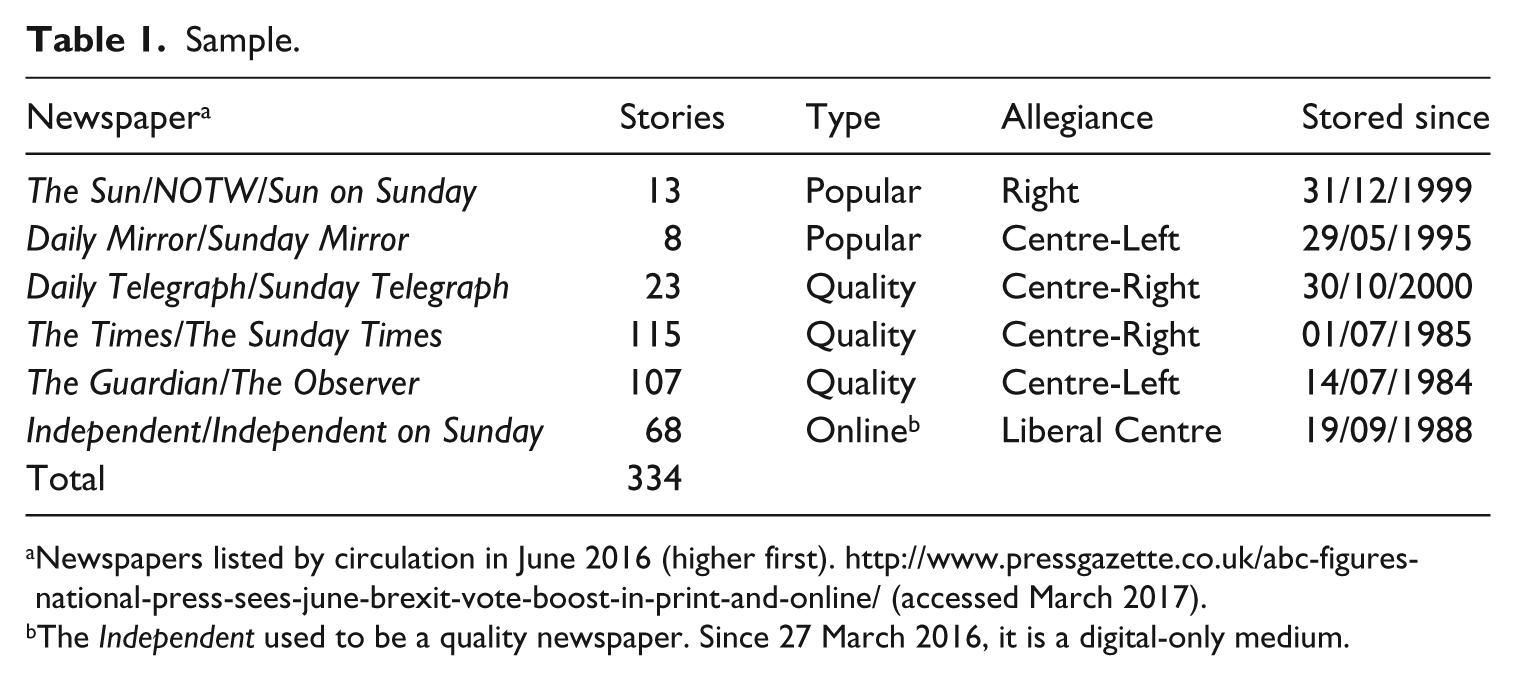
Newspapers listed by circulation in June 2016 (higher first). http://www.pressgazette.co.uk/abc-figures-national-press-sees-june-brexit-vote-boost-in-print-and-online/ (accessed March 2017).
The Independent used to be a quality newspaper. Since 27 March 2016, it is a digital-only medium.
The corpuses of themes and implications were developed as the pilot coding was undertaken, in order to achieve a more comprehensive range of results. Both authors designed and refined the coding frame. The second author coded the sample, and the first author coded the subsample for the intercoder reliability test (conducted on 10% of the stories). We achieved over 80 per cent agreement (averaging 85.42%) across all interpretive variables (i.e. those requiring a degree of judgment from the coder, rather than simply recording factual information). The lowest Krippendorff’s alpha score was achieved in the variable ‘Implications’ (0.789). The Krippendorff’s alpha score for every other interpretive variable rated above 0.81, the highest one being for the variable ‘Themes’ (0.883).
How cameras in courtrooms have been debated in British newspapers
Although the number of stories on the debate around the introduction of cameras in the courtroom is relatively low, the issue has never been absent from the British press. The subject has risen and fallen numerous times across the decades, normally following different triggering events. Generally speaking, broadsheets cover this issue more intensely than tabloids (even when it comes to covering high-profile or celebrity cases). Surprisingly, this debate has not featured much in the Telegraph throughout the years. The Times is the newspaper that devotes greater attention to this issue, followed by the Guardian and the Independent. Overall, these three newspapers do not display significant differences in the intensity of coverage, with the exception of 1994 (when The Times devoted special attention to the introduction of cameras in the courtroom following the release of The Trial in BBC2 and the OJ Simpson trial) and 2004 (when the Guardian covered intensely the pilot of filming in the Court of Appeal).
The first article in our sample was an opinion piece by Barrister David Pannick (1984) in the Guardian, arguing that it is difficult to even formulate an argument against the admission of the television camera and the radio microphones into British courts if the parties do not object and there are no witnesses giving evidence who may be influenced by the broadcasting of proceedings.
Concrete action started to take place in the late 1980s and early 1990s, when a committee of barristers began discussing the possibility of cameras being introduced into courtrooms. There was subsequently a discussion held about this in parliament during 1991, but no consensus was reached, and no further action was taken (Clouston, 1993). In 1994, BBC2 series The Trial was aired, focusing on trials in Scotland, which had occasionally permitted filming in courts, and prompted a revival of discussion surrounding the inclusion and use of real-life court footage. However, in 1995, the OJ Simpson trial was underway, and was often depicted as a media circus with participants grandstanding to the cameras (see below), which curbed any progress that the possibilities of cameras in UK courtrooms had made. In 1997, the Louise Woodward trial also delivered further impetus against filming for some, with it often positioned as impacting on the defendant and consequently placing the public as jury/judges. Three years later, the Lockerbie trial raised the issue of filming again, with some individuals and articles asking why an important case was not televised, rather than being just narrowcast to families involved. This provoked discussions surrounding the historical importance of certain events and the public’s ‘right to know’.
In 2003, and in a stated effort to protect witnesses, Lord Hutton banned cameras at his inquiry into the death of Dr David Kelly, but allowed the opening and closing remarks to be filmed. All main documents related to the trials were also put on a website for interested parties to examine. The same year, the Soham murders’ trial received extensive Sky News coverage, including re-enactments, and further information for viewers. The next year, and across 2005, filming in appeal courts in England and Wales underwent a pilot scheme and consultation (including views from the public) (Born, 2004). However, nothing further was done about this, and in 2009, Marcel Berlins (2009) stated in the Guardian that ‘the once lively debate on the televising of trials … suddenly died’. Keir Starmer, then director of Public Prosecutions, also revived the issue in an interview with Channel 4 News, arguing that ‘subject to appropriate safeguards, there’s no reason why there shouldn’t be televising of very many cases’ (Berlins, 2009).
The following year, the Lord Chief Justice allowed tweets, texts and emails in court from journalists, and in 2011, Justice Secretary Ken Clarke announced that filming of judges’ summary remarks in the Court of Appeal would be undertaken. This was followed in 2012 with a published letter by broadcasters in an effort to overturn the ban on cameras in courtrooms (Plunkett, 2012). The Queen’s speech to Parliament in May 2012 finally announced the new legislation of filming in courtrooms, prompting Sky News, ITN and the BBC to issue a joint statement stating, ‘following years of campaigning, we welcome this historic reform that marks an important step for democracy and open justice. The presence of cameras in our courtrooms will lead to greater public engagement and understanding of our legal system’ (Deans, 2012).
In 2013, televised Crown Court verdicts were announced. Channel Four’s The Murder Trial was also aired, featuring footage from a murder retrial in the Scottish High Court. In 2014, the televised Oscar Pistorius trial took place in South Africa, with Sky News in the UK broadcasting daily ‘round up’ programmes on the case, showing reflection and analysis from experts, leading to some discussion surrounding cameras in the United Kingdom. Later that year, and in the wake of the Pistorius trial, Alison Saunders, the Chief prosecutor in England and Wales, came out in favour of TV cameras being allowed into criminal trials, in an effort to achieve ‘open justice’ (Gibb, 2014). This was followed by Lord Gill in 2015 announcing proposals for live TV coverage of Scottish court proceedings.
In 2016, the Netflix Making a Murderer series was aired, which relied heavily on courtroom footage, and promoted some to contemplate how ‘[the show] could not have come out of the UK because our courtrooms have only just recently started allowing fixed cameras inside’ (Robey, 2016). In February 2016, the BBC Four series The Prosecutors explored the workings of the Crown Prosecution Service, yet was unable to show any actual trial footage, which prompted Tim Dowling (2016) to state in The Guardian that this was ‘an odd aspect of the programme’, which worked to enhance how ‘the barring of cameras in courtrooms is beginning to seem a rather quaint exemption these days’. Only 1 month later, the not-for-broadcast Crown Court pilot filming in England and Wales was announced (Ministry of Justice, 2016). Although the results of this pilot exercise are not known yet, it seems that this long-lasting debate may eventually find a resolution. In the following sections, we explore how this debate has been represented in the British press.
The voices in the debate
The debate around filming trials brings together different stakeholders, from journalists and media professionals, to lawyers, judges or politicians. Due to their role as textual producers/gatekeepers, print journalists and newspaper editors bear a privileged position in our sample. Other actors, however, also play a fundamental role in shaping metajournalistic discourse about the introduction of cameras in courtrooms, as actors in stories, as authors of columns and as sources too (Table 2) (cf. Carlson, 2016). In this vein, the debate has been clearly dominated by media professionals – featuring in more than half of the stories (53.3%) in our sample – and by lawyers – solicitors, barristers and Queen’s Counsels (QCs), present in half (50%). The voice of judges was included in one in five stories (21.6%). Politicians (13.5%), the Ministry of Justice (0.6%) and even its minister (1.2%) played a minor – we would say negligible – role in coverage, together with relevant professional organisations such as the Law Society (0.6%) or the Bar Council (0.3%). This suggests that discussions around televising trials were not policy-led, and that the views of the media industry and its workers, as well as those of individual legal professionals, were privileged in this debate.
Sources. a
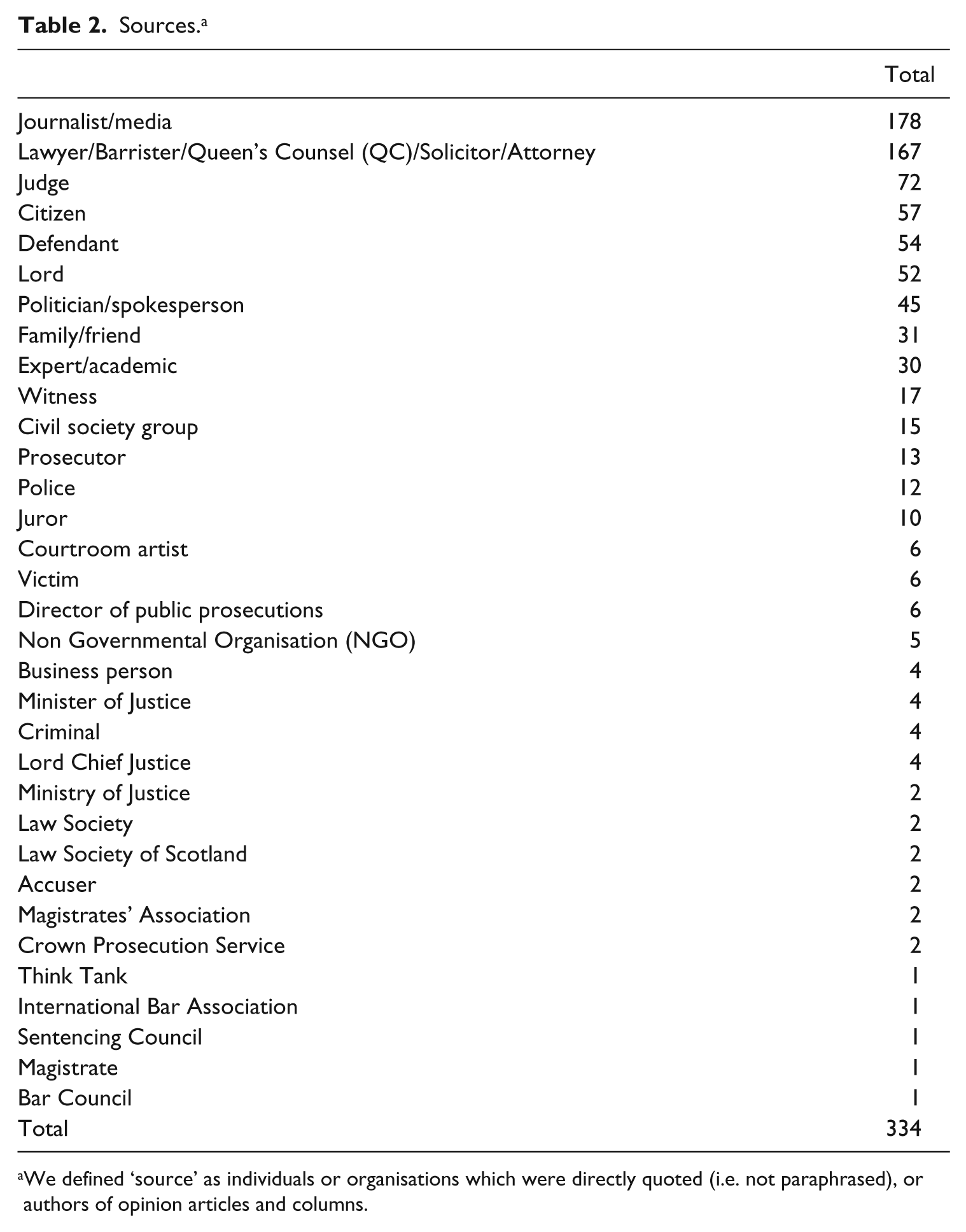
We defined ‘source’ as individuals or organisations which were directly quoted (i.e. not paraphrased), or authors of opinion articles and columns.
As an industry, broadcast media would be expected to be in favour of televising trials. Broadcasters consistently lobbied for the ban to be lifted. According to Lippman (1989), the BBC and ITV were ‘eager to take part in the experiment’ to explore the introduction of cameras in English and Welsh courtrooms. In 1994, it transpired that the BBC had held conversations to that effect with the Lord Chancellor for longer than a year (Frean, 1994). Such support became most apparent in the public letter the BBC, ITN and Sky News signed in 2012 (see above). John Ryley (head of Sky News) also penned a number of columns and letters to the editor demanding the overturn of the ban (e.g. Ryley, 2010, 2011, 2012). In essence, broadcasters campaigned to get access to content that was often newsworthy, but could only be offered to viewers secondhand, through the account of court reporters. While there are significant differences in regulation, adherence to impartiality and degrees of political parallelism among British print and broadcast journalists, working for a particular medium did not correlate with the adoption of particular stances on this issue.
Overall, newspaper coverage displayed a positive attitude towards the introduction of cameras in courtrooms (43.7% of stories). Almost one-third of the stories (29.9%) featured an unclear – or impartial – approach, which often followed the journalistic convention of presenting two sides of the debate, or took a more factual position. One in four stories (26.3%) displayed a negative stance. This proportion almost mirrored the allegiance displayed by stories with journalists or media professionals as sources (Positive: 43.3%; Negative: 25.8%; Unclear: 30.9%) (Table 3). Out of the stories featuring legal professionals, one in three displayed a positive allegiance towards filming trials (32.3%), whereas 28.7 per cent stories opposed it. Two in five stories with lawyers as a source (38.9%) displayed no clear stance with regards to filming trials.
Allegiance towards cameras in courtrooms.
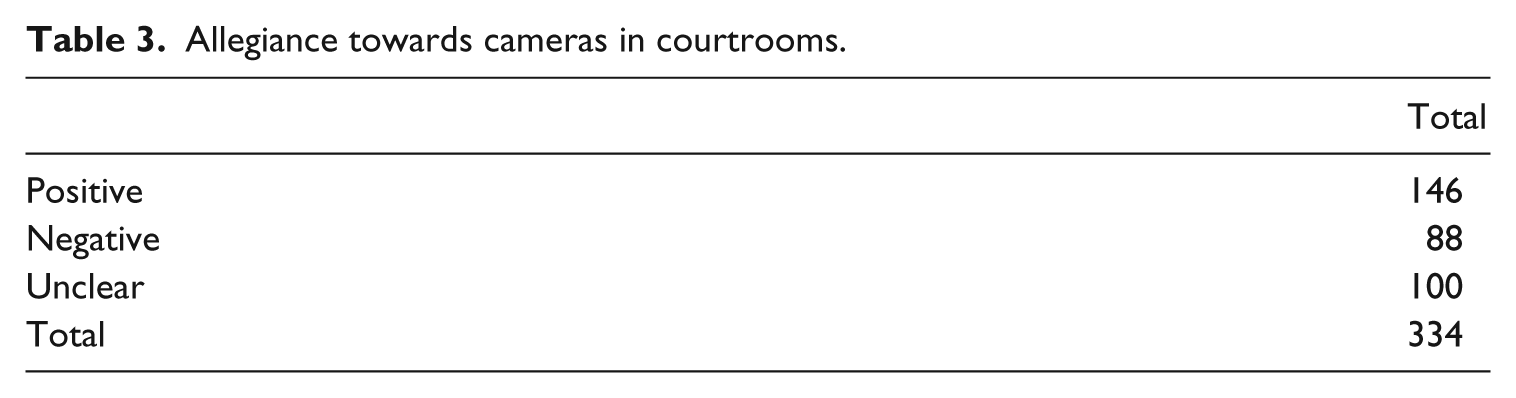
Significantly, news stories that had their main focus on domestic cases (n = 134) were overwhelmingly more likely to be positive towards filming in courtrooms (Positive: 61.1%; Negative: 14.9%; Unclear: 23.8%), whereas those focusing on international cases (n = 106) were most often negative (37.7%) or unclear (41.5%). This could be explained by the wealth of coverage on the OJ Simpson and Louise Woodward trials, and the negative attitudes and responses towards televised trials fostered by both instances. Overall, it could be said that the British press was more supportive of filming trials as an ideal, rather than when it discussed how trials in other jurisdictions had been broadcast, or the consequences of such coverage.
What is the coverage about?
The introduction of cameras in courtrooms is normally discussed in connection to their use in a specific trial, rather than as a policy itself. Two in three stories (68.3%) in our sample addressed the use or banning of cameras in a specific trial. However, and regardless of the main theme in the story or its geographical focus, one in two stories (50.8%) explored (at least partially) the implications of introducing cameras in English and Welsh courts, and almost every second story (46.1%) discussed the rules and safeguards that should govern the filming if it was ever to be adopted (Table 4). This indicates that the discussion around lifting the filming ban in England and Wales is defined in relation to the practice of televising hearings in other countries, particularly with regards to the experience in high-profile or celebrity trials.
Themes. a
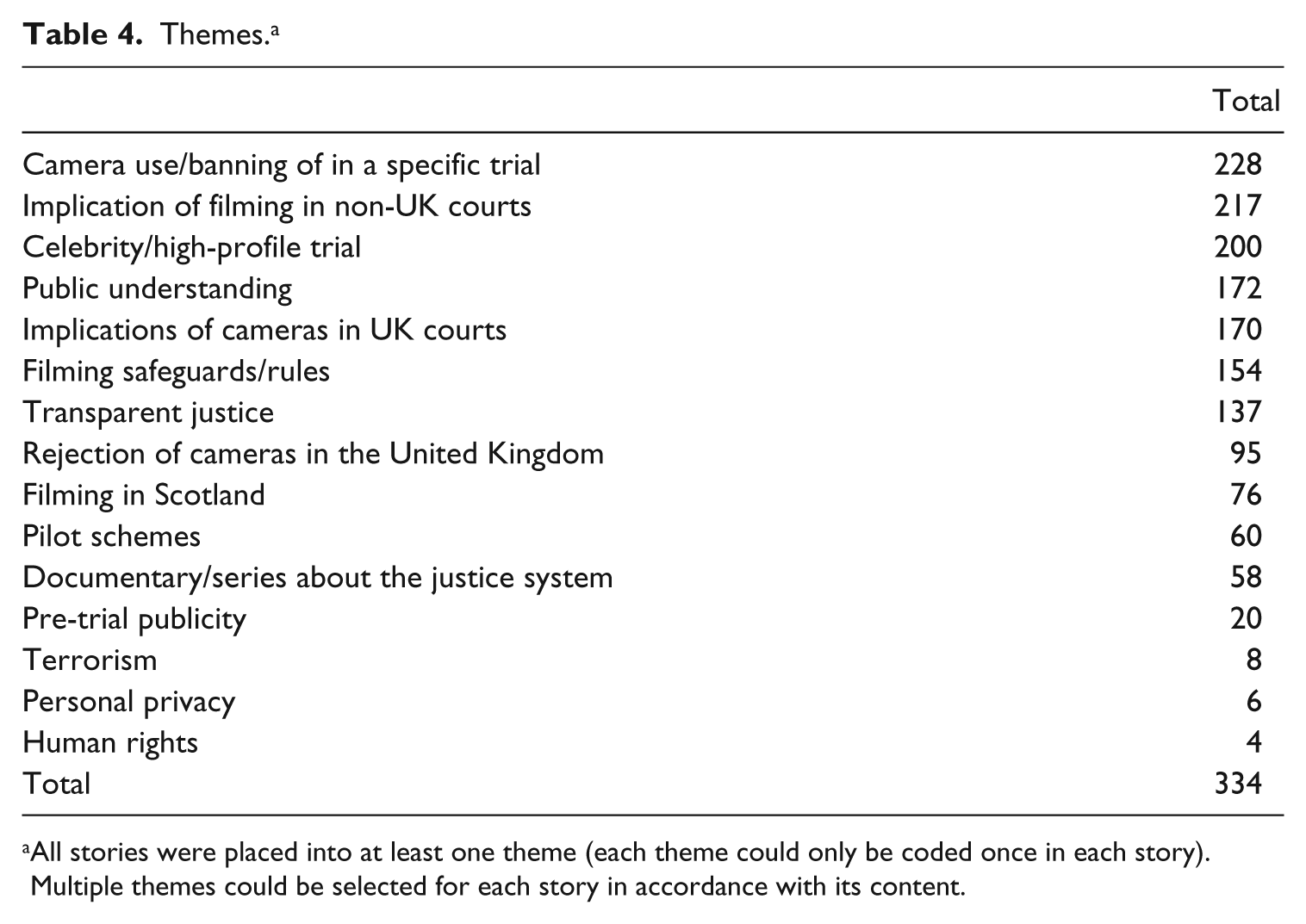
All stories were placed into at least one theme (each theme could only be coded once in each story). Multiple themes could be selected for each story in accordance with its content.
Two in every three stories (64.9%) referred (at least partially) to the experience of filming trials in different countries, as well as to the implications derived from this practice. The Scottish case also featured in coverage, although to a lower degree: one in three stories (35%) mentioning other jurisdictions were devoted to, or touched upon, the experience of filming trials in Scotland. Considering the cultural dominance of the United States, the global influence of its celebrities and that many US states allow the media to film and broadcast trials (Abrams and Kaminer, 1995), it should not be surprising that four out of every five stories (80.1%) mentioning a different country referred to the United States. Following the United States, Italy (the setting for the Amanda Knox trial) and South Africa (Oscar Pistorius) were mentioned in 6.9 and 5.5 per cent of the stories referring to a different country, respectively. Norway featured in 5 per cent of these stories, mainly because of the trial for Anders Behring Breivik, followed by The Netherlands (4.6%), due to the International Criminal Court being located in The Hague.
Our analysis shows the impact of high-profile/celebrity cases on the debate about filming hearings: three out of five stories (59.8%) mentioned or focused on these trials, with journalists being the most prominent source discussing this issue. As such, the OJ Simpson case illustrates how journalists in our sample – regardless of whether they work mainly for print or broadcast media – constitute an interpretive community ‘united through their collective interpretations of key public events’ (Zelizer, 1993: 223). The OJ Simpson trial was – by far – the most prevalent case in our sample, and its impact on this debate is undeniable, to the extent that Wells (2004) claimed that ‘the biggest obstacle to the introduction of cameras to criminal courts has been the OJ Simpson case’. This landmark case constitutes the ultimate example of a ‘media circus’ and of the negative implications of introducing cameras into courtrooms, with judges and lawyers performing to the cameras.
In the 1996 retrial of Lyle and Erik Menendez for the murder of their parents, for example, the judge ordered the cameras to leave the courtroom, prompting a Sunday Times journalist to argue ‘were OJ on trial today … things might be different. With no TV and a judge who instructed the egregious Johnnie Cochran, OJ’s attorney, to stick to germane issues, there might have been a conviction’ (Taki, 1996). The judge in the 2005 Michael Jackson trial barred cameras from the courtrooms, since he had ‘studied and learned from the state’s other notorious celebrity trial, that of OJ Simpson, and was determined that the same circus would not come to town again’ (Glaister, 2005). Years after its conclusion, the trial kept returning in newspaper coverage as evidence of why caution should be undertaken. In this vein, over a decade later, Robin Esser (Daily Mail) stated that we feel that [filming trials] will help open justice and bring instant pictures to the public, just as the people in the public gallery see what goes on. The judges fear some sort of OJ Simpson effect but that really isn’t going to happen. (Burrell, 2009)
However, despite these potentially positive benefits of the absence or banning of cameras, drawbacks were also mentioned, such as trials not having the impact ‘on the national – and international – psyche’ without the images and coverage from the courtroom as they unfolded (Glaister, 2005).
While the main policy driver to lift the ban on filming trials is to increase the transparency of the judicial system, only two in five stories (40.1%) focused on this aspect of the debate. Some elements in the debate itself lacked transparency too: while 18 per cent of the stories mentioned the filming pilots carried out in Britain, coverage barely discussed what these schemes consisted of, and what was judged to be the strengths and the weaknesses of such tests. As a glorious exception, Joshua Rozenberg (2004), one of Britain’s leading legal commentators, wrote in the Telegraph, After watching the first television pictures of an English court hearing ever recorded, I was convinced I had seen the future, and that it worked. Suddenly, it seemed the most natural thing in the world to put cameras in the courtroom.
This lack of debate around the pilot schemes where ordinary trials were filmed, combined with the overwhelming focus on the experience of high-profile and celebrity cases, may have helped to downplay essential considerations in this debate, such as how filming could contribute to enhance the transparency of the criminal justice system (present in 41% of the stories) or the public’s understandings of justice (51.5%), as well as addressing issues of personal privacy (1.8%) or human rights (1.19%).
Filming trials and its implications
Close to nine in 10 stories (88.9%) engaged in discussions about the implications (Table 5) that cameras in courtrooms could have over the conduct of trials, and over the judicial system overall.
Implications of filming trials. a
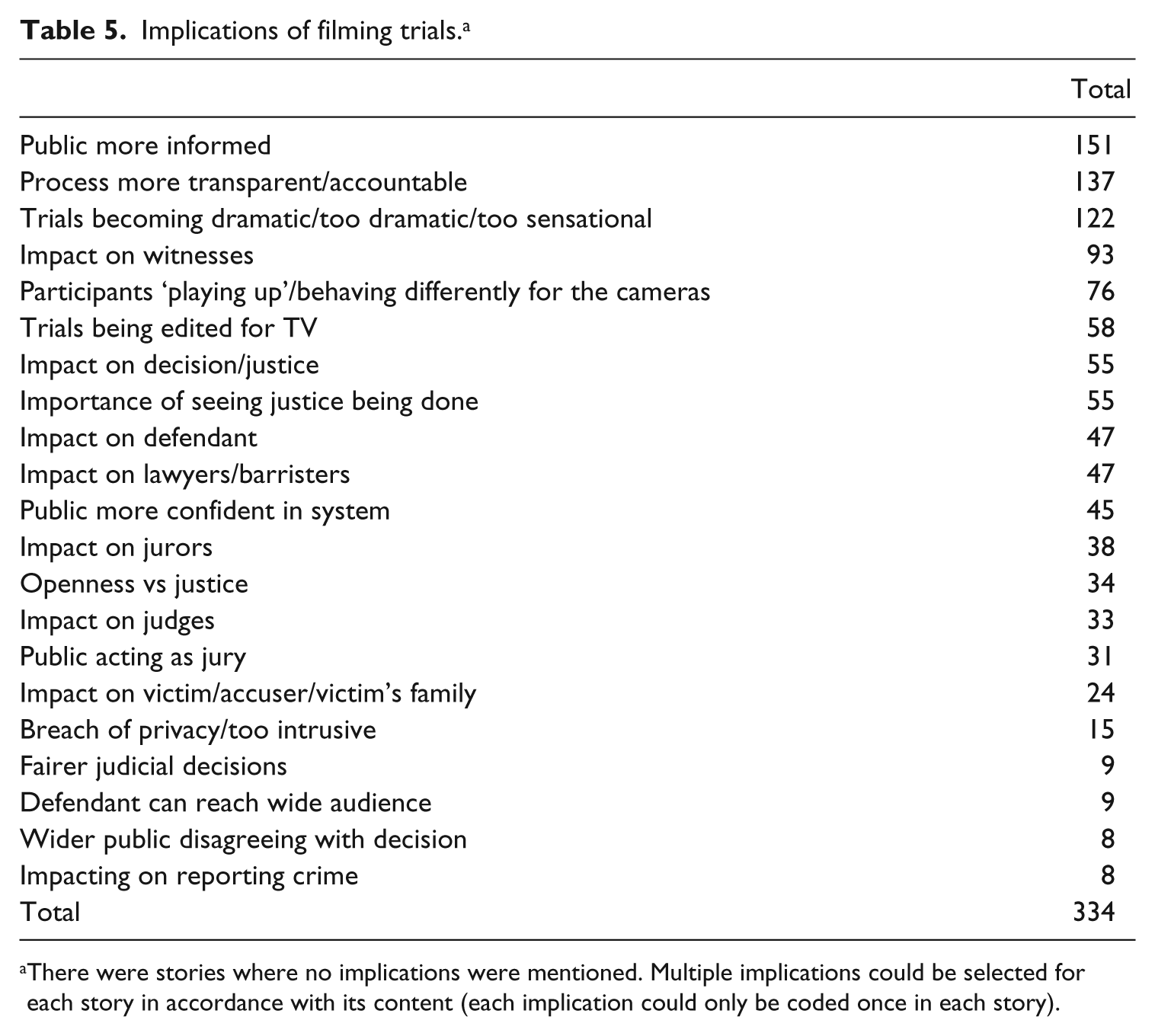
There were stories where no implications were mentioned. Multiple implications could be selected for each story in accordance with its content (each implication could only be coded once in each story).
Almost half of the stories (45.2%) maintained that the public would be better informed if trials were televised, and one in six stories (16.5%) underlined the importance of ‘seeing justice being done’. It was deemed that televised trials would help the public to become more aware of the workings and intricacies of legal cases, such as the use and significance of evidence, testimonies and the reaching of decisions: most people who haven’t been directly involved in a case base their appreciation of our legal system based on [courtroom drama] … it’s not a good thing that the reputation of our legal system and its personnel should be based on such unreliable fiction. (Berlins, 2002)
Filming in courts could have significant resonance and value for those that may have never witnessed a trial before and were basing their perceptions of law on films or series. Some deemed this had an important result in changing public perception about the criminal justice system, which is perceived to be in crisis (see above). In this vein, Lord Justice Judge stated, ‘there are all sorts of views about the judiciary that might be changed if the public could actually see us at work’ (quoted in Rozenberg, 2004). Some voices underlined how televising trials could lead to a better understanding of judicial decisions: it would become far clearer why members of a jury might have opted to vote in the way that they did if judicial advice as to what they should and should not deem to be relevant to the case was broadcast … sentences which might seem unreasonable when simply reported in the newspapers could make a lot more sense if a judge is seen explaining why he made the decision. (The Times, 2006)
The suggestion that the public would be more informed as a result of televising trials was closely linked to the public having an unfiltered, transparent access to trials. As described by Nick Pollard, head of Sky News, televised trials enable the public to ‘see and judge for themselves in total instead of having a secondhand filtered account’ (Branigan, 2003). Such a view obviously disregarded the processes of shot, selection and editing involved in video production: in fact, not even one in every five stories (17.4%) mentioned these processes.
Two in five stories (41%) highlighted how filming in courtrooms could lead to the legal process of trials being more transparent. Coverage also highlighted how televising trials could simply constitute a desirable adaptation of the public trial (see above) to our changing technological landscape. Simon Bucks, associate editor at Sky News, stated, it seems a very outdated position that open justice is only really open to somebody who’s actually going to go and sit in the court … the vast majority of people don’t have the opportunity to go and do that. (Midgley, 2013)
Transparency was understood to be closely associated to the notion of open justice, enabling the public to scrutinise the actions of the judiciary. In the words of Alison Saunders, chief prosecutor in England and Wales, ‘Open justice is about letting the public see justice being done … I would welcome the transparency, and indeed scrutiny, [televised trials] could bring’ (Gibb, 2014). Surprisingly, a rather limited number of stories (13.5%) suggested that televising trials could increase public confidence in the criminal system, in spite of the fact that transparency, public knowledge and confidence in the system are seen as closely intertwined in the government’s rationale in favour of televising trials. In a similar vein, it is worth noting that a negligible number of stories (2.7%) considered that a more transparent justice would lead to fairer judicial decisions.
The introduction of cameras in the courtroom was perceived to have its downsides too. One in three stories (36.5%) questioned how televising trials could lead to more dramatic or sensationalised court proceedings – a narrative which is closely linked to the coverage of celebrity/high-profile cases, especially the case of OJ Simpson (see above). The top three actors in coverage coincide in their analysis of the implications of filming trials: journalists, lawyers and judges agree that it would lead to a more informed public, to a more transparent process, and also to more sensationalised trials (in this order). Citizens show similar concerns, but are slightly more concerned about the possibility of participants playing up for the cameras than about the sensationalisation of court proceedings.
More than one in four stories (27.8%) showed concerns with the impact filming trials could have in deterring witnesses, which was perceived to be particularly worrying. There were instances, however, where the mention of the negative implications and strain of witnesses being filmed was rebutted with experience that this was not always the case. In this vein, Philip Havers, a QC, claimed that ‘[The Hutton inquiry] was the first real experience we’ve had of cameras in a public enquiry and after initially being against it, I became convinced that witnesses and others very soon forgot the cameras were there’ (Hodgson, 2001).
While there were significant worries with the impact that filming could have upon witnesses, press coverage was considerably less concerned with the impact such practice could have upon the judicial decision (a concern present in 16.5% of stories), or upon other participants in trials – defendants (14.1%), lawyers/barristers (14.1%), jurors (11.4%), judges (9.9%) or victims and their families (7.2%).
Conclusion
The introduction of cameras in the courtroom has enjoyed a sustained, but low-profile, debate in British newspapers in the 32 years covered in our sample. During this period, the discussion of the filming ban in the press has normally been triggered by celebrity/high-profile cases or, to a lesser degree, by proposals to modify the status quo. The prevalence of celebrity/high-profile cases – especially the OJ Simpson case – together with the prominent voice of media professionals placed arguments around the sensationalisation of trials centre stage – often presented as an unavoidable consequence of televising trials, rather than as a product of sensationalised coverage. As members of an interpretive community (cf. Zelizer, 1993), journalists and media professionals recurrently resorted to the OJ Simpson case as a key event that enabled their reflection about the journalistic coverage of criminal trials, as well as about the implications that the introduction of cameras in the courtroom could have upon journalistic practice. In addition to the risk of sensationalisation, the metajournalistic discourse (Carlson, 2016) that emerged in our sample also suggested that televised trials would definitely lead to a more transparent judicial system, and to a more informed, knowledgeable public.
Showing a remarkable lack of (self-)awareness, the debate largely ignored the processes of video production (shot selection, editing, etc.), and uncritically reproduced the idea that televising trials would enable citizens to see justice being done without any intermediaries. Still, a sizeable number of stories addressed the need for filming safeguards to be established. Perhaps unsurprisingly, the debate also failed to acknowledge the newspapers’ share of responsibility in the public’s mistrust in the justice system, and in the perception of justice as being remote and impenetrable.
The debate in the press failed to address a number of key issues in this debate. For example, it neglected the fact that a significant number of legal disputes do not have a criminal nature. Many of these disputes are settled outside of the courtroom, normally with an agreement to not disclose the conditions of the settlement. Televising trials will definitely not contribute to make these deals – often involving powerful individuals or organisations with the sufficient resources to settle outside court – more transparent nor fairer. If anything, lifting the ban may constitute an additional incentive for certain individuals or organisations to settle outside court, and avoid any potential criminal incrimination with the aim to avoid the media spotlight.
With regards to cases proceeding to court, the dominant narrative embraced the commonly held idea that the mere introduction of cameras in courtrooms would automatically lead to a more transparent judicial system. Few stories linked filming trials and public trust in criminal justice. When this link was made, however, it was invariably assumed that more transparency would lead to better knowledge, and to higher levels of trust. This assumption disregards that the very act of knowing precludes the need for trust. In the words of Han (2015), ‘if I know everything in advance, there is no need for trust … the society of transparency is a society of mistrust and suspicion’ (p. 47ff). From a more practical point of view, making footage available to the public does not necessarily lead to better understandings of justice, let alone to trust in the system. It could in fact have the opposite effect, as it has been the case with other public authorities. The Freedom of Information Act, for example, ‘has been used most frequently by the media … to highlight problems and mistakes in decision-making’ (Riddell, 2014: 27). Similarly, the introduction of cameras in the House of Commons has not contributed to raise public perceptions of our politicians, which continue to be very low (Grierson, 2017).
Evidence about the impact that televising trials had upon the perceptions of the judicial system in other jurisdictions was used sparingly, and references to other countries were dominated by highly mediatised cases. The debate did not shed much light upon the experience of filming ordinary trials in other jurisdictions, and the extent to which filming cases involving anonymous individuals had contributed to enhance the transparency of justice, or public understandings of how the judicial system works. The experience of filming pilots was remarkably absent from the debate too.
The over-reliance on celebrity cases, and the associated disregard for crucial elements in the debate – as highlighted in the paragraphs above – does not only reveal shortcomings in the journalistic coverage of this issue. The metajournalistic discourse emerging in our analysis also exposes some limitations in the conceptions held by key social actors – including journalists themselves – about the nature, the form and the multiple possible roles that journalism can play in a society.
Footnotes
Funding
The author(s) disclosed receipt of the following financial support for the research, authorship, and/or publication of this article: The authors received financial support from the GW4 accelerator fund for the research reported in this article. Funding from the Cardiff University Open Access Fund supported open access publication of this article.