




Abstract
In the journalism community’s constant search for alternative funding sources, Crowdfunding emerged as a promising mechanism that possibly allows new voices and approaches to secure funding for journalism. In this study, we content analyzed 627 journalistic crowdfunding pitches as a form of metajournalistic discourse and the funding public’s reaction to them as expressed in their funding decisions. Drawing on the journalism studies literature, we consider whether the stated journalistic orientation of the proposed project, the occupational and demographic identity of the campaign creator, and the technical proficiency of the crowdfunding pitch can predict funding success. We find that although technical aspects related to how the pitch was crafted and promoted are the strongest predictors of success, certain journalistic orientations, such as promising to conduct investigative journalism, can contribute somewhat to a project’s success. Data show that while self-identification as journalists, nonprofits, and the location of the proposed projects were strongly associated with crowdfunding success, creators’ gender and ethnic identity were not associated with success.
Introduction
In recent years, crowdfunding is increasingly used as an alternative finance model for journalism (Aitamurto, 2015; Carvajal et al., 2012; Jian and Usher, 2014). This novel finance method, in which producers from across the journalistic spectrum appeal to the public with financial requests, asking for monetary support in order to develop or maintain journalistic ventures, has the potential to enhance diversity in journalism (Aitamurto, 2011; Hunter, 2015; Hunter and Di Bartolomeo, 2019). Previous studies suggested that crowdfunding creates a new type of interaction between journalists and their public. It is a finance mechanism that potentially liberates journalists from newsrooms’ conventions and commercial pressures but ties them to the general public and in particular to their supporters. It might provide journalists with the opportunity to finance nontraditional journalism outside traditional media structures. Such journalism might otherwise go unfunded (Aitamurto, 2019; Porlezza and Splendore, 2016).
Crowdfunding requires journalists to adopt an entrepreneurial role, which according to some scholars has the potential to reshape the boundaries of journalism, tearing down the normative walls that separate editorial and commercial interests (Hunter, 2016; Porlezza and Splendore, 2016; Singer, 2018; Vos and Singer, 2016). It has the potential to create a more “participatory” media environment that empowers the audience, treating audience as “investors who cannot be let down” (Aitamurto, 2011: 434). Such awareness of the audience creates a sense of responsibility towards their backers, which requires crowdfunded journalists to renegotiate their professional roles (Aitamurto, 2011; Hunter, 2015). This attracts and might even encourage journalists to provide an alternative to the mainstream media, produce coverage for issues they feel are not getting enough or any media attention, and create a more diverse media landscape.
Crowdfunding is defined as “an open call, mostly through the Internet, for the provision of financial resources either in the form of a donation or in exchange for the future product or some form of reward to support initiatives for specific purposes.” (Belleflamme et al., 2014: 588). Adopting this broad definition seems particularly useful when exploring crowdfunded journalism since it recognizes a wide variety of digital practices journalists use. It refers not only to producers who launch crowdfunding campaigns on third party platforms, such as Kickstarter, Indiegogo or Patreon, but also to producers who harness their digital assets, such as news sites (e.g., De Correspondent), personal websites, blogs and social media accounts in order to appeal to the public with requests for financial support. What makes crowdfunding differ from other more traditional reader-based revenue models used by the media industry is that crowdfunded journalists are not selling their content per se, but creating campaigns intended to convince people to support their work financially. To achieve such financial support, crowdfunded journalists must tell stories about the journalism for which they seek support. They ‘pitch’ their journalistic ideas to potential supporters, hoping to convince people to financially support their journalistic causes and ventures.
We argue these crowdfunding pitches are a form of metajournalistic discourse. According to Carlson (2016), metajournalistic discourse appears when actors from inside and outside the journalistic field publicly discuss journalism. That is, when they explain their missions and agendas, debate or defend their norms and values, or discuss the things they want to achieve or improve in their work or the field. Previous studies show that in their campaigns, crowdfunding journalists often do just that. According to Aitamurto (2015), journalists perceive the value of crowdfunding as driven not just by the opportunity to raise money but also by the opportunity to brand themselves, test public demand for their ideas, and build an audience. Interviews with crowdfunded journalists suggest that by making explicit appeals while sharing their ideas, causes, and purposes, journalists often try to position themselves within the journalistic field. They often point to what they think is missing in the current media, talk about what they would like to achieve or improve, explain how they plan to do so, and why they should be the ones to do it (Bullard, 2016; Hunter, 2016; Hunter and Di Bartolomeo, 2019).
The notion of metajournalistic discourse relies on the premise that journalism is “a socially embedded, institutionalized cultural practice…[in which]… shared understandings of journalism arise through discursive processes that are then manifested in practice” (Carlson, 2016: 361). The analytical value of metajournalistic discourse as a theoretical construct derives “from how it connects discourse about journalism to how the news is understood and ideas of what it should look like” (Carlson, 2016: 361). In other words, metajournalistic discourse fulfills two roles. On the one hand, this type of discourse is how journalistic communities establish definitions and set boundaries – debate what should count as “good” journalism, what roles journalists embrace, who is a journalist and what journalism should look like. On the other, it provides “the means through which public understandings of journalism are being rethought, circulated, and contested” (Carlson, 2016: 363).
In this study, we examine metajournalistic discourse on journalism-related crowdfunding campaigns posted on Kickstarter – a major global general crowdfunding platform with a distinct category for journalism. Exploring metajournalistic discourse in such an arena allows us to examine whether substantive journalistic orientations journalists emphasize within their crowdfunding pitches - orientations which reflect, at least to some extent, what journalists believe will attract potential supporters - do in fact relate to financial success (e.g., reaching their financial goal). Metajournalistic discourse tends to “skew toward hackneyed normative constellations” (Carlson, 2016: 357) in pursuit of legitimacy. In that sense, such discourse resembles advertising discourse which relies “on the repetition of obvious exhortations” rather than on “the subtle transmission of values” (Schudson, 1986: 5) to persuade the public. Hence, crowdfunding pitches are simultaneously a form of marketing and constitute metajournalistic discourse (as Nechushtai and Zalmanson, 2021 also argue).
Previous crowdfunding research of various cultural domains suggests crowdfunding campaigns’ success depends not only on the product or service it promises to provide, but on a large number of factors related to the identity of its creators, to their occupational, professional and demographic backgrounds, to the nature of the community to which they appeal, and to the technical proficiency demonstrated within their pitches. (Kraus et al., 2016; Mollick, 2014). Some of these studies suggested crowdfunding seems to have a potential to encourage a more diverse population to participate in cultural entrepreneurship (e.g., Marom et al., 2016). Some work suggests that crowdfunding platforms, such as Kickstarter, might reduce socio-economic barriers (Secore, 2016). Others who examined crowdfunding campaigns’ success and failure dynamics found that in many cultural crowdfunding domains traditional social barriers remain significant (Kraus et al., 2016; Mollick, 2014). Hence, we explore whether journalists’ use of crowdfunding might reduce traditional social barriers and attract more diverse populations to practice journalism. We examine how creators’ stated occupational and professional orientations, demographic backgrounds and technical proficiency relate to financial success.
In the following literature review, we first present some of the particular journalistic orientations identified by previous studies as effective crowdfunding strategies, discuss how they refer to traditional journalistic orientations, and examine how they relate to behaviors demonstrated by crowdfunding entrepreneurs in other cultural fields. Second, we examine factors related to creators’ occupational and professional backgrounds that might be related to financial success. And thirdly, we review factors related to creators’ demographic background and other socio-economic barriers and their potential influence on financial success.
Literature review
Stated journalistic orientations
To succeed funding their ventures, crowdfunded journalists must actively woo their audience, not just as readers but as potential supporters. Journalists invest time and thought in designing and promoting their campaigns with the hope of attracting financial supporters. They thus have to adopt an entrepreneurial role to individually express their goals and agendas in a way that will appeal to the publics’ interests and desires, with the hope of convincing enough people to financially support their work (Hunter, 2016; Singer, 2018).
Interviews with journalists that successfully crowdfunded their projects suggest that those interested in journalistic crowdfunding should “promise to make something unique and specific, make it for an audience you know and who knows you, and never focus only on the money” (Bullard, 2016). North American journalists present their crowdfunding campaigns as attempts “to create a community and/or a movement.” (Hunter and Di Bartolomeo, 2019: 2). This might suggest that journalists identify an emphasis on community-focused journalism as a successful crowdfunding strategy.
Community journalism is often described in the literature as journalism that is accessible to a specific community and tells the community’s stories in the community’s voice. Such journalism is accountable to the community it serves, genuinely cares about the community, and participates in the process of negotiating the shared meaning of what the community is and in debates about its shared values (see Lowrey et al., 2008).
Evidence regarding the potential impact of community orientation emphasized within campaigns on financial success are scarce. Obviously, the label of community journalism connotes an antithesis to the “profit-margin-obsessed world of corporate journalism” (Cass, 2005: 20) and, in crowdfunding pitches this may present an underdog appeal calling the public to support resource-less journalism that really cares about their community. However, there are some indications that creating a sense of community might help attract supporters. In-depth interviews with supporters on Spot.us suggested that altruism and the feeling a part of a community strongly influenced supporters decision to contribute to a particular campaign (Aitamurto, 2011).
In an early study of journalism crowdfunding, Jian and Usher (2014) differentiated between stories intended to provide surveillance (such as stories about government and politics, economics, and environment); and those intended to provide guidance (city infrastructure, public health). They found that campaigns that pitched stories intended to provide guidance were more likely to receive backers’ support. They concluded donors preferred “news that serves as a practical guide for daily living” (2014: 156), and claimed their results imply “crowdfunded journalism offers a channel in which news consumers express their preferences for local news that they deem important to their own lives” (2014: 165).
However, in a later work Jian and Shin (2015) suggest that although Spot.us supporters claimed that contributing to one’s community motivated them to support journalism projects, such a motivation did not predict the total amount of support they gave in practice (Jian and Shin, 2015). They found that a sense of fun and supporting their friends and families were the only positive predictors for donation levels. We therefore ask:
Is a reference in journalism crowdfunding pitches to serving a particular community associated with the success of such campaigns?
Is a reference in journalism crowdfunding pitches to the provision of useful information associated with the success of such campaigns? Advocacy journalism is a type of journalism that is “pleading another’s cause or arguing in support of an idea, event or a person” (Fisher, 2016: 712). Studies suggest that journalists have emphasized the advocative role of journalism as a useful funding strategy (Hunter, 2015; Hunter and Di Bartolomeo, 2019). Interviews with North American crowdfunding journalists suggest that many turned “to crowdfunding in order to fund advocacy journalism” (Hunter, 2015: 273). Early in the emergence of crowdfunding, a few Spot.us supporters claimed supporting journalism was a means of participating in a good cause with the hope of impacting society (Aitamurto, 2011). However, Spot.us supporters who emphasized social influence as a motivation to support a journalism project did not provide journalists with more money than other supporters (Jian and Shin, 2015). Hence, we ask:
Is an emphasis on advocacy in journalism crowdfunding pitches associated with campaign success? Early discussions of crowdfunding suggested it could compensate for decreased financing of investigative journalism by established organizations (Carvajal et al., 2012). The success an investigative journalism startup enjoyed when it crowdfunded an early story (Price, 2017) might indicate such potential. Some journalists who successfully crowdfunded their work emphasized how crowdfunding as an alternative mechanism allowed them to do work that legacy media did not fund (Hunter, 2015; Hunter and Di Bartolomeo, 2019). We therefore ask:
Is a reference to an alternative orientation in journalism generally or a specific commitment to investigative journalism in crowdfunding pitches related to the success of such campaigns?
Organizational and occupational status
Beyond substantive aspects of the journalism work crowdfunding pitches promise to deliver, crowdfunding project creators’ occupational and organizational identity could also impact fundraising success. In-depth interviews with North American journalists suggested that “it helps to work as part of a team” because successful crowdfunding demands a diverse set of skills and a considerable investment of time to produce a campaign pitch and promote it (Hunter, 2016). More generally, team size is positively related to funding success (Davidson and Tsfati, 2019; Mollick, 2014). It is also possible that projects affiliated with an ongoing journalism endeavor would experience different levels of success from those aiming to fund a novel venture. An ongoing venture could suggest that the project is likely to achieve its promised goals and therefore attract more supporters. Alternatively, an ongoing project might signal that the project has already received support and therefore does not require funds from the crowd.
We, therefore, ask:
Do ongoing ventures enjoy more support compared to novel ones?
Do pitches promoted by a team enjoy more support compared to pitches promoted by an individual? Some research suggests that less experienced creators have an advantage when crowdfunding. Jian and Usher (2014) found in their Spot.us study that journalists with less experience in traditional journalism tended to be more successful in raising public funding. Similarly, more junior scientists were more successful crowdfunding than more senior ones (Davidson and Tsfati, 2019). However, there are indications that in some industries, higher professional status is related to crowdfunding success. For example, commercial projects with more board members with an MBA degree enjoyed more success in raising funding from the crowd (Ahlers et al., 2015). Previous research has suggested that campaigns that signal higher quality (e.g., lack of spelling errors, rapid updates), which could be identified with higher occupational status and hence more trustworthiness were more successful (Mollick, 2014). For journalists and media organizations, a credible and trustworthy reputation is generally very important, especially in a challenging economic environment (Anderson et al., 2012). Hence, established media organizations and experienced journalists that the public knows might have an advantage when crowdfunding. We therefore ask:
Is self-identification of a project founder as a journalist related to a project’s crowdfunding success? The status of a journalism venture as nonprofit or for-profit could also impact funding success. For example, an analysis of Kickstarter projects (across all funding categories) found that projects identifying as nonprofit were more likely to reach their goal but raised less funding than for-profit projects (Pitschner and Pitschner-Finn, 2014). However, on a prominent Chinese platform, the nonprofit orientation of ventures did not impact funding success (Zhou and Ye, 2019). While there is no research on whether the profit orientation of a journalism venture advantages or hinders crowdfunding, there is an increased interest in the potential of nonprofit funding models as advertising revenue has declined (Picard, 2017) and advertisers demand and secure greater control over the editorial product in the shape of sponsored content (Hardy, 2017). Those journalism nonprofits that rely on donors, advertisers, and a nonprofit tax status employ intensive efforts to maintain open and transparent relations with all these community stakeholders and the local audience more generally. This can make a nonprofit news organization a civically valuable part of a local community while maintaining editorial control (Ferrucci and Alaimo, 2020). The presence of well-funded nonprofit news organizations is related with increased prosecution of public corruption suggesting nonprofit status can empower journalists to act as watchdogs (Usher and Kim-Leffingwell, 2022). We, therefore, wish to investigate the relationship between a campaign’s stated profit orientation and its funding success, and ask:
Is the profit orientation of a journalism crowdfunding campaign (nonprofit/for-profit) related to funding success?
Crowdfunding and socio-economic barriers
The financial opportunity crowdfunding provides for individuals and groups with no professional experience or ties to the journalism industry might attract more diverse populations to practice journalism. Alternative institutional patterns could make journalism more demographically diverse, enabling news media to struggle more effectively for social justice and political equality (Glasser et al., 2009). Studies suggest that coverage patterns and story selection processes are often affected by the geographical and social distance between journalists and media outlets, which tend to be located in economic centers, and the location of reported stories (Avraham and First, 2006; Graber, 1989).
However, the demographic profile of journalists did not change much over the past few decades (Glasser et al., 2009; Weaver and Willnat, 2012). The “typical journalist” still is a young college-educated male from a dominant cultural group in society (Weaver and Willnat, 2012). Previous research suggests that crowdfunding has the potential to “democratize” entrepreneurial funding by reducing the barriers facing entrepreneurs from traditionally underrepresented groups such as women (Marom et al., 2016). However, African-American creators experience lower success rates than other groups (Rhue, 2015).
Spatial location could also be a factor shaping crowdfunding success. Proximity to economic hubs allows entrepreneurs to take advantage of extensive social networks to secure economic success (Saxenian and Sabel, 2008). These clusters are especially prominent in global cities such as New York, London, or Tokyo. Crowdfunding campaigns located in or close to cultural industry hubs enjoy more funding success (Mollick, 2014), perhaps because crowdfunding platforms whose physical headquarters tend to be located in urban hubs promote projects located in hubs more than others (Davidson and Poor, 2016).
Based on this discussion, we ask:
Are the demographic characteristics of crowdfunding creators related to the success of their crowdfunding campaign? Finally, we also examine whether the technical excellence of a campaign might be related to funding success. Crowdfunding journalism (and other cultural products) reflects the increased emphasis on social performance in modern societies (Alexander, 2004) as in crowdfunding the project creator markets a potential project that does not yet exist to convince the public to financially support them. Before they can do news work, journalists must tell a (metajournalistic) story about the news they hope to produce; performing news rather than doing it.
Method
To study these questions, we collected all the English language campaign pitches posted in the Kickstarter journalism category between December 2016 and May 2018 (see Online appendix 1 for details on sampling approach). Kickstarter was selected for our study since it is the major global general crowdfunding platform with a distinct category for journalism.
To examine how different journalistic orientations stated in campaign pitches affect campaigns’ success, we analyzed verbal indicators that may reflect such orientations. Community orientation was coded in cases where creators presented themselves as part of a community or designed their projects for a specific community (e.g., “We are the people who have tried to work with mainstream media to share the real stories of our community”), though not necessarily a geographically based community (we collapsed these two indicators, creating a mean variable). We used a separate variable to identify local journalism projects (a promise to serve the contributors’ specific geographic community, e.g., a neighborhood). In addition, we measured utility by coding expressions that assert an intention to provide supporters useful information relevant to their daily lives, (e.g., “transportation, affordable housing, gentrification, demonic landlords, immigration, and the living wage struggle”).
To measure the reflection of advocative roles, we coded creators’ intention to function as the people’s voice – with expressions addressing the public value of their work, or their obligation to serve the public (e.g., to raise awareness of a public issue – “This is a fight for the little guy”); to promote social change - with expressions asserting an intention to act as change agents to attain a social goal (e.g., journalism that supports political activism or a concrete policy proposal); we also coded political orientation - reflecting expressions asserting creators’ political stand (e.g., “we support progressive values”).
To examine the reflection of alternative roles, we measured two types of stated journalistic orientations emphasized within campaigns: alternative orientations and investigative orientations. To measure alternative orientations, three variables were coded (1) the use of the term “independence” or its cognates, (2) the use of the term “alternative” or its cognates, and (3) the presence of boundary work (a form of metajournalistic discourse; Carlson, 2016) with which creators differentiate themselves from mainstream media, pointing at their failures. Exploratory Factor Analysis (EFA)—an iterative empirically-based technique used to uncover whether a set of variables shares an underlying latent construct demonstrated these three variables load together. 1 Given this result, stated alternative orientations were calculated as the mean of these three 0/1 variables. To measure investigative orientations two variables were coded, measuring (1) the use of the term “investigative” or its cognates and (2) expressions that assert a promise to provide untold stories. Again, given that EFA demonstrated these two 0/1 variables load together, investigative orientations were calculated as a mean of these two indicators (see full coding scheme in Online appendix 2).
We analyzed verbal indicators regarding campaigns’ and creators’ organizational and occupational status. We coded creators Group/individual identity (individual = 0, group = 1), Journalistic self-identification (a mean variable of self-presentation of creators as journalists and reference to their prior journalistic work), projects’ status (development of a future venture = 0, existing venture = 1), and nonprofit status. We analyzed visual and verbal indicators to identify creators’ demographic backgrounds. We coded creators’ gender (female = 1) and their ethnic identity (non-white = 1) based on their profile picture on the Kickstarter platform or a connected social media account/personal website, whether they could be identified as U.S. creators and whether their campaigns were based in global cities (relying on the location field in the campaign page and a global cities index (Hales et al., 2018)).
We also collected a number of technical variables. We coded Online campaign presence (mean variable for links to a project’s website (=1), Facebook (=1) and Twitter (=1) accounts); Online creator presence (mean variable for links to a personal website (=1), Facebook (=1) and Twitter (=1) accounts, and the presence of the creators’ photo (=1)) as well as the inclusion of a project video (=1). Finally, we coded the number of Backed campaigns, the number of Pledge choices, and whether the campaign was financially transparent.
To measure campaigns’ success, we collected visible financial data regarding each campaign posted on its campaign page. We coded the Campaign’s goal – the financial goal stated on the campaign page (when necessary, we used an online converter 2 to convert to U.S. dollars); the Funds raised – the amount stated as pledged at the campaign’s endpoint (converted to U.S. dollars, if necessary); Success - We created a dichotomous funding success variable distinguishing between campaigns in which the funds raised were equal or larger than the campaign’s goal (=1); and the number of supporters – as stated on the project page after the campaign concluded. Coding reliability for all variables was assessed using Krippendorff’s alpha SPSS macro. The lowest reliability was α = .78, above the .70 threshold recommended by Krippendorff (2004).
Results
During the period of this study (approximately 18 months) 627 Kickstarter English language journalism-related campaigns, were sampled, 152 of them (24%) succeeded in reaching their funding goals. This success rate, similar to public data Kickstarter published regarding its journalism category (22%), is low compared to the success rate Kickstarter has published for all projects on the platform as of November 1, 2020. 3 On average, analyzed journalism campaigns set funding goals of USD 196,399.74 (SD = 4,012,599.84), 4 and raised USD 2952.90 (SD = 13,174.84). Campaigns that reached their funding goals, set on average lower goals USD 7182.03 (SD = 13,426.09), and were able to collect an average of USD 10,306.94 (SD = 24,650.97). Successful campaigns had an average of 148.58 (SD = 366.75) supporters, while the average number of supporters of all the analyzed campaigns was 42.80 (SD = 194.72). Full distributions of all variables by campaign success are presented in Online Appendix 3.
All in all, our findings indicate that producers from across the journalistic spectrum create crowdfunding campaigns to finance journalistic projects through Kickstarter. In terms of professional identifications: in the majority of the analyzed campaigns, creators identified as individuals (86%), the remainder appeared under a group name; in almost a quarter (23%), creators presented themselves as journalists; in 71% of the cases, creators were asking support for a future journalistic venture; and in 8% of the projects, creators identified as nonprofit. In terms of demographics: only a minority of creators were female (29.2%) and non-white (15.3%) echoing findings that the identity of those who attempt to crowdfund reflect existing social hierarchies; in 70% of the cases, creators identified themselves as American; and 32% of the campaigns were based in global cities.
Our exploration aimed to investigate crowdfunding pitches as metajournalistic discourse, as statements of journalism principles. The distribution of the stated professional-orientation variables in our data (presented in full in Online Appendix 3) demonstrates that there was much variance in the types of journalism promised on the crowdfunding platform: 26.3% of the projects offered to promote community journalism, 43.2% advocated journalism that gives a voice to the people, 10.7% of the pitches promised journalism that promotes social change, 11.5% advocated some sort of alternative journalism and 4.1% offered journalism with a clear political orientation. However, a large part of the pitches in our data still reflected the classic objective-detached model of journalism (Schudson, 2001) that strives for a detached presentation of facts and is still the most popular conception of journalism around the world (Hanitzsch et al., 2011): 34.8% did not promise any type of journalism that offers an alternative to the classic journalistic model.
Regression models predicting funding success (logistic regression), the amount (in US dollars) of money raised (OLS) and the number of supporters of each journalistic related campaign at Kickstarter (OLS, n = 627).
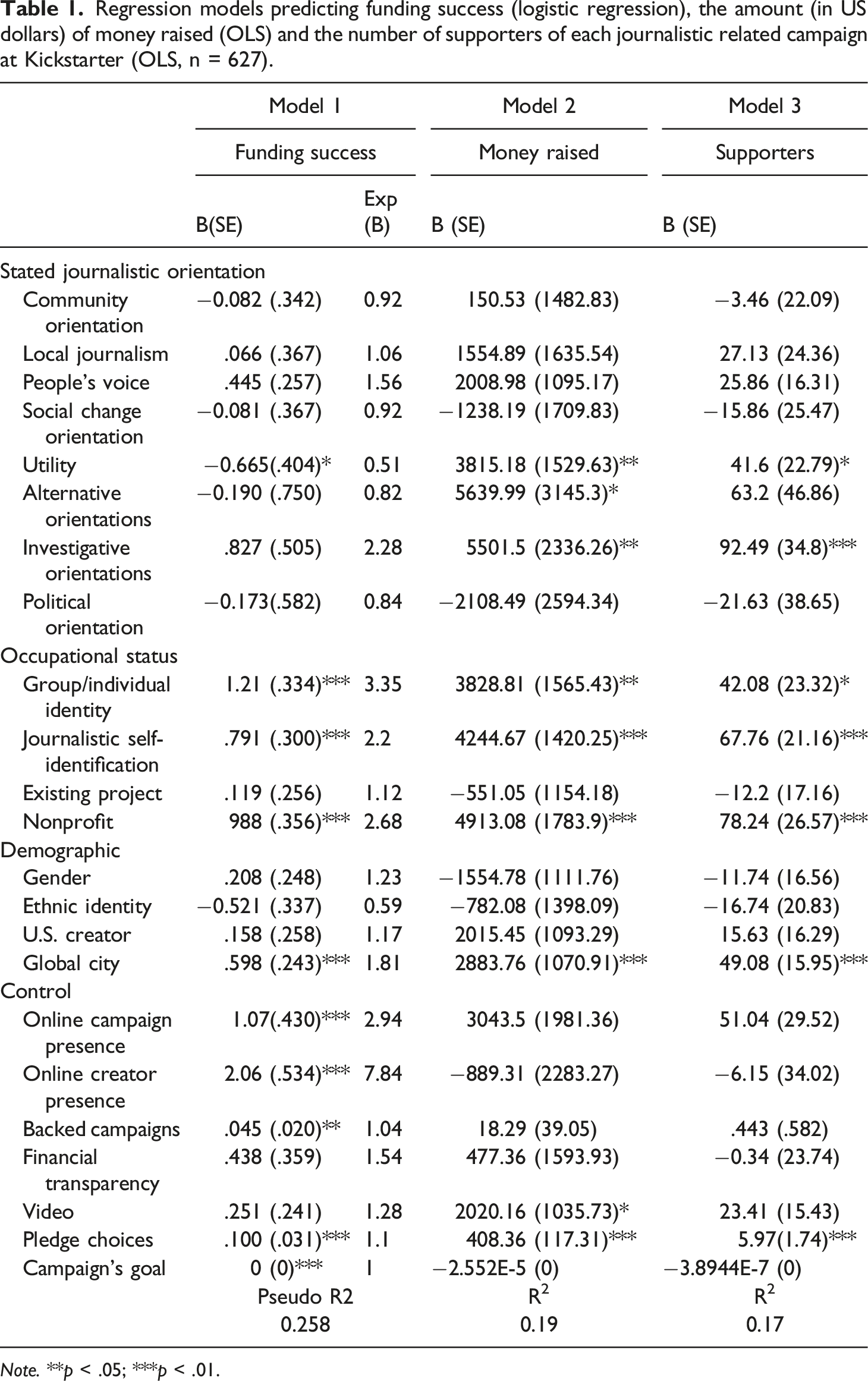
Note. **p < .05; ***p < .01.
Our first line of research questions explored whether stated journalistic orientations expressed within crowdfunding campaigns affect campaigns’ success. RQ1a inquired whether emphasizing a community orientation relates to funding success. Controlling for all other factors, community orientation, and local journalism projects were not associated with any of the dependent variables. Campaigns in which projects’ utility aspects were emphasized (RQ1b) were significantly more likely to recruit more funds (b = 3815.18, SE = 1529.63, p < .05 in Model 2), but were not significantly associated with the likelihood of meeting their goals and attracting more supporters (Models 1 and 3).
RQ1c examined whether emphasizing journalistic advocative roles relate to indicators of success. Results show that presenting a social change orientation or a clear political orientation were not associated with any of the dependent variables. Pitches presenting the journalistic project as representing the people’s voice were also not associated with the outcome variables (b = .44, SE = .25, p < .1 in Model 1; b = 2008.87, SE = 1095.17, p < .1 in Model 2).
RQ1d asked whether campaigns that emphasized projects’ alternative roles contribute to the probability of campaigns’ success. Results show that ceteris paribus, campaigns emphasizing investigative orientations were significantly more likely to recruit more funds and supporters (b = 5501.5, SE = 2336.26, p < .05 in Model 2; b = 92.49, SE = 34.8, p < .01 in Model 3). Emphasizing alternative orientation was unrelated with either of the dependent variables.
Our second line of research questions examined how occupational identity relates to campaigns’ success. We examined whether funding either an ongoing or a novel project was related to campaigns’ success (RQ2a) and whether the identity of the campaign creator as an individual or group (RQ2b) was related to campaigns’ success. When controlling for all other factors, creators who identified as a group were significantly more likely to achieve their funding goals (b = 1.21, SE = .33, p < .01 in Model 1), and more likely to recruit more funds (b = 3828.81, SE = 1565.43, p < .05 in Model 2). However, supporting existing projects was not significantly associated with any of the dependent variables.
RQ2c examined whether self-identification as a journalist would contribute to a campaign’s success. All else being equal, campaigns that described their creators as journalists or referred to their journalistic experience were significantly more likely to reach their goals (b = .79, SE = .3, p < .01 in Model 1). Campaigns whose creators identified as journalists raised on average 4244.67 USD (SE = 1420.25, p < .01) and attracted on average 67.76 supporters (SE = 21.16, p < .01) more than those who did not identify as professional journalists when controlling for all other variables.
Our analysis of the relationship between nonprofit identification and success (RQ2d) found that nonprofit identification was strongly associated with all of the dependent variables (b = .98, SE =.35, p < .01 in Model 1; b = 4913.08 USD, SE = 1783.9, p < .01 in Model 2, and b = 78.24, SE = 26.57, p < .01 in Model 3).
Our third line of research questions examined the role of demographic factors (RQ3). Findings suggest that ceteris paribus, minority status, and gender did not significantly impact success. However, campaigns that were identified as located in global cities had a significantly higher likelihood of meeting their funding goal (b = .59, SE = .24, p < .01). These campaigns raised on average 2883.76 USD (SE = 1070.91, p < .01) and attracted on average 49.08 supporters (SE = 15.95, p < .01) more than those who were not located in a global city. The impact of identification as a U.S. creator was unrelated to either of the dependent variables.
In line with earlier studies that showed a campaign’s quality indicators are associated with financial success, our results show that pitch quality was strongly associated with success. Campaigns’ online presence (a link to the project website and a social network account) was associated with a significantly higher likelihood of meeting their goal (b = 1.07, SE = .43, p < .01 in Model 1). Similarly, creators’ online presence was associated with a significantly higher likelihood of meeting their funding goals (b = 2.06, SE =.53, p < .01) but not related to the probability of more funds raised or more supporters. Posting a promotional video as part of the campaign pitch was not associated with recruiting more funds. The number of backed campaigns was associated with a higher likelihood of campaigns’ meeting their goal (b =.04, SE = .02 p < .05). The more pledge choices offered, the more successful campaigns were in meeting their funding goals (b =.1, SE = .03, p < .01), raise funds (b = 408.36, SE = 117.31, p < .01) and recruit supporters (b = 5.97, SE = 1.74, p < .01). Providing some level of financial transparency was not significantly associated with any of the dependent variables.
Discussion
To what extent does crowdfunding have the potential to change journalism by enabling voices outside mainstream media institutions to participate in the production of news? Seemingly, if we examine the “supply side” consisting of those who initiate journalistic crowdfunding projects (Davidson and Tsfati, 2019), the answer seems to be “at least to some extent.” First, a clear majority of project initiators were actually not journalists (only 23.1% self-identified as current journalists, and 21.4% previously worked as journalists). Second, sizable minorities promised to give voices to the general public or disadvantaged populations (43.2%), promote social change (10.7%), or deliver untold stories (12%). Third, some indications point out that creators were demographically different from typical journalists. Of the 441 projects originating from the U.S for which we were able to identify the race of the creator, 76 (15.3% in the full sample, or 17.2% of all U.S projects) came from African-American, Hispanic initiators, or other minorities (compared to only 7% African-American or Hispanic journalists reported by Brownlee and Beam (2012: 351)). Geographically, only 33% of the initiated projects came from global cities, while typically, national journalists reside and work in cultural and economic national centers. This might suggest that in journalism, as in technology (Sorenson et al., 2016), crowdfunding might promote more geographical dispersion than traditional funding methods allow.
Our content analysis of journalistic crowdfunding pitches adds to a burgeoning literature on metajournalistic discourse. First, the types of journalistic projects that the pitches promised were diverse, as demonstrated by the variance in the stated-professional-orientation variables. Surveys of journalists around the world demonstrate that there is more than one way to define and practice good journalism and the multiplicity of journalistic cultures is reflected in the crowdfunding pitches. Some projects advocated alternatives to mainstream news culture including community journalism, public journalism, alongside many that conformed to the objective-neutral model (Schudson, 2001). Second, alternative forms of journalism were perhaps more prevalent in our data compared to what studies have found in other forms of metajournalistic discourse because many campaigns were created by people that did not identify themselves as journalists.
Finally, our analysis clearly demonstrated that, when we examine the demand side (i.e., the funders’ preferences), crowdfunding does not erase existing social hierarchies in journalistic production but works within them. First, it shows that journalistic orientations expressed within campaigns were less influential for funding success compared with creators’ occupational identity, location and technical proficiency. While hopeful creators discursively offered a diverse supply of journalism projects, discursive commitments to alternative news-making had only a limited positive association with funding success. Second, it shows that even though crowdfunding might attract non-journalists to try and finance journalistic production, campaigns whose creators identified as journalists were significantly more likely to succeed. Furthermore, it suggests that although crowdfunding might promote more geographical dispersion, campaigns that were located in major cultural hubs (global cities) enjoyed more success. Further, more extensive online presence of the campaign and the creator, and offering more pledge choices, were more important predictors of campaign success, compared to stating a commitment to community, alternative or a social change journalistic orientation. This suggests that in crowdfunding journalism, as is evident in the crowdfunding of ventures in other domains (e.g., Davidson and Tsfati, 2019), the technical excellence and social capital of initiators often dominate the substantive aspects of proposed projects.
Nevertheless, it is noteworthy that projects featuring an investigative orientation in the pitch tended to raise more funding and that discourse aligning the project with “the people” and professing an alternative orientation might be related to more funding. Though relatively small, these effects do suggest that the type of journalistic product does matter somewhat when crowdfunding for public support.
We find that journalism projects that describe themselves as nonprofits were more successful. A nonprofit orientation is not a guarantee of watchdog journalism: many nonprofit news organizations in the U.S. are heavily funded by foundations. Some argue that foundations compel nonprofit news organizations to pursue technological fads and audience engagement and maintain extensive relationships with foundations (Ferrucci and Nelson, 2019). Further, critics have argued that foundation support subtly influences organizations’ reporting priorities to match those of foundations (Scott et al., 2019) in ways consonant with elite middle class interests (Benson, 2018; Usher, 2021). This elite orientation is not much different from the tendency of commercial news to cater to elite interests (McManus, 1994).
However, as noted earlier some forms of nonprofit funding can enable news organizations to carry out their monitorial role. Clearly, not all nonprofits are created equal. Hence, appealing directly to the public for distributed support could moderate large foundations’ influence (Cagé, 2016). The mean across all analyzed projects of the average support amount at the project level is USD 71.28, and the median is USD 52.80. Hence, supporters must have disposable income but need not belong to the very rich echelons of society. While the mean and median could mask dependence on one prominent supporter, across 15 randomly sampled projects, the support provided by the 10 largest supporters accounted on average for 22.7% of the financing raised, 5 suggesting that wealthy supporters do not tend to dominate project financing. Hence, crowdfunding could perhaps serve as a modest counterweight to foundation funding of nonprofit journalism. While crowdfunding does rely on middle class support, this support comes from a relatively distributed crowd without creating yet more concentrated institutional dependence on powerful interests as is the case with foundation funding. It constitutes an additional financial arrangement in “diversified media systems that capture the benefits of different arrangements and sectors” (Hardy, 2017: 163). Our findings suggest that using the nonprofit label in crowdfunding campaign pitches increases the funding public’s support because it seems to serve as a heuristic for journalism that requires public funding and is insulated from moneyed interests.
Future research and limitations
While this project relies on a systematic and theoretically grounded analysis of crowdfunding pitches, it is limited to the information creators shared on Kickstarter. Such missing information could be unintentional or stem from project creators’ perception that revealing such information could negatively affect project success. Future research could combine the analysis of the pitches with interviews or surveys to provide a better answer to these questions and examine the outputs of their funded projects. Another limitation of this study is that data collection concluded in 2018. However, the institutional context in which crowdfunded journalism operates has not dramatically changed in very recent years and while repeat crowdfunding has emerged more recently as an additional funding mechanism it also requires creators appeal to the crowd in ways similar to project-based crowdfunding as it relies on similar avenues of promotion.
In the meantime, this paper provides an important step forward in our quest to understand crowdfunding in journalism. Our analysis goes beyond current knowledge in providing a more exhaustive analysis that examines the stated journalistic orientations reflected in the crowdfunding pitches in a period of more mature journalistic crowdfunding. It also constitutes a novel examination of how metajournalistic discourse relates to audience responses going beyond the traditional analytic focus on discourse alone by investigating to what extent does the audience financially react to such discourse. Future research should examine whether they develop project-based crowdfunding or related direct repeat mechanisms such as Patreon or Substack can contribute to a more diverse community of news producers and news content. The evidence for now is that crowdfunding does so in a very limited manner.
Supplemental Material
Supplemental Material - Stated professional orientation, identity, and technical proficiency of journalists as predictors of the success of journalism crowdfunding campaigns
Supplemental Material for Stated professional orientation, identity, and technical proficiency of journalists as predictors of the success of journalism crowdfunding campaigns by Niv Mor, Roei Davidson and Yariv Tsfati in Journalism
Footnotes
Acknowledgements
The authors would like to thank Yasmin Morag for her valuable contribution, insights and suggestions in conducting inter-coder reliability analysis, and for serving as a second independent coder.
Declaration of conflicting interests
The author(s) declared no potential conflicts of interest with respect to the research, authorship, and/or publication of this article.
Funding
The author(s) received no financial support for the research, authorship, and/or publication of this article.

Supplemental Material
Supplemental material for this article is available online.
Notes
Author biographies
References
Supplementary Material
Please find the following supplemental material available below.
For Open Access articles published under a Creative Commons License, all supplemental material carries the same license as the article it is associated with.
For non-Open Access articles published, all supplemental material carries a non-exclusive license, and permission requests for re-use of supplemental material or any part of supplemental material shall be sent directly to the copyright owner as specified in the copyright notice associated with the article.
