




Abstract
Attributing blame to elites is central to populist communication. Although empirical research has provided initial insights into the effects of populist blame attribution on citizens’ political opinions, little is known about the contextual factors surrounding its presence in the media. Advancing this knowledge, this article draws on an extensive content analysis (N = 867) covering non-election and election periods to provide insights into how populist blame attributions are embedded in journalistic reporting styles. Using Latent Class Analysis, we first identified three distinct styles of reporting: neutral, conflict, and interpretative coverage. In line with our predictions, we find that populist blame attributions are present most in conjunction with an interpretative journalistic style and least when a neutral journalistic style is used. Populist blame attributions are more likely to be used by journalists of tabloid newspapers than journalists of broadsheet newspapers. These results provide valuable insights for understanding the intersections between journalism and populist communication.
Populist political parties are on the rise, and the media are said to be partially responsible for it (e.g. Krämer, 2014; Mazzoleni, 2008; Mudde, 2004). If this is the case, are the media passively conveying the viewpoints of populist actors, or are journalists actively using populism as a framework to cover news events? The jury is still out. Regarding the media’s role in the global rise of populism, two alternative explanations have been proposed. First, the media are assumed to provide a favorable stage for populist actors and their ideas (e.g. Vossen, 2012). Because populist ideas resonate with media logic, populist actors are said to be given disproportional media attention. Other scholars have argued that media content can be populist by itself (e.g. De Lange, 2011; Krämer, 2014; Mazzoleni, 2008). This perspective implies that journalists, and not only politicians, interpret issues along the lines of a populist distinction between the good people and culprit others. Previous empirical research has predominantly investigated the attention for populist rhetoric and actors in the media (e.g. Bos and Brants, 2014; Jagers and Walgrave, 2007). However, the strong claim that journalists possess agency to frame issues in populist ways themselves – populism by the media (Bos and Brants, 2014) – has not been tested empirically. Responding to this discrepancy, this article draws on a content analysis of different media outlets to unobtrusively investigate the role of journalists in communicating populist ideas.
Populism revolves around the construction of a blameless in-group opposed to culprit out-groups that are blamed for the people’s crisis (Canovan, 1999; Mudde, 2004). The in-group is commonly referred to as the innocent people who belong to the imagined community of the heartland. The out-group can be constructed both vertically as the elites and horizontally as societal out-groups. As the in-group is absolved of responsibility for causing the heartland’s crisis whereas out-groups are accused of causing it, the populist distinction between ‘us’ and ‘them’ inherently revolves around attributions of blame (Hameleers et al., 2016). Populist actors are indeed found to attribute more blame than mainstream politicians (Vasilopoulou et al., 2013). Against this background, we regard the core idea of populist communication as framing attributions of blame, emphasizing a shift in responsibility for the heartland’s problems from the innocent people to culprit others (Hameleers et al., 2016).
In this article, we assess whether and how populist blame attribution is used by journalists, which will allow us to answer the question whether journalists are active in framing issues in populist ways themselves. Crucially, this study tests whether certain aspects of media coverage link up to populist interpretations, as theoretically proposed by the concept of media populism (e.g. Krämer, 2014).
An extensive quantitative content analysis of tabloid and broadsheet media outlets in the Netherlands (N = 867) collected at election (2002, 2012) and non-election periods (2014, 2015) revealed that journalists are not just passive reporters, as they also attributed blame to the elites themselves. In line with theoretical assumptions, blame frames were more saliently used by interpretative journalists of tabloid newspapers than broadsheet newspapers. These findings advance theory by testing the assumptions foregrounded in extant literature on the important, yet understudied, link between populism and journalism (e.g. Krämer, 2014; Mazzoleni, 2008). By comparing the framing of blame between tabloid and broadsheet outlets, and election versus non-election periods, this article is one of the first in disentangling the political parallelisms between the media and populism (e.g. Hallin and Mancini, 2004). Doing so, this article provides important foundational evidence for the role of journalists’ agency in the dissemination of populist viewpoints: Are the media simply a passive conveyer of populists’ messages, or are they also composing and sending such messages themselves?
Attributing blame in populist communication
For representative democracy to function properly, citizens are expected to blame politicians for failures and to credit them for positive outcomes. This process, by which politicians are held accountable by the electorate, can be defined as causal attributions of responsibility (e.g. Johns, 2010; Malhotra and Kuo, 2008; Tilley and Hobolt, 2011). Causal attributions of responsibility provide citizens with powerful psychological tools, which enable them to process abstract political information in a meaningful way (Hewstone, 1989).
By pointing the finger at certain out-groups while absolving their own in-group of responsibility, attributions of blame enable citizens to bolster their positive self-concept by finding external causes for the problems they are facing (e.g. Dixon, 2008). Such responsibility attributions simplify and attach meaning to important, yet complex, societal issues such as the job market or the refugee crisis. In its essence, this simplification boils down to the presentation of issues into black and white terms. For example, all asylum seekers or the political elites in government are held responsible for a lack of available jobs, whereas all ordinary native people are depicted as hardworking victims. Hence, the ordinary citizens are depicted as being deprived by others and assumed to be treated unfairly by those who are actually responsible (e.g. Weyland, 2001). As these explanations help citizens to make sense of political issues by finding external causes for internally experienced problems, mediatized attributions of blame are highly attractive and persuasive (e.g. Iyengar, 1991).
A similar dialectical process of in-group favoritism and out-group hostility forms the heart of populism (e.g. Jagers and Walgrave, 2007). The core idea of populism can be regarded as the construction of a moral and causal divide in society: the ordinary people as blameless in-group versus the evil politicians or societal out-groups as the enemies responsible for the ordinary people’s problems (e.g. Mudde, 2004; Taggart, 2000). Populist blame attribution differs from other forms of blame attribution by its emphasis on a moral divide between ‘us’ and ‘them’, which moves beyond highlighting causal interpretations for societal issues. This conceptualization ties in with extant literature that defines populism as a moral and relational phenomenon, in which the centrality of the ordinary people as good in-group is a necessary, but insufficient, prerequisite for populism to be identified (e.g. Hawkins, 2009; Mudde, 2004). In populism, the elites are blamed for not representing the people’s will and accused of only adhering to their own interests (e.g. Mudde, 2004). By failing to keep the promises to the people they claimed to represent, the elites are accused of deceiving the ordinary people. The failed representation of the people is thus an important component of populist attributions of blame.
Populism by the media: The framing of blame
Populist attributions of blame may not only be used by populist politicians. They can also be emphasized by journalists. By means of framing, journalists actively reconstruct complex societal issues, such as the crisis on the job market or the refugee crisis, into meaningful patterns of interpretation (e.g. Scheufele, 1999). For populist attributions of blame, these patterns of interpretation reduce societal problems into binary oppositions of ‘the blameless us’ versus ‘the culprit them’.
In line with Entman’s (1993) definition of emphasis framing, such blame frames attach meaning to different components of an issue: the problem definition, causal interpretation, and the moral evaluation. Following this reasoning, blame framing revolves around attributing causal responsibility for experienced problems – blame – to the people’s enemy (e.g. Krämer, 2014). The moral evaluation defines who is evil (e.g. the corrupt elites or societal out-groups that cannot be trusted) and who is good (the ordinary people) (Hawkins, 2009). Populist blame attribution thus attaches a moral dimension to societal issues by emphasizing the conflict between the good people and the culprit others who fail to represent the people’s will (De la Torre, 2000).
Our foregrounded conceptualization of media-initiated blame attributions ties in with the concept of media populism (Krämer, 2014). Media populism can be defined as the media’s use of certain elements of populist rhetoric and style, independent of the political actors associated with populism. The media can draw on populist interpretations by referring to the ordinary people as ‘good’ and the elites as ‘evil’ (e.g. Krämer, 2014). In this reading, journalists engage in populism by framing issues in terms of the divide between innocent in-groups and culprit out-groups (Akkerman, 2011; Caiani and della Porta, 2011; Krämer, 2014).
Populist attributions of blame thus tap into an aspect of media coverage congruent with a central component of media populism, highlighting the Manichean outlook of ‘us’ versus ‘them’ (Krämer, 2014). An example of such a journalist-initiated populist interpretation is expressed in the British tabloid newspaper The Mirror: ‘Tory pensions shake-up will raid payouts to 20 million people – with low-paid workers hit worst’ (Bloom, 2016). In this article, the political establishment, referred to as the Tory government, is blamed for depriving the ordinary, hardworking people from their deserved pensions: The government’s failing policy causes the ordinary people to receive less than they in fact morally deserve.
Populist blame framing centralized in interpretative journalism
Opposed to the fact-centered and distant reporting style centralized in the hard-news paradigm, the rise of interpretative journalism prescribes a more central role of journalists’ agency in news coverage (Esser and Umbricht, 2014). Patterson (1993) even goes so far by arguing that the hard facts come second after the interpretation decided upon by the journalist. Here, it should be noted that journalistic styles may never be regarded as completely neutral in the sense that reporting always contains an interpretation of the issue or event by the journalist. However, journalistic constructions of reality can be regarded as differing on the extent to which factual information or interpretations of the events are highlighted.
In its essence, interpretative journalism revolves around the emphasis of the meaning of issues covered in the news, transcending the dissemination of hard facts and the centrality of political and expert sources (Salgado and Strömbäck, 2011). The shift toward interpretative journalism has been connected to media negativity, people centrality, conflict, and distrust in the political establishment (Djerf-Pierre and Weibull, 2008). The core components of an interpretative journalistic style of coverage can therefore be regarded as the emphasis on negativity, political cynicism, and interpretation instead of dissemination.
This conceptualization of agency-based interpretative journalism provides an important contextual factor for populist blame attributions (e.g. Krämer, 2014). Interpretative populist blame attributions emphasize which actors should be blamed for not representing the people and their will (Bos et al., 2013). Integrating theory on media populism and interpretative journalism, we therefore expect that media populism in the form of blame attribution is present most in conjunction with an interpretative journalistic style (H1).
Interpretative blame attribution across media outlets
Tabloid media outlets are, more than other media outlets, assumed to draw on populist framing to report on issues (Akkerman, 2011; Krämer, 2014; Mazzoleni, 2008). The expected populist bias of such media has been based on three core premises: (1) tabloid media maintain weaker ties to the political establishment than elite media (Hallin and Mancini, 2004), (2) tabloid media have a stronger market orientation than broadsheet outlets, which motivates them to cover issues in a commercially attractive, populist way (e.g. Art, 2007; Stewart et al., 2003), and (3) tabloid media cater to the needs of a different audience, which is more politically cynical and conflict-seeking (Mazzoleni et al., 2003). Being less dependent on relationships with the established order and more dependent on the popular demands of the (discontented) mass audience, tabloid media are assumed to express their closeness to ordinary citizens by articulating their distance to the elites, framed as being far-removed from the ordinary people. Ceteris paribus, we expect that populist blame attribution is more salient in tabloid newspapers than in broadsheet newspapers (H2a).
The act of criticizing and opposing the political establishment has been connected to interpretative journalistic styles (Djerf-Pierre and Weibull, 2008). Interpretative journalistic styles and populist attributions of blame, in turn, respond most saliently to the news values and the imagined discontented audience of tabloid newspapers (Mazzoleni, 2008). Journalists of broadsheet newspapers, in contrast, are expected to cover blame attributions with more distance (Krämer, 2014). We therefore forward the following hypothesis: The frequency of articles in which blame is framed in conjunction with an interpretative style of coverage is higher in tabloid media than in broadsheet media (H2b).
Populist blame attribution in election and non-election times
As pointed out by Rooduijn (2014), the media’s attention to populism has almost exclusively been studied during election campaigns, neglecting populist coverage in routine periods. It has been argued that, to respond to the electoral success of populists, mainstream politicians adopt elements of populism into their own communication strategy (Bale et al., 2010; Bos et al., 2013; Mudde, 2004). By taking this accommodative approach at election times, mainstream parties that have lost their votes to populist parties aim to win back the appeal of the electorate by copying stylistic elements of populism (Bale et al., 2010; Rooduijn, 2014). Therefore, blame attribution is most saliently covered in the media during election times (H3a).
Still, the media are not expected to only passively disseminate the viewpoints of populist actors at election times. In the midst of this competitive period, blame attribution provides journalists with an important persuasive frame, appealing to a discontented audience. As the blame frame resonates with media logic at election coverage, blame attribution should also be articulated most saliently by interpreting journalists during election times. Against this backdrop, we formulate our final hypothesis: The frequency of articles in which blame is framed in conjunction with an interpretative style of coverage is higher in election periods than non-election periods (H3b).
Method
Data collection and sample
This research draws on an extensive content analysis of different Dutch media outlets, including coverage on debates in a non-election period running from March 2014 to May 2015 and the coverage on general elections in 2002 and 2012 (N = 867). The Netherlands provides a suitable context because of the presence of influential populist political parties and the availability of a variety of relatively popular tabloid and broadsheet media outlets, which are published both offline and online. The data were collected by a research organization, which also supervised and trained six independent Dutch-speaking coders. The definition, conceptualization, and operationalization of populism results from collaboration within the module on populism in the context of globalization and mediatization of the Swiss National Centre of Competence in Research (NCCR) Democracy (Wirth et al., 2016).
A hierarchical codebook was used to collect the data. Using this codebook, all speakers in a text and all their statements on issues and target actors were coded. The variables measuring populist blame attributions were coded on the statement level and aggregated to the text level. Coders were trained to use the codebook during an intensive 7-day period. During this training, the coders were made familiar with populism as a concept, and learned how to apply the codebook and the coding tool. After both supervised and unsupervised coding, coders individually completed a reliability test. The results were discussed with the coders’ supervisors. If the reliability during the training phase was unsatisfactory, a re-training was provided.
To assess the inter-coder reliability and expert validity of the included measures, a random sample consisting of 174 units of analysis was independently coded by all six coders, who used the complete codebook to identify units of analysis and attach codes to the identified material. Overall, compared to a benchmark coding agreed upon by eight expert researchers, coders correctly identified the units of analysis for 86.7 percent of this sample. As an average of all 140 variables included in the codebook, they correctly coded 88.9 percent of the subsample. More detailed and chance-corrected inter-coder reliability indices are reported for each key variable below.
The non-election subsample concerns a random sample of 559 texts drawn from six national newspapers: De Volkskrant, NRC Handelsblad, De Telegraaf, Metro, Elsevier, and Vrij Nederland. These texts were collected between March 2014 and May 2015 and covered migration and labor market policies. The sampling procedure was guided by an inductively gathered and qualitatively validated list of key words related to the issues of the labor market situation or immigration. Articles were included if any actor made a statement on domestic labor market or migration policies in one of the sampled newspapers published between March 2014 and May 2015.
The election subsample covers two election periods: 2002 (n = 172) and 2012 (n = 136). The period 2012 covers the most recent general national election, in which the issues of the labor market and immigration were salient. The period 2002 covers a previous election period in which these issues also played a central role. Articles were included if any candidate or major party appeared as the target of a statement in a text. Texts were sampled in a period of 6 weeks before the election date. The search string contained the full names and abbreviated forms of all political parties and the names of the leading candidates.
We ensured that the election and non-election subsample were by and large comparable on key characteristics, most importantly regarding the salience of various important issues at the different periods. In addition, we controlled for the salience of these issues in the analyses comparing both subsamples.
Measures
The research organization developed an extensive codebook and an interactive coding interface to guide the coding procedure: Angrist (Wirth et al., 2016). For this study, we used a selection of variables: the sample type; the media outlet; the speaker and target; the communication strategy of blaming; and the presence of interpretative journalism opposed to objective/disseminative coverage, negativity, and conflict-driven journalistic styles. The election or non-election sample type and media outlet were coded automatically. In the next section, we will outline how the indicators of the manually coded variables were scored and transferred into the key variables reported in this article.
Populist blame attribution
Blame attribution was coded in three hierarchical steps. First, the societal impact of each target actor in a text, such as politicians in the government, was coded as posing a threat, posing a burden, accountable for negative development/situation (1 attribution, 0 not mentioned, −1 denial). Next, coders needed to identify what was threatened or burdened by the responsible actor (0 not specified, 1 the nation/country, 2 law and order, 3 politics/democracy, 4 the people/society, 5 other).
In the third step, coders identified the out-group that was blamed for this negative development. Coders distinguished among six categories of elitist actors: (1) The political elite (the established political order, excluding populist parties), (2) Supranational institutions (European Union (EU), United Nations Organization (UNO), International Monetary Fund (IMF)), (3) Foreign governments, (4) Financial elite (Banks/Stock Market), (5) Economic elite (corporations), and (6) Unspecific elite/power (‘They’)/lumping the elites together.
Coders further needed to identify that the elites are (1) deceiving the people, (2) distant from the people, (3) not belonging to the people, (4) not caring for the needs of the people, (5) not speaking on behalf of the people, (6) not knowing the needs of the people, or (7) explicitly not empowering the people. The combination of a positive answer to the presence of blame attribution (step 1), the specification of a threat to the nation, the people or society in terms of the attributes listed above (step 2) and the specification of an elitist target of that attribution (step 3) was interpreted as the presence of elitist blame attribution as a populist communication strategy. The inter-coder reliability of this variable was Krippendorff’s alpha = 0.95.
Journalistic styles
To investigate the embeddedness of populist blame attribution in journalistic styles, the presence of different content features indicating interpretative versus neutral journalistic styles were coded on the text level. The codebook entailed an in-depth description of the indicators of these styles, which were coded with the categories 0 (not present) or 1 (present). First, coders had to identify the presence of an interpretative stance of the journalist, which referred to the centrality of journalists’ own interpretations, opinions, explanations, and moral/causal evaluations opposed to the dissemination of other actors’ opinions. Second, for negativity, the presence of three indicators was coded: (1) a negative tone toward developments/issues/situations/policies, (2) critique and skepticism toward politicians, and (3) critique and skepticism toward societal out-groups. Finally, coders needed to code the presence of conflict in terms of (1) the journalist’s emphasis on disagreement between individuals, groups, or institutions and (2) the reproach of one actor to another.
The inter-coder reliability of the indices of journalistic styles was Krippendorff’s alpha = 0.68, percentage agreement = 78.2 percent.
Although it may be argued that populist blame attribution and interpretative journalism both tap into negativity and criticism, they were measured in substantially different ways. Our measure of populist blame attribution stresses the moral and causal divide between the ordinary people and the elites that are accused of posing a threat to the people, for example, by not representing their will. Interpretative journalist styles entailed a more general interpretation of social reality by articulating a negative tone, skepticism, and critique. Different from populist blame attributions, interpretative journalistic styles thus did not emphasize a divide between the ordinary people and culprit others. Indeed, the weak correlation between both constructs indicate that although they may share some characteristics, they are still substantially different (r = 0.23, p < 0.001).
Automatically coded content variables
The media outlet was automatically coded into the following categories used in this article: de Telegraaf, NRC Handelsblad, de Volkskrant, Metro, Vrij Nederland and Elsevier. The sample type was automatically identified as coverage on migration or labor market debates (non-election sample) or coverage on previous general elections (election sample).
In our analyses, we further report on three automatically coded control variables: the length of the text measured as the total number of words (M = 584, standard deviation (SD) = 569), the genre of the text categorized as a news story (48.2%), and a background story about politics (41.8%).
Data management
The content analysis was conducted on four levels of analysis: the text, the speaker, the target, and the issue. The data on the statement level were aggregated to the text level to investigate the framing of populist blame attribution in different outlets at different periods. For each text, a weighting factor was calculated, which indicates the total number of texts in the population each case in the sample represents. This factor was used to extrapolate the different samples to the total news coverage of particular outlets and periods and was used when comparing populist communication across outlets or periods.
Results
The presence of mediatized attributions of blame
Figure 1 presents an overview of populist blame attributions in the media communicated by political and non-political actors measured on the statement level. Overall, politicians are the most salient messenger of populist attributions of blame. Still, the mediatized blame-game is not reserved for politicians only. Indeed, as can be seen in Figure 1, blame attributions were also frequently communicated by actors outside of politics, such as journalists or ordinary citizens. Regarding blame attributed to elitist targets, the focal point of this article, the non-political sender mainly concerned journalists. More specifically, 23.3 percent of all blame attributions to the elites in the media come from the journalist himself or herself. Because attributions of blame to societal out-groups were extremely scarce (Figure 1), we exclusively focus on elitist blame attributions in the subsequent multivariate analyses.
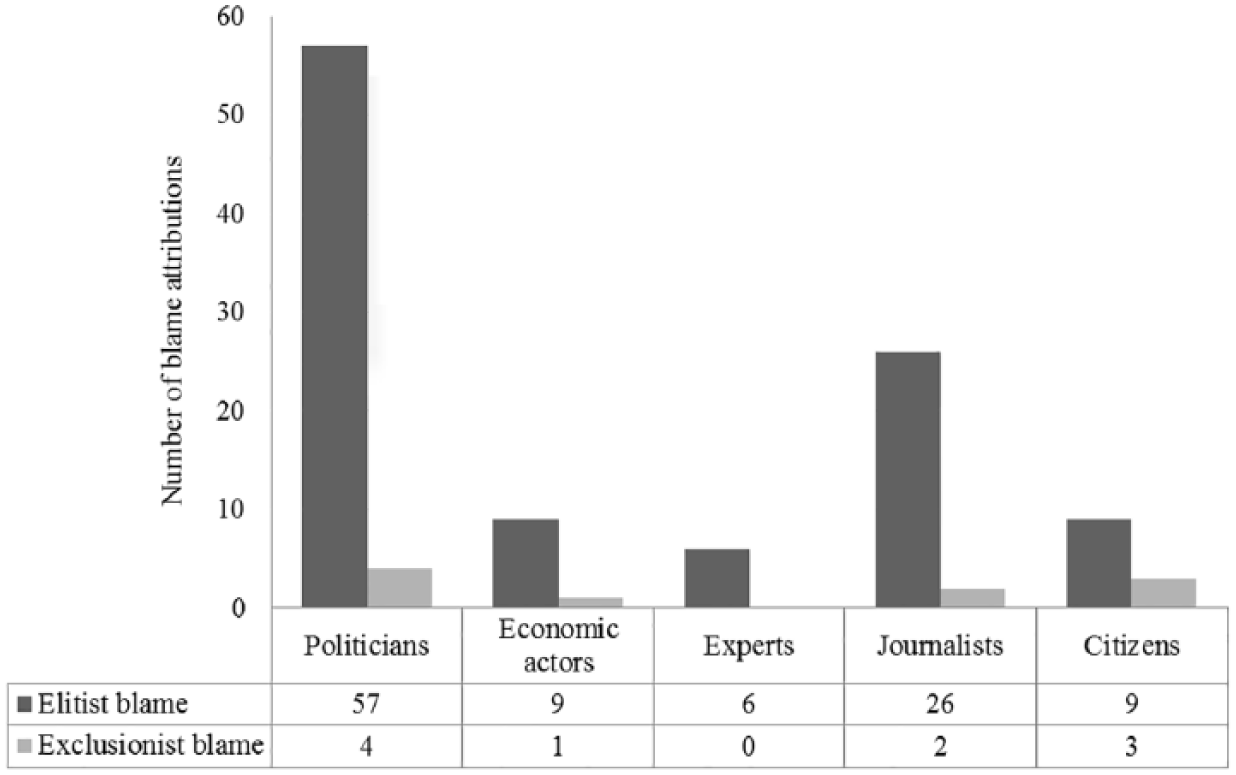
Number of blame attributions to elites and societal out-groups communicated by political and non-political speakers. N = 2672.
The embeddedness of interpretative journalism in news coverage
To investigate the embeddedness of populist blame attribution in journalistic styles, we first identified different classes that distinguished between the presence of interpretative opposed to more objective styles of journalism. To do so, we conducted a Latent Class Analysis. We additionally conducted a hierarchical cluster analysis as robustness check. 1
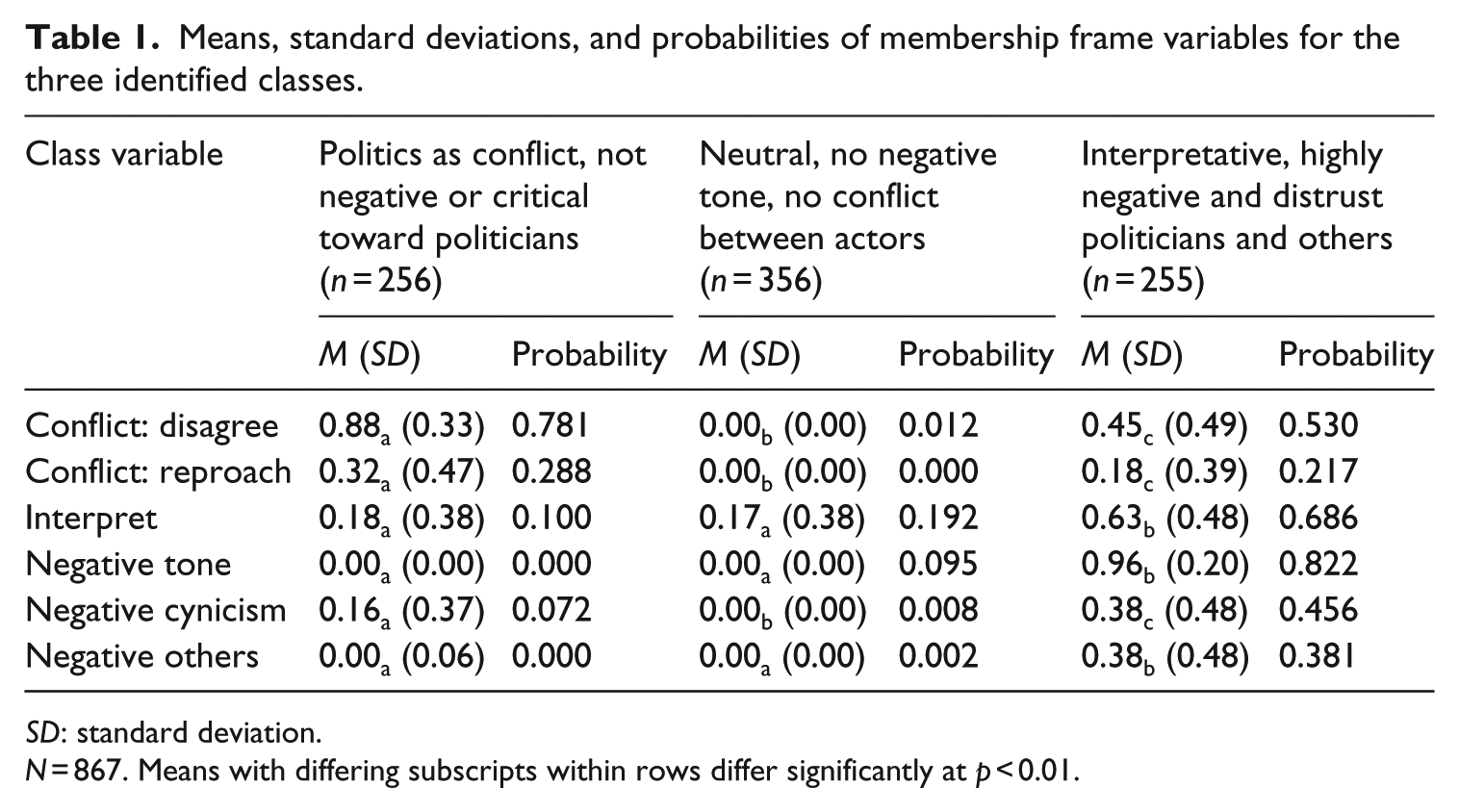
To validly distinguish between different neutral and interpretative journalistic styles, we estimated a range of alternative solutions. This range was informed by the exploratory cluster analysis. The fit indices for a three-class model are Akaike’s Information Criteria (AIC) = 4814.09, Bayesian Information Criteria (BIC) = 4909.39, χ2(43) = 137.74. The model fit decreased substantially and significantly for a two-class model: Δχ2(7) = 106.84, p < 0.001. We also compared the three-class model to a less parsimonious four-class model, which fitted the data even better (AIC = 4776.05, BIC = 4904.71, χ2(36) = 97.39). However, in terms of the interpretability of distinct clusters, the three-class model outperformed all alternative solutions. For this reason, the three-class model was regarded as the most optimal solution. For each indicator of the distinguished journalistic styles, probabilities of belonging to a certain class and mean scores are reported in Table 1.
Means, standard deviations, and probabilities of membership frame variables for the three identified classes.
SD: standard deviation.
N = 867. Means with differing subscripts within rows differ significantly at p < 0.01.
The outcomes of both clustering procedures indicate that the articles can clearly be clustered into three substantially different classes (see Table 1). The first class of articles (n = 256) can be labeled as ‘Dissemination of conflict’. This class emphasizes the strongest sense of conflict between actors. However, the journalist is not interpreting the issue himself or herself but is substantially more likely to passively disseminate other actors’ opinions. Journalists reporting on issues within this class are not likely to emphasize skepticism/cynicism toward political and non-political actors and are not negative in their tone of reporting. In the second and largest ‘Neutral dissemination’ class (n = 356), all style indicators are highly likely to be absent in the journalists’ passive dissemination of other political and non-political actors’ opinions.
The third class, ‘Interpretative journalism’ (n = 255) is the only class in which the journalist’s agency plays a central role. In this cluster, he or she is actively interpreting the issue in terms of causal and moral consequences. Doing so, the journalist draws on a highly negative tone of reporting, and emphasizes a sense of conflict while articulating distrust in political actors and societal out-groups.
To explore the discriminant and face validity of the three classes interpreted as journalistic styles, we conducted a multinomial regression analysis for which the three classes were explained by characteristics of the media outlet and the text (see Supplemental Material Appendix A). Most importantly, and in line with our expectations, the results indicate that journalists’ interpretative style emphasizing distrust in politics and society using a negative tone is more in sync with tabloid newspapers than broadsheet newspapers.
Populist blame attribution in interpretative journalism
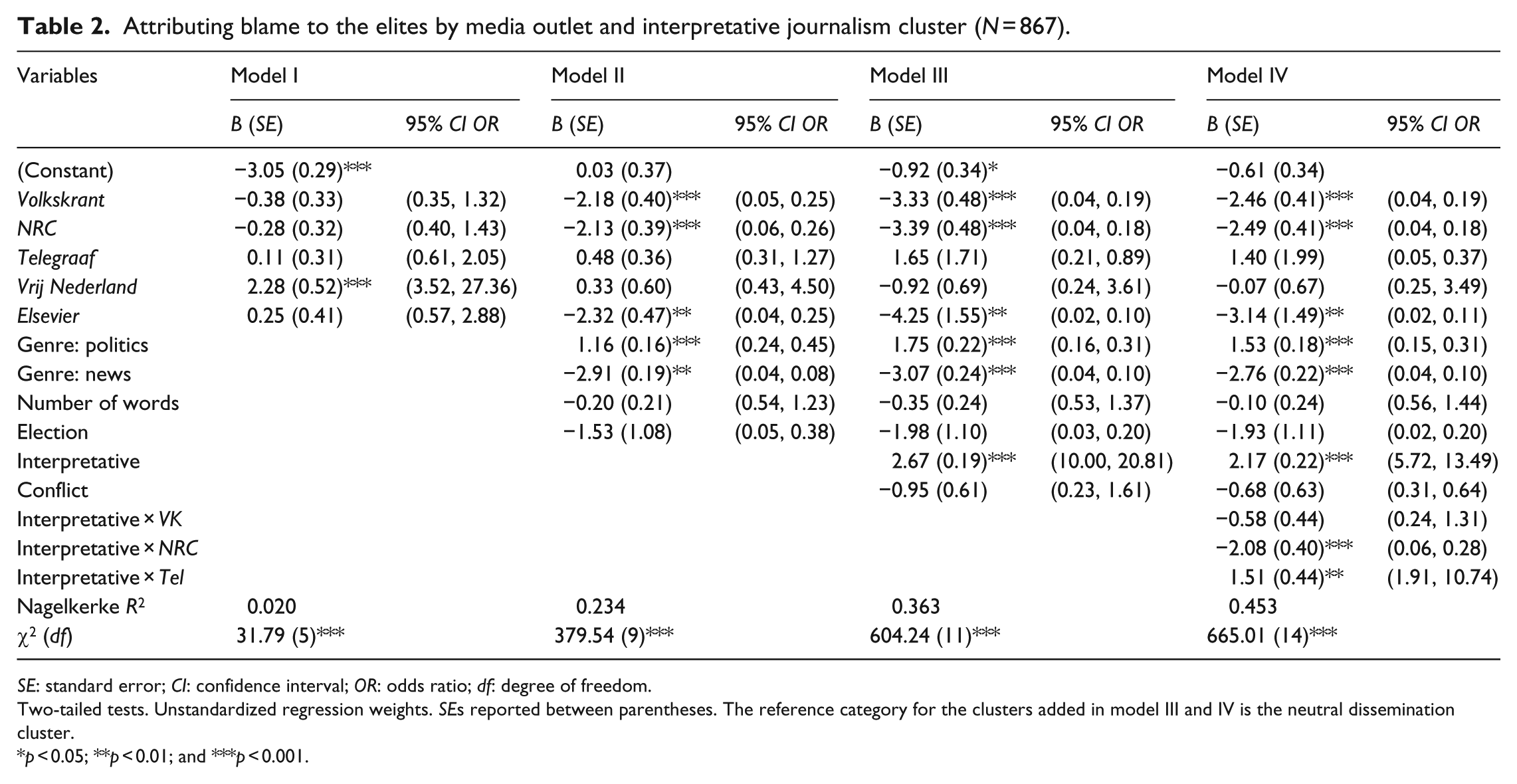
To investigate whether populist blame attribution is indeed most likely to be present in conjunction with an interpretative journalistic style (H1), we estimated a logistic regression model 2 to assess which of the three distinguished journalistic styles were most likely to relate to populist attributions of blame to the elites (see Table 2). We controlled for the media outlets and characteristics of the text. As can be seen in Table 2, when an interpretative journalistic style was used, the likelihood of populist attributions of blame was significantly higher than when the journalistic style concerned neutral dissemination (b = 2.67, standard error (SE) = 0.19, p < 0.001, odds ratio = 14.43, 95% confidence interval (CI) = (10.00, 20.81)). When the journalistic style of conflict dissemination was used, in contrast, the likelihood of the presence of blame attribution was not significantly different from the neutral dissemination cluster (b = −0.95, SE = 0.61, p = n.s., odds ratio = 0.49, 95% CI = (0.23, 1.61)).
Attributing blame to the elites by media outlet and interpretative journalism cluster (N = 867).
SE: standard error; CI: confidence interval; OR: odds ratio; df: degree of freedom.
Two-tailed tests. Unstandardized regression weights. SEs reported between parentheses. The reference category for the clusters added in model III and IV is the neutral dissemination cluster.
p < 0.05; **p < 0.01; and ***p < 0.001.
These results are supportive of H1. Media populism as blame attribution is indeed most likely articulated in conjunction with an interpretative journalistic style emphasizing distrust in political elites and other ‘enemies of the people’. Interpretative journalism thus indeed provides the most fertile soil for media populism to root.
Interpretative media populism in tabloid versus broadsheet outlets
In the next step, we conducted multivariate logistic regression analyses in which the interactions between media outlets and membership to the different classes were incorporated (Tables 2 and 3). First, we assessed the direct effects of media outlets. The opinioned outlet Vrij Nederland related significantly and positively to attributions of blame. In line with our expectations, we found that the broadsheet newspapers NRC and Volkskrant related negatively to the presence of populist blame attributions whereas the tabloid newspaper Telegraaf related positively to populist blame attributions. However, the direct effects of these media outlets were not significant, which does not provide support for H2a.
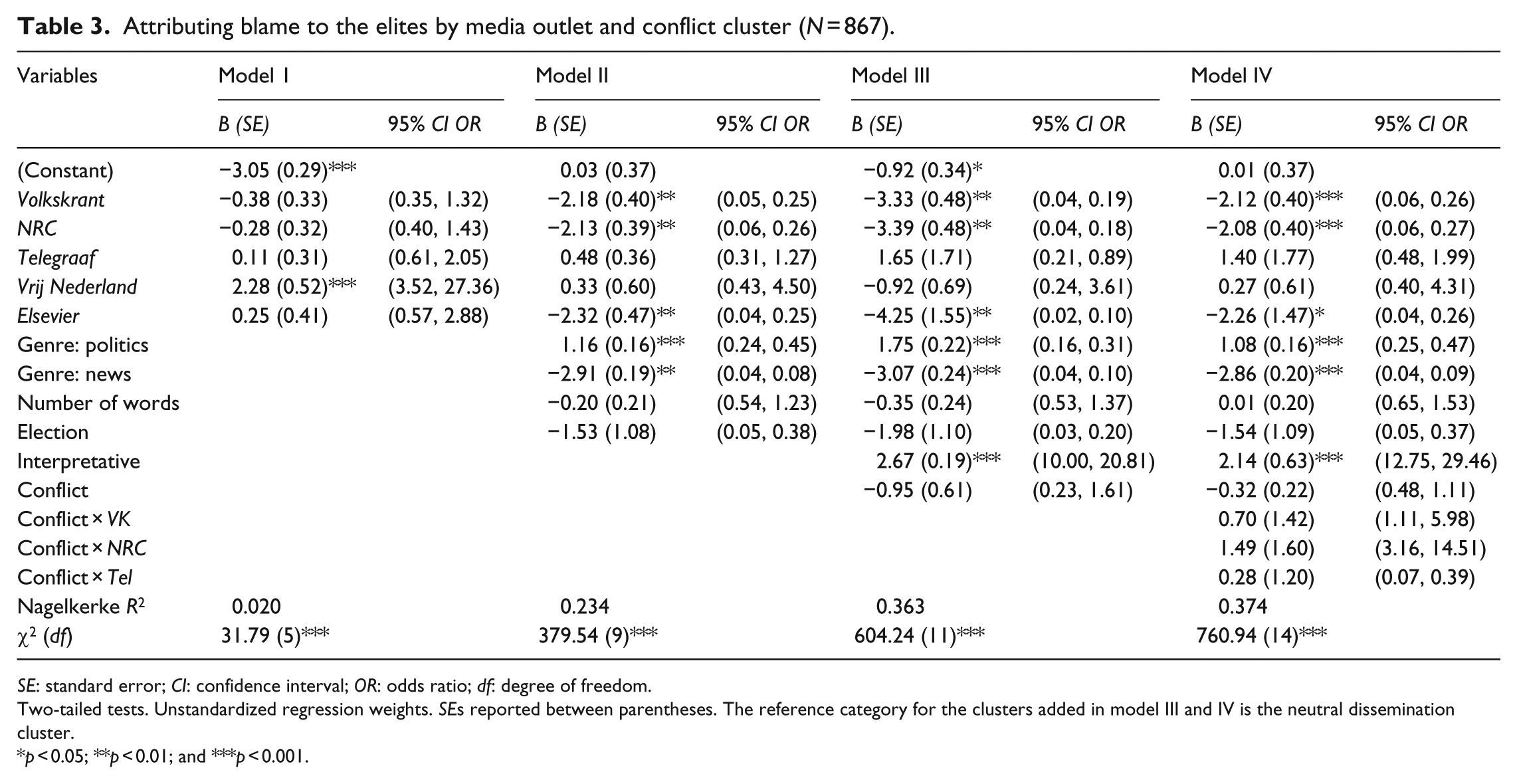
Attributing blame to the elites by media outlet and conflict cluster (N = 867).
SE: standard error; CI: confidence interval; OR: odds ratio; df: degree of freedom.
Two-tailed tests. Unstandardized regression weights. SEs reported between parentheses. The reference category for the clusters added in model III and IV is the neutral dissemination cluster.
p < 0.05; **p < 0.01; and ***p < 0.001.
A different pattern emerged once the interaction between journalistic styles and media outlets was taken into account (H2b). In support of H2b, the interaction effect between the tabloid newspaper de Telegraaf and interpretative journalism was positive and significant (b = 1.51, SE = 0.44, p < 0.001, odds ratio = 5.54, 95% CI = (1.91, 10.47)). This indicates that, for the tabloid newspaper de Telegraaf, populist attributions of blame to the elites were most likely to be present in conjunction with an interpretative journalistic style (see also Figure 2). The interaction effect between the broadsheet newspaper NRC and interpretative journalism was significant and negative (b = −2.08, SE = 0.40, p < 0.001, odds ratio = 0.13, 95% CI = (0.06, 0.28)). These results indicate that, compared to the reference newspaper Metro, journalists of tabloid newspapers were more likely to frame blame in conjunction with an interpretative style of coverage than journalists of broadsheet newspapers, which supports H2b. For all other newspapers, the effects were non-significant. It can be noted here that de Telegraaf and NRC are traditionally considered as outlets with a predominately right-wing leaning. The salience of interpretative blame attribution in de Telegraaf is thus more likely related to its tabloid rather than its ideological bias.
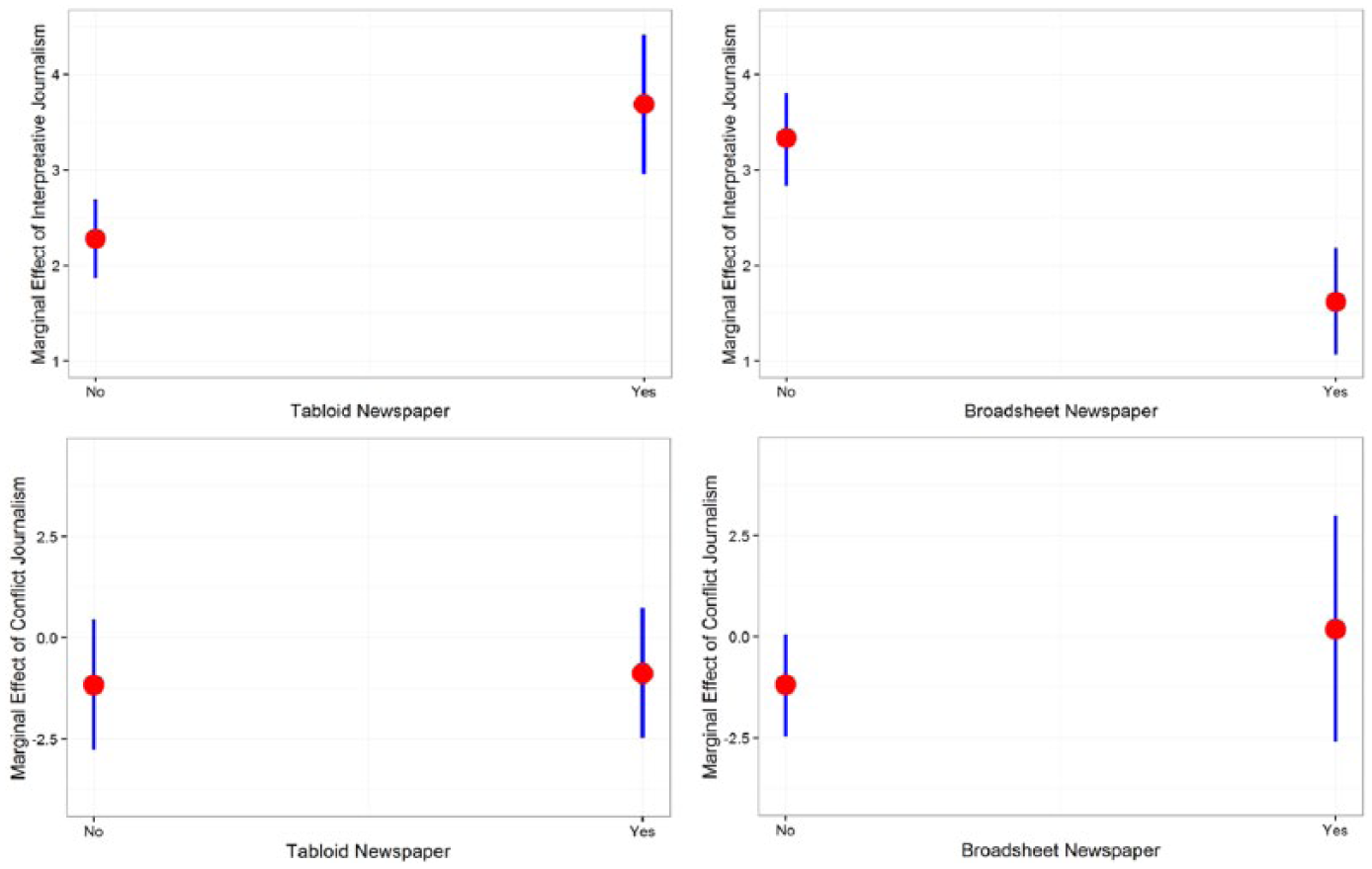
Marginal effects plots demonstrating the probability of blame attribution for different journalistic styles in tabloid and broadsheet newspapers. Dots represent regression weights and lines represent 95% confidence intervals. N = 867.
As can be seen in Table 3 and Figure 2, the populist bias is also more central for interpretative journalism than for objective, but conflict-driven styles of coverage. First, a non-significant, negative main effect of the journalistic style of conflict dissemination on the likelihood of populist attributions of blame to the elites was identified. Moreover, the interaction effect between the dissemination of conflict as journalistic style and broadsheet or tabloid media outlets were non-significant.
Taken together, these results indicate that attributions of blame are most likely to be emphasized by interpreting journalists of tabloid outlets, who use a negative tone to emphasize distrust in political institutions and societal out-groups. This supports H2b.
Framing blame in election times
In the next step, we investigated whether blame attributions were present most during election periods (H3a). As can be seen in Table 3, the presence of populist attributions of blame was not significantly more salient during election compared to non-election times (b = −1.53, SE = 1.08, p = n.s., odds ratio = 0.22, 95% CI = (0.05, 0.38)). This does not provide support for H3a. We also conducted a logistic regression analysis in which the interaction between interpretative journalism and the presence of an election period were estimated. Controlling for media outlets and text characteristics, we found no significant interaction effect between the election period and interpretative journalism on the presence of populist attributions of blame (b = −0.35, SE = 1.24, p = n.s., odds ratio = 0.57, 95% CI = (0.23, 1.43)).
As robustness check, we run an additional analysis in which we focused on a more direct comparison of the news coverage in the 2012 elections and the 2014 debate in the same newspapers. After controlling for the most salient issues in news coverage in both periods, our results again indicate that blame attribution is not emphasized significantly more salient by the interpretative journalist during election compared to non-election times. These results do not provide support for H3b.
Discussion
We aimed to provide unobtrusive empirical evidence to test the theoretical assumption that journalists of certain media outlets actively engage in populist coverage of political and societal issues (Krämer, 2014; Mazzoleni et al., 2003). In support of these assumptions, we found that the media, tabloid media in particular, do not merely act as a messenger that is passively conveying the viewpoints of populist actors to the public. Beyond being a messenger, journalists actively used their professional agency to reconstruct issues in terms of the causal and moral opposition between the people and culprit elites.
Responding to recent calls in the literature to further disentangle the relationship between the media and populism, our content analysis has provided empirical evidence for the existence of populist interpretations in journalistic media, which links up to the concept of media populism (Krämer, 2014). In line with this conceptualization, media outlets themselves engage in populist news coverage, independent of the viewpoints of populist political actors. In line with this, our results have provided insights into the understudied conceptualization of populist viewpoints articulated by the media (Bos and Brants, 2014).
These results also provide important insights for the broader literature on interpretative journalism (Djerf-Pierre and Weibull, 2008; Esser and Umbricht, 2014). More specifically, we identified a clear link between the interpretative reporting style of journalists and the articulation of populist attributions of blame to the establishment. Journalists who interpreted news beyond objective hard facts were most likely to frame issues in populist ‘black and white’ terms. We interpret this as evidence for the existence of a parallelism between interpretative journalism and media populism.
Delving deeper into this parallelism, our empirical evidence provided further support for the notion that populist interpretations are most salient in tabloid media (e.g. Mazzoleni, 2008). In line with theoretical assumptions about a link between populism and tabloidization, we found that populism was most likely to be used by journalists of tabloid media outlets whereas broadsheet media outlets were not likely to attribute blame to the elites themselves. In contrast, they merely disseminated populist viewpoints of political actors.
How do our results connect to the allegedly populist zeitgeist? As we did not find support for a pervasive populist bias in election versus non-election periods, one could argue that populism is present in media coverage at all times. However, we should not overestimate the dominance of media-initiated populism. As a small proportion of all coverage included populist attributions of blame, citizens who read the media outlets included in our sample are not that frequently exposed to populist frames. Hence, the limited prominence of populist blame attributions in the media does not provide much support for a pervasive mediatized populist zeitgeist.
In line with this, we only found evidence for the existence of populist blame framing to the elites. Societal out-groups were rarely attributed blame in media coverage. One explanation for the absence of such blame frames can be the influence of social desirability or ethical norms on journalist’s framing routines. Hence, it is more acceptable to attribute responsibility to the powerful elites who reside in their ivory tower than to blame powerless societal out-groups such as refugees for causing the problems of the native people. Moreover, in line with the definition of exclusionist populism, horizontal blame frames emphasize that out-groups among the people are evil (Jagers and Walgrave, 2007). This implies that journalists who blame societal out-groups construct segments of their own audience as the people’s enemy, which is in conflict with their desire to speak to a broad audience.
It can be argued that the salience of populist blame attribution may be affected by key events in the realm of politics and public opinion. The European migrant crisis, for example, erupted after the sampling frame of this study. As this issue is strongly related to populist interpretations of reality, one could argue that populist blame framing would be more salient in the period after the eruption of the migrant crisis than prior to this development, which may be especially the case for blame shifting to migrants. We leave it up to the future research to empirically investigate the influence of such key events.
Our study has some limitations. First and foremost, we only zoomed in on the populist phenomenon that we have defined as the core of populism: the causal and moral connection between the people as good in-group and others as evil and culprit out-groups. Extant literature points to a plethora of alternative indicators of populism, such as an emotionalized appeal (Fieschi and Heywood, 2006), the centrality of charismatic leadership (Taggart, 2000), and the use of a dramatized and personalized style of communication (Taggart, 2004). However, in line with Vossen (2012), we regard these indicators as more peripheral cues that facilitate rather than define populism’s essence. We regard our definition of populist blame attribution as the core of populism as it integrates the moral and causal ‘us’ versus ‘them’ divide. Including more characteristics of populism or employing a thinner definition may point to a more dominant presence of the concept, but with the risk of losing construct validity and overestimating the scope of mediatized populism.
Second, our sample is limited to a selection of offline media outlets. However, as most theoretical assumptions have been based on these media, the choice to focus our content analysis on such outlets offered the most valid test of the concept of media populism. Still, a growing body of literature is pointing toward a new development of mediatized populism on online media such as Facebook or Twitter (e.g. Bartlett et al., 2011). It has been argued that these media have an ever stronger connection to the ordinary people’s political discontent. Therefore, social media outlets may be much more prone to citizen-driven populist coverage. To more precisely investigate the presence of populism in offline traditional versus online and social media, the future research should incorporate the content of online and social media to compare this with media populism in traditional outlets. Next to this, it may be interesting to compare not only tabloid and broadsheet outlets but also media outlets with different ideological leanings.
Despite these limitations, our study has provided foundational empirical evidence for the presence of journalist-driven, interpretative media populism. Especially citizens with tabloidized media diets may be exposed to such ‘us’ versus ‘them’ coverage when learning about the news.
Footnotes
Funding
The author(s) disclosed receipt of the following financial support for the research, authorship, and/or publication of this article: This study was supported by the National Center of Competence in Research on ‘Challenges to Democracy in the 21st Century’ (NCCR Democracy), funded by the Swiss National Science Foundation.

Notes
Author biographies
References
Supplementary Material
Please find the following supplemental material available below.
For Open Access articles published under a Creative Commons License, all supplemental material carries the same license as the article it is associated with.
For non-Open Access articles published, all supplemental material carries a non-exclusive license, and permission requests for re-use of supplemental material or any part of supplemental material shall be sent directly to the copyright owner as specified in the copyright notice associated with the article.
