




Abstract
This article presents a content analysis of five very different examples of participatory journalism. The goal of this study is to examine the, largely untested, assumptions that news organizations and journalists have about audience input (audience material for instance being trivial, personal, emotional and sensational). We systematically ask how the contents of the five projects might be characterized in relation to conventional quality journalism as a particular genre by examining the contents against two criteria that have been critical to this genre: ‘objectivity’ and ‘diversity’. Second, given the core role that a notion of professional ‘control’ plays in discussions on participatory journalism, we examine whether these manifestations on objectivity and diversity are associated with the degree to which professional journalists have control over the participatory content published within these projects. By doing so, we aim to better understand what the participating audience produces in order to get an idea of what, according to participants, ‘counts’ as journalism and to determine whether and how this differs from conventional quality journalism. The results are explained in terms of ‘boundary work’.
Introduction
‘Participatory journalism’ has been anticipated as a form of journalism in which the audience no longer ‘merely’ receives news, but, enabled by digital technologies, is involved in its production and dissemination (Bowman and Willis, 2003). Viewed from a sociology of professions’ perspective, participatory news environments can be considered places of ‘boundary work’, where the boundaries of conventional journalism are challenged (Lewis, 2012; Robinson, 2010; Wahl-Jorgensen, 2015). The potential rise of the audience as producer of news challenges journalism to rethink its professional identity, conventional understandings of its function in society and key principles – such as objectivity and diversity – that are conventionally associated with professional journalistic quality. In short, participatory journalism forces professional journalists to reconsider the building blocks through which they have claimed their expertise, social authority and public legitimacy (Lewis, 2012: 841–842). News organizations and journalists have taken a hesitant attitude towards a participating audience, fearing a loss of journalistic quality (Singer, 2010). The assumption is that the audience would, for instance, have a preference for personal, trivial or sensational topics and take up a subjective, emotional style, all of which is considered incompatible with ‘journalism’ (Borger et al., 2013b; Costera Meijer, 2012; Singer, 2010).
Participatory journalism has been explored from various angles, but studies that examine participatory content have remained scarce. Existing content analyses concentrate on (hyper)local forms of participatory journalism, focusing on neighbourhoods or cities, and compare these to professional journalism (Carpenter, 2008a, 2008b, 2010; Fico et al., 2013; Karlsson and Holt, 2014; Paulussen and D’heer, 2013). These studies demonstrate that, generally, this type of participatory journalistic content is indeed less objective than professional journalism and does not show more diversity. However, participatory journalism is not a homogeneous phenomenon. Journalism practitioners have constructed different forms of participatory journalism, granting participants with varying roles and rights (Borger et al., 2013b), which leads to varied expectations and evaluations of taking part in journalism on the side of participants (Borger et al., 2015). Studies found notions of (editorial) control and professional autonomy to be key in this regard (Borger et al., 2013b; Lewis, 2012; Robinson, 2007; Williams et al., 2010). In general, journalists respond to audience participation by ‘reasserting control’ (Lewis, 2012: 850), finding it difficult to abandon their traditional role as ‘gatekeepers’ of the news (Singer, 2010). However, control by professional journalists over participatory content is not as strong in all participatory environments (Borger et al., 2013b). Typically, it is exercised less in local initiatives. Here, content autonomy, conventionally an important professional journalistic value (Singer, 2007), is transferred to participants. This raises the question of whether the results from existing content analyses are representative for participatory journalism beyond the (hyper)local, since studies that examine how more diverse types of participatory journalism (including both high and low content control/autonomy variations) impact on the characteristics of the content they produce are lacking.
The goal of this study is to examine the, largely untested, assumptions that news organizations and journalists have about audience input through an analysis of participatory content. First, we investigate the content of a wider variety of participatory journalistic projects, including and beyond the (hyper)local. Second, we systematically ask how these various forms might be characterized in relation to conventional quality journalism as a particular genre (Costera Meijer, 2001), examining them against two content criteria that have been critical to this genre: ‘objectivity’ and ‘diversity’. By doing so, we aim to better understand what the participating audience produces in order to grasp what, according to participants, ‘counts’ as journalism (Deuze, 2005) and in order to establish if and how this differs from conventional quality journalism.
Objectivity and diversity as cornerstones of professional ideology in Western journalism
There is a broad consensus that 20th-century journalism in Western countries has been characterized by a ‘professional model’ (see Schudson and Anderson, 2009) that centred on the idea of a trained professional gathering and disseminating objectively validated information to the public (McNair, 2009: 347). Over the course of the 20th century, this model became increasingly institutionalized through the forming of professional institutions and codes of practice (Schudson and Anderson, 2009), and the development of a professional ideology, consisting of a set of values to which journalists in all media types, genres and formats refer in the context of their daily work (Deuze, 2005: 445). Objectivity has long been considered a core tenet of this professional ideology. Although interpretations of objectivity vary across countries (Deuze, 2005), over time and journalistic subgenres (Wahl-Jorgensen, 2013), journalists in elective democracies worldwide consider themselves as committed to providing ‘objective’ information (Deuze, 2005). Objectivity as a core value translates into the idea that, as long as journalists follow depersonalized and rationalized procedures, ‘a true account of reality can be presented’ (Broersma, 2010: 27). Others have demonstrated how the objectivity standard is also a ‘strategic ritual’ (Tuchman, 1972), rooted in organizational demands to avoid libel suits and meet deadlines (p. 664).
In this article, we are interested in the collection of content characteristics that are the consequence of both professional ideology and organizational requirements. Professional journalists, following the objectivity norm, tend to (1) rely on quotations from external (official) sources as a procedure that removes journalists’ own subjectivity from the story, thereby supporting their claim to truth (Tuchman, 1972: 668) and (2) exclude personal views and values from their reporting, which results in journalism’s hallmark neutral style that avoids subjective language by the journalist (Broersma, 2010). In categorizing the ‘subjectivity’ of journalistic language, Carpenter (2008a) applied an intuitive approach by classifying articles as ‘mostly fact’ or ‘mostly opinion’ (p. 538). The linguistic approach of Vis (2011) offers a more quantifiable and exact measure. Vis measured change in the expression of subjectivity in four Dutch newspapers between 1950 and 2002. She understands as subjective ‘all expressions of beliefs, attitudes and opinions of a speaking or writing subject, and his attention to himself and to the addressee’ (p. 17). Thus, expressions are subjective when they represent a speaking subject’s evaluations (rather than facts) as well as the speaking subject’s explicit references to herself or himself (rather than implying herself or himself while referring to the world outside).
‘Objectivity’ as a core norm and distinctive content characteristic of professional journalism is associated with ‘diversity’ as another core tenet of quality journalism. Where the objectivity norm prescribes that journalists rely on external sources, a sense of ‘doing it for the public’ (Deuze, 2005: 453) requires that journalists do so in a manner that guarantees the representation of a diversity of points of view and perspectives, for ideally, the media reflect the ‘prevailing differences of culture, opinion and social conditions of the population as a whole’ (McQuail, 1992: 144). Media diversity is considered vital for processes of political deliberation and discussions among citizens, since the greater variety in offer (Van Hoof et al., 2014) of journalistic information, the better the needs of a diverse citizenry are served.
Diversity has been approached as a principle in government’s broadcast policy (Benson, 2005), emphasizing, for example, diversity of newsroom staff or diversity in media economy, or as a journalistic procedure ensuring a balanced and representative account (Broersma, 2010). As a content characteristic, diversity is typically measured not only in terms of source diversity but also in terms of diversity of topics or frames present in media content (Carpenter, 2008a, 2008b, 2010; Voakes et al., 1996), or in terms of news values (Paulussen and D’heer, 2013). Following Carpenter (2008a, 2008b, 2010) and Voakes et al. (1996), we approach diversity as a content characteristic, captured as variety in offer of topics covered of sources used. Following Paulussen and D’heer (2013), this conceptualization is complemented by variety in offer of news values that influence news selection.
Participatory journalism: Repairing a democratic deficit?
Professional understandings of objectivity and diversity have a paradoxical relation to journalistic quality: on the one hand, they are inextricably linked with an idea of what constitutes good journalism, but on the other hand, they have been criticized as obstacles to producing just that. Especially the ‘routinization’ (McQuail, 1992: 184) of the objectivity norm and its impact on the diversity ideal has attracted fierce criticism. Journalism’s professional quality logic dictates the following of fixed procedures to establish impartiality (Costera Meijer, 2012: 6), which results in a ‘ritual airing of different views’ (Maras, 2013: 87) and a preference for easily accessible, official (institutional) sources (Shoemaker and Reese, 1996). As a consequence, professional interpretations of objectivity have been observed to limit the diversity of news content, constrain understanding of issues presented in the news, thereby leaving the audience less involved (Costera Meijer, 2012; Rosen, 1999).
With the advent of participatory journalism, scholars and media observers have anticipated that a greater involvement of the public might lead to a break with professional understandings of objectivity and diversity. Participants might not be aware of professional ideals or simply have different concerns, and they would not be constrained by organizational demands and professional routines (Carpenter, 2008a; Wahl-Jorgensen, 2015). Participatory journalism could harbour a move towards a more personal and subjective style and an increase in the diversity of news content (Allan, 2013: 121), and, as such, has been ascribed the potential to re-engage the audience in politics and public life (Nip, 2006). Over the past decade, however, scholars’ initial enthusiasm about the potential of participatory journalism has shifted to disappointment, seeing that professional journalists adhere to professional control over content and the audience is less eager to participate than initially hoped for (Borger et al., 2013a).
Participatory content: Subjective and soft?
Studies investigating (hyper)local participatory content (Carpenter, 2008a, 2008b, 2010; Fico et al., 2013; Karlsson and Holt, 2014; Paulussen and D’heer, 2013) examined various aspects of objectivity and diversity. The mutual finding is that (hyper)local participatory journalism takes a different approach when measured against professional journalism.
Regarding objectivity, participatory journalism has been found to include more author opinion (Carpenter, 2008a), and use fewer sources to ‘objectively’ describe news events (Carpenter, 2008a; Fico et al., 2013; Karlsson and Holt, 2014), thus shifting towards a more subjective reporting style.
Regarding diversity in terms of topics covered, participants have been observed to cover ‘soft’ news topics such as entertainment, culture, sports and health, while leaving ‘hard’ news categories such as crimes, fires and accidents to professionals (Carpenter, 2010; Fico et al., 2013; Karlsson and Holt, 2014; Paulussen and D’heer, 2013). Regarding source use, scholars have demonstrated that participants use different sources than that used by professionals: participants show a greater reliance on personal experience (i.e. author as source) and first-hand witnessing (Paulussen and D’heer, 2013: 597) and on unofficial sources (Carpenter, 2008a, 2008b; Fico et al., 2013; Paulussen and D’heer, 2013). Participants thus give voice to different actors partaking in news events than professionals. Regarding the news values underlying news selection, participants have been observed to give primacy to ‘soft’ news values such as consonance, cultural relevance, reference to persons, self-promotion, good news and emotion, while professionals were guided by ‘hard’ news values such as unexpectedness, public relevance, negativity and recency (Paulussen and D’heer, 2013).
Summarizing then, studies of (hyper)local participatory content conclude that participatory journalism makes a contribution to the media landscape that is different from professional journalism, featuring relatively subjective and soft contents (Fico et al., 2013; Karlsson and Holt, 2014; Paulussen and D’heer, 2013).
Approach
Empirical studies reveal news organizations and journalists that experiment with audience participation as being caught in a tension between professional control and digital technologies’ logic of open participation (Lewis, 2012; see also Domingo et al., 2008; Singer, 2010; Williams et al., 2010). In a previous study (Borger et al., 2013b), we demonstrated that the dilemma between professional control and open participation is differently negotiated in various forms of participatory journalism, granting participants with different roles and rights. Our assumption is that the extent to which either professional journalists or participants have control over content impacts the type of participatory content that is published. In this article, we therefore investigate the content of five very different participatory journalistic initiatives, each of which occupies a different position on the scale of control over content by professional journalists to control over content by participants. We examine how these examples of participatory journalism manifest themselves on key variables traditionally associated with quality journalism, that is, objectivity and diversity. We conceptualized objectivity as (1) relying on external sources and (2) excluding personal views and values by avoiding the use of subjective language. We conceptualized diversity as the variety in offer of topics covered, sources used and news values underlying news selection. This results in the following research questions:
RQ1a. To what extent do content characteristics of various participatory journalistic initiatives reflect a more objective versus a more subjective reporting style?
RQ1b. Is the reporting style (objective vs subjective) associated with the degree of professional control over content?
RQ2a. How diverse are various participatory journalistic initiatives with regard to topics, sources and news values?
RQ2b. Is diversity of topics, sources and news values associated with the degree of professional control over content?
Research design
Selection of participatory initiatives
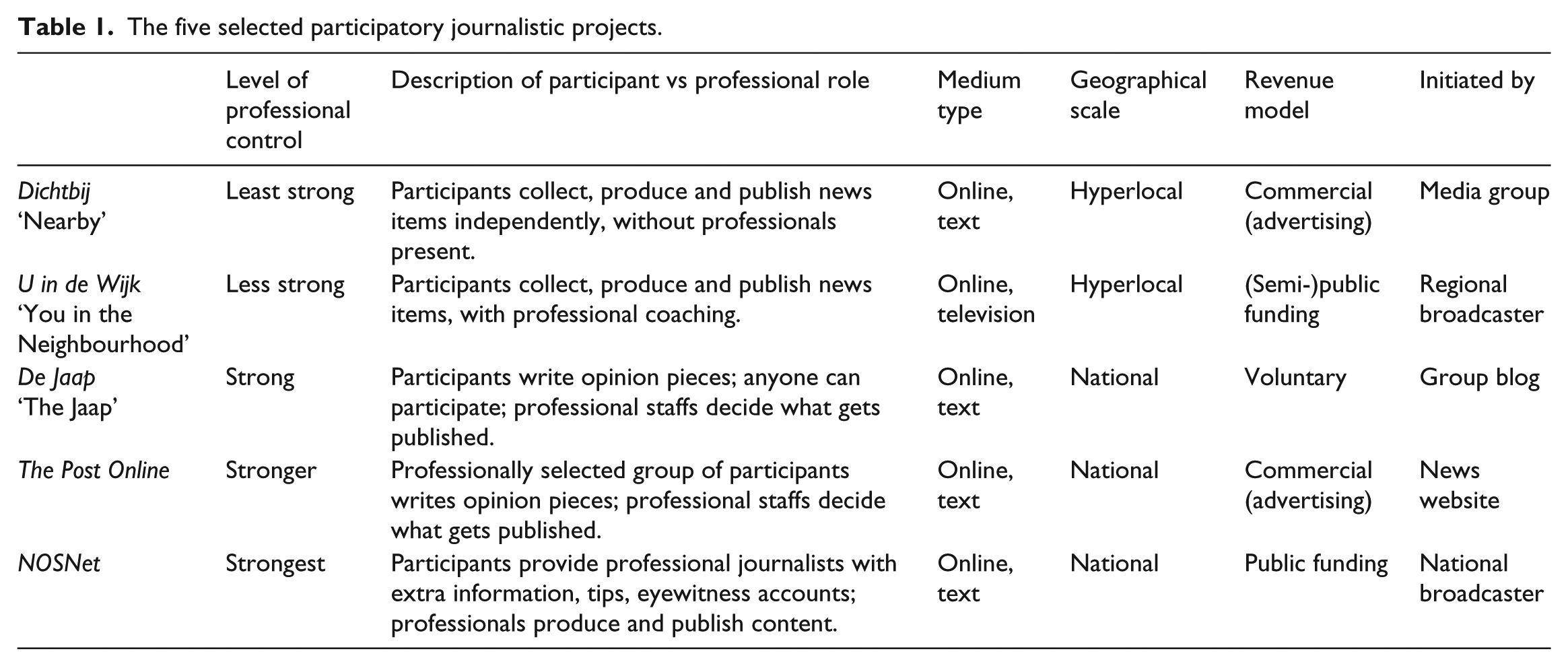
Our study employs quantitative analysis of 741 items from five participatory journalistic initiatives from the Netherlands. The projects were selected based on their great variety in the level of freedom granted to participants in the production and publication of content versus the level of control over the production and publication process exerted by professional journalists involved in the initiative. These characteristics were the results of a systematic analysis of interviews with professionals involved in a wide range of participatory projects in the Netherlands (see Borger et al., 2013b). The column ‘Description of participant role’ in Table 1 describes what aspects of production and publication of content were exercised by participants, and what aspects were appointed to the domain of professional journalists. Together, the selected five initiatives reflect a great variety – in terms of professional control, type of participant role, geographical scale, revenue model and type of organization that initiated the project – that can be found among participatory journalistic initiatives in the field. As such, the selected projects can be considered representative for participatory journalism in the Netherlands between 2010 and 2014.
The five selected participatory journalistic projects.
Selection of items
From each project, the most recent 150 items as of 12 November 2014 were selected in order to allow for a detailed description of the content. This number was set for practical reasons: One of the projects, NOSNet, did not contain more participatory items and we wanted the same number of items from every project. Given the purposes of our comparative content analysis, we concentrated on textual aspects of the items, entailing that, in the case of U in de Wijk, the first 2 minutes of video items were transcribed.
Operationalization of the variables
Objectivity
Objectivity was conceptualized as (1) relying on sources and (2) keeping personal views and values out by avoiding the use of subjective language. Conceptualizing objectivity as the absence of subjective language, we measured the deviation from objectivity by identifying the amount of subjective language used. Following Vis (2011), we first determined who expressed a piece of text: the (professional or participant) author or an external source. Direct quotations were labelled as ‘source text’; all other text was considered ‘author text’. Next, we used Vis’ model of subjectivity indicators (Appendix 1) to identify all subjective words in the ‘source text’ and ‘author text’. All texts were annotated automatically for part of speech and lemma information. 1 After all annotations were completed, a sample of 5 per cent of the corpus per participatory project was checked manually for words that occurred in double linguistic forms and meanings. The number of subjective words per project was subsequently weighed by the error rate, expressed as a percentage of wrongly annotated subjective words per project.
Regarding source use, we followed the example of Carpenter (2008a, 2008b, 2010), also followed by Paulussen and D’heer (2013). Carpenter (2008a) defines a source as a ‘provider of attributed textual information’ (p. 538). Note that this can also be a reference to the author himself. We identified all sources in the text by means of direct verbs of attribution (e.g. ‘said’, ‘reported’, ‘stated’ and ‘noted’) and indirect verbs of attribution (e.g. ‘hopes’, ‘feels’ and ‘believes’), and then counted all sources used per item per project. Reliance on sources was, thus, measured as the total number of sources used per project.
Diversity
We conceptualized diversity as the variety in offer of news topics, references to type of sources and type of news values per project.
Regarding the topics of the content that participants produce, we followed Paulussen and D’heer’s (2013) distinction between hard and soft news topics. For each item, the central topic that received most attention in the body of the text was coded. The coders 2 chose from a list of 27 societal domains. This categorization was based on Van Hoof’s (2000) listing of 27 societal domains that reflect how professional journalists select and present news items. In order to establish an interpretable overview, these 27 categories were, according to their internal coherence, divided into five supercategories: ‘hard public policy’, ‘politics’, ‘public event’, ‘soft public policy’ and ‘personal domain’. For a detailed account of these categories, see Appendix 2.
Diversity of hard/soft news topics was measured as entropy in number equivalents, 3 a measure for open diversity (Kleinnijenhuis, 2003). Open diversity means that the maximum level of diversity is reached when all categories are given equal attention and the minimum level when all attention is given to only one category. This open diversity measure is based on the proportion of the total amount of attention that each of the categories received across the projects. We transformed the proportion in such a way that diversity is 0 when all attention goes to only one category (meaning there is no diversity) and 1, when the attention is equally distributed over all categories (i.e. perfect diversity), from an open perspective (see Note 3), so that we can compare variables with a different number of categories on the same scale.
Regarding source type use, we further followed the example of Carpenter (2008a, 2008b, 2010) and Paulussen and D’heer (2013). Having already identified all sources per item for the purposes of determining the reliance on sources (see ‘objectivity’), we now determined the type of sources that were used. First, we distinguished between author source and external source (see above). Author source was operationalized as first-hand witnessing and personal experience, that is, explicit references to the ideas, opinions, experiences or observations of the author himself/herself. Furthermore, a distinction was made between official (i.e. sources speaking on behalf of an organization) and unofficial sources (sources speaking on their own behalf) and collective and individual identities. An ‘undecided’ category was created for sources that could not be categorized otherwise.
Diversity of source type was measured in the same way as diversity of topics, that is, as entropy in number equivalents, comprising five categories.
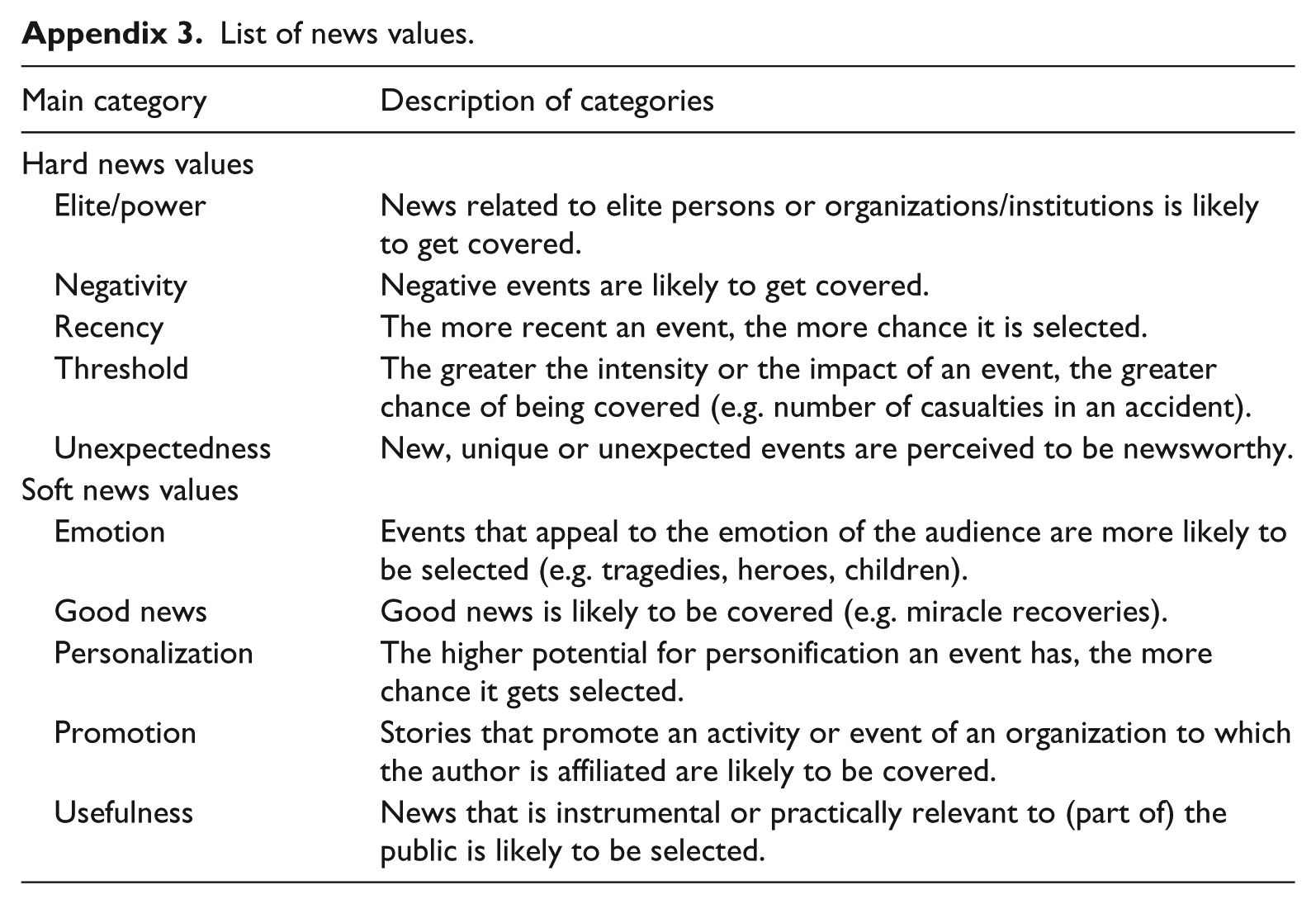
Concerning news values, we adapted the example of Paulussen and D’heer (2013), 4 resulting in the following list of 10: ‘threshold’, ‘unexpectedness’, ‘personalization’, ‘negativity’, ‘recency’, ‘elite/power’, ‘good news’, ‘emotion’, ‘usefulness’, ‘promotion’ (see Appendix 3 for definitions). The news values were recorded at the article level as being present (1) or absent (0). In order to establish an interpretable overview, these 10 criteria were clustered into two main categories, conform Paulussen and D’heer’s (2013) observation that in hyperlocal participatory journalism, news values follow the distinction between soft and hard news topics. News values were measured at the level of the news item.
Diversity of news values was, again, measured as entropy in number equivalents. We present diversity of news values both in the dichotomous hard–soft news value variable and in the 10 categories news values variable.
Coding procedures
A content analysis was conducted on the selected items. Subjective language use was measured by means of automated content analysis. All other variables were measured by means of manual coding, using AmCAT (Amsterdam Content Analysis Toolkit, cf. Van Atteveldt, 2008). To this end, a code book was developed by the main researcher and, for clarity of the instructions and uniformity of the categories used, tested by four trained coders (see Note 2). The main researcher coded 300 items; the other coders each coded just over 100 items.
Reliability
Five coders performed the coding. To establish intercoder reliability, the five coders all coded 5 per cent of the total sample. Krippendorff’s (2004) α amounts to .74 for central topic, .99 for number of sources per item, .77 for type of sources, which are acceptable to very good values. The Krippendorff’s α for the dichotomous news value variables ranged from .49 for personalization to 1 for threshold. Although Krippendorff’s α is very strict for dichotomous variables with a skewed distribution (Fretwurst, 2015), the low intercoder reliability for some of the news values implies that findings in this particular regard need to be interpreted with some caution. We decided not to exclude these news values from the analysis because the concepts are useful for exploration. The main coder checked and adjusted the codings of the other coders. So, the final data for news values that we used in the analysis were uniformly coded. We regarded this as the best possible solution to obtain the exploratory goal of this study.
Results
Reporting style
RQ1 asked (1) to what extent the content characteristics of various participatory journalistic initiatives reflect a more objective versus a more subjective reporting style and (2) whether the reporting style is associated with the degree of professional control over content. First, the number of external sources used is discussed; next, the use of subjective language is addressed.
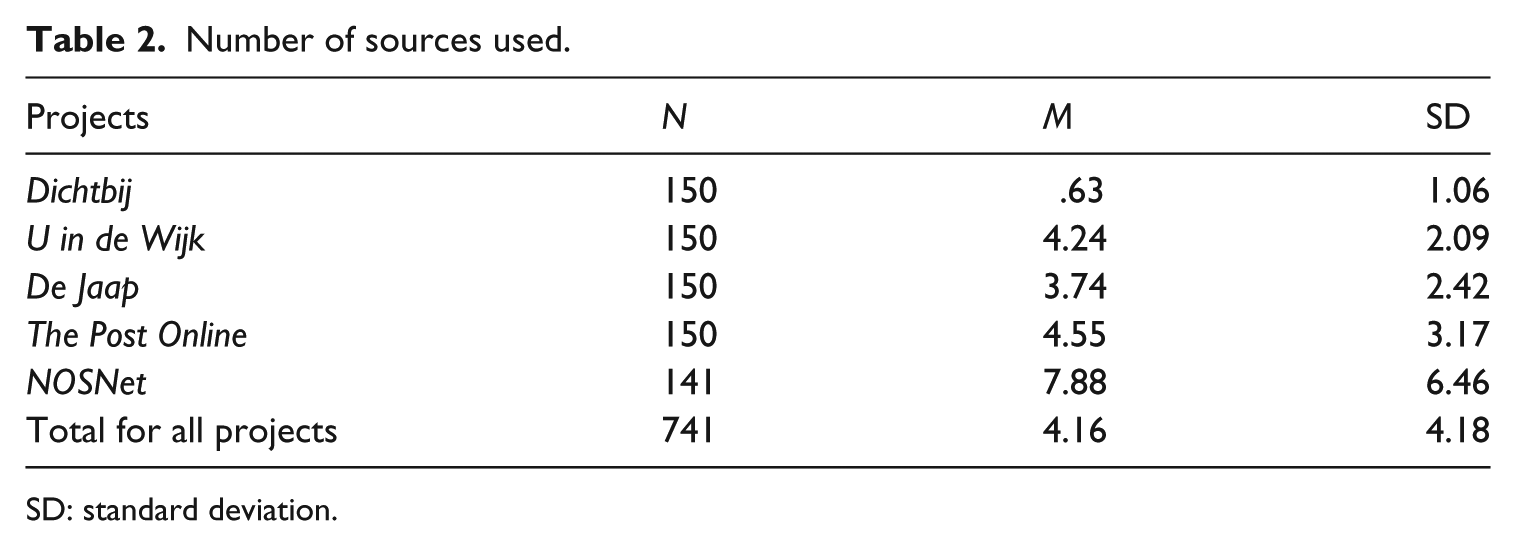
Table 2 shows the average number of external sources used per item for all projects. Project Dichtbij, where professional control is least strong, showed the lowest average number of external sources per item (0.63 per item); while NOSNet, where professional control is strongest, showed the highest (7.88 per item). The other projects, with stronger levels of professional control than Dichtbij, show higher number of sources per item but below the level of external source use on NOSNet. Analysis of Variance revealed that there was a significant linear trend, F(736, 4) = 78,783; p < .05.
Number of sources used.
SD: standard deviation.
Subjective language use is presented as the number of subjective words used per project as a percentage of the total number of words per project (Figure 1). The relative use of subjective language is a better measure to compare the five projects, since the length of the items varies per item and per project. Figure 1 shows three main results. First, as professional control increases, projects are less subjective. Second, as professional control increases, the author is less subjective. In this regard, there is a crossover point at The Post Online, where sources become more subjective than the author. Total subjectivity and author subjectivity are lowest on NOSNet, the project characterized by strongest professional control. Third, Dichtbij deviates from these general trends. Figure 1 shows that in this project, professional control is least strong, but total subjectivity is lowest and source subjectivity highest. This deviant pattern can be explained by the fact that source text is scarce in the items of this project.
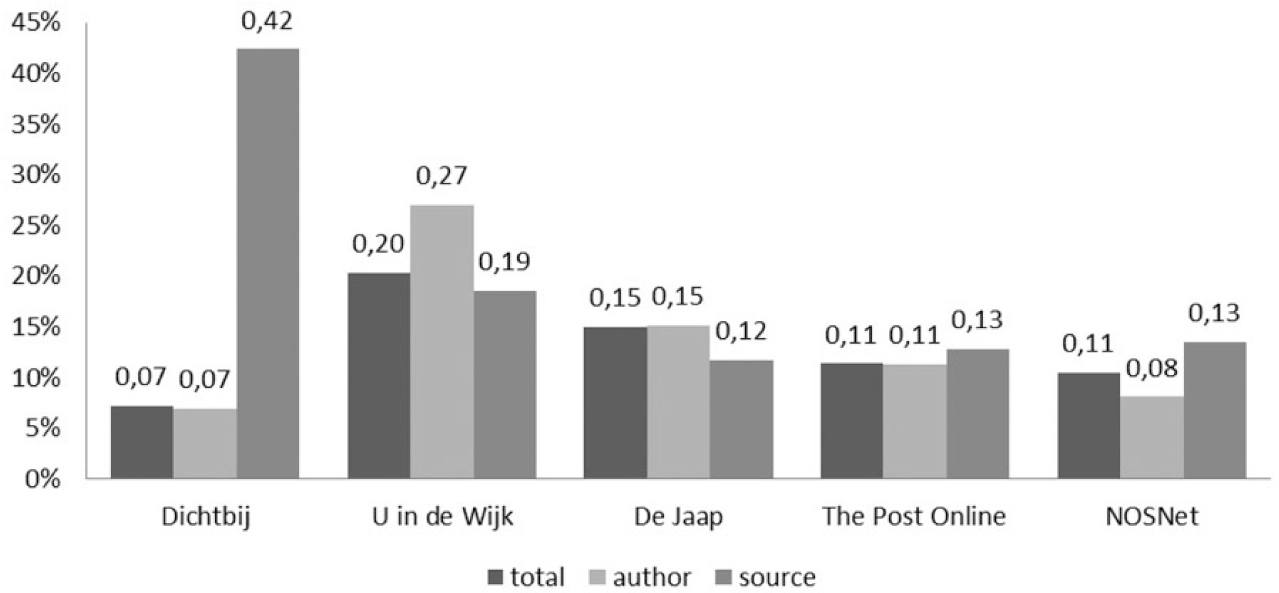
Relative use of subjective language per text type per platform.
In summary then, as professional control increases, the reporting style moves towards traditional interpretations of objectivity: there is a stronger reliance on external sources and – with the exception of Dichtbij – a decrease in subjective language use in general and in author subjectivity more specifically. Dichtbij can be typified as being farthest from traditional journalism in the sense that hardly any sources are used, which also explains the deviant pattern in terms of subjective language use.
Diversity
RQ2 asked (1) how diverse various participatory journalistic initiatives are with regard to topics, sources and news values and (2) whether diversity of topics, sources and news values are associated with the degree of professional control over content. We first address both questions in relation to the topics covered, and then move on to source use and news values.
Topics
Figure 2 shows the attention that the five topic categories receive in each of the projects. Taking all projects together, hard news (57.8%) is covered more often than soft news (42.2%). Most covered by far is the category ‘hard public policy’ (44.7%). ‘Public events’ are covered the least (2.3%). The difference between the projects is significant (χ2(16) = 228,161; p < .00), and the strength of the association is modest (Cramer’s V = .28; p < .00).
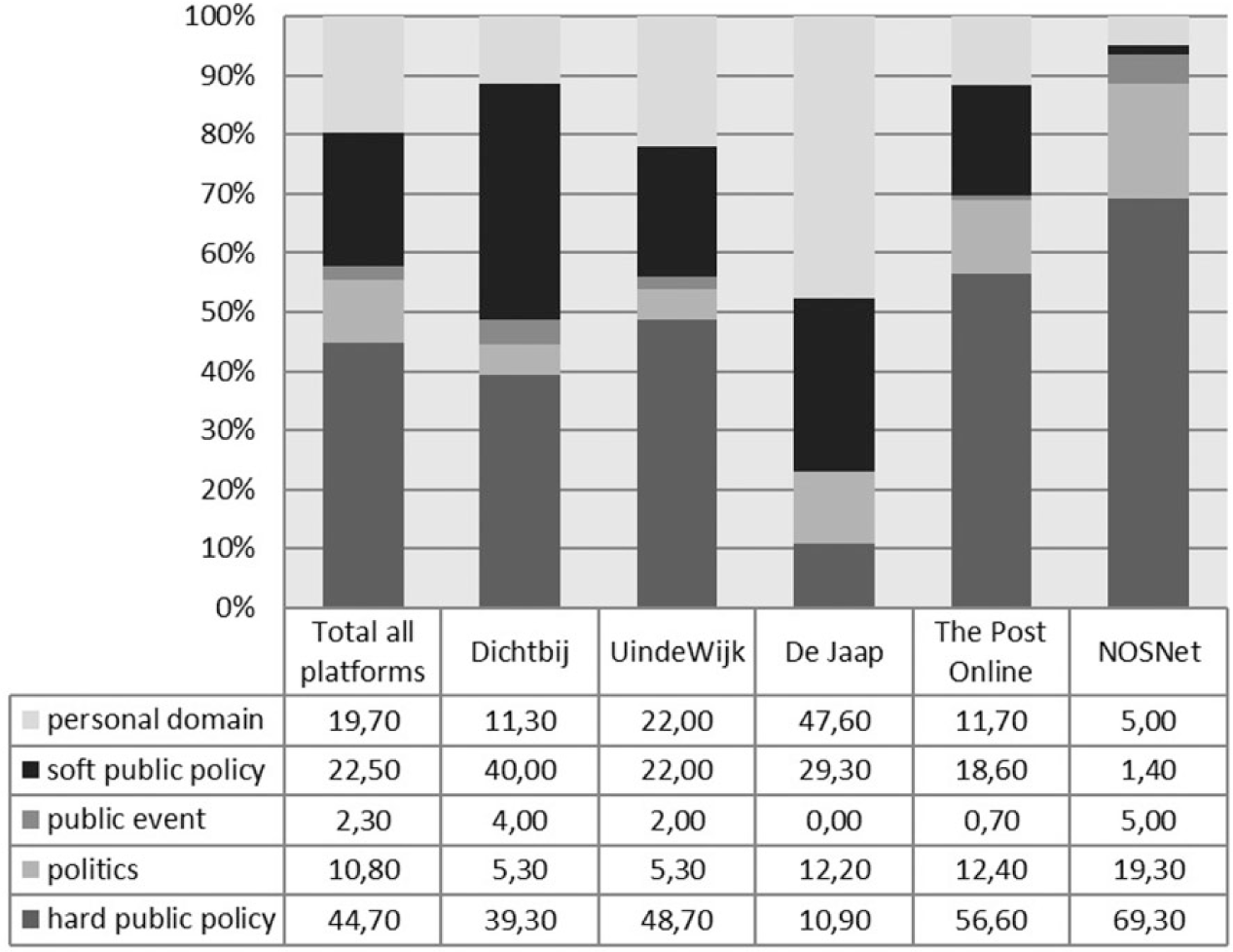
Relative attention for topics per platform.
As professional control increases, the share of hard news increases and soft news decreases: on Dichtbij, hard news accounts for 48.7 per cent of the items and soft news for 51.3 per cent; on U in de Wijk, the division is 56 per cent and 44 per cent; on The Post Online, hard and soft news measure 69.7 and 30.3 per cent, respectively. On NOSNet, hard news is overtly dominant (93.6%). Figure 3 shows the diversity in topics per project, both in terms of the five subcategories and in terms of the two main categories, hard and soft news. With regard to both measures, there is a general pattern of diversity decreasing as professional control over content increases. Diversity is higher when measured against two categories, but not perfectly linear, since De Jaap (.72) scores lower than The Post Online (.85). Diversity is highest in the project where professional control is weakest, that is, Dichtbij (.64 and 1). The smallest diversity is achieved in the project where professional control is strongest, that is, NOSNet (.38 and .27).
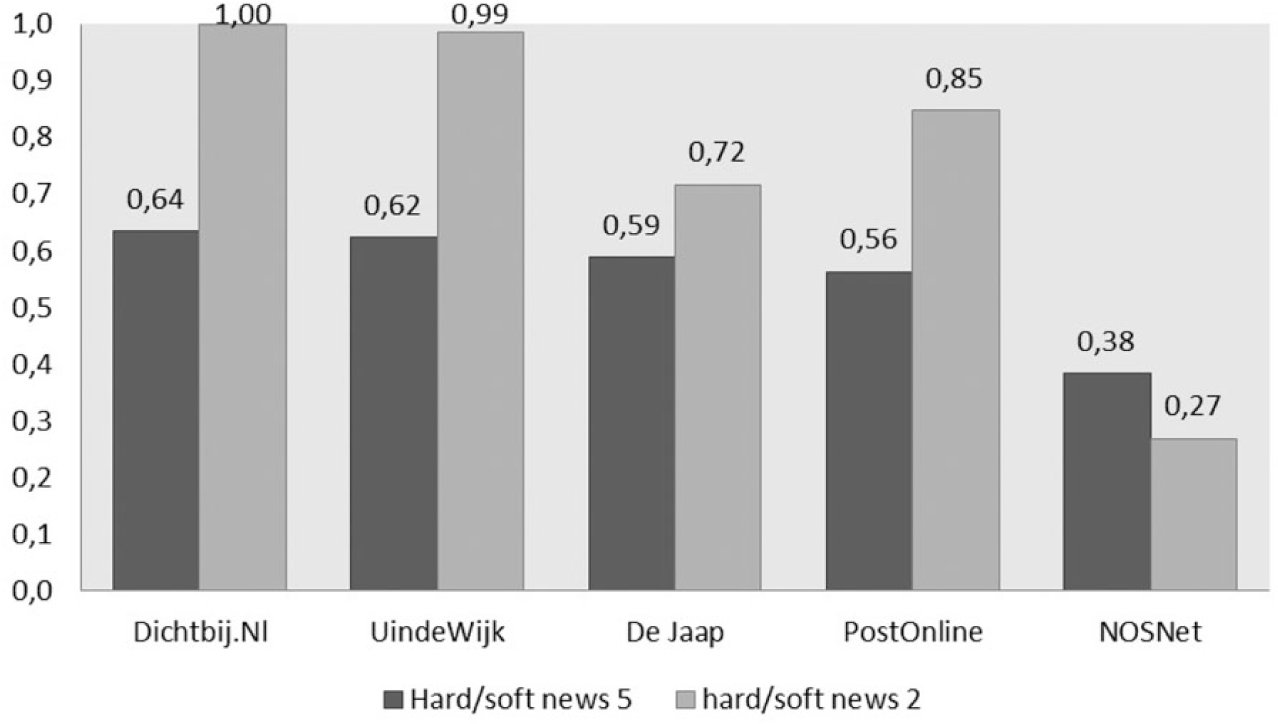
Topic diversity per platform.
In summary then, as professional control is stronger and participants have less autonomy to decide what to write, topic diversity decreases.
Source use
Figure 4 shows the relative attention that sources receive in each of the projects. Overall, there is a stronger reliance on external sources than on personal experience or first-hand witnessing by the author. The latter accounts for only 15.8 per cent of all source use; official sources (official collective identity plus official individual identities) account for 48.9 per cent of all source use, while unofficial sources take up 28.8 per cent. The differences between the projects are significant (χ2(16) = 574,723; p < .00) and the strength of the association is modest (Cramer’s V = .22; p < .00).
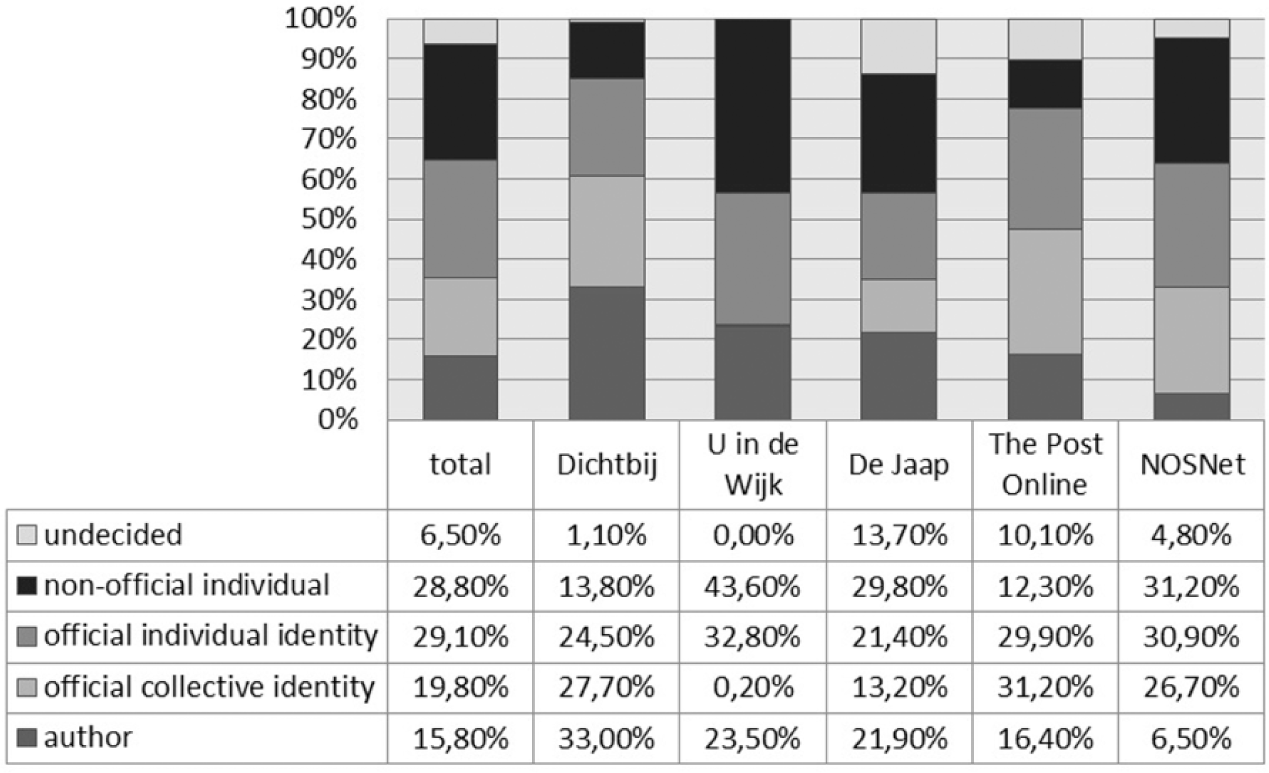
Relative attention for sources type per platform.
In all projects, there is a stronger reliance on external sources than on first-hand witnessing or personal experience by the author. However, the extent to which participants rely on personal experience or first-hand witnessing decreases as professional control over content increases: in Dichtbij, 33 per cent of all source use consists of personal experience or first-hand witnessing by the author, in U in de Wijk 23.5 per cent, in De Jaap it is 21.9 per cent, in The Post Online this is 16.4 per cent and in NOSNet 6.5 per cent.
The use of official and unofficial sources was not associated with professional control over content. The use of official sources takes up more than half of all source use on Dichtbij (52.2%), The Post Online (61.6%) and NOSNet (57.6%), and measures around a third of all source use in De Jaap (34.6%) and U in de Wijk (32.8%). Furthermore, source use in U in de Wijk, De Jaap and NOSNet is characterized by a considerable share of unofficial individuals (43.6%, 29.8% and 31.2%, respectively). U in de Wijk, which entails video items, differs from the other projects in that participants do not rely on official collective identities.
Figure 5 shows source diversity per project. The project where professional control is least strong, that is, Dichtbij, and the project where professional control is strongest, that is, NOSNet, have approximately the same measure of diversity (.75 and .77, respectively). In U in de Wijk, source diversity is lower (.49) than in Dichtbij and NOSNet. De Jaap and The Post Online both have greater source diversity (.94 and .88, respectively). Thus, these results do not suggest that source diversity is associated with professional control over content, but findings did demonstrate that participants are less likely to rely on personal experience or first-hand witnessing when professional control is stronger.
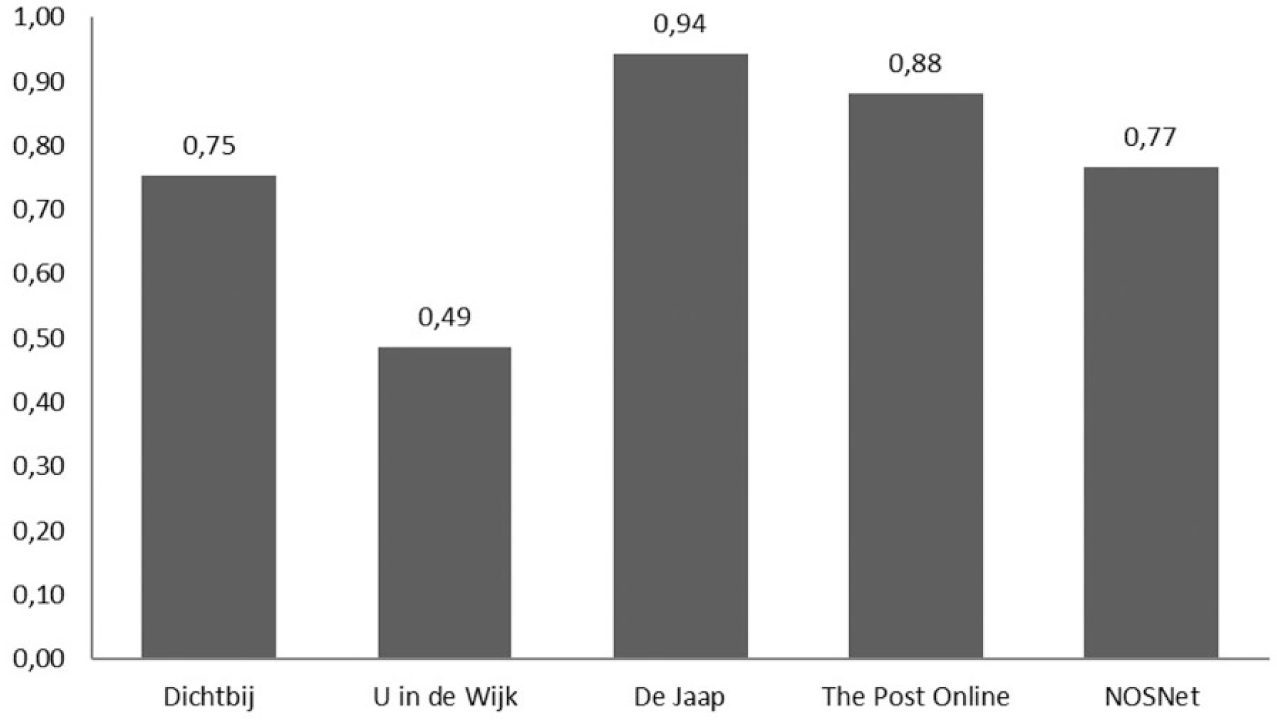
Source diversity per platform.
News values
Figure 6 shows the use of news values per project. Taking all projects together, the division between hard and soft news values is nearly 50–50. On the hard side, recency and negativity are used most often (22% and 16%, respectively); on the soft side, personalization and good news prevail (21% and 10%, respectively).
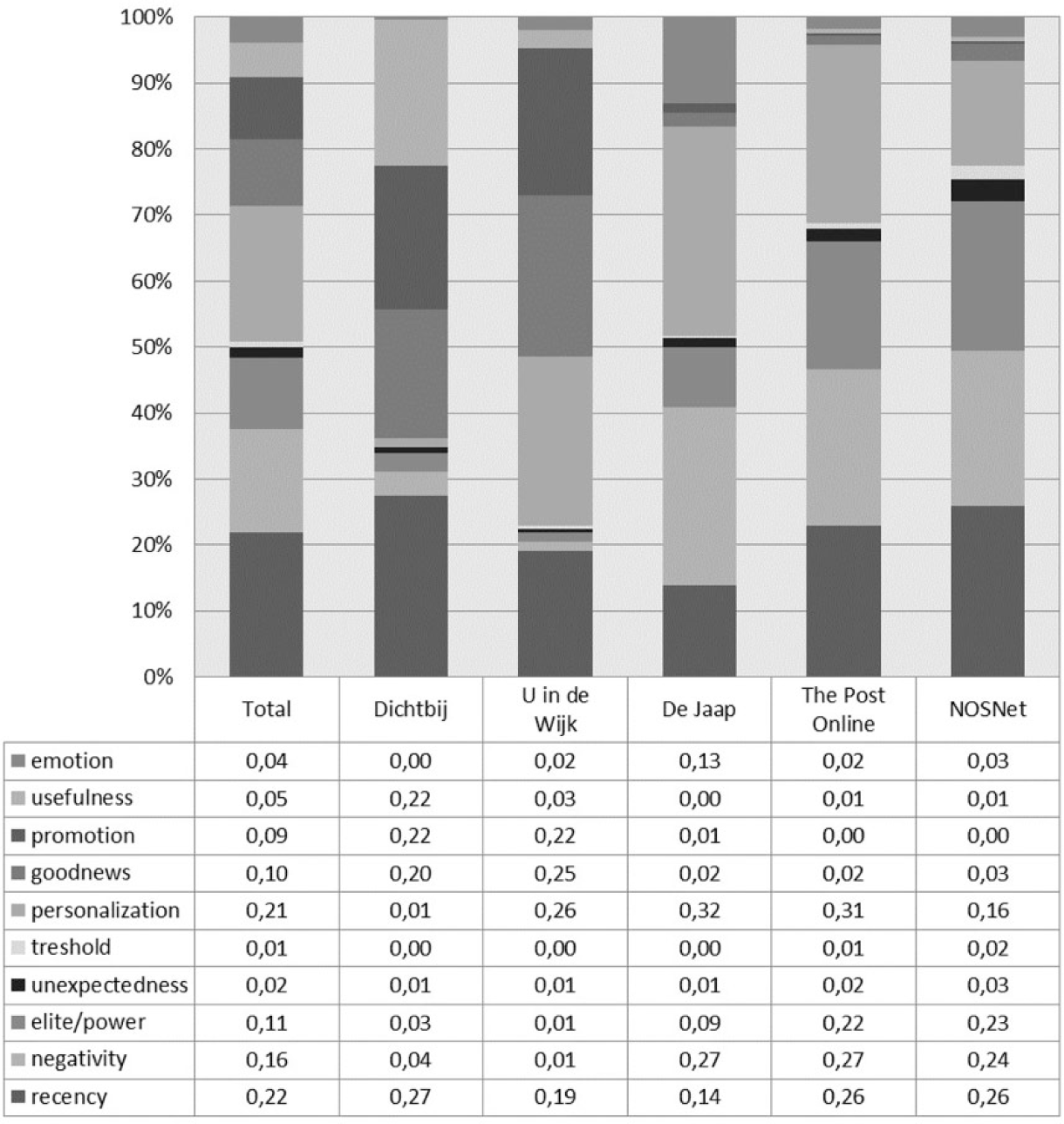
Relative use of news values per platform.
Significant differences between the projects exist for all news values. In general, the share of hard news values increases and that of soft news values decreases when professional control over content is stronger. U in de Wijk deviates from this general trend as it has a lower share of hard news values (22%) as compared to Dichtbij (35%). Regarding hard news values, the figures show that recency is important in all projects, regardless of professional control over content. Furthermore, as professional control increases, so does the occurrence of the values ‘elite/power’ and ‘negativity’. With regard to the use of soft news values, a few things stand out: in Dichtbij, the three news values that are used most often are ‘good news’ (20%), ‘promotion’ (22%) and ‘usefulness’ (22%). In contrast to other projects, ‘personalization’ is virtually absent in Dichtbij (1%). U in de Wijk is defined by a great share of ‘personalization’ (26%), ‘good news’ (25%) and ‘promotion’ (22%); of all projects, De Jaap has the greatest share of ‘emotion’ (13%).
Figure 7 shows the diversity in the use of news values, in terms of the 10 individual values as well as in terms of the two main categories of hard and soft news values. The differences between the projects are relatively small in terms of the 10 news values varying between .47 and .54. With regard to the dichotomous hard/soft categories, diversity varies between .71 and a perfect 1. Furthermore, these findings do not suggest that diversity in news values is associated with professional control over content.
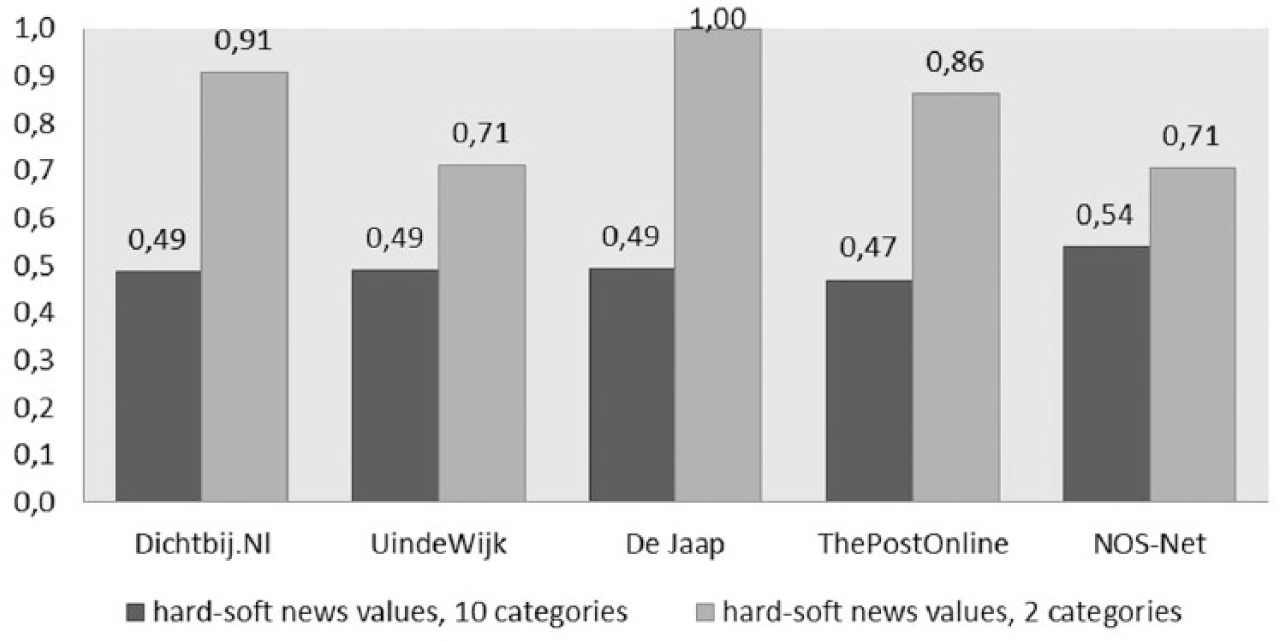
News values diversity per platform.
Discussion and conclusion
In this study, we investigated how the contents of five very different examples of participatory journalism manifest themselves regarding objectivity and diversity, two criteria traditionally associated with ‘quality journalism’ (Costera Meijer, 2001). We furthermore examined if these manifestations were linked to the degree to which professional journalists have control over the participatory content published in these projects.
To start with, our findings concur with those from previous studies on the content of (hyper)local participatory journalism (Carpenter, 2008a, 2008b, 2010; Paulussen and D’heer, 2013) in the sense that the tendency towards subjective reporting style, covering soft news topics, reliance on personal experience and first-hand witnessing, and towards the use of soft news values was particularly strong in the local projects that were investigated. At the same time, this means that existing content analyses of participatory journalism, scarce and with a homogeneous focus on (hyper)local forms, are not representative of participatory journalism in its entirety, as this study demonstrates that contents vary in terms of objectivity and diversity.
Most importantly, this study demonstrates that a notion of professional control is a meaningful concept when interpreting differences between participatory journalistic environments regarding these core elements of what has traditionally been considered as journalistic ‘quality’. It was found that reporting style is more subjective as professional control over content is weaker and that topic diversity increases. Source diversity and diversity in news values did not increase with a weakening of professional control, but participants did place different emphases regarding source use and news values when given room to manoeuvre; they were more likely to rely on personal experience or first-hand witnessing and to select news based on soft news values. The findings, thus, suggest that participants, at least partly, tend to move away from traditional journalistic understandings of objectivity and diversity.
Professional control, however, does not suffice to account for all the differences found between the projects, which suggests that other explanatory factors play a role as well. One such factor might be medium type. In contrast to written texts, video needs actual persons to tell a story. Thus, in U in de Wijk, in which only video items were produced, official collective identities (‘the government declared that’, ‘the labour union declared that’) were not used as a source and individuals (officials and non-officials together) made up 76.4 per cent of all source use. Another explanatory factor could be that participatory journalism comprises various journalistic subgenres: opinion journalism (De Jaap, The Post Online), commercially oriented hyperlocal journalism (Dichtbij), civically oriented community journalism (U in de Wijk). Subjective language, typical for opinion journalism, was frequent on both De Jaap and The Post Online; both projects explicitly invited participants to submit opinion pieces. On Dichtbij, most items were announcements by or promotions of local businesses, where authors explicitly included their positive evaluations of commercial activities or organizations. This explains why reliance on what we labelled as ‘personal views, experience or first-hand witnessing’ by the author was stronger here than in other projects (33%). U in de Wijk, funded by a regional broadcaster and a housing corporation with the purpose of increasing social cohesion in urban problem areas, featured a particularly large share of non-official individuals (43.6%). This type of source use corresponds with goals of ‘nurturing’ a (physical) community by giving voice to ‘ordinary’ people from neighbourhoods, typical for community journalism (Robinson, 2014).
Although this content analysis does not allow for claims about participants’ practices and their perceptions about participatory journalism, combining the results from this study with the findings from our previous study in which participants were interviewed about their expectations and evaluations of participating in journalism (Borger et al., 2015), we suggest that the tendency away from traditional understandings of objectivity and diversity reconfirms that participatory journalism is a space of ‘boundary work’ (Lewis, 2012; Wahl-Jorgensen, 2015) that encourages both rethinking and reinforcing boundaries of conventional quality journalism. Rethinking is implied in the tendency towards a more subjective reporting style, which suggests that participants might consider transparency more valuable than neutrality (Deuze, 2005); the tendency towards covering soft news topics, which suggests that participants see value in covering topics beyond those that are traditionally associated with quality journalism (economics, politics, foreign; Costera Meijer, 2001); the tendency towards soft news values – and the marginal presence of negativity in participants’ content especially – suggests that participants use different criteria for deciding what is ‘newsworthy’ (Costera Meijer, 2013). In our previous study (2014), we demonstrated that if participation takes place in hyperlocal contexts without any form of professional control, participants may use the opportunity to publish for communicative purposes connected to ‘marketing’ rather than ‘journalism’, labelling such activities as ‘not journalism’. This acknowledgement indicates an intuitively clear line between what counts as journalism and what goes beyond, and reconfirms existing boundaries between journalism and marketing, advertising or ‘PR’.
The projects studied in this article reflect the diversity among participatory initiatives in the Netherlands between 2010 and 2014. As such, we consider the findings to be representative of what has been developed under the header of participatory journalism in the Netherlands during this period. Future research should examine if similar patterns can be found in other countries, beyond the time span present in this study and outside the context of professional journalistic frameworks.
Footnotes
Appendix
List of news values.
| Main category | Description of categories |
|---|---|
| Hard news values | |
| Elite/power | News related to elite persons or organizations/institutions is likely to get covered. |
| Negativity | Negative events are likely to get covered. |
| Recency | The more recent an event, the more chance it is selected. |
| Threshold | The greater the intensity or the impact of an event, the greater chance of being covered (e.g. number of casualties in an accident). |
| Unexpectedness | New, unique or unexpected events are perceived to be newsworthy. |
| Soft news values | |
| Emotion | Events that appeal to the emotion of the audience are more likely to be selected (e.g. tragedies, heroes, children). |
| Good news | Good news is likely to be covered (e.g. miracle recoveries). |
| Personalization | The higher potential for personification an event has, the more chance it gets selected. |
| Promotion | Stories that promote an activity or event of an organization to which the author is affiliated are likely to be covered. |
| Usefulness | News that is instrumental or practically relevant to (part of) the public is likely to be selected. |
Funding
The author(s) received no financial support for the research, authorship, and/or publication of this article.