




Abstract
This article explores frame building in Scottish television coverage of the 2014 independence referendum. It uses content analysis of news and current affairs coverage and semi-structured interviews with broadcasters and their sources to explain how factors internal and external to the media may be specifically connected to the prominence of generic issue and game frames in the coverage. It argues that broadcasters’ perception of their role in this event and the powerful influence of political sources were factors that encouraged policy-focused coverage, while the journalistic routine of balance and media organizations’ perceptions of what would attract audiences favoured the strategic game frame.
The media play a vital role in defining what a referendum is about. The way they frame a decision-making situation affects how people judge the possible outcomes of the options available (Kahneman and Tversky, 1984) and how they interpret the issue on which they need to decide (Wettstein, 2012). Framing research (De Vreese and Semetko, 2002, 2004; Gerth and Siegert, 2012; Hanggli, 2012; Hanggli and Kriesi, 2010; Robinson, 1998; Wettstein, 2012) has so far contributed to our understanding of referenda by identifying the frames used in different contexts, comparing them to those promoted by political sources and/or exploring their influence on audiences.
The question of how frames originally emerge in the news has traditionally enjoyed less attention (Tandoc, 2015), and only more recently has framing research focused on the conditions in journalists’ work that influence their selection of specific frames in different settings. This article draws from and contributes to this area of research by exploring frame building in a recent referendum campaign in Scotland.
The article also makes a contribution to the study of two generic frames: the strategic game and the issue frames, both found in the coverage of politics in several contexts. After measuring these frames in the coverage of the final month of the referendum campaign on two television channels, the study uses qualitative data from interviews with broadcasters and their sources to discuss how these frames emerged in the coverage, based on the accounts of those who produced the media narratives.
The article identifies four factors promoting these frames in the television coverage of the 2014 Scottish independence referendum: broadcasters’ perception of their own role in the event and the influence of their political sources promoted the issue (or policy) frame, while the journalistic routine of balance and media organizations’ perceptions of what would attract audiences favoured the strategic game frame.
Discussion of these factors is contextualised within a broader taxonomy of influences on journalistic output (Shoemaker and Reese, 2014) and theories of frame building (Brüggemann, 2014). The study makes a contribution to our understanding of frame building by connecting specific news-making factors at different levels of Shoemaker and Reese’s model to the emergence of two common generic frames. Although these connections are based on qualitative evidence from a specific case study, its insights may help to understand other contested binary campaigns in liberal media systems.
Framing
Different frames emerge in public discourse ‘whenever there is more than one way to think about a subject’ (Popkin, 1993: 83). Frames are schemata organizing our understanding of the world and an essential component of how we tell stories about it – thus essential in how the media explain events in the news (Gitlin, 1980: 7). News frames propose ‘how politics should be thought about, thereby encouraging citizens to understand events and issues in particular ways. By defining what the essential issue is and suggesting how to think about it, frames imply what, if anything, should be done’ (Kinder, 2007: 156).
Frames may be ‘issue-specific’, namely applicable only to specific topics, or ‘generic’ and identifiable in the coverage of different topics and in different contexts (De Vreese, 2012). A generic frame, for instance, is the episodic frame (Iyengar, 1991), which constructs an issue in terms of particular cases or individuals affected by it, or the strategic game frame (Cappella and Jamieson, 1997), which represents political events as a competition or game of strategy between opponents.
Although critical approaches see news framing as an intentional selection process, others see journalists as ‘information processors who create “interpretative packages”’ (D’Angelo, 2002: 877) based on the input they receive from their sources and on social values and expectations, organizational pressures, professional routines, and their own ideological stances (Scheufele, 1999; Shoemaker and Reese, 2014). Frame building, or the development of media frames, is the first stage of framing (Scheufele, 1999). Frame-building research identifies frames in media coverage and investigates ‘the antecedent conditions that produce frames’ (D’Angelo, 2002: 873).
Influences on frame building
To identify these conditions, scholars have placed frame building within the study of journalism sociology and sought the influences in the work of journalists that lead them to adopt specific frames. I will subsequently discuss some influential work in this area and particularly Shoemaker and Reese’s (2014) theorization of factors influencing journalistic content more generally, Brüggemann’s (2014) suggestions regarding the application of this model to frame building specifically and recent empirical studies looking at frame building from this perspective. This discussion will help contextualize the approach this study takes.
With its broader focus on influences that impact news making, Shoemaker and Reese’s work (2014) has offered a useful integration and organization of a range of seminal journalism sociology studies – such as Gans’ (1979) or Tuchman’s (1972) work on newsroom routines. Their Hierarchical Influence Model (Shoemaker and Reese, 2014) distinguishes between factors influencing news content at the individual level (relating to individual journalists’ beliefs and values), the routines level (relating to standardized professional practices), the organizational level (the impact of media companies, their structures and ownership), the social institution level (the relationships between the media and other powerful institutions) and the social systems level (ideological influences from the social system as a whole).
This classification provides a broad analytic framework to help discuss how different types of influence interact. It recognizes that all levels impact journalistic output to different degrees and allows researchers to explain how they combine within the specific processes that they study. Despite suggestions that it does not account for the diminished role of professional routines in multiplatform and online media (Keith, 2011) and the authors’ admission that it is not meant to ‘capture all of the complex interrelationships involved in the media’ (Reese, 2007: 31), it remains a useful tool to organize our thinking around this subject.
Applying this model specifically to frame building, Brüggemann (2014) theorizes factors at the individual, organizational and social systems level, which may make journalists reflect the frames proposed by sources or construct their own frames. He proposes a continuum between frame sending (reproducing source frames with minimal intervention) and frame setting (producing original interpretations of an issue or an event) where coverage may be positioned, depending on the interaction between different levels of factors. He suggests that empirical studies should explore these factors through a combination of content analysis and qualitative methods.
Empirical studies taking such an approach have revealed that the frames adopted by journalists are influenced, at the individual level, by journalists’ goals and perceptions of their professional roles (Bartholomé et al., 2015; Castelló and Montagut, 2011; Kothari, 2010; Tandoc, 2015); at the routines level, by established news values and/or practicalities of newsgathering (Bartholomé et al., 2015; Boesman et al., 2017; Johnson and Fahmy, 2010; Tandoc, 2015); at the organizational level, by editorial policies and the degree of freedom journalists have to define their topics (Kothari, 2010), the production context (Castelló and Montagut, 2011), and the views of owners, peers and chief editors (Tandoc, 2015); at the social institution (or extra-media) level, by the frames promoted by their sources (Boesman et al., 2017; Hanggli, 2012; Hanggli and Kriesi, 2010; Kothari, 2010; Tandoc, 2015); and at the social systems level, by frames which are culturally familiar because they have been previously used in public debate on other topics (Boesman et al., 2017). Others found further connections between different levels, arguing that external forces put pressures on the organizational level, which in turn are passed on to newsrooms (Colistra, 2012).
This body of work has provided significant insights into how frame building works in different national contexts (Bartholomé et al., 2015; Castelló and Montagut, 2011; Colistra, 2012; Tandoc, 2015), as well as into how issue-specific frames emerged in the coverage of specific stories (Boesman et al., 2017; Hanggli, 2012; Kothari, 2010). This article contributes to this growing body of knowledge by focusing on two generic frames (De Vreese, 2012): it explores which factors may contribute to the prominence of the strategic game and the issue frame in the coverage of the final stages of a referendum campaign. As will be discussed below, these two frames are commonly found in a range of political events. The focus of this study on factors that may be connected to their prominence is therefore significant in an effort to better understand how they emerge in the day-to-day production of news.
Referendum campaigns: Games of strategy or policy debates?
The strategic game frame constructs politics as a competition or game of strategy between opponents. It focuses on who is winning and who is losing; it analyses candidates’ performance, style and perception; and it involves war and game metaphors and references to opinion polls to measure how opponents are doing in the competition (Cappella and Jamieson, 1997). The issue frame, by contrast, focuses on policy problems, politicians’ proposals for their solution and their implications for the public (Lawrence, 2000). Both are generic frames found in the coverage of a range of topics, and particularly in that of elections and referenda. They are seen as competing ways of understanding politics, with the issue frame associated with substantive deliberation (Lawrence, 2000) and the game frame seen as contributing to disengaged and cynical citizens (Cappella and Jamieson, 1997). Thus, from a normative perspective, the issue frame is seen as better for promoting informed citizenry and democratic debate as it focuses on the ‘substance’ of politics (Lawrence, 2000).
Among accounts that have sought patterns in the appearance of the game frame in news content, Iyengar et al. (2004) suggest that audiences prefer game framed to issue-focused coverage. Perhaps for this reason the game frame tends to be used more in commercial than in public service media organizations (Dimitrova and Strömbäck, 2011), although both types of media resort to it when a political competition is tight (Dunaway and Lawrence, 2015). It is more likely to be used around the period when an actual decision has to be made and conflict between elites culminates, rather than at the early stages of a debate when the issue frame is more prominent (Lawrence, 2000). Aalberg et al. (2012) additionally propose that the game frame reflects modern campaigning which has become increasingly strategic; it is connected to the wide availability of opinion polling; it satisfies newsworthiness criteria with its focus on drama, conflict and elite actors; and it provides a way for journalists to protect their autonomy against political spin.
The above discussion logically implies that the game frame is a ‘journalistic’ frame, created by the media rather than by their sources. The frames journalists introduce in the news are usually not advocacy frames but are rather ‘more apparent in playing-up, neglecting or juxtaposing advocacy frames’ (De Vreese, 2012: 367). They focus less on substance and more on process (De Vreese, 2012: 368). By contrast, issue or ‘substantive’ frames are seen as introduced in public discourse by sources, especially in the context of referenda (Hanggli and Kriesi, 2010: 154).
Both frames can, thus, be expected to emerge in the news coverage of referendum campaigns. De Vreese and Semetko’s (2002, 2004) study of the 2000 Danish referendum on the adoption of the Euro found both strategy and issue frames in the media coverage, as did Robinson’s (1998) study of the 1995 Quebec independence referendum. Particularly nearer the time of the vote, when a decision has to be made, the game frame can be expected to dominate over the issue frame (Lawrence, 2000), especially if the two options are close in polls (Dunaway and Lawrence, 2015).
This article examines this critical period in a referendum campaign, by focusing on the final month of the 2014 Scottish referendum coverage on two television channels. It explores how prominent game and issue frames were in television coverage as well as which factors at different levels of Shoemaker and Reese’s (2014) model promoted them, according to broadcasters’ and their sources’ accounts of their experiences of news making during that period. It thus addresses the following questions:
RQ 1. How prominent were the issue and game frames in the television coverage of the final month of the campaign?
RQ 2. Which internal and external frame-building factors were connected to the prominence of issue and game frames in the coverage?
Before discussing the methods of the study, I will provide a brief background on the referendum itself. This is not intended as a comprehensive analysis of the political processes at work before or during the event, but as a brief contextualization to help better understand the subsequent analysis.
The 2014 Scottish independence referendum
The UK state consists of four nations: England, Wales, Scotland and Northern Ireland. Although the constitutional relationship between Scotland and the British union had been the subject of two devolution referenda (the second of which led to the establishment of the devolved Scottish Parliament in 1999), the 2014 referendum was the first time Scots were asked whether Scotland should remain in the United Kingdom or become an independent country. It was the culmination of several decades of gradual distancing of Scotland from the union, which has been connected to economic decline after the loss of the British empire and the manufacturing industry, unequal development between the different parts of the United Kingdom, a decline of traditional concepts of British identity, a gap between the nations’ political agendas from the 1980s onwards (see Devine, 1999, for an account of these historical processes) and a perceived sense that Scotland was treated unequally in policy terms within the United Kingdom (Paterson, 2015).
Scotland had been semi-autonomous since 1999, with the Scottish parliament deciding on most matters affecting life in the nation, except foreign policy, defence, taxation, macro-economics, social security, abortion and broadcasting, which were reserved to the UK government (Schlesinger, 1998). Independence would see Scotland take control of all these areas and become an autonomous state. Debate on the referendum started after the Scottish National Party’s (SNP) victory in the 2011 Scottish parliament elections, as the party had promised a referendum on independence in its electoral manifesto. Subsequent negotiations with the UK government resulted in agreement for it to take place, followed by deliberations on the date and the question on the ballot paper. Eventually, it was decided that there would be one question (‘Should Scotland be an independent country?’) with two options (yes/no). The possibility of having a third option on the ballot, that of increased devolution with Scotland remaining in the union and getting more control over the areas reserved to Westminster, was ruled out during these negotiations, thus predisposing discursive frames towards a binary, polarized debate.
The two campaigns Yes Scotland (supporting independence) and Better Together were formed in summer 2012 and comprised the SNP, the Scottish Green Party and the Scottish Socialist Party (for Yes), and the Scottish Labour, Conservative and Liberal Democrat parties (for No). The Yes side nurtured a substantial grassroots movement, perceived to have galvanized the campaign (Paterson, 2015) and pushed both campaigns to engage more directly with voters. Much of this engagement took place online, on social media and grassroots websites that emerged during the campaign. Voices that may not previously have had access to the ‘old’ media challenged the monopoly of the latter through digital platforms. However, traditional media, including television, maintained a key role in setting the parameters of the debate (Law, 2015). In 2014, 92 per cent of UK adults still watched television almost every day (Ofcom, 2015) and reported it was the medium they used most for news (Reuters Institute for the Study of Journalism, 2015).
At the start, support for independence was low (around 30% in 2012). The annual Scottish Social Attitudes survey for many years showed an equal split in public opinion between the status quo, independence and increased devolution (Curtice, 2014). At the end of the campaign, though, opinion polls showed a narrow split between Yes and No and the outcome became more difficult to predict. This was also a time when both campaigns intensified efforts to persuade undecided voters (12% in mid-August 2014 – Whatscotlandthinks.org, 2014). The majority of newspapers were against independence, while UK broadcasting regulation requires that television remains impartial in all political matters.
The vote saw an unprecedented participation (84.6% of registered voters, the highest turnout in any UK election or referendum), and the outcome was 55 per cent in favour of staying in the United Kingdom. Voters’ high involvement and the intensive competition between the two sides meant that a great deal was at stake for both campaigners and the media covering the event.
Methods
This article discusses how prominent game and issue frames were in television coverage of the campaign and what factors in news production contributed to each frame. To do this, it uses interviews and content analysis. The content analysis maps out these frames’ relative prominence in the coverage of the final month of the campaign on BBC Scotland and STV, the two television stations that produce content specifically for a Scottish audience. A series of interviews with newsmakers and their sources subsequently seeks to establish which frame-building factors were connected to this framing. The rationale for using these two methods is to study both which frames were present and how they emerged.
The final month of the campaign was the focus of the analysis because this time has been found to be significant in shaping opinions (De Vreese and Semetko, 2004: 712) and is more broadly seen as ‘the crucial phase’ (Hanggli and Kriesi, 2010) of a referendum campaign in different national contexts. As discussed earlier, an emphasis on the game of the campaign is to be expected at this final stage, as is a focus on elite political sources – therefore, the coverage at this time is partly shaped by its proximity to the vote. This, however, is arguably the most important period in the campaign with the urgency of the vote pushing up audience interest in the referendum. It is therefore an important period to study the production of media frames.
In total, 64 hours of news and current affairs programming were analysed, including the early evening Scottish news bulletins (BBC’s Reporting Scotland and STV News at Six), the two channels’ daily Scottish current affairs programmes (Scotland 2014 and Scotland Tonight) as well as all special programmes and political debates about the referendum broadcast between 18 August and 18 September 2014. BBC Scotland is the Scottish branch of the national public service broadcaster, while STV is a commercial broadcaster. The sample did not include the ‘network’ coverage of the BBC and ITV, which is broadcast in the same form around the United Kingdom because, although network coverage is also shown in Scotland, it is made to address a much broader audience than that voting in the referendum and it is produced by a different part of the broadcasting organization or, in ITV’s case, by a different company. Exploring the relationship between the two is therefore outside the scope of this study.
A deductive approach (Semetko and Valkenburg, 2000: 94) was followed in measuring the strategic game and the issue (or policy) frame: the indicators used to identify them were those proposed in the literature on these frames. Therefore, an emphasis on political strategy; war, game and horse-race metaphors; emphasis on who is winning or losing; reports of how the two sides are doing in polls; and analyses of politicians’ performance (Cappella and Jamieson, 1997) were used as indicators of the game frame, and references to policy issues, the proposals of politicians and their impact for the public (Lawrence, 2000) were the indicators of the issue (or policy) frame. As will be explained, the policy frame was contested by both the Yes and No campaigns and it was outside the scope of the study to measure whether either side was favoured each time it was used, as the focus was only on how often the frame emerged.
The unit of analysis was the news or current affairs item, and all frames were coded based on the above indicators on a present–absent basis (Aalberg et al., 2012: 169). All the coding was done by the author, and 10 per cent of the sample (6.4 of the total 64 hours of coverage) was also coded by two research students. Krippendorff’s alpha showed satisfactory reliability (α = .78 for the policy frame and α = .80 for the game frame).
In-depth interviews were carried out with members of the news and current affairs teams who covered the referendum on BBC Scotland and STV. Interviewees also included directors of communication of the official campaigns or for the political parties that comprised them; representatives of Scottish civil society bodies that remained impartial in the referendum but run their own campaigns to highlight issues that they believed should be part of the debate; and a broadcasting regulator (13 interviews in total, ranging between 40 minutes and 1 hour). The sample included all key participants in news production during the campaign, including the Heads of News and Current Affairs at both channels, senior reporters and producers involved in the daily Scottish coverage, as well as senior members of the political communications teams and civil society.
The interviews explored how different actors defined what the referendum was about, and what influenced these definitions. The interview guide included open-ended questions on the daily procedures followed in reporting the referendum, interviewees’ understandings of what it was about, and the input they received in this. Its semi-structured nature allowed the interviewer to follow up points made by the interviewees and further explore aspects that were significant for them (Gillham, 2000). Interview transcripts were subjected to thematic analysis, initially by identifying inductively and coding together quotes referring to similar points made by participants but also statements contradicting them (Gillham, 2000: 70) and subsequently by organizing these codes under overarching themes. These themes make up the four factors identified in the findings. The quotes illustrating arguments in the findings were chosen as examples of patterns in the data, and are not isolated instances of a single interviewee’s view, unless otherwise stated in the discussion.
The insights from the interviews are based on self-reporting and reflect participants’ interpretations of the circumstances they experienced. Interviewing adheres to a constructivist view of the social world, whereby accounts of events are constructed by those who participate in them (Kvale, 1996). How they talk about these events reveals insights into their perceptions, understandings and reasoning for their actions. As a qualitative approach, interviewing does not seek to establish causal relationships as understood in quantitative research, but to deliver an in-depth account of interviewees’ experiences of frame building and the aspects that came into play in shaping frames.
The prominence of issue and game frames in the coverage
This section illustrates how prominent the issue and game frames were in the coverage studied. It forms an essential basis for the subsequent exploration of frame-building factors connected to each frame because it demonstrates that although other ‘symbolic’ frames were also present, the strategic game and issue frames dominated the coverage. It argues that, despite often being in tension with each other, the two frames may also co-exist and complement each other.
As expected, based on the literature reviewed earlier, the content analysis showed that the most prominent frame on both television channels in the final month was the strategic game frame. This focuses attention on the competition between opposing sides and on candidates’ performance, style and public perception (Cappella and Jamieson, 1997). The game frame was equally prominent on the two channels (69% of the coverage on STV and 70% on BBC Scotland). This seems to contradict research in other national contexts suggesting that commercial media (like STV) use the game frame more often than public service broadcasters (like the BBC) (Strömbäck and Van Aelst, 2010). However, the equal prominence of this frame on both channels may be partly explained by the closeness of the two sides in polls towards the end of the campaign (Dunaway and Lawrence, 2015).
Although, based on my earlier discussion, the issue frame (hereafter called policy frame to better reflect its interpretation of the referendum as being about specific policy decisions on matters like the economy or public services) should not be highly prominent in the final stages of a campaign, in the coverage studied here it followed the game frame very closely. The policy frame represented the referendum as a decision about how policy areas – particularly economic policy and other policy domains, such as defence, public services or welfare – would be managed after a Yes or a No vote. It was present in 68 per cent of BBC Scotland and 62 per cent of STV coverage.
Most of the items (62%) that contained the strategic game frame also contained the policy frame, and although the association between the two was not exactly statistically significant (p = 0.9), it is clear that the two frames are not mutually exclusive and may co-exist in the same narrative. Although they can be often contradictory (Iyengar et al., 2004; Lawrence, 2000; Robinson, 1998), they seemed to actually complement each other in the representation of this contested political event.
The policy frame presents the referendum as being about its practical implications. It suggests that the decision should be made based on whether voters believed policies affecting their lives would be better under independence or under the union. It corresponds to what Castelló and Capdevila (2013) identify as a ‘pragmatic’ frame.
Even though pragmatic considerations dominated the coverage, ‘symbolic’ frames focusing on symbolic, cultural meanings and social values (Castelló and Capdevila, 2013) were also present, albeit to a considerably lesser degree. Apart from the game and policy frames, the analysis also identified inductively, operationalized and measured seven other, issue-specific frames, which represented the referendum, respectively, as a decision regarding national identity, political self-determination, constitutional change, social justice, a divorce, a major democratic achievement and a source of national division. As shown in Figure 1, however, these symbolic frames were marginal by comparison to the game and policy frames, which are the main focus of this article. Differences between the two broadcasters in using different frames were not statistically significant and the two channels were consistent in framing the referendum primarily as a game between opponents and a decision with policy implications.
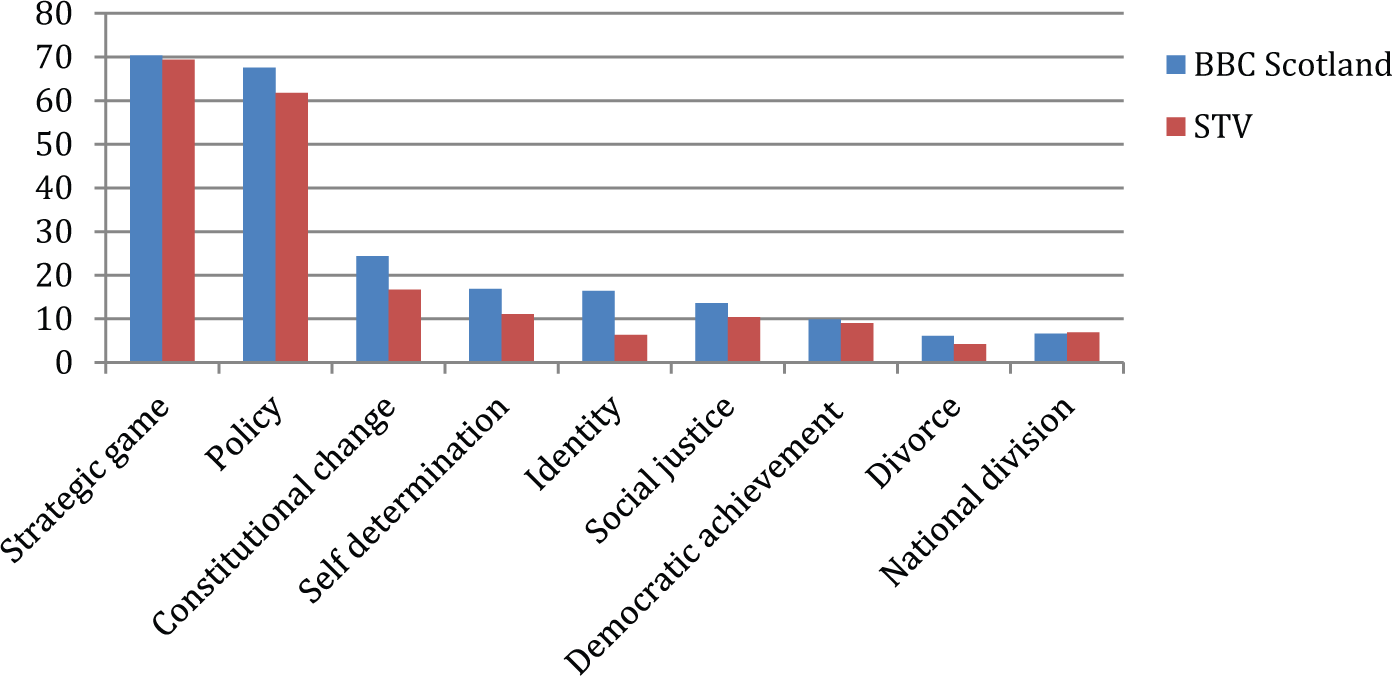
Presence of frames on BBC Scotland and STV coverage (% of each channel’s coverage).
The differences in how these symbolic frames defined what the referendum was about meant that they were conceptualized separately in this study: for instance, self-determination focused on democratic governance and future decision-making; identity was about history, culture and belonging; and democratic achievement was about the public engagement, civility and maturity in debating this sensitive issue. Taken together, one or more symbolic frames appeared in 45 per cent of the BBC coverage and 37 per cent of the STV coverage (Figure 2), which still suggests that symbolic values were not as prominent as the pragmatic implications or the game of the campaign.
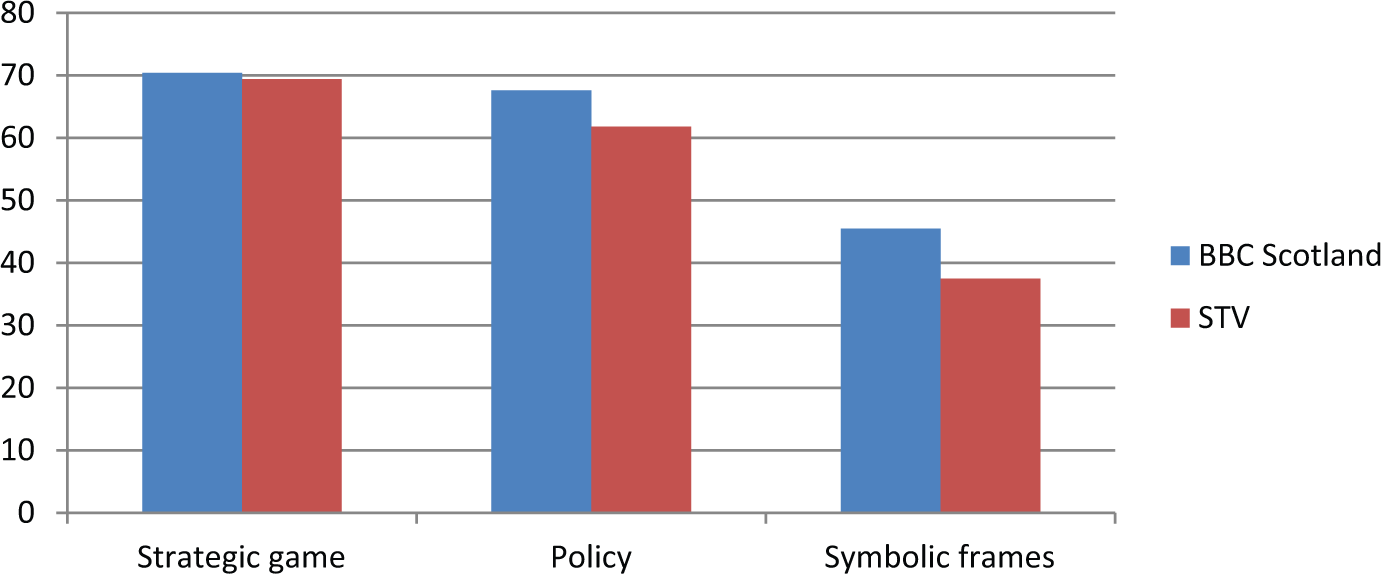
Game, policy and symbolic frames (% of each channel’s coverage).
Having established the relative prominence of the strategic game and policy (or issue) frames in the coverage (RQ1), I will now turn to suggest four factors which played a role in this construction (RQ2): journalists’ views of their own role in the coverage of the referendum, the influence of political campaigns, professional routines relating to balance and broadcasters’ perceptions of what attracts audiences. I will specifically argue that the first two factors encouraged the use of the policy frame and the latter two that of the game frame.
The influence of broadcasters’ perception of their role
One frame-building factor that emerged from the interviews was broadcasters’ perception of their own role in the campaign as mediators of what their sources had to say rather than as creators of frames. This factor is located at the individual level of Shoemaker and Reese’s (2014) Hierarchical Model of influences on news making.
When asked what the referendum was about, some members of the two news teams reiterated the question on the ballot paper (‘Should Scotland be an independent country?’) or slightly paraphrased it (e.g. ‘the future course Scotland would take’). Journalists seemed reluctant to mention specific frames, and when they did, they attributed them to others. For instance, the interviewee below mentions the self-determination and the constitutional change frames but attributes them to the campaigns:
I suppose the Yes side boiled it down to a matter of democracy, that if you had an independent country, you would always get the governments that you voted for was one of their core lines […] And then on the other side, I think it was core to their argument that you could have better change within the United Kingdom, more powers within the UK, while still benefitting from the strengths of the UK.
Interviewees from the two channels thus felt they had to distance themselves from what they saw as subjective frames. If journalists’ personal interpretations of what is at issue (Brüggemann, 2014) is a contributing factor in frame building, in the case of a highly contested event like the Scottish independence referendum, broadcasters who are bound to impartiality would not openly admit to having a personal interpretation.
This reluctance to take a position on how the referendum should be understood was consistent with interviewees’ rejection of the idea that television should have a role in defining the referendum. This was shared by reporters, producers and heads of news and is exemplified by the point made by the interviewee below:
I think [our duty is] to fairly and impartially reflect both sides of the argument, but in addition to that to explain, I think, what each side is actually proposing for each of the issues they’re talking about.
The same view was also supported by the broadcasting regulator interviewed:
I think they would look upon it, as a broadcaster, they would look upon it as their duty. […] Especially with their documentaries – I watched a few of them, well before the referendum – and they were trying to explain to viewers what the issues were.
Representing what the two campaigns had to say, providing analysis of their proposals and challenging politicians’ claims were professional duties interviewees agreed on, but the idea of broadcasters introducing their own frames to determine what the referendum was about was met with resistance. According to one producer,
We assess what the issues are, and the importance they have for voters and reflect that. […] I don’t think it’s for broadcasters to kind of dictate or direct. […] It’s to reflect the debate in as a comprehensive, informed and impartial way as possible.
Broadcasters therefore perceived their role in the referendum as ‘translators’ (Castelló and Montagut, 2011: 514) of the frames of each political side, rather than as ‘frame setters’ (Brüggemann, 2014: 64). As Lawrence (2010) proposes, the idea of journalists actively creating frames to report on a story often goes against their understanding of professionalism. Clearly this self-perception is reinforced by a UK media system where broadcasting is required to be impartial, and this is at the heart of the operation of both public service and commercial television. Hence, an influence at the individual level (journalists’ perception of their own role) is closely connected with one at the social systems level and the way broadcasting works within the United Kingdom’s liberal media model (Hallin and Mancini, 2004).
Journalists’ perception of their position as closer to the frame-sending rather than the frame-setting end of the continuum (Brüggemann, 2014) encouraged the prominence of the frames promoted by their political sources, in this case the two campaigns. As will be discussed in the following section, the source frame that particularly dominated the coverage of the final month, the policy frame, was promoted by both campaigns.
The influence of the official campaigns
Broadcasters’ perceptions of their role as ‘translators’ of sources’ statements was complemented by the powerful influence of the two campaigns at the social institution or extra-media level (Shoemaker and Reese, 2014), as will be discussed below. The high prominence of the policy frame, which was promoted by both political sides, makes sense when seen in the context of the privileged access these sides enjoyed, combined with broadcasters’ stance about their own role in the debate.
Broadcasters and political communicators I interviewed agreed that both official campaigns were central in the day-to-day coverage of the referendum, especially in the final month. According to a communicator from one of the campaigns,
The broadcasters wanted to know from us on a daily basis, when we got to the final stages of the campaign, which event on that day we regarded as the most important. […] That was quite useful from our point of view because we could determine what the broadcast coverage in the news programme would be.
Broadcasters stressed that they made a conscious effort to include a range of sources in their coverage. Apart from the official campaigns and the parties, they consulted grassroots campaigns, experts, bloggers, civil society organizations, local authorities, trade unions and many others.
1
However, it was clear that the two campaigns had the most important role. According to a current affairs producer,
Mainly we would be reacting to an instance by parties or campaign groups, that would be the main source. As I said, occasionally we would do … absolutely from time to time we would do our own stories and our own research but most of the time, on a day-to-day basis, we were reacting to announcements, to breaking news, to statements from either side.
Their role as central sources meant not only that the two campaigns had significant air time at their disposal to promote their frames but also that they enjoyed a ‘primary definer’ role (Hall et al., 1978) in determining what the debate was about. Both campaigns had messages that framed the referendum both in symbolic terms and in pragmatic terms. For the Yes campaign, the referendum was about Scotland getting democratic self-determination. According to a political communicator from that side,
[Our] central proposition was that the best people to make decisions about what’s right for Scotland are the people of Scotland. The people who live here, who work here.
Apart from the self-determination frame, the Yes side also promoted the social justice frame (the referendum was about Scotland becoming a more fair society), while the No side promoted the constitutional change frame (the referendum was about securing more constitutional powers for Scotland, within the ‘security’ of the union
2
). As discussed in the content analysis section, symbolic frames like these appeared in the coverage, but the source frame that dominated the television debate was the policy frame. A possible reason might be that this frame was promoted by both sides, albeit in different ways. For one of the interviewees on the Yes side,
The White Paper defined the exact prospectus of what an independent Scotland would be like. […] It wasn’t the case that people were voting for or against independence in an abstract sense – it was in a very clear, concrete sense. You’re voting for independence as defined in this document.
The White Paper, entitled Scotland’s Future: Your Guide to an Independent Scotland, was published by the Scottish Government in 2013 and explained in detail how different policy areas, such as economic policy, the management of healthcare, defence, welfare or childcare, would be shaped in an independent Scotland. Interviewees from the Yes side suggested that constructing the referendum as a decision on policy served to engage voters because it connected the referendum to things that were important to them in their daily lives.
Nisbet (2010) suggests that it is possible for the same interpretative frame to promote contrasting perspectives , and in this case, the policy frame was also used by the No campaign. For the No side, the referendum was primarily a decision on economic policy. According to a communicator at one of the Better Together parties, their key message was
The economic cost to Scotland, the cost in terms of jobs, the economic black hole in the Nationalists’ plans.
Interviewees from the No side said that their decision to focus on economic policy was based on polling showing that this was the area that would sway people’s voting intentions, particularly in relation to the perceived risk of losing economic security.
Although reporters questioned campaign sources on the specifics of their policy claims and, as will be discussed subsequently, broadcasters actively sought counter-claims to include in their coverage, they did not question that the referendum was about policy decisions (and not about identity for instance). Although this is in line with suggestions that political elites are influential in frame building (Brewer and Gross, 2010; Gerth and Siegert, 2012; Hanggli, 2012), the findings here also suggest that frames which are simultaneously contested by more than one elite group are more likely to be prominent in the news than frames promoted by one side.
The influence of balance rituals
So far, I discussed two influences, at the individual and social institution levels of Shoemaker and Reese’s (2014) model, whose combination encouraged the use of the policy frame. I will subsequently argue that two other factors, one at the occupational routines and one at the organizational level of the same model, combined to promote the game frame.
First, broadcasters’ occupational ritual of seeking balance through a juxtaposition of political opponents’ perspectives appears to have encouraged an emphasis on strategic competition. The issue of balance was controversial during the campaign, as broadcasters, and particularly the BBC, were accused by Yes supporters of failing to maintain impartiality (Riley-Smith, 2014). Balance at the time of elections and referenda is also a central requirement of the Ofcom Broadcasting Code (Ofcom, 2013), to which STV is subject, as well as of the BBC’s Guidelines (http://www.bbc.co.uk/editorialguidelines/).
Objectivity, impartiality and balance are related but distinct terms. Strictly speaking the definition of ‘balance’ is to present different views in the same story (Starkey, 2007). In this understanding of the term, both television channels gave equal amount of space to proponents of both sides. My content analysis of the coverage of the last month revealed that the numbers of political and non-political actors who spoke in the news and current affairs programmes favouring Yes and those favouring No were extremely close (227 and 230 on STV, and 470 and 480 on BBC Scotland). Evaluations of fairness based on other criteria, including the structuring of news reports, emerged during the campaign and were contested by broadcasters (The Courier, 2015). 3
Providing opponents with equal opportunities to speak offers an easily replicable measure and perhaps for this reason it remains a popular professional understanding of fairness. It is not unique to the coverage of referenda or to Scottish broadcasting. Tuchman (1972) suggests that news reporters employ balance (as defined above) as a ‘strategic ritual’ to protect themselves against accusations of bias and to deal with non-verifiable claims: by juxtaposing claims made by one side with counter-claims by the other side, journalists appear to be fair, avoid accusations of partiality and allow the audience to decide which source is right. As the interviewee below suggests,
I certainly don’t think I did a single report in the campaign that didn’t have both sides’ views in it. And by both sides, I suppose I basically mean the Yes campaign and the No campaign. [Because] you’ve got to be fair and I think we took the view that within certainly the pieces I was doing, fairness meant in every piece allowing the other side some kind of ability to reply to the argument being put forward.
Juxtaposing the two campaigns as the central sources in referendum stories, however, encouraged a focus on the competition between them. Although the political communicators I interviewed did not actively promote the strategic game frame in their media relations, the role of the official campaigns in the referendum was to compete against each other in winning over voters. Broadcasters’ tendency to counter each image, statement and report from one side with one from the other side contributed to constructing them as opposing camps. According to one news reporter,
I think that kind of draws you into a certain kind of formalized process and within a framework of ‘this formal campaign versus that formal campaign’.
The game frame thus provided a ‘safe’ way to challenge the campaigns while maintaining ‘an apparent stance of both independence and objectivity’ (Aalberg et al., 2012: 164).
The influence of what broadcasters think engages viewers
In addition to the balance ‘ritual’, a second aspect contributing to the prominence of the game frame was found at the organizational level of the influences model (Shoemaker and Reese, 2014). This was a perception among interviewees, particularly from the commercial channel, that the game frame attracts audiences.
Despite its prominence in the coverage, no interviewee mentioned the game frame spontaneously when they were asked what the referendum was about. When prompted explicitly about it, some responses seemed defensive and possibly implied a negative view of the game frame. The BBC interviewee below, for example, seems to suggest a conflict between ‘process’ and ‘policy’, with the latter being a ‘better’ focus for coverage:
I think we always have too much focus on process … I mean the media in the United Kingdom and Scotland generally has for years focused too much on process. […] Probably it would be better if we focused more on policy and I think in the referendum campaign, you know, arguably we could have … did we overall talk too much about process?
For other interviewees, though, the game frame was something that attracted viewers’ interest and contributed to public debate. The two official leaders’ debates staged by the two channels in August 2014 and their subsequent analysis were key examples of items that focused on political performance. Interviewees particularly at STV saw these debates, and public affairs programmes that followed a similar format, as the cornerstone of their referendum coverage. According to one interviewee,
We had a series of head-to-head debates and we would bring Nicola Sturgeon [at the time SNP deputy leader] to counter opponents from the other side and there were two which certainly in a political world played quite big: the clashes she had with Michael Moore [Liberal Democrat Scottish Secretary 2010–2013] and Alistair Carmichael [Liberal Democrat Scottish Secretary 2013–2015]. And they had real impact in the political world. They got big viewing figures but they also had a big impact in the political world and they were commented upon quite widely. […] Our first debate with Alistair Darling [Chairman of Better Together] and Alex Salmond [then SNP leader and Scottish First Minister] attracted a record audience for a political debate in Scotland – it was the sort of audience you would expect for a football match.
The interviewee here reflects the view that the game frame is attractive for audiences (Iyengar et al., 2004) and additionally suggests that media organizations are conscious of this appeal. The official leaders’ debates on both channels indeed attracted large audiences and were seen by many as significant contributions of television in the debate (Plunkett, 2014).
The civil society representatives interviewed, on the other hand, felt that this focus on the competition drew attention away from the debate. According to one civil society source,
If you frame the argument about a simplistic yes or no question, if you frame it as being polarized and all I’m doing is pitting these people against these people, and it’s their job to win those voters, and it’s my job to be the vehicle by which they might win them, then you’ve set the debate. But if you set it as, there’s more complex thinking here, it’s not as simple as yes or no, therefore my job is to allow those more complex ideas to be put forward and then voters will decide rather than be won over, I think that sets the debate completely differently.
All the civil society sources interviewed suggested that the emphasis on opposition between the two sides did not help answer voters’ questions and eventually made people tired. Whether this was the case, or whether the game frame helped increase interest in the referendum, would require further research to establish.
Conclusion
The issue of Scottish independence was a highly polarized and politicized one. In a liberal media system, and particularly in British broadcasting where due impartiality is a regulatory requirement, this factor alone predisposes television news coverage towards reproducing source frames and attempting to maintain a balanced distance (Brüggemann, 2014: 72).
In this case, campaign sources promoted multiple symbolic and pragmatic frames, but the policy frame was contested by both sides and this seems to be reflected in its prominence in the news relative to the symbolic frames. The policy frame was favoured in a context where political elites were the key information providers on a day-to-day basis and where journalists saw themselves as explainers of elite frames, rather than as definers of their own frames.
Broadcasters, however, did not only reproduce policy frames. The most prominent frame in the final month was the strategic game frame – even among the items that contained the policy frame, a majority also contained the game frame. Far from being the polar opposite of the policy frame (Iyengar et al., 2004; Lawrence, 2000), it appears that the strategic game frame reconfigured the policy frame without displacing it. Broadcasters functioned as ‘weak reframers’ (Castelló and Montagut, 2011: 517), and their weak reframing was manifested precisely in introducing the game frame along with sources’ policy frame.
I therefore argue that an emphasis on strategy, political performance and competition does not necessarily exclude an emphasis on substance. This study suggests that the former may also qualify, or ‘reframe’, the latter especially in a context where journalists are restricted in setting their own frames.
If the policy (or issue) frame was favoured by a situation where political sources had a lot of power in determining the coverage and where journalists saw their own role as presenting audiences with available options to choose from, the game frame was favoured by a professional understanding of objectivity as balance. My interview data suggest that when objectivity is understood as balance, namely, equivalent opportunities to speak and equal time devoted to political opponents, this can result in a constant juxtaposition of claims and an emphasis on political process. Finally, broadcasting organizations’ awareness of the appeal of game framed news for audiences may also contribute to legitimizing it as a contribution to public debate. These last two factors have also been associated with the prominence of the conflict frame in Dutch news (Bartholomé et al., 2015). Although the conflict and strategic game frames are conceptually distinct (Pedersen, 2014), there appear to be similarities in how they may emerge in the news.
The strategic game frame is traditionally seen as harmful for democracy, responsible for voter cynicism and disengagement (Cappella and Jamieson, 1997). Writing about an independence referendum in a different national context, Robinson (1998) argues that ‘in a “game” narrative, the story line and an oppositional style are more important than substance’ (p. 102), while, ‘if the [Quebec] referendum had been narrated as a citizen consultation rather than as a game, the boundaries of this discourse and of viewers’ interpretative options would have been enlarged’ (Robinson, 1998: 105). The analysis presented in this article showed that it is possible for ‘substance’ and ‘process’ to complement each other and that their relative prominence depends on a complex combination of factors internal and external to the media.
Footnotes
Acknowledgements
The author would like to thank Professors Neil Blain and Claes de Vreese for their comments on earlier drafts of this article.
Funding
The author(s) disclosed receipt of the following financial support for the research, authorship, and/or publication of this article: This research was supported by the Economic and Social Research Council, grant reference ES/L010062/1. The data the analysis was based on can be accessed at: http://reshare.ukdataservice.ac.uk/852450/ and  .
.