




Abstract
When ‘political correctness’ became a public concern in the USA in the early 1990s, it was almost immediately suggested that the term had long been something of a self-ironic slur in left-wing circles. While a number of people testified to this, the evidence advanced was almost entirely anecdotal, and to date no systematic attempt to gauge the reliability of these testimonies has been made. The present article seeks to rectify this. On the basis of a statistical account of politically correct (PC) terms – ‘politically correct’, ‘politically incorrect’, ‘political correctness’, ‘political incorrectness’ – in the Stockholm University version of the JSTOR database up to 1990, it challenges the received view that the term originated as a left-wing in-group marker which was used self-ironically. The evidence suggests, on the contrary, that the modern understanding of political correctness as a form of censorship first emerged in debates internal to the North American women's liberation movement. The article tables all uses of PC terms in JSTOR up to 1990. Before 1980, PC terms are used very sparingly and practically always non-ironically, with the possible exception of the one area in which the term gains ground in the 1970s: feminism. In JSTOR, prior to 1990, PC terms appear most frequently in feminist activist journal Off Our Backs (OOB). Usage in OOB makes evident that the notion of political correctness in the feminist context at the time was tied to a theoretical discussion concerning female sexuality. Climaxing at an academic conference arranged at Barnard College in 1982, this debate was pivotal for establishing the ironic understanding of political correctness we live with today, including the modern understanding of the concept as a means for the ‘closing of debate’. In sum, evidence suggests that the received view of the origins of the term ‘political correctness’ must be reconsidered.
At the Fox News GOP debate in 2015, Meg Kelly targeted Donald Trump's misogyny. ‘You’ve called women you don’t like fat pigs, dogs, slobs and disgusting animals’, Kelly pointed out: Your Twitter account has several disparaging comments about women's looks. You once told a contestant on the Celebrity Apprentice it would be a pretty picture to see her on her knees. Does that sound to you like the temperament of a man we should elect as president? And how will you answer the charge from Hillary Clinton […] that you are part of the war on women?
Trump immediately bit back: ‘I think the big problem this country has, is being politically correct’ (Berenson, 2015). Applause and cheering ensued; some fifteen months later, Donald Trump was elected President of the USA.
Trump's triumph can be seen as the culmination of a campaign that has depicted ‘political correctness’ as a major threat to free speech ever since the phrase became a matter of public concern in the USA in the early 1990s. President George H. Bush himself invoked the term in a speech at the University of Michigan on 4 May 1991, and claimed that ‘in their own Orwellian way, crusades that demand correct behavior crush diversity in the name of diversity’ (1992: 227). All of a sudden, ‘political correctness’ was a term frequently used, and almost invariably in a sinister sense. Political correctness, Richard Bernstein explained in one of the articles that was key in launching the concept to a wider audience, designates ‘a growing intolerance, a closing of debate, a pressure to conform to a radical program or risk being accused of a commonly reiterated trio of thought crimes: sexism, racism and homophobia’. In the words of Roger Kimball, one of Bernstein's informants, political correctness is ‘liberal fascism’ (Bernstein, 1990).
Despite numerous attempts to expose such accusations as ill-founded (Choi and Murphy, 1992; Cameron, 1995; Epstein, 1995; Wilson, 1995), the notion that political correctness amounts to a threat to free speech, ‘a hate ideology disguised as “tolerance”’ (Fjordman, 2006) even, remains rife in public debate, as Trump's casual invocation of the term and a mountain of right-wing publications make plain (see for instance: Satel, 2000; McGowan, 2003; Kimball, 2005; Harden, 2012). More recently, similar diatribes against ‘wokeism’ (Williams, 2022) suggest that the right-wing campaign to depict leftist views as a threat to free speech is still very much ongoing. For those of us who agree that ‘[t]he attack on the “politically correct” in the universities is an attack on the theory and practice of affirmative action’, as Ruth Perry (1992: 16) suggested long ago, the Left's difficulty to counter the charge of promoting political correctness should therefore be a cause of concern. 1
Part of the problem, I will suggest in the present article, is that while Perry may have been right about the implications of the attack on political correctness, her laudable attempt to provide a ‘historically correct’ account of the origins of the term unfortunately is anything but. Taking their cue from Perry, critics to this day assume that the term derives from Mao's Little Red Book yet was always used ironically, as ‘a kind of in-joke among American leftists – something you called a fellow leftist when you thought he or she was being self-righteous’ (Garber, 2001: 123; see also: Hughes, 2010: 63; Weigel, 2016; Wilson, 1995: 4). But this not the case: contrary to what Perry's influential article has made us believe, I will show, the phrase ‘politically correct’ has not ‘always been double-edged’ (1992: 16), nor did it first gain ‘currency in the U.S. in the mid to late sixties within the Black Power movement and the New Left’ (1992: 15). It stems much more specifically from debates within the women's liberation movement in the USA, which came to a head at the ninth The Scholar and The Feminist Conference, held at the women's centre at Barnard College on 24 April 1982. Perry devotes a section of her article to the Barnard conference but fails to register its importance for disseminating the ironic conception of political correctness that she mistakenly assumes was always a feature of the phrase. We shall have reason, therefore, to return to the conference below, but before doing so, should examine Perry's other claims.
When Perry's article appeared in 1992 the political correctness debate had been raging for over a year, and a provisional defence against the alarmist outcries against political correctness had already taken form. Charged with forming a new ‘Thought Police’ (Adler et al., 1990), many liberal academics had offered accounts of the roots of the term belittling its conceptual charge. Thus Stanley Fish claimed that the term was ‘a kind of self-mocking way’ for people on the left to ‘jok[e] about what would be the next politically correct -ism’ (Presser, 1991: 52); Rosa Ehrenreich that it was used by ‘progressive and liberal students’ to mock Leftists ‘who are intolerant and who could stand to lighten up a bit […] years before the Right appropriated the term, with a typical lack of irony’ (1991: 137); and Maurice Isserman that when the term was used in the 1970s, ‘[i]t was always used in a tone mocking the pieties of our own insular political counterculture’ (1991: 82; cited in Perry, 1992: 16). Perry's article so efficiently channelled these suggestions that leftists had never taken the concept of political correctness seriously that her account has been accepted as the final word on the matter even though its evidence is entirely anecdotal. Its appeal to academics at a time when their profession was being attacked is evident: if it really were the case that politically correct (PC) terms have always been used ironically, then the charge that liberal/radical academics are ‘politically correct’ can be re-written into a playful attempt ‘to differentiate the New Left from the orthodox Marxism it had rejected, and […] to satirize the group's own tendency towards humourlessness, self-righteousness and rigidly orthodox “party lines”, poking fun at the notion that anyone could be (or would want to be) wholly “correct”’ (Cameron, 1995: 126–127).
In reality, however, internal debate among feminists no less than among leftists in general has often been much more acrimonious than Perry's account would seem to allow for. Most problematically, in asserting that the phrase ‘politically correct’ was always ironic, Perry dispenses with the need to explain what an historical account of the term really ought to show, namely how this originally neutral term morphed into an ironically charged concept. It is often assumed today that political correctness is but a new way to distinguish between acceptable and unacceptable forms of language. As Perry puts it, ‘the phenomenon – labeling certain acts and attitudes as right or wrong – must be as old as belief itself’ (1992: 15; see also: Hughes, 2010: 7). But this is to overlook the most striking semantic feature of the concept of political correctness as used today, namely that it is ironic. Calling something politically correct means labelling that act or attitude right but meaning that it is wrong – and in political debate, that is by no means a widespread practice ‘as old as belief itself’, but a very peculiar one that has emerged only in the last four or five decades.
Normally, it goes without saying that it is correct to be correct. The OED defines the adjectival sense of ‘correct’ as ‘free from error; exact, true, accurate; right’. Early usages of PC terms (‘politically correct’ OR ‘politically incorrect’ OR ‘political correctness’ OR ‘political incorrectness’) retain this sense, assuming that political correctness means simply what is considered right or accurate in the given context, so that the phrase functions as an index of the situation, as it were. For that reason, I refer to unloaded usages of PC phrases as indexical throughout this article. The concept of political correctness, in contrast, ironically inverts the semantic content of the adjective, so that ‘politically correct’ somehow comes to mean ‘incorrect’. In the present article, I am first and foremost trying to establish that contra the received view, this ironic inversion of the semantic content of the phrase ‘politically correct’ was something that developed over time. Secondly, and just as importantly, I show that this ironic inversion did not develop in the Left in general, but specifically in the feminist debate about sexuality. My aim, in short, is to supply the history of the concept of political correctness that the received view has inadvertently suppressed.
To that end, in what follows I present the results of a search for PC terms that I conducted in 2019 of the Stockholm University version of JSTOR, a fully searchable database providing access to more than 1900 journal titles in over fifty disciplines. The results of this search provide precious little evidence for the notion that such terms were widely used self-ironically in leftist circles prior to the 1970s but suggest on the contrary that PC terms remained predominantly un-ironic right up until the end of the 1980s, with the significant exception of the debate around the concept of political correctness that emerged in feminist circles some ten years earlier. As my search of JSTOR shows that PC terms recur particularly frequently in feminist journal Off Our Backs, I devote the third section of this article to accounting for the usages of PC terms in this journal, and the fourth to the controversy surrounding the debate about political correctness at Barnard. In conclusion, I trace the impact of this debate upon further usages of PC terms in JSTOR, in the hope of shedding some additional light on how this highly problematic concept eventually developed into a mainstay of everyday political discourse.
A methodological reservation may be in order. Feminist debate in the 1970s mainly took place outside of the academy, so the picture of the origins of the term presented here is inevitably partial. I provide a fuller picture in an as yet unpublished sister-piece to the present article that dives into the Independent Voices database which has digitised large parts of the US alternative press, using a similar methodology. It is worth mentioning at the outset that that investigation confirms the main findings of the present one: prior to the mid-1980s, the term ‘political correctness’ was used almost exclusively in feminist publications, and the term itself became contentious only at the end of the 1970s (e.g. see: McDonald, 1977). Still, it seems important to begin the account of the origins of political correctness in an academic database, if only because it was in the academy that political correctness emerged as an essentially contested concept, that is, as a concept ‘the proper use of which inevitably involves endless disputes about their proper uses on the part of their users’ (Gallie, 1955–1956: 169). To understand how and why it did so, we must look first at how PC phrases were used in the academy before the intervention of feminist theory, and JSTOR is very helpful to that end.
PC phrases in JSTOR
Founded in 1995, JSTOR today is established as one of the largest databases for academic journals in the humanities and social sciences. In 2019, using the search string ‘(‘politically correct’ OR ‘politically incorrect’ OR ‘political correctness’ OR ‘political incorrectness’)’, I counted all articles containing any of these terms up to 1990. The sampling is limited to Stockholm University’s access to JSTOR, which comprises series one to twelve of the Arts & Sciences Collection, out of fifteen in total, or 1693 titles out of a total of 2145. Nevertheless, the results provide the first attempt at a systematic analysis of the contexts in which PC terms were used prior to the American outcry against the phenomenon in 1990.
In terms of frequency, JSTOR confirms that there was a dramatic rise in the usage of PC terms in the early 1990s (Figure 1). Prior to the 1990s, PC terms in JSTOR amount to only a small fraction of the total number of usages (Figure 2).
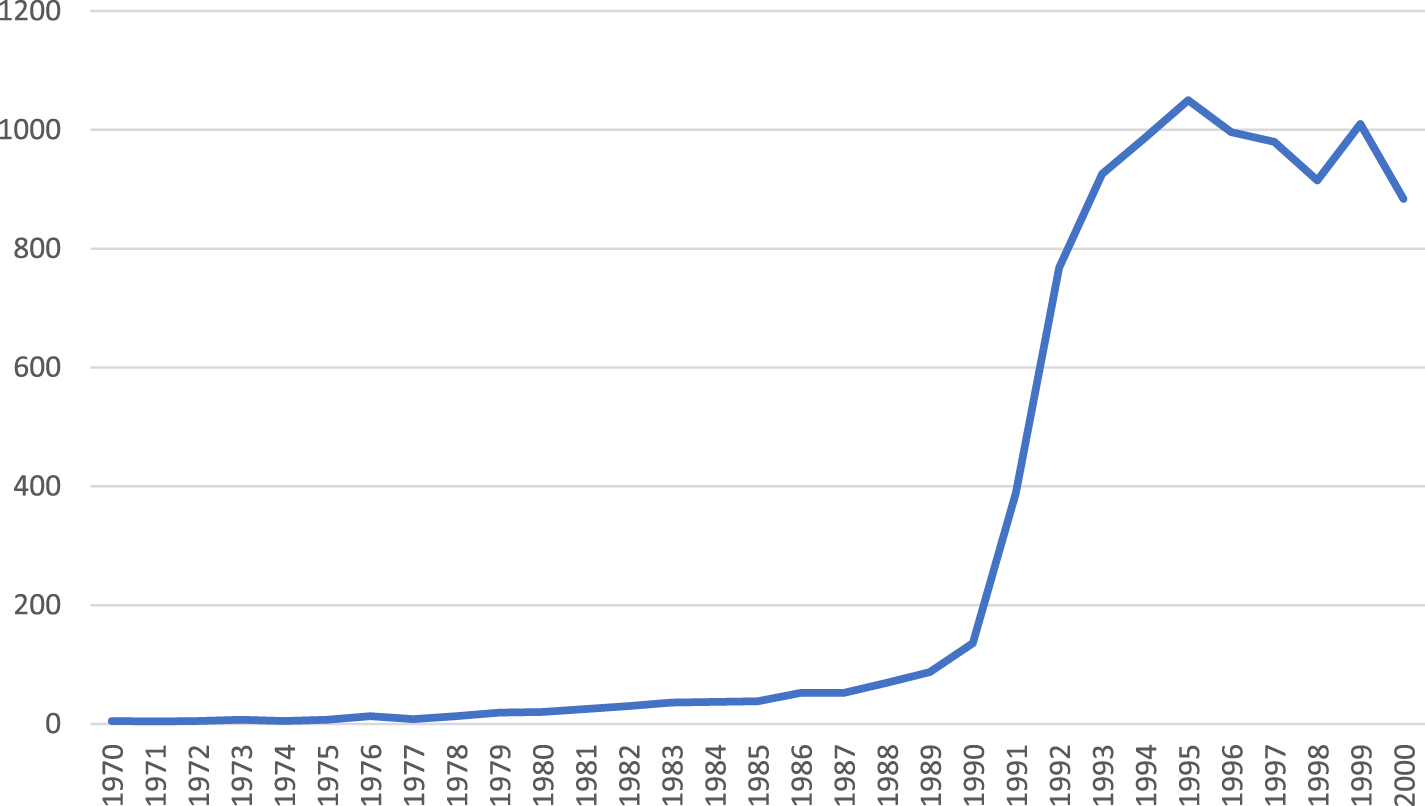
Articles with PC terms in JSTOR, 1970 to 2000.
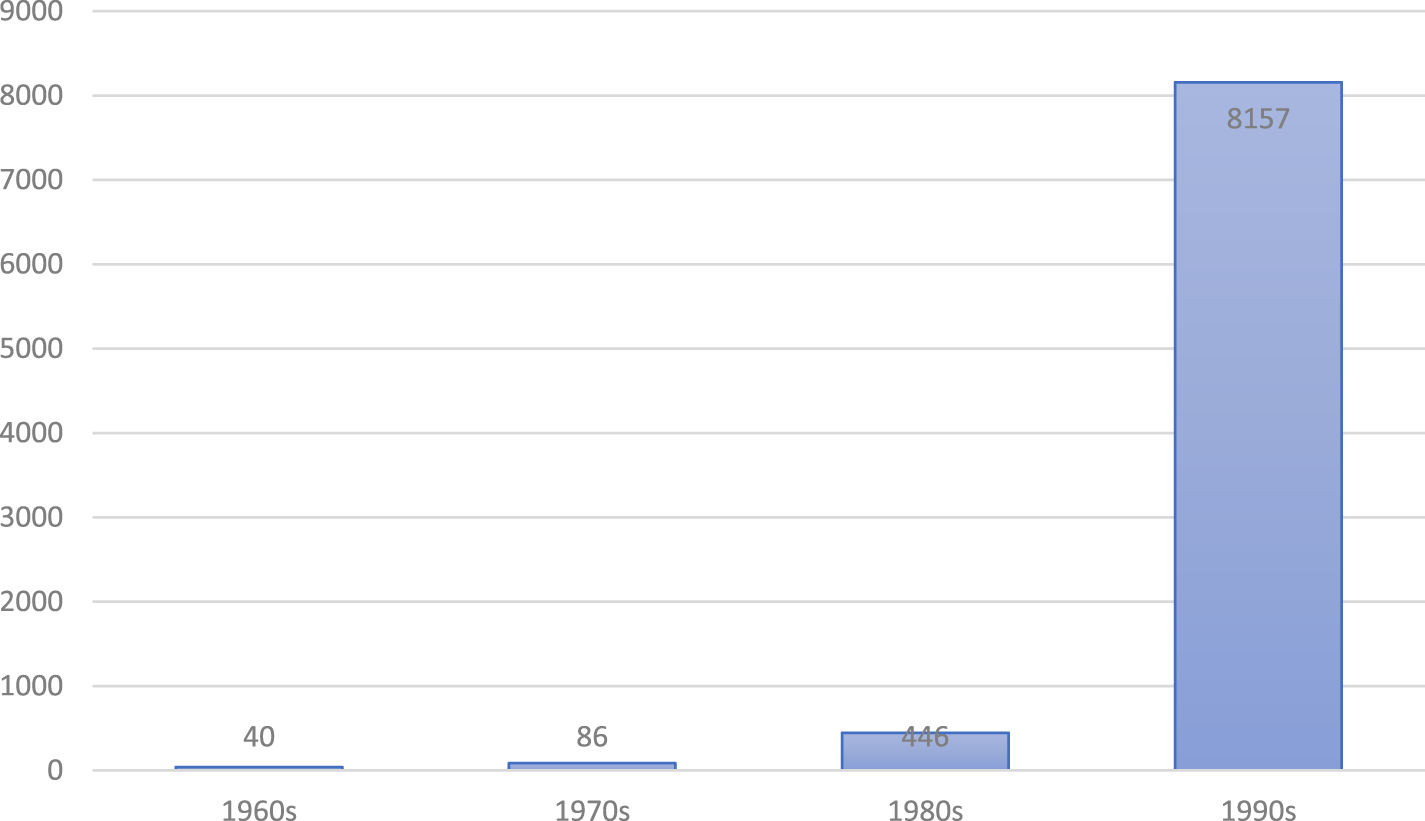
PC terms in JSTOR, 1900 to 1990.
Even so, it is the pre-1990 uses of political correctness that form the genesis of the concept of political correctness, and hence are the ones that this article focuses on. While PC terms can be traced back to the nineteenth century in JSTOR, they are exceedingly rare prior to 1970, occurring only in forty-one articles in total. They appear most often in law journals, in which nine articles make use of them in the fifty years from 1919 to 1969. Before 1950, there are at most a handful of uses per decade; in the 1950s and 1960s this increases to about fifteen per decade (Figure 3).
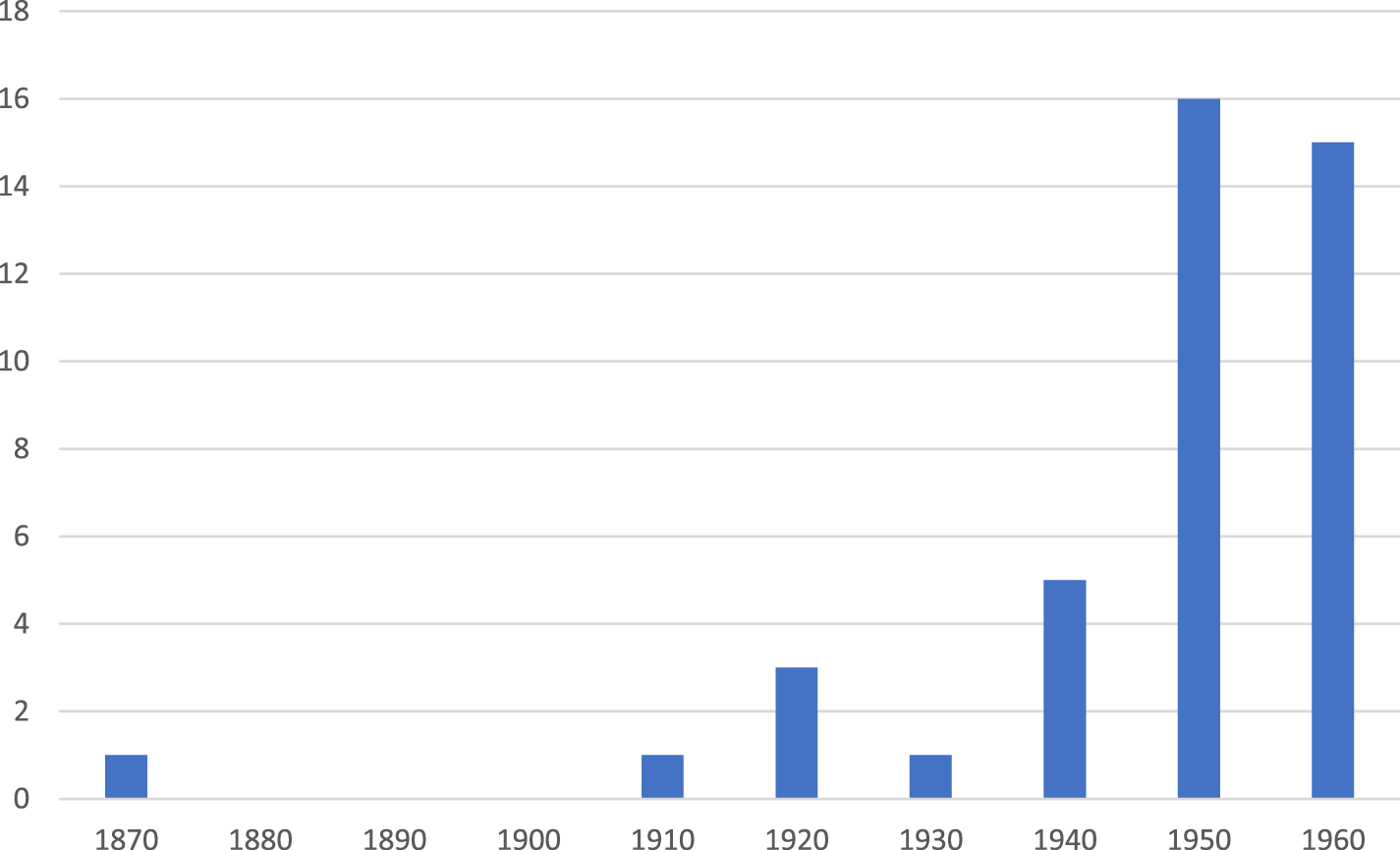
PC terms in JSTOR articles, prior to 1970.
The number increases in the 1970s, in which period PC terms appear in eighty-six articles in total. There are six occurrences in Education, seven in Asian Studies and History alike, twelve in Sociology, fifteen in Language & Literature, seventeen in Political Science and twenty-seven in Feminist & Women's Studies, with some overlapping. PC terms occur in more than two articles only in two journals: six in Cinéaste and twenty-four in Off Our Backs. More specifically, prior to the 1980s, ‘political correctness’ is associated primarily, if far from exclusively, with two areas: reports and debates about communist China (ten prior to 1970, another five in the next decade) and the women's liberation movement. Whereas in the former case it is used as a neutral, descriptive word, in the latter the usage is much more complex, as we shall see (Figure 4).
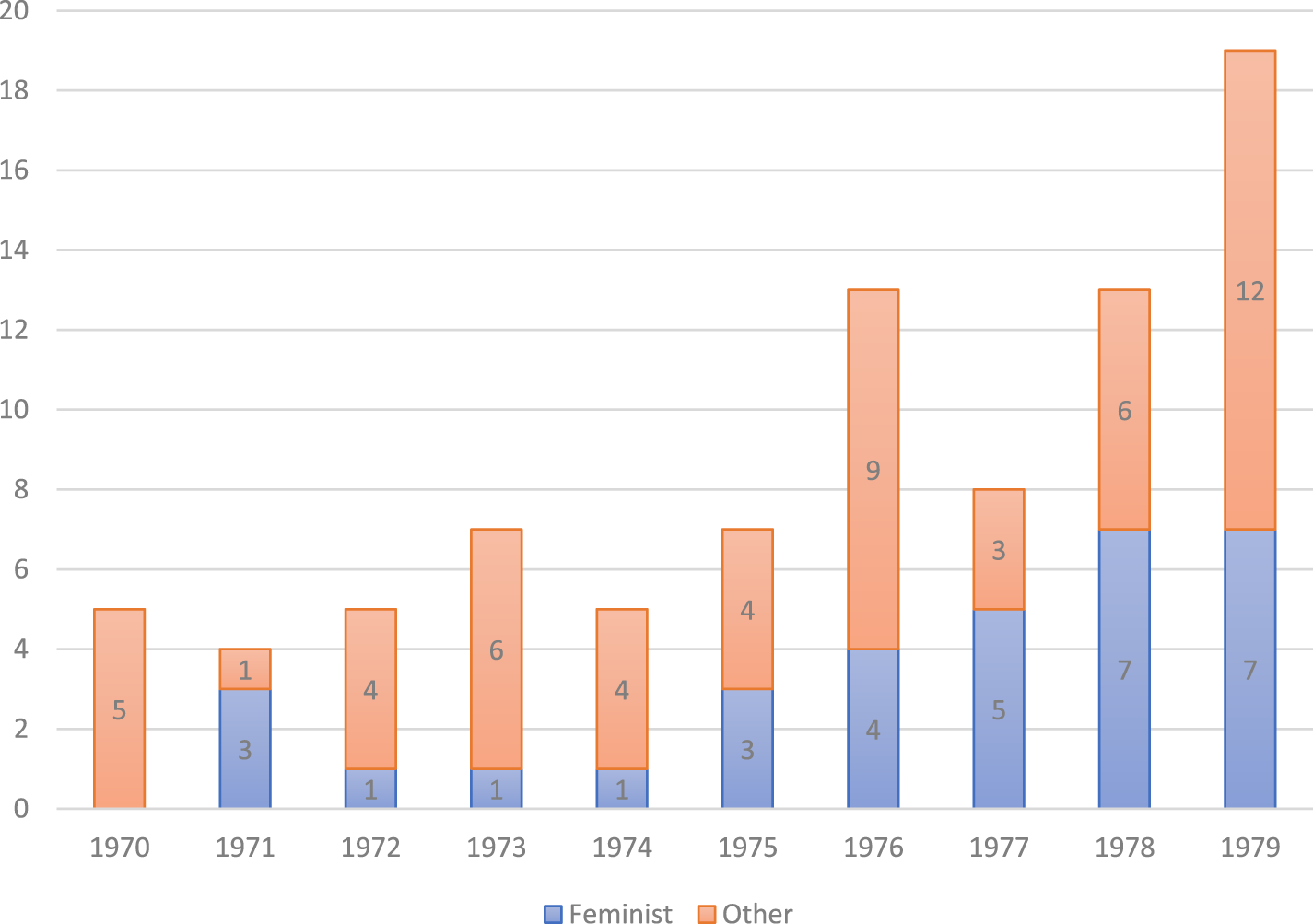
Articles with PC terms in JSTOR, 1970s.
That PC terms recur in reference to China from the 1960s onwards in JSTOR might seem to support Perry's claim that it was most likely ‘through translations of Mao Tse-tung's writings, especially in “the little red book” as it was known’ (1992: 15), that the term first gained currency in leftist circles. But while the word ‘correct’ is often used in the translation of Mao's book, the phrase ‘politically correct’ does not appear, nor do any of its derivatives. The phrase which comes closest is ‘correct political orientation’ – CPO; the expression recurs four times in two succeeding quotations at the end of section twelve (Mao, 1966). In all usages of PC terms in reference to China in JSTOR, the terms are used indexically, often designating the preferred politics of the Chinese Communist Party (CCP) at the time, but also used with more specific reference, as when Loh claims that Chiang Kai-shek's ‘notion of a modernized China on a Confucian foundation and his posture of reform traditionalism were politically correct to the degree that a centrist posture between the Sinophiles and the Westernizers could have become a useful bridge between the two cultural outlooks’ (1966: 444). There are no examples of PC terms being used ironically in this category, and they remain uncommon: as a point of comparison, ‘CCP’ appears in almost 2700 articles in the 1960s, and ‘Mao’ in over 9000.
Perry also suggests that the phrase was in common usage in radical black circles at the time by citing as ‘the earliest textual reference to the phrase that I have found […] an essay by Toni Cade (not, as yet, Bambara), “On the Issue of Roles”, in the anthology she edited in 1970, The Black Woman’ (1992: 15). The phrase does indeed appear in the essay: ‘And a man cannot be politically correct and a chauvinist too’ (Cade Bambara, 2005: 131). For Cade, then, it is PC for men not to be chauvinist; as Perry herself concedes, Cade here uses ‘the phrase straight up, without irony, without self-mockery’ (1992: 16). But as Perry is determined to prove that the phrase was always ironic, she immediately counters her own observation by going on to relate how Audre Lorde, in a poem responding to the foreword of Tales and Stories for Black Folks (Cade Bambara, 1971) published one year later, criticised Cade's stated ambition to raise her daughter to be ‘a Correct Little Sister’ (Lorde, 1973: 40) – N.B. correct, not politically correct. Ignoring the fact that neither Cade nor Lorde uses the phrase ‘politically correct’, Perry takes the non-occurrence of the phrase in this exchange to signal that ‘[a]lmost from the start, then, the phrase occasioned a dispute over what defined ‘politically correct’ and over its uncritical use’ (1992: 16; emphasis mine).
That Perry's one example of how PC terms were causing debate already in the 1970s does not in fact involve the phrase ‘politically correct’ casts doubt on her claim that ‘there is […] a great deal of evidence that within the New Left it was nearly always used with a double consciousness’ (1992: 16). JSTOR suggests rather that it was not used widely in academic circles at the time, and that there is little if any academic evidence tying the phrase to the Black Power movement. Up to 1990, the phrase appears in sixteen articles in the JSTOR African Studies and African American Studies journals, in all of which usage is indexical. For instance, Fidel Castro in an interview says that ‘if we had felt that it was politically correct, from our point of view, to have supported Mr M’Bumba and his movement, we would have welcomed and supported him’ (Castro et al., 1978: 38; emphasis mine).
There is some evidence to suggest that the phrase ‘politically correct’ was used in left-wing circles in the 1970s, but this also suggests that it was not used ironically until the late 1980s. Cinéaste, a magazine credited by the editors of fellow film journal Jump Cut as having ‘helped build a stronger left film culture in the U.S.’ (Hess et al., 1978: 39), contains PC terms six times in the 1970s and five in the 1980s, making it the second most frequent venue for the phrase in JSTOR prior to 1990. Yet it is not until 1987 that there is a clear case of the phrase being used ironically. In a letter to the editors, Spike Schwarz complains about Sydelle Kramer's review of Oliver Stone's Platoon, questioning what ‘kind of radical’ she really is: ‘Doesn’t she understand that we have to expose the class enemy 24 h a day, 365 days a year?’. Schwarz ends with a plea that the editors make ‘an effort to publish more ideologically correct film reviews in the future’. The editors respond with gentle mockery: ‘You can please all of the Marxists some of the time, and some of the Marxists all of the time, but you can’t please all of the Marxists all of the time’, headlining the letter ‘Politically Correct Reviews’ (Schwartz, 1987: 3). Despite the numerous claims that the notion of political correctness had been used in leftists’ circles for years, the evidence for this notion, then, is so slim that it would seem to suggest rather that the phrase was not a common one in left-wing circles in the 1960s.
As the above discussion makes plain, finding the phrase ‘politically correct’ does not amount to finding the thinking that is currently associated with it. Before 1980, practically all usages of PC terms are indexical: the term plainly has not yet become ironically charged. This holds true also for the one area in which PC terms do recur with some regularity in the 1970s in the JSTOR sample, namely feminism. The term's relatively high frequency in feminist contexts is especially noteworthy in that there were very few academic feminist journals in the 1970s, and even fewer that are part of the JSTOR database: Off Our Backs was established in 1970; Feminist Studies and Women's Studies Newsletter in 1972; Frontiers: A Journal of Women Studies and Signs: Journal of Women in Culture and Society in 1975; Feminist Review, finally, in 1979. (Women's Studies Quarterly was established in 1972 but is available in JSTOR only from 1981.) Nevertheless, a full third of the total number of articles using PC terms in the 1970s – twenty-seven out of eighty-six – appear in feminist journals. The figures become even more noteworthy in that twenty-four of the twenty-seven articles in the feminist category come from one and the same journal, Off Our Backs, suggesting that it was in the very specific context of feminist activism that political correctness first became a matter of contention, and the term started to morph into an ironically charged concept.
PC phrases in Off Our Backs
Off Our Backs was a radical feminist news journal, published between 1970 and 2008, making it the longest continuously published feminist newspaper in the USA. Although based in Washington, DC, the journal covered local, national and international topics pertaining to women's, feminist and lesbian issues and culture (Off Our Backs, n.d.). One gets a sense of how radically OOB differs from other journals in respect to using PC terms through the diagram in Figure 5.
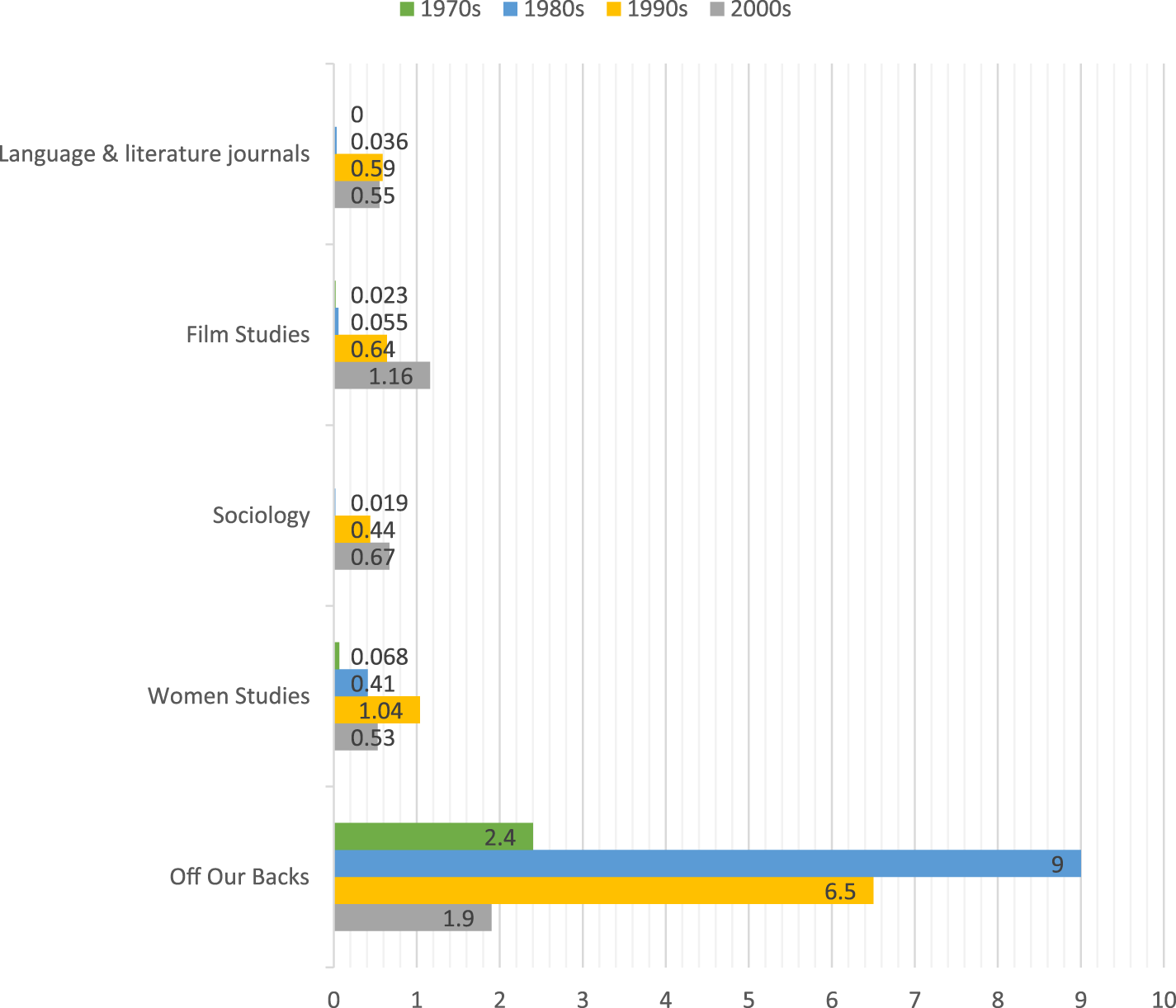
Average number of PC terms per journal and year.
Already in the 1970s PC terms are used frequently in OOB, in different contexts and to a variety of ends. The first instance occurs in 1972, in a short piece by Frances Chapman on a meeting about the experience of older activists in setting up a new women's centre in DC. One of the reasons it is difficult making such a centre work, Chapman reports self-critically, is because those who are already in the game are sometimes unwilling to trust those who have just joined the women's movement, ‘giving these women busy-work until you trust them, while you and your clique make decisions that are politically correct (but more usually are dead wrong) behind closed collective doors’ (1972: 17). While there is more than a trace of irony to this statement as a whole, it is notably produced by the juxtaposition of ‘politically correct’ with ‘dead wrong’: the PC phrase as such at this point is not yet ironic.
It is a full two years until the phrase turns up again. In a piece advocating lesbianism as a more radical version of the women's movement, the writer suggests that the 1960s’ call for sexual liberation was little but a male strategy for getting laid: ‘The hippie chick became politically correct ass. The Male Left convinced “their” women that it was politically correct to fuck their brains out’ (‘Marychild’, 1974: 22). Again, while this usage clearly is ironic, it is not the phrase itself but the context which establishes the irony. That the phrase as such at the time would seem to have been non-ironic is confirmed in a report from a conference on how to build a lesbian community: ‘One woman from Minneapolis said that she would prefer a lesbian communication network open only to women who were “politically correct”; others disagreed and said that we should find out who we should be supporting besides ourselves’. Judging from the introduction to the article, political correctness in this context meant something like ‘radical feminism, socialist-feminist or lesbian separatism’ (Chapman and Bernice, 1975: 4).
Indeed, the way that PC terms were used suggests that there was no shared understanding of such terms: ‘How is the Chicago area movement ever going to mature into a strong, self-supporting force for revolution if it continues to reject real support for feminist businesses in favor of “political correctness”, whatever that is, and petty jealousy’ (‘Jacy’, 1975: 22). What is clear is that while some dismissed the question of what ‘politically correct’ feminism was, for others this was a very real question: ‘We cannot/must not be “narrowly political”. Politics in a vacuum is not politically correct or even really possible’ (‘Joy & Struggle’, 1976: 26). In the same issue, a reader wrote in to relate her appreciation of an article on feminist businesses, commending it because ‘the thesis of the article is politically correct’, and because she found it ‘a real positive piece of analysis’, which might stimulate ‘more women to discussion, theory-building & effective action so that we more swiftly move toward a socialist revolution & the construction of a society where the words feminist & communist blend into one concept & are actualized by every individual's life’ (Dowe, 1976: 27). Others, however, called for the protection of more unorthodox views. Relating how a female artist friend had been trashed ‘for being “femme” and “insufficiently feminist”’ by ‘some very heavy, political, socialist dykes’, Janis Kelly argued that ‘that people ought not to be denied human dignity or forced to live a sub-human existence because they are young, old, poor, physically weak, mentally disorganized, or politically incorrect’ (1976: 13). Editorial material also sometimes challenged feminist notions of political correctness: ‘For the first time, oob [sic] advertises a dating service (for lesbians) this month. Some women may think this is politically incorrect, but chicken lady [the name of a recurring news column] thinks it's great’ (‘Chicken Lady’, 1976: 22). One should remember, also, that the women's movement at the time was a creature of many colours – in another letter to the editors, Flash Silvermoon complains about a report from a conference in which the OOB reporter had refused to take witches seriously: ‘Exploring our Hera-tage is no mere nostalgic whim or escape, rather it is a means to retain some of the positive aspects of that period and to learn by their mistakes. Why is it that blacks are politically correct in rediscovering their roots and we are accused of escapist fantasies?’ (Silvermoon and Kelly, 1977: 21).
Most often, the debate was more substantial: in an exchange on tolerance and anti-tolerance within the movement, Carol Anne Douglas suggested that she preferred ‘non-dogmatic styles and talking with people who say “we disagree” rather than “you are politically incorrect”’ (1977: 8). 2 While such conversations suggest that the notion of ‘correctness’ was important to OOB's readers, this also suggests that there was no consensus about what it was, and that there was as yet no concept of ‘political correctness’. Yet despite the lack of a clear definition, the term was used, and overall OOB seems to have been perceived as a champion of political correctness. One reader – a self-declared witch – complained about a cartoon which she thought replicated ‘the traditional, patriarchal portrayal of a witch. I would expect that portrayal perhaps from an insensitive, male-oriented publication, but to see such a cartoon in a newspaper that prides itself in being politically correct and so quickly points out the sexism and classism around us, had me worried’ (Wood, 1978: 27; emphasis mine). As the quote suggests, to many within the feminist camp at this time, political correctness already connoted sensitivity; for them, what set feminist ideology off from patriarchal politics, right and left, was this ability to recognise that other persons’ political sensibilities could well go beyond the consciousness of familiar oppressive structures such as class, gender and race to include more idiosyncratic ones as well, such as one's feelings about magic.
This suprapolitical character of much feminist theory is one reason it seems misplaced to argue that political correctness has its roots in the New Left. For while the women's liberation movement in the USA was indeed a left-wing project to the extent that it joined forces with ‘the larger radical Movement’ (Echols, 2019: 3) of the 1960s, radical feminism was soon enough offset by cultural feminists of various kinds. Even in its radical version, feminists recognised that feminism was a new form of leftism. ‘Women's liberation’, Robin Morgan influentially explains, ‘is the first radical movement to base its politics – in fact, create its politics – out of concrete personal experiences’. This emphasis on personal experience has two immediate consequences: first, it makes for a suspicion of theory – the women's liberation ‘theory, then, comes out of human feeling, not out of textbook rhetoric’, Morgan explains. Second, it builds into the very heart of the movement an unresolved (and often unrecognised) tension between its supposedly singular foundation – the experience of each individual woman – and its universalising claim to speak for all women. ‘No one article is meant to be “representative” of anything other than some part of all women’ (Morgan, 1970: xx) is the formula whereby Morgan tries to elide this contradiction in terms.
For some feminists, the phrase ‘politically correct’ seems to have been an attempt to neutralise this contradiction. In 1994, at the height of the first uproar against political correctness, Dianne Post and Olivia Free-woman discussed the concept in OOB, stressing the heritage of the term: […] ‘politically correct’ is not a new term. Feminists began using it in the 1970s and 1980s but with a different meaning than the scorn that greets it today. Then it meant, and still does for some of us, that we were personally responsible for our words and deeds. It meant that we must be considerate of other people beyond ourselves; people whose culture and traditions were not our own. It meant we must seek to be inclusive rather than exclusive and we had a responsibility as white women to learn about others and to act upon what we had learned. Most of all, it meant we must be ethical in our behaviors (1994: 20)
But as we have already seen, if political correctness in theory ‘meant that we must be considerate of other people beyond ourselves’, in practice PC terms often carried negative connotations. By the end of the 1970s, there are signs that some people felt the phrase insisted upon the feminist slogan that the personal is political too heavy-handedly. Thus, Marny Hall noted that it was problematic that some lesbians, ‘who have “come out” through the women's movement, may live in communities in which “politically correct” behavior is tightly circumscribed’ (1978: 381). Even more pointedly, in an article problematising the notion that women should fight back against, and even kill, rapists and abusers, Fran Moira concludes that may be easier said than done: ‘That which the body will automatically try to do to preserve itself, the thinking mind cannot do – without brainwashing, called basic training in some circles and political correctness in others’ (1978: 12). But the term could also be unequivocally positively loaded, as when one writer found the film In the Best Interests of the Children ‘beautifully made, purposefully politically correct’ (Stevens, 1979: 21). While the term often retained this sense of being something one should strive for, in some circles it did so to such an extent that others equated political correctness with a new form of ‘lesbian fascism’, highlighting ‘the dangers and heartache those separatist extremists who judge everything by whether it is politically correct can cause to their sister lesbians and the women's movement’ (Lipsyte, 1979: 14; referencing Lewis, 1979: 174–181).
If there was a general understanding within the feminist movement that political correctness might easily turn into just another form of oppressive ‘brainwashing’, it was on the issue of the individual's right to her own sexual desire that the ongoing debate on the pros and cons of political correctness in feminist circles came to a head. According to Sheila Roher of Women Against Pornography (WAP), lesbianism ‘was a kind of political crisis for the women's movement’, which was resolved through turning lesbian identity into something of a political choice, rather than a sexual inclination, so that ‘[l]esbianism was romanticized into something intrinsically “politically correct”’ (Cottingham, 1983: 23). In the feminist context, then, the notion of political correctness is tied to a theoretical discussion concerning female sexuality, especially the problematic notion that there could be a correct kind of female sexuality. This debate climaxed at an academic conference arranged at Barnard College in 1982, to which the modern understanding of political correctness as a means for the ‘closing of debate’ can be traced. Equally importantly, the debate at Barnard was instrumental in making political correctness a matter of academic interest.
Barnard and the feminist ‘sex wars’
The ninth The Scholar and The Feminist Conference, entitled ‘Towards a Politics of Sexuality’, is generally recognised as a pivotal event in North American feminism. That it holds an important place in the genealogy of the concept of political correctness too was clear already to Perry, but she unfortunately makes light of its significance by suggesting that it merely confirms her assumption ‘that the phrase “politically correct” has always been double-edged’ (1992: 16). In fact, the conference is more properly seen as the moment when political correctness starts to take on the ironic properties that we associate with the concept today. Held at the women's centre at Barnard College on 24 April 1982, the conference ambitiously set out to broaden the focus of feminist discussion, from sexual violence to sexuality per se. Judging from the turnout – ‘eight hundred registrants, the largest audience ever to attend the Scholar and the Feminist series’ (‘Barnard Conference’, 1983: 179) – it was a timely initiative, and an important early call for an intersectional approach to sexuality. In her opening remarks, Carol Vance argued that feminists ‘should ask whether sexual differences cut across the grid of class, race and other differences’ (Douglas and Henry, 1982: 2). As the Conference Diary makes evident, the organisers proceeded on the assumption ‘that inadvertently the movement itself may have fostered a split in our thinking about what is politically correct and what is pleasurable for both gay and straight women’, and ‘that “egalitarianism” as an ideology may have dictated which pleasures were “correct” and ‘incorrect”’ (Vance et al., 1982: 4). They did so in the awareness that ‘[s]exuality poses a challenge to feminist scholarship, since it is an intersection of the political, social, economic, historical, personal, and experiential, linking behavior and thought, fantasy and action’ (Vance et al., 1982: 39; emphasis mine).
Fran Moira reports that the one-day conference ran from 9 a.m. to 6 p.m. In the morning, three lectures addressed the overall theme of the conference, while in the afternoon, eighteen workshops in parallel sessions developed the themes further. Among them was a presentation by Gayle Rubin on ‘Concepts for a Radical Politics of Sex’ – later published as ‘Thinking Sex: Notes for a Radical Theory of the Politics of Sexuality’ – and a panel on ‘Politically Correct, Politically Incorrect Sexuality’, featuring Dorothy Allison, Muriel Dimen, Mirtha N. Quintanales and Joan Nestle, which opened with Dimen asking: 1) What is politically correct? Answer: I don’t know; anything/everything. 2) Why would one want to be politically correct? Answer: It's attractive; it starts from a perception of political oppression. 3) What is good about politically correct? Answer: It's empowering; it dispels the sense of victimization; it allows one to connect with the collectivity. 4) What is bad about politically correct? Answer: When a radical becomes politically correct, she becomes conservative, orthodox, conformist, controlled (Moira, 1982a: 22)
Dimen's questions are clearly not rhetorical but rather are genuine attempts to stake out the parameters of a concept – politically correct – that had become sufficiently prominent in feminist debate to be recognised as such but had yet to be properly defined. Her line of reasoning, moreover, suggests it was originally taken for granted that political correctness was seen as an attractive means to empower individuals, and that it was only more recently that it had become clear that it may also have negative implications.
Independently from the conference as such, but in conjunction with it, the next day a ‘Speakout on Politically Correct Sexuality’ was held where some twenty women – Rubin and Califia among them, with a young Judy Butler in attendance – spoke out ‘against what was perceived as “feminist fascism” and in celebration of their varied “politically incorrect” sexual practices’, as Moira reported in OOB, with ‘dildoes [sic], rubber penises, and nipple clips on display’. Moira claimed that she was ‘glad there was such a speakout, that women are refusing to deny their sexual beings for fear of being sneered at or vilified’, but in conclusion was careful to point out that she did ‘not agree with Pat Califia’ or the values championed at the speakout: ‘I can live with you who call yourselves outlaws, but I cannot agree with you – or have sex with you. Can you live with me?’ (1982b: 23–24).
Moira's question no doubt was an attempt to placate a discussion in which the confrontational tone had quickly escalated. On the day of the conference, a leaflet was distributed at the gates of Barnard College, protesting the ‘conference's promotion of one perspective on sexuality and its silencing of the views of a major portion of the feminist movement’ (‘Barnard Conference’, 1983: 180). The leaflet had been put together by members of Women Against Pornography, Women Against Violence Against Women and New York Radical Feminists, who were upset because the conference gave plenty of room to proponents of what they saw as ‘anti-feminist’ sexuality. Signed by the ‘Coalition for a Feminist Sexuality and against Sadomasochism’, the leaflet went on to attack several conference participants, including Village Voice columnist Ellen Willis (who was said to ‘contend that pornography is liberating’), Gayle Rubin and Pat Califia of ‘Samois, a San Francisco-based organization of lesbian sadomasochists named after a house of torture in The Story of O’ (who ‘make their own pornography, so closely modeled on heterosexual pornography that it is indistinguishable from it’), and finally Dorothy Allison, leader of the Lesbian Sex Mafia, a group ‘holding a “speakout” on “politically incorrect sexuality” (a codeword for sadomasochistic sexuality)’ at the conference. These individuals, and the organizations they represented, were accused in the leaflet of ‘advocating the same kind of patriarchal sexuality that flourishes in our culture's mainstream, that is channeled into crimes of sexual violence against women, and that is institutionalized in pornography’; in effect, of promoting ‘sexual fascism’ (‘Barnard Conference’, 1983: 180–181).
Tacie Dejanikus provided a lengthy report of some of the conference workshops in the June 1982 issue of OOB, in which both sides – the conference organisers as well as the WAP representatives protesting against it – were interviewed. She ended by stating that the debate sparked by the conference controversy ‘has all the markings of an intense ideological struggle that goes beyond just hurt feelings’, and that it was certain to ‘shape the future of the movement’ (Dejanikus, 1982: 20).
It certainly did. When Feminist Studies in early 1983 published not only the organisers' response to the coalition leaflet but also the leaflet itself, it caused such an outcry that in a subsequent issue the editors claimed to ‘owe an apology to our readers in general, and to five women in particular’ for doing so, stating that: ‘We were insensitive in reprinting the leaflet, and we deeply regret it’ (Vance et al., 1983: 589). This leaflet, Carol Vance claimed in a letter to the editors in the same issue, was ‘a lethal attack on particular women, who live, breathe, work, and worry in our world’ (Vance et al., 1983: 591). This ‘attack’ had already spawned a counter-attack, however, in the form of a post-conference petition sent to numerous feminist journals, first published in Off Our Backs 12.7 (1982). By the time the petition reached Feminist Studies, it had been signed by more than 300 conference participants. Decrying all ‘attempts to inhibit feminist dialogue on sexuality’, it stresses that ‘[f]eminist discussion about sexuality cannot be carried on if one segment of the feminist movement uses McCarthyite tactics to silence other voices’ (‘Barnard Conference’, 1983: 179 and 180). This marks the first time that ‘political correctness’ is accused of silencing free debate and causing direct harm to its opponents. Notably, the accusation comes not from the anti-porn camp but from the supposedly more radical sex-positive one.
In sum, the feminist movement went into the Barnard conference with an ambivalent understanding of political correctness but came out of it with a much more polarised understanding of it: henceforth, political correctness could mean either anti-pornography or McCarthyism. The polarisation was far from complete and did not by any means eradicate the multiplicity of meanings bestowed on the phrase, but it arguably underwrites the majority of subsequent usages of the expression within the feminist movement, from which it was in the process of spreading. In the process, the expression goes from being an ideologically neutral, yet positively charged term (to be correct is generally seen as something positive), to becoming an ideologically loaded concept, negatively charged: to be politically correct was not just to conform to the norm but to engage in McCarthyite tactics. While it took a few years for this negative understanding of political correctness to become the predominant one, it is surely important to note that it emerged within the feminist movement almost a decade before political correctness was established as a negatively charged concept in mainstream discourse in 1990.
PC phrases in JSTOR in the 1980s
The Barnard conference did not just cause an uproar within the radical parts of the American women's rights movement; it also contributed to the dissemination of political correctness as an essentially contested concept. Prior to 1980, there are fewer than 130 articles in JSTOR using PC terms; of these, practically all are indexical, with the possible exception of usages in feminist journals. The usage of PC terms increases somewhat in the 1980s, in which period there are 454 articles using PC terms in total. Overall, 168 of these appear in feminist journals, ninety-two in Off Our Back alone; in addition, in at least ninety-four of the remaining 286 articles feminism is the context in which PC terms are used. In total, feminism is thus the context for 58 per cent of all PC phrases in JSTOR in the 1980s (Figure 6).
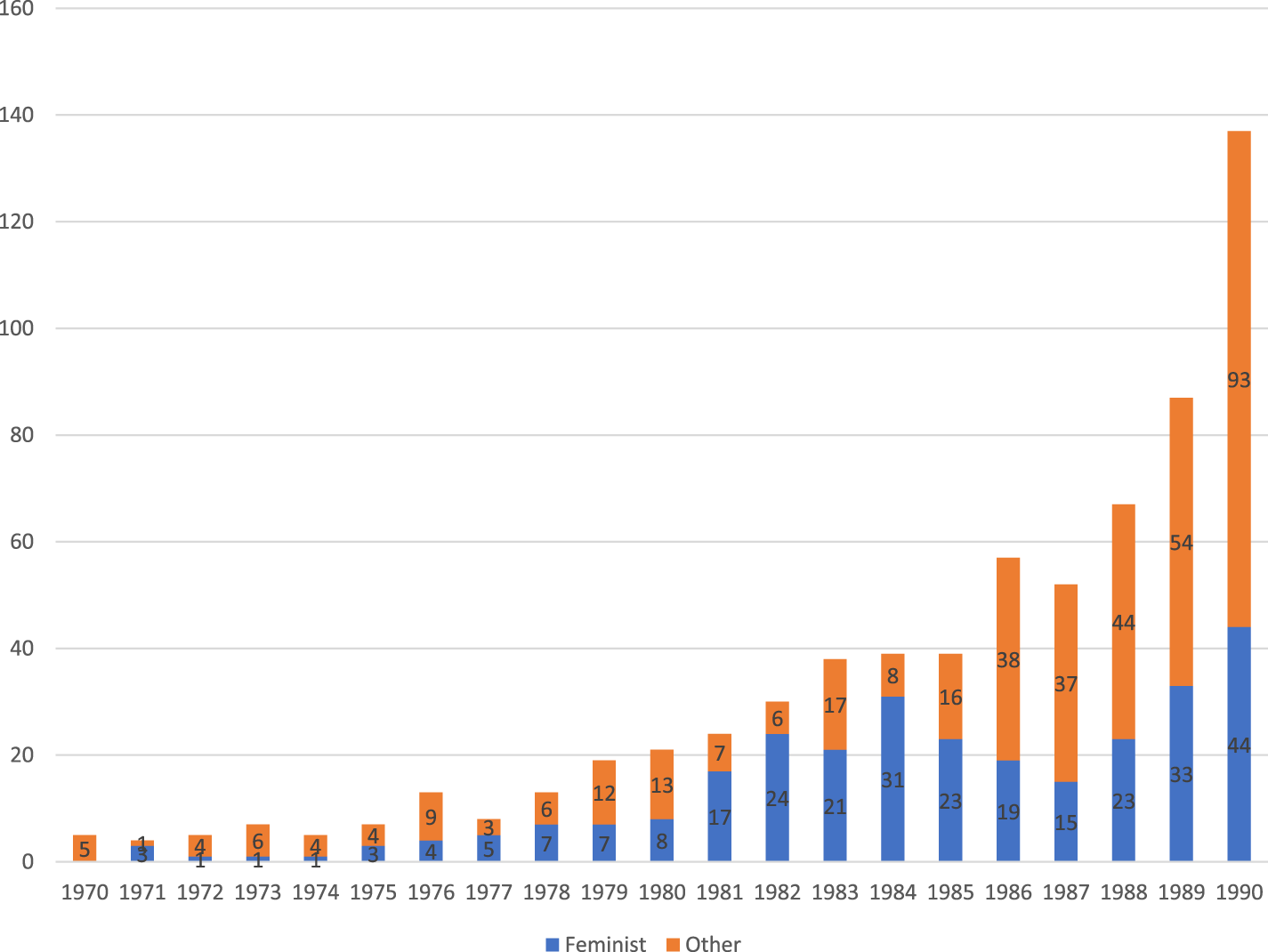
Articles with PC-terms in JSTOR, 1970-1990.
There can thus be little doubt that the discussion within the feminist movement that came to a head at Barnard contributed to a new understanding of the term, which henceforth took on a conceptual charge, especially among (feminist) academics. As we have already seen, the conference was extensively covered in the radical feminist press: OOB devoted most of its June 1982 issue (12.6) to it, and references to the conference recur in several later articles; two years later, the introduction to a thirty-four-page forum in Signs devoted to ‘The Feminist Sexuality Debate’, with contributions from eight different writers, asked whether ‘we want a movement' that labels ‘some sexual practices as “politically correct” and others as “incorrect”?' (Freedman and Thorne, 1984: 104); in 1992, Bat-Ami Bar On was still stressing that ‘Ann Ferguson has claimed in several articles that central to the most recent feminist sexuality debates is disagreement over the “correct” feminist theory of sexuality’ (1992: 45), showing the debate was no passing matter.
The Barnard conference itself of course may have gone all but unnoticed beyond feminist circles, but it was reported on in the independent press, and the conference volume Pleasure and Danger (Vance, 1984) reminded people of the debate. Besides being highlighted in Muriel Dimen's ‘Politically Correct? Politically Incorrect?’, the concept is used in seven further essays in the volume (Allison, 1984: 112; Echols, 1984: 62; Espín, 1984: 162; Nestle, 1984: 234; Newton and Walton, 1984: 243 and 247; Rubin, 1984: 282; Vance, 1984b: 443 and 445), and it is alluded to in yet another two (Hollibaugh, 1984: 402 and 407; Webster, 1984: 395). No one who read the book could fail to realise that regardless of what political correctness might mean, it would henceforth be qualified by whatever political incorrectness might mean. Not all people would have agreed, but all would have recognized that politically incorrect sexuality was in fact more PC than politically correct sexuality, which ironically turned out to be politically incorrect. In the words of Ann Ferguson, sexual freedom according to what she calls ‘libertarian-feminism’ ‘requires oppositional practices, that is, transgressing socially respectable categories of sexuality and refusing to draw the line on what counts as politically correct sexual’ (1984: 109). As these examples make plain, it was in direct connection to the feminist debate on sexuality that the notion of political correctness was ironically inverted, so that the term started to mean the opposite of what its composite parts normally suggest, and the concept of political correctness emerges.
Indeed, while PC terms are used in many contexts in the 1980s, the loaded understanding of political correctness was predominantly a feminist phenomenon. Of the ten journals that contain at least five articles with PC terms in the 1980s, six are feminist ones; in three of the other journals, the topic is often feminism when PC terms are used. Besides the ninety-two articles using PC terms in Off Our Backs, there were twenty-one in The Women's Review of Books, eleven respectively in Feminist Review, Feminist Studies, Signs: Journal of Women in Culture and Society and Social Text (in which five of the articles dealt with feminism), seven in The Radical Teacher (two on feminism), six in Frontiers: A Journal of Women Studies and five respectively in Bibliothèque d’Humanisme et Renaissance (four on feminism) and in Theatre Journal (three on feminism).
Beyond the specific discussion on sexuality, however, political correctness and political incorrectness remained for many people non-ironic terms. Consider for instance Ruth Colker's comment that ‘Although it is now considered unacceptable (or “politically incorrect”) to disregard feminist writing by women of color or lesbians, it is apparently still acceptable for feminists to disregard writing by religious feminists’ (1989: 1015–1016); or Karen Offen speaking about the importance of feminists considering ‘differing notions – among scholars as well as others – of what is politically correct or useful […] if we want to have any significant political effect on the sexual balance of power in today's societies’ (1989: 209). As these examples make evident, those who claim with Barbara Epstein never to have heard ‘the term “political correctness” […] used on the left except in a joking way’ (1995: 8) forget that terms and concepts tend to be used in different ways by different groups of people. While PC phrases were certainly used ironically in some circles by the late 1980s, the concept was still being used with a straight face among people on the left throughout the 1980s. Indeed, it seems likely that the ironic understanding of the concept became predominant among academics, and feminist ones in particular, which may explain why someone like Epstein claimed never to have heard the term used in earnest: to scholars who had suffered the fall-out at Barnard, the idea of political correctness may indeed have seemed too naïve to entertain except ironically.
Outside of feminist circles, however, political correctness remained an indexical term for most of the decade. Thus in the autumn of 1989, Foreign Affairs reported that Chinese ‘bureaucrats will be even more fearful of making politically incorrect decisions’ (Lord, 1989: 5), while Salmagundi recounts how the first French envoy in the new American republic in 1792 tried to embroil America in France's then war with Great Britain by ‘plotting military invasion and fitting out privateers with politically correct names like “Sans Culotte” and “Petit Democrat”’ (Miller, 1989: 184). But there are also a few examples suggesting that the ironic conception of political correctness that emerged from the feminist debate on sexuality was making its way into leftist-liberal debate more generally, especially in the last years of the decade. When Mark Krupnick closes a laudatory review-essay on political philosopher Michael Walzer by singling him out as ‘a person connected with the common life, one of whose tasks it is to expose the hypocrisy of the growing legions of the “politically correct” among us’ (1989: 698), the PC phrase is unquestionably used ironically. Importantly, however, Krupnick's ironic invocation of the ‘politically correct’ – like similar usages of PC terms in the late 1980s – appears only once the loaded understanding of political correctness as something essentially negative had spread from its origins in feminist discourse.
It would seem, then, that the received view of the origins of the term ‘political correctness’ must be reconsidered. The evidence, we have seen, does not support the notion that political correctness, either as term or as idea, has its roots in leftist discourse dating back to the 1960s or earlier. Rather, it emerges from a very particular rupture within the Left, namely the emergence of the North American women's liberation movement as a distinct part of the radical Left in the 1970s. It was in feminist discourse that the term ‘political correctness’ morphed into the concept of political correctness, and it did so in direct conjunction to an internal questioning of ‘the ideology “the personal is the political”’, which some felt ‘started out as liberating but became repressive, as women felt their personal lives were being scrutinized and judged by others’ (Vance et al., 1982: 10), as seen in the question of what ‘is a politically correct sexual line?’ (Vance et al., 1982: 11). After Barnard, large segments of the feminist movement rejected the notion that there could be such a thing as a politically correct sexuality as politically misguided (or incorrect), but still talked about it as ‘politically correct’, giving the phrase an ironic turn it had not had before. This ironic conception of political correctness gradually made its way into academic discourse beyond feminism, but the semantic inversion was neither immediate nor complete. As the sex debate itself shows, many feminists kept insisting that it made sense to speak of sexuality in terms of political correctness, and that it remained important for feminists to do so, to the effect that the neutral understanding of political correctness and its ironic inflection both won ground in the 1980s. Notably, Bernstein's influential article, published on 20 October 1990, channelled a critique of political correctness that was internal to the academic Left, lifting several of its key characterisations of political correctness from a paper presented at a Western Humanities Conference at UC Berkeley by Michel Chaouli called ‘The Invention of Political Correctness: A Reading of Rameau's Nephew’. Chaouli has since published books on Schlegel (2002) and Kant (2017) that owe a good deal to deconstruction, and lists Roland Barthes and Eve Sedgwick as critics whose style appeals to him (2013: 323) – hardly the profile one associates with a critic of political correctness.
Contrary to what Perry and others have led us to believe, the Right in other words did not hijack a term that was already established as ‘the New Left's in-joke’ (Perry, 1992: 16), and which ‘focused and expressed all the uncertainties about dogmatism and preachiness that these new movements were questioning, including the pieties of the Old Left, of corporate America and of the government’ (Perry, 1992: 15). Rather, it co-opted and re-directed a critique against political correctness that was mounting among many people on the liberal Left itself, just at the moment when that critique was on the verge of being theoretically articulated. As a result, the internal critique against political correctness that had been instigated at Barnard was interrupted just as it was about to take a theoretical turn, leaving the feminist movement (and the Left more broadly) in a situation where they had to conduct the debate on the terms of their principal opponents.
The original feminist critique of political correctness, after all, was an internal critique, directed at an orthodoxy within the movement, and at people with whom one shared a common goal: a society cleansed from discrimination based on gender, race or sexual orientation. The right-wing critique of political correctness, in contrast, was directed at their political opponents, and for that reason ought to have been recognised as a sham – not because tendencies to regulate speech on the grounds of its putative political correctness did not exist in the liberal/feminist camp but because the right-wing adoption of the term cemented and exacerbated what was essentially a misuse of the term put in play already in the original feminist critique of political correctness at Barnard. The feminist debate centred around a real issue: what was the politically correct strategy for the feminist movement? That is, how should the movement act to realise its overarching goal of equality between the sexes? While this question may have seemed straightforward enough in the early 1970s, it grew increasingly complex as the movement gradually recognised the intersectional nature of gender oppression.
The feminists who protested the notion of a politically correct sexuality rightly realised that there are areas of experience over which no ideology can be allowed to hold sway; they recognised that extending the notion that the personal is political too far, or without duly acknowledging the personal circumstances of the individual, could not be politically correct. Unfortunately, instead of insisting on the singular nature of personal experience, they simply revolted against the notion of political correctness by claiming that in their experience, what was considered politically incorrect was preferable. In consequence, the epistemological complication that lies at the heart of the heated debate about the relationship between political correctness and feminist theory at Barnard was circumvented rather than highlighted: if one extends the notion of what is politically correct beyond the bounds of a clearly defined situation, one inevitably ends up with a concept that expresses a normative value judgement instead of a strategic assessment of the best way to deal with particular problems in particular cases. Ironically inverting the coding of that value judgement, so that correct comes to mean bad and incorrect mean good, is a way of registering that this slippage from a strategic to a moralistic mode of reasoning is problematic but does not resolve the problem. Rather, it risks making it worse, as the last three decades’ debate about the pros and cons of political correctness demonstrates. For once the over-generalised concept of political correctness becomes the matter of contention, the theoretical question of what constitutes a politically correct mode of action in particular situations (and from particular perspectives) will inevitably slip into an ethical, if not downright moralistic, question about what is good and what is bad in general. The whole point of insisting that the personal is political was precisely to make moot that kind of non-situational epistemology, so to have it return in the question of whether political correctness (in general) is good or bad has been a tremendous blow to feminist critical theory.
Perry's suggestion ‘that the phrase “politically correct” has always been double-edged’, and that this ‘is testimony to a kind of self-critical dimension to New Left politics, a flexibility, a suspiciousness of orthodoxy of any sort’ (1992: 16), in itself signals how easy it is to slip into a moralistic rather than theoretical register when talking about political correctness. I have been suggesting in this article that a better way to further the feminist cause is to acknowledge that the concept of political correctness is in fact much more enmeshed with the contentious yet vibrant history of feminist theory than we have previously realised. If nothing else, it seems the politically correct thing to do: we stand a better chance of exposing the theoretical shortcomings of our ideological opponents if we are willing to own up to our own.
