



Abstract

Over twenty years ago, Amrita Basu, Inderpal Grewal, Caren Kaplan and Liisa Malkki argued that ‘capitalism depended on sexism in order to be global’ (2001: 943). This special issue revisits and updates that claim by combining the critical lenses of social reproduction feminism, world-systems and world-ecology. As Basu et al. rightly observed, ‘[p]utting gender at the very center of considerations of globalization enables us to understand globalization as a set of very uneven processes that are based upon older hegemonic formations as well as new subjects and practices’ (2001: 943). In deploying a reinvigorated social reproduction feminism – which attests to the importance of the daily work of creating and supporting the emotional and physical needs of life outside of that which capital is willing to pay for – we interrogate both hegemonic and newer, gendered labour practices at the heart of the contemporary moment. Our contributors’ analyses of selected world-cultural production reflect how the battle for bodily autonomy, reproductive rights, equality of remuneration and recognition of ‘women's work’ as work rages on, in illustration of the global intensification of what Silvia Federici (2017) has called ‘a true war against women’. 1
Recent years have been characterised by the enduring sexual division of labour and caring work, increasingly gendered labour precarity, ongoing workplace limitations for women, endemic rape culture, the escalation of the battle for reproductive rights, entrenched racialised distinction between women's productive and reproductive labours and the continuing stigmatisation of trans lives. Yet the international war on women is not the only long-term crisis rapidly reaching critical mass. Ecological catastrophe and the climate violence wrought by capitalism feed into, and combine with, the mass migration prompted by increasing tension over resources, mounting ethnic violence stoked by right-wing forces and profound inequality. Both environmental and migratory pressures have contributed to a growing sense of a systemic crisis in physical and mental health – in particular, amongst LGBTQIA communities, displaced and refugee populations, precarious workers and the young. Throughout the world, and across differing economic contexts, women are disproportionately impacted by such interconnected capitalist crises.
The COVID-19 pandemic, itself a product of intertwining social, ecological and public health catastrophes, revealed how profoundly gendered the world of work is – from the UN's observation that 70 per cent of global, frontline workers in the health and social sector at the start of the crisis were female-identifying (Mlambo-Ngcuka, 2020b) to the lack of availability of PPE in sizes to fit women (Porterfield, 2020). It also amplified gendered concerns, including the sharp increase in gender-based violence under lockdown conditions (UN Women, 2020). Many ‘essential workers’, it was quickly discovered, were among those paid least, and affected most by COVID, as epitomised by the plight of migrant women workers the world over, who were ‘disproportionately impacted’ in illustration of how ‘the virus does discriminate’ (Foley and Piper, 2020: 9). Among comparatively more privileged, dual-income households, quarantine meant that paid and unpaid labour had to exist in the same time and space in an unprecedented way. These changing conditions exposed the myth of household gendered equity to some extent, but are also predicted to have detrimental effects on women with regard to the labour market and long-term health (Gould, 2020; Kikuchi and Khurana, 2020; Lewis, 2020; Wenham, Smith and Morgan, 2020). Overall, the pandemic has ‘expos[ed] the deficiencies of public and private arrangements that currently function only if women play multiple and underpaid roles’ (Mlambo-Ngcuka, 2020a). However, as Tithi Bhattacharya and Gareth Dale (2020) have also noted, the crisis revealed the double-sided nature of social reproduction capacities under capitalism, both exposing ‘Capital's reluctant dependence on social reproduction’ and giving rise to a ‘rich outburst of “welfare from below,” or class struggle social reproduction’.
At the same time, existing racist structures have only exacerbated the effects of COVID-19 for global majority populations, leading to higher infection and death rates (Kirby, 2020; Letzing, 2020; UK Gov, 2022), while even UN officials have described the inequitable distribution of vaccines across the Global South as ‘policy violence’ (WEF, 2022). Many of those more exposed essential workers who were celebrated globally were from person of colour and/or migrant communities, yet simultaneously, criticisms of behaviour on public health grounds frequently recycled racially inflected language, as demonstrated by the disproportionate penalisation of BAME communities in countries like the UK (BBC, 2020). In a similar vein, discussions of America's escalating crisis of reproductive justice following the much-discussed 2022 overturning of Roe vs. Wade might have caused the country to be likened popularly to Margaret Atwood's notorious novel The Handmaid's Tale (1985). But, as some commentators have pointed out, the narrative tropes and subjectivities of Atwood's dystopia cannibalised the lived realities of enslaved women on the plantations of the American South (Berlatsky, 2017), never mind the fact that Black and Hispanic women are most likely to bear the brunt of current measures (Beecham, 2022). Meanwhile, as we write, the genocidal assault on Gaza in autumn 2023 by the racialised apartheid state of Israel seems aimed at annihilating the very grounds of social reproduction itself in occupied Palestine, destroying hospitals, schools, universities, and food and water infrastructure. No wonder Zhivka Valiavicharska (2020) cautions that home, family, domestic and care work have ‘acquired different political meanings and social value in communities surviving slavery, racist oppression and violence, and various regimes of racial and social control’.
However, in the current moment, with the efflorescence of powerful feminist movements across the Global South such as the Ni Una Menos (‘Not One Woman Less’) marches that began in 2015 in Argentina, the emergence of collectives of Latin American female artists and art workers such as Nosotras Propenemos or the leading role of women in the farmers’ protests in India since 2020, there is now a rich opportunity to consider anew how social reproduction and the productive economy are interconnected, with greater consciousness of the arising consequences for gender and racial equality, and with regard to ongoing struggles on the terrain of social reproduction. Central to the feminist strikes in Latin America, for instance, has been protest not just against physical forms of violence targeted against gendered and racialised minorities, but also against economic violence and the exploitation of women's unwaged or underpaid care work. The street art of Argentinian feminist activist and visual artist Ailén Possamay (see: Figure 1) captures this emphasis on ‘domestic disobedience’ and seeks to visualise the ‘care tasks and domestic work that women carry out inside the home and that are historically and systematically made invisible and naturalized’ (Possamay, 2019; translation ours). Possamay's series of stencil murals, created on walls in urban communities across multiple Latin American countries, after conversations with locals about their own experiences of care work, depict female subjects carrying out different forms of domestic chores and reproductive labour, coupled with the slogan (inspired by a phrase from Silvia Federici) ‘Eso que llaman amor es trabajo no pago’, which translates as ‘What they call a labour of love is really unpaid work’. Explaining this choice of phrase, Possamay observes: Deploying this slogan that denounces the naturalization of the domestic role of women has to do with the importance of taking to the street, of appropriating the public space that belongs to us and that the feminist movement has sought to win over time. While the system wants us relegated in our homes, working for free, we go out into the streets, to dispute the value of our lives against the system. It is about giving the battle in our community, opening the debate, generating a dialogue and building a new imagination (Cited in O’Higgins, 2018).
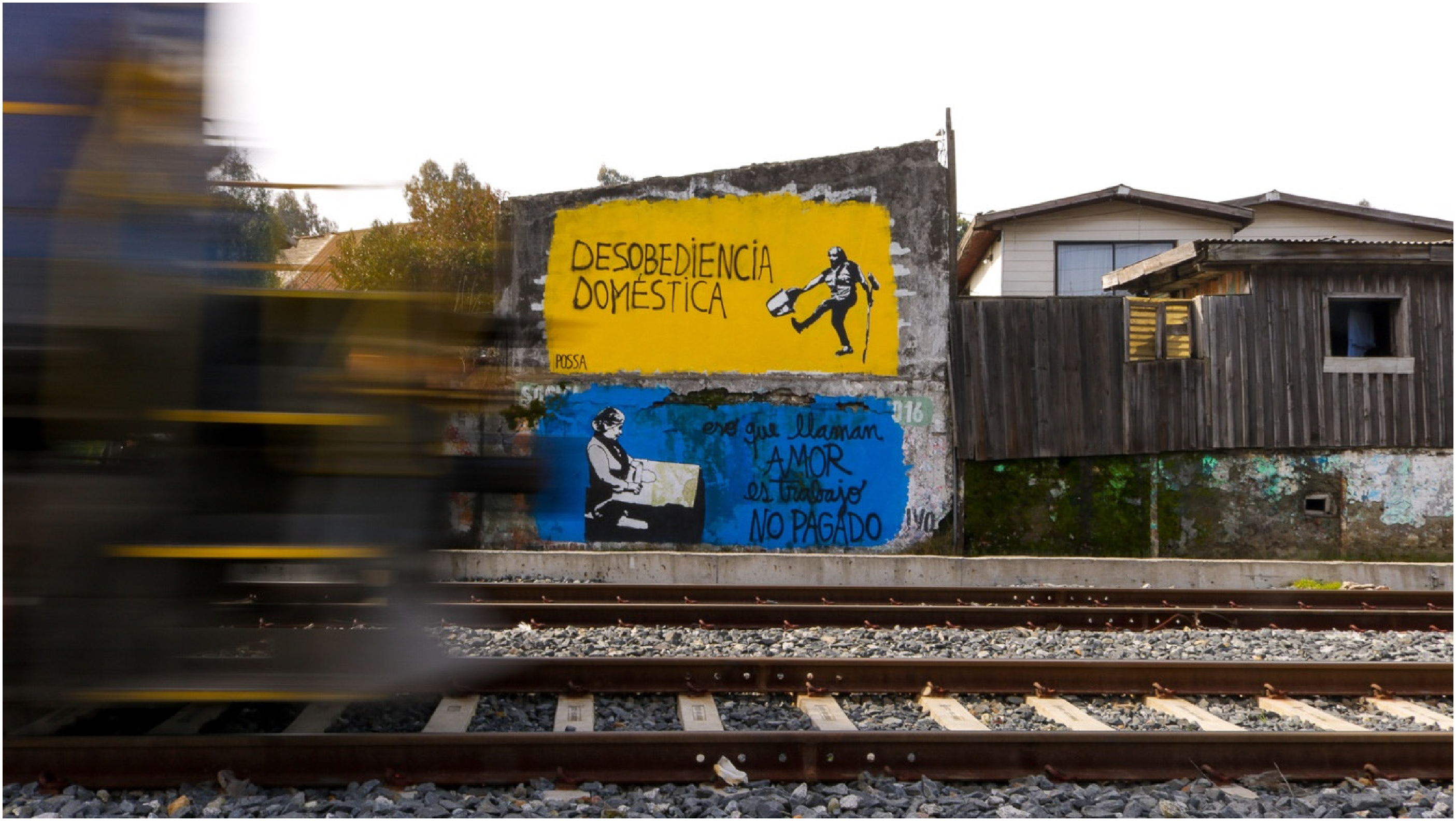
Ailén Possamay, ‘Domestic disobedience / What they call love is unpaid labour’, Concepción, Chile, 2019.
Social reproduction feminism
Alongside these new forms of political organisation and activist art, the past decade has witnessed a blossoming of feminist social reproduction theory both within academic scholarship and across the mainstream media and public sphere. From more veiled discussion of the rift between ‘individualist’ and ‘communal’ feminisms (Donegan, 2018), to increasing mentions of feminist thinkers such as Federici in particular across conventional media (Kisner, 2021), social reproduction as a concept appears to be on the rise. This ‘renaissance’ can be attributed to the ‘intensifying contradiction between the global reach and power of capital’ and ‘the erosion of the conditions’ necessary for social reproduction to occur (Bakker, 2007: 547). If Marx ([1867] 1990) viewed the worker's labour under capitalism as being obscured within the movement of commodity values, then social reproduction feminists believe this is even more applicable to the labour of women the world over, whose prescribed role of birthing, nurturing, cooking, cleaning and caring reproduces the ‘worker’ in the first place. As Houlden (forthcoming), therefore, describes, contemporary social reproduction theorists ‘seek to theorise production and reproduction simultaneously, and within a cohesive model, addressing the gaps in Marx's original discussion’.
Their project harks back to the insights of earlier materialist feminists such as Maria Mies, Selma James, Leopoldina Fortunati, Silvia Federici and Mariarosa Dalla Costa, bringing such work to new audiences while also expanding into fresh territory. Across the 1960s–1980s, these earlier thinkers challenged aspects of orthodox Marxism, emphasising the importance of household labour, and arguing that ‘[w]e inherited a distorted and reformist concept of capital itself as a series of things which we struggle to plan, control or manage, rather than as a social relation which we struggle to destroy’ (Dalla Costa and James, 1975: 5; emphasis in original). Yet their prevailing focus on the figure of the housewife had its limitations: Angela Davis (1983) describes this as ‘a partial reality’ less applicable to black women, who, for much of US history, have worked outside their homes. Hence, she asks, ‘does it automatically follow that women in general, regardless of their class and race, can be fundamentally defined by their domestic functions?’ (Davis, 1983). Similar attentiveness to cultural particularity was demanded by Chandra Talpade Mohanty, when she warned against the tendency of feminists located in academies in the capitalist cores to construct the ‘Third World Woman’ as ‘monolithic subject’ rather than attending to local specificities (1988: 61), including the multifarious demands on global majority women's labour. More recently, some thinkers such as Federici, whose earlier work offered path-making feminist historical materialist analysis of the interdependence of the origins of capitalist accumulation with the subjugation of women, have gravitated towards a problematic reliance on biological understandings of gender that run the risk of ‘attacking those people’ seen as complicit in patriarchal systems of oppression ‘via the erosion of the definition of “women”’ i.e. gender non-conforming and trans individuals (Knudson, 2020). In our view, in addition to creating false antagonists and undermining crucial solidarities, essentialist or biological conceptions that seek to reverse the de-naturalisation of the physical bodies and practices traditionally associated with the concept of ‘women’ detract from the broader question of capitalism's use of social reproductive labour, the gendering of which filters across a range of actual bodies. As Holly Lewis puts it, ‘Capitalism is not simply misogynistic, it is intent on upholding the traditional and oppositional sexism that secures the system. An injury to one is an injury to all’ (2016: 277–278).
In response to such interventions from Davis, Mohanty, Lewis and others, contemporary social reproduction feminism has demonstrated a new commitment ‘to examine the operations of capital, class, and gender not only within borders but also across them’ (Moghadam, 2005: 18). Thinkers such as Cinzia Arruzza, Tithi Bhattacharya and Nancy Fraser (2019) connect the domestic and economic spheres so as to understand the systemic nature of global gender inequality. Important collections such as Tithi Bhattacharya's (2017) Mapping Social Reproduction Theory: Remapping Class, Recentering Oppression redirect focus from the productive economy to issues like childcare, health care, education, family life and the intersecting roles of gender, race and sexuality internationally. This work elucidates the relationship between economic exploitation and gendered oppression, developing understanding of how forms of daily and generational reproductive labour – whether in households, schools, care homes, hospitals or prisons – enable and underlie capitalist modes of accumulation. In line with earlier thinkers, such thought is premised on what Bhattacharya describes as a belief in the falsity of separating ‘activities to reproduce life (unwaged) and the activities to produce commodities (waged)’ (2017: 18) such that ‘the essence-category of capitalism, its animating force’, is actually human labour rather than commodities (2017: 19).
In distinction from previous generations, the present era of financialised capital comes with differing pressures on social reproductive capacity. Neoliberalisation has increasingly recruited women into the paid workforce, while divesting from social welfare, leaving them ‘taking up the slack’ of ‘reduced public service provisioning’ (Bakker, 2007: 546). This has had the knock-on effect of relatively more privileged women outsourcing domestic labour to migrant and/or working-class women of colour, in ways that entrench further global inequality. Resultingly, recent thinking about social reproduction is ‘less grounded in family and the figure of the housewife, instead focusing on the interconnected global nature of race, gender, sexuality and class across strata of care’ (Houlden, forthcoming). Ultimately, the aim of contemporary theorising is: [T]o see emerge myriad capillaries of social relations extending between workplace, home, schools, hospitals – a wider social whole, sustained and coproduced by human labor in contradictory yet constitutive ways. If we direct our attention to those deep veins of embodying social relations in any actual society today, how can we fail to find the chaotic, multiethnic, multigendered, differently abled subject that is the global working class? (Bhattacharya, 2017: 74).
Social reproduction and world-culture
A central aim of this special issue is to put social reproduction feminism into conversation with recent critical debates on ‘world-literature’ and ‘world-culture’. The growing importance of world-literary studies as a field is indicated by the proliferation of institutions, conferences and specialist series engaging with the topic in the past two decades. As globalisation has forced the disciplinary protocols of the humanities into crisis, the turn to questions of the ‘world’ in literary and cultural studies has become part of a broader movement in the humanities and social sciences to re-think hitherto dominant methodological parameters and units of analysis. As the editors of Immanuel Wallerstein and the Problem of the World note, ‘Many of the objects of interest these days … call on us to learn once again to tell large stories, and to tell them better. The horrified recoil from any hint of panopticism has clearly had its day. […] Readers hunger for large stories that … offer them some sort of large-scale vision’ (Palumbo-Liu et al., 2011: 9). This issue takes its cue from those materialist scholars who draw on world-systems theory to argue that world-culture is best conceptualised with regard to the capitalist world-system, and, consequently, that the concept of combined and uneven development provides fruitful avenues through which to compare the aesthetic properties of seemingly diverse cultural forms (WReC, 2015; Macdonald, 2017; Shapiro and Barnard, 2017; Deckard and Shapiro, 2019; Lawrence, 2020; Mukherjee, 2020; Niblett, 2020; Poyner, 2020; Deckard, 2021; Lazarus, 2022; Oloff, 2023; Deckard et al., 2024).
Underpinning these critics’ various discussions is an insistence that the long 500 years of modernity must be grasped, like capitalism itself, as a singular and simultaneous phenomenon, yet one that is everywhere heterogeneous and unique. In this view, modernity represents something like the space-time consciousness corresponding to capitalist modernisation; it might be defined as ‘the way capitalist social relations are “lived” – different in every given instance for the simple reason that no two social instances are the same’ (WReC, 2015: 12). Yet, for any territory integrated into the world-system, the shared experience of capitalist modernisation provides a certain baseline of comparison, even as this experience is lived differently in different locations. Hence the possibility of reconstructing world-literature, or world-culture more broadly, in terms of its relationship to the uneven singularity of capitalist modernity. As WReC puts it, the ‘effectivity of the world-system will necessarily be discernible in any modern literary work, since the world-system exists unforgoably as the matrix within which all modern literature takes shape and comes into being’ (WReC 2015: 20). World-culture (with a hyphen, where the hyphen refers to world-system) is not the story or celebration solely of anti-capitalist cultural production (though it can indeed encompass those critically conscious texts that set out to represent and critique the totality of the capitalist world-system). Nor should world-culture be understood as representing some abstract notion of global culture. The articles in this special issue are interested in all the literary and cultural artefacts produced within the singular but radically uneven world-system, not just those institutions or texts that transcend the national. If world-culture refers to the manifold and many-sided culture of the capitalist world-system, world-cultural production can be expected to mediate ‘the intersection between the desired social reproduction of class identities and relations, as the attempt to reinstall the order of one generation into the next, and the range of responses to the historical changes that are structurally and inescapably generated by capitalism's logistic’ (Shapiro, 2008: 36). As such, world-culture, as a modern category, is shaped by and responds to the particular conditions of capitalism that have different effects on people based on their location within a historical moment within cyclical rhythms and secular trends marked by the variegated logistics of cores, semi-peripheries and peripheries. This approach encourages creative geographic and temporal comparativism, and is open to a range of cultural formats. It places fresh emphasis on how formal disjuncture, irrealist aesthetics and the activation of different generic possibilities might reflect the tensions and exclusions of global capitalism.
To this conception of world-culture we can add an understanding that the capitalist world-system is also a world-ecology. More recently, the ‘world-ecological turn’ has seen literary critics draw on the work of Jason W. Moore, in order to explore how the environmental history of capitalism and its evolution processes of frontierisation is mediated in world-literary aesthetics (Niblett, 2020) or to demonstrate how cultural production mediates ‘the fault-lines of ecology, race and gender’ and registers the ecology of women's work in relation to the socio-ecological relations that sustain capitalist accumulation (Oloff, 2016: 47). Moore formulates that the capitalist world-system is also a ‘capitalist world-ecology’, whose systemic cycles of accumulation are founded in organisational revolutions not only of social relations but also of those ‘bundles of human and biophysical natures’ that Moore labels ‘ecological regimes’ (2015: 9). These regimes are dependent on the dialectic of plunder and productivity: the appropriation of nature's ‘free’ gifts and their transmutation through labour into surplus value. When the commodity frontiers of each successive ecological regime are exhausted and no longer able to produce ecological surpluses, then the conditions of accumulation falter, and ecological revolutions occur. These revolutions comprise ‘creative responses’ to cyclical crisis which produce new technologies and locate new frontiers for appropriation, while intensifying existing extraction.
However, each revolution only resolves the exhaustion of the previous regime by reconfiguring its contradictions on a larger scale, and indeed, Moore suggests that the neoliberal ecological regime which began in the 1970s now faces an epochal crisis of productivity, as the ever-deeper financialisation of nature produces diminishing returns and encounters an intensification of opposition both from human political organisation (as in strikes, labour unrest, anti-systemic struggles, feminist movements) and from the escalation of biophysical resistance to capitalist technics of enclosure and rationalisation, including through the mounting costs of carbon pollution, an increase of zoonotic epidemiological vectors, pandemics, and ‘superweed effects’: ‘the tendency of extrahuman natures to evolve more rapidly than the technological disciplines of capitalist agriculture. In essence, the superweed effect signifies the coevolution of forms of work/energy that are hostile to capital accumulation’ (Moore, 2015: 31). Moore's own proposition of the importance of interpreting the development of the capitalist world-ecology not just in terms of a theory of value in relation to the exploitation of surplus value through economic waged labour but also through the appropriation of ‘unpaid work/energy of humans the rest of nature outside the commodity system’ (2015: 54) is heavily indebted to the insights of materialist feminist thinkers such as Maria Mies, who famously observed in Patriarchy and Accumulation on a World Scale that the subordination and appropriation of the unpaid work of ‘women, nature and colonies [is] the precondition for the continuation’ of capital accumulation (1986: 2).
It is here that a focus on social reproduction feminism conjoins fruitfully with the varieties of cultural criticism inspired by world-systems and world-ecology theory. World-systems differs from other classical Marxist approaches in its insistence that non-waged or poorly waged labour is as essential as fully waged work for the continuation of capitalism: whether the flexible, precarious work of the semi-proletariat, the unpaid work of social reproduction (frequently gendered as ‘women's work’), forms of coerced, unfree and unpaid racialised labour in colonies and peripheries or the unvalued work/energy of extra-human nature. Indeed, feminist world-systems theorist Wilma Dunaway has consistently intervened in the field to foreground the importance of examining the ‘semi-proletarian household’ as a unit of analysis over the longue durée: ‘To treat all peripheral households as though there are no gender differences in the experience of inequality is to ignore the worst effects of the world-system itself. Because women experience two levels of resource inequality (outside and within the household) and because capitalism increases female subordination (outside and within the household), poverty is disproportionately felt by the world's women’ (2012: 97). Illuminating the gendered hierarchies that inscribe what Fernand Braudel called the ‘humble lives at the bottom of the ladder’ (1973: 445, 28–29), rather than focusing solely on inter-state dynamics or commodity chains, is crucial: the terrain of social reproduction is where the appropriation of unpaid work of both humans and nature and the production of inequality is made starkly evident.
Using a social reproductive feminist lens therefore provides an opportunity for scholars who approach world-culture as that of the capitalist world-system – or indeed, capitalist world-ecology – to integrate a deeper analysis of gender, patriarchy and heterosexism into their critique of cultural mediations of capitalist power and accumulation. This issue's articles investigate the ways that the gendered practices, and relations accompanying different phases of capitalist accumulation, particularly the appropriation of unpaid reproductive labour, are mediated in literary aesthetics and cultural forms. We seek to analyse comparatively the ways in which the different bodily dispositions, subjectivities and habituses corresponding to gendered divisions of labour and forms of violence (at both the household and the systemic scale) are registered, visibilised or subverted in cultural production, as well as the forms in which cultural texts can conceive of or imagine modes of dissent and organisation. For cultural critics, the challenge of integrating social reproduction theory into cultural analysis not only entails interpreting texts and media in terms of their discursive representation of gender ideologies. Rather, it should also involve examining the ways that texts might represent sexism and racism as disciplinary strategies to maintain the costs of cheap labour-power or create reserve armies of workers; that is, in delineating the material conditions of appropriation of reproductive labour. Simultaneously, we task scholars from the social sciences to take greater account of the possibilities offered by the cultural domain.
To truly understand and intervene in this contemporary moment, we cannot afford to consider crises of economic and reproductive labour, bodily autonomy, ecology or mental and public health as mutually exclusive, nor to neglect the role of culture in the formation of both hegemonic ideologies and counter-hegemonic political movements. As a result, this special issue seeks to explore how we might better understand such interlinked trends through their representation and figuration in a comparative range of global texts and media. If social reproduction feminism ‘provokes us to examine the ways in which seemingly independent sets of relations (those that play out in racial, gendered, sexualized, colonialized ways) are part and parcel of a capitalist class dynamic of dispossession and accumulation’ (Ferguson, n.d.), and seeks to make visible the forms of labour and work that are ‘analytically hidden by classical economists and politically denied by policy makers’ (Bhattacharya, 2017: 2), then this issue contends that engagement with literary and cultural forms can play an important role in recuperating the subjective experience of women's everyday life.
Furthermore, this special issue's combining of the economic, socio-ecological and cultural provides an opportunity to place theories of resistance from both social reproduction feminism and world-cultural analysis in dialogue. The capitalist world-ecology constantly organises and reorganises states, ethnic groups and households in a historically dynamic way to respond to and contain capitalist crises of decreasing profitability. But it also gives rise to anti-systemic movements that ‘simultaneously undermine and reinforce the system’, often through ‘a pattern of cyclical rhythms and secular trends that incarnates the inherent contradictions of the system and which accounts for the systemic crisis in which we are presently living’ (Wallerstein, 2001: 268). As such, it is crucial for critics to adopt a dialectical approach that does not assume the ‘inevitability’ of the rise or collapse of particular hegemonic organisations but rather understands how relations are always contested at decisive turning points in the formation of the historical capitalist world-system through the periodic upheavals of rebellions, social movements and ‘popular anti-systemic struggles and discourses as well as governance strategies to contain them, coercively, politically and ideologically’ (Murray, 2016: 85). The pressure of history-from-below, of feminist strikes and labour unrest, of revolutionary movements and liberation struggles, of anti-capitalist and anti-systemic movements, shapes both the end of particular hegemonic organisations of capital and the forms that new organisations of social relations take.
Social reproduction theory offers the potential not only for a critique of oppression and exploitation from above but also for a vital understanding of the particular forms of contestation that can arise from the contradictions of social reproduction. As Bhattacharya writes, social reproduction theory ‘exposes to critical scrutiny the superficiality of what we commonly understand to be “economic” processes and restores to the economic process its messy, sensuous, gendered, raced, and unruly component: living human beings, capable of following orders as well as of flouting them’ (2017: 19). Social reproduction is both necessary to capitalist accumulation and contradictory, since capitalism strives towards ‘relations that constrain – though for the most part do not fully extinguish – working class people's capacity to meet not only their subsistence needs, but also those physical, emotional and intellectual needs and desires that exceed that which capital is willing to pay for’, but ‘always and everywhere, the bodies and minds of workers can and do push back against the dehumanising dynamic they are part of’ (Ferguson, n.d.). Accordingly, social reproduction theorists such as Salar Mohandesi and Emma Teitelman (2017: 47) have called for a shift in the focus on the history of class struggle from the organised activity of male factory workers to the forms of political contestation arising on the grounds of social reproduction, where they argue that actions can not only catalyse struggles elsewhere but also help stitch them together. Meanwhile, writing on the geographies of resistance in world literature, Joel Nickels has called for a cultural criticism that is more attentive to representations of forms of non-state organisation in peripheral and postcolonial societies, investigating mass-based resistance ‘whose terminus is not the capture and administration of the state’, and which often arise from crises of social reproduction (2018: 2). Following the lead of these critics, this special issue gathers contributions that analyse cultural representations both of social reproduction and of resistance arising from within the squeeze on reproduction itself. They examine how waged and statist struggles themselves depend on the accompanying organisation of workers in social reproduction, whether in the provision of food and water, childcare or the immaterial resources of nurture. The articles that follow foreground the cultural mediation of gendered forms of reproductive labour, as well as the ‘women's work’ involved in enabling the ‘suturing together’ and survival of resistance movements, as described by Selma James (2012).
Articles
In ‘Countertopographies of Copper: Martha Rosler, Chris Kraus and the Great Arizona Copper Strike of 1983–1986’, Myka Tucker-Abramson stages an intervention into feminist histories and culture by situating the novels of Chris Kraus against a broader tradition of feminist conceptual artists like Martha Rosler, who took the labour of predominantly white middle-class housewives as a standpoint from which to understand the expansion of US-backed global capitalism. Tucker-Abramson posits both Kraus and Rosler as enacting what Cindi Katz (2001) terms ‘countertopographies’ by using the reproductive sphere as a site from which to map global capitalism's uneven effects, while simultaneously exploring their own troubled response to the imperialist project of mapping itself; as such, she interrogates the ideological implications embedded in both mapping and art. If, as Tucker-Abramson makes clear, ‘the haunted unconscious of art in the 1960s and 1970s was reproductive labour (and Cold War militarism)’, then ‘during Kraus’ era art's unconscious is finance, gentrification, and war-making, with the liberated, entrepreneurial ex-housewife becoming a central figure’, with her own associated class- and race-biases (in this issue). Specifically, both artists mobilise strike histories, and working-class revolutionary women as decolonising counter examples, holding reproductive fictions to account by instantiating, as alternative, ‘a countertopography of copper rooted in a collective struggle’ (in this issue).
In ‘Domestic Service and Chilean Literature: Fictional Experiments in Narrating the Household’, Daniella Sánchez Russo makes an original contribution to thinking about social reproduction in Latin American contexts. She makes a case for the powerful nature of literary possibility, arguing that: ‘If the novel is capable of renewing itself through literary interpretation of persistent institutions, then this spirit of reinvention can potentially be applied to reconceiving society by envisioning structures of reproduction that are not grounded in exploitation’ (in this issue). Comparing fiction by Chilean authors José Donoso and Diamela Eltit, Sánchez Russo argues for their historicisation of the continent's reproductive sphere, anchoring domestic workers and literary specificities to national and global economic realities. In the case of the former, she outlines the varied literary strategies used to portray feminine labour, making a case that the ‘collapse in traditional master–servant relationships not only informed everyday life but, crucially, also heavily influenced Chile's literary development’ (in this issue). The works of Eltit, she claims, serve as a ‘new reiteration of an aesthetics of domestic service within Latin American peripheral literary traditions’ (in this issue), their direct language serving to demonstrate how precaritisation of the workforce has left many incapable of meeting their basic social reproductive needs. As such, she addresses reproductive labour not only as thematic component but also as formal and aesthetic anchor-point. In tandem, Sánchez Russo suggests that her chosen texts ‘periodise and problematise the persistence of an institution that has largely been disregarded as archaic, despite its essential capitalist function in the continuation of human life’ (in this issue). In so doing, she captures key moments of transition, and transformation, in Chilean domestic labour that are not fully documented in historical study.
In ‘Unruly Magic: Global Resource Extraction, Witchcraft and Resistance in Yaba Badoe's The Witches of Gambaga (2011) and Wolf Light (2019)’, Treasa De Loughry concentrates on the work of Ghanaian-British film-maker and author Yaba Badoe, and her use of representations of magic and witchcraft in registering the impact of neoliberal extractivist heteropatriarchal capitalism. Ranging across the 2011 documentary Witches of Gambaga, Badoe's account of that film's research and the author's young-adult novel Wolf Light (2019), De Loughry analyses how these texts’ figuration of witches as eco-utopian earth defenders and transformative shape-shifters provides a way of protesting neoliberalism's compound crises of reproduction. Following Giovanna Di Chiro's (2008) argument for a ‘coalitional’ approach to social reproduction as environmental issue, the article argues that ‘ecological destruction has yet to be adequately theorised in relation to social reproduction theory’ (in this issue). Accordingly, the article interrogates the interlocking processes of gendered exploitation and biophysical extraction on which capital accumulation depends on a world scale. In particular, De Loughry makes the case that Wolf Light builds consciously on global histories of women's oppression, reinvesting such narratives with a focus on local struggle. As the article concludes, witchcraft is ‘both threat and promise in Wolf Light, suggesting counter-histories of feminist care and alternative ways of co-existing with nature’, while simultaneously ‘building unevenly on global histories of women's oppression, from European witch hunts to recent sub-Saharan African accusations’ (in this issue).
In ‘Tracking the Monstrous Gendered Precarity of Neoliberalisation through Novels and Films of 1980s England and Contemporary Ireland’, Kate Houlden compares novels and films from 1980s working-class industrial England with those from post-Celtic Tiger middle-class rural Ireland, in order to build a generational argument as to the intensifying social reproductive consequences of neoliberalisation. Despite their different settings and demographic, she argues that Pat Barker's Union Street (1982) and Mike McCormack's Solar Bones (2016) both bring peripheral political experience to life to show how the bodies of women bear the brunt of late capitalism's horrors. Identifying an aesthetic through-line in the portrayal of social reproductive violence across both early and later stage neoliberalism, Houlden draws out both authors’ use of the gothic – particularly their deployment of vampires, zombies and vomiting – as an ‘irrealist’ tool (WReC, 2015). In so doing, she imbricates social reproduction theory with world-literary analysis and genre studies. Her argument is supported by reference to the wider literary and cinematic landscape, including the films Letter to Brezhnev (1985), Rita, Sue and Bob Too (1987) and Kissing Candice (2017). As she puts it, her chosen novels and films ‘make clear the devastating effects of the emerging crisis in care for women and girls’ while simultaneously harnessing their particular contexts ‘to global neoliberal crisis by using gothic modes and the motif of vomiting to help bridge their readers’ disjunctive experience of these shifting, but very necessary, scales’ (in this issue).
Christine Okoth, in ‘Narrative Reproduction: Plotting Land in Yvonne Owuor's Dust (2013)’, uses Silva Federici's recent work to contextualise the analysis of social reproduction and narrative reproduction with regard to the contemporary African novel. Her article begins with an analysis of Federici's writings on Nigeria, before developing a reading method which traces Owuor's use of land as generator of plot. Dust (2013), Okoth argues, exemplifies how the novel as a colonial form falls into crisis around an attempt to reach for the narratively reproductive potential of disavowed, arid lands at the borders of the postcolonial nation-state. Not only does the novel's caretaker character take on tasks ‘often associated with women's reproductive work’ but he also takes on ‘the task of narration’ (in this issue). As such, Dust's connecting of ‘house, nation, and novel’ reveals literary genre to be ‘reliant on an exploitation of the land's resources as the architectural structure and the political unit’ (in this issue). Owuor's novel, therefore, both chimes with theoretical interventions that depict social reproduction in Africa as a general theory of feminisation – of people and land alike – and offers an answer to how social reproduction might be rendered in literary formal terms.
Finally, in ‘Social Reproduction, Struggle and the Ecology of “Women's Work” in World-Literature’, Sharae Deckard returns to the question of the ecology of work and struggle in the sphere of social reproduction. Reading novels by Kamala Markandaya, Ousmane Sembène and Latife Tekin, she investigates literary depictions of three different types of environment-making labour that have been gendered as ‘women's work’ – foodgetting, water-carrying and waste-picking – in order to examine how novels imagine the terrain of social reproduction both as a site of appropriation, violence and crisis and as the potential ground for organised resistance. Elaborating insights from feminist scholars such as Maria Mies, Wilma Dunaway and Harriet Friedmann, the article explores how ‘women's work’ in the realm of social reproduction, particularly in the (semi-)peripheries of the world-ecology, often draws heavily upon natural resources and is thus preponderantly affected by forms of resource depletion and environmental crisis including water scarcity, land degradation, pollution and toxification. Deckard argues that world-literary criticism can help illuminate the socio-ecology of gendered forms of labour, by analysing how bodily dispositions, subjectivities and habituses corresponding to gendered divisions at household and systemic scales are mediated in specific literary aesthetics, and recuperating the utopian prospects of how texts imagine forms of struggle as arising from the contradictions immanent to capital's dependence on the unpaid work of both nature and social reproduction.
Roundtable
This special issue closes with a roundtable discussion that brings together its primary concerns in dialogic fashion. Featuring editor Kate Houlden in conversation with Amy Rushton (Nottingham Trent University), Alden Sajor Marte-Wood (Rice University), Daniella Sánchez Russo (Universidad del Norte) and Rashmi Varma (University of Warwick), it elaborates the possibilities opened up by the use of social reproduction theory in intersection with world-literary, materialist feminist, queer Marxist and world-systems approaches to literature and culture. In particular, contributors consider how the analysis of social reproduction might illuminate the politics of everyday life, the representational challenges accompanying the banality or ubiquity of women's work, the potential gaps of social reproduction feminism and the aesthetic challenges accompanying or following from an interest in social reproduction. Topics covered include digital media as foundational operating mode of Hindu nationalism, the sexuality- and race-based exclusions of employment in higher education, Philippine literature as ‘reproductive fiction’, the Latin American novel vis-a-vis its registration of domestic service, the short story as bellwether for global issues surrounding women's labour and questions of complicity in the kinds of labour some women and sexual minorities enact for larger authoritarian, patriarchal projects. As Rashmi Varma puts it, ‘women do the disproportionate work of producing the everyday which is the instrument of hegemony in an important sense’, hence a ‘potent site for understanding the fine-grained texture of reproducing dominant ideologies and of the affective labour that is required to keep them dominant’ (in this issue). By that same token, and with some reservations, we must also ask how women might re-make the everyday along more radical and radically egalitarian lines.
In conclusion, we would like to acknowledge that this issue is very much the product of collective intellectual endeavour and collaboration: alongside many fruitful conversations with its contributors, this collection of articles builds on a series of talks, conference panels and publications within wider networks of colleagues and friends. Some of these include the events ‘Women and World Literature’ (National University of Ireland, Galway, 2016) and ‘Gender and Global Crises’ (University of Oslo, 2019), as well as conference panels at EACLALS 2017 (European Association for Commonwealth Literature and Language Studies), PSA 2017 and 2019 (Postcolonial Studies Association), MLA 2022 (Modern Languages Association) and Women in World-Literature 2022 (Warwick University). We would like to extend our particular thanks to Sorcha Gunne, an original joint editor of this special issue and a crucial influence on its genesis, ideas and politics; to Roxanne Douglas and Fiona Farnsworth for their willingness to allow us to develop this discussion further in a roundtable at their invigorating conference in Warwick; and to Lise Sanders and the Feminist Theory editorial collective for their support and guidance.
Footnotes
Funding
The author(s) received no financial support for the research, authorship, and/or publication of this article.