




Abstract
This article presents reflections on our pre-Covid-19 exhibition Care and Control, and our interdisciplinary collaboration between artist Alice Tatton Brown and social scientists Maud Perrier and Junko Yamashita. The reflections expand current feminist debates about self-care and collective care by centring the importance of public space, refusals and contracts. Care and Control was designed as both an exhibition and a meeting place, created through our ongoing collaboration. It took place in a shopping centre in Bristol (UK) in June 2019. The exhibition was a collage of feminist archival objects and print, contemporary installation and community engagement. Care and Control began broadly as an experiment to seek out alternatives to an individualist approach to self-care, by researching how Women's Liberation Activists practised self-care and collective care beyond the household, and within protest, friendship and public space. In this article, we make a methodological contribution to feminist discussions of collective care by showing how our strategy of a) making a public exhibition and b) writing a Contract of Care is a significant technique for enacting some of the promise of Audre Lorde’s ‘self-care as warfare’. We show how Care and Control, drawing from the legacy of the Women's Liberation Movement, generated resources for countering definitions of self-care that predominate. Reflecting on how the Covid-19 pandemic has exacerbated classed, racialised and gendered divisions in reproductive labour, our article suggests that self-care and collective care need to be conceptualised drawing on social reproduction.
Keywords
Introduction
The exhibition Care and Control was an experiment in collective care inspired by the Women's Liberation Movement (WLM). The exhibition took place in a vacant shop in the Galleries Shopping Centre, Bristol (UK), from 7 to 15 June 2019 (Figure 1). Designed as both an exhibition and a meeting place, Care and Control displayed archival objects and print material on loan from the Feminist Archive South (FAS), alongside a contemporary installation and a communal space for visitors to make a badge, read, rest and talk.
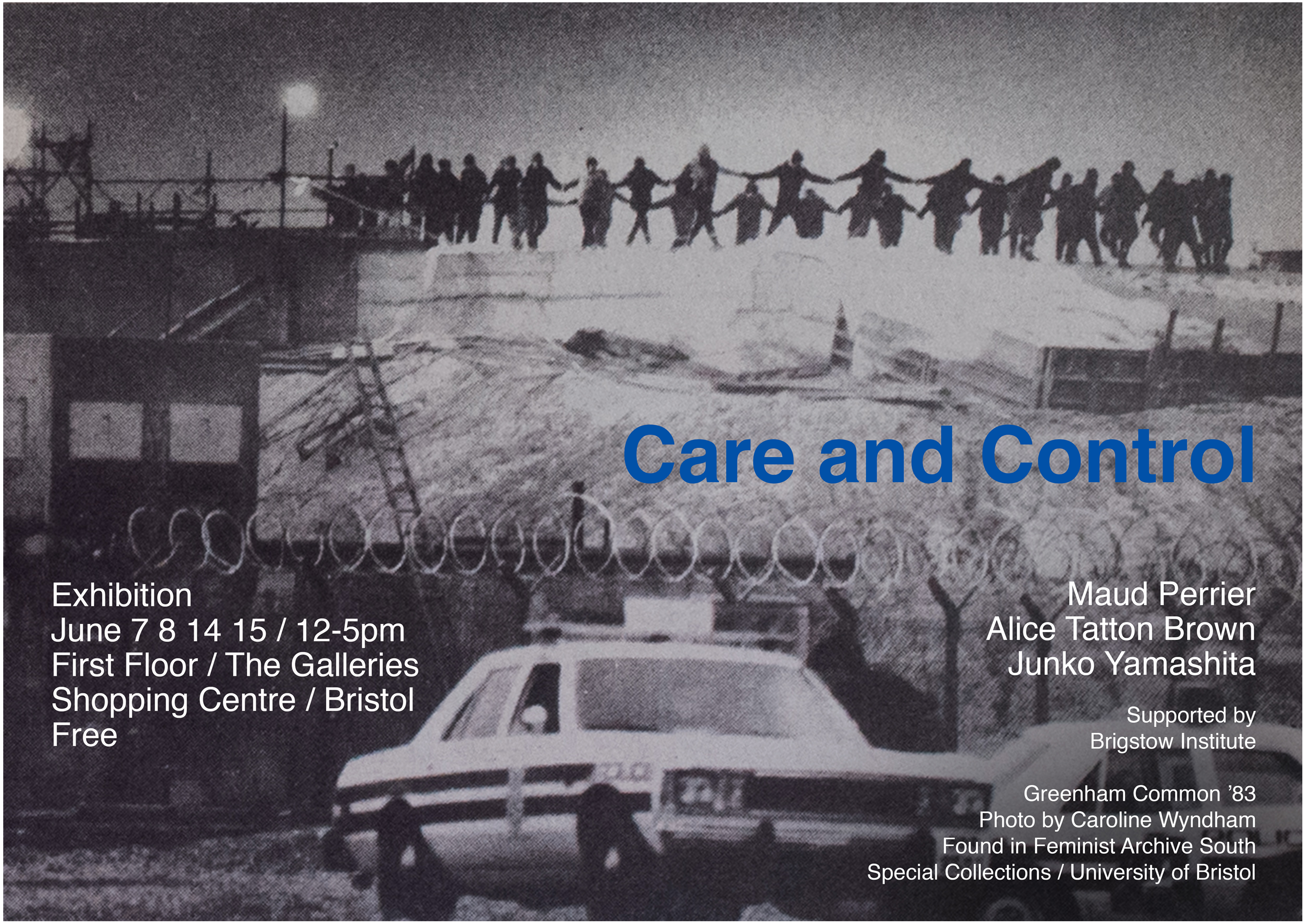
Care and Control: poster.
The Galleries Shopping Centre first opened in 1991, a three-storey shopping mall covering five acres of Bristol city centre, which in post-pandemic Britain has now been earmarked for demolition and redevelopment in 2024. The Care and Control exhibition was on the first floor, located between a Pound Shop and Boots Pharmacy, and importantly for footfall, was en route to the public toilets. If you were to peer through the large windows of the exhibition space, you would see a 3-metre-high chain-link fence encircling plinths, screens and a table and benches (Figure 2). Once through the double doors, visitors were required to pass through a hole in the chain-link fence, and once across the threshold, they were warmly welcomed with the offer of a cup of tea or coffee. For those who were inclined to enter, the hostility of the chain-link perimeter fence prompted a schism in the ‘business as usual’ context, introducing a new set of expectations around exchange, hospitality and refusals. We wanted to mark the threshold between the commerce of the shopping mall and collective action (re)presented in the exhibition through the fence. Indeed, whilst researching within the FAS, the team were particularly struck by the images of the RAF Greenham Common
1
(1983) perimeter fence. Not only had it become a charged threshold of state power and violence, it was also the canvas for a multiplicity of voices and intimate concerns of the women in the Women's Peace Camp. Inspired by the collective action of writing over or decorating the fence, we drew from Sara Ahmed's Killjoy Survival Kit (2017) to experiment with creating a contemporary installation on the fence. The Collective Survival Kit (2019) was an assembly of objects and images borne out of a call to Feminist activists, our female peers and elders. More specifically, prior to the exhibition we asked these women
2
to consider which objects soothed their weariness, or inspired disobedience, or helped them step up to, or step down from, their commitments. Within Care and Control, tied onto the chain-link fence were the objects we were loaned as personal responses to this provocation. The Collective Survival Kit (2019) consisted of: Swimming Costume, Patchwork Blanket, Book – Half the Sky: an introduction to Women's Studies
3
, Plant, Telephone, Floral Headpiece, Chainsaw Boots, Book – Women who run with Wolves, Photograph of Pet Cat, Candle, Bracelet – Journey to Justice, China Mug, DM Boots, Breast Milk in Freezer Bag, Ganesh Trinket Box, Fresco Painting – Madonna del Parto by Piero Della Francesca, Mooncup and Small Blue Pot.
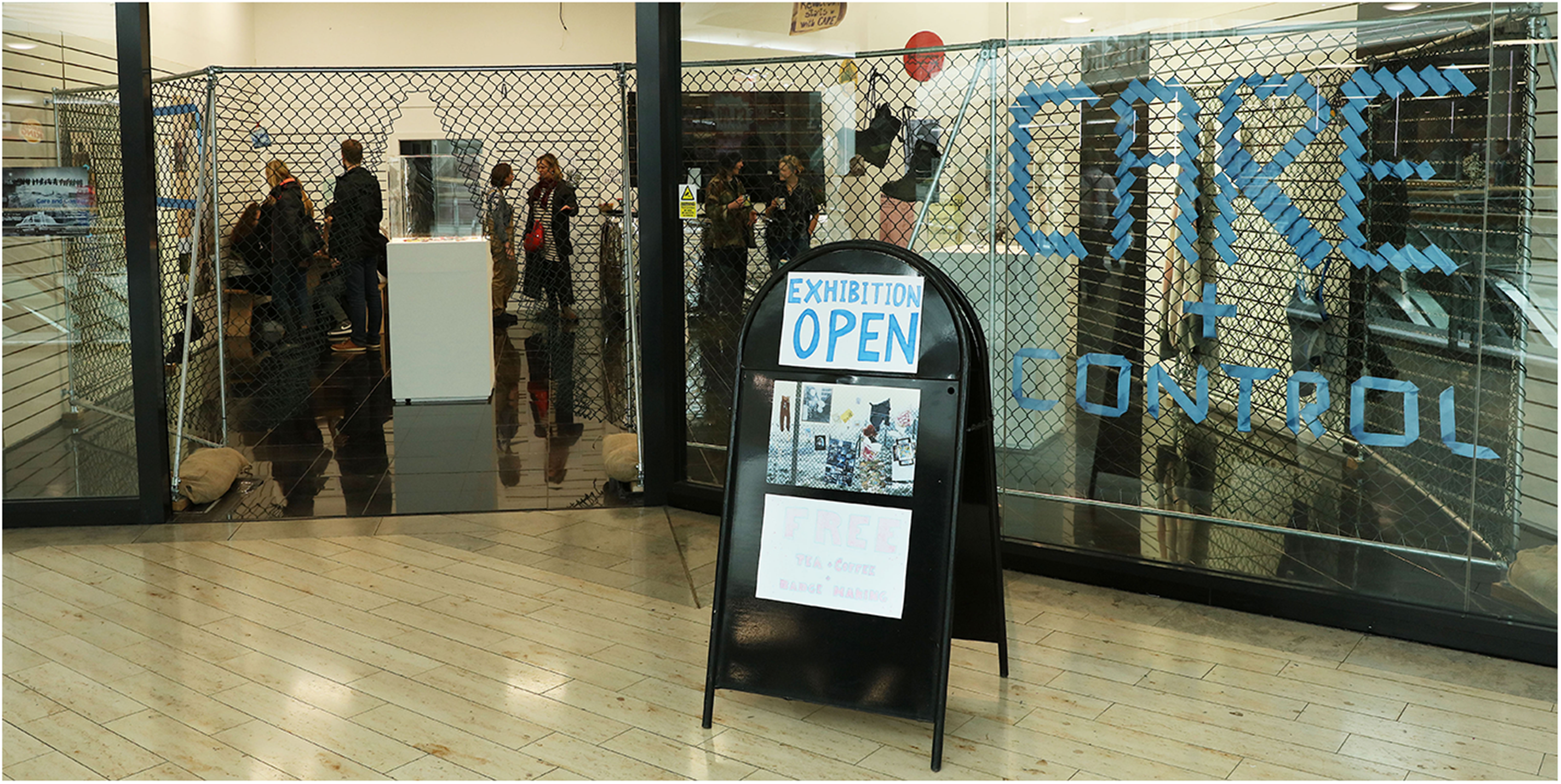
Care and Control exhibition: external display (Photo by Jana Rumley).
The Collective Survival Kit also addresses a broader language of art making, which exists within social practice or socially engaged art. Dominic Willsdon writes in regard to US artist Suzanne Lacy: ‘one of its [social practice or socially engaged art] central functions is to enable us to see relationships, and those relationships can be seen as sociopolitical, as they are aesthetic’ (Frieling et al., 2019: 41). The Collective Survival Kit invites visitors to think through objects, some of which are beloved, practical, decorative or fragile, exposing impressions and questions about what it is we are being asked to survive, and how we can be part of each other's survival.
Archival objects on loan from the FAS included forty-five feminist badges (Figure 3), an original piece of RAF Greenham Common fence and a broad selection of copied print material from publications, posters and photographs. In addition to the visual material, there was an audio recording of the event ‘Forty Years a Feminist’, 4 which featured a discussion chaired by Helen Taylor between panel members Liz Bird, Helen Dunmore, Ellen Malos, Pam Trevithick and Jackie West, 5 with a number of contributions from the audience, many of whom were also proudly part of the WLM.
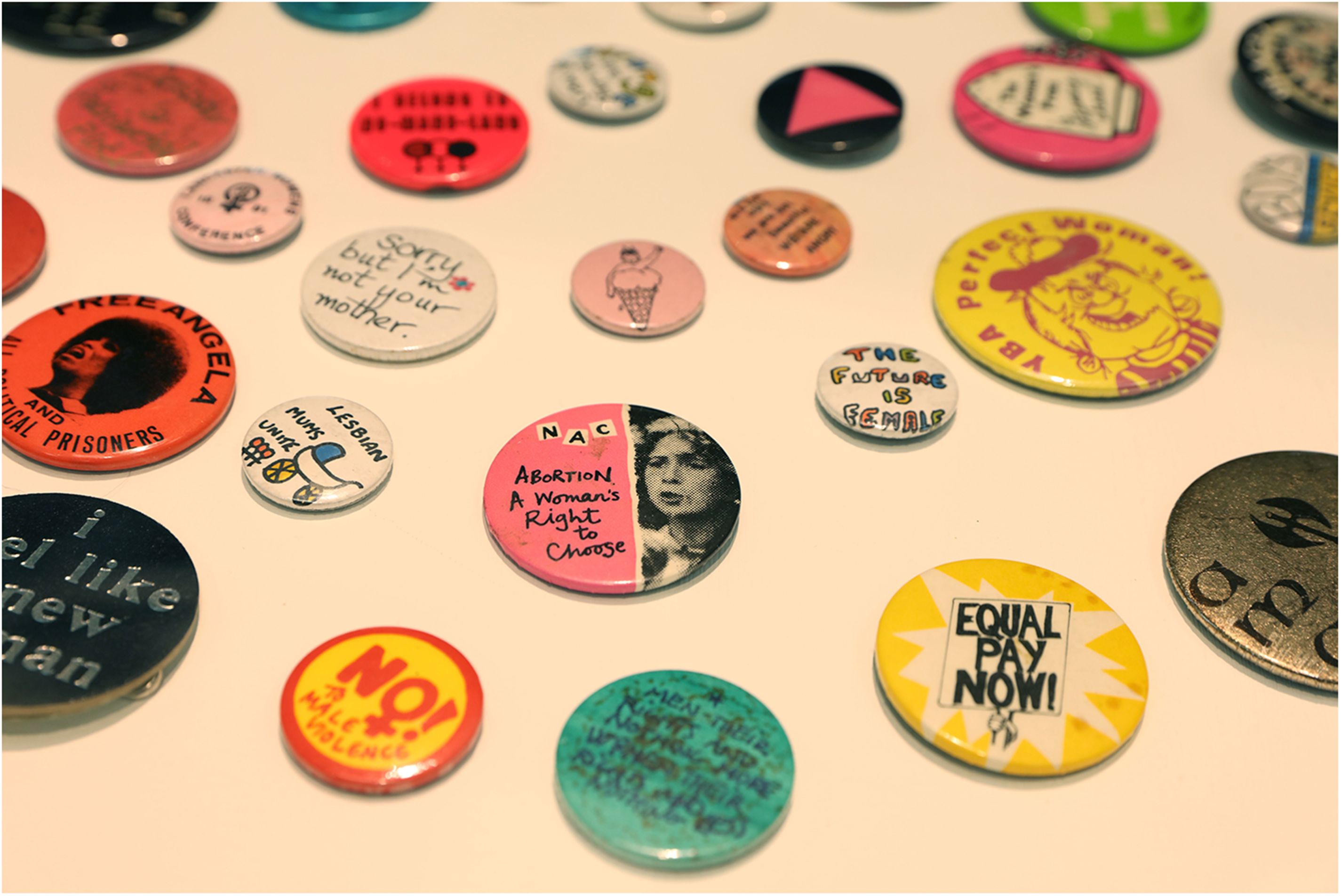
Care and Control exhibition: display of badges on loan from Feminist Archive South (Photo by Jana Rumley).
The name of the exhibition came late in the process of conception and design, as we sought alternatives to our working title, Experiments in Collective Care. Care and Control (1977) was originally a play by the Gay Sweatshop Theatre Company in London, about the prejudice faced by lesbian mothers in custody cases with the state. Our choice to name the exhibition Care and Control (2019) continues this examination of the role of state power in determining who, how and what we are permitted to care for. Alongside the inclusion of the chain-link fence, the Collective Survival Kit and the archival objects and print, this choice of title signalled our desire to explore how feminists – past and present – have reclaimed control over how we care for ourselves and others.
In this article, we draw from our experience of the exhibition, the collaboration and the pandemic to reflect and expand upon current feminist debates about collective care. Collective care has been and continues to be imperilled under neoliberalism, and in our conversation we argue for the importance of re-centring feminist public spaces and contracts which make collective care possible.
Theorising collective care pre and post pandemic
Pre the Covid-19 pandemic, we were inspired by Audre Lorde's declaration that self-care ‘is not self-indulgence, it is self-preservation, and that is an act of political warfare’ (1988: 112). As a consequence, our research in the FAS sought out alternatives to an individualist approach to self-care by examining how Women's Liberation activists practised self-care and collective care beyond the household, and within protest, friendship and public space. We identified archival objects and print material from FAS which expressed the WLM struggles to care for each other in new ways. By exhibiting the archival objects and print material alongside the Collective Survival Kit, we hoped to bring past and present into closer proximity, to question the continuity and survival of feminist communities and ideas across the last fifty years. We make a methodological contribution to feminist discussions of collective care by showing how our strategy of holding an exhibition and tactic of writing a ‘Contract of Care’ are significant techniques for enacting some of the promise of Audre Lorde's ‘self-care as warfare’. As Sara Ahmed's (2014) reading of Audre Lorde's definition makes clear, the strategies of marginal communities often blur the boundaries between self and collective: In directing our care towards ourselves we are redirecting care away from its proper objects, we are not caring for those we are supposed to care for; we are not caring for the bodies deemed worth caring about. And that is why in queer, feminist and anti-racist work self-care is about the creation of community, fragile communities, assembled out of the experiences of being shattered. We reassemble ourselves through the ordinary, everyday and often painstaking work of looking after ourselves; looking after each other.
Reflecting Sarah Ahmed's deliberation, we want to claim that Lorde's definition of ‘self-care as warfare’ comes alive if we centre collective care. Our project therefore began by focusing on exploring the relationships between self-care and collective care. Collective care is when individuals’ shared identities and/or needs create a sense of reciprocity and belonging, which usually involves practical action, emotional support and political companionship. Self-care is directed towards ourselves. However, self-care, we argue, can also be enabled through collective care. As presented later in this article, our reflective conversations during the Covid-19 pandemic brought us to revisit the reasons why we did not want to predominantly engage with childcare or elderly care (either paid or unpaid) as a form of collective care. We made a conscious choice in this project to focus on the collective care that characterises friendship and activist companionship.
Refusing to care for others in favour of caring for ourselves usually involves breaking and remaking expectations, obligations and daily habits. This can make ‘self-care as warfare’ difficult to practise, particularly for those who bear the gendered, racialised and/or classed responsibilities of care. By contrast, the history of middle-class women's self-care is tied up with individualistic bourgeois ideals which assume access to leisure time. Here we are interested in corrupting individualistic self-care with the archives of women's collective struggles, such as those of domestic workers. At the same time, we also reflect upon the impossibility of fully refusing to care for ‘the proper objects’ (Ahmed, 2014), especially dependants, which is a tension in our responsibilities to kin and to one another we explored in our conversations.
Theorising care as a political practice located within unequal power relations informed our research for the exhibition. Historically the middle class has depended on low-paid, feminised and racially minoritised workers to carry out social reproductive work in the domestic sphere and more recently waged work in the new service and care industries. The Covid-19 pandemic both laid bare and exacerbated the crisis of care and the power relations embedded in the care system. At the same time, this acknowledgement often translated into ‘care washing’, with an increase in public recognition and an outpouring of tributes, whilst neglecting questions of economic precarity, and hostile immigration/employment policies. This article, therefore, offers reflections on how feminists might seize this moment of heightened public consciousness about long-standing gendered, classed and racialised divisions of social reproductive work.
Research carried out during the Covid-19 pandemic has highlighted how collective care was a significant practice of repair and solidarity for some migrant communities, health care workers and women academics (Desai et al., 2021; Leetoy and Gravante, 2021; Plotnikof and Utoft, 2021; Raap et al., 2021). However, most of this scholarship is grounded in care ethics (Tronto, 2013) and has yet to fully grasp the implications of the historical moment of the pandemic to long-standing feminist debates about classed and racialised divisions in care and social reproductive labour. Our article addresses both of these questions.
Echoing those who have critiqued the characterisation of contemporary feminisms through the frames of co-optation and depoliticisation (Gannon et al., 2015; Perrier and Fannin, 2016; Roy, 2017; Eschle and Maiguashca, 2018), our research shows, firstly, that there are strong lineages with earlier feminist praxes of collective care which persist today within and beyond the neoliberal academy. Secondly, we show that feminist tactics for fighting the neoliberalisation of self-care need to involve refusing narrow definitions of care (ones that prioritise parent–child relationships and individual private heterosexual households), whilst centring care through a labour lens (illustrated by the method of Contract of Care) and understanding care as both dividing and binding women across class and ‘race’. In what follows, we show how these approaches informed and transformed our praxis of collective care. Ultimately, this leads us to argue for a praxis of collective care that is more closely informed by social reproduction theory.
Methodology: Enacting collective care through the collaborative research, the Contract of Care and the exhibition
As noted above, the Care and Control exhibition combined archival objects and print material, contemporary installation and community engagement. The project initially began as a series of conversations and what followed were three discernible phases before the launch of the exhibition: 1) archival research at the FAS, 2) focus group interviews with feminist scholars and 3) conceiving, curating and building the exhibition, including writing a Contract of Care together. This section offers our account of how the project developed through these phases.
The collaboration between Artist Alice Tatton Brown and social scientists Maud Perrier and Junko Yamashita enabled this interdisciplinary project 6 to re-imagine academic research into creative practice. Throughout the process, there was a strong commitment from the collaborators both to community engagement and to transforming academic thinking of care. Our initial interest was in how feminists and contemporary activists face a care deficit, which often manifests itself in the growing trend of burnout, especially in times of the entrenchment of neoliberalism and austerity. For the team, this signalled the need for a better understanding of how feminists and activists have historically met the challenges of uncertain times (e.g. Aune and Holyoak, 2018). Thus, by researching the diverse meanings of self-care and collective care present within the FAS, we aimed to identify a series of care strategies that formed an integral part of the WLM. We were also interested in how encounters in the FAS would challenge the authority and coherence of dominant feminist stories (Perrier and Withers, 2016), such as the idea that transnational feminist ties of solidarity were non-existent in the pre-internet organising era.
The FAS holds a wide range of materials related to the feminist movement from 1958 to 2000. We made several archival visits together to explore the archive, with a specific focus on the WLM in Bristol and the South West (though we still could not cover all the materials in the archive). This archival research enabled us to identify key materials that explored self-care and collective care during the WLM in Bristol and the South West.
In addition, two open conversations were held in the FAS, each with three feminists based in Bristol who were aged between thirty and seventy years old. The key materials on self-care and collective care were displayed and openly discussed. The archival research at the FAS and the subsequent group discussions emphasised the importance of friendships in the WLM, as well as time and space to practise self-care and collective care. Sharing time and space enabled consciousness-raising groups to form, and for emotional and intellectual exchanges to flourish. As historians of the WLM have documented, the praxis of this collective care was far from conflict free. Margaretta Jolly (2008) argues in relation to the WLM's epistolary cultures such as open letters that women continued to expect care from one another and relationships to endure even when personal and political differences appeared unsurmountable. Importantly, the WLM communities were also supported by public infrastructure spaces, such as parks, libraries and welfare benefits, as well as the creation of a social movement infrastructure, including gender violence refuges and public nurseries, some of which still exist today. The importance of sharing time and space became apparent through the archival research and focus groups. This led to the team deciding to hold an exhibition that allowed us to initiate conversations with the public. We also reflected on the local specificities of Bristol-based activism, past and present, and how to forge new links between these knowledge communities. This led us to decide to hold the Care and Control exhibition in a shopping mall. Instead of holding it in an exhibition space within the Georgian-style Bristol City Hall building, we opted for an empty shop in a shopping centre in central Bristol, outside academics’ comfort zones.
One of the tactical tools brought to the collaboration was the Contract of Care. The concept of a contract of care was originally conceived by Emily Williams, 7 an independent producer, and was later developed in collaboration with Alice Tatton Brown (Williams and Tatton Brown, 2015). The 2019 version of the Contract of Care (COC19) shared in this collaboration offered a series of questions designed to disrupt power and facilitate insightful conversations between collaborators. Unlike traditional workplace contracts, COC19 is predominately a blank space, with prompts to discussion and an optional checklist. The repurposing of a contractual format is deliberate, in order to address, albeit tangentially, the flaws and limitations of formal employment contracts whilst also offering a constructive alternative. The mutual interest in alternative contract templates between Emily Williams and Alice Tatton Brown was born out of the precarious working conditions in the Arts sector. COC19 was an attempt to reconsider the dynamics of power and risk at play within collaborations. As a consequence, it attempts to redraw the parameters of work, and to centre trust, understanding and informed care for one another.
The COC19 written for this collaboration was completed the day before the opening of the exhibition in the empty catering hall of the Galleries Shopping Centre. Following the questions embedded in the COC19, we discussed vulnerabilities, risks and expectations, sharing the task of recording the conversation as part of the contract. We talked about how we might work across the power differentials between us, as determined by our employment statuses: a freelance artist paid a project fee and two permanent full-time academics on salaries but paid no additional fee for the project. This involved recording how many hours were worked by each of us leading up to the exhibition, as well as acknowledging the demands of additional paid and unpaid care work, and full-time workload pressure. The team also let each other know what needed to happen when they became stressed or fatigued, to enable recognition and informed care for each other. Expanding beyond our immediate environment, the COC19 considered our environmental impact and (re)use of resources and materials. The completed COC19 was signed and exhibited, and, throughout the process of the exhibition, the COC19 flagged our commitment to each other, as well as sparking dialogue about tactical tools for collective care. In addition to this, we mapped the origin of exhibition resources and forecasted where and how materials would be disposed of, recycled or reused/sold. We published this information in the exhibition alongside the project budget.
The communal space in the exhibition consisted of benches and a table, and was often occupied by visitors drinking tea or coffee, making a badge and talking about related and unrelated topics. The exhibition was designed to be navigated freely, so there was no order in which to view the exhibits (Figure 4), or necessity to engage. During the five days of the exhibition, we had about fifty visitors per day; they included people from multiple genders, ethnicities and generations. Most of the visitors chanced upon the exhibition as they passed by. The team ensured – for those visitors who wished to engage further – that one of us was always available to have a conversation (Figure 5). We were surprised by how many people shared a conversation with us, often whilst enjoying another activity like making a badge or drinking tea/coffee. Through these, as Nato Thompson puts it, ‘extended transformations of public space’ (2015: 151), Care and Control offered a place where knowledge and the spirit of resistance, past and present, could be reflected upon.
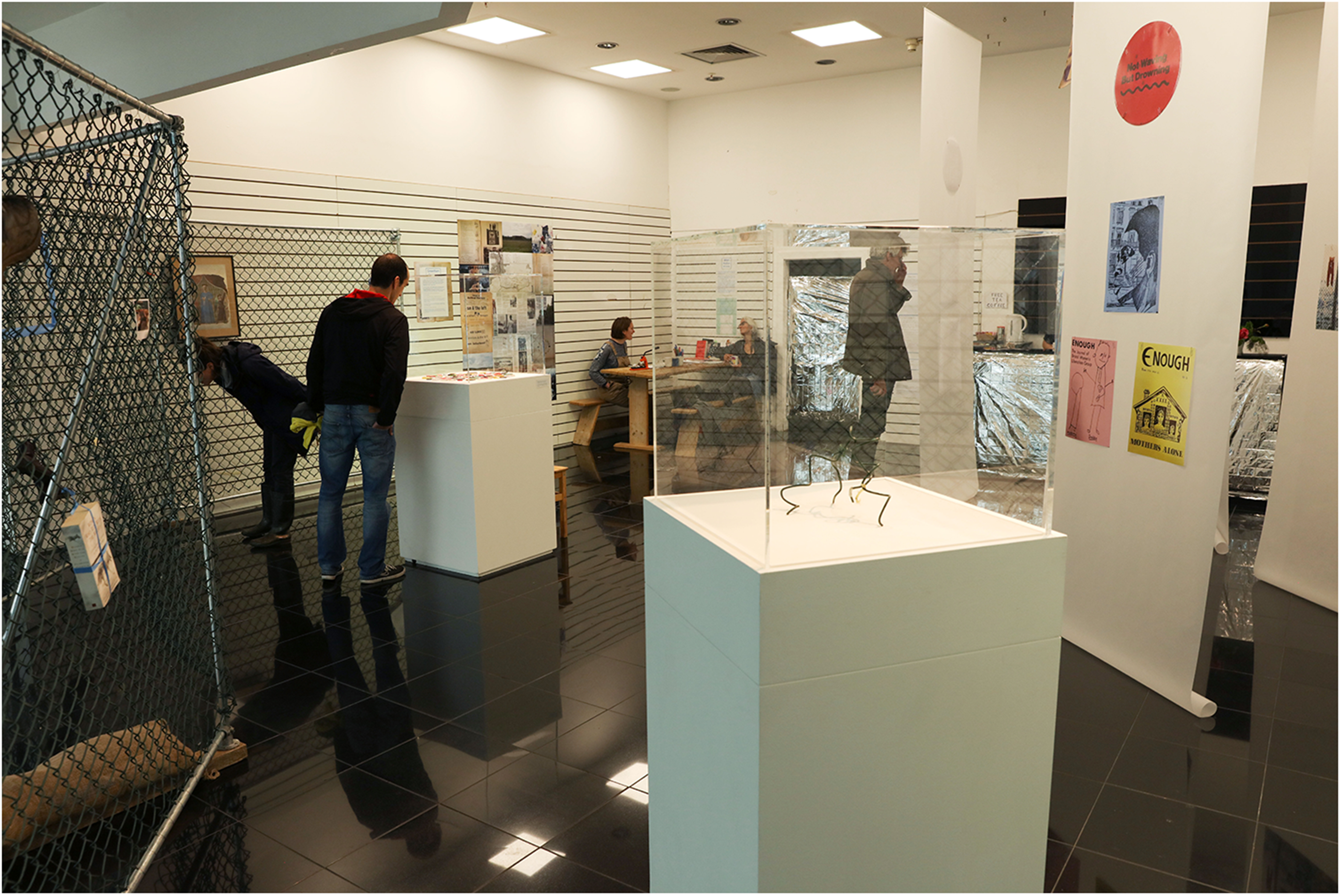
Care and Control exhibition: internal display 1 (Photo by Jana Rumley).
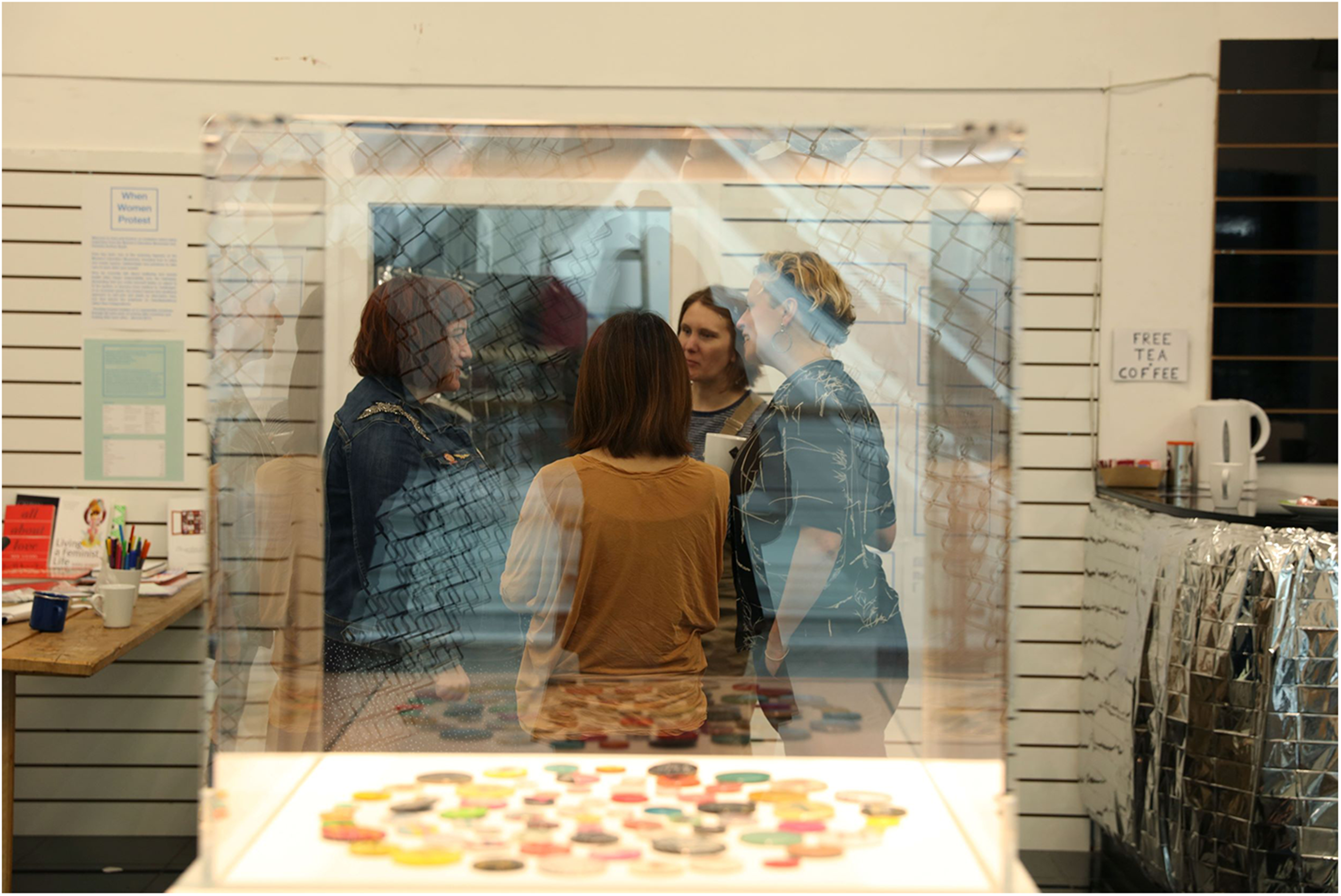
Care and Control exhibition: internal display 2 (Photo by Jana Rumley).
The exhibition was open for five days in June 2019, during which we took turns welcoming visitors. That previous year had been shaped for Junko and Maud by the University and College Union's lengthy strike action over pay, working conditions and pensions, a dispute that started in the UK university sector in 2018 and is ongoing (Bergfeld, 2018). Alice was involved in preparations for the Extinction Rebellion (XR) Summer Rebellion in Bristol, and for a week in July Bristol Bridge was blocked to traffic, and re-opened for talks, music and protests. Two years on, we reflect on traces left by the exhibition. The following conversations took place during the first and second year of the Covid-19 pandemic (May and July 2020 and June 2021). Here we present three themes that emerged from these conversations: collective care in public, refusing neoliberal definitions of care and towards a Contract of Care.
Collective care in public
Creating space and time for collective care and self-care for us, our friends and strangers in the community was one of key aims of the Care and Control exhibition. We began our conversation by reflecting on our experiences of practising collective care during the exhibition. I definitely remember how tired I felt afterwards, after all that attention freely given. I hadn’t really anticipated how tiring it would feel. It was exhausting wasn’t it. A kind of exuberance was required to keep welcoming people into the exhibition, many of whom were browsing in the shopping centre and were unsure of the rules of the shop / not shop. We were offering a welcome; tea/coffee, a seat, conversation, badge making; all this felt like an important part of ‘doing’ collective care. Facing all the strangers in a public space was challenging. Working out how we communicated with people coming into the exhibition and then creating space and time to care for each other was exciting but exhausting. It was unexpected how intimate the conversations were with relative strangers. I remember one older woman talking to me about her struggle to take care of her granddaughter, how she tried to take her to see places on public transport and help her with her schoolwork, whilst also taking care of her disabled partner. Though they were fleeting conversations, I have often thought about them again. I tend to assume that caring relationships need to be durable, but perhaps we also need to nurture more transitory relationships as well. We were experimenting with caring for strangers, without the exchange of money, I mean, without buying and selling ‘care’. The Care Collective (2020) suggests an ethics of promiscuous care, which enables us to multiply and experiment with how and who we care for, about and with. It expands our ‘caring imaginaries’ beyond the family and the market. It also includes care between humans, non-humans and our planet. Whilst reading this book, I realised that we created the exhibition in this spirit. It was not an easy experiment, there were feelings of discomfort and confusion, but also joy, surprise and positivity. There was a particular orientation towards the past and towards older feminists, those people would be even more likely not be able to visit the exhibition in today's world. Or maybe some of them would, I don’t know, maybe that's an assumption that I am making. Maybe we are a bit more aware of their vulnerability, as a generation that's passing through into their elderly years. I wonder what they would say about that? Being labelled, as so many have been during the pandemic, as ‘vulnerable’? Yes, their experience of being labelled as ‘vulnerable’ would be interesting to hear about. The space we made, an indoor public space, that's a difficult space to make at this moment [June 2020]. I know we talked a lot about parks, libraries, benches and how these are important as a space for both collective care and self-care. These public places are caring infrastructures where we can exchange care with family, friends, neighbours and strangers. Our FAS research and conversations with feminists in Bristol made us realise the importance of shared time in public spaces in the WLM. Public or community spaces are essential for enabling promiscuous care. These places need to be protected and supported by the state / local authorities and kept out of the interest of private capital. I think the transformation of a public space within the frame of a privately owned, 1990s shopping centre seemed to be quite freeing for us all. For me, the siting of the exhibition in an empty shop captured some of what felt intangible in the archive. The desire to boldly make public some of those intimate narratives around solidarity, vulnerability and progress. Before the exhibition, I wish I had read that article ‘Practicing Love: Black Feminism, Love-Politics, and Post-Intersectionality’ by Jennifer Nash (2011). Her celebration of progressive love and exuberant imaginations made a real impression on me. After I read it, I had a vivid dream manifesting versions of progressive love; it's unusual that an academic article has such an effect on me. Nash ends the article by saying: ‘For the scholar-activists at the centre of my analysis—Alice Walker, June Jordan, Audre Lorde—love acted as a doing, a call for a labour of the self, an appeal for transcending the self, a strategy for remaking the public sphere, a plea to unleash the radical imagination, and a critique of the state's blindness to the violence it in acts and enables’ (2011: 19). During the process of installing and opening, there was something of this utopian thinking, feeling and doing. But yes, utopia is tiring.
Refusing neoliberal definitions of care
During Care and Control, we explicitly sought to refuse particular neoliberal definitions of self-care which reinscribed dominant ideas about autonomy, productivity and separateness. We refused the contemporary notion of self-care as a fixer, solution or cure for complex societal problems. In sharp contrast, we emphasised the collective care bound within the relationships which women developed as part of the WLM, and aimed to de-centre care performed within private/heterosexual households and parent–child relationships. I really loved that piece ‘Antinomies of Self-Care’ [Sharma et al., 2017]; I wish I had read that before the exhibition. Its irreverent tone resonated: ‘There's no #selfcare list that says get high, call in sick, watch Netflix all day, punch a bigot’ [Sharma et al., 2017: 14]. But even back in 2018 the strike poem by Grace Krause [2018] was already connecting us with that modality: ‘Fuck you for sending me booklets with breathing exercises while you try to dismantle the pension’. For me, that anger was running just under the surface of the whole exhibition. In a lot of the objects and visuals we chose, there was a sense of defiant refusal; from the ‘Nuclear Family No Thanks!’ badge, to the hole we made in the chain-link fence, through the gay love/sex poster in the Issues in Radical Therapy publication, to writing our Contract of Care, and the time we made for each other. Maybe we were a bit tentative about accessing that voice for ourselves. I’m thinking of the tone of the curatorial text in the exhibition, which was attempting historical objectivity. If we were doing the exhibition again, we might be a bit bolder by allowing some more explicit ‘fucked off’ contemporary voices to emerge, say about our concerns for women, the environment, the climate and so on. But we were also emboldened by the ‘fucked off’ voices that came from the WLM archive materials, like the Bristol WLM magazine Enough! The choice of including it in the exhibition was deliberate, even if we didn’t ‘own’ the voice. When stories emerged from the archive about the first attempt to offer childcare in the University of Bristol, I think I responded to the material like it was a bit of a cul de sac. In part, maybe because of our status as three women doing a research project on collective care and there being an immediate assumption that we meant collectivising childcare. I don’t know if I voiced this at the time, but I thought this lens would limit the work. Though I actually think the reverse is true now, it limits our understanding of collective care not to consider childcare as a key question. Perhaps because I don’t have children this was a bit of a wilful blind spot for me. It seems to me now, how childcare operates and is distributed within and beyond the household has implications for how care is organised everywhere else. I think we all wanted to present care beyond mother–child symbolic relationships. We were talking about self-care through collective care, rather than collective care through childcare. The display of each Collective Survival Kit object, without any description, was a way to imagine how we can share and collectivise our seemingly individualised way of caring for ourselves, which creates resources for resistance. But yes, thinking about collectivised forms of childcare or elderly care can also form resistance to the family-centred, ‘care for your own’ mode of care. This is what we were trying to do as I remember it, by centring those lateral relationships between women – especially friendships – which are often not institutionally and symbolically recognised. The lockdowns did feel like a really good crash course in how fucked up households are as care structures. I think there's something powerful in that realisation that I hope can stay with us. Yes, the first lockdown was very revealing, I found I had unintentionally stowed away fantasies of the ‘happy household’, which were being seen anew. UK lockdown policies assumed some kind of containment; the household, heterosexual family, the nation state. All these protective structures began to take on a new dimension during the pandemic. Sara Ahmed describes heterosexuality as something to fall back on when you fall; those structures – a family, a home, a garden and an income – were all there to catch me. By the end of March, the book I was trying to write was flowing and I felt like a small crack was being opened. By that time, talk about our collective reliance on essential workers and the care washing in the media was contrasting with how little governments were doing to protect the most vulnerable care workers. I found myself fantasising a lot during this time – perhaps it was a response to the levels of global suffering. The fantasy that kept me awake the longest though was what would have happened if all, or even most, key workers had walked out on strike, right at the height of lockdown? The talk of post-Covid bonuses for health workers and other promises of financial compensation fuelled this fantasy for a very brief moment before it became clear that harsher austerity policies were to follow. As Tithi Bhattacharya and Susan Ferguson (2020) put it, ‘support for life making under capitalism right now is and can only ever be reluctant, minimal, temporary’, yet some of those fantasies persisted. We need fantasies, don’t we, to propel us. I experienced the minimal and reluctant state support for care during the first wave, when over the course of a week, all the community and institutional support structures for people with disabilities were withdrawn for the ‘foreseeable future’. The sole source of support for many (if they were eligible for PIP, Personal Independence Payment) was a support worker or carer. In my own work as a paid carer, I was on a zero-hours contract with no sick pay or holiday pay, so what was once (pre-pandemic) just viable had now become critically unsustainable. Even the moment when care is ‘publicly’ recognised, clapping or saying ‘thank you’ to NHS workers was deemed to be sufficient. I was also thinking about the term ‘care poverty’ or ‘care deficiency’. There is a huge discrepancy among those who care and those who receive care. I was pretty frustrated with the ‘clap for carers’ or a ‘blue badge’ – a badge of honour to care workers. Especially with the clapping as a public form of recognition to show that we all rely on care workers and essential workers, the centrality of care became more visible than ever. However, yet again, the recognition of care does not accompany valuing care as labour. Instead, care is again represented as sentimental, emotional, affectionate activities that people dedicate themselves to. We, including myself, need to keep being more angry about this. Like Maud, I had layers of nets to catch me, a family, a job, a house with a garden. But I remember that one sunny afternoon, reading a book with my daughter in a den that she made in our garden, I thought how lucky we were to have a feeling of peacefulness, despite what was going on outside our garden. Yet at the same time, I felt how temporal and fragile my luck, privilege and peace are in this society.
Towards a Contract of Care
During the process of Care and Control we wrote a Contract of Care in which we documented our respective vulnerabilities, our stress responses and how we might work across the power differentials, including the fact that one of us was working as a freelance artist. Once we had mutually agreed to the Contract of Care, and all signed it, we exhibited it as part of the exhibition. This connected with Maud and Junko's interest in how waged care workers mobilise and why feminised care workers continue to be portrayed as docile (Liu and Yamashita, 2020). Employment contracts can protect workers from labour exploitation but are outside the reach of many precarious and undocumented workers. During the pandemic, some domestic workers’ organisers in the USA developed Covid Contracts to demand that their family employers openly discuss how they would mitigate against the risk of infection and emphasise their responsibilities to protect them (Perrier, 2022). Our own Contract of Care was negotiated in a very different context, yet one connection is the discomfort women co-workers may feel when discussing inequalities between them. The words interdependence and contracts can be seen as antinomous, yet we found it was a fruitful tension that allowed us to explore the often-unspoken aspects of collaboration. Here we reflect on the place of interdependence for post-pandemic caring. It is quite challenging to collectively agree on what care means to us because we all have different capacities, preferences and expectations. The Contract of Care that we wrote together was interesting because it gave us an opportunity and a process to share our views on care. Contract of Care is a tool to help collaborators have honest, sometimes difficult conversations about expectations, vulnerabilities and risks. It's a tool to talk about power, differences and similarities. For our collaboration it seemed important to acknowledge in the contract that Junko and Maud have children and that the caring responsibilities for them had been passed to their partners whilst the exhibition was running. Looking back, I wonder: if the project had had a longer lead-in, could we have found a way to think collectively about how we organised childcare for you both? That's an interesting thought. Those who experienced collective childcare or collective care in communes during the WLM talked about the struggle to not treat your own children differently from others or accept others’ ways of caring. In practice, it can be quite difficult to do collective care, because today caring practices are so individualised. When I spoke with Meg Luxton, a prominent Canadian socialist feminist, in March 2020, she talked about how collectivising childcare was central to her activism from the 1970s and 1980s. She talked about how some of the socialists in the WLM aspired to raise future socialists. There was hope that by refusing individualistic parenting, this would bring about different ways of being for the next generation.
8
This hopefulness about our abilities to shape the future and the next generation makes me think about the long-term legacy of the lockdowns, and the pandemic more widely. I was also thinking in relation to redistribution, if one woman can’t carry out her caring responsibilities, that this labour gets passed onto other women. As decades of research on migrant care workers has shown, it is often women and their communities from Global South countries who are often most depleted by this process. With Covid, some have been stuck in the same households, with little prospect for any such respite care. In terms of domestic violence and the burden on low-paid women, this has been massively harmful. The pandemic has also shown that the most vulnerable have huge capacities for organising collectively, and examples of solidarity networks and mutual aid groups in deprived neighbourhoods and migrant communities are plentiful. Yet what is so often missing in the media coverage of the impact of the pandemic –because so much continues to tell a story about how the Covid childcare burden has slowed white middle-class women's careers – is how women are bound together within vital chains of interdependence. As Bridget Anderson puts it, we need empirically grounded theory and alliances which seek to understand ‘what binds some women together, and what drives others apart’ (2000: 197). Yes, we could ask, what types of care bind some women together, and what types of care drive others apart. I think placing care as an individual woman's responsibility divides women and hides the reality that our daily practices of care are supported by a wider and interdependent network of care provided by neighbours, friends, professional care workers, schools, community centres and so on. Stratigaki (2004) looks at the discourse of EU social policy on care responsibility and gender equality. She reveals a shift in the meaning of the ‘reconciliation of working and family life’, as it gradually changed from an objective with feminist potential (sharing care and domestic work between women and men) to a market-oriented objective; ‘encouraging flexible forms of employment’ for women to manage both paid and unpaid work. Along with this shift, buying care services became normalised in some countries like the UK, which led to a divide between women who can afford to purchase care and those who cannot. My sensibility to this divide shifted during the pandemic, including whether the concept of care is sufficiently able to centre divisions between women around citizenship and ‘race’. The nanny organisers I interviewed with the Nanny Solidarity Network in London and the Matahari Women's Worker Centre in Massachusetts during the pandemic had a lot to do with it. I also read some of Primilla Nadasen's (2021a, 2021b) wonderful research. She documents how African American domestic worker activists in the USA in the 1970s deliberately resisted their work being characterised as care because it reified the emotional component of their work. Some of the domestic workers she interviewed said they didn’t do their jobs because they cared. For them the discourse of care is reformist and fundamentally unable to address racism and economic exploitation. Nadasen makes the argument that the framework of social reproduction, because it is rooted in labour exploitation, is preferable to the discourse of care which emerged primarily through middle-class women's activism. She tracks how at the same time as access to parental leave and sick leave was widening in the USA in the 1990s was also the time when public assistance programmes for the most economically marginalised were cut so the ‘discourse of care made little material difference to the lives of the poor’. I had a sense of this; when I did a cleaning job for a woman, who I could see was very stressed; she had young children, both her and her husband worked from home and there was a noticeable disquiet in the house. I remember clearly that my employer said, as if to excuse herself, ‘when the cleaner comes is the one time I sit down on the sofa and have a quiet moment to myself’, which she did as I hoovered the hallway. There was something so dissonant about this experience, so separating and unsustainable. Whether care is passed to another person or if it is done collectively, it has a different impact. Are we passing the care to another, or are we trying to collectively share care? Also, if the care that another person provides is appropriately valued, does this make a difference when we pass care over? Yes, would it have been different if you had both done the hoovering together?
Conclusion
The making and afterlives of the Care and Control exhibition, enlivened by the legacy of the WLM, proved itself a rich resource for countering neoliberal definitions of self-care that currently predominate. Set in the context of the pandemic, our post-exhibition reflections suggest that collective care needs to be conceptualised in a way that centres its racialised and classed divisions. Self-care was enabled by our collective approach: from the time we made for one another before, during and after the exhibition away from our co-workers and households, to the contracts of care we experimented with, to the promiscuous care we briefly forged with visitors to the exhibition. Finally, the location of the exhibition in a mall, and in a non-gentrified part of the city, highlighted how occupations of public space are important dimensions of both self-care and collective care techniques.
Although our exploration started off with care as a core concept, we gradually shifted towards the vocabulary of social reproduction. Social reproduction gave us a framework to widen our archives of collective care beyond the Bristol WLM and connect with women workers’ struggles for survival during the pandemic, strikes and austerity. We were inspired by the call to integrate the Black feminist critique of unwaged domestic labour into social reproduction theory (Arruzza, 2016; Ferguson, 2019; Nadasen, 2021a). Racially minoritised women's kin relations can be spaces of resistance against racist hostility, which white feminist critiques of domestic labour as oppressive tend to neglect. Engaging with the work of domestic worker-organisers and African American feminists forced us to pay attention to how these groups direct care away from ‘proper’ objects: such as domestic workers refusing to care about employers. Social reproduction differs from care scholarship in seeking to capture the internal relationships between waged and unwaged labour. This helped us understand how techniques for caring for ourselves were not separate from our workplace struggles such as tackling precarity in the Arts through Contracts of Care, or our strikes for decent pensions and climate change. Social reproduction's attention to depletion as an ever-shifting feature of capitalist structures forced us to de-centre our own middle-class pandemic exhaustion so we could map out the ties that bind feminised care work across differentiated hierarchies. This also returns us to Audre Lorde's point that self-care is only political warfare when connected with the survival of marginal political communities.
Our second point – to refuse neoliberal definitions of self-care – was illustrated through experimenting with promiscuous care with strangers in public spaces. As the pandemic temporarily froze public spaces of collective care, we suggest that this shrinking is part of a longstanding assault on the commons (Federici, 2018). As one Bristol-based feminist group reflected over forty years ago, the gains of women's movements are constantly in jeopardy: ‘Where demands are won, through campaigns and political action, we have to recognise that they have been just as easily lost, or taken away’ (Bristol Women's Studies Group, 1979: 265). Today, withdrawing of public infrastructures of care constitutes a sustained threat to multiplying feminist experiments in collective care, not just in the sense of the privatisation of the formal care sector but also in curtailing access to spaces such as land, public libraries, parks and, closest to us, anti-protest laws that were passed in the UK in 2020–2021. Continuing to practise collective care in public – outside households and institutions – is set to be both a more difficult and more necessary form of protest in the post-pandemic era.
Our final point relates to the potential of contracts in re-organising collective care. Contracts are usually synonymous with waged employment and struggles to protect and mitigate against exploitation. The experimental Contract of Care we developed had a very different purpose, but had in common an attempt to explore with openness power differentials between us. Significantly, however, we omitted unwaged care with dependent others from our Contract of Care, pointing to our own blind spots about relations of inter/dependence. Care contracts – and other attempts to formalise informal care – are important tools to question under what conditions collective care can fulfil the promise of disrupting unequal power relations.
Footnotes
Acknowledgements
The authors would like to acknowledge the financial support of the Brigstow Institute (University of Bristol) who funded ‘Experiments in Collective Care’, the project which led to the creation of the Care and Control exhibition.
Funding
The authors disclosed receipt of the following financial support for the research, authorship, and/or publication of this article: This work was supported by the Brigstow Institute.
