




Abstract
This article discusses issues of racial marginalisation within two significant museum exhibitions, Art AIDS America (2015–17) and Queer British Art (2017). Specifically, the study centres on the responsive work of two young artists, Kia LaBeija and Travis Alabanza, who perform feelings of alienation to protest against the under-representation of queer and trans artists of colour in both museum exhibitions. Through an affective analysis of their artistic embodiment mobilising emotions of loneliness, I argue that such artistic expressions of queer loneliness, in relation to the excluding effects of the two museum exhibitions, are productive acts. They contribute to the building of emotional resilience and the recognition of intersectional communities.
Keywords
Introduction
As cultural institutions that select and showcase artworks, art museums produce representations that include certain social subjects while excluding others. For years, activists and artists such as Guerrilla Girls, who repeatedly show the imbalanced statistic numbers of female artists and artists of colour since the 1980s, have protested the gender and racial inequality in museums and gallery spaces. While several museums in the early 21st century begin to improve the underrepresentation of social minorities, some of their inclusive practices inadvertently reproduce exclusion within the diversity agenda. Art AIDS America (2015–17) and Queer British Art (2017) are prominent examples in Anglo-American context. Both are important LGBTQ art exhibitions that resist the homophobic and heterosexual norms of American and British art in public museums. However, both exhibitions have been criticised for lacking racial diversity (Kerr, 2015; Hazel, 2017; Potvin and Gindt, 2017). In the case of Art AIDS America, a travelling art show that toured 4 different museums and galleries, out of 105 artists 88 are White and only 5 artists are Black (Tacoma Action Collective, 2019). In the case of Queer British Art, the very first museum show dedicated to LGBTQ diversity at Tate Britain, out of nearly 70 artists only one artist of colour was featured, and only a few works depicting Black models by White male artists were displayed. 1 Such statistics evidence that queer artists of colour could be further marginalised within the museum exhibitions devoted to queer inclusion.
This article, following Roderick Ferguson’s criticism of mainstream queer representation, aims to reveal how HIV/AIDS and queer-themed exhibitions perpetuate racial, gender, and class exclusions (Ferguson, 2019). 2 For Ferguson, contemporary gay publications and media present a single-issue or what he calls a ‘one-dimensional’ queer politics which essentially diminishes the multiple struggles and creative resistance derived from poor queers and trans people of colour in earlier queer activism, such as the Stonewall Riots in 1960s New York (Ferguson, 2019: 8). Similarly, both the Art AIDS America and the Queer British Art exhibition have attempted to demonstrate the sexual and artistic diversity of visual art within the curatorial framework of national histories. However, they failed to address the multidimensionality of queer histories intersecting with the social variance of race, sex, and class. Pursuing the possibility of queerness that is multi-dimensional, I employ the term ‘queer’ not only to signify non-confirming sexual identity and representation but also to encompass racial formations as well as various social and emotional relations. By exploring the role of queer affect in artistic expressions, this article expands the one-dimensionality of queer representation in museums.
To gain a deeper understanding of the emotional responses of queer artists of colour to the two museum exhibitions beyond mere statistics, I focus on the works of artist Kia LaBeija (b. 1990), a participating artist in Art AIDS America, and artist Travis Alabanza (b. 1995), an invited performance artist alongside Queer British Art. Their utilisation of emotions unveils the alienation experienced by artists of colour in mainstream queer-themed exhibitions. Despite being invited to participate in the museum exhibitions or programs, both young artists felt alienated due to the prevalent White-dominant representation in these specific art shows and the broader art world. Consequently, they responded by creating artworks and performances as a form of protest, expressing their anger and feelings of alienation in response to institutional racism. To delve into their affective responses, I propose analysing Kia LaBeija’s self-portrait series 24 (2014) exhibited at Art AIDS America and Travis Alabanza’s gallery performance Left Outside Alone (2017) staged at Tate Britain. Additionally, I will examine their artistic statements using a method of close reading that intricately weaves together the multiple dimensions of queer loneliness within and beyond museum exhibitions. By scrutinising these affect-driven artworks and performances, we can gain a more profound understanding of how queer and trans artists of colour harness emotions to challenge the prevailing White dominance within art institutions.
Grounded in the queer theoretical contribution to affect theory, this study seeks to reclaim ostensibly ‘negative’ emotions, such as anger and loneliness, by positioning them as mobilising affects against the normative structure of feelings (Sedgwick, 1995; Crimp, 2004; Muñoz, 2006; Cvetkovich, 2012). 3 Notably, my analysis intends to show that Kia LaBeija and Travis Alabanza’s counter-performances not only foreground the problem of limited queer representation in museum exhibitions but also reimagine multi-dimensional connections of social oppressions by highlighting feelings of alienation.
Drawing on Australian-British feminist theorist Sara Ahmed’s concept of ‘affect alien’, which characterises the emotion politics of feminists, queers, and migrants rejecting the societal expectation of pursuing happiness (Ahmed, 2010), I argue that LaBeija and Alabanza’s artistic expressions of anger and loneliness are ‘alien’ feelings that potentially disrupt the one-dimensional queer representation in museums. 4 Here, ‘alienation’ denotes the state of feeling isolated, estranged, or disconnected from dominant societal norms and structures. These emotions of alienation, as per Ahmed (2010), encompass ‘affect alien’ – individuals who feel at odds with the normative perception of happiness in mainstream society and, consequently, experience a sense of displacement. By engaging with Ahmed’s critical writings on loneliness and feelings of alienation, my analysis moves beyond interpreting these emotions solely as negative or destructive. Instead, I propose that they have the capacity to reshape the one-dimensionality of curatorial discourse and provide an emotional network that connects broader communities within the context of museum exhibitions.
Before I embark on my affective analysis of LaBeija’s photography and Alabanza’s performance, it is necessary to offer a brief overview of the exhibitions where the artworks and performance took place. In both exhibitions, although aesthetic and gender diversity are the curatorial goal, the curators somewhat limited themselves to the artistic canon and traditional national identities without acknowledging the inaccessibility of economically disadvantaged queer artists of colour. Accordingly, I argue that racial exclusion is both museum exhibitions’s curatorial effects that showcase one-dimensional queerness. Against such a background, beyond portraying her isolated body living with HIV, LaBeija’s self-portrait transforms the stereotypical representation of lonely queers in art history and showcases a desire for communal bonding. Transitioning to Alabanza’s on-site performance at Tate Britain, which served as a protest against the one-dimensionality of the art show, this act, along with its engaging queer audience, not only occupies the museum space but also resists the social isolation and inaccessibility embedded in the institutional setting. By examining both artists’ embodied photography and performance against the racial marginalisation 5 of queer-themed exhibitions, my aim is to underscore the transformative potential of performing queer loneliness at the very site of exclusion.
Black marginalisation
Art AIDS America, co-curated by Jonathan Katz and Rock Hushka, was a retrospective exhibition that surveyed the impact of the AIDS pandemic upon American art, from the early 1980s to 2010s. Between 2015 and 2017, it travelled to four different art museums and galleries in the United States. 6 Arranged in four thematic sections, ‘Body’, ‘Spirit’, ‘Activism’, and ‘Camouflage’, the show mounted around 107 artists with diverse aesthetics ranging from archival documentation of AIDS activism (such as Catherine Opie’s San Francisco City Hall and Candle March for AIDS series in 1986) to a more obscure allusion to AIDS (such as David Wojnarowicz’s Untitled (Buffalo) photograph of a falling buffalo taken in Natural History Museum in 1988–89). The overall aim of this large-scale art show was to resist the division of the socio-political dimension of HIV/AIDS from American art history. As the co-curator Jonathan Katz writes: ‘To make of AIDS an active historical protagonist requires understanding that it is in fact ours, a collective trauma with a collective impact. Art AIDS America is premised on that collectivity’ (Katz, 2015: 24).
Central to the curatorial discourse is that the AIDS pandemic played a central key role in visual art production during the 1980s. Facing the governmental censorship from right-wing politicians and the deconstruction of autobiographical truthfulness by postmodern theorists, artists who wish sought to address HIV/AIDS developed what Jonathan Katz refers to as ‘poetic postmodernism’ (Katz, 2015: 36). Rather than simply picturing the AIDS pandemic in realistic graphics, such ‘poetic postmodern’ aesthetics offer only implicit associations of HIV/AIDS that rely on readers to decode or respond to the artwork. In this way, the artistic strategy of Cuba-born American artist Felix Gonzalez-Torrez (1957–1996) plays a crucial role in Katz’s curatorial idea. For instance, his paper installation requires the audience to take away and read the minimalist reference to political incidents, while his colourful hanging beads invite visitors to pass through the work and interact with it. 7 Although these interactive installations show nothing explicitly linked with AIDS, Katz argues, however, that Gonzalez-Torrez, Wojnarowicz, and many other artists employ obscure aesthetics that provide open-ended, participatory artworks to visitors without being excluded by the institutions that censor explicit AIDS representation (Katz, 2015). Such a curatorial discourse opens the aesthetic diversity of HIV/AIDS in arts, which traditionally tends to focus on activist or protest art with its explicit visuality.
However, although such curatorial discourse opens the abstract expressions and open-ended interpretation in HIV/AIDS art, the diversity of aesthetic expressions does not yield to racial diversity. The central problem of the show, as Tacoma Action Collective (2019) and Ted Kerr (2015) have suggested, is the focus upon established White male artists that inadvertently erases Black and artists of colour.
8
This imbalanced selection does not reflect the contemporary reality that Black communities suffer the most from the American demographics of HIV/AIDS infection: Black people accounted for 44% of new infections and 48% of deaths in the United States in 2010 alone (Tacoma Action Collective, 2019). As a travelling museum exhibition that took 10 years of making, curators of Art AIDS America consulted Black people or members of African American communities more broadly. Activist and writer Kenyon Farrow recalled his meeting with curators in 2011, a few of us pointed out (that) focusing on ‘canonical’ works would obviously limit the voices to mostly White men, and suggested they lean against that direction. I also … suggested they … expand what was considered ‘art’ (to) include Marlon Riggs, house music, hip-hop, and ballroom culture … Obviously, none of that was taken seriously (Kerr, 2015, citing Farrow).
Unlike the art world, established by financial and cultural elites that limit access for poor queers and trans people of colour, ballroom culture is the social space where drag performers and poor, queer, trans people of colour realise their creativity. Particularly, Riggs’s Tongues Untied (1989) mixes found footage and poetry to depict the dilemma of Black gay men facing social isolation in White culture and Black communities in the time of HIV/AIDS. Thus, the omission of Rigg’s work in Art AIDS America is a missed opportunity to closely engage in Black queer creative voices. 9
Although very different in terms of exhibition content and geopolitical focus, Queer British Art: 1861-1967 shared the problem of racial marginalisation with Art AIDS America. At Tate Britain, an art museum dedicated to historical and modern British art, the show certainly opened up a rare discussion about diverse genders and sexualities in art under its national framework. Arranged in eight thematic rooms, 10 Queer British Art: 1861-1967 curated by Clare Barlow showcased 202 art objects and ephemera by nearly 70 artists in a chronological order. More than a hundred years of queerness in British art history were showcased: from nineteenth-century Pre-Raphaelite painter Simeon Solomon’s homoerotic painting, Robert Pennington’s portrait of Oscar Wilde (c.1884) along with the prison cell door of Wilde’s trial, cross-gender impersonations on theatre culture, artists and writers of the Bloomsbury group such as Duncan Grant’s male–male erotic drawing and Gluck’s gender non-conforming Self-portrait (1942), London’s Soho in the 1950s and 1960s, and ending with canonical White gay male artists Francis Bacon and David Hockney.
While many reviewers appreciate the rather open-ended queer reading (from the artist’s biography, erotic representation, and to the viewer’s interpretation) in the Tate exhibition, some critics, including the curator herself, reflected on the framing problem and exclusions of others. As John Potvin and Dirk Gindt (2017) pointed out, both the timeframe and national boundary limited the possibility to tell a more diverse and transnational queer history: First, although the time frame was based around two significant historical events, the abolishment of the death penalty for sodomy in 1861 and the partial decriminalisation of male–male sex in 1967, this time frame could not accommodate the subsequent sexual revolution and the HIV global pandemic (Potvin and Gindt, 2017). Second, the national border fails to consider British artists in exile as well as in British colonies, nor does it include more artists of colour or people with migrant backgrounds (Potvin and Gindt, 2017). The curator Barlow responded to these two issues by arguing that the period of a hundred years offers a different historical narrative of queer culture that tends to be limited by post-war development and yet she acknowledges the lack of ‘surviving material’ to reflect the experience of people of colour and reckons the insufficient representation of trans and people with disabilities (Barlow, 2020: 272). Both Potvin and Gindt’s criticism and the curator’s reflection reveal the curatorial challenge of presenting a multi-dimensional queer history in a public art museum that collects mostly works by White artists.
As we can see in Art AIDS America and Queer British Art, despite their efforts in promoting aesthetic and gender diversity in HIV/AIDS and queer histories, racial marginalisation remains prominent in their overall selected artworks. With their focus mostly on successful White cis-male artists, they fail to recognise the class-based and race-based privileges that allow those artists to possess such artistic achievements. Thus, in both cases, the exhibition curation can be seen to lack an intersectional lens that could combine race and sex, even though some inclusive efforts are made. As film scholar Alexandra Juhasz and writer Ted Kerr observe, the collaborative, intersectional, feminist forces that AIDS and queer activism have been built on since the 1980s are largely ignored among recent popular media and filmic representations since the 2010s (Juhasz and Kerr, 2014). It is not surprising that this is mirrored by a similar tendency erasing the multidimensionality of social oppressions in HIV/AIDS and queer-themed museum exhibitions. This insufficiency not only excludes artists of colour but also alienates those who are included. In what follows, I closely analyse artworks that not only address but also attempt to transform these racial and social marginalisations.
Lonely queers
With its omission of Black artists, Art AIDS America has triggered a wide range of affective responses among Black and activist communities. On December 17, 2015, the Tacoma Action Collective organised an activist intervention at the Tacoma Art Museum in Washington. The key message of this protest campaign ‘Stop Erasing Black People’, which appeared in their chants and on their T-shirts, accentuates the under-representation of the Black community. In the manner of early AIDS activism that disrupted public space, the activist group staged a die-in protest, by lying on the ground between Jim Hodges’ floral installation When We Stay (1997) and Keith Haring’s Altarpiece (1990). Both art installations could be interpreted as a memorial to those who suffered from AIDS. This die-in protest further activated these installations’ sense of mourning by situating their bodies temporarily between Hodges’ and Haring’s memorial works. By doing so, the collective simultaneously drew attention to their marginalisation between White-identified artworks and reclaimed a central position for African American subjects marginalised by this museum exhibition.
Among the angry response to Art AIDS America, the participating artist Kia LaBeija’s emotional response and her artwork deserve to be unpacked. This is because she represents not only the subjective alienation felt by the only female artist of colour living with HIV but also the lost connection with her social and emotional communities. Born HIV positive and growing up in New York in 1990, Kia LaBeija’s artwork often weaves autobiographical elements with social surroundings, especially embedded in New York ballroom culture. In 2012, she joined the House of LaBeija, a respected Harlem ballroom family founded in 1972 and featured in Jennie Livingston’s Paris is Burning (1990). As a dancer and photographer, much of her work draws the creative energy from ballroom culture and voguing which are not only self-fashioning performances but also collective forms of creativity shared by African American and Latinx LGBTQ communities in New York.
Crucially, Kia LaBeija expressed her mixed feelings of being included in Art AIDS America, explaining an initial excitement but then subsequently feeling alienated after learning that she was only one of the five African American artists and the only female artist of colour in the show: It hurt(s) very much for me because I’ve always felt like especially women of colour are not recognized as being a part of the AIDS epidemic. We are very very silenced, we’re not really funded, we don’t have community. As a child born with HIV who lost her mother at 14, I felt very very alone for a long time. And to be a part of this show and to still feel like I’m standing alone just really affected me in a very deep way (Zuckerman Museum of Art, 2016).
LaBeija’s words testify how an artist working from intersecting identities (a Black woman with Filipino heritage and a daughter who lost her mother and living with HIV) could feel such a strong sense of loneliness while being incorporated into a group show that centres on White male artists.
While LaBeija’s work was selected for the Art AIDS America, her work seems not to be fully understood by the curators. Although LaBeija emphasised that her portrait series 24 (2014) is to create communities for those who suffer from HIV differently than the mainstream representation, she expressed the belief that the curator saw her work as merely a portrait of a woman living with HIV (Zuckerman Museum of Art, 2016). In the catalogue of Art AIDS America, LaBeija’s three selected photos are titled 24 (2014). However, on the website of Visual AIDS, a contemporary art organisation committing to AIDS activism, I discovered that each photo has a distinct title showing the artist’s personal and emotional attachment: ‘Mourning Sickness’, ‘Kia and Mommy’, and ‘In My Room’. The reduction to a single work title risks reducing the emotional meanings of these works to an uninformed visitor.
In the following paragraphs, I analyse the three self-portraits in the 24 series to draw out the richer meaning of a lonely subject staged by the artist that has been downplayed by the exhibition catalogue. Rather than reading LaBeija’s feelings of loneliness as simply personal, I see this solitude as key to understanding her artistic strategy. Drawing on queer feminist’s affective interpretations of loneliness, I posit that LaBeija’s emotional and artistic expression of loneliness is a queer feeling that generates connecting space for people facing multiple social marginalisations. As queer literary scholar Heather Love (2007) suggests, loneliness is a typical theme of twentieth-century lesbian and gay literature, especially in terms of the experience of living ‘in the closet’ and experiencing marginalised social positions. One of the most well-known examples is the British lesbian writer Radclyffe Hall’s Well of Loneliness (1928) which portrays the unhappiness of lesbian life with a tragic ending. However, as Love (2007) and Ahmed (2006) have suggested, such a feeling of loneliness could also be a source of self-empowerment and social connectivity. Reflecting on her reading experience of Hall’s novel, Ahmed states that, what is compelling about this book is how loneliness allows the body to extend differently into the world, a body that is alone in this cramped space of the family, which puts some objects and not others in reach, is also a body that reaches out towards others that can be glimpsed as just about on the horizon (Ahmed, 2006: 104).
Ahmed’s argument shows that loneliness is not self-isolating but world-making. By expressing loneliness, one might create emotional and meaningful connections between the body and the world. In this way, I read LaBeija’s self-portrait series 24 (2014) as an inter-relational and world-making project that mobilises her sense of loneliness in a generative way. Rather than emphasising her body alone, the series presents her intimate relationship with the living space and her bonding with family and the living community. Following Ahmed’s notion of the connective power of loneliness, in what follows I closely read this self-portrait series as the extension of the artist’s body that not only occupies her solitary space but also reaches out to her community.
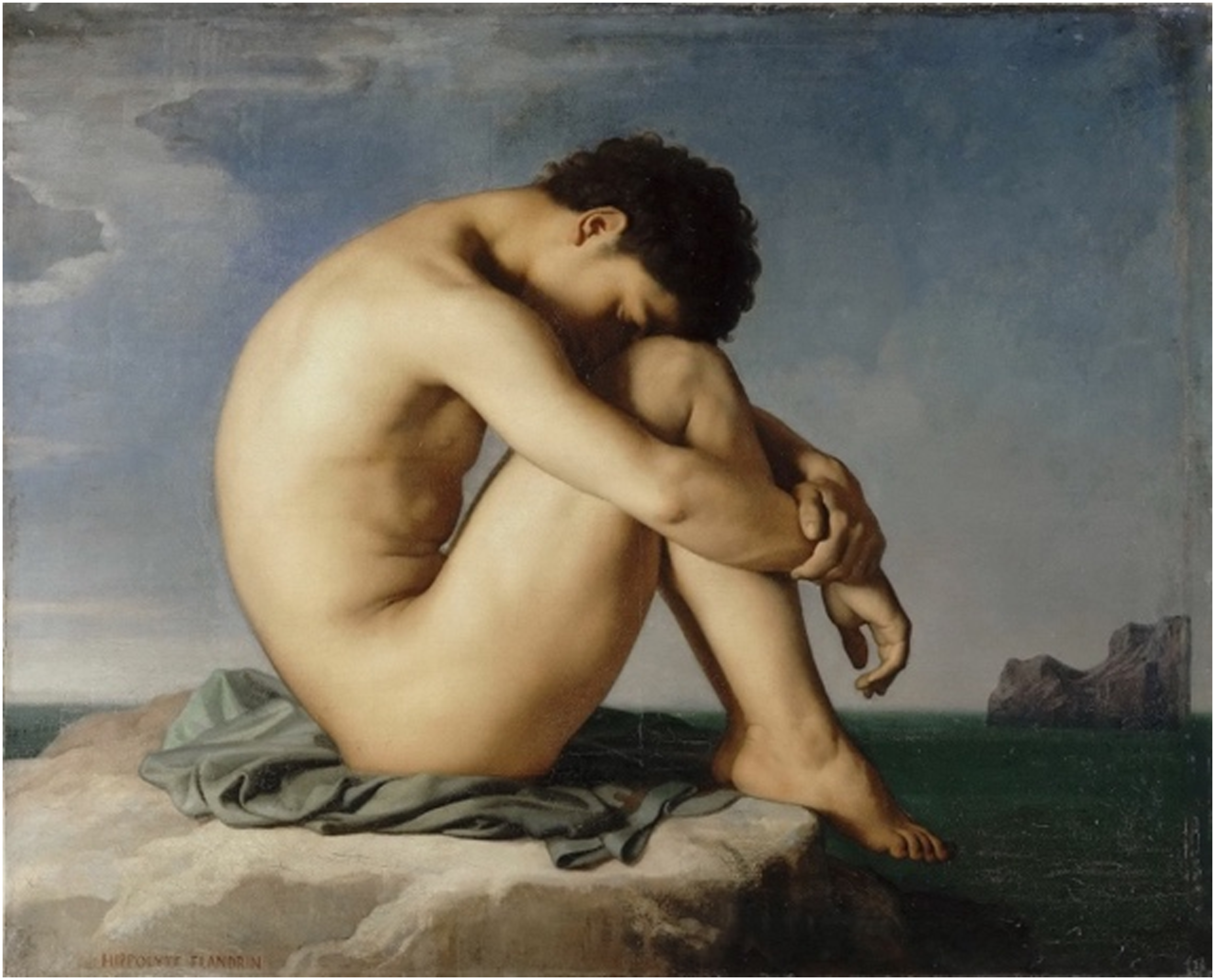
LaBeija’s In My Room (2014) in Figure 1, Kia LaBeija, In My Room, 2014, from series 24, archival inkjet print, 20 × 30 inches. Courtesy of the artist. Hippolyte Flandrin, Study Figure (Young Male Nude Seated beside the Sea), 1835–1936, oil on canvas, Louvre Museum.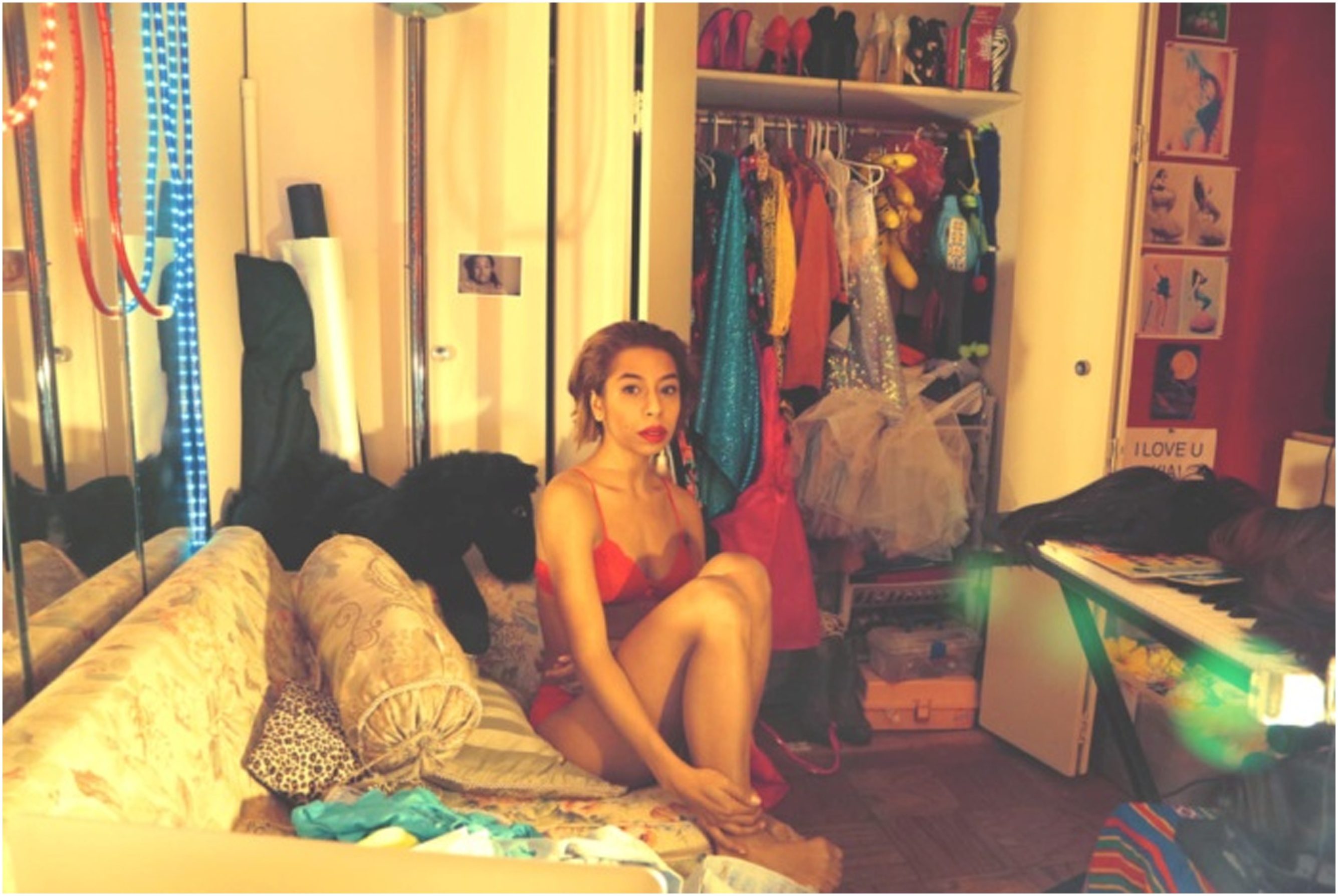
In contrast to the rich furnished space in In My Room, Mourning Sickness (2014), Figure 3 Kia LaBeija, Mourning Sickness, 2014, from series 24, archival inkjet print, 20 × 30 inches. Courtesy of the artist. The photograph also alludes to my childhood playing dress-up and singing in the bathroom mirror, being someone else. I used LaBeija as a way to feel confident confronting these issues…. My mother told me when I was a kid that all people lived behind masks, and they’re not all destructive. My mask has been very healing for me. By creating this character, I’ve been able to be brave about speaking my truth (LaBeija and Tolentino, 2018: 35).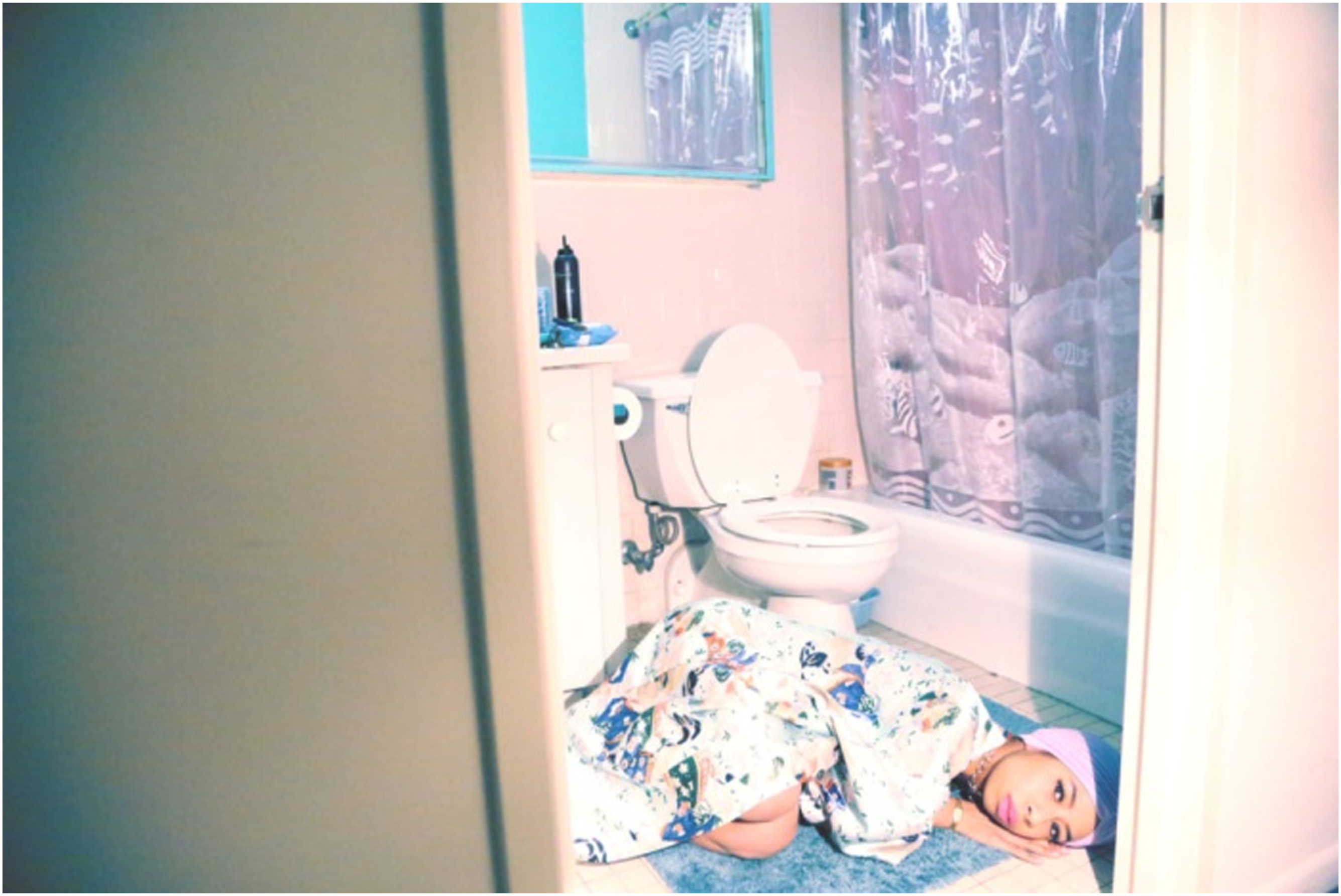
This artist statement is illuminating to me because it shows the transformative power of becoming and self-fashioning. Here, dressing up offers a source of empowerment for LaBeija. Lying on the ground of the bathroom does not mean that the artist assumes the passive position of subjugated other. Rather, she reframes the subjugated situation through her resilient gaze and radiant lighting.
In Kia and Mommy (2014), Figure 4 Kia LaBeija, Kia and Mommy, 2014, from series 24, archival inkjet print, 20 × 30 inches. Courtesy of the artist.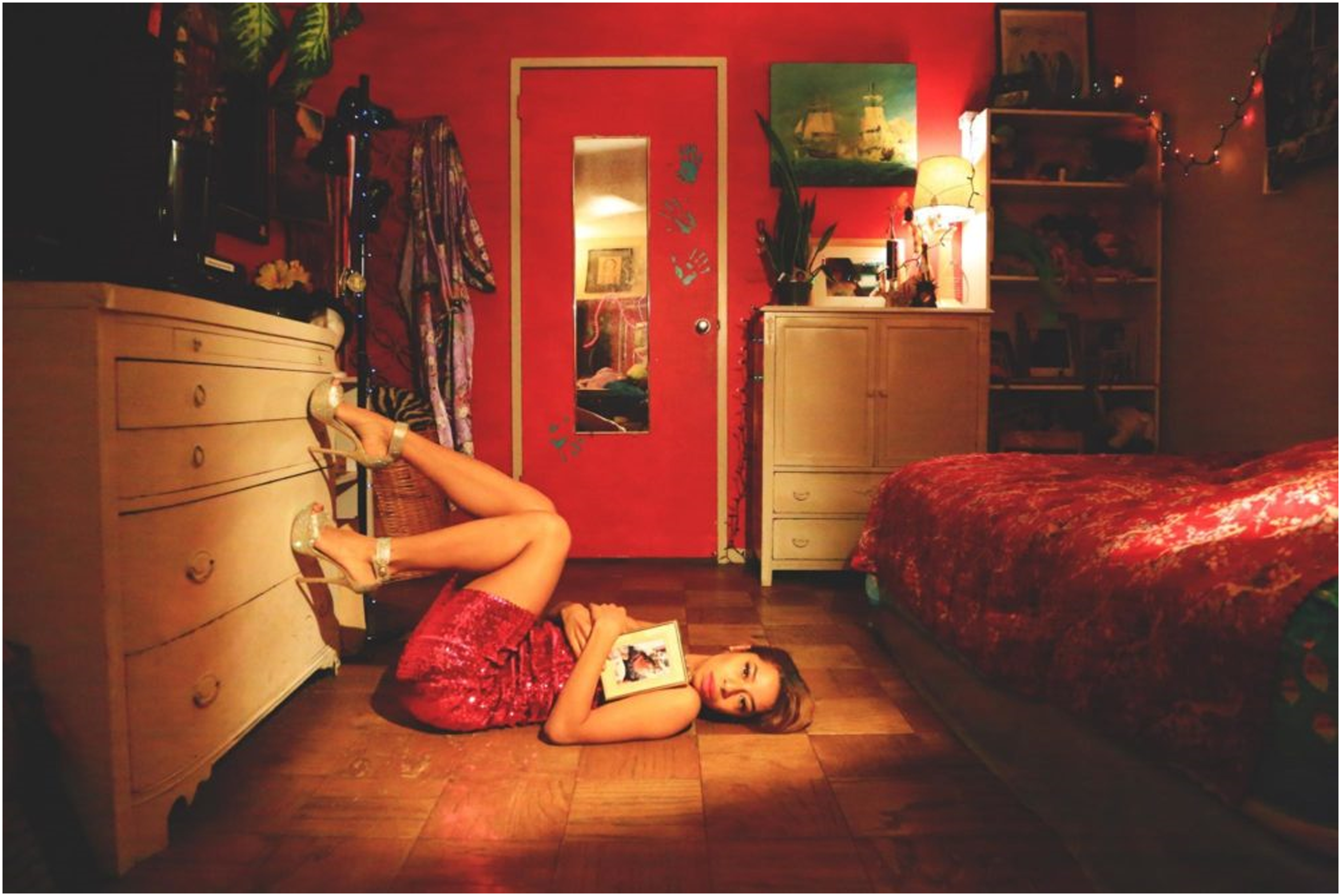
My visual analysis of the series 24 (2014) shows that LaBeija’s self-portrait is more than an individual subject or an isolated portrait of a woman living with HIV framed by the Art AIDS America show, but an inter-relational subject that links her personal narrative with her sense of belonging. As I have suggested above, LaBeija’s aesthetic strategy is deeply informed by the performativity of ballroom culture. As the artist explains: ‘In the ballroom, the idea of being an icon or legend is key because an icon can never die. I think a lot of these photos are my way of creating my own immortality, or consistently being in conversation with people for the rest of time’ (LaBeija and Tolentino, 2018: 35).
Here, LaBeija lays out two crucial aims of her portrait series. First is to create an immortal icon in her self-portrait in order to resist social erasure. The second is to embark on conversations with people within and beyond her social network. Named after her age and apartment number in Hell’s Kitchen, the series 24 not only demonstrates more than the experience of a Black woman in melancholic posture but also shows her emotional bonding and support network. In these three photos, LaBeija positions herself in domestic and intimate spaces such as a bathroom or a bedroom. Rather than illustrating a melancholic subject suffering from sickness and loss, her body is strategically positioned in relation to the homely objects and intimate space through hopeful or dramatic lighting, connecting her gaze with that of the viewer. Resisting the conventional narrative of HIV/AIDS portraits, which often portray tragedy without hope, 10 LaBeija re-stages the lonely subject not as an isolated figure but as an agential subject that generates intimate relations with her surrounding, communities, and viewers.
Confronted with the affective responses towards its first edition at the Tacoma Art Museum, subsequent editions of Art AIDS America attempted to include more Black artists. In the Bronx Museum of Art, New York in 2016, additional works of Black artists such as Willie Cole, Glenn Ligon, and Whitfield Lovell from its museum collection were added. In the Zuckerman Museum of Art, Kennesaw, not only additional artists of colour were included but also the local activism of the greater metropolitan Atlanta area was considered (Whitworth, 2017). The Zuckerman Museum of Art also invited Kia LaBeija to converse with curator Sur Rodney addressing the issue of racism in the art world where LaBeija expresses her feeling of loneliness in relation to the White-dominant art exhibition, as quoted above (Zuckerman Museum of Art, 2016). In this way, the artist’s expression of loneliness animated by her photography series could be part of the discursive conversations to address the institutional problem of racism and interconnecting social exclusions.
Left outside alone
On the evening of 24 June 2017 at the 1840s gallery of Tate Britain, London-based performance artist Travis Alabanza presented their performance Left Outside Alone (2017) as their artistic response to Queer British Art. 11 Unsatisfied with the (then ongoing) queer art show that focuses on White and middle-class art and visual culture, Alabanza, a 1-year residency artist at Tate at the time, proposed to perform at Queer and Now, a celebrative 1-day program accompanied by the museum exhibition. Importantly, the artist did not reveal what would be the exact performance to the host institution. Rather, in the manner of an activist intervention, it was during the 6-minute performance of lip-syncing and dramatic performance that the artist’s institutional critique was revealed. In less than 7 min, Alabanza mixed monologues, shouting, and lip-syncing with the pop-rock song ‘Left Outside Alone’ (2004) by American singer Anastacia.
Based in London, Alabanza often uses poetic monologue, storytelling, and lip-syncing to protest intersectional marginalisation relating to race, sex, and class. For instance, their theatre performances Before I Step Outside (You Love Me) (2017) and Burgerz (2018) both address their living experience as a Black trans person experiencing daily discrimination and violence. Specifically, both performances draw on their experience of being thrown a chicken burger by someone with a transphobic slur on the day in London city without anyone offering help. Turning these hurtful and alienating experiences into artistic performances, Alabanza transforms theatres, museums, and other mainstream cultural spaces into sites for anti-racist and anti-sexist awareness.
In relation to their art practices, Alabanza’s museum performance is significant in the way that it mobilised feelings of alienation such as anger, loneliness, and frustrations to engage with the issue of racial marginalisation critically.
In the realm of their art practices, Alabanza’s museum performance holds particular significance. It serves as a powerful mobilisation of feelings of alienation, encompassing anger, loneliness, and frustration, to critically engage with the issue of racial marginalisation. Ahmed’s concept of affective alienation is pertinent here, as it captures the idea that individuals can be affectively alien either by being affected in the wrong way by the right things or by affecting others in a way that disrupts established norms. According to Ahmed (2010: 67), feminists, queer individuals, and migrants often become ‘affect aliens’ because they resist conforming to the happiness defined by patriarchal, heteronormative, and White-dominated societies.
In the context of the Queer British Art exhibition, where the primary narrative celebrates the fiftieth anniversary of the partial decriminalisation of sex between men, Alabanza’s performance takes a divergent path. Instead of joining in the joyful celebration, they voice their feelings of alienation, of being left outside alone, becoming an ‘affect alien’ within the show. This departure and disruption serve to problematize the celebratory narrative and challenge the dominance of White perspectives in the Queer British Art exhibition. In the following analysis, I delve into Alabanza’s critical performance to further explore the emotional and artistic elements in Left Outside Alone that contribute to an intersectional understanding of the exhibition’s celebrative narrative and its implications on queer representation.
According to the sonic components, the performance is composed of three parts. Prior to the artist’s appearance, a broadcast voiced their ‘feeling sick’ of the museum that has a ‘white wall’ reserved for ‘White people’, saying ‘I think these galleries paint the wall white to remind us that we are never gonna be accepted… yep, I see the white walls as a reminder that we are never gonna be let in…’. Then, the classical piece of Bridal Chorus began to play while the artist entered the gallery in a pastel pink bridal gown, eagerly holding an artificial bouquet. After Alabanza walked into a small circle surrounded by the exhibition brochures, flowers, and a packed crowd in the gallery, they waved and greeted the audience. At the same time, the voice-over continued to question ‘Queer British Art, queer who?’ and mocked that any visitor must pay ‘sixteenth pounds? I’m gonna be left outside!’ Lastly, Alabanza lip-synced and danced along with Anastacia’s ‘Left Outside Alone’, an emotive song that expresses an unrequited love relationship, symbolising the imbalanced relationship between marginalised artists and the museum. With this pop-rock song resounding in the gallery space, the artist performed dramatic moves such as pointing to the exhibition handout while the lyric suggested they have been ‘played like a game’ by the museum. All these mixed sounds voiced out the artist’s critique of White dominance and racial marginalisation. Ending their show by tossing out the bouquet to their partner, Alabanza won the cheer of an animated crowd.
The emotional, sonic, and visual elements in Alabanza’s performance further illustrate how alien affects might work against the White-centric gallery. First, Alabanza uses the imagery of a white wall to symbolise the Whiteness in museums and art galleries. In an artist talk at the Royal College of Art in 2018, Alabanza recalled how once their school group (mostly non-White students) visit to an art gallery was evicted due to ‘loudness’ while in the meantime another school group (mostly White students) experienced no such a problem (Tadman, 2021: 175). Here, the artist recognises the white wall is not only a physical feature but also a social barrier that constantly estranges people of colour from the fine art venue. Like Kia LaBeija who uses loneliness to address the social isolation of women of colour and women living with HIV, Alabanza uses anger and loneliness (feeling left outside alone) to show that personal feelings are closely intertwined with the social architecture of race, class, and sex. By repeatedly calling out ‘white walls, white walls, White people, white walls’, the artist highlights the White dominance of the gallery space which often excludes artists of colour and yet disguises itself as a neutral and non-racial background. By mocking the expensive entrance fee of the Queer British Art exhibition (sixteenth pounds), the artist exposes the inaccessibility of economically disadvantaged queer and trans people of colour. Alabanza’s voice-over is comparable to Kia LaBeija’s protest work against Art AIDS America. In her work, ‘Your White Wall can Kiss my Black Ass’ (2015) in Figure 5 Kia LaBeija, Your White Walls Can Kiss My Black Ass, 2015. Archival inkjet print, 20 × 30 inches. Courtesy of the artist.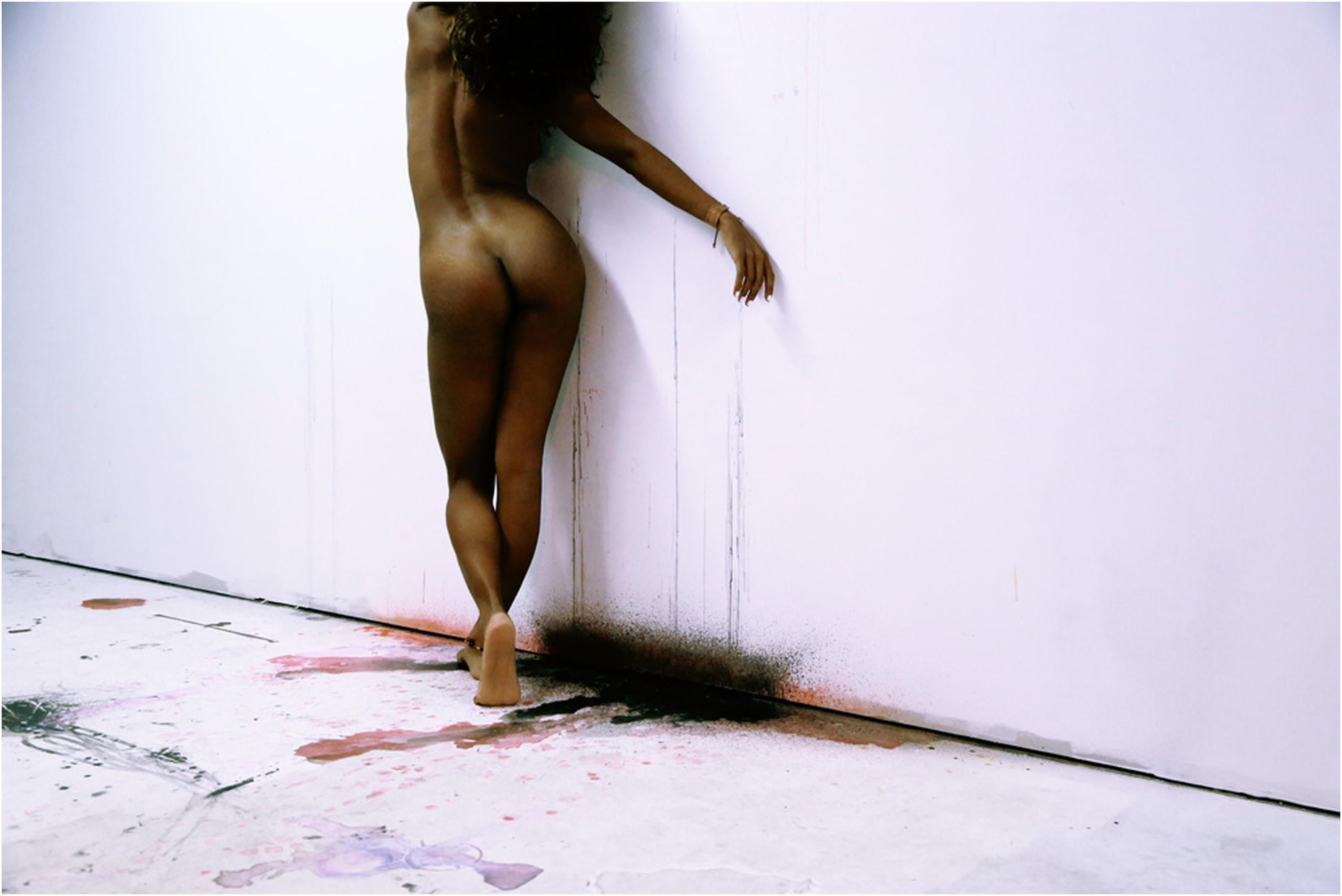
Second, Alabanza appropriates the form of marriage to voice out their institutional critique. In this gallery performance, as the artist entered the exhibition space in bride dress with wedding music and bouquet, they walked slowly and looked around in anticipation to show the excitement and the promise of happiness often built up in the wedding ceremony. Marriage is what Sara Ahmed (2010) calls a ‘happy object’ that promises to bring people happiness. Ahmed lays bare the normative ideology: ‘if you are married, then we can predict that you are more likely to be happier than if you are not married, then we can predict that you are more likely to be happier than if you are not married. The finding is also a recommendation: get married and you will be happier!’ (Ahmed, 2010: 6) In Alabanza’s performance, the marriage ritual symbolises the companionship between art institutions and artists which the former often promises to promote the latter’s career with recognition and acknowledgement. However, Alabanza’s voice-over lays bare the broken promise towards artists of colour and trans artists, absent in Queer British Art despite its promise for social diversity and queer inclusion into the mainstream art institution.
Finally, Alabanza’s performance disrupts the progressive narrative existent in the art show. Although the exhibition aims to stage a wide range of living situations of queer people and people with non-conforming genders, the historical development suggested by room titles from ‘Coded Desires’ to ‘Defying Convention’ and eventually towards artistic canons of ‘Francis Bacon and David Hockney’ seems to assume a progressive development. As written in the exhibition brochure that Alabanza picked up in their performance: ‘Legal persecution affected many, yet for some, this was a time of liberation – of people finding themselves, identifying each other and building communities’ (Tate Britain, 2017; Queer British Art: 1861–1967). While it is important to acknowledge legal development that has supported social recognition, as British queer historian Robert Mills (2008) has pointed out in many mainstream LGBT-focused cultural programs, ‘the idea that the history of sexuality can be understood simply as a progression from repression to liberation potentially has limits as a tool of analysis’ (Mills, 2008: 43). Inspired by French scholar Michel Foucault’s ‘repression hypothesis’ in which Victorian sexuality was considered conservative or repressive compared with the Western modernity, Mills (2008) cautions that museums might have employed similar rhetoric to flatten the diversity and potentiality of queer sexual histories. In this manner, Alabanza’s satirical performance of marriage disrupts the progressive narrative staged in Queer British Art.
The spatial disruption of Alabanza’s performance is even pronounced in the choice of Anastacia’s Left Outside Alone (2017), an outdated song released a decade ago. Such an artistic choice was strategic, as the artist explained in their interview with Beck Tadman: I wanted to create a moment that we could share… the exhibition (Queer British Art) didn’t create this… I picked a song that would immediately separate the room. Anyone that had been to a queer club, grown up gay, whatever – would know Anastacia’s Left Outside Alone is an absolute banger. Anyone that’s outside the community would be like, ‘This song is so dated! What the hell? What a weird song!’ You can actually see that in the video, some people rejoice and go ‘Yes!’ when the song comes on and I wanted that moment, of declaring who the room was for and who it wasn’t for, and that’s why I used lip syncing as well (Tadman, 2021: 179, citing Alabanza).
By choosing a dated song, but one that is affectively played in the queer club scene even today, Alabanza builds a community that could relate to queer loneliness in a public space often privileging straight heteronormative feelings. In this way, the weirdness or even alienation of the song (for those who are not informed by the queer club scene) played in Tate Britain creates a queer space that in the artist’s view, Queer British Art failed to create. As Beck Tadman (2021) has argued, Alabanza’s provocative performance seemed to have triggered the cis-White fragility of Tate Museum staff who left the artist’s performance midway through (Tadman, 2021: 182). For Sara Ahmed, affect aliens have the transformative power to disrupt the mainstream narrative that alienates or marginalises them. She suggests: ‘To speak out of consciousness of such histories, and with consciousness of racism, is to become an affect alien. Affect aliens can do things with alien affects, and do things we must’ (Ahmed, 2010: 158). If Alabanza’s performance here is an emotional embodiment of the affect alien, it might have created an ‘alien effect’ for the cis-White museum staff.
Overall, Alabanza’s Left Outside Alone (2017) effectively animates the young, queer audience who rarely occupy the 1840s gallery at Tate Britain. With this intervention, the artist interweaves the intersection of racism, classism, and different temporalities. By doing so, Alabanza successfully triggered laughs, cheers, and positive responses from the on-site audience and online viewers of the YouTube video, though clearly not some of the Tate staff (Tadman, 2021: 182). Here, personal feelings of alienation are not pathologised towards social minorities as an individual problem. Rather, it is mobilised as a community-building tool to call for solidarity and resist marginalisation in mainstream culture venues such as the Tate Britain.
Conclusion
As art curator Maura Reilly has observed, recent LGBTQ art exhibitions ‘demonstrate a dearth of women artists, artists of colour, and artists from non-Western countries, thus confirming the perpetuation of lesbo-phobic, sexist, and racist curatorial practices within the LGBTQ art community’ (Reilly, 2018: 165). Both LaBeija and Alabanza perform feelings of alienation and loneliness to address such social injustice in and beyond the ‘white wall’ of museum exhibitions. In the case of Alabanza, loneliness was performed to disrupt the self-contained British art history that excluded artists of colour and to appeal to allyship emotionally by occupying the exhibition space. In the case of LaBeija’s 24 photography series (2014), although it is not produced in direct response to the museum exhibition, it serves as a rare conversation piece to highlight the feelings of solitude experienced by women living with HIV and the potential of extended kinship grounded in ballroom culture. In both artistic productions, the expression of loneliness plays a stimulative role in creating communal connections. By doing so, their artistic performances contribute to queer of colour and intersectional feminist theories of affect, emotion, or what Sara Ahmed has called ‘emotion politics’ (Ahmed, 2004) that challenge and reshape the cis, White, heteronormative art world through seemingly ‘backward’ (Love, 2007) yet mobilising emotions.
In this study, I have proposed loneliness as an affective reading of LaBeija and Alabanza’s artworks in relation to the racial exclusion of HIV/AIDS and queer-themed museum exhibitions. Such an analysis of artistic emotions qualitatively foregrounds the emotional response and its emotive landscape beyond the statistics of the under-representation of artists of colour. A future inquiry might continue to explore in what ways various seemingly negative emotions, or what Jack Halberstam has referred to as ‘the dark landscape of confusion, loneliness, alienation, impossibility, and awkwardness’ (Halberstam, 2011: 97), could be considered in exhibition-making and curatorial practice. Rather than shaping a progressive narrative of HIV/AIDS or an one-dimensional queer history, how could these queer feelings offer more multi-dimensional and intersectional ways of social connections and emotional togetherness beyond the representation museums have tended to provide? Asking such questions might allow us to pay attention to the alienated feelings of excluded social groups as well as to hear creative voices that have the potential of reimagining cultural spaces for social resistance.
Footnotes
Declaration of conflicting interests
The author(s) declared no potential conflicts of interest with respect to the research, authorship, and/or publication of this article.
Funding
The author(s) disclosed receipt of the following financial support for the research, authorship, and/or publication of this article: This work was supported by the Nederlandse Organisatie voor Wetenschappelijk Onderzoek.
