




Abstract
The study of Queer Necropolitics has established that white futurity regularly relegates trans women of colour to zones of death and sacrifice. What has received less attention, however, is how trans women of colour use art to challenge these murderous assemblages. A primary example of this is Shraya and Lee's (2019) graphic novel Death Threat, which re-envisions a series of transmisogynistic hate letters that Shraya received in 2017. Taking Death Threat as my point of entry, I ask how trans women of colour can repair death into live-affirming art, giving substantive focus to the text's tendency to conflate the literal death of the body with the ‘social death’ of being misgendered. From here, I explore how Death Threat transforms the death worlds of trans women of colour into sites of agency and, in so doing, troubles and expands the analytical boundaries of Queer Necropolitics.
In their debut graphic novel, Death Threat, Shraya and Lee (2019) use satirical prose and surrealist imagery to portray hate letters that Shraya received from a stranger on the internet in 2017. Drawing on Shraya's lived experiences as a ‘Toronto-based South Asian/trans/femme/bisexual‐identified artist’ (Wiggins, 2017: 668), Death Threat contends with the violent realities that trans women of colour face under white cis-heteropatriarchy. While Shraya narrates her experiences with breath-taking sincerity, Lee brings her story to life with vivid and startling imagery, culminating into a graphic novel that, by virtue of its inception, constitutes a profound act of resistance. The final result is an uncannily beautiful product that illuminates the (im)possibilities, contours and vibrancies of minoritarian agency.
Using Death Threat as a reference point, this article examines the conceptual boundaries of Queer Necropolitics, a queer of colour analytic that brings the concept of ‘Necropolitics’ to bear on queer theory. Haritaworn et al. define Queer Necropolitics as the ‘concept-metaphor that illuminates and connects a range of spectacular and mundane forms of killing and or “letting die” while simultaneously radically reimagining the meanings, purchase and stakes inherent in “queerness” as a category of analysis and critique’ (2014: 4). Under this analytic, death works to fold white cis monied queers into the national imaginary by relegating their ‘less assimilable’ peers to zones of sacrifice (Atluri, 2018). In Death Threat, however, death is refashioned into a source of queer and trans of colour agency, providing the springboard from which Shraya and Lee conceive their radical aesthetic and critique, thereby indicating a new approach to Queer Necropolitics.
Building on this scholarship, I draw on the Black Feminist method of ‘Wake Work’ (Sharpe, 2016) to highlight how Death Threat queers the death-making logics that bar trans women of colour from the status of full humanity (Snorton and Haritaworn, 2013). Sharpe defines Wake Work as the analytical process of visioning alternative modes of living ‘in the wake’ of western (read white settler) imperialist systems, particularly racial slavery and settler colonialism, with the aim of surviving and thriving within the afterlife of these institutionalised violences, as a ‘mode of inhabiting and rupturing this episteme with our known lived and un/imaginable lives’ (2016: 17). Through this framework, I examine how Death Threat revisions moments of exchange between Shraya and her real-life aggressor that urge her symbolic or literal death. In doing this, my goal is to foreground the liberatory impulses underlining the graphic novel, chief among them being its ability to rupture the death-making capacities of late western modernity.
I frame my analysis around one main theme: the graphic novel's tendency to rhetorically conflate the literal death of the body with the ‘social death’ of being misgendered. Using this theme as my point of entry, I critically interrogate how Death Threat occupies the realm of artistic expression that ‘highlights impulses of subversion, slippage, and “turning away” as the height of agentic action and emancipatory (re)imagining’ (Ali, 2018: 3). I begin by outlining the sociohistorical landscape from which the death-making practices challenged by Death Threat are located and draw strength, revealing the impact such practices have on dominant (read white and western) modes of gender-sex signification/materialisation and, by extension, the positionality of trans women of colour within this milieu. Following this, I provide an overview of Wake Work and explain why this method is well suited to my analysis. I then illustrate how the semiotics of Death Threat expand the analytical boundaries of Queer Necropolitics, focusing, in particular, on how the graphic novel troubles the killing and letting die of trans women of colour.
Before I begin, a quick note about positionality. While the academic practice of positioning oneself in relation to one's object of investigation has largely become a way for privileged white scholars to offer a shallow caveat about reflectivity (instead of genuinely being reflective), it is also, and perhaps ironically, the best way to reveal power in writing. Given that trans and race studies alike are saturated by cis and white voices (as is all of academia), positioning is an important practice for those of us writing within these fields: trans and non-white readers have garnered a healthy distrust towards academics who purport to be experts on gender, race and sexuality, and so clarifying who wrote the words that they are reading seems a fair gesture.
To this end, I identify as a nonbinary queer woman of colour of mixed Goan-Indian and Hungarian-English descent. My father is a Goan refugee from Uganda of (achieved) middle-class status and my mother is a retired factory worker with an absent Hungarian immigrant father and white settler single mother. Across this spectrum, I identify as South Asian, East Indian, Brown, biracial, bisexual, pansexual, demisexual, AFAB, femme and enby. I also identify as ‘trans’ but only as a collective identity. Outside academia, I am an organiser and creative in Tkaronto / the Greater Tkaronto Area, working in community with other Queer and Trans/Black, Indigenous and People of Colour (QT/BIPOC). I share this information because it is the kind of information I would want to know as a reader: I would want to know that I exist in proximity to Shraya as a fellow ‘Toronto-based South Asian/trans/femme/bisexual‐identified artist’ (Wiggins, 2017: 668), but that this proximity is fraught. I would also want to know that I am neither white nor cis, that my politics are not limited to academia and that I am a non-Black person of colour mobilising Black feminist methods. I am not suggesting that such insights are inherently good or bad, but that they are implicating, and that you, as the reader, should get to decide the extent and nature of these implications for yourself.
White futurity and otherised death
My decision to engage Death Threat as a site through which to reimagine Queer Necropolitics emerges in relation to the growing body of scholarship concerned with white futurity (Sium et al., 2012; Schurr, 2017; Smith and Vasudevan, 2017). Smith and Vasudevan define white futurity as that which ‘centers futurity in the white subject and disqualifies non-white subjects from full humanity and thus from a forward-oriented agency’ (2017: 211). White futurity works by erecting a matrix of social, temporal and spatial relations that propel white subjects into the future by arresting non-white subjects to the past (Ali and Anane-Bediakoh, 2020). At the core of this matrix is what has been called the three pillars of white supremacy: 1) anti-blackness – the reduction of Black people to historical relics (via enslavement) and therefore abject; 2) settler colonialism – the erasure of Indigenous folx and lifeworlds from the present to legitimate our stealing of their lands; and 3) Orientalism – the posturing of racialised people as backwards and thus viable for imperial conquest and domination (Da Costa, 2021). Although each pillar operates differently, they all function to suture whiteness to the present by arresting non-white people back, before or beyond time (Snorton, 2017). Here, futurity is made visible to the white subject ‘through a backward colonial gaze’ that poses non-white people as always existing outside the present, subsequently rendering us unable to enter the future (Da Costa, 2021: 443). Thus, at the same moment white people are folded into the realm of futurity, BIPOC are barred from its horizons.
White futurity's temporal banishment or seizure of BIPOC often takes the form of killing these communities. This is especially pertinent when we consider the first two pillars of white supremacy, anti-blackness and settler colonialism, which concertedly position Black and Indigenous death as necessary precursors for white forward-oriented agency. Under settler colonialism, ‘enslaved Black people were used to re-territorialise Indigenous soil to the benefit of the white settler, who then claimed the labour as their own’ (Da Costa, 2021: 449). This not only required the expulsion of Indigenous peoples from the present-future world, but similarly reconstituted Black people as property – as tools through which the white settler could demonstrate their mastery over Indigenous lands (McKittrick, 2021). Accordingly, the Black subject was discursively constituted as beyond time, as ‘the unknowable figure’ upon which western development depends, at the same time that Indigenous people were temporally arrested – posed as only ever existing via pre-European contact and thus lacking present-day liveability (Da Costa, 2021: 449). In turn, Black and Indigenous communities have been systematically targeted for death since the moment of European contact, perpetually rendered unknowable and unhuman within the here-and-now so to secure the establishment of the modern western world (King, 2016). And although the extent of white futurity goes far beyond this brief description, it illustrates the ongoing role that anti-blackness and settler colonialism play within western notions of life, death and temporality, and thus makes clear the death-laden politics embedded within the concept.
To add to this, white futurity seeks to not only kill BIPOC, but to secure our ‘social death’: the generalised modes of dehumanisation that render certain groups non-or-not-quite-human (Haritaworn et al., 2014; Snorton, 2017). In essence, social death describes how BIPOC, among others, are relegated to the margins of society by design, revealing ‘the ecocidal and genocidal’ skeleton upon which our worlding is conditioned (McKittrick, 2021: 4). Exposing how this lethal social logic foregrounds the very development of late western modernity has become a central feature of contemporary QT/BIPOC scholarship (Green, 2016; Snorton, 2017; Brand, 2020; Jackson, 2020). Such scholars have illustrated that our sociopolitical landscape is constituted by a climate of social (and literal) death that is aimed at creating a future that is made by and for white people (Sium et al., 2012; Schurr, 2017; Atluri, 2018; Da Costa, 2021; McKittrick, 2021).
Given that white futurity is animated through racialising assemblages that seek to literally or symbolically kill BIPOC (Chen, 2012; Weheliye, 2014; Atluri, 2018), it can be considered a site of necropolitical domination: as operating though modes of literal or social death that are conditioned by white supremacy. Within this murderous social milieu, whiteness is literally given life through the material or social death of non-whiteness (Atluri, 2018; Jackson, 2020), thereby posing BIPOC in external relationality to the goodness of western (read white) society and subsequently condemning us to zones of sacrifice. The modern western world is now thought to have been built around this colonial practice (Weheliye, 2014: 22; see also: Jackson, 2020).
The impact of our colonial architecture on modern gender-sex relations is instrumental. For one, western gender-sex norms were elaborated according to humanist ideologies that position the white body as their cause (Weheliye, 2014; Green, 2016; Snorton, 2017). Thinking back to the three pillars of white supremacy, such positioning takes on multifaceted forms. Regarding anti-blackness, racial slavery has historically operated as ‘the necessary context for producing a field of sex/gender knowledge’, in which Black folx’s subhuman status as ‘captive’ not only incapacitated their ability to be gendered but concertedly provided the ungendered marker against which race as a condition of sex could be established (Snorton, 2017). ‘In this arrangement’, observes Snorton, ‘gender socially constructs sex, and captive flesh becomes the material and metaphorical ground for unsettling a view of sex and gender as neatly divided according to each term's relation to medicoscientific knowledge’ (2017: 33). To this effect, many Black trans and/or feminist scholars (most of whom build from the pioneering work of Sylvia Wynter) have begun to theorise the ongoing relationship between Blackness and gender/sexuality as either ‘plastic’ or ‘fungible’ (King, 2016; Awkward-Rich, 2017; Snorton, 2017; Chaudhry, 2019; Jackson, 2020). Within this formation, the abjection of Blackness is posed as the ‘register of sign and materiality’ upon which the dominant logics of ‘the human’, such as gender-sex codes, depend (Jackson, 2020: 9).
Similarly, settler colonialism now provides the very catalyst through which we can even imagine gender-sex relations, violently supplanting pre-contact articulations and embodiments with colonial registers so infused with whiteness that they push diametrical worldsenses beyond comprehension (Driskill, 2016). In many ways, settler colonialism works to consume bodies, Indigenous and otherwise, akin to its consumption of land. In the words of Infante: ‘By stealing and conquering the land and the body, “particularly women's bodies through sexual violence” and by “recreating gendered relationships”, settler colonialism secures its hold on Native land and body as a generational phenomenon’ (2020: 146). So, while anti-blackness places the abjection of Black people at the heart of modern western gender-sex subjectification, settler colonialism takes the diverse range of Indigenous cosmologies relating to said realm and, temporally speaking, obligates them, only allowing them to appear as primordial, pre-history artifacts to be consumed and contorted by the white gaze (Driskill, 2016; Whitehead, 2018).
Lastly, Orientalism positions those widely and ill-defined by the white imaginary as Brown, Asian, foreign and Muslim, as transfixed in halted proximity to whiteness, whereby we are considered, not stuck in or outside of time per se, but as behind in time (Puar, 2007; Chen, 2012; Ali, 2018). Here, people of colour are invited to pursue a whiteness that we will never catch up to but must always aspire towards. Those who decline are infantilised and declared ‘backwards’ (leaving them open to violence or fetishism), while those who accept are understood as being ‘saved’ by modernity and thus tokenised. The implications of this on gender and sexuality are different globally (as well as ethnically, culturally and racially).
Generally speaking, Orientalism's operative function within the western world is to consume, contort and assimilate people of colour into white gender-sex norms (Razi, 2021). That said, it often appears to those living in or from the global south in the contextualised forms of western imperialism and nationalism; as, for example, white women ‘saving’ Muslim women (re: imperial feminism) or the co-optation of queer politics to justify racial violence (re: homonationalism) (Puar, 2007). Although divergent in scope, in either local or global formations, Orientalism is called upon to scrutinise the gender-sex practices of racialised people according to western gender-sex norms that deem said practices backwards and thus conquerable.
The three pillars of white supremacy, and by extension, white futurity, have not only rendered whiteness synonymous with humanity, and non-whiteness synonymous with non-or-sub-humanity, but in so doing, have built this impossible dichotomy into our very ordering of gender-sex relations (Chen, 2012). Historically, this meant that only white people were considered human enough to be gendered, thus producing an ‘essentialist, culturalist logic of a particular flattened gender/sexual identity’ that hinges on the experiences of ‘Western, Euro-American bourgeois’ people (Davies, 2007: 55). By universalising dominant Eurocentric gender-sex configurations in this way, prevailing western gender-sex systems help to affix whiteness to a supposedly morphologically inset sexed body, which pathologises not only white gender-sex norms but also the racist schematics upon which these norms depend (Weheliye, 2014). Consequentially, whiteness is stabilised through dominant western gender ideologies, sutured into place through gender-sex assemblages that assume the ‘ideological belief in a naturalised whiteness’ (Noble, 2012: 43).
Within this milieu, trans women of colour are especially vulnerable to death-making capacities, specifically because they pose a salient threat to the racialising gender-sex assemblages of late western modernity (Snorton and Haritaworn, 2013). By virtue of their disposition at the nexus of white settler modes of gender, racial and sexual signification/materialisation, trans women of colour resist all intelligibility within dominator culture (Stryker, 2006; Green 2016; Chaudhry, 2019). In turn, these women call attention to the failure of white gender-sex norms to hold on/in minoritarian flesh, naturally blurring the racial and bodily matter that constitutes these ideological formations (Noble, 2012; Snorton, 2017). Accordingly, they problematise the west's belief in a naturalised white gender identity, which, in turn, gestures to the instability of the racialising informatics that constitute, not just prevailing western gender-sex codes, but modern western society as a whole. Given the radical implications of this, it is unsurprising that trans women of colour are murdered in epidemic numbers (Snorton and Haritaworn, 2013): they are being punished for the ontological threat that they pose to white futurity (Krell, 2017).
Literature on Queer Necropolitics has taken up the relationship between trans women of colour, violence and white futurity in various ways, exploring how myriad social systems engender the death-making practices of the state and the market in order to kill, cannibalise or exploit, poor, trans feminine bodies that are either non-white or from the global south (Snorton and Haritaworn, 2013). In many ways, Death Threat addresses these same questions and concerns: at its core, the graphic novel seeks to expose the everyday traumas that trans women of colour face as a result of the epistemological violence of white futurity. Yet, as a liberatory project that uses art to challenge these same impulses, Death Threat also complicates the presumed linkages between death and Otherness that Queer Necropolitics takes as its vantage point, gesturing to the possibility that the minoritarian subject can harvest death to their advantage. This then begs the question: how do Shraya and Lee (re)imagine Queer Necropolitics in and through Death Threat so to illuminate potential sites of agency? Using this question as my starting point, below I explore the themes of social death, non/humanity, futurity and resistance that appear in the text.
Death Threat
Published in the spring of 2019, Death Threat came out of a series of hate letters that were sent to the book's author, Vivek Shraya, from a stranger on the internet over a couple of months. During an interview with The Tyee, Shraya 1 remarked that, although she has been harassed online before, these letters were particularly disturbing (Wooden, 2019). For instance, they included inquiries about her mother, references to Shraya being hunted down in a forest and locked away in a mud hut and the assailant's full name and address, which Shraya felt was an ‘audacious move that indicated a weird level of confidence’ (Wooden, 2019: para 3). Further, the letters included culturally charged language, such as ‘Napumsaka’, a Sanskrit word which means eunuch: ‘a man who has been castrated’ (Lexico, 2019). Such uncanny and surrealist features made these hate letters especially frightening, and it was in the wake of this fear that Death Threat was born.
Death Threat starts with two side-by-side images, both of which foreshadow the arrival of the assailant's first threat: the first image contains a single cellphone, assumedly Vivek's, with the caption ‘you hunted me down’. The phone is lit up, which suggests that Vivek has just received a message. The second image shows a sequence of four sun-shaped faces, also assumedly Vivek's, falling in defeat (see: Figure 1). While the former image indicates the arrival of the first death threat, the latter image alludes to the imminent violence posed by the threat itself, highlighting its ability to eventually eclipse Vivek's sense of light. The graphic novel then moves into a series of images that detail Vivek's initial encounter with her assailant, depicting both of their actions before, during and immediately after the first threat was sent. Following this, the reader encounters multiple moments of surrealist imagery and narration. These moments vision all the subsequent threats sent to Vivek in concert with how she responded to them, thereby revealing the contents of each letter in dialogical juxtaposition with the effect they have on her psyche.
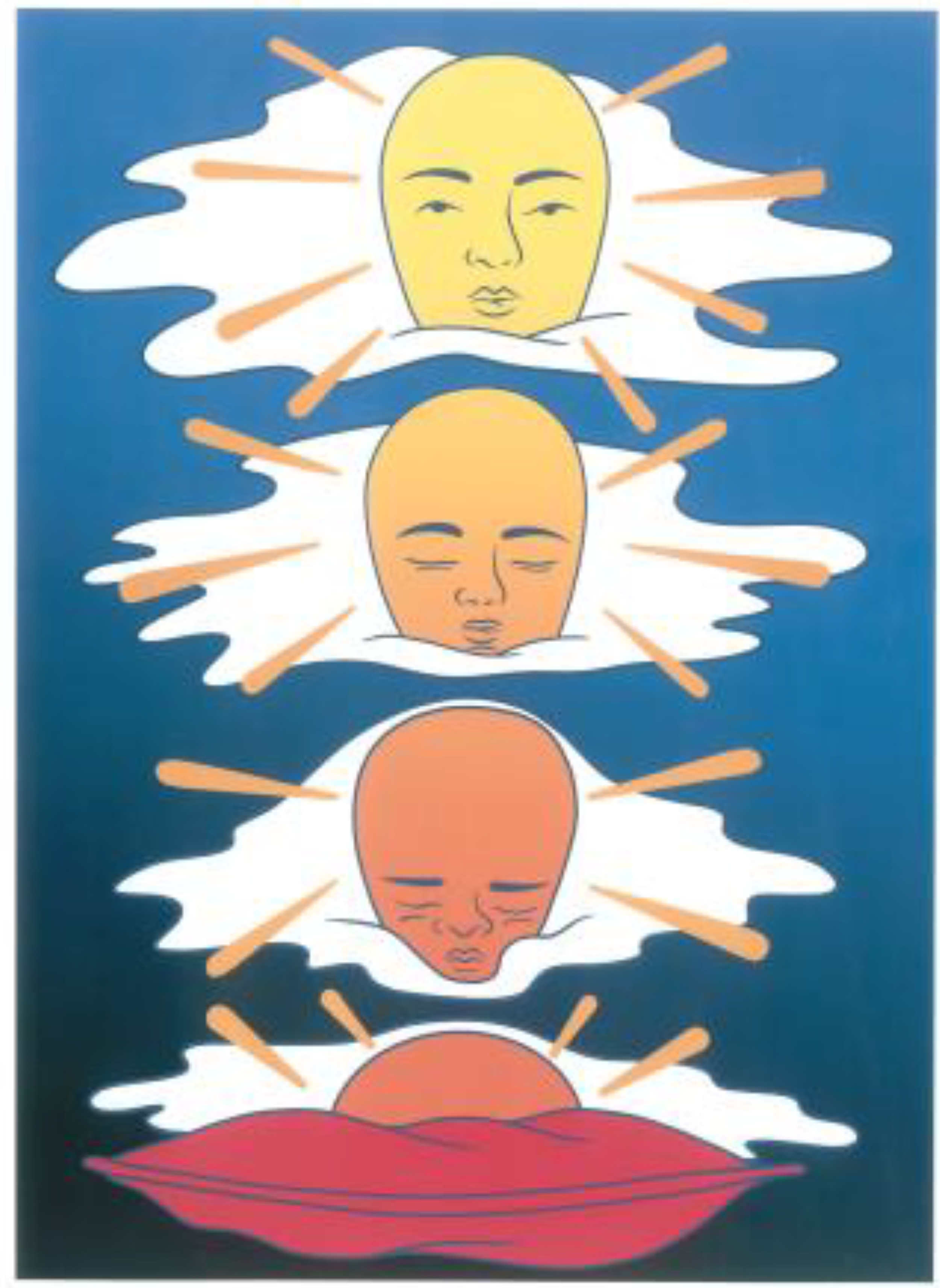
Illustration by Ness Lee; p. 5 of Death Threat (2019)
The graphic novel takes a turn when the attacker calls Vivek a ‘full-time whore’ (Shraya and Lee, 2019: 50), which echoes the real-life moment in which Shraya came up with the idea for Death Threat. Shraya writes: ‘Was “full-time whore” a reference to my album “part-time woman”? Your message made me think of Ness Lee, who had created the album artwork. You gave me an idea’. The following pages then depict the real-life creation of Death Threat, noting everything from the cease-and-desist letter issued on behalf of the assailant, to the struggles Shraya and Lee faced while trying to finish the book. However, this sequence concludes, not with a real-life event, but with an imagined book launch, wherein Vivek is shot dead by her attacker. The remaining pages of the graphic novel then draw on the death threats to vision Vivek's funeral, after which a blacked-out image of the assailant is shown approaching her grave and placing upon it another letter, ending the graphic novel with the chilling image of Vivek's body buried beneath a death threat (see: Figure 2).
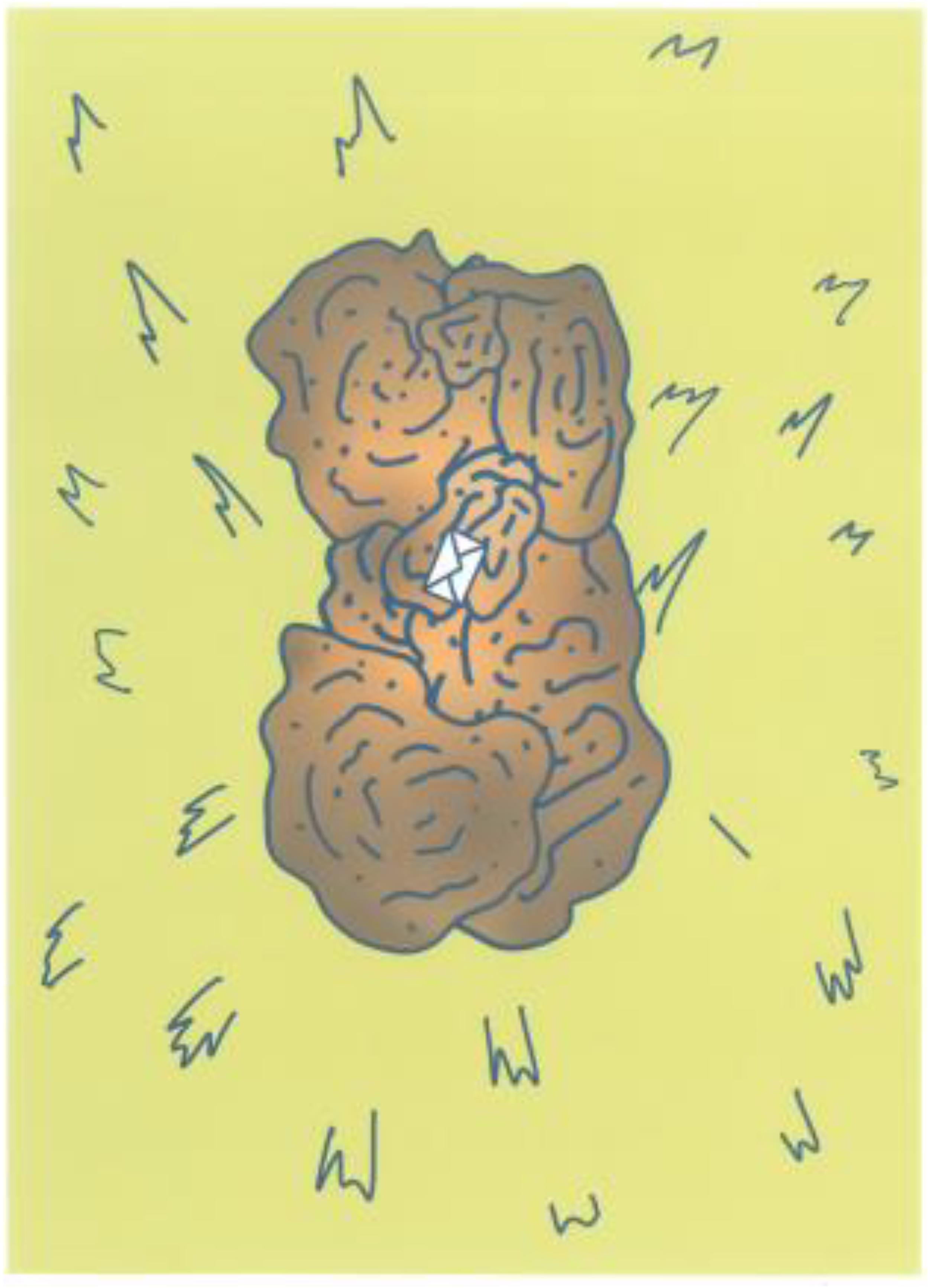
Illustration by Ness Lee; p. 68 of Death Threat (2019)
Even at first glance, Death Threat is rife with agentic and liberatory impulses that challenge the relegation of trans women of colour to zones of death. Drawing on Wake Work to engage the ‘continuous and changing present[-ness]’ of white settler domination (Sharpe, 2016: 15), I argue that Death Threat archives the moment in which the waking consciousness of trans women of colour reckons with the imperial informatics etched onto their bodies. Specifically, I examine how Shraya mobilises the historical violences felt in/signalled by her flesh to create a narrative that documents and rejects the imminent death that trans women of colour are forced to contend with in a world order defined by white supremacy.
As a method of analysis, Wake Work is rooted in a theoretical framework that examines how racial embodiments writ large are ontologically coterminous with the white-cis-heteropatriarchal-settler colonialist informatics of late western modernity (Jackson, 2020). A key epistemological premise of the practice is to harbour what Sharpe and others have called the power of the monstrosity: the ability of the so-called non-or-not-quite human subject to articulate themselves in ways that transcend the territorialising assemblages of the modern western world (Stryker, 2006; Weheliye, 2014; Sharpe, 2016). In using the analytic to frame my exploration of Death Threat, I not only explore how Shraya mobilises visual and linguistic representations to harbour her own monstrous powers but also use this exploration to interrogate the conceptual boundaries of Queer Necropolitics. As a result, I am able to expose the radical monstrosity that underlines the pages of Death Threat and therefore reveal how it ruptures the territorialising assemblages of late western modernity especially and white futurity more generally.
My analysis of Death Threat is grounded in the graphic novel's tendency to rhetorically conflate the literal death of the body with the social death of being misgendered. Misgendering refers to the misclassification of someone's gender and is often used to delegitimise non-cisgender identified identities (Kapusta, 2016). In framing misgendering as a type of social death, I explore how Death Threat both engages and radicalises the ‘known lived and un/imaginable lives’ (Sharpe, 2016: 17) of trans women of colour. I organise my analysis in accordance with specific moments in the text in which the real-life necropolitical rhythms that inspired the graphic novel feel most salient. I focus on instances where death is named, depicted or described. Moreover, each of these moments seem to contend with the sites of necropolitical domination that condition the everyday realities of trans women of colour and therefore offer an appropriate entry point for my analysis.
Misgendering as social death
Research has established that misgendering trans people can have dire consequences on our overall health and wellbeing (Kapusta, 2016; Gherovici, 2017). The reason for this is simple: when trans people are misgendered, our sense of identity, and thus existence, is threatened, which then forces us to live through the denial of our being, consequentially binding our waking consciousness to the inability to fully occupy our embodied cognitive, emotional and bodily registers (Gherovici, 2010; James, 2014). Within this field of non/intelligibility, living only happens alongside the total or partial loss of identity and, by extension, body, mind and soul.
This is one reason why so many trans people commit suicide (Gherovici, 2017): in cases where gender affirmation is not possible, life becomes plagued by an unbearable sense of loss from which one must escape. James illustrates this sentiment well when she describes the moment in which she found out she could no longer get sexual reassignment surgery (SRS): I accepted that I had done my best and that SRS was just not going to happen for me. I had been as patient as I could be, and on that day […] I was ready to exit this world. It was time to die. I was finished; there was no more fight or hope left inside of me. Suicide was to be my way of ending the emotional pain that I was experiencing. (James, 2014: 48)
James’ story illustrates how life can become a site of death for many trans people; a place where we are haunted by our own non-existence and where physical death becomes a type of refuge, a way to escape the trauma of (non)living. But, as James’ story also suggests, one does not simply choose death over life. Rather, this ‘choice’ is conditioned by transphobic violence: some trans folx only ‘choose’ to die because the only other option is to live in non-existence, to live in death.
With this in mind, we can begin to see why misgendering constitutes a type of social death. Misgendering trans people prohibits us from culturally, emotionally and spiritually embodying our gender, which, combined with the technical and somatic barriers to transitioning (James, 2014), makes living as trans a constant challenge for some, and an impossibility for others. As a result, trans people are constantly denied forward-oriented agency, confined to zones of sacrifice that express and beget our nonhumanness/dehumanisation. Given that dehumanisation is the root cause of all sociopolitical violence, such behaviour inherently constitutes a violent social act (Kapusta, 2016), and therefore renders misgendering synonymous with social death.
To explore how Death Threat engages this conceptualisation of misgendering, I draw on a series of moments in the text that highlight the multiplicity of social death that Vivek experiences as a trans woman of colour. I start with the moment in which Vivek receives her first threat. Here, Vivek is shown opening the threat above a series of panelled images that depict her assailant, an ambiguous white figure with fire-like hair, yelling her name throughout their house (see: Figure 3). These images appear under the first line of the threat, which reads: ‘Dear Vivek, your name was shouted at my place as someone who has to die’ (Shraya and Lee, 2019: 11).
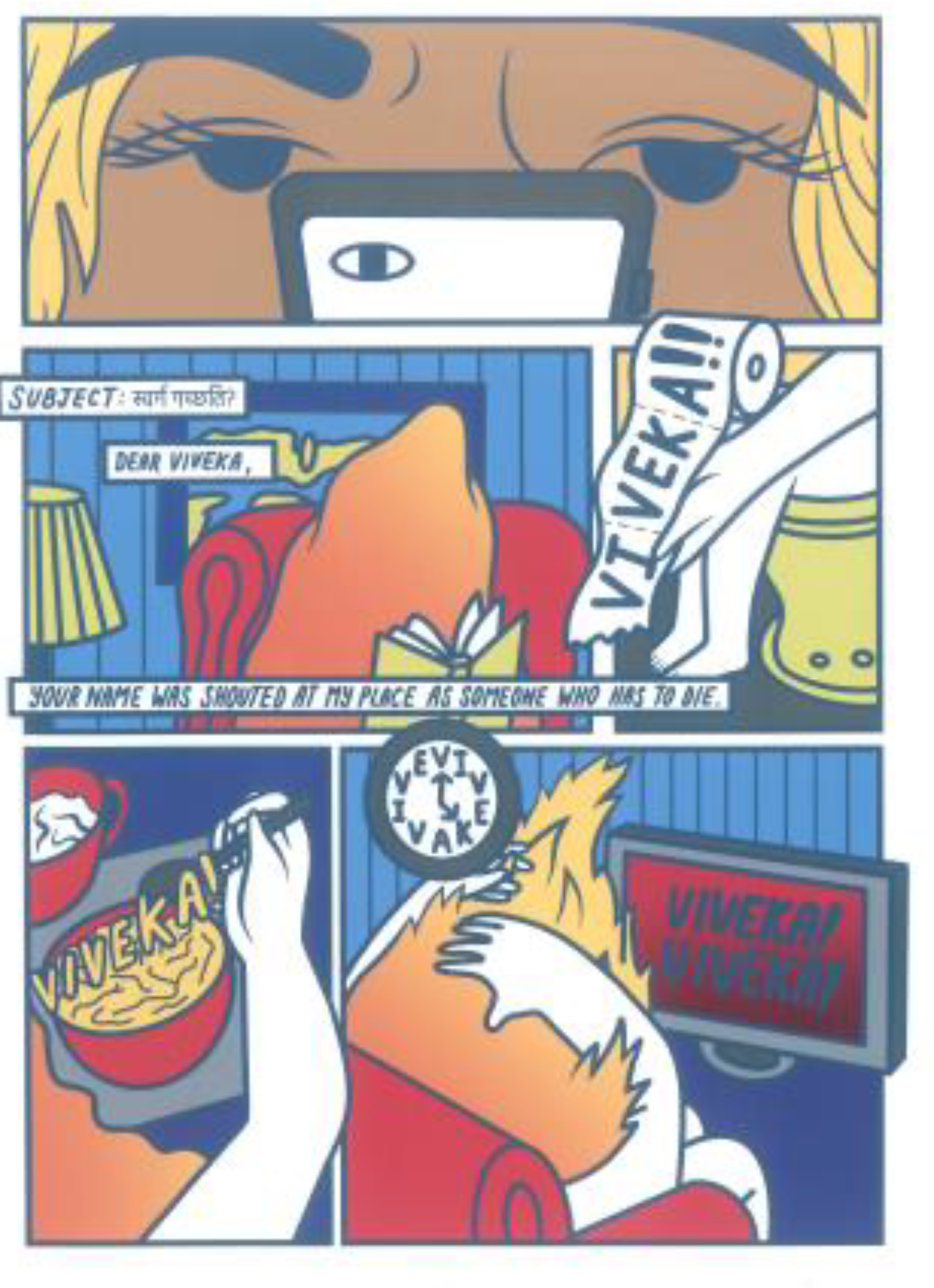
Illustration by Ness Lee; p. 11 of Death Threat (2019)
By creating a visual echo of Vivek's attacker angrily shouting her name throughout their house, Shraya and Lee position the space as plagued by a type of ‘collective effervescence’, whereby one original expression of anger is intensified by the proximity of subsequent expressions of anger, resulting in the intensification of rage in space (Sukarieh, 2020). It is only after this feeling of collective effervescence is established that Vivek is shown reading the rest of the email, which states: ‘They call you Anasraya (or Asraya). Your birth comes off as Napumsaka’ (Shraya and Lee, 2019: 12–13). Vivek then Googles the definition of ‘Napumsaka’, which appears against a backdrop of two overlapping images of her looking at her altered reflection in a mirror, as she is engulfed by flames (see: Figure 4).
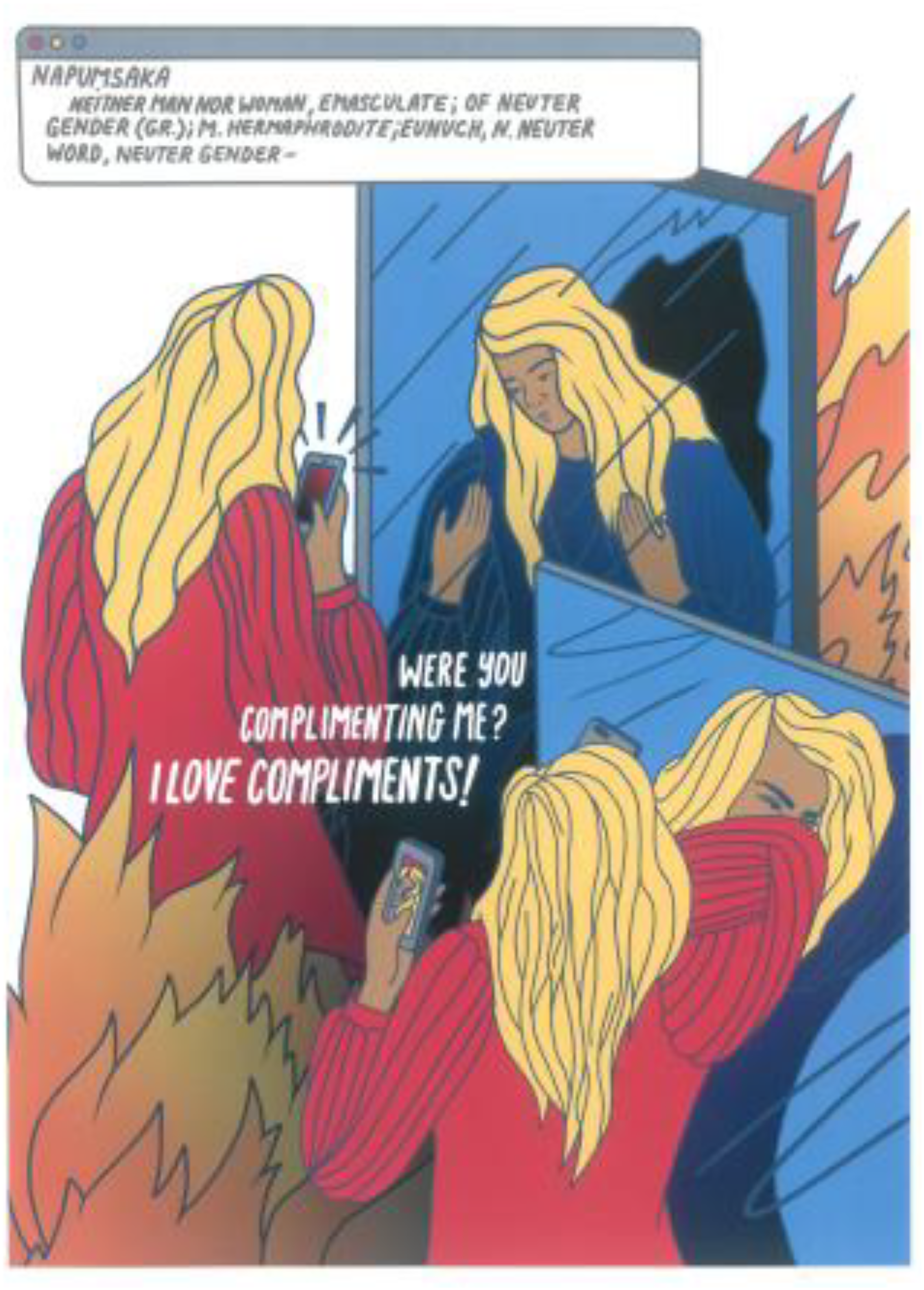
Illustration by Ness Lee; p. 13 of Death Threat (2019)
While these pages clearly visualise the murderous implications of the first death threat, their organisation within the graphic novel appears to be aimed at highlighting how the attacker threatens, not Vivek's physical body, but her identity as a woman: once Shraya and Lee establish the violent affect of the physical threat, they spend the remaining pages detailing how the letter misgenders Vivek. In turn, the reader need not dwell on the intensified mood of hate signalled by the actual physical threat. On the contrary, this moment merely primes the reader to encounter the subsequent instances of misgendering from a place of anger-induced collective effervescence. As a result, the assailant's rage, and the state of fear that it is meant to invoke, is felt in relation to Vivek's misgendering, opposed to the originating moment in which her life is threatened.
Further, while the threat against Vivek's life is shown against a series of images depicting her assailant, the threats on her gender are shown alongside multiple images of her, and her altered reflection, amongst a sea of fire (see: Figure 4). The image of fire alludes to the earlier depiction of the assailant's hair, thereby explicitly linking Vivek's assailant to the scene. This suggests that it is the attacker's misgendering of Vivek that leaves an indelible mark on her psyche: it is these words that consume and burn her the most, and which threaten her personhood the strongest. Said takeaway is further supported by Vivek's altered image in the mirror, in addition to the presence of the mirror itself: the former is a well-known symbol for self-dis/identification, just as the latter is a well-known symbol for self-reflection (Burkhardt, 1999). Combined, these two symbols indicate that Vivek is contemplating the validity of her existence, which suggests that the attacker's comments threatened her sense of subjecthood. Understood in this way, the above scene visually depicts how misgendering can harm or alter how trans people relate to ourselves and our bodies.
By connecting the potential psychic trauma of being misgendered to the emotional fear and pain of having your life threatened, Shraya and Lee implicitly pose the act of misgendering as a type of social death. This theme of conflating the literal death of the body with the symbolic death of being misgendered reappears throughout the text, particularly whenever Shraya and Lee visualise the contents of the death threats. A notable example of this is when they imagine the assailant’s references to Vivek being chased into a forest and locked away in a mud hut (Shraya and Lee, 2019: 24–25). In this threat, Vivek is told to go to the forest and find a traditional Ayurveda practitioner, or ‘Vaidya’, so that they can lock her inside a mud hut. ‘There you will see the earth, the atmosphere, the outer space’, the attacker writes, punctuating the threat with the claim: ‘you will be absorbed by your physical gender. Likely that is male’ (Shraya and Lee, 2019: 25).
Just as with the first threat, this threat goes from an attack on the physical body (being imprisoned within a mud hut) to an attack on Vivek's gender identity (being described as ‘physically’ male). However, unlike the first threat, these two acts do not happen back-to-back but are interwoven and inseparable. The assailant tells Vivek that it is in the mud hut that she will ‘see the earth, the atmosphere, the outer space’, the implication being that she will be dead, witnessing the world from the transcendental site of afterlife. Accordingly, locking her away in the hut serves to murder her. Further, it is in death that her attacker believes she will be united with her ‘physical gender’, thereby posing murder as an act of cisnormative rectification.
Not only is this instance of misgendering Vivek intimately tied to her physical death, but it also appears to be highlighted within Shraya and Lee's rendition of the threat. In particular, the first part of the threat, which describes Vivek's physical entrapment, is visualised in a realistic way (see: Figure 5), while the last part of the threat, which alludes to the cisnormative rectification properties of murder, is visualised in the abstract (see: Figure 6). The juxtaposition of mundane and vibrant surrealism draws further attention to the second image and what it represents: the violence of being misgendered. This emphasis is only augmented by the image's abstract quality, in which Vivek is shown in the afterlife, witnessing ‘the earth, the atmosphere, the outer space’, in the same instance that a dark masculine figure begins to absorb her, thereby signalling her return back to her ‘physical gender. Likely that is male’. Here, the aspects of the threat that convey either the physical killing of Vivek's body or the social death of her gender are imagined in tandem, subsequently posing the two acts as mutually dependent.
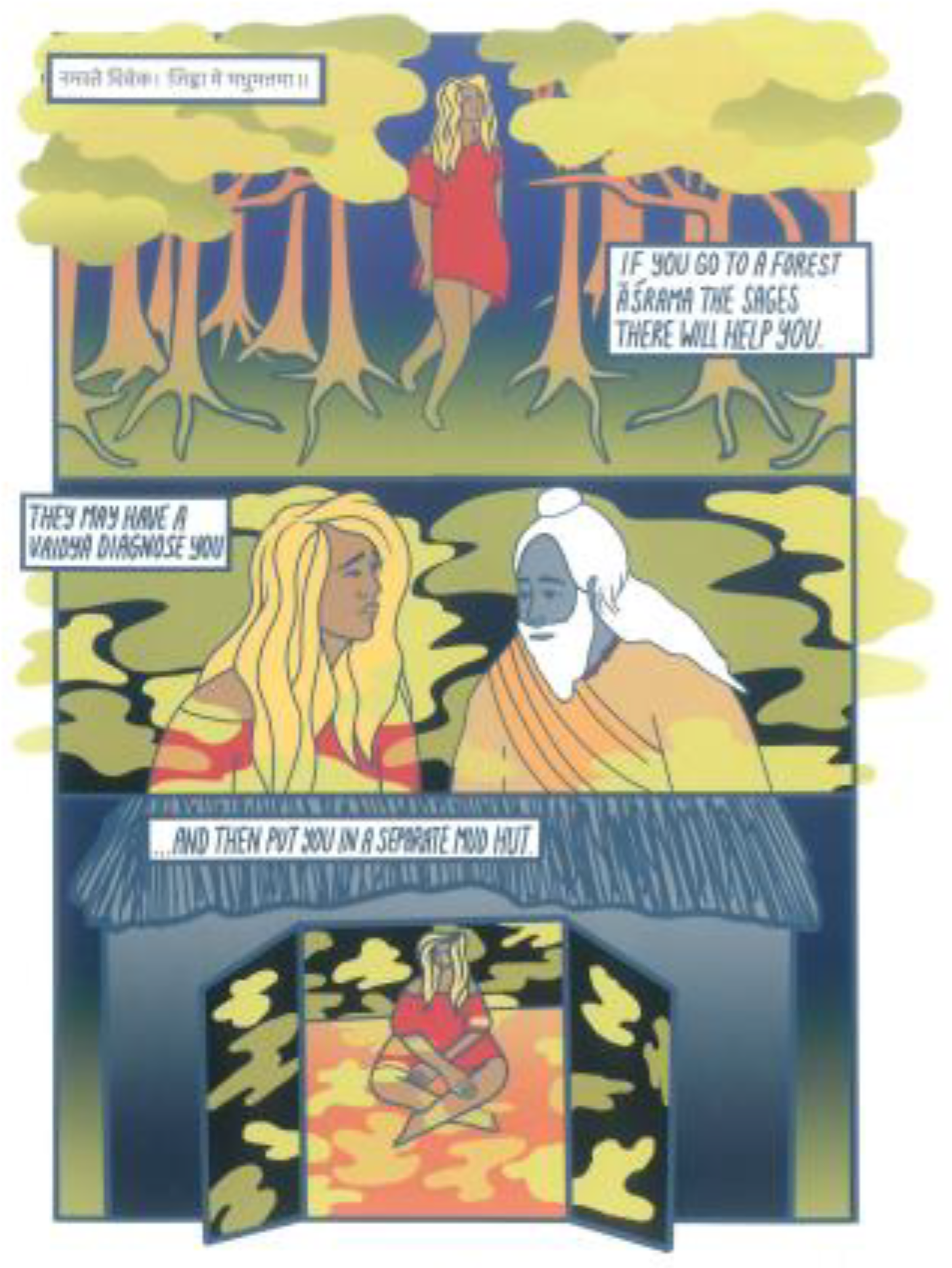
Illustration by Ness Lee; p. 24 of Death Threat (2019)
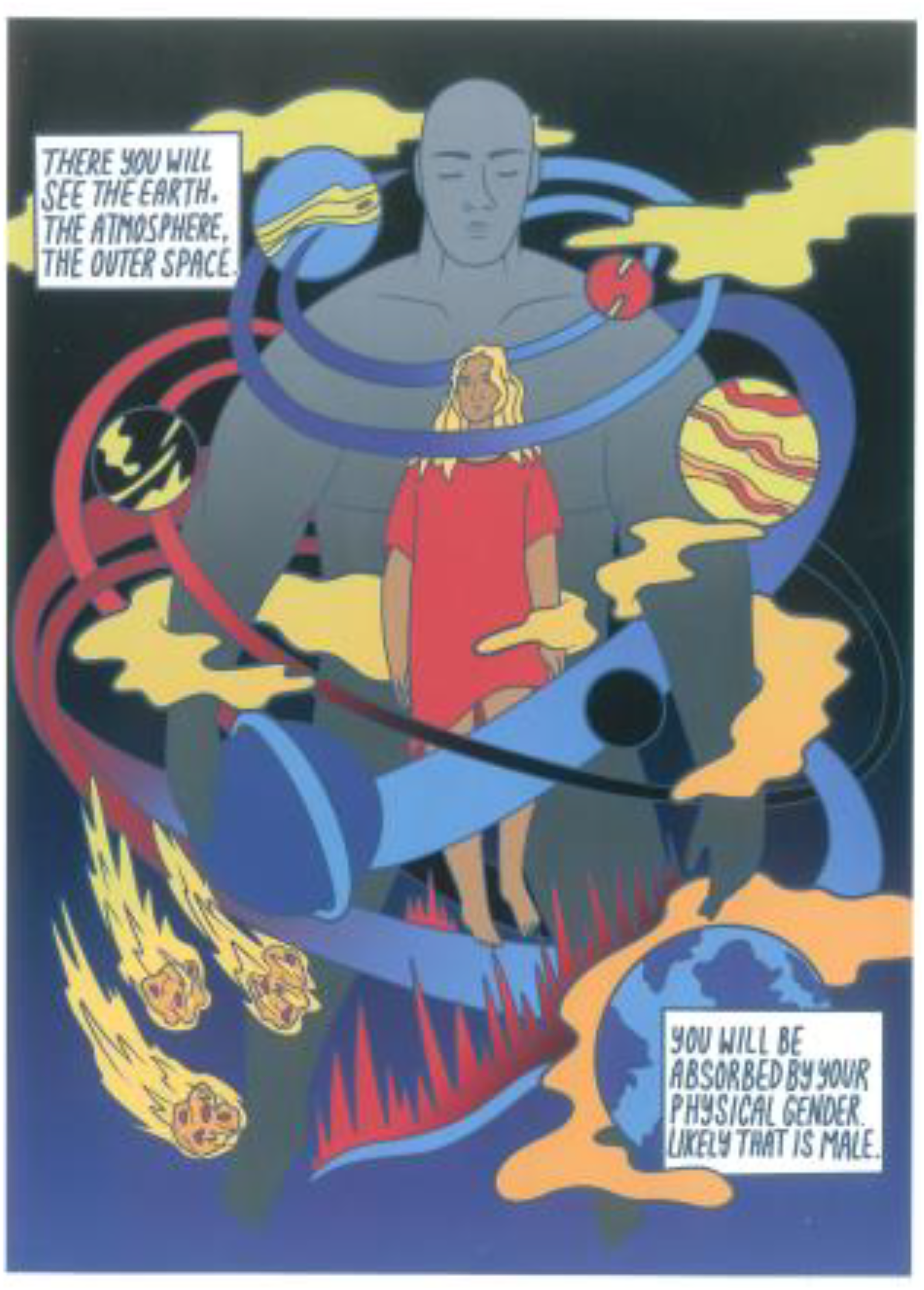
Illustration by Ness Lee; p. 24 of Death Threat (2019)
The abstract visualisation of the intimacies between the physical death of the body and the social death of being misgendered also appears elsewhere in the graphic novel. One noticeable instance is during Vivek's hypothetical funeral (see: Figure 7). Once again, the lines ‘There you will see the earth, the atmosphere, the outer space. You will be absorbed by your physical gender. Likely that is male’ appear above symbols of the earth, atmosphere and outer space (Shraya and Lee, 2019: 65). However, in this citation of the threat, Vivek is shown lying in an open casket while her friends, family and loved ones use ‘he/him’ pronouns to mourn her death. One person in the scene even describes her as ‘a lovely boy’. This is the most explicit instance of misgendering in the graphic novel, and it happens right after Vivek's attacker makes good on their threat and shoots her dead. In this moment, Vivek's misgendering and the death of her corporeal body are literally visualised in concert to her being murdered by her transphobic assailant.
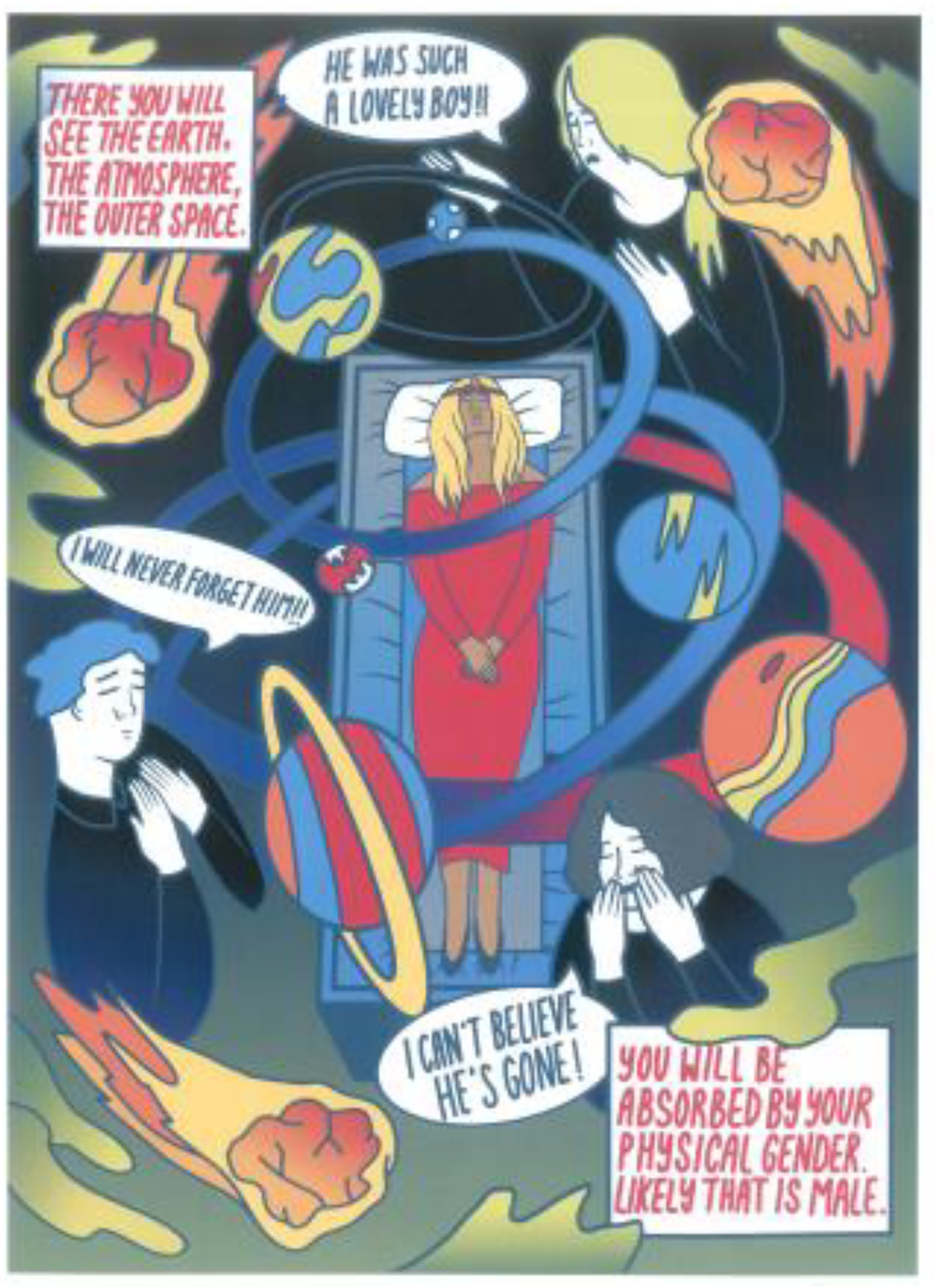
Illustration by Ness Lee; p. 65 of Death Threat (2019)
The implication of this scene is that the social death of being misgendered and the literal death of being physically killed and/or threatened function to dehumanise trans life in comparable, if not interconnected ways. This observation is further supported by how Shraya and Lee depict Vivek's murder: right before her attacker shoots her dead, the caption reads ‘You hunted me down’ (Shraya and Lee, 2019: 62). This passage echoes the first page of the graphic novel when Vivek received the original threat (Shraya and Lee, 2019: 4). Similarly, on the following page, after Vivek is shot, we see a sequence of four sun-shaped faces falling in defeat (Shraya and Lee, 2019: 63) – just as we did on page two of the graphic novel. However, in this image, the faces have a bullet in their foreheads and are shown drowning in a puddle of blood. These images link Vivek's imagined murder to the real-life moment in which she began receiving transphobic hate mail, thus drawing further focus to the similarities between being misgendered and being physically attacked.
The above instances all illustrate how Death Threat conflates the social death of being misgendered with the corporeal death of the body. This is a reoccurring theme in the graphic novel, and it operates to show how misgendering trans people constitutes a violent social act (Kapusta, 2016). When trans folx are misgendered, it binds our material existence to the symbolic death of our gender, thus exhorting us to become what Haritaworn et al. call ‘the living dead’ (2014: 8). Snorton describes this as the ‘death-space for human life, or, more precisely, a space of near death into which some other quality of living is assumed out of necessity’ (2017: 72). The constant atomisation that comes with existing this way can cause many trans people to turn away from life, forcing us to choose between living against nonlife or dying to escape it. In turn, trans existence becomes (conceptually) tied to dehumanisation and trans agency to death, effectively condemning trans people to zones of sacrifice – a fact that Death Threat not only takes seriously, but vibrantly animates through its semiotic conflation of being murdered with being misgendered.
Killing the monstrosity
By revealing how Death Threat engages misgendering as a type of social death, we can start to understand how the dialectical force of minoritarian monstrosity also operates in the graphic novel. This is an important move to make when engaging questions of trans being: even as trans existence is understood through frames of sacrifice, trans life must never be reduced to loss. On the contrary, it is the exact uncanniness of trans liveability that allows us to occupy, as phrased by Snorton, a ‘form of life that exceeds life's meanings and posthumous life’, in which trans existence ‘continues to accrue meaning after the event of death’, giving expression to ‘trans ghosts that persist and linger, as if they are not from the past but from the not-so-distant future’ (2017: 197). The past-present-futurity of transness, as described by Snorton, can be considered a function of our monstrous powers, in which our inability to temporalise our bodies against white gender-sex norms also allows us to escape, and maybe transform, the binds of white futurity.
Turning our attention to Death Threat, it appears that Vivek's own monstrosity plays a central role in shaping, if not grounding, the focus and direction of the graphic novel. For one, many of her assailant's threats, which inspired Death Threat, seek to stabilise her apparently nonnormative body and realign her with cisnormative conceptualisations of gender-sex embodiment. A prime example of this is when the attacker claims they want to murder Vivek so she can be ‘absorbed’ by her ‘physical gender. Likely that is male’. In this instance, the attacker is calling upon death to try to close the perceived disjuncture between the discursive gender boundaries assigned to Vivek at birth (male) and the expressions of her actual, physical body (femme/woman) (Stryker, 2006; Green, 2016; Simpkins, 2017). This suggests that the attacker's need to murder Vivek stems from a much larger need to force her (back) into the same analogous gender-sex categories that her existence calls into question and therefore reassert the so-called naturalness of said categories.
The ‘threat’ that Vivek's attacker identifies in her body is its ability to destabilise gender-sex configurations within our white cis-heteropatriarchy. This registers with what Gherovici (2010) describes as ‘the democratization of gender-nonconformity’: the ability of trans bodies to challenge the naturalness of (white) gender-sex norms and thus de-pathologise gender variances. This idea is similarly expressed in Stryker’s (2006) notion of ‘the trans-monstrosity’, wherein she likens her own trans body to Mary Shelley's Frankenstein. She writes: ‘Transsexual embodiment, like the embodiment of the monster, places its subject in an unassimilable, antagonistic, queer relationship to a Nature in which it must nevertheless exist’ (248). Stryker's point is that trans folx exist in an unhinged material state that ruptures the stability and linearity of normative gender-sex relations. Such a description also connotes the ‘trans ghost’ described by Snorton, who, like Gherovici and Stryker, regards trans people as having the radical ability to escape normative (read white) formations, and are thus able to 1) destabilise a naturalised gendered order rooted in essentialist linear logics, and 2) open up new ways of relating gender to the body.
Importantly, the same can also be said about BIPOC in general, trans or cis. Given that western gender-sex codes are embedded with racial matter that begets the linear schematics of white futurity, BIPOC across the gender spectrum de-pathologise so-called gender variance in a way comparable to (albeit distinct from) trans people. Indeed, it is in line with such thinking that Black trans and/or feminist scholars have begun to use ‘fungibility’ to discuss the relationship between Blackness and gender/sexuality (Chaudhry, 2019). In the words of King, fungibility denotes: ‘the way Black bodies slip in and out of other humanist categories and frames of legibility, like gender […] Black bodies become both engendered and un-gendered depending on the circumstance. In the case of Black captive bodies, gender becomes merely a function of making a body fungible rather than conferring it with human legibility’ (2016: 1028).
This point is akin to the one I raised earlier: given racial slavery / anti-blackness' abjection of Black people as a primary function of white futurity, Black flesh is unable to hold in/onto white gender-sex norms (Jackson, 2020). However, instead of merely framing this as stagnating Black subjectification, the term fungibility highlights how these discursive tensions make possible sites of Black liveability that are unbounded by imperial gender-sex codes and are therefore enabling of a futurity not promised to whiteness and empire (Snorton, 2017). Similarly, the logic behind fungibility (albeit differently phrased) has also been applied to Indigenous bodily, social and spiritual embodiments relating to gender and sexual expression. Here, the ahistorical condition attributed to Indigenous, specifically two-spirit people, is posed as a way to self-actualise beyond the oppressive gender-sex apparatus of the present and thus repurpose zones of death for gender and sexual reckonings inconceivable to the colonial mind (Driskill, 2016; Whitehead, 2018).
Although most aptly applied to Black and Indigenous communities, the same claim that racial subjugation = gender flexibility has also been attributed to racialised women, who, in Spivak’s (1988) formation, occupy a space of ‘postcoloniality’ that resides both at the heart of and in conflict with white western registers of femininity and thus humanity (Puar, 2007; Razi, 2021). Here, our subaltern status is posed as necessarily diametrical to hegemonic forms of white gender and sexual intelligibility, which, in turn, grants us the capacity (as agentic subjects) to refashion their destructive registers – an argument that has also been applied to non-white queer subjects, as exemplified by Muñoz’s (1999) concept of ‘dis/identification’. While the same fungibility attributed to Blackness (and Indigeneity) can-and-should-not be extended to non-Black women and queers of colour, feminist/queer of colour and or postcolonial scholarship has demonstrated that white supremacy also forces these subjects to contend with gender-sex codes from a liminal space of heightened fluidity (Chen, 2012; Gopinath, 2018).
Taken together, it seems that, despite being divergently focused and articulated, the legacies of racial and colonial domination central to white futurity and western modernity perpetually bring the white colonial contemporary to bear on all non-white frames of gender and sexuality in ways permitting not just death, but movement, thus enabling the potential for transcendence (Spivak, 1988; King, 2016; Snorton, 2017; Gopinath, 2018; Whitehead, 2018; Jackson, 2020). So, much like trans people writ large, non-white women and queer folx have our own type of monstrous power, as we too exist beyond the cosmic closure of white modes of gender-sex subjectification.
With this in mind, we can better understand why trans women of colour, such as Vivek, pose a particularly prominent threat to white futurity: these women simultaneously converge and diverge with multiple polarised sites of gender-sex assemblage, constantly moving towards, not only analogous, but Eurocentric, gender-sex categories that they can never completely fold into (Green, 2016; Simpkins, 2017). Consequentially, trans women of colour emerge as a hybrid of identities that are unmarked by the hierarchical racial and sexual schematics of late western modernity and, as a result, rupture the idea of a naturalised white gender identity (Noble, 2012). This, in turn, disrupts the pathologising gender-sex logics that work to suture whiteness into place and subsequently pose a threat to white futurity: when you destabilise prevailing western gender-sex ideologies, you destabilise whiteness, and when you destabilise whiteness, white futurity is no longer bound to the present, thereby making it possible to imagine different future worlds.
The complex relationship trans women of colour have to gender, race and futurity helps to explain why, in Death Threat, Shraya and Lee often visualise Vivek's misgendering in concert with her racialisation. The most notable example of this is when they depict the assailants’ references to Vivek being hunted down (see: Figure 8). Here, Vivek is shown with antlers on her head and gun sights encircling her body as she runs away from an armed and angry crowd. This image highlights how the assailant's transphobic threats dehumanise Vivek by posing her as non-human prey. Yet, at the same time, these features also serve to racialise Vivek. The very human/animal distinction that makes Vivek's dehumanisation possible in this image is rooted in white settler ontologies that pose the ‘domain of the animal’ as a zone of deficiency that not only subtends far below the superior ‘white human man’ but secures the primitive animality of the non-white human subject (Chen, 2012: 115). Working within this racist schematic, the human/animal distinction, or what Chen calls ‘animacy hierarchies’ (2012: 115), helps to stabilise Eurocentric incantations of the human, thereby rendering such hierarchies into racialising optics.
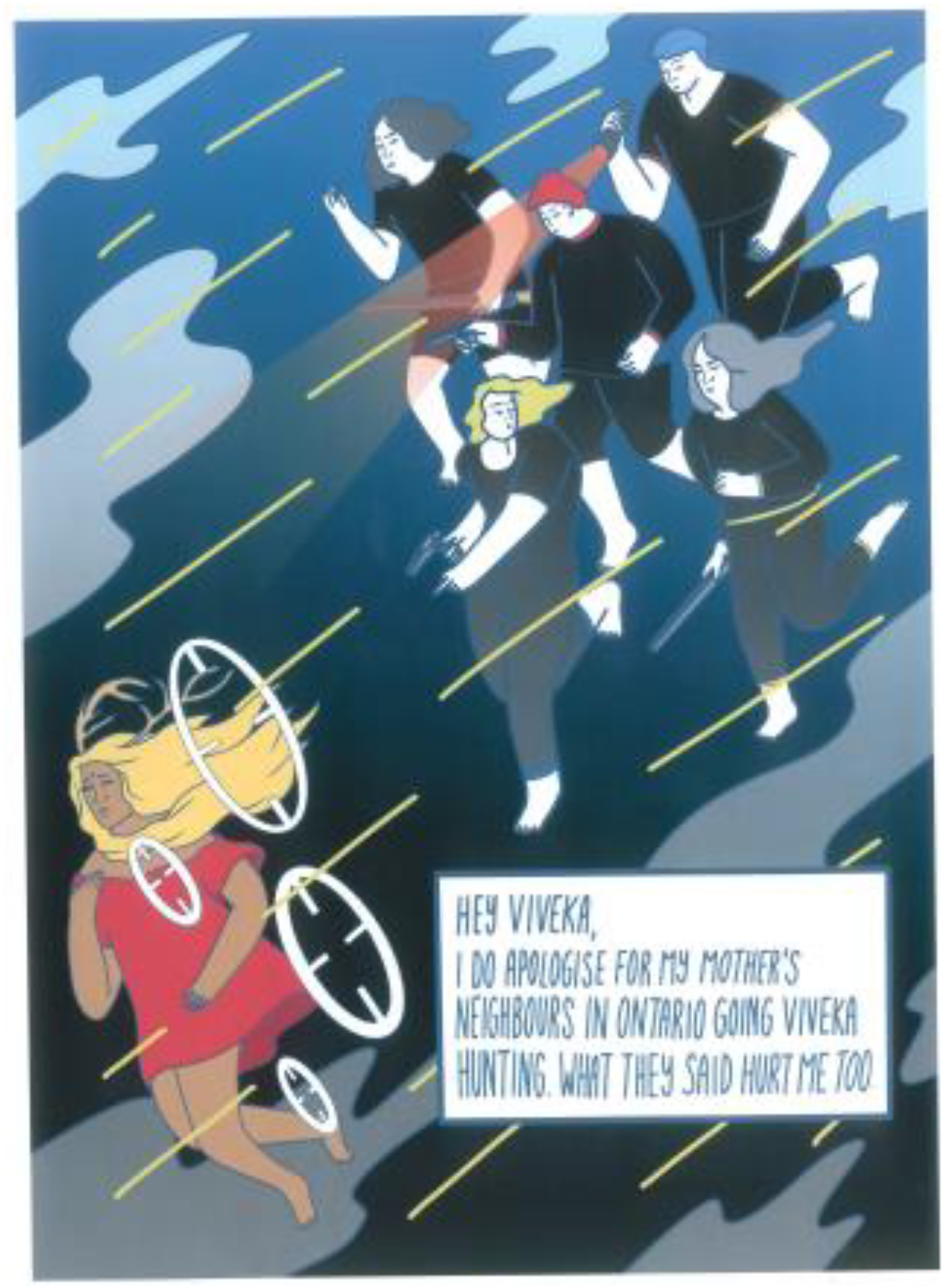
Illustration by Ness Lee; p. 46 of Death Threat (2019)
Accordingly, when Shraya and Lee use animalistic imagery to establish Vivek's dehumanisation, they simultaneously recruit the ‘wildness, monstrosity, bestiality, barbarity, and tribality’ (Chen, 2012: 122) already associated with her Brownness, and thus secure racism as a central feature of her subjugation. Moreover, by giving Vivek antlers, Shraya and Lee physically gender her as male. Thus, the same symbol that is used to dehumanise Vivek's body is also used to racialise and misgender her. Not only does this tie the physical death of murder to the social death of being misgendered, but it does so via radicalising optics. What we are left with, then, is an illustration of how trans women of colour exist in a nexus of racial and gender fluidity that diametrically opposes the white supremacist schematics of late western modernity.
It is in negation of this radical diametricality that white futurity erects necropolitical forces, such as misgendering, against trans folx, especially trans women of colour. Every time a trans person is misgendered and faces social death, it enacts what has been called a ‘paranoid reading’: a position of intense awareness to the physical, emotional and social threats posed by the murderous assemblages that minoritarian beings simultaneously anticipate, project onto and glean from the surrounding social world (Gill-Peterson, 2021). 2 When we inhabit a paranoid occupation, we constantly contend with our own dehumanisation or abjection, which can inhibit reparative practices aimed at consoling our battered psyches. When inhabited by trans women of colour particularly, it reminds them of their already fraught existence within western modernity. This then forces them to adopt an almost ever-present paranoia, thereby binding them to a fatiguing, potentially self-destructive gaze that seeks to diminish their monstrous ability to live truth to power. In the words of Gill-Peterson: ‘we who call ourselves trans are given to paranoid readings of ourselves, our lives, and each other, and these readings circulate so intensely that they often block more sophisticated thinking. This dynamic is highly racialized. I think it […] governs the way trans women of color are seen and talked about’ (2021: para 9).
The relationship between being misgendered and being paranoid is clearly visible in the pages of Death Threat, particularly when we consider Vivek's reaction to receiving the threats. After the assailant tells Vivek to be locked away in a mud hut, they write: ‘your mother wants to hear sweet words from you. Tell her you are not a woman’ (Shraya and Lee, 2019: 26). Vivek then calls her mother and asks, ‘are you upset with me?’, to which her mother replies ‘why would I be upset with you?’ (Shraya and Lee, 2019: 27). In this moment, Vivek is anticipating cisnormative violence from her mother as a result of being misgendered by her attacker. While her anticipation is buttressed by a real threat to her corporeal and subjective existence, it puts her on an almost irrationally high guard against the possibility of experiencing similar acts of abuse in the future.
This is a key facet of a paranoid orientation: by anticipating the violence to come, Vivek can try to avoid further damage to her psyche. However, at the same time: ‘The unidirectionally future-oriented vigilance of paranoia generates, paradoxically, a complex relation to temporality that burrows both backward and forward: because there must be no bad surprises […] paranoia requires that bad news be always known’ (Sedgwick, 2002: 130). As a result, someone in a paranoid habitus will seek out the same violence that they are trying to prevent. Although Vivek's efforts to locate violence are thwarted by her mother's diametrically supportive viewpoint, that Vivek calls her mother at all suggests that the threat animated a paranoid reading within her.
Vivek's paranoia is further evidenced in how Shraya and Lee vision what would have happened if Vivek had gone to the police for help (see: Figure 9). In this scene, Vivek imagines the police officers laughing at her and then arresting her for false accusation. Once again, we note that the death threat incites within Vivek a paranoid reading; but, unlike with her mother, the paranoia she feels towards the police is real, located in a long history of police harassing, detaining and killing trans women of colour (Krell, 2017). This scene perfectly highlights the double-edged sword of a paranoid reading: on the one hand, paranoia permits Vivek to regard the police for who they really are: state-sanctioned murderers aimed at her literal and social death (Snorton and Haritaworn, 2013). Yet, at the same time, Vivek's paranoia also permits her mind to be occupied by fear and anxiety, animating thoughts that invite these violences to take up habitation in her head and thus fill her brain with the knowledge and fear of her own imminent death.
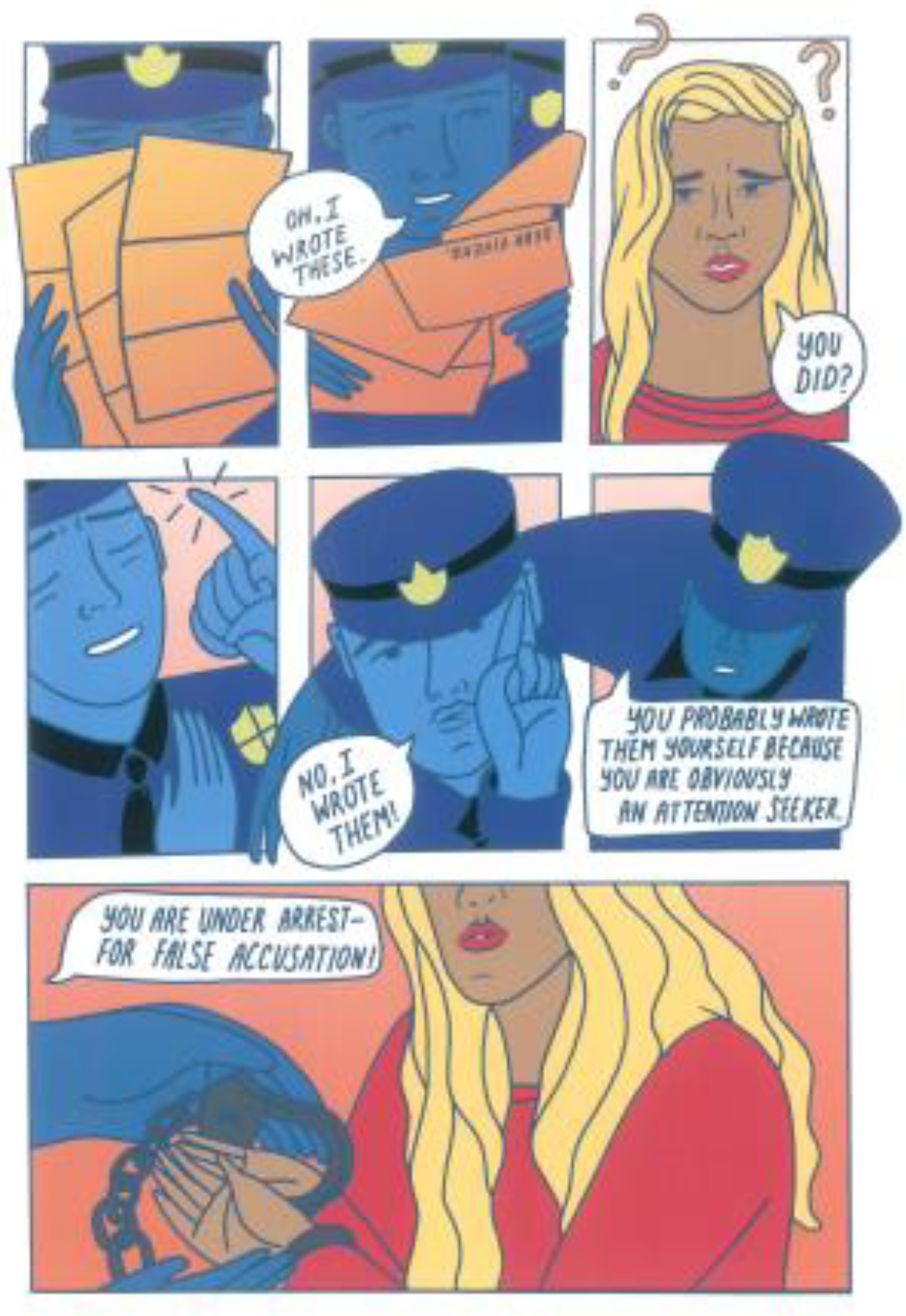
Illustration by Ness Lee; p. 31 of Death Threat (2019)
By demonstrating Vivek's paranoid response to the threats, Shraya and Lee highlight how misgendering trans women of colour can ignite a heightened sensitivity towards death and dying that is often demobilising. When Vivek's attacker threatens her, they invoke the death-making practices that condition her non/existence and thus exhort her to adopt a paranoid orientation. While this helps to protect her against murderous assemblages, it also foregrounds the dangers associated with being a trans woman of colour in modern western society. What is eclipsed in this process is the power that trans women of colour have to: 1) disrupt the same imperialising temporal logics that condition their death and, therefore: 2) open up space to (re)imagine a future beyond white time and space. Thus, by linking paranoia to Vivek's misgendering in Death Threat, Shraya and Lee demonstrate that paranoia is a measure of how misgendering promotes the social death of trans women of colour in service of white futurity.
Monstrous awakenings
At the heart of Death Threat is Shraya's unstably subjugated positionality. As a trans woman of colour, Shraya simultaneously exposes and is exposed by the racial and gender biases of western gender-sex norms and is thus both a threat and a victim to the death-making practices of white futurity. As a threat, Shraya contains a monstrous power to not only rupture the racial-linear matter upon which this landscape depends but also to subsequently induce alternative ways of relating to the world (Green, 2016; Snorton, 2017). It is this same ability, however, that renders Shraya a victim, as it exposes her to myriad forces that seek to pathologise and demobilise her radical embodiment.
Through Death Threat, Shraya and Lee contend with this tension, using Shraya's real-life experiences to think though the intersections of gender, race and violence that mark the liminal ground upon which she and other trans women of colour exist. Specifically, the two artists use surrealistic aesthetics to expose how misgendering trans women of colour relegates them to zones of sacrifice, which ultimately operate in service to white futurity. In doing this, they attend to the ways in which modern western gender-sex codes emerge in relation to racial and imperial regimes that bind transmisogyny and cisnormativity to white supremacy and western imperialism, thus exposing the complex prism of violence through which white settler domination is secured.
It is for this reason that I align Death Threat with Queer Necropolitics: it tackles gender, sex and sexuality as forms of ‘necropolitical molding’ (Haritaworn et al., 2014: 4), taking gender and sexual subjectification to constitute, not just sites of gender trouble, but extended and multifaceted modes of racialisation. In particular, Death Threat exposes how the literal or social death of trans women of colour operates according to a complex nexus of gender, sexual and racial subjugation that, above all else, seeks to maintain the existence of white life and white futurity. Hence, just as Queer Necropolitics considers how the killing or letting die of non-white people functions in relation to queerness, Death Threat queries how prevailing gender-sex codes operate in relation to white supremacy, subsequently invoking the queer necropolitical practice of examining gender-sex embodiment through the lens and language of race and racialisation.
However, beyond simply ‘bringing the queer into the necropolitical’ and detailing the deadly effects that white western gender norms have on QTBIPOC (Haritaworn et al., 2014: 3), Death Threat takes Queer Necropolitics one step further and renders the everyday death worlds of these communities into sites of unhinged agency. By turning the death threats that Shraya received into a work of art, Shraya and Lee swap the same paranoid gaze they document in the graphic novel for a diametrically affirmative viewpoint on trauma, or what others have called a ‘reparative reading’ (Gill-Peterson, 2021). A reparative reading takes value from the imperialising forces that a paranoid reading dwells on and uses them to reclaim the humanity that has been lost (or stolen). Unlike a paranoid reading, which emphasises how life is plagued by the imminence of death, a reparative gaze focuses on our ability to live in, through and against said death.
As regards Death Threat, the graphic novel can be thought to provide a reparative reading of the death-making logics that try to kill or let die trans women of colour within late western modernity. The graphic novel repairs these murderous assemblages into sites of agency by extracting ‘sustenance’ from them and turning them into art (Sedgwick, 2002: 128). In doing this, Death Threat mobilises the same forces that mark trans women of colour for death, so to fold them into life. In turn, the graphic novel does something somewhat spectacular: it ruptures and repairs the dehumanising function of Necropolitics. By illustrating how minoritarian subjects can use death, not only to their advantage, but to revision their own nonlife, Shraya and Lee flip the death-making capacities of white supremacy on their head and use them to affirm the lives of those they seek to kill. Hence, rather than bringing Necropolitics to bear on queer theory, Death Threat expands the realm of Queer Necropolitics by using the realities of queerly abject beings to disrupt the boundaries of necropolitical domination and thus white futurity.
It is in this way that I understand Death Threat as engaging in Wake Work. Wake Work contends with the (im)possibilities of living through the longstanding violences that condition our society; to live, as phrased by Sharpe, against the ‘historically and geographically dis/continuous but always present and endlessly reinvigorated brutality in, and on, our bodies’ (2016: 15). Sharpe describes this as living in ‘the wake’: the displaced epistemological space in which the historical violences of late western modernity are kept intact and held in view (2016: 21). It is from here that the imperialising relationship between the past and the present can be reimagined, forged into an alternative lifeworld ‘that would rupture the structural silences produced and facilitated by, and that produce and facilitate’ Otherised death (Sharpe, 2016: 22), thereby animating a new order.
Much like Wake Work, Death Threat plots, maps and collects the histories that give rise to the social and corporeal killing of trans women of colour in ways that rupture the immanence of their death. Further, when documenting these abuses, Death Threat moves them from the paranoid habitus that Vivek/Shraya occupies when she first receives the threats, to the reparative account invoked by the book itself, thereby transforming the experience into a site of repair, maintenance and attention, or what Sharpe calls ‘an ethics of care’ (2016: 131). When Shraya uses her creative energies to expose the immanence of her death, she provides an account of her trauma that foregrounds her ability to survive in the repeated wake of racial and gender violence, and thus offers us a reading of Otherised death that resists objectification, dehumanisation and alienation.
That this is the case is best exemplified by the end of the graphic novel, when Vivek's attacker places a final threat upon her grave. On the one hand, that the threats continue after Vivek is murdered signals the ever-present nature of their violence: the death threats exist alongside and beyond Vivek's physical body; they exist both literally and transcendentally, as a discursive force that conditions, but is not conditioned by, her material existence. The implication here is that the threat is located in death-making logics that extend well beyond Vivek's immediate world. However, instead of simply documenting this reality, Shraya and Lee use their combined critical and creative energies to map them out. Hence, any meaning that is gleaned from the real-life violence of Death Threat is framed and ordered by Shraya and Lee's artistic choices and, more specifically, their intentional efforts to repair the historical abuses that animated said trauma.
In this way, the last image of the graphic novel does more than simply denote the transtemporal aspect of trans social death – it also incites Snorton's corresponding figure of the ‘trans ghost’, letting the death of Shraya's past persist and linger in the present, as if it were not from the past at all, but from a potential future. From this perspective, we engage the end of the graphic novel in a different light: the threat resting upon Shraya's grave incites the transtemporal feature of her death (and life) by inciting her ability to continue ‘to accrue meaning after the event of death’ and therefore upend the temporal ordering of white futurity that has targeted her (Snorton, 2017: 197). Accordingly, when we encounter Shraya's story through Death Threat, with its joint transtemporal and monstrous impulses, we encounter it from the wake: from a position of care that brings the violences of our past into the realities of our present to repair them for the future.
From the wake, the monstrosity of Vivek's existence is no longer eclipsed. Rather, it is her monstrous power that gives rise to the narrative and form of Death Threat, directing us through the trauma and power of living with immanent death from and for the lives of trans women of colour, thus rupturing the bonds between Necropolitics, Otherised death and white futurity. Working from this displaced sociopolitical realm, the graphic novel engages and extends the proximity of death in trans/femme/of colour life, exploring everything from the social death of being misgendered to the corporeal threat of being murdered. Understood in this way, Shraya and Lee’s (2019) Death Threat can be considered to constitute a type of monstrous awakening, an engagement with the violences signalled in/on the bodies of trans women of colour that extends the boundaries of traditional Queer Necropolitics. In so doing, the graphic novel repairs the murderous assemblages of late western modernity into an archive of life, into a story of resilience that writes minoritarian being as it has emerged in the wake. Here, monstrosity constitutes power: it is used to resist and rethink the same imperialising assemblages that otherise and kill ‘nonnormative’ bodies, and through this revisioning, enable a future unbeholden to white futurity and found in the wake of freedom; in the wake of our monstrosity and the everyday immanence and imminence of our lives.
