




Abstract
In this paper, I explore the socio-legal status of trans women in contemporary Iran especially as it relates to Gender Affirmation Surgery. More specifically, I try to understand how trans women embody gender by investigating gender practices and relations in family, law, and medicine. Based on my fieldwork in Iran, the findings suggest that aberu – a phenomenon specific to Iranian culture – plays a big role in shaping trans women’s lives. By bringing together feminist philosopher Nancy Fraser’s work on the politics of recognition and sociologist Raewyn Connell’s understanding of social embodiment, I discuss how the status of trans women is pervasively misrecognised and how they are denied economic participation and democratic representation in Iranian society. Adopting the method of thematic analysis, I argue that the social pressure associated with aberu, and the lack of legal protection have made trans women simultaneously invisible and yet also subject to violence. Finally, I discuss how trans women go through the process of gender embodiment by problematising misrecognition, redefining femininity, and reclaiming womanhood through everyday life challenges.
Introduction
In 1982, 3 years after the Islamic revolution, during the Iran–Iraq War (1980–88), and at the height of state scrutiny of women in the public sphere, a trans woman named Maryam Khatoon Mulkara asked Ayatollah Khomeini, Iran’s supreme leader at the time, to sanction her Gender Affirmation Surgery (GAS) both legally and religiously. After Maryam Khatoon’s inquiry, Ayatollah Khomeini issued a legal opinion, known as a fatwa under Shi’a Islamic jurisprudence, asserting the permissibility of GAS upon medical approval.
Maryam Khatoon’s determination to meet Ayatollah Khomeini in person points to how dire the situation was for Iranian trans people, especially trans women, in the early 1980s. Although the situation remains dire, Maryam Khatoon’s historic act nevertheless resulted in the most important fatwa pertaining to gender and sexuality in Iran. Indeed, this fatwa has allowed trans people to forge – albeit with considerable difficulties – liveable lives in Iranian society. It is important to note that Maryam Khatoon lived as a trans woman and activist in Iran without undergoing GAS from 1982 to 2002. In 2002, she went to Thailand for gender-affirming surgical procedures (Najmabadi, 2014). After managing the only NGO for the protection of trans people’s rights – which she established in 2007 – for 5 years, Maryam Khatoon died in 2012 at the age of 62.
GAS is guaranteed only by Ayatollah Khomeini’s fatwa – that is based on Islamic jurisprudence rather than substantive and procedural laws (Saeidzadeh, 2016). As a result, the judiciary in different parts of the country has set different regulatory procedures for people who want GAS, which allows them to change their gender designation on legal documents such as birth certificates. Before diagnosing people with gender dysphoria (GD), the Tehran Institute of Psychiatry conducts 13 sessions of psychiatric evaluation, followed by individual and group psychiatric therapy sessions and a ‘Real Life Experiment’ based on the Harry Benjamin Protocol 1 (Aghabikloo et al., 2013). Accordingly, the Administrative Court of Justice in Tehran issues a certificate confirming GD and grants the applicants permission for GAS. This legal document allows trans people to appear in public with their desired appearance without being arrested by the police (Saeidzadeh, 2019, 2021).
In this paper, I explore the socio-legal status of trans women in contemporary Iran especially as it relates to GAS. Specifically, I investigate gender practices and relations in family, law, and medicine as well as how trans women embody gender. My investigation draws on five face-to-face and five long-distance interviews with trans women, one face-to-face interview with a trans activist, and one telephone interview with an Islamic jurist living in Iran. Ultimately, through thematic analysis of the interviews, the findings of my investigation suggest that aberu – a phenomenon specific to Iranian culture –shapes trans women’s lives. I understand aberu as a term that refers to policies and practices that preserve individual or collective moral worth and respectability in the eyes of others. Aberu can be attributed not only to people but also to institutions and establishments. In this sense, a country or a government’s cabinet can gain aberu or lose it.
Based on Nancy Fraser’s work on the politics of recognition and Raewyn Connell’s idea of social embodiment, I argue that the social pressure associated with aberu, the lack of legal protection, and medicalisation of trans all contribute to the misrecognition of trans women’s status in Iranian society which has in turn made trans women simultaneously invisible and yet subject to violence.
Contextualisation and literature review
Based on an extensive review of the literature on trans people in Iran, I identify two discussions developed during the past few decades: one addresses the legality of GAS under Islamic law, while the other addresses the life conditions of trans people in Iran. Earlier studies tend to discuss the permissibility of GAS, whereas more recent studies tend to be characterised by empirical inquiries into trans people’s life conditions in Iran. Below I expound on the literature about GAS inside Iran, consider the literature published in Iran about trans women, and also describe the literature produced outside Iran on GAS and trans people.
Iranian literature on GAS is dominantly published by jurists and medical doctors that emphasises biological gender determinism and pathologise trans people as patients who suffer from ‘transsexuality’. ‘Transsexuality’ is a medical term which was first used by an American physician David O. Cauldwell in 1949 2 to refer to people who did not identify with the gender assigned to them at birth (Cauldwell, 2006). This is manifested as a psychological disease known as gender dysphoria (GD) – that is, not being content with one’s assigned biological sex. Such literature refers to trans people as narizayani jinsi (sexually discontent people) or suffering from malali jinsi (sexual melancholic) due to their gender being in disharhomny with their sex (Javaheri and Kouchakian, 2006; Kalantari and Ibrahimi, 2011). Non-surgical treatments such as hormone therapy and psychotherapy are said to be ineffective, and thus surgery is the recommended treatment (Ahmadzadeh-Asl et al., 2011; Aghabikloo et al., 2013; Alirezanejad et al., 2016; Hedzaji et al., 2013; Kalantari and Ibrahimi, 2011; cf. Najafpour and Najafpour, 2018; Vahedi et al., 2017).
Recent literature on trans women’s life conditions in Iran published by scholars residing in Iran shows how trans women are highly stigmatised and subject to inequalities, violence, and discrimination, especially in public spaces, more than trans men due to derogatory social attitudes and legal shortcomings (cf. Alirezanejad et al., 2016; Heidari et al., 2021; Khoshnood et al., 2008; Musavi Mbarake and Navaei Lavasane, 2018; Moayedi-Nia et al., 2019; Nematollahi et al., 2021; Vafai, 2018; Yaghoubirad et al., 2021). Thus, it is reported that trans women are less educated than trans men, and more often unemployed (Hedjazi et al., 2013). This literature further notes how trans women’s needs and rights are not protected by law such as rights related to marriage and child custody (cf. Mousavi Mbarake and Lavasane, 2018; Rezaei Foomani and Ayati, 2014; Sani’i and Fasihzadeh, 2012). Therefore, theses scholars propose a legislation on gender transition that would ‘protect trans women from judicial arbitrary decision making as well as “degrading social attitudes” in everyday life’ (Mousavi Mbarake and Lavasane, 2018: 137). My own study of trans women in Iran confirms these findings.
Most current literature on GAS and trans issues published in English outside of Iran links the practice of GAS in Iran to the criminalisation of gays and lesbians by the Islamic state (cf. Bahreini, 2008, 2012; Carter, 2011; Hashemi, 2018; Jafari, 2014; Mohsenian-Rahman, 2015; Najmabadi, 2014). This literature views ‘trans’ as a new category, formed by the Islamic Republic of Iran, to enforce heteronormativity on gay people through GAS (Hashemi, 2018; Najmabadi, 2014). In other words, this literature perceives the practice of GAS in Iran as a heteropatriarchal cultural practice, fundamentally violating people’s human rights (Azoulay, 2009; Amin, 2016; Bahreini, 2008; Rahbari, 2016). Opposing these arguments, I side with Martino and Kjaran (2019), who posit that such discourses are driven by liberal democratic ideas that fail to understand the specificities of gender and sexuality in countries like Iran. I maintain that being a trans woman cannot and should not be reduced to an effect of the criminalisation of gay men. Thus, I problematise discussions of ‘gender authenticity’ that set binary standards for being trans, as well as ideas around ‘transgression of gender’, which emphasises only the disruption of gender binarism. I do this by emphasising the complexities of gender transition that are neither about gender authenticity nor transgressing gender, but about diverse knowledge and experiences of gender embodiment.
The existing literature on Iranian trans women produced both inside and outside Iran is almost always bound up with matters relating to gay men. Being a trans woman in Iran is associated with sexual deviancy and gay promiscuity (Saeidzadeh, 2016, 2019). The link between deviancy and criminality continues to stigmatise both gay men and trans women as morally reprehensible (Martino and Kjaran, 2019). Therefore, many trans men in Iran construct their masculinity by dissociating themselves from trans women and by emphasising heterosexual norms, because trans men ‘perceive themselves as real, while they regard trans women as not real, that is trans women are regarded as gay men who pretend to be trans since they usually do not undergo the surgery despite obtaining the certificate’ (Saeidzadeh, 2019: 304). This situation is not confined to Iran. Scholars of trans studies working in a variety of cultural contexts (cf. Bullough, 1975; Connell, 2009, 2011, 2012; Enke, 2012; Hines, 2020; Namaste, 2000, 2005, 2015; Serano, 2016, 2012) show that the social exclusion and discrimination against trans women, when compared to trans men, is more endemic in more patriarchal and misogynistic societies.
Theory: status recognition and social embodiment
In my overall theoretical framework, I subscribe to Nancy Fraser’s approach (2001, 2008, 2013) to social justice involving status recognition, redistribution, and representation. Moreover, I combine Fraser’s politics of recognition with Raewyn Connell’s (2009, 2011, 2012) concept of social embodiment. Connell sees embodiment as a collective and changing socio-historical process that refers to how the body is shaped by social dynamics and vice versa. Fraser understands recognition to be based on social status rather than on group identity which emphasises people’s experiences of ‘parity participation’, as members of society capable of interacting with the rest of people equally. The process of embodiment that Connell represents as collective could be explained similarly to what Fraser calls ‘parity participation’ in social life with emphasis on status recognition.
According to Fraser, social justice is violated if status is misrecognised, resources are maldistributed, and/or if people are politically misrepresented in society. Moreover, Fraser (2000, 2001, 2013) maintains that status is specific to individuals and cannot be universalised which points to the diversity of gender practices. She (2000: 114) explains misrecognition as ‘the process of being negatively recognised and subjected to social subordination’. Fraser (2000: 113) further claims that misrecognition should be treated as ‘institutionalized relations of social subordination’ rather than a ‘free-standing cultural harm’, because subordination occurs through ‘parity-impeding’ norms created by social institutions that constitute some people as normative, and some as deficient or inferior. These norms are then continuously reiterated through both formal (i.e. legal, administrative, and professional) and informal (i.e. customs, traditional, and cultural) practices (Fraser, 2000). For example, the institutionalised devaluation of womanhood and femininity is expressed at structural levels such as family law, criminal law, and state policies. Thus, she writes: ‘Women suffer gender specific forms of status subordination. Status subordination includes sexual harassment, objectifying, demeaning, violence, and disparagement in everyday life’ (Fraser, 2013: 163).
I use Raewyn Connell’s idea of social embodiment to discuss the process of transition described by trans women. For Connell (2009), social embodiment is a collective process of active change throughout life: ‘a process through which the body is entangled with social dynamics and vice versa’ (Connell, 2011: 1371). According to Connell (2011), the agency of the body is manifested in social embodiment through its materiality and its social relations – such as intimacy, ability, fertility, and vulnerability. Connell (2012, 2021), writing specifically about trans women’s embodiment, argues that changing the body changes the way one is located in relation to structures that shape gender relations: ‘A new gender comes to existence through the process of embodiment that involves family relations, workplace, healthcare, and public spaces’ (Connell, 2021: 91). Connell (2012: 871) also maintains that trans women and trans men experience transition differently, as after transition trans women are exposed to challenges that trans men are not. For Connell, this includes ‘social exclusion, violence, poverty, losing jobs, and falling into sex work’.
I connect Connell’s understanding of social embodiment to Fraser’s definition of status recognition; that is, in order to recognise trans women’s status in society, it is important to understand their practices of social embodiment. Thus, Connell’s work helps me to interpret gender practices of social, legal, and medical transition which occur in the process of embodiment. Thus, I borrow Fraser’s work on status-recognition to emphasise the socio-legal and economic challenges in the process of embodiment are embedded in the status-based misrecognition of trans women.
Materials and method
This paper is based on my fieldwork in Tehran in 2014 and 2015 as well as telephone interviews in 2017 that I conducted for my PhD thesis. I draw on interviews of 10 trans women who had either undergone or were planning to undergo GAS, one trans activist, and one Islamic jurist who lived in Iran at the time of interview. I went to Tehran in 2014 and accessed potential participants in Tehran with the help of a trans activist, Moh, who was the manager of Mahtaa (Centre for Protection of Iranian Transsexuals) in 2014. I recruited the research participants through snowball sampling. I conducted five face-to-face semi-structured interviews with five trans women in Tehran in 2014. I returned to Tehran in October 2015 and contacted Hujatul Islam Mohammad Mehdi Kariminia, a trans-friendly clergyman who advocates for the rights of trans people in Iran and whose real name I have used with his permission. As he was not comfortable being seen with me in public, I interviewed him by telephone.
Research participants’ backgrounds.
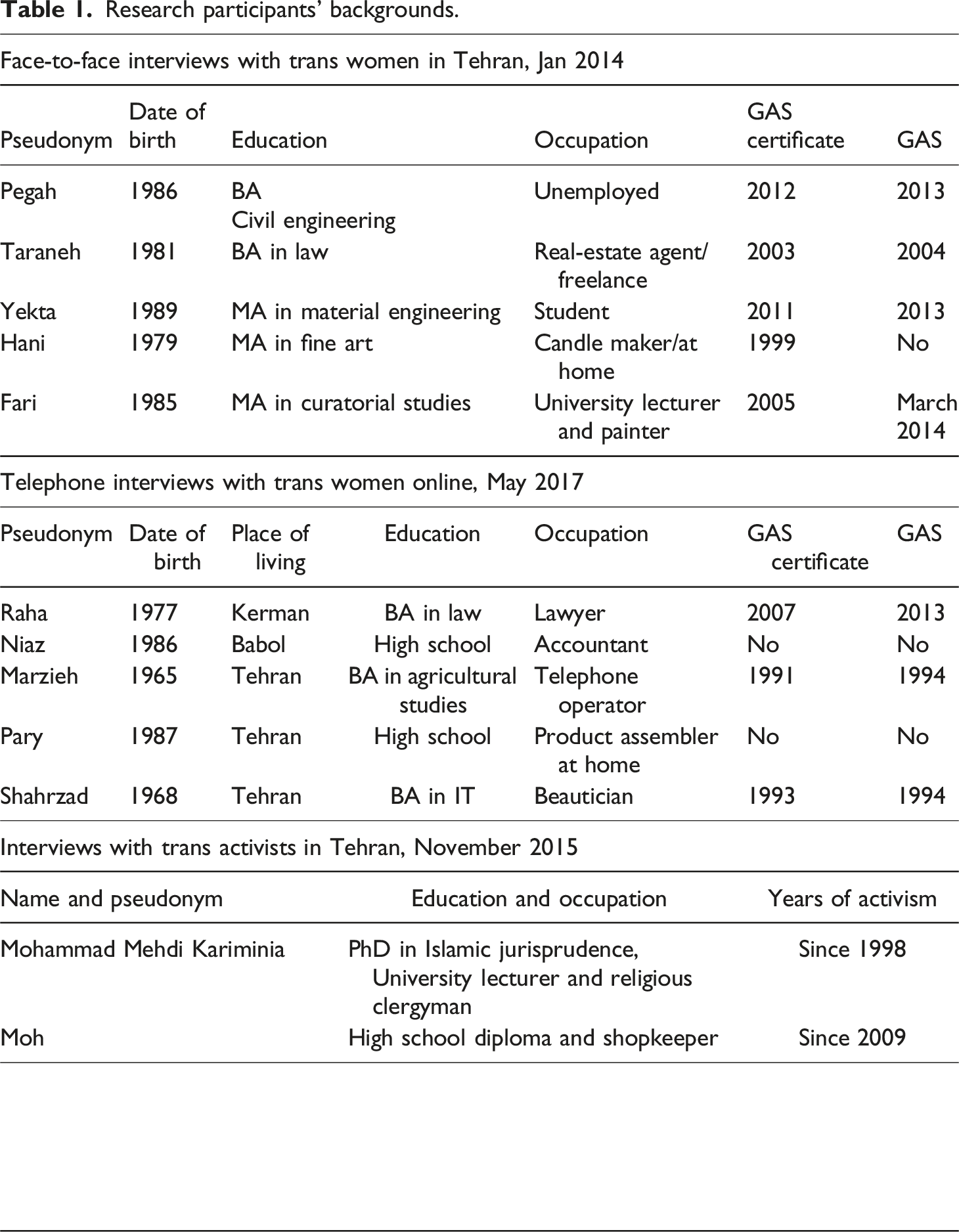
The trans women participants come from diverse educational and economic backgrounds in different age groups. However, they all come from working-class families in urban cities. Five out of 10 trans women had used or were using hormones without a doctor’s prescription before starting the process of GAS. Some said they had received advice from virtual doctors (online), and some had self-prescribed. Half of the participants had developed fuller breasts and thinned facial hair before the legal transition. All trans women underwent GAS between one and 3 years after obtaining the certificate except for Raha who took almost 7 years.
Meeting people in person in Tehran was a privilege. Also, observing trans women in public spaces both before and after transition added significantly to my knowledge. Telephone interviews allowed advantageous access to people from cities other than Tehran. I was so engaged with the participants during our meetings, and the interviews went so naturally, that they did not feel like formal interviews but rather like casual conversations. Moreover, having grown up in Iran really helped me understand and relate to the stories of people’s experiences as well as the structural conditions in which they have lived. I received much appreciation and encouragement from participants, most of whom saw my work as an important contribution to knowledge on the situation of trans women in Iran.
I did not find my identity as a non-trans heterosexual woman to be a barrier to speaking either with or about trans people in Iran. My interest in trans issues as a ‘cis’ person, and my study of trans issues as an academic outside Iran, were both received positively by the participants. For participants, talking with someone who was not trans helped prevent group identity issues, and the fact that I was an academic outside Iran rather than a journalist reassured the participants that their situation would not be jeopardised and that their voices would be heard without ramifications.
I have used thematic analysis as a method to interpret interviews. I searched the data for common themes, which then became categories for analysis. Thematic analysis allowed me to move between identified themes and theories during different phases of the analysis (Fereday and Muir-Cochrane, 2006). I identified the themes inductively in relation to the research questions. To apply thematic analysis method, I adopted Terry et al.’s six-phase analytic process (2017): ‘(1) familiarising with the data, (2) generating codes, (3) constructing themes, (4) reviewing potential themes, (5) defining and naming themes, and (6) producing the report’.
I transcribed all the interviews (in Persian) and read the transcripts several times before doing the preliminary data coding. I marked quotations related to the research question with the themes. Then I colour-coded all the themes while I ensured that I had identified and accurately selected the quotations for the themes relevant to the research question. After giving each theme a name, I translated the selected interview excerpts from Persian into English.
This study has presented issues of translation that far exceed the merely linguistic; indeed, I have encountered epistemological challenges as I navigated conducting my research from where I was based – Sweden – while writing about Iran in English using Persian materials. Most of my research participants do not speak English and will probably not speak it in the future. As a result, I have re-narrated and reinterpreted their words from Persian into English. As I am writing about people’s very sensitive stories, I have felt a great responsibility to be as faithful as possible to the participants’ intents.
Findings
In this section, I shed light on the findings through cross-cutting themes that I have identified in my analysis. I show how the status of trans women is misrecognised, how they are denied jobs, and how they are not represented equally. Finally, I show how trans women in this study describe their experiences of going through the process of embodiment. I present the interview quotations using four themes: (1) forced masculinity; (2) erased workers; (3) condemned gender transition; and (4) reclaimed womanhood. Before discussing the themes, however, I must explain the key concept that runs through them: namely, the concept of aberu.
Aberu
Aberu literally means ‘face water’ which can be translated to ‘water of the face’ in English. In Persian, aberu consists of two words: ab (water) and ru (face). Ab connotes purity and transparency as opposed to obscurity or morally questionable. Ru connotes a source of security and value, which requires care and protection. Thus, aberu in Iranian culture refers to individual and collective social standing, respect, and prestige (cf. Alibabaee, 2016).
Aberu can refer to the honour, respect, and value of a person and people related to that person in the eyes of others. In this paper, I understand aberu as an important element of preserving moral worth, respectability and prestige of individuals, groups, communities, institutions, and organisations in the eyes of individuals or communities. Therefore, Aberu – moral worth and respectability – can be ascribed to a person, family, the whole nation as well as the government at local, national, and international levels. For example, a country can preserve or lose its aberu in the eyes of international community based on its policies and practices. I see aberu as a set of socio-cultural practices that can even override law whether Islamic or secular. For example, GAS is permitted by Islamic law, but people in Iran oppose it due to preserving aberu. In Iranian culture, ‘aberu is considered as something that is [culturally] desirable, protected, and appreciated, sometimes even more than that of a human life’ (Zaborowska, 2014: 114). Thus, Iranians actively and consciously protect their aberu at any price, because losing one’s aberu comes with the loss of moral worth and respectability in the eyes of others, which might never be restored. There is even a term for the protection of aberu in the eyes of others, hifzi aberu. The term for losing aberu is aberu rizi. The person whose aberu is lost will have no status in society. That person would be called bee aberu or without aberu which is a derogatory term often used as a slur. The existence of such terms about aberu speaks to its important role in social practices.
Drawing on the interviews, I show how trans women describe the role of aberu in their experiences of gender and gender relations and how they challenge gendered policies and practices of aberu, especially in medical system, family, and workplace.
Finding 1: Forced masculinity
Some interviews with trans women indicate how doctors tried to make them ‘men’ while they were growing up. For example, Hani (pre-operative) described that her doctor medicated her with male hormones to make her a boy during her teenage time: After secondary school, I reached puberty and started to have feelings for boys. I fell in love with my male teacher. My mother took me to an endocrinologist who prescribed testosterone and diagnosed me with ‘delayed puberty’. After using the hormones, my body was covered with hair. Then I refused to take testosterone, but my family forced them on me [physically and psychologically].
Fari (pre-operative) described an experience that resembles Hani’s. At the age of 20, when her feelings for boys grew deeper, so too did her distress over the appearance of her body. As her testimony makes clear, she visited multiple doctors with the hope that she might be ‘made into a man’: The doctor diagnosed me with ‘delayed puberty’ and prescribed testosterone, which she called ‘man maker ampules’. I myself injected them, because I was embarrassed to go to the clinic. After one year, nothing changed and I did not turn into a man. So, I visited another doctor, he promised that he will make me a man. I was happy, but he gave me more testosterone. After two years, I found out that I am on the verge of prostate cancer. Then, I stopped. Despite using so much testosterone, I still looked very feminine and different from men.
Fari’s body paid a high price for the ‘man-maker ampules’ with which she was injected, and she was harmed in other ways as well. Indeed, she told me that her brothers used to beat her regularly for not being masculine enough while also pressuring her to present her body in what they considered to be a ‘manly’ way: My brothers constantly taught me how to walk like a man and how to move my ass that does not look feminine. They would buy me those loose jeans, but I would secretly tighten them and even I washed them myself so that my mother would not find out. I always had cramps in my bottom because I had to flex my muscles while walking not to look feminine.
Fari was not the only one of my interviewees who was subjected to family violence because of her gendered self-recognition. Pary’s (pre-operative) brother also physically and verbally punished her and forced her to work with him in a retail factory among dozens of men where she always felt harassed: He beats me every month. He beats me so hard, but it is not a problem. [Crying]. He beats me to prove he is right and to remind me that I am a man. My mother and sister have accepted me. They call me Pary, but he is the only one who does not.
Although many of the interviewees were subject to enforced masculinity by medical treatments and physical violence, their expression of femininity and bodily appearances frequently put them in a position where they were misrecognised as gay men. Fari provided an explanation: I see myself as a woman, I want to have sex with men whom I desire, but I must change my body first, because with this body, men think of me as a [gay] man and want to have anal sex with me.
Similarly, even after changing her body and undergoing GAS, Pegah’s (post-operative) experience aligns with Fari’s story. Pegah’s marriage suitor came to visit her family and ask her for marriage. She said that when they were talking to each other, she asked him the following question: ‘Do you want kids? he said no, and he said that he wishes to have sex with me from behind (anal) only’. Despite this wish, Pegah’s marriage suitor identified as a heterosexual man; he did not see or respect Pegah as a woman. He behaved pejoratively towards her on a day where he ought to have shown love and respect.
Many other interviews resemble Fari’s and Pegah’s experiences of abuse and violence. Pary’s voice was trembling when she spoke to me about how trans women in Iran are misrecognised as gay men, which subjects them to mistreatment: People’s attitude towards us [trans women] is very bad. They still think that trans woman means same-sex player [gay man]. They think same-sex player pretends to be trans. This is very vulgar.
In this section, the interview data shed light on how forced masculinity results in trans women being misrecognised as either gay or heterosexual men, both of which results in violence.
Finding 2: Erased workers
Every trans woman I interviewed said that they were either fired or could not return to their jobs after completing transition (i.e. the change of name and gender on legal documents). Those who said they found a job worked in ‘women-only places’ such as women’s beauty salons, animal centres, call centres, or as domestics where they were not visible publicly. According to the interviews, employers do not offer jobs to trans women because of their aberu and trans women do not feel safe to work in places surrounded by men due to harassment.
Shahrzad (post-operative) was offered a job in an Iranian TV show in 1993, but on the first day of her job, the security guard (harasat) forbade her from going to the studio, because it was obvious that she was transitioning. Therefore, going on air would have damaged the aberu of the state’s TV. Shahrzad said that since then she has not been allowed to have any jobs in public sector: I am 46 years old and the last job I had was at an animal care centre. Now, I work as a beautician. It is not my interest, but I have no choice. Despite having a BA in IT, I live on doing people’s nails [manicure and pedicure] for which had to take courses. But, at least in the beauty salons, I feel more comfortable and safer with women. I always get into trouble with men, you know... harassment and condescending behaviour all the time. And, God forbid if men suspect that you are a trans, they will do anything to you. But women don’t bother me. The worst thing might happen with women is that they will ignore you.
Like many other trans women, Shahrzad is erased from the public labour market unlawfully, marginalised economically, and faces the constant threat of violence. Raha (post-operative) worked as a successful lawyer over 10 years, but said that she was not optimistic about being able to continue working as lawyer after her GAS, which she had undergone 7 months before the interview. She now has started volunteering as a lawyer for trans people: I have not been able to work since after my surgery. My documents are not yet changed to my female identity, which has already taken seven months. It might even take longer. I am 40 years old. I have worked as a lawyer all my life under a male identity. So, we will see…[saddened voice].
Raha’s sorrow implicates the pain of losing her job over GAS. Marzieh (post-operative) was likewise disappointed about not being able to have the job she likes, because she would violate her family’s aberu if she worked for preserving nature and protecting animals. She finally managed to set up her own business selling handicrafts online from home. Besides that, she works part-time at a call centre. In her free time, she takes care of animals which she enjoys most: I had so much trouble finding a job since I was young, because I was not a boy. I have a degree in agricultural studies. I have always liked to be around plants and animals, but I work at in call centre [. . .].
Niaz (pre-operative) finds herself lucky as she works as an accountant in her uncle’s private company. Niaz explained that she could never have been given a job anywhere, because she carries a male ID that does not match her appearance. This would have resulted in damaging not only her family’s aberu but also the aberu of workplace. According to Niaz, her appearance is quite ‘feminine’: If it weren’t for my uncle, I would have never had a chance to have this job. It is very hard, because I go to work in my boy outfit with this face [hairless and smooth] and my big breasts. Working as a woman is not possible for me because my legal documents are under my male name […]. I am just very lucky that my workplace is full of women. I am very comfortable with women.
Niaz sounded proud when she said that she is usually mistaken as a woman who looks androgynous not as a man who expresses femininity.
In this section, the interviews highlight the ways trans women describe their experiences of being excluded from the labour market before and after GAS, firstly because of aberu and secondly because of men’s harassment and bullying. The exclusion and invisibility of trans women continues even after GAS due to carrying the diagnosis of ‘mental disorder’ which denies them employment not only because of preserving aberu but also because of the lack of legal protection against discrimination. All of these result in major social, physical, and economic harms against trans women.
Finding 3: Condemned transition
Most interviewees suggest that families appreciate and value boys more than girls. This was also reflected when talking about ‘male to female’ transitioning. Almost every trans woman mentioned the contrast that exists between them and trans men with regards to family acceptance and preserving the aberu of the family. For example, Hani talked about her mother, who often tells her ‘I wish that you were a girl who wanted to become a boy, at least…’. Hani said that strangers have often told her the same thing.
Fari, who saw herself as a woman and lived as a woman even though she had not undergone GAS at the time of interview, made the following observation: In my city (Shahrikurd) when a girl is born, the family keeps it a secret not to lose aberu [face], but they celebrate if a boy is born. Picture me as someone who wanted to be a woman in that family. They wanted me dead when I said I am not a man.
Several interviews pointed out that trans women are presented as fake and disabled and seen as ‘not proper’ women, because they are unable to procreate, but they can be objects of men’s sexual fascination (cf. Saeidzadeh, 2016). My interview with Moh, the manager of Mahtaa (Centre for Protection of Iranian Transsexuals), confirmed these views: They [heterosexual men] think of trans women as people with impaired bodies who are capable of doing nothing but satisfying them sexually. For example, a man contacted me saying that he is physically disabled (with no hands) but has enough money to be with a trans woman, since trans persons are also disabled because they have improper sexual organs and cannot have children.
Almost all interviewees reflected on how trans women’s expressions of femininity are degraded and perceived as fake. Their desire for men is misunderstood as gay men’s promiscuous sexual desires for men. Pary made this observation: If a trans woman puts on a lipstick or wears nail varnish, she is called all sorts of insulting names like same-sex player, psycho, Oedipus, bipolar, prostitute, obeyi.
3
This is enough to finish them. I have been called all of these names! But trans men can do whatever they want and nobody bothers them.
Yekta’s (post-operative) experience of hiding her body and her feelings to avoid being sexually harassed in public (e.g. on the metro, buses, and streets and in school) confirms Pary’s account: For years, I had to practice how to behave like a boy in front of a mirror for hours every day before I went out, to prevent bullying and harassment by men. […] I have always suppressed my feelings for boys because of preserving the aberu of I don’t know who!
The interviews with trans women also show that not only are they regarded as fake (not real trans) but also often misrepresented as prostitutes. In fact, after our interview in Tehran in 2014, Pegah and I shared a taxi. In a matter of minutes, I noticed another car driven by a man who had another man sitting next to him; he was honking at us while chasing our taxi quite closely. I asked Pegah if she knew them. She said, ‘no, these men just want to get my phone number to fix a date with me for sex […] they think I am kharab [refers to a prostitute in Iranian culture]’. After that she simply ignored them, as though nothing had happened.
A few days later, when I spoke with Taraneh (post-operative) who sees herself as a role model for the trans community in Iran. She claimed that trans women have created a lot of problems for both trans and non-trans people in society. Taraneh referred to some trans women as ‘businesswomen’ – that is, gay prostitutes who claim to be trans just to earn money: Iranian men are quite familiar with trans women. Because trans women do a lot of business for them. A trans woman is known as a businesswoman in Tehran. I mean prostitution. 80% of trans women are prostitutes in Tehran. They are in the streets of Tehran every evening. Why? Because someone who has no ID, is abandoned by family, has nobody but themselves becomes a prostitute to survive.
Despite acknowledging their difficult circumstances, Taraneh expressed her frustration about trans women exaggerating and faking their femininity: Trans is growing in Iran like a tsunami, full of these kids who cross-dress as women, and go on the streets to make money. They are migrating to Tehran from other cities. It is a question for me. They wear tight underwear, put on 70 forms of makeup, and come to the streets of Tehran. Whereas trans men are doing well. They move on with their lives, find a job and settle down. Those who are my type [trans women] are the problem.
Although Taraneh does not deny inequality, exploitation, and oppression she and other trans women face in Iran’s patriarchal society, she stresses that trans men are good people because they abide to the hegemonic rules of masculinity and do whatever ‘men’ should do following social norms.
Many interviewees emphasised how social structures in Iran advantage men systematically and treat women unequally. Below, Pegah explained why trans women compared to trans men face so many challenges in their life trajectories: Iran is a patriarchal [pedarsalar] society, MTFs [male to female] have a hard life. Families don’t accept them. But FTMs [female to male] are more supported. Families accept it better when they see someone becomes a man. My father did not look at me for a long time after my surgery. Now, he is used to me being around, but he still calls me by my birth [dead]name, Mohammad.
Similarly, Raha believed trans women and trans men have different experiences: Families are ready to let their children suffer rather than letting them become women. They are afraid of losing their aberu and what people might say about them, that their children are perverts, because we, Iranians, do not live for ourselves. We live for others.
In this section, the interviews illustrate how trans women experience inability to engage in social relations and have their voices heard as women due to being condemned for gender transitioning and mispresented as disabled, fake, gay prostitutes.
Finding 4: Reclaimed womanhood
Trans women sometimes said they assumed they were gay for many years before they recognised that they are trans. For example, Taraneh, who had gone through transition 10 years before we met, explained how same-sex desire is, in her view, the first sign of being trans: I lived as a gay man for several years. I did not have any kind of desire for women. I hated girls. But I realised that I am a transsexual, because I found out that homosexuals do not wear make-up and a gay person does not want to look like a woman. They [gay men] do not want to have breasts nor do they wear bra. A gay man, I understood, grows a moustache, but I did not. I wanted to wear make-up and look like a beautiful woman, which distinguished me from a gay person.
Like Taraneh, Pary thought that she was gay until the age of 20, when she tried to make friends in gay communities online, but after that she realised that she was not gay by embracing her womanhood: Look! When gay men wanted to introduce themselves to me [in our online chats], they would talk to me about their bodies and genitals […] like the size of their penises. I, on the other hand, would introduce myself as a delicate woman who adores snow, admires flowers, dolls and likes blue colour. They would not like this, not even my name, because it was girly. They would not even want to have sex with me, because I was too feminine for them. For some time, I thought that I was a true gay, and they were not. I did not know that I am a women if I am not like them.
The surgery is important for some trans women to reclaim their womanhood. However, trans women interviewees mentioned the family’s aberu as the main reason for their family’s resistance to GAS. Pary, for example, said that she has been struggling for years to get her brother’s blessing to proceed with the surgery, because she wants to have her family’s support, but her brother is against the surgery because of his aberu. This was no small matter for Pary: ‘The surgery is a reality of my life that completes my existence. I don’t exist without it’.
Hani’s life as a woman was not without challenges. Because of her appearance, friends and relatives shamed her family. Therefore, she could not interact with them to preserve the aberu of her family in the eyes of relatives and friends. When I met Hani, she had beautiful long hair and shiny hairless facial skin. She was wearing jeans, a loose shirt, and a cap, but she said that she wished she could wear a scarf to express her womanhood. She started her legal transition in 1999, but her father did not allow it. Although the rules have changed and she does not need her father’s permission, she cannot afford the expense. Nevertheless, she was hopeful and wished to have her female body back one day: My father wishes I were dead. He does not want me to be alive, because he thinks that I [my existence] have destroyed his life by ruining his aberu. But I will undergo the surgery even if one day is left of my life; the surgery gives me my identity and personhood (hoviyati shakhsi). I want to die as a woman.
Despite Ayatollah Khomeini’s fatwa which allows gender transition under Islamic law, Iranian culture does not accept GAS as it seems to be violating the aberu of the family and community. Hence, many families tend to accept same-sex relations more than consenting to GAS. Hujatul Islam Kariminia reiterated this situation: Families react to this issue [GAS] differently. Not everybody thinks the same, but they usually don’t accept it [the surgery] regardless of the surgery being allowed by Islamic laws or not. This [Islamic permissibility] is not a priority for families. They are concerned about their aberu and also the sharm [shame] that the surgery brings to their life.
In keeping with Kariminia’s claim, a few trans women in this study mention that they have delayed the legal transition; GAS. Niaz, for example, has not undergone GAS due to her family’s resistance. Nevertheless, she had already gone through years of hormonotherapy as well as laser therapy and was living with her male heterosexual partner at the time of the interview. I asked Niaz about the reasons for her family’s opposition to the surgery. She responded: Do you know why? Do you know why? Because of themselves and their own aberu. They don’t think about me. They think about themselves and how to explain my transition to the neighbours, uncle, aunt and how could I change to become a woman.
Similar to Pary’s and Niza’s experiences, Marzieh expressed her frustration about difficulties she faced from her family since she started transitioning, which has itself been a painful process: I am an intelligent and educated human being. I haven’t got any psychological problems. The problem is that we are left alone. Contrary to what the world says about us being forced to do surgery, we are forced not to undergo the surgery. We insist on it because it harmonises our body with our soul. If that does not happen, we will suffer until we die.
Here, Marzieh claims that she, along with many other people who decide to transition, do so with full knowledge of how to make such decisions. She emphasises her active agency and sanity in this process and claims she is misunderstood by the world.
Despite strong resistance to GAS from family, some trans women could have lived their lives without undergoing GAS, maintaining their family relations and employment; however, some felt they had to undergo GAS to avoid being misunderstood as heterosexual men and avoid being misrecognised as gay men in an attempt to preserve the family’s aberu. In other words, the aberu would have been damaged if they did not undergo GAS, because they would have been misrecognised as either heterosexual or gay men judged by their appearances and relations. Moreover, the Aberu would have been damaged even if they underwent GAS, since gender transition is highly stigmatised. For example, Raha took 10 years from when she received the certificate for the surgery until she underwent GAS: I could have moved on with my life without undergoing the surgery here, but it was painful for me to be called Mr. all the time. I could not express my sexual feelings because I would be misunderstood as gay. I am an educated respectable person. A lawyer. It would have been horrifying for me to carry the label of homosexual. Therefore, I decided to speed up the surgery […]. Believe me! If I lived in Europe or North America, I would have done the same.
Raha alludes to surgery being less important to her than it was to those for whom she had feelings. She ‘could have moved on with her life’ without it but doing so would have made it impossible for her heterosexual womanhood to be understood and experienced by others. Regardless of the intrinsic value of GAS, its extrinsic value was ultimately more important to Raha as it allowed her to avoid enforced masculinity.
Unlike Raha, Niaz had not started the process of legal transition at the time of our interview, but she thought of herself as ‘90% female’. Niaz was living with her male partner under her family’s blessing. Although her family is happy for her to live with a man, they did not approve of GAS. Therefore, she has not felt the need to undergo GAS, although she will if her family approves. She has even asked a clergyman if she can have sex with a man: He [the clergyman] told me that if I have the certificate for the surgery, then he could sanctify sighe (temporary marriage) between us, so that we could have sex.
Niaz has embodied her gender as a woman without undergoing GAS, but despite the various challenges and consequences it has still been important to her to go through breast augmentation and hair removal.
In this section, the interviews show how trans women deal with different challenges from law, family, society, and medical system to reclaim womanhood, to live as women, and even to die as women.
Discussion
In the following, I use the paper’s theoretical framework to make sense of the interview themes. In doing so, I discuss (1) how trans women’s status is misrecognised, (2) how they are denied economic participation, and (3) how they are misrepresented in society. Further, I discuss how trans women question misrecognition and reclaim their status as a member of society through the process of gender embodiment.
Status misrecognition
Fraser defines status as what is required in given circumstances to establish justice at institutional and structural levels (Dahl et al., 2004, 377). Thus, a claim for recognition focuses on removing institutionalised barriers to parity participation in society rather struggling over identity. I maintain that the status of gender and sexually diverse people is misrecognized by the Islamic law’s criminalisation and pathologisation of gay and trans people. Furthermore, the lack of substantive legislation on GAS, along with the socio-cultural practices of aberu have reinforced the subordination of gay and trans people in society, which has led to further institutionalisation of gender inequalities and violence against trans people, especially trans women.
Trans women are misrecognized as either heterosexual or gay men. Such misrecognition results in subordination of their status in society. Family, medical professionals, and employers associate trans femininity and womanhood with less manly behaviour, deviancy, and criminality compared to trans masculinity (Hashemi, 2018). In fact, some trans men in Iran construct their masculinity by distancing themselves from trans women (Saeidzadeh, 2019). This perception towards trans women links the expression of femininity by trans women and their desire for men to being gay, which is not only against the aberu but also is criminalised by the law. Additionally, trans women’s gender practices and relations are seen as incompatible with dominant masculinity in Iranian society, and thus subject to policing and violence.
The abandonment of ‘hegemonic masculinity’ by trans women brings about disrespect and loss of one’s aberu in the eyes of the family members, friends, neighbours, and colleagues. Therefore, in all phases of transitioning, trans women are usually coerced into adopting the ‘accepted’ gendered practices to preserve dominant masculinity (Yaghoubirad et al., 2021) and by extension aberu of their family, community, and workplace.
Forced gender practices of masculinity deny trans women recognition and subordinate their status in society as Julia Serano (2013: 31) puts it: ‘Every trans woman is a survivor, especially in a sexist and misogynist society where trans women are raped and forced into manhood’.
Contrary to the dominant discourse that exists outside Iran about GAS being coerced on gay people by the state, the interviews with trans women show that they had to hasten GAS to avoid being identified as gay men. Fari and Raha mentioned they did not wish to be called Mr and get misrecognised as gay men. Therefore, to be able to have male sexual partners, but not be called gay men, they accelerated undergoing GAS and legal transition; nevertheless, it took almost 7 years for Fari and around 10 years for Raha from when they received the certificate for the surgery to actually undergoing GAS and legally changing their name and gender.
It is important to note that the subordination of gay and lesbian people – that is referred to as same-sex player (hamjins baz) or people with same-sex desire (hamjins gara) 4 in Persian – did not occur with the emergence of the Islamic state; it began with modernity in the late 19th century (Vafai, 2018). In early 20th century Iran, being gay started to mean backwardness. During this time, same-sex love was condemned by Iranian intellectuals, who seemed to be parroting the West’s condemnation of same-sex relations (Abedinifard, 2019) and associating male–male love with men’s lack of access to women (Korycki and Nasirzadeh, 2016). The Islamic state, on the other hand, criminalised same-sex acts and desires after the 1979 revolution to resist Western values. Accordingly, Iran’s Islamic Penal Code (art. 233–243) punishes men’s same-sex sexual act of penetration (lavat) by death, but sexual acts without penetration (tafkhdh) are punishable by 100 lashes. Women’s same-sex sexual act (mosahighi) carries a punishment of 100 lashes. 5 Nevertheless, the state’s military regulation classifies same-sex desire as a neuro-psychiatric disease, which permits gay men to be medically exempted from obligatory military service. 6 This means that gay men have to come out as gay and bear the public stigmatisation and family abandonment. In other words, lose their aberu before they get exempted from compulsory conscription. 7
Maldistribution
Status recognition is intertwined with economic distribution which means social institutions that regulate norms to subordinate some people’s social status and also deny them economic participation (Fraser, 2000). The interviews show that misrecognition and subordination of the status of trans women are linked to economic harms, which Fraser (2000) explains as maldistribution of resources. The lack of access to resources causes violence against trans women, especially in public spaces (Nematollahi et al., 2021; Saeidzadeh, 2016). I argue that status misrecognition of trans women as gay men and/or emasculated men before GAS subordinates trans women’s position, practices, and relations in society. Such subordination is institutionalised through practices and policies of social actors in institutions such as law, medical system, and family which deny trans women employment.
Even after undergoing GAS, trans women are pushed out of labour market due to the lack of legal protection, pathologisation of their status, and socio-cultural practices of aberu.
The interviews show that trans women either lost their jobs, or were denied jobs during/after transition, and/or found it difficult to return to their jobs after GAS. This finding accords with other studies (cf. Alirezanejad et al., 2016; Connell, 2012; Nematollahi et al., 2021). While trans men seem to have significantly more opportunities and find it much easier to secure employment, which is likewise indicated by Saeidzadeh’s (2019) study on trans men in Iran and by Westbrook and Schilt’s (2014) study in the United States.
Due to overall lack of legal protection against gender discrimination at work, trans women encounter considerably more difficulties than other people securing and maintaining employment. After her GAS, Fari, who was the head of Restoration Centre for Cultural Buildings, continued going to work as a man not to violate the aberu of her workplace and colleague, but after a while her boss found out and fired her. Fari said that she was fired: ‘[…]to preserve the aberu of the centre and the employees’. She was also fired from the University of Fine Art, where she was a lecturer.
Unequal representation
Fraser’s trio framework to social justice involves recognition, redistribution, and representation. Representation is associated with social status and how people are represented in society, culture, economics, and politics – that is, who gets to have a voice and be included in the decision-making debates.
The representation element in social justice ensures ‘equal political voice to social actors’ (Fraser, 2010: 365). The way some people are represented in society allows them to have social standing and resources to participate in social interactions in the domains of family, employment, politics, and civil society (Fraser, 2010).
According to the interviews, trans women’s femininity is perceived as fake, ‘not real’. Serano (2012: 173), writing in a US context, concludes that ‘female gender identities are [seen as] fake or contrived and therefore not taken seriously, indeed, in the eyes of society, trans women are seen as doubly artificial because we are trans and because we are feminine’. Although I agree with Serano, I maintain that it is not merely the expression of gender identity that is misrecognised: the status of trans women in society is misrecognised that results in political misrepresentation. I argue that forgoing of manhood and expressing femininity by trans women are shunned by the legal system, medics, and family which reinforce subordination of trans women in society. This subordination prevents them from being on par with other members of society and thus exposes them to more sexual abuse, violence, and high risk of HIV (Moayedi Nia et al., 2019; Nematollahi et al., 2022).
Trans women’s bodies are seen as disabled for not being able to bear a child, and trans women are also represented as prostitutes in society. Such representation has not only exposed trans women to sexual abuse and exploitation but has also denied them the social standing to participate in sexual relations openly or form their own family. Pegah’s wish to get married had become impossible for her when she realised her marriage suitor did not respect her as a human being. Fari’s child was taken from her by the court, which decided that she suffered a mental disorder and therefore was unable to take care of her daughter.
Trans women receive a high level of physical violence from male family members in comparison to trans men, because the patriarchal culture is more resistance to MTF transition than FTM transition (Nematollahi et al., 2021; Yaghoubirad et al., 2021). Moreover, trans women are systematically being denied participation in civil society and being stripped of participation in debates about their own gender and sexuality, let alone being allowed to engage in political and law-making processes. However, their struggle for recognition continues in everyday life as I will show in the next section.
Trans women’s embodiment
Trans women’s embodiment of womanhood and femininity emphasises their status in society rather than the construction of individual or group identity. As Connell (2012: 867) says: ‘Trans embodiment is neither a syndrome nor a discursive construction; rather, it generates new realities, new possibilities, and new experiences at every moment’. For Connell (2011), it is necessary to understand practices and relations of social embodiment to recognise trans people’s status in society as these practices and relations are ‘a bundle of life trajectories that arise from contradictions in the process of social embodiment’ (Connell, 2012: 867).
According to the interviews, Iranian culture rejects MTF transition even more than it rejects FTM transition because forgoing one’s male privilege is considered shameful and a violation of the family’s aberu. Trans women are subordinated in society, disparaged, and abandoned by families more than trans men not only because they challenge gender binary norms but also because they embody femininity through rejecting masculinity (Alirezanejad et al., 2016). It is under such conditions that trans women go through the process of gender embodiment in everyday life.
The trans women in this study were automatically and reluctantly tuned to distinguishing themselves from gay men because of the misrecognition they face in society and the shame and criminality attached to gay men. This misrecognition renders trans women even more inferior and pushes them farther to the margins of society. Some trans women delayed the surgery to evade the stigma and consequences of gender transition, but at the same time, they expedite undergoing GAS otherwise they will have to bear being misrecognized as gay. Despite that, many trans women in this study explained that finding their true self did involve having same-sex practices and relations at some point in their lives. This is what Connell (2009) calls ‘contradictory embodiment’. Embodiment involves contradictions until one identifies as trans. These contradictions are intertwined with social norms, gender binary practices, and personal life experiences throughout the process of transition. Thus, transition is not a desire that appears overnight, nor is it a performative expression of gender. It is rather a process within which practices and relations of gender are in flux.
Niaz, for example, explains how she sees herself as a woman. Her family forbids her from going through GAS, but she has undergone breast augmentation and laser therapy and lives her private life as a heterosexual trans woman with her male partner. Niaz goes to parties and public places as a woman but goes to work as a man. She embodies her gender in relation to gender practices and relations in family, work, and society.
Conclusion
Drawing on my fieldwork in Iran, I have discussed how the status of trans women is misrecognised, how they experience economic harm, and how they are politically misrepresented in society by examining gender practices and relations within family, law, and medicine. I have shown how trans women are forced into masculinity, how their femininity is deemed inferior, and how their transition from male to female is condemned. Finally, I have elaborated on how trans women reclaim their womanhood, define and redefine their gender and gender relations throughout the process of embodiment, by problematising institutionalised heteronormative and patriarchal values.
I have argued that the lack of laws for the protection of trans women’s needs and rights along with gendered social practices related to Iranian cultural values of aberu – a central finding in this study – have led to invisibility and violence. Thus, I suggest that subordination and status misrecognition of trans women can be remedied if the process of trans women’s social embodiment and their claim of femininity are recognised by both law and society.
Footnotes
Acknowledgements
First and foremost, I am grateful to the research participants who made this study possible. Additionaly, I would like to expressss my gratitude to the reviewers for their constructive feedback and guidelines to enrich my paper. Furthermore, I would like to thank Marc Lafrance for his support and scholarly expertise which helped me to refine my work.
Declaration of conflicting interests
The author(s) declared no potential conflicts of interest with respect to the research, authorship, and/or publication of this article.
Funding
The author(s) disclosed receipt of the following financial support for the research, authorship, and/or publication of this article: This work was supported by the Örebro Universitet.
