




Abstract
Twitter played a dominant role during the 2014 general elections in India, ushering a right-wing party into power. Political leaders employed Twitter to augment their public image and push right-wing campaign agendas to millions of followers. A prominent and strategic use of Twitter was credited to Prime Ministerial candidate Narendra Modi, portrayed as a visionary leader supporting economic development, social empowerment and good governance. Within this narrative, women's empowerment debates underwent multiple transformations. Through this article, we aim to establish the nature of discussions lying at the intersections of feminist thinking and internet technology. We study the discursive trajectory of women's empowerment against the backdrop of a right-wing political (Hindutva) ideology playing out on Twitter. Utilising the qualitative methods of Thematic Analysis and Feminist Relational Discourse Analysis, we study two cases highlighting feminist campaigns beginning in 2014: instant triple talaq, and the Sabarimala verdict. We analyse tweets in relation to these incidents and highlight the rhetorical inconsistency of right-wing leaders and supporters. We further discuss the implications of this inconsistency for the simultaneous suppression of voices demanding empowerment and amplification of those justifying religious tradition. Finally, we conclude by introducing the idea of the ‘controlled empowerment’ of women in support of our analysis.
Keywords
The past decade has witnessed a steadily increasing contribution of feminist theories to the expanding domain of Human–Computer Interaction (HCI), from a study on the virtual abuse directed at women on social media platforms (Amnesty International, 2018) to one on the role of gender in design choices for software developers (Pincus, 2021). Feminist HCI has also contributed significantly to the intersecting domains of Feminist Theories and Interactive Technology Design (Bardzell and Bardzell, 2011). Building on this understanding, we explore the influence of new media technology platforms on the political dialogue about Indian women. Of particular interest to us is the role of a right-wing political party in power in shaping social empowerment agendas on digital platforms. This article is about the covert and explicit forms of right-wing expressions of women's empowerment that have legal, structural and everyday consequences for women who are Indian citizens.
Through the article, we establish the nature of inconsistencies discernible in the Hindutva right-wing positions on women's empowerment and religious minorities set against the broader backdrop of social progress and development rhetoric. Combining two techniques of qualitative analysis – Thematic Analysis (TA) and Feminist Relational Discourse Analysis (FRDA) – we analyse content scraped from the Twitter platform about two woman-centric cases: the instant triple talaq case and the Sabarimala temple case. Both case studies reveal contradictions at the core of a right-wing rhetoric on women's empowerment. We use these contradictions to articulate the implications of our study on feminist theories and feminist HCI by introducing the concept of the ‘controlled empowerment of women’. This concept is inspired by an analysis of the Hindutva right-wing worldview on feminism and of women's empowerment in India (Narula, 2018).
Tweets using the hashtags #tripletalaq and #sabarimala were scrutinised using TA and FRDA. The resulting content analysis is used to answer three research questions:
Our two case studies represent intersections between politics and women's agency in public and private domains. Both case studies were chosen because of the presence of elements of women's empowerment as well as of religious sentiment, directed towards and against right-wing followers in India on the Twitter platform. Observing a divided support for women's empowerment debates in India, we interpret the suppression of feminist discourses to augment political agendas in the two case studies. We then discuss the divided support for women's empowerment on public and digital forums as an example of the controlled empowerment of women.
Literature review
In India, a major right-wing ideology, Hindutva, was spearheaded by intellectuals such as V. D. Savarkar and Golwalkar (Editors of Encyclopedia Britannica, 2019). Hindutva intellectuals believe in highlighting specific goals and roles for citizens as well as leaders, all contributing to the formation and sustenance of an ideologically unified Hindu nation (Savarkar, 2016). Through their manuscripts on Hindutva, Savarkar and Golwalkar outlined specific roles that citizens of a Hindu nation are expected to play to restore the former glory of the Hindu nation. Today, the ideology has been adopted by the Bharatiya Janata Party (BJP) as its guiding principle to create a Hindu majoritarian nation (Editors of Encyclopedia Britannica, 2018). Rashtriya Swayamsevak Sangh (RSS) is the current ideological wing of the BJP which preaches Hindutva ideals through the organisation of grassroots projects and workshops for both men and women (https://www.rss.org). The rise of the Hindutva right wing through the BJP has significant implications for public discourses on women and minorities. We analyse its impact on our two case studies – the instant triple talaq case and the Sabarimala case.
Instant triple talaq: Case study 1
Our first case study is of instant triple talaq, a divorce practice in the Muslim community of India. There are many laws already in place to help protect the fundamental rights of minority Muslim women in India, such as the Domestic Violence Act (2005), the Muslim Women Act (1986) and Maintenance under Section 125 of the Criminal Procedure Code (Agnes, 2015b). The practice of instant triple talaq is considered to be an important issue concerning the women of the largest minority group in the country (Agnes, 2015b), wherein the husband can divorce his wife by uttering the word ‘talaq’ three times through any means of communication (BBC News, 2017). This practice makes the divorce final, with no scope for revoking it (Mohd. Ahmed Khan v. Shah Bano Begum, n.d.; Nasir, 2017). By contrast, a more common form of divorce in the Muslim community is the ‘talaq-ul-sunnat’, wherein the husband and wife must go through a three-month period to try to reconcile the marriage. Failing to do so by either consummation or explicit expression will then finalise the divorce (Indian Express, 2018a, 2018b).
The practice of instant triple talaq is believed to precede domestic violence, sexual harassment or other severe charges of violation of the fundamental rights of a woman (Agnes, 2015a). Muslim women have also traditionally been one of India's most economically and socially disadvantaged groups and access to education opportunities are rare, often discouraged by the community (Finnigan, 2019). Coupled with the triple talaq practice, this has greatly disadvantaged Muslim women and has often led to a lack of agency and voice in their fight for equal rights (Safi, 2017). Under the provisions of the Muslim Women Bill, which was introduced and passed by the BJP government, a man uttering instantaneous triple talaq is liable to be imprisoned. Uttering the word ‘talaq’ is believed to cause psychological trauma and many advocates of the criminalisation bill are believed to be portraying Muslim women as devoid of rights and lacking agency, while the Muslim male is portrayed as pre-modern, lustful and polygamous (Agnes 2015a). The timeline of events in the instant triple talaq case are highlighted in Figures 1 and 2.
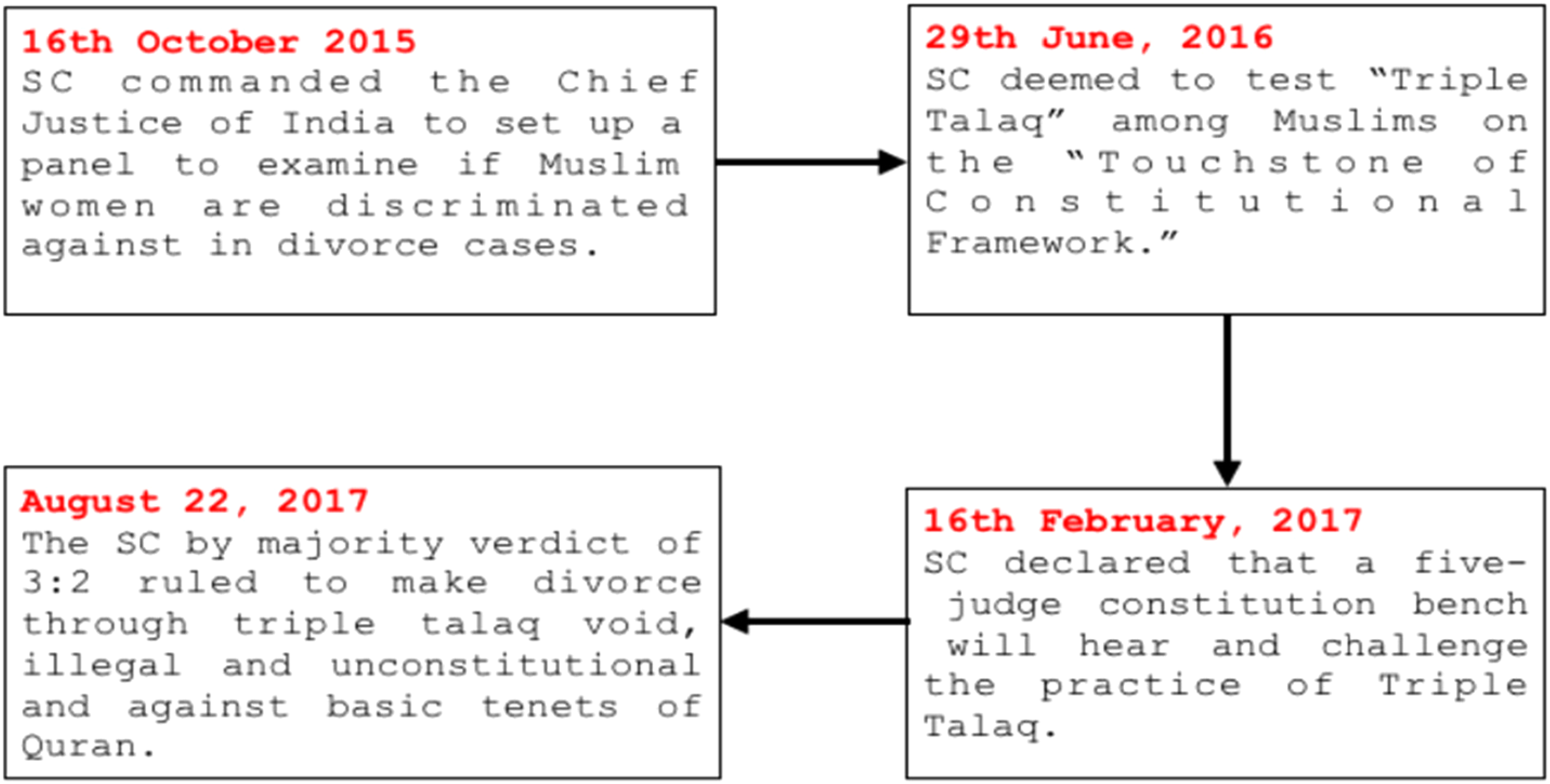
A timeline of events leading up to the declaration of instant triple talaq as unconstitutional by the Supreme Court. Source: (Indian Express, 2018a, 2018b).
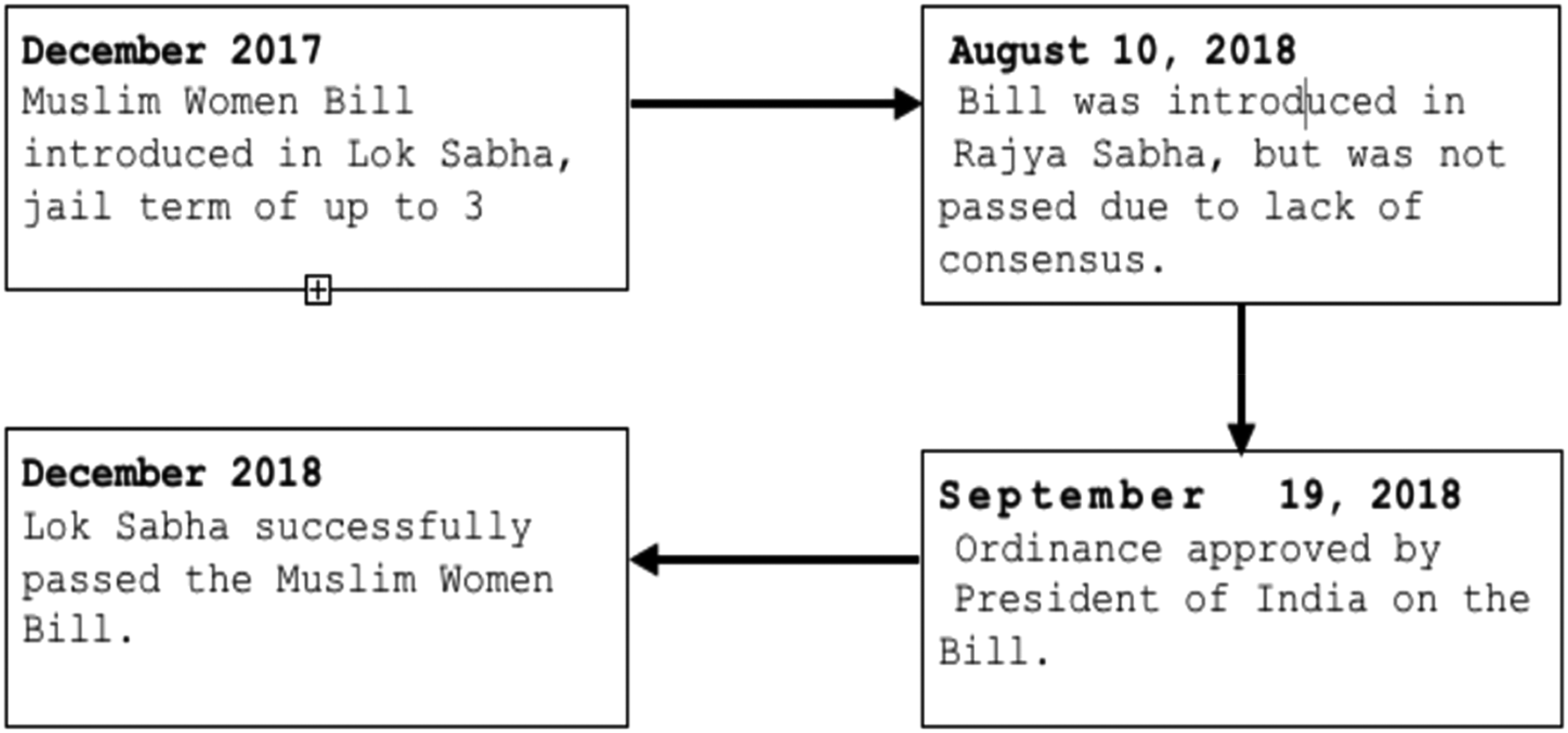
The timeline of events leading up to the issuance of a new ordinance in January 2019 for the Muslim Women Bill of the instant triple talaq case. Source: (Indian Express, 2018a, 2018b).
Sabarimala case verdict: Case study 2
Our second case unfolds around Sabarimala, a Hindu temple located in Kerala, where women of menstruating age (ten to fifty years old) had been banned by the temple trustees from entering since its establishment in the thirteenth century. This restriction owed to the celibate status of the presiding deity (Lord Ayyappa). The presence of women is said to ‘hamper’ the celibacy of the deity and ‘distract’ him from his devotees’ prayers (Dutta, 2019). This discriminatory practice raised important conflicts between freedom of practice of religion and the right to equality and protection from sex-based discrimination. The ban on women entering the temple was protected by the ‘morality’ clause regarding freedom of religion in the Indian Constitution (Dutta, 2019). Since the inclusion of the ‘morality clause’, a debate has ensued around the legal contentions in religious institutional practices – whether they should be resolved internally within the religious community or step into the public domain and into the scope for broader justice for humankind. In the Sabarimala case, a verdict was passed by the government in 2014 allowing entry to the temple for women, which was justified on the basis of delivering justice and empowerment for women's rights. The timeline for the Sabarimala case is highlighted in Figure 3.
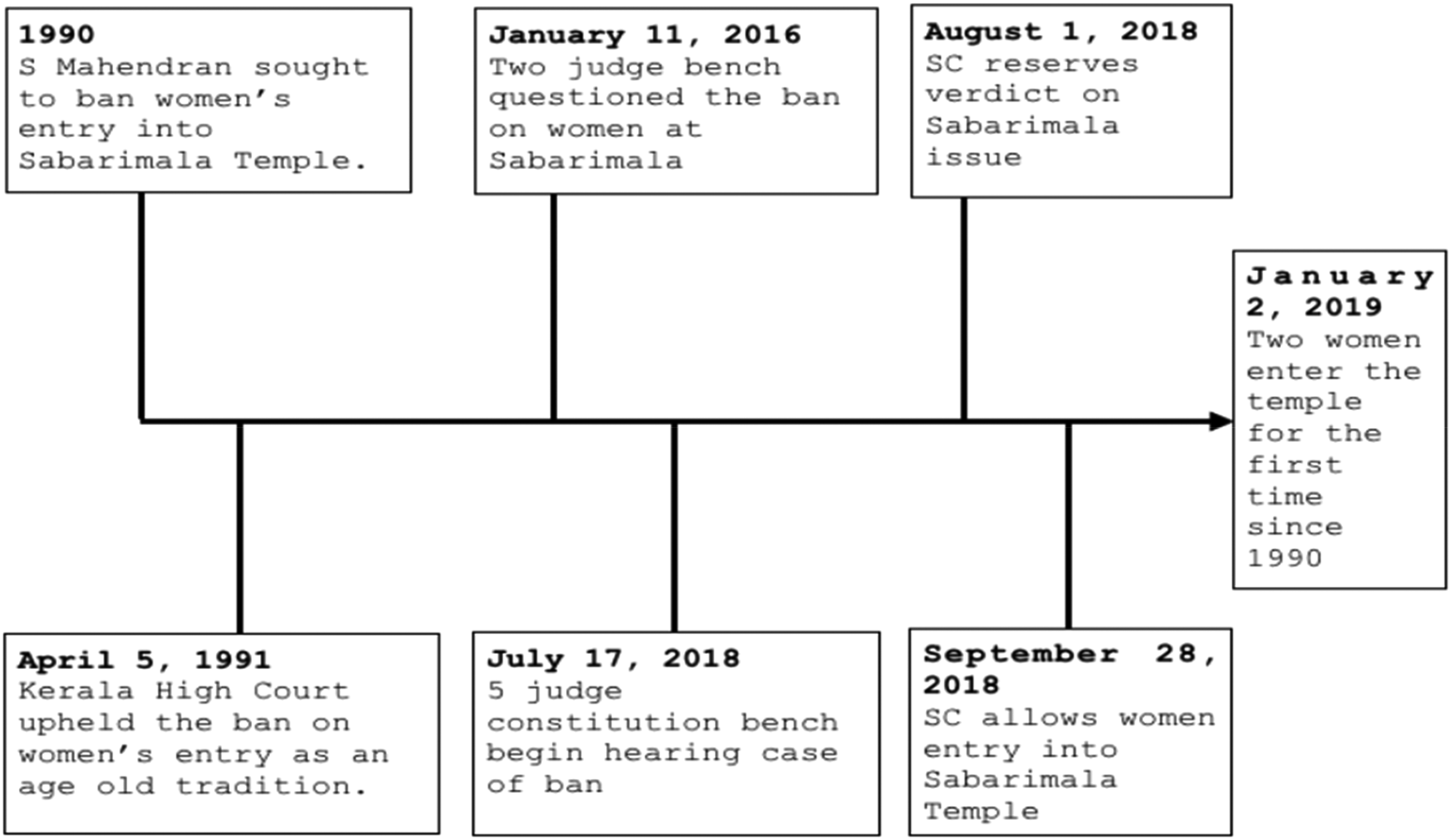
The timeline of events leading up to the entry of two women into the Sabarimala temple shrine after it was banned for the first time in 1990. Source: Indian Express.
The right wing and women in India
The empowerment discourse of most eastern civilizations echoes an intersection between multiple socio-political identities based on religion, caste, class, race and ethnicity (Niranjana, 2015). Unlike the western and more liberal feminist theories, eastern civilisations emphasise multi-dimensional feminism. In India, the Hindutva project supports this assertion when women incorporate concerns of caste and religion in their demands for emancipation or empowerment (Bedi, 2006). Such an empowerment necessarily intersects with discourses on religion-based traditions, values, moralities and agency. Women with a right-wing Hindutva persuasion have asserted enough power to legitimise claims to public amenities of clean water, access to education and medical resources, as well as permission to celebrate Hindu festivals in their respective local communities. The above may resound with liberal feminist theories with regard to accessibility and social empowerment for women, but women who are a product of the Hindutva politics will question the need for equality of rights, especially in matters concerning religion (Vijayan, 2012; Ranipeta, 2018). The Sabarimala temple case is based on a similar ideal, where the entry of women into a temple shrine is considered a religious matter, rather than a gendered issue (Bedi, 2006). While political agents endorsed the non-entry to the temple for women as an inviolable religious sanction, women themselves were divided – many believed religious inviolability over and above women's right and access to public spaces.
The right wing and women from minority communities in India
India is a multicultural society with diverse linguistic and religious traditions, further divided by caste and class stratification. In an attempt to forge solidarity and equality between diverse communities, India adopted ‘secularism’ as a landmark addition to the Preamble of its Constitution after independence from British imperialism (Maroti, 2017). Under the purview of secularism, India's legislative assembly abolished several regressive practices adopted by the Hindu Personal Laws, including child marriage and untouchability. While changes were empowering for Hindu women, similar reforms to empower women of religious minorities were not implemented in the personal laws. The instant triple talaq case was thus seen as a landmark judgment for the rights of Muslim women and a proactive move towards personal and social empowerment.
Hindutva ideologues like Golwalkar viewed the Muslim community as minorities who have claims to no privileges or preferential treatment, and who ‘must strive to respect and uphold the glorification of Hindu race and culture’ (Roy, 2016). Having partly adopted this ideology through the RSS, the BJP government has strived to empower Muslim women through the criminalisation of instant triple talaq. While gratefully welcomed by women as a step towards eliminating regressive laws, the criminalisation of this law may arguably be seen as a step towards a unified civil code – a potential imposition of ‘one’ code of personal laws, eliminating the bestowing of rights to minority populations as a secular feature from the Indian Constitution (Katju, 2018).
Since Hindutva is seen as an exclusivist ideology, backwards caste groups, Muslims, Christians and women of non-Hindu religious groups are traditionally viewed as intruders, minorities, others or outsiders in the Hindu Nation (Savarkar, 2016). Hindutva women thus view the instant triple talaq case as a legal structure permitting agency for women of other (non-Hindu) minority communities to emerge empowered from ‘oppressive and barbaric’ traditions perpetrated by other minority men (Vijayan, 2012). This justification further entrenches the social and political divide between the minority and dominant religious communities. Discourses of the right-wing Hindutva leaders and supporters have been disseminated through political rallies and online platforms such as Twitter. Twitter-based political communication has important implications for women's empowerment and their relationship to a narrative on religious minorities as they evolve and establish themselves in the two cases of instant triple talaq and the Sabarimala temple.
Discourses on Twitter
In India, the rise of the Hindutva right wing in politics has influenced an interplay between discourses around women's empowerment and narratives about religious minorities. Leaders of right-wing organisations and their political fronts have claimed to be working for the empowerment of women but most of these assertions have a communal angle, where Muslim or Hindu women are prioritised as a community deemed important for empowerment. Communal assertions in ‘calls for empowerment’ render the ‘women’ community as a non-coherent body of individuals, and their right to greater freedom transitions to a communal preference for one community over the other (Vijayan, 2012). A divided discourse on feminist empowerment then becomes instrumental in side-lining the broader picture of equality for women in favour of a legislative body that hands out preferential and biased treatment to religious communities.
Through the use of emotional appeal and indirect engagement such as ‘following back the more belligerent and extreme right-wing users’ (Pandey, 2017) on Twitter, right-wing leaders in India appeal to the sentiments of users who engage with specific volatile communal incidents such as the instant triple talaq. Right-wing support for the empowerment of Muslim women is expressed through an aggressive show of strength for introducing laws that ban/criminalise the practice of instant divorce. To convey this message, the right wing uses strong emotional appeal and phrases that allude to religious sentiments, mention Muslim organisations that support such laws and even allude to BJP's pro-development pro-empowerment narrative (Rajagopal, 2015).
Feminist HCI and our study
Through their paper ‘Towards a Feminist HCI Methodology’, Shaowen and Jeffrey Bardzell (2011) write about the relevance of feminist theories in the domain of HCI. As technology is increasingly being incorporated as an essential element of users’ daily lives, it has become important to establish the impact of design and interactions on the social, political and economic lives of stakeholders (Bardzell, 2010). To evaluate the impact of digital interactions, HCI borrows insights from multiple domains – feminist and queer theories, epistemologies, philosophy, economics, psychology and political science (Schlesinger et al., 2017). Seminal HCI researchers focused on the impact of feminist theories on HCI, bringing to the forefront the niche area of study commonly termed as Feminist HCI (Bardzell and Bardzell, 2011; Rode, 2011).
Breslin and Wadhwa (2014) discuss the need to educate ourselves – as researchers – about the risk of technologies enforcing stereotypes, abuse and regressive gender roles as normative among their users. Being aware of this risk is no easy task because it requires an active engagement with feminist, queer and identity politics theories and their relevance to the design of technology (Cassell, 2002; Rode, 2011). Breslin and Wadhwa (2014) also write about the need for gender design, a technology developed by catering to the demands of minority gender groups and their inter-group relationships with members from dominant sections of society.
Looking at the widespread scholarship in Feminist HCI, our study credits Feminist Standpoint Theory (Bardzell, 2010) and Framing Theory for informing our attention to inclusion and its social context. Discourse Analysis and Thematic Studies are rigorously employed to engage with our research questions. These will be elaborated in detail in the methods section of the article. We also explicitly strive to establish reflexivity enumerating ways in which marginalised identities become hindered in the process of technological advancements and the primacy afforded to technological innovation over and above the implications for HCI.
Methodology
This study focuses on two cases – instant triple talaq and the Sabarimala case – and uses #tripletalaq and #sabarimala to collect tweets that contribute to our discussion. Both methodologies employed are qualitative in nature and are used to explore appropriate socio-political contexts to explain the effectiveness of Twitter in facilitating the development and transition of discourses. Since establishing context requires careful and deep interactions with the data set, a feasible size of tweets set was designed for a qualitative data analysis approach. This was inspired by Small Data Analysis (Pal and Gonawela, 2017).
The data set used for analysis consists of 570 tweets, collected from Twitter based on trending hashtags in each of the two case studies. The official Twitter API does not allow users to collect tweets beyond seven days from the date of running the script. To scrape data that was older than almost one year, we used a python script called Get Old Tweets Programmatically, developed by Jefferson Henrique (2021). An initial data set contained 91,979 tweets. To manage feasibility of the task, the data set was reduced to 570 tweets, using favourites as our criterion for filtering (Meier et al., 2014).
After collecting tweets for both hashtags, #tripletalaq and #Sabarimala, we filtered to remove any tweets in languages other than Hindi and English. This was necessary because the researchers who engaged in the coding and analysis process were only fluent in these two languages. We collected the tweets by first identifying dates within each case that contained ‘newsworthy’ information that would potentially spark debates online. Each of these dates contributed to furthering the debates on the cases, but some incidents were of more importance than others because they sparked outrage and dialogue that continued for at least five days after the event had occurred. The dates and number of tweets used are presented in Table 1.
Details of the data set used.
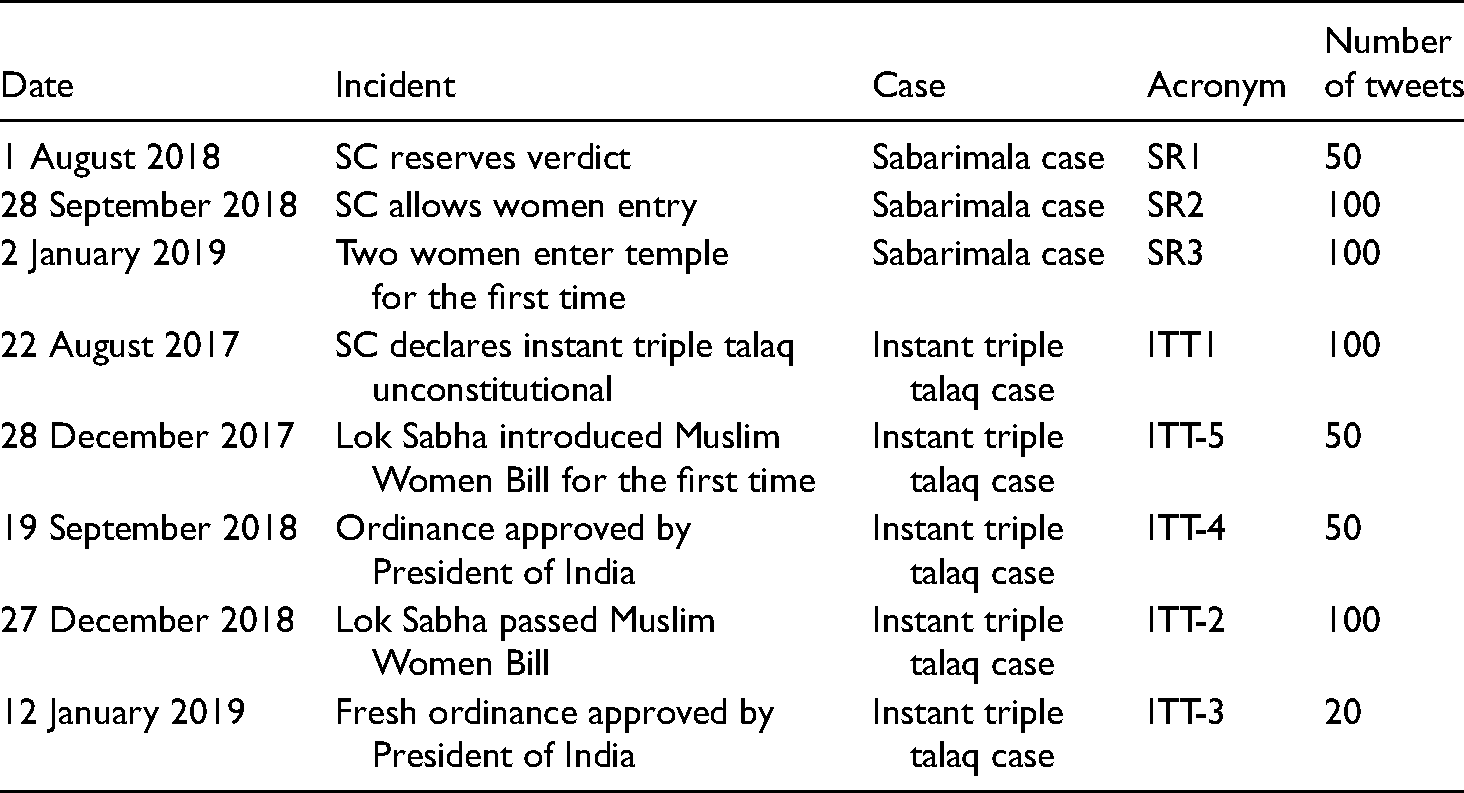
We also identify the dates as ‘Dates of Significance’ (DoS) because the events resulted in massive reporting in newspapers across India and contributed to offline actions as well. For instance, in the Sabarimala case, the Supreme Court verdict on 28 September 2018 sparked protests at the temple site and devotees threatened physical harm to any women who attempted to actually enter the temple (BBC News, 2019; Rautray, 2019). In another instance, the introduction of the Muslim Women Bill on 28 December 2017 was criticised by many for not taking into consideration the grassroots work of Muslim women's organisations. Additionally, the government was encouraged to engage with these organisations to create a more comprehensive Bill for gender-just Muslim family law reform in India (Salim, 2018). We collected tweets for hashtags used on the DoS and for five days thereafter. For the less significant dates, we collected and investigated tweets using the hashtag only on the date of the incident. In the instant triple talaq case, the trending #tripletalaq was used to scrape tweets. The DoS are taken as 22 August 2017 and 27 December 2018 because these dates marked the first instance of any action being taken against the discriminatory practice of divorce that would give women a sense of empowerment (Indian Express, 2018b), as well as when the instant triple talaq Bill was passed in the Lower House, making this practice punishable by law ( Indian Express, 2018a ). For the Sabarimala case, the hashtag #Sabarimala was used to scrape tweets. The DoS are taken as 28 September 2018 and 2 January 2019 because on these dates major outrage was sparked online and offline (PTI, 2018a, 2018b). The verdict passed by the Supreme Court on 28 September 2018 led to offline protests outside the shrine, and devotees threatened to physically guard the entrance to the shrine from women (BBC News, 2019). On 2 January 2019, after multiple failed attempts, the first women were able to break the traditional ban and enter the shrine, amidst heavy security (First Post, 2019).
Tweets in Tables 1–6 in this article were chosen as a random sample from the dataset to show evidence for the themes ‘Tweets on women's empowerment in the triple talaq case’, ‘Tweets supporting the Supreme Court verdict that deemed instant triple talaq unconstitutional’ and ‘Tweets about rights and sentiments of religious minorities in the instant triple talaq case’. Some of the tweets were chosen because of the user handles receiving high engagement. Below is a sample list of recognisable user handles:
@BDUTT – Barkha Dutt, journalist @rishibagree – Rishi Bagree, journalist @ArnazHathiram – Arnaz Hathiram, journalist @SirJadeja – Sir Jadeja, 1.2 m followers, popular account, identity unconfirmed @Being_Humor – Maithun, 239,900 followers, popular account, parody account
Tweets were sorted based on the number of retweets and favourites in decreasing order and screenshots of the top few tweets have been added to the article as a sample. This sorting and filtering based on retweets and favourites was used to avoid researcher bias while sampling data for presentation here.
To analyse our scraped Twitter content, we used a combination of TA and FRDA.
Thematic Analysis
A theme is a pattern that underlines a dominant section of our data set, obtained after a rigorous interaction with the text, audio or visual data (Braun and Clarke, 2006). The most ideal implementation of TA is to perform an initial organisation of the data set into a set of broad themes. Following the initial encoding, researchers then delved into understanding the social and political theories that the themes contribute to. Every iteration in TA requires rigorous and active engagement with the data. We used a combination with FRDA to conduct a small data analysis on tweets.
Feminist Relational Discourse Analysis
FRDA is a novel approach in Discourse Analysis which proposes to encourage voice-oriented analysis of discourse. It is based on providing agency to the ‘voice’ of marginalised communities, such as women and religious minorities, in research concerning oppression and suppression of these groups. With the voice as a central element of a discourse, an otherwise one-dimensional narrative can become a complex exploration of power structures and voices that are suppressed within these structures (Thompson et al., 2018). Following the steps of FRDA on tweets from #tripletalaq and #sabarimala, we arrived at dominant discourses arching over all the DoS and across both the incidents. Within the dominant discourses, our study endeavours to situate and interpret the more subtle and fine-grained narratives that run the risk of being engulfed by broader and more visible ones. We also hope to discuss how subtler strategies lead to controlled empowerment of women.
Emergent encoding
The analysis employed rigorous encoding from a close reading of relevant tweets, filtering and compiling a final dataset. To do so, the coders began by noting the broad notions conveyed repeatedly through the tweets: notions of ‘support’ or ‘opposition’ towards the Bill (in triple talaq) and towards the verdict (in the Sabarimala case). Tweets were also tagged as either congratulatory and positive or abusive and negative towards the cause of women. Lastly, the coders also noted tweets that were ‘neutral’ or ‘mere case updates’ in the dataset.
After the preliminary classification, a second level analysis was conducted. Tweets conveying opinions (positive or negative, supportive or opposing) were further classified. These were labelled as ‘questioning the constitutional validity of the Muslim Women Bill’, ‘questioning the validity of the Supreme Court's interference in matters of a religious groups’ personal laws/traditions’ or ‘demanding protection of a Hindu deity's fundamental rights’. The latter one was specific to the Sabarimala case and hence was not included in the next step: drawing overarching dominant discourses.
Through a final iteration of the tweets, these broad notions and their contributing tweets were combined into three overarching discourses which are discussed in the next section.
Results
In communications literature, ‘dominant discourse’ is said to be a narrative, or a particular ‘way of looking’ at an issue or a debate that is frequently repeated throughout the data set (athenian200, 2013). Since dominant discourses are born out of repeated occurrences within our data set, we suggest these discourses as acceptable interpretations of the tweets. The three discourses arch over the two case studies: the instant triple talaq case and the Sabarimala temple case. Additionally, we suggest that a transition between the three dominant discourses is evident from the data. Hence, if discourse X is dominant on date 1, and discourse Y is dominant on date 2, we suggest that a transition has occurred in our discourse from X to Y. For future reference, we will call the Twitter users engaging with tweets from our data set merely users or Twitter users.
In each of the two cases, employing TA gave rise to a number of broad themes largely specific to either the triple talaq case or the Sabarimala case. However, the themes identified employing TA were not a good fit for an overarching analysis, leading to the application of FRDA to obtain the three dominant discourses. Using emergent encoding, the preliminary analysis gave rise to themes outlined in Figures 4–6 for each DoS. Following this, the secondary analysis gave rise to a broad set of themes (outlined in Figures 7–9) for each case. Finally, the last iteration of analysis gave rise to three overarching dominant discourses which form the basis for our analysis and discussion. The coders relied on their understanding of the case studies, political and social concepts of feminism, right-wing Hindutva politics in India and the news reports from each case study to arrive at three dominant discourses:
Support/opposition: instant triple talaq and Sabarimala case In support of women's empowerment In support of rights and sentiments of religious communities
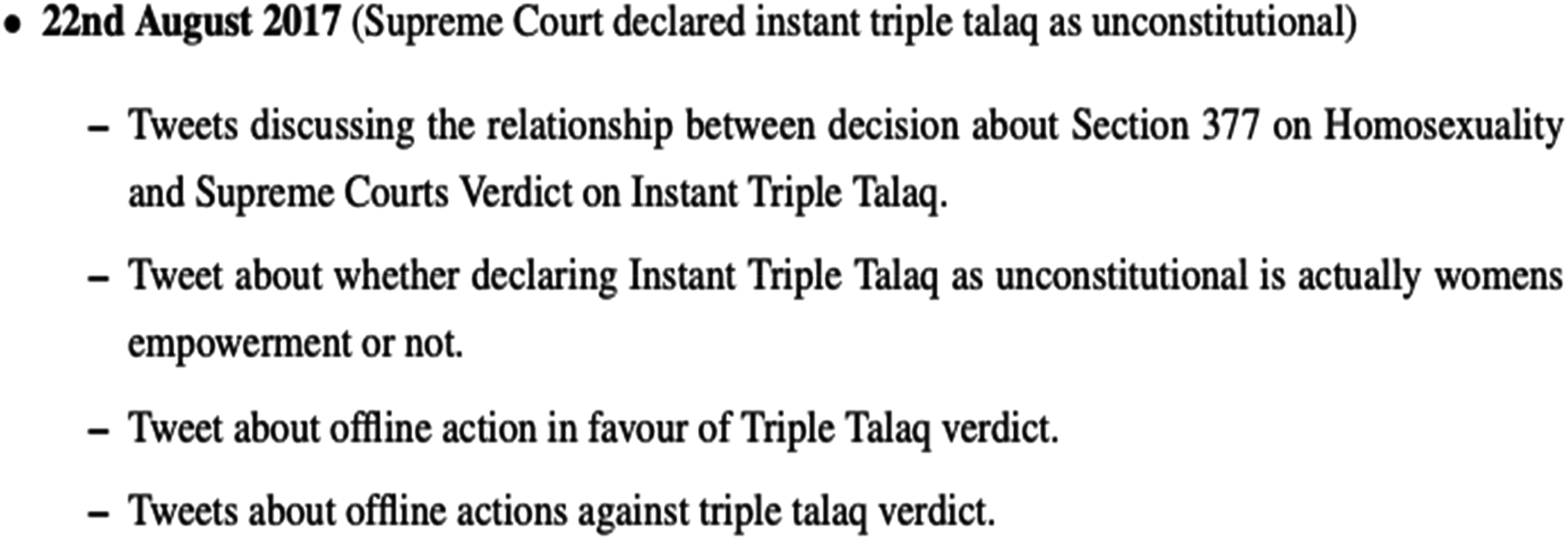
Themes that emerged from preliminary analysis in the instant triple talaq case.
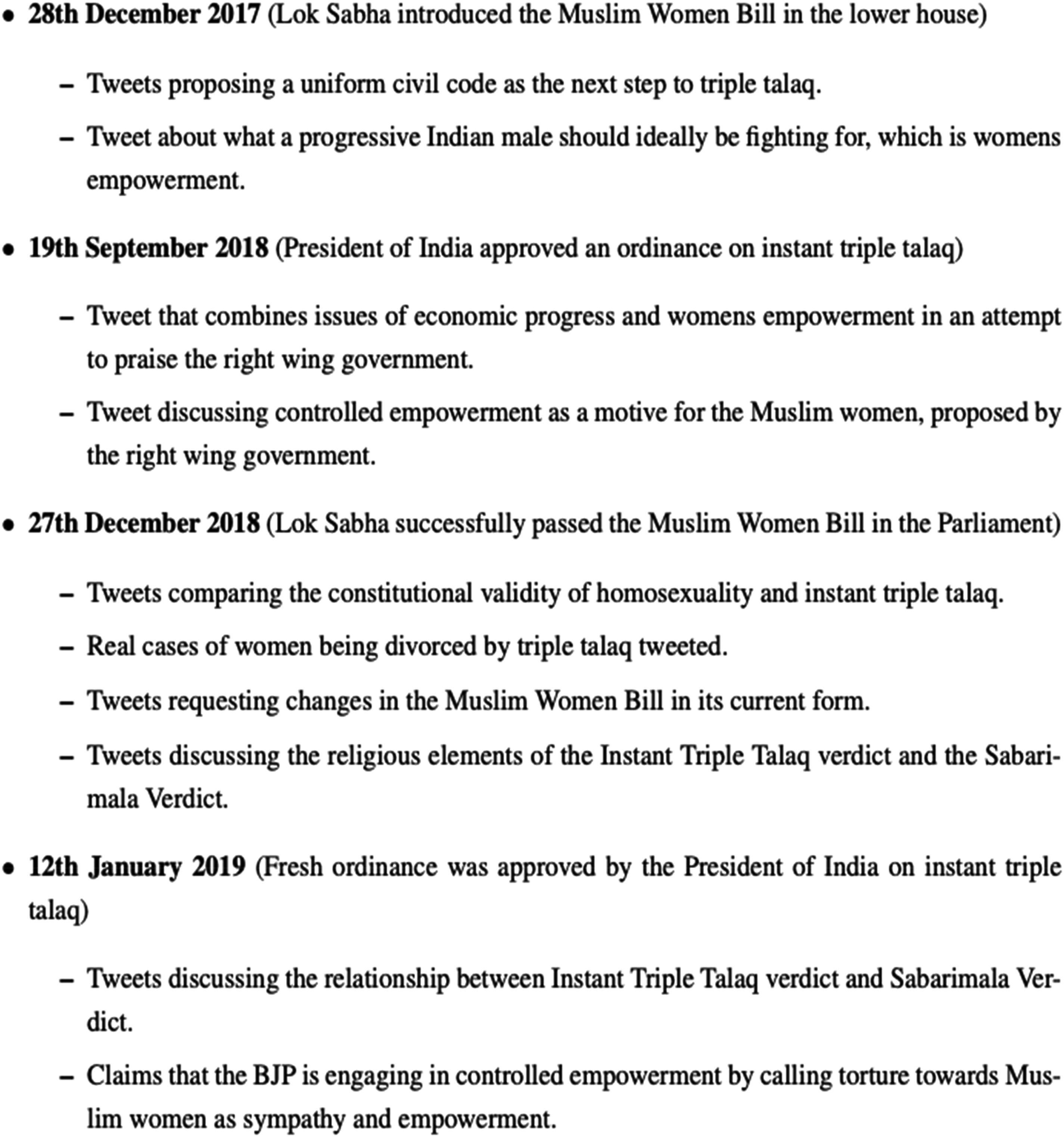
Themes that emerged from preliminary analysis of the instant triple talaq case.
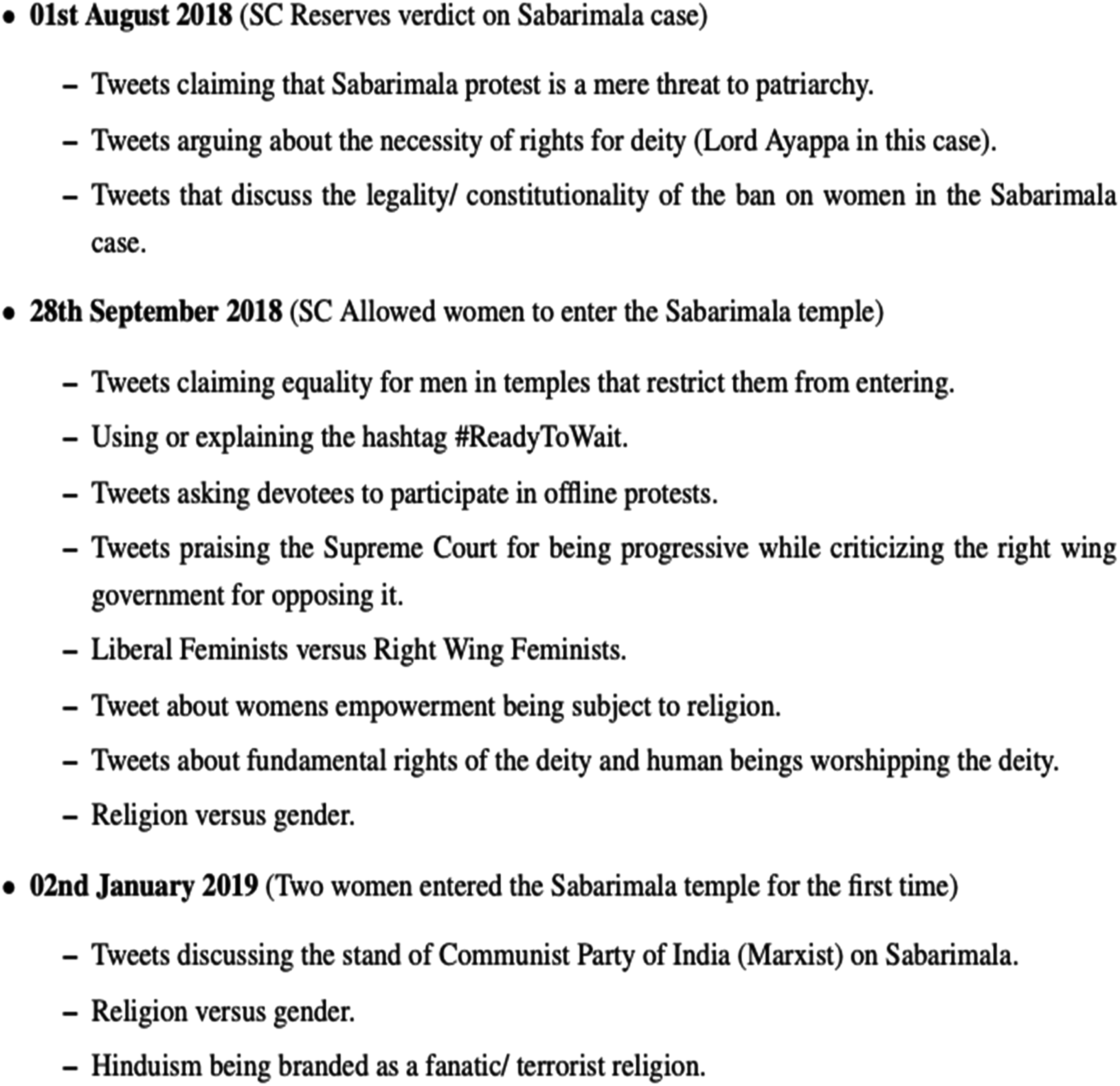
Themes that emerged from a preliminary analysis of the Sabarimala case.
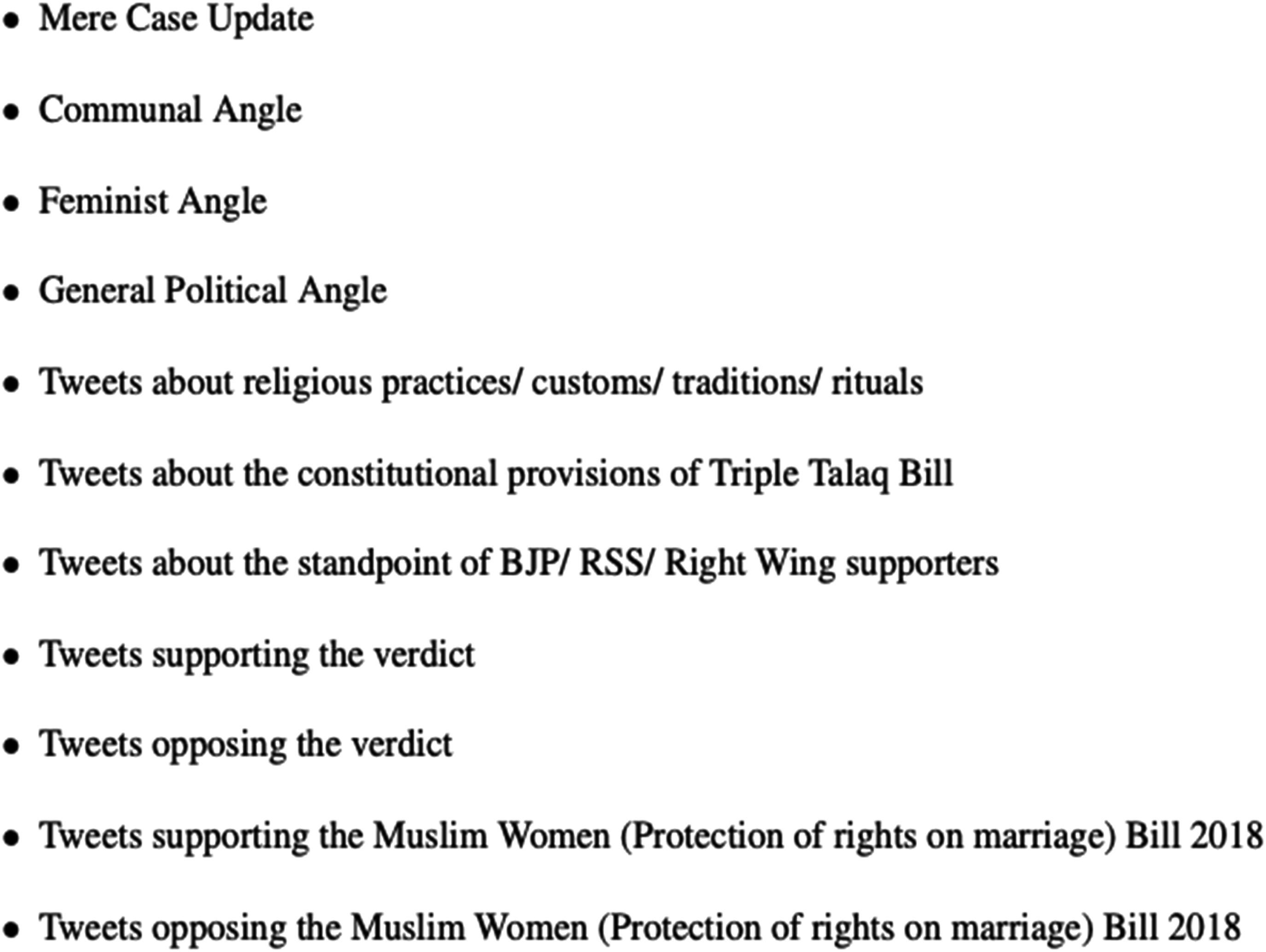
Themes that emerged from a secondary analysis in the instant triple talaq case.
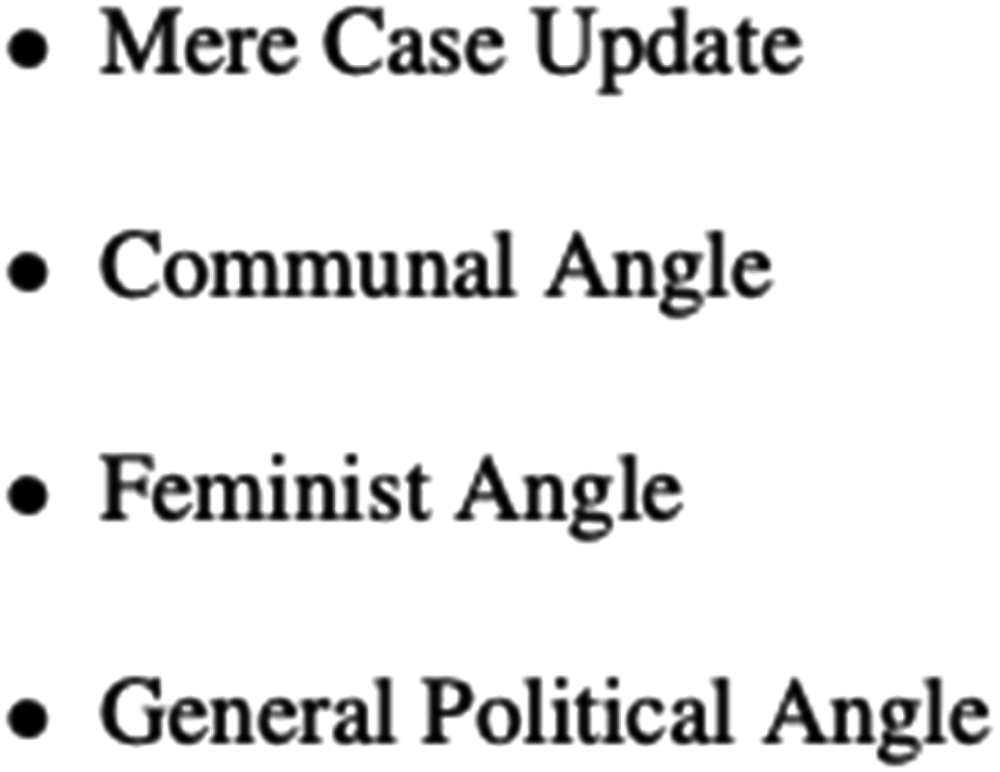
Themes that emerged from a secondary analysis of the Sabarimala case.
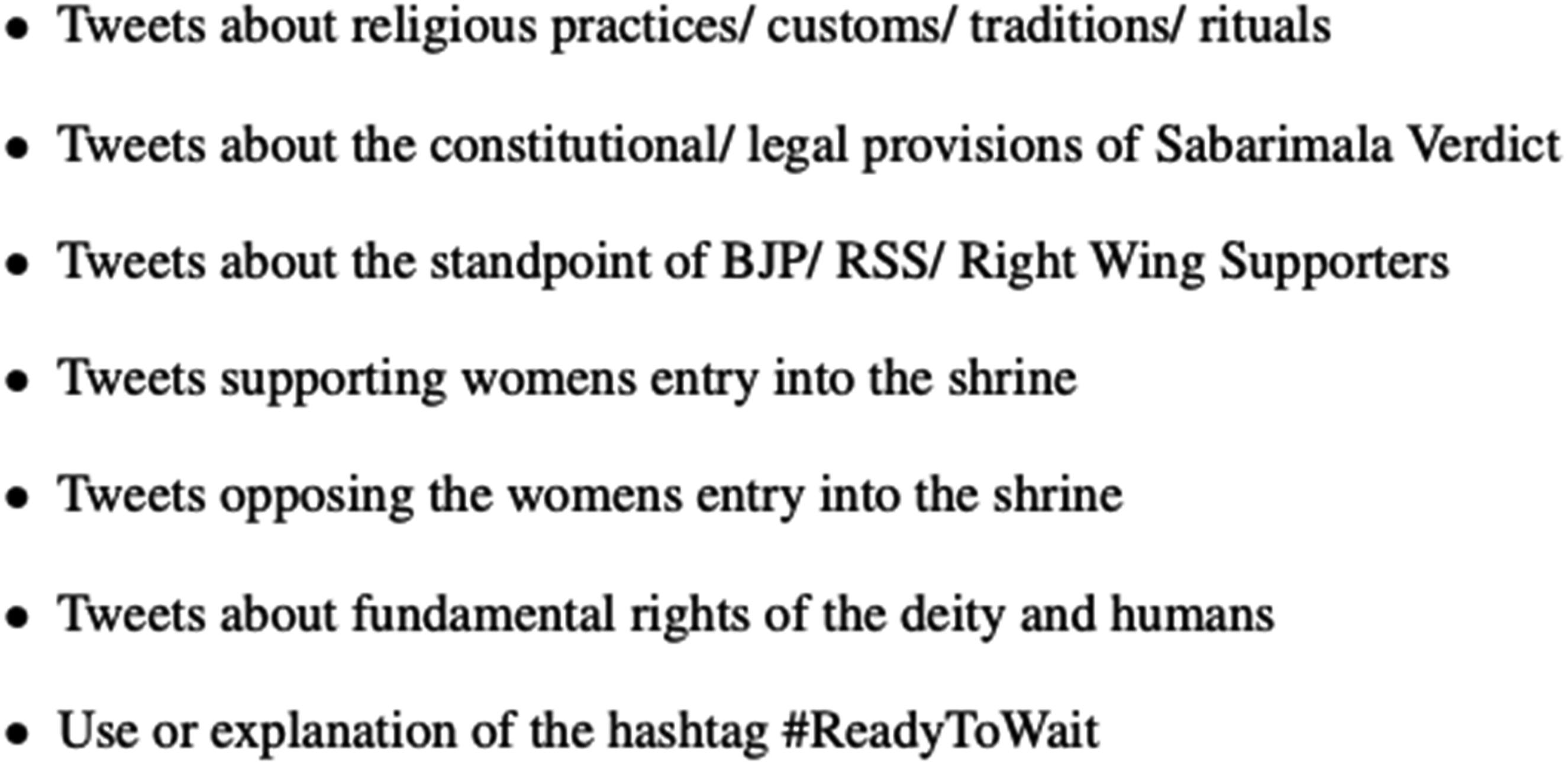
Themes that emerged from a secondary analysis of the Sabarimala case.
Each of the three discourses is deemed dominant, repeatedly occurring across all critical dates identified in the political life of both cases. We will discuss the dominant discourses and emergent transitions between them in the following section.
Transition between dominant discourses
Emerging transitions in a discourse are directly related to user engagement with a case. To discern significant user activity and engagement that merits our ‘dominant discourse and transition’ analysis, we conduct statistical tests of significance on these dates and related user activity. We find that there is a statistically significant engagement of users for all DoS in both case studies (ANOVA F(4319) = 17.09263, p < 0.05) (ANOVA F(2247) = 6.6949, p < 0.05). A significant user engagement in both cases thus indicates that Twitter users who engaged actively with either the instant triple talaq case or the Sabarimala temple case contributed to amplifying the dominant discourse on any given date of significance in both cases. We will now use transitions and discourses to answer our first research question: How and when does a discourse about women's empowerment transition into a political narrative designed to appeal to religious sentiments? We also answer our second research question here: How does Twitter facilitate the shift in discourse from women's empowerment to focus on a political appeasement of religious identity in India?
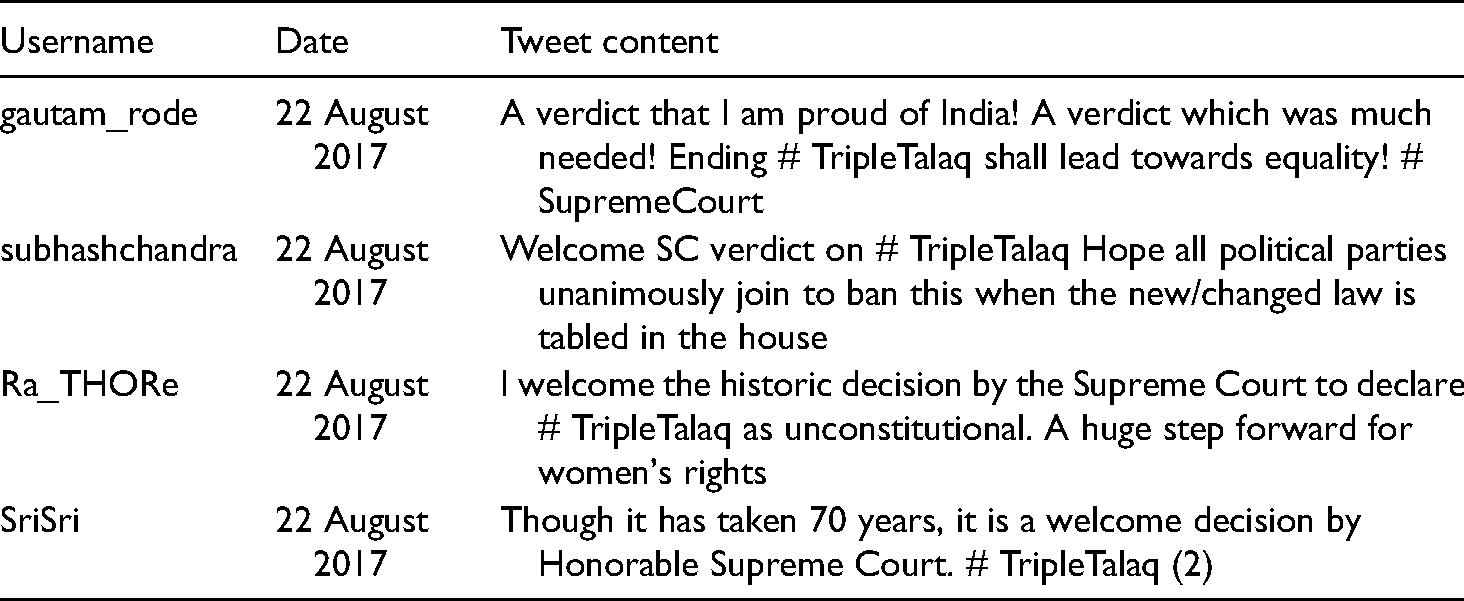
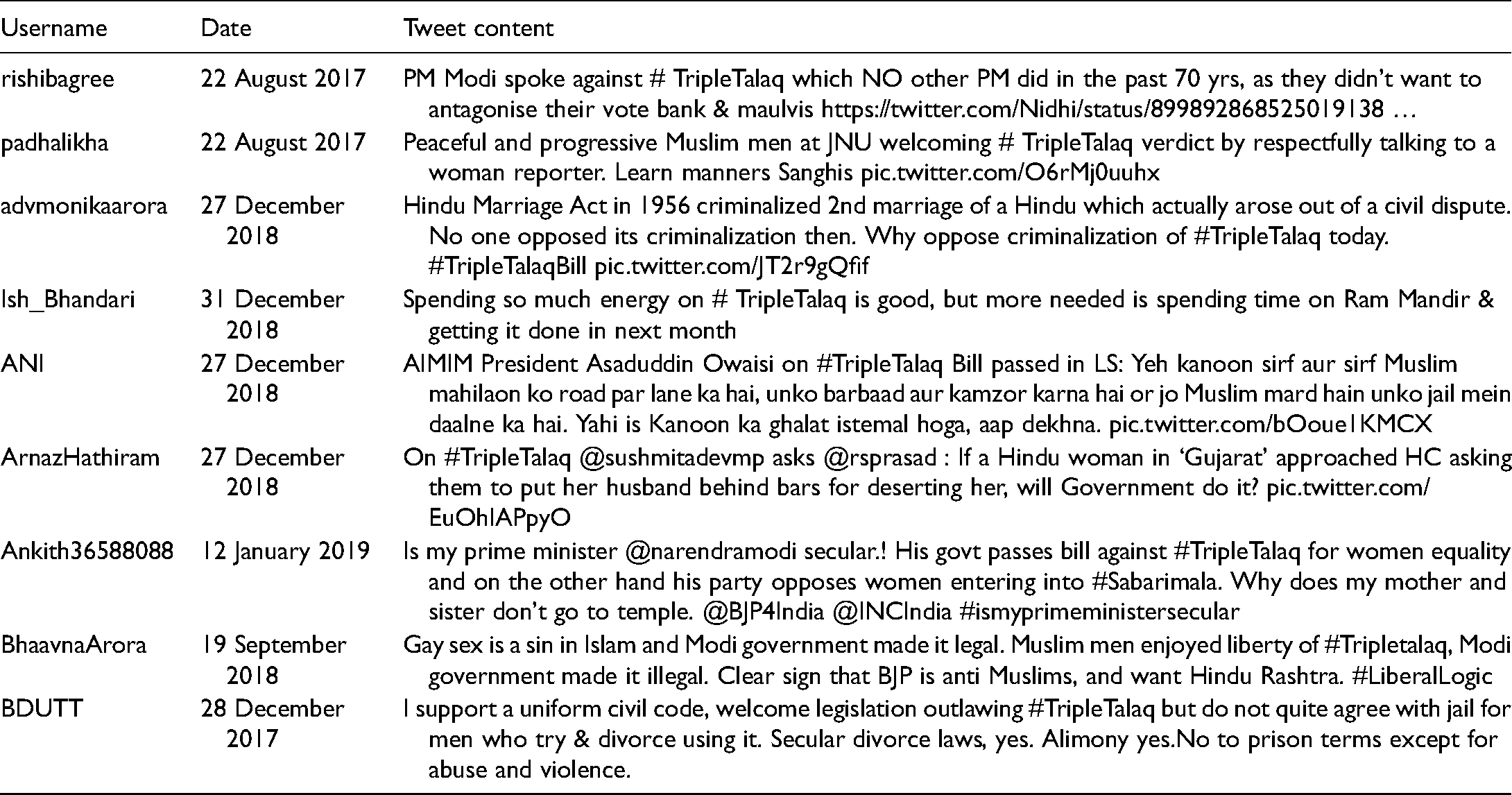
For the instant triple talaq case, the discourse begins with unanimous support for the Supreme Court's verdict declaring the practice unconstitutional. A majority of tweets we analysed supported in no uncertain terms the Supreme Court's efforts and the verdict towards empowerment of women irrespective of religion. There were a few tweets discussing the issue as ‘concerning only Muslim women’ and fewer rendering the verdict unfair or oppressive to the Muslim community. The tweets praising women's empowerment are seen in Table 2. When the Bill was introduced in the Lower House, it proposed criminalisation and prison for perpetrators of instant triple talaq. Table 3 shows tweets supporting the Supreme Court verdict declaring instant triple talaq as unconstitutional. We observed divided support for the Muslim Women Bill from 22 August 2017 onwards and suggest that this is because it was introduced by a right-wing government in an attempt to secularise the personal law of a minority community. Tweets around the dates when the Bill was introduced and passed rendered the ‘support of rights and sentiments of religious communities’ as the dominant discourse. This can be seen in the tweets in Table 4. We observe that on 12 January 2019, there was divided support for the Muslim Women Bill and for the freshly approved ordinance on the case. We conclude that the dominant trajectory at the beginning of the online political life of the instant triple talaq case was ‘in support of women's empowerment’ and transitioned in the course of time into divided support for women's empowerment and a more vociferous support of the ‘rights and sentiments of religious communities’. We present Supplemental Tables 1 and 2 to show the divided support for the Muslim Women Bill. The peaks in Figures 10–14 indicate a high engagement with the tweets on DoS and the emergence of dominant discourses identified earlier in our study.
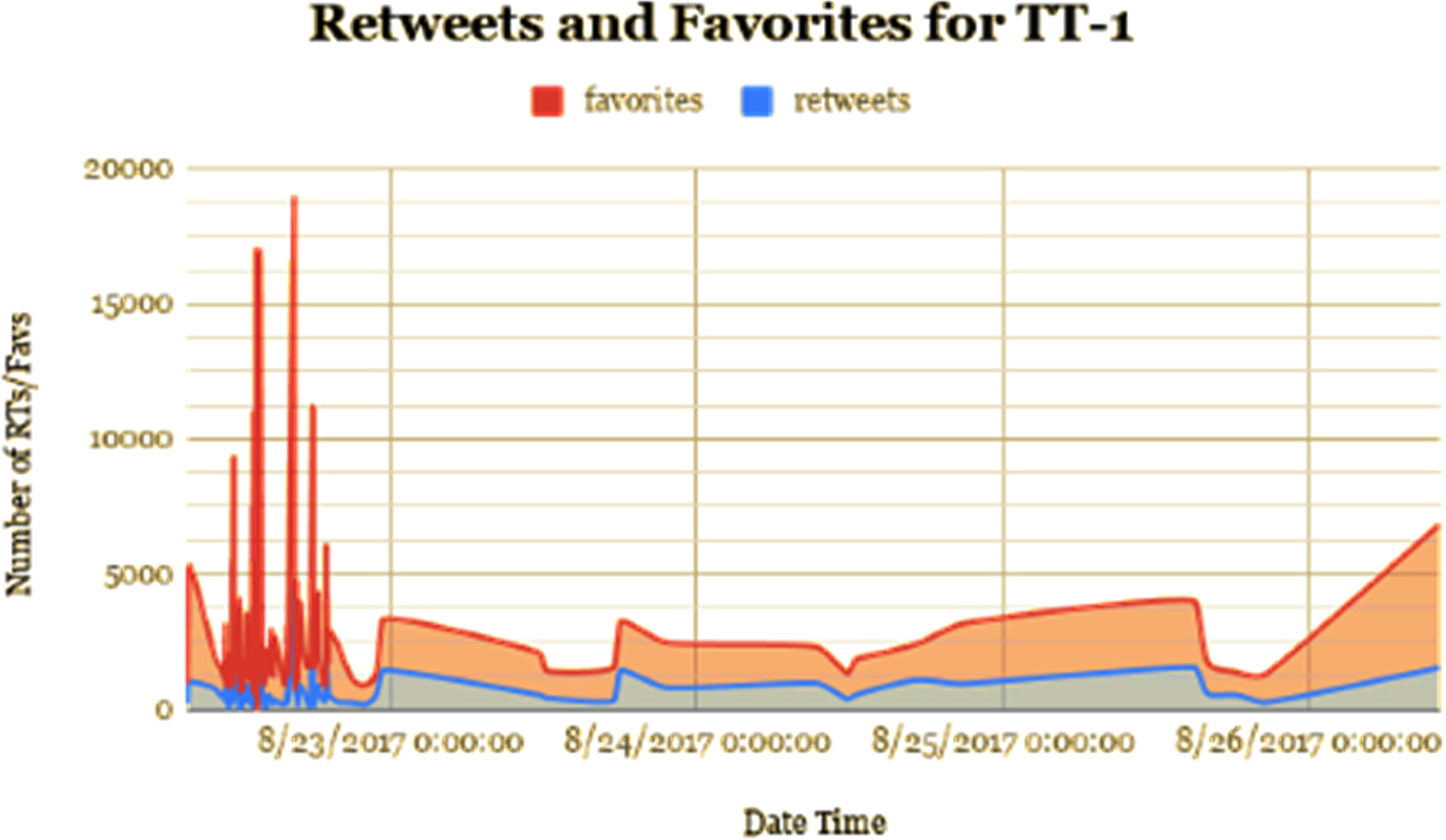
Retweets and favourites peaks for the instant triple talaq case.
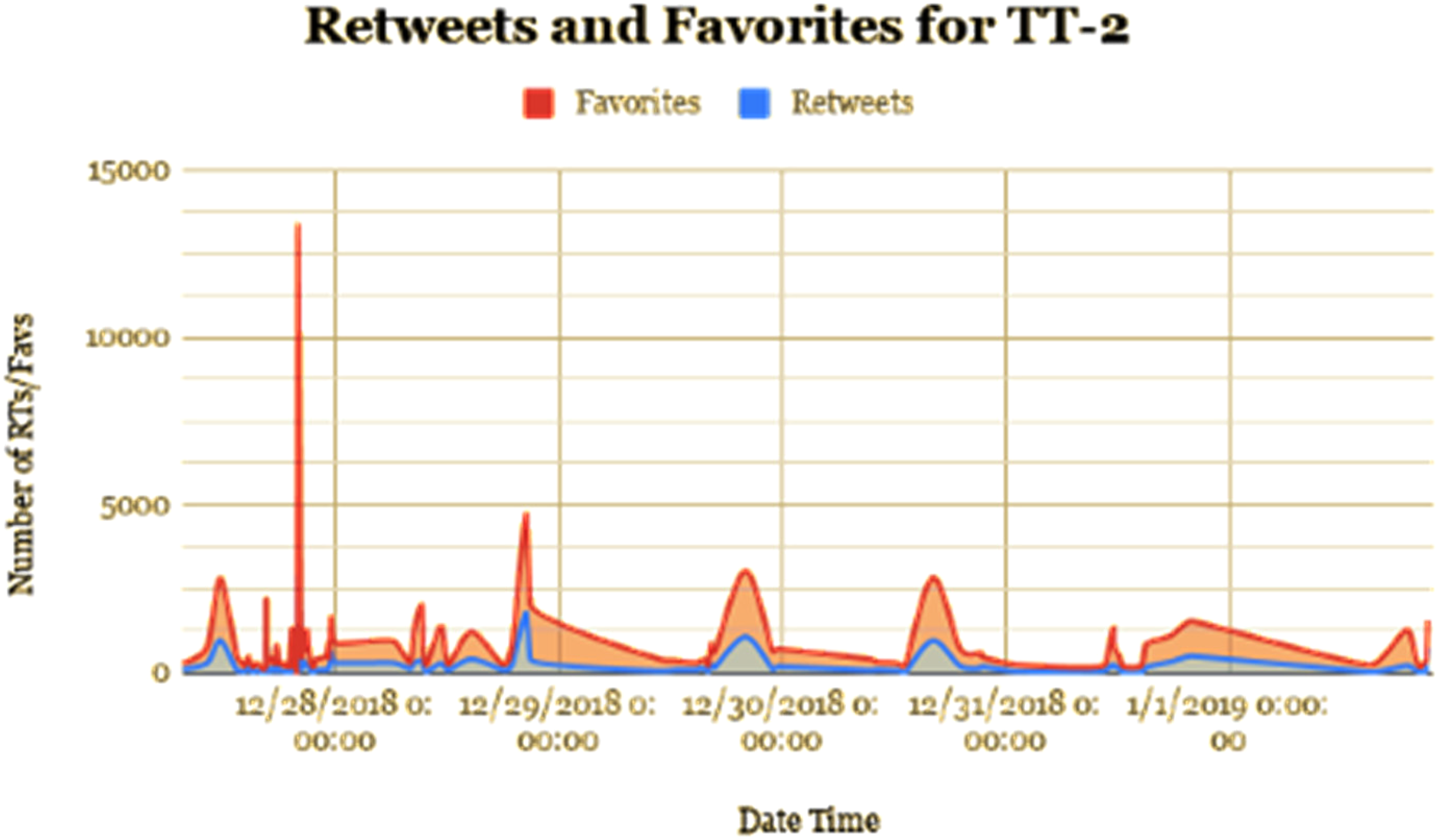
Retweets and favourites peaks for the instant triple talaq case.
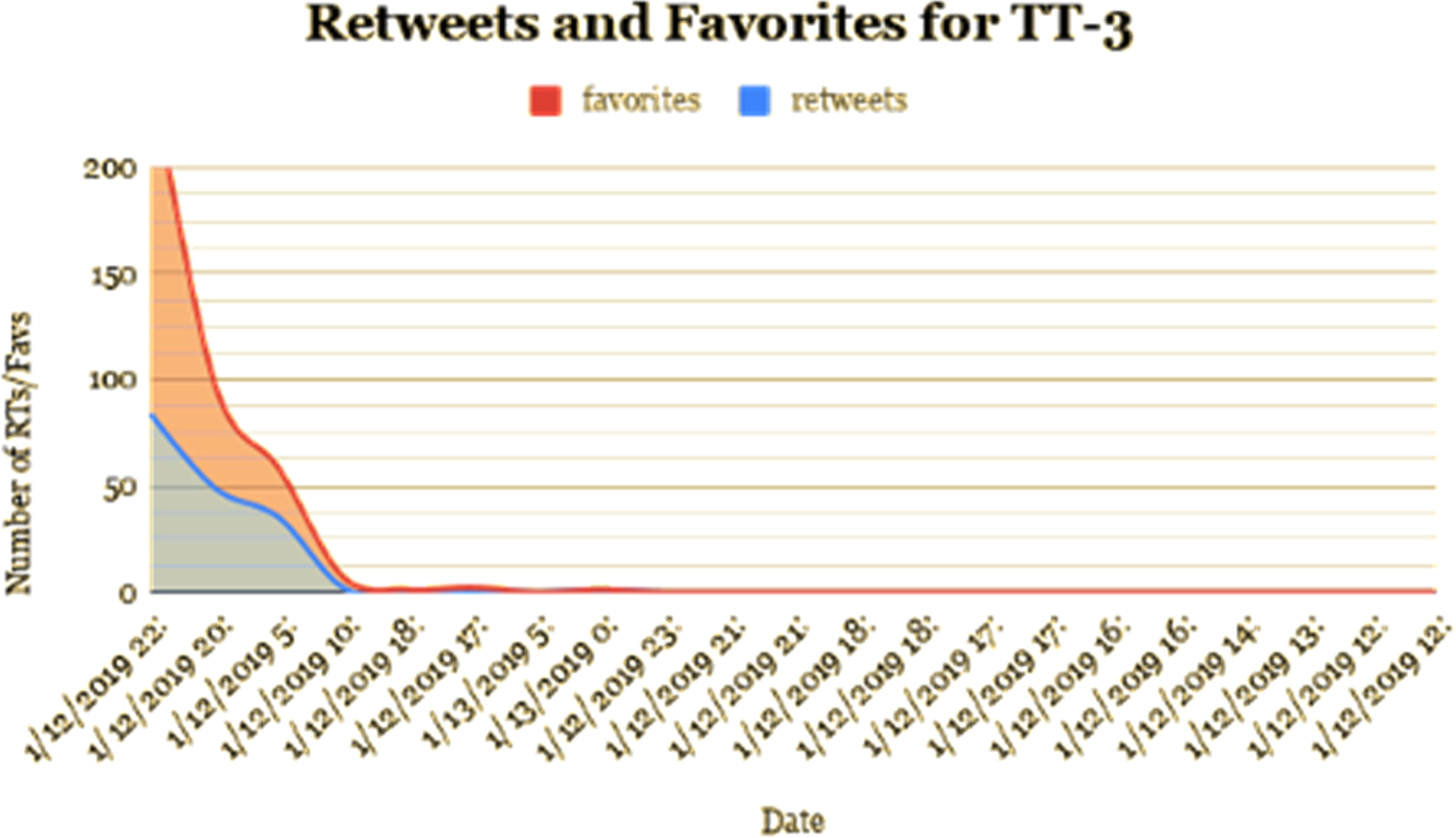
Retweets and favourites peaks for the instant triple talaq case.
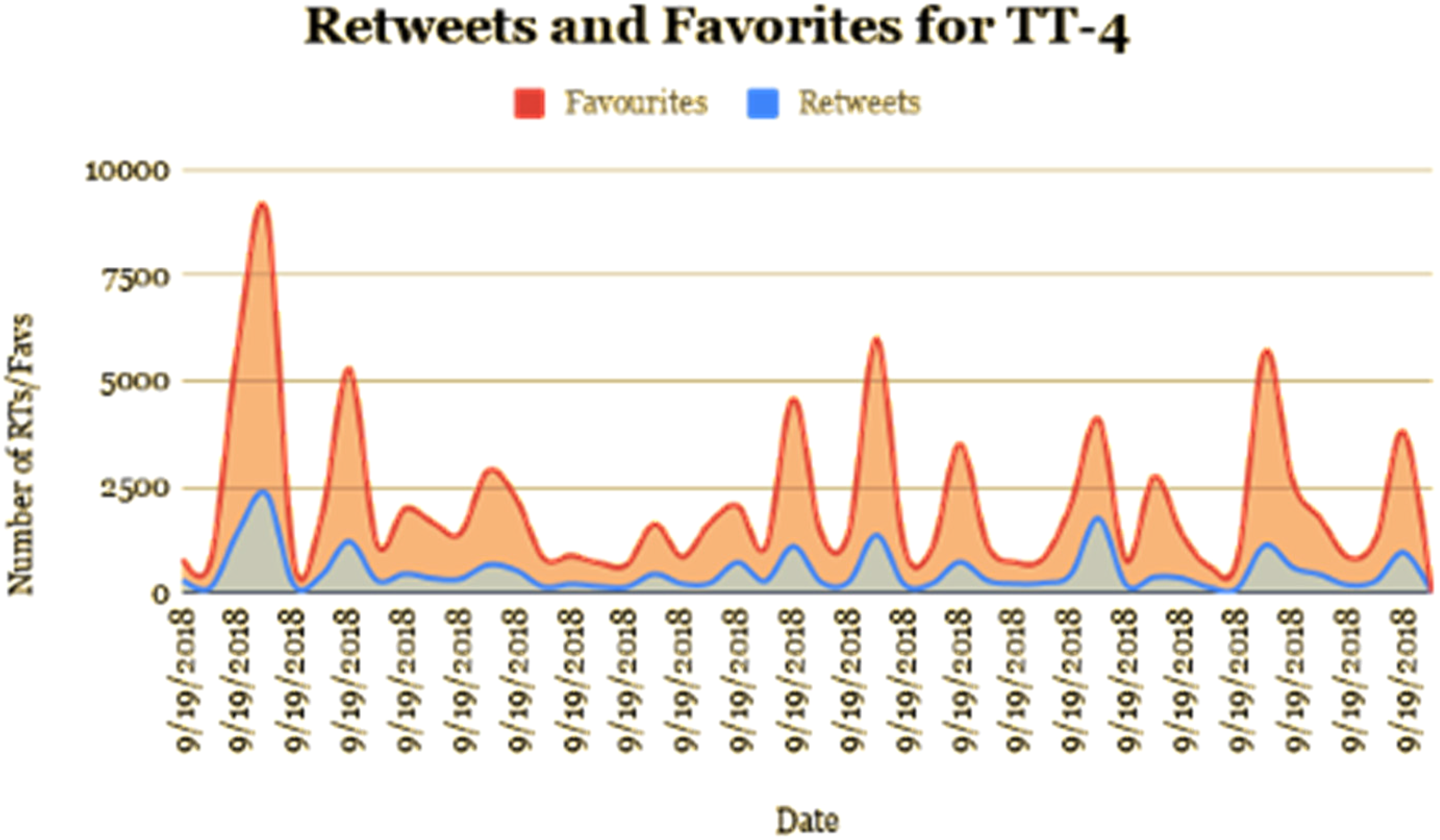
Retweets and favourites peaks for the instant triple talaq case.
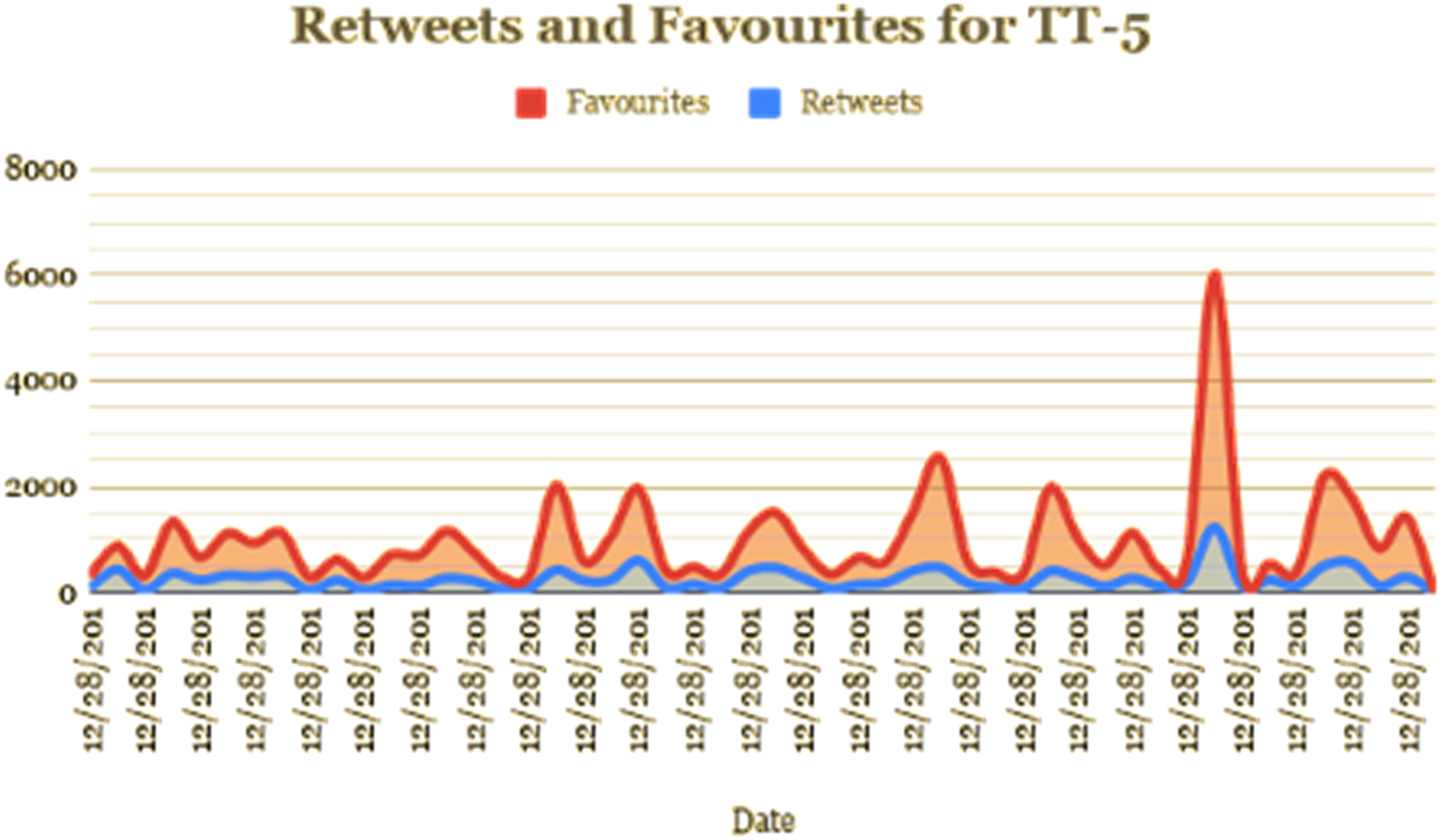
Retweets and favourites peaks for the instant triple talaq case.
Tweets on women's empowerment in instant triple talaq case.
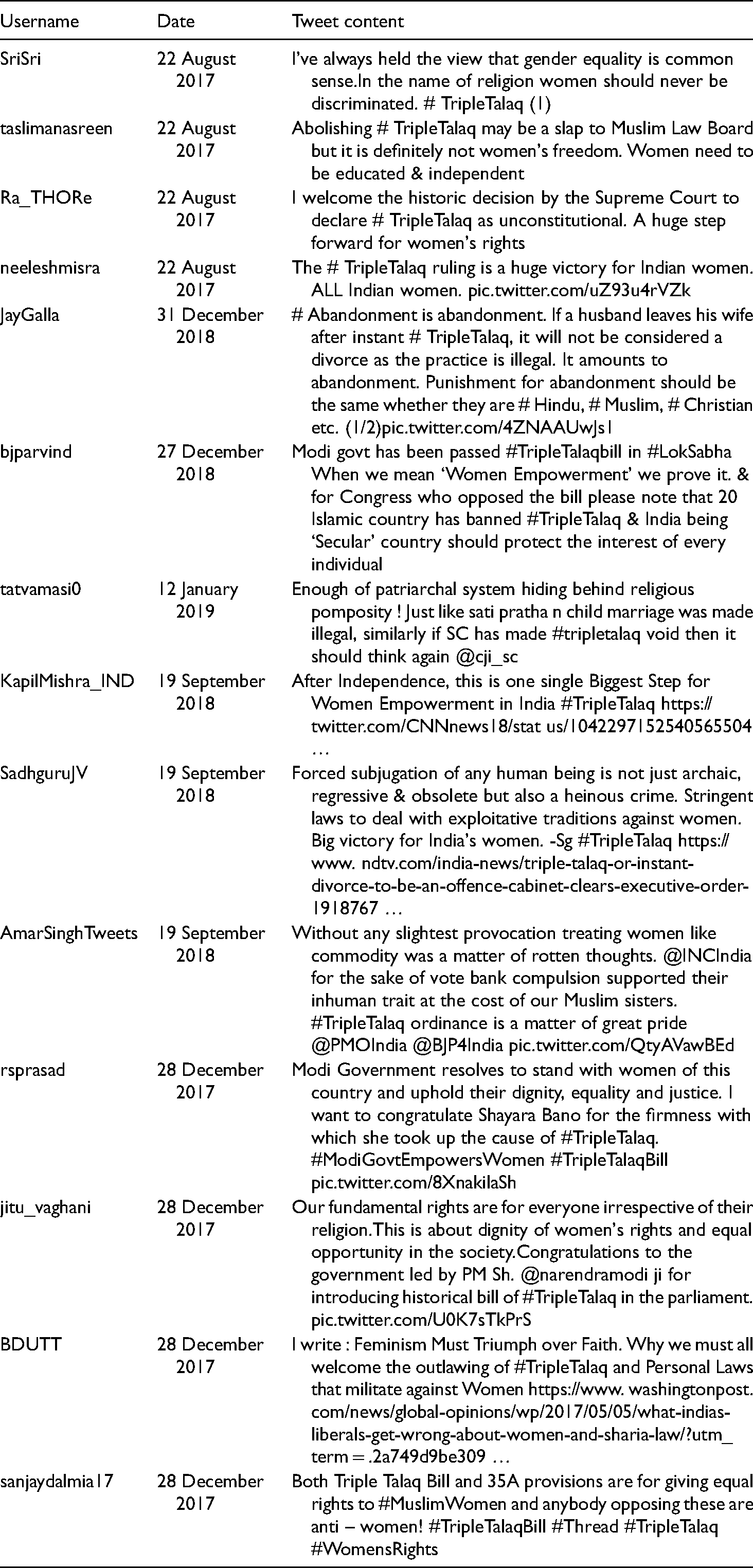
Tweets supporting the Supreme Court verdict that deemed instant triple talaq unconstitutional.
Tweets about rights and sentiments of religious minorities in the instant triple talaq case.
Our timeline for Sabarimala begins with the reservation of verdict by the Supreme Court on 1 August 2018. Tweets suggest an almost unanimous opposition to women's entry into the temple shrine on 1 August 2018. A large subset of the tweets from 1 August were, however, mere updates about the proceedings in the Supreme Court on the Sabarimala verdict. After the verdict was reserved, the ban on temple entry for women was lifted on 28 September 2018. After the verdict, we observed a division in support for women's entry and a large number of tweets criticising women who voiced their demand for temple entry. Tweets also claimed that ‘true women devotees of Lord Ayyappa would never contradict timeless customs and traditions of the temple and hence, would not enter the temple before 50 years of age’. We observed tweets opposing Muslim petitioners for demanding equality in the entry to a Hindu temple, and a few liberal feminist tweets criticising the ‘woman judge’ for opposing women's entry into Sabarimala (Abrahamand Singh, 2019). Supplemental Tables 3 and 4 show the transition from support for the verdict to divided support for women's entry into the Sabarimala shrine. We claim that the dominant discourse at this stage was ‘in support of rights and sentiments of religious communities’ while an equal number of tweets maintained ‘support for women's empowerment’, the other dominant discourse identified. We present Table 5 to support this. However, when the first women entered the shrine on 2 January 2019, support of ‘rights and sentiments of religious communities’ emerged as the single dominant discourse. We claim that devotees of Sabarimala placed higher value on the rights of the presiding temple deity, Lord Ayyappa, and opposed the entry of women into the temple as women's empowerment. This is seen in the tweets shown in Table 6. We present graphs in Figures 15–17, to depict higher peaks indicating user engagement contributing to the emergence of dominant discourses on DoS. It is important to note that in the Sabarimala case, women's empowerment is considered equivalent to the support for entry for women into the temple shrine.
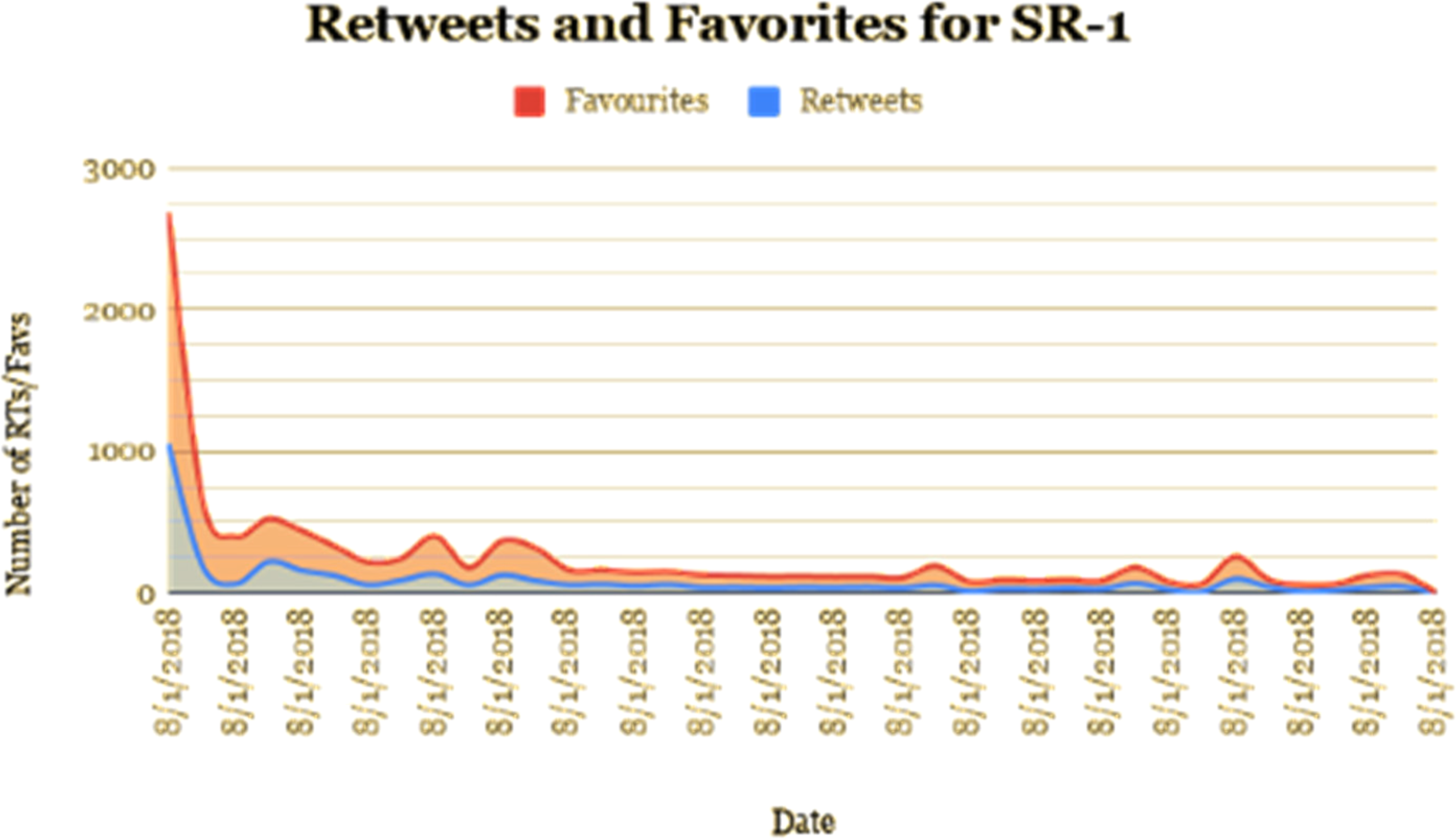
Retweets and favourites peaks for the Sabarimala case.
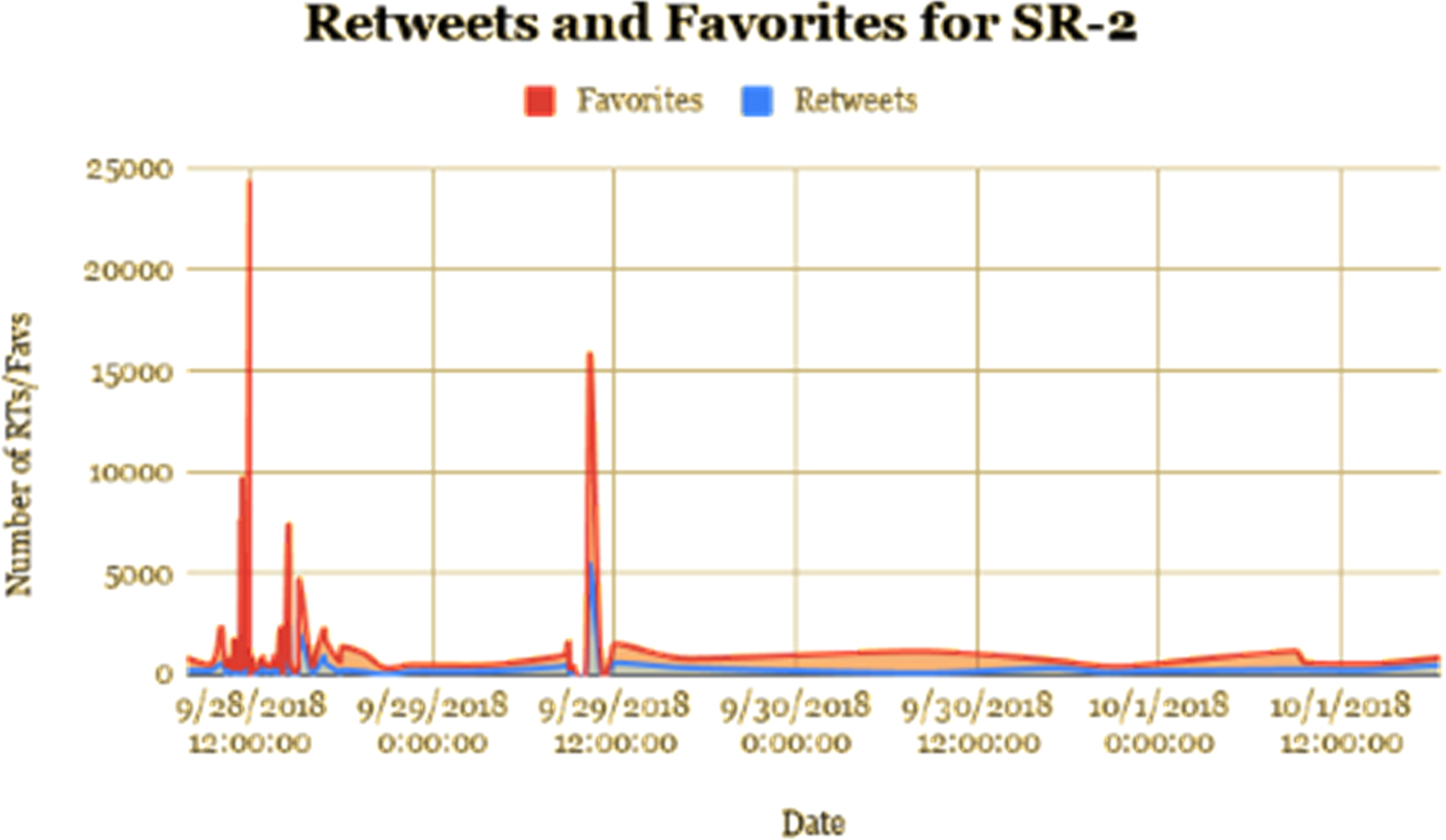
Retweets and favourites peaks for the Sabarimala case.
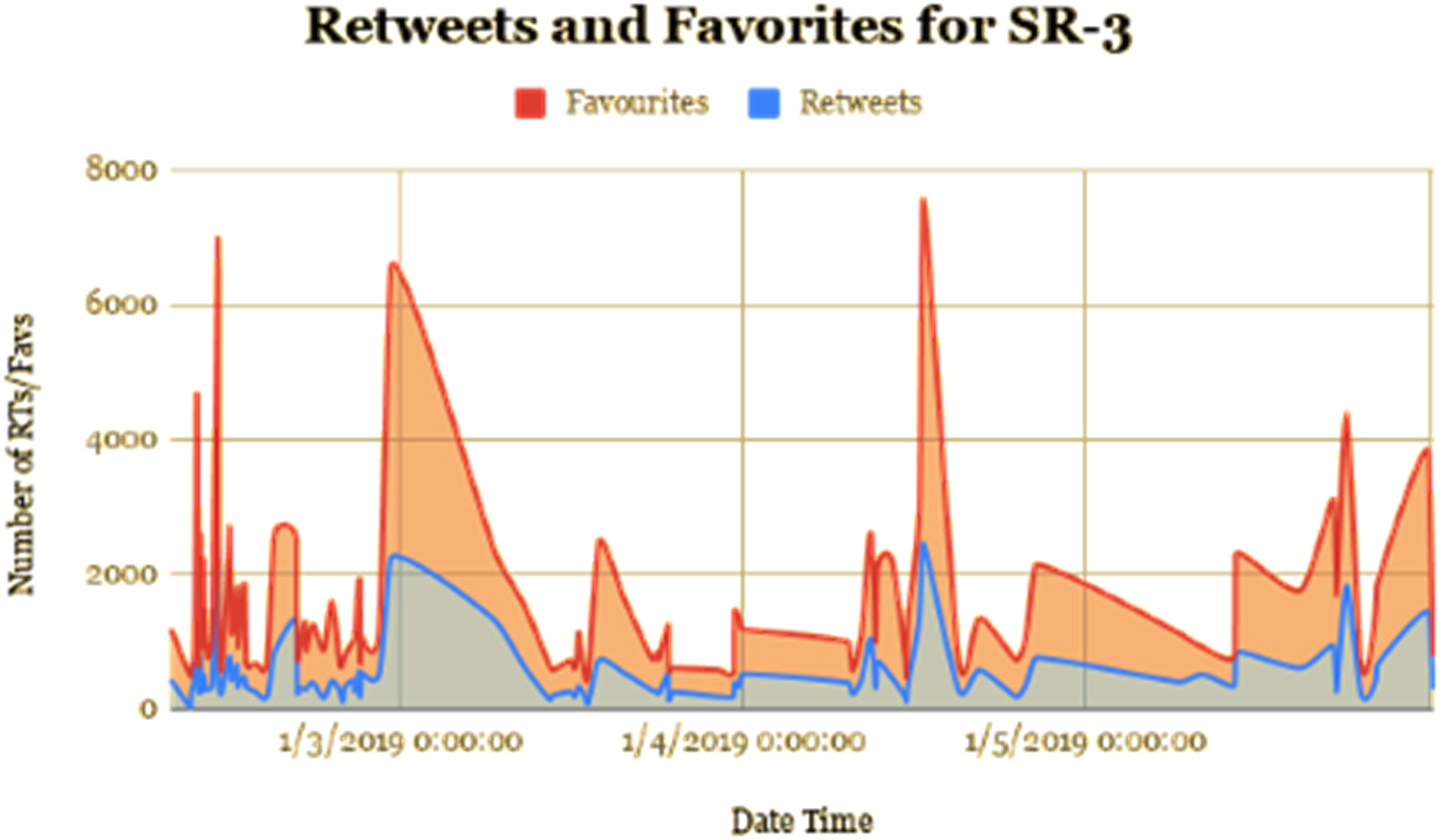
Retweets and favourites peaks for the Sabarimala case.
Tweets on women's empowerment in the Sabarimala temple case.
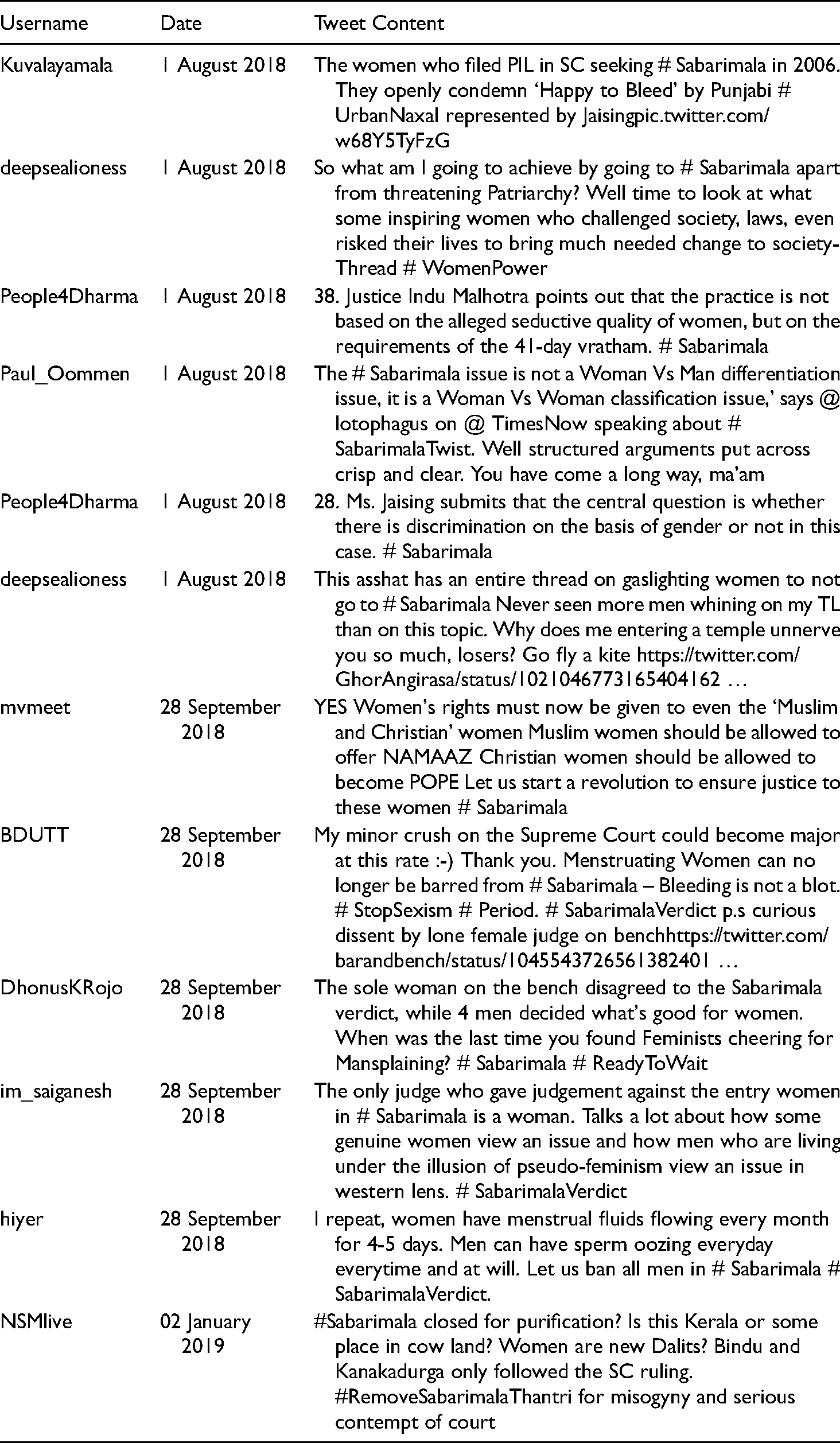
Tweets on rights and sentiments of religious communities in the Sabarimala temple case.
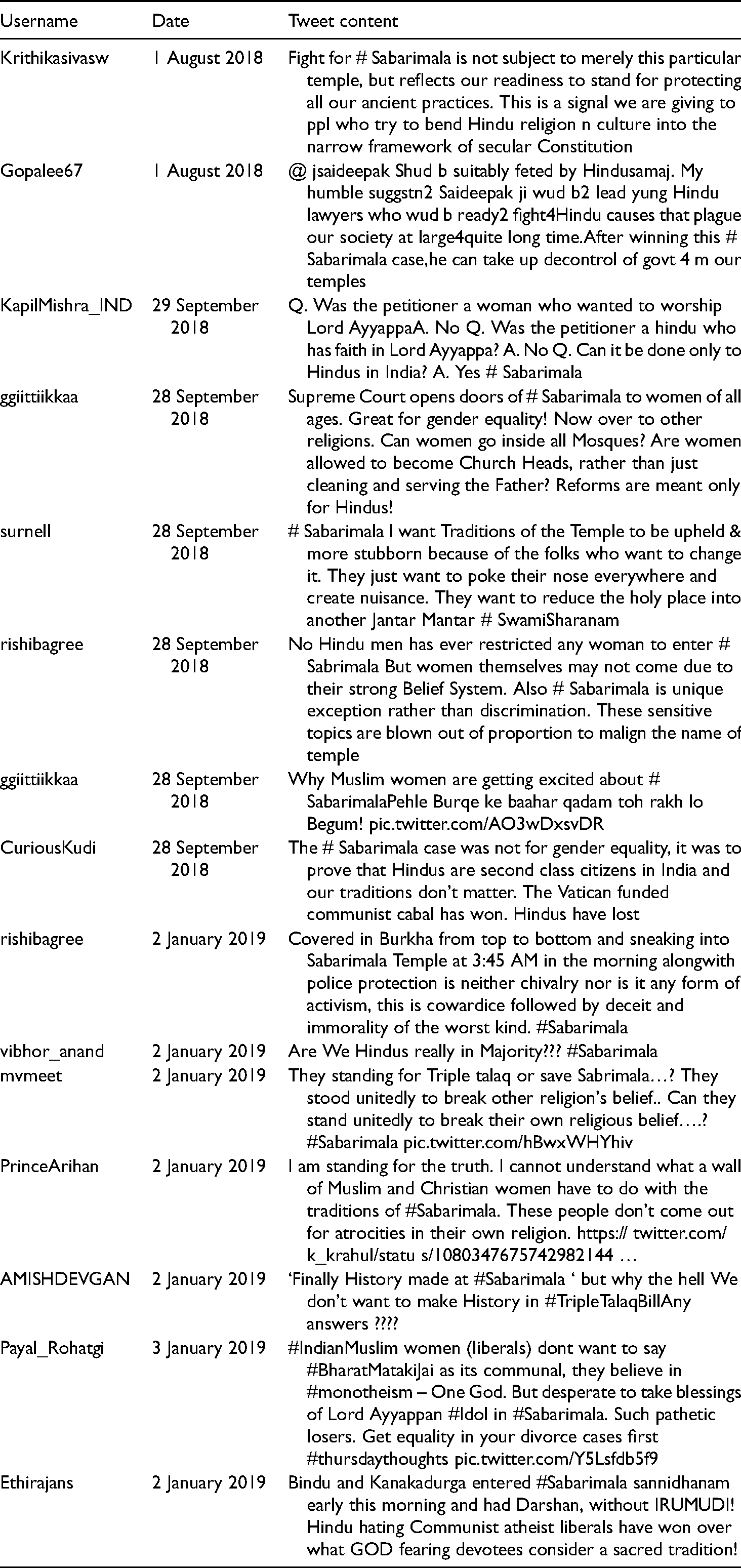
Discussion
Recently, women in India have sought more than ever before their visibility in public spaces and the agency to express their political opinions freely (Bedi, 2006). To avail the agency to speak of and about socio-political incidents in India, women have sought to hold positions of power in the government and journalistic careers. Besides these traditional positions of power, women have demanded visibility and voice on social media. Their endeavours have seemingly disrupted traditional gender roles and removed them from merely taking care of home and hearth. By opposing the instant triple talaq case, women have demanded liberation from oppressive divorce practices sanctioned by religious beliefs. Through struggles for gender equality in the Sabarimala case, women have demanded liberation from oppressive traditions in opposition to the ‘right to pray’ and the ‘right to public places of worship’.
We introduce and propose the phrase ‘controlled empowerment of women’ as a concept explaining the implications of struggles of women demanding social empowerment, especially challenging a conservative right-wing socio-political setup. Controlled empowerment alludes to the idea that right-wing leaders manipulate a seemingly pro-women stance surreptitiously serving the demands of a rightist, socially conservative agenda; the term also aids in situating the threat posed by women demanding freedom and emancipation from conservative religious hierarchies appropriating a socio-political incident or discourse on social media. In our study, the two conservative hierarchies are as follows:
Oppression imposed by the practice of instant triple talaq against Muslim women. The Hindu men were portrayed as ‘heroes’ who were rescuing Muslim women from the shackles of a regressive divorce practice of their own religion. Denial of equality imposed by the ban on women's entry into the Sabarimala temple. The Hindu men were seen as ‘tradition-obeying true devotees’ who were protesting against the entry of women in Sabarimala in an effort to protect Lord Ayyappa's privacy. Women demanding entry into the temple were portrayed as disrespectful of the traditions of the Sabarimala temple who were not true devotees of Lord Ayyappa. Moreover, Hindu women who participated in the #ReadyToWait movement were seen as true devotees by Hindu men and anti-feminists by women who were coming to the Sabarimala debate to lead a fight for a feminist/women's empowerment cause.
We argue that ‘Hindutva feminism’ as an ideology and practice of feminism stemming from right-wing beliefs in India leads to the controlled empowerment of women. Hindutva feminism situates the empowerment of women within the definition of Hindu culture, religious symbols, traditions and rituals (Turner, 2012). However, Hindutva feminists view their position as lower in the hierarchy to that of the nation and Hindutva men (Narula, 2018). By placing themselves lower in the social hierarchy, Hindutva women assign unconditional importance to traditions and culture and give up the task of women's emancipation in ‘the hands of Hindutva men’, thus participating in controlled empowerment. We call Hindutva women right-wing feminists, and their specific struggles and paths for greater visibility and participation in public spaces an example of right-wing feminism (Bedi, 2006). The efforts to empower women using right-wing grassroots organisations has earned the right-wing feminists criticism for their appropriation of Hindu religion in the demand for women's empowerment, most commonly from the left and liberal feminists (Turner, 2012; Narula, 2018). By explaining the discursive transitions observed in our data set, we show how the controlled empowerment of women plays out online on social media platforms, especially through the use of Twitter functionalities like hashtags.
Feminist theory
We have suggested that the instant triple talaq case and the Sabarimala case are both distinct examples of movement for women's empowerment in India. Our study of dominant discourses on Twitter suggests that transitions from ‘support of women's empowerment’ to ‘support of rights and sentiments of religious communities’ can be read as a contention between feminists from liberal feminism and right-wing feminism (Turner, 2012; Niranjana, 2015).
According to Sagarika Ghose (2019), a liberal feminist, questions must be raised about the validity of traditions and rituals that seem oppressive towards women. In India, liberal feminists criticise the traditional roles of women – homemaker and child bearer, and particularly participating in rituals that place a demand to ‘fast for the husband's good health’ – and relate them as oppressive tools to control women’s everyday life. As Ghose (2019) states, liberal feminists are portrayed as being against Hindu practices and customs when they question the ‘oppression’ and ‘silencing’ that come by practising them. In our study, tweets claimed that the Sabarimala case was a demand by liberal feminists against sex discrimination in the religious laws of the temple.
Right-wing feminists, on the other hand, are women who have empowered themselves albeit within conservative traditional settings (Vijayan, 2012). Many women, trained in self-defence, proved their mettle by participating in the Hindutva project for a unified India through public protests and aggressive stances on social media (Turner, 2012). In our study, we interpret that the participation of right-wing feminists in the #ReadyToWait hashtag on Twitter in the Sabarimala case is seen as support for the ban on women's entry and for not forsaking tradition in return for gender equality.
The instant triple talaq verdict by the Supreme Court (declaring the practice as unconstitutional) was welcomed and celebrated by the Bharatiya Muslim Mahila Andolan (BMMA) – an influential activist group spearheaded by two women, Zakia Soman (Assainar, 2018) and Dr Noorjehan Safia Niaz (Niaz and Soman, 2018; PTI, 2018a). Apart from Sharaya Bano (a 2015 case), there were four other Muslim women who also petitioned against the injustices of instant triple talaq – Ishrat Jahan, Gulshan Parveen, Aafreen Rehman and Atiya Sabri (Sethi, 2017). Altogether, these six petitions all welcomed the Supreme Court decision to declare this practice unconstitutional. However, the very influential All India Muslim Personal Law Board (AIMPLB), and especially its women's section, protested the central government's contentious Muslim Women Bill (when it was introduced in the Lower House in 2018). Led by Asma Zahra (head of the women's wing of AIMPLB), the board protested the criminalisation of triple talaq as proposed by the Bill (Assainar, 2018; Soman, 2019; Soman and Niaz, 2018). This contention between two grassroots Muslim women's organisations is a disconcerting example of Muslim women's lack of agency in speaking up about their domestic and public space presence.
In addition to liberal feminists like Sagarika Ghose, we look at Zakia Soman and Dr Noorjehan Safia Niaz, who founded the BMMA to voice and fight for equal rights for Muslim women. Mariya Salim, a journalist at Aljazeera, quotes the BMMA: Instead, we call for the progressive interpretation of Islam, using ‘ijtihad’ (the exertion of a Muslim jurist to deduce legal rulings from Islam's sacred texts) and working within a framework which the Muslim community accepts […] We have to fight for women's rights, both within and outside the family. What we see as the only solution to the present predicament is the codification of Muslim Personal Law (MPL) and we have already prepared a draft for debate and discussion […] The draft calls for the fixing of a minimum age of marriage for boys at 21 and girls at 18, and strictly prohibits polygamy, nikah halala and triple talaq while also addressing issues such as dowry and maintenance. (Salim, 2016)
These women and their approach to feminism may be regarded as a part of the Islamic Feminist Movement (Vatuk, 2008) – a movement dedicated to securing women's rights by appealing to the authority of the Qur’an, rather than the Indian Constitution or any secular liberal feminist frameworks (Vatuk, 2008). The claims of these grassroots organisations echo our findings in the instant triple talaq case – support for the Supreme Court's verdict on the practice and divided support for the Muslim Women Bill as passed by Central Government.
We argue that the contention between liberal and right-wing feminists imposes controlled empowerment on women. In both case studies, we show how the transition of dominant discourses on Twitter leads to divided support for women's empowerment. This divided support, within feminists, emerges from a difference in how empowerment is viewed by liberal feminists and right-wing feminists. With disagreements between the two types of feminists, ‘in support of women's empowerment’ as the dominant discourse in both cases gets suppressed in favour of ‘in support of rights and sentiments of religious communities’. This, in our view, is controlled empowerment of women. In this study, tweets suggest that liberal feminists support both the Supreme Court verdict declaring instant triple talaq as unconstitutional and the Muslim Women Bill criminalising the talaq practice. Similarly, liberal feminist tweets on the Sabarimala case also supported women's entry into the temple on grounds of gender equality. However, liberal feminists tweeted strongly opposing the #ReadyToWait movement, and claimed that right-wing feminists did not understand the true meaning of equality and empowerment.
On the other hand, right-wing feminists supported the verdict in the Muslim women bill in the instant triple talaq case, claiming that oppressive religious practices needed legal intervention. Tweets also suggest a strong opposition from right-wing feminists to women's entry into Sabarimala temple, thereby discarding the lens of empowerment which fuelled the earlier tweeting behaviour in support of legal intervention in the triple talaq and Muslim Women Bill. For right-wing feminists, the Sabarimala issue was a threat to the integrity of Hindu traditions and religion, and not in the least pertaining to gender equality. Because of the perceived threat to Hindu traditions and rituals, right-wing feminist tweets supported the #ReadyToWait movement, simultaneously decrying liberal feminists for betraying/destroying their cultural and traditional roots. Tweets have shown the contention between the two feminist groups. The Twitter platform facilitates and offers agency to both feminist groups to flourish and garner support on the platform. This agency is crucial to expanding narratives about feminism, with support for either liberal or right-wing feminism. However, the contention between liberal and right-wing feminism must be closely studied and we must strive to amplify the voices of pro-women's empowerment Twitter users.
Lastly, Muslim women's participation – especially in politics – has arguably been fraught with communal and social tensions. Despite an increasing visibility of women across religious and caste divides in India's public sphere, Muslim women face seemingly significant interceptions to any form of public presence and interventions particularly supporting enhancements to their socio-economic status. Muslim women have traditionally been amongst India's most marginalised groups, receiving few educational and socio-economic opportunities (About Half of Muslim, Hindu Women Illiterate, 2016; Finnigan, 2019). In contrast to the more dominant presence of savarna women in Indian politics, Muslim women therefore arguably face the double indemnity of occupying a depressed socio-economic status as a citizen of India and in their own Muslim community. We hope that by amplifying their standpoints on social media in our chosen case studies, we can draw attention to the voices of both, the right-wing and Muslim feminists alongside liberal feminists. Consequently, we hope we draw attention to how these diverse voices of feminism get suppressed.
Implications for Feminist HCI
We now answer our third research question: How does the rhetoric on women's empowerment issues that plays out on Twitter contribute to expanding current contributions in Feminist HCI? Feminist HCI researchers have typically studied digital interaction between users on social networking sites and its impact on social relationships and understandings of power relations and socio-political hierarchies (Bardzell, 2010). Within this scholarship, Feminist Standpoint Theory is a useful framework to understand dominant empowerment discourses of women and their intersection with Hindutva right-wing feminism as they played out on platforms such as Twitter. Feminist Standpoint Theory emphasises the need to engage actively with voices of minority social groups and treat their point of view as an important contribution to the discourse (Bardzell and Bardzell, 2011). The use of Feminist Standpoint Theory is an important addition to Feminist HCI studies, bringing multiple points of view to foreground analysis (Bardzell and Bardzell, 2011). As we engage with our three dominant discourses, we show that public opinion about Hindutva leaders can be traced through transitions between three dominant discourses. By reflecting on the dominant discourses, the tweets provide insights into the complex relationships between liberal and right-wing feminism, political leadership of the BJP and Hindutva right-wing ideology. Such complexity leads to contradictions in rhetoric on case studies foregrounding women's empowerment. As a result, the cases of instant triple talaq and the Sabarimala temple alluded to divided support for women's empowerment. The support for religious traditions was manipulated and inserted into the discourse on feminism, exposing the working of the ‘controlled empowerment’ of women.
For instance, tweets that supported the entry of women to the shrine of the Sabarimala temple were severely countered by tweets that claimed destruction to the Hindu religion and timeless traditions of the temple. Tweets that opposed the entry of women congratulated them for being true devotees of the lord and for opposing the lifting of the ban and criticised liberal feminists for demanding entry into the temple. We suggest that our analysis aimed to enforce the belief that women's empowerment lies within the scope of religion and traditional values of right-wing Hindutva ideology.
The dominant discourses of the instant triple talaq case, however, are concerned with freeing Muslim women from the shackles of ‘regressive and barbaric’ practices preached by Islam, where Hindu men are the harbingers of freedom and empowerment. On the contrary, the concern in the Sabarimala case is to protect the rituals and traditions of the Sabarimala temple and the sentiments of Hindu devotees, rather than buttressing women's right to equality of worship. Feminist Standpoint Theory therefore suggests that when the right-wing government was involved in legislating over the Muslim divorce practice of instant triple talaq, the support for women's empowerment was contradicted, divided and controlled by expressing the issue as oppressive to Muslims rather than as empowering women. By extension, we can say that controlled empowerment was exercised by amplifying ‘in support of rights and sentiments of religious communities’ as the dominant discourse. This amplification was possible because the users engaged with features of Twitter such as favouriting, retweeting, and hashtags. Twitter facilitates agency to feminist groups in both case studies to garner support on the platform. This agency is crucial to expanding narratives about feminism. However, the contention between liberal and right-wing feminism must be closely studied, and we must strive to amplify the voices of pro-women's empowerment Twitter users. In the hope to amplify feminist standpoints on social media in cases such as instant triple talaq and the Sabarimala temple, we not only apply a new conceptual thinking in the ‘controlled empowerment of women’ but illuminate the workings of an anti-women stance of the right wing to suppress the voices of liberal feminism. We also show efforts to highlight implications of a platform like Twitter for women's empowerment discourses in the hope to study future movements and discourses similar in nature.
Conclusion
The article attempts to explain the relationship between political communications of the right-wing supporters in India as a contribution to women's empowerment discourses in the country. We use a combination of two qualitative research methodologies: TA and FRDA. We investigate two case studies – the instant triple talaq case and the Sabarimala temple case – to find three dominant discourses emerging as a result of our study.
These dominant discourses are central to narratives on women's empowerment related to the two case studies, bearing important implications for political communication studies. Besides implications for political communication, dominant discourses also inform our understanding of the effectiveness of Twitter functionalities such as favourites and tweeting behaviour, to amplify and suppress narratives supporting women's empowerment. For example, Twitter activity re-enforcing gender stereotypes compromises the agency of women demanding empowerment and alters perceptions about incidents related to gender empowerment in India. This study is a confluence of insights from multiple domains of study – political communications, right-wing politics, feminism and social media analysis. We set up a socio-political context for understanding two case studies – the instant triple talaq and the Sabarimala temple cases – as social media phenomena. The study is guided by the principles of Feminist HCI methodological principles (Bardzell and Bardzell, 2011) and our overarching discourses employed TA and FRDA to propose the idea of the controlled empowerment of women. Through the concept, we establish the implications of our study on political communications, on the practice of right-wing feminism in India and on Feminist Theory as a domain of study. We hope future work will focus on and propel the central ideas in our study on the unfolding of controlled empowerment via online and media discourses. We hope that our work is a step towards inclusion of diverse opinions surrounding women's constitutional rights and ensuing empowerment in the annals of mainstream Twitter narratives.
Footnotes

References
Supplementary Material
Please find the following supplemental material available below.
For Open Access articles published under a Creative Commons License, all supplemental material carries the same license as the article it is associated with.
For non-Open Access articles published, all supplemental material carries a non-exclusive license, and permission requests for re-use of supplemental material or any part of supplemental material shall be sent directly to the copyright owner as specified in the copyright notice associated with the article.
