




Abstract
Composite materials have significantly stood out in the aerospace sector despite the industry's rigorous demands and high standards, owing to their outstanding mechanical, thermal, low-density, and corrosion resistant properties. This has positioned them as robust competitors against conventional materials like aluminum alloys. This article provides a comprehensive review of recent advancements in the development of composite materials for aerospace applications, emphasizing innovative elements such as hybrid composite materials, the integration of advanced functionalities like self-healing and structural adaptation, and the adoption of additive manufacturing technologies. In particular, the document explores the potential of composite materials in aircraft and satellites, highlighting their multifunctionality, including structural adaptability and self-healing capabilities. The detailed analysis of these applications is underscored, emphasizing how these materials can offer innovative solutions to the specific challenges within the aerospace industry. Finally, the article underlines the potential for additive manufacturing technologies to streamline the production of complex geometries and enable serial customization of aerospace components. Specifically, advances in 3D printing of lattice structures are discussed, emphasizing their outstanding mechanical properties and relevance for critical applications in the aerospace domain.
This is a visual representation of the abstract.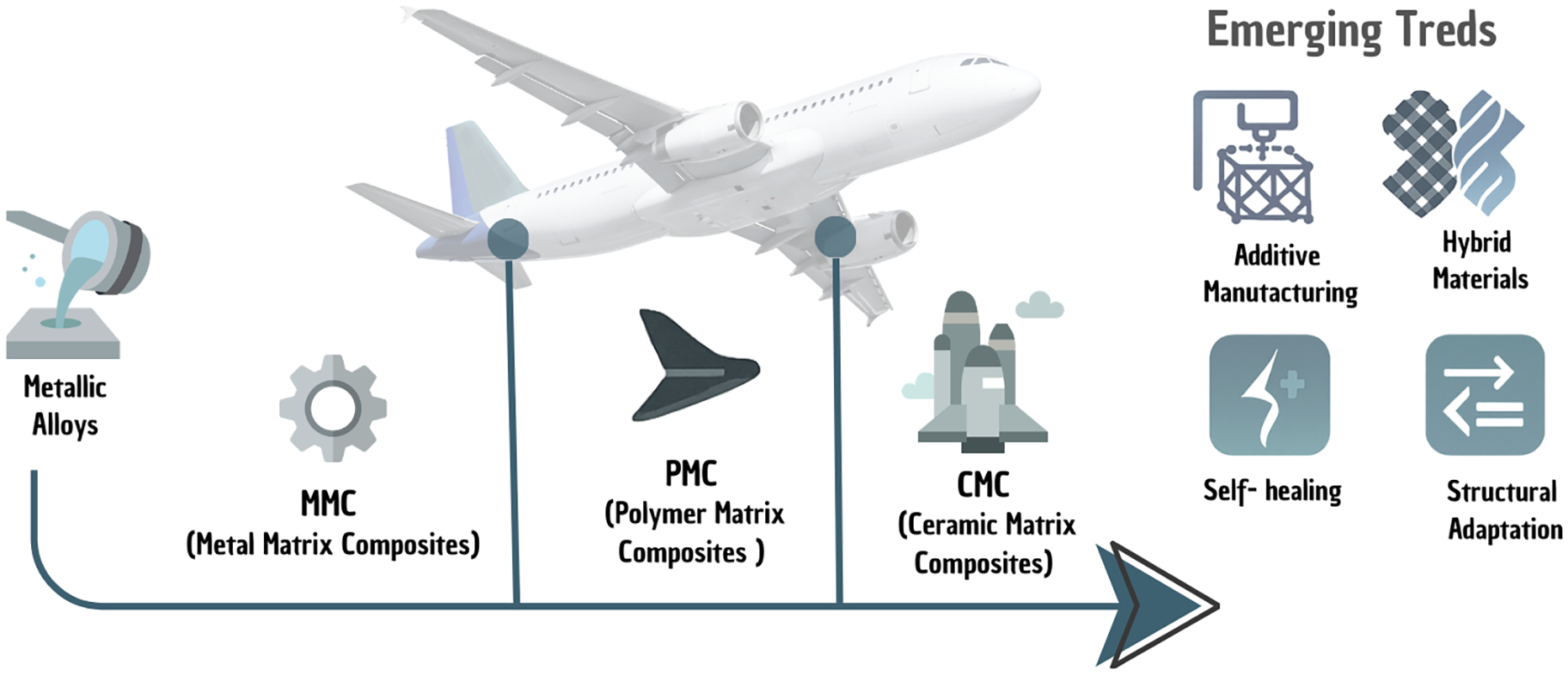
Get full access to this article
View all access options for this article.
References
Supplementary Material
Please find the following supplemental material available below.
For Open Access articles published under a Creative Commons License, all supplemental material carries the same license as the article it is associated with.
For non-Open Access articles published, all supplemental material carries a non-exclusive license, and permission requests for re-use of supplemental material or any part of supplemental material shall be sent directly to the copyright owner as specified in the copyright notice associated with the article.
