



Abstract
The development of advanced surface coatings is essential for various engineering applications. These coatings must address surface properties while meeting competing demands for enhanced efficiency in biomedical, aviation, semiconductors, automobiles, marine, pipes of oil and gas, and electronics. However, because opposing features must be present in the same coating simultaneously, surface coatings on a wide variety of constituents have proven to be a challenging problem for researchers. Functionally graded coatings (FGCs) have been increasingly popular in recent years to protect surfaces by attaining particular qualities in various locations that are appropriate for varying operating situations. One effective and adaptable method for improving the properties of the base material—mainly its functionality and longevity—is the precise placement of FGCs on its surface, exhibiting a gradient behaviour that refers to the continuous and gradual transition in composition, microstructure, or properties (e.g., mechanical, thermal, or corrosion resistance) across the thickness of the coating, enabling a smooth variation in performance attributes without abrupt interfaces. To create FGCs considering the process at the time of applying the coating, this review paper provides a thorough study of the widely utilised physical vapour deposition technologies. Additionally, a thorough examination of the generated FGCs’ microstructure characteristics, mechanical attributes, wear resistance, and corrosion behaviour has been conducted. Additionally, understanding FGC's applications is the main focus of the current review study. The findings will serve as a resource for designing advanced coatings that improve the performance and lifespan of critical components across multiple high-tech industries.
Graphical Abstract
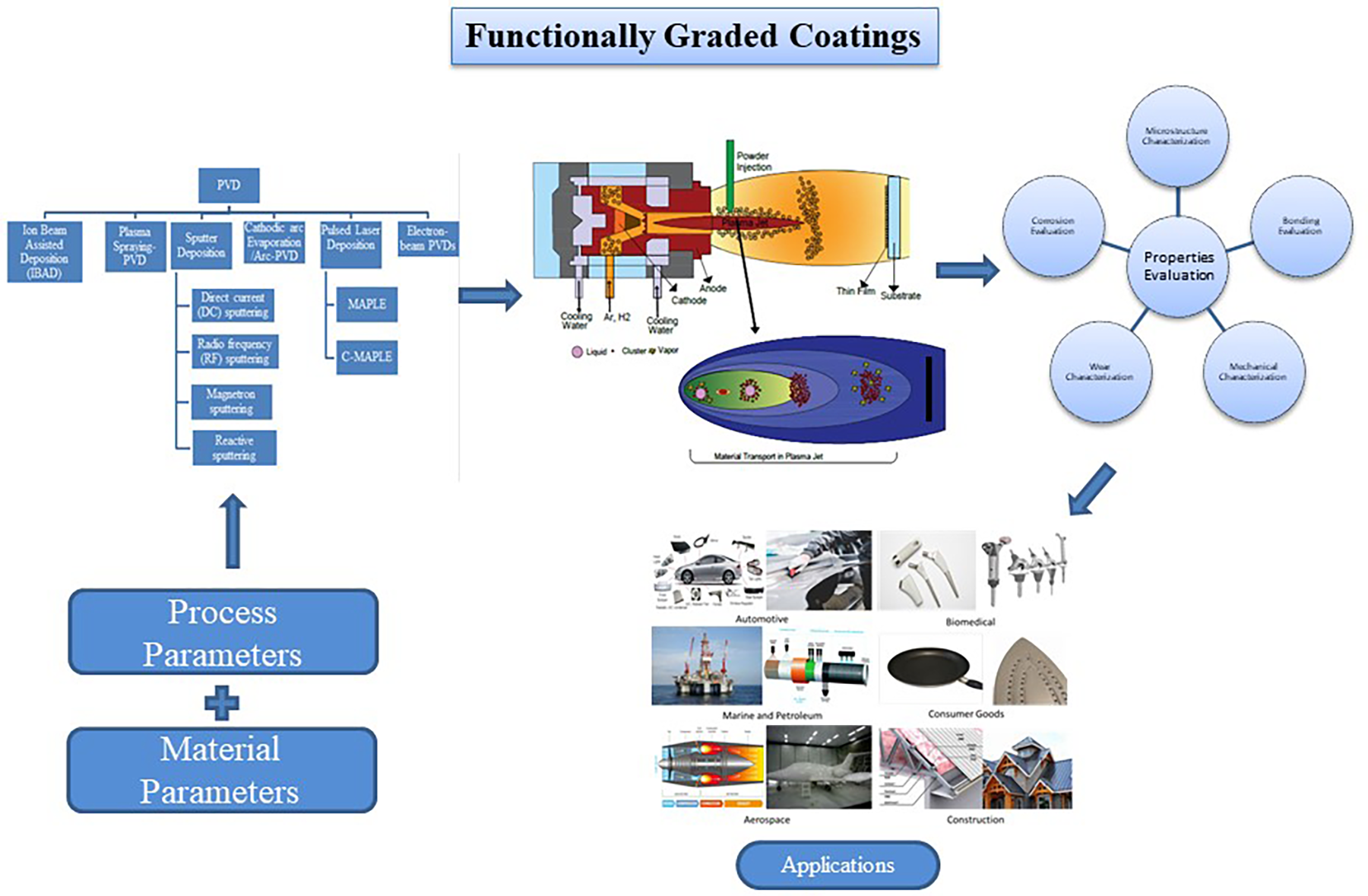 .
.
Keywords
Get full access to this article
View all access options for this article.