



Abstract
Soft smart materials have useful properties for addressing everyday problems affecting human health and well-being, having a positive societal impact. For instance, these materials can serve as sensors for breath monitoring or as soft actuators to stimulate muscles impaired by injury or illness. A notable example of their versatility lies in piezoelectric materials, which can function both as passive elements (utilising the direct piezoelectric effect) and as active elements (employing the converse piezoelectric effect). This dual functionality showcases the broad potential of smart materials in various applications. The present study is an in silico simulation of a wearable piezoelectric material (polyvinylidene fluoride - PVDF), using finite element analysis (FEA) to evaluate the effectiveness of the touch sensation provided by the haptic device on human skin, using different actuators geometries and voltage input intensities. Moreover, the main active element, a PVDF-based soft actuator, was fully characterised in terms of the piezoelectric matrix, using an inverse finite element approach. In conclusion, the findings point to promising results when using this haptic technology for re-educational therapies.
This is a visual representation of the abstract.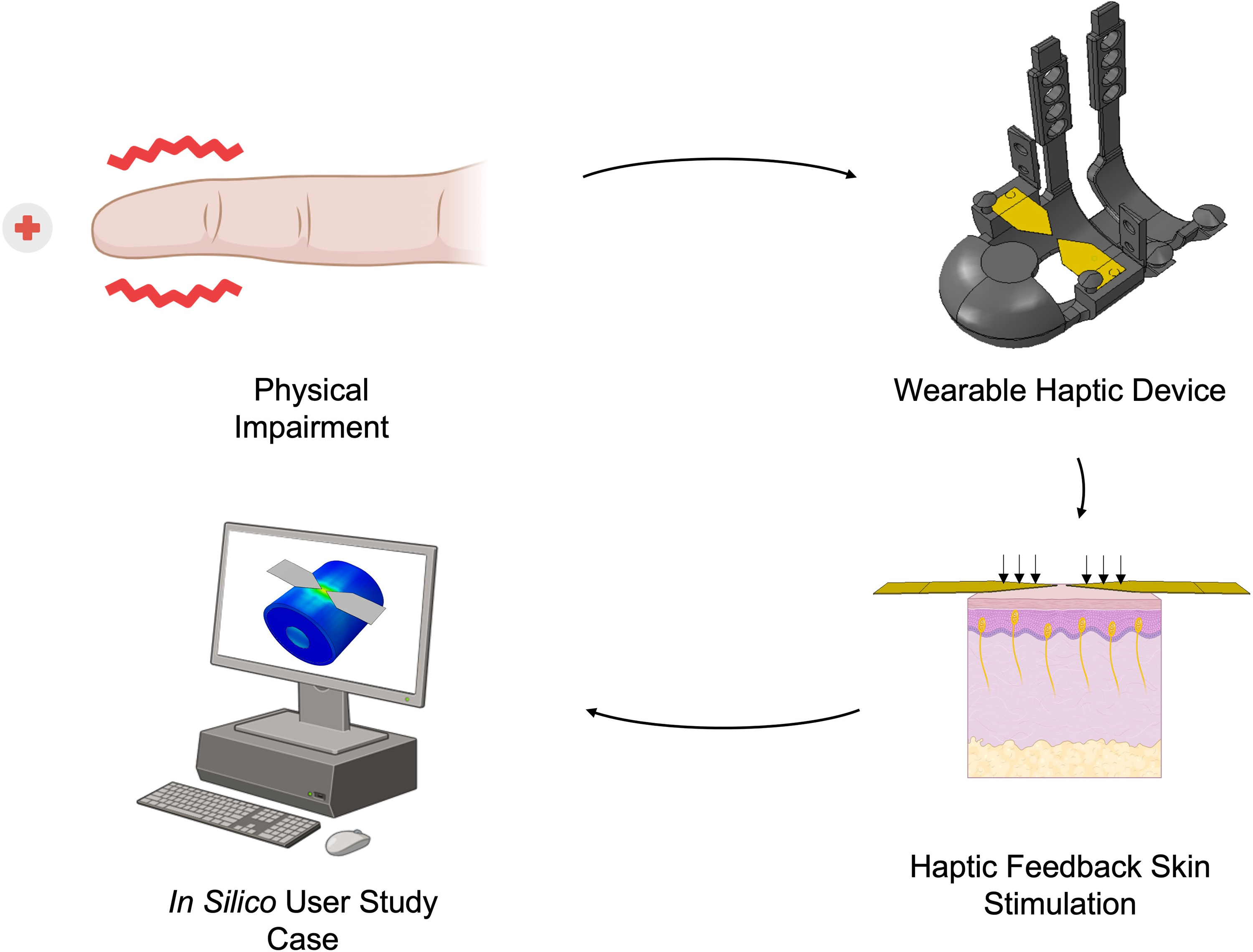
Get full access to this article
View all access options for this article.