



Abstract
This paper explores how outdoor museum environments, particularly those grounded in living relationships with Country, can act as co-educators in children's learning and development. Drawing on qualitative data from family focus groups at the University of Wollongong, located on Saltwater Wadi Wadi Country, the research examines how elements such as water, trees, birds, mist, and open space shape children's embodied, emotional, and relational experiences. Framed through Indigenous and Country-centred pedagogies, the study positions Country as an intelligent and communicative presence that teaches through sensory invitation, movement, and more-than-human relationships. Findings reveal that children's interactions with natural elements foster joy, reciprocity, and attunement—qualities that underpin relational learning and wellbeing. Parents described experiences of freedom, calmness, social connection, and sensory immersion, suggesting that outdoor museum environments can be analysed as relational spaces where pedagogical exchanges occur between children, families, and Country. The Early Start Discovery Space emerges not only as a museum but as a living site of mutual teaching and learning between children, families, and Country. This research contributes to early childhood education by offering a theoretical framework to interpret how learning with Country-centred pedagogies opens possibilities for reciprocal and ethical relationships with more-than-human kin. By weaving Indigenous frameworks of kinship, care, and relational ethics with posthuman and affective perspectives on play, the paper advances understandings of how informal learning in museum spaces can nurture ecological and spiritual capabilities in children. Through the voices of families and nonhuman beings the study demonstrates how Country continues to teach, inviting more relational and decolonising futures in early childhood education.
Keywords
Introduction
I Am Water, I Sing
I am water
breath of morning mist's call,
soft veil born through waterfall
where children are held and born.
I carry the memory of rock and sky,
of tears and tides,
of Ancestors who once drank from me
and sang their way through Country.
I sing to children
not in words, but in ripples,
in feeling, in rhythm,
when a bird calls back.
I am the first touch on skin,
the shimmer in sunlight,
the song that fills your body
and invites you to ripple.
I teach with flow.
I teach with stillness.
and the way you feel when you are submerged in me,
free and connected.
To each child, I whisper:
You are safe here.
because you feel it
in your bones,
in your breath,
in your becoming.
Poem by Crystal Arnold
This paper begins with a poem spoken in the voice of water to centre Country as Educator and to invite you, reader, to listen. Water does not speak in words, but in ripples, mist, rhythm, and touch. Through this poetic framing, the paper calls for a reorientation to how we understand children, learning, and place. It positions children not as passive recipients of knowledge, but as relational beings and teachers, deeply attuned to the languages of Country. Transcending the notion of a geographic site, we define Country as a sentient and sovereign entity: a shimmering web of land, water, sky, and ancestral spirit. We look to Country as an intelligent educator, offering sensory invitations that call children into a practice of relational ethics and deep listening (Karulkiyalu Country et al., 2021). Within this sentient landscape, children move with a curiosity and ancient intelligence that mirrors the water itself, physically and spiritually responding to these more-than-human invitations as they unfold (Smyth, 2024).
This research proceeds from the theoretical premise that learning extends beyond formal curricula, occurring instead through relational and reciprocal processes with the more-than-human environment. Content then, is a living, reciprocal process grounded in kinship with birds, trees, stones, and wind. Beginning with the poetry of Country, the paper flows into an exploration of outdoor museum spaces as experienced by children and as reported by their families, shaped by and shaping relationships with and connection to Country.
Crystal contributes to this paper as a Gundungurra woman, researcher, educator, and mother. Her ways of knowing and being are shaped by the teachings of her Ancestors, by Yuin Elders who have guided her learning, and by ongoing relationships with Country, especially the water, birds, mist, and trees who teach her every day. She sees children as wise and relational beings, already in deep conversation with the world around them. Her work emerges from Indigenous frameworks that respect Country as educator, kin, and spirit. Crystal carries responsibilities to care for Country, to listen deeply, and to walk gently with all living beings. In her academic role, she walks between cultural and institutional knowledge systems. She is constantly navigating the tensions of speaking from within a university system while staying true to the knowledges and protocols gifted to her by community and Country. This research is not separate from who she is; it is part of her responsibility to make space for the voices of families, children, and the more-than-human beings who are too often overlooked in educational discourse. She approaches this work with humility, reciprocity, and a commitment to restorying how we learn, teach, and relate.
Lisa's contributions to this paper are grounded in her experiences as a woman, researcher, educator, and mother, born on Wiradjuri Country. Her research into play is shaped by a commitment to understanding the ideological and relational dimensions that influence how play unfolds in children's lives. She views play not only as a developmental process but as a dynamic and co-constructed context through which children engage with and make sense of their worlds. This perspective recognises the entanglements of human and more-than-human elements, how play is shaped by the presence of objects, environments, and temporal rhythms, and how children's actions are always situated within broader cultural and ecological assemblages. Lisa's work is enriched by Aboriginal cultural mentoring from Crystal, which deepens her understanding of Country as a living presence and teacher. Through this collaboration, Lisa seeks to honour Indigenous ways of knowing and being, and to challenge dominant narratives in educational research by foregrounding relationality, respect, and the voices of children and communities.
The paper does not seek to provide ‘proof’ of kinship or ‘Country as Educator’ in a clinical sense. Instead, it offers a way to read children's everyday interactions, such as balancing on logs or feeling the mist, not just as physical play, but as collaborative, cooperative connections with Country and more-than-human kin. We suggest that while parents describe the experiences their children have with ‘nature’, the ‘Country as Educator’ lens invites us to understand the meaning of that experience as an expression of more-than-human kinship.
More-Than-Human kinship in outdoor spaces
Children's outdoor experiences in museum spaces and other play-based environments are deeply shaped by interactions with space, materials, weather, and more-than-human beings. Outdoor spaces are full of possibilities whereby humans and materials intra-act and play together, whereby children and the outdoors are constitutively entangled in play entanglements (Malone, 2016). For example, in the literature on children's museums, informal learning is most powerful when it supports autonomy, curiosity, and multisensory engagement (Anderson et al., 2002; Chermayeff, 2010; Enseki, 2010; Kervin et al., 2025). Water, loose parts, soundscapes, and textured surfaces become mediators of learning, inviting playful exploration that is both embodied and social. Yet, there is no single agreed definition of play, and in museum contexts it remains under-theorised. Holdgaard and Olesen's (2023) scoping review shows that while play is often invoked by museum professionals, only 35% of studies treat it as a central, empirically defined concept. Their work argues that play should not be seen as an afterthought but as a constitutive way of knowing and engaging. This calls for deeper engagement with the meaning of play in museum pedagogy and highlights that current scholarship is largely western-centric, often disconnected from critical, cultural, and place-based perspectives.
Alongside play, autonomy, and sensory immersion, companionship emerges as a powerful way of understanding children's relationships with both human and more-than-human beings in outdoor environments (Hordyk et al., 2015). Rather than being limited to friendship, companionship describes affective, embodied, and reciprocal bonds that shape how children experience learning and place. We distinguish place here as a situated ‘text’ of the land (Harrison and McConchie, 2012), a site of relational literacy where histories are ‘read’ through attentive presence. This literacy is inherently sensorial; it is through the embodied feelings of comfort and belonging (Bartos, 2013; Hordyk et al., 2015) that children physically entwine their own stories with the enduring text of the land (Harrison and McConchie, 2012).
From an Indigenous perspective, companionship is inseparable from kinship, where water, trees, and birds are recognised as relatives and co-participants in life (Arnold et al., 2021). Smyth (2024) similarly shows how becoming with water through mythic and posthuman frames creates openings to decentre the human and nurture more-than-human reciprocity. Thinking with companionship makes visible how children regard water not only as an object of play but as a partner in joy, how birds become attentive witnesses rather than background sound, and how mist enfolds them as an embracing presence. To assist readers in navigating the intersection of these paradigms, we identify a ‘conceptual stitch’ between Indigenous and posthuman perspectives. While posthumanism decentralises the human to recognise the agency of ‘vibrant matter’ (Bennett, 2010), Indigenous pedagogies center ‘Country’ as a living, sentient relative (Arnold, 2025; Neidjie, 1989). Within this braided framework, nature is understood not as a resource for human utility, but as a ‘relational being’ and more-than-human kin that invites children into reciprocal learning. These paradigms understand the world as composed of active, communicative forces. By ‘weaving’ (Johnson et al., 2016) these frameworks, we move beyond seeing the wind or water as elements of play and instead recognise them as living participants in a pedagogical encounter. This aligns with emerging work on weathering-with pedagogies, which centres children's entanglements with mud, shadows, dust, and more-than-human weather bodies as situated, relational, and ethical practices of care (Rooney et al., 2020). In this sense, companionship demonstrates how children form friendships not only with peers but also with nonhuman beings.
There is growing evidence that place, especially outdoor space with nonhuman beings, shapes children's cognitive, emotional, physical, and social development. Children are reported to demonstrate a preference for play areas rich in natural elements, with loose parts, and in open spaces, which all enable diverse cognitive and social play behaviours (Cetken-Aktas and Sevimli-Celik, 2023). Traditional, fixed equipment may support basic physical and social development, but environments designed with natural affordances further invite imagination, risk-taking, creativity, and social negotiation. Children's voices also reveal that their memories and attachments to place are affective and sensorial (Bartos, 2013). Furthermore, children's sense of place is grounded not in information acquisition, but in feelings of safety, friendship, freedom, and sensory engagement (Kalessopoulou, 2019). Place therefore becomes meaningful when it enables self-discovery, loyalty, and shared imagination. These sensorial and emotional responses to outdoor spaces have cognitive and cultural dimensions. For example, outdoor environments stimulate integrated development across physical, social, and cognitive domains (Kemple et al., 2016). When play happens in natural environments, children are more likely to feel calm, focused, and confident in their bodies. These responses are not incidental; they are foundational to how children experience and make sense of the world.
When viewed through a decolonial lens, outdoor learning takes on deeper ethical and epistemological significance (Lloyd et al., 2018b). Place-based outdoor learning can be utilised as a way to ground learning in local ecologies and communities. This emphasises the importance of children not only learning about place but with place through embodied, multisensory, and socially grounded interactions (Lloyd et al., 2018b). As such, outdoor pedagogy is a form of reading the landscape (Harrison and McConchie, 2012) as learning is situated in complex cultural and ecological histories (Stewart, 2008). Incorporating Indigenous perspectives such as reading the text of the land (Harrison and McConchie, 2012), reminds us that soil, water, and birds are living beings with agency (Larsen and Johnson, 2016). Learning with Country means tuning into these presences as co-educators and kin. Lloyd et al. (2018a) describe this as place-responsive pedagogy, which calls educators to honour the intelligence of Country through attentive presence, rather than extractive learning. However, there is a need for clarity in museum contexts, showing that the concept of play is often idealised or vaguely defined, making it difficult to evaluate its impact (Luke et al. 2021). Play, when supported by thoughtful design and purpose, can disrupt rigid models of pedagogy and offer children space to be joyful, curious, and autonomous (Luke et al., 2021; Nordström, 2022). These bodies of research support the argument that Country is not just a setting for play but a living, teaching presence.
Reading the text of the land: stories, memory, and relational pedagogies
Outdoor learning environments offer children more than physical activity and sensory play; they offer the chance to learn how to read the landscape as text, to engage with Country as living stories, relationships, and responsibilities (Harrison and McConchie, 2012). Environmental education must foreground stories in the landscape, attending to the visible and invisible traces of cultural and ecological change (Stewart, 2008). From scar trees (trees that have had bark removed by Aboriginal people for making tools and cultural items) to middens, from floodplains to fish migration paths, Country holds memory in both human and more-than-human. Yet without cultural guidance, these stories risk being overlooked, overwritten, or forgotten. Importantly, Stewart reminds us that “not paying attention to the history of a place is an exercise of power by omission” (2008: 88). In this sense, children's outdoor education must be more than play; it must be grounded in ethical attentiveness to what is seen, what is hidden, and what has been silenced. Teaching children to “read” the land, then, becomes a pedagogical responsibility. This mirrors teachings from Yuin Senior Elder Uncle Max Dulumunmun Harrison, who taught people to “look, listen and see” (Harrison and McConchie, 2012), a principle that reorients how people relate to and engage with Country. Looking is not just with the eyes, but a way of witnessing signs and messages. Listening invites the quieting of the self to attune to what trees, winds, animals, and rocks may be saying. Seeing is the deeper recognition of stories, of connectedness, of presence and spirit. For children, this offers a framework for learning that is embodied, spiritual, and relational. It nurtures a connection to the messages of the land, not only in what is present, but also in what is absent, altered, or hidden. This literature (Harrison and McConchie, 2012; Stewart, 2008) invites a pedagogy that acknowledges Country's layered histories and active relationships. As such, these texts carry memory, emotion, and sometimes pain. However, the failure to acknowledge such histories contributes to a “cult of forgetfulness,” where settler amnesia reinforces dispossession (Stewart 2008: 87). By encouraging children to notice, question, and care for these traces, educators nurture deep relational literacy. An ability to see Country as a teacher and relative. As Uncle Bill (Bininj Elder Bill Neidjie) taught us, “Earth just like Mother and Father or brother of you. That tree same thing. Your body, my body I suppose, I’m same as you…” (Neidjie, 1989). In this way, Country becomes an epistemological presence in the curriculum. To teach children to read Country is to teach them kinship, responsibility, and relationality.
Methodology
Reflexivity and positionality are central to the methodological approach. Following the teachings of Yuin Elder Uncle Max (Harrison and McConchie, 2012), the children's engagement in an outdoor museum space is analysed as a process of ‘looking’ (witnessing signs), ‘listening’mpa#nbsp;(attuning to the more-than-human), and ‘seeing’ (knowing). These ways of knowing and researching are inseparable from who we are and the responsibilities we carry to Country, Elders, and community. Including our positionality is not a personal aside but a methodological necessity, ensuring that knowledge is produced in ways accountable to relationships, protocols, and cultural ethics (Wilson, 2008; Bawaka Country et al., 2015). In this study, reflexivity operates as a methodological practice: it acknowledges that research is always situated, that Country teaches in particular ways, and that our interpretations are shaped by ongoing relationships of kinship, story, and responsibility.
Research context and methodology
This paper draws data from a larger cohort study involving families who were members of a university-based children's museum. It adopts a qualitative, relational methodology grounded in Indigenous research principles and participatory engagement. Rather than viewing data in isolation, this approach seeks to listen attentively to families’ experiences and interpret them in direct relation to the invitations of Country's more-than-human beings. While primary data collection was conducted through structured focus groups, the analysis was framed by Indigenous and Country-centered pedagogies to ensure that Country was respected as central in the generation of knowledge. Consequently, our analysis considers parents’ narratives in conjunction with the active, material, and sensory roles played by more-than-human kin, such as water, birds, and trees.
Setting
The Discovery Space, located in the University of Wollongong, is the world's first children's museum situated on a university campus. It is a research-informed environment designed to support playful learning, creativity, and connection for children from birth to ten years and their families. Operating as both a public venue and a research site, it enables collaboration between educators, families, and researchers. The space is shaped by interdisciplinary work within the C.H.I.L.D. framework, which focuses on Country, Healthy bodies and minds, Interactions and Relationships, Learning and Play, and Development and Assessment. These principles are embedded in the design and facilitation of experiences and programs.
A key feature of the Discovery Space is its outdoor Discovery Garden, co-designed with members of the local Aboriginal community. This immersive area honours its proximity to Djeera (Mount Keira), a site of cultural and spiritual significance. The garden's layout, plantings, and structural elements reflect cultural knowledge and support intergenerational learning grounded in Aboriginal protocols and seasonal knowledge. Unlike standard early childhood settings, this environment is a purpose-built museum installation where every feature is the result of collaborative, research-led design aimed at nurturing relational ecologies with Country. The selection of native plantings was guided by the principle of kinship, ensuring that the garden serves as a living habitat for local relatives, such as the Satin Bowerbird (black Australian bird), and native pollinators. For instance, as guided by local Elders, specific plants were chosen to reflect the local seasonal cues of Wadi Wadi Country, allowing children to witness the shifting moods of Country through the flowering and seeding of kin-plants.
Participants and recruitment
This paper draws data from a larger cohort study of families belonging to a university-based children's museum. Focus group discussions were held between April and May 2025, all groups took approximately 60 min and focused on adult recall of the museum space and their reflections on their children's responses to the space. A total of 40 participants participated in focus group discussions across 12 groups. Focus groups were audio-recorded and transcribed. This paper utilises a qualitative, relational methodology grounded in Indigenous research principles and participatory engagement to examine the focus group transcripts. Central to this approach is a commitment to listening attentively to families’ experiences while interpreting them through the environmental invitations of Country. While primary data was gathered through structured focus groups, our focus was on their insights about the outdoor space and the analysis was framed by Indigenous and Country-centered pedagogies to ensure Country was respected as central in the generation of knowledge. Consequently, our analysis weaves parent narratives together with the active, material roles of more-than-human kin, specifically the water, birds, and trees that shape the garden's pedagogical landscape.
Ethical approval was granted by the University of Wollongong Human Research Ethics Committee (Project No. 2024/289). Informed consent was obtained, and the research was conducted with cultural safety, reciprocity, and gratitude. While the children of these specific parent participants were not directly observed for this study, our analysis is informed by extensive professional practice within the museum's outdoor garden space. As researchers and educators who regularly facilitate workshops with diverse groups of children in this space, we have consistently witnessed the distinct sequences of engagement and relational actions described by the parents. This ongoing pedagogical immersion allowed us to triangulate the focus group narratives with our own observations of children's physical dialogues with Country.
Data collection
Open-ended prompts encouraged participants to reflect on their child's experiences at the Discovery Space, including shared enjoyment, evolving interests, and learning preferences. Reflections included what children most enjoyed, how their interests changed over time, and connections to their school learning. These insights offered valuable perspectives on children's evolving dispositions across settings. The reflections shared by parents and carers provided guidance to us to observe aspects of the garden in-action. We took field notes to capture sensory and environmental cues such as weather, bird presence, and child interactions, guided by what we were hearing from the focus group reflections.
This paper focuses on reflections about the Discovery Garden, a 600-square-metre outdoor area accessed through sliding doors from the museum's interior (see Figure 1). Designed to nurture sensory engagement and nature-based play, the garden features a central creek, interactive water elements, painting walls, wind chimes, native plants, and a misting system. Raised planter beds and bamboo contribute to ecological richness, while a timber fence provides enclosure. Outdoor tables near the café window reinforce the garden's role as a communal space. This setting supports relational play and positions Country as Educator, offering a place where children's interactions with human and more-than-human elements can be observed and understood.
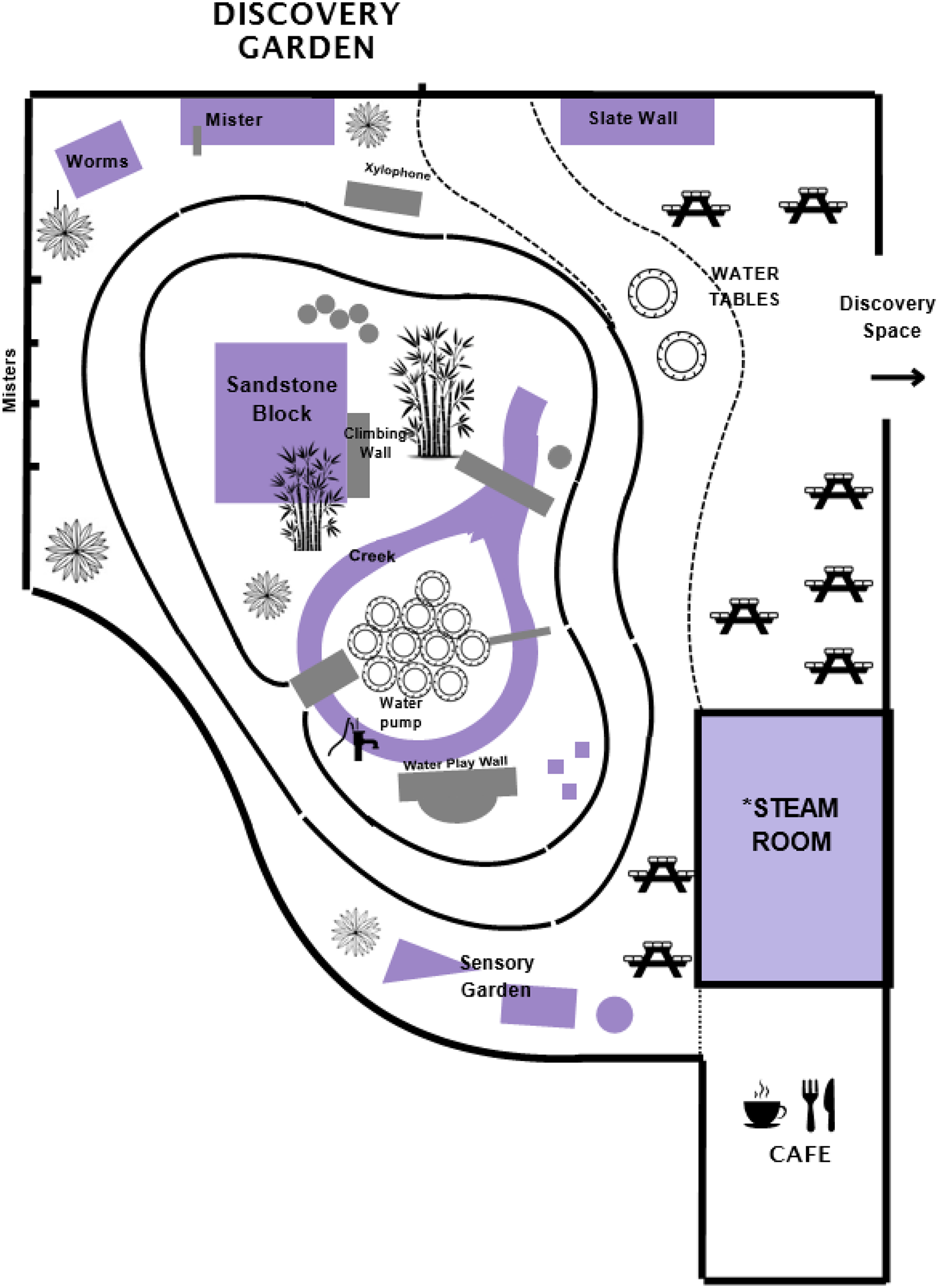
Map of the Discovery Garden (2025).
Relational and Country-informed analysis
In analysing these findings, we distinguish between the empirical narrations provided by parents and carers through the focus groups and the relational literacy displayed by the children during observations. While the verbal data is recorded through parental observation and reflection, the children's voices are heard through their physical responses and sensory immersion. We interpret their purposeful lunges toward the creek, the quiet stillness when watching a Satin Bowerbird and the rhythmic dancing prompted by the wind chimes as forms of embodied joy, the child's way of speaking back to Country. By framing the analysis through this lens, we make visible the pedagogical work of the more-than-human world, positioning the child as an active kin-member in conversation with the land.
Data analysis was derived from two primary sources: 1) transcripts from twelve focus groups with parents and carers, and 2) pedagogical reflections and researcher observations. These reflections represent our active attention to the site as educators who regularly facilitate workshops and teaching sessions within the garden. While these observations did not involve the children of the focus group participants specifically, they capture a recurring and consistent pattern of engagement we have witnessed through our long-term professional roles and focused attention on the garden space guided by transcript analysis. By documenting these embodied memories alongside participant narratives, we acknowledge our role as active witnesses in the co-construction of knowledge. Themes were not drawn solely from participant language but emerged through a sustained attention to the shifting relationships between people, place, and more-than-human kin. Key guiding principles for analysis included:
What was Country teaching in that moment? How are children forming relationships with people, with place, with beings? What emotions, sensory experiences, or stories were shared? How did parents describe their children's learning, and how might these relate to Country?
Transcripts were coded iteratively, with recurring themes such as outdoor area, water play, freedom of movement, more-than-human connection, and sensory immersion becoming focus points. The analysis was conducted not only with academic rigour but with ethical and spiritual attentiveness to Country, recognising the presence of water, birds, and mist as active contributors to learning. To ensure Country actively informed the research process beyond a conceptual frame, the analysis was informed by yarns with Aboriginal colleagues and Elders. Beyond verbal interaction, yarning constitutes a sensory and reciprocal engagement with Country through movement and sound (Hughes and Barlo, 2021). This collaborative interpretation ensured that elements like water and birdlife were understood as living educators rather than just environmental elements. This paper distinguishes between the empirical observations provided by parents (e.g., children running to the water) and our theoretical reading of these practices. We interpret these as pedagogical invitations from Country, seeking to make visible the teaching work performed by the more-than-human world.
Crucially, this analysis acknowledges a distinction between the raw data and our theoretical interpretation. Parents’ descriptions often focused on children's sensory enjoyment and physical movement. Our role as researchers was to interpret these sensory events through the prism of Indigenous kinship. By doing so, we aim to enrich the pedagogical understanding of what these experiences represent, recognising sensory moments as communication from Country.
Findings
We organise our findings into three key sections to enable us to examine spatiotemporal freedoms, atmospheric dialogues and relational ecologies. Each section unpacks specific instances of engagement, moving from physical movement toward a deeper understanding of Country as an Educator.
Spatiotemporal Freedom: moving Beyond Urban Constraints
Parents described the Discovery Garden as a site where the usual constraints of a museum were absent, describing different or even an absence of formalised rules at play. The scale of the garden is critical; it allows children to run, climb, and stretch without constraint. This spaciousness enables children to find quiet corners for solitude or gather for shared discovery without the pressure of overcrowding. They were also able to move; children reported the Discovery Garden enables them to run, jump and throw things. One parent described, “they need to run,” while others acknowledged the physical activity but also described a “peaceful” feeling. This physical freedom is essential for self-regulation; running and climbing are not just motor skills, but ways children map out their agency within their world. We view the importance of the outdoor space to allow for spontaneous connection with Country.
Being Watched Over: learning Under Grandmother Mountain
The physical location and design of the outdoor space mattered. The tall timber fence and family seating areas anchor relationships between children, caregivers, and more-than-human kin. This boundary, thickened by bamboo, created a living microclimate. To the west, the ever-watchful presence of Grandmother mountain Djeera reveals herself over the fence. The design's orientation ensures that children's play remains under her protective gaze, reflecting a pedagogy of ‘being watched over’ by Country. This architectural and spiritual alignment connects the rhythms of family life with the immediacy of embodied play.
Cultural design: kinship through planting
These spontaneous connections were enabled through cultural design. The water-painting walls and native plantings were specifically chosen through yarns with Aboriginal knowledge holders to reflect the ephemeral nature of storytelling and the seasonal cues of kin. This multiplicity of affordances nurtures embodied joy, where movements are expressive and relational. The space becomes a canvas for children's bodies to connect with the more-than-human world, reinforcing the idea that learning lives in the body and in place.
Birds and Trees as Co-participants
The Discovery Garden is alive with more-than-human presence, offering children opportunities to form relationships with the living world through sensory and embodied encounters. The plants and trees are active participants in the play ecology. Their textures invite touch, their scents and colours shift with the seasons, and their movements in the breeze create a visual rhythm that children often mirror in their own bodies. These plants also offer shelter and food for local birdlife, whose visits punctuate the day with song, flight, and fleeting moments of interspecies connection. Children pause to watch, listen, and sometimes even speak to these visitors, forming spontaneous, affective relationships that extend their sense of belonging beyond the human.
Emotional Safety: sightlines and Trust
The design of the Discovery Garden reflects a strong commitment to safety, accessibility, and inclusivity, ensuring that all children and families feel welcome, supported, and free to engage. Its layout is open and navigable, with clear sightlines and gentle transitions between play zones, allowing adults to supervise while children explore independently. While the design of the garden is physically accessible, participants specifically identified that the lack of high-sensory, overwhelming features, allowed their children to settle into a relational rhythm with the water. Our observations corroborated this, noting how the physical boundaries of the space allowed parents to step back, creating the emotional safety required for children to engage in deep play with the mist and birds.
In addition, the tall timber fence establishes a secure boundary, offering a sense of enclosure without confinement, while the double sliding doors provide accessible entry for prams, wheelchairs, and mobility aids. Inclusivity is also embedded in the diversity of play affordances. While there is access to a café, many families reported they also brought their own food and drink, making it an environment that could be used by everyone. As such, the Discovery Garden becomes a model for inclusive, respectful, and joyful learning. Parents frequently emphasised the value of this thoughtful design. A parent reflected that there were “plenty of good paths around there that the kids can run around and not be run over by cars,” highlighting the trust families placed in the space as a safe environment. Importantly, the outdoor setting worked across different ages. Infants, toddlers, and older children could all use the garden together, creating possibilities for family members to connect, play, and learn alongside one another. This intergenerational dimension underscores how the garden functions as a trusted, shared environment, where inclusivity and safety form the foundation for joyful, collective engagement.
Atmospheric Dialogues: water, Wind, Mist, and the Song of Country
The garden's sensory richness does not arise only from its design or arrangement of materials but from the way Country speaks through water, wind, plants, and air. Rather than a destination, the transition to the garden becomes a sensory invitation.
Water as Teacher: sensory Invitations to Play and Embodied Joy
Several parents noted a distinct sequence of engagement: as the double sliding doors open, children often pause momentarily, their breath hitching as they meet the cooling draft of the misting system. From this stillness comes a purposeful, magnetic pull toward the creek, a movement one participant described as less an elective choice and more a response to a call. Through a Country-centered relational lens, we interpret these interactions as a deep, embodied exchange; children do not just play in the water, they play with it. This is evidenced by children reaching out to catch individual droplets, matching their breath to the rhythm of the flow, and leaning their bodies into the moisture as if leaning into a relative. The agency of water nurtures wonder and joy, being a primary pedagogical force that draws children in first and holds them longest. The inevitable “drenching” reported by parents, which led many to pack swimmers as a standard part of their museum kit, transforms what might be characterised as a simple attraction into a recognised encounter with a communicative, more-than-human educator.
Across all focus groups, parents observed that children gravitated toward the creek as “companions.” This characterisation shifts the perception of water from a play resource to a relational entity. When children drench their clothes, they are enacting Uncle Bill Neidjie's (1989) teaching that the ‘Earth is just like Mother.’ Meaning that being in the water is like returning to the womb and a connection with the Earth as Mother. While a parent might view a soaked shirt as a practical inconvenience, we interpret this as an intimate, physical merging with a relative. It suggests that it is not only children who play with water; rather, Country plays with them, educating through sensation and holding the child within a reciprocal relationship.
The wind as rhythmic yarn: calls to respond
The wind also makes its presence known, carried on the tones of the large chimes hanging in the garden. Resonance, shaped by both the breeze and children's touch, calls bodies to respond: arms reaching, ears tilting, and feet dancing. We interpret this not as sound for amusement, but as song-as-communication; a rhythmic yarn (Hughes and Barlo, 2021) between Country's breeze and children's movement. Noting too that the changes in wind also changes the sounds, which then alters the children's responses.
Mist as Kin: active Participant through atmospheric exchange
The misting structure adds another layer to this atmospheric exchange, where cool droplets meet warm skin to wrap children in shifting textures of air and moisture. Parents described the mist as a “delight” and a “playful embrace” that altered the mood of the garden and deepened engagement. It offered thermal comfort on hot days. This description of ‘delight’ offers a critical analytical pivot: the mist is an active participant, kin, that invites children to run, pause, and twirl in a reciprocal encounter. As one parent reflected: “I guess in a child's eyes, that outdoor space and the magic of it, would really capture them.” While the parent uses the term ‘magic,’ we recognise this capture as a moment of relational attunement. It is a state where the child is physically responsive to the shifting songs and moods Country offers, moving from being a visitor in a space to becoming a relative with mist.
The Songs of Country: ephemeral Canvases and Grounded Teachings
Other features extended these yarns with Country (Hughes and Barlo, 2021). The water-painting wall transformed everyday surfaces into ephemeral canvases where children's gestures appeared and vanished, the speed of which was also impacted by the temperature of the day. These fading traces mirror the transient nature of play itself, momentary, yet deeply felt. Similarly, raised planter beds and native plants provided grounding through the textures of bark and the fragrance of soil. Parents’ observations of children engaging with these features highlight a shift from sensory novelty to an engagement with the ‘slow time’ of growth. We interpret this grounding as a pedagogical lesson in ecological presence; children learn that play can be both fleeting (like the water-paint) and deeply rooted (like the kin-plants) while also impacted by the air around.
Relational Ecologies: social Learning and Shared Joy
The Discovery Garden was overwhelmingly positioned as a place children and their families wanted to visit – a space of learning, joy and connection.
Spontaneous Collaboration and Peer Learning
The Discovery Garden's open design and diverse and open-ended play affordances encourage spontaneous collaboration, turn-taking, and co-creation. Children often gather around the water tubs, negotiating roles as they pump, pour, and redirect water; learning through doing, watching, and responding to one another's actions. The layout supports both parallel and cooperative play, enabling children to move fluidly between solitary exploration and group interaction. Families are active participants in this ecology of play. Parents and carers sit at tables with and without their children, join in games, and share moments of joy and discovery. The proximity to the café window creates a gentle flow between adult routines and children's activities, reinforcing the idea that learning and connection are shared and relational experiences and both sets of needs are important.
Intergenerational: families in Place
The garden supports intergenerational and intercultural play, welcoming families from varied backgrounds and creating opportunities for shared experiences. Its design supports relationality between children, adults, and the more-than-human world, while ensuring that every visitor feels safe, seen, and valued.
The garden's open design encourages spontaneous collaboration and turn-taking. Families are active participants; parents sit at tables and share in the joy of discovery. A mother shared how her daughter “regularly formed new friendships” while waiting for lunch. These micro-interactions among children were a social bridge, prompting adults to talk and share experiences. This shared environment allowed participants to find comfort in others similar to themselves, other grandparents or dads, transforming a public space into a mirror of community identity. Ultimately, this suggests that the garden is not only a setting for social life, but an active participant in it. The presence of more-than-human elements enriches human bonds, proving that learning is not a solo endeavor, but one co-constructed in constant negotiation with the world around us.
Children's Routines: example of the Drenching Ritual to complete playtime
Families reported they prioritized outdoor play, and frequently saved the outdoor play for last. One participant explained that her children would “always end up getting wet in the creek.” This was an experience shared by many families. Far from being incidental, thorough a Country as Educator lens, this drenching ritual reveals the high value placed on the water as a space of completion. It marks a transition from the structured forms of indoor play to the openness of embodied exploration outside on Country. This suggests children intuitively recognised the garden as a space of integration, where the day's experiences could be processed through touch and relational play.
Discussion: learning with Country, not just in nature
Families’ descriptions of children's connections with birds, mist, and logs provide the groundwork for this discussion. While these accounts are presented as descriptions of children's enjoyment, we propose they offer a way to understanding Country as a relative. By interpreting these moments through Indigenous frameworks, we suggest that children are already attuned to these relationships, even if they are not yet named as such in conventional educational settings. This interpretation is grounded in our identity and methodology, where our professional immersion as educators allows us to perceive a relational literacy that may remain invisible in standard empirical accounts. While parents provide vital empirical narrations of sensory joy, our theoretical reading reorients these practices as purposeful dialogues, recognising the children's movements as sophisticated responding to the pedagogical invitations of Country.
The findings from this study reaffirm and extend the existing literature that reports the importance of outdoor, informal, and museum-based learning. Prior work has shown that sensory-rich environments, especially those featuring water, loose parts, and unstructured play zones, are powerful mediators of learning (Anderson et al., 2002; Chermayeff, 2010; Enseki, 2010). Our data supports this, particularly through parents’ descriptions of water play as a deeply embodied and joyful (Nordström, 2022), aspect of children's experiences at the Discovery Space. However, what emerges from these focus groups and what extends the field is the role of Country as an Educator. Water, trees, birds, mist, and soil are living, communicative agents shaping children's knowledge, wellbeing, and belonging.
This relational worldview calls for place-responsive and decolonising pedagogies in outdoor education (Rooney et al., 2020; Larsen and Johnson, 2016; Lloyd et al., 2018a; Brown, 2012). Families’ descriptions of children's connections with birds, mist, and logs resonate with Indigenous understandings of more-than-human kinship, suggesting that children are already attuned to these relationships in everyday ways. Within this context, the Discovery Space can be seen as supporting more than nature-based learning; it offers opportunities for children and families to engage with place in ways that reflect relational and kinship-oriented perspectives. In this way, the paper adds to current conversations by considering how Indigenous frameworks might inform early childhood informal education (Smyth, 2024; Kitson and Bowes, 2010), an area where decolonial thinking is still developing. While much of the museum and informal learning literature emphasises autonomy, creativity, and multisensory exploration (Piscitelli and Penfold, 2015; Enseki, 2010), this paper takes it further by centring Country's agency. By listening to what families said children loved, the creek, the mist, the birds, we see Country as a being that invites, teaches, and holds children. This distinction marks a vital epistemological shift. Furthermore, our analysis highlights how routines like saving outdoor play for the end of a visit demonstrate ritual, reverence, and reward. These practices may seem insignificant, but they speak to how families view outdoor play as the most meaningful part of their visit. Rather than framing water play as an add on, we argue it should be recognised as central to relational pedagogies grounded in Country. Lastly, we challenge dominant developmentalist logics that measure learning solely through cognitive milestones or outcomes. Here, learning is relational, sensorial, affective, and Country-centred. By weaving in Indigenous understandings of learning as living in right relation with all beings, this study provides a framework for researchers to examine children's ecological attunement by analysing the communicative potential of more-than-human elements. However, it is vital to emphasise that the Country as Educator lens is not a framework for non-Indigenous practitioners to adopt in isolation or as a detached curriculum. Instead, this approach serves to demonstrate how Country actively educates and how more-than-human relatives communicate, provided that such engagement remains grounded in genuine, ongoing collaboration with Indigenous people. By recognising Country's agency, we identify new pedagogical possibilities that respect Indigenous sovereignty and ensure that the reading of the land (Harrison and McConchie, 2012) is always guided by cultural protocols rather than extractive observation.
Overall, this paper makes three key contributions. First, it extends scholarship in early childhood education, museum learning, and outdoor pedagogy by reframing informal learning as a relational process grounded in Country. Here, children's ecological and spiritual capacities are nurtured through right relations with all beings, moving beyond individual skill development to emphasise reciprocity, kinship, and joy. Second, it offers an applied example of how museum spaces for children, like the Discovery Space, can nurture decolonial approaches to learning. Rather than simply adding Indigenous content, the paper shows how shifting the foundational relationships between children and place creates opportunities for learning with, rather than about, Country. Third, it outlines future directions for practice and research. This includes collaborating with Aboriginal Elders and knowledge holders to co-design outdoor museum and early learning environments where Country's voice is central, not only thematically, but structurally. Practical pathways for this work include weaving in Aboriginal storytelling, seasonal cycles, and native pollinators as part of living, relational pedagogies. We also call for evaluation frameworks that recognise emotion, kinship, and attunement as legitimate pedagogical indicators. The contribution of this paper is not to claim that every sensory act is an intentional act of kinship, but to demonstrate how viewing them as such broadens our understanding of the child-Country relationship. By taking seriously the idea that water speaks and birds watch, this paper opens Ancient pedagogical possibilities in which children do not simply visit the Discovery Space but become part of its living story.
Critical reflections and limitations
We acknowledge several limitations in this study. First, our data is mediated through adult accounts; while parents are expert observers of their children, these narratives remain an adult interpretation of the child's interior experience. Second, we recognise the institutional constraints of a museum setting, such as safety fences and structured opening hours, which may at times conflict with the unhurried rhythms of Country. Finally, while we consistently consult with Aboriginal community members, there are inherent tensions in weaving Indigenous knowledge within western institutional frameworks. Acknowledging these limitations is a necessary step in the ongoing decolonising process of this research.
Conclusion
In conclusion, this research demonstrates that when outdoor museum spaces are co-designed with Country in mind, they move from being a learning space to having living co-educators. Our key contribution in this paper lies in the weaving of Indigenous kinship with posthuman affect to reveal a more-than-human pedagogy. For museum practitioners and educators, this implies a shift in focus: from designing for activity to designing for attunement. By making space for Country as Educator, we do more than teach; we restore a sacred exchange, ensuring that as our children grow, they walk not just upon the land, but in a deep, rhythmic dance of kinship with a world that has been waiting, for a very long time, to be heard.
Footnotes
Acknowledgments
We gratefully acknowledge the beautiful Country we live and work in and the sacred mountain, Djeera. We also give gratitude to families who shared their time and reflections. We thank Wadi Wadi, Dharawal and Yuin Elders and knowledge holders whose guidance supports us in every way. We also acknowledge the support of colleagues who contributed to yarning and reviewing drafts.
This paper reports data from a large cohort study commissioned for the 10th anniversary of UOW Early Start's Discovery Space. The cohort study was led by Professor Lisa Kervin and the research team included Dr Crystal Arnold, Professor Steven Howard, Professor Bridget Kelly, Lisa Kilgariff, Dr Franka Mackie, Dr Matthew Schweickle, Prof Lisa Smithers, Dr Chye Toole-Anstey, Dr Joanna Waloszek, Dr Lauren Weber.

Ethical considerations
This study was approved by the University of Wollongong Human Research Ethics Committee (Project No. 2024/289). Cultural safety and reciprocity were prioritised throughout, and the research was conducted in a spirit of gratitude and respect for Country.
Consent to participate
All participants provided informed consent prior to participation.
Consent for publication
Not applicable. This study did not include images or data that identify individual participants.
Funding
The authors received no financial support for the research, authorship, and/or publication of this article.
Data availability
The qualitative data (focus group transcripts) generated and analysed during this study are not publicly available due to ethical restrictions on sharing identifiable information. De-identified excerpts are available from the corresponding author upon reasonable request.