



Abstract
Given the critical role that teachers play in children's learning and the effective delivery of early childhood education and care, research on early childhood education and care teacher recruitment has been limited. This study examines employer expectations for teacher competencies in early childhood education and care teacher recruitment by analysing 322 job advertisements for early childhood education and care teacher positions in Finland. A deductive qualitative content analysis was conducted using the teacher competencies defined in the multidimensional adapted process model of teaching as a framework. The findings highlight the prominence of relational skills, motivational orientation and personal dispositions in these advertisements. Considering the global challenges of teacher recruitment in rural areas and regional variation within Finland, the study also explores differences across municipalities and regions. Although some associations between municipality type (i.e. urban, semi-urban, rural) or regions and teacher competencies were found, no consistent patterns emerged to suggest systematic differences. The implications for developing competency definitions and teacher education are discussed.
Introduction
The global challenge of attracting, recruiting and retaining high-quality teachers is intensifying, with a rising shortage of educators reported worldwide (European Commission, 2021; Organisation for Economic Co-operation and Development, 2020). This problem is particularly acute in early childhood education and care (ECEC). In Finland, day-care centres have struggled with teacher shortages for years (Lassheikki, 2023). In the UK, a similar challenge, where ECEC employers are struggling to recruit the necessary staff, has been regarded as an acute workforce crisis (e.g. Sakr et al., 2023). Given the critical role that quality teachers play in children's learning (Gerritsen et al., 2017) and the effective delivery of ECEC (Manning et al., 2019), research on ECEC teacher recruitment remains limited (Fenech et al., 2022).
A well-established approach to understanding recruitment trends and dynamics is the analysis of job advertisements (Mahjoub and Kruyen, 2021). These advertisements, published through public media channels, are written documents that are designed to attract the most suitable candidates for open positions (Harper, 2012). They offer valuable insights into employers’ expectations, such as the qualifications, experience, skills and knowledge required for a given role. The analysis of job advertisements has been used, for instance, to identify gaps between employment requirements and educational programmes, thereby aiding in the redesign of curricula to better prepare students for future workforce demands (Kim and Angnakoon, 2016). Furthermore, this analysis can reveal discrepancies between the competencies emphasised in academic literature and those prioritised by employers (Rios et al., 2020). Examining job advertisements can also enhance the communication of key teacher competencies, which is a crucial step in effective teacher recruitment (Klassen et al., 2021).
Research on employer expectations in ECEC teacher recruitment is currently insufficient, as noted in a recent review of teacher job advertisement studies (Mankki, 2023). The few studies that have analysed job advertisements for ECEC positions, alongside primary and secondary education positions, have revealed that employers often prioritise interpersonal and teamwork skills and intercultural understanding (Bailey et al., 2013; Selvi, 2010), as well as leadership abilities and alignment with the ethos of a specific educational institution (Stephenson and Carter, 2014). Moreover, discrimination based on nationality preferences in pre-kindergarten–Grade 12 job advertisements has been identified (Selvi, 2010). However, ECEC positions were only a marginal subset in these studies, and the research did not specifically differentiate or highlight the competencies desired in ECEC teacher recruitment. As a result, it is not possible to draw meaningful conclusions about employer expectations specific to the ECEC sector.
This study aims to address the gap in the existing literature by examining the teacher competencies sought by employers in ECEC teacher recruitment. Specifically, the primary research question is: What types of teacher competencies are articulated in job advertisements for ECEC teacher positions in Finland, and how are these competencies interrelated? The study also takes a regional perspective. While public attention in Finland has focused on ECEC teacher shortages in urban metropolitan areas (e.g. Aalto, 2023), research indicates that recruitment challenges are even more common in rural municipalities (Kosunen et al., 2024), aligning with the international trend of rural teacher shortages (e.g. Burke and Buchanan, 2022). Moreover, recruitment in the Western Finland region has been found to be less problematic compared to other parts of the country (Kosunen et al., 2024). Therefore, an additional research question is: What differences in articulated teacher competencies can be observed across municipalities and regions? Overall, this study adds to the limited research on ECEC teacher recruitment by examining employer expectations in ECEC, which have previously been overlooked. By integrating a regional perspective, it also contributes to the field of teacher segregation research, which has been identified as a blind spot in educational segregation research in Finland (Kosunen et al., 2024).
Theoretical framework
Teaching is a multifaceted and demanding profession that requires a wide range of diverse competencies (e.g. Baumert and Kunter, 2013; Blömeke et al., 2015). As many nations prioritise the professionalisation of ECEC teachers as a key policy agenda (Nolan and Molla, 2020), efforts have been made to conceptualise teacher competencies and identify the systemic conditions necessary to support these competencies at the individual, institutional and inter-institutional levels (Urban et al., 2011). Research has also explored teacher competencies from the perspective of ECEC student teachers (Lillvist et al., 2014; Pažur et al., 2024).
A study by Klassen et al. (2018) found that while certain teacher competencies – such as empathy, organisation and resilience – were consistently valued across different countries and contexts, notable variations also exist that reflect national and cultural differences in education. In the Nordic countries, the ‘Nordic model’ – a comprehensive welfare approach characterised by robust social welfare systems and social cohesion – extends to education systems and pedagogy (Garvis and Ødegaard, 2017). This approach is reflected in the curricular differences between the sociocultural pedagogical tradition in Nordic countries, which emphasises children's social development, well-being and agency through playful, interaction-oriented methods, and Anglo-American pedagogy, which focuses more on cognitive goals and school readiness (Bennett, 2005). The sociocultural tradition, by adopting a broader approach to developmental goals, enables teachers to adapt their practices (Pianta et al., 2020) and highlights the importance of diverse pedagogical competencies and continuing professional development (Garvis et al., 2018).
To conduct a culturally sensitive analysis of the teacher competencies sought by employers in Finnish ECEC, this study adopted the multidimensional adapted process (MAP) model of teaching (Metsäpelto et al., 2022) as its theoretical framework. Originating in Finland, the MAP model offers a collective interpretation by an expert panel from seven universities organising teacher education in Finnish, synthesising contemporary evidence on the knowledge and skills teachers across all educational levels should possess. The model was developed through a rigorous process that included an extensive review of relevant research and structured dialogue among experts, fostering both individual and collective reflection. The goal was to translate a broad and fragmented body of literature into a coherent consensus model that accommodates the diverse contexts of the teaching profession – from ECEC to subject-specific disciplines. The MAP model has played a key role in reforming standardised admissions to Finnish initial teacher education programmes by defining the competencies expected of applicants during the entry phase, and has also informed curriculum design in teacher training, as well as guided the professional development of in-service teachers (Metsäpelto et al., 2024).
The MAP model builds on Blömeke et al.'s (2015) teacher competence continuum, which distinguishes between teacher competence (effective performance of a teacher's work), situation-specific skills (perceiving, interpreting, and making decisions in teaching and learning situations) and individual teacher competencies. These underlying yet evolving individual teacher competencies represent the potential of the teacher and serve as prerequisites for acting professionally and effectively (Blömeke et al., 2020). In the MAP model, these competencies are originally defined as: (1) a knowledge base for teaching and learning; (2) cognitive thinking skills; (3) social skills; (4) personal orientations; and (5) professional well-being (Metsäpelto et al., 2022).
However, the framework for this study was streamlined by excluding two categories – cognitive thinking skills and professional well-being – since an earlier study focusing on class teacher recruitment revealed that job advertisements contained very limited references or preferences related to these categories (Mankki et al., 2024). Rather than interpreting their absence as a lack of value placed on these competencies by employers, the decision was grounded in the understanding that articulating such qualities in job advertisements is often challenging or unconventional. These competencies may not align well with the typical language used in job postings or may be difficult to express within the format and purpose of such advertisements (see Mankki et al., 2024). To support this approach, a preliminary analysis was conducted on a subsample of the data, which confirmed that similar omissions also appeared in ECEC advertisements.
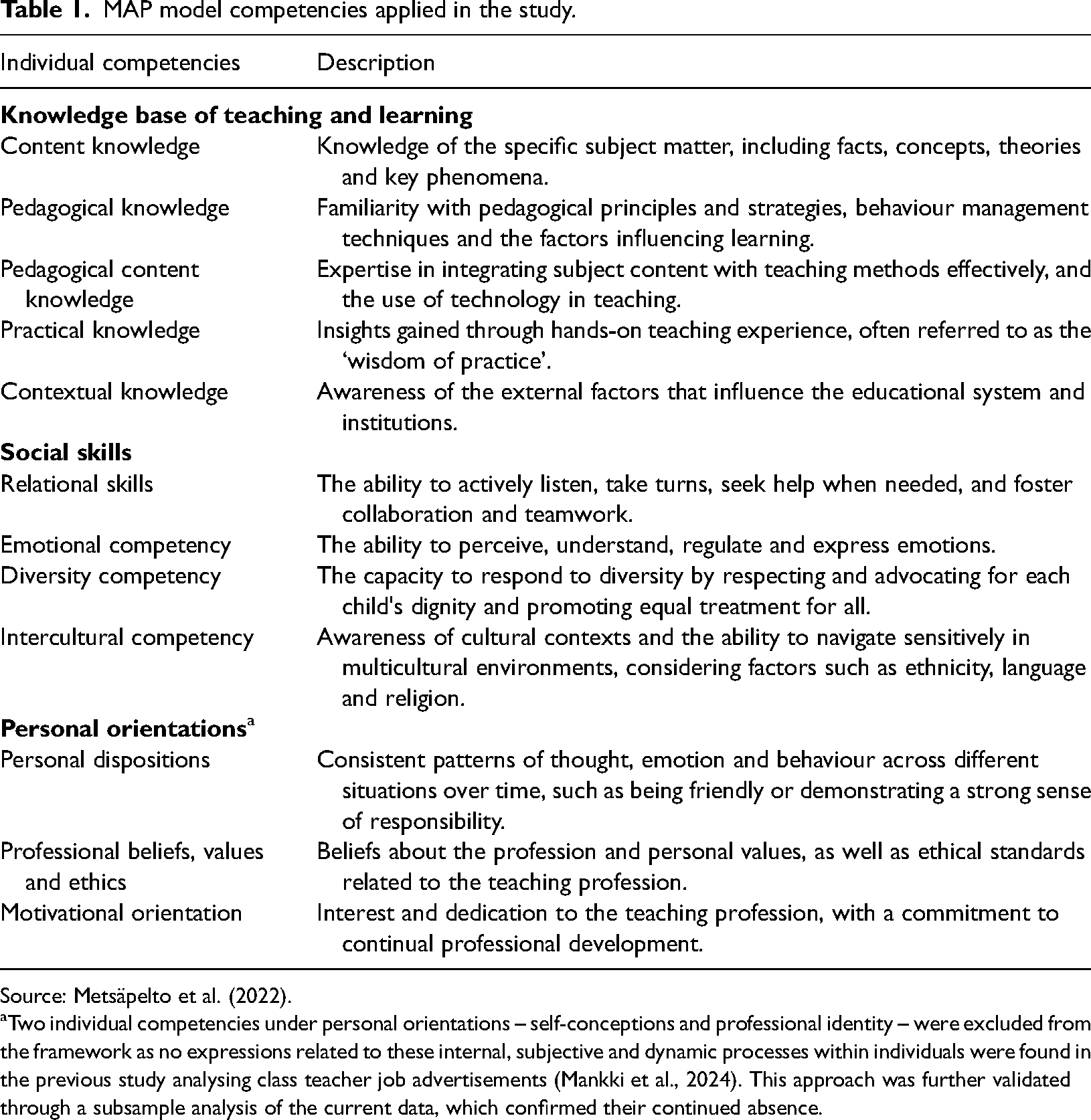
As a result, the analysis focused more closely on the three remaining competency categories – knowledge base for teaching and learning, social skills and personal orientations (described in detail in Table 1) – as they were expected to be reflected in ECEC teacher job advertisements. Of these competencies, the first is classified as a cognitive competency, while the latter two are considered non-cognitive (Metsäpelto et al., 2022).
MAP model competencies applied in the study.
Source: Metsäpelto et al. (2022).
Two individual competencies under personal orientations – self-conceptions and professional identity – were excluded from the framework as no expressions related to these internal, subjective and dynamic processes within individuals were found in the previous study analysing class teacher job advertisements (Mankki et al., 2024). This approach was further validated through a subsample analysis of the current data, which confirmed their continued absence.
Methods
Research context
In Finland, ECEC encompasses institutional education for children under six, integrating education, teaching and care with a strong focus on pedagogy (Act on Early Childhood Education and Care, 2018). The work communities in Finnish ECEC settings are multiprofessional, comprising teachers, childcarers, social pedagogues, directors and assistants, each with varying educational backgrounds and qualifications, as well as different competencies resulting from their professional training (Ministry of Education and Culture, 2021). ECEC teachers in Finland qualify with a Bachelor's degree comprising 180 ECTS (European Credit Transfer and Accumulation System) credits (equivalent to three years of full-time study), awarded by a research-based university.
The 2018 Act on Early Childhood Education and Care revised the occupational titles and qualification criteria for professionals, with the goal of increasing the number of highly qualified personnel in ECEC teams. Each team – comprising at least three professionals – is responsible for one group of children. The legally mandated child-to-staff ratio allows a maximum number of children based on the number of adults present: for children under the age of three, the group size may not exceed 12 (i.e. four children per professional), and for children over three, the maximum is 21 (seven children per professional). By 2030, each team will be expected to include two ECEC teachers with a Bachelor's degree in Education and one childcarer, marking a shift from the current legislated structure of one teacher and two childcarers per team.
Municipalities are responsible for organising ECEC in Finland (Act on Early Childhood Education and Care, 2018). While private providers are legally allowed to organise day-care services, nearly three-quarters (72.5%) of day-care centres were municipal in 2019 (Finnish Education Evaluation Centre, 2019), making municipalities the primary recruiters of ECEC teachers. Although job advertisements for ECEC teacher positions must include specific regulated elements, such as references to qualification criteria (Act on Early Childhood Education and Care, 2018) and information on mandatory criminal background checks (Act on Checking the Criminal Background of Persons Working with Children, 2002), municipalities retain significant discretion in shaping the content and scope of their job advertisements (Hirvonen and Mäkinen, 2006).
Data collection
This study employs document analysis, a systematic method for examining various pre-existing organisational and institutional documents not initially created for research purposes (Bowen, 2009). This method offers advantages for qualitative researchers by addressing challenges related, for example, to ethical and stability concerns regarding the data (Morgan, 2022). However, to ensure the credibility of the data, it is crucial to establish a well-grounded sampling framework for selecting sources and documents (Kim and Angnakoon, 2016).
Job advertisements were collected from a centralised recruitment website intended for municipalities in Finland, where nearly 80% of municipalities post their open vacancies (Anne-Mari Mourukoski, Director of Services, personal communication, 2022). Additionally, job postings from Helsinki and Vantaa, two major Finnish cities that choose to advertise on their own recruitment websites, were included in the data set. The advertisements were gathered over a six-month period (between 1 January and 30 June 2022). New advertisements were reviewed on the last working day of each week, usually Fridays, and saved as PDF (Portable Document Format) files. In total, 1756 advertisements were collected. For research efficiency, the data set was streamlined with the following criteria: (1) a maximum of 10 advertisements per municipality and (2) a maximum of 50% of advertisements from each municipality. These rules ensured better representation of municipal variation, as all municipalities posting advertisements were included. The final data set consisted of 322 advertisements, a typical sample size seen in educational job advertisement studies (Mankki, 2023) and other fields (Harper, 2012; Kim and Angnakoon, 2016).
Based on Statistics Finland's (2025b) municipal grouping, which categorises municipalities by urban settlement proportions and the population of the largest urban settlement, the advertisements were distributed as follows: 133 from urban municipalities, 85 from semi-urban municipalities and 104 from rural municipalities. According to the European Union’s Nomenclature of Territorial Units for Statistics2 regional classification system, which divides Finland into five major regions (Statistics Finland, 2025a), the advertisements were distributed as follows (in descending order): 93 from Northern and Eastern Finland, 85 from Southern Finland, 74 from Helsinki-Uusimaa and 70 from Western Finland. The data excluded job advertisements from the fifth region, Åland, since only Finnish-language advertisements were collected. Åland has a clear Swedish-speaking majority, therefore job advertisements are written in Swedish.
Data analysis
Deductive qualitative content analysis, using predetermined categories derived from existing theory or prior research findings, was employed (Elo and Kyngäs, 2008). As stated, the MAP model framework (Metsäpelto et al., 2022), which provides a systematic and conceptually coherent structure for categorising, comparing and understanding the multifaceted competencies of teachers, was adopted in this study. The analysis primarily focused on manifest content, meaning it was closely tied to the text and concentrated on what was explicitly visible, rather than searching for underlying meanings (Bengtsson, 2016). However, some latent features and an interpretive approach were necessary due to the inherent ambiguity in the competence descriptions within the MAP framework and the occasional brevity of the language used in the advertisements. The analysis was conducted independently by the author, who served as the sole coder throughout the process.
The analysis began with a thorough familiarisation with the data. Advertisements were reviewed, and meaningful units containing insights related to individual competencies were identified and coded using ATLAS.ti 25. Coding rules were developed based on the competency definitions, and explicit, concise examples (i.e. anchor samples) were selected for each category. Requirements related to statutory qualifications or language skills (‘We require applicants to have proficiency in both official languages’) were excluded from the coding process. Additionally, common phrases such as ‘We value expertise in ECEC’ or ‘We expect you to have diverse skills’ were not coded, as they did not specifically reflect the individual competencies sought in the advertisements. Expressions that primarily discussed a particular day-care centre without directly referencing the requirements for applicants were also excluded from the analysis. Given the interpretive nature of the process, the coding rules were refined iteratively through comparisons of the data and the MAP model, particularly to clarify borderline cases and ensure proper categorisation. To maintain consistency and reduce the risks associated with single-coder analysis, a second round of coding was carried out after the initial round, allowing for the identification and correction of any inconsistencies in the allocation of expressions to the relevant categories.
To explore how competencies are associated with each other in the advertisements, a co-occurrence analysis was conducted, which identifies the codes applied to the same or overlapping quotations. Additionally, quantification was used to provide an overview of the reviewed documents (Bowen, 2009). In this study, quantification helped to highlight the prominence of individual competencies in job advertisements and was also employed to compare advertisements and identify differences between urban, semi-urban and rural municipalities, as well as across regions. To further analyse these relationships, a chi-square test of independence was performed in SPSS 28 to examine the association between municipality type or region and the presence of individual teacher competencies in the advertisements.
Results
Of the analysed ECEC teacher job advertisements, 275 (85.4%) included requirements or preferences for individual teacher competencies aligned with the framework of this study. The number of competencies identified in each job advertisement ranged from zero to eight, with most advertisements including four competencies (M = 3.22). The most frequently identified competencies were relational skills (identified in 73.2% of the advertisements), motivational orientation (65.5%) and personal dispositions (60.5%). In contrast, requirements or preferences for intercultural competency (1.5%) and content knowledge (0.9%) were notably rare in the advertisements. Table 2 provides an overview of the percentages of job advertisements that included individual teacher competencies.
Percentages of ECEC teacher job advertisements encompassing individual teacher competencies.
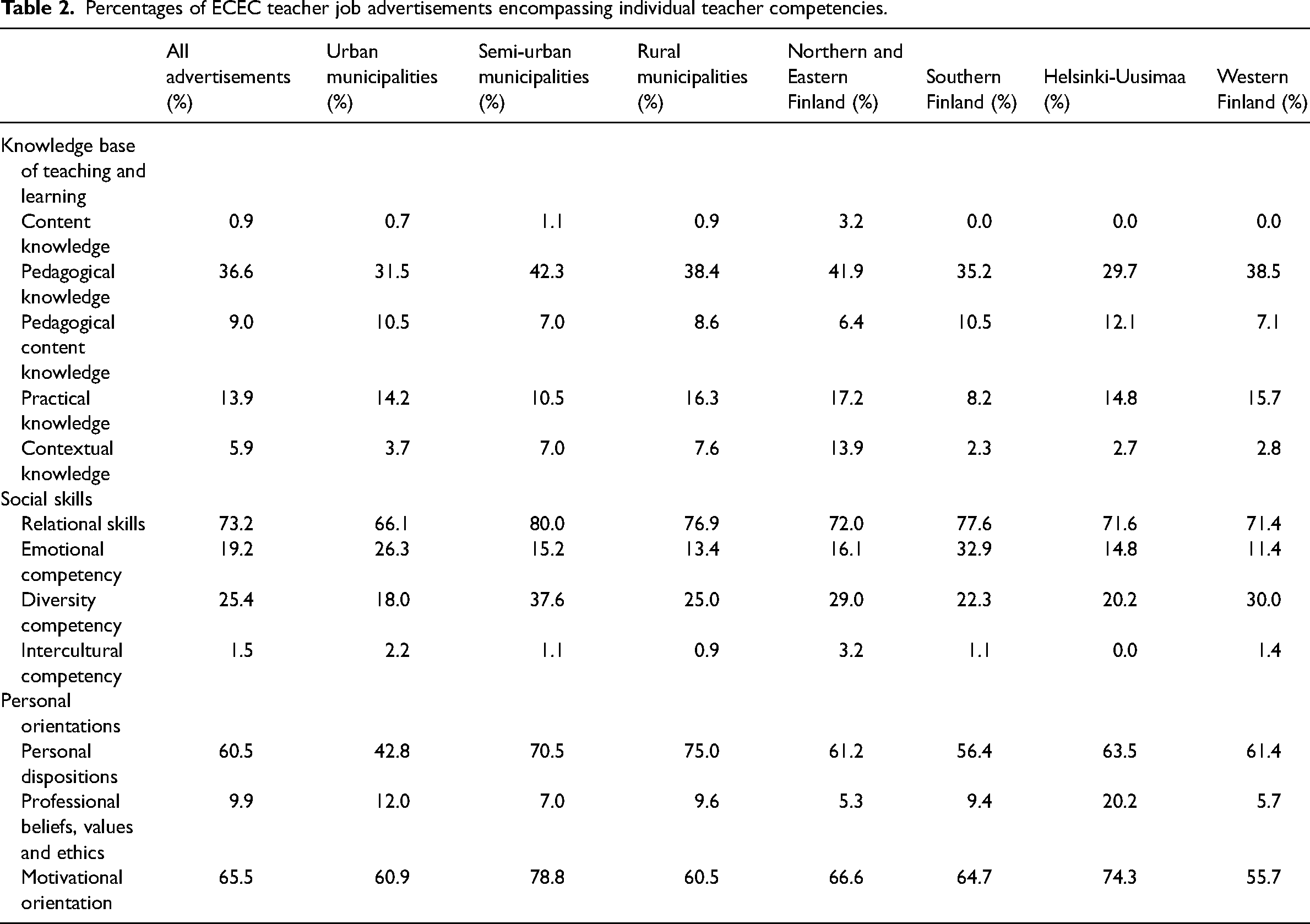
A chi-square test of independence was conducted to examine the associations between municipality type or region and teacher competencies. The analysis revealed statistically significant associations between municipality type and relational skills (χ²(2) = 6.1, p = .047), emotional skills (χ²(2) = 7.3, p = .025), diversity competence (χ²(2) = 10.5, p = .005), personal dispositions (χ²(2) = 30.1, p < .001) and motivational orientation (χ²(2) = 9.0, p = .011). Table 2 shows, for example, that while over 70% of advertisements from rural and semi-urban municipalities included competencies related to personal dispositions, this was the case for only 42.8% of advertisements from urban municipalities.
At the regional level, the chi-square test revealed statistically significant associations between region and contextual knowledge (χ²(3) = 15.3, p = .002), emotional skills (χ²(3) = 14.5, p = .002), and professional beliefs, values and ethics (χ²(3) = 12.4, p = .006). For instance, emotional competency was included more often in advertisements from Southern Finland (32.9%) compared to other regions (ranging from 11.4% to 16.1%), while contextual knowledge appeared more frequently in advertisements from Northern and Eastern Finland (13.9%) compared to other regions (ranging from 2.3% to 2.8%).
A detailed description of each competency and its associations will follow, supported by excerpts from the data to enhance the trustworthiness of the findings. The excerpts, translated from Finnish to English by the author, are labelled with codes indicating municipality type – urban (U), semi-urban (S) and rural (R) – and region –Northern and Eastern Finland (NEF), Southern Finland (SF), Helsinki-Uusimaa (HU) and Western Finland (WF). For example, the code R–SF denotes an excerpt from a rural municipality in Southern Finland.
Knowledge base of teaching and learning
The most prominent competency related to the knowledge base for teaching and learning was pedagogical knowledge, which encompassed proficiency in general teaching strategies and an understanding of factors influencing learning and development. This is exemplified in the following excerpt: ‘The position requires pedagogical expertise as well as an understanding of a child's early development and learning’ (S–SF). More specifically, pedagogical knowledge was reflected in the ability to support the learning process from planning to evaluation, as stated in: ‘We hope you have the skills and expertise to plan, implement, develop and evaluate pedagogical activities’ (R–NEF). In some job advertisements, mastery of diverse pedagogical methods was highlighted – for example: ‘Success in this position requires expertise in early childhood pedagogy and various methodological skills’ (R–NEF). Others specified the desired methodological expertise more precisely, such as the use of positive pedagogy methods: ‘The use of positive pedagogy methods is considered an advantage’ (R–NEF). Additionally, skills in managing groups of children were briefly mentioned: ‘We expect you to have good group-management skills’ (U–SF).
Content knowledge was notably lacking in the advertisements. The references primarily included statements about proficiency in specific content areas, such as ‘musical and visual arts skills’ (S–NEF), and knowledge of a particular culture – for example: ‘The position requires familiarity with Sami culture’ (R–NEF). This highlights the lack of focus on content-related facts, concepts and theories in job advertisements for ECEC teachers.
Pedagogical content knowledge, which plays a pivotal role in how educators translate their understanding of subject matter into effective instruction, was also rather limited in ECEC teacher advertisements. In cases where pedagogical content knowledge was present, the connection between content and teaching was expressed either vaguely, such as in ‘We hope the applicant is willing to implement flexible teaching arrangements across different content areas’ (U–SF), or by targeting pedagogical expertise more specifically at a certain content area, as illustrated in ‘We value expertise in child-centred mathematics in early childhood education and pre-primary education’ (U–SF). Since the MAP model also includes the integration of digital technology into teaching as part of pedagogical content knowledge, requirements or preferences for technological proficiency, such as ‘success in the position requires good information and communications technology (ICT) skills’ (U–WF), were categorised under this competency. However, only one advertisement explicitly referred to the instructional use of ICT, stating: ‘Expertise in utilising ICT in pedagogy is considered an advantage’ (S–WF).
In this study, practical knowledge referred to experience and evidence of practical actions in ECEC. The job advertisements generally valued, for example, ‘practical experience in ECEC’ (S–WF), ‘previous work experience in a day-care setting’ (U–HU) or ‘experience working with children aged 1–6’ (R–WF). An interesting expression mentioned the need for ‘just the right amount of pedagogical work experience’ (R–WF), which might suggest a reluctance to hire teachers who are ‘too experienced’. Some advertisements set specific requirements or preferences for prior experience, such as working with certain age groups, as illustrated in the following: ‘Experience working with children under the age of three is considered an advantage’ (R–NEF). Expectations for specific prior experience also included ‘working with children who need special support’ (U–SF), as well as working with multiculturality – for instance: ‘Experience working with multicultural children is considered an advantage’ (U–SF).
Contextual knowledge, which was also rare in the advertisements, mainly focused on familiarity with and understanding of the framework provided by the national core curriculum for ECEC in Finland, as exemplified in the following statement: ‘The position requires knowledge of the curriculum for ECEC’ (U–HU). In one advertisement, familiarity with the local curricula, created in Finnish municipalities based on the national core curriculum, was required: ‘Knowledge of the [municipality] ECEC curriculum is required’ (S–NEF). Additionally, contextual knowledge was demonstrated through requirements related to the ability to work with local pedagogical documents: ‘You should be able to produce pedagogical documents for personal use and within networks’ (S–NEF).
Social skills
The requirements for social skills were mostly directed towards relational skills, especially from the perspective of collaborative abilities, often combining these in the following manner: ‘We expect good relational and collaboration skills’ (R–WF). The desired relational skills were often framed in relation to different groups, such as children (e.g. ‘We value good and warm interaction between the educator and the child’ (S–WF)), families and guardians (e.g. ‘Your collaboration with families is smooth’ (S–WF)), and other staff members, as well as external stakeholders (e.g. ‘We consider the ability to collaborate with external networks, in addition to ECEC personnel, as important’ (U–NEF)).
Diversity competency was primarily expressed as general requirements related to the ability to work with various characteristics, such as: ‘We value that you can get along with diverse individuals’ (R–NEF). A recurring theme in this category was the emphasis on a ‘child-centred approach’ or ‘child-centredness’. When expressed in more detail, this meant that applicants were expected to have the ability to ‘consider children's needs’ (S–NEF), ‘take children's interests into account’ (U–SF), ‘understand the strengths of children’ (U–HU) and ‘understand the world of the child’ (S–SF). As promoting participation is regarded as an important aspect of diversity competency, there was also a desire for applicants to enhance the participation of both children and families. This is exemplified in the following statement: ‘We value … the ability to promote the participation of children and guardians’ (R–NEF).
Emotional competency was often expressed directly, with phrases such as ‘We value … emotional intelligence’ (R–SF) or ‘Good emotional skills are considered an advantage’ (R–NEF). However, empathy (e.g. ‘You are empathetic’ (R–NEF)) and sensitivity (e.g. ‘We consider the educator's sensitivity important’ (S–WF)) were also included, as they were interpreted as the ability to perceive and understand emotions. These expressions related to empathy and sensitivity constituted the clear majority in this competency.
The advertisements rarely set explicit requirements for teachers’ intercultural competency. Expressions related to intercultural competency usually overlapped with practical knowledge and included statements about intercultural expertise gained through experience, such as: ‘Experience working with families from diverse linguistic and cultural backgrounds is considered an advantage’ (S–NEF).
Personal orientations
Personal orientations were primarily focused on the requirements or preferences for a motivational orientation and personal dispositions. Motivational orientation refers to having an interest in and being dedicated to the teaching profession. Teachers described as ‘motivated’, ‘committed’ and ‘excited about their work’ (S–WF) were frequently sought. The advertisements also emphasised intrinsic values, meaning that an individual enjoys the core aspects of the profession, such as working with children (e.g. ‘We are looking for someone who enjoys working with children’ (R–NEF)) and their parents (e.g. ‘We need someone with a genuine interest in working closely with children and parents’ (R–WF)), and participating in play activities in small groups (e.g. ‘We value a willingness to work in small groups and enthusiasm for joining the world of play’ (S–HU)). However, motivational orientation was also discussed in terms of work contracts, emphasising, for example, the willingness to work shifts (e.g. ‘In addition, readiness to work in shifts, including evenings and weekends, is required’ (S-NEF)) or extended hours (e.g. ‘We value your willingness to work extended hours when needed’ (U–HU)), or make a long-term commitment (e.g. ‘You are ready to commit to a long-term employment relationship’ (R–NEF)).
Motivational orientation also encompasses an interest in and dedication to professional development. Some advertisements highlighted a positive attitude towards personal growth, as exemplified in statements such as: ‘You are dedicated to developing yourself’ (U–SF) and ‘We hope for a desire to learn new things’ (U–NEF). However, a larger percentage of the advertisements that included statements related to this area focused on requirements for developing ECEC either within a centre or a municipality. Development requirements were linked to improving not only ECEC in general (e.g. ‘You want to develop high-quality ECEC’ (S–NEF)) but also specific contexts (e.g. ‘We hope for your interest in developing pedagogy in shift care (i.e. ECEC that is provided at night, at weekends and on midweek holidays and holidays at shift day-care centres)’ (R–NEF)) and themes (e.g. ‘The position seeks a person with a willingness to develop nature-based pedagogy in ECEC’ (R–NEF)).
Personal dispositions included a range of required or preferred personal traits that reflected teachers’ inherent tendencies to think, feel and behave. First, the advertisements emphasised flexibility, as shown in the following extract: ‘We expect flexibility and adaptability to sudden changes in situations’ (U–SF). Second, the advertisements highlighted the need for teachers to act responsibly and reliably, with statements like: ‘We are looking for someone who can take responsibility in the ever-changing daily life of ECEC’ (U–SF). Third, the advertisements stressed qualities associated with positivity, such as being energetic, lively, enthusiastic, inspiring, humorous and cheerful. And lastly, the advertisements emphasised the importance of the teacher's proactivity and initiative, highlighting qualities such as being self-driven, organised, solution-oriented, and confident in expressing opinions and challenging existing practices. Other personal dispositions, which were mentioned less frequently, included attributes such as patience and calmness.
Professional beliefs, values and ethics were less frequently mentioned compared to other competencies under personal orientation. These were primarily reflected in expressions emphasising the appreciation of one's own and others’ work in ECEC, as in ‘Your professional approach is reflected in the appreciation of both your own and others’ work’ (U–HU). Additionally, this category included requirements for adhering to ‘the shared value base of the work community’ (S–WF) or more specific value-based principles, such as: ‘Is your work guided by the principles of a sustainable lifestyle?’ (U–HU). Statements highlighting the recognition of meaningful aspects of the profession, like ‘A calm and safe daily environment is meaningful to you’ (U–HU), were also coded under this category.
Co-occurrence of competencies in the advertisements
To explore how the competencies described above were interconnected in the advertisements, a co-occurrence analysis was conducted. This analysis utilised the concise language typical of job advertisements, where multiple meaning units are often embedded within a single sentence. For example, the expression ‘We value the ability and willingness to guide the learning process’ (S–WF) reflects two competencies: pedagogical knowledge (the ability to guide learning) and motivational orientation (the willingness to guide learning). As shown in Figure 1, the results of the co-occurrence analysis highlight the close interplay between pedagogical knowledge and motivational orientation.
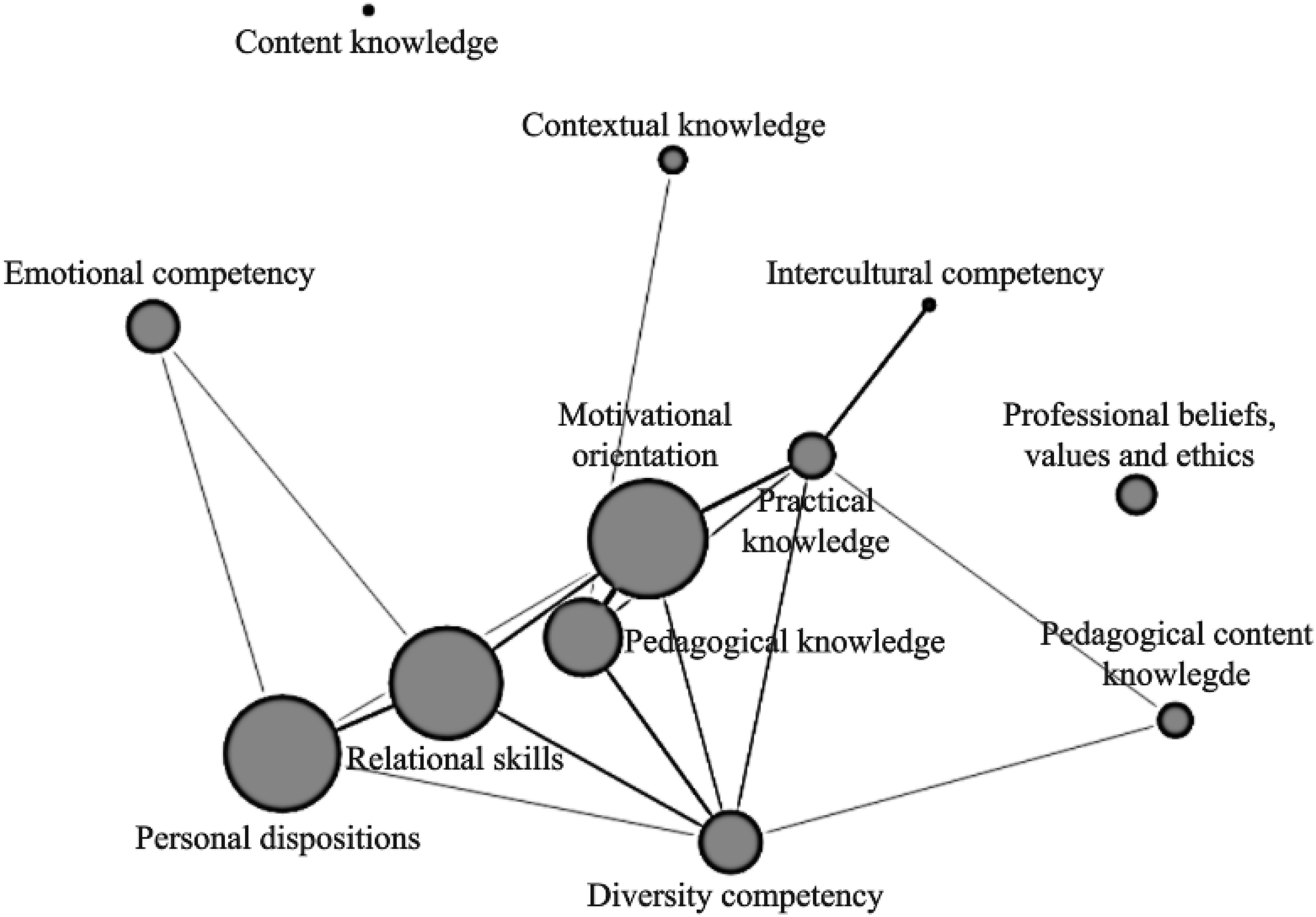
Co-occurrence of competencies in ECEC teacher job advertisements.
The analysis also revealed the connections – or lack thereof – between competencies that appeared less frequently. For example, the rare mentions of intercultural competency often co-occurred with practical knowledge, as illustrated by the statement ‘Experience working with families from diverse linguistic and cultural backgrounds is considered an advantage’ (S–NEF), which was coded under both practical knowledge (gained through work experience) and intercultural competency. In contrast, some competencies, such as content knowledge and professional beliefs, values and ethics, often appeared in isolation from other competencies (see Figure 1).
Discussion
This study aimed to examine the competencies required of ECEC teachers as outlined in job advertisements in Finland. The findings highlight the prominence of relational skills, motivational orientation and personal dispositions in these advertisements. These results align with previous research on teacher job advertisements, which has highlighted employer expectations regarding interpersonal and teamwork skills (Bailey et al., 2013; Selvi, 2010). However, this study makes a novel contribution by specifically elucidating employer expectations regarding ECEC teacher competencies. Previous studies on job advertisements have included ECEC positions only as a marginal subset of broader analyses, without explicitly detailing the specific competencies required for these positions.
The emphasis on relational skills, motivational orientation and personal dispositions reflects a broader trend in recruitment strategies, where non-cognitive competencies are increasingly prioritised. This approach is evident across various professional fields, including public service and health care (Klassen et al., 2021). However, it is noteworthy that certain non-cognitive competencies received relatively little attention in the job advertisements analysed. For instance, intercultural competency was explicitly mentioned in only 1.5% of the advertisements (see Bailey et al., 2013; Selvi, 2010), despite its recognised importance in an increasingly culturally diverse society (Lash et al., 2020). Given the growing necessity for teachers to be globally competent and to equip diverse student populations with essential intercultural perspectives, knowledge, attitudes and skills, the limited emphasis on intercultural competence in job advertisements warrants further examination. At least two possible explanations can be considered. First, job postings serve not only as recruitment tools but also as a means of promoting the hiring institution (Harper, 2012). As a result, explicit references to multicultural competency requirements may be omitted to avoid emphasising potential challenges associated with diversity in the work environment. Second, employers may view intercultural competence as a component of broader diversity competencies. Thus, when job advertisements reference diversity-related skills, they may implicitly include intercultural competency, even if it is not explicitly stated.
The findings further indicated associations between municipality type (urban, semi-urban, rural) or region (Northern and Eastern Finland, Southern Finland, Helsinki-Uusimaa, Western Finland) and teacher competencies, such as emotional skills, personal dispositions and motivational orientation. However, these associations varied, and no consistent patterns emerged to suggest systematic differences across municipalities or regions. These results contrast with previous research on class teacher job advertisements, which found fewer competency requirements in rural municipalities compared to urban and semi-urban areas (Mankki et al., 2024). Furthermore, the findings do not align with documented challenges in rural teacher recruitment in Finland (Kosunen et al., 2024) and internationally (Burke and Buchanan, 2022). Prior research has also identified regional differences, with Western Finland experiencing fewer recruitment difficulties than other parts of the country (Kosunen et al., 2024). The absence of such regional distinctions in this study suggests that employer expectations for ECEC teachers may be relatively uniform across different geographical areas, regardless of recruitment challenges.
This study contributes to the ongoing development of teacher competency frameworks, specifically within the ECEC context, by addressing discrepancies between the competencies emphasised in academic literature and those prioritised by employers (see Rios et al., 2020). In particular, it offers insights into the MAP model (Metsäpelto et al., 2022) and suggests that the existing framework may require revision. For example, intercultural competency could be integrated into the broader category of diversity competencies. While it is acknowledged that competency definitions should not be solely determined by researchers but should also reflect the views of practising teachers (Ukkonen-Mikkola and Varpanen, 2020), this study emphasises the importance of incorporating employer perspectives in discussions on teacher competencies. The practical implications of these findings are particularly relevant for the development of teacher education programmes. By comparing employer expectations with the goals and content of teacher education, this study highlights potential gaps between training and field requirements (see Kim and Angnakoon, 2016). These insights can inform the refinement of ECEC teacher education curricula, ensuring a closer alignment with professional demands.
This study has several limitations that should be considered when interpreting the findings. First, it focused exclusively on Finnish job advertisements. Comparative cross-national analyses could provide valuable insights into cultural and international variations in employer expectations. Additionally, examining differences between private and public sector job postings would be beneficial, given the growing role of private ECEC providers. Second, the study employed a modified version of the MAP model (Metsäpelto et al., 2022) as its analytical framework. While this model provided a structured approach, the use of alternative competency frameworks – such as Baumert and Kunter's (2013) teacher competency model or a framework of non-cognitive competencies across cultures by Klassen et al. (2018) – would have been justified and might have yielded different findings. Third, the use of a single coder represents a clear constraint in the analysis. Although manifest analysis was employed, the inherent ambiguity in competency definitions within the selected framework, combined with the often terse wording of job advertisements, required a degree of interpretation. This may have influenced the findings. Nevertheless, transparency in reporting the coding process and its challenges was prioritised to enhance the trustworthiness of the results.
Further research is needed to deepen our understanding of ECEC teacher recruitment. Analysing job advertisements alongside other data sources could provide more nuanced insights. Future studies could, for example, explore how job postings are constructed by using original advertisements as prompts in interviews with those responsible for ECEC recruitment or who have drafted these advertisements. This approach may reveal the reasoning behind the structure of the advertisements and the factors that led to variations in their content. It would be particularly interesting to focus on open-ended statements, such as ‘Do you have additional skills you would like to bring to our community? Contact us and let us know’, as these phrases shift the responsibility for defining key competencies onto the applicants themselves. Finally, given that recent Finnish policy documents have been criticised for paying limited attention to defining future competencies for ECEC teachers (Harju-Luukkainen and Kangas, 2021), it is important to critically examine the extent to which future-oriented competencies are addressed not only in job advertisements but also in broader recruitment practices.
Footnotes
Data availability
The data sets generated during and/or analysed in the current study are available from the corresponding author on reasonable request.
Declaration of conflicting interests
The author declared no potential conflicts of interest with respect to the research, authorship and/or publication of this article.
Funding
This work was supported by the Research Council of Finland (grant number 358924).
