




Abstract
The study discusses children's diverse resources and positions during their transition from early childhood education and care (ECEC) to pre-primary education. The ethnographic data were collected in two pre-primary contexts in Finland: early childhood education centres and schools at the beginning of the pre-primary year. Theory-informed thematic analysis produced categories and distinctions of resources, which had different social meanings depending on the context of transition, thus affording diverse positions for children going through this process.
Introduction
The Finnish educational system consists of four different levels. ECEC and one-year pre-primary education (e.g. ‘zero grade’ in some countries) constitute the first level in this system before compulsory education. In both ECEC and pre-primary education, holistic pedagogy and play are seen as key tools for learning and teaching. Although ECEC and pre-primary education are closely connected, they are still separate educational institutions with distinct aims and responsibilities. These institutional differences, along with the age-based organisation of child groups, produce the first formal educational transition for Finnish children – typically, when they turn six and enter pre-primary education (Harju et al., 2024). Although Finnish pre-primary education covers all six-year-olds nationwide, its organisation varies both between and within municipalities. For example, municipal autonomy allows each municipality to decide whether pre-primary education is provided in school buildings or ECEC centres. This results in a variety of local educational environments and facilities for children (Havu-Nuutinen and Niikko, 2014; Kauppinen and Alasuutari, 2018).
This study examines the transition from Finnish ECEC to pre-primary education. The Organisation for Economic Co-operation and Development (OECD, 2017) stated in a report that a diverse organisation of pre-primary education can be problematic, as the location of pre-primary education depends on children's place of residence, potentially increasing inequality among them. The report also emphasises the need for more research-based evidence on the advantages and disadvantages of different educational transitions (Brotherus, 2004; Çan et al., 2024; Karikoski, 2008; Kauppinen and Alasuutari, 2018; OECD, 2017). Previous research has paid limited attention to children's daily activities and relationships during early transitions, leaving a gap in the literature (cf. Kangas and Ukkonen Mikkola, 2021; Rantavuori, 2019).
Educational transitions involve various changes in children's lives in educational institutions, including children's institutional relationships, identities and positions based on socio-cultural and developmental views and expectations regarding their activities and competences (Çan et al., 2024; Dockett and Einarsdóttir, 2017; Dunlop, 2002; Fincham and Fellner, 2016; Margetts, 2007; Puroila and Estola, 2014). In this article, we analyse how children's new positions as pre-primary schoolers are defined at the beginning of the pre-primary year. The focus is on inter- and intragenerational relations between children and educators in two diverse pre-primary education contexts in Finland: ECEC and primary school. Using Bourdieu and Wacquant's (1995) concept of differentiation and resources, we explore children's resources in the transition process, and how these resources are interwoven with the age structure of preschool settings. Drawing on ethnographic data, the study examines the social actions of children and caregivers at the beginning of the preschool year.
Transition from ECEC to pre-primary education in Finland
Internationally, pre-primary education refers to the phase between ECEC and primary school (first grade), that is, before compulsory school starts (Alatalo et al., 2016; Garvis et al., 2019; OECD, 2017). In Finland, it is a planned pedagogical education and care that starts in the year when children turn 6 years old. Unlike in many other countries, Finnish pre-primary education is compulsory and free of charge (OECD, 2017). The social goals and tasks of pre-primary education have traditionally focused on preparing children for the transition to basic education (Ackesjö, 2013; Brotherus, 2004; Karikoski, 2008). The transition from Finnish ECEC to pre-primary education marks a shift to a new educational field where children's participation changes from voluntary to compulsory. This change is based on Finnish law. ECEC is regulated by the Act on Early Childhood Education and Care 540/2018, and pre-primary education is regulated by the Finnish Basic Education Act 628/1998. In addition, both institutions have their own national curricula: the National Core Curriculum for ECEC (2022) and the National Core Curriculum for Pre-Primary Education (Finnish National Agency for Education, 2014).
The structural differences between the two institutions are inevitably reflected in children's daily lives as they transition from ECEC to pre-primary education. There are changes in the physical environment and in peer relationships, and group size increases as the adult-to-child ratio decreases, meaning that as children grow older, there are fewer adults per group. From children's perspective, the transition from ECEC to pre-primary education entails changes from play-based activities to more academic-orientated pedagogical action due to the different goals and tasks of the national curricula, which emphasise the goal of preparing children for school (Brotherus, 2004; Karikoski, 2008; see also Ackesjö, 2013). The transition process also includes changes in children's institutional identities and positions from ‘ECEC child’ to ‘pre-primary schooler’ (Brotherus, 2004; Çan et al., 2024, Karikoski, 2008). The position of preschool child refers to a more learning-orientated ‘pupil’ position, while the position of the ECEC child refers to a more play-orientated one (Brotherus, 2004; Karikoski, 2008). These changes in positions are the result of the diverse social tasks and aims of the educational institutions.
However, in Finland, the location of pre-primary education plays a significant role in how it is organised daily, and how the position of pre-primary schoolers is established; this location can be either in the ECEC context or at school (Brotherus, 2004; Çan et al., 2024; Karikoski, 2008). These contexts differ, for example, in how pedagogical activities prepare children for the future transition to school, as well as in their respective schedules and rhythms (Havu-Nuutinen and Niikko, 2014). In addition, educators may have different approaches and expectations for children's activities, which require children to engage with diverse resources—such as varying learning environments, materials, and adult support—depending on what is expected of them in relation to their skills and knowledge at the start of the autumn semester (Brotherus, 2004; Karikoski, 2008). In this article, we analyse these processes from a relational perspective by linking age-specific relationships to the transition process.
Age-based relations, distinctions and resources in the transition process
Belonging to a certain age group plays a unique role as a marker of children's social status in the educational system (Fincham and Fellner, 2016). Age is thus related to intergenerational and intra-generational relations, for which we use the concept of age-based relations (Çan et al., 2024; Hockey and James, 2003; Karikoski, 2008). From a relational perspective, the (re)production of age-based relations is actuated by national laws that define, for example, the child–adult ratio and children's age-based location in the educational system (Bühler-Niederberger, 2021; Hockey and James, 2003). In Finland, this is especially evident in the transition from ECEC to pre-primary education, in which access is structured by children's age.
In addition to the structural level, age-based relations are present in children's daily activities in educational institutions. Through age, both educators and children connect expectations with children's growth, competency and activities, which also (re)produce their peer relations and positions (Dunlop, 2002: 98). We suggest that the transition from ECEC to pre-primary education produces a transition space for children to develop and maintain their age-based status and position while they participate in this transition process (Çan et al., 2024). In the transition from ECEC to pre-primary education, these age-based expectations and relations are highlighted due to the change from a ‘small and novice’ ECEC child to a ‘big and expert’ pre-primary schooler (Çan et al., 2024; Clerkin, 2014: 63; Fincham, 2022; Puroila and Estola, 2014; Rogoff, 1990). In other words, transitions include processes of distinctions (Bourdieu and Wacquant, 1992). Making distinctions not only helps people define themselves regarding their new social group, but also defines ‘others’ who are excluded from a certain group (Bourdieu, 1998; Peters and Sandberg, 2017: 223–237). In the transition process from ECEC to pre-primary education, distinctions are made between ‘ECEC children’, who they no longer are, and ‘school pupils’, who they are not yet.
However, this process is not simple because it includes the order of age-based relations, which defines those relations contextually. Moreover, children participate in these relations and reproduce them by negotiating their boundaries, conditions and possibilities related to the ideals of educational institutions (Raittila et al., 2024). In this article, children's participation in these negotiations is understood to emerge through various resources (Bourdieu, 1986; Bourdieu and Wacquant, 1992). Thus, even when the competency of children is linked to age, it does not ensure power positions, which depend on the age relations between individuals contextually (Lago and Elvstrand, 2022). In this study, the concept of resources is a theoretical tool to understand what occurs in the transition process by looking at how distinctions and age-based relations are made, and what resources are the most important for children. Here, the concept of resources is embedded in the concept of capital (Bourdieu, 1986), which refers to the skills, knowledge and material conditions that children accumulate by participating in and defining pre-primary education actions, relations and positions (Bourdieu and Wacquant, 1992: 148–149).
The starting point of resources is linked to their unbalanced and unequal distribution in certain fields through individuals making distinctions and relations with each other. Therefore, the availability of resources is based on the emergence of inequality (Bourdieu, 1986). Resources are mainly divided into economic (money and materials), cultural (knowledge, skills and instruments, such as musical instruments) and social capital (quality and quantity of social networks). In educational studies, the concept of resources has been widely used, highlighting the importance of children's activities and capital in different educational institutions. Educational research has identified resources that support children's participation, such as conversation capital (Vuorisalo, 2013) and embodied capital (Kuukka, 2015), which belong to cultural capital. Children's social capital refers to peer relations and networks (Devine, 2009) that provide cultural and social knowledge of primary school. Children can also participate in and define relations and activities in ECEC through material capital, such as toys (Lehtinen, 2000).
In educational transition research, resources are viewed as accumulated skills and knowledge, which not only support children's activities during the transition but also create inequalities between them by generating a transition space with positions and relations that can give children differential access to certain resources and thus possibilities to contribute to the transition process (Çan et al., 2023, 2024; Dunlop, 2015, 2021; Schürer et al., 2022) In this article, we discuss the daily inequalities that children experience during the transition process by investigating inter- and intragenerational relations. We argue that the core of age-based relations relies on distinctions that provide diverse resources, and thus possibilities for children through different positions (Çan et al., 2024; Devine, 2009).
Methodology
Data and method
The data were produced in a three- to six-month period using ethnographic methods in five different Finnish pre-primary settings at the beginning of the autumn semester as part of a larger longitudinal research project (Trace in ECEC, project no. 321374). One of the pre-primary settings was organised in private ECEC centres, and four others were municipally organised within school buildings. In terms of transition, the transition from ECEC to pre-primary education occurred in two ways: moving from one room to another in the same building or moving to a school building. Pre-primary setting 4 participated in a national trial for two-year pre-primary education (Ministry of Education and Culture, 2021). This trial created two transitions for some children. Each observation day lasted 8 h, which consisted of the time for pre-primary education (4 h/day) and the time for ECEC in the afternoons (Table 1).
Summary of the data collection.
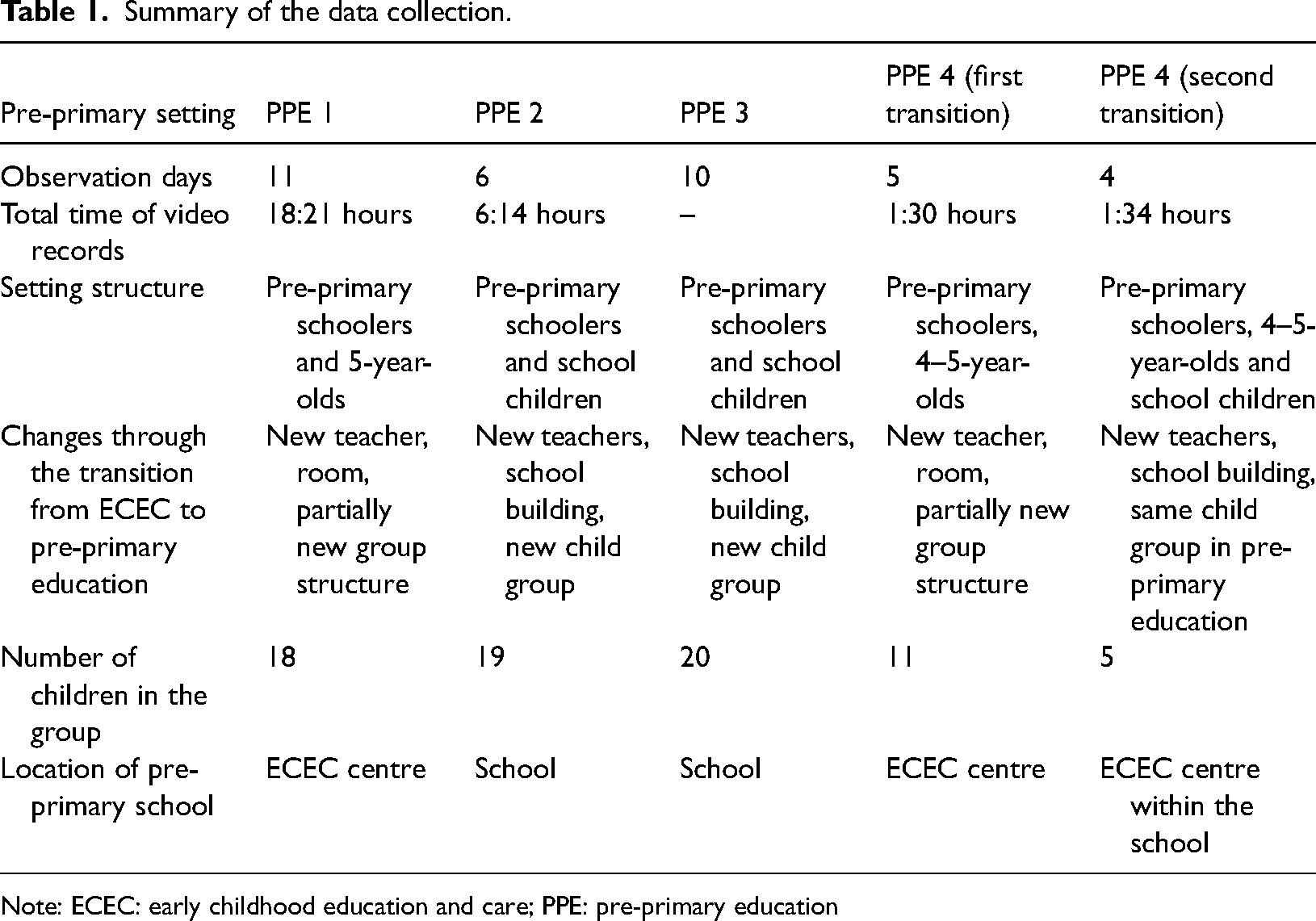
Note: ECEC: early childhood education and care; PPE: pre-primary education
Data were produced through ethnographic field notes and video recordings. The field notes contained descriptions of children's and educators’ social actions and relations, the physical environments and researchers’ notes about various situations. Video recordings included children's daily activities, such as mealtimes, arrivals and departures from pre-primary education, teaching activities and free playing time. The total time of the video recordings varied based on the children's and educators’ consent. Thus, the main focus of the analysis was on the field notes.
Analysis
Adopting a relational perspective within theory-informed thematic analysis (Braun and Clarke, 2023), we focused on social action as well as inter- and intragenerational relations at the beginning of pre-primary education. Using ethnographic field notes and transcribed video recordings, we selected 262 episodes for deeper analysis, focusing on discussions around ‘being and acting like a pre-primary schooler’. These discussions between children and educators were understood as daily negotiations in which age-based relations and power positions are formed, specifically in terms of legitimising, valuing or forbidding certain ways of being and acting (Bourdieu and Wacquant, 1992). Bourdieu's concepts of capital and distinction were used to interpret how children's positions and resources were constructed and recognised within these discussions and everyday practices. Theory informed the coding process and the thematic structuring of the findings.
The data were analysed in line with thematic analysis (Braun and Clarke, 2023). First, we coded the data to identify the characteristics, skills and competencies (resources) associated with the children. Focus was placed on how pre-primary schoolers were categorised in relation to ECEC children and older school-aged children. Special attention was paid to how the positions between children were constructed through these relational comparisons regarding their resources. These constructions were further interpreted through the concept of distinction, highlighting how differences between children were enacted legitimised and exclusionary processes. Finally, we examined similarities and differences in how children's positions were constructed in two different pre-primary education settings.
Ethical considerations
The methodology and methods of this study are part of a larger research project (Trace in ECEC project) that followed the ethical guidelines of Finland's National Advisory Board on Research Ethics (TENK, 2019). Written informed consent was obtained from the adult participants, including teachers and childcare providers, who gave consent only for their own participation in the study.
During fieldwork, children and adults were observed by the first author and three research assistants. In planning the data collection, all the researchers adopted the ‘least adult role’, which involved avoiding the actions of educational staff by sitting on the floor or at the children's tables and participating in activities like the children (Atkinson, 2019). Aside from written informed consent, children's agreement to participate in the research was negotiated and observed in situ over time by having spontaneous discussions of agreement and observing the children's non-verbal communication (Rutanen et al., 2023). Both methods helped the researchers respect the children's situational refusal (when this was the case) to participate in the written field notes, interviews and filming of the daily action. During fieldwork, the children were encouraged to ask questions and express their ideas about the current and forthcoming data collection sessions. After fieldwork, the children's names and other identification details were pseudonymised, and all staff members were identified as ‘educators’.
Transition to pre-primary education in ECEC centres
Analysis showed that at the beginning of the pre-primary year, categories of novices and experts were created between ECEC children, preschoolers and schoolchildren. The categories of novice and expert were used to underline the transition and the changes it brought to the actions and positions of children. Depending on the location of pre-primary education, age-based relations and resources provided contextually different positions and distinctions for the children. In ECEC centres, the most important resources included academic and culturally embodied ones, which provided pre-primary schoolers with expert positions in relation to younger ECEC children.
Pre-primary schoolers as experts relative to novice ECEC children
The categorisation of ‘expert’ was constructed by identifying how children were positioned at the beginning of the pre-primary year. This categorisation emerged relative to younger ECEC children. At the beginning of the pre-primary year, both children and educators expressed a high regard for pre-primary education, indicating its perceived importance and value in the educational process. The shared understanding of the position of pre-primary schoolers in ECEC centres was shaped by the children's age- and context-based competency, through which the children's resources were acquired. Pre-primary schoolers were the oldest children in ECEC centres; this was the key element in the rationale for assigning children to pre-primary activities (from which, younger children were excluded). Also, educators and children’s pre-primary education activities were clearly differentiated from early childhood education ones. Unlike early childhood education, pre-primary education was seen as an academic institution, where participation in daily activities was considered to require more academic (preliminary reading and writing skills, mathematical skills) and cultural resources (knowledge of general rules, eating with cutlery, sitting quietly during guided activities, dressing independently) from children. Competencies and knowledge act as resources which are connected not only to the new position of children but also to their age, as pre-primary education is only for six-year-olds.
The pre-primary time (4 h/day) was attached to the physical place of the ECEC centre; thus, it defined who (children of different ages) and when could use the rooms during the day. In this sense, the position of pre-primary schoolers also strongly materialised in the physical environment. In both pre-primary settings, the new pre-primary schoolers had specific rooms called ‘pre-primary rooms’. Pre-primary schoolers also had shelves with their name tags, pencils, notebooks, computer tablets and board games, which excluded younger children from certain activities. These age-based materials, routines, spaces and relations were formed at the beginning of the pre-primary year, thus establishing the basis for distinctions between children in the ECEC centre.
The distinctions between children in early childhood education and pre-primary schoolers were also emphasised by certain practices that gave pre-primary schoolers privileges in ECEC centres. Pre-primary schoolers also made distinctions between themselves and ECEC children by using their social, material and cultural knowledge of how pre-primary education had been organised in previous years. The reproduction of power relations and distinctions was maintained through age-based relations and practices, through which educators recognised the knowledge children had accumulated during their previous years in ECEC, and thus gave preschoolers social recognition. In one of the early childhood education centres, children were invited to assist the teacher with special tasks and were allowed to jump the line, which was highly valued among the children. In general, children were aware of the differences between early childhood education and pre-primary education, especially in regard to the physical environment: these distinctions excluded younger children from places and activities for pre-primary children but also reproduced and reinforced their power relations. These situations sometimes provided children with resources, as shown in the following excerpt, where adults acknowledge children's experiences and skills acquired in previous years: Aapeli (aged six) tells the educator, who is usually not included in their group, that he goes to the front of the line because he is an assistant for the day. The educator says, ‘Good to know about this kind of rules’ and allows Aapeli to go to the front of the line. (Fieldnotes)
In the above excerpt, the children's accumulated skills and experiences from previous years are acknowledged in various ways. Aapeli's strategy is to maintain his new power position and long-awaited privilege (passing others in line), which belong only to pre-primary schoolers. The educator, who is usually with the younger ECEC children, is not familiar with the assistant practice, which also shows that a similar practice is not used with the other ECEC children. Nevertheless, the educator still believes in Aapeli, which indicates the educator's expectations of pre-primary schoolers’ competency and expertise regarding the cultural rules of the action. In this sense, Aapeli's position as a pre-primary schooler provides him with a social resource (social acknowledgement) to pass younger children in line in the presence of the educator, who also indirectly acknowledges Aapeli's culturally embodied notion (assistant practice) that younger children cannot be first in line or at least not in front of pre-primary schoolers.
Pre-primary schoolers as novices relative to expert school pupils
The categorisation of ‘novice’ was constructed by highlighting age-related hierarchies and symbolic boundaries through academic activities and resources. At the beginning of the pre-primary year, educators usually emphasised that pre-primary education is a place for learning school skills for the forthcoming transition to primary school. The distinction of pre-primary schoolers relative to school children comprised ideas that primary school entails a more academic-orientated education that includes reading and writing skills, which the children did not need to possess in their present position. Moreover, knowing numbers over 100 and independently remembering homework were skills considered to belong to the primary school level. In ECEC centres, educators made clear distinctions between pre-primary education and primary school. This was especially evident in Pre-primary Setting 4, which participated in a national trial for two-year pre-primary education. In this setting, an educator expressed frustration, saying, ‘The children are not suddenly independent, and not all have turned five years old yet! So, through play, that’s how we learn here.’ This highlights how children's age-based competencies and their ability to act are valued.
However, children were expected to learn the basics of academic skills in pre-primary education through school-like 45-min lessons. During the lessons, children were expected to learn to do activities precisely and quietly, and to raise their hands to ask for permission to speak, in preparation for the following year's school transition. During the first days, educators guided the children to act without delay in daily micro-transitions, such as getting dressed after an outdoor activity and going back to the classroom, so they would learn to use their time during break times at school the following year. Comparing children’s age-based positions, pre-primary schoolers were considered novices in relation to primary school children and the upcoming transition to that academic level. This was not evident in the everyday practices of pre-primary schoolers, but it was embedded in differences that arose in situations where the upcoming transition to school was negotiated: The children are sitting at their desks during mathematical activities. ‘Now we will practise the orthodox way of doing numbers one to three, just like the teachers teach in school,’ the educator says. Alma (aged six) is huffing, ‘Now I did not get it right’ and erases the numbers from the workbook. The educator replies, ‘Yes, even if you can count well and recognise the numbers, writing the numbers is something that we need to practise. And this is what we will do here in pre-primary education.’ Meiju says, ‘Yes, so that we will also have beautiful handwriting in school.’ … Now, the educator asks the children to count how many characters are in the picture. ‘Raise your hand and wait, bite your tongue!’ However, Alma answers aloud instantly. The educator puts her hand on Alma's shoulder and hushes her. Alma whispers to the educator, ‘I don’t know how to be quiet.’ The educator says, ‘But you need to learn that in school. You cannot talk all the time. It might disturb others’ concentration.’ (Field notes)
Transition to pre-primary education within the school
In pre-primary education within school settings, novice and expert categories were also generated by making distinctions between ECEC children, pre-primary schoolers and schoolchildren. However, in the transition process in this setting, the resources of preschoolers were not recognised in the informal or more formal activities guided by adults.
Pre-primary schoolers as novice ECEC children.
The categorisation of novice was represented regarding how cultural and embodied resources of pre-primary schoolers were recognised in relation to older school-age children; thus, by making distinctions between the different age groups of children. When the transition from ECEC to pre-primary education occurred within the school setting, pre-primary schoolers started their pre-primary year in unfamiliar environments, with school pupils. In such a transition process, children entered a new daily rhythm and routines defined and limited by educators and school schedules. Thus, the distinction in pedagogical activities between ECEC and pre-primary education was clearer. Regarding cultural and physical skills, teachers required children to practise dressing independently, eating without delay and behaving quietly in formal settings, as part of their preparation for the transition to school. However, these skills had already been a significant part of early childhood education.
At the beginning of the semester, the negotiations regarding the transition to pre-primary education and the positioning of pre-primary schoolers were conducted by adults within the school. This kind of adult-based action mirrors the intergenerational order of pre-primary education, in which educators have the power to define the activities. However, regarding the transition, the adult-based action also reflects adults' views on children's accumulated resources. Due to the unfamiliar physical school environment and the lack of a history of relations between the children and educators, pre-primary schoolers did not hold the same valued position as they did at the ECEC centres, where they were the oldest and most competent relative to younger children, and were familiar with the setting. Instead, pre-primary schoolers were seen as novice ECEC children within the new age-based relations and their physical and socio-cultural place within the school. However, the children seemed to use their accumulated resources from their ECEC years by tapping into their memories and known characteristics from that period. It is the first day of pre-primary education. Piia (aged 6) says, ‘This does not feel like pre-primary education because I have been here earlier’. (Note: Piia refers to the days when pre-primary education had not officially started.) The educator says, ‘Yes, in here, we do things a little bit different from ECEC but also some same things’. Piia wonders, ‘Oh, really? Some same things as well?’ The educator continues, ‘Yes, in the beginning, we will do some of the same things because the new children need to get used to this place, but yes, after that, many new things will come, too’. (Field notes)
Novice pre-primary schoolers relative to expert school pupils
The categorisation of novice was also shaped by adults and children, who made distinctions regarding children's academic, embodied and cultural resources between different ages. At the beginning of the pre-primary year, the distinction between pre-primary schoolers and school pupils was linked to pre-primary schoolers’ lack of knowledge of the school area and its material resources. In addition, children were not allowed to go to the school cafeteria, playground or gym without adult permission. In this sense, the position of pre-primary schoolers did not connect similarly with the physical place as in the ECEC centres, where they were already familiar with the place and its conditions, and were the oldest children in the age-based relations. This required educators to use more time to introduce the physical boundaries of pre-primary settings. The following excerpt describes how the position of pre-primary schoolers as novices was represented through the school pupils, which did not provide resources for the children: This is the first time in pre-primary education to do outdoor activities. The children wear vests so that they can be easily identified from schoolchildren. One of the children, who is already dressed, asks for permission to go outside and wait for the others. The educator says, ‘No. In here, we wait indoors’ … At the yard, the educator first shows the boundaries of the yard to the children before they can play. The children are now waiting for the others at the side of the school. An educator says that when places become familiar to children, they do not need to wait this long. (Field notes)
This excerpt illustrates a common situation at the beginning of the pre-primary year within the school building. Despite the material (vests) and children's culturally embodied resources (previous experiences of outdoor activities in ECEC), the position of pre-primary schoolers is defined as a novice in the unfamiliar environment of the school, in which teachers worry that children will get lost or mingle with older pupils. Although the outdoor area was not fenced, the educators made their own ‘invisible’ boundaries for the pre-primary schoolers, which limited their movement in the school area. At the same time, older pupils could use all the areas freely. However, the educator's statement at the end of the excerpt describes how things will change in the future. It highlights the children's growing knowledge of the place and their increasing skills. Here, the interplay between age-based relations and a new physical place within new cultural circumstances did not provide any resources to the children, and thus produced a novice position for them.
The differences between pre-primary education and primary school were not defined as clearly as in the ECEC centres. In pre-primary education within the school, activities were more school-like than those in the ECEC centres. For example, the adult-guided activities involved more difficult tasks that required more academic competency from the children – such as identifying syllables, reading clocks and simple calculations – than that required from those in pre-primary education within ECEC centres. These school-like activities also required many embodied skills from pre-primary schoolers, such as listening, sitting down quietly and waiting for their turn to speak by raising their hand. However, the educators still made distinctions between the positions of pre-primary schoolers and school pupils through the forthcoming transition to school, which produced a novice position for pre-primary schoolers. In addition to academic and embodied skills, the ability of independently describing their day to their parents, their independence in daily activities and their capacity to listen to instructions were all connected to their future school transition [Fied notes and video recordings]. In the following excerpt, the future school transition merges with pre-primary education, a process where pre-primary schoolers are identified as lacking the necessary resources while still not being provided of them: It is circle time. The educator mentions the lunchtime and sets the Time Timer clock to mark how much time the children have to eat during lunchtime. ‘If you hear a beeping sound, it means “oh no,” and you will try to eat faster next time. With this clock, you will focus better on eating next time.' The educator tells me [the researcher] that they aim for the children to eat in 30 minutes. ‘In this way, we educate the children to eat on time so that they will have time to go on a break in the future.' (Field notes)
Here, the position of pre-primary schoolers is defined by their lack of embodied resources – that is, acting promptly at lunchtime. In addition, embodied skills are connected to the future school transition and school skills, which children need to learn before they enter school. The excerpt describes how pre-primary schoolers are seen as novices who are practising appropriate behaviour at lunchtime, in contrast to older school children, who are assumed to already have mastered these skills. Thus, instead of acknowledging the children's skills in institutional lunch practices, the educator focuses on age-based distinctions, which emphasises the novice position of pre-primary schoolers at the beginning of the pre-primary year.
Despite the adult-based definition of pre-primary education and the children's unfamiliarity with this educational level, the children tried obstinately to use their accumulated social and cultural resources from ECEC by connecting new circumstances to their previous experiences. This was especially evident during their free time, when children engaged in peer relations with familiar children from their ECEC years. However, the use of resources was regulated, especially in adult-guided activities, which increased during the transition. As a result, children were not able to focus on their peer relationships, but rather on adult-guided activities, where a peaceful working environment and a focus on learning were considered the core of pre-primary education: Three weeks into pre-primary education, the children and educators are at the gym. A few moments earlier, the educator announced that the children were not allowed to play their own games during adult-guided activities. This was brought on by two girls who weren’t taking part in the activities but were walking around the gym holding hands. Now, the adult-guided activity is just ending, and the children complain about the lack of free play. The educator explains using her hands, ‘Yes, in pre-primary education, we have this much free time (spreads her hands widely) and this many guided activities (puts her hands a little bit closer together). The younger ones have this much free time when they crawl on the floor (she spreads her arms widely again) and this many adult-guided activities (the space between her arms increases again a bit) … and when you are in school, you only have this much free time left (her hands almost touching [each other]).' (Field notes)
Here, the excerpt describes how pre-primary education and children's positions are presented when this educational programme is imparted in school settings – through age-based relations. In the school context, pre-primary education practices are evaluated from an academic perspective. This means that children’s ways of doing things in ECEC are not recognised, and sometimes not even accepted. From the children's perspective, the educator did not acknowledge their social resources (forming peer relations through play), but instead made distinctions between the different educational settings to highlight children's age-based relations and resources (focusing on adult-guided activities, play no longer being a part of academic-orientated activities). In this sense, the position of pre-primary schoolers is not acknowledged, and emphasis is placed on the school pupils position. Thus, pupils are considered experts, as they have the skills required for academic activities and know that there is less time for play.
Discussion and conclusion
This study aimed to investigate children's resources and positions in the transition process from ECEC to pre-primary education. From age-based relations and resources, the children were categorised as novice or expert in different aspects during the transition. Analyses showed how children’s resources were acknowledged differently depending on the location where pre-primary education was imparted. In ECEC centres, pre-primary schoolers were seen as competent and having a lot of resources, while in the school context, their competence was questioned and their resources were not recognised. This result is consistent with previous studies of different pre-primary education contexts (Brotherus, 2004; Havu-Nuutinen and Niikko, 2014). Using a relational approach to intra- and intergenerational relations provided a productive framework for investigating children's own contributions through age-based relations.
Using Bourdieu and Wacquant's (1995) concepts of resources and distinctions, our findings show how children are active participants in the transition process by reproducing and defining their new positions through their transition resources. This was especially evident within ECEC centres, where children demanded and received the privileges of pre-primary schoolers at the very beginning of the pre-primary year. Fundamentally, the relational approach underlying this study posits that what children do, or what is considered possible for them, plays a crucial role in shaping how their position is constructed. Age-based distinctions involved two important resources, academic and cultural, in line with previous studies (Brotherus, 2004; Karikoski, 2008; Lappalainen, 2008). Regarding the importance of academic and cultural resources, the transition from early childhood education to pre-primary education seems to represent a shift toward a more academically orientated pedagogical framework that emphasises independence, with a central focus on how children are viewed as learners (Dunlop, 2002, 2003). According to Dunlop (2002: 98), understanding the different views of children as learners may help to consider why some of them have smoother and easier transitions than others.
Pre-primary schoolers’ positions – novice and expert – were linked to the changing circumstances of the transition space, and to children's possibilities to define that transition. Our findings show that identifying children's resources in the school environment was more challenging and slower than in ECEC centres. The findings point to age-based positions, where pre-primary schoolers seem small and novice compared to older schoolchildren. In this position, their resources were not recognised as important, which prevented them from participating in and influencing the transition process. When children's resources and previous experiences are not acknowledged in the transition process, difficulties may arise, particularly for those who face additional challenges in adjusting to new educational settings or circumstances, such as those with limited prior experience or support (Fast, 2007; Sandberg, 2012). Based on our findings, the children did not have the opportunity to determine the conditions of their transition to pre-primary education, and their activities were more limited by the adults and the unfamiliar circumstances in the school setting. This raises critical questions about whether the two different pre-primary education contexts provide equal opportunities for all children in Finland, given that several resources depend on space-based relations among children (OECD, 2017).
The findings also indicate the unclear position of pre-primary schoolers, as found in other studies (Brotherus, 2004). These findings highlight the need for educators to be aware of the differences in the transition process from ECEC to pre-primary education. We recommend that educators critically reflect on transition practices and consider what expectations these practices create for children. Transitions involve numerous changes. Therefore, professionals should find ways to support children's agency and provide them with opportunities in all pre-primary education contexts. Previous research has shown that young children starting ECEC are often perceived as inexperienced and not yet competent. It is therefore important to recognise that even young children have resources and the ability to act during transitions (Çan et al., 2023, 2024; Raittila et al., 2024). The transition from ECEC to pre-primary education seems to construct a liminal space in which children become pre-primary schoolers who are simultaneously ‘future school children’ and ‘ex-ECEC children’ (Beech, 2011). These simultaneous but different definitions of children's positions can produce inequalities concerning how these aspects are emphasised in intra- and intergenerational relations, and how different social spaces support or prevent the use and accumulation of children's resources.
Footnotes
Declaration of conflicting interests
The authors declared no potential conflicts of interest with respect to the research, authorship and/or publication of this article.
Funding
The author(s) disclosed receipt of the following financial support for the research, authorship and/or publication of this article: This study is part of the Trace in ECEC project, supported by the Academy of Finland (grant no. 321374). This research was also funded by the University of Jyväskylä and the Finnish Cultural Foundation.
