



Abstract
The purpose of this scoping review is to gain insight into the empirical research conducted regarding young children's resistance and opposition to teacher norms and rules in the pedagogical context of early childhood education and care. A total of 52 publications in English, Danish, Swedish and Norwegian published between 1989 and 2023 was analysed. The studies used a variety of data collection methods and were conducted in 13 countries. They were published in 29 academic journals as well as in books and doctoral theses. A qualitative content analysis of the publications investigated the children's strategies/tactics of resistance, dividing them into the categories of open and hidden resistance. The results indicate that the publications, to a large degree, focus on open and visible forms of resistance, identifying a gap in the research regarding more discreet and silent types of resistance. The analysis also showed the potential for widening theoretical approaches and drawing inspiration from the field of resistance studies.
Introduction
In 2017, the term ‘resistance’ entered the Framework Plan that guides Norwegian early childhood education and care (ECEC) teachers’ work. Under the heading ‘Formative Development’, the framework plan now states: ‘Kindergartens shall use interaction, dialogue, play and exploration to help the children develop critical thinking, ethical judgment and an ability to put up resistance and take action in order to effect change’ (Ministry of Education, 2017: 21). Thus, the ability to resist is framed as something desirable and explicitly linked to the development of critical thinking and the ability to create change. This expression is unique and specific to the Norwegian context, but other countries’ ECEC steering documents also emphasize how children should learn negotiation and conflict management skills. Thus, we argue that the theme of children's resistance and opposition is of great importance in the study of childhoods and ECEC worldwide because of its potential to broaden knowledge of children's agency and democratic participation.
Around the time that the concept of resistance was included in the Norwegian Framework Plan, several Nordic researchers wrote about resistance in relation to democratic participation and children's agency (Dolk, 2013; Johansson and Emilson, 2016; Pettersvold, 2015; Seland, 2013). Øksnes and Samuelson (2017) also published an edited volume simply titled Resistance (Motstand in Norwegian) in a book series called Childhood in ECEC, where contributors from Sweden, Denmark and Norway discuss many aspects of democracy, agency and participation both based on empirical data and in a theoretical context. The theme of how ECEC children's subversive activities can contribute to democratic participation has also been studied in other parts of the world in both empirical studies (Lekkai, 2016; Salonen et al., 2022; Schultz, 1989; Tesar, 2017; White, 2017) and theoretically based discussions (Øksnes, 2017; Seland, 2017; Tobin, 2005). All these authors share the perspective that a child's ‘no’ and oppositional behaviour should not be seen as problematic signs of ‘disobedience’. Instead, they highlight the potential for democratic participation that arises when one frames children's resistance, opposition and negotiation tactics as an attempt to be heard and assert agency. However, despite the growing interest in children's resistance, many researchers in the field are unaware of each other's work and, with the exception of Dolk (2013), none incorporate perspectives from resistance studies.
Resistance studies is a growing transdisciplinary field within the social sciences and beyond, focusing on the intricate dynamics of power and resistance in various contexts. However, pedagogy and childhood studies are notably under-represented in this field, as evidenced by the articles published in the Journal of Resistance Studies. This peer-reviewed academic journal, in publication biannually since 2015, has yet to feature contributions focused on children's resistance (we reached this conclusion after reading all of the titles and abstracts in all of the issues of the journal published to date). Within resistance studies, there is an open invitation to incorporate new perspectives (Vinthagen, 2015, 2021) and a call for more research on resistance within welfare state contexts (Sørensen et al., 2019). Since ECEC is a component of welfare services, investigating children's resistance holds value not only for researchers specializing in children and childhood, but also for enriching other fields. For example, the unique asymmetric power relations (where teachers generally have the child's best interests at heart) provide a distinct perspective on the power–resistance nexus, as the context significantly differs from many others.
Until now, no one has attempted to conduct a review of children's resistance to teachers’ norms and rules. Thus, we conducted this scoping review with the purpose of gaining insight into what empirical research has been conducted regarding young children's resistance and opposition to teachers’ norms and rules in the pedagogical context of ECEC. We applied a qualitative content analysis and describe our method in more detail below. Subsequently we present our findings, before we discuss the findings and draw conclusions. By providing an overview of what research exists and where the gaps are, we make it possible to establish a more coherent vocabulary for talking about children's resistance, which again is necessary in order to articulate how children's resistance can be seen as a resource that can contribute to their agency and democratic participation.
Method
According to Tricco et al. (2018: 1): ‘Scoping reviews [are] a type of knowledge synthesis [that] follow a systematic approach to map evidence on a topic and identify main concepts, theories, sources, and knowledge gaps’. This made a scoping review the most appropriate method for the purpose of our study. We followed the PRISMA-ScR (Preferred Reporting Items for Systematic Reviews and Meta-Analyses Extension for Scoping Reviews) and, shortly after the search was conducted, published our protocol on Open Science Framework. A scoping review can take a more qualitative approach when analysing the articles included than other types of reviews. Thus, we conducted a content analysis of the 52 included publications to understand how the authors conceptualized resistance, their theoretical perspectives, and what strategies and tactics of resistance the children engaged in.
Search strategy
The search for literature was conducted in different types of information sources: academic databases, online library catalogues and search engines. The original search string (Table 1) was in English and included three elements. In order to reflect the fact that different pedagogical traditions have different understandings of resistance and opposition, Element 1 includes terms that are positive and negative, as well as neutral.
Search string in English.
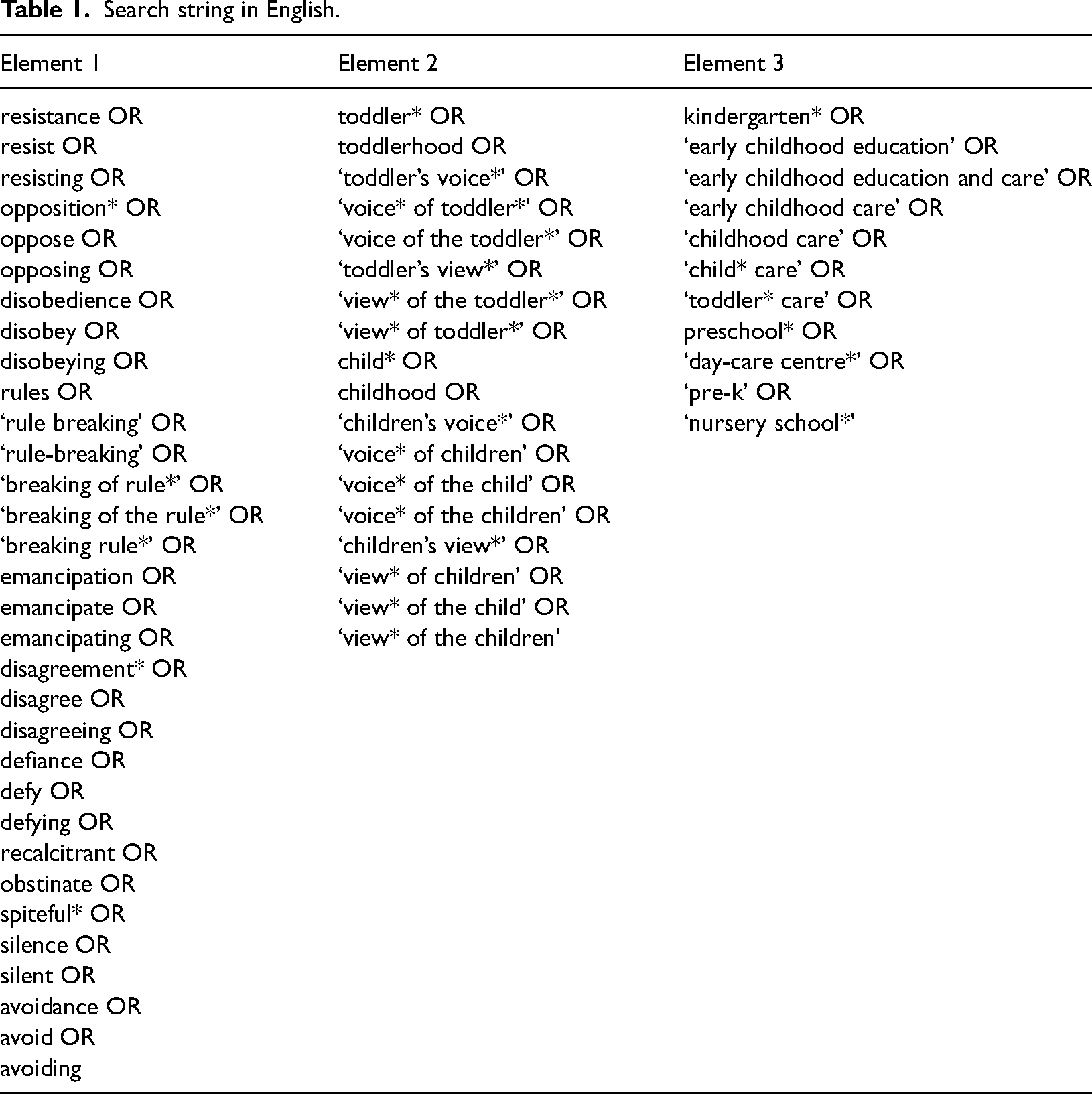
Afterwards, the search string was translated into Norwegian, Swedish and Danish. However, it had to be shortened due to the limitations of the library catalogues and search engines used for these Scandinavian languages, which could not accommodate as many words and elements as the academic databases used for English searches.
The search for peer-reviewed journal articles in English was conducted across five academic databases – Education Source, ERIC, Teacher Reference Center, APA PsycInfo and Academic Search Premier – on 15 March 2023. The search was limited to articles published between 1970 and 2023.
The searches for peer-reviewed journal articles and books written in Norwegian, Swedish and Danish were conducted across several library online catalogues, search engines and databases: Oria, National Library of Sweden, DiVA portal, Nora-Research Portal Denmark, Royal Danish Library, Google Scholar, SwePub, and Nordic Base of Early Childhood Education and Care (nb-ecec.org). The date for these searches was 30 March 2023. When relevant and possible, the result lists were limited to the publication years 1970–2023.
Additional searches for books in English were conducted in the online catalogues of the British Library (19 September 2023) and Library of Congress (20 September 2023). There was no limit on the year of publication in these two searches due to the small number of results. More details are available in the search documentation. Due to the cyberattack on the British Library in 2023, we were not able to access the results of the search, and the results are not included in this review.
The search strategy described above was designed in collaboration with a senior librarian and resulted in 1857 results for English-language articles; 56 results for English-language books; 183 books, book chapters and articles in Norwegian; 328 books, book chapters and articles in Swedish; and 367 books, book chapters and articles in Danish. These numbers exclude Google Scholar, the use of which resulted in several thousand results for each language. For Google Scholar, we screened the first 50 results.
For the English-language articles, we used the software Rayyan when screening their titles and abstracts. The first author screened all the results and the second author screened 20% of the results. When there were inconsistencies in our evaluation, the team easily resolved these through discussion. Since there was no simple way to import the results from the Scandinavian-language databases into Rayyan, we did this screening manually. Here, we used the same strategy as with the English-language articles: the first author screened all the results and the second author screened 20% of the results. Our review also includes four publications that we did not find with the search strategy described above. Two of these (Markström, 2005; Schultz, 1989) were repeatedly referred to by other authors and, when we read them, fulfilled all the criteria for our review. We also added Seland (2013) and Kibsgaard (2019), which we were already familiar with.
The screening of the abstracts resulted in the inclusion of 52 full-text publications in English, Danish, Swedish and Norwegian.
Inclusion and exclusion criteria
The studies included in this scoping review are based on empirical data on child–adult interactions in ECEC. The children had to be six years of age or younger and without a reported diagnosis. Although we are aware that in some places eight is the upper age for what is considered ECEC, we decided on six because that is when children in Scandinavia transfer from ECEC to school, and most places have an even earlier transfer age. We included only publications that analyse naturally occurring instances of children's resistance and opposition to adult rules in a pedagogical context, or children's and adults’ accounts of such naturally occurring instances. Thus, for instance, all publications that were based on experiments or parents’ experiences were excluded. We also excluded publications that reported research on some type of diagnosis. Reviews, study protocols, Master’s theses, editorials and purely theoretical publications were also excluded. These criteria meant that many interesting publications were excluded – for instance, when they were primarily about child–child interactions (Arnott, 2018), did not meet the age criteria or were not from an ECEC setting (Shayan, 2022). We included studies that had a primary focus on something other than resistance and opposition – for instance, meals, gender or children's art – as long as they reported results and analysis concerning resistance and opposition to norms and rules, and fulfilled the other inclusion criteria.
We divided the reading of the full texts of the 52 publications equally between the three authors, working in an Excel spreadsheet to produce an overview of the content of the texts. To create a common understanding of how to analyse the publications, we organized a seminar where we discussed 15 random texts. This process resulted in our decision to note the following data for each of the included publications: (1) title; (2) journal; (3) language; (4) age of children; (5) country of study; (6) design and method; (7) main focus of study; (8) central concepts and definition of resistance/opposition; (9) number of resistance/opposition instances analysed; (10) strategies/tactics of resistance documented; and (11) theoretical perspective in the analysis. While categories 1–6 and 9 are factual and easily quantifiable, the rest required a qualitative content analysis. Since many of the publications did not mention the children's gender, race and socio-economic background, it was not possible to analyse this in a meaningful way. However, it is our impression that many studies include children from diverse backgrounds.
Findings
Countries of origin and where publications were published
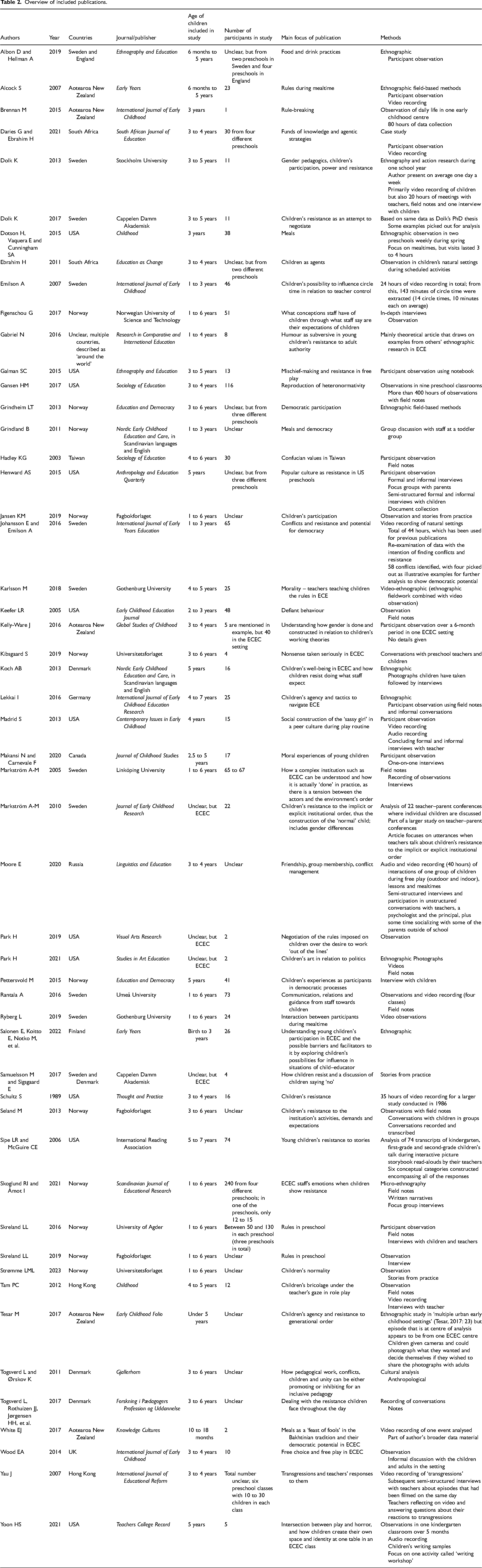
Based on our selection criteria, we identified 52 relevant publications: 38 peer-reviewed articles from academic journals, three peer-reviewed articles from two anthologies, seven doctoral theses and four textbooks. Of the 41 articles, 32 were written in English, four in Norwegian, three in Danish and two in Swedish. Of the seven doctoral theses, five were in Swedish and two in Norwegian. All four textbooks were written in Norwegian. The publications are from different parts of the world (see Table 2). A total of 13 countries are represented, which we consider a relatively low number. The articles included in the review were published in a variety of academic journals (29 in total). As shown in Table 2, the International Journal of Early Childhood published four of the articles; all of the other journals published one or two articles.
Overview of included publications.
Methods used
All of the studies we reviewed applied qualitative designs, but there were variations in their data collection methods. These methods included observation, note-taking, video recordings and interviews. Specifically, 19 publications relied solely on observation and three used only video recordings; 17 studies utilized multiple methods, combining approaches such as observation, interviews and video recordings. Notably, all of these multimethod studies included video recording as a technique. We find it noteworthy that approximately half of the studies relied on video recording either as the only method or as part of a design that included more than one method.
When interviews or conversations were used, they mostly involved ECEC teachers. In all, 11 studies used interviewing as their only method or combined it with other methods. Two studies that stand out as different in terms of data collection are Pettersvold (2015), who conducted semi-structured group interviews with 41 five-year-olds, and Markström (2010), who analysed teachers’ accounts in teacher–parent conferences of children's resistance.
The sample sizes in the reviewed studies ranged from one child to 73 children, reflecting a significant variation in the number of participants. However, calculating an average was challenging because not all publications precisely described the number of children involved. In all of the studies examined, the children were six years of age or younger. We noted that the Nordic studies tended to focus more on the youngest children, aged one to three. One possible reason for this trend is that Nordic countries have a higher proportion of one- to three-year-olds attending ECEC compared to other regions. Additionally, the Nordic perspective tends to view children and ECEC as part of an educational institution rather than merely childcare.
Main focus
The main focus of the publications included in this review varies greatly, and only a minority have children's resistance and opposition to norms and rules as their main focus. The large majority of the studies are about something else other than resistance and opposition, such as democratic participation (Dolk, 2013; Grindheim, 2013; Johansson and Emilson, 2016; Pettersvold, 2015; Salonen et al., 2022), children's agency (Daries and Ebrahim, 2021; Ebrahim, 2011; Lekkai, 2016; Tesar, 2017), Confucian values (Hadley, 2003), gender and heteronormativity (Gansen, 2017; Kelly-Ware, 2016), art (Park, 2019, 2021), friendship (Moore, 2020), morality (Karlsson, 2018; Makansi and Carnevale, 2020), meals (Albon and Hellman, 2019; Alcock, 2007; Dotson et al., 2015; Grindland, 2011; Ryberg, 2019; White, 2017) and parent–teacher conferences (Markström, 2010). A significant number of studies focus on play as their main topic, encompassing teacher-directed play, free play and role play. Additionally, some of these studies also examine rules, rule-breaking, defiant behaviour or mischief-making as forms of resistance.
Although children's resistance is not explicitly addressed as the main theme in most of the publications, it nonetheless emerges as a prevalent topic in the examples analysed by the authors. Several studies have examined children's opportunities to influence their everyday lives and how teachers can communicate with children in a way that prevents them from feeling the need to resist (Salonen et al., 2022; Strømme, 2023).
Central concepts and understandings of resistance
The publications rarely explicitly discuss definitions of resistance and opposition, and a likely explanation for this might be that most do not have resistance and opposition as their main theme. However, there are some exceptions in studies that have resistance or opposition as their primary focus. Johansson and Emilson (2016) define resistance as both individual and collective enterprises that can be expressed verbally, bodily and/or as silence. Dolk (2013) not only talks about individual and collective resistance, but also mentions resistance as being either open or hidden – a distinction she brings from the field of resistance studies. Below, when we present the different strategies and tactics children used to resist, we will use the same terminology.
When the authors discuss resistance and opposition, they point out how it can be forms of freedom from staff norms and rules. The studies show various possibilities for children to reverse the hierarchical relationship between teacher and students, including the use of negotiation (Dolk, 2017; Lekkai, 2016; Park, 2019, 2021), exercising the independence of decision-making (Keefer, 2005), how using nonsense is regarded as a productive force of resistance (Kibsgaard, 2019), ‘togetherness’ and ‘freeing up’ rules, and how acts of resistance are concrete experiences of freedom (Alcock, 2007). Other examples include children's resistance to behaving as ‘good’ students (Hadley, 2003), and how those with less power often find ways around rules that limit their behaviour (Henward, 2015). Some authors also draw attention to how children's possibility for influence is limited. Keefer (2005) describes how children have the inability to break free from prior decisions made by staff, and Alcock (2007) uses the term ‘powerlessness’ to describe the situation from the children's perspective. Several studies show how mealtimes are an arena where children have opportunities to resist staff authority (Albon and Hellman, 2019; Alcock, 2007; Dolk, 2013; Dotson et al., 2015; Grindland, 2011; Moore, 2020; Ryberg, 2019; White, 2017). Furthermore, we identified a number of terms being used when children break the rules. One author uses the term ‘transgressions’ as an explanation for when children break rules (Yau, 2007). Another explains resistance as a protest against something that is perceived as unfair (Jansen, 2019). Dolk (2013) uses the term bångstyriga, which is difficult to translate but means something along the lines of ‘mischief-making’.
Strategies and tactics of resistance
The number of documented episodes of resistance varied from 1 to 68, but most publications presented only one to three instances of children resisting teachers. As can be seen in Table 2, Yau (2007), with 68 episodes, really stands out in our data set. While the studies underlying the other publications might include more episodes than those mentioned, this is rarely quantified. This is hardly surprising, given that many publications did not focus primarily on resistance.
Regarding the strategies and tactics engaged in to undermine and challenge teachers’ norms and rules in ECEC, the children's creativity is wide-ranging. Following Dolk (2013), we divided them into open and hidden resistance when analysing the publications. This terminology originates in resistance studies, where it is widely used in the context of researching ‘everyday resistance’ (Johansson and Vinthagen, 2020).
Open resistance
When it comes to forms of open resistance, the authors use a variety of terms to describe what the children do to resist. The term ‘refusal’ is popular and includes examples of foot-dragging (Brennan, 2015); not following or breaking rules set by the teacher (Albon and Hellman, 2019; Brennan, 2015; Dolk, 2013; Emilson, 2007; Figenschou, 2017; Gansen, 2017; Jansen, 2019; Johansson and Emilson, 2016; Park, 2021; Ryberg, 2019; Skreland, 2016, 2019; Yau, 2007); explicit (Brennan, 2015) or verbal protest (Dotson et al., 2015; Johansson and Emilson, 2016; Lekkai, 2016; Markström, 2010); sitting down or refusing to clean up when it is clean-up time (Rantala, 2016); and denying having done anything wrong (Karlsson, 2018). Another term used by the authors is ‘ignoring’. Examples of this type of action include running away (Brennan, 2015; Kibsgaard, 2019) or hiding (Skreland, 2016); avoidance (Ebrahim, 2011); not answering the teacher and continuing to play without even looking at the teacher (Lekkai, 2016); and doing something other than what they are being told to do (Daries and Ebrahim, 2021). As we can see, there is considerable overlap between refusing and ignoring. Many authors also describe instances of ‘physical resistance’. Examples of these actions are throwing things (Alcock, 2007; Brennan, 2015; Keefer, 2005); rocking chairs and scraping tables (Alcock, 2007); children spitting, moaning and sticking their tongue out (Madrid, 2013; Skreland, 2016); shouting (Galman, 2015), hitting and pushing (Togsverd et al., 2017); and emotional expressions like being angry or sad (Togsverd and Ørskov, 2011) or starting to cry (Salonen et al., 2022; Skreland, 2016). One of the authors also describes ‘threats’ as a resistance strategy. Here, the example is that a child threatens to pour ‘compost water’ on the floor and over the teachers (Alcock, 2007). Other terms include the ‘use of humour’. Examples here are when children explore taboo topics like pee and poo (Gabriel, 2016; Kibsgaard, 2019; Skreland, 2016); make faces in circle time to get other children to laugh (Kibsgaard, 2019); joke with names or ages to distract the teacher (Hadley, 2003; Kibsgaard, 2019); or just use humour as resistance (Dolk, 2013, 2017; Johansson and Emilson, 2016; Strømme, 2023). We identify all these strategies as open resistance because teachers can both see and experience them.
Hidden resistance
Although more than a third of the publications mention various forms of hidden resistance, it is sometimes only mentioned in passing and rarely given as much space as open resistance. When the authors do write about hidden resistance, there is again great variation and creativity in what the children do. It is mostly performed when the teacher is not paying attention to the children or when the children know they are doing something that is ‘not allowed’. Examples of hidden resistance are children ‘sneaking in’ or bringing in toys that are not allowed (Henward, 2015; Madrid, 2013); how children ‘smuggle’ in their own genres in role play (Tam, 2012); talking about the teacher when the teacher is not present (Madrid, 2013); monitoring the location of the teacher (Henward, 2015); checking to see if the teacher knows what they have been doing (Tam, 2012); switching the topic when the teacher is not present (Yoon, 2021); waiting for the teacher to be out of sight (Henward, 2015); continuing to do what they were doing when the teacher is no longer paying attention (Daries and Ebrahim, 2021); sneaking back to a space when the teacher is not looking (Henward, 2015); and transforming a teacher-created play space into something else (Galman, 2015). Other examples include children pretending to do what they are told or expected to do (Dotson et al., 2015); remaining silent (Dotson et al. 2015; Keefer, 2005; Yau, 2007); or having secrets (Tesar, 2017). Pettersvold (2015) gives an example of children collectively making secret strategies to resist teachers. Children may also do something they believe is forbidden when no one is looking (Henward, 2015; Park, 2019, 2021) or withdraw from an activity (Dolk, 2013). We identify all these actions as strategies of hidden resistance, as they are not seen by teachers but reported by the researchers. In the examples presented above, most hidden resistance occurs during playtime (both teacher-instructed and free play). This is not surprising, as play is the children's own arena.
Our analysis also revealed that most of children's documented resistance – open as well as hidden – was performed individually. Only four publications present examples of collective resistance by more than one child (Dolk, 2013; Henward, 2015; Pettersvold, 2015; Schultz, 1989), while another publication (Johansson and Emilson, 2016) mentions the potential of resistance being both individual and collective.
Theoretical perspectives
The theoretical perspectives employed in the analysis and discussion sections of the publications vary widely, ranging from sociological and ethical theories to feminist post-structural theories. It is noteworthy that some authors primarily draw from philosophical perspectives, while others integrate these with more contemporary viewpoints. This is not uncommon in ECEC research, as many scholars exploring issues of power, resistance and governance in relation to children and childhood are open to incorporating insights from post-structural thinkers.
Corsaro's perspectives are incorporated to varying degrees in 23 of the 52 publications included in our review (Albon and Hellman, 2019; Alcock, 2007; Daries and Ebrahim, 2021; Dolk, 2013; Dotson et al., 2015; Ebrahim, 2011; Gabriel, 2016; Galman, 2015; Grindheim, 2013; Hadley, 2003; Henward, 2015; Jansen, 2019; Johansson and Emilson, 2016; Karlsson, 2018; Koch, 2013; Lekkai, 2016; Madrid, 2013; Markström, 2005, 2010; Ryberg, 2019; Seland, 2013; Skreland, 2016; Tam, 2012). Examples of perspectives from Corsaro include when the authors connected their studies to childhood, peer culture and children's agency – how children are viewed as actors in their own lives. Furthermore, perspectives from Foucault were used in 16 of the publications (Albon and Hellman, 2019; Dolk, 2013; Figenschou, 2017; Gansen, 2017; Johansson and Emilson, 2016; Markström, 2005, 2010; Park, 2019, 2021; Pettersvold, 2015; Rantala, 2016; Seland, 2013; Skreland, 2016, 2019; Strømme, 2023; Tesar, 2017). Examples of perspectives from Foucault include power, disciplining and the surveillance of children. That Foucault was referenced in six publications from Sweden and six from Norway (12 out of the 16) is not surprising as Foucault is presented as a highly influential thinker in the ECEC curricula of universities in Scandinavian countries (Hammer, 2017).
Another popular theoretical perspective relevant to early childhood and resistance is Bakhtin's concept of the ‘carnivalesque’, which was used by eight authors (Dolk, 2017; Gabriel, 2016; Henward, 2015; Kibsgaard, 2019; Ryberg, 2019; Tam, 2012; White, 2017; Yoon, 2021). An interesting finding regarding the use of Bakhtin's theories is that Kibsgaard (2019) is the only one to draw on Bakhtin's ‘frivolity’ and what is considered as exceeding when she discusses young children's use of humour and nonsense as a positive force of resistance. Gadamer is also a central theorist for early childhood education. His theories are mentioned in six of the publications (Kibsgaard, 2019; Skreland, 2016, 2019; Strømme, 2023; Togsverd and Ørskov, 2011; Togsverd et al., 2017). Gadamer is mostly referenced regarding play. Vygotsky, another central theorist for early childhood education, and his theories are drawn on in seven texts (Alcock, 2007; Brennan, 2015; Daries and Ebrahim, 2021; Gabriel, 2016; Keefer, 2005; Ryberg, 2019; Tam, 2012).
Two Swedish authors – Markström and Dolk – are each represented in our review with two publications (Dolk 2013, 2017; Markström, 2005, 2010) and at the same time are relatively popular as a reference among the other authors. A total of 18 publications refer to Markström, either to two articles she co-wrote with Halldén, her doctoral thesis or her newer articles (Daries and Ebrahim, 2021; Dolk, 2013, 2017; Dotson et al., 2015; Ebrahim, 2011; Galman, 2015; Grindheim, 2013; Johansson and Emilson, 2016; Karlsson, 2018; Koch, 2013; Lekkai, 2016; Pettersvold, 2015; Rantala, 2016; Ryberg, 2019; Salonen et al., 2022; Skreland, 2016, 2019; Strømme, 2023). Dolk's PhD thesis was mentioned in six publications (Dolk, 2017; Karlsson, 2018; Rantala, 2016; Skreland, 2016, 2019; Strømme, 2023). It is no surprise that the studies referencing Dolk are only those conducted in Sweden or Norway, as Dolk's texts are written in Swedish.
Omissions
In addition to the findings presented above, it is worth noting what is not reported, discussed or theorized in the publications. First, academic interest in the theme of children's resistance and opposition to teachers’ norms and rules in ECEC is restricted to a relatively limited geographical area. It is also notable that even if many authors mention that resistance and opposition can take many different forms and include discreet forms of resistance such as withdrawal and silence, almost all the empirical episodes that are analysed in depth are of cases of easily observable expressions of dissent. Dolk's (2013) PhD thesis was one of the most elaborate studies on children's resistance we came across, but even Dolk primarily focuses on open resistance. In Chapter 6, which most explicitly explores resistance, there are eight examples of open resistance, where children, for instance, bang on the table or play with their food, and only one example where a child silently withdraws from an activity (Dolk, 2013).
We also noticed that many of the publications only to a very limited degree seem aware of others’ work in the field. Although some mention other authors (e.g. Alcock and Markström), this might be an indication that there is still a way to go before one can talk about children's resistance as a coherent field of research.
Regarding theoretical perspectives, only two publications (Henward, 2015; Tam, 2012) mention De Certeau (1984) and his concept of ‘everyday resistance tactics’, and only Dolk (2013) draws on concepts from resistance studies. Although these concepts were not developed with ECEC in mind, we find it noteworthy that they were not used more frequently among authors writing about children's resistance.
Discussion and conclusion
This scoping review shows that 52 publications published in English, Danish, Swedish and Norwegian between 1989 and 2023 have analysed empirical data on children resisting teachers’ norms and rules in the pedagogical context of ECEC. The studies used a variety of data collection methods, such as observation, video recording and interviews with teachers. The studies were carried out in only 13 countries and were published in 29 academic journals, as well as books and doctoral theses. This indicates that numerous journals are potentially interested in the theme and that it is not ‘owned’ by a few journals. However, the studies are restricted to a relatively limited geographical area, where Norway, Sweden and the USA are the countries that stand out, with the most publications.
When it comes to the year of publication, there is a clear trend that the number of publications on the theme is increasing. Our search included publications dating back to 1970 in case the turbulent end of the 1960s had also resulted in academic interest in young children's resistance and opposition. However, the first article in our review was not published until 1989, and the second did not appear until 2003. Most of the articles were published after 2015.
Children's resistance in ECEC settings
The publications’ authors use a wide variety of terms to describe and analyse children's resistance and opposition. Following the terminology used in resistance studies, we have presented them in two categories – open resistance and hidden resistance – although only one author uses this terminology. The episodes we considered ‘open resistance’ (Albon and Hellman, 2019; Alcock, 2007; Brennan, 2015; Daries and Ebrahim, 2021; Dolk, 2013, 2017; Dotson et al., 2015; Ebrahim, 2011; Emilson, 2007; Figenschou, 2017; Gabriel, 2016; Galman, 2015; Gansen, 2017; Hadley, 2003; Jansen, 2019; Johansson and Emilson, 2016; Karlsson, 2018; Keefer, 2005; Kibsgaard, 2019; Lekkai, 2016; Madrid, 2013; Markström, 2010; Park, 2021; Ryberg, 2019; Salonen et al., 2022; Skreland, 2016, 2019; Strømme, 2023; Togsverd and Ørskov, 2011; Togsverd et al., 2017; Yau, 2007) were when the authors used terms like ‘refusal’, ‘ignoring’, ‘physical resistance’, ‘threats’ and ‘use of humour’ to describe what the children were doing. On the other hand, when authors used terms like ‘silence’, ‘pretending’ and ‘in secret’, we interpreted these as forms of hidden resistance (Daries and Ebrahim, 2021; Dolk, 2013; Dotson et al., 2015; Galman, 2015; Henward, 2015; Keefer, 2005; Madrid, 2013; Park, 2019, 2021; Pettersvold, 2015; Tam, 2012; Tesar, 2017; Yau, 2007; Yoon, 2021). There is no consistency in how the different authors use the different terms, and none of the studies were designed to include data other than what the authors themselves had gathered. To address this, future research should aim to analyse a substantial number of resistance episodes and propose a coherent terminology. This approach would also provide a valuable contrast to the current trend in the literature, where the majority of studies analyse fewer than five episodes of resistance.
The distinction we have drawn between open resistance and hidden resistance highlights a critical gap in the literature – that is, the predominant focus on open and visible forms of resistance. Even though more than one-third of the authors acknowledge various hidden forms, these seldom receive the same level of attention as their open counterparts. We also find that terms such as ‘open’ and ‘hidden’, which may be appropriate in other areas of resistance studies, might not always be the most meaningful in an ECEC context. Since teachers closely monitor young children, it is rare for any form of resistance to remain hidden for long. For future research exploring these types of resistance, we recommend using terms such as ‘discreet’ or ‘quiet’ resistance to emphasize the contrast with overt and easily detectable forms. Such a nuanced exploration has already begun in the field of resistance studies, with scholars advocating for more refined terminology (Lilja, 2022; Lilja et al., 2022). We argue that studies of children's resistance can provide insights that might be of value to the broader research community interested in everyday resistance. One reason why studies involving children can offer new perspectives is the unique power dynamics in ECEC environments, which differ considerably from the political contexts commonly examined in resistance studies. In the context of ECEC, as with many other welfare services, the power exercised by teachers is generally aimed at fostering positive outcomes: teachers establish norms and rules to create educational opportunities and support children's social development and relationships with peers and adults.
Need for future research
We find that there remains a significant need for more research on various aspects of children's resistance, as it offers a crucial avenue for children to express their agency and have their voices heard. Most of the studies we reviewed rely primarily on observation and video recording, indicating a significant potential to diversify the methodologies used for data collection. Alternative approaches could include gathering narratives from teachers about children's resistance through written accounts or interviews or employing quantitative methods. Additionally, collaborative projects that actively involve both children and teachers to gather data could provide fresh insights. Future research should also consider including children with special needs to assess whether their resistance strategies are equally recognized by teachers as valuable resources, compared to children without diagnoses.
Some of the publications investigate resistance within a context of democracy and children's participation – an avenue of research we find highly interesting. Especially when it comes to the more hidden, quiet and discreet forms of resistance, we see the potential for exploring how they could be considered a resource for including children in democratic processes. The publications’ authors include a number of theoretical perspectives from ECEC; nevertheless, we see the potential for widening the theoretical approaches – especially to be in dialogue with research on resistance in other fields. An important question here could be: What is the relationship between young children's resistance and their potential involvement in social movements when they grow up? This question was raised by Schultz in 1989 and remains worthy of research today.
Limitations
This review aimed to identify all of the research that exists on children's resistance to teacher norms and rules in ECEC settings from 1970 to 2023. Despite our rigorous efforts to include all relevant publications, the lack of coherent terminology around the theme makes it likely that there are pertinent publications we were unable to locate with this search strategy. In reviews like this, it is also notoriously difficult to locate relevant articles in anthologies. Additionally, many European countries might also have publications in languages that were not included in this review.
We did not include any purely theoretical publications but noted during the screening that we excluded some texts that were of an abstract or more theoretical nature (e.g. Øksnes, 2017; Seland, 2017; Tobin, 2005). Thus, there might be more theoretical concepts related to children's resistance and opposition in circulation in the literature than we have captured here. Another type of publication we excluded is Master’s theses. However, during the screening, we observed that (especially in Norwegian) there appeared to be a number of Master’s theses on the theme of resistance.
Our review only included publications reporting on naturally occurring instances of resistance. This means that we did not include any highly structured ‘set-ups’ or ‘experiments’, which are typical in psychological studies. For instance, we excluded two articles by Haswell et al. (1981; 1982), because the situation observed was artificially created. This criterion for exclusion might have led to the exclusion of studies that can shed further light on the topic of resistance and opposition in pedagogical contexts and might deserve their own review. Likewise, there is also the potential for studying children's resistance outside of a pedagogical context.
Footnotes
Acknowledgements
We would like to thank Kjell Erik Johnsen, senior librarian at Østfold University College, for valuable advice when designing the search strategy and for conducting the search across the different databases, library catalogues and search engines. Our colleagues Trude Skogsberg and Angela Rieck contributed to some of our early discussions on the theme of children's resistance. A special thank you to Associate Professor Nina Johannessen and Professor Anders Nordahl-Hansen, both at Østfold University College, for their valuable comments on drafts and advice along the way.
Data availability
The data sets generated and analysed during the study are available from the corresponding author on reasonable request.
Declaration of conflicting interests
The authors declared no potential conflicts of interest with respect to the research, authorship and/or publication of this article.
Funding
The authors received no financial support for the research, authorship and/or publication of this article.
