



Abstract
Despite its pivotal role in young children's development and learning, early childhood care and education (ECCE) remains undervalued and under-resourced, with its professional status and recognition often ambiguous. In South Africa, ECCE professionals experience dislocation and marginality within a fragmented system, hindering their efforts to achieve professionalism and consistency in recognition and status. This article examines workforce professionalism in South Africa's ECCE sector, analysing the interplay between policy ideologies and teachers’ understandings. A dual lens of democratic professionalism and transformative feminist perspectives was employed to analyse the sector's challenges within a highly unequal socio-economic landscape. The study combined document analysis of the Policy on Minimum Requirements for Programmes Leading to Qualifications in Higher Education for Early Childhood Development Educators (MRQECDE), and data collection through an online questionnaire with a purposive sample of 208 ECCE teachers from 73 ECCE centres in the Ekurhuleni district of Gauteng province. Findings reveal tensions between qualification-centric policies and teachers’ experiences, highlighting how systemic constraints and intersectional disadvantages affect workforce professionalism. Whilst teachers internalised policy ideologies on qualifications, they demonstrate agency by reimagining alternative pathways for their professionalism. This study contributes to global debates on ECCE professionalism, particularly to contexts where predominantly feminised workforce experience similar structural challenges. A more inclusive and context-responsive approach to professionalism is essential – one that adopts an empowerment framework and prioritises the recognition of marginalised voices.
Keywords
Introduction
Quality early childhood care and education (ECCE) is a crucial social investment strategy. It provides the foundation for children's lifelong learning and contributes significantly towards positive family and societal outcomes (Plagerson et al., 2019). However, in low- and middle-income countries, nearly 60% of children do not have access to ECCE (UNESCO and UNICEF, 2024). The situation is particularly dire in sub-Saharan Africa where an average of 70% of children experience barriers to accessing ECCE. Children from poverty-stricken backgrounds, rural contexts and those who experience multiple deprivations are particularly vulnerable. Moreover, the ongoing poly-crisis characterised by risks related to Covid-19, conflicts, migration, displacement and emergencies is eroding the gains made in ECCE in the African region (UNESCO, 2023). This rapidly changing environment highlights the critical need for quality ECCE provision in complex and uncertain times.
A key contributor to quality ECCE provision is the workforce. Despite the recognition, this human resource for birth to five experiences social, economic, cognitive and cultural injustices that militate against the goal of quality ECCE (Aploon-Zokufa, 2024; Fredman et al., 2022). Considering that the workforce is highly feminised and in need of having their voices heard, this article provides a nuanced understanding of ECCE professionalism through democratic and feminist perspectives. Specifically, the article examines the nature of workforce professionalism in South Africa's ECCE sector, investigating both policy ideologies and teachers’ understandings. By integrating top-down policy analysis with bottom-up teachers’ perspectives, we construct a more nuanced understanding of early childhood professionalism in South Africa. To do this, the article addresses the interplay between official professional standards and the lived experiences of ECCE teachers, contributing to broader discussions on the conceptualisation and implementation of professionalism in early educational settings. South Africa, with a history of injustices in early childhood and its continuing struggles to achieve equity, forms an ideal context for this examination (Aubrey, 2017; Martin et al., 2022; Ebrahim et al., 2021).
Early childhood workforce professionalism in South Africa, must be understood against the backdrop of the plight of young children and specifically the challenges experienced by the workforce. The latest South African Early Childhood Review (Hall et al., 2024) estimates the child population under six at approximately 7 million, making up nearly a quarter of all households. The review also indicates that about 70% of children live in poor households where unemployment disrupts steady income, hindering the provision of basic needs. These circumstances create the need for comprehensive ECCE services to help children realise their developmental potential. The compromised circumstances of women, often living in poverty and employed in the informal sector, underscores the urgency for quality ECCE service provisioning.
The country's early childhood workforce faces numerous challenges, largely due to its position within an informal sector governed by the non-profit sector. The early childhood development (ECD) census of 2021 reports 165,059 staff in early childhood programmes, with many holding low-level qualifications, primarily at skills and certificate levels, with few possessing diplomas and degrees (Department of Basic Education [DBE], 2022). Ebrahim (2023) highlights that birth to three is a critical area for transformation as knowledge and practice with very young children remain poorly understood. This situation warrants contextually responsive approaches to guide professionalism, which is yet to be developed.
The Public Expenditure and Institutional Review Report (World Bank and UNICEF, 2022) emphasises how the scarcity of funds for professional development, lack of continuity in career paths and low wages contribute to high staff turnover in the ECCE sector. Against this backdrop, South Africa recently released its six-year strategy for ECD, outlining its programme for action (DBE, 2024). In this article, we examine professionalism in the ECCE sector through a dual lens of democratic professionalism and feminist transformational politics, offering a more nuanced understanding of early childhood workforce professionalism. We focus on women's lived experiences, contextualising these within recent policy developments and ongoing challenges in the ECCE sector. We believe that such an exploration is highly applicable to global debates on ECCE workforce professionalism, given the global migratory patterns and the efforts in low- and middle-income countries to develop systemic responses to ECCE.
Feminist transformational politics and democratic professionalism
This study employed two interconnected theoretical frameworks that gained prominence in the late 20th and early 21st centuries: feminist transformational politics and democratic professionalism. These frameworks are used to examine complex connections between political ideologies and the lived realities shaping ECCE teachers’ professionalism.
At the outset, it is crucial to differentiate between professionalisation and professionalism. Professionalisation and professionalism are interlinked and contested concepts that can either reinforce or challenge existing power structures and ideologies within a field (Mooney and Murphy, 2023). While professionalisation refers to the systemic creation and regulation of a profession, professionalism encompasses the standards, ethics and competencies shaping teachers’ daily work and identities (Gibson et al., 2017; Irvine et al., 2023). These interlinked yet distinct concepts can reinforce or challenge existing power structures and ideologies depending on the underlying philosophical and political perspectives informing their implementation (Mooney and Murphy, 2023; Oosterhoff et al., 2020). Osgood (2011) warns against conflating these terms, as it can obscure power dynamics within the field.
Feminist transformational politics, rooted in the work of Peggy Antrobus (2004, 2018), emerged in the late 20th century as a response to gender inequality, discrimination and lack of representation in various societal spheres. At its core, this framework emphasises equity, social justice and participatory decision-making to create systemic change (Antrobus, 2004, 2018; Wolff et al., 2017). Antrobus's personal experiences of gender oppression informed her research, heightening awareness of intersectional forms of marginalisation. This approach is particularly relevant in the South African context, where ECCE is dominated by Black African women facing significant socio-economic challenges (Rogan and Alfers, 2019).
Democratic professionalism, on the other hand, draws from the theoretical foundations of democracy and democratic education (Dewey, 1977), offering an alternative to top-down managerial approaches (Evetts, 2013, 2018; Sachs, 2016). From this viewpoint, democracy is not ‘something institutional and external’ but rather a ‘personal way of individual life’ (Dewey, 1977: 4). When professionalism is driven from within (Osgood, 2010), teachers’ autonomy, agency and discretionary judgment are valued. Central to this approach are collegial and participatory relationships with stakeholders, including children, families and communities (Sachs, 2016). By integrating individual agency and collective responsibility, democratic professionalism offers a holistic and inclusive model of ECCE to study workforce professionalism.
The intersection of these two frameworks offers a powerful analytical tool for re-envisioning professionalism in the South African ECCE context. Both approaches seek to dismantle intersecting oppressions that marginalise individuals and communities. Feminist transformational politics challenges patriarchal structures and gender inequalities, advocating for genuine equity through inclusive, participatory decision-making processes. This aligns with democratic professionalism's emphasis on centring the workforce's own understandings of their professional roles and identities. Together, these frameworks highlight the importance of transforming traditional power structures and hierarchies that have historically marginalised early childhood teachers (Antrobus, 2004, 2018). They promote inclusive, democratic processes in shaping professionalisation and professionalism, challenging top-down, technocratic notions of professionalism. Instead, they advocate for a collaborative and emancipatory vision centring on the voices and experiences of ECCE teachers.
In the South African context, where the majority of the ECCE workforce are Black African women experiencing socio-economic disadvantage in urban settings, this combined theoretical approach reveals how dominant definitions of professionalism can marginalise intersectional experiences. It argues for resisting the separation of professionalism from material conditions like compensation, professional recognition and status, as these shape how the workforce constructs their own professionalism (Gibson et al., 2017; Irvine et al., 2023). This ecosystemic framing positions professionalism as multidimensional, requiring holistic change across policy, resources, training, public perception and workforce lived experiences. As Cerna (2013) advocates, a ‘combined approach’ where implementation occurs through interaction between state policymakers and local stakeholders is crucial. From a feminist transformative perspective, this requires actively centring the knowledge, experiences and leadership of early childhood teachers, particularly women and marginalised groups, in redefining the professional standards, ethics and identities of the field.
By applying these interconnected frameworks, we aim to reframe how we understand and approach issues of workforce professionalism in this crucial sector of education. Only through such an approach can professionalism become a tool for challenging rather than reinforcing existing ideologies and inequities in South African ECCE services.
Methodology
This study employed a qualitative case study approach framed by democratic professionalism and feminist transformational politics. The research was grounded in a transformative emancipatory worldview, as described by Creswell and Creswell (2018: 9): … research inquiry needs to be intertwined with politics and a political change agenda to confront social oppression at whatever level it occurs … an action agenda for reform that may change the lives of the participants, the institutions in which individuals work or live, and the researcher's life.
The research was conducted in two phases: first, a critical analysis of The Minimum Requirements for Programmes Leading to Qualifications in Higher Education for Early Childhood Development Educators (MRQECDE) (DHET, 2017) against the backdrop of ECCE workforce reform. Second, an empirical study of 208 early childhood teachers who participated in online questionnaires about their conceptualisations of professionalism. The online questionnaires focused on characteristics contributing to workforce professionalism in ECCE, examining both enabling and constraining factors. The questionnaire design incorporated both close-ended and open-ended questions. The closed-ended questions focused on biographical information: number of years teaching in ECCE, education qualifications, race, gender, salary and current position at the centre. The open-ended questions explored four broad areas of professionalism found in literature: a professional workforce, a growing workforce, a responsive workforce and a qualified workforce (Cumming et al., 2015; Gibson et al., 2017; Molla and Nolan, 2019). Additionally, the themes, a professional workforce, a growing workforce, a responsive workforce and a qualified workforce were used to generate data as they often surfaced in local forums on workforce development in South Africa. The questions specifically addressed teacher competencies, professional recognition, relationships with stakeholders, teaching and learning, teamwork, participation in decision-making, access to training opportunities, career pathways, retention and attrition, belonging to professional bodies, and challenges in developing a professional workforce. Both phases of data production used dual lenses of democratic professionalism and feminist transformative politics, allowing for a consistent analytical framework across the data sets.
A combination of purposive and convenience sampling was used to select 208 participants working in 73 ECCE settings in the Ekurhuleni district, Gauteng province. Criteria for selection included teaching in ECCE centres for a minimum of two years, holding positions as teachers, centre managers or owners of ECCE centres representing diverse racial, gender and social class backgrounds. Access to research sites in both advantaged and disadvantaged areas was facilitated by a team member's prior research experience in the district allowing for variation in systemic support, programme quality, and human and material resource availability (Britto et al., 2011). After being informed of the study's purpose and nature, the selected participants provided written consent to share their views, beliefs, and experiences of professionalism. The study received ethics approval from one of the authors' university. Participants provided written informed consent and were assured of confidentiality and anonymity. They were informed of their right to withdraw without consequence. The naming of participants in the study was based on their self-positioning as teachers, rather than practitioners reflecting their lived experiences and professional identities.
Data analysis was carried out in iterative stages that involved repeated reading of the data sets and moving back and forth between the data sets and the theoretical framework, between inductive and deductive reasoning, and between description and interpretation (Merriam and Tisdell, 2015). Analysis of the open-ended questionnaire revealed that 69% (143) of the participants placed an emphasis on qualifications. We thus worked with the data sets that detailed this information. The research team examined workforce professionalism in both policy and practice through democratic professionalism principles (collaborative decision-making, public engagement, professional autonomy, accountability) and feminist transformative politics (gender equity, intersectionality, challenging power structures). This dual lens approach was consistently applied to both policy texts and teachers’ reported understandings to capture nuanced perspectives and potentially reveal mismatches, contradictions and tensions between the rhetoric of MRQECDE and early childhood teachers’ lived realities of their professionalism (Creswell, 2014; Hennink et al., 2020; Tomaszewski et al., 2020). This method was particularly suited to examining the relationship between early childhood policy ideology in South Africa and the experiences of teachers, particularly those in marginalised communities. By applying the same analytical framework to both policy texts and teachers’ experiences, the study aimed to provide a more coherent and holistic view of the complexities surrounding workforce professionalism in early childhood education. Additionally, this approach allowed us to critically scrutinise dilemmatic contradictions between policy rhetoric and teachers’ understandings of their professionalism, while maintaining analytical consistency throughout the research process.
Findings
Our analysis of the nature of workforce professionalism in the ECCE sector in South Africa, investigating both policy ideologies and teachers’ understandings, revealed three interconnected themes. Read together, they illuminate the multifaceted nature of professionalism and the stark discrepancies between policy intentions and teachers’ realities (Kamenarac, 2023).
Policy texts and the creation of the ECCE professional
The findings show that the MRQECDE policy plays a significant role in shaping the professional identity of ECCE teachers in South Africa. The MRQECDE policy represents a critical initiative in response to ECCE workforce reform (DHET, 2017). It establishes a comprehensive career pathway for ECCE teachers working with children from birth to four years. Furthermore, it allows for the integration of those with level 4 and 5 qualifications 3 as a means to access higher education qualifications (DHET, 2017; South African Qualifications Authority [SAQA], 2023).
Furthermore, the MRQECDE outlines a range of strategic actions aimed at creating career progression routes and enabling ECCE teachers to develop the requisite knowledge and competencies to work with babies, toddlers and young children effectively: Design and offer qualifications that will afford professional status and recognition to ECD educators. Standardise the training and qualifications of and provide a career pathway for ECD educators. Develop quality programmes to equip ECD educators with information, knowledge, and skills to support the implementation of the National Curriculum Framework. (DHET, 2017: 12)
Equally, ECCE workforce sustainability and professionalism are significant policy drivers and linked to high-quality standards, accreditation of appropriately qualified ECCE teachers and teacher competencies: Sufficient qualified human resources … through the expansion of the size and diversity of the workforce to meet the assessed need, ensuring that the workforce is qualified and has the necessary skills. (DHET, 2017: 12) Providing national high-quality standards through the availability of a committed cadre of appropriately qualified and passionate employees in the sector. (DHET, 2017: 12)
These workforce initiatives appear to be reactive and responsive to specific challenges within the sector, including the lack of ‘defined career pathways and opportunities for ECD educators’ and the inadequacy of existing training programmes that are ‘neither producing the number, nor the kind of educators needed for the diverse ECD context’ (DHET, 2017: 12). This policy outlines ‘basic competences that professionally qualified ECCE educators should be able to demonstrate after completing a programme leading to an initial professional qualification’ (DHET, 2017: 19). While these goals appear to raise the status and recognition of early childhood teachers and practitioners, tensions exist around adopting professionalism discourses linked to qualifications. The qualification-centric foci of these policies can be construed as professionalism imposed from above, where training and qualifications become instruments of performativity, control, regulation and accountability (Evetts, 2013, 2018). Similarly, Osgood (2006: 6) argues that the consequence of this ‘proletarianisation thesis’ creates an emphasis on technical competence and performativity. A paradox exists within this thesis as centralising reforms initiatives are presented as being responsive to workforce challenges, yet the workforce is managed according to the ideology of professionalism which has the effect of ‘de-regulating and then re-professionalising’ the workforce (Osgood, 2006: 188).
Becoming a ‘sufficient qualified human resource’ thus brings with it a culture of performativity since professionalism is linked to individual teachers’ achievement of externally determined, measurable standards and inextricably linked to basic competencies that justify how ECCE teachers should perform their professional roles and responsibilities (Bourke et al., 2013; Gibson et al., 2017). Although recognition, professional status, standards, career pathways, knowledge and skills are presumed to be guaranteed through training and qualifications, this approach introduces a culture of performativity (Ball, 2003). Equally, MRQECDE becomes a ‘bureaucratic re-professionalisation’ process where fixed notions of professionalism are individualised, reifying the early childhood workforce as ‘objects of technical intervention’ (Colley et al., 2007: 176).
This standardisation approach, with its emphasis on predetermined competencies and qualifications, stands in stark contrast to the principles of teacher autonomy and self-regulation central to democratic professionalism (Sachs, 2016). By focusing on creating a ‘sufficiently qualified human resource’, South African policies may inadvertently undermine the very professionalism they seek to establish. Viewed from a feminist transformational perspective, this tension becomes even more pronounced. As Osgood (2006) warns, top-down professionalisation strategies can reinforce existing power structures rather than challenge them, especially when beneficiaries are not viewed as agentic, or as having competencies. The policy focus on ‘sufficient qualified human resources’ (Republic of South Africa, 2015: 69) and ‘appropriately qualified’ employees (DHET, 2017: 12) frames the ECCE workforce as objects of ‘technical intervention’ (Colley et al., 2007: 176) rather than active agents in their own professional development.
The qualification-centric focus of these policies can be interpreted as professionalism imposed from above, where training and qualifications become instruments of ‘control, regulation and accountability’ (Evetts, 2013: 787). The emphasis on measurable standards and competencies potentially limits the transformative potential of ECCE work by focusing on narrow, predefined outcomes. Moreover, this standardisation approach may not adequately account for the diverse contexts in which ECCE practitioners work. A more democratic and transformative approach would consider how social, cultural and economic factors influence ECCE practice and would involve practitioners more directly in defining professionalism within their field (Osgood, 2011).
Uncontesting acceptance of policy imperatives
Sixty-nine percent (143) of teachers emphasised the importance of qualifications. Teachers expressed this through statements such as ‘qualifications are important’, ‘knowledge and required qualifications for the job are important’, ‘recognised qualifications’ and ‘lack of qualifications is a problem’. This focus on qualifications is exemplified by a subset of responses that highlight how teachers actively engage with policy ideologies. Whilst these ideologies might be constraining and represent a technical intervention, many teachers in the study demonstrated agency by attempting to exploit the available space to reimagine alternatives in light of future aspirations for their professionalism (Kilderry, 2015; Oosterhoff et al., 2020). These teachers internalised and reinterpreted top-down definitions of professionalism, emphasising qualifications as a means to assert their professionalism: Teacher (T) 15: I need to up my qualification to a Bachelor of Education (B.Ed). T24: We need to train for a diploma or degree. T194: I have no qualifications, so I have to learn and go to school to get a qualification and have knowledge. T27: All teachers need to be forced to get a qualification. T59: … encourage ECD practitioners to go for training and higher qualifications.
This emphasis on qualifications must be understood within the broader socio-economic context of ECCE in South Africa. The majority of participants in this study are Black African women experiencing socio-economic disadvantage in urban settings, which in turn significantly impacts their approach to professionalism. Williams and Collins (2001: 122) posit that Black women experience disadvantages on various levels, namely racism, sexism and classism, as a result of cumulative disadvantages in employment, income and other economic prospects. From a transformational politics perspective, the teachers’ focus on qualifications reflects an unconscious and uncontested internalisation of dominant definitions of professionalism that potentially marginalises them. Foucault (1984) argues that power resides in qualifications, producing and giving status to teachers who ‘go to school to get a qualification and have more knowledge’. Therefore, ‘all teachers need to be forced to get a qualification’, and they need to be encouraged ‘to go for training and higher qualifications’.
For these teachers, qualifications signify and shape professionalism, discursively producing the workforce's professional identity. It is the imperatives of the policy that unconsciously dictate teachers’ understandings about professionalism and normalise and reinforce the triple jeopardy of social injustice facing the workforce. Policy imperatives fail to take cognisance of the underpinning race, class and gender influences that structure teachers’ understanding of their professionalism. This is echoed by Osgood (2021) who argues that reform initiatives seldomly address the structural inequalities faced by women such as lack of recognition, poor pay, unfavourable working conditions, lack of access to training and funding opportunities. She further argues that this leads to the reproduction of injustices because of the gendered nature of the work, the gendered composition of the workforce and the fragmented nature of the field as an employment sector.
Within this constraining policy context, teachers demonstrate a complex interplay of compliance and agency. Their focus on qualifications reveals tensions between transformative aspirations and conformity to established norms in policy. Osgood's (2006) observation that professionalism and professionalisation are often used interchangeably is evident in the teachers’ responses, potentially restricting their conceptualisation of professionalism. Teachers here equate qualifications with professionalism, concurring with democratic professionalism that encourages teachers’ own understanding of their professionalism. By aligning themselves with the qualification-centric foci of policies, teachers are attempting to exploit the space to reimagine alternatives for their professionalism. Teachers’ emphasis on qualifications can be interpreted as an active, agential strategy to assert their professionalism and improve their socio-economic status through qualifications and further study. Whilst this focus may seem to reinforce systemic injustices, it represents their efforts to legitimate their roles, professional status and identities. In a sector where Black, poor women have historically faced social and economic disadvantages, the internalisation of policy imperatives is unsurprising as they strive for recognition and professional validation – it is the pursuit of women to gain voice and occupy a more significant position in society (hooks, 2000). By articulating their own vision of what it means to be a professional, these teachers engage in the feminist practice of redefining professionalism on their own terms. This approach reveals both an internalisation of top-down professionalism discourses, and a demonstration of agency as teachers re-interpret external standards to assert their professional status within an existing unequal system.
The teachers in this study placed emphasis on qualifications over other kinds of expertise and experience as crucial for professional recognition and status in the ECCE sector. For example: T14: qualified teachers are needed to build a professional workforce. T21: Qualifications are important … it raises the standard.
The sentiment is that qualifications are desirable and necessary to not only ‘raise the standard’ of early childhood education but also to ‘build a professional workforce’.
Additionally, qualifications brings about a recognition of the ECCE sector: T7: … qualifications are important for recognition of the sector. T121: ECD … must be recognised.
Molla and Nolan (2019) argue that professional functioning of recognition requires that ECCE teachers are publicly valued and respected for their specialist work, competence, and contribution to quality ECCE. T7 and T121 determined that qualifications would bring about professional recognition and enhance the status of the field as ‘qualifications are important for recognition of the sector’. This aligns with policy where qualifications are essential for the ‘professional status and recognition of ECD educators’ (DHET, 2017: 12).
From a democratic professionalism perspective, early childhood teachers’ emphasis on qualifications can be construed as strategic responses to a systemic devaluation of their work. Gibson (2013) posits that this approach establishes a paradigm where qualifications signify position, which in turn denotes professionalism. By internalising and advocating for formal qualifications, these teachers are actively engaging in the process of professionalising their field, seeking to elevate its status in the broader educational landscape. This strategy is particularly significant for Black women, who constitute most of the ECCE workforce and have historically struggled for recognition, professional status, and equitable working conditions. Hamilton et al. (2021: 3061) describe Black women as working in a ‘context of constraint’ facing multiple, intersectional barriers that ultimately affect their career pathways, access to professional development, and funding opportunities. For these teachers, the emphasis on qualifications becomes a tool to transform power structures and hierarchies that have historically, socially, and economically marginalised them (Antrobus, 2004, 2018). By pursuing and advocating for qualifications, they seek to claim the respect and status associated with the title of ‘professional’, while simultaneously asserting their value and expertise in a system that has often overlooked or dismissed their knowledge and skills. The qualification-denotes-position-denotes-professionalism paradigm (Gibson, 2013), whilst offering a pathway to recognition and status, raises questions about the nature of professionalism and whether it can be fully captured by formal credentials alone.
Critics argue that an excessive focus on qualifications can reshape teacher professionalism within a discourse of ‘trainability’ that serves political and economic interests rather than educational ones (Beck, 2009; Gibson et al., 2017; Hordern and Brooks, 2024; Osgood, 2010, 2021; Wingrave and McMahon, 2016). This is evident in policies like the MRQECDE, which frames ECCE as important for addressing ‘social and economic disparities and race and gender inequalities’ and for ‘human and social development and human productivity’ through the development of ‘a cadre of professionally qualified’ ECD teachers (DHET, 2017: 8–12). The result is often an emphasis on ‘training’ that promotes technical competencies rather than ‘educating’ teachers with specialised knowledge, leadership skills, critical thinking abilities, and reflexivity. These latter qualities are crucial in contexts where teachers must constantly ‘negotiate hegemonic policy discourses and collective professional subjectivities’ (Osgood, 2010, 2021).
Credentialing and qualifications: Becoming an early childhood teacher
Becoming an early childhood teacher in South Africa is deeply intertwined with issues of qualification, credentialing, and systemic inequalities. Policy views on qualifications and training, which aim to construct professionalism, often clash with the realities of access to these qualifications, career structures, and pathways for the majority of teachers in the study (Ebrahim and Clasquin-Johnson, 2024).
Whilst a highly qualified workforce is generally considered beneficial to the provision of quality ECCE, the uneven distribution of suitably qualified teachers, particularly in disadvantaged areas, widens the equity gap and exacerbates existing educational inequalities (Podolsky et al., 2016; Symeonidis and Eloff, 2023). The age of teachers in the study ranged from 21 to over 61 years. Teachers’ education levels varied across sites and comprised a blend of degree-qualified teachers, diploma, and certificate-trained teachers, and teachers without a matriculation certificate. Table 1 shows the qualification mix of the ECCE workforce.
ECCE teachers qualification levels.
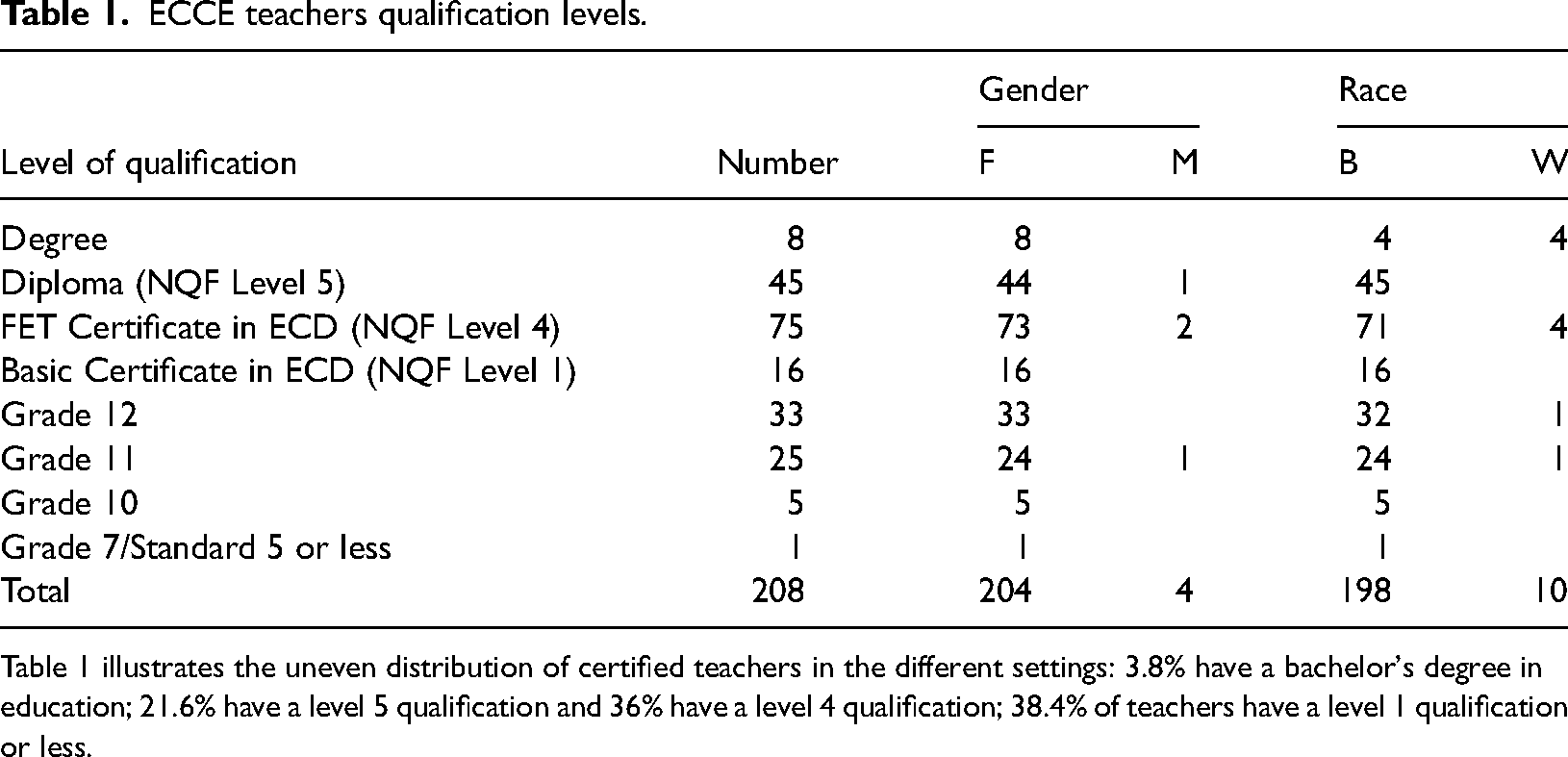
Table 1 illustrates the uneven distribution of certified teachers in the different settings: 3.8% have a bachelor's degree in education; 21.6% have a level 5 qualification and 36% have a level 4 qualification; 38.4% of teachers have a level 1 qualification or less.
The South African government has shown commitment to improving the qualifications of the ECCE workforce teachers by implementing measures that are responsive to issues of certification and qualifications. The South African Qualifications Authority has been tasked with aligning qualifications to the NQF with several training providers, including universities, technical and vocational education and training colleges, and non-governmental organisations that offer early childhood qualifications (Zulu et al., 2022). However, the high number of teachers with only Level 1 qualifications or no formal qualification in ECCE remains a concern. Notably, those with degrees were either centre owners or managers, half being white women.
Whilst there have been a number of workforce initiatives in South Africa, structural injustices persist. Ebrahim et al. (2021: 207) argue that the ECCE sector fails to attract teachers with degree qualifications due to a lack of status, recognition, poor working conditions, low remuneration and the ‘underdevelopment of a robust system to professionalise the field’. This impacts the development of effective workforce sustainability as teachers who achieve higher qualifications are offered little in return for their effort and investment in having acquired these qualifications (Cumming et al., 2015). However, 745% of the participants in this study have qualifications that are at a level 4 or lower. This reveals that despite these constraints, this highly gendered and classed workforce continues to show its commitment to the education of the youngest children in South African society.
The demographics of the South Africa ECCE sector reveal additional challenges. The field is dominated by Black women who experience marginalisation in multiple ways. In post-apartheid South Africa, women experience a widening gender gap in income poverty, a phenomenon termed the feminisation of social and economic disadvantage (Rogan and Alfers, 2019). For the largely female, Black workforce, issues of economic marginalisation, lack of access to resources and educational opportunities, and entrenched racial and gender inequalities are persistent realities. A salary analysis of ECCE teachers revealed stark disparities: 109 teachers earned below R3000 monthly, while only 10 (including 4 white women) earned above R10,000. The low salaries earned by ECCE teachers, often below poverty levels, coupled with poor working conditions and minimal access to employee benefits, are deeply concerning. Given the crucial role of educating, nurturing, and caring for society's most vulnerable children on a daily basis, these working conditions perpetuate systemic injustices within the ECCE sector.
Concluding remarks
In this study, we examined ECCE workforce professionalism within the context of South African early childhood workforce reform. We argue that ECCE workforce initiatives become a means to reconfigure ECCE as a system of performativity and control with a focus on ‘high-quality standards, accreditation of appropriately qualified ECCE practitioners’ career progression routes, and teacher competencies’ (DHET, 2017: 12). We used a democratic professionalism and feminist transformative lens to reveal the complex interplay between individual agency, systemic constraints, and the material conditions that shape professionalism for marginalised early childhood teachers. It underscores the importance of developing more inclusive and contextually sensitive definitions of professionalism that recognise and value the diverse experiences and contributions of all members of the workforce, particularly those facing intersectional disadvantage. The use of both the democratic and feminist theoretical lens goes some way to show how the workforce is affected by categories of difference such as race, gender, and socio-economic conditions. This study makes salient the importance of addressing systemic oppressive dynamics that limit women's empowerment for professionalism where there are high expectations related to professionalism as labour.
Footnotes
Funding
The authors received no financial support for the research, authorship, and/or publication of this article.
