



Abstract
Young children take up literacies that reflect the everyday cultural practices of their families. For families who are newly settled, sustaining family cultural practices may be constrained by dominant cultural norms, especially once children experience education outside their homes. In this article, the early literacies of Aathmiga, an Aotearoa New Zealand-born child, are highlighted in interview conversations with her mother, Vaishnavi, a newly settled immigrant from Sri Lanka. Aathmiga (2 years, 5 months old at the beginning of the study) and Vaishnavi participated in a community playgroup in Auckland that was the site of a year-long multilingual qualitative study of the everyday cultural practices of newly settled families and how these shaped children's early literacies. Vaishnavi's reflections on her family's Sri Lankan Tamil Hindu cultural practices highlighted how Aathmiga read images, films, and artefacts, and composed through song, dance, and play, shaping early childhood literacies that spanned multiple modes and digital media. The multilingual approach to the study amplified the centrality of the Tamil language in the family’s cultural practices and in Aathmiga's early literacies, demonstrating the critical importance of expanding school-sanctioned definitions of literacy to understand what young children know.
Introduction
Young children participate in cultural practices alongside their families that influence the way they communicate and represent their understanding of the world around them. For families who are newly settled, sustaining family cultural practices may be constrained by dominant cultural norms, especially once children experience education outside their homes. While immigration has contributed to increasing superdiversity in nations where English is dominant (Spoonley, 2015), family languages, cultural practices, and worldviews that do not match closely with dominant cultural norms may not be given power and status in children's learning experiences in early childhood education and schooling (Chan and Ritchie, 2016; Park, 2023; Rios-Aguilar et al., 2011). However, when children are encouraged to draw on their linguistic and cultural resources in educational settings, the literacies they carry from their cultural heritages and family immigration histories are more visible, strengthening their sense of belonging and their learning (Mitchell and Bateman, 2018; Orellana and D’warte, 2010; Taylor et al., 2008).
Literacies emerge in families and communities well before children begin school (Park, 2023; Souto-Manning and Yoon, 2018). Scholars have long challenged narrow conceptions of early literacy, documenting how early experiences shape linguistic and cultural resources that are foundational to children's first meaningful encounters with written language (Ferreiro and Teberosky, 1982; Genishi and Dyson, 2009). However, the myriad ways young children communicate and represent what is meaningful to them may be ignored in educational policy and practice. In nations where English is dominant, literacy definitions associated with school readiness privilege monolingual norms, shaping subtractive orientations toward children's bilingual and multilingual realities and literacy skills in home languages other than English (Cummins, 2017).
Restrictive English print literacy approaches significantly undervalue cultural practices in families as contexts for early literacy learning when these do not closely resemble literacy practices in schools (Park 2023). Researchers have documented literacy practices in homes and communities, highlighting how children readily take up literacies alongside their families across meaningful contexts (Gregory et al., 2004; Heath, 1983; Volk, 2016). More research is needed to understand children's literacies prior to schooling to disrupt deficit paradigms that ignore the languages and cultural practices of children's homes as valuable resources for learning (García and Otheguy, 2017; Souto-Manning and Yoon, 2018).
This article is focused on the contributions of a Sri Lankan Tamil Hindu family who participated in a larger qualitative study at an Aotearoa New Zealand playgroup, focused on how newly settled families worked to sustain their everyday cultural practices and how these efforts shaped their children's early literacies (Jacobs, 2024). For this article, the reflections of Vaishnavi, a newly settled immigrant from Sri Lanka, highlight the participation of her young daughter, Aathmiga (2 years, 5 months at the beginning of the study) in family cultural practices. Vaishnavi chose the pseudonyms and pronouns for herself and Aathmiga used throughout this article. Vaishnavi's stories in interview conversations are privileged as critical family expertise to understand the following research question: How does Aathmiga's participation in her family's cultural practices shape her early literacies?
Theoretical lens and literature
Sociocultural theory underpins the exploration of how children's early literacies are embedded in the everyday culturally situated practices of their families and communities. The enactment of cultural practices occurs within families in unique ways, challenging essentialist notions of culture as inherently determined by categories such as nationality or ethnicity (Rogoff et al., 2015). Children learn through keen observation and action as they participate alongside their families as members of communities, and individual family members both sustain and modify cultural practices as they navigate different settings (Rogoff et al., 2015). However, children's cultural resources may be undervalued or misrecognised in educational settings, particularly when these are not representative of the dominant cultural practices and language of schooling (Cummins, 2017; Moll and González, 1994; Paris and Alim, 2014).
In an increasingly pluralistic world, what constitutes ‘literacy’ has been continually expanded beyond written language to encompass the various modes and media people draw on to traverse linguistic, cultural, and geographic borders, combined in numerous ways to make meaning (Kalantzis and Cope, 2012; Lam and Warriner, 2012; New London Group, 1996). Children's multimodal literacies are conveyed beyond language through images, movement, touch, and sound (Kress, 1997). Young children do not just tell and write stories but play their way in and out of the stories most familiar to them, reshaping these significant stories for their own purposes (Wohlwend, 2017). Literacies are also represented in artefacts that have significance in children's lives (Pahl, 2004) and the social and cultural practices in which knowledge is shared in families and communities (Moll and González, 1994). In this article, we embrace a broad definition of early literacy to include the multiple modes and digital media that comprise the communicative repertoires of young children (Marsh et al., 2017; Razfar and Yang, 2010). The present study highlights communicative repertoires as literacies by intentionally exploring the cultural practices of importance to one family, rather than their engagement in print literacy practices or the production of particular texts (Leander and Boldt, 2013).
Souto-Manning and Yoon (2018: 86) defined the concept of home literacies as “the ways in which language and communicative practices come to life in homes and across interactions with family members, anchored in cultural practices.” Kress (1997: 6) argued the complex meaning-making of young children is shaped by their early experiences within “social structures and cultural systems in which children and adults act in communication” (8). Incongruencies between the literacies in homes and educational settings require an expansion of the definition of literacy to value children's competencies in early childhood beyond their experiences with the English language (oral and written). A monolingual print-centric literacy lens is not sufficient to understand the complexities of children's early literacies encoded in family languages and everyday cultural practices (Edwards and Smith, 2024; Moll and González, 1994).
Literacy, from a sociocultural perspective, involves socially and culturally situated practices across various contexts and purposes (Street, 1984) through which people make sense of themselves and others in the negotiation of identities (Gee, 2012). Children fluidly make sense of their worlds in relationship to the people, places, and things that are central in their lives (Ministry of Education [MoE], 2017). The connections between language, culture, identity, and literacy are critical to understanding the discourses, practices, and ideologies that shape how children see themselves as they navigate differences between home and educational settings (Cummins, 2001). In the context of immigration, young children leverage shifting identities through literacy practices across social contexts and positionings such as nationality, religion, language, and gender, intertwined with family histories (Compton-Lilly et al., 2017).
Spiritual or religious experiences in children's lives may shape literacies that affirm identities rooted in family immigration histories. Lytra et al. (2016: 2) asserted that religion is “an essential part of culture; a cultural practice underpinning many young peoples’ lives.” Societal discourses and institutional policies may constrain how children sustain family cultural practices that intersect with religion over time (Lytra et al., 2016). Research has shown how cultural practices associated with children's spiritual and religious experiences shape their funds of knowledge, identities, and literacies in powerful ways, but may not be legitimised by school-sanctioned literacy practices or curriculum (see Peñalva et al., 2014; Volk, 2016). For the present study, Aathmiga's participation in the Sri Lankan Tamil Hindu cultural practices of her family intersected with the oral, audio, visual, embodied, and written texts of her family's prayer room. The following section provides context for the larger study and relevant aspects of early childhood education in Aotearoa New Zealand.
Context
Te Whāriki (MoE, 2017), the internationally acknowledged official bicultural early childhood curriculum of Aotearoa New Zealand, takes an affirming stance toward children's cultural practices, languages, and identities, shaped by their families and the wider world in which they participate. Languages are broadly defined and associated with multiple ways of knowing such as the “languages of sign, mathematics, visual imagery, art, dance, drama, rhythm, music and movement” (MoE, 2017: 41). Te Whāriki's emphasis on multimodal communication and the centrality of identity, language, and culture stands in contrast to an “anglophone” early childhood education agenda in which linguistic and cultural diversities are framed as deficiencies when measured against dominant monocultural and monolingual norms (Moss and Urban, 2020). In Aotearoa New Zealand, professional obligations are anchored in Te Tiriti o Waitangi, the founding document of the nation between the British Crown and Māori, the Indigenous people of the land. Te Whāriki's vision requires a commitment to the bilingual/bicultural foundation of Te Tiriti o Waitangi and an intentional move away from a monocultural/monolingual agenda (Skerrett and Ritchie, 2021). Privileging the linguistic and cultural resources and expertise of families is central to this endeavor.
Playgroups are one early childhood service option in Aotearoa New Zealand where parents and other family members attend with children from birth to school age for minimal or no fees. Playgroups are generally held in a community space, run by parents, and less formal than other early childhood education services. Playgroups are focused on providing play, social, and learning opportunities for children and increasing participation from parents in early childhood education (MoE, 2024a). The multilingual community playgroup for the larger study was available to parents three days per week for three hours and had an appointed playgroup leader (see Jacobs, 2024). Research observations at the playgroup were shared with parents to engage their perspectives as they participated alongside their children, positioning them as experts. Family interpretations of children's participation enhanced research observations. Without parent input, children's enactment of family cultural practices may have been misinterpreted or underrecognised (Jacobs and Marea, 2019).
The community playgroup Vaishnavi and Aathmiga attended was located in Auckland, where nearly 40% of the residents were born overseas and the locally born children of immigrant families constitute approximately another 16% of the population of the superdiverse city (Spoonley, 2015). The larger study focused on eight newly settled families with immigration histories from Sri Lanka, Pakistan, China, Syria, Saudi Arabia, Kiribati, and Ethiopia (see Jacobs, 2024). Except for Vaishnavi, the other newly settled families in the study had lived in Aotearoa New Zealand for between 6 months and 3 years from the start of the study in February 2018. Vaishnavi moved to Auckland 6 years before the study because of escalating political conflict in Sri Lanka. Aathmiga was one of three children within the newly settled families in the larger study born in Aotearoa New Zealand.
Positionality
Meg is an American monolingual English speaker of European heritage. A primary teacher and teacher educator in the US for a combined 19 years, Meg moved to Aotearoa New Zealand in 2017. Meg's research aims to conceptualise early literacies alongside families to position children's linguistic and cultural resources as foundational to literacy learning and to disrupt deficit narratives regarding children's readiness for school. Sujatha is an Indian New Zealander from Mumbai, India, and has a 34-year career in education. Since moving to Aotearoa New Zealand 19 years ago, Sujatha has worked in early childhood settings and in early childhood teacher education. Multilingual and multiliterate in Tamil, Malayalam, Hindi, Marathi, and English, Sujatha is also a member of the temple attended by Aathmiga's family.
Method
For this article, we primarily draw on data collected from a photo-elicitation interview conversation and a follow-up semi-structured interview conversation, both in Tamil. We also briefly draw on fieldnote data collected by Meg during a playgroup session (with the support of Vaishnavi's translation and interpretation) that intricately connected with family practices described by Vaishnavi in interview conversations. Three interview conversations, the first in English with Meg followed by two in Tamil with Sujatha, were approximately 60 min. in length and took place over several months (Meg also attended interview conversations in Tamil). Vaishnavi requested to participate in the first interview conversation in English and the last two interview conversations in Tamil. During the first interview, Vaishnavi shared her family history of immigration and her hopes and aspirations for Aathmiga growing up in Aotearoa New Zealand. The first of two interviews in Tamil was a photo-elicitation interview (Saldaña and Omasta, 2017) in which Vaishnavi and Aathmiga shared approximately 10 family-selected photos of important places and things. This was a family-led conversation with no predetermined questions. The final interview in Tamil allowed for follow-up questions necessary to deepen analysis and for member-checking.
Research collaborations that go beyond data collection and English translation are necessary to privilege family languages and worldviews throughout the research process. Sujatha and Vaishnavi's participation in the same temple community supported the establishment of a trusting relationship. Sujatha's insider knowledge of the Tamil language and intersecting experiences with the family's everyday cultural practices at temple were critical to the processes of data collection, analysis, and co-authoring. Tamil was privileged in interview conversations and careful consideration was given to translation of Vaishnavi's words to avoid essentialising or othering interpretations of the family's experiences (Burkhard and Park, 2024). Sujatha limited translation of Tamil to English during interview conversations to occasionally clarify questions with Meg. Sujatha transcribed the interview and then translated the Tamil transcript to English, privileging ideas rather than translation at the word level to preserve meaning in Vaishnavi's perspectives.
The limitations of translation and issues that arise from interpretation and the differing sociocultural location of language speakers are necessary to acknowledge in the present study. Although Vaishnavi and Sujatha spoke Tamil fluently, their sociocultural positionings were connected to unique histories in Sri Lankan and India and distinct immigration experiences, as well as the relationship between their countries of origin. Sujatha's membership in the family's Hindu temple community represented a significant sociocultural position beyond shared language for interpreting the cultural practices most important to Vaishnavi. However, to address the dilemmas and limitations of translation and interpretation from Tamil to English, the Tamil interview transcripts and the completed English manuscript were reviewed and approved by Vaishnavi to account for possible translation dilemmas and power differentials within the research process (Burkhard and Park, 2024; Temple and Young, 2004).
Participant-observation and interview conversations occurred at the playgroup rather than in the family home due to Vaishnavi's preference. While this could be considered a limitation of the present study, widening the lens through which children's early literacies are explored to include the testimonies of parents and family members in their home languages is central to the larger study in which these data were collected. The playgroup context for the study offered opportunities for family members to establish rapport with Meg during weekly playgroup sessions before interview conversations commenced, and to share their interpretations and expertise regarding their children's communication and representation at the playgroup (Mitchell and Ouko, 2012). This article privileges Vaishnavi's reflections on family cultural practices as windows to understand Aathmiga's early literacies over Meg's research observations at the playgroup. Early literacies embedded in family cultural practices take place within contexts in which meanings are negotiated by family members and not necessarily accessible to outside observers. Vaishnavi's stories and reflections, representative of her intimate knowledge of Aathmiga's participation in her family's Sri Lankan Tamil Hindu cultural practices, provided valuable insights that a cultural outsider would have missed (Edwards and Smith, 2024).
The iterative process of data collection, interpretation, and analysis (Charmaz, 2014) initially involved line-by-line coding of each interview transcript, following Sujatha's transcription and translation of Tamil to English. For the initial analysis, we coded separately to stay open to interpretations that could arise from our unique worldviews. We cross-checked codes from initial analysis with existing codes generated from data collected from all families in the larger study. The larger data-set codes with overlapping meanings were collapsed into broader concepts and defined for focused coding. Related concepts were grouped to constitute overarching themes and related subthemes. In this article, we highlight snapshots that illustrate the following theme and subthemes:
Everyday Ways of Knowing, defined as the everyday knowledge/s and cultural practices families worked to sustain from the places they moved, and the new knowledge/s and practices that emerged in a new country. This theme contains the subthemes Early literacies across multiple modes, languages, and cultural practices and Recognition of family knowledge/s.
The snapshots composed for this article represent the fluidity of the family's everyday cultural practices and align with Lytra et al.'s (2016: 3) aim to “provide snapshots in time and space rather than create and reinforce stereotypes.” Interview conversations presented in the following snapshots are Sujatha's English translations and interpretations, approved by Vaishnavi. The Tamil transcripts are presented in Appendix A to acknowledge the language inseparable from the family's cultural practices and Aathmiga's early literacies. The University of Auckland Human Participants Ethics Committee reviewed and approved the study (reference 2017/020365) from which the data in this article were drawn. Vaishnavi provided written consent to publish the data, including personal photos, in the snapshots below.
Snapshot #1
During the photo-elicitation interview, Vaishnavi shared photos that showed the temple her family attended, the prayer room in the family's home, and objects she carried from Sri Lanka. For Vaishnavi, going to temple was the most important family cultural practice, but she worried that temple visits would become less frequent as Aathmiga grew up in Aotearoa New Zealand. Hindu prayers and rituals of worship were strongly woven into the everyday life of Aathmiga. Figure 1 is a photograph of objects displayed in the family's prayer room at home. Aathmiga's response to Vaishnavi's and Sujatha's questions about the photo demonstrates meaning she attributed to the objects. This is our prayer room. Which is this god? [asking Aathmiga] Do you know this? Who is there? Saraswathi This? Lakshmi. This? Durga. I think she has a lot of devotion! This? Vishnu. [points to photo] This? [asks] Shivan Shakthi What does Aathmiga like? Which god? [Aathmiga points to the peacock feather] Aathmiga likes Krishna very much. (Interview, June 13, 2018)
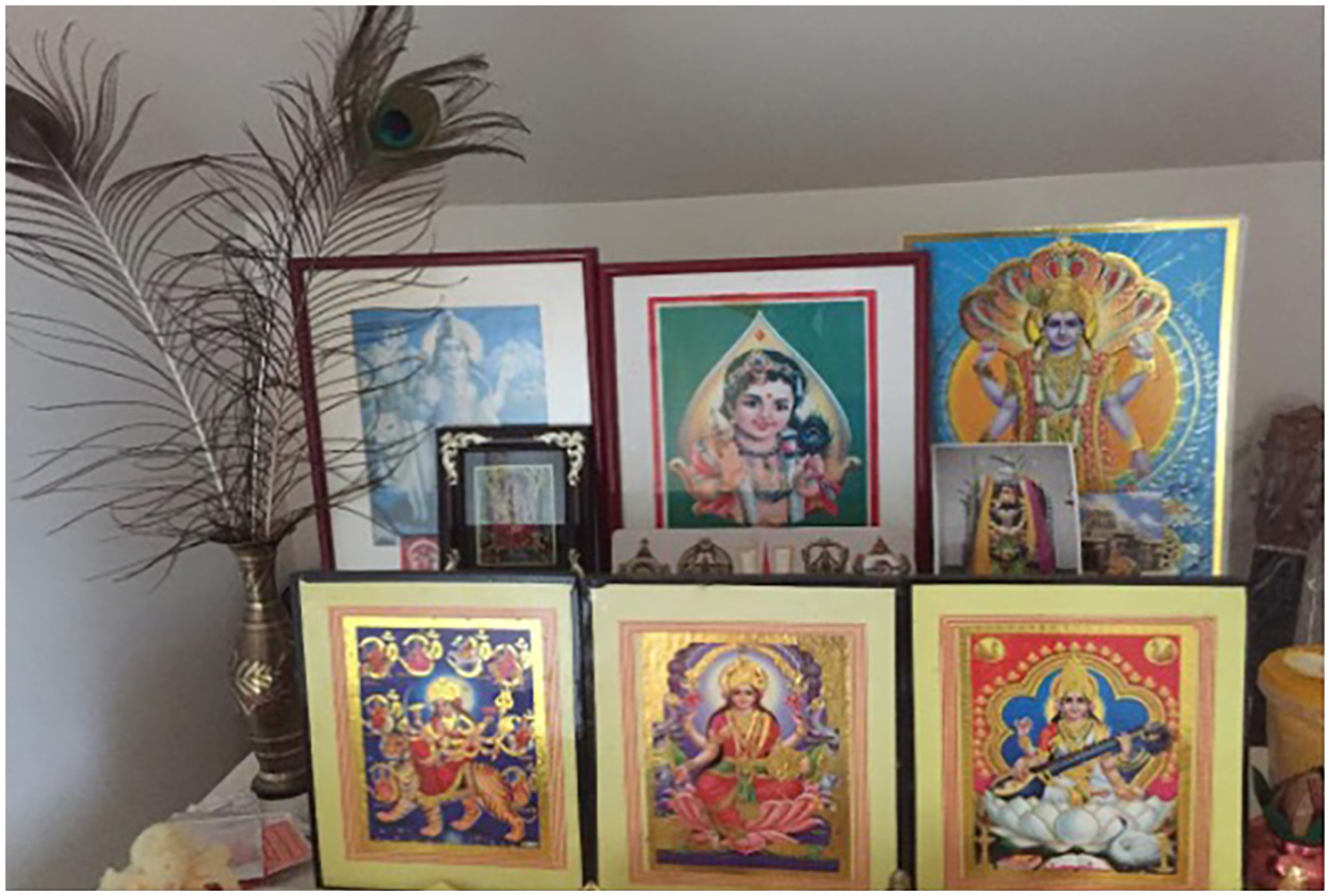
Family prayer room.
Aathmiga identified Hindu goddesses from the color of their attire (saris), pink for Lakshmi, the Goddess of Wealth, and white for Saraswati, the Goddess of Learning. Perhaps Aathmiga could read the complex differences in the images because they connected to her interests, shaped by valued family cultural practices in a significant place. When Sujatha asked her to name her favorite god, she pointed to a peacock feather rather than one of the images. The peacock feather, an object that represented Krishna, a Hindu god, and the stories connected to him, was of great interest to Aathmiga. Childhood stories of Krishna (Bal Krishna) portray him as cheeky, mischievous, and playful, stealing from the milkmaids, crawling, eating butter, and dancing. A popular image is of Krishna wearing a peacock feather in his turban, playing the flute, and adopting the pose of one foot bent in front of the other with milkmaids and cattle around him. The attention to detail required for Aathmiga to distinguish between the subtle differences in the images and to associate objects with stories illustrates her sophisticated early literacies expressed beyond oral and written language.
Snapshot #2
Aathmiga drew on the familiar stories of Krishna in her everyday play. When Aathmiga and a friend met at the playgroup one day, she allocated the role of Radha (Krishna's female consort) to her friend, while she took the role of Krishna. She directed her friend to skip alongside her, speaking in Tamil. Vaishnavi interpreted their play and translated what Aathmiga said to her friend: “I’m Krishna. You be Radha” (Vaishnavi, June 6, 2018, personal communication). Vaishnavi laughed and explained that Aathmiga often played Krishna. This moment would have been missed in research observations due to cultural distance between Meg and the family, and Meg's inability to understand Tamil. When Aathmiga mentioned the friend in an interview, Sujatha asked about Aathmiga's insistence on being Krishna. Vaishnavi explained Aathmiga's embodied knowledge of “being Krishna.” Is the “Radha” boy a Tamilian? We frequent their house. They too are Sri Lankans. He is 2 months younger. How come he is Radha, and she is Krishna? We have told her you are a girl, so you are Radha and he is Krishna, but she is firm that she is Krishna. Ahh … Does she think that Krishna is more powerful? No no, she likes Krishna very much. She likes dance. She has seen the idol of Krishna with his legs crossed and standing, and she imitates it and dances, and she imagines herself to be Krishna. Does she watch dance? Yes, she watches herself and she dances by herself. Have you subscribed to Lebara? [A Tamil cable connection] We have YUPP TV. Does she watch everything on it? Very little on it. When there is Kamal Hasan's song on it, “unnai kanatha” she dances [referring to a Tamil film song/dance]. She picks up the moves from it and dances. (Translation from Tamil, interview, June 13, 2018)
As this snapshot shows, Krishna is a storied identity that Aathmiga took up in play connected to an artefact in the family prayer room (see Figure 1), and the stories she heard, told, and retold through different modes and media. Vaishnavi understood that being Krishna was important to Aathmiga and aligned with her aspirations to sustain family cultural practices in Aotearoa New Zealand. Vaishnavi explained that Aathmiga listened to the song, drew on her memory of the dance scene in the movie, and engaged in the dance, as she played being Krishna. The dance itself is a complicated text, an Indian classical dance called Kathak, which focuses on facial expressions, hand movements, and extensive footwork that Aathmiga has interpreted from repeatedly watching the Tamil film. Aathmiga read and interpreted the dance scene in the film and acted on her interpretations to represent her storied identity through bodily movement. Although Aathmiga's embodiment of Krishna challenged her family's view of gender identity, Vaishnavi's story suggests it was more important that Aathmiga's insistence on “being Krishna” connected her to significant family cultural practices, strengthening her cultural identity.
Snapshot #3
Aathmiga's family also participated in everyday practices that align with school-sanctioned literacy practices: library visits and book reading. Vaishnavi shared a photograph of books and a puzzle she and Aathmiga checked out from their neighbourhood library (see Figure 2). A children's book in Tamil is prominently featured in the photo. Although access to books in Tamil was important to Vaishnavi, book reading did not replace but was interwoven with modes and digital media that demonstrated complex early literacies. In this snapshot, when Sujatha expressed surprise at what Aathmiga knew regarding the prayer-room photograph and the complexity of the dance, Vaishnavi explained that Aathmiga also knew the first 10 couplets of Thirukkural, a classic Tamil text consisting of 1,330 couplets or Kurals, that provide guidance on everyday virtues. She reads books, and she likes it. We have to read for her, she too pretends to read. But she likes us to read to her. She knows the first chapter of Thirukkural [a classic Tamil-language text]. There are a lot of kurals in the chapter? Ten. Does she know it by heart? Yeah, I play it like a song. Cassette? YouTube, she listens to it frequently and knows it by heart. Otherwise, she may forget Tamil. How about god songs? Thevaram, “Aindhu Karathinai” she knows fully [a devotional hymn]. Did you teach her? When we pray, she sings. She sings alone too. I have a video. (Interview, June 13, 2018)
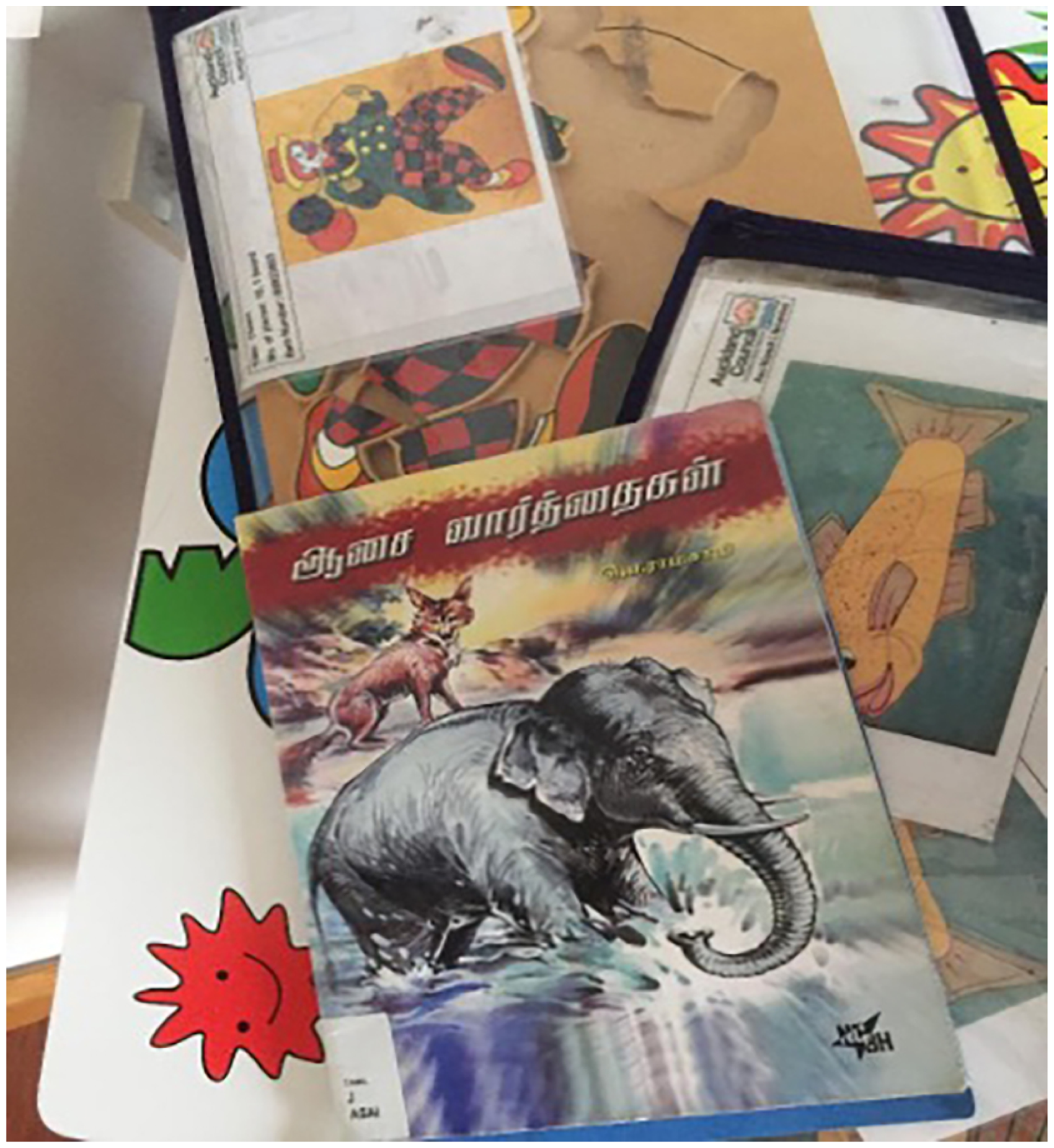
Library books.
Vaishnavi's reflection in this snapshot describes audio and oral modes of communication and representation using digital media connected to a printed text, central to the family's everyday cultural practices of the prayer room. Aathmiga was learning the language structure and meaning of Thirukkural, from repeatedly listening to a YouTube clip, and from listening to her parents read aloud. Like the Tamil cable television channel, YUPP TV, that provided access to the film that featured the dance, digital media resources in Tamil enhanced Aathmiga's participation in valued family cultural practices.
Discussion
The literacies children bring to early childhood settings from their homes and communities are shaped by the everyday cultural practices of their families. Literacy is saturated with beliefs that children carry with them from their lived experiences, significantly influencing their ways of being and becoming (Peñalva et al., 2014), and their reading and composing in the places they belong (Kress, 1997). Without Vaishnavi's intimate knowledge of Aathmiga's participation in her family's everyday cultural practices, the complexity of her early literacies may have been less visible or misrecognised in the study. Sujatha asked questions in Tamil that prompted Vaishnavi to further elaborate and explain family cultural practices, opening the linguistic and cultural space in which Aathmiga's early literacies could be legitimised. Vaishnavi's expertise and Sujatha's role as a translator and co-researcher were central to widening the lens through which Aathmiga's early literacies were interpreted (Burkhard and Park, 2024; Mitchell and Ouko, 2012; Souto-Manning and Yoon, 2018).
Aathmiga's declaration in Tamil, “I’m Krishna. You be Radha,” made known what was important to her as she played, fluidly taking up an identity connected to the Sri Lankan Tamil Hindu practices of her family. Wohlwend (2017: 66) argued “play is a ‘printless’ literacy that creates action texts (Wohlwend, 2011), stories enacted with bodies, toys, props, and scenery rather than written with print on paper.” As Krishna in play, Aathmiga “embodied identities and ideological becomings—literacies that are part of her ways of being and knowing” (Peñalva et al., 2014: 100) reflected in the storied and treasured objects of her family (Pahl, 2004). Aathmiga's embodiment of literacies connected to her family's Hindu faith and Tamil language present complex considerations for what counts as valued knowledge in educational settings (Peñalva et al., 2014).
Aathmiga's early literacies may not be easily recognised in a western-oriented early childhood or school setting where English and secular norms dominate (Volk, 2016). Though dominant discourses suggest western educational settings are neutral in terms of religion, Christian normativity may also assume religious beliefs, traditions, and histories that make other religions, and the practices associated with them, less visible or well understood. Volk (2016: 35) suggested that one way to overcome this power imbalance is to “reconceptualize a church, synagogue, mosque, temple, or home religious event as a literacy context.” Aathmiga engaged in cultural practices that she carried between significant places—home, temple, and playgroup. The congruency between these settings for Aathmiga was the value placed on her family cultural practices and the language of her home, allowing her early literacies to flourish in each place (Si‛ilata et al., 2023).
Vaishnavi described Aathmiga's participation in the family prayer room, highlighting literacies enacted through family cultural practices and Tamil. Vaishnavi's reflections describe how Tamil was heard, seen, recited, sung, read, and danced regularly in the family home. Souto-Manning and Yoon (2018: 49) wrote, “it is unlikely that the dominant language will have the breadth and depth to acknowledge, name, and explain worlds beyond the one it privileges.” For example, the Thirukkural extols the virtues a person must possess to lead a virtuous life. To understand Thirukkural, Tamil is necessary to engage deeply with the essence of the themes (albeit translations are available in other languages). Over time, Aathmiga's cultural identity may be shaped by dominant cultural norms that undermine Vaishnavi's efforts to sustain her family's Sri Lankan Tamil Hindu cultural practices, such as the prominence of English outside their home (Perera, 2016). Digital media peppered Aathmiga's family cultural practices, enhancing access to her Sri Lankan Tamil Hindu heritage in Aotearoa New Zealand.
As the first generation of her family born in Aotearoa New Zealand, many of Aathmiga's early literacies were enhanced through engagement with digital media (i.e., YUPP TV, YouTube). Digital media described by Vaishnavi reflected linguistic and cultural resources that supported Aathmiga's participation in the cultural practices of the family's prayer room. In the instance of choosing the feather as her favorite Hindu god, Aathmiga showed that she understood the feather represented the familiar stories, films, songs, and dances associated with Krishna. Vaishnavi's description of how Aathmiga chose to dance after reading the dance scene in the film highlights how she composed a story with movement, represented through her dancing body (Sansom, 2013). Aathmiga's choices represent and communicate complex cultural understandings that intersect with digital media accessible in Tamil, but extend well beyond language and the conventions of print.
Aathmiga's choices of varied modes demonstrate the sophistication of early childhood literacies when children can draw on their full communicative repertoires (Cummins, 2001) and interact with media that connect with the languages and cultural practices of their family (Compton-Lilly et al., 2017). Aathmiga's participation in family cultural practices was not simply for the purpose of becoming “literate,” rather, she enacted multimodal literacies to engage in the communicative contexts important to her family (Kalantzis and Cope, 2012; Kress, 1997; New London Group, 1996). Even when Vaishnavi described family library visits and reading aloud, practices strongly associated with what counts as literacy at school, she made no mention of “literacy.” Instead, Vaishnavi described how Aathmiga read images, films, and objects and composed through dance, song, and play long before school (Kress, 1997; Wohlwend, 2011). Vaishnavi's research contribution shows how parent stories of children's engagement with family cultural practices may amplify multimodal literacies that intersect with a diverse landscape of digital media (Marsh et al., 2017) that have the potential to enhance children's early language and literacy learning (Razfar and Yang, 2010).
Early childhood education and research that engages parents to understand children's multimodal reading and composing may expand pedagogical approaches to early literacy that are more representative of young children's family cultural practices and heritage languages (Siʽilata et al., 2023). Vaishnavi's stories about Aathmiga's participation in family cultural practices were not just more valuable than research observations, but more closely represented Aathmiga's early literacies from the family's worldview (Edwards and Smith, 2024). Aathmiga communicated and represented the complex ideas available to her, where people she loved could see the significance of her actions and the people, places, and things that intersected with her meaning-making. In Aotearoa New Zealand, Kōwhiti Whakapae (MoE, 2024b), an online curriculum resource that aims to support teachers to notice, recognise, and respond to “children's progress,” emphasises cultural and social forms and functions of literacy, and the importance of children's languages, cultures, and identities to enhance learning. However, opportunities to communicate and represent literacies and identities anchored in the social and cultural contexts of their lives are not necessarily available to young children if pedagogical practices are restricted by policies that promote English print literacy as the starting point (Rios-Aguilar et al., 2011; Souto-Manning and Yoon, 2018). Parent stories and interpretations can inform a wider representation of children's linguistic and cultural resources in early literacy research, policy, and practice. One limitation of the present study is the limited use of research observations in the analysis. The cultural practices shared in the present study were mostly connected to the family's prayer room, and this intimate family space would not have been suitable for research. While Vaishnavi's parent stories were deliberately privileged, research observations within family homes have the potential to enhance opportunities for detailed multimodal analysis of children's early literacies alongside parents (White et al., 2024).
Early childhood research that highlights the literacies of bilingual and multilingual families challenges deficit paradigms imposed through monocultural and monolingual norms of school readiness (García and Otheguy, 2017; Park, 2023). Like Aathmiga, the knowledge children carry from their early childhood experiences into schooling may be encoded in languages other than English. Decades of research have shown that heritage languages do not interfere with learning English, but instead enhance children's understanding of both languages (Cummins, 2017; May, 2020). Literacy approaches that restrict children from using their languages and prior knowledge in their early learning experiences at school may diminish children's linguistic and cultural identities and meaningful opportunities for learning to read and write in English (Cummins, 2017). In Aotearoa New Zealand, it is imperative to make a sustained investment in an additive bilingual agenda that normalises te reo Māori in early childhood education and schooling. Aligned with obligations to uphold Te Tiriti o Waitangi, the elevation of te reo Māori is critical to counter linguistic discrimination and erasure (Skerrett and Ritchie, 2021) and to affirm the educational value of Indigenous and heritage languages in a nation where over 160 languages are represented (Royal Society New Zealand, 2013). Literacy approaches reflective of English-only ideologies are inherently deficit, limiting the potential of multiliteracies in an increasingly pluralistic world (New London Group, 1996) and perpetuating educational inequities that such monolingual approaches purport to address (García and Otheguy, 2017; Park, 2023).
The linguistic and cultural resources children bring from home to early childhood settings are immense—paving pathways to their early literacies and identities. Te Whāriki (2017: 47) calls for an early childhood environment “rich in signs, symbols, words, numbers, song, dance, drama, and art that give expression to and extend children's understanding of their own and other languages and cultures.” A school-readiness narrative that is solely focused on English is contradictory to the ethos of Te Whāriki and diminishes the significant contribution of early childhood teachers to notice, recognise, and respond to the literacies of children and families (Harvey and Myint, 2014; Mitchell and Bateman, 2018). It is essential to learn from families to avoid reproducing discourses that pathologise knowledge distant from dominant institutional norms (Rogoff et al., 2017). In Aotearoa New Zealand, early literacies implicit in Te Whāriki can be explored through family stories of children's engagement in family cultural practices (Edwards and Smith, 2024), amplifying literacies and identities that bring meaning to children's early reading and writing experiences in the languages of home and school.
Footnotes
Acknowledgements
This study was supported by the University of Auckland, Faculty of Education and Social Work through a Research Fellowship in the Marie Clay Research Centre and Faculty Research Development Funds (project 3715752). Thank you to Vaishnavi for sharing your expertise and stories of Aathmiga's participation in your family cultural practices, and thank you to Aathmiga for sharing your knowledge with us. The University of Auckland Human Participants Ethics Committee reviewed and approved this study: reference 2017/020365.
Consent to participate
All adult participants provided written informed consent prior to participating. Written informed consent to participate for children in this study was provided by the participants’ legal guardians/next of kin.
Consent for publication
Adult participants provided written consent to publish the data, including personal photos included in this manuscript.
Data availability statement
There is a reference to the larger study in this manuscript that can be accessed online through open-access publishing. The data set is not available in a public repository due to the nature of the research and families not being informed of this possibility.
Declaration of conflicting interests
The authors declared no potential conflicts of interest with respect to the research, authorship, and/or publication of this article.
Ethical considerations
The study was approved by the University of Auckland Human Participants Ethics Committee (reference 020365) on November 29, 2017.
Funding
The authors disclosed receipt of the following financial support for the research, authorship, and/or publication of this article: This research was funded by the University of Auckland, Faculty of Education and Social Work, Faculty Research Development Funds (project 3715752).
