




Abstract
Play has been widely examined and viewed as an effective pedagogy to promote children's literacy development. While current research has identified various benefits associated with play, discrepancies still exist regarding what type of play could be more effective, for example, home play or school play. This could further lead to an outcome-oriented, positivist perception of play as a designed intervention that risks neglecting children's agency in creating, negotiating, and interpreting their play activities. In this conceptual article, we explore the theoretical affordance of the concept of temporal and spatial scales to rethink children's play as a dynamic, multilayered flow of meaning-making and negotiation across time and space. We discuss how using the lens of scales, play can be analyzed as actions, processes, and contexts. The methodological and pedagogical implications of scales are also illustrated for practical applications in research and education on play-based literacy learning. Finally, this article aims to draw researchers and educators’ attention to the complexity and diversity of play, as well as children's agency in (re)constructing playfulness.
Introduction
In childhood education, play has been viewed as an essential part for children's cognitive and socio-emotional development and well-being (e.g., Hartas, 2020; Walsh et al., 2006; Whitebread, 2017) and research on play has flourished in recent years (see Pyle et al., 2017 for a review). Although current research on play and literacy learning has explored a wide range of topics including play facilities, participants, and social relations (e.g., Herrington et al., 2022; Kane, 2016; Parent et al., 2021), most studies posit a binary, static view of categories in play-based literacy development, for example, school play vs. home play, indoor play vs. outdoor play, individual learning vs. collective learning, digital play vs. physical play, learning of everyday concepts vs. learning of scientific concepts. Besides, the current research, although putting children at the center, seems to overlook their agency in play activities; for example, how they interpret and enact their play (Olsson, 2023). Current research tends to focus on what children can achieve through play, instead of what they are doing in play activities. These two tendencies in play research have possibly derived from an instrumental view of play as an event for literacy development. In this sense, play is viewed as a positivist experiment that functions as an intervention to test whether children can be intellectually and socially enhanced after certain designed activities. Play researchers thus focus on the observable impacts facilitated by different types of play in different situations, trying to locate the best strategy to promote children's development on various attainment variables. Their research, in most cases, concerns what knowledge is more likely to be developed, which aspects of learning are more likely to be achieved, and which environment is more conducive to learning outcomes. This line of research tries to locate the best practices in play-based literacy development; however, it might simplify the learning process in play activities, as well as the complex dynamic interaction of personal, social, and contextual elements (Nilsson et al., 2018). The overemphasis on results may lead to the oversight of other elements and processes that constitute the totality of the play-based literacy experience and development.
In this paper, by drawing on the concept of scales, we explore its theoretical, methodological, and pedagogical affordances that may help address the current issues surrounding the play–literacy interface. The theoretical framework of scales highlights the ecosocial system perspective that enables a dynamic, interdependence-oriented view of all the meaning-making processes in play activities. It directs our attention to what is happening, how it is happening, and who is participating in play activities, instead of what works in terms of learning. It also involves the interconnectedness of ecological and social factors that shape and influence children's literacy development within the context of their play. Through the lens of scales, play can be viewed as children's agential actions through which they draw upon available meaning-making resources in (re)creating their play contexts across time and space, thus responding to Pyle et al.'s (2017: 342) call to conceive play “as beneficial for more than one purpose in more than one form, so that educators can move away from a bifurcated stance and towards the integration of developmental and academic perspectives in the same environment.”
Children's play: A brief review
In childhood research, play has been generally approached from two theoretical perspectives: play as representation (Piaget, 1962) and play as social interaction (Vygotsky, 1978). According to Piaget (1962), play is an essential aspect of a child's cognitive development. Through play, children actively construct knowledge about the world and refine their cognitive abilities. He viewed play as a means for children to assimilate new information into their existing cognitive structures and adapt to their environment. Play thus serves as a symbolic or representational activity for children in which they make use of cultural objects in their interpretation, practice, and internalization of social entities. Play, in Piaget's view, is not merely a pastime but a fundamental activity through which children actively construct their understanding of the world and refine their cognitive abilities. From Vygotsky's (1978) perspective, play reproduces the social context where children engage in collaborative meaning-making, social sharing, and knowledge negotiation. Play is a collaborative and social activity rather than an individual endeavor. Through play, children can create scenarios that relate to their real-life encounters and engage in make-believe activities that allow them to explore and understand aspects of their culture and social world. Both Piaget (1962) and Vygotsky (1978) highlight the connection between play and cognitive development, which has largely led to correlational studies in childhood research that examine the relationship between play settings, activities, and personal factors on the one hand and children's literacy and cognitive ability measurements on the other (Roskos and Christie, 2001). For example, studies on guided or structured play have demonstrated that play-based learning strategies support such areas of development as literacy (Van Oers and Duijkers, 2013) and self-regulation (RiVA and Ryan, 2015).
In their recent discussion of the interaction between play and literacy, Christie and Roskos (2015) identified three major lines of research: play as setting, play as activity, and play as process. For some researchers, play serves as a crucial setting and provides a specific time and space for early literacy experiences. It highlights the role of both physical and social aspects in children's overall literacy development. Such studies have found the influence of environmental design features on affording literacy development during play, for instance, outdoor play equipment (Herrington et al., 2022), digital technologies (Bird and Edwards, 2015), and the home environment (Gomes and Fleer, 2019). Additionally, it has been explored how social factors such as neighborhoods (Parent et al., 2021) could offer a facilitating socio-demographic and contextual background for children's play. Research holding the view of play as activity focuses on the elements of design that contribute to children's learning experiences. Studies have attended to the various aspects of play activities and explored their roles in helping children achieve play goals and literacy development. For example, Fleer et al. (2017) examined teachers’ design and implementation of a play activity in which playworlds were used as a pedagogical context for students and teachers to collectively engage in creating dramatic scenarios and problem-solving so that children could develop their executive function skills, that is, higher-order cognitive capacities like working memory. Research of this line generally promotes a skills-focused, standard literacy curriculum and views play as a pedagogical intervention that can be integrated into formal learning for the improvement of children's literacy practices (Christie and Roskos, 2015). The third line of inquiry concerning the play–literacy interplay views play as a process by which children are put at the center of learning and teaching. It foregrounds play as a child-initiated activity that is evolving and fosters the gradual acquisition and enhancement of literacy abilities. In this context, play is seen as a valuable, experiential learning process that allows children to explore language, reading, and writing in a natural and interactive way, enhancing the development of various literacy knowledge and skills such as phonological awareness, vocabulary, and comprehension.
Although previous studies have identified the potential of play for literacy development, what is missing is a dynamic understanding that emphasizes the interaction of ecological systems across play as setting, activity, and process (Christie and Roskos, 2015). The current static, fixed view of play possibly leads to the disparate perspectives concerning which and how play could work as an effective pedagogy for literacy development. Based on their review of scholarship on play-based pedagogies in early childhood education, Pyle et al. (2017) argued that teachers might experience challenges navigating a constellation of contrasting recommendations from research that was limited by their design of play activities and focused on certain aspects of learning. Moreover, although current conceptions of play center on children and their learning, much discussion has been directed to the role of teachers in creating a learning-oriented play setting. In other words, how children themselves make sense of their play and conceive its playfulness has attracted less scholarly attention.
The static, outcome-oriented approach to play renders a flat view of the interaction of play and literacy development at a singular moment and context. Play thus becomes a one-time event with a specific end goal, possibly ignoring its dynamic and continuously evolving nature. With the emphasis on at-the-moment, the flat view of play fails to capture the broader spectrum of play experiences and their contribution to literacy development across time and space. From a more dynamic perspective, play is not a one-off occurrence but a series of interconnected moments and events. These moments and events form patterns that repeat and influence each other, shaping the overall impact of play on literacy development (Lemke, 2000). For example, when children engage in imaginative play using building blocks, the flat view will focus on the observable performance and interaction between children and conclude whether imaginative play in this context could be beneficial for learning. A more dynamic perspective involves examining the entire processes of play and exploring the connections of play at different layers. The children do not merely take part in the fixed structure of play; they engage in a series of moments and events within the play. They discuss ideas, negotiate roles, experiment with different arrangements of blocks, and adapt their plans as they go along. This dynamic process reveals the patterns of communication, collaboration, and problem-solving inherent in their play, and these interactions extend beyond the momentary play by involving other social activities and knowledge. Therefore, children's play in building blocks reflects a network of interdependent practices, understanding, and social relations across time and space that is largely not observable, if not possible, but still contributes to the literacy learning potential of the play.
The interdependent, dynamic perspective of play is especially urgent, given the prevalence of digital technologies that blur the boundaries between different types of play (Bajovic, 2018; Lafton, 2021; Wernholm, 2021). As argued by Bajovic (2018), children's play in the twenty-first century has changed dramatically, and “playing and learning moves across multimodal spaces, time and space, the concrete and digital” (p. 202). Edwards et al. (2020) used the concept of convergence to reveal the interconnected nature of play across time and space in the digital era where new communicative possibilities reduce the physical constraints on the places and materials for play activities. In their discussion on the mobility of learning, Jones and Hafner (2021) offer insights into how recent technological advancements have changed the conception of space and the way of meaning-making across time, space, and materials. From their perspective, digital communication has become more physical (e.g., virtual museum tours), and physical reality has become more digital (e.g., Pokémon Go). Therefore, play is no longer a static, single-layered concept that merely accommodates children's social practices; it is hybrid, multiple, and layered, involving the mixing of physical reality and digital reality.
In this conceptual paper, we utilize the theoretical concept of scales (Lemke, 2000) to revisit and better understand the relationship between play and literacy. Scales in this paper refer to the interdependent macro and micro aspects of the play–literacy interface. The scale-based perspective allows for a more comprehensive exploration that goes beyond a narrow focus on specific learning outcomes and emphasizes an ecosocial system understanding of children's play. It takes into account the dynamic and interdependence-oriented nature of meaning-making processes within play activities, rather than focusing on what is effective for achieving learning outcomes. Furthermore, the concept of scales directs attention to the participants in play activities, emphasizing who is involved, how they are engaged, and what is happening during these activities (Lemke, 2000). Additionally, it highlights the interconnectedness of ecological and social factors, revealing how environmental and social elements shape and influence children's literacy development within the specific play context. It thus directs researchers’ attention to play itself as a meaning-rich construct, rather than a reduction of play to static structures. Overall, the paper aims to provide a more nuanced and holistic understanding of the play–literacy interface by adopting the theoretical framework of scales.
Scales and scaling practices in play
This section will provide an overall theoretical discussion of scales in the field of social sciences in general and childhood research specifically. According to Lemke (2000), a social activity can be approached from multiple layers ranging from the specific words used for conversation to the wider, complex history of lived experiences that inhabit one's practices and feelings. To reflect the heterochrony in actions, Lemke (2000, 2002) puts forward the concept of timescales and directs educational researchers’ attention to the interaction between the local, shorter timescale and many other longer timescales that may also be pertinent to the social action. In Lemke's (2002) view, timescales form “hierarchies of organizational levels in which each emergent level of organization is constrained by the level above it in scale, while itself being an organization of units and interactions one level below” (p. 69). Timescales as a whole constitute ecosocial systems where humans act within levels of systems and their environment, including people, artifacts, and natural elements. From a sociolinguistic perspective, Blommaert (2007) views scales as “processes of hierarchical ordering, in which different phenomena are not juxtaposed, but layered and distinguished as to the scale on which they operate and have value and validity” (p. 1). Despite this polycentric view of social actions, he also acknowledges the presence of an overarching order that conditions the way layers of scales interact with others. For example, a child may play with building blocks in their own unique way, constructing various shapes. However, the local scale of play operates within a higher scale framework that establishes and defines rules, norms, and conventions for block building. Therefore, in Blommaert's (2007) view, lower scale is momentary, local, and individual, featuring diversity and variation, while higher scales direct to the timeless, collective, and translocal homogeneity.
In both Lemke's and Blommaert's theorization of scale, an essential construct is semiotic mediation by which signs – including words, images, gestures, and other forms of communication – are used within specific social groups and cultural settings to convey meaning and interact with one another. From this perspective, children's play involves various modes of signs or semiotic symbols (e.g., building blocks), as well as the social and cultural contexts in which play takes place. The semiotic mediation also reflects indexicality in social actions (Blommaert, 2007) and indicates the interdependence between the layers of systems and between systems (Lemke, 2000). Moreover, the notion of semiotization reveals the agency of human actors to generate scales (Blommaert et al., 2015), which refines Blommaert's (2007) previous discussion of scales as systems of hierarchical orders. Scales are layered with “different degrees of locality and translocality” (Blommaert et al., 2015: 124), and the scalar layers can be semiotic materials from which other scalar frames can be produced to index other orders of elements. For example, during their play with building blocks, children engage in negotiation and decide what structure they would like to construct. Through discussion, they may imagine themselves as bridge engineers and use blocks to build a bridge which serves as not just the outcome of semiotic mediation but also the process of scale-making. It indicates the way children draw on their experiences and knowledge and generate the scale involving bridge-building from a dynamic pool of choices to their advantage. In this sense, scale is not fixed and predefined, as if there is a one-on-one equation between conditions and outcome. Scale itself is open to change, functioning as “a shifting category of practice, an epistemological construct that enables subjects to negotiate meaning and value to their communicative practices” (Canagarajah and De Costa, 2016: 7).
Indeed, the dynamic, multilayered approach is also gaining momentum in childhood research in recent years, with much of this work under the theoretical theme of posthumanism (for a review, see Lin and Li, 2021). To provide a more detailed explanation, three ways of approaching scales will be discussed: scales as a verb (e.g., the indexicality of social interactions at one moment in relation to other scales), scales as processes (e.g., the ongoing (re)construction of scales), and scales as context (e.g., TimeSpace as embodying context). Figure 1 provides a graphical illustration of each dimension and their interactions. As a verb, scales relate to the situated actions, being, and emotions that a child exhibits while making sense of and negotiating meaning with the semiotic resources available during play. Scales as processes point to the social interactions involved in play, which include the fluid re/configuration of social relations and practices. As a context, scales expand the perspective to encompass a broader view of time and space, situating play within an unfolding process of embodied becoming. Collectively, these three approaches to scales create a nested and open system (see Figure 1) where the innermost circle focuses on actions, and the outer circles progressively center around more dynamic, yet patterned, social practices in play. The dotted arrows in Figure 1 indicate that scales, as a traversal concept, move through time and space in children's play.
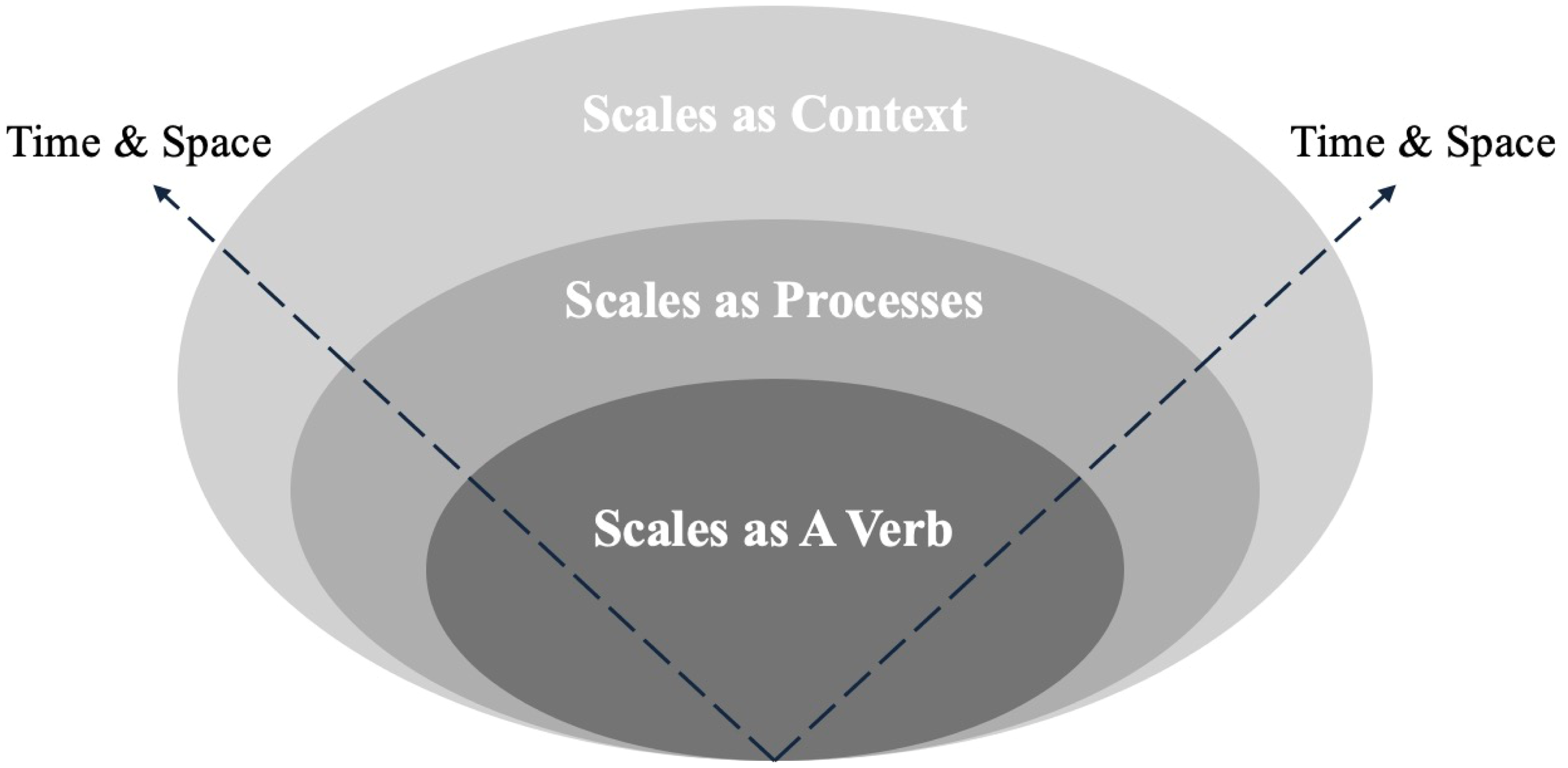
The multilayered understanding of scales in play.
Scales as a verb is mainly reflected in the generation and shifting of scales in children's engagement in learning, which is associated with children's agency in play. This can be illustrated with the example of a pretend play where two children, Jimmy and Lily, are having a tea party in their backyard. Lily takes on the role of the hostess, pouring invisible tea into plastic cups and offering pretend cookies to Jimmy, who plays the role of a guest. They are having a conversation about their favorite tea. While the immediate context of their play focuses on the tea party and their favorite tea, their conversation is scaled onto other dimensions. For example, they may recall where they have tried the tea or imagine a tea that is associated with certain stories. In this case, their favorite tea expressed in the social interaction of the party is indexed or expanded upon other scales, reflecting how the local pretend play can connect to larger social and historical contexts. The children's agency to make scales is often found in childhood researchers’ discussion on meaning negotiation (e.g., Carter et al., 2020), children's imaginations (e.g., Caiman and Lundegård, 2018; Fleer, 2021; Li, 2024), and multimodality in play (e.g., Bengochea et al., 2018; Lim and Toh, 2020; Smith, 2021). These areas of research shed light on the different aspects of children's agency in making scales during play. Carter et al. (2020), in their study on the addiction discourse in game play, found that children would appropriate the language of addiction to understand their engagement with digital games and, drawing on their encounter with media reports on games, present a variety of meanings of addiction. In Carter et al.'s (2020) study, children would upscale digital game play from an individual behavior to a social debate on the definition of game addiction by recalling their experiences with articles and videos discussing the potential problems associated with excessive digital gaming. In this sense, children's opinions on play are not static and personal; rather, they reflect a mix of scales that are both personal and collective, static and dynamic, and local and social. And children can make scales and negotiate their interpretation of play by mobilizing their knowledge and lived experiences. Children's scale-making is also revealed through their imagination, which, indeed, has long been understood as an essential aspect of children's play (Fleer, 2021). It has been found that children can change the meaning of their surrounding objects and create an imaginary situation for their play (Li, 2024). Children's imagination, in this situation, is social, as they express their agency and insert new scales (e.g., social interaction rules) into their play by imagining a context that is compatible with the overall constitution of the social relations and materials in their imaginative play. In his discussion of the learning potential of imagination, Fleer (2021) argues that children can work with their imagination by giving the physical world a new sense, which further shows how they could cross borders between the real and the imagined worlds. From this perspective, scale-making reveals children's agency to bridge and across “boundaries” (from the perspective of scales, boundaries are blurred). Another example that demonstrates children's capability to scale their play concerns the multimodality of their meaning-making. It focuses on the various semiotic resources such as pictures, gestures, audio, and videos that children could draw from (Blommaert et al., 2015) and also recognizes their critical thinking, creativity, and resourcefulness in making meanings in their play (Lim and Toh, 2020). The multimodal approach to play expands children's scale-making beyond the conceptual level (e.g., imagination) by involving the physical aspect of scaling. For example, in Bengochea et al.'s (2018) study on sociodramatic play, the bilingual child used a combination of objects, positions, gestures, and spatial movement in demonstrating and explaining his play. Scale-making is physical in the sense that new meaning can be created through the employment of visual and actional modes. As argued by Blommaert (2007), the movement from one scale-level to another generally invokes the “images of society,” that is, the semiotic, multimodal symbols. Moreover, the multimodality also indicates play as a third space (Potter and McDougall, 2017) in which a variety of scales mash together and boundaries are blurred between the spatial and the material, the virtual and the real, and the in-school and the out-of-school.
Scales as processes concerns the dynamic interaction of space, places, time, and objects in children's play. It rejects the structuralist paradigm that examines the rules and structures in play; instead, it follows a rhizomatic model that integrates “the constant reconstitution of scales, generation of new scalar relationships, fluid connections between scales and other social and material constructs, unpredictable cause/effect relationships, and changing configurations of social processes and practices” (Canagarajah and De Costa, 2016: 2). The previous example of the pretend tea party also contains dynamic scaling processes. In the conversation about their favorite tea, Jimmy and Lily may engage in discussions and negotiations to decide which tea is the best. Throughout this process, scales are continually (re)constructed as they navigate between local, regional, and social perspectives on tea. The ongoing (re)construction of scales in this process demonstrates how the understanding and framing of topics in play evolve over time and across different levels of analysis. Scales as processes can be explained through the posthumanist concept of intra-activity, which means the connections of different entities exist through their entangled relationality that does not necessarily require a proximity in space and time (Barad, 2007). It situates children's play at the interaction of humans and nonhumans and directs researchers’ attention to the force that produces to-act and to-be-acted in play and propels the formation of different constitutions of playful elements. From the posthumanist view, the objects in play also have agential power to shape, afford, and alter children's play. Agency, in this context, does not mean that these nonhuman entities could come alive and express their needs. Instead, agency legitimates the source of knowledge, and for nonhumans, becoming agentive acknowledges their liberation from being a passive matter for human use (in this case, children's play) to an essential part of intra-activity. As argued by Lenz Taguchi (2010), “it is the material-discursive forces and intensities that emerge in the intra-actions in-between the child and the materials in the room that together constitute the learning that can take place” (p. 36). Therefore, scales in play concern the (re)construction of relationality between children and the objects at their disposal in play. Such an emphasis on processes shifts researchers’ focus from documenting the outcome of play to asking what kind of play is underway (Kuby and Rucker, 2015).
Scales as context focuses on the embodiment of children's play and the pattern formation on a longer timescale. It should be noted that the embodying context of scales does not indicate a separate understanding of space and time as two different dimensions. According to Schatzki (2020), the temporality and spatiality of a social activity are teleological, meaning the setting of space and time is based on the activities that people perform in that setting and the motives for those actions. This suggests that the organization of children's play is not arbitrary. Instead, it can be analyzed without dividing the play into split views of the past, present, and future, or distinguishing between here and there. Wallerstein (1998) also refers to the interdependence of space and time as TimeSpace, which constitutes a single dimension of human activities. As shown in the previous tea-party example, Jimmy and Lily could draw from their own experiences and imagination to generate new scales, during which their play is turned into rhizomatic, fluid processes. Despite the unpredictability of the play, there is also a spatial-temporal setting. Within this TimeSpace context, the play of tea party unfolds simultaneously, including pouring invisible tea, having pretend cookies, and casual talk about favorite tea. The tea party itself serves as a microcosm of interconnected scales, where the TimeSpace moves along the interaction of spatial dimensions of the play with the temporal dimensions of personal reflections and social interactions. TimeSpace embodies the context within which these scales intersect and influence one another, shaping the experiences and interactions of the two children in their pretend play. The TimeSpace view reshapes the understanding of context as static and objective; instead, scales as context highlight the complex, dynamic nature of context by positioning it as becoming, emerging, and merging. Besides, scales as context concerns embodiment, meaning the experiences, interaction, and feelings in play cannot be separated from the physical bodies (including both human and nonhuman). Hackett and Somerville (2017) conceptualized this embodiment as movement and sound in which the play between children and natural entities (i.e., water and mud) constantly poses questions and (re)directs the human–materials interaction. The movement and sound make and are made into a “more-than-human world (mud, drums, floors, water etc.) coordinating the actions of the children” (p. 386). This way of interpreting children's play, according to Hackett and Somerville (2017), helps “connect with the notion of ongoing becoming between the child and the more-than-human world, and to resist arriving too quickly to ‘common sense’ representations or interpretations of what young children's literacy practices are or mean” (p. 387). Although the dynamic view of scales reveals the fluidity and unpredictability in children's play, repeating patterns can be found on a longer timescale (Lemke, 2000). During play activities, scales of routines are emerging, and new scales are constantly inserted with the formation of new social relations, understanding, language, and feelings. In Lemke's (2000: 278) words, “these in turn can become the raw material for more complex new patterns unique to the classroom [in this case, children's play], and they certainly constrain the probabilities of actions and utterances that would invoke these special meanings or contribute positively or negatively to social relationships.” In this situation, children's play can be viewed as “an individual at its own scale of organization. It has a unique historical trajectory, a unique development through time” (p. 278).
Play across time and space: Methodology and pedagogies
From the perspective of scales, children's play can be viewed as dynamic, interdependent, and self-evolving systems of semiotic resources, meanings, and practices. Scales also help to unthink and rethink the binary understanding of elements in a play activity by situating it in a converged TimeSpace where multiple timescales intersect. Methodology-wise, scales facilitate a more nuanced, dynamic understanding of context. While most studies on children's play focus on the observable, immediate contextual features, the theoretical perspective of scales enables researchers to explore how different layers of context intersect and influence each other within the broader context of play (Canagarajah and De Costa, 2016). This approach allows for a deeper examination of the multifaceted nature of children's play, acknowledging the complexity and interconnectedness of various factors at play. This polycentric understanding of context also rejects the binaries such as classroom play vs. home play, play-based learning vs. formal schooling, or digital play vs. offline play, as well as the excessive emphasis on linearity and chronology in analysis. Instead, with the emphasis on interdependence, scales necessitate a relational view of various timescales, human, and nonhuman involved in play. There exists a relational distance that circulates, allowing children to draw upon the most relevant scales to formulate a play experience that aligns with their preferences and needs. Thus, the play elements like classroom play and home play are relational concepts that are produced in and through the relationality of children's play. The predefined boundaries between different play elements blur, and what matters is the flow of meaning-making and negotiation. In this sense, rather than centering around what could work to facilitate literacy learning in play activities, scales direct researchers’ attention to the developmental trajectories of play. This shift in research focus also alleviates the tension in educational play where specific learning goals and outcomes mandated by the curriculum have to be met (Edwards et al., 2020). By examining play activities across different scales of time, space, and social organization, researchers can gain insight into the dynamic nature of children's play and its evolution over time. This longitudinal approach allows researchers to track the progression of play behaviors, identifying patterns, transitions, and developmental milestones within the context of scales. Besides, scales also allow a broader view of the unit of analysis. Rather than focusing solely on individual actions or isolated events, researchers can analyze play at multiple timescales, ranging from micro-level interactions to macro-level structures. This broader perspective enables researchers to capture the complexities of social processes in play, taking into account the interplay between different levels of analysis.
The methodological values of scales can be found in research methods like nexus analysis (Scollon and Scollon, 2004) and scalar analysis (Blommaert, 2007), both of which concern how social actions like children's play are mediated by the intersection of different layers of timescales. For nexus analysis, the primary goal is to map the discourses from various timescales and trace how they mediate social actions. The nexus of practice serves as the focus of analysis. For example, children's play could be a nexus of practice where relevant scales could emerge, including the school curriculum, toys for play, physical environment, and social relations. In particular, nexus analysis explores the way social action is mediated through the intersected dynamism of historical body (i.e., children's life experiences), discourses in place (i.e., beliefs surrounding the play), and interaction orders (i.e., social conventions in play). While nexus analysis centers around social actions, scalar analysis directs more attention to the contested feature of scales as a category of practice in shaping interaction (Blommaert, 2007). Researchers consider how phenomena manifest and interact at various levels, ranging from the individual or local scale to larger scales. This approach allows for a comprehensive understanding of complex systems, processes, and relationships in children's play by considering the hierarchical or nested nature of their components.
Pedagogically speaking, scales help address the deficit view of children in play design in which much attention is devoted to the surrounding elements like playground facilities for their play affordances (e.g., Herrington et al., 2022), whereas children's agency to make their play playful is less discussed. From the perspective of scales, children have the agency to define, construct, and negotiate scales (cf. Canagarajah, 2016). In this sense, instructors need to shift their focus from what children can benefit from their play to what children can do in their play. Teachers can allow for flexible learning goals that facilitate spontaneous and emergent play experiences while also incorporating intentional learning opportunities that span multiple levels of analysis. One example is the converged play that creates a TimeSpace for “multi-modal, global-local, and traditional-digital activities … alongside well-established opportunities for play-based learning in early childhood classrooms such as exploration, problem-solving, and discussion” (Edwards et al., 2020: 657). At the same time, teachers need to acknowledge the ways in which play objects come to act and how children, together with the objects, can construct and transform contexts for their play. One practical implication of this perspective is for teachers to recognize children's play as their engagement in meaning-making and negotiation, rather than categorizing children as passive or active participants. Put differently, children should be viewed as producers, rather than consumers, of play (Moberg, 2024). The role of teachers is to create pedagogical spaces where children can freely recall their personal histories and bring their lived experiences into their play, thereby activating these critical timescales into the (re)constitution of their becoming in the play. Furthermore, teachers are suggested to view children's play as continuities and discontinuities across space and time. Thus, play reveals children's behaviors and learning, with their meaning-making grounded not only in their individual lived experiences but also in the traces of social actions across different timescales.
Conclusion
This paper explores how the theoretical perspective of scales can enrich and shift our understanding of children's play from a static, outcome-oriented activity to a series of meaning-making and self-emergent processes. As discussed in this paper, scales in play can be approached from three aspects: actions that reveal children's agency in drawing from their available semiotic repertoire across time and space; processes by which they (re)construct meanings with other nonhuman and human participants; and contexts where their play is embodied. This rethinking of children's play is necessary given the current dynamic, fluid understanding of literacy (Bajovic, 2018). The previous binary categories in play research—for example, guided play and free play—are giving way to an emphasis on the interconnection between the elements running through children's play at multiple layers of timescales, which enables a fruitful way of approaching children's imagination, language, interaction, vocalization, and movement in their efforts to demonstrate their sense-making. As argued by Canagarajah and De Costa (2016), scales are indeed onto-epistemological constructs that serve as a lens and stance to understand, interpret, and define social actions like children's play. In Compton-Lilly's (2014) view, “the spaces and times in which people act and interact, alongside the social relationships that transpire within those contexts, are significant considerations for learning” (p. 1). Literacy nowadays features complexity and diversity, and the context-fixed analysis might not be the best way to capture the flow of literacy learning in children's play. With its critical perspective on contexts, as discussed in this paper, scales can generate new theoretical, methodological, and pedagogical insights into children's play, their literacy learning, and agency.
Footnotes
Author note
Dr. Angel M. Y. Lin was affiliated with Simon Fraser University at the time funding for this research was awarded.
Declaration of conflicting interests
The authors declared no potential conflicts of interest with respect to the research, authorship, and/or publication of this article.
Funding
The authors disclosed receipt of the following financial support for the research, authorship, and/or publication of this article: This work was supported by the SSHRC Partnership Engage Grant (no. 1008-2020-0161) awarded to Angel M. Y. Lin from Simon Fraser University.
