




Abstract
In this article, we introduce a relational approach to toy pedagogy. A narrative and three photographs from field studies in kindergartens function as sticky knots. By following Haraway and her philosophical explorations of string figures, we discuss the stickiness of the photos and how they contribute to understanding a concept like toy pedagogy. By interrupting the traditional understanding of toys in pedagogical practice, we suggest that toy pedagogy evolves between children, toys and the environment. Multiple connections appear when examining the photographs in light of kinship, which leads to creations of the environment as a place where companion species engage in processes of becoming-with the world. Finally, we discuss how toys affect networks of meaning and worlding, take part in producing dreams and give hope to the lives of children.
Curiosity about toy pedagogy in kindergarten drives our thinking and writing in this article. By examining meetings of texts and photos as conversational partners, we rethink how toys are positioned in kindergartens and what they produce. Our fascination with toys in meetings with young children springs from multiple observations in kindergartens. We introduce the concept of toy pedagogy to challenge traditional notions of toys by highlighting the intricate and multifaceted interactions that can occur between children and toys, as well as the potential for transformative experiences through these relationships. We have chosen to name these multifaceted interactions toy pedagogy, as they also involve pedagogy and pedagogical intentions. As an entrance to our thinking with toy pedagogy, we present a dialogue in the form of a fictive conversation between a section of Haraway's (2016) text and us:
Inspired by how MacLure (2013) describes the choice of data as directing attention to something that glows, we allow ourselves to be captured by three photographs involving children and toys. The photographs are not seen as images of reality but rather as an entrance for attending to particular practices (Moxnes, 2022); this thereby directs attention to the materiality of lived experiences and the ethical implications of the stories we use and the way we tell truths. Two of the photographs originated from events that took place in different kindergartens, and the third is a fusion. Following Haraway and her philosophical explorations of string figures, we discuss how they may contribute to the understanding of toy pedagogy. Our arguments for using the photos include how they inspire us to think of toys as active agents in children's lives and to wonder how toys are a part of the pedagogical foundation in kindergartens and contribute to the idea of them as active parts in pedagogical production in kindergartens. Before untangling this knot, we provide a brief overview of previous research involving toy pedagogy.
Toy pedagogy in kindergarten
Toys, like play, can be examined from different research traditions, and different theories and philosophical approaches create different conditions and perspectives for how play, and thus toys, can be understood. Often, the understanding of play is on a continuum between play as a planned, purposeful or developmental activity that builds during learning (Pramling Samuelsson and Johansson, 2006) and play as a creative way of life or a condition with intrinsic value that has significance in itself (Sutton-Smith, 1997). Hassinger-Das et al. (2017) write that all material that children can use in play (regardless of the form of play) can be defined as a toy, regardless of whether it is actually produced as a toy. The point is that the view of play will connect to and influence the view of toys. A prominent premise is that learning takes place in all forms of play because children actively relate to the outside world and are actively involved in encounters with materials that capture their interest and are experienced as meaningful to them (Chi, 2009; Frödén and Rosell, 2019; Hassinger-Das et al., 2017).
In early childhood and educational research, we can follow the trail of toys through time back to Friedrich Fröbel and his emphasis on the gift of play as an important factor in children's lives (Johansson, 2020). The concept of toy pedagogy is traditionally based on human-oriented thinking, which is in line with Fröbel's description of how play gifts should contribute to education (Johansson, 2020). Fröbel wanted to give children an opportunity to discover the structures of the world in interaction with an adult, by proceeding from the child's experience of the world (Johansson, 2020: 53). However, this idea of toy gifts or toys was developed in the mid 1800s.
In our first attempt to grasp the concept of toy pedagogy, we understood it as pedagogy involving toys. However, we became aware of the need to connect this understanding to earlier research, and our literature search informed us that knowledge of toys has not been given a significant place in kindergarten research in recent years (Kjørholt and Os, 2019: 84). Toys and their importance in early childhood have mainly been placed within a cultural-historical understanding apparatus in which the idea of proper toys can be traced across the Nordic countries. Furthermore, research has also focused on the number of toys available for children in kindergartens and the fact that Norwegian childcare faces challenges connected to the lack of adequate materials for play and learning (e.g., Bjørnestad and Os, 2018). However, toys have recently been framed more clearly in learning discourses as ‘tools for learning, for socialization and training’ than they were previously (Lauwaert, 2009: 40). Other perspectives on how materiality works upon children's play with toys have been produced by, for example, Ottersland Myhre (2019), who discusses how new ideas, theories and practices might emerge through re-turning a LEGO event in a kindergarten. Jones (2013) discusses how play with a dress becomes an opener for discussing how we inscribe children. Others have explored the use of mechanical toys (e.g., Hohti and Osgood, 2020; Lafton, 2021) and connections of play involving plastic animals (Aslanian and Moxnes, 2020). Even though toys have been examined in several studies, they are mainly seen as a ‘natural’ part of childhood and tools for learning, play and socialisation; however, the relationship between a child and toy(s) has rarely been touched upon in research.
With this in mind, we wonder what the complex relationships between children, toys and the world around them do or produce when they are present and part of relational connections. Haraway's (2016) worlding through the string figure, which weaves the material aspects and relationships closer together follow this understanding further. First, though, we dive into another of the knots in the string: our methodological entrance.
Glowing knots in strings: Our methodological entrance
MacLure (2013) describes choosing data as directing attention to something that ‘glows’ – something that affects and captures. This can include small comments from an interview, such as an anecdote or a feeling that arises. In our case, we use selections of photographs from kindergartens that ‘glow’ and to which we repeatedly return (Holmes, 2016). These can be understood as precise excerpts that can be explained in light of concepts or discussions in the field of early childhood education and care (MacLure, 2013). At the same time, they push the boundaries of what is possible without rejecting the idea of gender, development, children's perspectives or other possible chosen frameworks of discourse. They are broken into past, present and future and are connected to beings-of-the-world on several levels. MacLure (2013) names these types of data ‘wonder’, and Holmes (2016) links them to curiosity. In selecting the photos in our study, we used curiosity as the closest to describing exactly why they were chosen. The photos help raise questions that Manning (2009) introduces as ‘the what if’ and Haraway (2016) calls speculative fabulations. Rather than giving the photograph the status of an image of something that already exists (Barthes, 1985: 206), we give the photos the status of sticky knots in our string figure (Moxnes, 2022; Moxnes and Osgood, 2018). By treating the photo as one possible understanding among several, we present photography, not as a reflection of reality, but as something we cannot trust: ‘Such objects constitute excellent elements of signification: on the one hand they are discontinuous and complete in themselves, a physical qualification for a sign, while on the other hand they refer to clear, familiar signified’ (Barthes, 1985: 203).
In the translation between two media – from photo to text – the toy depicted acts as what Barthes calls the signified, and the moment we understand the signified as text, the content changes. The toy itself does not change, but the idea is perceived differently due to the translation. In such thinking, we must move away from the idea that the photograph is captured through an anthropocentric lens, ‘accounting for the boundary-making practices by which the “human” and its others are differentially delineated and defined’ (Barad, 2007: 136). By presenting the photo like this, we implement it as part of our research story. Rather than describing extracts from our empirical material in a larger project involving children and toys, as we could have done, we examine the selected photographs as data involving overlaying stories. Therefore, the photographs not only must be read as inscribed in a kindergarten practice or children's encounters with toys but are also intertwined with our own historical knowledge and experiences. If the photographs are no longer a mirror of reality, they can become an entrance for examining multiple connections in the world.
Our reading of the photos creates sticky stories inspired by Haraway's (2016: 12) practice of ‘passing patterns back and forth giving and receiving, patterning, holding the unasked-for patterning in one's hand, response-ability’. At the same time, we ‘also know that our methods for telling stories are always imperfect. We cannot notice all stories, not all stories are ours to share, and each child, educator and researcher connects differently to different stories’ (Land et al., 2020: 138–139). Through the photos, we pay attention to the materiality of lived experiences and to the ethical implications of the stories we use and the way we tell truths. Stories provide a particular view of the world – a visualisation of the match or mismatch between the view of the world that exists in the story and the actuality of our existence (Land et al., 2020). As such, the stories told are not solely scientific facts; the photographs function as sticky knots of storying in toy pedagogy that connect to multiple micro-moments that cannot be connected to one and the same reality but rather to patterns that emerge through multiple versions of relational worlds.
As researchers, we have deliberately chosen the photos we present here. We are aware that ‘the researcher must be careful because one does not have access to the full truth of one's lived experiences’ (Greenhalgh-Spencer, 2019: 53). This urges us to position the photos as what Haraway (2016) presents as a get-go to generate richer, quirkier, fuller stories. Like Haraway (2008: 4), our concern is how different bodies and opinions mutually create each other. Haraway uses the term worlding to refer to what occurs when semiotics, affect and materiality meet in the exploration of the world. In her writing, Haraway (2016: 35) returns to the following phrase: ‘It matters what stories tell stories.’ Such an entrance to stories is linked to how patterns emerge in multiple versions, and in each version, there are more possible places from which to think about other ideas.
Further theoretical interweaving: String figures and collective making-with
Haraway's (2018: xxxix) philosophy is relational and involves a ‘collective making-with’. This means that the concept of the string figure is woven together with other string figuring (SF) concepts, such as science fiction, science facts, speculative feminism, speculative fabulation and so forth. SF is a relational practice, a writing practice, ‘gaming’, a speculative fabulation and performative practice, and it always involves many co-players (Osgood and Mohandas, 2020). The idea of a collective ‘making-with’ provides us with possible ways to resolve and recreate threads and knots in ‘playing’ with the photographs in the string figure of this article. The threads and knots connect past, present and future by weaving existing theories with the photographs and creating wonder about the future. As such, SF activates and connects the empirical materials and theories.
When we activate SF, the concept of toys becomes performative and is linked to one possible construction of toy pedagogy. Seeing toys as performative implies that toys can simultaneously stage action and be staged. As part of a child's world, toys carry inherent meaning, while, at the same time, this is open to negotiation. Haraway's (2016) term kin can help develop this understanding further. Kin is an assembling sort of word. All critters share a common ‘flesh’, laterally, semiotically, ‘and genealogically. Ancestors turn out to be very interesting strangers; kin are unfamiliar (outside what we thought was family or gens), uncanny, haunting, active’ (Haraway, 2016: 103).
By thinking of children and toys as kin, we open other worlds and a myriad of narratives that stretch in an infinite number of directions; neither the world nor the narratives about the world are linear. In this way, toys do not work logically into children's lives but intervene and allow themselves to be grasped across space and time. Children and toys thereby become intertwined and affect each other's stories: ‘to make kin in lines of inventive connection as a practice of learning to live and die well with each other in a thick present. Our task is to make trouble, to stir up potent response to devastating events, as well as to settle troubled waters and rebuild quiet places’ (Haraway, 2016: 2).
Haraway (2016) includes both humans and non-humans in the word ‘kin’. Kinship requires that there are several kin present at the same time, and what is excluded and what is anchored in the knot are significant to what remains. By treating the knots in SF as sticky, the aim of our work is to untangle them in order to identify connections in between the diverse pieces contributing to collective sense-making. The point is that everyone can play along by pulling threads or creating knots in the string figure.
Producing toy pedagogy
Take, for example, a car in a photograph waiting for us (Figure 1) – a toy car that can rush us out of institutionalised kindergarten life. This red car can take us to Route 66, to our childhood photo album or to the bottom of the ocean. The toy can take us away from the already defined. In our investigation, the photos provide us with an opportunity to start in the middle, or in Haraway's (2016) words, to search the depths of the knot between the threads in the string figure. The photographs are located in the string figure, like a glowing or sticky knot found within yourself. Such a way of using photography differs from the traditional semiotic focus in visual methodology (Rose, 2016).
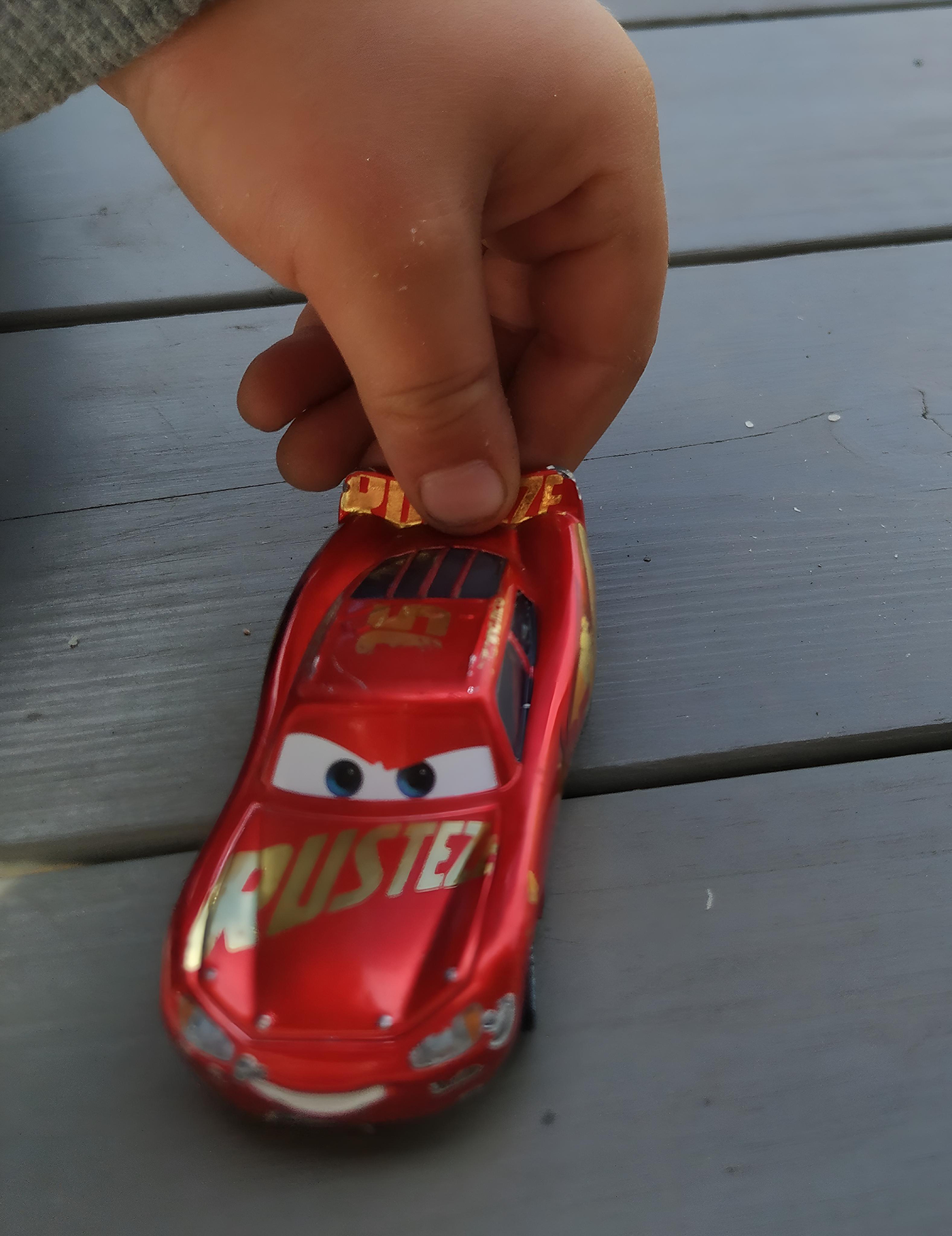
The red car.
What strings are activated by the red Lightning McQueen (Figure 1)? We must ask why the car is manufactured; thus, we discover whether the toy product is part of a large commercial chain of products spun out of a film or whether the film spun out from the toy product. Although the first film in the series dates to 2006, the products are still on sale and in private ownership. If we follow Haraway (2016) and the idea of sticky knots, we could ask the following: Where is the car manufactured? What climate footprint does its production, transport and distribution leave? Is child labour part of its production? Such questions produce sticky notes that move beyond local toy pedagogy and force us into ethical discussions. In everyday kindergarten practices, educators might consider what the limits are for the kind of toys that should be included. The discussion involves how children relate to toys offered by their kindergartens, as woven together with their private toys. Some knots become a collective coproduction that intervenes in each other's stories without defining them, but rather stirring them up. The child's hand in contact with the car is not concerned with whether Pixar and the Walt Disney Company make money or how environmentally friendly or commercial this product is. Such ethical considerations are not up to the child but are rather pedagogical issues. Nevertheless, both commercial and non-commercial toys activate kinship systems among various species, stretching out the SF and challenging us to link ourselves to other places, practices and pedagogies.
However, some patterns and sticky knots are created between the hand, the body and the car. The car is a beloved toy to which the owner of the hand is greatly attached. One of the child's parents made us aware that ‘now you get a picture of the toy [that the child] is the fondest of’ (Figure 1). Friendship? Love? Love toys? Toys are more than toys – they are loving friends and supporters. This draws attention to Haraway's (2016: 2) concept of kinship. It may be troublesome or provocative to consider the car and child as being in kinship, but there's something about the way they connect, the calm they create together and the security. Like Haraway, we argue that all ‘SF is a method of tracing, of following a thread in the dark, in a dangerous true tale of adventure’ (Haraway, 2016: 3). SF regulates what counts when activating what is at stake when playing with the toy and our understanding of these toys. Haraway (2016) starts by examining what is already known in SF before moving in the direction of exploring fabrications about what futures could be produced: ‘SF is practice and process; it is becoming-with each other in surprising relays; it is a figure for ongoingness in the Chthulucene’ (Haraway, 2016: 3). In kindergarten practice, many of the discussions linked to commercial toys and tools are governed by whether it is okay to bring things from home, whether play should originate from forces other than the commercial ones and whether kindergartens can produce an ‘opposite pole’ to commerce toys. However, Haraway (2016) introduces other questions when she advances the narrative towards who survives and who dies in the negotiations of toy production, which is something that cannot be controlled by the concrete things themselves. What will continue to be of interest in the game, what is passed on and what emerges from other meetings are more important than the toy itself.
In such thinking, we come into a constant process of becoming – in this case, to the sound of Sheryl Crow singing, ‘Life is a highway. I wanna ride it all night long’ from the soundtrack from the movie Cars. The fact that toys also connect with digital technology and mass media contributes to the fact that inspiration for play can move across previously drawn boundaries in that children in many countries relate to the same media content and the same toys developed from that media content (Marsh et al., 2016). Children can thus move across time and space in play, as several researchers have pointed out (Frödén and Rosell, 2019; Jones, 2013; Marsh et al., 2016). An apparatus through which both humans and other-than-humans have agency and are created through connections requires understanding toys in ways other than as something intentional to promote learning or as something that can contribute to the development of children's cognitive abilities. Because children are not ‘brains-on-a-stick’ (Murris, 2018), we have no guarantee that a link exists between the design of the toy and possible cognitive development. What if the child adopts the car as ‘mine’ in a group in which all toys are common and should be shared? Such questions go beyond those that have right or wrong answers, because they connect to an ethical practice requiring us to examine what is at stake right now.
Engaging in becoming-with
Thinking further along the lines of Haraway (2016: 13) and how companion species engage in processes of becoming-with the world – a world in which neither nature, culture, subjects nor objects have given characteristics and frameworks for existence – we note that they all come into being through the interweaving of the world. Such worlding creations cannot be predetermined but come into being as consequences of interweaving everything that matters when other stories and dreams enter the scene and when toys connect to everyday events; thus, it makes sense for them to become real for us (Haraway, 2016). Another connection glows and nags us to investigate becoming-with feelings and emotions that intra-act from far away but are still so close. A story was given to us by a parent: Another child, another place Arild is 5 years old and is on his first fishing trip. He catches and pulls in a feisty live mackerel. From the time we went out that morning, we had talked about fishing for dinner, and he was in on the concept until we broke the neck of the fish. He cried, even though he knew we were going to catch it and eat it and thus had to whack it. But when he saw the little creature that went from being feisty alive on the hook to lying on the rock, he wondered who would miss the fish, if it had family, what they would say when it didn’t return home. And that he had contributed to it.
As depicted in the connected photo (Figure 2), a white tent was set up in the kindergarten department, and outside the tent was a projector. The kindergarten staff collected a film from the bottom of the sea, which they projected onto the tent cloth (Figure 2). Then, they invited the children into the tent. Like de Freitas and Palmer (2016), we will move out of an epistemological debate that focuses on whether children's conceptual learning and meaning-making can be understood as coherent or fragmented and move into the idea that children are ‘in the middle’ of the world of which both the concept and the child are a part. However, the dilemma lies in the (im)possibility of knowing for sure how the different events affect each other; this is particularly important to kindergarten teachers. When moments of pedagogy are considered open-ended and are not able to be defined in advance, the possibility of planning for toy pedagogy becomes troubled. Land et al. (2020: 141) elaborate on how their pedagogical intentions are imperfect and flooded with tensions. While teachers and pedagogues offer intentions as tentative propositions in constructing early childhood pedagogy, we as researchers find ourselves eager to question what it means to cultivate pedagogical intentions with the complexity of children's lived experiences. Davies and Davies (2007: 1143) discuss how to gain access to someone's experiences after the discursive turn: ‘The “experiencing subject” in these reflections, is never cocooned from the world, never complete, never free of the other, but an ongoing unfolding in relation to the other [sic]’ (Davies and Davies, 2007: 1143). As researchers, we could have described Arild's doings and sayings with the other children in the tent (Figure 2) by involving his previous experiences from the fishing trip. However, our assumption and taken-for-granted ideas about how experiences affect the moment may have been standing in the way of examining the possible outcomes of micro-moments of toy pedagogy. Pedagogues could face similar challenges when pedagogically working to make sense of the (im)possibility of presenting how different events involving toys, children and the world affect each other.
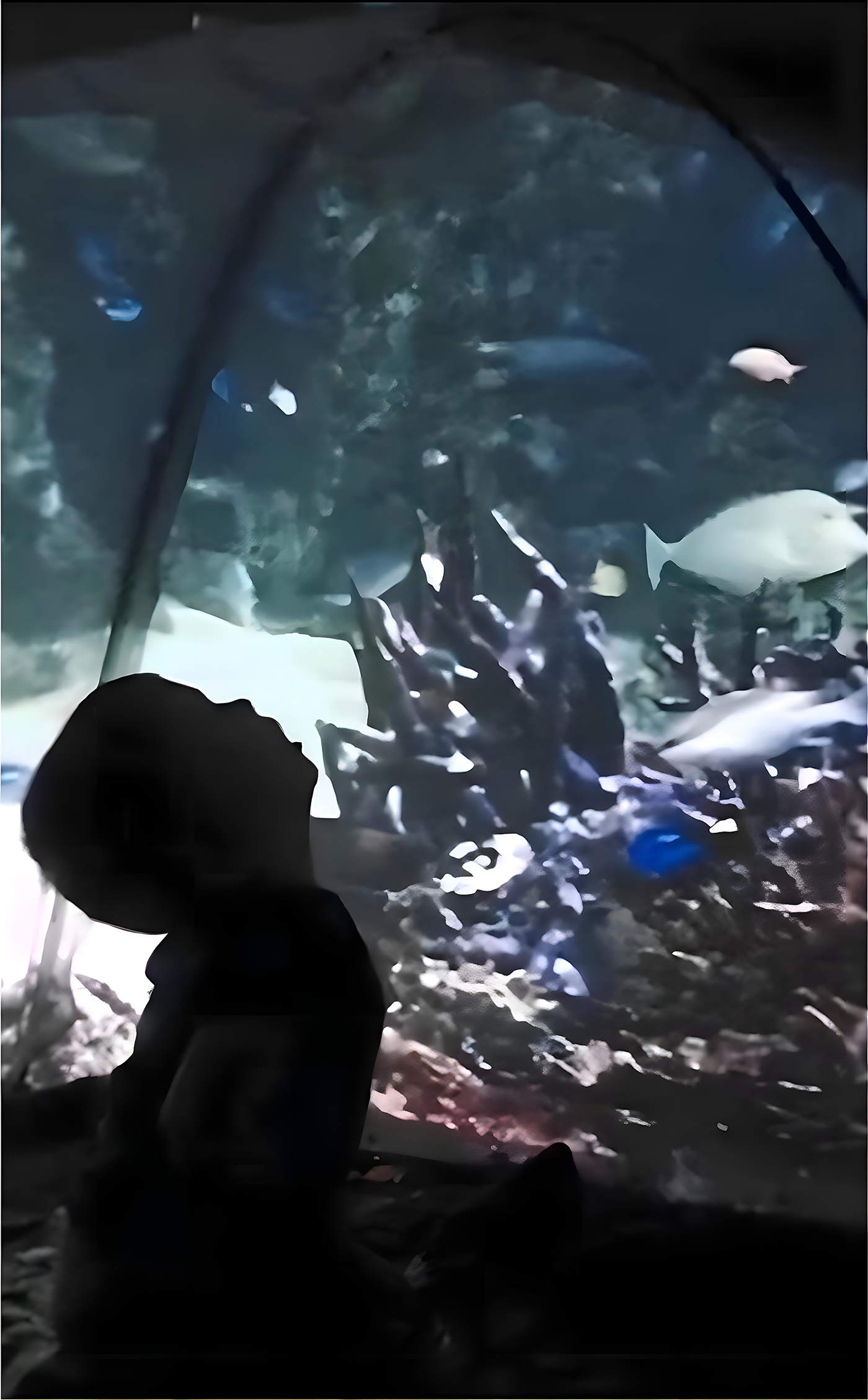
Tent with projector creating underwater landscape.
In our investigation, toys are intertwined with children's play, learning and educational processes in kindergarten. These timeless acts are woven into the knot, while the time in which play arises anchors the experience. The film shown in the tent is from a different time but connects with the children in the tent (Figure 2). Arild, from the excerpt above, goes on a fishing trip somewhere else at another time, but the film affects the trip, or the trip affects the film. We do not know what took place first or last, but we do know that, together, they produce an attitude towards the world and a way of being in the world. This brings us back to Haraway and how she points out the connection between choosing and applying the most appropriate terminology that can convey some of the worlding that occurs in the human–non-human interweaving: ‘It matters what stories we tell to tell other stories with; it matters what knots knot knots, what thoughts think thoughts’ (Haraway, 2016: 12). From such a perspective, the world, the body and non-human actors are equal and constantly changing.
The photo of the tent and the story about Arild going fishing combine into a string figure that includes both storytelling and fact-telling; it is the pattern of possible worlds and possible times. From such a perspective, toy pedagogy also becomes somewhat unfinished. The photo enables us to access the process of producing common worlds and becoming-with. Time is something magical that glows together with the sea on the tent cloth, the child's body appearing as a shadow in the photograph and Arild's crying on the fishing trip. They intervene with each other and constitute each other, becoming kin. The play situation extends beyond the given moment and connects with other events that are already part of the children's worlding. We do not know how different companion species activate each other in kindergarten, nor do we know which companion species participate. Such insight requires educators to see kindergarten play and learning situations as explorations and experiences with unknown participants. This leads us to Haraway's idea that ‘our task is to make trouble, to stir up potent response to devastating events, as well as to settle troubled waters and to rebuild quiet places’ (Haraway, 2016: 1). The question is who is not seen and heard because they are not recognised, thereby losing their place in the kinships; bring them up front and let them speak as companions. By taking Haraway's ontological approach seriously, we can recognise how several participants are simultaneously present without necessarily being visible.
(Re)turning to the sticky lightning
Kinship requires that several kin, such as the child and the car (Figure 1), be present at the same time. Haraway (2016: 106) writes, ‘Cross-species kinship has consequences.’ As previously noted, Haraway anchors both humans and non-humans in the word kin but does not treat kin alone. In a kindergarten, the red car is carried in hands or put in pockets, and it is included in various activities with the child. In this child–toy kinship, there has been a relationship for some time – from the time the child and the toy caught the attention of each other. From this perspective, the interaction involving the child and the toy is what creates kinship. However, the marketing of the product, or what status this particular toy has through its role as a protagonist in a cartoon, connects with this kinship across time and space, becoming present in the sticky toy-knot in the string figure.
Playing with the photographs and letting them merge into one photograph (Figure 3) gave us the idea to examine what they collectively offer in terms of possibilities and understandings. The photograph with the car and the hand and one with the tent with the sea perhaps offer relationships and cosmic performances in that they move outwards and beyond being just human and a ‘toy’. As a response to our wondering about what toys and children do or produce when they are both present and part of a relational connection, the fusion may contribute new connections. The question of whether all materials that children can use in play can be defined as toys, despite whether they are actually produced as toys (Hassinger-Das et al., 2017), is not the main issue in the fusion (Figure 3), nor is the research finding connected to a lack of adequate materials for play and learning (Bjørnestad and Os, 2018). Rather, the idea of fusion is to investigate how toy pedagogy involves a relational approach through which toys and children engage in the lives of others. Together, they turn into ‘something more’. In this fusion, anything may happen, just like when children use toys diversely, beautifully, safely, frighteningly and relationally as kinship and in their worlding. As such, the idea that toys in kindergartens should be connected as ‘tools for learning, for socialization and training’ (Lauwaert, 2009: 40) might become a limitation for the roles that toys play in their performance of pedagogy. We even remember moments from our own childhood when the safety of play moved into something new and unexpected or perhaps unpleasant and frightening. Perhaps the fusion of the photographs offers precisely this.
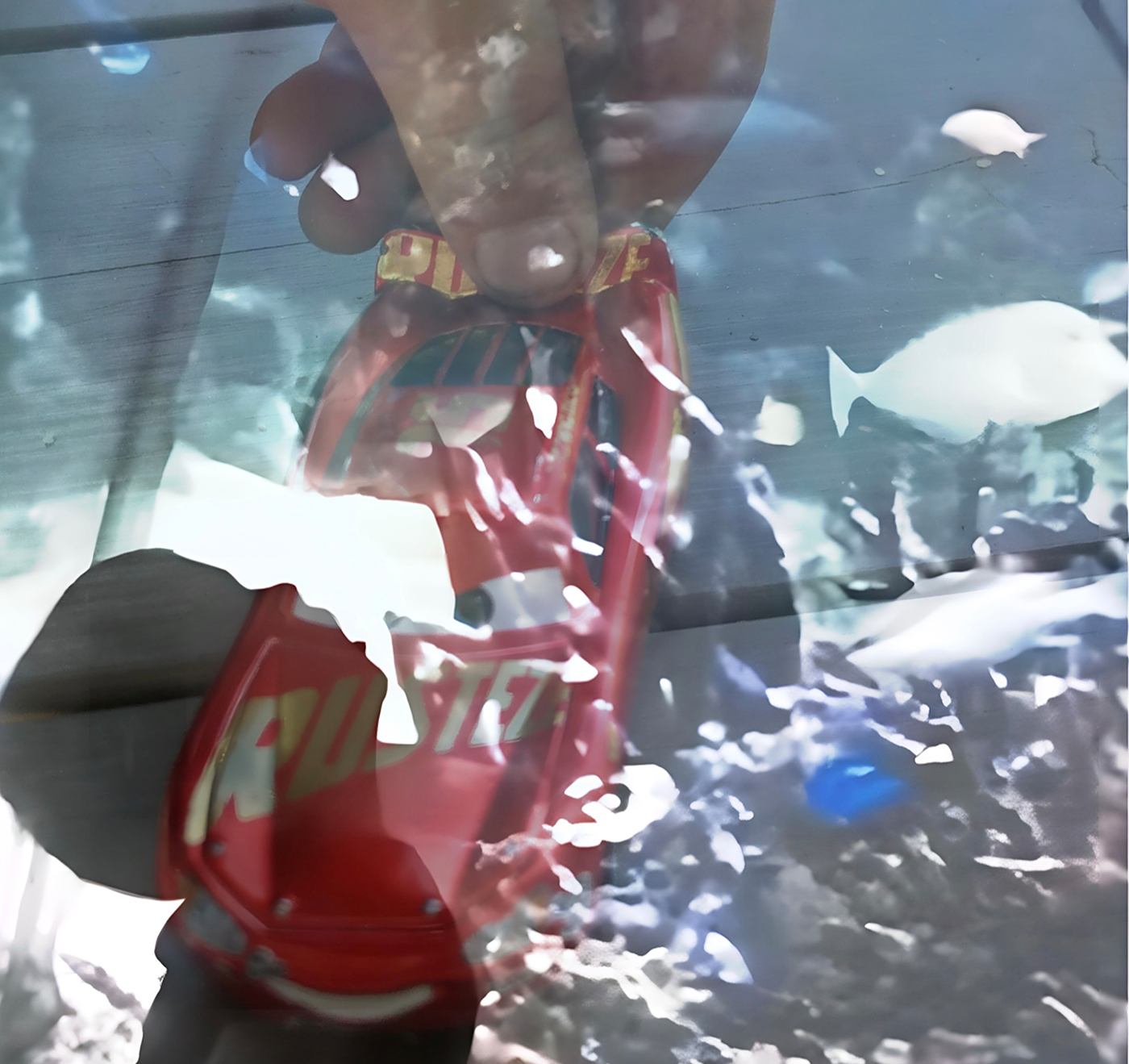
A merge of photos 1 and 2.
If we look at Lightning McQueen as a commercial toy figure (Figure 1), education and exploration may not be the first thing that strikes us, but there is something in the relationship between children and Lightning that matters. At the same time, such a play gift as this sticky, glowing Lightning may function as a counterforce – a counterforce to adults’ power to protect children from strings attached to children and labour markets far away. Haraway's SF has constructed an apparatus that makes it possible to look for other inputs regarding which toys can also be in kinship and in children's and our worldings.
A question that arises is whether toy pedagogy in today's kindergartens has the potential to include ideas of transformative toy figures. The world is not stable or predictable, and what if the toy offers opportunities to do reworlding? We are not asking to allow commercial toys to characterise kindergartens’ toy pedagogy but instead perhaps for greater curiosity about how the toy affects the network of meaning and worlding. Including toys that one can recognise or imagine with and that can allow one to become the other, along with the strength and courage it can provide, may expand our understanding of toy pedagogy and fuel other possibilities. What happens when the child becomes someone else in the face of Lightning McQueen or dreams of becoming a fish-saver? What properties does Lightning have that the child needs? If the child does not have these, the two together, through the power of imagination, can construct some flashes of light in many directions and become adventurers on a journey, the end of which no one yet knows
Moving towards an unknown future with sticky knots
Haraway's (2016) string figure is about constructing lines, but in this article, it is the sticky knots and meetings that have interested us. Haraway (2016) was inspired by Navajo SF. Navajo refers both to the place and to those who live there. SF, in Haraway's (2016) terminology, is a game, but not just any game. It is a game that teaches us about life and ways to live life in coexistence, like the red toy car or the tent cloth with the movie from the bottom of the ocean. SF is about receiving and passing on patterns, losing threads, failing and occasionally finding something that works, something inconsistent and perhaps even beautiful that was not there before (Haraway, 2016: 10) in children's relationships with education and encounters with toys.
This article offers no answers as to what kind of toys kindergarten should be equipped with or what a toy is, but it points in the direction of the need for toys that create dreams, hopes and other ways of understanding our challenging world. In destabilising the intentions of what toys can contribute to children's processes of meaning-making, we also destabilise the role of the pedagogical intentions. Consequently, pedagogues may need to rethink and negotiate what children's encounters with different companion species can produce in pedagogical practices. However, the unexpected is also linked to which participants are part of the situation, and in many cases, pedagogues cannot understand what is being activated at the time. Such an understanding of toy pedagogy requires curiosity about who is included in events and what they produce.
The philosophy applied here provides some transference to poetry. Haraway (2016) orders vigour. What happens when poetry and vigour unite on the path to new understandings of toy pedagogy and of creating a world in which kinship is to live and die well together? What happens to the toy as a momentary experience, as dreams, as friendship and as love? Worlding and speculative dreaming, where ongoing toy pedagogy evolves through something more. Where books, fish and cars along for the ride become part of moments with the child in becoming-with transformation into so many more(s). Kinship with toys, seaweed and death, with the child present in safe and agitated water, Lightning McQueen and a favourite song, is best friend and playmate – kinship, or buried under several layers of sand.
Footnotes
Declaration of conflicting interests
The authors declared no potential conflicts of interest with respect to the research, authorship and/or publication of this article.
Ethical approval
Funding
The authors received no financial support for the research, authorship and/or publication of this article.
