




Abstract
The practice of seed-bombing, or guerilla gardening, has its roots in radical environmental activism. As a community-generated response to ecological degradation and capitalist ruins by way of development and gentrification of city spaces, seed-bombing as it is commonly practised involves the subversive dispersal of seeds in an attempt to beautify or reclaim spaces otherwise perceived as unsightly or damaged. In this article I think with common worlding and Louise Boscacci’s word-concept wit(h)nessing to explore the possibilities for seed-bombing with young children as a practice of enacting recuperative pedagogies in landscapes shaped, in part, by the ongoing global waste crisis. I draw on moments from practice in a walking-based, post-qualitative inquiry with young children at a former quarry and landfill to explore recuperative pedagogies through the culminating pedagogical gesture. I suggest seed-bombing as an act of thinking and doing recuperation in blasted landscapes, one not limited to a singular event, but a cross-temporal attunement to children's waste relations with particular futures in mind.
Introduction
This article takes waste landscapes and their proliferation as an inheritance for children in the Anthropocene and a matter of pedagogical concern for early childhood education. In particular, I focus on the pedagogical responses made possible when encountering decommissioned and converted landfills, a phenomenon Matt Barlow has described as the ‘production of urban natures’ (2023: 11). I share from a four-month, walking-based, post-qualitative inquiry with children and educators at a former quarry and landfill, now a public recreation space in what is currently known as St Catharines, Ontario. I think with common worlding pedagogies and Louise Boscacci's (2018) word-concept wit(h)nessing to suggest recuperation as a pedagogical orientation from which educators might contest anthropocentrism and begin to reimagine young children's relationality with landscapes shaped by histories of extraction and waste. I conclude by sharing moments from practice which activate seed-bombing with children as an intentional pedagogical decision to enact recuperative orientations, grounded by practices of attending to the life of landfills, gathering, and dispersal for (re)imagining early childhood education in waste landscapes.
The empirical work this article draws on was part of the Transforming Waste Practices project, one of two under the broader Climate Action Childhood Network. 1 CAN was a global project which brought together early childhood scholars, artists, educators and children working in collaboratories as sites for pedagogical and curricular experimentation in response to the climate and waste crises. My contribution to the project, the Blasted Landscapes collaboratory, took place at the Glenridge Quarry Naturalization Site – a space I have written about extensively in the context of its intersections with childhood in southern Ontario and the pedagogical possibilities for walking with waste landscapes (see: Jobb, 2023; Wintoneak and Jobb, 2022). Framing the place we walked with as a blasted landscape, a term I borrow from Anna Lowenhaupt Tsing (2014), has been instructive for contextualizing the co-constitutive scalar and temporal complexities of children and childhoods in this waste landscape, and for locating ourselves amidst its temporalities. By this I mean that life – including childhood – unfolds alongside the scale and endurance of a collective uncertainty on how to respond to the global accumulation of waste and how it has reshaped landscapes in the 21st century. Tsing draws on her anthropological work on the matsutake mushroom and its resilience and capacity for growth in the aftermath of the Hiroshima bombing to illustrate how ‘some, though not all, forms of disturbance can be life-giving’ (2014: 88). For Tsing, and others (see: Kirksey et al., 2013), attuning to the blasted state of degraded and damaged landscapes is not merely descriptive, nor are such sites fixed in time. Instead, to witness blastedness is an invitation for those who encounter such sites to attend to their ghostly and cross-temporal entanglements, to look towards new configurations for life with the ruins (Tsing et al., 2017), and to ask – what forms of life are present here, and what forms might yet flourish here? The blasted landscapes concept has taken up elsewhere in critical childhood studies, most notably by Karen Malone (2019), whose work on walking-with children in Kazakhstan traces the porous borders between child–land–radiation and their meeting points. It is this sense of being-and-becoming-with (Haraway, 2016; Somerville, 2020), a co-and-sympoietic noticing in landscapes blasted by waste, which animates this particular inquiry to ask different questions for pedagogical work with young children. In early childhood education, which has been critiqued for its narrow preoccupation with logics of growth and development, what other concepts might we think with to co-compose other worlds (Land and Frankowski, 2022), and what practices for flourishing might we turn towards? What other modes of growth are possible, here?
To build towards a response to these questions, it is useful to first explore some of the histories of the Glenridge Quarry Naturalization Site, and how these lands, like other former landfills, come to intersect with childhood–waste relations. Briefly, here, I will offer an abridged and incomplete timeline of the site in reverse chronology to establish some context for the particularities of place, and why this project happened when and where it did. The Quarry, as I will refer to it throughout this article, opened to the public as a recreation and leisure site in 2004, a municipal and regional response to pressing ecological concerns raised by community-led activists, organizing under the long-running Glenridge Landfill Citizens Committee. 2 Subjectively speaking, the site's trails and their views, opportunities to encounter its non-human inhabitants and a connection point to the Bruce Trail are some of its inviting qualities, yet walking in this place occurs overtop a quarter-century of buried waste. As waste accumulates and when landfills reach their capacity, municipalities are left to determine how to manage or redevelop lands now occupied by materials with indeterminate effects and lifespans (Hird, 2013a; Hird, 2016). In most instances, waste materials remain in place, where post-closure protocol and care includes a capping system, meaning a barrier layer is created between the waste and the site's post-closure land use (Townsend et al., 2015). The site underwent a dramatic (re)construction after the decommissioning and closure of the Glenridge Quarry Landfill, which accepted industrial, commercial and institutional waste (ICI) and municipal solid waste (MSW) from 1976 to 2001. The site was selected as a landfill after the region took over the land from St Catharines Crushed Stone Ltd, which previously operated a limestone quarry from 1957 to 1972. In spite of the intervening years, evidence of extraction and waste histories remain visible, including a gas ventilation system which, most relevant to this article, was an active construction site during the summer we walked with the Quarry. Some histories are less visible. Aside from a faded placard at the site's entrance, there is little published material available regarding the site and its history and significance to the Haudenosaunee, Anishinaabeg, Ojibway and Chippewa peoples on whose traditional lands the site rests. I share this always-partial history, in part, to situate the Quarry and spaces like it amidst extraction and waste as a constitutive element of ongoing settler colonialism (Bacon, 2019; Liboiron, 2021; Potter, 2021; Whyte, 2018). Moreover, attuning to the obscured lives of landfills (Hird, 2013b; O’Hare, 2021) is a gesture towards the possibilities for children and educators learning how to live with the conditions of a waste crisis which demand a pedagogical response to what is an increasingly prevalent form of commons.
Common worlding in waste landscapes: Wit(h)nessing Anthropocene inheritances
Here I want to trace some of the conceptual underpinnings of the pedagogical inquiry in order to map out possible generative forms of thought for educators and researchers working to reimagine child–waste relationality. With interdisciplinarity in mind, I am interested in bridging early childhood education and the environmental humanities to articulate the intersections between common worlding and Louise Boscacci's concept wit(h)nessing. I do so to conceptualize pedagogy, and specifically early childhood education as a worlding project, one through which wit(h)nessing makes it possible for children, educators and more-than-human Others to co-compose a commons attentive to the complexities of waste landscapes.
First theorized by Affrica Taylor and Miriam Giugni (2012) in their interdisciplinary feminist early childhood research, common worlding draws on Bruno Latour's (2004; 2014) notion of hybridized nature-cultures which resist human separation and supremacy. The concept has grown through the Common Worlds Research Collective, a global network of scholars who work to reconceptualize early childhood through feminist and anticolonial perspectives on children's relations with the more-than-human world. 3 For Taylor and Giugni, common worlding proposes a framework for thinking childhood relationality beyond anthropocentrism to explore other possible configurations for ‘learning how to live well together and flourish with difference’ (p. 109). Relevant to this inquiry, common worlding has been taken up by researchers in childhood studies and early childhood education working with interdisciplinarity in mind, weaving together perspectives from post-humanism, feminist new materialism and the environmental humanities to expand the possibilities for post-foundational and post-developmental pedagogies (Hodgins, 2019; Pacini-Ketchabaw and Blaise, 2023). I have written elsewhere (Jobb, 2023) on common worlding in walking research with young children in waste landscapes, and here I return to it as a conceptual and pedagogical orientation for theorizing waste pedagogies in response to shared waste worlds. I situate the inquiry and our culminating pedagogical gesture as worlding practices for two interrelated reasons. First, to resist enduring binary waste myths of dirt and purity (Eitel, 2021; Liboiron and Lepawsky, 2022) and argue for waste pedagogies which instead attune to the ways in which children's lives are already in relation with waste. Second, to continue pushing against discourses of childhood innocence which work to separate and depoliticize childhood, in spite of children's existing relations with, as Affrica Taylor (2017: 72) notes, ‘entangled inheritances and trajectories’. To be present in the world today is to live with waste as a co-constitutive presence. To take waste seriously as a shared worldly inheritance necessarily includes children as those in the position to be inheriting uncertain waste futures.
How we attend to common worlding with waste matters, here I suggest wit(h)nessing as one possibility. Louise Boscacci describes wit(h)nessing as an affective, relational and co-poietic mode for how we might understand subjectivity differently. That is, we are made in relation with and to one another, where to witness subjectivities beyond the self is to recognize that ‘there is no I without a non-I’ (2018: 343). Building on Bracha L. Ettinger's (2001; 2006) work in feminist psychoanalysis and seeing its utility for the environmental humanities, Boscacci argues that wit(h)nessing is constituted by an encounter-exchange between humans and non-human Others. We change and are changed through our relations with the world around us. In conceptualizing child–waste relations in landscapes like the Quarry, wit(h)nessing became immensely useful for transgressing extractive modes of education to turn towards reciprocal and recuperative relations and practices for being-and-walking-with place. Recently, witnessing and wit(h)nessing have been taken up in early childhood education, where scholars have drawn from Black and Indigenous feminisms, ecologies and geographies to unsettle objective and Anthropocentric modes of doing environmental and place-attuned education. Fikile Nxumalo (2020a; 2020b) has written on testifying-witnessing as a practice for refiguring childhood place-stories in the Anthropocene, grounded in Black feminisms for noticing and resisting anti-blackness. Writing from South Africa, Theresa Magdalen Giorza (2021) offers b(e)aring wit(h)ness as a practice emerging from her work with a community preschool. For Giorza, attuning to the sense of intra-active relationality offers a mode for reimagining child–park relations in colonial spaces, inviting with-ness into dialogue with Black and Indigenous geographies as orientations for worlding. I situate testifying-witnessing and b(e)aring wit(h)ness alongside wit(h)nessing as a useful demarcation from witnessing, practices which resist the figure of the passive, neutral, objective onlooker, and instead turn towards our active co-becomings, our worlding-with in more-than-human worlds.
Etymologically and conceptually, I see a significant connection between commoning and wit(h)nessing. Common/ing is rooted in the Latin prefix com, meaning with and together, which, in the context of this pedagogical inquiry is a reminder of the centrality of more-than-human relationality, or an attunement to the sense of with-ness in shared common worlding. The seed-bombing practices we enacted emerged as a generative response to a summer spent walking-with the Quarry, noticing the collision points between the histories of waste and our presence as co-constitutive inscriptive presences. Scholars and educators working with common worlding pedagogies do so to resist the anthropocentric and extractive logics which position children as learning about the world, instead recognizing children as always-already entangled in complex relationality, learning with the world (Common Worlds Research Collective, 2020; Taylor, 2020; Taylor, Zakharova and Cullen, 2021).
On the radical potentialities of seed-bombing
Looking to histories of community-generated radical activism provides an alternative mode for exploring and understanding child–plant–place relations, but there is a tension I would like to acknowledge first in the linguistic inheritances woven through the practices I am writing towards. I admit some hesitance due to the reality that, for many children, historically and contemporarily, bombing is not an abstraction or a subversive and provocative metaphor, but an ongoing presence and threat to life. While the practice of seed-bombing predates the name, their rise in social awareness is most often attributed to activist Liz Christy and the formation of the Green Guerrillas in New York City in 1973 (Gralińska-Toborek, 2021). Christy and her community collaborators cleared and reclaimed a vacant lot at the intersection of Bowery and East Houston Street in Manhattan, where it remains today. This guerrilla garden marked the beginning of their activism, through which they crafted and dispersed their makeshift seed-bombs – or green-aides – as further evidence of their attempt to playfully subvert militaristic language. In a thoughtful critique, Gina Badger describes the name as ‘a mutation of militarism’ (2010: 133), grappling with its origins in the language of war, while ultimately arguing for seed-bombing to be understood as a reclamation or reorientation of both space and terminology. It is in this spirit that I follow seed-bombing and the origins of its name as a feminist reclamation project, one which gestures towards less violent futures.
For many early childhood educators, encounters with seeds and plantlife takes place in the context of gardening with children as a familiar yearly project. In a recent systematic review of environmental education practices in early childhood education, Nicole Ardoin and Alison Bowers (2020) categorize gardening as an exemplar of time in nature, a pedagogical practice observed in 76% of the available literature. However, as an educative practice gardening is frequently coded in a child-centred, developmental context, with research often centring on measured learning outcomes or health indicators for individual children, and limited space afforded to the socio-ethico-political worlds it may make visible. At times, the intersections between gardening and food production and environmental justice have been explored in the context of early childhood education. For example, Jenny Ritchie (2015) has written about gardening practices with children as pedagogies of place, which intersect with food justice, sustainability and embedding Māori cultural teachings in Aotearoa New Zealand early childhood education. Elsewhere, Monica Green and Iris Duhn have examined children's encounters with gardening as human and more-than-human intra-action, drawing attention towards the complex meeting places between children and the ‘life forces of a food garden’ (2015: 69). Thinking with waste landscapes, and what forms of flourishing might be possible within them, I am interested in the possibilities for encounters with plantlife beyond human sustenance. Here, I want to examine seed-bombing as a minor gesture beyond the human and beyond particular measurable outcomes. Calling back to Louise Boscacci (2018), it is my sense that decentring the child as a recipient or beneficiary constitutes a form of recuperative encounter-exchange, one which activates different affective responses and ways of living with plants, soil and land in waste landscapes.
Perhaps in part due to what I ascribe to a hesitant or even conservative undertone to Canadian early childhood education, pedagogical work inspired by radical activism is often relegated to its more critical corners of scholarship, and thus requires more attention. Cristina Delgado Vintimilla (2020: 182) describes the meeting point between a politics of niceness and ‘nostalgic imaginaries and myths that sustain our being-with-others’ as a form of relationality operating in ways which foreclose the potential for thinking otherwise. Working those tensions between what is and what is yet-to-be requires unsettling the taken-for-granted and status quo assumptions of early childhood education, a field which thrives on tidy narratives. Borrowing from Natasha Myers, I am writing towards seed-bombing as a practice for making visible ‘plant/people involutions’ (2017: 4) in landscapes produced through relations with waste. Part of my intention in sharing seed-bombing as a practice for common worlding is to invite educators to start with small gestures which might begin to slowly reorient pedagogical dispositions and practices. Writing from their experiences in post-secondary settings, Aoife K. Pitts et al. (2022) have argued for the metaphoric potential of the seed bomb, drawing on Black and Indigenous radical ecologies in pursuit of abolitionist education. Artist and scholar Tina Carlisi (2016: 1) frames seed-bombing as an example of ‘poetic micro-actions’ which invite a radical relationality with degraded landscapes through her community-based arts and guerrilla gardening campaign in Montreal. Thinking with the possibilities for seed-based ecological awareness in Australian cities, Alexandra Crosby and Ilaria Vanni (2023) describe their approach to seed-bombing as ‘planty design activism’ which decentres the human and reorients attention towards Indigenous ecologies for plant flourishing. Similarly, I position our seed-bombing as a departure from child-centred pedagogies. Instead, I suggest that guerrilla gardening, or seed-bombing practices, open towards a socio-ethico-political reimagining of children's affective relations with seeds, plantlife and place in waste landscapes like the Quarry.
Recuperation for wit(h)nessing common worlds
Part of the intention behind the Transforming Waste Practices project was to undertake a critical re-examination of the 3Rs of waste – recycle, reduce, reuse. In early childhood settings, the 3Rs are a memorable slogan to adopt, but in practice operate in ways which have been criticized for absolving producers of responsibility for discard materials, shifting the problem and the solution of the waste crisis to the level of the individual (Merewether et al., 2023; Pacini-Ketchabaw and Blaise, 2023). Similarly, environmental early childhood education has been criticized for its enduring commitment to anthropocentrism (Taylor, 2017). Drawing on their work in a plastics collaboratory, Veronica Pacini-Ketchabaw and Kelly-Ann McAlpine think with the concept of excess and plastic as queer kin, no longer separable from human and more-than-human co-existence, to refigure children's relations with waste (Pacini-Ketchabaw and MacAlpine, 2022; MacAlpine and Pacini-Ketchabaw, 2022). I am sensitive to the importance of activating critique, which, thinking with Rosi Braidotti (2012), is made possible through the proposal of an alternative. In experimenting with moving generative critique into action, what might be possible when unsettling waste relations through recuperation as a collective pedagogical orientation, one which disrupts anthropocentric and moralizing arguments for waste relations, resists easy-to-digest solutions, and instead moves towards relational and responsive ethical engagement with shared waste worlds? Recuperation has a long history across different disciplines, from Deborah Bird Rose's (2004) work on decolonial attunements to country, to Donna Haraway's call to ‘redo ways of living and dying attuned to still possible finite flourishing, still possible recuperation’ (2016: 10). An undercurrent of feminist care ethics flows through recuperative orientations to human and more-than-human relationality, something Maria Puig de la Bellacasa makes clear as she situates feminist reclamation projects as ‘recuperating previously neglected grounds’ (2017: 11). Yet, the notion of recuperation itself is complex and contested. For example, in working with children and educators, how might we take care in attending to recuperative pedagogies in ways that do not reinscribe human supremacy, or collapse into idealized or romanticized fictions about a past state of being? This matters for how we might approach waste landscapes like the Quarry, where it is possible to be seduced by the myth of a return to unspoiled nature. The promise of becoming natural again is in the name – naturalization site. Eve Tuck, Marcia McKenzie and Kate McCoy (2014) are critical of modes of environmental education which treat this form of recuperation as a product of the settler imaginary, and a humanist gesture towards the legitimation of colonial logics. Recuperation as a practice for common worlding requires active resistance against rescuing or maintaining the project of settler colonialism, and so care must be taken to enact recuperation as intentional movements towards disrupting what David Lloyd and Patrick Wolfe (2016) name its logics of dispossession and dominance. In conceptualizing child–waste landscape relations through recuperative pedagogies, I return to common worlding and wit(h)nessing as a reminder that we are collectively implicated in, and response-able towards shared worlds, and that worlds are made and remade, not restored.
How then might educators and researchers make pedagogical decisions which attune to children's worldly entanglements, particularly in waste landscapes? Recognizing the limitations of child-centred pedagogies, some critical scholars in recent years have turned to interdisciplinary theorizing to help move beyond the anthropocentric gaze in early childhood studies and reorient pedagogical thought. As Affrica Taylor (2020) has written, the discursive centring of sustainability which undergirds much of Western environmental education frequently reinforces an anthropocentric saviour narrative and positions humans as separate from and responsible for fixing a damaged earth, rather than as always-already in deeply entangled relationality with more-than-human worlds. Tonya Rooney, Mindy Blaise and Felicity Royds (2021) think with care ethics to develop the concept of ‘weathering-with pedagogies’ to ground children's weather relations and educators’ pedagogical responses in complex and shared socio-ethico-political more-than-human worlds. Fikile Nxumalo (2019) thinks with decolonial orientations to place to refigure Indigenous presences and unsettle children's relationality with rotting tree hollows, remnants of histories of colonial extraction in British Columbian forests. While these examples are not explicitly grounded in the concept of recuperation, I read it through the kind of deep pedagogical work happening when researchers take up common worlding pedagogies as practices of refiguring child–world relations in their commitment to ‘encounter our difference’ (Taylor and Giugni, 2012: 113). Beyond early childhood, Donna Haraway (2016) writes of recuperation in the context of living and dying without the promise of survival, as practices which tend to non-innocent kinships nonetheless tethered in sympoietic world-making. Recuperative pedagogies are thus not committed to beautification – beauty is too vain a pursuit – too grounded in romantic myths of nature's purity. Nor do they intend to ‘set things right again’ via repair, though, as a conceptual kin of recuperation, repair has a long history as feminist care practices (Crosby and Stein, 2020). By bridging the conceptual connections between common worlding, wit(h)nessing, and recuperation, I am trying to offer new frameworks for being affected by shared relationality. If waste relations are understood as co-poietic entanglements, in what ways might we be differently accountable, or in different relation with plantlife in blasted landscapes? From wit(h)nessing emerges pedagogical thought because of the coming into awareness of a duty of reciprocity in co-and-sympoietic relationality with waste landscapes and the possible production of new forms of being together in the encounter-exchange.
In this project our pedagogical thinking and doing oriented around recuperation is a disposition for encountering waste landscapes distinct from sustainability – as a pedagogical orientation committed to decentring the individual and responding to the Quarry with recuperative ethical commitments. Again, I look to Deborah Bird Rose and Donna Haraway to situate seed-bombing as recuperative work, as a practice of wit(h)nessing children's common worlds, and as a generative relational gesture which might create different forms of living together. From Rose (2004: 30), who frames witnessing as ‘promoting remembrance’ and whose work was always in dialogue with – thinking with kin, being with place – I am reminded that recuperation is a response to witnessing differently, to looking beyond the self in recognition of our being-and-becoming-with places and non-human Others. And from Donna Haraway, who invites a reconsidering of sowing seeds as terraforming, as the creation of new ways of being human with plants and earthly matter, I am reminded that, in alignment with Boscacci's wit(h)nessing, worlding is a trans-subjective shift. Haraway sees this as a making-together of different futures on a degraded planet, suggesting that ‘sympoesis is a carrier bag for ongoingness, a yoke for becoming-with, for staying with the trouble of inheriting the damages and achievements of colonial and postcolonial naturalcultural histories in telling the tale of still possible recuperation’ (2016: 125).
Recuperative pedagogies for ecologically damaged landscapes
In this section I share moments from practice to illustrate the thinking and doing from our seed-bombing which concluded the four-month walking inquiry. I weave together thinking on wit(h)nessing, common worlding and recuperation as orienting concepts for attuning to the Quarry as a waste landscape and grappling with our accountabilities to a place we spent time commoning with. The inquiry emerged in collaboration with three educators and eight children from one preschool, and one kindergarten classroom whose parents or guardians provided consent for their children’s participation in the inquiry, while in total 24 children took part at various times as members of the classrooms. Broadly, the inquiry was focused on generating conceptual and pedagogical possibilities for reimagining children's relations with waste landscapes, which meant that much of our time was spent thinking and talking about waste and its temporalities at the Quarry. After reaching capacity, engineered landfills require ongoing maintenance, even upon conversion for post-waste collection land use, including systems for gas capture and leachate containment (Reno, 2016). The summer we walked with the Quarry coincided with a municipal infrastructure project wherein the existing gas ventilation system 4 was replaced with a passive gas collection system. This meant that we walked alongside an active construction site 5 as labourers extracted the gas vents which previously dotted the hillside and spaces just off the trails (Figure 1). As the summer continued and our inquiry was winding down, it was the presence of construction vehicles and their impact on the lands which provoked affective and relational responses from the children, and together we planned to create and disperse seed-bombs.
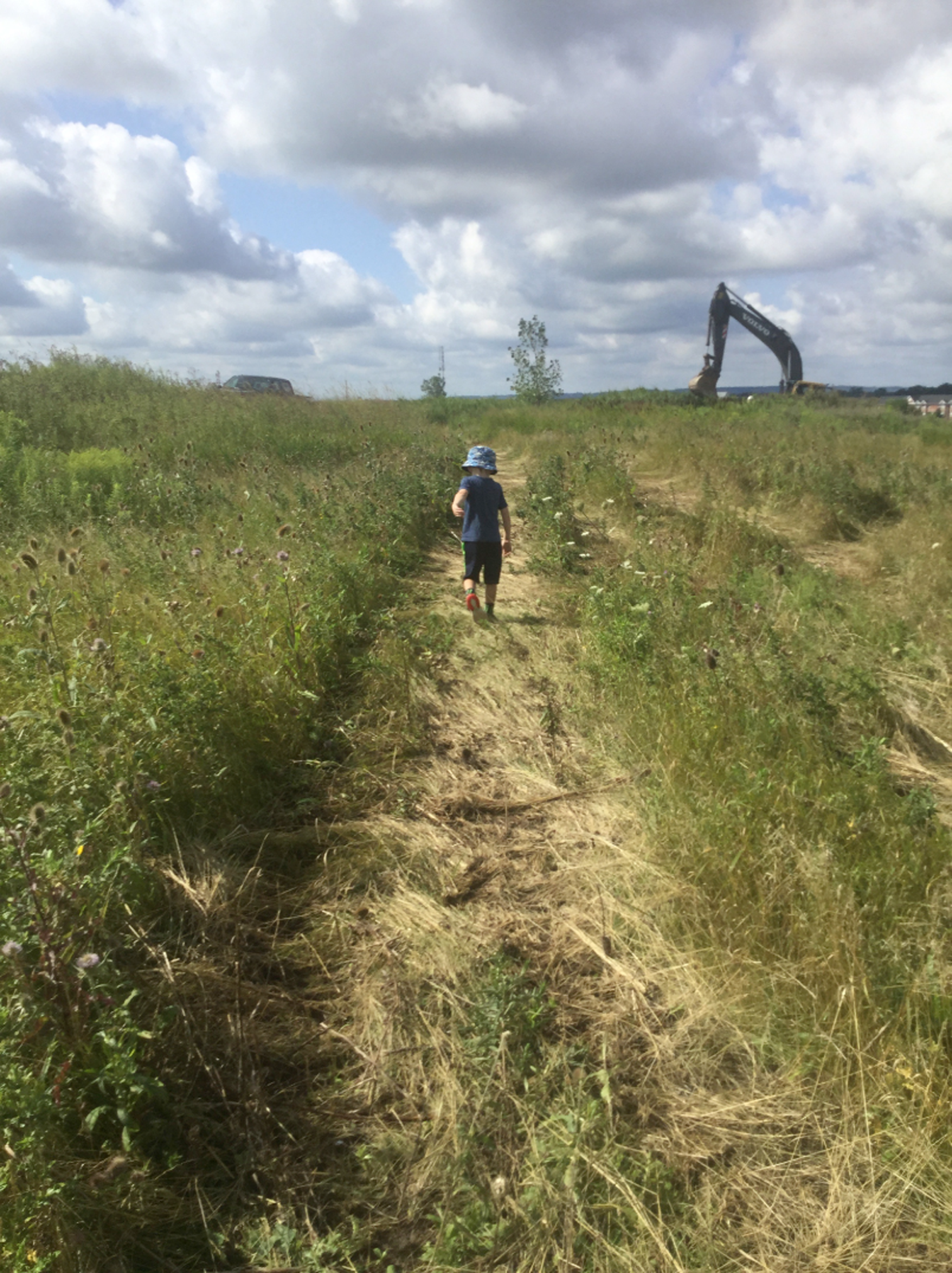
Walking with trampled grass.
The life of landfills
At the centre of the Quarry is the summit overlook, a large hill with intersecting trails that wind around its perimeter and curve up and around its slopes. It is here where we walk in closest proximity to the Quarry's waste holdings. It is here where, upon closure, barriers and infilling and landscaping fabric and plantlife meet to separate the park's visitors from the waste below. It is here where labourers drive excavators through the tall grass throughout the summer, where their treads roll across the landscape and leave flattened grass behind and where their extraction of gas wells reveals layers of waste embedded in the soil.
At the northern edge of the Quarry there is a large, clay-bottomed, borrow-pit pond. Borrow-pits refer to the space remaining when materials (e.g., soil, limestone, gravel) have been excavated and extracted for usage elsewhere, and when such landscapes are excavated for human use the resulting pit can become a body of water by way of natural runoff or intentional water management. In sites like the Quarry where waste is present, leachate runoff remains an ongoing environmental concern requiring ongoing monitoring and intervention, but in its capacity to sustain life, spaces like the pond are a meeting point from where we might orient towards the radical relationality between humans, waste and non-human Others (Hird, 2013b; Hird & Yusoff, 2016). Many of our walks included a detour to the sandy bank of the pond to walk alongside frogs, ducks and geese – dead and alive (Jobb, 2024) – who make their homes in and around the water. While much of the reedy or elevated shoreline which borders the pond creates a distance between walkers and water, the sandy bank is an open space where children and educators could gather and pull clay from the shallow water where the pond meets the shore.
The possibilities for responding to histories of extraction and ongoing damage to these lands came into view through our encounters with the pond and clay and the flattened foliage. What modes of living here might we bring into dialogue with one another as we work the concepts of common worlding, wit(h)nessing and recuperation in this blasted landscape? From early in our inquiry, as we traced multispecies life and death across the Quarry, as we witnessed new life in the pond and extinction on the summit, the children were drawn to the clay, forming it into balls to throw back into the pond, or leaving small sculptures on the bank. In spaces like the Quarry, the life of materials like clay are always in co-relation. Between the clay pulled from the pond and the clay used in constructing a barrier system between the waste below and trails above, its life takes multiple forms. Our encounters with clay reveal a tension, where pulling it from the water for our own desires intersect with histories of extraction, and yet, here, clay and seeds and waste are co-poietic materials in children's common worlds (Figure 2). Thinking with clay as an extracted material, Pacini-Ketchabaw et al. write that ‘ecologies of practice are always emergent’ (2017: 65). How then might we attend to the tensions of this accountability to enact recuperative pedagogies while acknowledging that our pedagogies are already ensnared in the overlap of waste flows and capitalist extraction and discourses of childhood premised upon ‘anything goes’ (Pacini-Ketchabaw and Blaise, 2023: 120)?.
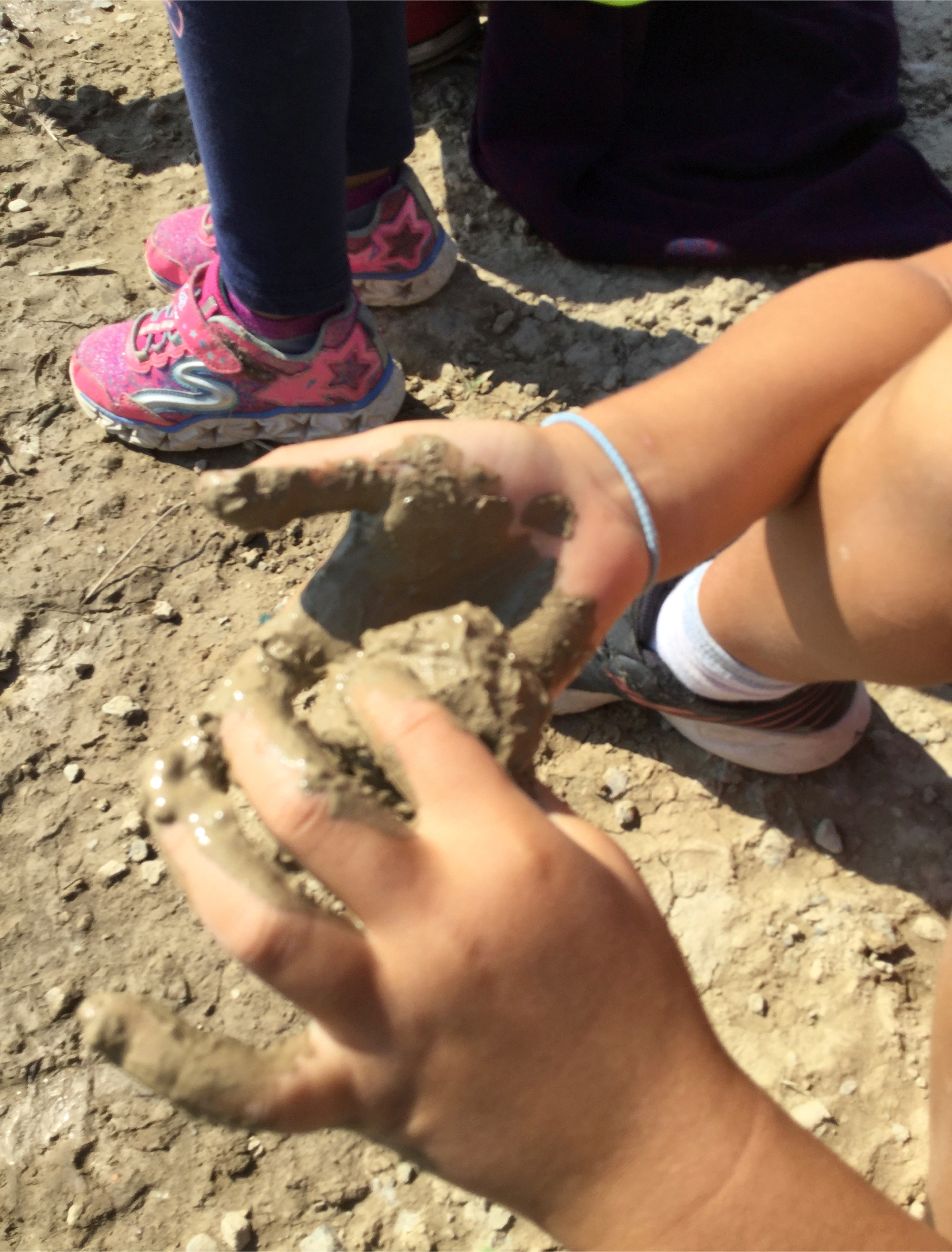
Encountering clay.
Gathering
The materials we gathered to compose our seed-bombs were easy to source, and we established two parameters around their creation and dispersal (Figure 3). First, the materials we used to assemble the seed-bombs were gathered from the Quarry – the clay was collected from the shallow bed of the pond, while ‘seeds’ were collected from dead plants and grasses which had been damaged by construction equipment. The children left the marked trail, into the areas damaged by the construction vehicles, returning with what they called ‘seeds’ stripped from flattened and dead plants, like the panicles from Canada Wild Rye and Indian grass, and the prickly burrs from dried thistle, to name a few. Second, our seed-bombs were dispersed throughout these same areas, as the decision to create seed-bombs came in response to walking alongside plantlife flattened and pulled from the earth by the treads of construction vehicles working to decommission the gas valves. From Vanessa Clark (2019: 127) I am reminded that gathering ‘creates small conditions’ to guide ethical decision-making in how and what to gather. I frame these parameters for gathering as wit(h)nessing practices, attuning to the particularities of the Quarry as a blasted landscape where, again, recuperative orientations are not committed to restoration to a mythical ‘before’, but gesture towards the possibilities for flourishing in different formations. Nor are recuperative orientations unaware of the impact of our pedagogical interventions. These parameters are instead an ethical grappling with the non-innocence of our presence at the Quarry, while remaining attuned to our co-becomings and co-makings. They show our moves to minimize our impact on the continued degradation of the land, and to think with anti-colonial orientations which acknowledge the existing non-human presences when working with the possibility of future life at the Quarry.
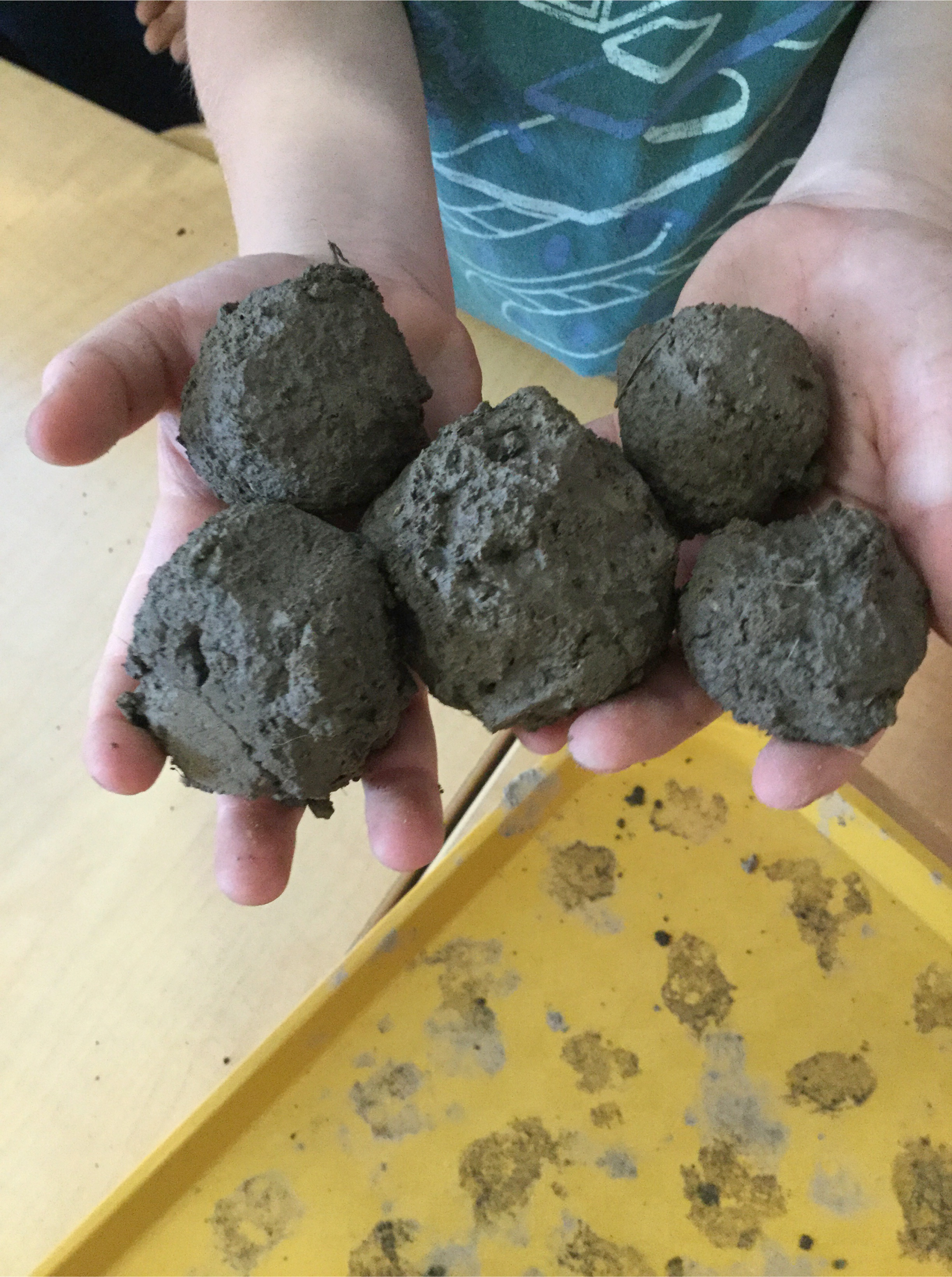
Creating seed-bombs.
Dispersing
Over a two-day process in the final week of August before the kindergarten children returned to school, we assembled our seed-bombs. On the first morning, after a walk to the Quarry to gather our materials, we returned to the childcare centre and worked together, adding water or clay where necessary to thin or thicken the seed-bombs and pressing seeds into the middle and rolling them into balls. We dried them on a tray overnight and when I returned the following morning for our final walk together, we gathered the seed-bombs and carried them to the summit overlook. Here, stepping off the trails we had walked together for four months, the children hurtled the seed-bombs into the most recent expanse created in the wake of innumerable anthropogenic harms on these lands (Figures 4 and 5). When the last seed-bomb had been thrown, we walked back to the centre, and our working and thinking together on this project concluded. In a project which worked to decentre the individual child and disrupt anthropocentric logics at the heart of early childhood education, I situate the dispersing of seed-bombs as a launching away from the child and towards our degraded common worlds as an enactment of recuperation towards shared matter(s) of concern. A small moment in a series of small, but carefully considered moments spent thinking with recuperation as an attunement to more-than-human flourishing in waste landscapes.
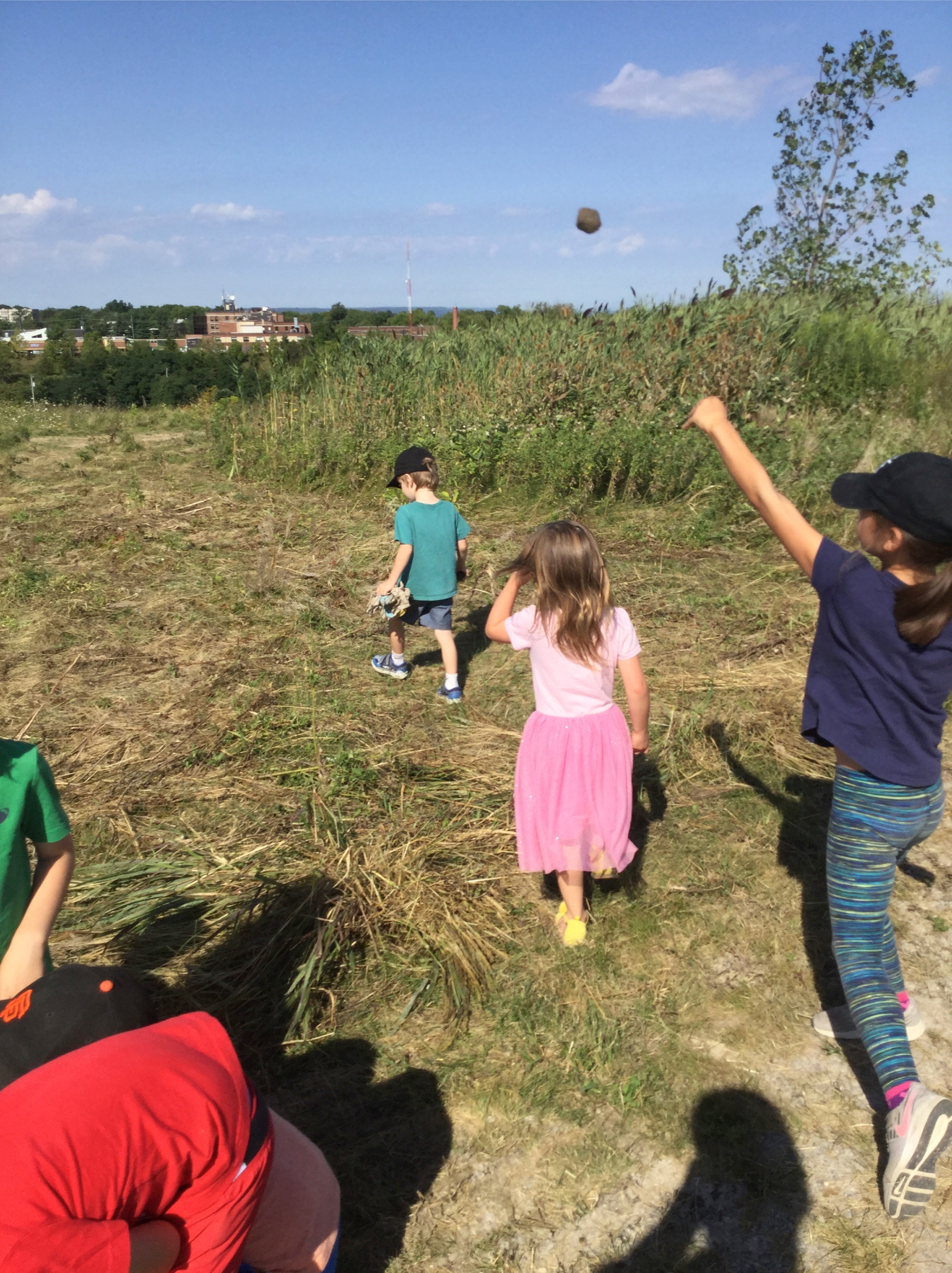
Dispersing seed-bombs.
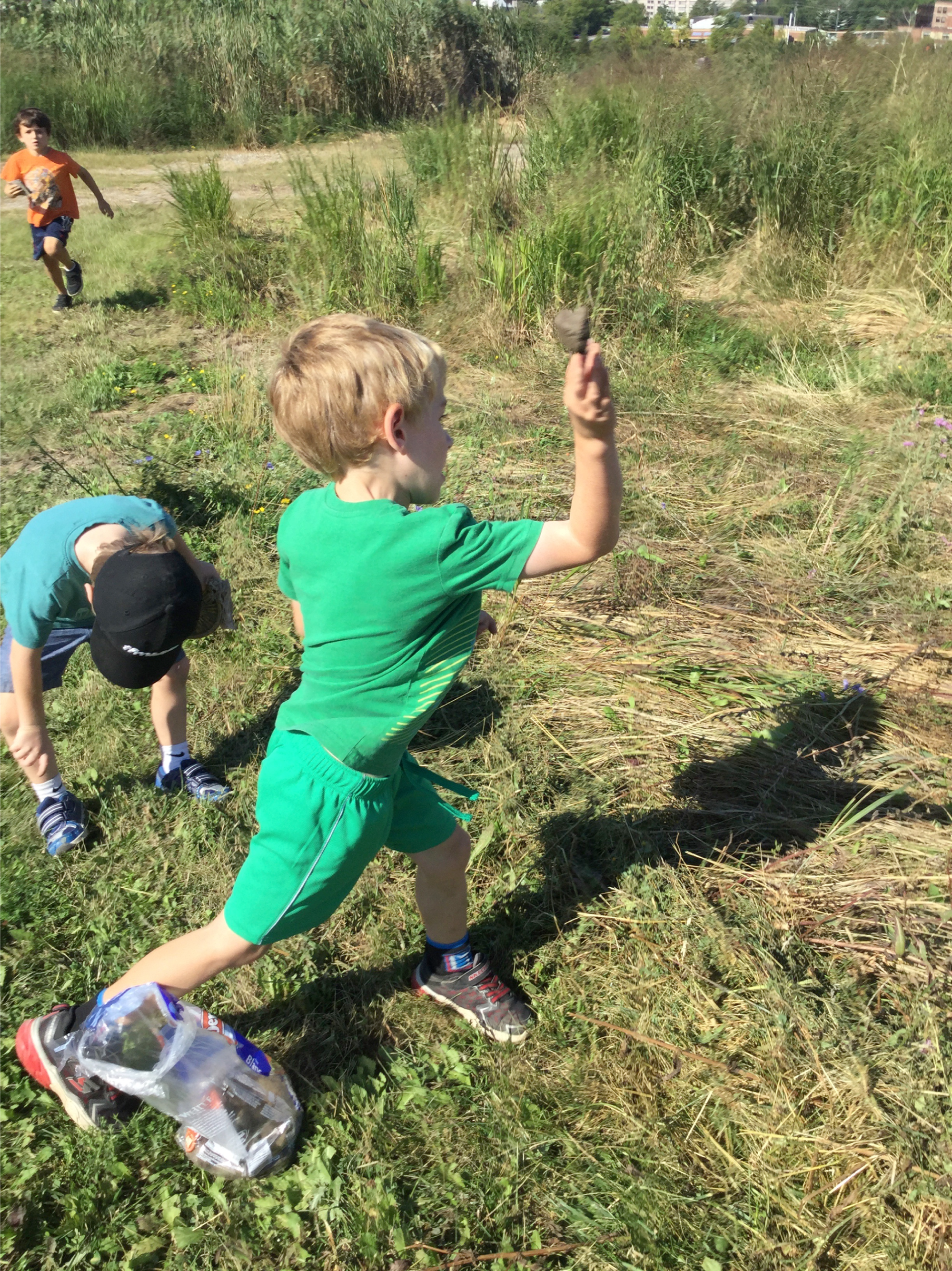
Dispersing seed-bombs.
Conclusion
Where I end is the significance of the uncertain and tentative gestures that undergird much of common worlding pedagogies, and which provoke questions of how we might live well together, while we can, in whatever ways we can. For me, wit(h)nessing as a practice for common worlding is an attunement towards being affected by our shared ruins, and thinking with recuperation is an ethical consideration of shared co-becomings across multiple timescales – child, waste, land and more-than-human Others. Returning to Haraway, ‘what and whom the Anthropocene collects in its refurbished netbag might prove potent for living in the ruins and even for modest terrain recuperation’ (2016: 47).
What future waste relations might seed-bombing make possible? One conceit of early childhood education is that educators and researchers tend to work and think closely with children for only a short while, and so the question is unanswerable with any certainty. This indeterminacy is apt for seed-bombing as a pedagogical practice for walking waste landscapes. New modes for flourishing in waste landscapes are contingent upon entangled and uncertain conditions, yet it mattered that we enacted recuperative orientations for refiguring child–waste–landscape relations. Optimistically, perhaps our seed-bombs contributed to new life and growth in a damaged ecosystem. Our seed-bombing represented a conclusion of the Blasted Landscapes project, a pedagogical gesture to respond to the affective meeting points between childhood in waste landscapes and the possibilities for shared relationality therein. In this sense the conclusion of our inquiry left open other possible beginnings that neither I, nor the children and their educators were around for long enough to see come to fruition. For now, what seems certain is the common worlds to come will include waste as a co-constitutive presence, worlds made and remade in relation with inherited blasted landscapes.
Footnotes
Ethical approval
The project received ethics approval from Western University's Non-Medical Research Ethics Board (NMREB File Number 109353).
Funding
This publication draws on research supported by the Social Sciences and Humanities Research Council (SSHRC) of Canada.

Notes
Author biography
Cory Jobb is an assistant professor in early childhood education at Thompson Rivers University. His research draws on common worlding and the environmental humanities to rethink children’s relations with landscapes shaped by anthropogenic harms such as waste and climate change.