




Abstract
Contemporary battles over transgender rights reinvigorate the figure of the innocent, ignorant, and vulnerable child at risk and in need of protection. However, critical childhood scholars have shown that not all children are deemed innocent, but rather innocence has always been raced White. Given this, I ask: What does the innocent child rhetoric do to trans activism and trans (early childhood) pedagogies? I unpack how the premise of innocent children pervades responses to anti-trans backlash. Likewise, childhood innocence also thwarts early childhood teachers’ pedagogical efforts to disrupt gender stereotypes. I argue that the mobilization of childhood innocence whitewashes our policy and practice efforts toward trans justice; and call for more promising, intersectional avenues toward gender justice.
John: What is the SAFE Act? Attorney General: We passed a law in Arkansas a couple of years ago called the SAFE Act, which stands for Save Adolescents from Experimentation. And, essentially, what it does, John, is to prevent young people from [going] through these experimental procedures to transition their gender from male to female, from female to male. J: What do you mean by experimentation? AG: Well, all these drugs we are talking about have not been approved … And, what we passed in Arkansas was to simply say that you can’t do that. That we are going to protect these children. So, this … doesn’t prevent them as an 18-year-old. I think that is what is important for Arkansas and Americans to understand: This does not prevent someone at age 18 from making that decision. … J: I think a lot of people might say, including myself, that it's surprising that the state would say, “We wanna make a decision for your family and your child to protect them, even though the American Medical Association, the American Association of Pediatrics, the Endocrine Society, the American Association of Psychiatrists, all recommend a certain set of guidelines for children that are expressing gender dysphoria.” So, I guess my surprise is: Why would the state of Arkansas step in to override parents, physicians, psychiatrists, and endocrinologists who have developed guidelines? Why would you override those guidelines? … You are suggesting that protecting children means overriding the recommendations of the American Medical Association, the American Association of Pediatrics, the Endocrine Society. AG: We don’t have enough data to show that these drugs are effective and that these children are better off and that we should encourage … J: You don’t have enough data, or is it not enough for you? Let me try and flip it in a different way and see if maybe this can help: In Arkansas if you have pediatric cancer … And obviously, we all want to protect children. I think we established that earlier. Whose guidelines do you follow?
In later years, mainstream health organizations such as the American Psychological Association have released position statements against conversion therapies (i.e., the treatment aimed at changing a person's gender identity or sexual orientation) (Council on Minority Mental Health and Health Disparities, 2018) and provided updated guidance to health professionals to support trans people's physical and mental well-being (Coleman et al., 2022). Since 2012 to date, 22 US states plus the District of Columbia have passed laws that banned the use of conversion therapy on minors (Movement Advancement Project, 2024).
On the other hand, increased visibility and legal protections have encountered fierce backlash. At the time of this writing, 508 anti-LGBTQ bills have been proposed in the US, most of them targeting trans youth (American Civil Liberties Union, 2024). Disregarding evidence-based standards of health care, 16 states have banned affirming medical care for trans children (Movement Advancement Project, 2023a).
In this paradoxical era of increased support for transgender people alongside heightened gender violence, TV host Jon Stewart interviewed the then Attorney General Leslie Rutledge, who was representing Arkansas—the first US state to ban gender-affirmative care for minors. 1 I have shared a short and edited excerpt of the 15-min.-long interview, during which Stewart displayed exemplary journalistic skills. With unmatched poise, he broke apart the Arkansas Attorney General's arguments against affirming care for trans children. Needless to say, I agree with Jon Stewart: Trans children deserve access to gender-affirming health care. However, in this article I aim to shift the foci of the conversation to complicate the one and only issue at hand where Jon Stewart and the Arkansas Attorney General seemed to unquestionably agree: As stated at the end of the interview excerpt, “Obviously, we all want to protect children.”
As I will unpack, at the macro- and micro-levels—in policy and in educational practice—the presumption that adults need to protect innocent children shapes trans debates. Trans supporters rightfully argue that conservatives are not so much concerned with children's well-being but mobilize the image of a child at risk to protect whiteness (Shepard, 2021). As Ramjewan and Garlen (2020: 282) put it, “A key part of the strategy to secure the fervent admiration of those who benefit from White supremacy is invoking the spirit of the innocent child.” Repeatedly, during historical moments of social gains for marginalized populations, the figure of the child has functioned as a tool to restore the hegemonic social order. Anita Bryan's infamous “Save the Children” campaign in the late 1970s demonized homosexuals as pedophiles to fight against same-sex marriage (Rofe, 1998). Likewise, Robison's work on media depictions of same-sex families (2008: 114) demonstrated how “moral panics are used as a political strategy for maintaining the hegemony of the nuclear family, the sanctity of heterosexual relationships and the heteronormative social order.” Nowadays, the image of children at risk is being once again weaponized by those in power. Trans people are portrayed as groomers and child predators, and those who engage in any sort of affirmation of queer and transgender expressions and identities are accused of having an agenda aimed at recruiting and turning kids trans (Serano, 2022).
Yet, just as Stewart and the Arkansas Attorney General agreed that “obviously, we all want to protect children,” trans advocacy is also largely organized in the name of childhood innocence. As Wiggins (2022: 3) notes, “One can find a chorus of adult voices speaking out of concern for the child's wellbeing … none are exempt from protective mechanisms.” This, I argue, is beyond problematic because, as critical childhood scholars have shown, childhood innocence has always been raced White (Bernstein, 2011; Garlen, 2019). Hence, as we mobilize and reinforce the figure of the innocent child, we obscure the intersectional nature of gender oppression.
In this article, I argue that childhood innocence whitewashes our policy and practice efforts toward trans justice. I unfold my argument by asking: What does the innocent child rhetoric do to trans activism and trans (early childhood) pedagogies? In other words, what are the effects of relying on the innocent child in need of protection to create structures and practices that respect and honor all gender identities and expressions?
To begin with, I briefly overview scholarship on the ideology of childhood innocence as regulating not only young children's agency on gender and sexuality matters but primarily racial relations (Robinson, 2008; Templeton and Cheruvu, 2020). Second, I provide a brief overview of the study and methods. Lastly, I unfold the argument that, organized by the pervasive premise that adults must protect pure and vulnerable children, both, the political responses to anti-trans backlash as well as gender-inclusive early childhood pedagogies fail to account for the intersectional nature of gender oppression, obscuring the realities of the most marginalized, primarily poor trans people of color.
Centering race in childhood innocence critiques
For a long time now, critical childhood scholars have provided compelling critiques of innocence as the natural marker of childhood. Innocence, they argue, is a historical social construction (Ariès, 1962; Valentine, 2004) that “presumes children exist in a space beyond, above, outside the political; we imagine them to be noncombatants whom we protect from the harsh realities of the adult world” (Jenkins, 1998: 2). In this sense, the protection of innocence has denied children agency on matters that are important to them and silenced social issues for which they are already implicated and affected (Sonu and Yoon, 2020). More importantly, yet somewhat less evident, is the fact that rather than applying equally to all children, innocence has, from its inception, been raced White (Bernstein, 2011; Dyer, 2019; Farley and Henry, 2019; Meiners, 2016).
As the well-known work of Phillipe Ariès (1962) demonstrated, the ways we know and feel about children are not natural and universal but historically situated. The ideology of childhood innocence traces back to White European philosophers from the modern and Romantic periods. During the 1600s and 1700s, philosophers and educators (e.g., Locke, Rosseau, Comenius) advanced the idea of childhood as a distinctive developmental phase. John Locke departed from the by-then-dominant religious views of children as marked by original sin to describe the child as a blank slate to be nurtured into the ideal future citizen. Later in the 18th century, Rousseau wrote his famous treatise Emile, further sedimenting the ideology of childhood innocence (Epp and Brennan, 2018; Garlen, 2021; Miller, 2021). From its beginning, the Romantic ideal was classist, patriarchal, and “uniquely useful to the construction and maintenance of Whiteness” (Berntesin, 2011, p.7). In spite of their claims of universality, the tomes of political philosophy in which the modern child first emerged were only concerned with the noble European boys who would become landowners with power and influence … The conditions of childhood prescribed by Locke and Rousseau and romanticized in art and literature required, above all, individual freedom, which neither women nor any non-white person was entitled to at the time. (Garlen 2021: 25) Whiteness . . . derives power from its status as an unmarked category . . . Childhood innocence—itself raced white, itself characterized by the ability to retain racial meanings but hide them under claims of holy obliviousness—secured the unmarked status of whiteness and the power derived from that status . . . What childhood innocence helped Americans to assert by forgetting, to think about by performing obliviousness, was not only whiteness but also racial difference constructed against whiteness.
Historian Gill-Peterson (2018) also demonstrates how medical understandings of transness have always been racialized. In her groundbreaking medical archival work, she shows that the figure of the developing child functioned during the early 19th century as an effective medical metaphor to mobilize ideas of sex and gender plasticity in the context of eugenic projects to alter phenotypes. Endocrinologists materialized racialized sex plasticity in differential medical treatments of White and Black transgender children, with children of color deemed as not enough malleable or salvable. Racial innocence, she explains, was “witheld from black children in the United States in order to justify forms of ongoing dissposesion” (Gill-Peterson, 2018: 160)
Importantly, “while the history of deeply racialized constructions of the child is documented, the continuation of this legacy is less visible and not popularly understood” (Meiners, 2016: 35). We are currently living amidst cultural battles that reinvigorate childhood innocent tropes. In Garlen and Hembruff's (2023: 930) words, “Contemporary debates over the rights of trans children and the legality of early instruction on gender orientation, sexuality, and race are reinforcing childhood as a time of ‘not-knowing.’” Against this background, understanding and centering the effects of racialized childhood innocence is of utmost importance. Evidently, the innocent child continues to work as a vessel of adults’ anxieties, desires, and political agendas (Jenkins, 1998).
Similarly, early childhood educators have traditionally excluded topics such as illness, death, gender, and sexuality from the curriculum (Silin, 1995). Poststructural feminist studies have pushed against assumptions of an innocent child and demonstrate that young children are powerful agents constructing their gender and sexual subjectivities (Davies, 1989; MacNaughton, 2000; Thorne, 1993; Walkerdine, 1990). Likewise, queer scholarship has unveiled how ECE pedagogy is already (hetero)sexualized (Blaise and Taylor, 2012; Taylor and Richardson, 2005). Together, this body of literature has pushed against the silencing of gender and sexual topics in ECE. However, as Templeton and Cheruvu (2020) point out, this body of work has not centered but largely overlooked the fact that innocence is raced White. As these authors argue, “In early childhood, we must deploy more than our traditional critical lenses (for example, sexuality, race, and gender) to interrogate childhood. [Racial] innocence has to be considered” (Templeton and Cheruvu, 2020: 138).
If innocence is a socially constructed concept that serves to maintain the current White, hetero-patriarchal social order (Ramjewan and Garlen, 2020; Robinson, 2008), what happens when early childhood teachers engage in pedagogical and curricular practices to welcome all gender differences in their classrooms alongside exacerbated child protective frameworks? Likewise, I wonder: If childhood innocence is raced White, what are the effects of co-opting a protective narrative in response to anti-trans backlash?
Following, I share some details of my study to then examine these inquiries. I reflect on the exclusive effects of salient child protective narratives, with the hope of envisioning more promising, intersectional perspectives toward gender justice.
Study context and methods
Data come from a larger study in which I examined how early childhood teachers enacted gender-inclusive educational policies in New York City schools (NYC) (Snaider, 2023). Adopting a critical approach to policy-as-practice (Levinson and Sutton, 2001), I worked with the premise that policies are always political. That is, embedded in every policy process, including how policy problems are defined, there is always a great deal of negotiation of power. In this sense, gender policies can be interrogated as normative, authoritative discourses that usually empower some people and silence others (Levinson et al., 2009; Wright and Shore, 1997). Understanding that policy and educational practice are rooted in larger social and material structures and systems of power, policy-as-practice studies are interested in “grappling with the broader social, political, and economic structures that affect policies in practice” (Kendall, 2012: 17).
To investigate early childhood teachers’ enactment of gender policies in their classrooms, I interviewed teachers (n = 22) and school principals (n = 4). I worked with a purposive sample (Yin 2016) of educators (i.e., preschool to 3rd grade) from schools engaged in efforts toward gender diversity, as indicated by their participation in professional development focused on gender and sexuality topics or that had modified their practices to some extent to disrupt gender binaries in their classrooms. I virtually interviewed each participant once. Among other questions, I asked participant teachers about the evolution of their perspectives on gender, their classroom practices to disrupt gender binaries and stereotypes, and their knowledge and perspectives on the official gender-inclusive policy.
Following the tenets of policy-as-practice studies, I also collected data at higher policy levels to make sense of school-level data as situated within a larger set of social and material forces. I interviewed policymakers and professional development providers (n = 19) and collected and critically analyzed the normative discourses embedded in multiple gender policy documents and cultural texts (Snaider, 2023).
In this piece, I anchor my argument on two data glows—that is, pieces of data that left me wondering and had an intense “capacity to animate further thought” (MacLure, 2013: 228). At the macro-level, I unpack Stewart's interview rhetoric and effects as a normative discourse that is located within and illustrative of a larger context where the so-called right and left wings reinforce the figure of the innocent child as they debate trans children. At the micro-level, I focus on a teacher interview excerpt to elaborate on how the discourse of childhood innocence also thwarts teachers’ efforts to create classrooms that honor gender differences. I contend that when we address gender and sexuality matters alongside childhood innocence tropes, our policy and pedagogical efforts erode the historically racialized nature of gender in America (Snorton, 2017; Gill-Peterson, 2018).
“Obviously, we all want to protect [White, middle-class] children”: childhood innocence effects on gender-policy debates
At the outset of this writing, I shared a brief excerpt of Jon Stewart's interview with Arkansas Attorney General Leslie Rutledge. I want to move sideways from the gender-affirming ban under discussion to attend to the figure of the innocent child that circulates throughout and organizes their exchange.
The rhetoric of children at risk and in need of protection pervades and shapes the conversation. The SAFE Act—which stands for Save Adolescents from Experimentation—presumes children are at risk and in need of protection in its very name. Youth and children must be rescued, the SAFE acronym implies. Likewise, the Attorney General explained the state passed the law “to simply say … That we are going to protect these children.” Jon Stewart responded that gender-affirming care—not the ban— is what appropriately protects trans kids. In his words, [Are you] suggesting that protecting children means overriding the recommendations of the American Medical Association, the American Association of Pediatrics, the Endocrine Society?”
Arguably, the conservative sectors of the population are not so much concerned about child well-being but simply use the rhetoric of “threats to impressionable children,” aware that it works wonders to leverage their political power (Nagourney and Peters, 2017: para. 16). Appealing to and triggering public moral panic, the right disseminates faulty information or plain lies about children in danger (such as the Arkansas Attorney General's claims that physicians are using untested drugs and experimental procedures on kids). Yet, less attention has been drawn to the fact that those of us located on the more progressive side of the dispute never question the premise of vulnerable children in need of protection and, thus, contribute to its racialized effects.
As the left reinforces the child-protection narrative that molds the dispute, we obscure the classed and racialized nature of the issue at hand. Namely, we ignore that access to health care is unevenly distributed across gender and racial, class, language, citizenship, and geographical lines, among other social locations (James et al., 2016; Lett et al., 2022). As Gill-Peterson's (2018) historical work demonstrates, the medical establishment has always been more responsive to White trans kids, whereas Black trans children were dismissed as mentally ill and subjected to different forms of institutional abuse. Nowadays, she explains, It's primarily upper-middle-class and white well-educated families that actually have the time and the money to access care. So we’re now facing the proposition of banning forms of healthcare that almost no trans kids even have access to. The possibility of making things better and righting historical wrongs will stop with these bills. And it's a direct continuation of this history that is also a racial history. (Gill-Peterson, cited in Levin, 2021: para. 10).
Simply put, our fight against gender-affirming care bans, framed within the child-protection narrative, appears to presume trans children's families have the material and human resources (e.g., money, time, language, social networks, information, citizenship status) to understand, successfully navigate, and afford the cost of a beyond-complicated and expensive US health-care system. It obscures the fact that most children do not have access to the type of care that these bans forbid. As Meiners (2016) put it, “While our culture purports to be focused on child protection and interrupting harm to children, the pain and sentience of select white children is visible, prioritized” (37).
Even more, the narrow focus on child protection lets slide the fantasy that the issue is simply a matter of adults’ consent as if all transgender adults were able to access health-care services. As the Arkansas Attorney General claimed, We are going to protect these children. So, this … doesn’t prevent them as an 18-year-old. I think that is what is important for Arkansas and Americans to understand. This does not prevent someone at age 18 from making that decision.
Before moving to my micro-level analysis, it is worth pointing out that the dynamic of Stewart and Rutledge's exchange resembles the multiple political battles around LGBTQ + rights, where the innocent child is salient. For example, the main rationale for censoring books and curricula with LGBTQ + content is that these are inappropriate and harmful content for young children intended to groom children (Friedman and Johnson, 2022). Florida's governor, Ron De Santis, signed into law the now infamous “Don’t say gay bill” surrounded by (all White and light-skinned) children holding “Protect Children. Support Parents” signs (Matthews, 2022). At the time of this writing, nine states prohibit trans people from using bathrooms according to their gender identity (Movement Advancement Project, 2023c). The protection of children, again, has been the main rationale, portraying trans people as pedophiles—that is, a threat to children (Dastagir, 2016).
Like the case of affirming care bans, the responses to these attacks on trans rights also generally reinforce the innocence rhetoric. Press-release statements claim that “These politicians do not care that they are harming vulnerable children” (Cathryn Oakley as cited in Fields, 2023, para.7); or that, “Instead of protecting children, banning books harms them” (Pickering, 2023: 23). All in all, since 2016, “Protect Trans Kids” has become a popular trans activism slogan. It is now a common phrase on signs in protests; #ProtectTransKids has been a trending hashtag in social media, and all sorts of pricey merchandising—from stickers to t-shirts—are now available for purchase online (Protect Trans Kids, 2023). Yet, knowing that innocence is raced White, in each of these instances, we might want to join Bond Stockton (2009: 5) and ask, “How does innocence, our default designation for children, cause its own violence?”
“I’m not calling her out on her ignorant comment”: childhood innocence effects on gender-justice pedagogies
I now move to the intimate space of early childhood classrooms to unfold my argument that—much as in the public arena—childhood innocence displaces the much-needed intersectionality that gender justice requires. As I thoroughly elaborated elsewhere (Snaider, 2023), most—if not all—of the teachers in my study had revised their understanding of gender but left their understanding of childhood unchanged. They had come to question heteronormativity and cisnormativity in their practice. On the other hand, much as the innocent discourses circulating at higher policy levels, teachers continued to refer to children as pure and powerless beings to be protected from the harmful injustices of the adult world.
Here, I deepen my exploration of the connections between childhood innocence and whiteness by focusing on an excerpt from my interview with Valery, one of the participating kindergarten teachers. As I will elaborate, even when teachers like Valery engage in pedagogical and curricular efforts to disrupt the rules of femininity and masculinity, the ideology of childhood innocence might still operate, regulating racialized gender relations.
Valery identifies as a White, cis, straight woman. She works at a highly gentrified and segregated public school: Almost 60% of the students at Valery's school are White and come from economically privileged families. In contrast, less than 15% of NYC's school district's students are White, and almost 73% qualify for free or reduced-price school lunch (New York City Department of Education [NYCDOE], 2023).
Valery shared a specific “incident” that took place in her classroom when reading the book Julian Is a Mermaid, by Jessica Love (2018). Julian Is a Mermaid tells the story of Julian's love of mermaids and desire to be one. Like other teachers in the study, Valery appreciated the book for a variety of reasons: Julian Is a Mermaid does not take up binary narratives of girl-to-boy/boy-to-girl transitions like most children's books addressing gender identities and expressions (Lester, 2014). The story faces the reader with an uncertain space that resists being named. It does not specify Julian's gender identity, and it is also unclear if the mermaids are real mermaids, Julian's fantasy, drag queens, performers at a carnival, a pride parade, the historical Coney Island Mermaid Parade, or whatever the reader can imagine about who and where they are. Moreover, the book features a family of color and cross-generational queer kinship (Halberstam, 2018) between Julian and his beloved caretaker Abuela. Teachers appreciated the representation of Black and Brown women in the book, which enriches and complicates the textual story about Julian.
When Valery read Julian is a Mermaid aloud, one of her four-year-old students responded in an unexpected way. As she recalled, Valery: I was reading, you know, the book, Julian Is a Mermaid? So, I read that book, not too long ago. And in the beginning, there's a picture of very curvy, thick, dark-skinned women in water [see Figure 1]. And one of my students calls out and says, “Why are all the nannies swimming?” And I just was like, what? [laughs] Wow, wow. Researcher: So, what happened? Teacher: I just continued [reading]. But now I am more conscious, like when choosing books to represent curvy black women in ways that are not being a nanny. Yeah, I’m not calling her out on her ignorant comment. It's not her fault, right? She's grown up in this [environment], this is what she saw, what she has been exposed to. To me, it's more of taking that comment in my head and realizing, “Okay, I have to make sure that she now sees these curvy, dark-skinned women in a way that's not just as a nanny.” So it's things like that … Julian Is a Mermaid was written to kind of break that stereotype right? Little boys can be mermaids if they want to. Now, when I read that book in my class, there is no reaction from my students “Oh, he's a boy, he can’t be a mermaid …” Instead, there are lots of other pieces and parts that come out of books like that, like the fact that this little blond-haired blue-eyed girl only knows thick black women to be nannies, right?
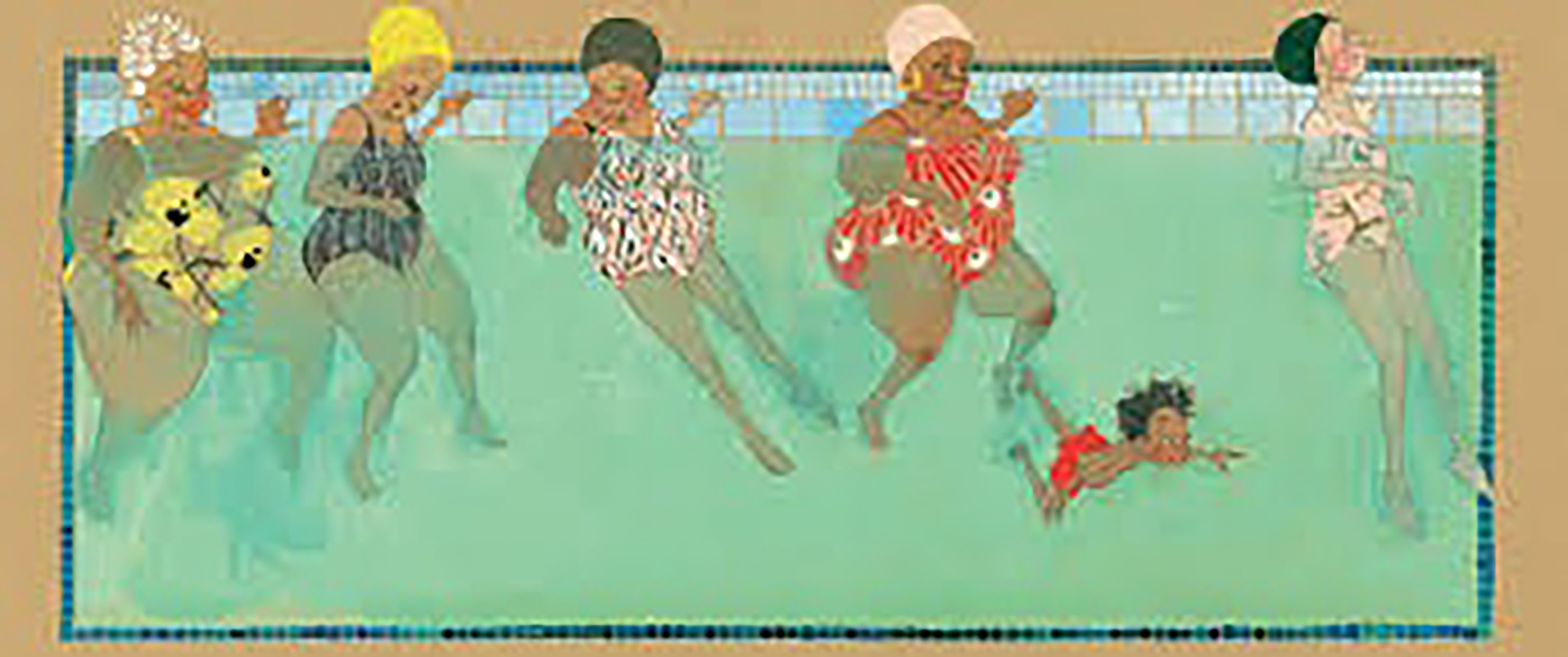
Excerpt of Julian is a Mermaid.
However, Valery did not address these interlocked issues. Instead, she displayed discomfort (“I just was like, what? [laughs] Wow, wow”) and responded with avoidance (“I just continued”). Especially revealing is the fact that she was able to avoid the issue at hand—that is, to ignore the truths underlying the question, “Why are all the nannies swimming?”—by mobilizing the construct of childhood innocence. In her words, “I’m [not] calling her out on her ignorant comment. It's not her fault, right?” As Soon and Yoon (2020: 3) put it, “The force of innocence can lead to the avoidance of potential controversial topics even amongst progressive educators.” Valery claimed that this racially loaded question was a result of her student's lack of knowledge—and she decided to protect said ignorance. Perhaps not by chance, she not only described the girl as very innocent, but she also described her as very White (“This little blond-haired blue-eyed girl”).
Valery aimed to queer her practice while simultaneously seeking shelter from the intersecting complexities of this work within the myth of child innocence. As Farley and Henry (2019: 156) point out in their decolonial “call to act beyond childhood innocence,” teachers presume an innocent child reader to be protected from traumatic histories in which they are always already implicated. Simply put, the presumption and sacralization of childhood innocence afforded Valery and her gentrified classroom the refusal to acknowledge the structures and systems in place that allow White families to rely on underpaid Black and Brown women to take care of their kids.
As this anecdote exemplifies, we cannot bring trans pedagogies to early childhood classrooms while silencing the racialized nature of gender oppression in America. For a long time now, ECE critical scholars have argued the field needs to disrupt its over-reliance on developmental frameworks and see children not as “too young” but as capable and active participants in the social world and its injustices (Bloch, 1991; Robinson, 2013). Some have shown promising venues through which early childhood teachers can disrupt dominant notions of childhood to revise their pedagogical and curricular approaches and center gender, race, ability, class, and other intersectional social justice issues (Derman-Sparks and Edwards, 2020; Templeton, 2013). Gender justice in ECE not only requires that teachers challenge binary and cisnormative understandings of gender. It necessitates teachers to challenge childhood innocence's historically racialized nature. Gender justice pedagogies must be intersectional—childhood innocence is not.
Conclusion
To sum up, images of innocent children at risk and in need of protection are being emphasized in policy and in practice amidst “gender wars.” The far-right sectors of the population are banning gender-affirming care, access to all-gender bathrooms, books, and LGBTQ + curriculum, among other anti-trans initiatives, mobilizing the figure of the child as a device to maintain a White hetero-patriarchal system in place. Yet, trans advocacy also relies on the child protection narrative, thus serving primarily racially and economically privileged children and families. Likewise, early childhood teachers who aim to address instead of silence gender issues might still operate within child innocence frameworks. Thus, they end up silencing complicated yet necessary racially loaded conversations. As I have exemplified, childhood innocence allowed Valery, a teacher committed to gender-inclusive pedagogies, to avoid facing White people's engagement with the historically racist practice of exploiting Black women for childcare work.
As sociologist Matthew Desmond (2023: 156) puts it, “Social ills—segregation, exploitation—can be motivated by bigotry and selfishness as well as by the best of intentions, such as protecting our children. Especially protecting our children.” In this sense, I join critical childhood scholars’ appeal that the figure of the innocent child has, by design, been racialized White (Bernstein, 2011). Hence, efforts to protect trans children will most likely always exclude protections for the poor and people of color.
Notably, “once the innocent child has been evoked, it becomes difficult to pull back and examine these cultural issues from other perspectives” (Jenkins, 1998: 14). But those of us who strive for gender justice might want to consider ways to disengage from child-protective narratives to respond + to LGBTQ backlash more productively.
As I have articulated, most trans people already lack access to proper health care. Thus, we could shift our pleas to protect trans kids and underscore rather than omit the historically racialized nature of access to gender-affirming health care. Perhaps we could demand affordable health care for all. Likewise, we could reconsider rationales against, say, book bans, recognizing that they negatively impact those who already have privileged access to books. Almost half of children in the US live in households with no books and in neighborhoods with no bookstores or public libraries, and two out of three schools located in the poorest US neighborhoods lack the funds to purchase new books (Ness, 2023). Instead of arguing that book bans harm children, we could frame our responses towards book bans in ways that account for poor Black, Latinx, and Native American children and families living in so-called “book deserts” (Neuman and Moland, 2019).
These, of course, are simply some possibilities I envision to engage differently in our efforts toward social change, leaving protective approaches behind us. By any means, I have the right answers as to how to shape the fight. It is trans people, kids and adults alike, who know best. Perhaps a good starting place is to turn down the volume of our #ProtectTransKids demands and more clearly listen to trans people-of-color appeals.
Footnotes
Funding
The author received no financial support for the research, authorship, and/or publication of this article.
