




Abstract
We live in a culture that teaches us to value being seen and heard above all else. In early childhood classrooms teachers are encouraged to create individual spaces for every child and to artfully display their work as it is created. Especially in Euro-Western, neoliberal contexts, policy and curricula commonly call for early childhood professionals to pay special attention to children and families who come from immigrant or otherwise marginalized backgrounds. We are urged to acknowledge and elevate children's and families’ differences for all to see. But does everyone—child, teacher, and caregiver—want to be seen and heard all the time? What are the affordances and constraints of the visibility injunction under which we live? In this article we set out to reimagine the classic hide-and-seek paradigm in order to shed fresh light on the place of hiddenness and withdrawal from public view in the formation of positive self-regard. Is the joy of hiding always defined by the anticipation of being found? Are the pleasures of seeking only realized by the possibility of finding something/someone or is seeking an activity with its own rich rewards? Our stories and responses to each other are set out in a call-and-response pattern that echoes the six semi-structured hour-long conversations on which this article is built. Musical interludes are provided between each story/response couplet offering readers moments to pause, reflect, and argue with us as they move through the article.
We live in a culture that teaches us to value being seen and heard above all else. In early childhood classrooms teachers are encouraged to create individual spaces for every child and to artfully display their work as it is created. Especially in Euro-Western, neoliberal contexts, policy and curricula commonly call for early childhood professionals to pay special attention to children and families who come from immigrant or otherwise marginalized backgrounds. We are urged to acknowledge and elevate children's and families’ differences for all to see.
But there may just be a downside to classrooms in which everyone is seen and heard at all times. We are not the first scholars who have wanted to unpack the complex meanings that arise from the visibility injunction. Freud for one employed his psychoanalytic lens to identify the tension between hiddenness and visibility as a structure through which we learn essential ways of being in the world. Later, in the second half of the twentieth century, Foucault signaled the dangers of visibility as a gateway to governmental surveillance which has only been intensified during the twenty-first century by new media technologies. Fittingly, as early childhood educators, we have chosen to take a fresh look at the questions raised by visibility and disclosure through reimagining the traditional hide-and-seek paradigm. Working with Winnicott's dictum—“it's a joy to be hidden but a disaster not to be found”—has led us to rethink our ideas about hiddenness and not-found-ness as a reconceptualization of pedagogical orientations and assumptions. Is the joy of hiding always defined by the anticipation of being found? Or are times of solitary sanctuary critical to becoming a self-aware subject? Are the pleasures of seeking only realized by the possibility of finding something/someone or is seeking an activity with its own rich rewards?
In this article we invite you into the personal and professional stories that emerged over a half dozen semi-structured hour-long conversations. Inevitably we found that our stories confirmed, interrogated, and contradicted each other. Our commitment to sitting in our differences—determined not to resolve, fix, or bridge these gaps—led us to increasingly complex and nuanced understandings of the visibility/hiddenness conundrum. The stories and responses to each other follow in a call-and-response pattern that echoes our conversational encounters. Musical interludes are provided between each story/response couplet offering you moments to pause, reflect, and argue with us as you move through the article. When engaging with our narratives we hope that you will keep in mind these questions:
What are the affordances and constraints of the visibility injunction under which we all live?
Do I, let alone the children, caregivers, and teachers with whom I interact, really want to be seen and heard all the time?
When is visibility discomforting and when is it a relief? What would a pedagogy predicated on longing rather than fulfillment, the search rather than its conclusion, look like?
What I learned in the closet—Chelsea's story
Between the ages of about 8 to 11, one of my favorite activities was to take everything out of my shallow walk-in closet in our small suburban home in Texas and throw it all in the middle of my bedroom floor and recreate the closet into my secret magical space. I filled it with the softest, coziest pillows and blankets I could find, as well as any number of stuffed animals favored at that particular time. I brought in snacks and drinks, beloved books to read and reread, and most importantly, notebooks, pens, and colored pencils for writing and drawing. This was a place of creation, of dissolution and invention and reinvention of self and self in the world. I would spend hours there, lost to the world, held sweetly in the liminality of the in-between world of my own making. This was my space of joy, of retreat, my invisibility cloak, where, as an extravert, I could orient to a self not produced, defined, excited by, or entangled with others. It was heaven.
Of my closet activities, the thing I remember most, and with the most joy, is writing poetry. I filled notebook after notebook with the poems of a queer girl child on the lee side of adolescence traversing and dismantling myself over and over again from the gender confabulations seeking to replace my stories with their own. In these poems, I wrote myself back to myself, even if it took pages and pages to get there, carefully illustrated with images that made my creation of self more real and tangible. In these poems, I re-queered myself over and over again through a careful process of imaginative regeneration and the radical embrace of those tender, battered roller-coaster feelings of a young queerling buoying themselves against the roar outside.
There were other closets in the house that I would take over for my own purposes, tucking myself away like a rechargeable battery as needed. I have no memory of any adult interacting with me about these retreats, nor do I remember ever sharing these spaces with friends. They were mine and mine alone, and this was their magic and their power. The notebooks that held all the poems and drawings have long vanished, as well as who I was and all that could have been before the roar became so great I couldn’t hear myself anymore. But the roadmap for getting back home again is written into my emotional as well as discursive DNA. Writing poetry and the power of recursive self-naming still returns me to the deep well of my own recognition of self and internal radical freedom.
From an interpersonal to intrapersonal paradigm—Jonathan's response
Following the theologian Paul Tillich, I read Chelsea's story as an ode to solitude. Tillich makes this distinction between loneliness and solitude: Our language, he says, has created the word loneliness to expresses the pain of being alone. And it has created the word solitude to express the glory of being alone.
The closet Chelsea describes is a carefully constructed space with its piles of pillows, stuffed animals, and blankets—a home within a home—in which she explores and sustains her inner life. She offers us a narrative about the pleasures of hiding. Her experience belies Winnicott's familiar aphorism: It's a joy to be hidden and a disaster not to be found.
For Winnicott the game of hide and seek is social, relational. In hiding we wait filled with anticipatory excitement for the moment of discovery. And not to be found? As Winnicott implies that might be to win the game and to lose something far more important—our connection to others.
Chelsea illumines a different understanding of the hide-and-seek paradigm than Winnicott, one that is intrapersonal rather than interpersonal, one that is about interiority rather than sociality. She is both the one who is hiding and the one who seeks. Her search is for spaces inside of herself that are hidden in everyday life and can only be found when we disengage from the busyness around us.
We don’t know if she is thinking about being found. Being found is irrelevant. She will only emerge when satisfied that her explorations into self have run their course. These explorations take form in the pages of poetry and images she generates and resonates with Joan Didion's (2021) reflection, “I write entirely to find out what I’m thinking, what I’m looking at, what I see and what it means” (p. 49). In many ways, writing is the act of saying I, of imposing oneself upon other people, of saying listen to me, see it my way, change your mind. It can be an aggressive, even a hostile act.
Writing takes courage. It's an assertion of self. But it also takes a willingness to embrace uncertainty and not knowing. I am reminded of this commitment to epistemological humility each fall as I listen in rapt attention during the Yamim Noraim, the Jewish High Holidays, to the words of the prayer—Hineni—here I am—chanted by the cantor who declaims their unworthiness to plead for others in front of the Devine. Hineni is a prayer that moves me to tears because it's about the humility with which we best approach our search for meaning, our attempts to make sense of ourselves and our place in the world.
In one pocket I carry Didion's words encouraging me to speak up and out, and in the other I carry the Hineni which reminds me to do so with humility and respect for all that I don’t know and can’t grasp. I need both and want them on hand at all times. I acknowledge these opposite impulses within me. My aspiration is toward coherence, not consistency, and to living with the contradictions that frame all our lives.
Musical Interlude
(SoundCloud permits advertisements and the proceeds from these go to the musicians.)
Incurably different and unacceptable—Sonja's story
My early schooling took place in a relatively new and small community on the outskirts of Melbourne. The community was sufficiently removed from the rest of the families of the German refugees and later migrants that came to Melbourne from Palestine and Germany when my parents were teenagers. So, I was the German alone in our class. Most families in the community were of British descent, apart from our back neighbors, who were from Pakistan. Their daughter Rachel was my best friend.
I realized of course that superficial distinguishing features of my “unacceptability” were easily disposed of: I could take my plaits out before walking into the school gate, I could dispose of my brown bread sandwiches in the first rubbish bin I found. However, I could not understand or remove the name calling, chasing, constant noticing, and seemingly incurable difference.
What does Nazi even mean? Why does it matter that my family has a German heritage? Tentatively raising the question with my parents did not bring any answers. They were not ready yet, as I found out many years later, to talk about the topic.
“You are a problem, a desire—positive or negative, never neutral,” Kristeva (1991: 39) says. Oh yes, I was. Luckily for me one of the teachers in our little school asked me to teach her German. This was both positive and negative. It was awkward, since it meant that I had to negotiate the school corridors to get to this teacher's office without being noticed by the other children—imagine if I’d been found out in this outright admission of “being German”!? On the other hand, it was certainly also positive. I became quite hungry during the day, having thrown out my lunch (never telling my mum, who lovingly made my sandwiches every day), and this teacher offered me a pie in return for my “lessons.” I am really not sure how much she learnt but remember struggling with how I could help her learn to make the “ch” sound in “Milch” for example.
I wish I could ask now, what was this teacher thinking? Did she recognize the void within which I was hiding, ruminating, with no apparent way out?
Did she know how hungry I was—and how “Australian” I felt eating a meat pie?

At the time I was not equipped to process why I was not keen to be noticed, different or unacceptable. I did know that I’d have much preferred to be neither seen nor heard. I’d have much rather slipped into the background, than being chased around the playground, labeled a German, a Nazi, clearly understanding that I was “not an ordinary negligible presence,” but not understanding what the comments made by other children had to do with who I was—except that whatever I was was not welcome, accepted, “an object of fascination.”
Psychosomatic response in prose—Chelsea's response
Lying down in the recesses of what you yourself barely know. Struggling to hide, struggling to be seen. We are broken and broken again by a self-denial as a form of protection. Picking a fight with the bouncer at the door again and again, thrown to the curb, ribs crack, heart breaks. Outside in. You are a problem.
What is this disturbance? This sound? Twigs breaking underfoot. Swift cruelty. Children's games. We name you and you become so, against your will, against your self-preservation, for your self-preservation, lost in the echo of the poison songs that write you into existence and erase you simultaneously. Lost to the world, a game of hide and seek against yourself, and you lose because there may or may not be a home to return to in this unmapped translucent reality.
Unremarkable, unmarked, unnamed, decidedly ordinary, decidedly not extraordinary. (You can’t see me.) I write my name in invisible ink and it fades into the seams, the spaces in between. Sanctuary of the invisible, the safety of self-denial. There is no regret. There is safety here. Discarding brown bread, mother's care wrapped in paper, the price of entry into the discourses by which we are bound, a small, airless box where we no longer decay, only calcify into the hard shell of the stories we are told about ourselves, that we both believe and fight against.
Where does knowing lie? Where can the truth of this self be told, be held? Acceptable identity is the translucent mirror that hides what we cannot reveal. It cannot show what cannot be seen. Nuance, “difference,” vulnerability, un-nameability, is the transgression, the object of fascination. Shape, skin, hair, teeth, utterances or their lack, what we carry in our lunch, how we roll our R's, the way we move across the room, our true forms—not that they even exist—and our deepest desires, naturally unnaturally hidden.
To be something, someone, in a world defined by difference, is to be alone, braids undone, a singularity of self and its witnesses. We hold its hand gently. There is a comfort in the silence, in the sanctuary of otherness, in the camouflage of sameness. When I am recognized through this netting, when my difference has its own value, when I am invited in, there is a gentleness in the gesture, there is a great kindness that rushes in. And without explanation, there is also pie.
Musical interlude
Better than the lie—Jonathan's story
I was an improbable child, a child who did not want to be seen and heard—at least not in a way that calls attention to your person. Painfully shy, in public spaces I would do my best to disappear or preferably not appear at all. Invitations to birthday parties were the occasion for fraught exchanges with my parents who were always encouraging me out into the world. Lingering at an apartment door, I did my best to hide behind them and prolong the moment before there was no choice but to enter a space noisy with others who appeared to have none of my hesitations.
And yet, as a novice teacher at the Bank Street School for Children in the Fall of 1969, I seemed to have forgotten this personal history. I was assigned to the classroom of an extraordinary teacher of four year-olds, Barbara M., who was brilliant, charismatic, and frequently absent. I read these absences as a sign of trust and neglect, endorsement and abandonment.
Many weeks into the Fall, in a burst of decorating mania we, myself and the second student teacher, took it upon ourselves to hang the children's paintings on what had been the drab, bare walls of the converted Fleishman's yeast factory that housed the school. Perhaps I worried that the children might feel themselves forgotten and unnoticed. Perhaps it was I who was feeling unseen and unsettled by Barbara's benign neglect. Clearly, I had hidden my childhood self from view, the self who was reluctant to attend birthday parties, enter a hotel dining room, or cross the threshold of the nursery school classroom.
I don’t remember what, if anything, the children noticed in the following days. But in Barbara's eyes we had clearly made an unwarranted mark on the classroom. In her enigmatic and provocative way she questioned us about what we had done. Clearly we had taken the mantra, every child seen and heard, too far. We had crossed an invisible line, an egregious betrayal of progressive pedagogy, by failing to ask permission of the young artists to display their work. Barbara, of course, made no suggestions about how to move forward.
Being seen and heard is a profoundly American value that forefront's each child's specialness. But what about children who only want to fit in and quietly disappear in the classroom? And what of cultures that place the highest value on conformity, on not standing out?
I have often wondered if being a queer child brings with it a certain sensitivity to questions of hiding and showing up, disguising and speaking out. To that end I have always loved
J. D. McClatchy's (1996)
description of his own queer childhood. McClatchy writes:
Long before I was given the fountain pen, of course, I had learned to hide things. Childhood's true polymorphous perversity, its constant source of both pleasure and power is lying. But that pen helped me to discover something better than the lie. Almost as soon as it was given to me, I learned to hide inside the pen. Or rather, the pen allowed me to learn the difference between hiding something and disguising something—that is to say make it difficult but not impossible to be seen. Even when I knew the difference, I couldn’t always keep myself from confusing them. (p. 194)
Theorizing our strangeness: Exile, dissidence, and delirium—Sonja's response
The notion of living life as always “Other” in some way, the “improbable child” as Jonathan states, or potentially, as stated earlier, being “a problem, a desire—positive or negative” you highlight ways that children, adults, families, teachers, we all are “never neutral.” We all are in a constant state of becoming, our subjectivities always in construction, and, to continue to draw on Kristeva (1991), we all are always strangers, even to ourselves, three-year-olds entering a birthday party, teachers making classroom decisions, and perhaps even if there were any sense of us “knowing ourselves,” it is so fleeting it is immediately bypassed by the next level of strangeness.
How do we conduct ourselves, then, as teachers, as humans? What does a sense of being constantly Other mean in terms of our awareness of our own strangenesses, in or outside of the classroom, center, or even the community? In articulating strangenesses in Jonathan’s story, I wonder if we might find a useful conceptual framework, in the notions found in Kristeva's work, of exile, dissidence, and delirium.
Exile, Kristeva says, is a conscious othering from the familiar, such as what you refer to as your three year-old self. Even if you had to enter into a room, exile offers a conceptual, paradigmatic removal. Peters (2008) has also called such an exile “the experience of being lost and at times of not knowing how to proceed or what to do” (p. 600)
Dissidence builds on this idea, developing Kristeva's statement that “true dissidence today is perhaps simply what it always has been: thought” (Kristeva, 1977/1986: 299; emphasis added), that is, it involves seeing thoughts through without prematurely expecting outcomes, resituating individuals as transformative interpreters of their own thought and being open to critical, profound confrontations.
Delirium, in this framing, represents the climax of a succession of griefs, confusion, and crises, that which, perhaps, is “better than the lie.” That which, in Kristeva's vocabulary, represents childhood's “polymorphous perversity” and maybe all at once includes a range of frustrations, disturbances, and uncomfortable conceptual insights that did not previously exist or were not previously evident.
Musical Interlude
When we were queer—Chelsea's story
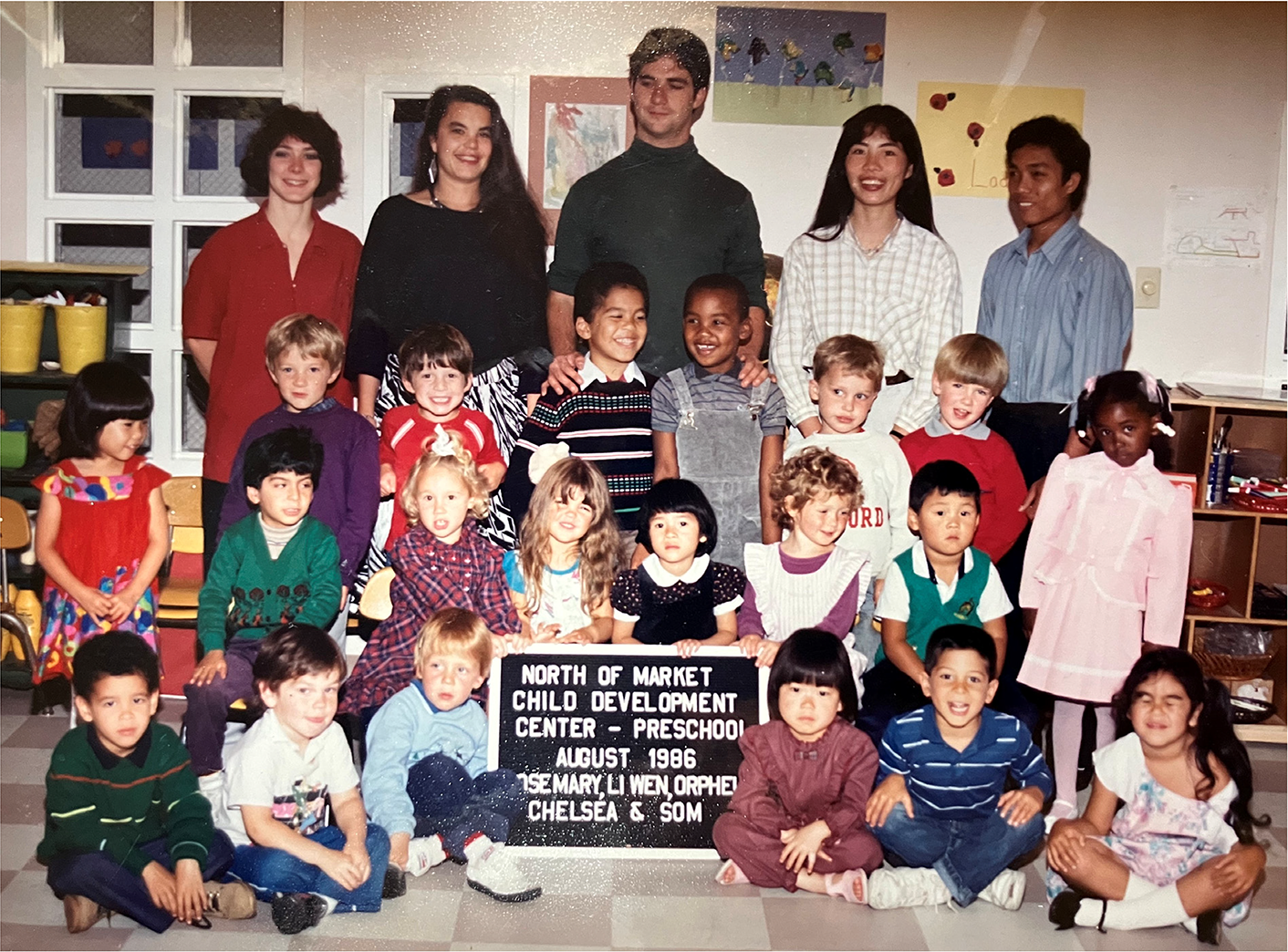
When I began my work as an assistant teacher in the newly named North of Market Child Development Center in the Tenderloin area of San Francisco in 1985, I found a home for my 20-year-old unintelligible queerness. Despite the newly hired director's NAEYC-inspired vision for the program, the teachers ensured that the children's spaces remained resistant to aspirations of intelligibility by the leadership. We were dedicated and persistent in our unintelligibility, and I would argue, in our queerness. Rather than organized by regularity and measurability, our time and experiences were organized by the flow of connection, exploration, tender-heartedness, and a collective sense of wonder and a shared sense of the complexity and disorderliness of both adult’s and children's experience of being human. We followed the path of wonder, uncertainty, joy, and, at times, messes, mistakes, and even tragedies.
Orpheus and Rosemary were the lead preschool teachers, each bringing their own unique perspective and magic. Orpheus was a fairy-tale mistral, traveling slowly among the children, strumming his awkwardly large guitar and engaging with the children on all manner of things through songs composed on the spot. His musical ease held space for the wide variety of crises, exuberations, ponderances, and quiet intimacies. Rosemary was a magnetic pied piper and still one of the best teachers I have ever known. The children hung on her every word and followed her into every adventure, real and imagined, and into every opening and possibility she created. More than that, every single one of us knew that she saw who we were as well as who we were becoming at any given moment. Wherever we were, regardless of how challenging or joyful, we were in it together, held by a profound sense of it being okay to just be as you are.
I could tell you more stories of the others in our unconventional community. I could share pages of stories of how we showed up exactly as we were, real and imagined, bold, tender, full of adventure, woven into each other stories with joyful acceptance, patience, and a quiet sense of how unique and important it all was. I could tell you how Rosemary and I still ground ourselves in the stories from that time.
North of Market is long closed. Jade and Kevin died of complications from AIDS years ago. Orpheus and Carl were each forced out by false accusations of inappropriate behavior with children. Rosemary retired after a long career as a 3rd grade teacher in the San Francisco public schools. What remains is the knowledge and wonder of being unintelligible, of not fitting, of being un-fit-able. The North of Market Childhood Development Center of the 1980s no longer physically exists, but lives in the radical refusal of fixity and the reclamation of the fundamental queerness of spaces of uncertainty and becoming, as all children's space are. It lives in the impossibility and unintelligibility of showing up fearlessly as the most joyful and unintelligible version of yourself again and again.
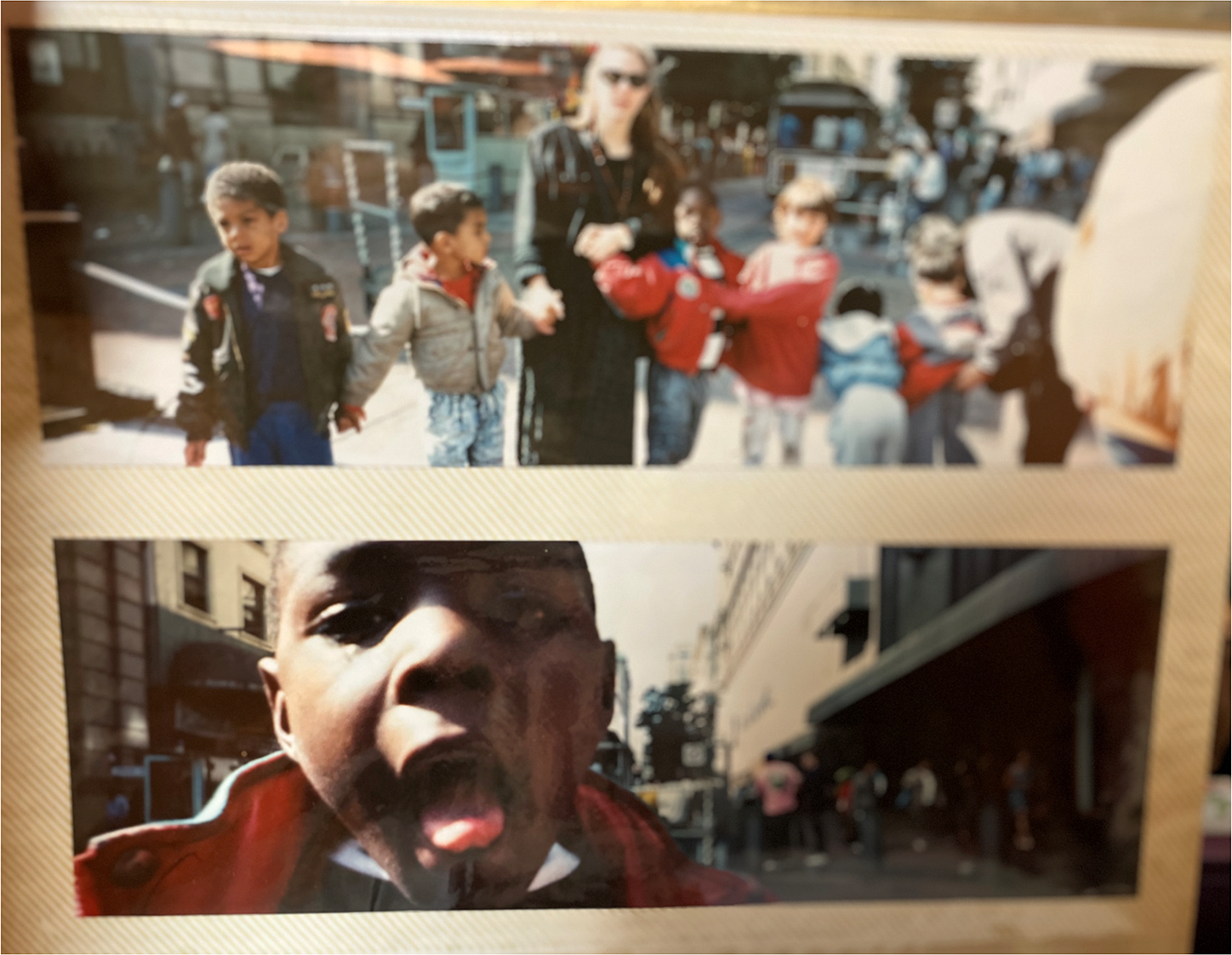
(Pictures taken by the children of NMCDC 1988)
The wonder of the unintelligible—Sonja's response
Pedagogy might be predicated on longing rather than fulfillment, on “joyful chaos” rather than an orderly, structured, predictable, measurable space, fitting into intelligible schemas, rubrics, and developmental appropriateness. In this story of multiple unintelligabilities you challenge us, Chelsea, to reimagine what we really see in a teacher.
What is “the best teacher”? When teachers are always searching, avoiding the stasis of “getting there,” recognizing as, and again I draw on Kristeva, when she invites us to see “the nonexistence of banality in human beings” (Kristeva, 1991: 3).
The wonder of being unintelligible, of not fitting, of not being fit-able, arises again in this suggestion of ourselves as always unknowable, Other, not only to those around us but also to ourselves. It offers a sense of humility, and of strength and freedom. Freedom from the need to constantly strive for knowing. Freedom from the desire for certainty. Freedom from a need for truth. Recognizing our “strangenesses,” Kristeva says, promotes “the togetherness of those foreigners that we all recognize ourselves to be” (Kristeva, 1991: 3): the un-fitable.
Such an unfittableness brings to mind a metaphor originating in my country of birth, in the Australian Aboriginal philosophy of Ganma (Watson and Chambers, 1989). Ganma represents the confluence of freshwater streams with the saltwater of the sea. It symbolizes the interface of different knowledges, from different origins, histories, or situations, as they intersperse, fluidly intersecting molecules, forces, particles, and materialities. This Aboriginal theory holds that the “forces of the streams combine and lead to deeper understanding and truth” (Watson and Watson and Chambers, 1989).
Through Ganma, knowledges converge, as we recognize others as foreign, “forc[ing] us to display” our own “secret manner in which we face the world” (Kristeva, 1991: 4). They demonstrate how “foreignness is within us,” that “we are our own foreigners,” and that “we are divided” (Kristeva, 1991: 181), simultaneously exuberant, relational, fitting, not fitting, “on the fragile threshold between brutal rejection and loving acceptance” (Purcell, 2010: 577), teetering on the threshold of wonderful unintelligabilities.
Musical Interlude:
Diffractive visibilities and unknowing—Sonja's story
Unanswered questions from my childhood encroach on my sense of seen-ness. Unsettling, fragile, subtle, and most recently following my own travel in Israel, which was punctuated by the memories of my 85-year-old mum. Mum all the while texting me snippets of her experiences: the 10-year-old youngest child; deported from the German colony in Palestine, then called Wilhelma, from the port of Haifa, amid shooting, bombs, and vomit; to spend a year in a refugee camp in Cypress on the beach in Famagusta, and then on to Australia.
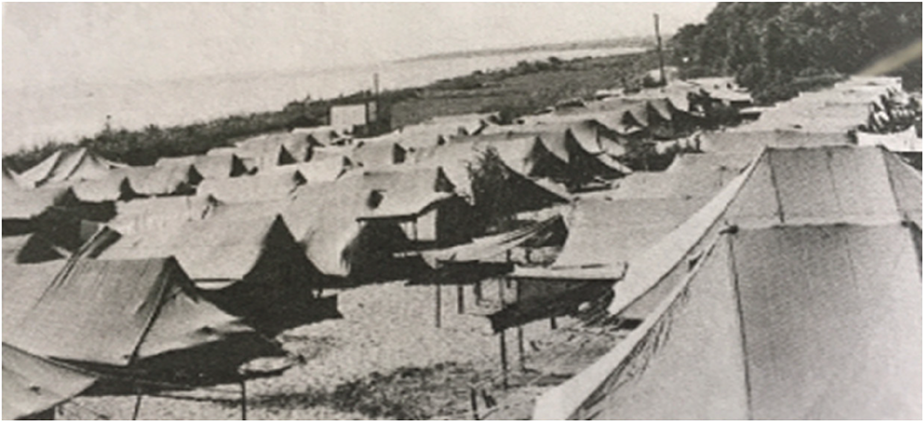 Golden Sands refugee camp, Cyprus, 1948 (Blaich, 2009)
Mum's memories of these times had been too painful for her or the other elders in our German community in Melbourne to explain to me earlier. Perhaps the elders questioned, as I do now, whether there really could be an “answer” to who we are? How were they to explain to me why and how they were sent to Australia, themselves young children or teenagers at the time, why some of their community went to Germany instead, following imprisonment in Akko and Atlit, just south of Haifa, and the importance of keeping our community together in Melbourne, where we spent weekends at the German school and community house, rather than at the local sports club or in parks, like the “locals,” the “real” Australians, those whom I so desperately wanted to be like?
Is there room for me to be, but not be dominated by, many German traditions, some of which I loved, and some not so: the Advent wreath and candles, the smell of real Christmas trees, baking, and Easter traditions, songs (well, some!), celebrations, and Swabian food?
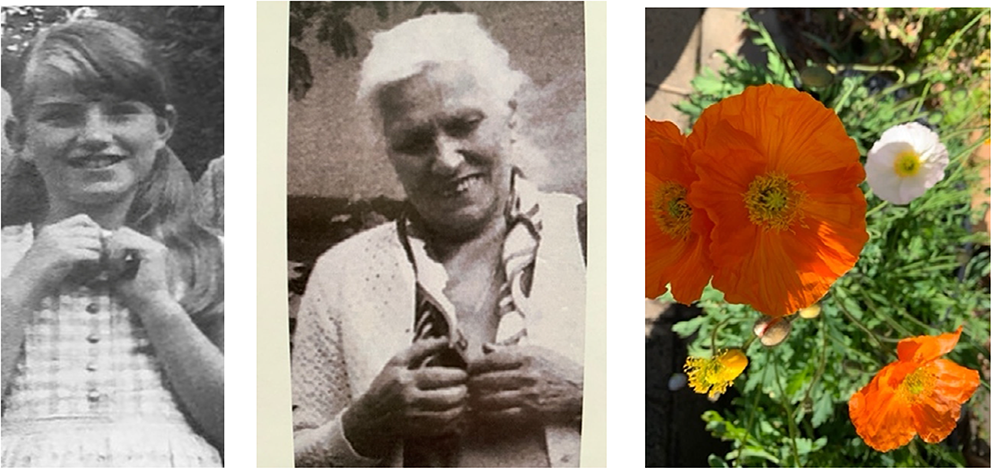 Myself at 10 years old, my aunt Anna, poppies in mum's sister's garden (family photographs)
When I look from another angle, reflecting on my teacher identity, it may be affected by my ancestors—my pioneers—in other ways for instance, my great aunt Anna—who ended up in Germany rather than Australia after World War II, and many years later walked with 10-year-old me through poppy fields in the Black Forest. We picked poppies and made “dolls” by wrapping a strand of our own hair around the middle of the bent-down flower petals, while she told me I would one day become a kindergarten teacher, just like her. I adored Aunt Anna and loved and held on to this idea.
Surely not unique, in the complexities of worldly occurrences, families migrating, hiding, finding themselves, and embroiled in conflict, am I somehow just reliving a certain foreignness, always Other, seemingly never knowing myself, completely—always in some kind of complicated tumultuous evolution, always starting from the middle, never a beginning, never an end? Is the knowledge I can hold about me—the foundation of teacherly reflection—not always partially there as well as partially absent, my story, and my Otherness, always to be implicated in some bigger picture, of which I am not really in control, diffractively (in)visible and (un)knowable?
The limits of stories—Jonathan's response
Sonja sheds a bright light on the injunction to reflect that has come to haunt teacher preparation and in-service programs. She teaches us to carefully consider the constraints and affordances of a taken-for-granted practice that often demands public displays of private histories that we would prefer to keep to ourselves. Like Sonja I too have been reconsidering what such public story telling entails.
For much of my professional life I have been guided by the words of the iconic Danish author, Isaak Dinesen—“All sorrows can be borne if you put them in a story or tell a story about them.” I have written about living through the AIDS crisis in 1980s New York, caring for my frail, aging parents followed soon after by the death of my first life partner.
Writing has been a comfort and helped to ground me when life was spinning out of control. It also allowed me to bridge disparate parts of my experience, to transport the “lessons” learned in one arena into another. I have often chosen to turn myself inside out and upside down on the page. If anything, it felt mandated by circumstances. Reflection was story making, an opportunity to come closer to my feelings by packaging them in words, paragraphs, chapters, and books.
Recently, however, I have begun to rethink this process, newly suspicious of the comfort that storytelling provides and curious about all the things that it leaves unsaid. What is it that story does not allow us to see? In what ways might we hold in greater respect the unsayable and incomprehensible nature of experience?
Is the drive to articulate our thoughts and feelings part of the human condition or, as Foucault might have argued, better understood as a function of the modern technology of the self—the injunction to know, a demand to attend to one's relationship to the truth as a function of caring for oneself?
What if we spent less time and effort eliciting reflection from our students and the narrativization that follows in its wake, and created more space for epistemological humility and uncertainty?
A provocative essay by the critic Parul Sehgal (2023) reminds me that living and telling are very different projects. I know that I am easily seduced by the beauty of words and the well-turned phrase. I also know that the curative powers of a good story, a mindful reflection, its therapeutic quotient, can obfuscate the unruliness of lived experience. I want to get closer to the seething cauldron of emotions that always lies just beneath the surface, the jumble of fragments that spreads itself out over the wild country of time and belies all our attempts at narrative causality.
In creating stories we are selective, choosing words to persuade and to convince. Details are enhanced, others are left on the editing room floor, as we contort our messy lives into a structure with a beginning, middle, and end.
Hiding in plain sight—Jonathan's story
In the winter of 1998, I traveled from my professional home at Bank Street College in New York City to York University in Toronto. Didi Khayatt (1997) had recently published an article in the Harvard Ed Review that had filled me with righteous rage. In it she argued that as a lesbian teacher educator she had no need to come out in her graduate school classrooms. Her sexual identity had nothing to do with her pedagogy. Since coming out in the classrooms had grounded my own teaching since the early 1980s, I had no patience with the coy game of hide and seek that I thought Didi was playing with her students.
The deep currents of complicated emotions sparked in me by Didi's essay had obviously resonated with my own personal and professional histories of hide and seek. Since the late 1950s my life had been indelibly marked by the pleasures and dangers, the opportunities and risks, of hiding in plain sight.
At York, in 1998, I argued that being out in the classroom, abandoning hiddenness, was for me not a choice but paradoxically an essential survival strategy. Survival, because coming out allowed me to feel comfortable in what I otherwise experienced as an intolerably stressful situation. Survival, because I believed that only in coming out was I able to demonstrate an authentic pedagogy—one that, in today's language, made clear the layered intersectionality of my educational commitments. Coming out, I assumed, prompted neophyte teachers to examine who and how they wanted to be with their own young students.
Publicly gay was not without its challenges even in the relative safety of the progressive Bank Street context. In their evaluations, some students accused me of “having an agenda” and others peppered their evaluations with comments such as, “teaching is a very personal experience for this instructor” and “I appreciate the personal excitement of an instructor but this went too far.” Can we be too gay? Perhaps, not gay enough?
In the 1990s I constructed the intellectual architecture of my argument on the then-popular science of narratology, highlighting the way our stories change over time and are edited in response to particular audiences. Today, I trouble the binary itself of being in or out of the closet, hidden or visible, and the way that the binaries reinforce a particular epistemological lens. It's true that articulating my queer orientation toward the world may have shattered a glass closet but that was not to reveal some essential truth about my life. It is exactly that myth about the truth of our sexuality that Foucault so powerfully excavated in his History of Sexuality.
Julia Kristeva says that we can never fully know ourselves completely. It follows that our disclosures are always partial and fragmented. This is to suggest that hiddenness is an essential aspect of our humanness, a protective quality constructed with the porous screens through which we look out at the world and through which others catch partial glimpses of us. Perhaps my carefully chosen words did not make me as visible or as different from Didi as I initially imagined. The politics of self-presentation are not always what we think them to be.
Troubling ideas of queerness—Chelsea's response
Jonathan's story suggests that at least for some of his students there is an urgency to fit within acceptable, intelligible borders of difference—not too much, not too little, just enough—“the most acceptable and least threatening queerness.” The tension of being “too gay” or of expressing “unruly queer desires” haunts heterosexual anxieties because it unsettles the fantasy of straightness itself and the boundedness of an easy narrative of in or out.
To abandon hiding, to come out, implies being seen and, therefore, in some way, to be known, to be understood, to be intelligible, but not, however necessarily, by oneself. To be queer, in any and every since of the word, is to be forced by circumstances of power and survival to choose between abandoning whatever small amount of safety hiddenness affords and abandoning ourselves in a self-perpetuating violence. This is the impossible lie of the binary narrative of the closet. “In” and “out” are boundaries defined by the wishes, needs, and anxieties of others who do not know where they end and the fragile mechanisms of power begin. We trouble these lines with our erasures, our absences, and, most urgently, the specter of our excesses.
In the 2020 documentary film Disclosure, exploring the history of trans representation in the media and the impact of representations on the lives of trans and other queer communities, trans actress and writer Jen Richards says, “I hate the idea of disclosure because it presupposes there is something to disclose.” To put it another way, why would we need to identify ourself as gay or queer or trans (or … fill in the blank) if we were not defined against something not that. It is a forced choice, and it is a reserved and special privilege to not be forced to name oneself in this way. When we truly name ourselves, our narratives are messy and complex, shifting, fragmented, always partially hidden from ourselves. It is the slippery excesses of not just queer self-representation, but all such attempts to tell one's own account of oneself, that the narratives of the closet seek to contain.
What happens when the truth of the complexity of queer (and non-queer) lives are present in our educational spaces, discourses, and encounters? What is at stake in abandoning hiddenness and enacting the authentic pedagogy of being “out as self,” present, shifting, and complex? I would argue pretty much everything we are talking about in our carefully crafted academic papers. Put simply, what are the possibilities of any kind of authentic encounter, educational or otherwise, if hiding one's own urgent narratives requires others to hide theirs as well? We must all consider who we show up as, what we keep hidden, even and especially from ourselves, and what we cannot bear witness to because of that.
I want to close by telling you that it doesn’t matter how many times I come out to you, I will do something that troubles your idea of my queerness. This is not a comfort to me. It is a continuous dissolution of the ground of my being-ness. Mine is not an intelligible narrative, but whose is? We just have to go on telling our imperfect stories in a voice we recognize, even tentatively, as our own.
Coda
We began by wanting to explore the constraints and affordances of the injunction to visibility which permeates many aspects of contemporary life, and most relevantly for us, the early childhood classroom. In telling our stories we returned often to Julia Kristeva's belief that we are all always not only strangers to others, but also to ourselves. In this way she asks us to reconsider the very idea of visibility, let alone Winnicott's dictum that it is a disaster not to be seen and found. If individuals are always other, even to themselves, perhaps invisibility might be understood as offering a form of freedom—not only erasure, subjugation, and suppression. Maybe “being hidden,” or “not found,” allows for critical moments of self-care, a reprieve, a safety zone, a buffer, which it would be detrimental to interfere with. As you go about your work of educating and caring for others, no matter their ages and dispositions, we hope that you will bring these questions along with you and expand your appreciation for the hidden and unknowable in human experience.
Footnotes
Declaration of conflicting interests
The authors declared no potential conflicts of interest with respect to the research, authorship and/or publication of this article.
Funding
The authors received no financial support for the research, authorship, and/or publication of this article.
