



Abstract
In peer culture, children develop social and moral orderings that justify exclusion of one or more peers – an area that has sparked debate among early childhood education groups. Therefore, the present study employed the idea of the power order or social and moral ordering of belonging to explore young children's narratives of social exclusion. We asked what story types can be identified in these narratives and how exclusion is reasoned in them. The data consisted of 25 narratives produced by 12 children, aged 4–6 years, via the Story Magician's Playtime method in early childhood education and care in Finland. Four story types were identified (repulsion, hierarchy, adult as mediator and conciliation), in which the moral reasoning for and conclusion of the exclusion differed. The diverse story types manifested complex negotiations, meaning-makings and diversity of emotions, in which children transcended dichotomous, black-and-white moral reasoning. Children's narratives illuminate how they negotiate social orders in situational interactions. Rules prescribed for children from adults are reproduced, modified and reinterpreted in these interactions. The narratives imparted the contradictions between preserving specific rules and members for ongoing play and the altruistic all-can-participate rule. The study highlighted the importance of addressing exclusion situations in ECEC. If social exclusion is not reflected on with children, they are left alone to solve these situations, which may cause a vicious cycle for repeatedly excluded children.
Keywords
Children's peer relationships, which concern the questions of equality, fairness, hierarchy and exclusion, are crucial elements of belonging and participation (Evaldsson and Aarsand, 2023; Konstantoni, 2013; Löfdahl and Hägglund, 2006; Ólafsdóttir and Einarsdóttir, 2021). As a result, studying social exclusion in children's peer relationships has recently become pertinent in scholarly research (Evaldsson and Karlsson, 2020; Lundström et al., 2022; Ólafsdóttir and Einarsdóttir, 2021). Early childhood education and care (ECEC) is significant for many young children as a place for the creation, negotiation and transgression of peer-relationship rules (Corsaro, 2018; Köngäs et al., 2022; Ólafsdóttir et al., 2017). Therefore, this research focused on children in Finnish ECEC, which aims to ‘develop the child's interpersonal and interaction skills, promote the child's ability to act in a peer group, and guide the child towards ethically responsible and sustainable action, respect of other people and membership of society’ (Act on Early Childhood Education and Care 540/2018, §3). Likewise, ECEC also seeks to ensure children's protection ‘from violence, bullying and other harassment’ (Act on Early Childhood Education and Care 540/2018, §10). Furthermore, Puroila et al. (2021) argued belonging is negotiated in daily contexts but also at the level of institutional and organisational practices and educational policies in ECEC. Thus, ECEC is a key context for exploring belonging and exclusion for young children (e.g., Köngäs et al., 2022; Löfdahl and Hägglund, 2006; Ólafsdóttir and Einarsdóttir, 2021).
Belonging refers to the human need to belong and construct and maintain meaningful relationships with others (Yuval-Davis, 2006). Social exclusion involves a state of unbelonging or ostracism, including being disliked, rejected, ignored and excluded by others (Puroila et al., 2021; Williams and Nida, 2022). Although the content and severity of exclusion may vary, it always has negative consequences for those excluded (Lipponen and Pursi, 2022; Williams and Nida, 2022). In Peltola et al.'s (2023) Finnish study, the interviewed preschool-aged children had all experienced exclusion and could narrate diverse coping strategies. They waited to be included in play or asked for help from adults. However, most children found it difficult to give reasons for why they were excluded. This makes the study of social exclusion in early childhood significant.
Peer exclusion occurs in daily ECEC activities, especially during play (Evaldsson and Tellgren, 2009; Lundström et al., 2022; Ólafsdóttir et al., 2017). Its purpose is not always harm; instead, it serves to construct social orders and define relationships (Corsaro, 2005; Evaldsson and Tellgren, 2009). Adults do not always witness peer-exclusion processes (Evaldsson and Tellgren, 2009; Köngäs et al., 2022; Lundström et al., 2022). Therefore, the meanings children give to exclusion are still poorly understood by adults in ECEC. Thus, the present study focused on children's individual narratives in which social and moral hierarchical orders developed and executed in peer culture became identifiable (e.g., Cobb-Moore et al., 2009; Evaldsson and Tellgren, 2009; Löfdahl and Hägglund, 2006). The aim was to explore the meanings, orders and moral reasonings attached to peer exclusion in the narratives of 4- to 6-year-old children. The study contributes to improve our understanding of how to foster belonging and prevent exclusion in the ECEC context.
Social exclusion in young children's peer relationships and cultures
When considered from children's perspectives, constructing belonging or exclusion can be understood as continuous negotiation processes in peer relationships and cultures in ECEC (Juutinen et al., 2018; Peltola et al., 2023; Theobald and Danby, 2023). In this study, social and moral ordering of belonging in peer relationships refers to active attempts by children to construct belonging by creating orders developed through and executed in peer culture and play (Cobb-Moore et al., 2009; Evaldsson, 2009; Löfdahl and Hägglund, 2006; Theobald and Danby, 2023). Diverse rules and norms are created in children's interactions to reason and justify a specific power order and peer exclusion (e.g., Cobb-Moore et al., 2009; Evaldsson and Tellgren, 2009; Löfdahl and Hägglund, 2006; Theobald and Danby, 2023).
Social exclusion is difficult to observe for adults because it might occur within play and through diverse direct or indirect actions (e.g., Cederborg, 2021; Evaldsson and Karlsson, 2020; Kalkman et al., 2017). Research conducted in ECEC has found various actions related to and means of exclusion employed by children in peer relationships. For instance, in Cederborg's (2021) ethnographical case study of 3- to 5-year-old children in Swedish preschools, young children created and maintained asymmetrical relations during outdoor play by co-constructing status positions through various means (e.g., reprimand/disapproval or praise/approval, consent to act, sharing with one peer and rejecting/ignoring another). The study of Lundström et al. (2022) in Finnish ECEC showed how exclusion or discrimination in play can embody diverse power mechanisms, such as limiting free choice or coercing subordination. Kalkman et al. (2017) found exclusion occurred in their ethnographic study of Norwegian preschool-aged girls through acts of relational aggression, such as rebuffing migrant newcomers’ attempts to join in daily activities in spaces where children generally acted and played independently. In their study, the oldest children used positioned and privileged power for inclusion and exclusion. Similarly, Konstantoni (2013) noticed in her ethnographic study in two nurseries in Scotland that very young children already expressed stereotypes associated with some ethnic groups and refused to play with certain children as a result (cf. Ólafsdóttir and Einarsdóttir, 2021).
Studies have also shown ongoing interactions between peer and institutional cultures. Corsaro (2018) posited childhood is related to (adult) society and other structural categories, and via interpretive reproduction, even young children actively participate in, modify and mould adult culture, such as norms and rules, in their peer cultures. Theobald et al. (2022) revealed how children re-create adult culture within their actions, for example, in play or narrating their experiences. In Cobb-Moore et al.'s (2009) Australian study among 5- to 6-year-old children in a preparatory classroom, both diverse adult- and child-formulated rules and social orders were developed to negotiate power, group membership and status, but these negotiations were fluid and open to situational reordering. The analysis of the video-stimulated interviews with children aged 4 to 6 years by Theobald and Danby (2023) revealed the importance of the moral orders young children constructed both inside pretend play and relationship interactions.
In a Finnish ethnographic study of 3- to 6-year-old children, Köngäs et al. (2022) showed how children bridge peer culture with adult culture in ECEC, trying to adhere to acceptable behaviours and social norms set by adults within the context of achieving their goals and power in peer relationships. They related how children used indirect ways, such as nonverbal approaching, awaiting permission and employing material objects, to gain access to play. Löfdahl and Hägglund's (2006) observation study in a Swedish preschool with 5- to 6-year-old children revealed how they created and maintained an age-based social order through implicit strategies (e.g., ending or changing the ongoing play, rules or roles or giving peripheral roles to the child attempting to join). In this way, they could skirt or depart from the rule established in their preschool of including everyone in play. Likewise, in their ethnographic study using video-stimulated accounts with 3- to 5-year-old children in Iceland, Ólafsdóttir et al. (2017) discovered they contested but did not break adult rules by creating their own rules. In the study by Evaldsson and Tellgren (2009) with Swedish preschool girls, children developed ways to avoid appropriating adult-based institutional peer-interaction rules to achieve power, control others and strengthen in-group alliances. Evaldsson and Aarsand (2023), in turn, showed how two 7-year-old boys’ game practices involved degrading and excluding a third boy as deviant and abnormal to strengthen their bond. In short, children reproduce and modify real-life power roles and orders by appropriating vocabularies and language usages of authority from adult culture (e.g., Evaldsson, 2009) or manipulate, modify or dodge adult rules for their own purposes (e.g., Ólafsdóttir et al., 2017).
Given this background, the present study examined how young children make sense of social exclusion in ECEC through the meaning-making in their storytelling. We established two research questions: what story types could be identified from young children's narratives of peer exclusion and how was exclusion morally reasoned in these story types?
Methods
Creative and arts-based methods are considered appropriate when traditional means of research are insufficient. Such methods permit acknowledging children's and young people's perspectives and opinions while employing child-centred approaches (Mand, 2012; Khanolainen and Semenova, 2020; Lahtinen et al., 2023). This study was part of the VALTAKO project applying a narrative approach targeted at listening to children and young people about conflicts and power in their close relationships. The narrative approach was chosen as it respects children's storytelling abilities and acknowledges culture's role in narrative meaning-making (Nicolopoulou, 2011; Puroila et al., 2012). It also offers a safe space for discussing difficult topics without precluding narratives rooted in children's life experiences (Tumanyan and Huuki, 2020).
Story Magician's Play Time method
The data were collected using the narrative, child-oriented Story Magician's Play Time (SMPT) method (Koivula et al., 2020). This vignette-based method was developed specifically for listening to young children's perspectives about socially challenging situations through guided storytelling and play (Koivula et al., 2020; Lahtinen et al., 2023). The SMPT's basis is that narrating stories and playing are inherent ways for young children to describe, understand and make sense of their worlds and experiences (Koivula et al., 2020; Moran et al., 2021; Puroila et al., 2012).
Participant recruitment occurred via two ECEC centres with permission from municipal early childhood authorities. Staff were informed about the research and distributed invitations to families with 3- to 7-year-old children. The guardians provided written informed consent after being informed about the research and its adherence to the ethical principles of the Finnish National Board on Research Integrity (2019) related to voluntariness, the right to end participation at any stage of the study and confidentiality. Next, two of the researchers met with the participating children at their ECEC centres. In one ECEC centre, both researchers met with the children in a group. Due to COVID-19 restrictions, only one researcher was allowed to meet with a maximum of two children at the same time in the other ECEC centre. During the meetings, the researcher(s) introduced themselves, the research topic (with pictorial support) and the SMPT method. The children were also familiarised with and could test the video camera and audio recorder. Because of mask mandates, the researcher(s) had a printed photo of themselves so the children could see what the researcher(s) looked like and thereby feel more relaxed with an unfamiliar adult.
For the data collection, seven pictures depicting everyday situations in ECEC were designed. Based on previous findings in Nordic countries, the pictures illustrated social situations where conflicts could occur, such as mealtime, exclusion from the group or having a disagreement about a toy (e.g., Löfdahl and Hägglund, 2006; Markström, 2010; Salonen et al., 2022). Preliminary versions of the pictures, designed and drawn by a graphic artist for this study in collaboration with the research group, were discussed with the participants. The final versions were created based on the children's comments.
The children participated in individual SMPT sessions and were informed about the voluntariness of the sessions, that is, they could refuse to take part or discontinue their participation anytime (Finnish National Board on Research Integrity, 2019). The researchers paid careful attention to establishing a safe and trusting relationship with the children (for relational ethics, see Hilppö et al., 2019). During the SMPT sessions, the children were first asked to select a picture from which to create a story. The pictures were neither labelled nor defined as presenting conflicts. Next, their construction of the story was facilitated through supplementary questions, such as ‘What has happened in the picture?’ and ‘What might happen next?’ The researcher was careful not to lead the children's storytelling, instead letting them freely narrate the events, characters and circumstances related to the picture. Although fictional, the created stories could be rooted in the children's experiences. However, they were also a production of collaboration between the children and the researchers (Moran et al., 2021; Puroila et al., 2012). Children were offered six emotion cards (showing joyful, sad, angry, fearful, embarrassed and astonished facial expressions) to facilitate the discussion about emotions.
Second, a created story was acted by the child and the researcher using props, such as dolls and play furniture (Koivula et al., 2020). The researcher used a hand puppet, which created a comfortable atmosphere and elicited the free expression of the children's views (Coyne et al., 2021; Koivula et al., 2020). The hand puppet also introduced the reflection on how the conflict might be resolved to the satisfaction of all parties, the potential lessons and whether the child had ever been in a similar situation (Koivula et al., 2020; Lahtinen et al., 2023).
Analysis of the children's narratives
Project data were collected with 28 ECEC-aged children during 54 SMPT sessions. For the present study, only narratives focusing on social exclusion in peer relationships that originated from the exclusion picture (see Appendix) were included in the analysis. In total, 12 children (four boys and eight girls) aged 4 to 6 years produced narratives from the exclusion picture. The child could create more than one narrative by describing a new situation with a different plot when the narrative was played or detailing their own experience. The children told 25 exclusion narratives.
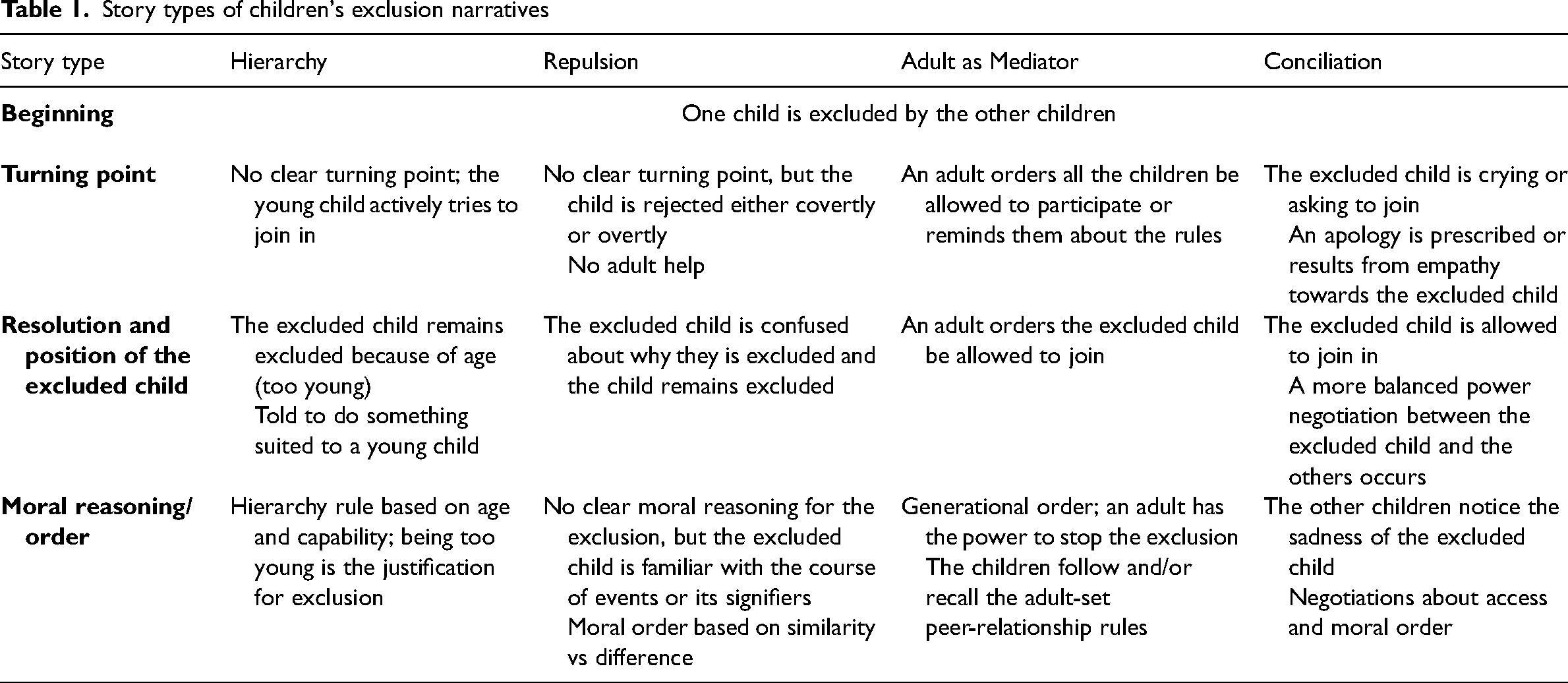
The children's narratives were analysed by plot structure (Labov, 1972) and story evolution. Narratives, typically, embody a temporal ordering of events and a description of characters, complicated action or a turning point, and a resolution (Labov, 1972; also Theobald et al., 2022). All stories had a similar beginning (one child was excluded from other children's activities); some had a turning point where events departed from the earlier story and an ending/resolution. In addition to examining the plotline to identify different story types, we looked at the positioning of the characters and related changes (see Table 1). Inspired by Corsaro (2005) and the social and moral ordering in children's peer relationships (Cekaite and Evaldsson, 2020; Löfdahl and Hägglund, 2007; Theobald and Danby, 2023), we investigated the moral reasoning in the children's narratives; that is, how moral orders and normative assumptions about peer relationships were made sense of in the narratives (Cekaite and Evaldsson, 2020; Evaldsson, 2009) (see Table 1). Thus, the narrated emotions and moral reasoning were also a means of identifying each story type. The first author did the initial categorisation of the story types, but for the mixed narratives and final categorisation, the authors collaborated in categorising the narratives. Only one narrative was considered to include two types (a conciliation and hierarchy story) (see example story 6).
Story types of children's exclusion narratives
Findings
Through our analysis, we found four social exclusion story types: hierarchy, repulsion, adult as mediator and conciliation (see Table 1). All the stories began with a pictorial cue of a situation in which one child was excluded by the other children.
Below, the story types are presented with examples from the SMPT sessions. All names are pseudonyms. Bolding denotes the elements most relevant to the analysis.
Hierarchy stories
In hierarchy stories, age (being too young) was the justification for exclusion. This type of story was reflected in the narratives of three girls and one boy.
Example story 1: Michael's acted story
Does this child want to join in? This child is yet a bit too little. Yes, he is. Let's go to the train! What do you think they feel when they say that he is too little? [mumbles] Oh, was I a bit too big for this train? [playing] Let's go yet here! [The young child says:] I want to come too! [A bigger child says:] Too little! Too little! [pause] Where did they go now?
… They went to the slide. [The character says:] You are too little! Let's go now to the slide. Let's go to the slide! Yuhuu! My turn.
In Michael's acted story, the youngest child asked to join in. However, as is openly communicated and reasoned on many occasions, he was excluded because of his age.
In hierarchy stories, the reason for exclusion was expressed the most explicitly compared to the other story types. Moral reasoning led to justifying the exclusion by saying the child was too young to participate with the other (older) children; the child could get hurt, the child should do something more appropriate for young children or the child was incapable of participating in shared activities. Age seemed a solid rule for moral reasoning in hierarchy stories, where the youngest child remained excluded and powerless at the end, having no means or resources through which to rise in the social hierarchy. Young age worked as a marker of the difference and powerlessness of the excluded child.
Repulsion stories
The six repulsion stories (five told by four girls and one by a boy), where one child is actively expelled from the group or not allowed to join in, were often based on the child's own experiences. In two stories, the situation was narrated from the excluding child's perspective, and in two stories, repulsion was actualised inside the play.
Example story 2: Leo's own experience
Have you been in a similar situation sometimes? Sometimes, somebody doesn’t want to play with me, but I go to tell the teacher. But sometimes, I can play alone too. … Sometimes, I find a peer and sometimes, not. When Jack came to play with me, then he left away. Didn’t he want that anymore? No, because Okay. He just left if someone else came, right? Sort of, so I didn’t let him run away. How did it end then?
How did you feel then?
Right. What could adults or the Story Magician learn from this story? Except one thing adults should know… What was it? [10 s pause] One thing was, like, when I wanted to play with some peers, So, they run away? Yes. Didn’t they have time to listen to you? Well, no. Continued their own things? Yeah. Yes, how did you feel?
It's, if I wasn’t let in, I’d feel bad too. It's surely common. How would the adult have behaved better then? Would something have helped, can you imagine? That I’d have been allowed to join in the play.
(Leo, 6 years)
Leo explained he sometimes plays alone and listed many means of exclusion (cheating, whispering, leaving or running away). His word choices referring to repetition indicate he was familiar with exclusions scenarios, including what preceded or signified exclusion. In the end, he was not able to narrate any clear solution or emotion. Leo said he tried to ask the teacher for help without success, ending his story by stating joining in the play with adult assistance would have been a good solution.
The following story was narrated from the perspective of the excluding child and the exclusion occurred inside the play.
Example story 3: Viola's own experience
Ida scratched me today. Did she? Did you have a quarrel or why did she scratch you? Because I, I tried to say that Aha. Didn’t she like to be the one to be hunted? Yes. But then, Ok. So, where did you go? Then, Aha. What did Ida think about that? That Oh, well then.
(Viola, 4 years)
Viola stated Ida had scratched her during play after she had ordered Ida to be a prey instead of a hunting dog like the others. Ida opposed her role by showing her disappointment and anger with a physical response, which was handled by the other children leaving her alone. The narrator reasoned the girl who was left alone wanted to play alone. Viola's story described how power ordering could be accomplished inside play via assigning one child a different role from the others, thus creating a social order of similarity versus difference.
Repulsion stories described the child's rejection from peer membership either in blatant or subtle ways. Repulsion may function as a means of gaining power within peer relationships and constructing power orders within ECEC peer culture. The covert methods of exclusion described in repulsion stories may indicate processes of constructing situation-specific rules for play to preserve the play space only for certain children. In repulsion stories, the excluded children could also try to gain access to the group by behaving badly (as in Viola's story). However, they remained excluded, indicating powerlessness and repression, but the narratives did not generally have clear moral reasoning for the exclusion.
Adult as mediator stories
Two boys and five girls narrated adult as mediator stories. These seven stories had a turning point and resolution by an adult who fostered reconciliation or directed all children to participate (according to the rules).
Example story 4: Leo's story: The child was not allowed to join in the play
Once upon a time, there were two boys and one girl. One boy wanted to join in play, but … What do you think that this [the boy in the picture] felt then? Ok, sad. How do you think these [the children in the picture] might feel? Happy and joyful although What happened then? Then, the adult came to say that nobody can taunt others. How did these [the children] feel then? They then said they are sorry. What comes next? That Was he then allowed? Yes. Those [children] said they are sorry and then this [child] could join in. How did these [children] feel about saying they’re sorry? Well, just normal. Just normal. What about this? How might he feel then? Happy. He became happy … … when he could join in play.
(Leo, 6 years)
In the example story, the child blocked from playing felt sad; the other children were happy and joyful. Leo added exclusion is not ‘fun for real’, signifying he knew the unkindness of exclusion. The situation was resolved by an adult, who reminded the children not to taunt others, resulting in the excluded child joining the group. The narrator described how the children apologised after the adult's reminder and felt apologising was ‘just normal’. This may indicate the normal procedure of apologising in the ECEC context does not lead to an immense emotional response in children, that is, they complied with the familiar institutional expectation without feeling sorry.
In another story, an adult helped by asking the other children to let the excluded child join their play.
Example story 5: Peter's story: The child wasn’t included in others’ play
What happens then? [10 s pause] Well, they’d let him join in the play. They’d let him join. How might the child feel?
In Peter's story, the children did not want to let the excluded child join in and were unhappy about complying with the adult's request; they would have preferred to play only in a group of three. Peter's story captures well the ambivalence of deciding between continuing to play with those already participating and allowing new members to join.
In adult as mediator stories, the adult had the authority to intervene, remind about the rules and oblige or help the children follow the rules. Thus, these stories in one sense offered a clear plot line: the excluded child was accepted into the group play according to the adult-led rules. However, these stories also showed how children try to coordinate and negotiate the conflicts among norms, the adult voice and their agency in a particular situation.
Conciliation stories
In the eight conciliation stories (five narrated by girls and three by boys), there was a more balanced power negotiation related to inclusion, in which compassion often played a role.
Example story 6: Anna's story
Well, what do they do there? Those [the children in the picture] play in the sandpit, and the youngest one is not allowed to join in the play. Who are playing in the sandpit? Those three [the characters in the picture], and they don’t let that [one] join in the play. Yes, they don’t let [the child play] … … They said that they won’t let that child join in the play. Why don’t they want to take this [child] along? … because, How do they notice they should say they are sorry? Well, she was annoyed, and they let her join in the play then. Right. Did they notice that she was annoyed or how did they notice it? Well, they surely noticed. Okay. They heard that she was weepy, and did they then say they are sorry? Mmhmm.
(Anna, 5 years)
Here, there was a turning point when the other children noticed the excluded child's emotions from physical signs and reactions in their interaction. Although the story also resembled hierarchy stories, the moral reasoning did not revolve around age but relied on the characteristics of conciliation stories. The resolution can be interpreted as revealing empathy towards the child left alone, which caused a behavioural change and an act of compassion in asking the child to join.
Conciliation stories showed how children in positions of power used their influence to create mutual relationships and belongingness through exclusion. Yet, these stories involved negotiations of belonging in which the child wanting to join was acknowledged and taken seriously. In three stories, noticing the excluded child's sadness caused a behavioural change, but the narrators also presented other facilitators of group membership: suggesting taking turns, the excluded child asking permission to join again or the other children apologising and inviting the child to join. Conciliation stories embodied resolutions in which children's mutual negotiations initiated change and allowed the excluded child to participate. In some stories, children's mutual negotiations were accompanied by the excluding children remembering their ECEC centre's all-can-participate guideline.
Discussion
In this study, we explored ECEC-aged children's peer-exclusion narratives. In line with UNCRC Article 12 (UNICEF, 1989), the applied narrative approach and play-based method enabled children to envisage experiences familiar in their daily peer relationships and feel heard (Lahtinen et al., 2023; Theobald et al., 2022; Tumanyan and Huuki, 2020). The study produced crucial information about how young children narrate, make sense of and justify peer-exclusion situations. Based on the plotlines and moral reasoning, we identified four story types: hierarchy, repulsion, adult as mediator and conciliation. In over half the narratives, the excluded child was accepted by the group with or without adult help, but almost as often, the child remained excluded.
The children's narratives illuminated three key phenomena related to peer exclusion. First, emotions were meaningful in exclusion processes. The children's narratives contained what Søndergaard (2014) labelled the fear and anxiety of being excluded when one's belonging is being questioned. This co-existed with the hope of inclusion and joy of group belonging. Sadness rooted in powerlessness related to exclusion and rejection may lead to withdrawal, subordination or conformation to moral orders to avoid exclusion (Cederborg, 2021; Lipponen and Pursi, 2022).
Second, an important question is how power is involved in peer-relationship negotiations (Cederborg, 2021; Evaldsson and Tellgren, 2009; Kalkman et al., 2017). Notably, power/powerlessness and right/wrong were not fixed but a result of diverse situational negotiations and moral reasoning. In their stories, children created power orders, reproducing social hierarchies based on age and similarity versus difference (cf. Löfdahl and Hägglund, 2006). Furthermore, the narratives also imparted the contradictions between preserving specific rules and members for an ongoing play and the altruistic all-can-participate rule (cf. Evaldsson and Tellgren, 2009; Löfdahl and Hägglund, 2006). While earlier studies (Cederborg, 2021; Cobb-Moore et al., 2009) have uncovered means of achieving and maintaining high-power status in play, the narratives examined were often from the perspective of the least powerful children. Although the narratives conveyed strategies for coping and joining in play (cf. Peltola et al., 2023), they also demonstrated power asymmetries in children's peer relationships. Repeated exclusionary acts may normalise certain children's exclusion, resulting in permanent marginalisation and exclusion (see Evaldsson and Aarsand, 2023; Köngäs et al., 2022; Löfdahl and Hägglund, 2006; Ólafsdóttir and Einarsdóttir, 2021).
Alternatively, trying to avoid being defined as powerless or different within the peer hierarchy occurred through opposition or aggressive behaviours in the narratives. Such narratives lead to questions of whether exclusion is justified when actualised as a defence against the negative (aggressive or bullying) behaviour of the excluded child. However, aggressive behaviour caused by continued exclusion can easily be misinterpreted by peers and adults (Köngäs et al., 2022). That said, negotiation and reunion in exclusion situations were also present in conciliation stories, indicating both children's empathy, willingness and capabilities for shared reconciliation, as well as power asymmetries and orders being changeable and situationally adjustable.
Third, the narratives showed questions of belonging and exclusion are negotiated in the intersection of ECEC peer and adult cultures (Corsaro, 2018; Köngäs et al., 2022; Ólafsdóttir et al., 2017). In addition to the explicit facilitator or intervener role of the adult in adult as mediator stories, many narratives included children recalling adult-set rules although there was not necessarily an adult character. The hierarchies and moral orders in children's narratives parallel, reproduce and modify what those children have observed in adult-prescribed rules (Cekaite and Evaldsson, 2020; Evaldsson and Tellgren, 2009; Köngäs et al., 2022). For example, through interpretive reproduction, age as a marker of difference in adult culture becomes an acceptable basis for children's moral reasoning and meaning-making (Corsaro, 2005; Evaldsson and Tellgren, 2009). Conversely, children's narratives also illustrated adult rules colliding with children's moral reasoning, since their strict nature did not account for all children's perspectives, the ongoing situation, the course of play and events preceding the exclusion.
In this study, our data did not include gender or personal appearance (e.g., skin colour or clothing) as moral reasoning for exclusion, in contrast to other studies (e.g., Evaldsson and Aarsand, 2023; Kalkman et al., 2017; Konstantoni, 2013; Ólafsdóttir and Einarsdóttir, 2021). Although the data were collected in ECEC centres in socio-economically diverse areas and participation was facilitated for non-Finnish speakers, the participants were mainly of Finnish origin and all spoke Finnish. Furthermore, no specific information about family background (ethnicity, family composition, class or education) was collected. For future studies, it would be beneficial to apply an intersectional lens in researching peer exclusion for more detailed understandings concerning differences between children.
Further, in relation to the methodology and adult–child hierarchy (see Koivula et al., 2020; Mand, 2012), the children might have tried to create stories to please the researchers. This was addressed by the researchers’ commitment to respecting the children's (non)verbal expressions, encouraging them to narrate according to their preferences and relying on child-initiated narration.
Conclusion and practical implications
The diverse story types identified in this study revealed complex meaning-making and emotions related to exclusion. This research showed children can both employ and oppose adult-led rules to construct their moral orders and use these rules as resources to negotiate their peer relationships (see Cobb-Moore et al., 2009; Kustatscher, 2017; Ólafsdóttir et al., 2017; Søndergaard, 2014). Overall, young children's moral reasoning goes deeper than knowing or separating right from wrong (Theobald and Danby, 2023) and transcends dichotomous moral reasoning (Evaldsson and Tellgren, 2009). This makes tackling exclusion complex and demands ECEC professionals be able to recognise the diverse processes of peer exclusion and how children's social norms and orders are created and maintained (see Kalkman et al., 2017).
Nevertheless, in line with previous research (Kalkman et al., 2017; Köngäs et al., 2022; Konstantoni, 2013; Ólafsdóttir and Einarsdóttir, 2021), the study highlighted the importance of addressing exclusion situations in ECEC. Mitigating social exclusion requires conscious efforts to build belonging and togetherness for all members in the child group. This does not happen by itself nor with one-size-fits-all solutions. Since it is important for children to learn positive ways to interact and the skills to maintain peer relationships, ECEC educators should assist, encourage and guide them in this process. Konstantoni (2013) emphasised diversity, social exclusion and inequality should be discussed with young children, rather than allowing these topics to remain taboo to supposedly preserve childhood innocence.
Social exclusion situations create space for situated socio-emotional learning (Evaldsson and Tellgren, 2009), wherein instead of holding to adult-led practices and rules, both children and adults can learn collaboratively (see Köngäs et al., 2022). Learning about social exclusion can be situated in everyday incidents that could be narrated, acted out and reflected on with children. Preventing unwanted outcomes of peer exclusion and building impartial understanding demands respecting children's experiences, emotions and meaning-making regardless of their roles in exclusion situations.
Footnotes
Acknowledgements
We want to express our gratitude to the children, their guardians, and ECEC centers for being involved in the study. We also warmly thank Jauri Laakkonen for drawing the backdrops and pictures for our study.
Declaration of conflicting interests
The authors declared no potential conflicts of interest with respect to the research, authorship and/or publication of this article.
Funding
This work was supported by Suomen Kulttuurirahasto (grant no. 00190973).

Author biographies
Appendix
The picture of peer exclusion (picture by Jauri Laakkonen)