




Abstract
The important role of early childhood education and care in nurturing and ensuring belonging among all children is well recognised, but research specifically focused on how this is accomplished for autistic children is scarce. The aim of this study was to examine how supporting autistic children's belonging appeared in the stories of Finnish early childhood education and care professionals (e.g. early educators, special education teachers, and early childhood education and care nurses). The data was collected by using the method of empathy-based stories, which prompts participants to produce stories. A qualitative analysis of 104 professionals’ stories produced one overarching theme of professionalism comprising two interconnected main themes: (1) established support solutions and (2) a willingness to understand the child. The findings suggest that understanding a child as a unique individual with autism is a cornerstone of favourable pedagogical support solutions for belonging.
Introduction
The concept of belonging refers to a person becoming accepted and included as they are within different communities and society as a whole (Yuval-Davis, 2011). Autistic children tend to face challenges in their experience of belonging, both in their younger years and across their lifespan (e.g. Pesonen, 2016); they also run a high risk of exclusion from mainstream education (Äikäs et al., 2023), given their encounters with networks of social expectations, responses and attitudes, with many possibly preventing their experience of belonging (e.g. Pesonen et al., 2020).1 Most autistic children need support with social interaction and communication, and with processing everyday sensory information (American Psychiatric Association, 2013). Such individual support measures are founded in the culture and practices of an inclusive environment, where support is a shared responsibility of all professionals working with a child in early childhood education and care (ECEC; Finnish National Agency for Education, 2022). Overall, neurotypical (non-autistic) norms and expectations (e.g. certain ways of being in social interaction with others) can hinder autistic people's belonging and result in poor well-being (Milton and Sims, 2016).
Prior research has indicated that autistic people might not even want to belong as they continue along their educational paths (e.g. in higher education), actively aiming for unbelonging (Pesonen et al., 2020). Further, autistic children may not have been provided with enough opportunities to feel connected to places, situations or different groups of people, or ‘sameness’ (e.g. to find ‘soulmates’); instead, having been expected to relate to neurotypical norms (e.g. Pesonen et al., 2015), they might not feel connected to, or share an identity with, a particular group within the educational context (Johansson and Puroila, 2021).
Thus, in ECEC, educational professionals play an important role in supporting autistic children's belonging and preventing the development of its opposite – unbelonging (Pesonen et al., 2015; Puroila et al., 2021; Syrjämäki et al., 2023). Belonging is one of the key components of inclusion on a child's educational path (see Emilson and Eek-Karlsson, 2022; Noggle and Stites, 2018), as well as an integral part of well-being – together with enhancing the development and learning of the child – and, consequently, is indicated as the objective of ECEC (Finnish National Agency for Education, 2022). Furthermore, ECEC professionals might only be supporting one ‘right way’ of belonging to ‘one kind’ of neurotypical childhood group, which does not consider an autistic child's belonging needs (e.g. in which situations the child feels most accepted) and, in turn, may lead them to feel left out. Autistic children have the same needs to belong and feel accepted as part of a group, which is also related to improved well-being (Pesonen et al., 2015; Brennan Devine, 2022). Professionals often encounter challenges in supporting children with high support needs (e.g. autism associated with intellectual disability) in inclusive ECEC (Saha and Pesonen, 2022).
Despite the recognition that autistic individuals face challenges to belonging throughout their educational trajectories (Pesonen et al., 2015), research focusing on the importance of professionals’ ways of supporting autistic children's belonging in ECEC is scarce. Such scarcity is of vital significance, as ECEC is crucial for belonging experiences, which are also related to autistic children's identity development – for example, being one of the group of children or different from others (Farahar, 2022). To examine this, we analysed 104 ECEC professionals’ stories about their ways of supporting autistic children's belonging, specifically focusing on the various dimensions of belonging that are also part of their professional responsibilities in ECEC (Alila et al., 2022).
Dimensions of belonging in ECEC
Psychologically oriented research frames belonging as a basic human need (Maslow, 1962): people have a natural desire to be socially connected to other people and part of a group throughout their life (e.g. family, children and adults in ECEC). Thus, belonging is a need for acceptance by, connectedness with and respect from others in various social contexts (Baumeister and Leary, 1995; Hagerty et al., 1992; Johansson and Puroila, 2021). The psychological aspects of belonging research indicate that people who have close and dynamic relationships with others experience belonging, which is also related to improved mental and physical health (Baumeister and Leary, 1995; Juvonen, 2006). In contrast, a poorly developed sense of belonging can lead to serious issues such as depression (Pesonen, 2016; Baumeister and Leary, 1995).
Most of the literature on the topic of belonging appears to focus on the individual, particularly their self-conception and capacity to relate to others (Allen et al., 2018; Masika and Jones, 2016; O’Keeffe, 2013). From an ontological standpoint, it is suggested that a sense of belonging can be achieved, captured and measured, and is in some ways consistent (Slaten et al., 2018; Yorke, 2016). Thus, belonging is often considered as something that can be enhanced or fixed through interventions, policies and in-service training, specifically among those who might ‘lack’ belonging – for example, persons with autism or mental health issues (O’Keeffe, 2013).
In recent years, belonging research has aimed to reach beyond the individual, using, for example, Bronfenbrenner's socio-ecological framework (Allen et al., 2016, 2018) and drawing on relational and intersectional approaches regarding children's belonging (Puroila et al., 2021). The concept of belonging in our research builds on the frameworks developed by Yuval-Davis (2006) and Antonsich (2010), among others, which suggest that belonging is a dynamic process wherein children become identified by someone else (e.g. ECEC professionals and peers) and identify themselves in relation to people, cultures, material objects and places (May, 2013; Puroila et al., 2021). Here, we particularly focus on the belonging dimensions of social relationships, the environment and politics in ECEC.
First, ECEC professionals’ (e.g. early educators’, special needs teachers’) warm, caring and understanding relationships with children support these youngsters’ belonging (Syrjämäki et al., 2019; Puroila et al., 2021; Chang and Shire, 2019; Ninda et al., 2022). Professionals also need to support relationships among children to encourage a feeling of connection to, and acceptance by, a group, leading to the experience of belonging (Pesonen, 2016). In fact, active engagement in peer relations and social interactions in early education is considered a marker of successful ECEC (Vlasov et al., 2018). Second, not only are these types of relationships important, but a child's relationships with other professionals and adults outside the ECEC context are equally vital if belonging is to be properly nurtured – to include, for example, collaborative multidisciplinary support provided by health-care professionals, therapists, families and the like (Pesonen, 2016). Moreover, in the dynamic process of belonging, relationships are associated with the physical environment and politics of ECEC (Puroila et al., 2021).
The environment can include characteristics related to physical aspects (e.g. light, sound) and pedagogical methods (e.g. alternative communication methods), while politics is associated with professionals’ values and beliefs – and thus the attitudinal climate – towards children with diverse needs (e.g. autism), which can either foster or hinder children's belonging (Pesonen, 2016; Honig, 2006). Here, we refer to the politics of belonging and the ‘grid of power relations’ in society, which includes the discourses that separate groups into ‘us’ and ‘them’ (Yuval-Davis, 2006; see also Nieminen and Pesonen, 2021; Nieminen, 2020). For example, in practice, educators implement the politics of belonging by following the ECEC curriculum (e.g. Yuval-Davis, 2011), and the way they implement it can thus also be related to their values and beliefs (Honig, 2006). Further, even though it is the responsibility of professionals to promote belonging in Finnish ECEC (Finnish National Agency for Education, 2022), the way in which it is promoted can vary depending on who is implementing the policies and how they do so (Honig, 2006). Overall, the connections and interplay between the dimensions of social relationships, the environment (including pedagogical methods) and politics can either create opportunities for children to feel safe and accepted to belong in ECEC or lead to unbelonging (Puroila et al., 2021).
Double-empathy-problem perspective and belonging
The double-empathy-problem theory suggests that both autistic and neurotypical people face challenges in understanding each other (Milton, 2012, 2020). A gap in empathy can occur when people with very different experiences of the world interact with each other; in this case, they may have difficulties feeling empathy for each other due to, for example, differences in communication and its understanding, such as reading gestures (López, 2015, 2022; Milton, 2012; Mitchell et al., 2021). Thus, problems between an autistic person and a neurotypical person are caused not only by the cognitive abnormalities of the autistic person, but also by a lack of reciprocity and mutual understanding. This theory appears to be closely related to the belonging dimension of relationships between adults and children, highlighting the importance of encountering a child with warm, caring and accepting ways to support their belonging (Juvonen, 2006; Yuval-Davis, 2011). For example, professionals’ warm relationships with an autistic child and a genuine curiosity to understand them are dually associated with the belonging literature and double-empathy-problem theory.
However, problems in the interactions between ECEC professionals and autistic children may arise not because the children do not have the ability to empathise with other people, but because they interpret others’ actions differently. Further, ECEC professionals may not understand the way in which autistic children show empathy, and the understanding between the two groups may reflect a failure in mutual empathy. Thus, the dilemmas of interaction are both biologically and socially constructed (Milton, 2012). However, in the particular context of ECEC, professionals can be seen as uniquely responsible for bridging the gap between autistic and neurotypical ways of understanding the world in order to create opportunities for autistic children's belonging (Syrjämäki et al., 2023). People can have similar or different ways of belonging, and thus there is no one right way of belonging (Yuval-Davis, 2006). Yet autistic and non-autistic children's belonging experiences can have similar meanings, which are essential for healthy development (Over, 2016). Creating opportunities to belong is fundamental for all children in ECEC.
Research objective
The existing research on autistic children in ECEC has mainly focused on intervention programmes that promote social skills and communication, and aspects of play and behaviours (e.g. Dynia et al., 2020; Hart Barnett, 2018; Martinez et al., 2021; Olsen et al., 2019). However, research focused on professionals’ ways of supporting autistic children's belonging in ECEC is scarce. To fill this research gap, the aim of our study was to examine how supporting an autistic child's belonging appeared in the stories of ECEC professionals in Finnish ECEC. To this end, we analysed 104 ECEC professionals’ stories to address the following research question: How does supporting an autistic child's belonging appear in the ECEC professionals’ stories? By examining these stories, our study sought to increase understanding as it relates to the understudied topic of autistic children's belonging and the double empathy problem in ECEC, and thus has the potential to improve inclusive practices.
Methods
Context
In Finland, every child has the right to participate in institutional ECEC, regardless of their parents’ employment status (Act on Early Childhood Education and Care (540/2018)). Children also have the right to receive support as soon as the need arises (Finnish National Agency for Education, 2022). Autistic children often attend mainstream ECEC centres’ children’s groups or, if their best interests so require, integrated special groups (Finnish National Agency for Education, 2022). The latter consist of children with and without special education needs, who play and interact on a daily basis, and also provide full-time special education (Syrjämäki et al., 2019).
Support for children is based on the shared responsibility of all members of the multi-professional ECEC community (teachers, ECEC nurses and other professionals) to plan and carry out pedagogical practices. Along with pedagogical and structural arrangements that enable the child's participation in daily activities with their peers, it also includes the right to early childhood education special teacher services, which comprise part- or full-time special education and consultation with ECEC staff (Finnish National Agency for Education, 2022). The role of the early childhood education special teacher in inclusive ECEC is both to teach children and to promote efficient pedagogy and support for ECEC communities in creating environments and structures that consider all children.
Participants and sampling
We purposefully sampled participants (n = 104) who had generated autism-specific data in a larger survey (N = 201). The participants were predominantly special education teachers (66.3%) and ECEC teachers (23.1%); almost all of them were women (96%), and 46% had over 10 years’ experience working in ECEC. The survey data was collected as part of a university-led in-service training and research project (2021–2023), which focused on interprofessional collaboration and support in Finnish ECEC. The data was collected prior to the in-service training after the participants had enrolled on the training. Thus, the participants were generally interested in developing inclusive practices in ECEC, but the material does not reflect the training topics covered. We did not collect the age or the educational background of the participants. With a reasonable response rate of approximately 57%, the data can be seen to picture the ideas of the participants in the training programme quite well.
The project was advertised by the Finnish National Agency for Education (its funder) and on Twitter and Facebook. The participants who voluntarily signed up for the project's training were interested in professional development opportunities around collaborative working methods, where various professionals work together to ensure support for children who often have high support needs.
Procedure
We followed ethical principles and privacy and data protection legislation (Privacy Protection Act (1050/2018)). Written informed consent was obtained from all of the participants prior to data collection using an online survey, and participation was voluntary.
We collected the data using the method of empathy-based stories (MEBS) as part of the open-ended questions in the survey (see Pesonen et al., 2021; Kultalahti et al., 2015). MEBS is a qualitative data collection method that uses at least two frame-story versions that prompt participants to write short imaginary pieces based on the frames provided by the researchers (Wallin et al., 2019). Epistemologically, MEBS is based on constructivism and refers to reality being contextually and socially produced; thus, reality and what is told are presumed to reflect and imitate each other (Wallin et al., 2019; see also Berger and Luckmann, 1984; Eskola, 1998). The stories produced describe professionals’ perceptions and sociocultural representations of a certain phenomenon (Äikäs et al., 2023). The frame stories used in MEBS often differ in certain aspects, and such variation provides the researcher with an opportunity to study how the participants’ stories change when elements are varied (Wallin et al., 2019). Usually, the frame stories describe an event or situation that participants can relate to, and are based on either real or imagined experiences (Wallin et al., 2019). The frame stories also include instructions, asking the participants to continue with what the situation in the frame describes, what they would do, and how it makes them feel, for example (Wallin et al., 2019).
We received 201 completed online survey answers that consisted of stories produced by the participants. The online survey software randomly distributed frames to the participants. In total, we used four frame stories with alterations (negative and positive frames of a child with autism and intellectual disability, and negative and positive frames of a child with behavioural issues), and we focused on the frames about autistic children. We purposefully used a frame of a child with autism and intellectual disability since such children comprise a well-recognised group of children under school age (seven years old) who require interprofessional support in Finnish ECEC (Heiskanen et al., 2021). The professionals were asked to write a story about their potential actions and thoughts after reading one of the following frames:
In your group, there is a child with an intellectual disability and autism. The child does not communicate with speech. You feel that the child is well, learns and gets involved in the group. You know how to work with the child, and you get enough help to do this. Describe the situation, your own actions and your thoughts in more detail. In your group, there is a child with an intellectual disability and autism. You feel that the child is not well, does not have the opportunity to learn and does not get involved in the group. You do not know how to work with the child in the best possible way, and you do not get enough help to do this. Describe the situation, your own actions and your thoughts in more detail.
Since the frames produced the professionals’ stories, we were interested in the stories that referred to the phenomenon of belonging. Here, we understand stories as situation-based and not as objective descriptions of reality (Herman, 2009). Frame stories outline an issue that participants solve by producing a solution in their story, which includes both individual and collective aspects (Bruner, 1990; Herman, 2009).
Data analysis
The data comprised 104 stories with an average of 62 words. We purposefully analysed the positive and negative stories as a combined data set. The research question supported this choice, and the issues regarding support were equally discussed in both data sets, regardless of the professional group. Distributing the stories to negative and positive could have also directed our thinking, and we might not have remained open to data interpretations and thus could have missed important nuances. Further, since we were interested in professionals’ stories as a whole, we did not investigate the differences in responses between the occupational groups. Thus, in identifying and developing the analytical framework, this did not become the focus of the analysis cycles (Thomas, 2006).
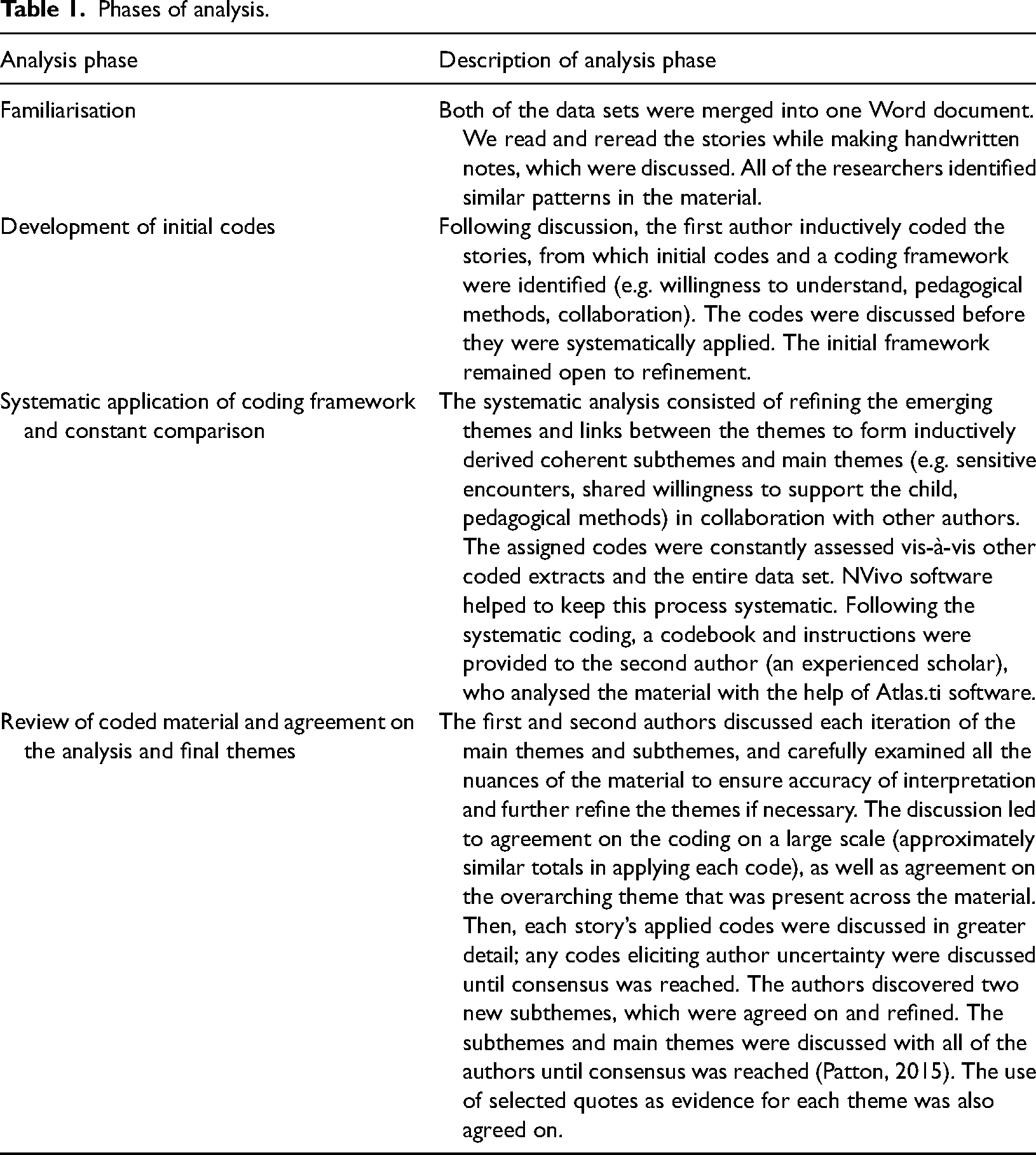
The stories were written in Finnish, and the quotes used in this article have been translated into English. We analysed the participants’ stories using an inductive approach, which is effective in addressing specific research objectives and questions (Thomas, 2006). The inductive content analysis and constant comparison in our study (see Table 1) were guided by the inductive analysis phases introduced by Leal et al. (2018) and Thomas (2006).
Phases of analysis.
Findings
The data analysis identified one overarching theme with two interconnected main themes and nine subthemes (see Figure 1). The overarching theme of ‘professionalism’ was consistently present and included (1) established support solutions and (2) willingness to understand the child. Both of the main themes are part of professionalism and they do not rule each other out. The data extracts are identified using the participants’ codes (Participant 1, Participant 2, etc.).
Established support solutions
Collaboration.
Family members, the ECEC team, health clinicians, speech and occupational therapists, and psychologists all participated in supporting the child. Families and guardians were emphasised and always mentioned as the first collaborators when organising support:
With the family, I try to maintain open interaction and explain what [kind of support] we have in our everyday practices, but what additional help the child would benefit from (smaller group, assistants, special education teacher's support, occupational therapist, speech therapist, etc.). (Participant 49)
When collaboration with a family had been established, the guardians showed an initiative to work with ECEC professionals: ‘Parents are in very close contact with the early education centre and our relationship with the parents is confidential and direct’ (Participant 86). Overall, families’ involvement was clearly present. This is crucial as they are the experts with regard to their children's needs.
The professionals constantly described close collaboration with various other actors along with families: I discuss the child's situation with the parents, the ECEC team, the consulting special education teacher, therapists [e.g. speech, occupational] and health professionals. (Participant 44) I work in interprofessional collaboration with the child's rehabilitation services, family and early childhood education team [in the ECEC centre]. (Participant 89)
The stories also highlighted how collaboration needed to be well functioning and meaningful within all sectors, so that the child received suitable support: ‘The support network works around the child, the therapies or other support outside the daycare centre work well, and these collaborators work well with the parents and daycare centre staff’ (Participant 86).
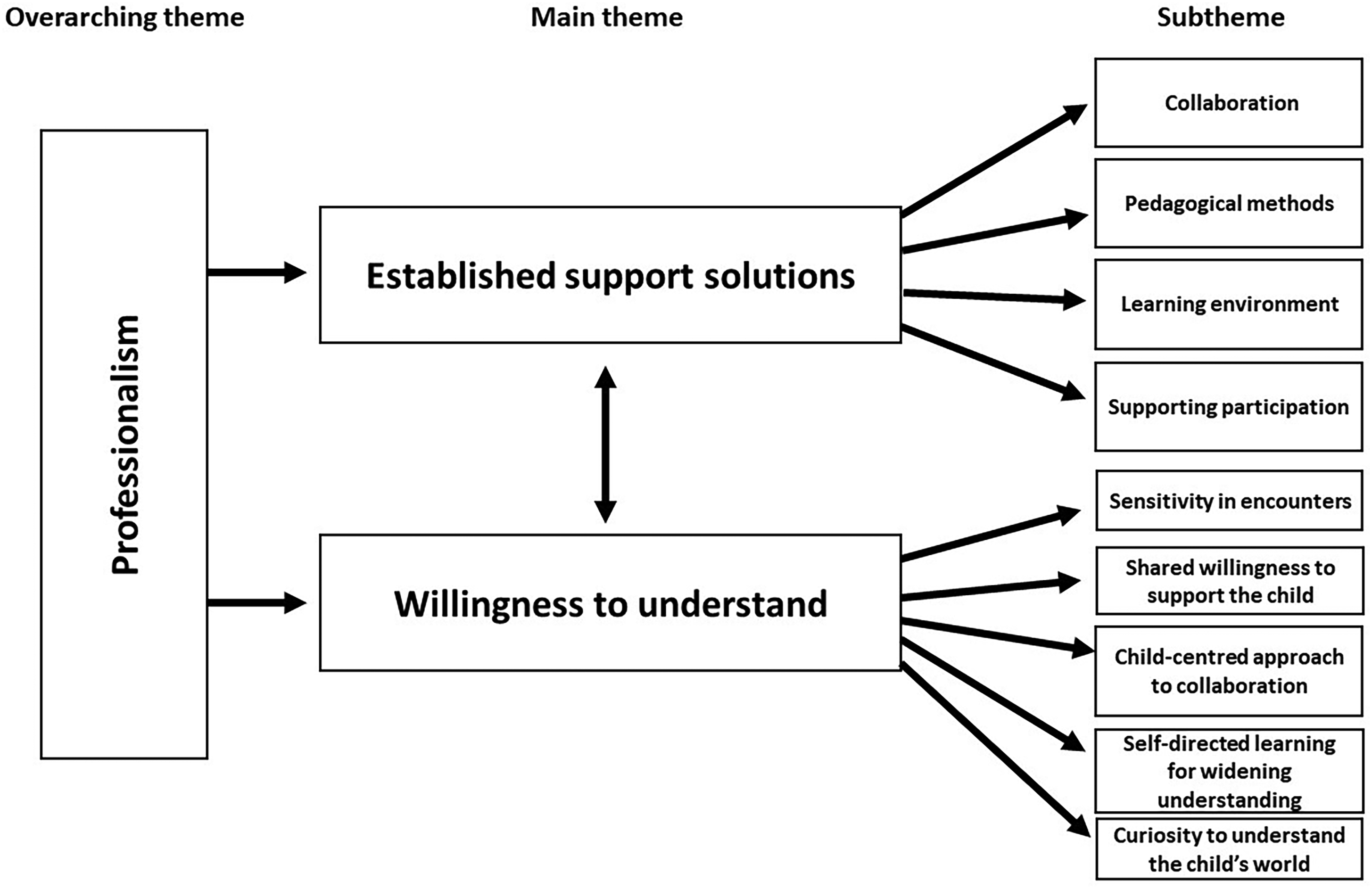
Overarching theme, main themes and subthemes.
Further, the stories included descriptions about the importance of open communication and constant planning between various collaborators: [The] child's ability to participate [in inclusive early education] has been discussed with parents, therapists and colleagues … What could be learned and obtained from them in order to adequately support the child's well-being? There is no situation where it is not possible to find new ways [for support], knowledge and know-how. (Participant 39)
The extracts specifically demonstrate an emphasis on support from, and with, families, always mentioning them first when organising support. Overall, collaboration must work well in those situations where the autistic child needs support.
Pedagogical methods.
The professionals used observation as a pedagogical method for obtaining information about the child to plan support for belonging: I would try to make observations more efficient and look for more information so that I could better support the child. (Participant 10) The observations by all adults [in the ECEC group] about the situation and development of the child are important. (Participant 81)
Observation also helped with planning the use of various communication methods (e.g. Augmentative and Alternative Communication (AAC) folders or the Picture Exchange Communication System) that are part of established pedagogies for general support in ECEC (see Finnish National Agency for Education, 2022): ‘In our group, we know how AAC helps the child to communicate. The staff know how to use support signs, and the use of pictures is part of everyday life’ (Participant 62). The professionals also aimed to find the most suitable ways for communication: ‘I also offer them [the autistic child] opportunities to try something new, be it picture support, support signs, Blissymbols, some technological tool, etc.’ (Participant 63). Another professional mentioned the importance of using ‘gestures, facial expressions, body language’ (Participant 61).
The professionals also emphasised certain pedagogical methods that are typically considered ‘autism-specific’ (Dunn Buron and Wolfberg, 2008; Finnish National Agency for Education, 2022): ‘illustrated daily activities, structuring everyday situations with pictures or drawings, sign language’ (Participant 65); ‘I pay attention to structured everyday life and predictability’ (Participant 96). However, the professionals described pedagogical alternatives – ‘I get the child's attention by singing. I sing and speak to them at their level, making eye contact the best I can with them’ (Participant 84) – demonstrating that they did also use creativity and fewer ‘autism-specific’ methods to support children's belonging.
Further, the professionals planned such everyday pedagogies so that the autistic child could interact with other children, which is important for the child's belonging: ‘In the child group, we use strong visual supports, signs and images, which are used with the entire child group’ (Participant 93). Another professional commented: ‘In peer and play activities, other children are used to the autistic child's way of communicating, and signs and picture communication are part of everyday life [for all the children]’ (Participant 96).
Learning environment.
The professionals described organising children and learning environments to be free from distractions in order to minimise sensory overload: The child group is organised in smaller groups [within the bigger group] as much as possible, so that providing individual attention becomes better, and the noise level remains moderate. (Participant 93) [I]n everyday transition situations, it is good to think about how to create them … so that it is possible for them [children] to function without being too burdened … away from the sensory overload. It might be necessary to create separate spaces where this need can be achieved. (Participant 91)
These extracts demonstrate how organising and planning physical environments can support a child's belonging.
Supporting participation.
The professionals described supporting children's belonging by highlighting the importance of participation: ‘The child has the right to participate in joint activities’ (Participant 35). There were also descriptions of supporting the child's growth to become an active citizen, which is related to participation: Despite being worried [about the child], it is necessary to find small positive moments in everyday situations and make use of the skills of everyone who works with the child, so that every child has the opportunity to learn and participate and be in an active role in their own life. (Participant 25)
These extracts demonstrate factors related to quality ECEC that ensure the child's participation, equal opportunities for learning and active citizenship (see Finnish National Agency for Education, 2022; Vlasov et al., 2018).
The stories further highlighted pedagogical, structural and rehabilitative perspectives that are mentioned in policies as factors related to participation and quality-driven ECEC (see Finnish National Agency for Education, 2022): The child's participation in the group is supported by adults not only by supporting the child's participation in activities and joint play, but also by guiding the other children to interact with the non-verbal child. The child is a full member of the group … who enriches and teaches others important skills. (Participant 83)
Willingness to understand
Sensitivity in encounters.
Instead of listing autism-specific pedagogical methods, the professionals encountered these children with sensitivity: ‘I treat the child equally and with sensitivity like all the other children’ (Participant 59); ‘I would aim to be sensitively available … close to the child’ (Participant 27). The stories highlighted the importance of sensitivity in connecting with the child and creating situations for belonging: ‘The adult’s job is to draw the child to be in contact with their sensitive presence’ (Participant 76); ‘I am sensitive, encouraging and prefer using touch (in communication) if that is what the child wishes’ (Participant 89). Overall, these extracts demonstrate how the professionals wanted to connect with the child and create situations in which the child and the adult could be sensitively present.
Shared willingness to support the child.
The professionals described how important it was to have shared goals and a shared mindset when supporting the child's belonging, to include elements related to the ECEC team spirit: The [ECEC] group has a functioning team and good team spirit, a shared mindset regarding children who need support. We think very inclusively … everyone who needs support gets the support they need. (Participant 98) The team is aware of the importance of being present [for the child] and supporting play. Adults invest in children's participation and belonging. Without this type of team, it is difficult to imagine finding effective support for the child in question. (Participant 93)
Further, it appeared that a shared mindset was also associated with the thought that the ‘child needing special support is richness in the group. We all are equally available, and we all have our own unique characteristics and needs’ (Participant 59). Such a shared vision can be particularly important from the perspective of supporting autistic children's belonging when hiring people in the ECEC context.
Child-centred approach to collaboration.
The stories demonstrated the professionals’ willingness to build networks to ensure belonging, rather than just describing collaboration as a working method: I am going to build a network of experts around me so that I can also get support for my work. (Participant 40) I would map out the collaboration networks and organise a meeting where support for the child and possible assessment to find out individual needs would be planned. (Participant 30)
It was also clear that such collaboration was close and prioritised the child's needs: The collaboration between therapists and the child's parents is close and reciprocal; we pay attention to good things and successes. Goals for learning are small within the zone of proximal development goals that have been agreed together with other adults who are important to the child. (Participant 99)
Self-directed learning for widening understanding.
The stories showed that the professionals had a willingness to seek information from various sources about how to support the autistic child in ECEC: they would ‘seek information online’ (Participant 23); ‘get familiar with the topic by reading literature’ (Participant 47); and ‘specifically acquir[e] evidence-based information from the literature (including articles and recommended readings in domestic and foreign sources), as well as from elsewhere’ (Participant 22). These extracts demonstrate that self-directed learning to support the autistic child can potentially lead to improved belonging.
Curiosity to understand the child's world.
The professionals were curious about the child's thoughts – being in their world – and thus wanted to learn from the child. Interestingly, even though we analysed the stories as a combined data set, the professionals’ curiosity about the child was equally present in both scenarios. A deeper willingness to understand the child rather than seeing ‘one kind of autistic child’ was apparent: It would also be particularly important to immerse myself in the child's everyday life and world, and get to know them in the best possible way, and thereby find out the child's interests and their ways of acting [and being in situations]. (Participant 1) I try to get to know the child and their ways, read their reactions, what would have been a good experience and what not. (Participant 13) I start to get to know the child by observing, empathising with their gestures and expressions, and watching if they like being touched. (Participant 50)
These extracts demonstrate a willingness to understand autistic children's worlds in order to better support their belonging.
Discussion
We examined how supporting an autistic child's belonging appeared in the stories of ECEC professionals. Our findings offer a novel contribution to the literature related to professionalism and children's belonging in ECEC, with a focus on researching beyond the individual – and psychological – definitions of belonging (Antonsich, 2010; Yuval-Davis, 2006), and also including the perspective of the double-empathy-problem theory (Milton, 2012, 2020). The results suggest that supporting belonging is associated with professionalism, which consists of established support solutions and a willingness and curiosity to understand the autistic child's world, and that these two elements and their subthemes must be present and in balance when supporting the child’s belonging.
As identified, established support solutions helped the child to develop skills in communication, interaction, and everyday routines and activities, providing them with opportunities to belong (Olsen et al., 2019). The support was frequently arranged through interprofessional collaboration among families and other professionals (e.g. health professionals, therapists, special needs teachers). The professionals also focused on environmental factors (e.g. reducing noise) so that the child could belong in activities (e.g. play). Although our findings suggest the use of various pedagogical methods (AAC, the Picture Exchange Communication System) and the focus on adapting environmental factors, these approaches are also often associated with autistic children (Dunn Buron and Wolfberg, 2008). Further, while using these support solutions is part of professionalism and necessary for belonging, it might also appear that the child is ‘a target’ of pedagogical actions. Using specific methods is important, but simultaneously the child may be seen through the lens of their disability and not through personal encounter, where individual adaptations are considered regardless of their autism. Perhaps this approach is related to the disability paradigm that persists in education (Honkasilta, 2017). However, these individual and established support solutions are needed and must be used for guaranteeing the child's right to support. Thus, our findings suggest that it is essential to combine the established support solutions with a willingness to deeply understand the child. Furthermore, the professionals used the established solutions to develop and arrange activities for the whole group of children, so that the child and all the children in the group would have opportunities for belonging. This suggests professionals’ sensitivity in recognising and ensuring various ways for the child to belong (Puroila et al., 2021).
Interestingly, some of the professionals expressed a deep willingness to understand the child and to see them as unique individuals who happened to be autistic. This element of professionalism reaches beyond the established support solutions into professionals’ sensitivity in encountering the child, expanding existing collaborations and developing professionalism via information searches. Having the curiosity to learn from the child's world implies an intriguing factor in promoting belonging. Such curiosity is closely related to the double empathy problem, suggesting that professional empathy for the child's situation (e.g. having a willingness to see the world from their perspective) may reduce the gap between neurotypical and autistic worlds (Milton, 2012, 2020). This finding has the potential to contribute to the literature about the importance of the belonging dimension with regard to warm and caring relationships (Ninda et al., 2022) and its relation to the double empathy problem (Milton, 2012, 2020). However, for more generalisable conclusions, further research on these associations is unquestionably needed.
Although our findings add to the literature, the double empathy problem remains unresolved in the professionals’ stories, which might also be related to the data’s limitations (see below). Despite the professionals’ willingness to understand the child, the goal of ‘being open to other people's otherness’ remained unachieved. However, glimpses of this profound desire to understand the autistic child were present in the stories. Our findings indicate that the professionals were ‘building bridges’ to close the empathy gap and thus supported belonging. For example, they used pedagogical methods efficiently once they had discovered the child's autism-related and individual needs (see Syrjämäki et al., 2023).
Thus, all professionals need to endorse diversity and understand their own role in creating belonging. Such a culture creates the foundations for individual support measures such as small-group or one-on-one teaching of social interactions. However, the development of such an ECEC environment requires expertise, commitment and systematic work as a community. For example, it needs to be carefully considered when hiring new staff to ECEC, specifically concerning the values and beliefs the candidates possess and how they ‘fit’ with the ECEC climate. Moreover, professionals’ limited willingness to understand the child as a unique individual – regardless of their autism – might lead to the organising of pedagogical efforts that are unfavourable to the support of belonging (Pesonen et al., 2015). Such support always requires a striving to understand the child's individual point of view and the planning of support from that starting point. When professionals’ interpretations are based on stereotyping (e.g. autistic children's play), different nuances and ways of interacting may not be recognised (Syrjämäki et al., 2023). Although our study was conducted in the Finnish context, the issues related to encountering autistic children are international, and thus our findings can offer insights to different stakeholders for improving inclusive education practices.
Limitations, future research and conclusion
Our study has limitations. The data was not specifically collected for the purposes of the research objective, and including specific elements related to belonging and the double empathy problem when constructing the frame stories may have produced more research-aim-oriented data. Furthermore, related to this, since the MEBS used frames that illustrated a non-verbal autistic child with intellectual disability, the participants’ stories have likely focused on a specific child, and thus their responses might reflect more ‘traditional’ views on autism instead of a neurodiversity perspective, which the double-empathy-problem theory emphasises. Therefore, it is possible that understanding the child's experiences is less present in the stories; perhaps a more fluid view on autism could have prompted different stories to be written. Future studies should consider all of these elements. Future research should also use comparative study approaches that could further contribute to the topics of inclusion, well-being and belonging. In future studies, comparison between different occupational groups could also bring interesting new insights on supporting autistic children's belonging.
Since the data was collected as part of a nationwide project, the participants were already interested in the topic of supporting children with high needs, and thus they might have been familiar with and interested in the theme. Yet the data was collected prior to their training. MEBS, as a data collection method, has limitations. MEBS was used to capture the potential experiences of supporting belonging. Thus, the stories do not necessarily reflect the professionals’ actual lived experiences; however, the imaginary stories do include their personal and cultural experiences – for example, their values and ECEC institutional practices (see Spector-Mersel, 2010). Lastly, although the data comprised both negative and positive stories, which included responses from ECEC teachers, special education teachers and other ECEC professionals, we purposefully analysed the data as a whole as our research question was such; we also wanted to have an open mind in analysing the material without prior familiarity with the data (positive versus negative and differences in professional groups). In the future, it would be important to study belonging support from the perspectives of interprofessional collaborators, guardians and autistic children. These perspectives would bring valuable insights, especially autistic children's views. Here, we examined how supporting an autistic child's belonging appeared in ECEC professionals’ stories. Our research provides novel and theoretically encouraging findings for further investigations regarding supporting autistic children's belonging in ECEC, specifically from the perspective of the double-empathy-problem theory.
Footnotes
Declaration of conflicting interests
The author(s) declared no potential conflicts of interest with respect to the research, authorship, and/or publication of this article.
Funding
The author(s) received no financial support for the research, authorship and/or publication of this article.
