




Abstract
This article focuses on the methodological experiences that emerged from a study investigating how teachers valued their daily encounters with children in early childhood education. Early childhood teachers often balance the demands of documentation with time spent with children, so have little time to reflect on their practice. Furthermore, participation in research projects tends to be both time-consuming and distracting from the practitioners’ perspective, without providing immediate opportunities for professional development. The purpose of this article is to elaborate on the use of a mixed-methods approach that combines a quantitative digital tool (an application) for collecting data with the use of short qualitative interviews in order to explore methodological aspects in educational research. The pros of this mixed-methods approach include flexibility, the instant overview of data, and the reflective potential offered to the participants, as well as the researchers. The teachers had the opportunity to ‘set the agenda’ when giving their own definitions of valuable encounters and then reflect on their experiences in their own words. This gave them a strong voice. The main risks of this method concern the dependence on technical devices and software. The authors argue that there is potential in the reflective methodology used in this study to bring research and practice closer in comprehensive knowledge creation. This methodology offers a respectful way to gather information from practice and simultaneously provide opportunities to change.
Introduction
Bae (2005) and Nind and Lewthwaite (2018) are among those who argue that educational research should involve practice to a greater extent than at present. We agree, but for this article we move forward and focus on how the choice of participatory methods and research implementation may also be important for the development of educational researchers themselves.
We share our experiences from a study in Swedish preschool and school-age educare, focusing on teachers’ daily valuable encounters with children (Löfgren and Manni, 2020), and discuss methodological aspects and the pros and cons of a method we found to be valuable and important for further research in similar educational settings. Conducting research includes establishing mutual respect and trust between the researchers and participants in practice. The choices and use of different research methods involving quantitative as well as qualitative concepts – such as trustworthiness, scientific validity and reliability – and contributing to different research fields as well as the participating practice, are not always easy to balance (see Bae, 2005). Furthermore, knowledge and understanding about contextual preconditions have been shown to be vital when approaching and conducting research. This relates to both the questions posed and the practical set-up, as well as the analytical lenses used.
Within early childhood education (ECE) settings, in both policy and practice, documentation and measurements have increased in different ways over the last decade. This could be seen as well-intentioned attempts to improve the quality of education and to strive for more equal conditions. Research has shown, however, that documentation and assessment often focus on only one aspect of the educational task – namely, factual knowledge (Smith, 2016). Furthermore, assessment and the demand for documentation through, for example, quality reports also signals a decrease in trust in teachers’ professional knowledge regarding their ability to teach and provide care (Löfgren, 2016, 2017). Alongside an assessment culture in practice, some research methods within the field of educational research also tend to be quantitative, large scale and general, with a focus on formal knowledge. Research that focuses on social, relational or value-oriented aspects of educational practice and the teaching profession, in comparison, is often qualitative, small scale and informal, and has disadvantages in terms of providing an overview.
Furthermore, it is not unusual for both quantitative and qualitative research projects to be both time-consuming and distracting from the practitioners’ perspective, without necessarily giving them any immediate opportunities for professional development. This, we argue, risks shaping a legitimacy crisis, whereby practitioners avoid taking part in research projects. One way of avoiding such a crisis could be to design research projects that are of immediate benefit to the professionals taking part, without burdening them with the rigorous procedures of research or making them wait for results, which are sometimes presented years later.
Considering the issues described above, the following question arises: If you want to investigate the values and relational aspects of ECE, not only relying on individual cases through a small number of interviews but also attempting to generate a general picture of the situation, what methods are available and what methodological issues are at stake? Tests and large-scale methods have so far included ‘hard-fact’ knowledge, giving us an insight into the more formal aspects of learning, while the social and relational aspects are usually only documented on a small scale. This phenomenon highlights a possible methodological dilemma since, in this way, the more human aspects of the profession and ECE practice are made invisible in the broad overviews. For school leaders and decision-makers, general and large-scale information is important, and if some aspects of the educational practice/task are missing from the available information, there is a risk of these becoming a blind spot in awareness. The need for new methods or combining existing methods, as well as the methodological considerations of possibilities of communicating with both qualitative and quantitative research fields, was constantly on our minds when setting up the study from which we draw our experiences here.
The purpose of this article is to elaborate on the use of a method that combines quantitative digital tools for collecting data with the use of short qualitative interviews in order to explore the methodological aspects of educational research. In this article, we also discuss how such methods can provide opportunities for uncovering interesting data and professional reflection among participants, as well as researchers. The analysis deals with the following question: What methodological aspects can be distinguished within the pros and cons of a research method involving both a quantitative digital tool and a qualitative reflective interview in ECE practice?
Background
In this background section, we first give a short introduction to our study concerning relational encounters within ECE (Löfgren and Manni, 2020). The main focus is then on the methods and methodological aspects of educational research in this setting, as well as reflection as an integral part of the education profession.
An interest in relational encounters in ECE
In a previous article (Löfgren and Manni, 2020), we focused on some dilemmas within educare, and showed how Swedish ECE professionals find a balance between the different agendas of caring, learning and teaching in their daily encounters with children. Caring for children’s well-being, together with establishing trust and good relations, has always been a central task, and is considered a foundation for children’s learning by ECE professionals in Sweden and elsewhere (Hamre, 2014; Noddings, 2012). However, due to the increased demands for documentation and assessment in educational settings, even among younger children, teachers need to spend more time on other, less relational activities. Concerns have been voiced that these trends might result in a turn away from the relational aspects of teaching, leading to the more formal and assessment-based aspects being favoured (Biesta, 2009; Löfgren, 2015). Among professional teachers, this shift is not unproblematic and is cause for concern; many struggle to balance care and teaching, which are sometimes communicated as competing tasks (Santoro, 2016). In the work during our study on relational encounters, it was important to gain an overview of where and how such encounters developed according to the teachers, but without disturbing them at work. This forced us to focus on our choices of method and reflect on the methodological implications of those choices, which we scrutinise here in light of other articles addressing this matter.
Methods and methodological considerations in educational research
Previous studies have shown that there is a vast number of methodological aspects, both possibilities and risks, that one might consider when conducting research in educational settings (see Bae, 2005). In this section, we elaborate on some of the aspects that we found to be vital, but we do not claim to cover all methods or their methodological implications.
Ethical issues
Research projects in ECE settings risk taking up teachers’ time and attention, which should be directed towards the children. This is a delicate ethical matter. In Sweden, it has become increasingly difficult for researchers (and students) to gain access to ECE settings that are willing to participate in studies. Nind and Lewthwaite (2018) address this point and ask: How can research also be educative for those participating in it? In this case, how can we, as researchers, disturb the hectic daily practice as little as possible while at the same time providing opportunities for professional reflection among the participants? In the same vein, Anderson and Herr (1999) argue that common analytical methods do not often aim to contribute to or communicate with the participants providing the data, but draw the findings further away from the original practice. One might argue that this is the task of researchers – to gain deeper knowledge about practices through systematic and scientific analytical work. We do not disagree with this, but we also want to continue a critical discussion on this matter similar to Bae’s (2005), since we also find it to be an aspect of ethical and respectful research to involve the educational practice (see Anderson and Herr, 1999). Ideally, we argue, such involvement might even contribute to (social) change and development within practice and research procedures.
Quantitative methods
Another concern deals with the lack of, and possible need for, large-scale methods in ECE that provide an overview, comparison and awareness of the values and relational aspects of educational practice in ECE. In other words: How might one study relational encounters in educational settings in a quantitative way without risking the process being transformed into a more formal and static aspect of teaching and learning?
It is also notable that it is the large-scale, subject-specific studies that gain the most attention and thus (unconsciously) draw the focus towards those aspects of teaching and learning. A problem that follows from the small number of large-scale studies in ECE settings is that knowledge at a general level is scarce (see Ardoin and Bowers, 2020). The results gathered from case studies are important and provide valuable in-depth knowledge, but if research is to provide guidelines or support developmental work in practice, more generalised knowledge from the field is also vital. This is a possibility when using quantitative methods.
The benefits of well-constructed questionnaires are, for example, that they may provide a large amount of data in a shorter time than methods such as interviews, which are time-consuming in comparison (Cohen et al., 2010). Furthermore, data that it is possible to count adds information to contextual descriptions of the same situation (Agresti and Finlay, 2009). A final argument for using questionnaires in educational settings is that they might not only contribute to a broad understanding of the phenomenon that is the focus of a research project (Cohen et al., 2010), but also provide an immediate overview of the educational practice. For teachers in practice, such quantitative overviews could provide trustworthiness when communicating with parents and school leaders, empowering them in their profession.
Qualitative methods
Semi-structured interviews are well established and are considered to offer participants an opportunity to give their views on subjects initiated by the researcher, and for the researcher to ask follow-up questions on the initial statements and thus gather rich data (see Kvale et al., 2014). During observations, researchers spend time observing practice and taking notes on events as they happen, with the advantage of understanding the contextual situation, as well as what is said about it (DeWalt and DeWalt, 2011).
Interviews and observations could imply, however, that information is drawn ‘from’ the practice and brought ‘to’ research. If so, one might question the ethics behind such studies, and this could be especially problematic when studying practices under pressure. Even if the aims are well intentioned and intended to highlight misconduct in society, the participants might be used as sources and not gain any benefits from taking part (at least not immediately). Furthermore, qualitative research requires rich and comprehensive data, often gathered in collaboration with teachers, which is a time-consuming task, taking up time that is perhaps not free to give during daily ECE practice.
Another concern relates to the reliability of interviews, since there is always some kind of reconstruction of the experiences being retold. A major strength of qualitative interviews and reconstructions, however, is that they offer sites for narrative reflection (Freeman, 2010; Mishler, 1986, 1999). Interviewees can use their answers or stories to position themselves in relation to their practice and argue for a certain stance or gain new insights that change presupposed ‘truths’. The legitimacy of such qualitative research therefore lies in how the results are evaluated and interpreted, and what claims of generalisation are made by researchers when publishing their findings (Denzin and Lincoln, 2008).
In educational settings, many spontaneous events and relational meetings take place during a single day, which might be forgotten in a later reconstruction. This concern is shared by those who choose to conduct stimulated recall interviews, where the interviews take place with the help of photographs or videos sampled by the researcher (see Vesterinen et al., 2010). This kind of method tries to recall what happened in the situation in practice and to elicit the participants’ own words on the events, as reflection. Sometimes, researchers who use this method claim to be giving a voice to the participants (Naido et al., 2018), and this raises questions about both the data collection and analytical procedures. In many stimulated recall methods, it is the researchers who document the activities, not the participants themselves; hence, the validity/authenticity of the data could be questioned in terms of what is being documented or, rather, who is doing the documenting. Furthermore, claims of authenticity or giving participants a voice require transparency and trustworthy descriptions of the analytical procedures, as well as a reflective stance throughout the whole research process (Naido et al., 2018). If research makes claims of giving a voice to participants and acknowledges their subjective perspectives, it is also necessary to acknowledge the subjective aspects of the method used and spell out the assumptions and grounds for interpretation in order to gain trustworthiness.
In line with this method but also considering the presence of researchers in a rapidly changing practice, we believe that there might be a need for something else, which would minimise the role of researchers but still capture crucial and immediate events. Following this line of reasoning, Anderson and Herr (1999) argue that teachers should be the active agents in research, sampling the events and telling their own stories of their experiences as professionals in practice. Today, digital techniques have opened up new possibilities for participatory research approaches in many different ways (see McSweeney et al., 2022; Marklund, 2020), which we also consider in this study.
Mixed-methods approaches
Mixed-methods approaches have been criticised for dividing inquiry into two categories – (qualitative) exploration versus (quantitative) confirmation – and thereby excluding stakeholders from active participation and the democratic dimensions of the research process (Denzin and Lincoln, 2008: 12–13). Furthermore, quantitative research seems to have gained a somewhat ‘bad reputation’ in Swedish ECE research at least, mirroring the ontological and epistemological battles over the years (Kincheloe and Tobin, 2009).
Although others have argued that we must overcome our disagreements and jointly learn from each other’s research approaches (Lund, 2005), Tashakkori and Creswell (2007) write in the editorial of the first issue of the Journal of Mixed Methods Research that an understanding of the benefits and possibilities of combining methods is now established. Mixed-methods approaches provide both an overview and depth, and thus strengthen each other through triangulation and abduction (Biesta, 2010; Creswell, 2009; Haig, 2005). However, combining methods is not all that the mixed-methods approach has to offer: researchers argue further in a methodological sense that we need to avoid the dichotomy of quantitative versus qualitative at a pragmatic philosophical level, and instead look at the research problem itself and understand it in a more holistic way (Biesta, 2010; Tashakkori and Creswell, 2007). Furthermore, mixed-methods approaches might work as a transformative paradigm for change and social justice (Mertens, 2007, 2012): A qualitative dimension is needed to gather community perspectives at each stage of the research process, while a quantitative dimension provides the opportunity to demonstrate outcomes that have credibility for community members and scholars. Transformative mixed methodologies provide a mechanism for addressing the complexities of research in culturally complex settings that can provide a basis for social change. (Mertens, 2007: 212)
To conclude, focusing on the risk of a crisis of legitimacy, we can state that most established methods in ECE research could be time-consuming and demanding for the participants in one way or another. Furthermore, few researchers use more than one method or provide opportunities for immediate professional reflection in a ‘smooth’ way. Interviews are frequently used as a method that enables researchers to grasp people’s experiences and thoughts on educational matters. This has contributed with valuable in-depth knowledge and raised awareness from the participants’ point of view, but more general knowledge is also needed in all aspects of ECE practice. Finally, Mertens (2007) argues that there is potential in transformative mixed methodologies when addressing the complexities of ECE settings, despite challenges regarding time, authenticity and participation.
Teachers’ professional reflection in educational research
An ethical awareness of giving participants something back, not just drawing from them, and minimising interference in practice leads us to the issue of reflection in educational research.
Reflection is an important part of the theoretical understanding of experiential learning and meaning-making provided by John Dewey (1966). Via the integrated processes of immediate experiences and reflection, people act and make meaning in their everyday lives. Dewey (1934), along with Martha Nussbaum (2001), emphasises and describes the emotional side of everyday experiences, and how they build a foundation, including for values, through reflection. Pragmatic theory thus argues that we should avoid the separation of theory and practice since they are inevitably integrated. This line of argument is also fundamental in mixed-methods approaches, where a holistic picture is considered necessary in research about human life and practice (Biesta, 2010).
Narration through stimulated recall is also a method that provides the opportunity for reflection on experiences (Freeman, 2010) and the articulation of what is important for someone as a professional (Mishler, 1999). Therefore, it is argued that it is essential for providing opportunities for teachers to tell others about their experiences in a way that encourages short, focused stories. Such stories about teachers’ professional experiences and how they interpret what they are involved in are individualised and personalised enactments, through which teachers position themselves (Bamberg, 1997) and demonstrate what they think is important when they carry out their work. Studies of such small, everyday stories (Olson and Craig, 2009) have shown that teachers use their professional expertise to both confirm and confront dominant discourses that they believe interfere with their pedagogical practices.
Previous studies within the teaching profession have also noted the need for, and value of, continuous reflection on one’s own practice (Löfgren, 2016). In interviews with preschool teachers about their work with documentation, a narrative approach was used by Löfgren (2015, 2017) and Löfgren and Karlsson (2016), which provided plenty of time for the teachers to develop their stories. These studies showed that many of the teachers had never talked about these experiences, and were now using the opportunity to develop their thoughts in a professional way. However, this method was time-consuming for the teachers involved and the intellectual work they had to do was somewhat demanding. Thus, it should be considered whether it might be possible to develop a research method that contributes to reflection in practice, but is less demanding for the teachers involved.
A methodological challenge, however, is how to encourage teachers to reflect on something that is important to them as professionals. Some studies have shown that teachers might achieve their own agency through their personal life and professional histories (Biesta et al., 2015). Thornberg (2016) has shown that the design of a study can encourage teachers to reflect on what is important to them as professionals based on their own premises. Studies with the ambition to strengthen professionals’ reflections as part of the research design might be time-consuming, but it is possible to limit the time and effort that teachers need to spend. Building narrative reflection into the research design is a way to provide opportunities for professionals to strengthen their agency within the profession (see Bae, 2005), and with new digital techniques this ambition is easier to achieve.
Results: experiences of the method when put into practice
In this section, we present some experiences (the pros and cons) from the method we chose in our study – a mixed-methods approach involving two phases. Our experiences from this study are presented in chronological order, starting with the design and followed by the implementation procedure.
Design
The overall design of our study was a sequential mixed-methods approach (Creswell, 2009), but with a ‘twist’ during the first inductive phase of more quantitative data sampling. In many cases, traditional surveys are used to gain an overview before conducting follow-up studies in a second phase, but we wanted to try something new and decided to use a digital tool – an application (app) called Socrative – which enabled the teachers to sample the number, and character, of their daily encounters with children in their practice without being disturbed by the researchers. 1 The results of such data-sampling could have been analysed and used without further steps, but we wanted to use it as foundational material for stimulated recall interviews. Thus, we conducted short reflective interviews in which the teachers told us more about the encounters they had experienced and noted in the app – that is, a qualitative follow-up. Both the quantitative sampling and the qualitative interviews were considered to be resources for the teachers’ own professional reflection.
Participants and ethical considerations
Our main ethical concerns when conducting this study focused on how to interfere as little as possible in the teachers’ daily practices because we recognised the intensity of their work and wanted to respect them in that. Seven teachers in Swedish preschool and school-age educare agreed to participate after both written and oral information about the study had been given to them. All are qualified teachers with many years of experience. They were selected through our network within teacher education, and work with children between the ages of one and six. All the empirical data has been handled with care and confidentiality by the researchers. The participants were made anonymous, even between the two of us as researchers, and first names or initials only have been used in the interview transcripts (Vetenskapsrådet, 2017).
Implementation procedure
When the participants agreed to take part, they were instructed to download the app free from the Internet onto their smartphones. The procedure for using the app in this study is described in five steps.
Setting up and starting the programme
We created a ‘room’ in the app where we set the questions and response alternatives. The teachers who had volunteered to participate then received a link and were able to self-register to participate. The app offered anonymity through the use of ‘fake’ names, and the participants could not see each other’s answers. It was only us, as researchers, the owners of the digital room in Socrative, who could see all the answers. Setting up and starting the programme for sampling quantitative data, for both us as researchers and the participants, was quite easy and user-friendly in this app. This first step was achieved without any major problems and was also good from a confidentiality point of view because it offered anonymity. One finding connected to this specific app relates to the limited freedom of choice in creating questions. We would have preferred more flexibility and not to have had the tool limiting the research questions.
Defining valuable encounters
After they had installed the app and registered, the participants had to answer the first question, which was open in nature: What is a valuable meeting with children to you? We then asked them to use their own definitions as the basis for registering in the app when and where they had experienced a valuable encounter with a child or group of children. We identified three themes concerning who was the focus in the definitions of the encounters: the professional, the child or both reciprocally. We also found that many encounters that the participants defined as valuable were not planned for or organised, but occurred spontaneously through the professionals’ sensitive employment of an ethics in practice (Löfgren and Manni, 2020). This step worked without any problems and was key to our aim to explore the teachers’ own qualitative definitions of daily valuable encounters in their educational practices. Once they had created an account, they answered the first question before starting to take notes. As researchers, we were also able to follow their responses in the app, so we knew that they had started and were ready for the next step.
Taking notes
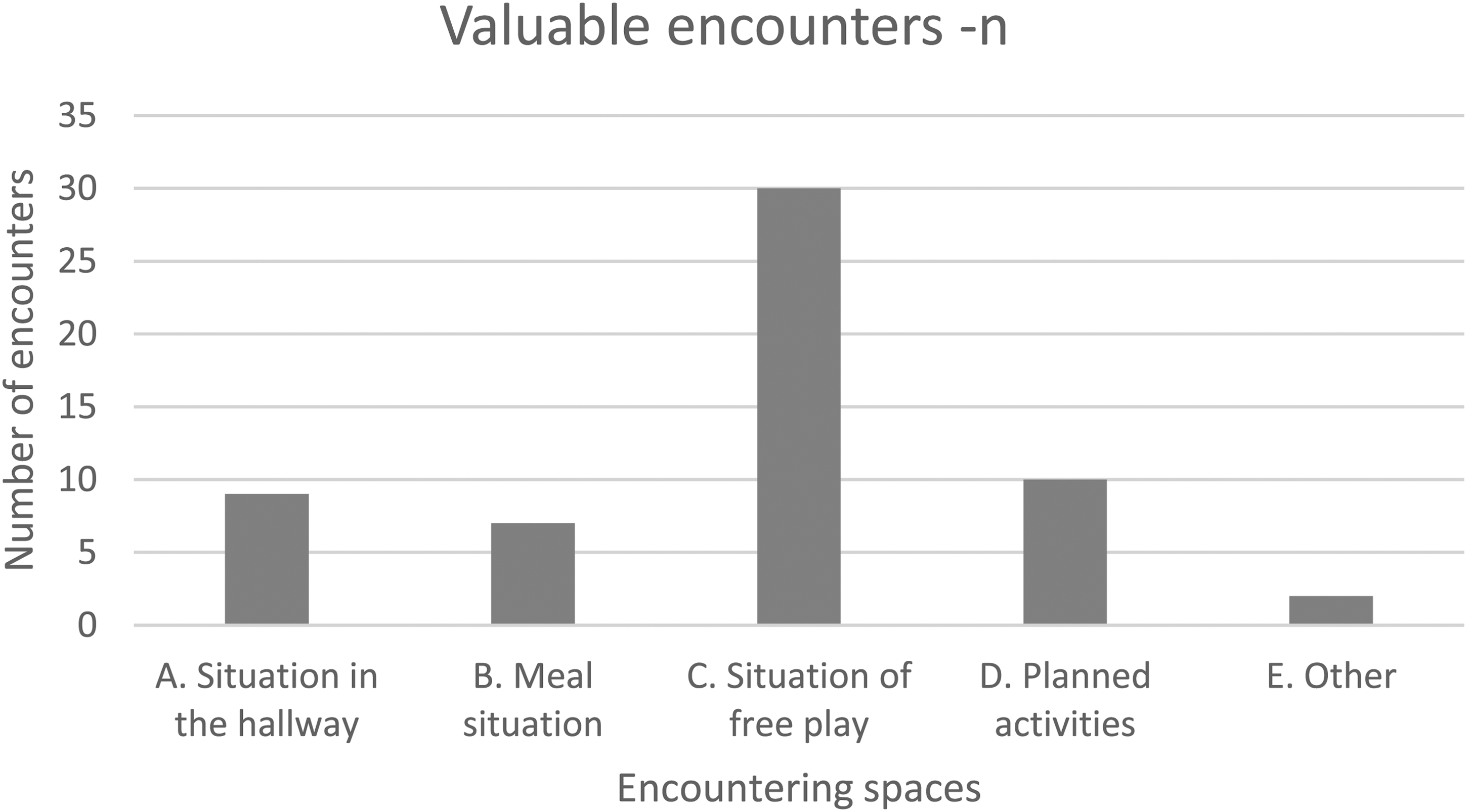
Taking notes in the app during one day at work was the third step undertaken by the participants. They used a single click to mark the kind of situation/activity where the encounters took place. The alternatives were set by us and were: (A) Situation in the hallway; (B) Meal situation; (C) Situation of free play; (D) Planned activities; and (E) Other. These alternatives were chosen according to the general structures of preschool and school-age educare in Sweden, so we considered that we had covered the different types of situation most commonly encountered. Positive practical aspects of using the app, rather than paper and pen, were noted in the responses: If you write on paper, then it could be like … ‘Oh, where did I put it now?’ That’s better with the app; I mean, it’s all gathered there. Yes, it’s good that this goes quickly, because you don’t have time to take down extensive notes in the moment; so, yes, that’s good.
One somewhat unexpected finding concerned having access to a device that could be used for this purpose, which was not self-evident to all of the participants: Well, we’re a team of three colleagues and we only have one iPad … and that’s used all the time, so that’s a problem. We use it all the time to take pictures of the kids and show things, so, yes, this is a bit problematic. Well, you could also use your phone. Yes, but I don’t want to use my private phone at work. Oh, but don’t you have phones at work? Yes, but that’s not a smartphone so that can’t be used either.
Another technical complication that arose during this step was that this version of the app was sensitive to entering and leaving a room, and asked the participants to create a new profile every time they logged out and logged in again. This technical problem was frustrating for both us and the teachers, and had not been encountered when we piloted the app. We solved the problem by asking the teachers to use the same code name throughout, and then we sorted out the answers. However, before recommending that anyone use this particular app for such purposes, we would advise that this issue be resolved or a different app be used.
Using digital notes in individual reflection
All of the digital answers, both open and closed, were documented in the app, while the interviews were audio-recorded and transcribed for our research purposes. The participating teachers were able to keep, save and reflect on their own documentation, both in the app and their choice of stories, for future use. In their responses on this point, the participants described how defining valuable encounters during the first phase had made them more aware of the relational aspects of their daily practice: Yeah, but you become more aware of this now when you ask about it, and I start thinking about it, and that’s good. Well, [the fact] that I tried and gave it some thought was also valuable, because then I started to think about this with [all my] daily encounters.
Between them, the teachers recorded 58 relational encounters that they found valuable over the course of one day, according to their own definitions in the different categories given in the app. These encounters were summed up quantitatively in the app and are displayed in Figure 1.
Number of valuable encounters in early childhood settings registered by seven teachers.
These quantitative results, gathered from the quick notes made in the app, revealed different aspects of their daily encounters than the qualitative definitions of the same meetings. Figure 1 reveals a place-based aspect – namely, that valuable encounters were more frequent in spontaneous interactions, as well as in informal places and spaces. This insight was additional to the narrative descriptions we obtained through the interviews.
Using digital notes in narration during reflective interviews
The fifth step of our study was the follow-up reflective interviews – that is, the stimulated recall interviews. We then either visited or phoned the teachers at the end of the day on which they had taken notes. They were asked to choose three of the situations they had noted and tell us more about them, so that we could develop a mutual understanding of the specific context of those encounters and why the teachers considered them to be valuable. As a guide for the conversation, we had the results from their notes in the app. The interviews were also influenced by narrative methodology, with the focus on the participants’ own stories of the meetings they had chosen. This part worked really well, and the teachers said that using the app, even for only one day, had made them more aware of the encounters they had (or did not have) with the children in their care. Being the interviewer was easy and we were grateful because the participants spoke with engagement and self-confidence about their own practice and experiences.
One major concern in this study was the extent to which a research design and method could also provide an opportunity for teachers to engage in professional reflection. In this study, this was included in both the first phase, when the teachers were asked to define their idea of a valuable encounter with children during their practice, and the second phase, during which the follow-up interviews had a reflective and narrative character when the teachers considered the encounters they had experienced and noted in the app.
For the interviews, the teachers chose three encounters they wanted to tell us more about. Reflection was then initiated both during the selection phase and as an aspect of ‘telling us the story’ in a narrative way. The moment of reflection in the interviews was appreciated in itself, according to their answers: Yes, well, I think it could work as a good document for discussions, I think so. Maybe a printed version in a simple way would be good then. Well, there’s usually no time for reflection. I mean, these valuable daily encounters happen, but what to do with it? I mean, how can we develop it? That’s what I miss! Yeah, but I like to challenge myself and reflect on things, because otherwise it’s easy to just stop in your own personal development.
In this case, we as researchers were not people who were collecting data from teachers, but actors who were mediating their stories into a more professional consciousness as we listened to them.
Summing up
The main advantages of this method – the pros – are its flexibility; the instant overview regarding quantitative aspects of the data offered by the digital app; and the reflective and ethical potential that emerged through the integrated use of qualitative and quantitative procedures that closely involved the participants. The main risks of this method – the cons – are the dependence on technical devices and software, and on digital resources in preschools and schools.
Discussion: methodological reflections and their implications
Looking back on our study, which combined a quantitative digital tool with reflective interviews in educational research and practice, we conclude by discussing some of the main methodological aspects of such an approach.
We have found that a digital mixed-methods approach can be useful in ECE research, even in ‘difficult-to-catch’ areas such as values and relational aspects. A mixed-methods approach can be suitable in the area of educational issues, providing complementary quantitative and qualitative knowledge (Biesta, 2010; Creswell, 2009). The choice of multiple methods is not only a matter of trustworthiness, validity and reliability in a practical respect; it is also about methodology in a deeper sense. Considerations on how the methods are sensitive to participatory and ethical issues (Bae, 2005; Lund, 2005), as well as transparent and solid from qualitative as well as quantitative research approaches, demand reflection and awareness from the researcher (Freeman, 2010; Naido et al., 2018). We argue that such sensitive mixed-methods approaches might acknowledge different voices and truths, and that participatory research can benefit from new technology involving both qualitative and quantitative methods.
Data that provides an overview is valuable not only for research and practice, but also for educational decision-makers (Ardoin and Bowers, 2020), and, as Mertens (2007) argues, is transformative. The quantitative overview provided by the app, presented as diagrams, made it possible for both the researchers and the participants to gain new and instant qualitative insights into the phenomenon in focus. The two-step structure of the mixed-methods approach was also valuable because it provided a space for reflection during the process – not only on the final results – for both us as researchers and the teachers. By means of the first quantitative sampling, both we and the teachers gained a first insight into the responses, and had an opportunity for individual reflection before the stimulated recall interviews (see Vesterinen et al., 2010). The immediacy – where the participants defined, registered and narrated valuable encounters (or other issues) within the space of a few hours – plays an important role in the reflective and ethical potential of the method. Furthermore, the ethical and democratic aspect to which we refer here also includes the fact that the participants chose what was important to them and registered the events on their own (see Mertens, 2007; Naido et al., 2018). The teachers’ voices, we argue, were strongly represented in our study because they had the opportunity to ‘set the agenda’ when giving their own definition of the concept of a ‘valuable encounter’, and then reflect on their experiences in their own stories. Still, it is important to remember that it is we, as researchers, who have the final say when presenting the findings, and we agree with Naido et al. (2018) that all claims of voice demand transparent descriptions of the analytical procedures and a reflective stance throughout the whole research process. At its best, if it is informed by community perspectives, such mixed-methods research might provide a basis for change (Mertens, 2007).
In terms of the relation between research methods and professional reflection, we argue that the issue of quality in educational sciences and practice is a matter of mutual benefit. In answer to the question posed by Anderson and Herr (1999) – ‘Is there room for rigorous practitioner knowledge in schools and universities?’ – we say yes. We think that there is potential in the reflective methodology used in this study to bring research and practice closer in comprehensive knowledge creation, as similarly argued by Nind and Lewthwaite (2018), and it is a respectful way to gather information from practice without interfering too much.
The main problematic methodological issue relates to technical matters and the dependence on digital resources in preschools and schools. In terms of an inclusive research approach, one cannot take access to digital devices for granted everywhere, not even in Sweden, which is a welfare-supported and digitalised country. Although we gained valuable benefits from the quantitative overview in our study, we are aware of the possible negative aspects of such methods and approaches. In other words, we acknowledge the contemporary situation of increased documentation and assessment in ECE settings. We do not want such a choice of research method to become yet another tool for simply making measurements (see Biesta, 2009). Neither do we want relational encounters in ECE settings to be minimised or dehumanised into a statistical number. Instead, our intentions have been to explore methods that acknowledge quantitative aspects as well as the voices of professionals when investigating the somewhat invisible aspects of care in early childhood.
Conclusions and implications for further research and educational practices
This study was conducted before the appearance of COVID-19. In many ways, the possibilities and usefulness of this method seem even greater now in light of this difficult situation; this research method is ‘safe’ in terms of maintaining social distancing and also provides an opportunity for educational research to continue during a time when these settings are not accessible and physical meetings are not possible for professional reflections through in-service training. The implications for further large-scale studies are positive in the sense that a mixed-methods approach could provide a valuable overview of the ongoing activities and encounters in early childhood settings through an almost immediate and very visual form of results reporting, while also providing opportunities for professional reflection for teachers.
In addition to supporting professional reflection for teachers, a method such as this could also encourage researchers to reflect on their own choices and work, thus supporting methodological reflection for professional researchers. Hence, we suggest that, in order to maintain professional researchers’ reflections, it is important to critically examine the choices of methods in practice. Furthermore, we think that this kind of mixed-methods approach could be useful not only for teachers and researchers in practice, but also for student teachers, for whom empirical-based reflection is crucial for developing professional knowledge.
Footnotes
Declaration of conflicting interests
The authors declared no potential conflicts of interest with respect to the research, authorship and/or publication of this article.
Funding
The authors received no financial support for the research, authorship and/or publication of this article.
