



Abstract
In this article, the authors experiment with data-ing as a methodology, and wonder how three researchers — two in Oslo (Norway) and one in Melbourne (Australia) — can come closer to-with the research material by following and buggy-walking a young wayfarer in urban spaces and places. The ideas of not knowing and experimenting, making-with urban landscapes, transportation, materials, sounds, surfaces, bodily movements, minor gestures, and haptic engagement, transform their thinking about data-ing as research-creation while traveling and walking the city with a buggy and a young wayfarer's adventure. Their experimental method uses smartphones and digital technology, and the methodological contours in this article are attuned to and engage in and with multiple surfaces of an urban city landscape. Lines and threads transform into traces and create surfaces, and lines transforming into threads dissolve surfaces. The authors create city maps and investigate what digital tools, social media, and a chat service can generate and unfold when wayfaring locally and talking and writing across continents. Their project follows two layers — doing data-ing as research-creation and wayfaring. To do data-ing as collective open-ended productions among researchers invites one to ask what happened and what might occur temporally in cities as minor gestures here and there. The bodily movement offered by an urban wayfarer invites the authors to speculate with what the phenomenon of an investigator, an artist, a maker, a runner, or an activist can unfold in the moments to come.
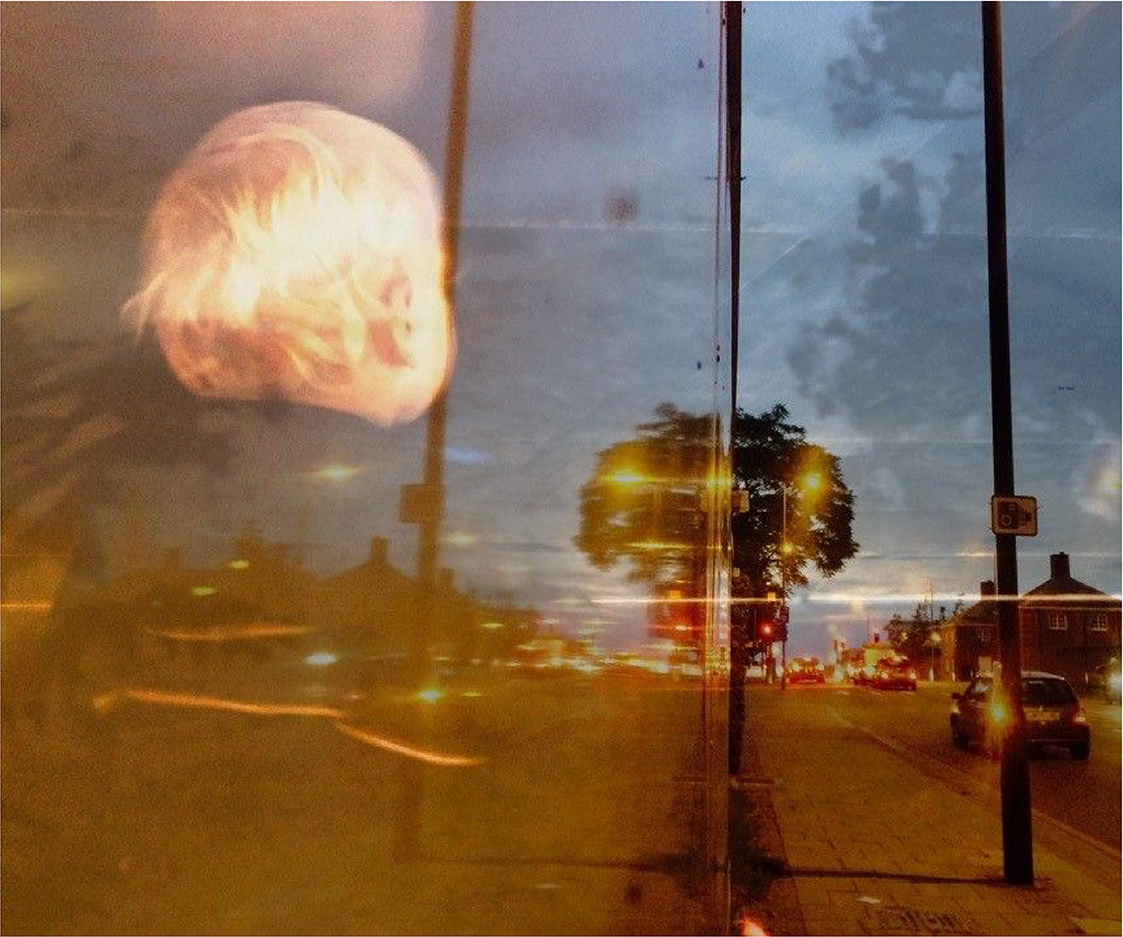 “We are curious because we care” (Ingold, 2018: 71).
“Jeg skal sjekke”: more than lines of collaboration
In the field of early childhood education and care, there is a range of diverse theoretical and practical approaches that work to construct, figure and reconfigure children and childhood differently (Coleman and Osgood, 2019; Otterstad and Waterhouse, 2016). Manning’s (2016) concept of “research-creation” inspires research that makes a difference and creates other ways of thinking about the world and what research might be. We therefore ask: How else and what is left behind? We explore thinking otherwise with early childhood theory in order to surface something more with children when we as researchers speculate with a variety of forces, wayfaring in togetherness with a young toddler adventurer in cityscapes — “It is as wayfarers, then, that human beings inhabit the earth” (Ingold, 2011: 148). In doing so, we move away from a traditional figuration of children as research based on ethnographic descriptions through observations and attend to the concept of the becoming child through the sjekking (“checking”) of what is happening (Stewart, 2013).
To do such a research-creating project, we are thinking with and responding to humans and more-than-humans as inseparably connected in the world and in relation with one another. Thinking in this way decenters the human as the superior species in the world and, in early childhood, attends to the dynamic of adults having power over children. We create data-doings/data-ings and changes, and the working forces we think and do our research with are open-ended relationalities with humans and more-than-humans, materials, a buggy, lines, sounds, bodily movements and the multisensorial. These ways of producing data-doings combine photographs (taken in the moment) with digital technologies, places, spaces and haptic engagement. “Haptic engagement is close range and hands on. It is the engagement of a mindful body at work with materials and with the land, ‘sewing itself in’ to the textures of the world along the pathways of sensory involvement” (Ingold, 2011: 133). Our worlding situatedness is locating the project geopolitically in Oslo (Norway) in wintertime as well as in Melbourne (Australia) in summertime, not to compare early childhood in different spaces but to engage in dynamic earthing relationships among many (Guttorm, 2021).
This article has been created by merging various types of text. By interweaving academic text, poetic text and images as photo-graphics, different layers and textures are added. The extended text works as an assemblage (Deleuze and Guattari, 1987), and a fourth layer is created through the reader's involvement. Doing text collaging offers a sensuous thinking–writing process and invites readers to think with more than words. Multimodal texts offer writers and readers opportunities to wayfare through/with the text differently (Honan and Bright, 2016). The artistic dimension opens for research-creations and bodily involvements, making-with through the various texts.
The organizing of the article offers selected lines to experiment with — seasons, temperature, clothing, tempo, interruptions and bodily movement located in different urban sites. We have created subtitles for these lines, starting with the expression “Jeg skal sjekke” (“I shall check”), as a way of giving emphasis to the “not yet known” knots (Haraway, 2016) together with Stewart’s (2013) phrase “what is happening.” Doing research with children is not a linear process; it involves curiosity, noticing, sensing, attuning, wondering and risky situations for the unthinking to come. The researchers are also encouraged to be ethically responsible for balancing the research project among the participants. Travelling with a wayfarer and a buggy on the underground in minus temperatures, visiting places densely populated with humans and more-than-humans in areas none of us had regularly visited, was also part of the experimental project. Interested in data-creation-doings and buggy-walking, we ask how digital technologies participate in different atmospheres in our online Zoom conversations — what seems left behind as absence. Since we are on different continents, buggy-walking data-ing, memories and here-there-and-now proposes sharing stories and passing patterns back and forth online (Haraway, 2016: 12) to respond with each other as researchers without containment and borders.
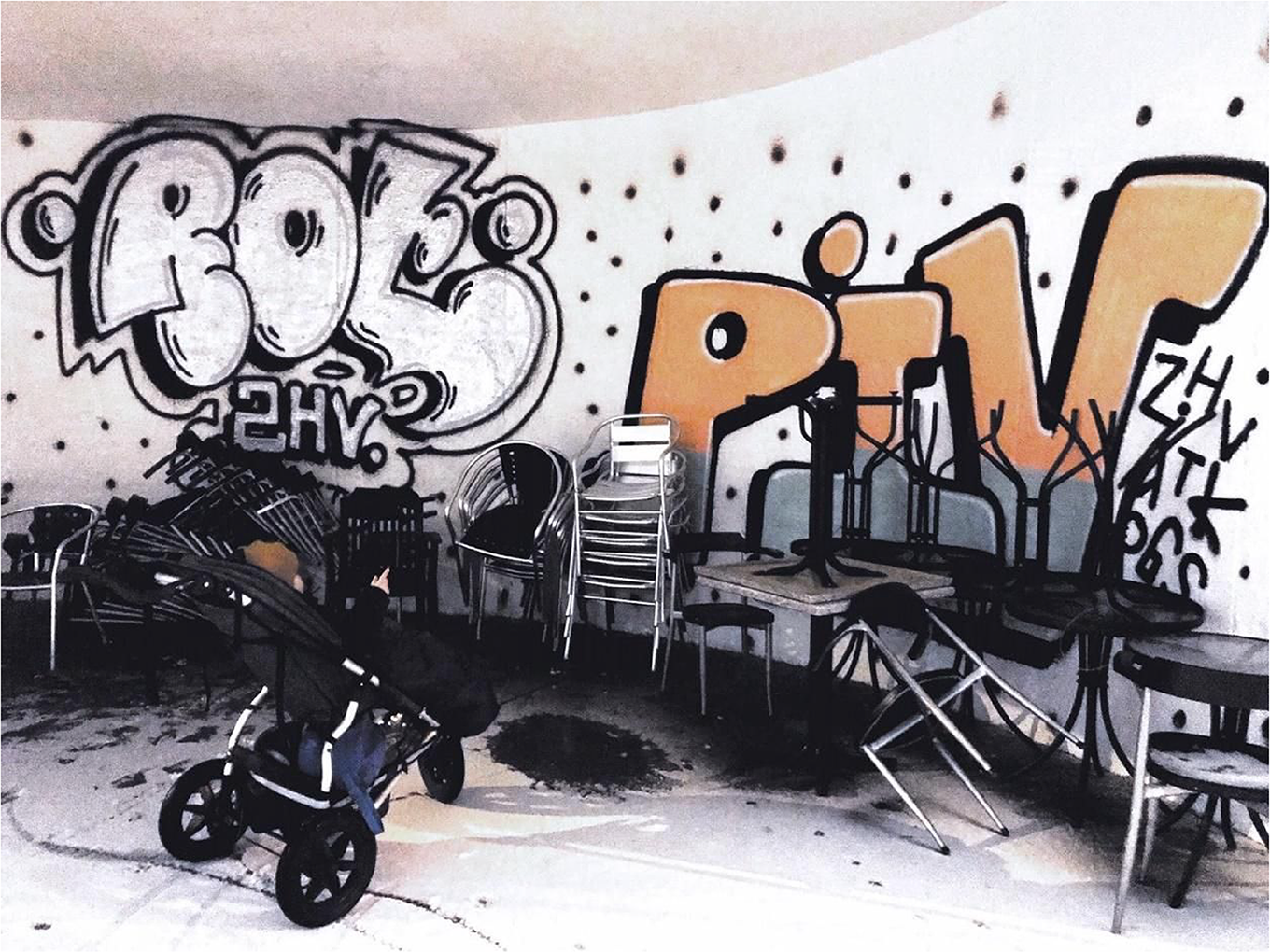 Photo-graphic data-ing: Stop … haptic reminiscences of summer events, hope and longing for a warmer lively season. Cold lines trace motion … rebellious line movements … weather textures might call for the young haptic engaged wayfarer…
Working concepts
Our conceptual framework challenges us to think beyond dominant ways of doing empirical work by giving the potentialities of data-ing and research-creation (Manning, 2016) with children a wider position than merely collecting, describing and interpreting data. By intra-acting (Barad, 2007) with each other, located on different continents, we wonder what might “happen” (Stewart, 2013) when the urbanized city surfaces and movements are at the center of the researchers’ interests. Manning’s (2016) concept of “minor gestures” gives us possibilities of knowing and noticing new things, and to rethink “what happened.” By giving attention to the minor, diverse theories and political knowledge can offer possibilities to see young wayfarers in their encounters with the more-than-human. To visualize change and movements, the creation of the photo-graphics in this article is given a wide textural place together with the written text. Lines of movements are added with the images to invite the reader to follow layers and maps of the zigzagging traces in the city. These visual patternings create-with the wayfarer. Textures are layered, lines are offered, and surfaces are travelled in digital motion. These photo-graphics are not an interpretation of documented outings; rather, they are an opening to connect together with experimental stories across continental lines. Such research-creation might propose other ways for children's wayfaring and transporting in-through-with a modern city. Data-ing and research-creation become our adventurous lines to figure and reconfigure children.
Inspired by Stengers (2011), we search for generic notions for our processual research project in the sense that Stengers attributes to the philosopher Alfred North Whitehead. Instead of categories being assumed to be logical classifications and thus too easily contradicted, our research adventure, buggy-walking transportations and thinking routes are unpredictable and can be risky. Not knowing, and not planning the research project in detail, opened for the photo-graphic empirical data material-creation, inspired by Manning’s (2016) question — “what else” might become within the invention of our methodological experimentations (see also Murris, 2016; Osgood and Robinson, 2019; Otterstad, 2018)?
We have also been grappling with how our values and ethical response-abilities might attend to matters of concern (Latour, 2004) — to how we might live with a more-than-human worldly ecosphere affecting all living creatures everywhere (Haraway, 2016). In order to activate these concepts in an urbanscape, we experiment with digital technology. We chose to use technology to think with the concept of “leakage” and search for the potentialities for how our data-ing making-with (Haraway, 2016) urban landscapes, transportation, materials, sounds, surfaces and bodily movements could intra-act. Deleuze and Guattari (1987: 451) affirm that whenever we encounter matter, “it is matter in movements, in flux, in variation,” and it is through this matter-flow that our research project brings in speculation and experimentation with photo-graphics, poetic texts and haptic engagements. We see the speculative element here by thinking with the mind as “a leaky organ, forever escaping its ‘natural’ confines and mingling shamelessly with body and with world” (Clark, 1997: 53). Such ideas open to a research project with a buggy and a toddler, wayfaring wintery urban cityscapes in togetherness (Springgay and Truman, 2018), searching for what was not there as obvious “information” with a toddler in everyday urban spaces and places.
As well as attending to Haraway’s (2016) “making-with,” our project is supported by intra-active research-creation (Manning, 2016) processes, orientated around elaborations and collectively searching for alternative child-ren-hood knowledge directions. Such ideas can connect to the concept of “leakage” addressed above. We are taking a “step behind” to speculate how the concepts of “mind” and “knowledge,” together with “child,” are valorized in early childhood research. Our suggestion is supported by Clark (1997: 53), who states that the mind is a leaky organ “that will not be confined within the skull but mingles with the body and the world in the conduct of its operations.” By revisiting Deleuze and Guattari's (1987) philosophical “lines of flight,” as well as investigating in more depth Ingold's (2015) work on the wayfarer, our research processes can also be located as messy — like a mesh of lines intertwined theoretically with knots of entangled lines (Ingold, 2011).
“Jeg skal sjekke”: lines of buggy-wayfaring data-ing
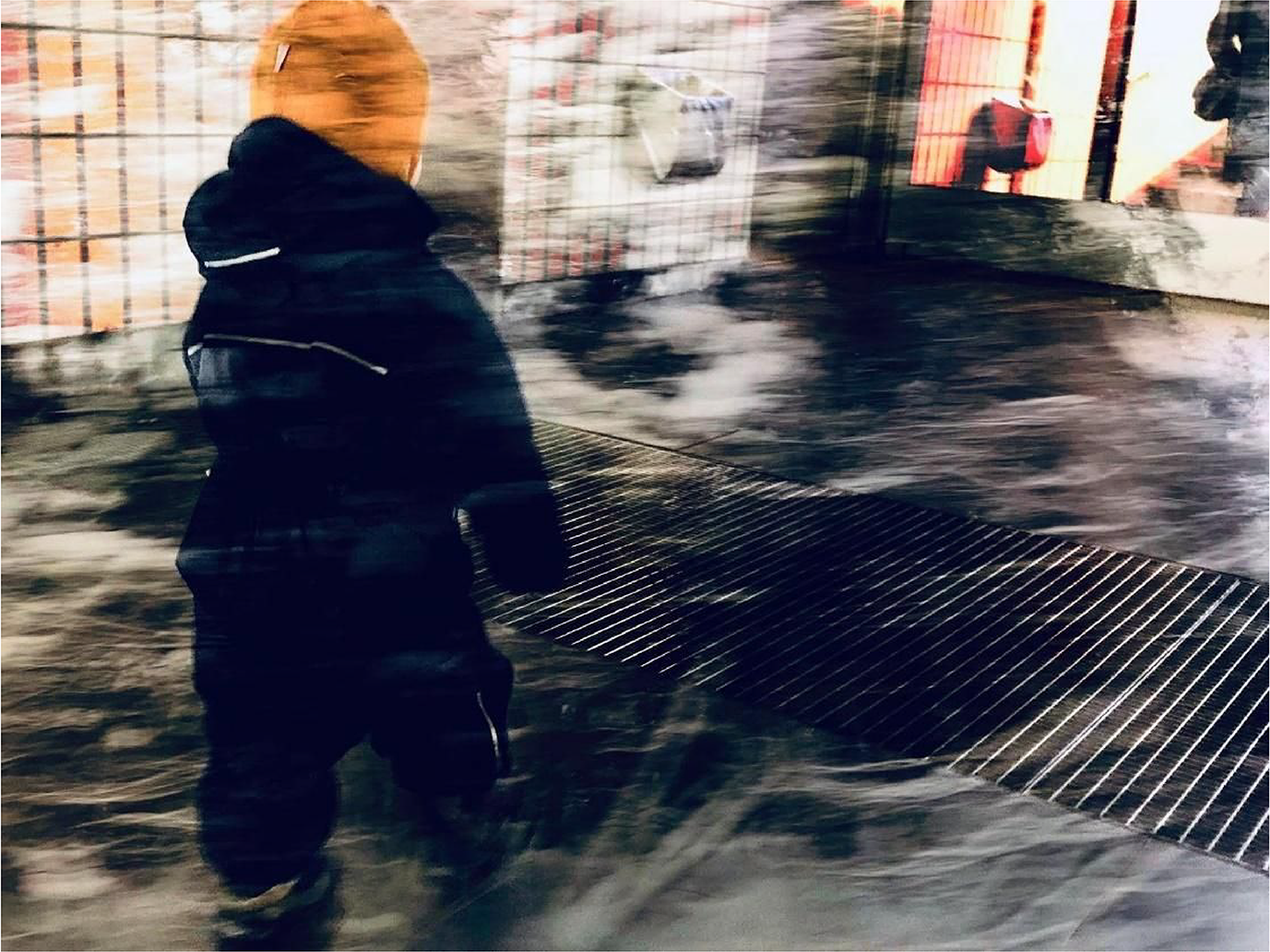 Photo-graphic data-ing: Stop … in the middle of sounds, smells, speeds, temperatures, rushing bodies, signals … tunnel system rhythms … swirling underground heat … cold wind through sliding doors … sensuous city atmosphere cacophonies…
Buggy-walking without exactly knowing where to go, despite wanting to follow a wayfarer's journey in the urban city, geographic mapping movements and threads of our journey adventures are starting. A wayfarer can, according to Ingold (2011), become a transported traveler, a passenger who does not move but is, rather, moved from place to place and inhabits the world. The data-ing sights, sounds, affects and motions that carry movements back and forth upon arrivals and stops are our interest.
Influenced by Haraway's (2016: 12) practices of “passing patterns back and forth, giving and receiving, patterning, holding the unasked-for patterns in one's hand, response-ability” (see also Land and Hamm, 2018), our digital photo-graphic empirical material appears in collectiveness, scribblings and talking across continents as urban wayfaring geography (Field, 2009; Saldanha, 2018). The lines are not straightforward lines; they are complex, uncertain and messy. Often shifting thinking and talking into something not asked or thought about, abstract lines, lines of growing and becoming (Ingold, 2013), are working.
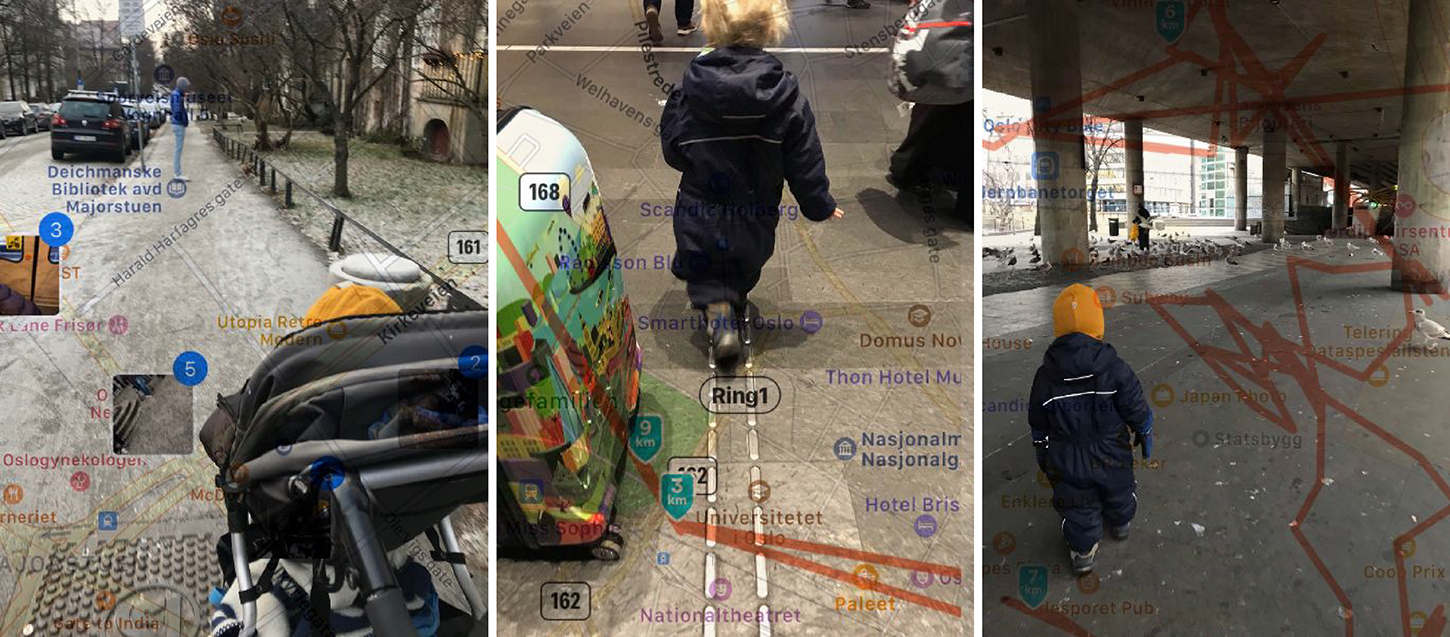 Photo-graphic stops … wayfaring unknown terrain … voyaging through new cityscapes … following lines of haptic engagement … creating maps of desire … digital data-ing tracing flows of adventurous curiosity…
In the making of the data-ing photo-graphics, we move away from creating a research study of lines to a study in lines and with lines. We speculate through artistically engagements with materials and insights are shaped without a clearly preconceived idea, what might the images become? According to Ingold (2010a: 301–302), drawing carries on — “it is always work in progress, manifesting itself in its lines of becoming rather than an image of being.”
Attending to these intra-relations, we ponder on what is happening when the notion of wayfaring, or becoming, is conceptualized. Ingold (2015) reminds us of the sky–earth and weather–earth effects and affects. In child-ren-hood studies, the weather world has often been left aside from ideas and thinking further. Fortunately, in educational research, a change is happening (Bartnæs and Myrstad, 2022; Rautio and Stenvall, 2018), attuning us to how the wind, lack of sun, snow, temperature and surfaces of the earth (Ingold, 2015) might affect childeren. Ingold (2011) writes of the inhabited world being constituted by the flows of dynamic earth, weather and atmosphere. This speaks of the emergence of the inhabitant in these flows or movements in life.
The ecology, or weather world, might become “a tapestry … a field not of interconnected points but of interwoven lines,” where the “living, breathing body is at once a body-on-the-ground and a body-in-the-air” (Ingold, 2010b: 122). Ingold (2011: 111) emphasizes the “open world,” which “has no boundaries, no insides or outsides, only comings and goings.” The wayfaring moments during the urban buggy-walking events respond to Ingold's boundary-less “open world” in that everything is interwoven and mingling with what appears — becoming effected and affected. These affects can leak into-with the not-yet-known. And maybe these experimental thoughts might leak out into the worldly map as cross-continental thought drifts.
“Jeg skal sjekke” as minor gesture: what is happening?
Thinking with Manning's (2016) “minor gesture” asks otherwise of empirical thought. The minor gesture asks “what else” more than “why.” “What else” is a cutting through of the definition and categorization of-with-in moments and suggests complexity. The minor gesture thinks with ethics and response-abilities (Haraway, 2016). Experimental research-creation troubles collective thinking of small everyday events otherwise, where leakages, interruptions and tangents of research-creation put something else into what happened and speculate-with the potentialities of “Jeg skal sjekke.” Manning says: The Minor Gesture engages directly with this tension between knowledge and value. What else could be at stake in the encounter if it weren’t organized around the certainty of knowing? What might become thinkable if knowledge weren’t so tied to an account of subject-driven agency? And, what else might value look like if it weren’t framed by judgement? (Manning, 2016: x)
These aspects of the minor gesture also connect with the photo-graphical empirical data-ing material in the making in our research-creation, connecting to a worldly minor gesture of “what else,” a “what else” that assumes uncertainty and ambivalence towards child-centered knowledges in early years settings. Our situated knowledges (Haraway, 1991), following Manning (2014), encourage “wondering in movements” — wonder that moves the me; I am becoming. Such an affirmative knowledge shift gives possibilities for a future change with child-hood knowledge, potentialities to move an “I” towards the events. So, what more than “why” is happening among the “I”s in our urban buggy-walking movements? The “I” can be perceived as a habit, something taken for granted, placing the subject at the top of the hierarchy — an initiator of what happened. If it is the movements of the becoming subject the researcher is investigating, then a shifting concept of experience stretches the researcher into something unknown — an unknown that is entangling perception, affects and feelings, creating a minor becoming subject of the event. Whitehead (1967) calls the subject “of the event” a “superject.” The “superject” — a subjective form of the event — includes every subjective form as different from each other. Difference is in the making-creation (Otterstad, 2018). Since, ethically, we are concerned with reconfiguring research, researchers and children by undoing the “I,” this act is not an easy gesture. Early childhood education and care has historically (and more recently) been engaged in defining and categorizing the individual child. In neoliberal times, such an “I” continues to produce professionals as individual caregivers and the individual child as the receiver of care and knowledge. Our colletive research-creation project follows the subject of the event, which includes more-than-human matters.
“Jeg skal sjekke”: lines of haptic surface-ing
In his article “Surface visions,” Ingold (2017b: 100) asks: “What if surfaces are the real sites for the generation of meaning?” A redirected attention to surfaces in the arts and social sciences is a shift from the “optical to its haptic modality” (Ingold, 2017b: 99). With haptic vision, the surface is no longer merely the outer boundary of objects in the world, but something with the potential to produce knowledge in textures, regardless of the shape of the object. Surfaces are not superficial just because they are surfaces. Haptic vision opens to the touching of surfaces and “it is close-up, affective and kinesthetic” (Ingold, 2017b: 101), a touching with both the hand and the eye. Textures disclose the substantive composition of things, and surfaces are the milieu of bodily rationalities in the world.
The ground is not the surface of materiality itself, but a textured composite of diverse materials that are grown, deposited and woven together through a dynamic interplay across the permeable interface between the medium and the substances with which it comes into contact. (Ingold, 2011: 130)
So, how do surfaces correspond (Ingold, 2017a) with a young wayfarer in togetherness with the urban city? Buggy-walking reveals the relationalities and the interplay between materials, structures, systems and signs, and how they affectively move bodies in city spaces among humans and nonhumans. Different textures and surfaces attract our feet and the wheels of the buggy-walking in urban city surroundings. Signals from surfaces can transport and transform bodies. Matter is vibrant (Bennett, 2010). The surface qualities invite us to walk differently, and layers of snow force us to pay attention to changing surfaces. Intra-acting with the young wayfarer brings attention from the visual to haptic engagement. Following the movements, relationalities, pace, engagement, pauses and directions, something else occurs. Correspondence (Ingold, 2017a) with the city surfaces discloses new potentialities of encountering with-in the world. The young wayfarer is passing patterns and bodily rhythm, a giving and receiving, entangling with the surfaces at work. Changes in tempo, movement and intensities are a redirecting of possibilities with the urban cityscapes.
It is at the interface where signals and information transmit and correspond that surfaces might become the bodily moments for a young wayfarer in movements. Urban surfaces are embedded with codes and signals — a complexity of information inviting haptic engagement. Lingering with what urban textures and knowledges might produce corresponds with and exchanges alternative knowledges “of the I” through haptic visuality, movement and surfaces. Lingering is to be bodily entangled and intimate — a wayfaring meshwork with-in the world.
“Jeg skal sjekke”: lines of memories and here, there and now
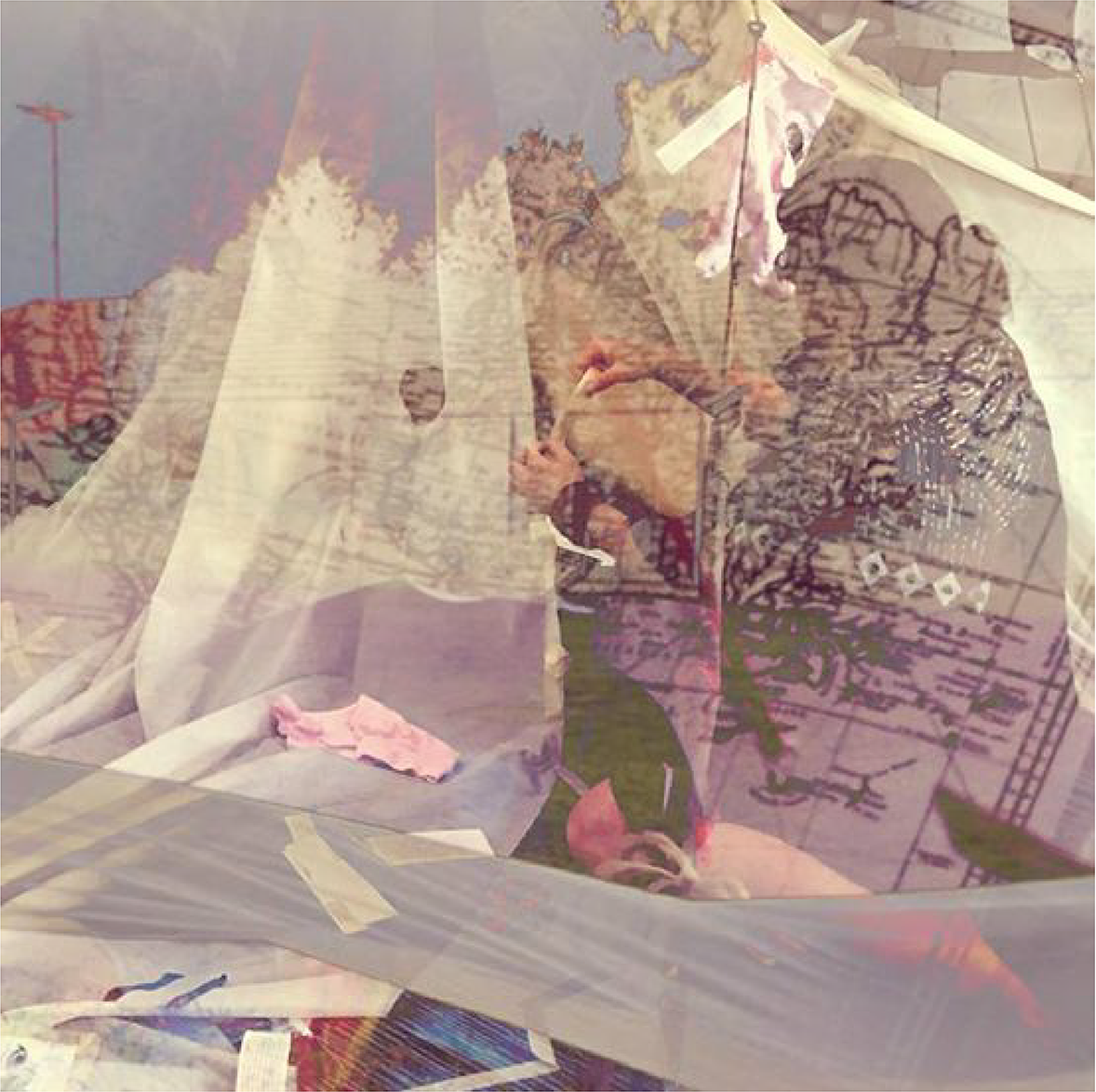 Photo-graphic data-ing: Stop … wayfaring continents forth and back and forth and … recalling Australian summer breeze … digital data-ing sewing writing collaborations layer by layer…
How does data move through time zones, hemispheres, weather, patterns and seasons? Our cross-continental data-flow-ing is generated via social media. Smartphone notifications ping as photographs and videos of the young wayfarer, buggy and researcher movements across Oslo are delivered in an instant. Technology allows for immediacy. Instant noticing of Oslo city movements occurs in another hemisphere — in a country weathered by heat and wind movements. Technology brings us closely together in an instant. We are attending to and thinking with research as a worldly offering to-with cross-continental childhoods. We ask: How might we become together with digital surfacing and movement on opposite sides of the globe?
Cross-continental thought-fabric(ing) leaks through as heat-affected skin folds in with bodies needing warmth protection. Fabric becomes a mode of data-ing movement. Bulky winter clothing affects our guide's wayfaring movements in the city. We respond with fabric-noticing as surfacing digital stories and technologies. The Oslo data-ing multiplicities capture light through lenses. Data affects flow through digital devices and electronic signals; waves and frequencies transmit across vast interconnected cellular networks and into a different weather world. In an instant, a southern-hemisphere researcher becomes Ingold's (2010b: 122) “body-on-the-ground and a body-in-the-air.” When the smartphone sounds and images are viewed, memories of a familiar city are recollected. The wayfarer and researcher's positioning is captured via a smartphone fitness application based on GPS (Global Positioning System) technology, and lines, surfaces and textures are mapped with-across urban spaces and places — still images in motion; movement continually moving.
Moving with Wurundjeri Country asks what potentialities might occur when data is thought with in kangaroo apple season (December), or when data is changeable, thundery and weathered, with Biderap dry season's (January–February) hot, dry winds (Melbourne Museum, n.d.). We wonder what tensions exist when urban buggy-walking, researchers and GPS lines are thought with on stolen land inscribed by settler-colonial histories, and what our responsibilities and accountabilities are as researchers responding collectively through complexities of movement, data, surfaces, borders, time zones, climates and hemispheres (Land and Hamm, 2018).
In Biderap dry season's high temperatures and low rainfall (Melbourne Museum, n.d.), data-thinking follows the path of a female Common Brown butterfly. Butterfly movement, together with a blowfly's irritating buzz, offers a remapping of erratic wayfaring lines across a city grid. This data-ing back and forth responds to-with Haraway (2016), generating an ecology of cross-continental movement and flight lines. These flight lines, passing across, giving and receiving through-with different biospheres, enact Haraway's “response-ability.” In the complex, uncertain and messy research-creation that we generate with an ability to respond, our responses become patterns, changed leakages that cannot be contained, passing back and forth through and with the surfaces of the “not yet known”.
“Jeg skal sjekke”: lines of speculation to come
As already mentioned, our research-creation does not discuss if speculative philosophy can be used in the social sciences. Our standpoint is that our buggy-walking is an adventure to come. We find support in Stengers’ Thinking with Whitehead, where she follows Whitehead's process philosophy by saying:
to think with Whitehead today means to sign on in advance to an adventure that will leave none of the terms we normally use as they were, even though none will be undermined or summarily denounced as a carrier of illusion. (Stengers, 2011: 24)
Stengers’ enthusiasm for Whitehead is obvious through her writing with his process philosophy, presenting a radical alternative mode of contemporary and future thinking. Here, Stengers’ intensity and flow-thinking redirect us towards alternatives and a non-controversial affirmative method of Whitehead's thinking otherwise. For Whitehead, science is understood as an adventure, and “an adventure never enables to draw on a general lesson” (Stengers, 2011: 13). If it turns out badly, Whitehead encourages us to ask what happened, which can be a re-turning to empiricism. So, to think otherwise is to question empiricism with the interest for what is given in experiences. Our thinking and research choices connect empirically to buggy-walking with experimentation and creation. We are doing these makings to escape the norms to which experiences are isolated by the logical, moral, empiricist way of conducting research. This indicates that we need the support of speculative philosophy, which, in its very production, brings into existence the possibility of adventures and experimenting with “data-ing.” A way of experimenting with “data-ing” is to include speculative thinking, and physical and digital tools with a smartphone and applications to hand. We follow with an example from the adventure motions that carries the movement back and forth with the wayfarer (Ingold, 2011).
When the young wayfarer says “Jeg skal sjekke” (“I shall check”), there is a moment of surprise among us, as researchers, in the urban space. The statement comes “out of the blue” during the buggy-walking adventures. The wayfarer walks towards a bin and eagerly wants to see what is there. The researchers follow the route and the bodily movement lines of the expression (Manning, 2014). It seems that the expression “Jeg skal sjekke” has no precautions — as mere potentials of what might happen, not knowing what the implications of the walking adventure and routes can create. The moments of the movements happening here and now in an open urban-environment city space seem to avoid a world as bifurcation. The bodily movements and intra-actions encourage walking, running, investigating, listening and feeling, in the middle of something becoming. A search for “what else” (Manning, 2016) might be generated as haptic possibilities with “Jeg skal sjekke.” Speculative process philosophy does not limit artful practices. Inspired by Manning (2016: 13), an “artful child” brings in “the in-act of the more-than” — an investigator, an artist, a runner, an activist in sharing togetherness, intra-acting with the upcoming bodily movements. The title of Manning’s (2016) book, The Minor Gesture, together with the expression “Jeg skal sjekke” can be-come an artful minor gesture, searching for more — for “how and what else” lines of thinking and doing can create.
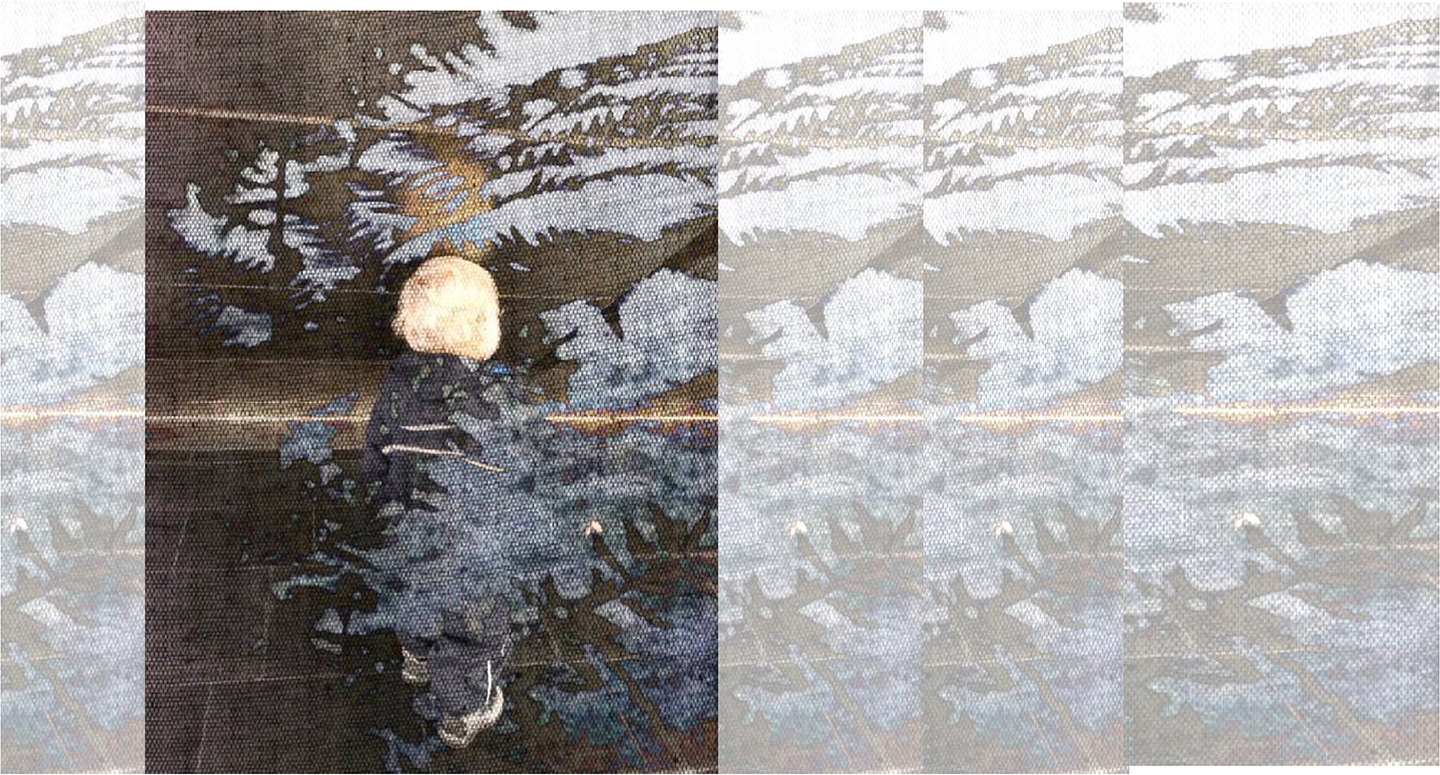 Photo-graphic data-ing: Stop … leaky urban space … inviting fragments of architecture … exploring surfaces … rolling, crawling, touching, sensing, absorbing city surfaces through layers of skin, clothes and rubber soles…
“Jeg skal sjekke”: lines of research-creations, data-weaving and digital experimentations
Qualitative research methodologies invite inventive research; however, we wonder whether creative ideas are enough. We continually grapple with how these lines of research-creation might support, disrupt or activate thinking otherwise in global childhood research and everyday practice. Svend Brinkmann (cited in Ege Møller et al., 2015: 221) encourages research to be thought of as processes of uncertainty that avoid repetition and sameness. Being researchers in doubt, risk and uncertainty offers us artistic speculations. Bearing in mind Brinkmann’s warning that creativity is not enough, something new is generatively produced. Doing and thinking data-surface weaving and experimentations with urban textures are ways of generating with-in data-ing, transforming data into something different. So, what might happen? During the data-ing creation processes, transformations of data materials into artistic materials become corresponding processes of decoding and recoding information, engaging haptically in wonderings and surprises. Our photo-graphics are not representations or frozen moments of a real-life “documentation” of collective city buggy-walking. The images are decoded and recoded, and leak into new experimental thinking about a young wayfarer's haptic engagement (Ingold, 2011) in urban multiplicity (Deleuze and Guattari, 1987) — mesh-working (Ingold, 2011) urban landscapes. As researchers, we are expected to be transparent in how we are carrying out our inquiries and we are ethically situated in and with response-ability (Haraway, 2008) for the participants involved. As such, the wayfarer has not given consent (only the parents), but is presented with the images during our collective walk and has seen the final photo-graphics that we created during the process.
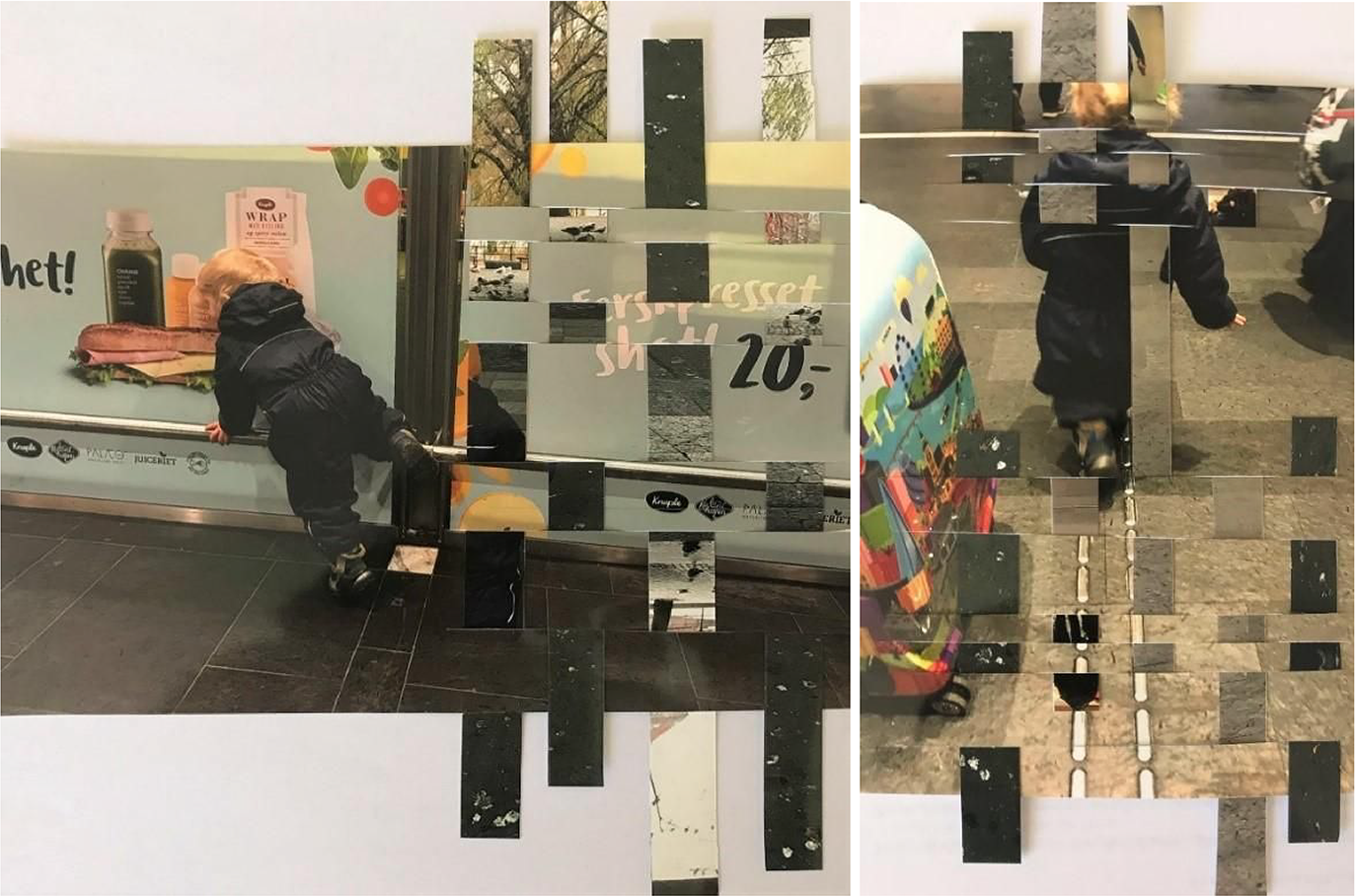
Photo-graphic data-ing: Stop … wayfaring elements … materializations … connecting different surfaces … walking, climbing city lines … new territories … data-weaving minor tapestries of haptic engagement…
“Jeg skal sjekke”: “what else” to come
Our entangled, becoming-worldly buggy-walking project here and there is following the lines within a new-materialist approach to early childhood education and care. By turning away from the gathering and interpreting of empirical data, we buggy-walk with the wayfarer, affirming a minor becoming the subject of the event (Whitehead, 1967). We have suggested intra-acting research (Murris, 2016; Osgood and Robinson, 2019; Otterstad, 2018; Otterstad and Waterhouse, 2016) with a wayfarer, supported by process-orientated thinking and methodology, and with attention to the non-anthropocentric speculative philosophy of Whitehead (1967, 1978). Drawing on Whitehead’s speculative philosophy in conjunction with recent new-materialist thought, this article proposes that speculative experimentation can produce different forms of togetherness amongst species, practices, technologies and modes of existence (Haraway, 2016; Stengers, 2018). By working to reimagine the notion of moving bodies in terms of lines of multiplicities and speculative processes (Manning, 2016), we hope to offer affirmative ways of doing research-creation in togetherness across continents. An ethical response-ability might be how we inhabit uncertainty in togetherness (Massumi, 2015: 11).
Photo-graphic data-ing: Stop … wayfaring cityscapes … haptic visions of fractal city movements … thinking-sensing the perfume of city life … leaky bodily sensations…
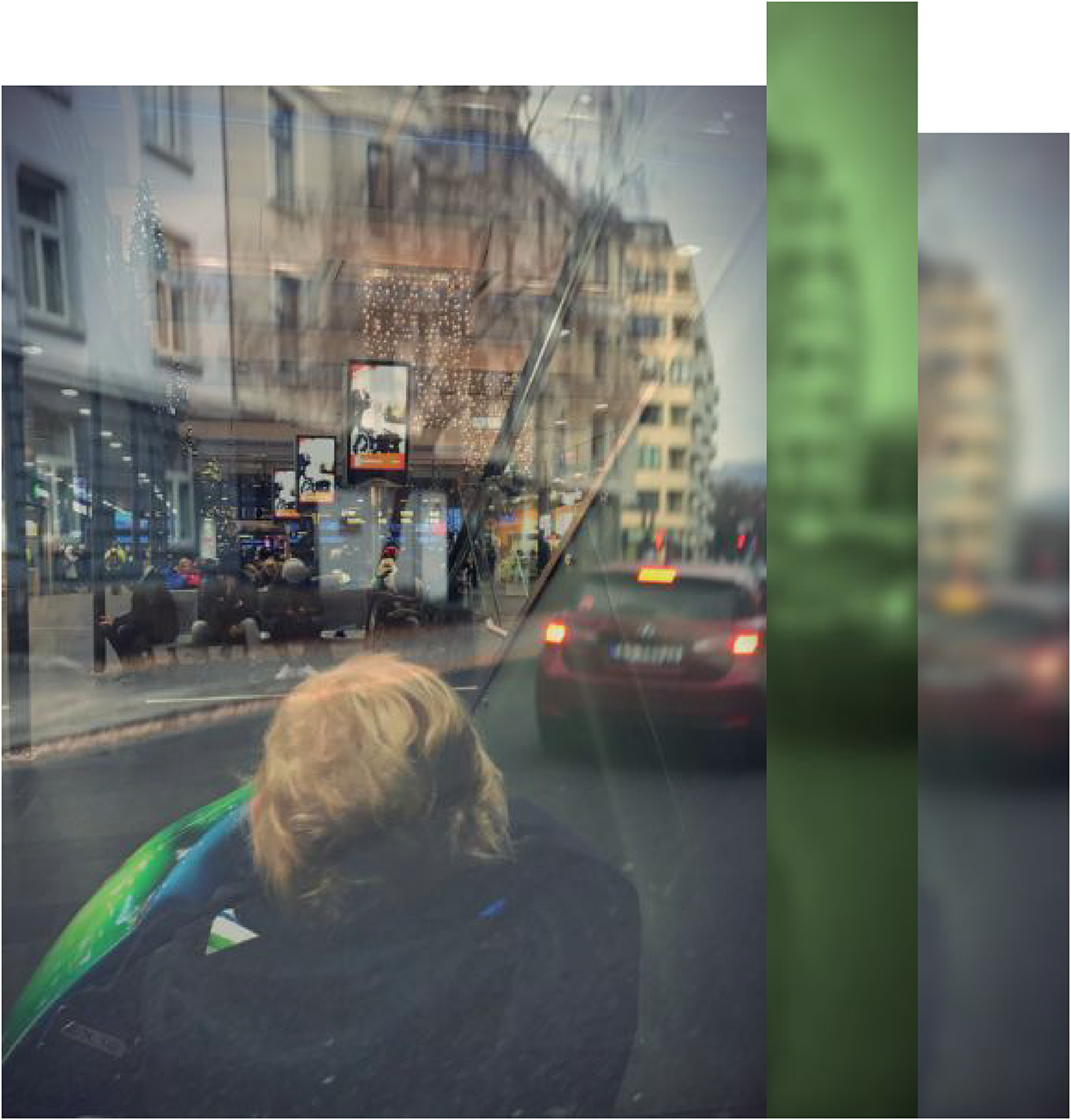
Our data-ing research-creation is entangled with technology and wayfaring in multiple ways: using smartphones and different digital applications as research tools to trace our urban buggy-wayfaring in distance, time, pace and lines of movements; photographing and making photo-graphics with technology on the phone screen; checking timetables for the metro line and buying tickets; video meetings and writing the article simultaneously across time zones when mornings merge with evenings and warm winds intra-act with a snowy atmosphere. New technologies open potentialities for research-creation as multiplicities and digital wayfaring, exploring urban surfaces where signals, codes and digital information swirl in the air, entangled with the weather. Digital applications leak in cityscapes. Walls and squares, old information interfaces merged with new technology, smartphones and wayfaring urban surfaces might be leaky. We would suggest that the dynamics of embodying speculative possibilities as an affirmative ethic (Braidotti, 2017) with research-creation in the early years might shift ideas, reconfigurations and knowledges about children and researcher positions in multiple and political ways.
Footnotes
Declaration of conflicting interests
The authors declared no potential conflicts of interest with respect to the research, authorship and/or publication of this article.
Funding
The authors received no financial support for the research, authorship and/or publication of this article.