



Abstract
The performance of standardized tests is an ongoing matter of concern for childhood researchers. Standardized tests are often described as neglecting the ethical complexities of doing research with young children. However, this critique is primarily presented in general terms, and does not attend to the locality and specificity of particular test situations. With this as a starting point, the aim of this article is to challenge a narrow understanding of standardized tests as activities done ‘on’ children and examine the complexities of emerging relations in test situations performed in Swedish preschools. Through analysing video recordings made as part of an intervention project, the article focuses on the practices that surface in test situations with four- to six-year-olds. Inspired by Haraway and Strathern, the article puts to work a relational approach to analysing the test situations. This approach contributes with an understanding in which the contextual details are taken into account, which in turn highlights how the atypical and the moving are often the standard in standardized testing. The insights from a relational analysis point to important aspects to consider in the performance of standardized tests: it matters to attune to and problematize a narrow understanding of standardized tests; it matters to consider the local specificities; and it matters to scrutinize in new ways the relations between children and researchers.
Opening scene
This article analyses video recordings from standardized tests performed with young children as part of an intervention project in Swedish preschools in 2015–2018. As an entry point into the frictions and complexities involved in this practice, I borrow the experiences of Martin Woodhead – now an Emeritus Professor of Childhood Studies at the Open University, UK. By sharing his insecurities as a novice researcher, Woodhead generously invites the reader join him in the 1970s when he performed psychological tests with four-year-olds at a nursery school. Woodhead describes how he welcomed the children into a small room allocated for the purpose, and to the games designed to test the cognitive styles of the children. One child accomplished the tests but seemed uncomfortable; another child seemed anxious; a third refused even to enter the room. No textbook had prepared Woodhead for a child being reluctant to do the tests. However, he describes his relief at a reassurance from the head teacher that their hesitancy was probably due to the children's newly discovered description of the small room as the ‘naughty room’. Woodhead explains how, up until the day he published the anecdote, he kept wondering about the ‘real or imagined fate that awaited children sent to the “naughty room”’ (Woodhead and Faulkner, 2008: 10).
Introducing the aim and research questions
The desire for evidence-based practices for children in educational settings has resulted in a proliferation of intervention studies, often performed as randomized control trials (Hanley et al., 2016; Mills et al., 2021). This has, in turn, contributed to what critics refer to as an overuse of standardized tests and test methodologies (e.g. see Ball, 2015). There is a serious and lively debate on standardized tests, in which the tests are often described as neglecting the ethical complexities of doing research with young children (Bodén, 2019, 2021). As part of this debate, the critique of such tests is primarily presented in general terms (e.g. see Biesta, 2010; Lather, 2004), leaving the locality and the specificity of particular test situations out of the story. With the above anecdote as an exception, there is thus a gap in the scholarly discussion on standardized tests, where little is known about what happens in actual test situations. This, in turn, makes it difficult to evaluate if the critique of standardized tests is justified or not. Or, to return to the opening scene, it is difficult to figure out whether the fate that awaits children who perform standardized tests is real or imagined.
To fill this research gap, this article analyses test situations in which four- to six-year-olds participated. The tests were performed as part of the ‘Enhancing Preschool Children’s Attention, Language and Communication Skills’ project (popularized as the ‘Brainways in Preschools’ project), and aimed to compare the effects of two pedagogical methods (Gerholm et al., 2018). As one of the first randomized control trial studies in Swedish preschools, the methods were implemented at 18 preschools (including control groups) during six weeks of intensive interventions. In total, 432 children and 98 teachers participated (Gerholm et al., 2019). In line with the design of randomized control trial studies, standardized tests were performed before and after the pedagogical interventions. The tests aimed to investigate the effects of the interventions and were staged and performed in a predetermined manner, in which the participating children solved similar tasks under similar conditions (Gerholm et al., 2019; Tonér, 2021).
Even if 50 years have passed since Woodhead entered the nursery school, similar discussions on the adequacy of performing standardized tests also emerged in relation to the Swedish project (Frankenberg, 2018; Frankenberg et al., 2019). For Woodhead and his co-author, the anecdote introduces key issues when testing young children: the ethical dilemmas raised by the test methodologies; the critique of research done ‘on’ children; the power relations between the child and the adult; and the ‘status of children who are the subject of a scientific discipline primarily concerned with the description and explanation of psychological and developmental processes through objective observation, experimentation and explanation’ (Woodhead and Faulkner, 2008: 11). For this article, the anecdote helps to highlight aspects that will be of specific importance when analysing the recordings from the Swedish test situations: the globalized – and yet narrow – scientific and political discussions on standardized tests that call for an investigation of actual test situations; the specificities of the (Swedish) preschool setting, informing how the tests are played out; and the hierarchical relations between children and researchers, which are both reinforced and challenged by standardized tests. In this article, I argue that the relations between all of these different aspects make the standardized tests appear in specific ways. Inspired by how Haraway (2003, 2004, 2016) and Strathern (2018, 2020) approach relations, the aim of the article is thus to challenge a narrow understanding of standardized tests as activities done ‘on’ children and examine the complexities of emerging relations in test situations performed in Swedish preschools. The following three research questions have been formulated:
How do the specificities of the Swedish early childhood research context become part of the test situations? How is the educational setting of the Swedish preschools affecting these events? How do the relations between children and researchers alter the test situations?
A theoretical approach to relations
The opening scene shows a practice where known relations emerge along with unexpected relations. It is impossible to sidestep the relations between the child and the researcher, as has been thoroughly discussed in studies addressing children in research (Alderson and Morrow, 2011; Christensen and James, 2017; Clark, 2017; Einarsdottír, 2007; Kellett, 2010; MacDonald, 2013; Mason and Watson, 2014; Schulte, 2020; Thomas, 2021). However, the scene gives glimpses into other relations that enable these interactions to play out in certain ways: the nursery setting where the testing took place; the meetings between an experienced teacher and a novice researcher; the resistance of the children; and the lack of ‘textbook information’ about how children might react during a test. Thus, this article is not only interested in the relations between the child and the researcher, but it is definitely not not interested in these relations. To enable this, I will turn to relational approaches as they are theorized by Haraway and Strathern.
According to Haraway (2003: 7): ‘Subjects, objects, kinds, races, species, genres, and genders are the products of their relating’. A relation could be defined as ‘a particular way in which one thing or idea is connected or associated with another or others’. Further, a relation could illustrate ‘the position which one person holds with regard to another by means of social or other mutual connections; the connection of people by circumstances, feelings, etc.’ (Oxford English Dictionary, n.d.). Strathern (2018, 2020) discusses how this has sparked a continuing debate in which one stance focuses on the different parts held together and the other focuses on what relations this holding together creates. Drawing on Strathern, Haraway (2016: 34) argues that we need to accept ‘the risk of relentless contingency, of putting relations at risk with other relations, from unexpected worlds’. Strathern (2020: 8) elaborates on this and argues that relations have ‘an effect on – and pose problems for – actors far beyond the scope of their connections’. A relational analysis thus ‘shifts from matter or subjects and subjectivities in themselves, to the relations and the networks from which they emerge and within which they are constituted’ (Bodén et al., 2019 : 4).
Through relational approaches, childhood researchers have problematized a division between nature and culture, mind and body, and discourse and matter (Alasuutari et al., 2020; Esser et al., 2016; Murris, 2016; Osgood and Robinson, 2019). It is common for these studies to focus on children's co-existence with the environment and the material world, where children are described as interdependent, entangled and connected with their surroundings (Elkin Postila, 2021; Sjögren, 2020). This has, for example, resulted in studies paying attention to children's milieus and to the objects children are surrounded by, to highlight ‘children as relational becomings’ (Tammi et al., 2020). For this article, the relational approach means that I put the relations of the test situations at the centre of attention, to explore the complexities of standarized tests.
Situating the tests and the empirical material
In the following, I introduce the context in which the tests were performed – namely, the Swedish preschool setting. Thereafter, I introduce the empirical material of the study and how it has been analysed.
Pre-tests and post-tests as part of an intervention in Swedish preschools
In Swedish preschool culture, there has been a growing resistance since the mid 1990s towards individualizing research strategies and what has been described as ‘normalizing psychology-based theories … to determine the child's normal development’ (Aronsson and Lenz Taguchi, 2018: 244). Intervention studies in the context of Swedish preschools are thus rare (Tonér, 2021). The testing of young children is even rarer. Instead, small-scale qualitative studies have dominated the field. Accordingly, sceptical questions were asked as to why the ‘Brainways in Preschools’ project was going to use psychological analysis and statistical methods to investigate pedagogical practices, focus on individual children and, particularly, test the participants (Frankenberg, 2018: 3).
This scepticism resulted in a number of ethically informed decisions on how to conduct the study (Frankenberg et al., 2019). The tests took place on the premises of the preschools – in educators’ offices or lunch rooms, reading rooms, painting studios, play areas and storage rooms – to enable a more familiar experience for the children compared to the test being performed in a university laboratory (Frankenberg et al., 2019). The children took the tests individually with a trained research assistant, and at all times at the preschools the researchers wore blue T-shirts with the logo ‘Brainways in Preschool: Ongoing Research’. The other ethical measures that were taken were a 2.5 metre long calendar, which was put up at the children's height and showed what would happen during the 10 weeks of testing and intervention, and a video and book to inform the children about the research practices of the project. The project was approved by the Regional Board of Research Ethics and consent was given by the guardians of all the children.1 However, what was equally important was the in situ informed consent of the children themselves, where at any time they could say ‘yes’ or ‘no’ to participating in the interventions or tests (Frankenberg et al., 2019).
The tests were designed to measure the effects of the pedagogical methods by comparing the results of the pre-tests and the post-tests (Frankenberg et al., 2019; Gerholm et al., 2018, 2019; Tonér, 2021). In total, the test battery consisted of nine different parts, which were performed over two sessions during the pre-test period and two sessions during the post-test period (Gerholm et al., 2018). In order to provide an accessible introduction to the process and practicalities of the tests, I will give a brief description of a video recording from one of the test sessions: Serena, a four-and-a-half-year-old girl, and the trained research assistant, Maria, are sitting next to each other in a teacher’s office. Rather than facing the camera opposite the table, they look at each other. After 24 minutes, the test session is just about to end. Maria holds a piece of paper – a description of all the different tasks they have performed. ‘Look at this. We have done all these things’, she says, pointing at the piece of paper. Serena moves closer. This is their fourth joint session and they seem to know each other quite well. ‘We have done those the last time and, today, we have done the game [Flanker Fish Task] and the cards with the funny pictures [What's Wrong? cards] and the book [Peabody Picture Vocabulary Test] and the numbers [The Digit Span]. We have done it all!’ Serena hums as Maria moves her hand towards her sweater and takes off her microphone.2
Tables 1 and 2 describe the test sessions in detail. The first session consisted of five parts (Table 1).
The first test session.
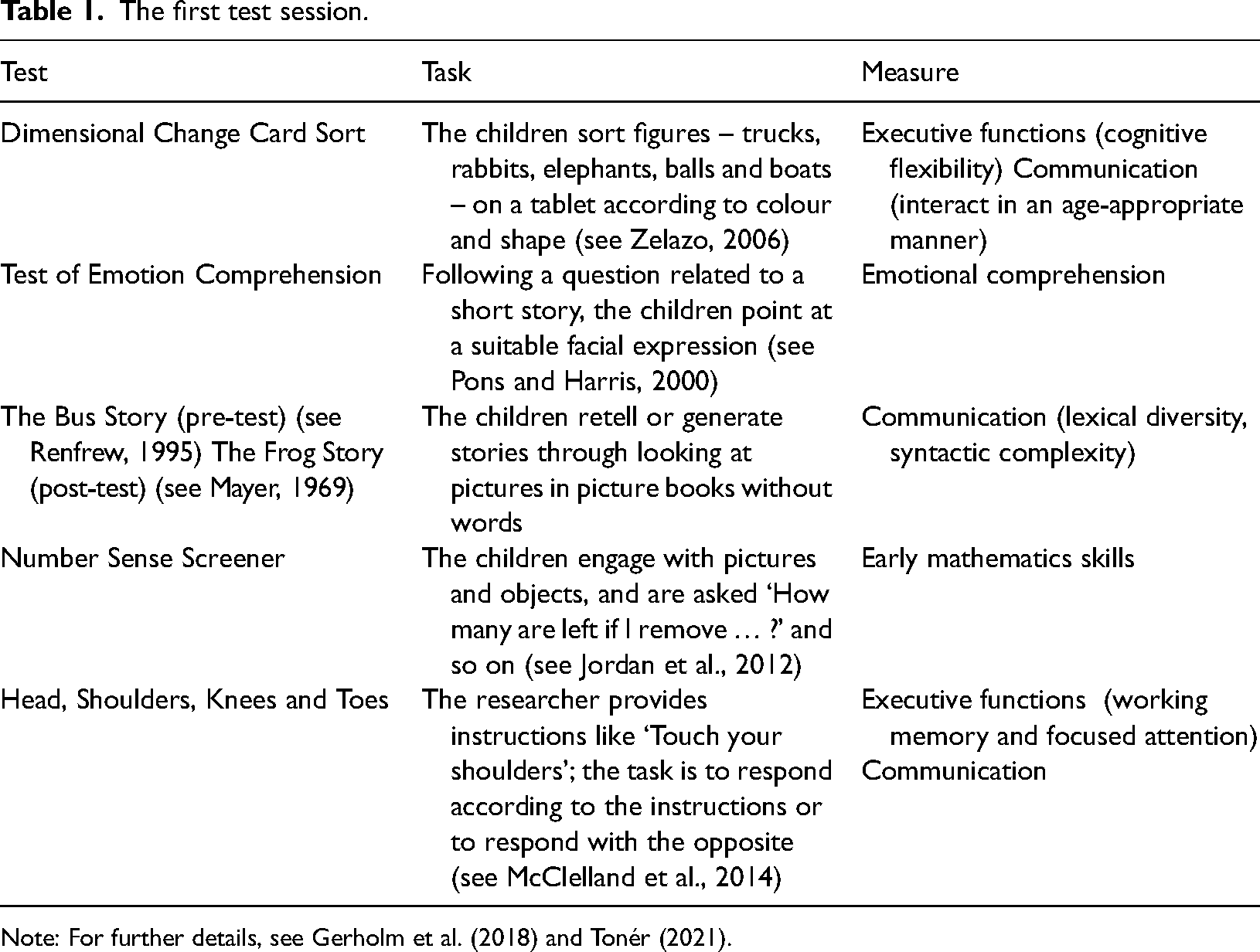
Note: For further details, see Gerholm et al. (2018) and Tonér (2021).
The second session, illustrated in the example with Serena, was usually performed on the day after the first session and consisted of four parts (Table 2).
The second test session.
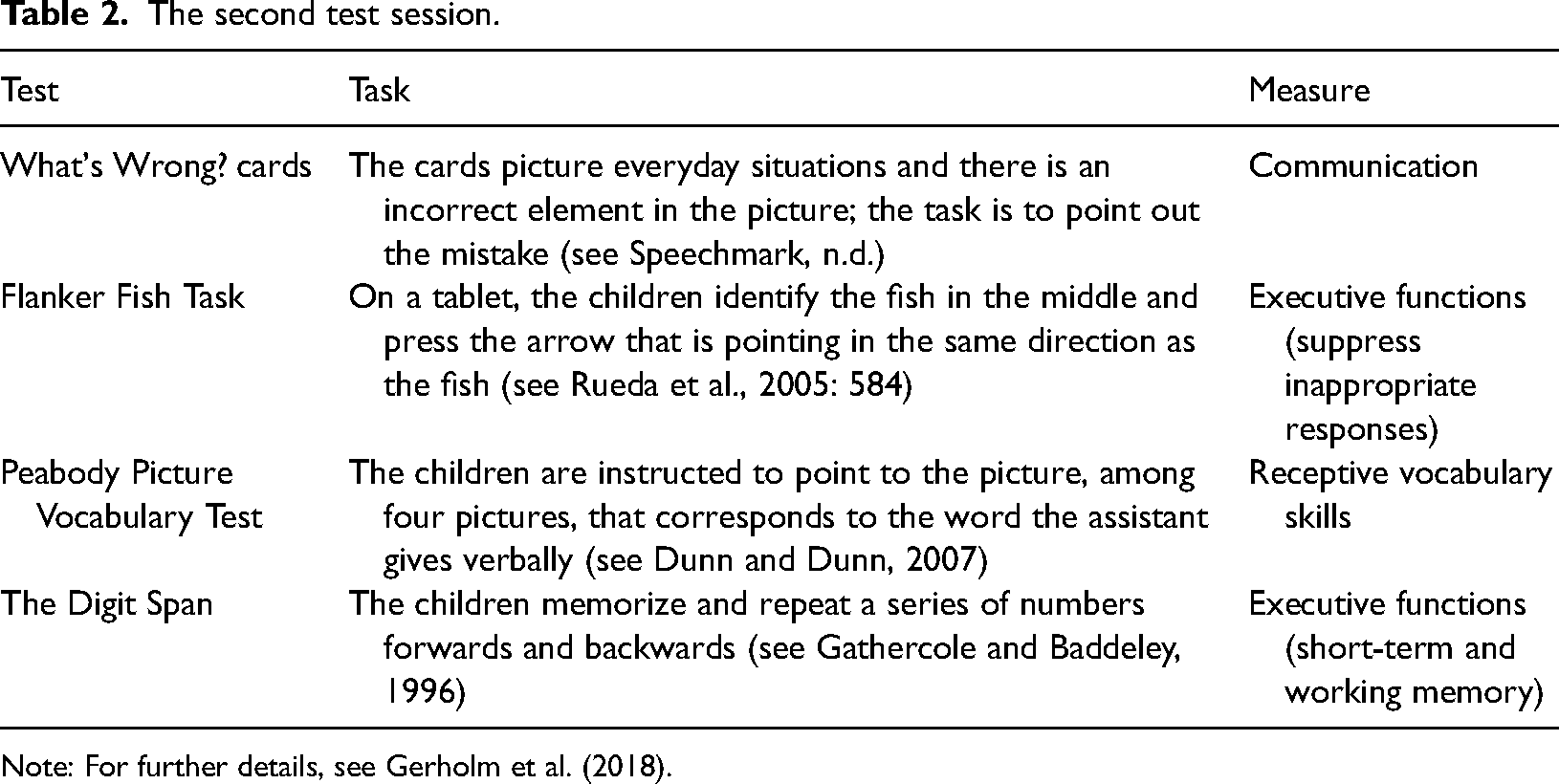
Note: For further details, see Gerholm et al. (2018).
The sessions covered a number of different aspects, but seldom lasted longer than 30 minutes. Each test – like the game, the cards with the funny pictures, the book and the numbers – took approximately 7 minutes.
Video recordings as empirical material
The sessions were recorded to evaluate whether the test had been performed according to the standardized instructions and to give data on the interactions between the children and research assistants (Gerholm et al., 2018). What unites all of the recordings is that the child and the assistant, just like Serena and Maria above, are seated next to each other – on sofas or in armchairs, office chairs, children's chairs at low tables or high chairs at high tables – facing the camera. It is most often a quiet and unhurried event, where the child is focused on the tests and the assistant makes comments when necessary. The recordings do not only show the performance of a number of tests. Rather, a typical recording starts by an unintentional close-up of a sweater, arm or hand, showing the assistant pressing the record button on the camera. The first words uttered on the recording are usually fragmented, indicating that the child and the assistant are in the middle of a conversation when the recording starts.
The recordings of all of the tests produced an archive of more than 1700 test sessions and approximately 700 hours of recorded material. To enable an in-depth understanding of what happened in specific test situations, I made a stratified sample. First, I created three stratified categories in relation to the children participating in the recordings: gender, age (divided into three groups), and monolingual or multilingual. The combination of these categories created 12 groups that included girls and boys who were monolingual or multilingual and at different ages. Three recordings were randomly selected from each stratified group of children. Half were from the pre-tests and half from the post-tests, and included recordings from both the first and second test sessions. In a few cases, I selected multiple recordings of the same child to analyse connections between events in the recordings from the pre-tests and post-tests. What it is important to emphasize is that the sampling process was not an attempt to strive for generalizability from the sample (Schreier, 2018). Rather, it was purposive sampling to maximize differentiations within the sample (Gobo, 2004: 418) and to highlight a range of different test situations, events and relations within the recordings (for a discussion on sampling strategies in qualitative research, see Robinson, 2014). In total, this process created empirical material that consisted of 43 recorded test sessions – approximately 20 hours of video material.
The method for analysing the video recordings of the test situations was theoretically driven and put the relations of the actors involved at the centre of attention. In a relational approach, the actors participating in test situations could be children and adults, as well as non-human entities, such as the material used for the testing or the room where the test was performed. Verran (2013: 27) calls this a ‘modal analysis of relations between entities that can be understood as participants in some (contingent) collective (with no distinction made between human and non-human actors)’. To carry out such complex analysis, one needs to be very specific. This means that when I watched the video recordings, I made detailed notes on what actions, activities and reactions the tests evoked; what was said and done in relation to the performance of the tests; and what was said and done in relation to the things surrounding the tests, like microphones, video cameras or notebooks. I also made notes on the specificities and details of the room in which the test was performed and what it looked like; how the child and the assistant were seated, and so on. Further, I made notes on events that did not seem to be related to the performance of the tests. Examples of this were when the children started to talk about their birthdays, asked about the assistant's piercings, described a family holiday or needed help with blowing their nose. The reason I included these events was to enable an analysis of all the situated details of the test situations, and also the things that at first seemed unrelated to the tests. It was thus a ‘long, slow, familiarisation with the details’ (MacLure, 2013: 174) of the test situations. This approach helped me to explore questions I had in relation to the test situations, as well as open up new questions.
Analysing the ongoing relations of the test situations
This section of the article assembles and disassembles the ongoing relations within the test situations. The first part focuses on the relations of the research context of Swedish preschools; the second on the relations of the preschool practices; and the third on the relations between the children and the research assistants. The selection of examples from the test situations presented inevitably influences the knowledge produced. It is therefore important to stress that the situations have not been chosen as examples of typical or atypical test sessions, nor as examples of ‘good’ or ‘bad’ practices. Rather, they need to be understood as temporary sites to explore the happenings within the standardized tests.
Cheating in the research context?
Standardized tests are often described as research done ‘on’ children rather than ‘together with’ them (Bodén, 2021; Clavering and McLaughlin, 2010; James and Prout, 1990; Kellett, 2010; Mayne and Howitt, 2015). Through testing, children are described as being ‘transformed into … de-personalized object[s] of systematic enquiry’ (Woodhead and Faulkner, 2008: 14). As such, such research is described as ethically questionable or even unethical (Bodén, 2021; see also Burman, 2016; Christensen and James, 2017; Mason and Watson, 2014). A broad or inattentive examination of the video material would possibly come to the same conclusions – namely, that the children are monitored by a video camera and have to follow a pre-planned research route, where the focus is directed at how the children handle the pregiven tasks. However, when the emerging relations within the test situations are studied more carefully, it is evident that the children are continually making their own experiences and questions visible: The five-year-old girl Halima, who has Swedish as her second language, is in the middle of performing the Flanker Fish Task. Alongside pressing arrows on the tablet, she asks the assistant, Maria, numerous questions concerning the tasks but also concerning their presence in the room at that particular moment. In one of the questions, Halima mixes up the word ‘research’ [fårs`ka] with the word ‘cheat’ [fus`ka] and asks: ‘Why you have cheated?’ The slip of the tongue passes by without being further noticed, as together they continue to discuss why they do research.
Among the hours of test situations I analysed, the randomness and triviality of this conversation would be easy to gloss over. It was a situation where Halima and Maria worked their way through the Flanker Fish Task, like many of the children and research assistants in the other recordings. However, Halima's accidental question about ‘why they had cheated’ was something I returned to, even as I was analysing other recordings. The emerging relations in this particular situation – the accidental Swedish linguistic relation between the words ‘research’ (fårs`ka) and ‘cheat’ (fus`ka) – made me aware of howthe performing of a standardized test in a Swedish preschool was more or less a ‘cheating’ on how research in this particular context was supposed to be done. As described above, Swedish preschool culture has been critical towards psychology-based theories (Aronsson and Lenz Taguchi, 2018), and intervention studies and the testing of children are very rare. The fact that the test battery was carefully constructed using knowledge from the fields of behavioural psychology, neuropsychology and linguistics (for an overview, see Tonér, 2021) did not help to reduce the critique (Frankenberg, 2018). In fact, it was quite the opposite: educational researchers (e.g. see Biesta, 2007, 2010; Lather, 2004; McKnight and Morgan, 2020; Shahjahan, 2011; Soto and De Moed, 2011) have long been critical of transferring methodologies from the disciplines of psychology or medicine to healthy preschool children. Inviting new and unknown scientific relations into the realm of the preschool was like putting preschool relations ‘at risk with other relations, from unexpected worlds’, in the words of Haraway (2016: 34). In this, the tests became a cheating on the most central figures of all: the participating children.
When analysing the recordings with a focus on relations, it is nevertheless evident that research methodologies and standardizations are never merely transferred from one practice to another. As the test methodologies become part of the preschool setting, the standardizations are continually disrupted. New and unknown scientific practices are thus invited into the preschool but, through the emergent relations they become part of, they are also changed. The children's everyday lives and opinions alter the route of the tests, as well as the actions of the research assistants: Sebastian, four-and-a-half years old, is three minutes into the post-test session: ‘But I don't want to look at crazy pictures [the What's Wrong? cards]’. ‘I have some ordinary pictures [Peabody Picture Vocabulary Test] too’, the assistant Andrea replies. ‘And I have the fish game [Flanker Fish Task]!’, she continues. They prepare the tablet for the Flanker Fish Task, but Sebastian finishes it before the game is over: ‘I don't want to continue anymore’. Andrea asks him if he thinks the game is boring and continues: ‘We can, I can show you one of those crazy pictures. And you can tell me what you see. This one is really crazy!’ Sebastian looks at a picture and bursts out laughing while at the same time saying: ‘But I don't want to look at another one’. He rises from his chair: ‘I just want to go’. ‘Okay, thanks for the help, Sebastian!’ The camera is shut off and the session is over after six minutes.
This short recording shows how the research assistant tries to follow the rigid structure of the test sessions as far as possible, to create a test result that can be used to measure the effects of the pedagogical interventions. But it also shows how Sebastian withdraws his participation – an important aspect of the in situ informed consent of the test situations. As long as the different parts of what constitutes a test session are held together – the different tasks, the tablet, the pictures, the sitting down, the encouragement to continue – the relations between these aspects maintain the event as a standardized test situation. But as soon as other relations enter the discussion – the in situ ethics of the situation, Sebastian expressing his resistance towards this research practice, rising from a chair, Andrea's approval of this and the ending of the recording – the standardization dissolves: the tasks are done in the wrong order and finished before they are completed, and the session is over almost before it has begun. Accordingly, this example demonstrates how the local and situated relations of the test situations open up for a problematization where a standardized test is more than merely research ‘on’ children. Rather than regarding this as the opposite of how critics of the tests usually describe them, the video recording shows that multiple conditions appear at the same time: it is a practice where the children, like Sebastian, are gently asked to subject themselves to the structure and, in the next moment, are able to rise from their chair and leave (see also Bodén, 2021).
This first part of the analysis shows how the specificities of the Swedish research context become part of how the tests are played out, both through Halima's words, which helped me to shed light on the research traditions within Swedish preschools, and through how Sebastian utilizes the ethical measures of the ‘Brainways in Preschools’ project. The analysis shows how a relational approach enables a problematization of notions on standardized tests as objectifying or unethical per se, and instead forces us to pay attention to how the situatedness of each specific test also transforms and alters the methodology. This will be developed further in the following.
Meetings between tests and preschool practices
Even if Halima's slip of the tongue served as a first glimpse into the relations of the Swedish preschool as a specific research context, it would not be fair to use her mispronunciation only to make a witty point about tests being fraudulent with regard to how early childhood research is supposed to be done. I will thus return to the video recording with Halima to investigate it further. Looking at the recording of the test situation, the counter on the video player showed that Halima was 13 minutes into her fourth and last test session. The counter also showed that 9 minutes remained before the test would be done. Halima's question needs to be taken seriously: ‘Why you have researched?’ Halima says, while pressing the arrow again on the tablet. In the events preceding the question, she has tried to explain what is incorrect in three What's Wrong? cards, asked whose father it is on one of the cards and what her [sic] name is, looked at 37 pictures as part of the Peabody Picture Vocabulary Test, and counted both forwards and backwards, while all the time occasionally yawning. ‘I do a lot of research’. ‘Yes, we do’, Maria replies. ‘But you say that we need to do research only two times’. Halima raises her hand and shows two fingers, as if she would form a victory sign. ‘Yes, two times a long time ago, and two times now’, Maria explains. ‘Let us finish playing first and then I will tell you why’. Halima raises her other hand and starts finger-climbing the itsy-bitsy spider, combined with pressing the arrow on the tablet. Six minutes later, as Halima has gone through the Flanker Fish Task, Maria turns to her: ‘Do you know why we do so much research, Halima? It is because we want to know how you learn things when you go to the preschool’.
Halima's yawns and her comment, ‘But you say that we need to do research only two times’, highlights how the work performed during the tests is rather exhausting. During this fourth session, Halima seems to be well aware of the defined temporal circumstances of the test. The ‘V’ sign is not a sign of victory but a visual illustration to accentuate that it should be two times, and no more. The  turns into a spider, even if it is repeatedly disturbed in its climbing by the test procedure, which calls for Halima to press the tablet. A sound of singing from the hallway outside the playroom moves her closer to Maria and involves them in a conversation about Halima's first language. Within the structured practice of the test, relations well known to Halima thus seem to enter the room as she finds ways of combining the test procedures with play and conversations common to her everyday preschool experiences.
When analysing the particularities of this test situation, it is apparent how connected they are to the context in which they are played out: a room where mirrors have been placed along the floor for children to have fun with; the furniture is at the children's height, which causes Maria to sit in a rather awkward position; and there are thin doors that let singing slip through. It is a room for play, for children, and the relationalities of this room, the preschool milieu and the tests make itsy-bitsy spiders seem as reasonable as anything else. These aspects need to be considered when trying to understand how the test situations are also affected by the relations that the Swedish preschool setting brings to the test. Swedish preschools and Swedish preschool pedagogy are often portrayed as being significantly different from school practices (Aronsson and Lenz Taguchi, 2018). Even if, in recent years, the curriculum is to a larger extent focused on instruction and knowledge (Karlsudd, 2021), preschools have a long history of being almost free from measurements of children's individual skills. Instead, the preschool curriculum emphasizes that individual children should not be assessed and that the focus should be on the conditions that the preschool offers (Alasuutari et al., 2014; Aronsson and Lenz Taguchi, 2018; Einarsdottír et al., 2015). What is sometimes described as an assessment culture in education (e.g. see Ball, 2015; Lingard, 2010; Mayes and Howell, 2018), reflected in the work in preschools (Brown, 2009; Dahlberg et al., 2013; DeLuca and Hughes, 2014; Frans et al., 2020; Krejsler, 2012; Moss and Urban, 2020; Moss et al., 2016), is less apparent in the Swedish preschool context. Standardized tests of children's skills are virtually non-existent. Accordingly, Serena, Sebastian, Halima and the children who will be introduced below had rarely performed a test in a preschool setting before, either as part of research or as part of an educational assessment.
From a relational perspective, this is a local circumstance that has to be part of how the test sessions are analysed and understood. The unfamiliarity and newness of the tests in the locality of the Swedish preschools turned them into something attractive and even exciting for the participating children. Interviews with both the children and educators show that the children actually made a fuss if they were not going to take part in the tests (Aronsson, forthcoming). Instead, the children were curious about the tests and the different tasks, and hence Halima was not the only child who asked questions. In other recordings, children ask about the assistants’ notebooks (‘Why do you do all these marks?’), the test battery (‘Are we doing all these parts?’) and the video recording (‘Why is the camera recording?’). These questions could reflect the unusual situation of performing tests and of having researchers dressed in blue T-shirts at the preschool, or the fact that the information imparted to children participating in research will always be partial (Ericsson and Boyd, 2017; Pinter and Zandian, 2015). What they nonetheless show is yet another way in which common preschool practices have a relational effect on the scientific procedures of the test situations: the Swedish preschool has a tradition of highlighting the necessity of taking children's questions seriously (Olsson, 2013) and is a pedagogical setting in which children are positioned as competent (Månsson, 2008). In the recordings, questions that ‘disturb’ the predefined route of the standardized tests are significant factors for which room needs to be made. The research assistants often combine a discussion of the children's questions with the different tasks. This is demonstrated in the following, where the research assistant, Hanna, shows five-year-old Olle pictures of four different animals as part of the Peabody Picture Vocabulary Test: ‘Hyena’, says Hanna. ‘Do we have hyenas in Sweden?’, asks Olle. ‘No, we don't’, Hanna replies. ‘But where are they?’, Olle continues. ‘Ehhhhmmm …’, Hanna says hesitantly. ‘South America?’, Olle suggests. ‘I don't know. I think in Africa, or India maybe?’, Hanna replies. ‘Noo’, Olle says convincingly. ‘Maybe Africa?’, Hanna tries again. ‘Yes’, Olle confirms. Hanna also says ‘Yes’. ‘South Africa. There you have hyenas’, Olle decides. ‘Plumber’. Hanna has turned the page and moved on to the next four pictures.
To summarize this second part of the analysis, the preschool practices destabilize and resist some of the new knowledge practices of the test sessions, piercing them with preschool activities enacted by the children. The locality of the Swedish preschools as particular places, rooms and milieus, as well as a particular preschool culture that emphasizes children's questions and competences, produces specific relations that affect the outcome of the test situations. Thus, it is not only the preschool practice that is affected by the invitation of new scientific relations. The relationalities within these sessions put the scientific practices themselves at ‘the risk of relentless contingency’ (Haraway, 2016: 34), as they become intertwined with preschool practices and queried by the preschool children.
Shifting and changing alliances
As described in the introduction to this article, the relation between the adult and the child – the researcher and the researched – is impossible to ignore. This relation is not only centred in the literature on children in research, but also on the screen in the video recordings. The test situations accentuate this relation but make it both movable and moving: ‘Now we will do some maths!’, says Emma, the assistant. Alice, a six-year-old girl, starts counting, as part of the Number Sense Screener. ‘One, two, three, four …’, and when she gets to 16, she says, ‘And, by the way, I can count to 100!’. ‘Wow, that was far. We can stop there’, the assistant says smilingly. They continue by looking at a picture of five stars in a row. Emma asks: ‘How many are there if it is one fewer?’. ‘If one goes away, you mean?’, asks Alice. ‘If it is one fewer’, Emma replies. With a surprised look, Alice asks: ‘If it is one more?’. ‘Neee ….’. Emma looks puzzled and finally says: ‘If it is one less’. ‘Ehh … then its four’, Alice answers, looking satisfied.
As in all of the test sessions, Emma and Alice follow a specific and consistent structure. The test battery consists of multiple sources that are complex enough to adequately measure the effects of the interventions but easy and fun enough for the assistants and children to handle (see Tonér, 2021: 53). The different tests are performed in a specific order and the different tasks should be solved by the child with as little help as possible from the assistant. In the example of Olle, Hanna and the hyena, consistency is shown when Hanna returns to the book and the ‘plumber’ in the middle of the hyena conversation. In the above example, consistency is enacted through small details: the stars are ‘fewer’ rather than ‘less’, and Alice should count ‘far’, but not too ‘far’.
Consistency also affects how Emma answers Alice when they meet six weeks later for the post-tests and the Peabody Picture Vocabulary Test. The recording shows how Alice, from pictures of four outfits, hesitantly points at the one she thinks represents the word ‘uniform’. When Emma turns the page and Alice chooses the picture representing ‘gigantic’, she looks at Emma and asks: ‘Was that uniform?’. In the context of the Swedish preschool, and regarding how questions are usually perceived (as discussed above), Emma's answer is unusual: ‘I can't tell you, you know. It's a secret’. This is also an answer that in scholarly work would be characterized as ethically questionable, and as a practice that does research ‘on’ children without taking into account their interests (Bodén, 2021).
The (unequal) power relations between the adult researcher and the child participant, and the different strategies with which to overturn these hierarchies, are an ongoing discussion in the childhood literature (e.g. see Atkinson, 2019; Barker and Smith, 2001; Canosa and Graham, 2020; Kellett, 2010; Punch, 2002). However, taken together with the layers of scientific knowledge forming the test battery, Emma's answers make perfect sense: no solutions should be given during the test sessions. Accordingly, the relation between adult and child is downplayed. At the same time, this points to another relation that is maintained: namely, an alliance between the assistants and the tests. In the particular moments when this alliance appears to be uninterrupted, the power asymmetries emerge more strongly. Nonetheless, relations will always be affected by other relations (Haraway, 2016). The alliance is disturbed, making the hierarchies move and wobble, as will be discussed below in the final part of the analysis.
Even if the children are steered by the apparatus of the tests, there are numerous challenges to this structure. During the Dimensional Change Card Sort, Edwin, a four-and-half-year-old boy, tells the assistant, Andrea, that he ‘can't handle more games. I can't do more fishes or elephants’; he puts his feet on the tablet and tries to press it with his toe. A moment later, the sorting part of the test session is done, and Andrea says: ‘You are done. It was only one question left. Nice, right?’. This is an example not only of the resistance of a child but also of the relief of an assistant. The research assistants are also steered by the test battery. The scientific relations between behavioural psychology, linguistics, mathematics and preschool didactics affect all of the participants. The fact that the tests and how they are designed are something that both the children and the research assistants need to attune to makes the tests as important as any other of the (human) participants. In this, both the assistant and the child are the products of their relating (see Haraway, 2003). When the six-year-old boy Erik sighs and says, ‘You get tired from this’, the assistant, Hanna, chimes in: ‘Yes, that's really true’. The fact that the children and the assistants both ‘team up’ against the test apparatus emphasizes yet another layer of relations.
When, three months later, Hanna meets five-year-old Alfred, who performs the Flanker Fish Task, the performance of the tests in togetherness becomes even more visible: The room is quiet, except for the Swedish word ‘mitten’ [‘the middle’] repeated by the assistant to remind the child to look at the fish in the middle. Since there is no available Swedish-speaking tablet version of the test, Hanna needs to give verbal instructions. ‘Mitten’. ‘Mitten’. ‘Mitten’. ‘Mitten’. Alfred turns to Hanna: ‘You say that all the time’. She responds: ‘It's only to remind you. I have to say that’. The test continues for another minute. ‘Mitten’. ‘Mitten’. After once again pressing the arrow, Alfred chimes in with Hanna: ‘MITTEN’. Alfred and Hanna look at each other and burst out laughing. ‘MITTEN’. The next time Alfred is quick and says it before Hanna: ‘Mitten’.
When specifically addressing the relations between the children and the research assistants during the tests, the relational approach opens an understanding where the standardized tests – thought of as a scientific practice that keeps an objective distance between children and the researcher – could, in the everyday localized practices of specific test situations, also be the factor that brings the children and researchers together. To summarize this last part of the analysis, the bringing together of the children and assistants thus inevitably affects the power relations and forms new alliances.
Concluding discussion
The relational approach of this article has enabled an exploration of standardized tests – performed together with young children in the context of Swedish preschools – which shows how the performance of tests is much more than standardized. Instead, the differently situated test sessions engaged with in the analysis show the complexity of the phenomenon of standardized testing. In this concluding part of the article, the three research questions are discussed. Through this, I also highlight the contributions that a relational approach brings when it comes to understanding standardized testing.
When returning to the first research question on how the specificities of the Swedish early childhood research context affect the relations within the test situations, it becomes evident how the performance of the tests as part of an intervention in a Swedish context to some extent relates to the standards of standardized testing but, at the same time, thoroughly challenges the notions of the tests as precarious activities carried out ‘on’ children. Research methodologies are never simply transferred from one scientific discipline to another, but changes with each specfic setting. While the existing literature has discussed standardized tests as both objectifying and unethical, paying attention to the relational details of the tests highlights an important matter that seems to be missing in the debate: no research methodology can be understood as ethical or unethical, or ‘good’ or ‘bad’, per se (see also Bodén, 2021). Standardized tests may be as ‘good’ or as ‘bad’ as any other research methodology that involves children. The relational approach thus helps to stress that if we carelessly define ‘good’ or ‘bad’ research practices, without engaging in the specifics of how these research methodologies are put to work, we are at risk of cheating on children in the research. This does not mean that this article presents a success story, or argues that more tests should be performed. The situated practices of test sessions are sometimes hard on children: ‘You get tired from this’, Erik complains, and ‘Why have you researched?’, Halima asks. But a focus on the relational aspects of the test situations enables a challenging of the narrow understanding of standardized tests through highlighting the locality and specificity of particular test situations.
The discussions provoked by the second research question, focusing on the Swedish preschool setting, show how the What's Wrong? cards, the Flanker Fish Task, the Number Sense Screener, the Dimensional Change Card Sort and all of the other parts of the test battery become different and specific when encountering Swedish preschool practices. The analysis shows essential engagements with scientific relations and procedures unknown to the preschool setting, as well as essential engagements with the children's questions that disturb the rigidness of these procedures. Itsy-bitsy spiders become as indisputable as pointing at virtual fishes. The relational approach thus shows that what happens during the tests is dependent on many things, ‘human and nonhuman alike’ (Haraway, 2004: 4).
As earlier childhood studies have highlighted (see for example Alderson and Morrow, 2011; Christensen and James, 2017; Einarsdottír, 2007; Thomas, 2021) , the relations between children and researchers emerge as important during test sessions. To engage with the final research question on the relations between children and researchers, the analysis shows how necessary it is for the research assistants to temporarily ally themselves with the tests and keep saying ‘mitten’ to remind the young children, but also that it is just as necessary to form new alliances and laugh with a child. As such, the relations between the children and the researchers are always part of a contingent collective that emerges with and through the tests. Without these multiple relations affecting each other in unexpected, moving and movable ways, the performance of standardized tests would be impossible. A consequence of a relational understanding is that this approach allows the tests to materialize in all their complexities: not only as research ‘on’ children, but also as something happening in togetherness as children and researchers jointly question and queer the standardizations. The analysis shows that standardized tests could also be what brings children and researchers together in a research practice that is more attentive to children's everyday lives and experiences than what the critique might acknowledge.
To conclude, this article argues that tests are relational affairs from start to finish. Even when the structured procedures are followed, each of the test sessions is twisted by unexpected associations and connections. This contributes to an understanding of standardized testing with young children as filled with situated details, which, in turn, highlights how the atypical, the ongoing, the overlapping and the negotiated are often the standard in standardized testing. The insights from a relational analysis point to important aspects to consider in the performance of standardized tests: it matters to attune to and problematize a narrow understanding of standardized tests; it matters to consider the local specificities, as in the course of this article; and it matters to (still) highlight the relations between children and researchers as important – because all of these things affect whether or not it is the ‘naughty room’ that the children enter.
Footnotes
Declaration of conflicting interests
The author declared no potential conflicts of interest with respect to the research, authorship and/or publication of this article.
Funding
This work was supported by the Vetenskapsrådet (grant number 2018-03732).
