



Abstract
This study examined the impact of an intensive professional development series on early childhood educators’ content knowledge of engineering and their self-efficacy towards teaching engineering. Seventeen early childhood teachers participated and responded to questionnaires, surveys, and focus-group interviews before and after the professional development. The results show that these early childhood educators significantly (1) increased their knowledge of engineering; (2) improved their engineering teaching self-efficacy; and (3) enhanced their confidence level towards teaching engineering for young children. This study is important because it provides an example of an effective approach to enhance early childhood teachers’ preparation in teaching engineering activities for young children. It also sheds light on the urgency to improve overall teacher preparation and continuous education in science, technology, engineering, and mathematics for young children.
The importance of STEM education in childhood
The USA has identified science, technology, engineering, and mathematics (STEM) education as a critical priority for its global competitiveness. The National Science Foundation (2015) report “Revisiting the STEM workforce” emphasizes the need to act now to build a STEM workforce. There has been an increasing demand for STEM-related professions and declining student interest and competence in these professions, therefore many initiatives have been taken to increase STEM preparation (Aldemir and Kermani, 2017). For example, the US Department of Education has focused on increasing proficiency in STEM skills among both teachers and students through targeted investments. However, the current STEM programs have primarily focused on middle-level, secondary, and post-secondary education, leaving the early childhood years behind, which are considered particularly critical to the development of STEM skills.
Foundational knowledge of STEM is formed in childhood (Nadelson et al., 2013). Children's early experiences with mathematical concepts and scientific curiosity position them to build fundamental knowledge in mathematics, science, and engineering concepts (National Research Council 2009). McClure (2017) gives many examples of how children are natural scientists with inborn scientific instincts to ask questions, conduct experiments, and make observations. Children have an innate scientific capacity to learn (McClure, 2017) and have limitless questions about the world in which they live (Tippett and Milford, 2017). STEM learning encourages children's natural predisposition to be curious explorers (Tippett and Milford, 2017). The skills and concepts acquired through STEM activities have also shown cognitive benefits for language development, listening comprehension, reading skills, and other executive functions (McClure, 2017). Therefore, early childhood educators should capitalize on this inborn inquisitiveness and plan activities in which scientific methods are carried out in a meaningful and playful manner for young children (Tippett and Milford, 2017).
Problems and issues in STEM education for young children
Quality STEM education is crucial for young developing minds. For teachers to be effective in delivering STEM concepts, they must hold accurate knowledge of STEM concepts and know ways to teach them (Ginns and Watters, 1995). Unfortunately, research has indicated that early childhood teachers in general are lacking knowledge, preparedness, capability, and confidence in implementing STEM activities in their classrooms (Crismond and Adams, 2012; El Nagdi et al., 2018; Nadelson et al., 2013; Nadelson and Seifert, 2017). In addition, there is a lack of quality engineering curricula for early childhood at large (Bagiati and Evangelou, 2011). There are no clear state standards for engineering learning objectives, leaving the subject often vague and unaccounted for (Katehi et al., 2009). According to Bagiati and Evangelou: In addition to the lack of valid engineering curricula for the early years, obstacles appear to be teacher uneasiness with engineering content, terminology, and procedures. Limited exposure to such content, in addition to its reputation as a difficult discipline that requires rigorous specialization, makes most teachers feel inadequately prepared to deal with it in the curriculum. (Bagiati and Evangelou, 2011: 645 )
Many stereotypes and fallacies exist around the idea of STEM that prevent quality STEM activities and programs from being implemented in the early childhood field.
Specifically, early childhood is a gender-imbalanced field (Durdy, 2008) with mostly female teachers (US Bureau of Labor Statistics, 2021), many of whom may not be well prepared to teach STEM. The same gender issue exists in the STEM field, with a very small number of female workers. Cheryan et al. (2015: 2) explain that “[s]tereotypes about the culture preclude many girls from even considering the fields in the first place, and thus deter a large number of girls from STEM.” Girls are misinformed about the kinds of people who work in mathematics and engineering jobs. There are misconceptions about the type of work done in these careers, and the level of intelligence required to work in them. These stereotypes are rooted in childhood. Many girls think that computer science and engineering jobs require working in solitude, which is an unpleasant thought for many (Cheryan et al., 2015). There is a lack of engineering toys for girls, and this deficit is another contributor to the gender gap in STEM jobs (Reinking and Martin, 2018). Therefore, given the cultural influences on career choice, female teachers in the field of early childhood education who grow up with this mindset might not be well prepared in the STEM content areas. They might lack the knowledge necessary to teach STEM subjects. Given the importance of female role models and their critical influence on girls’ interests in learning STEM (Drury et al., 2011), it might be essential to help early childhood educators become STEM role models, who are equipped with content knowledge and confidence in teaching STEM.
In addition, early childhood educators are misinformed about the true meaning of STEM, and this misconception has caused an educational deficit that is having generational effects (McClure, 2017); this misconception may be transferring from teachers to their students (Deemer, 2004) . The truth is that no one needs to be an expert in the fields of STEM to teach STEM concepts in the classroom. True STEM-centered classrooms have teachers at the helm who are coaching their students in “[h]ow to think instead of telling them what to think” (Keogh, 2014). According to Tippett and Milford (2017: 69): “Instead of delivering education in the form of information to be memorized, we are more likely to support children in their learning by providing opportunities that benefit young children.” This is a revolutionary concept in today's test-centered educational system. Impactful STEM learning involves an educator who intentionally creates an environment that promotes curiosity, observation, exploration, and investigation (McClure, 2017). Teachers must purposefully refrain from answering students’ questions and encourage them to draw conclusions for themselves (McClure, 2017). One of the fallacies about STEM education is that it is a curriculum on its own; STEM, however, can be implemented in any currently existing curriculum (McClure, 2017). This problem may have been aggravated by insufficient professional development and a lack of resources (English, 2018). Therefore, developmentally appropriate resources and high-quality professional development for early childhood educators are needed (Early Childhood STEM Working Group, 2017).
Engineering is a key component of STEM education and yet largely ignored in the early years (Aguirre-Muñoz and Pantoya, 2016; English, 2018) for the reasons mentioned above. However, engineering can be integrated naturally with other disciplines in early childhood education (Nadelson and Seifert, 2017). To better support early childhood educators in their instruction of engineering, the current research study intended to examine the impact of an intensive summer professional development series on their content and pedagogical knowledge of engineering, as well as their attitudes and self-efficacy towards teaching engineering. The study was guided by the following research questions:
What is the impact of the engineering professional development series on participants’ content and pedagogical knowledge, levels of self-efficacy, and confidence in teaching engineering activities? What aspects of the professional development did the participants find beneficial in preparing them for engineering activities with young children?
Methodology
Study design
The study adopted a time series design, using a mixed methodological approach with qualitative and quantitative methods. A time series design is used when studying one group over a period with pretest and posttest measures (Creswell, 2008). Creswell (2008) asserts that mixed methods combine quantitative and qualitative data collection and analysis. In this study, qualitative methods (focus-group interviews) were mixed with quantitative methods (questionnaires, pretests, and posttests). The blending of these methods is similar to what Yin (2006) describes when there is a mix of methods, and there is also a stronger data set to use for analysis. An added benefit of using mixed methods for research is that mixed methods provide a strong way to triangulate the research findings. Additionally, a mixed methodology adds greater scope and depth to a study (Creswell, 2008; Tashakkori and Teddlie, 1998). Thus, using a mixed methods approach, the study aimed to explore the effect of professional development on teachers’ content and pedagogical knowledge of engineering.
Participants
The original enrollment in the professional development series was 47 participants. Due to COVID-19, some of the participants were ill and some decided not to attend the face-to-face meetings. The final group of participants consisted of 17 female early childhood teachers, who were recruited from local Texas independent school districts. The majority of them were white, five were Hispanic, two were African American, and one was Asian. Among these participants, one was a first-grade teacher, two were kindergarten teachers, and the rest were pre-kindergarten teachers.
Measurement and data collection
The teachers attended an intensive summer professional development series at a STEM-based early childhood center. The professional development introduced five main topics associated with engineering: the engineering design process; simple machines; the importance of a makerspace; design challenges; and everyday and novel engineering. These modules were carefully designed and implemented. During the training, the teachers had opportunities to (1) systematically learn engineering content knowledge and ideas for teaching engineering; (2) observe young children engaging in engineering activities with their teachers; and (3) practice some activity ideas using the resources provided with a group of children who were enrolled in the STEM center. The one-week professional development was scheduled from 8 a.m. to 12 p.m. from Monday through Friday. All of the content and activities during this professional development were video-recorded. The participating teachers took the pretest prior to the summer professional development course and were evaluated again after the professional development using the measurements described in the following.
The engineering content knowledge was measured through a questionnaire that was developed and modified by the principal researcher and the STEM center. This instrument contained 30 multiple-choice questions—for example: Which material(s) are standardized engineering toys? Lego sets Lincoln Logs Blocks All the above
This instrument was piloted with the targeted teacher groups and finalized before implementation.
The teachers’ attitudes and teaching self-efficacy were measured by using a modified version of the Science Teaching Efficacy Belief Instrument (Riggs and Enochs, 1990), replacing the term “science” with “engineering” and switching the future tense to the present tense. This is a reliable instrument with a reliability alpha of 0.91 (Riggs and Enochs, 1990). It contains 25 statements with responses using a 5-point Likert scale (1 = strongly disagree to 5 = strongly agree). Example items are: “I am very effective in monitoring engineering experiments” and “When teaching engineering, I usually welcome student questions.” There are two subscales in this instrument: (1) the Engineering Teaching Outcomes Expectancy subscale, which measures participants’ belief in their ability to improve students’ engineering learning, and (2) the Personal Engineering Teaching Efficacy subscale, which measures participants’ belief in their ability to be an early childhood engineering instructor.
To triangulate the research data, the teachers’ attitudes towards engineering were measured through focus-group interviews on the first and last days of the professional development. Questions like “Do you find engineering activities fun to teach in your classroom, and why?” were asked. In addition, casual conversations with the participants from the daily observations were captured to be transcribed for analysis. All of the data was audio-recorded and transcribed.
Data analysis
The data was first deidentified and organized by pseudonyms. The constant-comparative method (Glaser and Strauss, 1967) was adopted. The frequencies were analyzed to establish patterns in the data. While reading the data and using the initial broad categories, the patterns were turned into codes (Merriam, 1998). Then, the coded text was categorized based on the previously created codes. Matrices were also created that allowed for contrasts, comparisons, and were furtherly used to note patterns, quotes, and themes to be emerged (Miles and Huberman, 1994). Finally, guided by Miles and Huberman (1994), the qualitative data analysis drew conclusions based on confirming evidence and data triangulation.
Additionally, during the coding of the qualitative data, inter-rater reliability checks were conducted as the researchers wanted to make sure that the coding reliability fell within the expected value suggested by Miles and Huberman (1994). After the initial code checks, the researchers added details to the coding scheme and revised definitions of codes as needed. Additionally, the researchers had sessions of coding together for different portions of the data, and the overall process of analysis produced an inter-coder reliability of 90.9%.
The quantitative data provided a way to triangulate the qualitative findings over time. For the quantitative data analyses, the researchers used the SPSS statistical package (version 27). The quantitative analysis started with descriptive statistics, such as means, standard deviations, and cross tabs for each test score of the participating teachers. These descriptive statistics provided changes over time among the study's sample. The quantitative measures were displayed with graphic statistics to provide an outline of the participants’ degree of building engineering content and pedagogical knowledge, as well as their engineering teaching self-efficacy. Paired sample t-tests were conducted to compare the mean differences in the teachers’ content knowledge of engineering before and after they received professional development. The same statistics were used to measure the teachers’ pedagogical knowledge of engineering, as well as their self-efficacy in teaching engineering activities in their classrooms.
Results
To answer the first research question—“What is the impact of the engineering professional development series on participants’ content and pedagogical knowledge, levels of self-efficacy, and confidence in teaching engineering activities?”—the participants’ scores in both the pretests and posttests of the engineering content knowledge instrument and engineering teaching self-efficacy measurement were calculated and compared. The participants’ responses in the focus-group interviews were also examined to triangulate the findings.
Engineering content knowledge
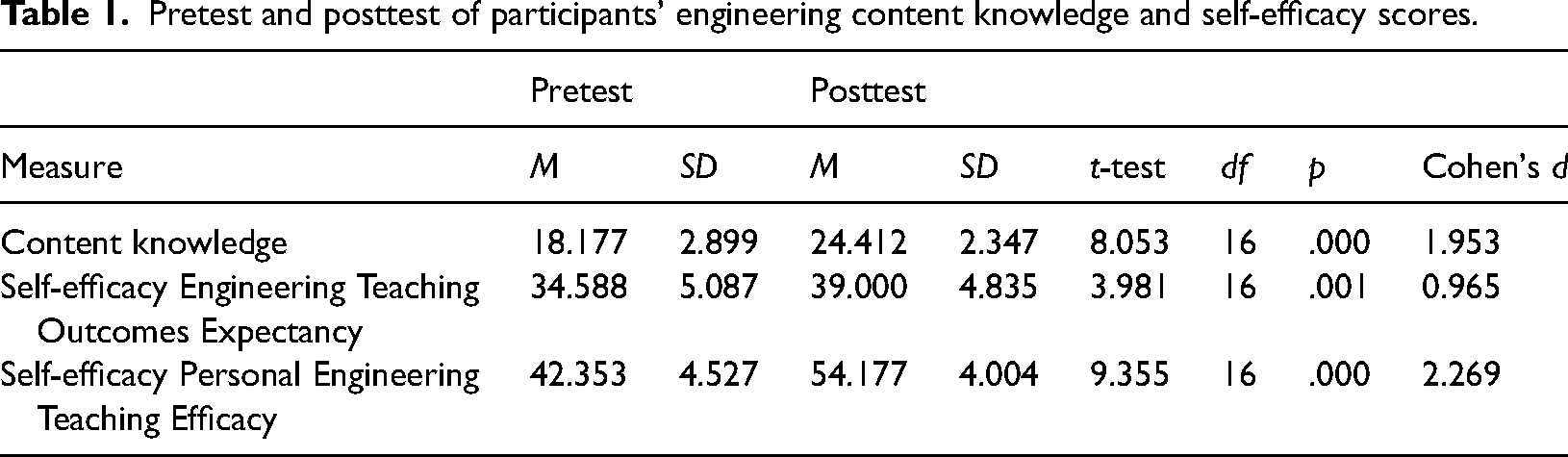
The results from the pretest (M = 18.177, SD = 2.899) and posttest (M = 24.412, SD = 2.347) of the engineering content knowledge measurement indicated that there was a significant increase in the participants’ engineering content knowledge at the end of the professional development training, t(16) = 8.053, p < .001, with a huge effect size, Cohen's d = 1.953 (see Table 1).
Pretest and posttest of participants' engineering content knowledge and self-efficacy scores.
Engineering teaching self-efficacy
Overall, there was a significant increase in the participants’ engineering teaching self-efficacy after attending the week-long professional development training. Specifically, the results from the pretest (M = 34.588, SD = 5.087) and posttest (M = 39.000, SD = 4.835) of the Engineering Teaching Outcomes Expectancy measurement indicated that there was a significant increase in the participants’ engineering teaching outcomes after their participation in the professional development training, t(16) = 3.981, p = .001, with a large effect size, Cohen's d = 0.965. For the Personal Engineering Teaching Efficacy subscale, the results from the pretest (M = 42.353, SD = 4.527) and posttest (M = 54.177, SD = 4.004) indicated that there was also a significant increase in the participants’ personal engineering teaching efficacy, t(16) = 9.355, p < .001, with a huge effect size, Cohen's d = 2.269 (see Table 1).
Engineering teaching confidence
In addition to significant increases in their knowledge and teaching efficacy, the participants in the current study reported increased confidence levels. The participating teachers admitted at the very beginning that engineering caused apprehension and they were a bit overwhelmed by it; by the end of the professional development training, many were confident enough to state that “I am an engineer!” They had a better mindset towards engineering and felt more confident teaching engineering activities to young children. For example, Nicole said: It makes me feel more confident in doing this. It gives me a different mindset that when I’m looking at something [classroom material], I’m looking at it differently now and I’m, like, “Oh, there's a resource right there [for teaching engineering].”
When Kari was asked if she was confident in teaching engineering activities, she said with no hesitation: “Yes, because you gave us such a strong foundation to go back and take these [what we've learned] back with us.” Mary explained: I never thought that I would think or even consider teaching engineering, because I thought it was so difficult … but now, after this training, I feel very confident that I don't have to know everything. Based on what I’ve learned, I know I’m going to be using it to teach.
Diana also felt confident and shared the following observation: Now I have a more clear vision of how to present this … So, I think what was talked a lot about is that word “intentionality,” and I really feel strongly that that's what I came out with. I can do this and now I can present this confidently.
To answer the second research question—“What aspects of the professional development did the participants find beneficial in preparing them for engineering activities with young children?”—the interview responses and daily conversations were examined. The results show that the overall learning experience was very inspiring and encouraging. Specifically, these participants learned many instructional strategies, especially cross-curricular ideas for implementing engineering activities in their classrooms. The participants had a better understanding of engineering vocabulary. They demonstrated an eagerness to learn more about engineering for young children. They visualized their classroom materials in a different way and had a better concept of how to transform classroom materials into engineering activities. Here are some of the comments shared by our early childhood educators.
Shery liked the idea of integrating engineering into art activities and remarked: I really like the way that we have an art center in our classroom and it's pretty much open[-ended]. I like the idea that we can bring some science and some art into the engineering project and work that center a little differently.
Terry loved using books with engineering activities: The book of engineering was my favorite and, like I’ve mentioned before, I would read books to the children, but now it's set to a new level, higher level, because I am able to put that learning engineering design into perspective with the books that I’m going to be reading and it's just awesome … awesome.
The participants had a better understanding of engineering vocabulary and used more engineering terminology during the interview conversations after participating in the professional development training. Shery explained: “I think I would have been at first intimidated by the terms ‘STEM’ or ‘engineering thinking’. ‘Oh no, this is not my wheelhouse.’ But [now], no, very doable at all ages.” Caren echoed Shery's comments: “The vocabulary part, so I think a lot of us probably do some of these things to some level already, but knowing how, like just incorporating the vocabulary for them, is a strong skill [for me] to have.” Jenn had the same experience and remarked: “I think that all my children are always doing engineering in the classroom. But now I have the basis to give them the vocabulary to go with that. So, my whole experience was getting that vocabulary.”
Susi shared a strong statement about the importance of having a common language that young children could understand and communicate to engage them in learning: I think the thing about language is that it has to be common, so if we know what we’re talking about, then we pass it on to them, then our communication is going to be on the same level. I want to reach out to the class on the level that they are because of their ages, but now it's easy enough to say, “OK … we need to do a blueprint” while we’re going to know what a blueprint is … we don't have to fumble for words. We will know what we’re talking about.
In response to the interview question "what would you like to learn more about engineering for young children?", the participants not only emphasized the importance of starting engineering activities at a young age but also demonstrated an eagerness to learn more about engineering so that they could guide young children to be engineers, with equal exposure opportunities for boys and girls. For example, Sharl observed: “I’d like to see more civil engineering, more of the art and science brought into it. I think that would be an expansion. It would be beneficial to everybody.” Kristy indicated: I would probably be interested in the different branches of engineering, and so what does that look like? So, if I was doing electrical engineering or this circuitry, how would that look like and what would be my next step?
Jenn emphasized equal opportunities for children to learn engineering: I think, as for society, I mean, if we start them young, then everybody is not going to be looking, like, “Oh well, you’re a woman. You know we shouldn't be doing stuff like this.” So, I think starting them young will help them understand that everyone can be an engineer. I can be an engineer; I can be a scientist—whatever you want.
Leisha echoed Jenn's comments: Equal opportunity for exposure is just so lacking right now, and, you know, kids grow up with all these stereotypes and then as adults we have all these fallacies in our brain that we really have to break down in order to be able to even teach them these things. We’ve got to teach ourselves before we can give them this new mindset.
Discussion
This research project examined the impact of an intensive summer professional development series on early childhood teachers’ content knowledge of engineering and their attitudes and self-efficacy towards teaching engineering. The results show that this group of early childhood educators’ knowledge of engineering did increase significantly as a result of the professional development. This finding is consistent with Webb (2015) and Matthew (2019), who found that participants had statistically significant gains in content knowledge of engineering after participating in the professional development. The results also show that there was a significant increase in the participants’ positive attitudes and self-efficacy in teaching engineering. This finding is evident in previous studies (DeJarnette, 2018; Matthew, 2019; Nugent et al., 2010; Webb, 2015), in which researchers discovered that participants developed more positive attitudes towards teaching engineering and their self-efficacy also significantly increased after receiving professional development training. This study contributes to the body of evidence that through participating in professional development in engineering, early childhood teachers gain knowledge of engineering, especially engineering vocabulary and cross-curricular instructional strategies. Specifically, in this study, they had a better idea of integrating art, science, language, and engineering into the curriculum they were currently teaching. They also learned ways to adapt and modify classroom resources and materials to fit into integrated engineering learning activities for young children.
Most importantly, this study provides an example of an effective approach to enhance early childhood teachers’ preparation for teaching the subject of engineering to young children. This approach involved a well-structured professional development series with workshops, hands-on learning opportunities, observations, and immediate implementation of the skills obtained from the workshops with supplied resources. This professional development not only provided the teachers with engineering instructional strategies and resources, but also subsequently gave them opportunities for daily practice and implementation of what they had learned in an active classroom setting with children. It seems that this tri-purpose model—knowledge, resources, and application—was an effective learning experience for all of the participants. These three elements seemed to be crucial to ensure that the participants successfully comprehended the content knowledge and practiced their instructional skills. The participating teachers felt empowered by the straightforward and realistic ways in which the engineering content and pedagogical knowledge were conveyed.
Another interesting finding, commonly reflected by the participating teachers, is that this group of early childhood teachers were fascinated to see that these preschool children (not only boys, but also girls) were competent in engaging in engineering learning. Therefore, the participating teachers were encouraged to design and implement engineering activities in their own early childhood classrooms. As confirmed by Kropp (cited in DeJarnette, 2018 ), engineering is not too difficult for preschool children and they naturally try to fix things to suit their desired goal. This study was extremely important because it assisted in correcting the common misconceptions that early childhood teachers may have with regard to young children and provided them with clear evidence that all preschool children are capable of engineering. From this perspective, the study definitely followed the call to “increase awareness of young children's competence in early engineering” (English, 2018: 280).
Implications
The findings from this study suggest that implementing a well-structured professional development program that focuses on engineering knowledge, resources, and application could significantly improve early childhood educators’ knowledge, enhance their attitudes, and increase their confidence levels. At the same time, the study also highlights a problem that we are currently facing: early childhood teachers might lack adequate preparation to teach engineering. As indicated in previous research studies, early childhood teachers may be lacking in preparedness in teaching engineering, therefore their confidence in teaching engineering is low (Crismond and Adams, 2012; Nadelson et al., 2013; Nadelson and Seifert, 2017). This might be true due to insufficient professional learning opportunities and a lack of resources (English, 2018). It might be necessary and important for schools across all levels to develop and provide appropriate and intentional STEM courses to engage all students in learning STEM subjects, with a special focus on engineering in the early years (Bagiati and Evangelou, 2011). These STEM courses and activities should be meaningful, relevant, and designed at different levels, from simple to complex, to allow for scaffolding and mastery of these subjects.
It appears that there is also a need for early childhood teacher education programs to provide comprehensive STEM courses, focusing on supporting and preparing pre-service teachers in teaching STEM subjects to young children. This said, continuing education for early childhood teachers, such as professional development opportunities, may be a more practical avenue to ensure that they keep up to date with the latest knowledge and instructional strategies in teaching STEM. However, it seems like quality engineering professional development is rare and difficult to find, which is problematic, since engineering skills need to be established in the early years (Katehi et al., 2009). More studies need to be done in the future to focus on engineering learning experiences among young children in kindergarten and preschools. Studies regarding effective professional development for early childhood educators in STEM subjects might also be needed.
Most importantly, early childhood educators who struggled in STEM subjects in their learning experience may also require a growth mindset to gain confidence in trying new things with children. As El Nagdi et al. (2018: 11) suggest: “STEM teachers need to be flexible, open to change, collaborative, problem solvers, and aware of the recent trends in teaching and learning.” Educators who are willing to allow their perspective to be shifted can have their eyes opened to a whole new world of possibilities in their classroom (Gold et al., 2015). These are the kinds of educators who can implement creative and integrated engineering in their curriculum and classroom.
Limitations
Some limitations must be acknowledged. First, this study examined professional development among a small group of early childhood teachers, therefore the findings cannot be generalized to a large population. Second, a longitudinal study would be more meaningful in terms of examining the long-term effects of this professional development training on the early childhood teachers’ content and pedagogical knowledge, as well as their attitudes towards teaching engineering in their classrooms.
Conclusion
In conclusion, this study is significant for the early childhood education field for the reason that the professional development was appropriately designed based on the need to (1) teach the engineering design process in a way that could be easily adopted by early childhood teachers in their classrooms (Estapa and Tank, 2017); (2) incorporate developmentally appropriate experiences that provided pedagogical support (Gadanidis et al., 2016); and (3) integrate engineering into other subjects, such as mathematics, the arts, and reading. The results of this professional development were effective and meaningful. The teachers who attended the intensive summer professional development training significantly increased their content knowledge of engineering, improved their pedagogical skills, and enhanced their confidence levels in teaching engineering. More research might be needed on the implementation of STEM in early childhood classrooms and the long-term effect of professional development on early childhood educators’ content and instructional knowledge of engineering for young children.
Footnotes
Declaration of conflicting interests
The author(s) declared no potential conflicts of interest with respect to the research, authorship, and/or publication of this article.
Funding
This work was supported by Stephen F Austin State University (grant number 2020-039).
