




Abstract
The global growth of makerspaces, focusing on STEM (Science, Technology, Engineering, Mathematics) disciplines, supports participatory child-centred learning and fosters essential skills in areas such as creativity, critical thinking, and collaboration. We argue that establishing a makerspace pedagogy in schools fosters children’s engagement in digital/technological learning in a way that is in-keeping with the creative practices of the early years. This paper reports on findings from a research project that took place in one local authority in the north of England focusing on the educational implications of makerspace participation for young children and teachers. The project explored children and teacher engagement with a ‘MakerBox’ containing a story sack, language and maths activities and maker activities in 17 early years classrooms (Nursery and Reception). As a way of recording children’s learning we devised the Makerspace Learning Assessment Framework (MLAF) based on the Characteristics of Effective Learning (CoEL). This framework has been developed as a way of supporting teachers to assess children’s skills, knowledge and understanding when participating in makerspaces in a child-centred and holistic way. Through interviews with teachers, we explored their perception of the educational implications of makerspaces for children’s learning and their own professional development. Our findings indicate that engagement in makerspaces enhances children’s learning experiences as evidenced by the CoEL and positively impacts teachers’ STEM knowledge and practice. We conclude that makerspaces offer an holistic, child-centred approach to learning and skill development, aligning with early years creative practice and teacher professional growth.
Keywords
Introduction
In the most recent iteration of the English Statutory Framework for the Early Years Foundation Stage (EYFS) (Department for Education [DfE], 2021) the Technology strand of learning has been removed so there is no longer a curricular requirement to teach children how to use digital tools in the early years classroom. In the government’s consultation response to the revised EYFS, it was highlighted how the early years workforce were consistent in their view that ‘the removal of technology as an ELG [Early Learning Goal] would be a negative step’ (DfE, 2020: 14). Early Childhood Education (ECE) policy in England has seen a persistent narrowing of the curriculum with an increasing emphasis on reading, writing and phonics (Marsh et al., 2019: 231). There is a risk that if technology skills are not being assessed in the revised EYFS then there will be limited expectations for children’s use of technology, and they will not be taught the skills to use digital tools effectively and appropriately (Faulder, 2021). Mertala (2019: 1230) argues that a classroom without technology ‘fails to meet children’s changing educational needs’, which are driven by an increasingly digitised society. It is therefore imperative that early years classrooms maintain an approach that fosters children’s technological skills, interests and understanding so they are well-prepared for their educational and vocational futures. Furthermore, by recognising children as competent and active agents, teachers should develop opportunities to up-skill children’s technical ability through sound pedagogical principles that support curiosity, motivation, and critical attitudes towards digital technologies so that they can be used creatively and responsibly (Gillen et al., 2018).
One pedagogical approach that has been an emerging focus in ECE is the ‘makerspace’ movement which clearly aligns with STEM learning using technology as well as supporting children to engage in engineering type processes (Johnston et al., 2022). STEM (Science, Technology, Engineering and Mathematics) disciplines are often viewed as ‘separate domains of knowledge’ connected through the role they play in the job market of the technological world (Isabelle and Valle, 2015: 2). In the current educational climate, there is an increased interest in STEM design and making activities on a global level as a way of developing participatory child-centred learning which is driven by children’s interests and fosters creative ways of engaging with STEM (Leskinen et al., 2021). Facilitating a makerspace pedagogy enables children to acquire STEM knowledge and develop important skills such as collaboration, problem solving and critical thinking.
Makerspaces and the characteristics of effective learning
Makerspaces align with the traditional play-based philosophies of early childhood in particular the Characteristics of Effective Learning (CoEL) that underpin teaching and learning in the EYFS in England. CoEL are included in the EYFS and describe behaviours children use to learn and make good progress:
Playing and Exploring: finding out and exploring; playing with what they know; being willing to ‘have a go’.
Active Learning: being involved and concentrating; keeping on trying; enjoying achieving what they set out to do.
Creating and Thinking Critically: having their own ideas; making links; choosing ways to do things and finding new ways.
As a way of observing children’s learning during their participation in makerspace activities we have formulated the Makerspace Learning Assessment Framework (MLAF) (Appendix A) which builds on the CoEL assessment framework devised by Bristol Learning City (BLC, 2017). The aim of the framework is to give focus to child observations, as key characteristics are specified for the observer to look out for. We used the BLC CoEL assessment framework in an after-school makerspace project (pre-pandemic) that took place in a community centre in the north of England to observe children (aged 3–10 years old) participating in makerspace activities. Using this framework, we were able to record and analyse the ways in which children displayed CoEL during these activities. We then adapted the BLC CoEL assessment framework to align with what we had observed by adding specific questions linked to making and design. Creating and Thinking Critically was split into two elements, given the significance of both in makerspaces. A separate section was also included, labelled ‘Creativity and Design’. A ‘Social Learning’ section was added to record social interactions in makerspaces. The framework enables the observer to highlight the question prompts as they emerge during the activity and record more detailed observation notes. It is important to note that whilst these prompts are useful to help frame makerspace observations it is not an exhaustive list and other behaviours may also be recorded.
There are three significant reasons for adapting the BLC CoEL framework as a makerspace assessment tool. Firstly, in England where the research took place, teachers in the early years will be familiar with the concepts of the CoEL. Secondly, Tickell (2011: 87) highlights how the CoEL describe ‘how children learn rather than what they learn’. As an assessment tool, the MLAF contrasts with more formal and standardised ways of assessing children and aligns with the ‘process not product’ philosophy of the makerspace movement (Buxton et al., 2022). Thirdly, the MLAF is a tool that provides a focus for teacher observations helping to identify key characteristics of children’s learning when they participate in maker activities. Whilst this approach aligns well with the Early Years Foundation Stage assessment requirements, these characteristics are universal and there is potential to inform approaches to makerspace assessment in primary aged children.
The benefits of young children’s engagement with STEM are ‘often intangible and difficult to measure’ and, as such, there is limited empirical research on the impact of makerspaces on children’s learning and development (Strawhacker and Bers, 2018: 2). This article seeks to address this gap in literature and understand how the Characteristics of Effective Learning (CoEL) can be developed through children’s engagement with STEM focused makerspaces.
Literature review
The importance of STEM learning in Early Childhood Education
The development of the ‘global knowledge society’ and the prevalence of Information and Communications Technology (ICT) in contemporary society makes the acquisition of digital and technological skills a necessity for children and young people. The ability to search and evaluate information, solve problems, exchange ideas, and develop ideas in a digital context are perceived as essential skills for future employment (van Laar et al., 2017: 578). Ferrari (2013: 2) argues digital competence is imperative to ensure that all citizens can actively participate in society. It is also recognised by educators and industry experts that the development of a pupil’s STEM knowledge, and the ability to apply STEM concepts and skills, is crucial to children’s future success (John et al., 2018). Intertwined with these digital competencies are other transversal 21st century skill sets, including ‘critical thinking skills and learning-to-learn, interaction and expression, multiliteracy, working life skills and entrepreneurship, as well as social participation and influence’ (Blum-Ross et al., 2019: 3).
Marsh et al. (2019: 230) assert that makerspaces are important in ‘moving early years practice on to ensure that children develop the dispositions and skills required for 21st century leisure, culture, and employment’. Makerspaces also have the capacity to support children’s interpersonal and intrapersonal development by providing opportunities to ‘cultivate a strong personal identity through building, maintaining and leading their community’ (Strawhacker and Bers, 2018: 3). A systematic literature review that aimed to identify the main themes around the STEM experiences of young children reports numerous benefits of implementing a makerspace pedagogy in the classroom (Johnston et al., 2022). Alongside academic development, findings from the review also highlight the benefits of collaboration, self-efficacy, confidence, positive attitudes towards STEM subjects, and the potential to challenge systemic inequalities in society.
Makerspaces as a pedagogical approach
As a pedagogical approach, makerspaces align well with early years curricula and philosophies of learning and are a valuable way of teaching young children STEM skills. They provide opportunities for children to play in a constructive way in an environment that encourages ‘curiosity, exploration, risk-taking and creative freedom’ (Burke and Crocker, 2020: 2). Based on a constructionist approach, makerspaces adopt project-based inquiry where children are viewed as agentic inventors/engineers/scientists engaging with hands-on experiential learning experiences and real-world problems (Hachey et al., 2022). Marsh et al. (2019: 226) highlight how makerspaces provide opportunities for children to have ‘maker agency’ as they engage in the exploration of personal interests, acting independently and with volition. This agency has the potential to empower children as they are able to follow deep lines of inquiry drawing on their funds of knowledge (Moll et al., 1992) and life experiences to scaffold both individual and collective endeavours. Shifting the focus from the product, often driven by specific learning outcomes, to the process of making positions exploration and experimentation as being core to the learning process.
Further to the potential for children’s learning, literature on makerspaces also focus on the ‘value of the environment as a teacher’ which is in line with traditional ECE philosophy (Johnston et al., 2022: 11). Makerspaces utilise ‘physical spaces that have been designed or set aside to support the maker in the creation, design, and building of new projects and technologies’ (Blackley et al., 2017: 23). The makerspace environment can be physical or virtual and can include both digital and non-digital tools and materials that provide a vehicle for children to explore STEM concepts (Johnston et al., 2022). Children’s participation in makerspaces facilitates making, creating and innovation and helps develop skills, knowledge and understanding, and an increased interest in STEM subjects (Blikstein et al., 2017). Buxton et al. (2022: 1) assert that ‘As well as equipping children with knowledge and skills in areas such as electronics, digital fabrication, and crafts, makerspaces are also key to supporting other important habits of mind such as creativity, critical thinking and collaboration’. Drawing on Nordic models of relational work, makerspaces enable children to learn together through trial and error with tools, technologies, and arts and crafts while teachers shadow, model, and scaffold with much less direction.
Makerspace pedagogies are a useful and appropriate way of working with young children to develop their technological and digital skills through creative and collaborative ways. It is therefore important that teachers have the knowledge and confidence to be able to implement this approach in the classroom.
Teacher skills and knowledge of teaching STEM subjects
Research has consistently highlighted pre-service teacher training and professional development opportunities around the STEM domains are insufficient, leaving teachers underprepared to teach these subjects (Çiftçi et al., 2022; Ingleby, 2015; Johnston et al., 2022). Coe et al. (2014) argue that teachers with deep subject knowledge are the most effective and that when this knowledge is lacking there is a serious impact on students’ learning. Furthermore, positive teacher attitudes towards children’s STEM learning and development are an important pedagogical catalyst (Wan et al., 2021). Johnston et al. (2022: 2) assert that while mathematical and scientific concepts are encountered by children in their daily experiences, there needs to be greater intent in pedagogical approaches to ‘build conceptual knowledge as well as positive attitudes and dispositions towards the STEM domains’. It is therefore important that teachers have the knowledge to support children’s STEM development in a way that is creative, playful, and affective.
A systematic review of international empirical studies focusing on ECE and STEM education highlights the following challenges when implementing these subjects in the early years classroom (Wan et al., 2021: 949–950). The first is constraints on teacher time which can result in children having to stop working on their STEM activities when they are at the ‘peak of their learning’. A prioritising of children’s reading skills leaves little or no time to focus on children’s STEM skills. A lack of resources and appropriate tools are also a challenge for teachers due to insufficient funding as well as working with student diversity in terms of developmental levels and different educational/STEM needs. Finally, the review reports that the lack of professional training means teachers lack STEM knowledge resulting in ‘teachers’ low self-efficacy to implement STEM in their classrooms. The implementation of makerspaces in an English context seeks to address some of these challenges and investigate the impact on teachers’ STEM knowledge and practices. As Jones et al. (2020) assert, there is a need to understand teachers’ perceptions about integrating maker type activities in the classroom and to develop effective teacher professional development experiences in maker-centred learning. Our project responds to this call and extends current research knowledge on the potential of makerspaces to enhance teacher knowledge, understanding and competence when teaching STEM subjects to young children.
Methodology
The aims of this research were to explore the educational implications of makerspace participation for young children with a focus on CoEL and to develop early years teacher knowledge in STEM teaching and learning. The research questions addressed in this paper are as follows:
How can children’s learning (as demonstrated by evidence of the Characteristics of Effective Learning (CoEL)) be developed through their engagement in STEM-focused makerspaces?
What is the impact of a STEM -focused maker project on teachers’ STEM knowledge and practice?
The MakerBox project was initiated by a local authority in the north of England as part of a wider intervention that focused on enhancing children’s outcomes in the early years with an emphasis on language and literacy. The area demographic is predominantly white and is listed in the Indices of Multiple Deprivation (National Statistics, 2015) as one of the most deprived local authorities in England. The local authority identified the settings they wanted to be involved and three intervention projects were offered. A brief was developed for the MakerBox project that outlined its aims and procedures and this was circulated to the chosen settings along with briefs for the other projects. Seventeen early years settings chose to be involved in the MakerBox project.
Teachers from the settings attended a full day of professional development in which they were introduced to the project team’s research on makerspaces in the early years. Participants were also provided with guidance on using sets of maker resources placed in MakerBoxes, based on the traditional early years resource ‘story sacks’. The MakerBoxes were thematic and typically contained:
A picture book
A non-fiction book
A set of toys and props to facilitate small-world play
A language game
A mathematics game
Two maker activities
An example of the contents of a MakerBox can be found in Figure 1.
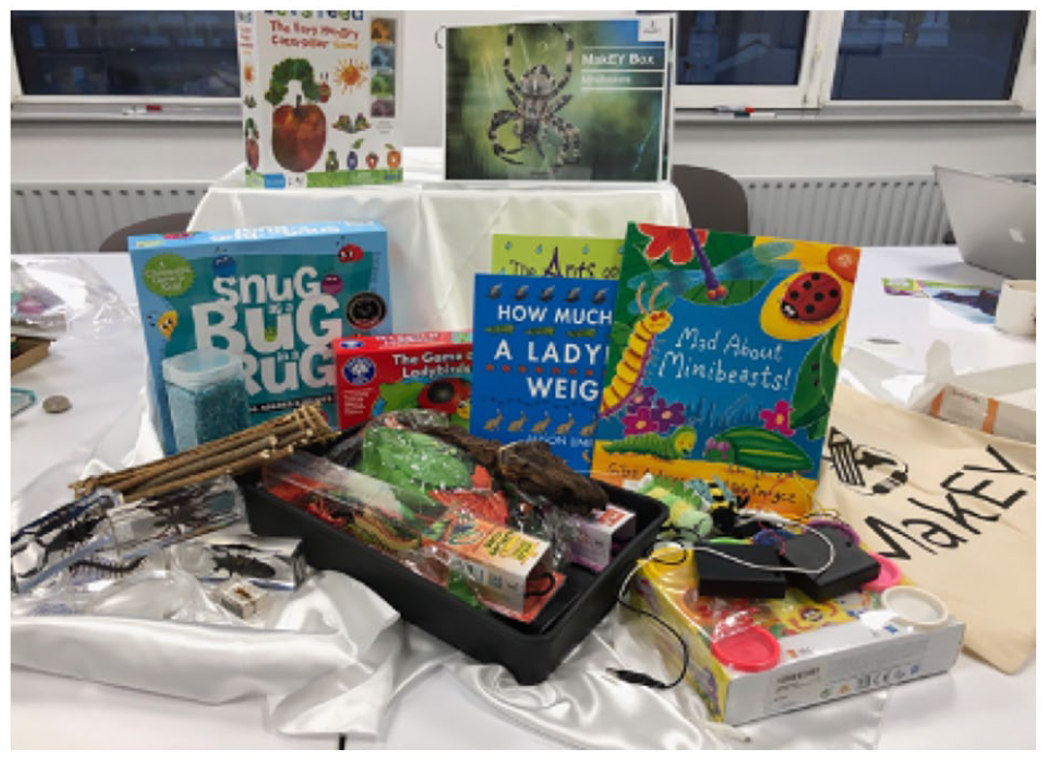
Minibeasts MakerBox.
The MakerBoxes were loaned to the settings. Settings also had access to a 3D printer. The teachers were given a set of maker resources by the local authority to enable settings to set up their own maker activities once they had finished using the MakerBoxes.
At the end of the project, teachers took part in individual semi-structured interviews which are an effective way of capturing participant reflections and experiences (Kvale and Brinkmann, 2015). The interviews enabled the research team to discuss the teachers’ observations of children’s learning and engagement with the MakerBoxes, Teachers were also given the opportunity to discuss the impact on their professional development and the challenges they encountered. Ethical procedures were guided by BERA’s (2018) guidelines and University of Sheffield procedures. All teachers were asked to sign consent forms after discussing the ethical issues on the training day and all names have been changed to protect anonymity.
The first part of the analysis involved reading through the transcripts to become familiar with the data. The transcribed interviews were thematically analysed (Braun and Clarke, 2006) using colour codes to highlight examples in the data linked to the following categories:
Active Learning - concentration, keep on trying, pride in achievements (blue)
Playing and Exploring - investigation, experience, having a go (green)
Creativity and Design - developing ideas and strategies, making links (yellow)
Critical Thinking – solving problems, questioning, use initiative (pink)
Social Learning – collaborate, listen to ideas of others, support learning of others (grey)
Teacher - knowledge and impact on practice (orange)
Challenges (red)
Colour coded statements were then collated into seven separate documents. The final phase of the data analysis involved working through the collated data in each category to identify consistent themes evidenced by specific examples. The categories and themes will be discussed in the following section.
Findings
The findings illuminate observations about children’s learning in relation to each of the CoEL (Active Learning, Playing and Exploring, Creativity and Design, Critical Thinking and Social Learning). This section will highlight extracts from the interview data which demonstrate the CoEL observed when children participated in the makerspaces. The benefits of participation in the project for teachers’ professional development and the challenges of undertaking makerspace activities with young children will also be discussed.
Active learning
Active learning encompasses dispositions such as being absorbed in learning, demonstrating a sense of purpose, persistence, and pride in achievements. Prevalent in the interview data were examples of children maintaining concentration and evidence of perseverance. Teachers explained how this was particularly noticeable for children who found it difficult to focus their attention on one activity:
. . . for the little ones, particularly the ones that flit a lot from activity to activity, because they’ve been engaging in those kinds of activities their attention, that’s grown . . . they’ve been able to spend more attention . . . because they’re genuinely interested by the activity (Klara)
Teachers also observed how children were much better at persevering with a task rather than ‘giving up’ (Michelle, Amy) especially when they could not get something to work:
. . . just having that tenacity to keep going and that problem-solving, growth mindset kind of aspects to things, and you know ‘can we puzzle this out’ (Jasmine)
One teacher also relayed an anecdote about her own persistence when she could not get her light bulb to work and how she worked with the children and another colleague to solve the problem collaboratively:
. . . I was like ‘right guys, so this is how you make the play dough light up’ and my bulb wasn’t lighting up and I was like ‘maybe I’m doing it wrong, oh my goodness I’m doing it wrong’ . . . so we all had to work together . . . we had to work our way through and we were like ‘oh that’s how you do it’ . . . so I think that’s what it is, I think it’s about having a go, don’t be scared, just do it (Kerry)
Laura reported children participating in the maker activities were more ‘resilient’, ‘not afraid to fail’ and had a willingness to ‘take control of their own learning’.
Playing and exploring
The Playing and Exploring CoEL focuses on children exploring the world around them, demonstrating a ‘can do’ attitude, being eager to try new ideas and unafraid to make mistakes.
Teachers reported multiple examples of this CoEL which also impacted on other aspects of children’s learning and dispositions within the classroom. Experimentation was a dominant theme across the interview transcripts, but teachers also spoke of the wider implications of children being allowed to explore:
. . . it’s self-esteem building. For some children, it gives instant results. So, they can take the clip off, they can put it on, they can take it off. And for some children I saw that going for a long time. It was that fascination of ‘oh my goodness, if I take it off the circuit’s broken, if I put it on the light shines on’ . . . (Mia)
The freedom to tinker and play through trial and error, without the need for accountability or assessment, seemed key to developing children’s confidence in an open and autonomous way.
Another common theme running through the data was that the open-ended nature of the activities meant they were not driven by outcomes or the final product. It was the ‘having a go’ and letting the errors happen so the children ‘work it out for themselves’ (Kate) that was important to the teachers:
. . . they’ve certainly learnt about electricity and simple circuits . . . just a sort of trial and error . . . experimenting with things, finding out what works and what doesn’t work and talking about why. And making predictions, what they think might happen if they do certain things (Lindy)
Kate also explained how the activities were inclusive of children with limited English language ability as they ‘did not need to communicate a lot’ but allowed them to be ‘just as involved by listening and sharing’. Teachers observed how girls were engaging with the activities when perhaps before they would not have got involved, with one teacher commenting ‘it was nice to see the girls having a go at something that perhaps they wouldn’t have chosen’ (Kathryn).
Creativity and design
Creativity and design encompass skills such as using resources in a creative way, adopting and adapting ideas accordingly, using previous experience to develop solutions, and adjusting goals based on suggestions.
Teachers reported across the dataset how the makerspaces allowed children the space to come up with new ideas based on their previous learning around electronics and technology. In one activity, the class was making a Christmas tree and one child wanted to ‘put the bulbs through the artwork for the lights’ (Melanie). Another example demonstrates how children incorporated their knowledge of simple circuits and lights to enhance their fairy doors they had made:
. . . we did some work about fairies that the children were interested in, so we had some fairy doors and because they’d had the experience of the circuits and lighting the bulbs up it was their idea that they made like lanterns for the fairies because it was going to be dark (Katriona)
Alongside supporting children to come up with new ideas, participation in the makerspace activities also helped children ‘apply their skills using their own ideas’ (Libby) based on what they had previously learned. One teacher spoke of a child who turned one of the scribble machines (a cup with a motor and pens attached that scribbles when activated) into a lighthouse which sparked other children’s interest:
. . . he put the light on top and he said, ‘oh it reminds me of a lighthouse’. Well that was it then, they were all trying to make a lighthouse. So, like they’re still the circuits but they adapted their own learning . . . so there’s a lot more communication between the children (Lelia)
The children’s learning also spilled into other aspects of the continuous provision on offer in the classroom:
. . . they’ve absolutely loved doing the simple circuits and the LED lights . . . and then they’ve wanted to adapt it into their own junk modelling. So if they’ve made flashing eyes or whatever, they’ve wanted to make a robot that’s got flashing eyes. And they’ve used it with the play dough. So it can be used in lots of different areas (Lindy)
Children demonstrated ‘making their own big links’ (Melanie) with other aspects of their learning during these activities, relating to their life experiences:
. . . a little boy . . . who isn’t the most engaged in learning, but my goodness with the motor, he was telling me all about his dad’s machines at his farm and how he turns it on with a switch (Lottie)
Amy also reported children were using their imaginations much more pointing out ‘. . . the boys are getting more imaginative with what they’re building’, and ‘. . . the girls are learning more like how to build rather than just using their imagination, so they’re thinking more of a finished product’.
Critical thinking
Critical thinking skills include such attributes as using initiative, demonstrating curiosity and innovation, solving problems, extending their own learning, and adapting methods to solve problems and work with their own ideas.
There were several interesting examples of children exercising their critical thinking skills when participating in the makerspace activities, including problem-solving and not giving up when things did not work the first time. One teacher relayed how a boy who sometimes faces challenges at school had filmed a puppet show using the green screen with the Teaching Assistant but when they watched it back the puppet was not visible on the video. The Teaching Assistant asked why they could not see the puppet, but the child did not know so they filmed it again, and the puppet was still not visible. The boy said ‘Oh! The puppet is green - I need to use a different puppet!’ (Lesha).
There were examples of children extending their learning and negotiating with others during a rocket making activity:
I do think they learned a lot about negotiating with each other to get something to work. And also, when they were making the rockets and everything was out . . . asking ‘what would be useful’, ‘do I really need that’, ‘could someone else use it’ (Jasmine)
Over time children moved beyond curiosity about the resources and equipment and started to plan their ideas more carefully, sharing ideas and deciding what tools they need to be successful in the activity. Kate reported children began to make suggestions and ask questions such as ‘what shall I do next?’, ‘I want to do this but what do I need?’ and ‘I wonder what we could do to do that?’
Social learning
Social learning includes skills such as listening to and building on the ideas of others, supporting each other’s learning, and seeking help from others. Teachers reported that makerspaces encouraged children to develop their social skills by enabling them to get involved with other children through participation in the activities. There were also examples of children and teachers working as a team and helping each other to solve problems and achieve goals:
. . . we were all learning together. I don’t think they particularly struggled with anything because we were sort of tinkering all together . . . the children helped us, and we helped them, so it was a bit of a team effort (Klara)
Teachers also saw the benefit of language development in the social aspect of learning:
I think they’ve learnt to actually be able to talk about what they are doing . . . they can actually stand up and say and explain what they’ve done to other children. So, their language skills are a lot better (Nicola)
Children were also observed helping each other in their learning through problem-solving and modelling, especially when the child had already mastered the skill. Melanie commented that it was a ‘very powerful way of learning for the children who felt less confident’.
Teacher knowledge and impact on practice
The project had a positive impact on teacher knowledge and understanding and all agreed that the project had been beneficial for the children. They all stated that they would be more likely to plan for a makerspace in their setting than was the case prior to the project. Teachers enjoyed co-constructing knowledge alongside the children and the activities helped to shift the mindset that it was OK if things did not work the first time. The children also recognised that everybody was learning together and ‘absolutely loved that aspect too’ (Melanie):
It’s definitely about ‘we’re learning this as well, isn’t this exciting’ you know ‘we’re not the experts, we’re learning this alongside you’ (Mia) . . . being willing to have a go at something that maybe is a little bit out of your comfort zone, you know doing things with children that has that element of not going right (Jasmine)
All of those interviewed also stated that the project had developed their professional practice, including improving STEM knowledge and skills. Teachers reported across the dataset that participating in the scheme had provided them with ideas for activities to do with the children, and they also sourced inspiration from elsewhere, including Pinterest and Facebook. Resources were used in a more mindful, purposeful, and meaningful way and teachers shared that they were more adventurous in their approach to STEM learning in the classroom:
. . . it’s just given me more ideas of what we can provide for the children in the provision. And I think just being mindful of technology and how sort of competent really young children can be with it (Lindy)
One teacher commented on how much they had learnt about technology and engineering by ‘encouraging children to take things apart and to try and figure out how to put things back together’ (Katie). Lorraine described being involved in the MakerBox project as ‘the best professional development’ as it was a way of ‘engaging with the children to move practice forward’.
A dominant theme across the transcripts was the revelation that children are more competent than they are often given credit for with one teacher stating, ‘it’s far surpassed what I’d expect them to be able to do’ (Michelle). Involvement in the makerspace activities helped teachers to get to know the children better in terms of what they are capable and ‘how much they can take on’ (Kathryn) if given the time and support to practise the skills:
I think that probably they are capable of doing these things that sound very difficult, but actually it’s not if they are given the time and that facilitation from an adult and the materials, and the challenge is to be able to do that. Which is something that we don’t normally have in school . . . so having these extra opportunities has been positive (Zara)
Teachers also highlighted how being involved in the project had increased their confidence teaching STEM subjects and utilising the resources:
I love it. I just think the learning opportunities it provides has enriched my confidence and what I will now put into practice . . . I personally probably wasn’t confident to have a go at but now really feel informed and inspired to lead into other activities. So yes, I’m bubbling still with the excitement from it (Lorraine)
Settings found it a useful way of engaging with parents, with some sending home maker activities for children and parents to complete together and holding workshops for parents to attend. One setting sent home ‘maker packs’ over the holidays so children could do activities with their families, and parents were also asked to bring in old electrical equipment the children could use to take apart and tinker with.
Many settings stated that they were intending to continue makerspace provision beyond the project. For some settings located in or with primary schools, this included extending the maker provision to classes of older children. In addition, some settings had developed additional MakerBoxes, drawing on their own library of picture books.
Challenges
Whilst the project was beneficial overall, several challenges were identified by the participants. The 3D printer was a source of frustration as several teachers could not get it to work and did not have the technical skills to fix it, relying on the IT technician who would usually only visit once a week.
A prevalent theme across the transcripts was the accessibility and age-appropriateness of the resources. Amy described them as ‘a bit fiddly’ whilst Michelle explained:
. . . we want the fine motor challenge for the children that they use a crocodile clip, but their hands are quite small . . . they’ve not got a great deal of strength to press on it to open the crocodile clip.
Laura also pointed out the health and safety implications:
. . . in our big room it’s 2- to 5-year-olds, so some children have literally just turned 2 and to leave the bulbs out all the time would be sort of health and safety.
The difficulties faced by the children often led to adults intervening:
Some of the things that we wanted to do were too hard for them, so we ended up doing them, and then you think well that’s not the point (Julie)
There were also challenges with ‘space and time’ (Julie). Amy highlighted practical challenges such as ‘keeping on top of resources to keep the boxes filled’ and fitting the sessions into an already busy timetable:
. . . having the time and sparing the member of staff to lead it and run it and, you know make sure that we can fit it in with all the other things that we’ve got to fit in in reception class (Libby)
Rosanna echoed this challenge stating she had struggled to ‘fit it into our timetable and routine’.
Discussion
The purpose of this study was to explore how children’s learning (as demonstrated by evidence of CoEL) can be developed through their engagement in makerspaces and the impact of a maker project on teachers’ STEM knowledge and practice.
Observations of the CoELs as children engaged in the makerspaces encompassed the notion of ‘maker agency’ (Marsh et al., 2019) as children were able to make choices over what, when and how they engaged in making. Children demonstrated the ability to adapt their ideas, adjust goals and use their previous experience to come up with solutions to challenges they encountered when using the technology. There were also examples of how children began to extend their own learning, thinking more critically about how they could use the tools and resources and negotiating with each other to get something to work. Children’s demonstration of ‘Social Learning’ in the data aligns with the funds of knowledge work of Moll et al. (1992) which observed how children who had already mastered a skill were able to support other children. The makerspaces encouraged a sense of teamwork amongst the children, and staff as they tried to collectively solve problems and achieve goals. The open-ended nature of the activities meant teachers focused on the process, the trial and error, rather than the outcomes or product.
Providing children with the time to spend tinkering with objects and providing the challenge of getting something to work encouraged perseverance and persistence. Teachers highlighted how the makerspaces were particularly beneficial for children with language delay or English as an Additional Language (EAL) as they were still able to have a go and be successful in the task (whatever form that success might take). Boys were observed being ‘more imaginative’ and teachers also commented on how girls who may not have engaged prior to the makerspaces were more willing to ‘have a go’. Teachers also reported children’s concentration improved during the makerspace activities, particularly for children who tended to ‘flit’ from one activity to another. Observations of the development of these types of skills reaffirms similar findings in the literature (Blackley et al., 2018; Buchholz et al., 2014; Forbes et al., 2021; Jones et al., 2020).
The impact on teacher STEM knowledge and practice was extensive. The data highlighted an overall lack of confidence when delivering STEM type activities in the early years classroom prior to the project taking place. Jones et al. (2020: 698) argue that to realise the benefits of makerspaces ‘teachers must experience maker-centred learning in order to design and integrate these types of activities into their curriculum’. The MakerBoxes encouraged teachers to push themselves out of their comfort zone with the technology and the professional learning was viewed as a co-construction of knowledge alongside the children. The MakerBoxes provided new ideas for the teachers which they were then able to extend using the Internet to inspire further activities. Teachers also started to use resources they already had in different ways (e.g. an Overhead Projector). Many of the settings adapted their continuous provision to include a tinker table with resources on offer all the time. Other settings utilised a trolley system where they stored all the resources, and which could be wheeled to different areas of the classroom. Demonstrated across the interviews was how children often ‘surpassed’ what teachers thought they were capable of when they were given the time, space, and resources to experiment. There were also extensive examples of how the makerspace activities engaged parents including the utilisation of ‘maker packs’ which were sent home during the holidays, and parent workshops to share the makerspace activities. The opportunity to engage fathers was also reported as being a positive outcome to the project.
Whilst the project was successful there were challenges when implementing makerspaces in the classrooms, echoing findings by Godhe et al. (2019: 327) who argue that teachers need to be better supported to ‘make the most of maker technologies’. One challenge was related to resources; for example, one setting commented that the maker activities included in the box were a little too challenging for very young children and this led to the activities being much more adult-led (instructionist) rather than allowing children the time to tinker. Teachers were aware of the health and safety aspect of working with very young children who may put objects in their mouth or struggle with fine motor skills. The findings highlight how accessibility and appropriateness of resources when facilitating makerspaces with very young children needs careful consideration. Several settings also found the 3D printer difficult to use with our further support questioning the educational value of using expensive technical items if they are unreliable and difficult to use. Practical challenges were discussed such as keeping on top of managing the resources in the MakerBoxes. Teachers sometimes found it difficult to find time to do the makerspace activities due to pressures from other aspects of the curriculum such as Literacy and Mathematics, echoing findings from research carried out by Wan et al. (2021). Further work could be done to identify how makerspaces could be used as a vehicle for achieving outcomes linked to these areas of learning. Despite these challenges, overall, the project had a positive impact on children’s learning and their demonstration of the CoEL, in addition to the transformations in teacher knowledge and practice.
Conclusion
The limited scope of the study means that the findings cannot be extrapolated to all young children or all settings. However, the study offers a detailed insight into the use of the MLAF by teachers to observe and record children’s demonstrations of the CoEL whilst participating in makerspace sessions. The findings from the project identify several recommendations to enhance future educational policy and practice. Firstly, there is already a range of creative practices undertaken in continuous provision in the early years, for instance role play provision, independent access to creative resources and free-flow outdoor provision. This could be extended through the integration of STEM activities into the continuous provision, thus averting the need to have a specific set of resources available, such as MakerBoxes. Secondly, there is a need for settings to invest, where possible, in resources which can support maker education. This includes high-tech items such as hardware (e.g. tablets, 3D printers), software (e.g. apps for animation, coding, green-screen filming), maker resources such as woodwork and electronics items. It is important to note that settings need support and guidance on purchasing equipment which is unfamiliar to them, such as electronics equipment. Low tech, cheaper items are also imperative to makerspaces including recycled items, construction paper, cardboard, scissors, glue, clay, textiles, and sewing materials. Alongside resources, teachers also need appropriate professional development opportunities to ensure that they are confident in their STEM subject knowledge. Finally, as more early years settings and schools begin to incorporate makerspaces into the curriculum, assessment processes will need to be carefully considered to ensure children’s learning is sufficiently well documented. Further work can be done to gain perspectives of teachers on the implementation of the MLAF and its effectiveness in identifying CoEL and assessing learning outcomes.
The project also has implications for future research. There is a need to explore in more depth how different groups of children (i.e. EAL, Special Educational Needs, girls) engage in makerspace activities. Tracking differences in children’s responses to makerspaces will help to identify factors which maintain children’s interests. There is also a need to identify children’s making experiences at home to establish stronger links with families and the wider community. It is important to provide opportunities for children to engage in STEM subjects in the early years and makerspaces demonstrate potential in this regard.
Footnotes
Appendix
Makerspace learning assessment framework.
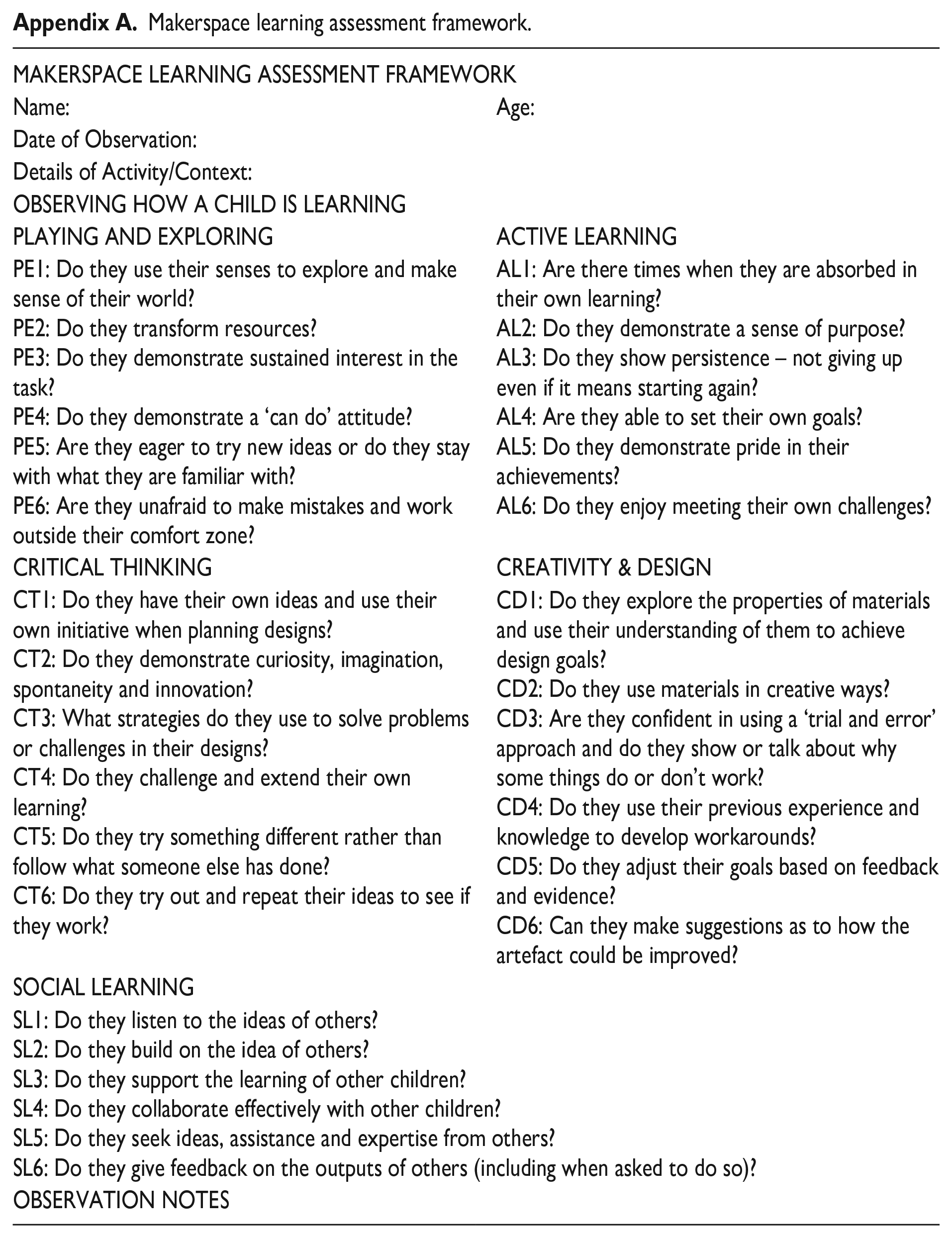
| MAKERSPACE LEARNING ASSESSMENT FRAMEWORK | |
| Name: | Age: |
| Date of Observation: | |
| Details of Activity/Context: | |
| OBSERVING HOW A CHILD IS LEARNING | |
| PLAYING AND EXPLORING | ACTIVE LEARNING |
| PE1: Do they use their senses to explore and make sense of their world? |
AL1: Are there times when they are absorbed in their own learning? |
| CRITICAL THINKING | CREATIVITY & DESIGN |
| CT1: Do they have their own ideas and use their own initiative when planning designs? |
CD1: Do they explore the properties of materials and use their understanding of them to achieve design goals? |
| SOCIAL LEARNING | |
| SL1: Do they listen to the ideas of others? |
|
| OBSERVATION NOTES | |
Funding
The authors disclosed receipt of the following financial support for the research, authorship, and/or publication of this article: This project was funded by the LEA Early Start and Family Service.
