




Abstract
Early childhood teachers worldwide feel that their ability to act according to their professional knowledge and values is constrained. This sense of constraint is commonly attributed to the pressures of accountability policies, aimed at ensuring and improving educational quality. By law, Dutch schools are free to choose how they design their teaching practices. Nevertheless, efforts by the government to control daily teaching practices are encountered in Dutch schools. The generally recognized importance of teachers’ professional autonomy led the authors to conduct an in-depth study on this topic in Dutch early childhood education. They interviewed experienced early childhood teachers in open one-on-one interviews to explore their lived realities. The findings contribute to the discourse on three topics: first, the generally felt forces of accountability stemming from a variety of actors in the school environment; second, the impact of these forces on daily education practice, as well as on teachers’ emotions; and third, the role of the head teacher, who appears to be able to either enforce or inhibit these impacts. The results of the study show that where external forms of regulation and accountability measures are passed on by the head teacher, the negative emotional impact of the pressures is high. For head teachers, however, operating in a position between multiple fields of professional influence also seems to offer opportunities for maintaining a healthy balance between regulation and freedom.
Keywords
Introduction
Teachers around the world appear to feel that their ability to act according to their own professional knowledge and values is constrained. This is commonly attributed to the pressures of accountability policies that are aimed at ensuring and improving educational quality (Biesta, 2009; Imants et al., 2016; Jensen, 2014; Nussbaum, 2012; Osgood, 2006; Van den Berg et al., 2012). Thus, teachers sense that their professional autonomy is being thwarted (Biesta, 2007; Education Council, 2013; Moss and Dahlberg, 2008; Onderwijsraad, 2013; Osgood, 2006).
Within this generally identified trend in education, early childhood educators are drawing attention to the specific problematic effects of the perceived pressures on early childhood education (ECE) – effects that concern the developmental characteristics of children aged four to seven (Bodrova, 2008; Boland, 2015; Gallant, 2009; Goorhuis-Brouwer, 2014; Goorhuis-Brouwer and Levering, 2006). Researchers have indicated that accountability policies have led to an increased emphasis on teacher-centred didactics, an emergent standardized test culture and a narrowing of the educational content at kindergarten level (Bassok et al., 2016; Bradbury, 2019; Frans et al., 2017; Gordon et al., 2019; Roeleveld, 2003). This is at the cost of ‘learning through play’ and other holistic developmental activities that are considered to be especially important for this age group (Bodrova, 2008; Boland, 2015; Gallant, 2009; Goorhuis-Brouwer and Levering, 2006; Janssen-Vos, 2012; Miller and Almon, 2009; Oenema-Mostert, 2012; Onderwijsraad, 2010). Additionally, the performative (test) culture seems to be affecting teachers’ emotions (Goorhuis-Brouwer, 2012; Kelchtermans, 2005, 2012).
This article arises from an exploratory study on this topic in Dutch ECE, investigating the following research question: ‘How does the school environment affect the professional autonomy of early childhood teachers?’ The findings presented in this article focus on three related topics: first, the generally experienced forces of accountability that stem from a diversity of actors in the work environment of the respondents; second, the impact of these forces on daily education practice, as well as on teachers’ emotions; and third, the role of the head teacher, who appears to be able to either enforce or inhibit these impacts.
Teacher professional autonomy
In order to frame the term ‘professional autonomy’ in the context of the teaching profession, we will discuss the concept from the two perspectives of professionalism and autonomy.
Professionalism
On the basis of a historical literature overview, Evetts (2013) argues that professionalism derives from the advanced division of labour in modern societies and the need for trust in economic relationships which emanates from this. Professionals must be trusted, and professionals should be worthy of that trust and thus do a good job. Two important questions arise: ‘What is good?’ and, moreover, ‘Who decides what is good?’ Is this the professional or the public, represented by the government? Evetts (2013) argues that either answer is possible in professional practice: professionalism can be constructed from within and professionalism can be imposed from above. When professionalism is constructed from within, a normative value system is (re)produced by individual practitioners in the workplace, based on collegial, cooperative relationships and competences that are to be guaranteed by education and training. In the context of ECE, there is a version of ‘professionalism from within’ that tends to prioritize an ethic of care, in which emotional investment is integral (Osgood, 2010). Currently, however, Evetts argues, professionalism is increasingly being imposed from above. This has resulted in ‘a discourse of control’, with externalized forms of regulation and accountability measures (Evetts, 2013: 787). Accountability processes expect professionals to justify the way they perform their professional responsibilities (Fenwick, 2016). Scholars have repeatedly cautioned against a culture of performativity, which arises in the wake of these processes – the pressure to perform in terms that are defined and measured by external actors (Kelchtermans, 2012; Priestley et al., 2015). While schools are held accountable for spending public money on the intended purposes, current accountability policy is also built on the belief that monitoring school performance will improve the quality of education (Imants et al., 2016). Colley et al. (2007: 176) call the latter process ‘bureaucratic re-professionalization’; this process creates a fixed notion of professionalism, ‘one which individualizes and reifies both teachers and learners as objects of technical intervention’. These technical discourses contradict the affective and emotional aspects of the insider construction of ECE professionalism (Osgood, 2010: 125).
Following Evetts (2013), we emphasize that there is no simple distinction between ‘within’ and ‘above’, but rather that there is always a certain balance between the two, which fluctuates over time. This instability has been illustrated by Kuiper et al. (2013: 141), who describe Dutch educational policy over the last four decades as a continuing ‘complicated balancing act between regulation and freedom’. The professional teacher operates within a complex sociopolitical landscape, in which the interests and discourses of many different stakeholders must be balanced (Priestley et al., 2015). When teachers see their professionalism being defined by others and when these definitions differ from how they define themselves as professionals, there are likely to be tensions (Day and Gu, 2007). Teachers must perform their own balancing act on a daily basis in dealing with these tensions.
Furthermore, teachers must perform this balancing act in highly uncertain situations (Fenwick and Edwards, 2010; Kelchtermans, 2012; Kuiper et al., 2013). In daily teaching practice, educators shape their concern for children through their engagement with them. In this relational moral practice, however, technical certainty regarding the desirable effects can never be guaranteed. Teachers make their decisions based on a constant reflection on what works and is desirable, at that moment, for a specific student, in multifarious daily educational situations. This process of meaning-making and judgement is always value-laden, contextualized, provisional and thus contestable (see also Moss and Dahlberg, 2008). These complex relational and moral aspects of their work leave the teacher vulnerable. Vulnerability, Kelchtermans (2005) argues, is not an emotion but a structural condition of the teaching profession. Vulnerability, however, does cause emotions, both positive and negative. Working conditions have a significant impact with respect to the occurrence and intensification of emotions. In human-centred work, such as education, emotions are integral (Cooper, 2017; Hökkä et al., 2017; Osgood, 2010). School leaders play a particularly important role in creating a positive emotional atmosphere that appears to be connected to organizational productivity (Hökkä et al., 2017).
Autonomy
What role does autonomy play in this permanent balancing act of the professional teacher? The importance of teacher autonomy has been demonstrated repeatedly. The professional teacher has the knowledge and experience to decide what is required in fluid educational situations (Kelchtermans, 2012). Furthermore, when top-down decisions about educational improvements are made, they often lack support in their daily practice (Fullan, 2007). Moreover, workplace autonomy has been found to affect job satisfaction, motivation, stress levels and professionalism (Day and Gu, 2007; Pearson and Moomaw, 2005; Ryan and Deci, 2000).
Defining the concept of ‘teacher autonomy’ is not straightforward. Several terms that are closely related or partly overlapping are used in the literature when discussing autonomy, such as ‘agency’, ‘personal professionalism’, ‘professional space’ or ‘task autonomy’ (Moomaw, 2005). While providing a broad spectrum of possible views on the concept, Pearson and Moomaw (2006: 46) narrow down their definition of teacher autonomy to one of perceived control: ‘teachers’ feelings of whether they control themselves and their work environments’. Ryan and Deci (2000) put a different accent on the conceptualization of autonomy in their self-determination theory, emphasizing the feeling of functioning without pressure. This psychological freedom may also occur when performing a task which is assigned by others, as long as people ‘grasp its meaning and synthesize that meaning with respect to their other goals and values’ (74). Self-determination theory emphasizes the importance of enabling a deep holistic process in such instances, in which rules and codes of conduct imposed by the environment are internalized by understanding them and aligning them with one’s own goals and values (self-determination). Autonomy in self-determination theory is identified as one of three innate basic psychological needs, alongside competence and relatedness, which interdependently promote autonomous motivation. Self-determination theory is of particular value because it examines the contextual conditions which support or frustrate the presence and growth of autonomous motivation (Minnaert and Odenthal, 2018).
The ecological approach to teacher agency (Priestley et al., 2015) offers an important amplification of the concept of teacher autonomy. This approach shifts the focus from autonomy as mere perceived professional space to a more layered perspective, in which the teachers themselves actively achieve agency by exploiting that space (Oolbekkink-Marchand et al., 2017) in light of the future aspirations for their pupils. Although regulations may be constraining, agentic teachers do not merely react to accountability mechanisms; they are also able to imagine alternatives (Kilderry, 2015). The teaching profession, as a public service, operates within cultural, structural and material circumstances that fluctuate, for example, in response to the enactment of mechanisms of external control (Priestley et al., 2015). Within the teaching context, ECE professional teachers struggle to negotiate these complex, fluid and contradictory circumstances, ‘trying to negotiate hegemonic policy discourses and collective professional subjectivities’ (Osgood, 2010: 126). They do this with the intention of meeting short- and long-term objectives, as they engage with their pupils’ development from the perspective of their futures to come (Kelchtermans, 2012). Hence, we argue that, for teacher autonomy to be considered ‘professional autonomy’, teacher agency as understood by the ecological approach should be incorporated.
In this article, we explore the current balance between regulation and autonomy in the daily professional practice of ECE teachers and the accompanying tensions, focusing on the impact of these tensions on teachers’ emotions. Furthermore, we explore the contextual conditions which either sustain or constrain a healthy balance between regulation and professional autonomy in ECE. Hence, we will particularly focus on the role of the head teacher.
ECE in the Dutch context
Because of its decentralized characteristics (Imants et al., 2016), the Dutch educational system, in general, is a special case with respect to teachers’ professional autonomy. By law, Dutch schools are free to choose how they design their teaching practices (Constitution, 2008: Article 23.2). Final learning outcomes are broadly defined by the Dutch government (Primary Education Act, 2017: Article 9) and supervised by the Inspectorate of Education (Education Inspection Act, 2016). Nevertheless, governmental efforts to control daily teaching practices are encountered in Dutch schools. An exploratory report by the Dutch Education Council (Onderwijsraad, 2013) revealed that teachers feel constrained in carrying out their daily work and have a sense that their professional autonomy is limited due to government policies.
Kindergarten (for children aged four to six) is integrated into primary school in the Netherlands. Empirical studies concerning Dutch primary schools (for children aged four to twelve) usually do not make distinctions for the kindergarten grades. In this study, we therefore focus on four-to-six-year-olds, aiming to fill this knowledge gap.
Methods
In order to explore how the work environment affects the professional autonomy of early childhood teachers, we applied a qualitative research design. We interviewed eight experienced Dutch ECE teachers in open one-on-one interviews. Two follow-up interview rounds (face-to-face and by telephone) at annual intervals enabled us to track developments over three years.
The sample was purposely stratified. The participants differed equally according to whether or not they perceived they had space to act in a manner consistent with their own professional beliefs, which enabled contrasting the perspectives of teachers who did not feel constrained with those who did. Furthermore, we ensured a regional distribution and included some variation in school characteristics (see Table 1). The size of the sample was deliberately kept small to allow for extensive data-gathering over time and in-depth analysis.
Respondents’ and school characteristics.
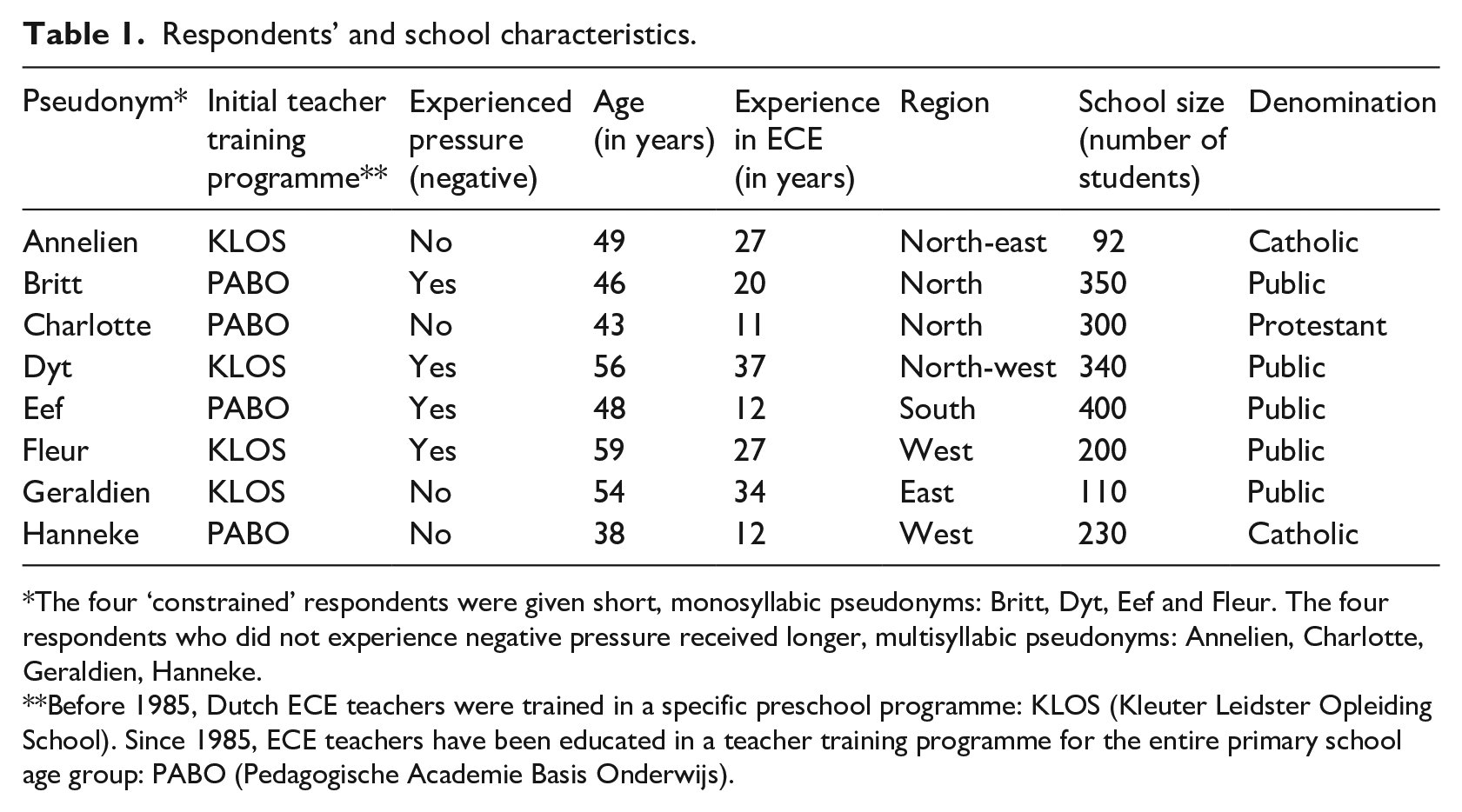
The four ‘constrained’ respondents were given short, monosyllabic pseudonyms: Britt, Dyt, Eef and Fleur. The four respondents who did not experience negative pressure received longer, multisyllabic pseudonyms: Annelien, Charlotte, Geraldien, Hanneke.
Before 1985, Dutch ECE teachers were trained in a specific preschool programme: KLOS (Kleuter Leidster Opleiding School). Since 1985, ECE teachers have been educated in a teacher training programme for the entire primary school age group: PABO (Pedagogische Academie Basis Onderwijs).
The interviews focused on the teachers’ perceptions of professional autonomy and tensions that did or did not occur at the interface of autonomy and accountability pressures. An exploration of the relevant literature led to some broad sensitizing concepts, which functioned as leading topics in the interviews: professional beliefs, work environment (context), consequences for practice (effects) and responses to autonomy-limiting influences (strategies).
Verbatim transcripts of the initial interviews were thematically analysed (Braun and Clarke, 2006). Initial themes were identified and coded after listening to the audiotaped interviews and reading through the transcripts. The themes were grouped together and checked for patterns and for variability and consistency across the entire data set by querying the data with the help of ATLAS.ti software (Friese, 2014). The interviews and analyses were carried out by the first author. Peer debriefing was conducted to enhance reflexivity during the overall research process. The findings were summarized in comprehensive vertical analysis documents for each respondent (Kelchtermans, 1994) and sent to the respondents for approval. All of the participants considered the vertical analysis to be a good representation of their respective interviews.
Results
The stories of the eight participants provide a rich source of insight into various daily ECE practices. In the presentation of the results in this article, we include a sizeable number of quotes from the respondents to illustrate our findings and to bring ECE teachers’ voices ‘back into the quality conversation’ (Delaney, 2018: 169). The quotes have been edited to promote readability.
We will present our findings on three topics: first, generally experienced forces of accountability stemming from a diversity of actors in the work environment of the respondents; second, the impact of these forces on daily educational practice, as well as on the teachers’ emotions; and third, the key role of the head teacher, who appears to be able to either enforce or inhibit these impacts.
Forces of accountability in the ECE work environment
Examining the balance between regulation and autonomy, the data indicates that Dutch ECE does not appear to have escaped the ‘swing towards more output and input regulation’ that, according to Kuiper et al. (2013: 154), has characterized Dutch education policy over the last decade. The interviewees all sensed an increase in public demand to achieve higher learning outcomes, with a concurrent emphasis on intellectual skills. The respondents identified certain effects of these forces as pedagogically inappropriate for young children in kindergarten (aged four to six). According to the respondents, the specific developmental characteristics of this age group demand a flexible approach which departs from the child’s interests and learning needs, focuses on the children’s well-being and aims to develop their self-confidence, and creates opportunities for learning through play and physical experiencing. Pedagogical patience is required as a basic condition for this approach. This task perception, however, contradicts the pressure to achieve higher learning outcomes with an emphasis on intellectual skills. For this age group of children, however, even more than for education in general, what seems to be most important is best summed up by Kelchtermans (2007: 14–15): ‘Education inevitably contains a dimension of passivity, of things “happening”, “taking place”’; this is being undermined, as now education focuses on ‘“being made”, or “being done” as is reflected in the currently dominant performativity discourse’.
They say you have to get the most out of every child. Of course, that is what I have always wanted, too. But what is the most? Is it getting that A score in maths or language skills? Or is it a self-conscious child, who takes the next step in its development with self-confidence and thinks, ‘Yes, I want to learn to read’, and that you animate a curiosity for reading. The times when they do nothing, then the dots get connected. But no, hurry! Efficiency, you know, effective learning time, so, up to the next, and the next. They keep on putting in stuff. (Dyt)
These public pressures, which are generally recognized by the respondents, have entered schools in diverse ways, reflecting a complex web of influence (Neumann, 2016) involving many different actors (e.g. the school head, inspectors, parents and colleagues) and non-human actors (e.g. methods, tests, reports and the Internet), both inside and outside the school, in an interrelated manner. The respondents experienced the main source of the demands as stemming ‘from up there’. The government and the Inspectorate of Education are referred to most in relation to an increased sense of external control over educational practice. The respondents also indicated that the school board was a mediating actor. The teachers themselves were not able to pin down how things ‘work’ precisely. Furthermore, we can recognize the two faces of a belief in the external ‘controllability’ of teaching practice (Kelchtermans, 2012) in the data collected – the external definition of input (the prescription of desirable educational processes to attain prescribed goals) and the monitoring of output – which are strongly intertwined: ‘Well, yes, that was the question from the Inspectorate: to justify the way you work as clearly as possible you have to keep the record in different places’ (Charlotte).
At some of the respondents’ schools, their results are monitored with the use of standardized tests. These external accountability demands add extra pressure because they are made public. This points to another important group of players: parents. Parents can find the inspection reports on the Internet, and this is what underpins their choice of school, or at least this is what concerns the schools: ‘I hear from parents: “I didn’t choose that school because of their Cito scores”.
1
Due to the Internet, of course, parents can find anything’ (Hanneke). The pressures of tests seem to depend to a great extent on the visibility of the test scores not only to people outside, but also to colleagues in the school community. At Britt’s school, for example, the test scores are compared and discussed by the broader school team. She described the compelling force that emanates from this:
You feel pressure to show your scores at the end of the year. . . . Everybody has this feeling. You know, there are the norms, and we have group monitoring. All results are mapped, from grade one to grade eight. The entire school looks at your scores. (Britt)
Impact on practice and emotions
The eight teachers’ accounts reveal the impact of these generally felt forces of accountability on their daily professional practice and, in the wake of this, on their emotions. Although the teachers warn against the negative impact of teacher-centred and structured didactics on young children, they also indicate that they are not always able to withstand the pressures to use these didactics. As found by a number of scholars internationally (e.g. Bassok et al., 2016; Boland, 2015), this leads to actual changes in the teachers’ daily teaching practices, with a trend towards a narrowing of the teaching content:
Cito scores are being looked at more often. And then I notice that I am sometimes tempted to push them more on those skills than I want to. Because you think you have to take them as far as possible. But it really doesn’t make sense. Who decides that they learn more in this way? We have to watch ourselves. (Hanneke)
There is also a trend towards a more structured way of working:
You must plan your activities beforehand, with a time schedule indicated below it. You can’t decide anymore, ‘Oh, this is the moment to touch on something with a certain child’. I think they need to let things sink in with ease, and a young child does that through play. That ease is being lost more and more. (Dyt)
As Day and Gu (2007: 429) observe, we also found that ‘teachers’ sense of well-being is deeply connected with how they define themselves as professionals, and how they see their professionalism being defined by others’. When modifications in teaching practice conflict with a teacher’s own core beliefs and definitions of good teaching, this appears to trigger feelings of falling short (Kelchtermans, 2012). This is even more the case when teaching methods are implemented with an emphasis on the rigorous execution of prescriptions, which was the case for Dyt and Fleur. Fleur was forced to use a standard lesson plan in a technically correct way, with set materials and strict time sequences:
I had to start to work with ‘Play-Pleasure’, which assumes that play should run through specific phases. I don’t agree with that. . . . I had to do guided activities every day, and during free play time I had to join the play in a way that was narrowly prescribed. I was not allowed to deviate. (Fleur)
Dyt had to deal with the fact that the highly detailed and structured way of working did not match with a child-centred way of working:
I have to make an action plan, with SMART goals, on the basis of the low results. And I have to describe when, where, how and how often I go and sit with them to practise. That we practise those skills throughout the day while singing, playing and interacting . . . yes, I have to note that afterwards. Well, I can’t report in detail what exactly I did and said for every child. (Dyt)
When teachers are forced to act like this – contrary to their beliefs – teachers’ self-esteem is challenged (Kelchtermans, 2005). Dyt literally begged for acknowledgement several times throughout the interviews. The respondents also struggled with feelings of being mistrusted. As a result, both Fleur and Dyt had taken sick leave: ‘I just couldn’t do it. It was simply impossible for me . . . It was horrible. . . . Then I became ill’ (Fleur). Fleur recovered with the support of her peers. Dyt ultimately quit her job: ‘I decided to quit. I can’t do it anymore – the things that are expected of us, but also from the children. Also, the lack of trust is a severe shortcoming to me’.
The role of head teachers
Although all eight participants reported on most of the internal and external constraining forces in their work environment discussed above, not all of them considered their own school environment to be ‘restricted’ (see Table 1). On this point, the data strongly suggested that the head teacher plays a key role. In relation to factors influencing their autonomy, the head teacher was referred to most frequently by all of the respondents. In some cases, the school heads passed on the demands from outside the school; in other cases, they appeared to have the space to negotiate external demands: ‘But then you notice, they [school heads within the same board] all get the same message, but each of them explains the rules in different ways’ (Geraldien).
Moreover, in all four cases of a non-restrictive environment, the head stimulated and facilitated open reflection on external demands in the team as a whole, with the aim of finding appropriate responses on the basis of the expertise and shared beliefs of the ECE teachers. The head teachers in these cases appeared to support professional autonomy by creating the contextual conditions for teacher agency to develop, enabling critical engagement with policy demands (as discussed by Priestley et al., 2015). In these cases, time for team communication was also mentioned as an important autonomy-enhancing precondition, because of its function in supporting teachers to make their own well-informed decisions and enhance their professional development (Wenger, 2010):
We had to make changes on behalf of the Inspectorate, but our head teacher asked us: ‘Which aspects are you satisfied with and what do you think has to change? Go and work it out’. We were really given the time to discuss what was important in first-grade classes and how we wanted to proceed. (Charlotte)
In contrast to this autonomy-enhancing role of the head teacher, the teachers who considered their environment to be restrictive reported that the constraining forces emanated directly from their head teachers. The heads passed on external demands, for example, by mandating standard teaching methods and different kinds of administrative requirements regarding accountability, without serious consultation with the ECE teachers. In some cases, management carried out inspections to control practice: ‘We have to use “Play-Pleasure”, an ECE method. The Inspectorate appears to value it. . . . And then unannounced audits started, to check whether I was conforming to the method and everything that is part of it’ (Fleur). The constrained respondents identified two main causes for the restrictive attitude of their management – fear of inspection and lack of specific ECE teaching expertise: ‘Our school head is nervous about the Inspectorate. . . . Because he doesn’t have answers to questions from the Inspectorate, he has to prescribe instructional methods, which he can then refer to’ (Dyt).
One of the four restricted cases – the story of Eef – offers a remarkable exception to this general picture of the school head as the determining factor in a restrictive environment. Nevertheless, the nature of this distinction strongly confirms the important role of management. Eef’s basic feeling that her professional autonomy was being threatened was primarily caused by the prospective retirement of the head teacher, who up to that point had protected the team from pressures that teachers from other schools on the same board were faced with:
He [the school head] retires this year and this will be really significant for us: Who is going to replace him and what demands will there be? Because we hear from other teachers within our board that we are quite an exception regarding how we are allowed to work. (Eef)
The head of Eef’s school had taken the initiative to prepare the team for the change of headship by facilitating communication processes that would strengthen their own capacity to safeguard their current autonomy. The ECE team was invited to explicitly describe its views on teaching young children:
On our agenda, more attention is being paid to first-grade learning . . . one of us is given time to work on this early childhood project. . . . We want to use this year to finally thoroughly define our viewpoint on the young child, so that we can show others: ‘This is the way we work’ . . . What counts for him [the school head] is that he leaves things in good order now that he is retiring. (Eef)
A follow-up interview with Charlotte also confirmed the key role of the school head and the emotional impact the school head can have. In the first interview, she expressed a high level of professional autonomy. Between the first interview and the follow-up interview, however, her school head was replaced. The new school head was commissioned by the board to upgrade the Inspectorate’s report. Under his regime, Charlotte struggled severely with the decrease in autonomy:
A lot of things happened here that show how changes have their influence . . . We have become a very controlling, top-down, ‘this is how we are going to work’ type of organization. . . . So the space to say ‘I would prefer to do it this way’ isn’t there anymore . . . I’m not happy with that . . . no [her voice falters; there are tears]. Motivation, autonomy, it has so much to do with circumstances . . . the key is in the hands of the head teacher. (Charlotte)
Discussion
The teachers’ stories reported above reveal the pressure to use more teacher-centred and structured didactics to push children to improve their learning outcomes, with an emphasis on intellectual skills. The teachers indicated that they were not always able to withstand these pressures that stem from their work environment, with many actors involved in interrelated ways. Some studies suggest that the long-term effects of structured early intervention programmes are poor (Frans et al., 2017; Fukkink et al., 2015), while others suggest that an early focus on academic skills may negatively impact children’s motivation and self-confidence (Bassok et al., 2016). Additionally, the performative test culture seems to produce ‘anxious parents and frightened teachers’ (Goorhuis-Brouwer, 2012: 30).
The data clearly illustrates the affective consequences of these forces on teachers. The fears indicated by Goorhuis-Brower (2012) were apparent in several interviews and seem to be one of the driving forces behind compliance with changes in teaching practice that are actually considered undesirable. External standards, however, are merely a small part of what teachers ideally aim to achieve (Kelchtermans, 2012). When the reforms require them to give up ways of doing things that reflect deeply held beliefs and norms on good teaching, the teacher’s own task perceptions (What ought I to be doing?) are questioned and, thus, their moral and professional integrity is put in doubt. In this study, we saw stress and doubt as a result of this in several cases (i.e. Fleur, Dyt and Charlotte, after the management change). In addition, as Kelchtermans (2005) argues, ignoring or denying the essential – relational and moral – aspects of the educational reality ultimately also affects teachers’ job motivation and their future perspective, both of which have an effect on their reasons for becoming and remaining a teacher. We saw that Dyt ultimately quit her job. In this regard, Van den Berg et al. (2012) have shown, in the Dutch context, that when they feel esteemed, the likelihood that a teacher will consider leaving teaching is significantly reduced.
The key role of head teachers
The data from the present study supports the view that there is a gap between internal and external quality discourses in the field of ECE (e.g. Biesta, 2007; Day and Gu, 2007; Kelchtermans, 2012; Moss and Dahlberg, 2008). However, although all of the respondents recognized this gap, the negative effects described above do not transpire in all cases. The results suggest that the head teacher plays an important role in determining the extent to which this ‘discourse gap’ has a constraining influence on teaching practices. As the stories in our study show, an important way in which a head teacher can play this role is by facilitating the early childhood teachers to find their own responses to external demands, within their own context and based on their own expertise. We thus see that autonomy, understood as ‘psychological freedom’, can occur even when a task is assigned by others (e.g. by the Inspectorate), as long as people ‘grasp its meaning and synthesize that meaning with respect to their other goals and values’ (Ryan and Deci, 2000: 74). Moreover, in these cases, the head teachers support professional autonomy by creating the contextual conditions that allow teacher agency to develop, which enables critical engagement with policy demands (Osgood, 2010; Priestley et al., 2015). When teachers are given time to negotiate external demands – drawing on them, adjusting them or rejecting them – ‘performative confidence’ or the ability to ‘confidently make professional judgements’ develops (Kilderry, 2015: 646). Teachers are given the space to ‘do’ professionalism in contradictory daily practice (Osgood, 2010). The teachers’ struggle to negotiate different interests and discourses, and merge them with the emotional and affective aspects of their daily work with children, becomes part of the insider construction of professionalism. This adds to the argument that there is no simple distinction between the two forms of professionalism from ‘within’ or from ‘above’ (Evetts, 2013).
Hökkä et al. (2017: 177) found that emotions can have ‘a transformative and a sustaining power in the enactment of agency’. Their empirical work shows that negative emotions, such as dissatisfaction and distress, can be the motor behind agentic behaviour, while the enactment of strong agency itself fosters positive emotions. When teachers feel they are ‘making a difference as a person’ in the life of their students, ‘joy, pride and existential personal fulfilment are the emotions that go with it’ (Kelchtermans, 2005: 999). Our findings indicate that the conditions in the work environment are crucial to the occurrence of these positive emotions.
Contrary to a facilitating attitude on the part of the head teacher, in four cases, the head teachers passed on the external demands by translating them into internal procedures without consulting the teachers. The teachers in these cases appeared to develop ‘performative anxiety’ (Kilderry, 2015), which comprises feelings of falling short. The lack of recognition and the lack of space to influence an existing undesirable state of affairs affected the resilience and motivation of the teachers, which in one of the eight cases ultimately resulted in the teacher leaving the profession.
Methodological reflections and further research
In our investigation of the question of how the workplace environment affects professional autonomy in ECE, we used qualitative longitudinal research methods, which assisted us to explore the balance between regulation and freedom in ECE and its effects in professional educational practice. The heterogeneity of characteristics within the sample enabled comparison across sites and revealed the important role of the head teacher. However, it should be noted that the findings represent the perspectives of the respondents, and thus this view may be narrow. The teachers themselves admitted that they did not always have a clear idea of ‘how things really work out there’. That the respondents mainly pointed to the head teacher as a determining factor may have been due to the fact that the head teacher is most visible in the daily life of the teachers. Moreover, in the complex ECE environment, in which a diversity of actors is involved, it makes no sense to identify any one actor as being responsible for ensuring the best conditions. Future research might investigate the role of the various actors in more depth, and the dynamics over time, including the agentic role of teachers.
Another limitation of this study is the sample size. The stories of the teachers are not necessarily generalizable to teachers in other contexts. The main outcomes concerning the influence of management have been tested in a follow-up study using larger-scale quantitative methods to determine the degree to which these outcomes can be generalized to the actual population of Dutch early childhood teachers (Oosterhoff et al., 2019). The study shows that, similar to the findings of Imants et al. (2016), ‘the Dutch primary education system offers scope for local principals to develop a bottom-up approach where there is room for teacher ownership’ and ‘that most of the principals were at least partly successful at utilizing this space’ (Oosterhoff et al., 2019: 186). Further research should explore the differences between school heads who do and do not utilize this space.
Implications for policy and practice
Under the current accountability pressures aimed at increasing educational outcomes, head teachers operate in a difficult position (Kessels, 2012; Van den Berg et al., 2012), in which they themselves are the target of influence of many others (e.g. school boards, inspectorates and parents). However, in this position, they can play an important role in keeping a healthy balance between regulation and freedom by seeking forms of horizontal leadership in which dilemmas are tackled in collaboration with colleagues (Kessels, 2012). It seems important that head teachers acknowledge that, as Moss and Dahlberg (2008) argue, we live in a ‘multi-lingual world’ where different perceptions of ‘quality’ exist. Recognition of these different ‘languages’ could promote the utilization of the value of multiple perspectives for different purposes and in distinct circumstances.
Head teachers are also able to see and acknowledge ‘teachers’ ongoing emotional struggles with demands for change, as well as their thoughtful professional hesitations about these demands (resistance)’, which, according to Kelchtermans (2005: 1005), ‘may constitute a more “effective” warranty for “good education” than their compliance to the policy agendas’. Teachers’ capacities to manage the challenges embedded in the emotional contexts of teaching vary due to factors such as the support of leaders and colleagues (Day and Gu, 2007). Osgood (2006) highlights the importance of time for reflection on teachers’ own commitment to external demands. However, time is becoming scarce under the current intensification of the workload in schools.
At the same time, this acknowledgement of teachers’ perceptions of educational quality and their emotional struggle with external demands might assist in avoiding the risks of imbalance and, instead, safeguard the relational and moral aspects of teaching, which are powerful sources of motivation and job commitment. Nurturing motivation and job commitment might support teacher retention. In the Netherlands, the retention of teachers is one line of action being pursued by the government to address the current teacher shortage (Slob and Van Engelshoven, 2018). This article indicates that fostering the professional autonomy of teachers – that is, creating space for complex contextualized processes of meaning-making and judgement – safeguards the essential aspects of teaching, which, in turn, supports teachers’ well-being, job commitment and motivation.
Footnotes
Acknowledgements
Our sincere thanks go to the participants in the study and, furthermore, to Ernst Thoutenhoofd, a senior lecturer at the University of Gothenburg, for his contribution to the methodological cohesion of the project, and to Terrie Lynn Thompson, a lecturer at the University of Stirling, for her helpful feedback on an earlier draft of this article. We would also like to thank the three anonymous reviewers for their constructive feedback.
Declaration of conflicting interests
The authors declared no potential conflicts of interest with respect to the research, authorship and/or publication of this article.
Funding
The authors received no financial support for the research, authorship and/or publication of this article.
